Red China lives by the sword and shall perish by the sword
TIBET CONSCIOUSNESS – RED CHINA – LIVE BY THE SWORD – PERISH BY THE SWORD. THERE ARE NO EXCEPTIONS TO THIS GOLDEN RULE.
Red China conquered Tibet using the power of her Sword and she oppresses Tibet with her Sword’s Power. I have to share these words with Red China: “Put your sword in its place, for all who take the sword will perish by the sword.” If Red China Lives by the Sword, surely, She will Die by the Sword. No exceptions to this Golden Rule (Reference. Book of Matthew 26:52).
Rudra Narasimham Rebbapragada Ann Arbor, MI 48104-4162 USA Special FrontierForce-Establishment 22-Vikas Regiment
TIBET CONSCIOUSNESS – RED CHINA – LIVE BY THE SWORD – PERISH BY THE SWORD. NO EXCEPTIONS TO THIS GOLDEN RULE.Tibet Consciousness – Red China – Live by the Sword – Red China shall Die by the Sword.Tibet Consciousness – Red China Slain Tibet with the Sword – Red China Must be Killed with the Sword. No Exceptions to Golden Rule – The Book of Revelation 13:10Tibet Consciousness. Those who use the sword will die by the sword says LORD Jesus. No exceptions to this Golden Rule. Red China slain Tibet with Sword and hence will perish by the Sword.
NDTV
China has turned Tibetan Plateau into vast military zone, claims Core Group
PRESS TRUST OF INDIA Updated: November 05, 2015 01:13 IST
TIBET CONSCIOUSNESS – RED CHINA – LIVE BY THE SWORD – PERISH BY THE SWORD. CHINA TURNED TIBETAN PLATEAU INTO VAST MILITARY ZONE.
A Tibetan monk stands outside a temple near Mount Kailash in Ngari, Tibet Autonomous Region September 3, 2011. (Reuters)
Guwahati: China has turned the Tibetan Plateau into a “vast military zone” deploying a large number of troops with most of them along the Indian sub-continent, claimed the Core Group for Tibetan Cause (CGTC).
“China has turned the once peaceful and buffer state between India and China into a vast military zone. The militarisation of the Tibetan Plateau profoundly affects the geopolitical balance of the region, which causes serious international tension, particularly in the Indian sub-continent,” claimed the Core Group for Tibetan Cause, an apex coordinating body of Tibet Support Groups all over India.
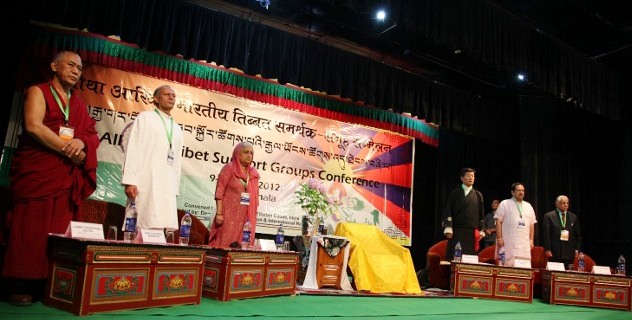
In a publication distributed in the 5th All India Tibet Support Groups Conference that concluded here yesterday, it claimed that as part of its militarisation, China has “17 secret radar stations, 14 military airfields, eight missile bases with eight Intercontinental Ballistic Missiles and 20 intermediate range missiles.”
Referring to the China’s 1,118-km railway project in Tibet connecting Gormo to Lhasa, it claimed that “China’s determination to construct the rail link to Lhasa is of political and military need.”
The CGTC held its 5th All India Tibet Support Groups conference here on November 2 and 3 which was addressed by Tibetan Government in-exile in India Prime Minister Dr Lobsang Sangay and Information and International Relations Minister Dicki Chhoyang.
Story First Published: November 05, 2015 01:13 IST
TIBET CONSCIOUSNESS – RED CHINA – LIVE BY THE SWORD – PERISH BY THE SWORD. 5th ALL INDIA TIBET SUPPORT GROUPS CONFERENCE, GUWAHATI. TIBET IS TRANSFORMED INTO A VAST MILITARY ZONE.TIBET CONSCIOUSNESS – RED CHINA – LIVE BY THE SWORD – PERISH BY THE SWORD. RED CHINA RULES TIBET BY THE SWORD. TIBET ADVOCACY GROUPS 5th MEETING IN GUWAHATI.TIBET CONSCIOUSNESS – RED CHINA – LIVE BY THE SWORD – PERISH BY THE SWORD. CORE GROUP FOR TIBETAN CAUSE. 4th ALL INDIA TIBET SUPPORT GROUPS CONFERENCE JUNE 09, 2012, DHARAMSALA.TIBET CONSCIOUSNESS – RED CHINA – LIVE BY THE SWORD – PERISH BY THE SWORD. A LESSON FROM THE BOOK OF MATTHEW.TIBET CONSCIOUSNESS – RED CHINA – LIVE BY THE SWORD – PERISH BY THE SWORD. A LESSON FROM BIBLE.TIBET CONSCIOUSNESS – RED CHINA – LIVE BY THE SWORD – PERISH BY THE SWORD. RED CHINA KILLS WITH THE SWORD. SHE MUST BE KILLED BY THE SWORD. TIBET CONSCIOUSNESS – RED CHINA – LIVE BY THE SWORD – PERISH BY THE SWORD. FOR RED CHINA KILLED WITH THE SWORD, SHE MUST BE SLAIN WITH THE SWORD. JESUS IS LORD, SPOKE THE GOLDEN RULE.
Tibet Consciousness – Glimpses of Tibetan Identity – Images of Yamdrok Lake
TIBET CONSCIOUSNESS – THE YAMDROK LAKE – LET IT SNOW, LET IT SNOW, LET IT SNOW FOR FREEDOM IS NEAR. TIBET’S FREEDOM AS WHITE AS SNOW.
Tibet, known as the Land ofSnows, is a country of immense natural beauty. The landscape is intrinsically linked to the lives of holy enlightened beings and imbued with the mystique of powerful mountain gods and goddesses. There are many places of power and natural beauty in the country and one such place is Yamdrok Yumtso Lake.
Yamdrok Yumtso is a freshwater lake that lies around 90 kilometres to the east of Gyantse and 100 kilometres southwest of Lhasa. The largest lake in all of southern Tibet, it is roughly 638 kilometres2 and its average depth is about 30 metres, although it can reach 60 metres at its deepest. Its waters are a deep turquoise which is where it gets its name — roughly translated as ‘Turquoise Lake of the Upper Pasture‘ — and is fed by numerous streams from the surrounding snow-capped mountains.
Yamdrok Yumtso is considered to be one of the four largest sacred lakes of Tibet, the other three being Lhamo La Tso, Namtso and Manasarovar. According to local legend, the lake is the physical manifestation of the goddess known as Dorje Geg Kyi Tso.
The landscape of Tibet is sacred to the Tibetan people. Just as how mountains are believed to be the homes of gods and goddesses, so are Tibet’s great lakes. As they are considered the earthly abodes of powerful protective deities, Tibet’s lakes are intrinsically invested with spiritual power. Yamdrok Yumtso is one such lake and is believed to have the power to grant divinatory visions to those who meditate upon her serene yet supernatural waters.
Local villagers and high lamas alike make the pilgrimage to her shores, and they can be seen walking along the lake’s shores in prayer. To complete a circumambulation of the lake within seven days is said to purify tremendous amounts of negative karma.
Tibet, known as the Land ofSnows, is a country of immense natural beauty. The landscape is intrinsically linked to the lives of holy enlightened beings and imbued with the mystique of powerful mountain gods and goddesses. There are many places of power and natural beauty in the country and one such place is Yamdrok Yumtso Lake.
Her waters are said to have powerful properties, which include healing diseases, granting long-life and increasing one’s intellect. The lake is so revered that it is said if her waters dry up, the entire land of Tibet will no longer be habitable for humans.
Together with Lhamo La Tso, it is one of two lakes which are said to provide visions that can help locate the reincarnations of high lamas. According to tradition, an appointed search party will travel to the lake to engage in lengthy prayers. Throwing a khata, a Tibetan silk scarf, into the waters along with other ritual objects and medicines, one of the party then has visions. When correctly interpreted, these visions can lead to the successful recognition of a high lama’s reincarnation.
Dorje Geg Kyi Tso, the goddess of Yamdrok Yumtso, is part of a group of such deities known as the Tenma Chunyi, who opposed the growth of Buddhism in Tibet.
The lake and its islands are closely associated with Guru Rinpoche or Padmasambhava, the great 8th century Indian mahasiddha who was invited to Tibet to tame the local deities that hindered the spread of Buddhism in the country.
Dorje Geg Kyi Tso, the goddess of Yamdrok Yumtso, is part of a group of such deities known as the Tenma Chunyi, who opposed the growth of Buddhism in Tibet.
I am pleased to share pictures of The Yamdrok Lake taken on October 31, 2015. The Lake is covered with fresh snow and its pure whiteness gives me a sense of Hope and my heart tells me that ‘Freedom is Near.’
TIBET CONSCIOUSNESS – LET IT SNOW, LET IT SNOW, LET IT SNOW, FOR I HEAR THE BELLS OF FREEDOM RINGING, FREEDOM IS NEAR, TIBET BLANKETED BY FREEDOM.
Let it Snow, Let it Snow, Let it Snow,
For I hear the Bells of Freedom ringing,
Freedom is Near, Tibet blanketed by Freedom.
Rudra Narasimham Rebbapragada Ann Arbor, MI 48104-4162 USA Special Frontier Force-Establishment 22-Vikas Regiment
Snow scenery of Yamdrok Lake in Tibet
2015-11-02 10:22 Xinhua Editor:Li Yan 1
TIBET CONSCIOUSNESS – THE YAMDROK LAKE – LET IT SNOW, LET IT SNOW, LET IT SNOW, FREEDOM IS NEAR, TIBET’S FREEDOM ASWHITE AS SNOW.
Photo taken on Oct. 31 shows the snow scenery at the Yamdrok Lake in Nagarze County of Shannan Prefecture, southwest Tibet.The Yamdrok Lake, about 100 kilometers south of Lhasa, is one of the four holy lakes in Tibet. (Photo: Xinhua/Liu Dongjun)
TIBET CONSCIOUSNESS – THE YAMDROK LAKE – LET IT SNOW, LET IT SNOW, LET IT SNOW FOR FRREDOM IS NEAR. TIBET’S FREEDOM AS WHITE AS SNOW.TIBET CONSCIOUSNESS – THE YAMDROK LAKE – LET IT SNOW,LET IT SNOW, LET IT SNOW FOR FREEDOM IS NEAR. TIBET’S FREEDOM AS WHITE AS SNOW.TIBET CONSCIOUSNESS – THE YAMDROK LAKE – LET IT SNOW, LET IT SNOW, LET IT SNOW FOR FREEDOM IS NEAR. TIBET’S FREEDOM AS WHITE AS SNOW.TIBET CONSCIOUSNESS – THE YAMDROK LAKE – LET IT SNOW, LET IT SNOW, LET IT SNOW FOR FREEDOM IS NEAR. TIBET’S FREEDOM AS WHITE AS SNOW.TIBET CONSCIOUSNESS – THE YAMDROK LAKE – LET IT SNOW, LET IT SNOW, LET IT SNOW FOR FREEDOM IS NEAR. TIBET’S FREEDOM AS WHITE AS SNOW.TIBET CONSCIOUSNESS – THE YAMDROK LAKE – LET IT SNOW, LET IT SNOW, LET IT SNOW FOR FREEDOM IS NEAR. TIBET’S FREEDOM AS WHITE AS SNOW.TIBET CONSCIOUSNESS – THE YAMDROK LAKE – LET IT SNOW, LET IT SNOW, LET IT SNOW FOR FREEDOM IS NEAR. TIBET’S FREEDOM AS WHITE AS SNOW.TIBET CONSCIOUSNESS – THE YAMDROK LAKE – LET IT SNOW, LET IT SNOW, LET IT SNOW FOR FREEDOM IS NEAR. TIBET’S FREEDOM AS WHITE AS SNOW.TIBET CONSCIOUSNESS – THE YAMDROK LAKE – FREEDOM IS NEAR.THE BELLS OF FREEDOM RINGING IN TIBET.TIBET CONSCIOUSNESS – THE YAMDROK LAKE – FREEDOM IS NEAR. I HEAR THE RINGING OF BELLS OF FREEDOM.TIBET CONSCIOUSNESS – THE YAMDROK LAKE – FREEDOM IS NEAR. I HEAR THE RINGING OF BELLS OF FREEDOM. TIBET’S FREEDOM AS WHITE AS SNOW.TIBET CONSCIOUSNESS – THE YAMDROK TSO LAKE. FREEDOM IS NEAR. I HEAR THE RINGING OF BELLS OF FREEDOM.TIBET CONSCIOUSNESS – THE YAMDROK LAKE – A LAKE TO HERALD DAWN OF FREEDOM IN TIBET. FREEDOM BELLS RINGING IN TIBET.TIBET CONSCIOUSNESS – THE YAMDROK LAKE WELCOMES SNOW. LET IT SNOW, LET IT SNOW, LET IT SNOW FOR FREEDOM IS NEAR.TIBET CONSCIOUSNESS – THE YAMDROK LAKE WELCOMES FREEDOM IN TIBET.TIBET CONSCIOUSNESS – LET THE HOLY LAKES OF TIBET GIVES THE TASTE OF FREEDOM. LET US HEAR THE BELLS OF FREEDOM RINGING IN TIBET.TIBET CONSCIOUSNESS – THE YAMDROK YUMTSO LAKE – BRING US GOOD TIDINGS OF FREEDOM. LET THE BELLS OF FREEDOM RING IN TIBET.TIBET CONSCIOUSNESS – LET CHARMING HOLY LAKE YAMDROK GIVE US BLESSINGS OF FREEDOM. I HEAR THE RINGING OF BELLS OF FREEDOM.TIBET CONSCIOUSNESS – LET HEAVENLY LAKES OF TIBET DELIVER US HEAVENLY JOY OF FREEDOM. I HEAR THE BELLS OF FREEDOM RINGING IN TIBET.TIBET CONSCIOUSNESS – THE YAMDROK LAKE – LAKE IS EXOTIC BEAUTY. FREEDOM IS SIMPLE AND ELEGANT. I HEAR THE BELLS OF FREEDOM RINGING IN TIBET.TIBET CONSCIOUSNESS – BEAUTIFUL LAKE – LET YAMDROK GIVE US BLESSINGS OF PEACE, JOY, AND FREEDOM.TIBET CONSCIOUSNESS – I HEAR THE FREEDOM BELLS RINGING IN TIBET. FREEDOM IS NEAR. DISCOVER FREEDOM IN TIBET.
Tibet Awareness – Tibet is the Core Issue for the World Community of Nations
There should be no border dispute between India and the People’s Republic of China as they do not share a common border. The problem of China’s military occupation of Tibet should be addressed by the global community of nations to secure Peace, Security, and Justice in South Asia. To resolve the Great Problem of Tibet, we must resolve Tibet-China Border dispute.
There should be no border dispute between India and the People’s Republic of China as they do not share a common border. The problem of China’s military occupation of Tibet should be addressed by the global community of nations to secure Peace, Security, and Justice in South Asia. To resolve the Great Problem of Tibet, We must Resolve Tibet-China Border dispute
Rudra Narasimham Rebbapragada
Special Frontier Force-Establishment 22-Vikas Regiment
TIBET’S MILITARY OCCUPATION – THE GREAT TIBET PROBLEM: Historically Tibet came under military conquests by Mongol China and Manchu China and yet retained its independent way of living without any problem. The Evil Red Empire formulated by Red China’s Communist Party Chairman Mao Zedong unleashed a different kind of beast to rule over the lives of Tibetans.
Tibet should be one of the core issues for India, says Lobsang Sangay, the head of Tibetan Government-in-Exile
Tibet should be one of the core issues for India as China is trying to “influence” all of its neighbors, Lobsang Sangay, the head of the Tibetan government in exile has said.
There should be no border dispute between India and the People’s Republic of China as they do not share a common border. The problem of China’s military occupation of Tibet should be addressed by the global community of nations to secure Peace, Security, and Justice in South Asia. To resolve the Great Problem of Tibet, we must resolve Tibet-China Border dispute.
Tibet should be one of the core issues for India, says Lobsang Sangay (Reuters)
Tibet should be one of the core issues for India as China is trying to “influence” all of its neighbours, Lobsang Sangay, the head of the Tibetan government in exile has said. China insists Tibet has been part of its territory for centuries, but many Tibetans say they were essentially independent for most of that time. The Dalai Lama fled to India in 1959 amid an abortive uprising against Chinese rule in his Himalayan homeland.
Sangay, who is currently here, has met several senior US administration officials, congressmen and senators and members of the think-tank community like the Hudson Institute. Explaining his quest for India making “Tibet a core issue”, Harvard educated Sangay said that after the occupation of Tibet, the People’s Liberation Army has now moved near the border of India.
“Now they are influencing all of India’s neighbours, from Pakistan, to Sri Lanka, Bangladesh and Nepal. It is a reality now,” he said in an interview to PTI.
India and Tibet have had historically, cultural and civilizational ties for hundreds of years, he said, adding Tibet is the source of water for India and South Asia. “For these reasons, Tibet is very important for not just India, for whole of South Asia and ASEAN countries too. Hence, Tibet should be one of the core issues for India,” Sangay said.
“China has already said Tibet is one of the core issues. So, India should also table Tibet as one of the core issues and address this issue with Tibetan people in mind,” he said. Responding to a question, Sangay said that the people of Tibet are following the middle way approach by seeking “genuine autonomy within the framework of the Chinese constitution”. “This is the reasonable moderate line,” he said.
For that there should be a dialogue between the envoys of the Dalai Lama and the Chinese Government, he said. He sought the revival of a dialogue that happened between 2002 to 2010. “We think, that kind of dialogue will lead to the resolution of the Tibetan issue,” he said.
The Celebration of World Tibet Day – The Concept of Tibet Equilibrium
The Celebration of World Tibet Day – The Concept of Tibet Equilibrium. I coined the phrase ‘Tibet Equilibrium to describe a Natural Condition that restores Natural Freedom, Natural Order, Natural Balance of Power and Natural Harmony in Occupied Tibet.
Thursday, July 06, 2017, 82nd Birthday of His Holiness the 14th Dalai Lama is observed as ‘World Tibet Day’ to promote Tibet Awareness.
I coined the phrase ‘Tibet Equilibrium to describe a Natural Condition that restores Natural Freedom, Natural Order, Natural Balance of Power and Natural Harmony in Occupied Tibet.
I coined the phrase ‘Tibet Equilibrium’ to describe a Natural Condition that restores Natural Freedom, Natural Order, Natural Balance of Power, and Natural Harmony in Occupied Tibet.
Rudra Narasimham, Rebbapragada
Special Frontier Force-Establishment 22-Vikas Regiment
I coined the phrase ‘Tibet Equilibrium to describe a Natural Condition that restores Natural Freedom, Natural Order, Natural Balance of Power and Natural Harmony in Occupied Tibet.
World Tibet Day – Tibet Awareness – Tibet Equilibrium. I coined the phrase ‘Tibet Equilibrium to describe a Natural Condition that restores Natural Freedom, Natural Order, Natural Balance of Power and Natural Harmony in Occupied Tibet.
World Tibet Day – Tibet Awareness – Tibet Equilibrium. 82nd Birthday of His Holiness the 14th Dalai Lama on Thursday, July 06, 2017. I coined the phrase ‘Tibet Equilibrium to describe a Natural Condition that restores Natural Freedom, Natural Order, Natural Balance of Power and Natural Harmony in Occupied Tibet.
(Photo: AFP)
Thousands of Tibetans on Thursday morning joined in the 82nd birthday celebrations of their spiritual leader, the Dalai Lama here. On this occasion, the Tibetan cabinet urged US President Donald Trump to initiate steps to restart dialogue on Tibet’s future.
Large crowds donning traditional dresses began to assemble since morning at the Shiwatsel Phodrang complex on the city’s outskirts for the birthday celebrations.
“Special prayer sessions were held for the long life of His Holiness,” a Central Tibetan Administration (CTA) spokesperson told IANS.
The Dalai Lama, revered by the Tibetans as a “living god”, attended the prayers and blessed the gathering.
Tibetan Prime Minister Lobsang Sangay also attended the celebrations, while his cabinet urged Trump to initiate steps for restarting the dialogue process on the future of Tibet.
“We also urge President Trump to support the middle-way approach and dialogue between the envoys of His Holiness the Dalai Lama and the representatives of the Chinese government,” said the cabinet in a statement.
Expressing gratitude to US Secretary of State Rex Tillerson for his support for dialogue, it said: “We also thank Terry Branstad, the US Ambassador to China, for calling on China to provide meaningful autonomy for Tibetans.”
The cabinet reiterated its commitment to “middle-way” approach as the mutually beneficial solution to resolving the long-standing issue of Tibet.
Meanwhile, officials of the Dalai Lama’s office said the spiritual leader would stay in Shiwatsel Phodrang in Leh till July 30.
During his visit, he would participate in religious ceremonies, conduct meditational retreat and deliver teachings at Diskit Monastery in the Nubra Valley, Padum in Zanskar area and the Shiwatsel teaching ground here.
The Dalai Lama’s sermons on ethics, non-violence, peace and religious harmony have made him one of the 20th century’s most revered spiritual leaders.
Born on July 6, 1935, at Taktser hamlet in northeastern Tibet, the Dalai Lama was recognized at the age of two as the reincarnation of the 13th Dalai Lama, Thubten Gyatso.
He fled Tibet after a failed uprising against the Chinese rule in 1959 and has been based in India since then.
The Dalai Lama was awarded the Nobel Peace Prize in 1989 for his non-violent campaign for democracy and freedom in his homeland.
However, the Chinese view him as a hostile element bent on splitting Tibet from China.
India is home to around 100,000 Tibetans. The Tibetan government-in-exile is not recognized by any country.
World Tibet Day – Tibet Awareness – Tibet Equilibrium. Thursday, July 06, 2017.I coined the phrase ‘Tibet Equilibrium to describe a Natural Condition that restores Natural Freedom, Natural Order, Natural Balance of Power and Natural Harmony in Occupied Tibet.
The Cold War in Asia – Lessons of Covert Action in Tibet
The Cold War in Asia. Lessons of Covert Action in Tibet.
The Cold War in Asia represents the security threat posed by the spread of Communism to mainland China. Because of my lifetime affiliation with the military organization called Special Frontier Force, I can review the covert action in Tibet to draw some lessons.
Whole Dude – Whole Secret: The CIA covert operations inside Tibet led to the creation of a military organization called Establishment Number. 22, or Special Frontier Force which was formed in 1962 during the presidency of John F. Kennedy
In my analysis, the US, India, and Tibet lack the intelligence capabilities to conduct a successful covert action in Tibet. In 1959, Tibet National Uprising failed for the CIA underestimated the enemy’s capabilities both in terms of intelligence and the use of military power to crush civilian uprising or rebellion. In 1962, the CIA again failed to know the enemy’s war preparation and the attack across the Himalayan Frontier came as a rude surprise.
Establishment No. 22 – Operation Eagle: This badge represents a military alliance/pact between India, Tibet, and the United States of America. Its first combat mission was in the Chittagong Hill Tracts which unfolded on 03 November 1971. It was named Operation Eagle. It accomplished its mission of securing peace in the region that is now knownas Republic of Bangladesh.
I directly ask the CIA to improve its intelligence capabilities to respond to the security challenge posed by the spread of Communism to mainland China. The United States fought wars in Korea and Vietnam without testing the enemy’s military capabilities. To fight against the enemy, the United States must recognize the face of the enemy. No covert action will succeed without knowing your enemy.
Rudra Narasimham Rebbapragada
Special Frontier Force-Establishment 22-Vikas Regiment
TIBET AWARENESS – PROJECT CIRCUS. The quest for Freedom in Tibet. A military training Camp known as Camp Hale was established in Colorado under the supervision of CIA officers Roger E. McCarthy and John Reagan.Whole Dude – Whole Secret: The CIA Tibet Operation.Whole Dude – Whole Agency: Allen Welsh Dulles shaped the history of the Central Intelligence Agency. During World War II, he had served in the Office of Strategic Services(1942-1945), and when CIA formed in 1951, he served as Deputy Director under General Walter Bedell Smith. He was appointed the Director by President Dwight D. Eisenhower during January 1953.Whole Dude-Whole Master: November 29, 1961. President John F. Kennedy welcomes the 6th Director of CIA, John Alexander McCone.Richard McGarrah Helms(March 30, 1913 – October 22, 2002) was the chief architect of the legislation that created the Central Intelligence Agency during 1947. He had served in CIA in various positions and was its Director from June 1966 to February 1973. The 1962 India-China War was the consequence of a failed CIA mission inside Tibet.
Between 1950 and 1972, the Central Intelligence Agency (CIA), in close cooperation with the Departments of State (DoS) and Defense (DoD), conducted a comprehensive covert action campaign in support of Tibetan resistance movements fighting against Communist Chinese occupation of their homeland. The campaign consisted of “political action, propaganda, paramilitary, and intelligence operations” intended to internally weaken and undermine the expansionist ambitions of the People’s Republic of China (PRC).[i] Following the October 1950 invasion of Tibet by the PRC, the CIA’s Special Activities Division (SAD) inserted teams into Tibet to train, advise, and assist Tibetans who were already fighting the Communists.[ii]
A number of Tibetan resistance fighters were specially selected and exfiltrated to the Pacific island of Saipan and Camp Hale in Colorado to undergo training in demolitions, clandestine communication, and other critical skills.[iii] Operating out of neighboring Nepal and India, SAD-directed teams of Tibetan rebels waged a ceaseless campaign against the Chinese that tied down significant PRC troop strength, strengthened international opposition to Chinese atrocities against Tibetans, and prevented the PRC from effectively pursuing its regional ambitions in South Asia to further spread its communist ideology.[iv] The CIA continued to support the Tibetan resistance until 1972 when U.S. President Richard Nixon changed course and decided to normalize relations with the PRC.[v]
Though the CIA’s Tibetan covert action campaign never successfully ousted the Chinese Communists, the campaign was quite successful in accomplishing the U.S.’s limited objectives. Through its covert action campaign, the U.S. sought to internally weaken the PRC through sustained attrition and distraction in order to prevent the Chinese from spreading their brand of communism across South Asia – specifically India.[vi] The CIA’s covert action campaign succeeded in three ways: it depleted the PRC’s already limited resources, which further weakened the state; it undermined the PRC’s international standing and limited its regional influence, and it prevented the expansion of the PRC’s borders.[vii]
Specifically, the CIA’s covert action campaign forced the PRC to commit vast numbers of troops and resources to pacify Tibet, which delayed a number of other critical initiatives that the young communist state sought to pursue. In 1959, the CIA estimated that the PRC had over 60,000 soldiers deployed just to subjugate Tibet, a force that required 256 tons of supplies daily to sustain. [viii] The PRC, which had just successfully ended its own civil war in 1949, saw its military stretched incredibly thin by its Tibetan occupation. This strain likely undermined the ability of the Chinese government in Beijing to effectively consolidate full control over the expansive country, further encumbering efforts to pursue its strategic ambitions.
Adding to the PRC’s frustrations was the widespread international condemnation resulting from the increasingly brutal pacification campaign that China felt compelled to undertake to try and quell the Tibetan rebellion.[ix] Much of this international focus was (and still is) cultivated by Tenzin Gyatso, the 14thDalai Lama and the spiritual leader of the majority of Tibet’s Buddhists. During a particularly violent 1959 revolt, The Dalai Lama fled from Tibet with over 100,000 of his followers, escaping with the help of the CIA to India where he established a Tibetan “government in exile”.[x] This government has been a constant thorn in the PRC’s side, with the Dalai Lama and his disciples incessantly lobbying the international community for Tibetan rights and autonomy from China.[xi] The sustained focus on Chinese atrocities against the Tibetans significantly undermined the PRC’s regional standing and efforts to strengthen ties with neighbors.
Finally, the CIA’s covert action campaign was successful in its primary objective of preventing the spread of communism across South Asia. Mao Tsetung, the chairman of the PRC’s Communist Party, was convinced during an extended stay in the Soviet Union between 1949 and 1950 to undertake the leadership role in “liberating” Asia for the cause of global communism.[xii] However, the PRC’s inability to fully control Tibet, largely due to the CIA’s covert action campaign that sustained indigenous resistance, denied China the use of key terrain that might have enabled military action against India or even the Middle East.[xiii] The covert action campaign thus protected the U.S. or its allies from the need to fight a major land conflict in South Asia against the military forces of the PRC.
The CIA achieved a significant victory for the U.S. with a minimal commitment of American resources: total expenditures per year amounted to roughly $1.7 million dollars.[xiv] However, it is important to note that the CIA’s covert action campaign cost tens of thousands of Tibetans their lives, and the supported resistance encouraged violent oppression from the Chinese occupiers. Further, when relations between the U.S. and China normalized under President Nixon, many Tibetans and even a few CIA SAD officers saw the abrupt decision in 1972 to cease support of the Tibetan resistance as tantamount to betrayal.[xv] The Dalai Lama described this sentiment with some bitterness in a 1998 interview, saying that the CIA had aided his cause, “not because they cared about Tibetan independence, but as part of their worldwide efforts to destabilize all Communist governments.”[xvi] Despite such accusations of duplicity, the CIA achieved its stated objectives through this covert action campaign.
The CIA’s efforts in Tibet were successful because the objectives of the covert action campaign were reasonably limited and achievable with the resources available. While the Tibetans themselves may have nursed illusions of eventually driving all Chinese occupiers from their homeland, it is clear from the available records that the CIA and the political leadership in Washington were content to simply destabilize China and frustrate the Communists’ designs to spread their ideology throughout Asia.[xvii] Once the political winds changed and relations started to improve between the U.S. and China, the continuation of support to the Tibetan resistance was no longer in the best interests of the U.S. The U.S. successfully achieved its objectives through this covert action campaign because those objectives were achievable without escalating into a wider conflict.
Other successful covert actions, such as the SAD-spearheaded coups that toppled the governments of Mohammed Mossadegh of Iran in 1953[xviii] and Jacobo Arbenz of Guatemala in 1954[xix] are thought by historians to have given the CIA and subsequent U.S presidents an overly optimistic opinion of the potential for covert action to achieve outsized objectives. This overconfidence likely led to the 1961 “Bay of Pigs” invasion in Cuba, which was a tremendous failure because its objectives were overly ambitious and unachievable given the limited resources that the U.S. committed.[xx] Rather than be greeted as liberators and reinforced by masses of Cubans dissidents flocking to their cause, the US-backed Cuban rebel forces were quickly overwhelmed. The most important lesson that covert action practitioners and policymakers who consider the use of covert action should take from the highly effective campaign in Tibet is that such campaigns must be reasonably limited in their objectives to maximize the chances of success.
The Cold War in Asia. Lessons from Covert Action in Tibet.
The Supreme Ruler of Tibet is unlike any spiritual leader or king
The Supreme Ruler of Tibet is unlike any spiritual leader or king
I am pleased to share the photo images of the 14th Dalai Lama, the Supreme Ruler of Tibet, living in exile.
All photographs are part of the book, ‘A God in Exile: The Fourteenth Dalai Lama by Raghu Rai’, published by Roli Books.
The BBC News shared these photo images describing the Dalai Lama as a ‘spiritual leader’. Photographer and author Raghu Rai went a step further in recognizing the Dalai Lama as “A God in Exile.”
In my analysis, the relevance of the 14th Dalai Lama relates to the Institution of Dalai Lama that governs Tibet giving a sense of reality to the Tibetan Living Experience. If the Dalai Lama is just a Spiritual Leader, he would not be living in exile. If the Dalai Lama is indeed a ‘God’, Communist China would have utterly failed in crushing the massive Tibetan Uprising of March 1959.
Rudra Narasimham Rebbapragada
Special Frontier Force-Establishment 22-Vikas Regiment
The Supreme Ruler of Tibet is unlike any spiritual leader or kingThe Supreme Ruler of Tibet is unlike any spiritual leader or king
The Dalai Lama: Intimate portrait of a spiritual leader – BBC News
The 14th Dalai Lama. The Supreme Ruler of Tibet living in exile. The Supreme Ruler of Tibet is unlike any spiritual leader or king
Image copyright Raghu Rai Image caption The Dalai Lama watching the TV series, Mahabharata
A new book by acclaimed Indian photographer Raghu Rai offers an unprecedented glimpse into the life of one of the world’s leading religious figures.
A God In Exile is the result of a photographer’s decades-long insight into his muse. Rai took his first picture of the iconic Tibetan spiritual leader in 1975.
He recalled being stopped by the Dalai Lama’s security. “I somehow managed to make eye contact with His Holiness and asked him if I could take some photos of him. He smiled and said yes,” Rai told the BBC.
Over the years, he has photographed the Dalai Lama many times and has cultivated a “deep friendship”.
In March 1959, as Chinese troops crushed an attempted uprising in Tibet, the 14th Dalai Lama, who was born Tenzin Gyatso, fled into India. He was then a young man in his mid-20s.
The 14th Dalai Lama. The Supreme Ruler of Tibet living in exile. The Supreme Ruler of Tibet is unlike any spiritual leader or king
Image copyright Raghu Rai
The Indian government granted him asylum and he settled in the northern town of Dharamshala. About 80,000 Tibetans followed him into exile, most of whom settled in the same area.
The 14th Dalai Lama. The Supreme Ruler of Tibet living in exile.The Supreme Ruler of Tibet is unlike any spiritual leader or king
Image copyright Raghu Rai
Thronged by Tibetan worshippers and tourists, the Dalai Lama is seen in the above image blessing a woman at a ceremony.
“When he sees his Tibetans, my god! You should see his eyes! It’s like a grandfather doting on his grandchildren,” Rai says.
In 2014, Rai decided to curate the hundreds of photos he had taken of the Dalai Lama and compile them into a book – a project which, he said, has been in the making for 40 years.
· The ancient wisdom the Dalai Lama hopes will enrich the world
The 14th Dalai Lama. The Supreme Ruler of Tibet living in exile. The Supreme Ruler of Tibet is unlike any spiritual leader or king
Image copyright Raghu Rai
Many of the photos in the collection capture the Dalai Lama in candid moments, giving us an intimate glimpse into his everyday life.
“He loves to play with animals – I was waiting for him one day when he suddenly showed up with a cat,” Rai says.
The 14th Dalai Lama. The Supreme Ruler of Tibet living in exile. The Supreme Ruler of Tibet is unlike any spiritual leader or king
Image copyright Raghu Rai
Rai also captured scenes from the Dalai Lama’s 80th birthday celebrations in 2015 at home in Dharamshala.
He hosted his siblings, including his older brother, Gyalo Thondup (pictured above), whom he introduced to guests as a “troublemaker”.
The book’s preface, written by Rai, offers readers an account of his interactions with the Dalai Lama.
“He left an indelible impression on me – gentle, gracious, humble and full of wonder. It is peculiar to say such a thing, but I got the strange yet pleasant feeling of being equals, despite his position. In hindsight, I realise it was because His Holiness behaved with such unfeigned kindness and lack of vanity.”
The 14th Dalai Lama. The Supreme Ruler of Tibet living in exile. The Supreme Ruler of Tibet is unlike any spiritual leader or king
Image copyright Raghu Rai
Many images in the book feature the Dalai Lama performing innocuous chores such as repairing his TV or gardening in his home – tasks that he always did himself, Rai says.
The 14th Dalai Lama. The Supreme Ruler of Tibet living in exile. The Supreme Ruler of Tibet is unlike any spiritual leader or king
Image copyright Raghu Rai
“In a lot of ways, he gave me everything a photographer ever wants from a subject,” the photographer says.
The 14th Dalai Lama. The Supreme Ruler of Tibet living in exile. The Supreme Ruler of Tibet is unlike any spiritual leader or king
Image copyright Raghu Rai
Among the Dalai Lama’s favorite places at his home is the garden, where he grows all sorts of plants.
All photographs are part of the book, ‘A God in Exile: The Fourteenth Dalai Lama by Raghu Rai’, published by Roli Books.
The Supreme Ruler of Tibet is unlike any spiritual leader or king
TIBET EQUILIBRIUM – BALANCE OF POWER IN OCCUPIED TIBET. THE GREAT TIBET PROBLEM WILL EXIST UNTIL THE BALANCE OF POWER IS RESTORED IN OCCUPIED TIBET.TIBET EQUILIBRIUM – BALANCE OF POWER IN TIBET. US PRESIDENT DWIGHT DAVID EISENHOWER WITH INDIAN PRESIDENT DR BABU RAJENDRA PRASAD AT RASHTRAPATI BHAVAN, NEW DELHI. TIBET, INDIA, AND THE US WORK TOGETHER TO RESTORE BALANCE OF POWER IN OCCUPIED TIBET. PHOTO TAKEN IN DECEMBER 1959.
Balance of Power refers to the distribution of military and economic power among nations that is sufficiently even to keep any one of them from being too strong or dangerous. The term ‘Balance’ describes a state of equilibrium or equipoise, equality in power between two nations. Red China’s economic and military power is far greater than power of Tibet and hence there is no equilibrium in Tibet. Red China’s overwhelming economic and military power has serious consequences to all nations in her neighborhood. To restore this Balance of Power, Tibet has willingly joined a larger group by allying with India, and the United States. Special Frontier Force is a military organization that represents Tibet’s alliance with India and USA. While Red China demands “stability” in Occupied Tibet, Tibet and the alliance partners reject Red China’s demand for it will not resolve the problem of Balance of Power. To the same extent, Red China has rejected Tibet’s demand for meaningful autonomy or “Middle Way” as a means to restore Tibet Equilibrium.
Most of my readers know that CIA takes orders from the Executive Branch of Power called US Presidency. The other two branches of Power are known as the US Congress (Legislative Power) and the US Supreme Court (Judicial Power) and the Balance of Power between these three branches is maintained by the US Constitution. CIA has no external source of funding for its activities. The US Congress approves National Budget for funding requests submitted by the Executive Branch. Hotel Mount Annapurna in Nepal that supported CIA operation, was funded by US President Richard M Nixon and American citizens, the taxpayers who provide funds to the Government for further use as allocated by a Budget plan duly approved by representatives of elected by people and signed into a Law by the US President. I categorically affirm that all CIA operations to help Tibetan freedom fighters are funded by the US Congress and Budget Laws signed by the US President. I thank US President Dwight David Eisenhower and the US Congress for supporting Tibetan Resistance Movement to counteract Red China’s Evil Power.
Rudra Narasimham Rebbapragada Ann Arbor, MI 48104-4162 USA Special Frontier Force-Establishment 22-Vikas Regiment
The CIA’s Secret Himalayan Hotel for Tibetan Guerillas
TIBET EQUILIBRIUM – BALANCE OF POWER IN TIBET. I THANK US PRESIDENT DWIGHT DAVID EISENHOWER AND THE US CONGRESS FOR THEIR SUPPORT TO RESTORE BALANCE OF POWER IN OCCUPIED TIBET. Photo. Nolan Peterson. The Daily Signal.
TIBET EQUILIBRIUM – BALANCE OF POWER IN TIBET. HOTEL MOUNT ANNAPURNA IN NEPAL OPENED IN 1973, WITH FUNDING SANCTIONED BY US PRESIDENT RICHARD M NIXON.
The Hotel Mount Annapurna was opened in 1973 as part of a CIA program to rehabilitate former Tibetan guerillas. (Photo: Nolan Peterson/The Daily Signal)
POKHARA, Nepal—It’s been 43 years since the CIA cut off support to the Tibetan guerillas that the agency trained and armed to fight a covert war against China. Yet, a monument to the CIA’s secret war in Tibet is still standing in Pokhara, Nepal.
The former Hotel Mount Annapurna building sits on a quiet side street off the Pokhara airport. Established in 1972 with CIA funds, the hotel was meant to give former Tibetan resistance fighters based in Nepal’s nearby Mustang region a livelihood and a future as they laid down their arms and transitioned to life as refugees.
Tibetan guerillas and their families ran the hotel until it closed in 2010. Today, the Hotel Mount Annapurna building is a nursing school. The aging concrete structure with 1960s lines looks tired and nondescript. Paint is peeling off the exterior walls. The once lush and well manicured landscaping is overgrown and wilted. This relic of the CIA’s secret Cold War guerilla campaign in Tibet is now locked behind a rusting metal gate and easily overlooked. It is in a part of town into which tourists rarely venture.
The area around the Pokhara airport was prime real estate in the 1970s. But business slowly dried up as Pokhara’s tourism center of gravity shifted to the Phewa Lake shoreline to accommodate waves of hippies and trekkers. The Lodrik Welfare Fund—an NGO that former Tibetan resistance fighters created in 1983 to provide welfare for veterans and their families—currently owns the property and rents it out to the Gandaki Medical College.
TIBET EQUILIBRIUM – BALANCE OF POWER IN TIBET. HOTEL MOUNT ANNAPURNA WAS FUNDED BY US PRESIDENT RICHARD M NIXON in 1973. NOW IS RENTED TO A MEDICAL SCHOOL. Photo. Nolan Peterson. The Daily Signal.
The former hotel is now a nursing school. (Photo: Nolan Peterson/The Daily Signal)
“This used to be the best spot, but we shut down because there was no business,” said Tsultrim Gyatso, chairman of the Lodrik Welfare Fund and former manager of the Hotel Mount Annapurna. His father was a Mustang resistance fighter. Gyatso was born in Pokhara in 1972. He worked at the Hotel Mount Annapurna from 1989 to 2010 and was the hotel’s manager at the time it shut down.
Gyatso currently works next door to the former hotel property out of the same offices that were a command center for the Mustang resistance in the 1960s and 1970s—the office he works in was opened in 1962 for the resistance movement. “My father worked in this very office when he was an intelligence officer for the resistance,” Gyatso said.
OVERLOOKED LEGACY
Today there are few visible clues to the former hotel’s guerilla heritage. In the lobby there is a framed poster of Mt. Kailas (the most holy mountain in Tibet), which is hanging next to a painting of the hotel in its glory days. There is also a painted mural on the wall of the main stairwell, the imagery of which pays homage to the fighting spirit of Tibet’s resistance fighters.
The security guard at the gate offered a confused look when asked about the building’s Cold War history. Younger shop owners on the adjacent street shrugged their shoulders politely and said they knew nothing about Tibetan resistance fighters. A few older shop owners, however, acknowledged the hotel used to be run by “Khampas”—a reference to Tibet’s Kham region, which is known for its warriors and bandits and was the birthplace of Tibet’s guerilla campaign after the 1950 Chinese invasion.
Those who knew about the hotel’s past, however, were reluctant to talk about it. Questions about the CIA and Tibetan resistance movement spurred worried looks and anxious body language. One older shop owner, a Sherpa from the Solukhumbu region near Mt. Everest, offered an explanatory hint when he claimed pressure from Maoist rebels during Nepal’s civil war (1996-2006) forced the hotel to shut down. As proof, he pointed to Maoist graffiti on a wall across from the hotel’s entrance. “They’re bullies,” the old Sherpa said, speaking about Maoist rebels. “And they didn’t get along with the Khampas.”
Maoist rebel graffiti outside the former Hotel Mount Annapurna. (Photo: Nolan Peterson/The Daily Signal)
Gyatso disputes the claim, however, and insists that a struggling bottom line forced the hotel’s closure. “We have a friendly relationship with the Maoists,” Gyatso said. “Some of them stayed in the hotel. I know many old Tibetans think communists are the enemy, but we never had a problem with them.”
Gyatso did acknowledge, however, that Communist labor unions contributed to the hotel’s demise. The hotel initially employed only Tibetans, but pressure from unions spurred the hotel to ultimately employ a mix of Tibetans and Nepalese. At its height, the hotel had about 40 employees. But as business tapered in the 1990s and early 2000s, Gyatso said the unions tied his hands when he tried to streamline staff and cut down on expenses.
“The Unified Marxist-Leninist Party workers union gave us a lot of trouble,” he said. “They demanded a lot and basically put us out of business.”
The Lodrik Welfare Fund is an evolution of the Mustang resistance bureaucracy, which is now dedicated to welfare, not armed insurgency. While the hotel was operational, it generated revenue for the Lodrik Welfare Fund to finance schools and public works for Tibetan refugees around Pokhara and to provide benefits for Tibetan resistance veterans. Now only a thin slice of revenue from the building’s rent goes toward the NGO’s welfare projects. The majority of funding comes from foreign sponsors—many of whom are anonymous Americans.
The CIA did not immediately respond to a request for comment on whether it was still providing any support for the veterans of the Mustang resistance living around Pokhara. But Gyatso said there was no ongoing U.S. government support for the guerilla fighter veterans or their descendants.
“There’s no official U.S. support,” Gyatso said. “But of course the U.S. should help us. They used us to fight China for them and then they dropped us on the spot. They should do something for us.”
NO MORE BAD BLOOD
The CIA began training and arming Tibetan guerillas in 1957. Initially, the Tibetan resistance fighters, called the Chushi-Gangdruk, were based inside Tibet. But in the 1960s groups of fighters also set up bases in Nepal’s Mustang region, from which they conducted raids across the border into China.
The Mustang resistance, as the Nepal-based fighters came to be known, were supported by CIA funds until 1972, when President Richard Nixon normalized relations with China and the CIA’s Tibetan operation (in Nepal) ended. The Mustang resistance continued without U.S. support until 1974, when Nepal, bowing to pressure from China, sent soldiers into the arid Himalayan region to root out the Tibetan guerillas.
The Hotel Mount Annapurna was the CIA’s olive branch to the Mustang fighters, attempting to give the former guerrillas (many of whom had no education or professional skills beyond soldiering) a chance to make a livelihood as they transitioned to (their former) life as refugees.
TIBET EQUILIBRIUM – BALANCE OF POWER IN TIBET. TSULTRIM GYATSO, FORMER MANAGER OF HOTEL MOUNT ANNAPURNA FUNDED BY US PRESIDENT RICHARD M. NIXON. Photo. Nolan Peterson. The Daily Signal.
Tsultrim Gyatso, chairman of the Lodrik Welfare Fund and former manager of the Hotel Mount Annapurna. (Photo: Nolan Peterson/The Daily Signal)
“After surrender, it took at least 15 years before the soldiers could finally reintegrate into normal life,” Gyatso said. “The CIA was good in the beginning, but they abandoned us.”
Today, resistance fighter veterans and their descendants still do not have Nepalese citizenship, and most do not have paperwork identifying them as refugees—making it impossible to travel abroad, get a driver’s license, open a bank account or start a business. They live in refugee camps around Pokhara and are largely dependent on welfare for their survival. “Babies don’t even have birth certificates,” Gyatso said. “We just need a paper to identify ourselves so we can work.”
The Mustang resistance raids ultimately did little to seriously damage China’s occupation of Tibet, but the intelligence Tibetan fighters gathered was sometimes of great value to the United States. A raid on a Chinese convoy in 1961, for example, killed a Chinese regimental commander and provided the CIA with what it later referred to as the “bible” on Chinese military intelligence.
A faction of Mustang resistance fighters under the command of Baba Yeshi collaborated with Nepal in 1974 by giving up their compatriots’ positions, clearing the way for an operation that killed many Tibetan guerillas, including their CIA-trained commander, General Gyato Wangdu. Yeshi’s Tibetan collaborators went on to create prosperous carpet-making enterprises in Kathmandu. And unlike the descendants of the Mustang resistance fighters around Pokhara, the descendants of the Tibetan collaborators enjoy Nepalese citizenship, according to Gyatso.
Yet, Gyatso added, there is no more bad blood between the descendants of the Mustang resistance and those who betrayed them. “There are no more divides between factions of the Mustang resistance,” Gyatso said. “We are all Tibetan. The history is there, yes. But we are all against the Chinese. Bad things happened, and His Holiness (the Dalai Lama) has forgiven them.”
Nolan Peterson, a former special operations pilot and a combat veteran of Iraq and Afghanistan, is The Daily Signal’s foreign correspondent based in Ukraine.
TIBET EQUILIBRIUM – BALANCE OF POWER IN OCCUPIED TIBET. US PRESIDENT DWIGHT DAVID EISENHOWER APPROVED FUNDING OF TIBETAN RESISTANCE MOVEMENT WITH INDIA AND TIBET AS US PARTNERS.TIBET EQUILIBRIUM – BALANCE OF POWER IN TIBET. 34th US PRESIDENT DWIGHT DAVID EISENHOWER SANCTIONED FUNDS FOR SUPPORTING TIBETAN RESISTANCE MOVEMENT TO RESTORE BALANCE OF POWER IN TIBET.TIBET EQUILIBRIUM – BALANCE OF POWER IN OCCUPIED TIBET. RED CHINA’S ECONOMIC AND MILITARY POWER IMPOSES A HUGE IMBALANCE OF POWER IN SOUTHEAST ASIA. US PRESIDENT DWIGHT DAVID EISENHOWER TOOK EXECUTIVE ACTION TO CORRECT THIS IMBALANCE.TIBET EQUILIBRIUM – BALANCE OF POWER IN OCCUPIED TIBET. A SPECIAL TRIBUTE TO 34th US PRESIDENT DWIGHT DAVID EISENHOWER FOR HIS PARTNERSHIP WITH TIBET AND INDIA TO RESTORE BALANCE OF POWER IN TIBET.Photo by Bachrach. 1952.TIBET EQUILIBRIUM – BALANCE OF POWER IN OCCUPIED TIBET. THE GREAT TIBET PROBLEM WILL EXIST UNTIL THE BALANCE OF POWER IS RESTORED IN OCCUPIED TIBET.
Whole Equilibrium – Balancing the Force – Tibetan David vs Chinese Goliath. Victory is Just a Stone’s Throw Away.
Excerpt: In my analysis, Tibet Equilibrium is about balancing physical force applied by Communist regime to overcome Nature’s Agenda of granting freedom without asking questions. Living Tibetan Spirits speak of Nature’s Agenda in Tibet. Freedom and Independence are gifts of Nature quietly operating across Tibetan Plateau long before the arrival of Anatomically Modern Man. Occupying force wielded by Communist China creates imbalance, disharmony, and discord in the lives of Tibetans who view freedom as natural experience.
Author Alexander Norman gives an illuminating account of the Dalai Lama, from his selection as an infant through to his exile and his 21st century persona as a benign all-smiling Buddhist version of the Pope
I like the description of the Dalai Lama as a “Tibetan David who stood up to the Chinese Goliath.” In my analysis, Tibetan Equilibrium, the restoration of Natural Freedom in Tibet is Just a Stone’s Throw Away.
Whole Equilibrium – Balancing the Force – Tibetan David vs Chinese Goliath. Victory is Just a Stone’s Throw Away.
Rudra Narasimham Rebbapragada
Special Frontier Force-Establishment 22-Vikas Regiment
Whole Equilibrium – Balancing the Force – Tibetan David vs Chinese Goliath. Victory is Just a Stone’s Throw Away.
The Dalai Lama: a Tibetan David who stood up to the Chinese Goliath
Whole Equilibrium – Balancing the Force – Tibetan David vs Chinese Goliath. Victory is Just a Stone’s Throw Away.
Author Alexander Norman gives an illuminating account of the Dalai Lama, from his selection as an infant through to his exile and his 21st century persona as a benign all-smiling Buddhist version of the Pope
Biography
The Dalai Lama
Alexander Norman
Rider, hardback, 464 pages, €33.59
Tibet’s exiled spiritual leader the Dalai Lama addresses those gathered at Buyant Ukhaa sport palace in Ulaanbaatar, Mongolia, November 20, 2016. REUTERS/B. Rentsendorj
Kim Bielenberg
February 29 2020 02:30 AM
Whole Equilibrium – Balancing the Force – Tibetan David vs Chinese Goliath. Victory is Just a Stone’s Throw Away.
For most of his adult life, the Dalai Lama has been the leader in exile of a vast mountainous territory under the yoke of communist China. Almost as soon as he took power in Tibet as a spiritual and political leader, his authority was being stripped away from him – and within a decade he had fled to India.
Whole Equilibrium – Balancing the Force – Tibetan David vs Chinese Goliath. Victory is Just a Stone’s Throw Away.
Over the decades, the Dalai Lama, now 84, could only read with horror about what happened in his homeland under Communist rule. Monasteries were destroyed, monks were killed and religious freedom obliterated by the occupying power.
There was a ban on displaying or possessing pictures of his image. Tibetan students were even banned from visiting monasteries or taking part in religious ceremonies, and the Chinese stranglehold has hardly loosened.
And yet, after 61 years of exile, the Rolex-wearing holy man – known by his acolytes as “the Precious Protector” and by Rupert Murdoch as a “canny old monk in Gucci loafers” – remains a potent moral and spiritual force around the world.
Whole Equilibrium – Balancing the Force – Tibetan David vs Chinese Goliath. Victory is Just a Stone’s Throw Away.
In his illuminating biography, Alexander Norman describes the Dalai Lama as the “Tibetan David standing up to the Chinese Goliath, armed only with the rhetoric of compassion.”
Whole Equilibrium – Balancing the Force – Tibetan David vs Chinese Goliath. Victory is Just a Stone’s Throw Away.
He roams the globe as a kind of benign all-smiling Buddhist version of the Pope, welcomed by world leaders and cheered at the Glastonbury rock festival, where he was kissed by the singer Patti Smith.
Bizarrely, he once appeared as a guest judge on the Australian version of Masterchef, and relaxes watching the 1970s BBC comedy, Dad’s Army. He is fascinated by the art of clock and watchmaking, hence his interest in Rolex watches.
THE BATTLE OF RIGHT AGAINST MIGHT. Just like David who defeated the Philistine Champion Goliath, Tibet will prevail in its just battle against the military giant called China.
His form of spirituality – with its emphasis on extended periods of meditation – is arguably now more appealing in secularised Western societies than traditional Catholicism.
Alexander Norman is clearly an avid admirer of the Tibetan leader, and interviewed him for this biography, but does not gloss over controversies, or romanticise life in the old Tibet.
In the feudal society of Tibet before the communists arrived, there could be bitter infighting between those with an eye on power, and it was far from being a peace-loving Shangri-la.
One senior official from the last century had his eyes gouged out and was consigned to a dungeon. And Reting Rinpoché, who served as regent when the present Dalai Lama was a boy, also met a sorry end.
Depending on which account you believe, he died by having his testicles crushed, he was poisoned or he was strangled.
The appointment of the present Dalai Lama as a young child is one of the more fascinating episodes in this biography.
He is supposedly the reincarnation of the last one. So how is the infant Dalai Lama found?
Whole Equilibrium – Balancing the Force – Tibetan David vs Chinese Goliath. Victory is Just a Stone’s Throw Away.
The lengthy selection process involves senior officials having dreams and visions, sending out search parties, and worthy toddlers undergoing a series of tests.
The two-year-old boy who became the present Dalai Lama had to choose between two drums, one of which belonged to the previous Dalai Lama, and he picked the right one. He also picked out other objects belonging to his predecessor.
Other auspicious signs that he was the rightful heir were that visitors to his home heard the first cuckoo of spring, and on the day he was born, a rainbow appeared above his house.
Once he had been found, the young child was separated from his parents and taken to a monastery, where he lived until his confirmation by the authorities.
Whole Equilibrium – Balancing the Force – Tibetan David vs Chinese Goliath. Victory is Just a Stone’s Throw Away.
The Dalai Lama by Alexander Norman
When he eventually came of age, the communist pressure on Tibet was already being felt and under duress, his officials signed an agreement with Chairman Mao for the “peaceful liberation” of Tibet.
Of course, by liberation, the communists meant suppression.
Still remarkably young, the Tibetan leader tried to appease Mao in the hope that the territory could maintain some of its independence, or at least its religious freedom.
At a banquet in Beijing, Mao impressed the Dalai Lama with his charm, and at one stage even applied to join the Communist Party. Any hopes that there could be peaceful co-existence were dashed, however, with many monks in open rebellion and a growing Chinese military presence.
Trouble flared in the capital Lhasa in March 1959, and amid fears that he might be captured by the Chinese, the Dalai Lama fled his palace. He crossed the border into India after an epic 15-day journey on foot over the Himalayan mountains.
Once the religious leader had gone into exile, the communist invaders seemed to lose all restraint and their opponents were often subjected to beatings and ritualised humiliation.
The death of Chairman Mao seemed to signal a softening of the treatment of Tibet. The new leader Deng Xiaoping fostered these hopes and even wanted the exiled Dalai Lama to return.
But exiled Tibetans who were invited to return on fact-finding missions encountered extreme poverty and intolerance of their religion. Monasteries had been destroyed, temples were used as slaughterhouses, and schoolchildren were not allowed to learn their own language.
In 2011, the Dalai Lama renounced his claim to lead his people as head of state in favour of a democratically elected layman. He now sees his role as that a teacher.
According to Alexander Norman, this makes perfect sense. The word lama is the Tibetan translation of the Sanskrit word guru – a spiritual guide. Communist tyrants may still hold a grip on China, but across the world, the teachings of the Tibetan holy man have echoed more loudly than the thoughts of Chairman Mao.
Indo Review
Whole Equilibrium – Balancing the Force – Tibetan David vs Chinese Goliath. Victory is Just a Stone’s Throw Away.Whole Equilibrium – Balancing the Force – Tibetan David vs Chinese Goliath. Victory is Just a Stone’s Throw Away.
Whole Trouble – Troubles of Tibet – Red China’s Cyberspace Expansionism
In my analysis, Communist China’s Beidou Satellite Navigation Network may succeed in the invasion of Tibetan Cyberspace but will utterly fail in defending China from an attack from Heavenly Domain.
Rudra Narasimham Rebbapragada
SPECIAL FRONTIER FORCE
Red China – Evil Empire-Isaiah 47: 10 and 11
Big data system keeps real-time track of visitors in Tibet – Global Times
Whole Trouble – Troubles of Tibet – Red China’s Cyberspace Expansionism
Whole Trouble – Troubles of Tibet – Red China’s Cyberspace Expansionism
A Tibetan opera competition held in a park during the traditional Shoton Festival in Lhasa, Tibet Autonomous Region, on August 12, 2018, attracts numerous Tibetan people and tourists from home and abroad. Photo: VCG
Whole Trouble – Troubles of Tibet – Red China’s Cyberspace Expansionism
Tibet University installs a real-time monitoring electronic screen which can display the number of tourists in a given period and the specific number at any tourist attraction. Photo: Courtesy of Nyima Tashi
Whole Trouble – Troubles of Tibet – Red China’s Cyberspace Expansionism
This big data screen made its debut at this year’s Tourism and Culture Expo that kicked off in Lhasa, the capital of Tibet, in early September. The screen shows the distribution of Tibet’s natural resources including lakes, lands and rare wild species. Photo: Courtesy of Wang Sheng
As China enters the era of big data, a key university in Southwest China’s Tibet Autonomous Region is using this technical method to monitor the flow of tourists.
Analysts said the move will not only boost the tourism industry but also help safeguard regional stability and promote national unity.
Tibet University, the largest university in the region with an internationally renowned department of Tibetan studies, has established a big data center based on tourism information.
The center was jointly built by the university’s information and technology school and Beijing-based Wiseweb Technology Company, one of China’s leading companies that provide big data smart software and services. It was officially launched in early September.
Nyima Tashi, dean of the school, told the Global Times on Friday that the center aims to provide data support for the regional government to boost the local tourism industry and further accelerate the region’s openness to the world.
Nyima said the school installed a real-time monitoring electronic screen which could display the number of tourists in a given period and the specific number at any tourist attraction.
Moreover, it can show the background information of local tourist attractions and exhibit any trends of changing tourist preferences.
“In near future, the screen could also show more information about tourists, such as the origin of domestic and overseas tourists and their preferences of scenic spots, as long as the information does not invade personal privacy,” Nyima noted.
The big data screen made its debut at this year’s tourism and culture expo that kicked off in Lhasa, the capital of Tibet, in early September.
Wang Sheng, deputy manager of Wiseweb, told the Global Times on Thursday that the data aims to provide a reference for the regional government to monitor tourism market dynamics.
For example, the screen could display important events held in Tibet, ticket information, and the number of tourists in different scenic spots, he said.
“The real-time monitoring could give a warning to the government on negative social events,” Wang noted.
According to Wang, some data is captured from open sources on the internet while other data is purchased from tourist companies. For the next step, the company will obtain more data from different levels of government. “Possibly, the screen will show more information about overseas tourists,” said Wang.
The big data center impressed foreign visitors. Han Woo-duck, director of South Korea Central Daily China Institute, said in an article published on its website on September 18 that what marveled him most during his four-day visit to Tibet was not the Potala Palace or the Jokhang Monastery, but the big data center at Tibet University.
Han said the university’s staff led him to the center, and the changing data on the screen, shown as pie charts and bar graphs, could demonstrate the changes of tourists in real-time.
“It means that the Tibet University, in the deep heart of China, is building up a big data center. It marks a clear comparison with South Korea, where there is not any real-time information about the number of tourists in scenic spots or the major gathering spots of overseas tourists,” Han said in the article.
Tibet received a record 25.6 million domestic and foreign tourists in 2017, up 10.6 percent compared with the previous year, the Xinhua News Agency reported in January, citing regional authorities.
Tourism has become one of the pillar industries in the region. Tourism revenue during 2017 reached 37.9 billion yuan ($5.9 billion), with a year-on-year increase of 14.7 percent. Statistics showed that for the past five years, total tourism revenue in the region topped 130 billion yuan, said Xinhua.
Due to special ethnic traditions and environmental protection concerns, overseas tourists must get a permit from the regional tourist bureau before entering into Tibet.
From January to April, Tibet received nearly 40,000 foreign tourists, up 50.5 percent compared with the previous year.
“A big data system incorporating tourism information will help local governments manage the industry in a more orderly way and avoid accidents,” Xiong Kunxin, a professor of ethnic studies at the Minzu University of China in Beijing, told the Global Times on Friday.
In addition to sharing the beautiful scenery and cultural heritage with the outside world, developing tourism in Tibet is also an important move to safeguard regional stability, promote national unity, and guard against separatist forces, said Xiong.
Whole Trouble – Troubles of Tibet – Red China’s Cyberspace Expansionism
The Great Problem of Tibet is on the Back Burner. My hope for Tibet’s Future comes from the Biblical Prophesy.
During the month of March, Tibet Awareness Month, I regret to report that The Great Problem of Tibet is still on the Back Burner. But, I am adamantly hopeful for the word Evil means Doom, Apocalypse, Calamity, Cataclysm, and Disaster. The global attention for Tibet has shrunk but the Evil Red Empire could be rushing ahead to meet its unavoidable Fate. My hope comes from a Biblical Prophesy.
The Great Problem of Tibet is on the Back Burner. My hope for Tibet’s Future comes from the Biblical Prophesy.
How China has shrunk global attention for Tibet and the Dalai Lama — Quartz
The global attention for Tibet has shrunk but the Evil Red Empire could be rushing ahead to meet its unavoidable Fate. My hope comes from a Biblical Prophesy.
March is a sensitive month in Tibet. In 1959, an uprising led to a bloody crackdown by Chinese forces, culminating in the 23-year-old Dalai Lama’s escape to India on March 17, where he arrived after two weeks of apprehension over his fate. Protests marking the Tibetan revolt were put down in 1989, and most recently in 2008, months before China was set to showcase itself to the world with the opening of the Beijing Olympics.
It’s hard to imagine such acts of defiance taking place today. In 2011, Beijing further tightened its chokehold on the autonomous region under the leadership of new Tibet Communist Party secretary Chen Quanguo (paywall), who implemented a vast array of security measures, including the incarceration and “re-education” of those who had returned from listening to the Dalai Lama’s teachings in India. Tibetans were also forced to adapt their culture to party ideology and to learn how to “revere” science, part of Beijing’s ongoing propaganda campaign that portrays its rule in Tibet as a benevolent exercise in modernization and anti-feudalism. Ten years ago today (March 28), the Chinese instituted Serfs’ Emancipation Day as a holiday to celebrate its program.
The global attention for Tibet has shrunk but the Evil Red Empire could be rushing ahead to meet its unavoidable Fate. My hope comes from a Biblical Prophesy.
Reuters
Smoke rises from burning buildings below the Potala Palace in the Tibetan capital Lhasa during protests on March 14, 2008.
“To some extent, China has been very successful in dealing with Tibet,” said Tsering Shakya, an academic at the University of British Columbia in Vancouver.
Beijing is applying the Tibet model to another minority considered to pose a danger to the state. In 2016, Chen became party secretary in the Xinjiang region of northwest China, where his Tibetan policies are largely seen as the foundation for repression of the Uyghur minority. Large-scale re-education camps hold hundreds of thousands of Muslims as Uyghur cultural and religious practices face systematic erosion.
From Kundun to Rock Dog
Advocates hope that growing international awareness over Xinjiang will help rekindle the world’s attention toward Tibet, which has dwindled amid the Chinese Communist Party’s relentless efforts to reshape the global conversation about the region.
Perhaps the starkest manifestation of that is in the arts. Tibet, once a cause célèbre in Hollywood as the subject of films such as Kundun and Seven Years in Tibet—in which Brad Pitt played the role of an Austrian mountaineer who tutored the young Dalai Lama—is today almost nowhere to be seen on screen. Actor Richard Gere, one of the most well-known celebrities to support Tibetan independence, said in 2017 that he has been shut out of major productions because of his outspokenness.
The global attention for Tibet has shrunk but the Evil Red Empire could be rushing ahead to meet its unavoidable Fate. My hope comes from a Biblical Prophesy.
Reuters/Yuri Gripas
Nancy Pelosi talks to Richard Gere at a memorial event for Kasur Gyari, former special envoy of the Dalai Lama to the US, March 12, 2019.
When Tibet is still visible, said Seagh Kehoe at the University of Leicester, it is often in a watered-down and totally depoliticized fashion, as in the animated Rock Dog, a 2016 joint US-China production about a Tibetan mastiff who becomes a music star. Self-censorship over Tibet can be seen at work in London as well, with a West End theater suspending performance of a play about Tibet last year reportedly at the urging of the British Council, the UK’s international cultural organization, which is partly government funded. Following accusations of censorship by its playwright and apologies by the theater, Pah-la is now due to be staged next month.
Shaping the narrative on campus
Universities are another important battleground in Beijing’s attempt to mold its narrative. Campus activism in an earlier era was generally pro-Tibetan. That’s changing today with the ballooning number of Chinese students abroad—over 600,000 now compared with fewer than 50,000 in the late 1990s.
Chinese authorities “see overseas students as allies in their ongoing efforts to counter regime opponents” including groups sympathetic to Tibet, Xinjiang, Taiwan, and the Falun Gong, according to a report (pdf) last year by the Wilson Center, a Washington, DC-based think tank. The report detailed attempts by Chinese officials to put pressure on institutions to cancel invitations to the Dalai Lama and to bring more Chinese delegations to US universities to espouse the Communist Party’s line on Tibet.
Chemi Lhamo, a Tibetan student who was elected last month as a student president at the University of Toronto, received thousands of threatening Instagram messages from Chinese students. The student union decided to close her office out of concern for her safety. Chinese officials in Canada denied having anything to do with the incident or a case in which an Uyghur speaker was disrupted by Chinese students at McMaster University who had reportedly sought advice (paywall) from the consulate in Toronto. Chinese diplomats in Canada have praised the actions of students in both instances as being “patriotic.”
“Slow violence” gets less attention
Draconian restrictions on travel by Tibetans, foreign diplomats and journalists have made getting disseminating information from the region immensely more difficult.
Ever-tightening security has eliminated visible, large-scale displays of protest. The “optics of urgency” spotlighting the Xinjiang situation, such as satellite photos of camps and reporting by journalists on the ground, are missing from the Tibet narrative, wrote Gerald Roche, an anthropologist at La Trobe University in Melbourne. The “slow violence” that characterizes the plight of Tibet today, Roche added, makes it harder to get global attention.
Ahead of the 60th anniversary of the uprisings in Tibet, Chinese authorities further tightened control, restricting even foreign tourists from traveling there. Meanwhile, a white paper from China’s State Council on Tibet released yesterday (March 27) boasted of “democratic reform” over the past six decades, including a chapter titled “The People Have Become Masters of Their Own Affairs.”
During the month of March, Tibet Awareness Month, I regret to report that The Great Problem of Tibet is still on the Back Burner. But, I am adamantly hopeful for the word Evil means Doom, Apocalypse, Calamity, Cataclysm, and Disaster. The global attention for Tibet has shrunk but the Evil Red Empire could be rushing ahead to meet its unavoidable Fate. My hope comes from a Biblical Prophesy.
Reuters/Thomas Peter
Armed police attempt to prevent a photographer from taking pictures at the entrance to the village of Taktser, known in Chinese as Hongya, where the Dalai Lama was born in 1935, Qinghai province, China March 9, 2019.
Dramatic protests have continued. Since 2009, Tibetans have been self-immolating as a form of protest, with the act spreading from nuns and monks to laypeople. The International Campaign for Tibet’s latest count of self-immolations totals 155, with the last of the three known to have occurred in 2018 taking place in December. International media coverage, however, has largely disappeared. “We have some 150 cases of self-immolation, but for all, I know it could be 300,” said Kevin Carrico at Monash University in Australia. “Even for people who pay attention to this situation, we don’t really know what’s happening.”
The debate over the next Dalai Lama
Sophie Richardson, China director at Human Rights Watch in Washington, said that spotlighting China’s human-rights abuses in Xinjiang can reinforce mutual support between diaspora Uyghur and Tibetan groups. There’s a common “core pathology” underlining Beijing’s actions in both places, including the “erasing of cultural identities and practices,” she said. Lhamo, the Tibetan student, told Quartz that a growing focus of her activism now involves building ties and sharing information with Uyghurs, Taiwanese, and the Falun Gong.
Advocacy groups have also welcomed renewed pressure by the US on Beijing. Congress passed the Tibet Reciprocal Act in December, which denies entry to the US any Chinese official who blocks Americans from going to Tibet. Matteo Mecacci, a former lawmaker in Italy and president for the International Campaign for Tibet, said the bill signals “enduring, bipartisan support for Tibet” in the US. The law requires annual reports detailing access to Tibet for Americans, with the first published this week.
The Dalai Lama smiles as he sits on his chair at the Tsuglakhang temple in Dharmsala, India, Feb. 27, 2019.
AP Photo/Ashwini Bhatia
The Dalai Lama smiles as he sits on his chair at the Tsuglakhang temple in Dharmsala, India, Feb. 27, 2019.
The fight over the Dalai Lama’s succession—and China’s obsessive control over it—could also return Tibet to headlines in the coming years.
Amid a flurry of attention this month marking the leader’s 60th anniversary in exile in Dharamsala, the 83-year-old Dalai Lama said in an interview that his next incarnation could be found in India, adding that Beijing is likely to appoint its own successor whom “nobody will trust.” Beijing, which consistently maintains that the Dalai Lama is a separatist, promptly reiterated that the selection of the next Tibetan spiritual leader must follow Chinese law.
During the month of March, Tibet Awareness Month, I regret to report that The Great Problem of Tibet is still on the Back Burner. But, I am adamantly hopeful for the word Evil means Doom, Apocalypse, Calamity, Cataclysm, and Disaster. The global attention for Tibet has shrunk but the Evil Red Empire could be rushing ahead to meet its unavoidable Fate. My hope comes from a Biblical Prophesy.




 Whole Dude - Whole Concept