Whole Trouble – Troubles of Tibet – Red China’s Cyberspace Expansionism
In my analysis, Communist China’s Beidou Satellite Navigation Network may succeed in the invasion of Tibetan Cyberspace but will utterly fail in defending China from an attack from Heavenly Domain.
Rudra Narasimham Rebbapragada
SPECIAL FRONTIER FORCE
Red China – Evil Empire-Isaiah 47: 10 and 11
Big data system keeps real-time track of visitors in Tibet – Global Times
Whole Trouble – Troubles of Tibet – Red China’s Cyberspace Expansionism
Whole Trouble – Troubles of Tibet – Red China’s Cyberspace Expansionism
A Tibetan opera competition held in a park during the traditional Shoton Festival in Lhasa, Tibet Autonomous Region, on August 12, 2018, attracts numerous Tibetan people and tourists from home and abroad. Photo: VCG
Whole Trouble – Troubles of Tibet – Red China’s Cyberspace Expansionism
Tibet University installs a real-time monitoring electronic screen which can display the number of tourists in a given period and the specific number at any tourist attraction. Photo: Courtesy of Nyima Tashi
Whole Trouble – Troubles of Tibet – Red China’s Cyberspace Expansionism
This big data screen made its debut at this year’s Tourism and Culture Expo that kicked off in Lhasa, the capital of Tibet, in early September. The screen shows the distribution of Tibet’s natural resources including lakes, lands and rare wild species. Photo: Courtesy of Wang Sheng
As China enters the era of big data, a key university in Southwest China’s Tibet Autonomous Region is using this technical method to monitor the flow of tourists.
Analysts said the move will not only boost the tourism industry but also help safeguard regional stability and promote national unity.
Tibet University, the largest university in the region with an internationally renowned department of Tibetan studies, has established a big data center based on tourism information.
The center was jointly built by the university’s information and technology school and Beijing-based Wiseweb Technology Company, one of China’s leading companies that provide big data smart software and services. It was officially launched in early September.
Nyima Tashi, dean of the school, told the Global Times on Friday that the center aims to provide data support for the regional government to boost the local tourism industry and further accelerate the region’s openness to the world.
Nyima said the school installed a real-time monitoring electronic screen which could display the number of tourists in a given period and the specific number at any tourist attraction.
Moreover, it can show the background information of local tourist attractions and exhibit any trends of changing tourist preferences.
“In near future, the screen could also show more information about tourists, such as the origin of domestic and overseas tourists and their preferences of scenic spots, as long as the information does not invade personal privacy,” Nyima noted.
The big data screen made its debut at this year’s tourism and culture expo that kicked off in Lhasa, the capital of Tibet, in early September.
Wang Sheng, deputy manager of Wiseweb, told the Global Times on Thursday that the data aims to provide a reference for the regional government to monitor tourism market dynamics.
For example, the screen could display important events held in Tibet, ticket information, and the number of tourists in different scenic spots, he said.
“The real-time monitoring could give a warning to the government on negative social events,” Wang noted.
According to Wang, some data is captured from open sources on the internet while other data is purchased from tourist companies. For the next step, the company will obtain more data from different levels of government. “Possibly, the screen will show more information about overseas tourists,” said Wang.
The big data center impressed foreign visitors. Han Woo-duck, director of South Korea Central Daily China Institute, said in an article published on its website on September 18 that what marveled him most during his four-day visit to Tibet was not the Potala Palace or the Jokhang Monastery, but the big data center at Tibet University.
Han said the university’s staff led him to the center, and the changing data on the screen, shown as pie charts and bar graphs, could demonstrate the changes of tourists in real-time.
“It means that the Tibet University, in the deep heart of China, is building up a big data center. It marks a clear comparison with South Korea, where there is not any real-time information about the number of tourists in scenic spots or the major gathering spots of overseas tourists,” Han said in the article.
Tibet received a record 25.6 million domestic and foreign tourists in 2017, up 10.6 percent compared with the previous year, the Xinhua News Agency reported in January, citing regional authorities.
Tourism has become one of the pillar industries in the region. Tourism revenue during 2017 reached 37.9 billion yuan ($5.9 billion), with a year-on-year increase of 14.7 percent. Statistics showed that for the past five years, total tourism revenue in the region topped 130 billion yuan, said Xinhua.
Due to special ethnic traditions and environmental protection concerns, overseas tourists must get a permit from the regional tourist bureau before entering into Tibet.
From January to April, Tibet received nearly 40,000 foreign tourists, up 50.5 percent compared with the previous year.
“A big data system incorporating tourism information will help local governments manage the industry in a more orderly way and avoid accidents,” Xiong Kunxin, a professor of ethnic studies at the Minzu University of China in Beijing, told the Global Times on Friday.
In addition to sharing the beautiful scenery and cultural heritage with the outside world, developing tourism in Tibet is also an important move to safeguard regional stability, promote national unity, and guard against separatist forces, said Xiong.
Whole Trouble – Troubles of Tibet – Red China’s Cyberspace Expansionism
TIBET CONSCIOUSNESS – GLOBAL WARMING: GRASSLANDS FAIL TO THRIVE DUE TO WARMING AND LACK OF PRECIPITATION.
It is with a sense of deep pain I share an article titled “TROUBLE IN TIBET” published by NATURE, international weekly Journal of Science. Tibetans are paying a heavy price for Tibetan Plateau shoulders the burden of environmental degradation contributed by Red China’s industrial growth and advancement. Red China is responsible for reckless land management policies and for disrupting traditional lifestyles of Tibetan nomads.
Trouble in Tibet troubles my heart. I have several serious concerns about Tibet, the Land, the people, and the Government. The Institution of Dalai Lama is Tibet’s Government and it was forced into exile in March, 1959. Tibetans living in exile have the opportunity to participate in elections and choose their own representatives who run Tibetan Government-in-Exile. Tibetans living in occupied Tibet have no access to Government that represents Tibetan people. The global community of nations should not waste any more time and take action to uplift Tibetans from their troubles.
Rudra Narasimham Rebbapragada Ann Arbor, MI 48104-4162 USA SPECIAL FRONTIER FORCE
Rapid changes in Tibetan grasslands are threatening Asia’s main water supply and the livelihood of nomads.
JANE QIU 13 January 2016
TIBET CONSCIOUSNESS – TIBET IN TROUBLE. TIBETAN GRASSLANDS ARE DISAPPEARING RAPIDLY AND RED CHINA IS ACCOUNTABLE FOR THIS ENVIRONMENTAL CATASTROPHE.
Photo Credit. Kevin Frayer/Getty
A group of young Tibetan monks huddles on a degraded pasture on the Tibetan Plateau.
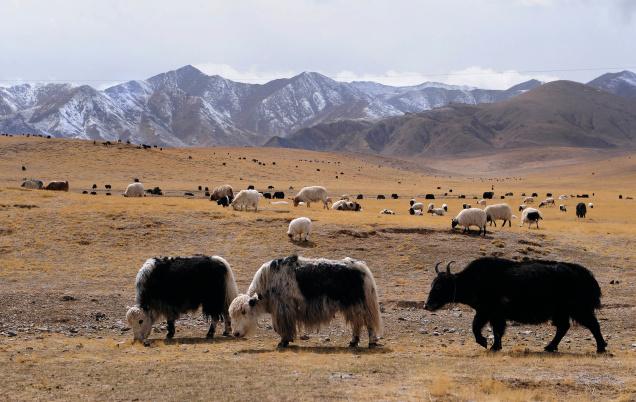
In the northern reaches of the Tibetan Plateau, dozens of yaks graze on grasslands that look like a threadbare carpet. The pasture has been munched down to bare soil in places, and deep cracks run across the snow-dusted landscape. The animals’ owner, a herder named Dodra, emerges from his home wearing a black robe, a cowboy hat and a gentle smile tinged with worry.
“The pastures are in a bad state and lack the kind of plants that make livestock strong and grow fat,” says Dodra. “The yaks are skinny and produce little milk.” His family of eight relies on the yaks for most of its livelihood — milk, butter, meat and fuel. Dodra was forced to give up half of his animals a decade ago, when the Chinese government imposed strict limits on livestock numbers. Although his family receives financial compensation, nobody knows how long it will last.
“We barely survive these days,” he says. “It’s a hand-to-mouth existence.” If the grasslands continue to deteriorate, he says, “we will lose our only lifeline”.
The challenges that face Dodra and other Tibetan herders are at odds with glowing reports from Chinese state media about the health of Tibetan grasslands — an area of 1.5 million square kilometres — and the experiences of the millions of nomads there. Since the 1990s, the government has carried out a series of policies that moved once-mobile herders into settlements and sharply limited livestock grazing. According to the official account, these policies have helped to restore the grasslands and to improve standards of living for the nomads.
But many researchers argue that available evidence shows the opposite: that the policies are harming the environment and the herders. “Tibetan grasslands are far from safe,” says Wang Shiping, an ecologist at the Chinese Academy of Sciences’ (CAS) Institute of Tibetan Plateau Research (ITPR) in Beijing. “A big part of the problem is that the policies are not guided by science, and fail to take account of climate change and regional variations.”
The implications of that argument stretch far beyond the Tibetan Plateau, which spans 2.5 million square kilometres — an area bigger than Greenland — and is mostly controlled by China. The grasslands, which make up nearly two-thirds of the plateau, store water that feeds into Asia’s largest rivers. Those same pastures also serve as a gigantic reservoir of carbon, some of which could escape into the atmosphere if current trends continue. Degradation of the grasslands “will exacerbate global warming, threaten water resources for over 1.4 billion people and affect Asian monsoons”, says David Molden, director general of the International Centre for Integrated Mountain Development (ICIMOD) in Kathmandu, Nepal.
Such concerns propelled me to make a 4,700-kilometre journey last year from Xining, on the northeastern fringe of the plateau, to Lhasa in the Tibetan heartland (see ‘TREK ACROSS TIBET’). Meeting with herders and scientists along the way, I traversed diverse landscapes and traced the Yellow and Yangtze Rivers to their sources. The trip revealed that Tibetan grasslands are far less healthy than official government reports suggest, and scientists are struggling to understand how and why the pastures are changing.
TIBET CONSCIOUSNESS – TIBET IN TROUBLE. TIBETAN GRASSLANDS FACING RAPID DECLINE; CHINESE MISMANAGEMENT CAUSED ENVIRONMENTAL DISASTER.
Fenced in
It began to drizzle soon after we set off from the city of Xining on a stretch of newly built highway along the Yellow River. As our Land Cruiser climbed onto a 3,800-metre-high part of the plateau, the vista opened to reveal rolling hills blanketed by a thick layer of alpine meadow, resembling a gigantic golf course. We passed herds of sheep and yaks, white tents and nomads in colourful robes — along with barbed-wired fences that cut the rangeland into small blocks.
This part of the Tibetan Plateau, in a region known as Henan county, is blessed with abundant monsoonal rains every summer. The herders who live here are able to maintain healthy livestock and can make a decent living. “We have plenty to go around, and the livestock are well taken care of,” says herder Gongbu Dondrup.
But life has been different since the government began to fence up grasslands around a decade ago, says Dondrup. Before that, he took his herd to the best pastures at high elevations in the summer, and then came back down in the winter. Now, he must keep the yaks in an 80-hectare plot that the government assigned to his family. The pasture looks worn, and he is being pressed by the government to further downsize his herd. “I don’t know how long it can keep us going,” he says.
The fencing initiative is the latest of a string of Chinese grassland policies. After annexing Tibet in 1950, the young revolutionary Chinese republic turned all livestock and land into state properties. Large state farms competed with each other to maximize production, and livestock numbers on the plateau doubled over two decades, reaching nearly 100 million by the late 1970s. But in the 1980s, as China moved towards a market-based economy, Beijing swung to the other extreme: it privatized the pastures and gave yaks back to individual households, hoping that the move would push Tibetans to better manage their land and so boost its productivity.
Despite the privatization, nomads continued to use the rangeland communally — often in groups led by village elders. Then the government began to limit herds, and it built fences to separate households and villages. “This has totally changed the way livestock are traditionally raised on the plateau, turning a mobile lifestyle into a sedentary existence,” says Yang Xiaosheng, director of Henan county’s rangeland-management office.
The fencing policy does have merits when applied in moderation, says Yönten Nyima, a Tibetan policy researcher at Sichuan University in Chengdu. Because an increasing number of nomads now lead a settled life — at least for parts of the year — it helps to control the level of grazing in heavily populated areas, he says. “Fencing is an effective way to keep animals out of a patch of meadow.” Many herders also say that it makes life much easier: they do not have to spend all day walking the hills to herd their yaks and sheep, and if they go away for a few days, they don’t worry about the animals running off.
But the convenience comes at a cost, says Cao Jianjun, an ecologist at Northwest Normal University in Lanzhou. Fenced pastures often show signs of wear after a few years. In a 2013 study, Cao and his colleagues measured growth of the sedge species preferred by livestock in two scenarios: enclosed pastures and much larger patches of land jointly managed by up to 30 households. Despite similar livestock densities in both cases, the sedge grew twice as fast in the larger pastures, where animals could roam and plants had more opportunity to recover1. That matches the experience of Henan county herders, who say that their land sustains fewer animals than it has in the past.
Water worries
The future of the grasslands looked even bleaker as we left relatively well-to-do Henan county and ventured into the much higher, arid territory to the west. After 700 kilometres, we reached Madoi county, also known as qianhu xian (‘county of a thousand lakes’), where the Yellow River begins. Although this region gets only 328 millimetres of rain on average each year, about half of what Henan receives, Madoi was once one of the richest counties on the plateau — famous for its fish, high-quality livestock and gold mines.
Now, the wetlands are drying up and sand dunes are replacing the prairies, which means that less water flows into the Yellow River. Such changes on the plateau have contributed to recurring water shortages downstream: the Yellow River often dries up well before it reaches the sea, an event not recorded before 1970.
In 2000, China sought to protect this region, along with adjacent areas that give rise to the Yangtze and Mekong Rivers, by establishing the Sanjiangyuan (or Three-Rivers’ Headwaters) National Nature Reserve, an area nearly two-thirds the size of the United Kingdom.
Nearly one-tenth of the reserve area falls into core zones in which all activities, including herding, are prohibited. The government spends hundreds of millions of US dollars each year on moving nomads out of those core areas, constructing steel meshes to stabilize the slopes and planting artificially bred grass species to restore the eroded land. Outside the core regions, officials have banned grazing on ‘severely degraded grasslands’, where vegetation typically covers less than 25% of the ground. Land that is ‘moderately degraded’, where vegetation coverage measures 25–50%, can be grazed for half of the year.
TIBET CONSCIOUSNESS – TIBET IN TROUBLE. TIBETAN PLATEAU GRASSLANDS REPLACED BY DRY, BARREN LAND.
Jonas Bendiksen/Magnum
Near the headwaters of the Yellow River, lush grasslands have given way to sand dunes.
Such policies — and related initiatives to limit livestock numbers and fence off areas of pasture — have not been easy on the herders, says Guo Hongbao, director of the livestock-husbandry bureau in Nagchu county in the southern Tibetan Plateau. “The nomads have made sacrifices for protecting the grasslands,” he says. But he also says that the strategies have paid off. Guo and other officials point to satellite studies showing that the plateau has grown greener in the past three decades2. This increase in vegetation growth, possibly the result of a combination of grazing restrictions and climate change, “has had a surprisingly beneficial effect on climate by dampening surface warming”, says Piao Shilong, a climate modeller at Peking University.
But ecologists say that such measurements look only at surface biomass and thus are not a good indicator of grassland health. “Not all vegetation species are equal,” says Wang. “And satellites can’t see what’s going on underground.”
This is particularly important in the case of the sedge species that dominate much of the Tibetan Plateau, and that are the preferred food of livestock. These species, part of the Kobresia genus, grow only 2 centimetres above the surface and have a dense, extensive root mat that contains 80% of the total biomass. Studies of pollen in lake sediments show that Kobresia and other dominant sedges emerged about 8,000 years ago, when early Tibetans began burning forests to convert them to grasslands for livestock3. The prehistoric grazing helped to create the thick root mat that blankets the vast plateau and that has stored 18.1 billion tonnes of organic carbon.
But Kobresia plants are being driven out by other types of vegetation, and there is a risk that the locked-up carbon could be released and contribute to global warming. Every now and then on the trip to Lhasa, we passed fields blooming with the beautiful red and white flowers of Stellera chamaejasme, also known as wolf poison. “It’s one of a dozen poisonous species that have increasingly plagued China’s grasslands,” says Zhao Baoyu, an ecologist at the Northwest Agriculture and Forestry University in Yangling. Zhao and his colleagues estimated that poisonous weeds have infested more than 160,000 square kilometres of the Tibetan grasslands, killing tens of thousands of animals a year4.
Herders also report seeing new grass species and weeds emerge in recent years. Although most are not toxic, they are much less nutritious than Kobresia pastures, says Karma Phuntsho, a specialist on natural-resource management at ICIMOD. “Some parts of the plateau may seem lush to an untrained eye,” he says. “But it’s a kind of ‘green desertification’ that has little value.”
In one unpublished study of the northeastern Tibetan Plateau, researchers found that Kobresia pastures that had gone ungrazed for more than a decade had been taken over by toxic weeds and much taller, non-palatable grasses: the abundance of the sedge species had dropped from 40% to as low as 1%. “Kobresia simply doesn’t stand a chance when ungrazed,” says Elke Seeber, a PhD student at the Senckenberg Natural History Museum in Görlitz, Germany, who conducted the field experiment for a project supported by the German Research Foundation (DFG).
“The policies are not guided by science, and fail to take account of climate change and regional variations.”
The changes in vegetation composition have important implications for long-term carbon storage, says project member Georg Guggenberger, a soil scientist at Leibniz University of Hanover in Germany. In moderately grazed Kobresia pastures, up to 60% of the carbon that is fixed by photosynthesis went into the roots and soil instead of the above-ground vegetation — three times the amount seen in ungrazed plots5. This underground organic carbon is much more stable than surface biomass, which normally decomposes within a couple of years and releases its stored carbon into the air. So a shift from Kobresia sedge to taller grasses on the plateau will ultimately release a carbon sink that has remained buried for thousands of years, says Guggenberger.
Critics of the grazing restrictions in Tibet say that the government has applied them in a blanket way, without proper study and without taking on board scientific findings. In some cases, they make sense, says Tsechoe Dorji, an ecologist at the ITPR’s Lhasa branch, who grew up in a herder family in western Tibet. “A total grazing ban can be justified in regions that are severely degraded”, he says, but he objects to the simple system used by the government to classify the health of the grasslands. It only considers the percentage of land covered by vegetation and uses the same threshold for all areas, without adjusting for elevation or natural moisture levels.
“Pastures with 20% vegetation cover, for instance, could be severely degraded at one place but totally normal at another,” says Dorji. This means that some of the grasslands that are classified as severely degraded are actually doing fine — and the grazing ban is actually hurting the ecosystem. “Having a sweeping grazing policy regardless of geographical variations is a recipe for disasters,” he says.
Fast forward
China’s grazing policy is only one of several factors responsible for such damaging changes, say the researchers. Pollution, global warming and a rash of road-building and other infrastructure-construction projects have all taken a toll on the grasslands.
Ten days after leaving Xining, we caught a glimpse of Tibet’s future when we arrived at Nam Tso, a massive glacial lake in the southern part of the plateau. Here Dorji and Kelly Hopping, a graduate student at Colorado State University in Fort Collins, have been turning the clock forward by surrounding small patches of grassland with open-topped plastic chambers that artificially raise the temperature. These experiments are important because Tibet is a hotspot in terms of climate change; the average temperature on the plateau has soared by 0.3–0.4 °C per decade since 1960 — about twice the global average. In trials over the past six years, they found that Kobresia pygmaea, the dominant sedge species, develops fewer flowers and blooms much later under warming conditions6. Such changes, says Dorji, “may compromise its reproductive success and long-term competitiveness”.
“Having a sweeping grazing policy regardless of geographical variations is a recipe for disasters.”
At the experimental site, the artificially warmed pastures have been taken over by shrubs, lichens, toxic weeds and non-palatable grass species, says Hopping. But when the researchers added snow to some heated plots, Kobresia did not lose out to the other plants, which suggests that the loss of soil moisture might be driving the shift in species. Higher temperatures increase evaporation, which can be especially potent at high elevations. “This is not good news for species with shallow roots”, such as the Kobresia favoured by livestock, she says. Piao says that “this interplay between temperature and precipitation illustrates the complexity of ecosystem responses to climate change”. But researchers have too little information at this point to build models that can reliably predict how global warming will affect the grasslands, he says. To fill that gap, Wang and his colleagues started a decade-long experiment in 2013 at Nagchu, where they are using heat lamps to warm patches of grassland by precise amounts, ranging from 0.5 °C to 4 °C. They are also varying the amount of rainfall on the plots, and they are measuring a host of factors, such as plant growth, vegetation composition, nutrient cycling and soil carbon content. They hope to improve projections for how the grasslands will change — and also to determine whether there is a tipping point that would lead to an irreversible collapse of the ecosystem, says Piao.
Plateau prognosis
A fortnight into the trip, we finally arrived at the outskirts of Lhasa. At the end of the day, herders were rounding up their sheep and yaks in the shadows cast by snow-capped peaks. They and the other pastoralists across the plateau will have a difficult time in coming decades, says Nyima. Climate change was not a consideration when grassland polices were conceived over a decade ago, and so “many pastoralists are ill prepared for a changing environment”, he says. “There is a pressing need to take this into account and identify sound adaptation strategies.”
As a start, researchers would like to conduct a comprehensive survey of plant cover and vegetation composition at key locations across different climate regimes. “The information would form the baseline against which future changes can be measured,” says Wang. Many scientists would also support changes to the grazing ban and fencing policies that have harmed the grasslands. Dorji says that the government should drop the simplistic practice of ‘one policy fits all’ across the plateau and re-evaluate whether individual regions are degraded enough to merit a ban on grazing. “Unless the pastures are severely degraded, moderate grazing will help to restore the ecosystems,” he says.
But scientists are not banking on such reforms happening soon. Policies in Tibet are driven less by scientific evidence than by bureaucrats’ quest for power and funds, says a Lhasa-based researcher who requests anonymity for fear of political repercussions. Local officials often lobby Beijing for big investments and expensive projects in the name of weiwen (meaning ‘maintaining stability’). Because resistance to Chinese control over Tibet continues to flare up, the government is mostly concerned with maintaining political stability, and it does not require local officials to back up plans with scientific support, says the researcher. “As long as it’s for weiwen, anything goes.”
But officials such as Guo say that their policies are intended to help Tibet. “Although there is certainly room for improvement in some of the policies, our primary goals are to promote economic development and protect the environment,” he says.
Far away from Lhasa, herders such as Dodra say that they are not seeing the benefits of government policies. After we finish our visit at his home, Dodra’s entire family walks us into the courtyard — his mother in-law spinning a prayer wheel and his children trailing behind. It has stopped snowing, and the sky has turned a crystal-clear, cobalt blue. “The land has served us well for generations,” says Dodra as he looks uneasily over his pasture. “Now things are falling apart — but we don’t get a say about how best to safeguard our land and future.”
Journal name: Nature Volume: 529, Pages: 142–145 Date published: (14 January 2016) DOI: doi :10.1038/529142a A related story at SciDev.Net explores how climate change will affect Tibetan herders.
References
Cao, J., Yeh, E. T., Holden, N. M., Yang, Y. & Du, G. J. Arid Environ. 97, 3–8 (2013). Article Shen, M. et al. Proc. Natl Acad. Sci. USA 112, 9299–9304 (2015). Article PubMed ChemPort Miehe, G. et al. Quat. Sci. Rev. 86, 190–209 (2014). Article Lu, H., Wang, S. S., Zhou, Q. W., Zhao, Y. N. & Zhao, B. Y. Rangeland J. 34, 329–339 (2012). Article Hafner, S. et al. Glob. Chang. Biol. 18, 528–538 (2012). Article Dorji, T. et al. Glob. Chang. Biol. 19, 459–472 (2013). Article PubMed
Related stories and links
From nature.com
Droughts threaten high-altitude Himalayan forests 27 January 2015 Tibetan plateau gets wired up for monsoon prediction 01 October 2014 Double threat for Tibet 19 August 2014 Floods spur mountain study 04 September 2013 Thawing permafrost reduces river runoff 06 January 2012 China: The third pole 23 July 2008 Nature Geoscience Nature Climate Change
From elsewhere
Third Pole Environment International Centre for Integrated Mountain Development Institute of Tibetan Plateau Research
Author information
Affiliations
Jane Qiu is a freelance writer in Beijing. Her trip across the Tibetan Plateau was supported by the SciDev.Net Investigative Science Journalism Fellowship for the Global South, which was funded by a grant from the International Development Research Centre, Ottawa, Canada.
TIBET CONSCIOUSNESS – TIBET IN TROUBLE. SUGE LA PASS AT 5440 METERS IN ELEVATION. GRASSLANDS DESTROYED.
TIBET CONSCIOUSNESS – TROUBLE IN TIBET. PLATEAU GRASSLANDS DISAPPEARING AT RAPID PACE.
TIBET CONSCIOUSNESS – TIBET IN TROUBLE. YAKS GRAZING ON THE TIBETAN PLATEAU. GRASSLANDS DISAPPEARING DUE TO MANAGEMENT FAILURE.TIBET CONSCIOUSNESS – TIBET IN TROUBLE. GRASSLANDS OF TIBETAN PLATEAU IN SERIOUS TROUBLE.
Trouble in Tibet – Tibetans Under Constant Surveillance
TROUBLE IN TIBET – TIBETANS UNDER SURVEILLANCE. HUMAN RIGHTS VIOLATIONS IN OCCUPIED TIBET.
Red China extended indefinitely a village-based Tibet Surveillance Program which in its essence is a continuous Human Rights violation.
Rudra Narasimham Rebbapragada Ann Arbor, MI 48104-4162 USA SPECIAL FRONTIER FORCE
CHINA DIGITAL TIMES
Tibet: Surveillance & Living Buddhas
Human Rights Watch reports that authorities in Tibet are extending a village-based surveillance scheme that was originally scheduled to end in 2014, creating a permanent system of cadre teams to maintain political stability in the region:
“The Chinese government’s decision to extend its Tibet surveillance program indefinitely is nothing less than a continuous human rights violation,” said Sophie Richardson, China director. “The new normal is one of permanent surveillance of Tibetans.”
[…] The purpose of the village-based cadre teams was initially described as improving services and material conditions in the villages, but, according to the Party leader of the TAR in 2011, their primary requirement was to turn each village into “a fortress” in “the struggle against separatism,” a reference to support for Tibetan independence and the Dalai Lama.
This was done by setting up new Communist Party organizations in each village, establishing local security schemes, gathering information about villagers, and other measures. The teams were also required to carry out re-education with villagers on “Feeling the Party’s kindness” and other topics.
[…] The village-based teams also “screen and mediate social disputes,” which involves acting to settle and contain any disputes among villagers or families, because of official concerns in China that small disputes might lead to wider unrest or “instability.” One objective is to prevent villagers from presenting petitions to higher level officials.
[…] In August 2015, a statement posted on a government Tibetan-language website said that the TAR authorities had called for work teams “to be constantly stationed at their village committees.” It added that “on hearing that village-based-cadre work was to continue, the rural masses were overjoyed, saying that this was one of the Party and government’s best policies to benefit rural areas.”
Read Human Rights Watch’s 2013 report on the surveillance grid in Tibet, the reported use of monks’ cellphones as monitoring devices, and more on surveillance in the region, via China Digital Times.
Meanwhile, the BBC reports that the Chinese State Administration for Religious Affairs has established the country’s first database of “authentic living buddhas,” complete with photos, personal details, and license numbers, that has been made available to the public for verification purposes.
Beijing has taken the unusual step of concerning itself with matters of reincarnation by releasing the names, photographs and locations of 870 “verified” buddhas on the website of the State Administration for Religious Affairs, Xinhua news agency reports. It’s a move that’s been praised by one of the men who features on the list. “As a living buddha, I feel genuinely happy about it,” Drukhang Thubten Khedrup tells the state-run news agency.
According to China’s religious affairs agency, the system has been inaugurated to counter “fake” buddhas who are undermining Tibetan Buddhism by cheating believers out of cash. However, the spiritual cataloguing scheme has already been criticised as a means of further controlling Tibetan affairs. “This living Buddha database and the whole policy toward reincarnation is clearly a pre-emptive move by the government to control what happens after this Dalai Lama,” Amnesty International’s Nicholas Bequelin told Time magazine in December 2015, when the list was first announced. It’s also seen as a means of confirming state choices for other religious appointments.
At China Real Time, Olivia Geng and Josh Chin note that fake living buddhas were described as a national security threat on state broadcaster CCTV last year.They also point out that the Dalai Lama is not among those on the new register, despite Beijing’s repeated insistence that he must reincarnate, and that it has the right to identify his reincarnation.
Elsewhere, Jane Qiu looks at the negative impacts that a series of government grazing restrictions and fencing policies have had on the Tibetan grasslands and the health of the surrounding environment. From Nature:
The challenges that face Dodra and other Tibetan herders are at odds with glowing reports from Chinese state media about the health of Tibetan grasslands — an area of 1.5 million square kilometres — and the experiences of the millions of nomads there. Since the 1990s, the government has carried out a series of policies that moved once-mobile herders into settlements and sharply limited livestock grazing. According to the official account, these policies have helped to restore the grasslands and to improve standards of living for the nomads.
But many researchers argue that available evidence shows the opposite: that the policies are harming the environment and the herders. “Tibetan grasslands are far from safe,” says Wang Shiping, an ecologist at the Chinese Academy of Sciences’ (CAS) Institute of Tibetan Plateau Research (ITPR) in Beijing. “A big part of the problem is that the policies are not guided by science, and fail to take account of climate change and regional variations.”
The implications of that argument stretch far beyond the Tibetan Plateau, which spans 2.5 million square kilometres — an area bigger than Greenland — and is mostly controlled by China. The grasslands, which make up nearly two-thirds of the plateau, store water that feeds into Asia’s largest rivers. Those same pastures also serve as a gigantic reservoir of carbon, some of which could escape into the atmosphere if current trends continue. Degradation of the grasslands “will exacerbate global warming, threaten water resources for over 1.4 billion people and affect Asian monsoons”, says David Molden, director general of the International Centre for Integrated Mountain Development (ICIMOD) in Kathmandu, Nepal. [
Read more on threats to grasslands in Tibet and elsewhere, including a 2013 Human Rights Watch report on the forced settlement of Tibetan herders, via China Digital Times.
TROUBLE IN TIBET – TIBETANS UNDER SURVEILLANCE – HUMAN RIGHTS VIOLATION IN OCCUPIED TIBET.TROUBLE IN TIBET – TIBETANS UNDER SURVEILLANCE – HUMAN RIGHTS VIOLATION IN OCCUPIED TIBET.TROUBLE IN TIBET – TIBETANS UNDER SURVEILLANCE. RED CHINA’S PROPAGANDA AGENTS MOVE INTO EVERY TIBETAN VILLAGE.
TROUBLE IN TIBET – TIBETANS UNDER SURVEILLANCE. HUMAN RIGHTS VIOLATIONS N OCCUPIED TIBET.
Tibet is in deep trouble; the trouble called ‘Climate Change’ is no Secret, the trouble caused by Communist Regime occupying Tibet is indeed the bigger of the two troubles confronting Tibet. Regime Change in Tibet will resolve the problem of ‘Climate Change’.
Tibet is in deep trouble; the trouble called ‘Climate Change’ is no Secret, the trouble caused by Communist Regime occupying Tibet is indeed the bigger of the two troubles confronting Tibet. Regime Change in Tibet will resolve the problem of ‘Climate Change’.
Rudra Narasimham Rebbapragada Ann Arbor, MI 48104-4162 USA SPECIAL FRONTIER FORCE
Tibet is in deep trouble; the trouble called ‘Climate Change’ is no Secret, the trouble caused by Communist Regime occupying Tibet is indeed the bigger of the two troubles confronting Tibet. Regime Change in Tibet will resolve the problem of ‘Climate Change’.
EURASIA REVIEW – A JOURNAL OF ANALYSIS AND NEWS
NEW METHOD UNLOCKS CLIMATE CHANGE SECRETS FROM TIBETAN ICE
ISSN 2330-717x
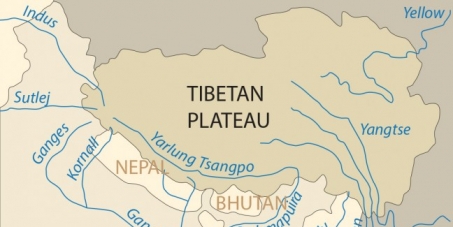
The Qinghai-Tibetan Plateau lies between the Himalayan range to the south and the Kunlun Range to the north. Map by Lencer, Wikipedia Commons.
The Qinghai-Tibetan Plateau lies between the Himalayan range to the south and the Kunlun Range to the north. Map by Lencer, Wikipedia Commons.
By EURASIA REVIEW December 19, 2015
Identifying forest fire molecules in the Tibetan ice could give us an insight into how human activity is contributing to climate change and melting glaciers. A new study published in Talanta presents a method to help scientists identify forest fire molecules in Tibet.
The researchers behind the new method, from the Institute of Tibetan Plateau Research in China, say their work will enable scientists to spot the molecules produced by burning forests more easily. This will help them understand the history of fires in the region, adding to the picture of how humans are contributing to climate change.
The Tibetan Plateau is one of the cleanest regions in the world. It is a huge area, covering around 1000km north to south and 2500km west to east, in western China and India. The glaciers supply water to people in surrounding countries and are critical for people’s survival. However, they’re retreating at an alarming rate, putting the water supply in jeopardy for more than 1 billion people.
Climbing temperatures are contributing to the disappearance of the glaciers. But previous research has also pointed to molecules in the air called carbonaceous aerosols as another cause of the glaciers melting. Carbonaceous aerosols are commonly produced by burning fossil fuels. However, almost half of the carbonaceous aerosols in south Asia are produced when people burn biomass, such as trees.
Studying the aerosols trapped in the ice of the glaciers can give scientists insights into the history of biomass burning and how it is related to climate change and glacial melting. For the new study, the researchers developed a method to help scientists identify a molecule called levoglucosan, which can identify carbonaceous aerosols that came from biomass burning. Researchers often look for levoglucosan in snow and ice in Antarctica and the Arctic. However, ice from the Tibetan Plateau contains many more complex molecules, such as sugar and sugar alcohol, making it much harder to spot the levoglucosan.
“Carbonaceous aerosols can tell the story of biomass burning in a region, helping us understand more about how human activity has shaped glaciers over time,” explained Mr. Chao You, lead author of the study from the Institute of Tibetan Plateau Research. “But it’s quite difficult to identify the molecules that tell us when these aerosols were released, so we wanted to come up with a better method to use in Tibet.”
Usually, researchers use a technique called High Performance Liquid Chromatography (HPLC) to identify levoglucosan in snow and ice samples. However, because of the insoluble particles in the Tibetan ice, using this method without pre-treating the samples can actually harm the system. Furthermore, levoglucosan is present at such low concentrations in the Tibetan ice that standard methods often can’t identify the molecules.
Mr. You and his colleagues developed a method that can detect levoglucosan at tiny concentrations in snow and ice samples. The researchers first melted the ice, filtered it and mixed it with acetonitrile. They then analyzed the mixture using chemistry analysis called ultra-performance liquid chromatography combined with triple tandem quadrupole mass spectrometry. They then analyzed the levoglucosan in the sample.
The method is very sensitive: the team could identify levoglucosan at a concentration of only 110 nanograms per liter of ice. They could use the method with small samples of only 0.5ml. Also, the method is not just suitable for Tibetan ice, but for samples from any low and middle latitude glaciers around the world.
“I am interested in finding more evidence of biomass burning in Tibetan glacier snow and ice. To do this, we improved and tested this new method for identifying levoglucosan quickly and accurately in Tibetan ice and snow,” explained Mr. You. “Our method can reveal more detailed information about the environmental process and changes that happened in Tibetan glaciers.”
This research was supported by the National Scientific Foundation of China.
Copyright 2015 | By Eurasia Review(ISSN 2330-717x)
Tibet is in deep trouble; the trouble called ‘Climate Change’ is no Secret, the trouble caused by Communist Regime occupying Tibet is indeed the bigger of the two troubles confronting Tibet. Regime Change in Tibet will resolve the problem of ‘Climate Change’.
Whole Dude – Whole Conservation: The Celebration of World Water Day on March 22
The Celebration of World Water Day on March 22
World Water Day celebrates water and raises awareness of the 2.2 billion people living without access to safe water. It is about taking action to tackle the global water crisis. A core focus of World Water Day is to support the achievement of Sustainable Development Goal 6: water and sanitation for all by 2030.
Water: Our Common Wealth
The Celebration of World Water Day on March 22
The Importance of Water
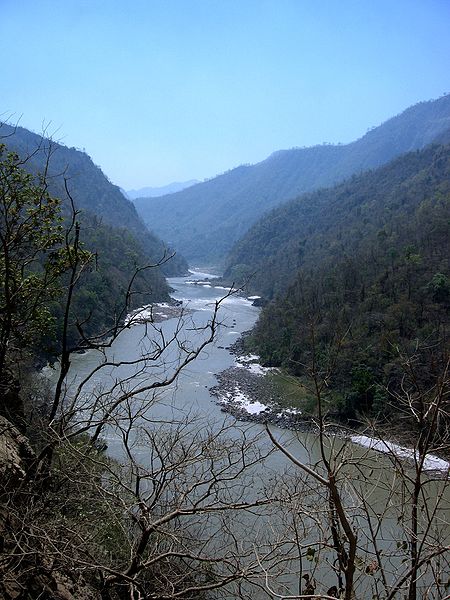
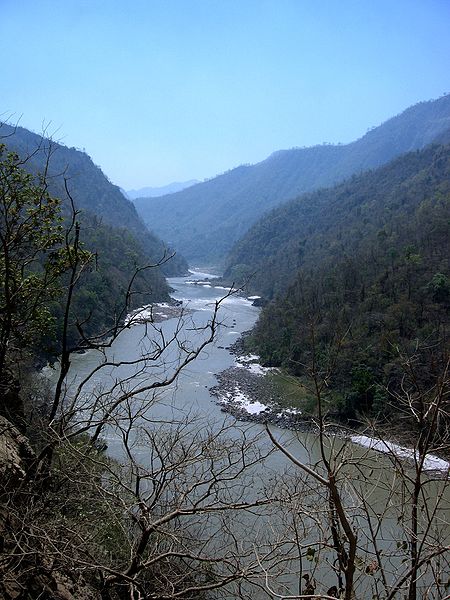
River Ganga meandering through the Shivalik ranges near Rishikesh symbolizes my WAVE THEORY OF IMMORTALITY. Man always exists in constant relationship with his physical environment. Immortality is not about perpetual residence in a Heavenly Mansion. Immortality is associated with the idea of Ultimate Reality which is represented by SAT+CHIT+ANANDA. In this physical world, the Indian Identity is immortalized by the flowing River adoringly described as Mother Ganges.The Celebration of World Water Day on March 22
World Water Day, held on 22 March every year since 1993, focuses on the importance of freshwater.
Celebrating World Water Day
The Celebration of World Water Day on March 22, 2024. The Panna Meena Ka Kund Stepwell, Jaipur, Bharat.
The stepwell that these women are climbing is an apt image to mark World Water Day. Stepwells originated in western India over a thousand years ago as way for locals in that arid climate to easily and reliably access fresh water—even during the driest months. The Panna Meena Ka Kund stepwell in Jaipur is a classic example of the beautiful, regular, geometric architecture used to produce these useful public works. Most stepwells also feature shaded side chambers where locals (primarily women) can gather to escape the heat of the day.
In this image, one can see obvious signs of previous high-water marks on the well’s walls as seasonal fluctuations and the changing climate affect water levels throughout the region. The impact of climate change on fresh water accessibility is the theme that the United Nations has chosen for World Water Day 2020. The goal of today’s observance is to focus attention and energy not just on those problems, but on potential solutions as well.
Water and Climate Change
The Celebration of Spiritual Dimension of Water on World Water Day
World Water Day 2020 is about water and climate change – and how the two are inextricably linked. The campaign shows how our use of water will help reduce floods, droughts, scarcity and pollution, and will help fight climate change itself.
By adapting to the water effects of climate change, we will protect health and save lives. And, by using water more efficiently, we will reduce greenhouse gases.
Our key messages for this day are clear:
We cannot afford to wait. Climate policy makers must put water at the heart of action plans.
Water can help fight climate change. There are sustainable, affordable and scalable water and sanitation solutions.
Everyone has a role to play. In our daily lives, there are surprisingly easy steps we can all take to address climate change.
History of the Day
The Celebration of World Water Day on March 22
The idea for this international day goes back to 1992, the year in which the United Nations Conference on Environment and Development in Rio de Janeiro took place. That same year, the United Nations General Assembly adopted a resolution by which 22 March of each year was declared World Day for Water, to be observed starting in 1993.
Later on, other celebrations and events were added. For instance, the International Year of Cooperation in the Water Sphere 2013, and the current International Decade for Action on Water for Sustainable Development, 2018-2028. These observances serve to reaffirm that water and sanitation measures are key to poverty reduction, economic growth, and environmental sustainability.
March 22. The Celebration of World Water Day 2020. Antoine Laurent Lavoisier discovered the chemical composition of Water Molecule.
Antoine Laurent Lavoisier (1743-1794), French Chemist and Physicist. He discovered the Composition of Water Molecule and of various other Organic Compounds.
March 22. The Celebration of World Water Day.
Water Molecule looks very simple and yet it plays a mysterious role inside all living cells. It is essential to Life and its propagation. Its Spiritual nature is revealed by its pure, original, and sweet taste it imparts apart from its role as a Chemical Compound. It is the main mode of transport of many Elements that are needed by the living organisms. Water is the Agent that leaches Nutrient Elements and Compounds from rocks and soils and makes them available for use by plants, and animals.
Bharat Darshan – The Celebration of World Water Day on March 22.
Bharat Darshan – The Celebration of World Water Day on March 22
Bhagavad Gita, Chapter 7, verse 8: I am the taste in water, O son of Kunti, and the radiance of the sun and the moon. I am the sacred syllable Om in the Vedic mantras; I am the sound in ether, and the ability in humans.
Bharat Darshan – The Celebration of World Water Day on March 22
Man alone can describe the original, sweet taste imparted by the Water Molecule. The taste cannot be discovered in the atoms of Hydrogen and Oxygen that constitute the Water Molecule. Indians have glorified the significance of fresh water which is delivered from Heaven and the identity of the Land of Bharat is cherished as the Land where the sacred River Ganges flows.
Bharat Darshan – The Celebration of World Water Day on March 22. Mother Ganges is the Spirit of the Nation called India or Bharat.Bharat Darshan – The Celebration of World Water Day on March 22. This River GANGA or GANGES is adored by people across the Land of India or Bharat. Mother Ganga defines my National Identity and National Individuality. March 22. The Celebration of World Water Day. Living Waters. The New Testament, The Gospel According to John, Chapter 3, verse#5 , Jesus answered, “I tell you the truth, no one can enter the Kingdom of God unless he is born of the water and the Spirit.”
Trouble in Tibet – Dalai Lama Portraits Confiscated
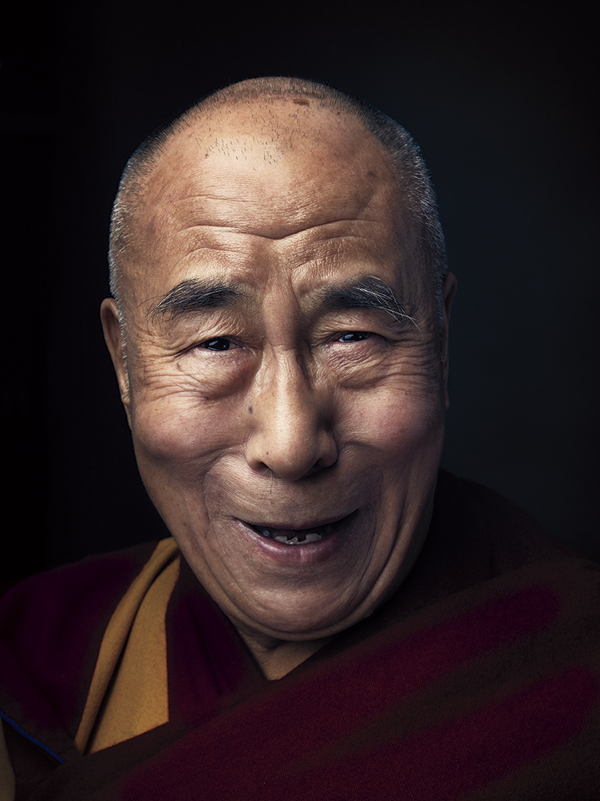
Confiscation of Dalai Lama portraits in Occupied Tibet is a sign and symptom of deep Trouble in Tibet. To give relief from Trouble, Tibet needs Freedom From Occupation. The Dalai Lama will not reincarnate in a Land where his portraits are confiscated.
Confiscation of Dalai Lama portraits in Occupied Tibet is a sign and symptom of deep Trouble in Tibet. To give relief from Trouble, Tibet needs Freedom From Occupation. The Dalai Lama will not reincarnate in a Land where his portraits are confiscated.
Rudra Narasimham Rebbapragada Ann Arbor, MI 48104-4162 USA SPECIAL FRONTIER FORCE
Confiscation of Dalai Lama portraits in Occupied Tibet is a sign and symptom of deep Trouble in Tibet. To give relief from Trouble, Tibet needs Freedom From Occupation. The Dalai Lama will not reincarnate in a Land where his portraits are confiscated.
DALAI LAMA PORTRAITS CONFISCATED IN CHINA: REPORT
February 3, 2016 12:40 AM
A man prays below a portrait of the Dalai Lama at Kirti Monastery in Aba, a Tibetan area of China’s Sichuan province, on December 9, 2015 (AFP Photo/Benjamin Haas)
Beijing (AFP) – A Chinese province with a large Tibetan population has ordered shopkeepers to hand in portraits of the Dalai Lama, state-run media said Wednesday, quoting Beijing experts likening the Nobel laureate to executed Iraqi leader Saddam Hussein.
Sichuan in the southwest, which includes several ethnically Tibetan areas, set up a “law enforcement squad” of cultural bureau personnel, police and other officials to enforce the drive, reported the Global Times, which is close to the ruling Communist party.
The aim was to “crack down on pornography and illegal publications, which include portraits of the Dalai Lama” ahead of the Lunar New Year, it quoted Gou Yadong, director of the provincial publicity department, as saying.
People were more than welcome to put on show pictures of the country’s past and present leaders, he added, referring to former heads of the ruling party. The Global Times also cited Lian Xiangmin, of the China Tibetology Research Centre in Beijing, as saying that for Chinese people, hanging his picture was the same as displaying Saddam Hussein’s image would be for Americans.
The former Iraqi leader was executed in 2006 after being convicted of crimes against humanity, while the Dalai Lama, who fled Tibet after a failed uprising against Chinese rule, was awarded the 1989 Nobel Peace prize.
The move in Sichuan comes as Beijing steps up a campaign against the spiritual leader, who is still widely revered by Tibetans. Beijing brands him a dangerous separatist, despite his repeated statements condemning violence, and in Tibet it tightly controls images of him as part of what many Tibetans see as official repression of their religion and culture.
China denies repression of minorities and says its massive investment in Tibet has brought development to a formerly poverty stricken region. Some Tibetan areas in Sichuan had seen laxer enforcement in recent years, with business owners displaying his portrait in shops.
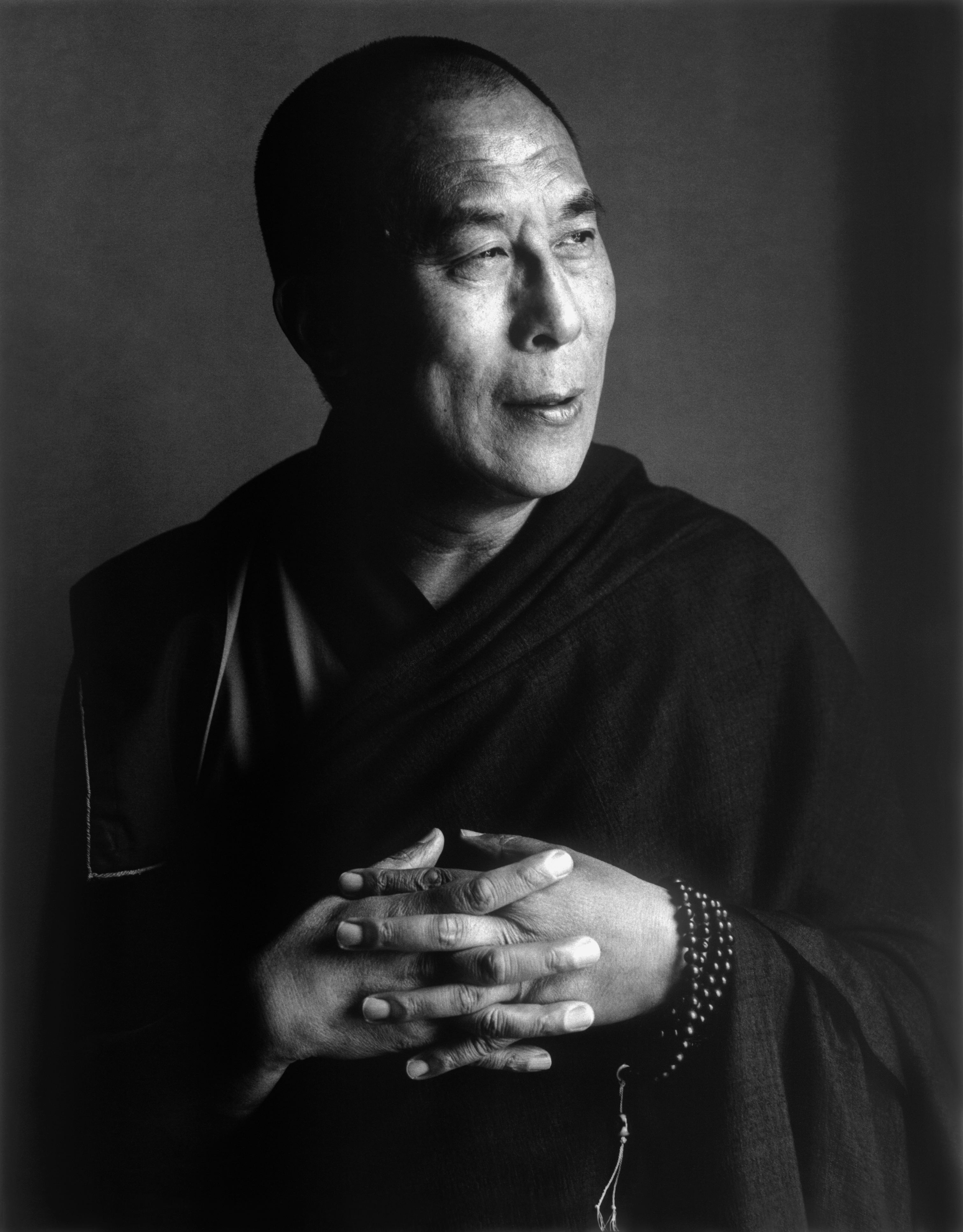
TROUBLE IN TIBET – DALAI LAMA PORTRAITS CONFISCATED IN OCCUPIED TIBET. 1987 Photography by Herb Ritts.Confiscation of Dalai Lama portraits in Occupied Tibet is a sign and symptom of deep Trouble in Tibet. To give relief from Trouble, Tibet needs Freedom From Occupation. The Dalai Lama will not reincarnate in a Land where his portraits are confiscated.
Science Daily published an article titled, “Water Supplies in Tibet Set to Increase in the Future.” When Freedom is in Short Supply, there is no hope for Water Supplies in Tibet to increase.
Rudra Narasimham Rebbapragada Ann Arbor, MI 48104-4162 USA SPECIAL FRONTIER FORCE
Comparison Pictures of Rongbuk Glaciers. Trouble in Tibet – Freedom is in Short Supply
ScienceDaily
Water supplies in Tibet set to increase in the future —
Science Daily published an article titled, “Water Supplies in Tibet Set to Increase in the Future.” When Freedom is in Short Supply, there is no hope for Water Supplies in Tibet to increase.
ScienceDaily Water supplies in Tibet set to increase in the future Date: January 20, 2016
Source: University of Gothenburg
Summary: The Tibetan Plateau has long been seen as a “hotspot” for international environmental research, and there have been fears that water supplies in the major Asian rivers would drastically decline in the near future. However, new research now shows that water supplies will be stable and may even increase in the coming decades. Researcher Deliang Chen.
The Tibetan Plateau has long been seen as a “hotspot” for international environmental research, and there have been fears that water supplies in the major Asian rivers would drastically decline in the near future. However, new research now shows that water supplies will be stable and may even increase in the coming decades.
A report by the International Panel on Climate Change (IPCC) from 2007 suggests that the glaciers in the Himalayas will be gone by 2035. This statement was questioned and caused a great stir.
“This mistaken claim and the subsequent debate pointed to a need for a better understanding of the dynamics of climate, glaciers and future water supplies in the region,” says Deliang Chen, Professor in the Department of Earth Sciences at the University of Gothenburg.
River flows stable or increasing Since the statement by IPCC in 2007, the Tibetan Plateau has been a focus of international environmental research.
A research group led by Professor Deliang Chen at the University of Gothenburg, in close collaboration with researchers from the Institute of Tibetan Plateau Research at the Chinese Academy of Sciences, headed by Professor Fengge Su, has studied future climate change and its effect on the water balance in the region. The great Asian rivers have their source on the Plateau or in the neighbouring mountains.
The researchers recently published a study in Global and Planetary Change which modelled the water flows upstream in the Yellow River, the Yangtze, the Mekong, the Salween, the Brahmaputra and the Indus. The studies include both data from past decades and simulations for future decades.
The results show that water flows in the rivers in the coming decades would either be stable or would increase compared to the period from 1971-2000. Affects a third of the world’s population The Tibetan Plateau is the highest and most extensive area of high land in the world, and what happens there affects water resources for almost a third of the world’s population.
Dr. Tinghai Ou, who was responsible for the climate projections in the study, has commented that increased precipitation and meltwater from glaciers and snowfall are contributing to increased water flows in the region.
“This is good news because social and economic development in the surrounding areas, including China, India, Nepal and other countries in Southeast Asia, are closely tied to climate change and access to water. But the fact that the glaciers are shrinking in the region could be a concern in the longer term, and we must keep a close eye on what is happening with global warming,” says Professor Deliang Chen.
Story Source: The above post is reprinted from materials provided by University of Gothenburg. The original item was written by Carina Eliasson. Note: Materials may be edited for content and length.
Journal Reference:
F. Su, L. Zhang, T. Ou, D. Chen, T. Yao, K. Tong, Y. Qi. Hydrological response to future climate changes for the major upstream river basins in the Tibetan Plateau. Global and Planetary Change, 2016; 136: 82 DOI: 10.1016/j.gloplacha.2015.10.012
University of Gothenburg. “Water supplies in Tibet set to increase in the future.” ScienceDaily. ScienceDaily, 20 January 2016. <www.sciencedaily.com/releases/2016/01/160120113706.htm>.
Sep. 12, 2012 — Glaciers in the eastern and central regions of the Himalayas appear to be retreating at accelerating rates, similar to those in other areas of the … read more
Copyright 2015 ScienceDaily or by third parties, where indicated. All rights controlled by their respective owners.
Science Daily published an article titled, “Water Supplies in Tibet Set to Increase in the Future.” When Freedom is in Short Supply, there is no hope for Water Supplies in Tibet to increase.
Peach Blossoms – Prayer for Freedom to Blossom in Tibet
Tibetans need courage and freedom to be the people they were made to be. They need humility to lay aside progress or development granted by occupation. I ask the Lord of Compassion to give wings to Tibetans and they shall fly to experience the Joy of Freedom.
Tibetans need courage and freedom to be the people they were made to be. They need humility to lay aside progress or development granted by occupation. I ask the Lord of Compassion to give wings to Tibetans and they shall fly to experience the Joy of Freedom.
Tibetans need courage and freedom to be the people they were made to be. They need humility to lay aside progress or development granted by occupation. I ask the Lord of Compassion to give wings to Tibetans and they shall fly to experience the Joy of Freedom.
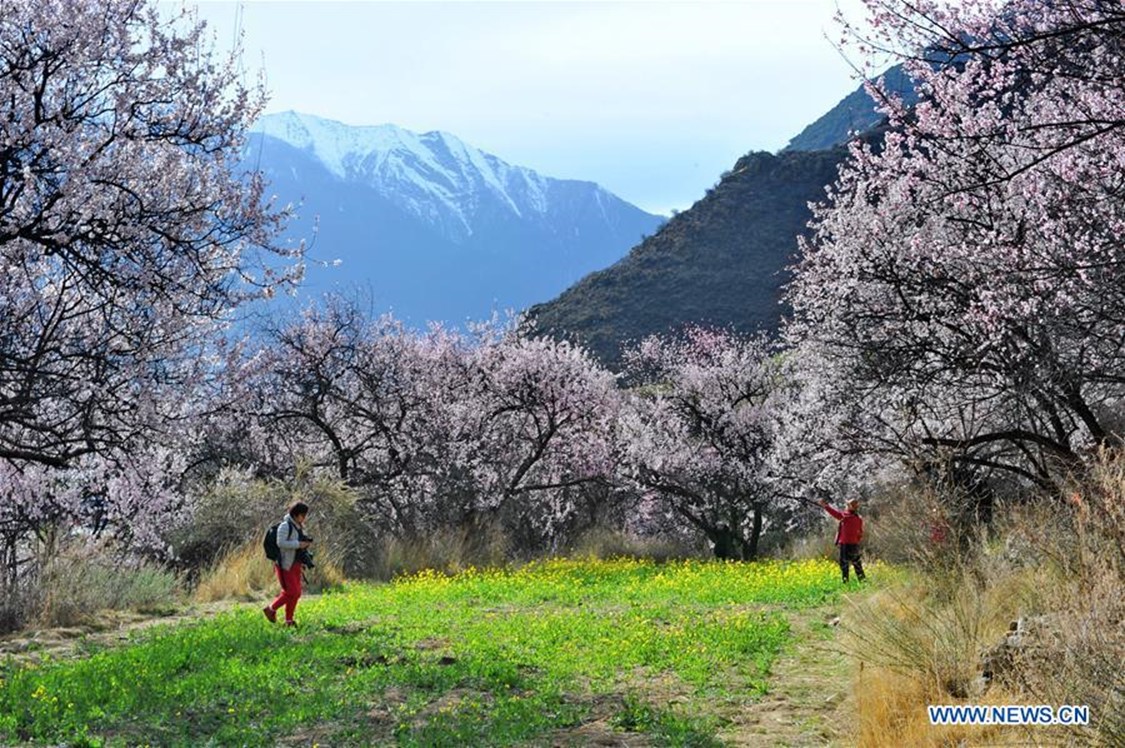
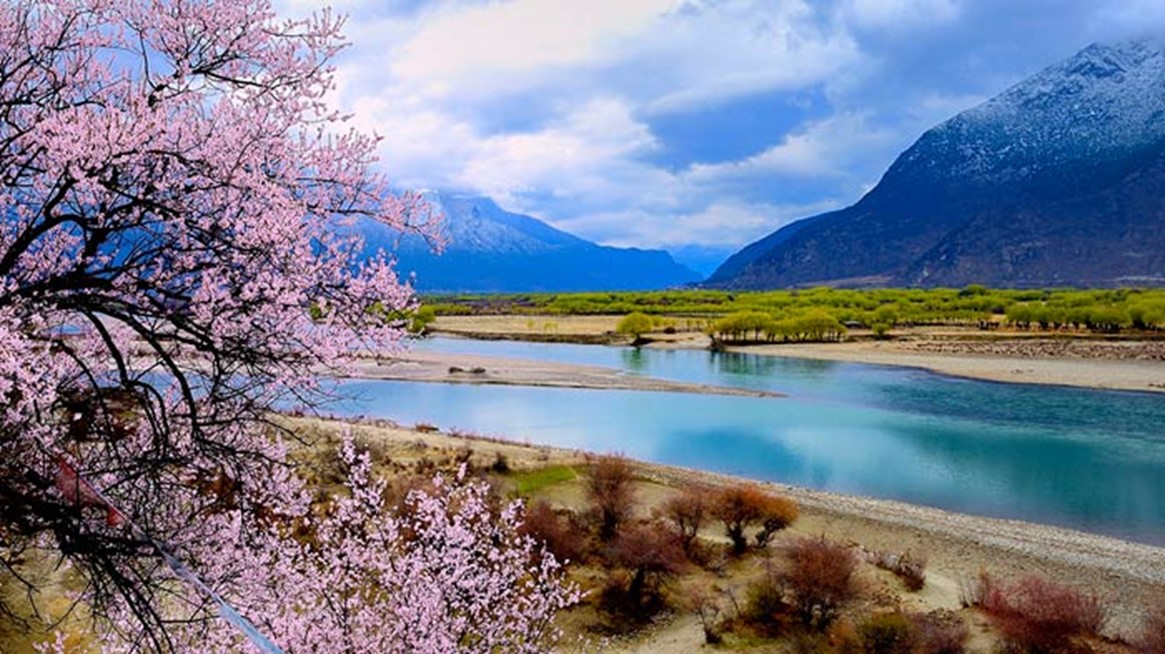
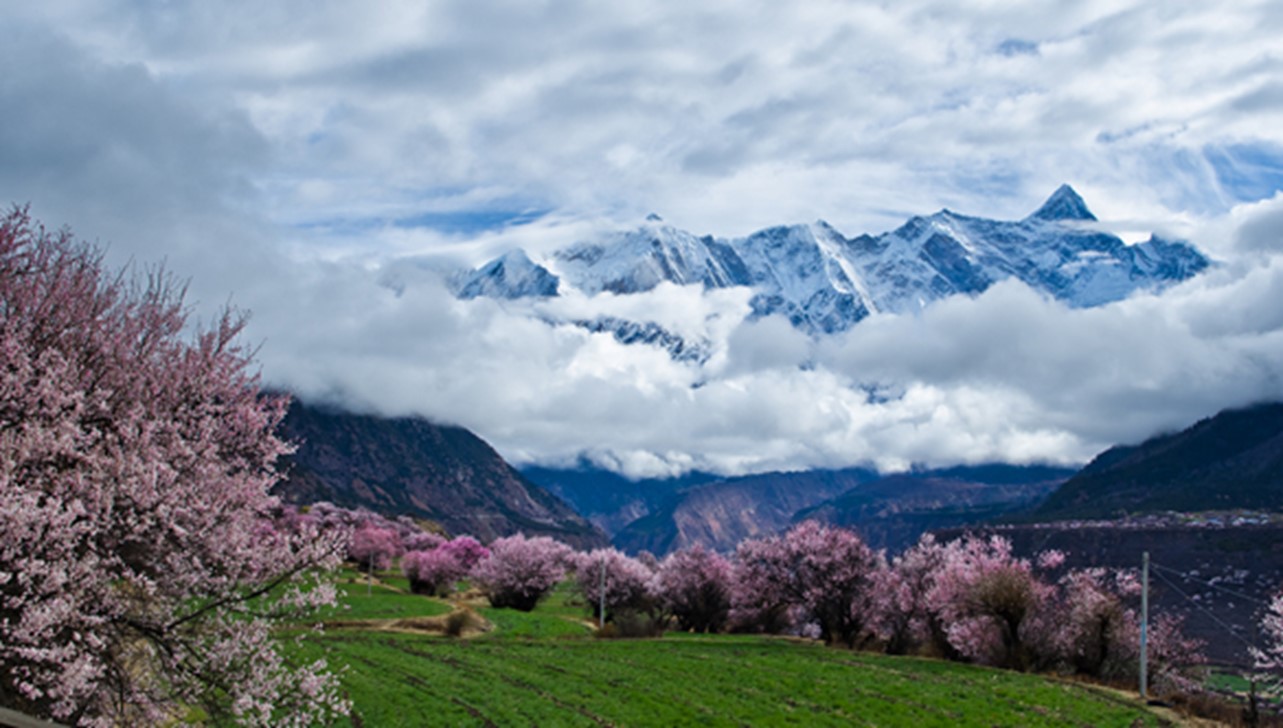
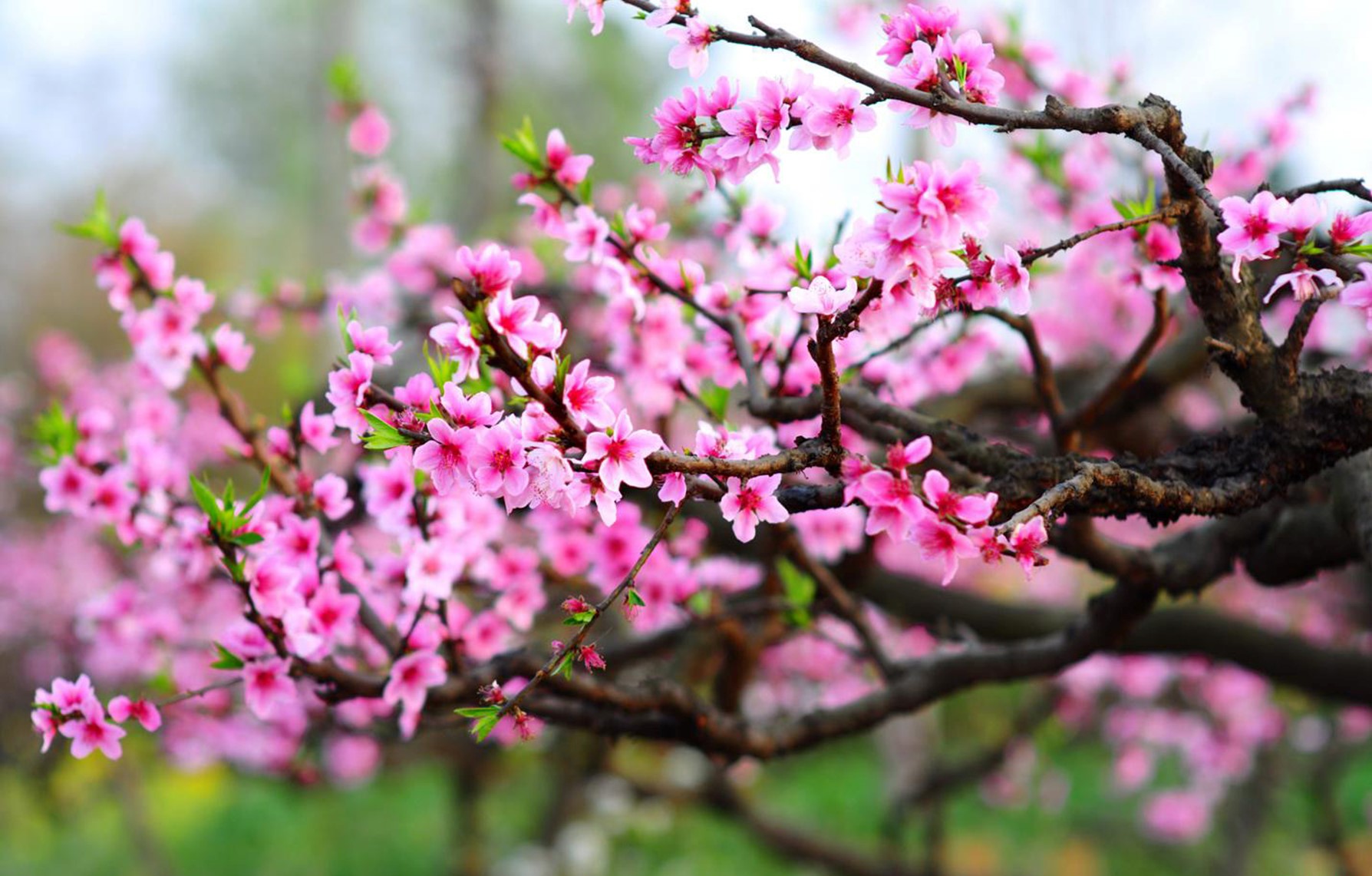
Photo taken on March 27, 2018 shows peach blossoms at the Gala peach blossom scenic area in the Baiyi district of Nyingchi, Tibet. [Photo/Xinhua]
Tibetans need courage and freedom to be the people they were made to be. They need humility to lay aside progress or development granted by occupation. I ask the Lord of Compassion to give wings to Tibetans and they shall fly to experience the Joy of Freedom.Tibetans need courage and freedom to be the people they were made to be. They need humility to lay aside progress or development granted by occupation. I ask the Lord of Compassion to give wings to Tibetans and they shall fly to experience the Joy of Freedom.Tibetans need courage and freedom to be the people they were made to be. They need humility to lay aside progress or development granted by occupation. I ask the Lord of Compassion to give wings to Tibetans and they shall fly to experience the Joy of Freedom.Tibetans need courage and freedom to be the people they were made to be. They need humility to lay aside progress or development granted by occupation. I ask the Lord of Compassion to give wings to Tibetans and they shall fly to experience the Joy of Freedom.Tibetans need courage and freedom to be the people they were made to be. They need humility to lay aside progress or development granted by occupation. I ask the Lord of Compassion to give wings to Tibetans and they shall fly to experience the Joy of Freedom.Tibetans need courage and freedom to be the people they were made to be. They need humility to lay aside progress or development granted by occupation. I ask the Lord of Compassion to give wings to Tibetans and they shall fly to experience the Joy of Freedom.Tibetans need courage and freedom to be the people they were made to be. They need humility to lay aside progress or development granted by occupation. I ask the Lord of Compassion to give wings to Tibetans and they shall fly to experience the Joy of Freedom.Tibetans need courage and freedom to be the people they were made to be. They need humility to lay aside progress or development granted by occupation. I ask the Lord of Compassion to give wings to Tibetans and they shall fly to experience the Joy of Freedom.Tibetans need courage and freedom to be the people they were made to be. They need humility to lay aside progress or development granted by occupation. I ask the Lord of Compassion to give wings to Tibetans and they shall fly to experience the Joy of Freedom.Tibetans need courage and freedom to be the people they were made to be. They need humility to lay aside progress or development granted by occupation. I ask the Lord of Compassion to give wings to Tibetans and they shall fly to experience the Joy of Freedom.Tibetans need courage and freedom to be the people they were made to be. They need humility to lay aside progress or development granted by occupation. I ask the Lord of Compassion to give wings to Tibetans and they shall fly to experience the Joy of Freedom.Tibetans need courage and freedom to be the people they were made to be. They need humility to lay aside progress or development granted by occupation. I ask the Lord of Compassion to give wings to Tibetans and they shall fly to experience the Joy of Freedom.Tibetans need courage and freedom to be the people they were made to be. They need humility to lay aside progress or development granted by occupation. I ask the Lord of Compassion to give wings to Tibetans and they shall fly to experience the Joy of Freedom.Tibetans need courage and freedom to be the people they were made to be. They need humility to lay aside progress or development granted by occupation. I ask the Lord of Compassion to give wings to Tibetans and they shall fly to experience the Joy of Freedom.Tibetans need courage and freedom to be the people they were made to be. They need humility to lay aside progress or development granted by occupation. I ask the Lord of Compassion to give wings to Tibetans and they shall fly to experience the Joy of Freedom.Tibetans need courage and freedom to be the people they were made to be. They need humility to lay aside progress or development granted by occupation. I ask the Lord of Compassion to give wings to Tibetans and they shall fly to experience the Joy of Freedom.Tibetans need courage and freedom to be the people they were made to be. They need humility to lay aside progress or development granted by occupation. I ask the Lord of Compassion to give wings to Tibetans and they shall fly to experience the Joy of Freedom.Tibetans need courage and freedom to be the people they were made to be. They need humility to lay aside progress or development granted by occupation. I ask the Lord of Compassion to give wings to Tibetans and they shall fly to experience the Joy of Freedom.Tibetans need courage and freedom to be the people they were made to be. They need humility to lay aside progress or development granted by occupation. I ask the Lord of Compassion to give wings to Tibetans and they shall fly to experience the Joy of Freedom.Tibetans need courage and freedom to be the people they were made to be. They need humility to lay aside progress or development granted by occupation. I ask the Lord of Compassion to give wings to Tibetans and they shall fly to experience the Joy of Freedom.Tibetans need courage and freedom to be the people they were made to be. They need humility to lay aside progress or development granted by occupation. I ask the Lord of Compassion to give wings to Tibetans and they shall fly to experience the Joy of Freedom.
Waiting for the Tibetan Spring with Optimism shared by Richard Gere
WORLD PARLIAMENTARIANS CONVENTION ON TIBET HELD IN OTTAWA, CANADA, 2012. Carl Gershman, President of the National Endowment for Democracy, Washington, DC, Professor Jayadeva Ranade, Distinguished Fellow with the Centre for Air Power Studies, New Delhi, with Richard Gere, Chairman of the International Campaign for Tibet.
Richard Gere shared his sense of optimism and expressed his hope for a Tibetan Spring and encouraged Tibetan supporters to wait with patience. At Special Frontier Force, I recognize Patience and Perseverance as part of our military strategy.
If not Tibetan Spring, I am waiting for a Red China “Meltdown” that would eventually lead to the Tibetan Spring. The term ‘meltdown’ describes a situation in which a rapid rise in the power level of a nuclear reactor, as from a defect in the cooling system, results in the melting of the fuel rods and the release of dangerous radiation and may cause the core to sink into the earth. ‘Meltdown’ also refers to a sudden decline or breakdown in a situation or condition. I am really impressed by Red China’s expanding military, economic, and political power. At the same time, I recognize inherent weakness of Red China’s Expansionism. In my analysis, there is no person, and there is no national entity that can save Red China from a catastrophic ‘Meltdown’, a sudden decline, a rapid breakdown of her Evil Power.
Rudra Narasimham Rebbapragada Ann Arbor, MI 48104-4162, USA
Special Frontier Force, Establishment 22, Vikas Regiment
Richard Gere: ‘There Will Be a Tibetan Spring Eventually,’ We Have to Be Patient
Richard Gere: ‘There Will Be a Tibetan Spring Eventually,’ We Have to Be Patient
July 4, 2015 | 09:21AM PT
‘I am welcomed by the Chinese people, but not by the Chinese government’
LEO BARRACLOUGH
KARLOVY VARY, Czech Republic — Richard Gere predicted a Tibetan Spring at a press conference on Saturday at the Czech Republic’s Karlovy Vary Film Festival. The actor, who received the festival’s Crystal Globe for outstanding contribution to world cinema on Friday, was addressing a question regarding Chinese control of Tibet, which it has occupied since an invasion in 1950.
Gere is a follower of the Dalai Lama, the India-based spiritual leader of Tibet, and an advocate for the liberation of Tibet. He disputed a suggestion from a journalist that he was not welcome in China. “I am welcomed by the Chinese people, but not by the Chinese government. I haven’t been able to (visit China) since 1993. But you guys can understand that. The Czech Republic understands Communism very well,” he said.
Gere rejected the suggestion that there were negotiations going on behind the scenes that would lead to an improvement in relations between the Tibetan Buddhists in exile and the Chinese government.
He was asked what would happen when the Dalai Lama, who is 80 years old on July 6, dies and the Tibetan Buddhists sought out the next Dalai Lama. Gere referred to an episode in Tibetan history when the Panchen Lama, the second-highest Tibetan lama, spoke out against the Chinese treatment of Tibetans in 1989, and died in “mysterious” circumstances soon thereafter. When the Panchen Lama’s successor, a 6-year-old boy, was named by the Tibetan Buddhists, he was “kidnapped” by the Chinese Communist authorities, Gere said, and “has not been seen since.” The Chinese then selected their own Panchen Lama, whom the Tibetans regard as “bogus,” Gere said. This scenario could be repeated when the Dalai Lama dies, Gere claimed.
“There is a fear — which is based in reality — that the Chinese will try to co-opt the next incarnation of the Dalai Lama. In fact the Chinese Communist Party has said that it is only up to the Chinese to decide who the Dalai Lama will incarnate as,” he said. “So there is a drama going on now about who will decide who is the next Dalai Lama.”
He continued: “The Dalai Lama has said: ‘Well, first of all, he is not going to incarnate inside of China if it is still controlled by the Chinese Communists.’ In any event it is up to him where he, and how he incarnates, not the Chinese Communists, so there is this absurd line of reasoning and declarations from the Communist Party.”
Gere added that the Czechs, because of their experience of living under Communism, could identify with such “absurdity.” “You have such experience with the absurdities of a Communist party, so you’ll understand the position of the Tibetans quite well. It will change eventually as it changed here, and there will be a Prague Spring in Tibet,” he said, referring to the anti-communist uprising in Czechoslovakia in 1968, that was unsuccessful, and the Velvet Revolution in 1989, which ended communist rule in the country. “Things will change,” Gere said. “We have to be patient and we have to keep Tibetan culture alive in the meantime, because the Chinese are doing their best to completely eradicate it.”
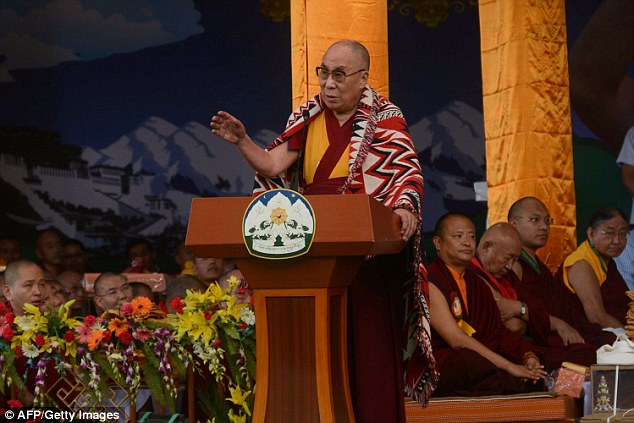
The Dalai Lama, shown here speaking to the Wisconsin Legislature in 2013, will be back in Madison on March 9, 2016 to participate in a gathering billed as “The World We Make.”
As of today, our World is in awful shape. Actually, we did not make this World. Just as in the case of Tibet, troubles are imposed upon innocent people who simply mind their own business without causing inconvenience to others. There is no choice other than that of remaking this World to give Peace and Justice to all people.
Rudra Narasimham Rebbapragada Ann Arbor, MI 48104-4162 USA Special Frontier Force, Establishment 22, Vikas Regiment
THE CAP TIMES
Madison, Wisconsin
Bill Berry: Wake up, Wisconsin, to impact of Dalai Lama, climate change
BILL BERRY | state columnist Jan 25, 2016 JOHN HART – State Journal
The Dalai Lama, shown here speaking to the Wisconsin Legislature in 2013, will be back in Madison on March 9 to participate in a gathering billed as “The World We Make.”An international spiritual leader, the Dalai Lama has worked for decades to building better understanding among the scientific and spiritual communities. John Hart/State Journal111
News that didn’t but should have stopped the presses as we came out of post-Christmas hibernation:
Welcome back: The Dalai Lama will make his 10th visit to Madison come March 9, as reported last week in Madison media. Beyond the Madison market, chances are the word won’t get out much on the visit from this international spiritual, ethical and moral leader. Its too bad. His international impact is immense. He’ll participate in a Capitol Theater event billed as The World We Make, a gathering of world leaders in science, health care and the media, according to its sponsor, the Center for Healthy Minds at UW-Madison. Among his many accomplishments, the Dalai Lama has been able to build better understanding among the scientific and spiritual communities.
The connection between the Dalai Lama and UW-Madison is well known in the Madison area. Outstate, not so much. But people might like to know that the connection has led to vibrant research on the healthy mind at the center, headed by Richard Davidson, and elsewhere on the UW campus. The simple idea that we can learn about humans by studying the healthy mind is transformational. Its also part of a vibrant body of research that stretches well beyond the Madison campus.
Bill Berry of Stevens Point writes a semimonthly column for The Capital Times. billnick
About the columnist
Bill Berry is a self-employed writer and editor who contributes to state and national publications. His Capital Times columns cover an array of topics, but he specializes in conservation, agriculture and sustainable land use.





































 Whole Dude - Whole Concept