
NO REINCARNATION OF DALAI LAMA WITHOUT FREEDOM IN OCCUPIED TIBET.
I am not surprised to note about a historical change introduced by His Holiness the 14th Dalai Lama. He has given up his political power and has decided to guide future of Tibet as a spiritual leader. Such separation of powers is needed in view of Red China’s military occupation of Tibet. There will be no reincarnation of Dalai Lama without Freedom in Occupied Tibet. His legacy is of far more greater importance to Red China. But, for Dalai Lama there is no one who can save Red China. Beijing is Doomed. No other nation on Earth can come to rescue of Red China as she marches ahead to meet her downfall.
Rudra Narasimham Rebbapragada Ann Arbor, MI 48104-4162, USA Special Frontier Force – Establishment 22 – Vikas Regiment
Dalai Lama: China more concerned about future Dalai Lamas than I am
By Mick Krever, CNN
Updated 8:05 AM ET, Wed October 7, 2015
Dalai Lama: China more concerned about future Dalai Lamas than I am
Dalai Lama: Future Dalai Lamas concern China
London (CNN) The Chinese government cares more about the institution of the Dalai Lama than the man who carries that name, the 14th Dalai Lama told CNN’s Christiane Amanpour.
“I have no concern,” he told Amanpour in London, adding that it is “possible” he would be the last Dalai Lama.
Dalai Lama: China more concerned about future Dalai Lamas than I am
The Chinese government still considers him a political leader, the Dalai Lama said, as the previous men carrying that title were for centuries. But since 2011, he told Amanpour, he is only a spiritual leader. “I totally retired from political responsibility — not only myself retired, but also (a) four-century-old tradition.”
Buddhism in Tibet far precedes the Dalai Lama, and “in the future, Tibetan Buddhism will carry (on) without the Dalai Lama.” Decades ago, he told Amanpour, “I publicly, formally, officially — I announced the very institution of the Dalai Lama should continue or not — (it is) up to Tibetan people.”
Amanpour spoke with the Dalai Lama shortly before he was hospitalized and forced to cancel several appearances in the United States. Now back in India, he has assured his followers he is in “excellent condition.”
The Chinese government is continually at odds with the Dalai Lama, the spiritual leader of Tibetan Buddhists. Chinese officials label him an “anti-China splittist,” alleging that he wants Tibet — now a region of China — to become an independent country.
“We are not seeking independence. Historically, we are (an) independent country. That’s what all historians know — except for the Chinese official historian; they do not accept that.” Labeling him a “splittist,” the Dalai Lama said, fits with China’s “hardliner policy.” “Past is past. We are looking (to the) future.”
Tibet, he said, is “materially backward,” and benefits from being part of China. “It’s in our own interest, for further material development — provided we have our own language, very rich spirituality.”
Asked if he had a message for Chinese President Xi Jinping, who at the time was on the eve of a state visit to Washington, the Dalai Lama at first demurred. With a laugh, he told Amanpour he’d have to think about it.
“I may say to him, Xi Jinping, leader of most populated nation, should think more realistically.”
“I want to say (to him), last year, he publicly mentioned in Paris as well as New Delhi, (that) Buddhism is a very important part of Chinese culture. He mentioned that. So I also say — I may sort of say some nice word about his — that comment.”
Nowhere else, the Dalai Lama said, is the “pure authentic” tradition of the religion kept so intact as in Tibet.
“No other Buddhist countries. So in China, preservation of Tibetan Buddhist tradition and Buddhist culture is (of) immense benefit to millions of those Chinese Buddhists.” In one of those Buddhist countries, Myanmar, the often peaceful image of practitioners has been tarred in recent years with the persecution of — and often outright violence against — Muslim minorities, the Rohingya.
Whenever a Buddhist feels “uncomfortable” with a Muslim, or person of any other religion, the Dalai Lama said, he or she should think of “Buddha’s face.” “If Buddha (were) there — certainly protect, or help to these victims. There’s no question. So as a follower of Buddha, you should follow Buddha sincerely. So national interest is secondary.”
“Consider as a human brothers, sisters. No matter what is his religious faith.” “To some people, Muslim, Islam, (is) more effective. So let them follow that. We must accept that.”
As such Tibet is not part of China at any time in human history. There are two issues of primary concern; 1. Action of Natural Forces Raising Tibet, and 2. Red China’s use of Military Force to Occupy Tibet which demands Raising Tibet Awareness.
Mother Nature has vast resources of energy which she is slowly spending over the last 50 million years to Raise Tibet with ease and without any apparent effort. Surprisingly, humans are spending more energy as compared to Mother Nature’s energy expenditure to Raise Tibet. I am not resourceful like Mother Nature. My efforts to Raise Tibet Awareness is lot more challenging as I confront Red China who with her superior military force occupied Tibet which could not offer significant resistance. Tibet existed as Independent Nation with full control on its internal affairs even during times of Mongol and Manchu China Empires.
As such Tibet is not part of China at any time in human history. There are two issues of primary concern; 1. Action of Natural Forces Raising Tibet, and 2. Red China’s use of Military Force to Occupy Tibet which demands Raising Tibet Awareness.
Rudra Narasimham Rebbapragada Ann Arbor, MI 48104-4162 USA
SPECIAL FRONTIER FORCE
THE CONVERSATION
As such Tibet is not part of China at any time in human history. There are two issues of primary concern; 1. Action of Natural Forces Raising Tibet, and 2. Red China’s use of Military Force to Occupy Tibet which demands Raising Tibet Awareness.
RAISING TIBET
April 28, 2016 11.30pm EDT
MIKE SANDIFORD Professor of Geology, University of Melbourne Disclosure statement: Mike Sandiford receives funding from the Australian Research Council for research into the tectonics of the Indo-Australian tectonic plate.
Partners
University of Melbourne and Victoria State Government provide funding as founding partners of The Conversation AU.
Republish this article
We believe in the free flow of information. We use a Creative Commons Attribution NoDerivatives licence, so you can republish our articles for free, online or in print.
It’s more than a little disconcerting to wake every hour or so, gasping for air, suffocating.
It happened to me during a field season in southern Tibet camped at about 5400 metres above sea level. With my normal sleep breathing patterns, I just couldn’t get enough oxygen. We were working in an area known as the Kampa dome, some 50 kilometres north of the border with India and about 150 kilometres east of Mount Everest.
As such Tibet is not part of China at any time in human history. There are two issues of primary concern; 1. Action of Natural Forces Raising Tibet, and 2. Red China’s use of Military Force to Occupy Tibet which demands Raising Tibet Awareness.
Crossing a pass into the Kampa dome, southern Tibet, elevation 5500 metres.
The Kampa dome is a sort of giant geological “blister”. The dome, which is about 25 kilometres across, comprises a core of rocks originating deep within the Tibetan crust now exposed beneath a carapace of much shallower rocks.
As such Tibet is not part of China at any time in human history. There are two issues of primary concern; 1. Action of Natural Forces Raising Tibet, and 2. Red China’s use of Military Force to Occupy Tibet which demands Raising Tibet Awareness.
Google Earth image of the Kampa dome in southern Tibet, viewed from the south-east. The dome rises to almost 6000 metres above sea level at its highest point. The lighter coloured rocks in the valleys in the core of the dome are granites and metamorphic rocks that have been forced up through a carapace of darker coloured and shallower sedimentary rocks, now exposed around the rim of the dome and along the ridge crests in its core. Image obtained from Google Earth – 29/04/2016
Kampa is just one of a number of domes distributed in a belt along the southern boundary of Tibet, not far north of the Himalaya. These domes attract the attention of geologists interested in what’s going on deep under Tibet and in the sequence of events that raised the plateau over the last 50 million years or so.
And that is not just of geological interest. The Tibetan plateau is so large, and so high, that it influences the global pattern of atmospheric circulation. So the raising of Tibet has had a profound impact on the evolution of the modern climate system. It is one of the elements in the transition from the green-house world of the dinosaur era to the ice-house world in which our own species has evolved.
Our work in Kampa was part of a broader program investigating the magnitude of the forces that drive tectonic plate motion. Amongst other things, getting a handle on those forces is important for understanding what limits the heights of our great mountain ranges such as the Himalaya.
The particular issue that motivated our interest in Kampa was the idea that weak rocks heated beneath Tibet were being, or had been, squeezed outwards to the south in a giant pincer movement by the ongoing convergence between the Indian and Asian plates. The idea that the rocks exposed in Kampa, as well as in the high Himalaya, are a kind of geological “toothpaste” is quite a departure from the conventional view that the mountain system has been created by stacking of thrust sheets one on top of the other.
One of the master faults lying above this purported channel of extruded rock is exposed high up in the face of Everest beneath a limestone that was deposited immediately prior to the raising of Tibet. The southern Tibetan domes make for rather easier and less dangerous field work than the face of Everest.
More than any other, mountain landscapes manifest the awesome power of our restless planet. In the rarefied atmosphere high up in the Kampa, the sense of awe was greatly magnified, especially with the Himalaya towering above the horizon.
The amount of energy involved in building these mountains, in lifting those 50 million year old limestones out of the sea to now sit high up the slopes of Everest, is simply mind-boggling, or so you would think.
To give you a sense, let’s calculate it.
Even though it involves some big numbers, the calculation is really quite trivial. We simply multiply the area of the plateau (about 2.5 million square kilometres ) by the work done against gravity. To lift a column of the crust one square metre in area by 4-5 kilometres takes about 4 trillion joules.
Harmonising units, and we get our estimate of the work done against gravity in raising Tibet – about 10 yottajoules (think “10” followed by 24 zeros). The trouble with big numbers such as these, and one reason they feel so daunting, is we have no natural reference frame to make comparisons.
So let’s compare it to the energy we humans consume to run our daily lives. We could ask how many years would it take to raise Tibet if we put all human energy consumption to work. In its Statistical review of world energy BP estimated the human primary energy consumption in 2015 at 550 exajoules (that is 550 followed by 18 zeros). At that rate, and neglecting inefficiencies, it would take about 20,000 years to raise Tibet.
While that’s a long time, it’s far less than the 50 million years that nature took to raise Tibet. In fact, the rate we consume energy is around 2000 times greater than the 10 gigawatt rate nature has been storing it in the raising of Tibet.
Here in Victoria, with a population at about 6 million, we consume electrical power at a rate of about 5 gigawatts. Making that electricity is only about 30% efficient, and so the burning of coal releases heat at a rate of about 15 gigawatts.
We use energy at a rate, quite literally, that could make mountains move. Now that is something I think really is mind-boggling.
Footnotes
We were guided in our work in the Kampa in 2004 by local herders. It’s hard to imagine more hardy folk. While communication from Tibetan to Chinese to English and back again meant many nuances were missed, it was a special experience. It seemed our guides hadn’t had much to do with westerners before, and we were quite a source of amusement for them. Indeed, it seemed to me there was a very real sense of fun in the way they went about their daily life on the top of world.
TIBET CONSCIOUSNESS – GLOBAL WARMING – CLIMATE ACTION. TIBETAN NOMADS LIVE IN PERFECT HARMONY WITH NATURE LIVING ON LIVESTOCK-REARING. INDUSTRIAL POLLUTION IS THE CHIEF CULPRIT OF GLOBAL WARMING.
Our Tibetan guides in one of the glacial valleys high in the Kampa dome, southern Tibet.
A particular highlight was their invitation, on our arrival, to join for some authentic yak’s butter tea. At these heights with little oxygen, not much fuel and with everything just a little damp, cooking is challenging. Burning damp goat dung in the close environment of a yurt produces an awful lot of foul-smelling, acrid smoke, but not much heat. I didn’t much enjoy the taste of the rancid butter either. While the invitation to join with our Tibetan hosts in their summer home remains one of my most treasured experiences, it was with some personal relief that I declined a second “cuppa”, doubting I could hold any more down.
TIBET CONSCIOUSNESS – GLOBAL WARMING – CLIMATE ACTION. GRASSLANDS FAIL TO THRIVE DUE TO WARMING AND LACK OF PRECIPITATION.
Enjoying yak butter tea inside our host’s yurt at over 5000 metres above sea level in Southern Tibet.
Despite it’s remoteness, this is a region in transition, for many reasons. One of my enduring memories of the Kampa is captured in the photo below, showing the alarming degradation of the thin soils that mantle these recently de-glaciated landscapes.
As such Tibet is not part of China at any time in human history. There are two issues of primary concern; 1. Action of Natural Forces Raising Tibet, and 2. Red China’s use of Military Force to Occupy Tibet which demands Raising Tibet Awareness.
Like so many parts of the world, soil loss in the Tibetan plateau is an issue of critical importance. As this photograph dramatically illustrates, the thin soils that mantle the rocky, recently de-glaciated landscape in the Kampa appear to be degrading at a frightening pace . The story of what we are doing to soils on this planet is an issue of immense importance, for all people.
Raising Tibet – Raising Tibet Awareness. Tibet is Never Part of China. It is correct to state China is in Tibet as an Occupying Force.Raising Tibet – Raising Tibet Awareness. Red China’s Occupation of Tibet threatens World’s Water Supply. Tibet is Never Part of China.Raising Tibet – Raising Tibet Awareness. A view of Tibetan Plateau and Himalaya Mountain Range. Tibet is Never Part of China.Raising Tibet – Raising Tibet Awareness. Collision between Indian Landmass and Eurasia is raising Tibetan Plateau. A similar collision involving Force can evict Red China from Tibet.
Whole Foods-Whole Inspiration-Whole LanguageWhole Foods, Whole People and Whole Planet inspire Whole Dude to invent Whole Phrases: Whole Linguistics – Whole Language. The concept of Whole Cookie and Whole Love. Whole Dude uses the phrase Whole Linguistics to describe three entities; 1. Language User, 2. Language Interpreter and 3. Language Creator. Image Credit: Agenda Publications, Ann Arbor District Library, Issue Dates, December 1997 and February 1998.
The Art of Learning and Creative Writing
Pioneer High School, Ann Arbor, Michigan. The Students started a new School Year on September 08. My children in the past had attended this School. In the past ten years, I had visited this building countless number of times particularly after the School is closed at the end of the day.
East and West – What sets us apart in Learning and Creative Writing?
Besides food, in the East, particularly in India, we tend to use visual images and use imaginary personalities with individualistic characteristics to engage in all kinds of human effort and activity. In the field of Education, we use the images and the characteristics associated with the following personalities:
The Art of Learning and Creative Writing: Lord Shiva-The God of Learning: Om, NamaH Shivaya, Siddham NamaH.
Lord Shiva, the God of Learning insists that we should seek the ability to think for ourselves. Learning commences after the student respectfully submits to Him and states that he is ready and prepared for Learning.
The Art of Learning and Creative Writing: Om, Namah Sivaya – The Five Letter Mantra – Traditional Indian Greeting-Namaskar
In Sanskrit language the student makes his submission to Lord Shiva: ” Om, Namah Shivaya; Siddham NamaHa.” An attitude of humility, and a willingness to accept personal responsibility and being mentally prepared before any Learning instruction is imparted are the first steps for Learning to begin. In my view, Lord Shiva presides over the frontal area (Prefrontal Cortex) of the human brain which is the seat of intellectual thoughts.
The Art of Learning and Creative Writing: Sarasvati – The Goddess of Wisdom and Perfect Knowledge, the Goddess of Speech or Vaak presides over the Broca’s Area, the Speech Center of the Brain.
Sarasvati is the Goddess of Wisdom and Perfect Knowledge. Learning is not about the mere exposure of a student to new information. Learning involves the process of assimilation of new information and an ability to analyze that information, and to formulate an opinion based upon that information. The student should be able to express that information in his speech and prove that he had imbibed the information in a critical manner. Sarasvati is also the Goddess of Speech or “Vaak” and controls the Speech Center or Area of the brain known as Broca’s Area. She banishes mental lethargy, mental laziness which impedes the ability to learn new information. She removes the mental barriers, the mental fences that we erect which disrupt ‘mental fluidity’, the fluid dynamics required for smooth flow of mental impulses between different areas of the brain involved in Learning and Speech.
The Art of Learning and Creative Writing: Lord Ganesha – The Mentor of Learning, the Remover of Obstacles.
Lord Ganesha is the Mentor of Learning. Learning is a complicated process. At individual level, it needs neuro-muscular coordination and at an external level it needs the removal of all distractions that interfere with the process of Learning. Ganesha removes all obstacles that could prevent the student from his pursuit of Learning.
The Art of Learning and Creative Writing: Lord Rama is the source of inspiration to writers, musicians, dancers, and other artists and craftsmen.
Apart from the three personalities, the student can choose an image of his choice to specifically draw inspiration while he travels on the path of Learning. The personality of Lord Rama alone inspires thousands of Indians to express their devotion to Him in creative and distinctive ways. In the Indian Tradition, the Guru or the teacher has a very unique position and is elevated to the status of the Divine Trinity represented by Brahma (the Creator), Vishnu (the Protector), and Shiva (the Restorer).
The Creative Writing Class at Pioneer High School, Ann Arbor, Michigan:
Jeff Kass is a teacher of Creative Writing at Pioneer High School in Ann Arbor and he also teaches at the Eastern Michigan University in Ypsilanti, Michigan. He teaches four sections of Creative Writing per day and over 110 students attend his classes to learn Creative Writing at Pioneer High School.
George Bernard Shaw – July 26, 1856 to November 2, 1950 – Author of more than 60 plays, distinguished essayist, music critic, the only person who won a Nobel Prize for Literature and also an Academy Award.
George Bernard Shaw apart from being a great playwright, was an influential music and drama critic, a superb essayist, and a penetrating analyst of virtually every important aspect of Western culture. The adjective ‘Shavian’ describes anything resembling his distinctive ideas or personality. Shaw rejected orthodoxy to become an atheist and a Darwinist, and moved through radical anarchism, Marxism to Socialism. He had finally arrived at Creative Evolution which viewed life as a whole and over an infinite time span. I could use his image to inspire myself while I indulge in expressing my thoughts, but I cannot draw any inspiration from his distinctive ideas and use them as a basis for my writing.
Jeff Kass includes a quotation from the playwright George Bernard Shaw in the hand-out for his class and designates the quotation as the Mission Statement, the Journey in Learning and Creative Writing that his students will diligently pursue throughout the semester. The Bernard Shaw quote is as follows: ” I want to be thoroughly used up when I die, for the harder I work, the more I live.” Jeff Kass further instructs his students: “I want you to be thoroughly used up. I want you to feel like you gave this class everything you possibly could and you have nothing left.” He drew the analogy of a boating crew, the athletes who compete in boating races. These athletes at the end of the race are very physically exhausted, they manage to hobble across the dock without an ounce of energy left in their bodies. Jeff Kass states that his Creative Writing Class students may experience a figurative death at the end of their semester as they are thoroughly used up.
The Art of Learning and Creative Writing: Row, row, row your boat, Gently down the Stream; Merrily, merrily, merrily, merrily, Life is but a Dream.
Creative Writing and Mental Fluidity:
Creative Writing should not demand any kind of strenuous effort and particularly should not result in mental strain. Firstly, writing needs neuromuscular coordination but it is not viewed as a physical effort. What makes an individual ‘creative’ is his ability to think for himself. An individual may need the necessary language skills to express his thoughts; he needs information about the subject of his thoughts, and his mind actually experiences a sense of profound relief when the thoughts find an outlet in the form of written expression.
Creative Writing is like the sense of relief a pregnant woman experiences after delivering the baby she had conceived before. A mind, full of thoughts is often compared to the state of pregnancy. The act of delivery is the ultimate Joy and the painful contractions of delivery are instantly forgotten and the face of the mother reflects a glow of happiness.
I expect to see a Glow of Happiness when the students leave the Creative Writing Class. Creative Writing should not be like that of a boat rowing race and it should rather represent the act of gently rowing the boat down the stream and the act of rowing should give a sense of Joy as expressed in the following popular nursery rhyme:
Row, row, row your boat
Gently down the stream
Merrily, merrily, merrily, merrily
Life is but a Dream.
A Creative Writer never dies as he always lives through the thoughts that he had expressed in his Writing.
Individualism and Creativity:
The Art of Learning and Creative Writing: What is Creativity?
We come into existence as individuals. We are created as persons with qualities and characteristics that set us apart from others. Our personal identity relates to the condition of being an individual or different from others. The students of the Creative Writing class should be able to describe their ‘Individuality’. For Creative Writing, the individual must express his original, distinctive ideas, the ideas that set him apart from the ideas expressed by other individuals. The Individuality is not related to the individual’s skin color, hair color, or the glasses the individual may wear. The Individuality exists in the thoughts and which when expressed in words speak about the Creativity of the individual. The students of the Creative writing class should seek to exist as individuals, capable of thinking for themselves, form their own opinions, and express their own distinctive ideas. The Class should provide tools to students to express their Individualism.
Creative Writing: Individualistic Rhythm vs Group Dance:
The Art of Learning and Creative Writing: Raas Leela – Lord Krishna in Vrindavan dancing with Gopis. Lord Krishna is simultaneously One and also Different. He is the manifestation of Creative Energy.This Group Dance is an example of ‘Individualistic Rhythm’.
Jeff Kass encourages his students to perform a ‘Group Dance’ to encourage them to share their thoughts with the ‘Group’ and getting connected to them.The individual always exists in an environment. For Creative Writing, the individual needs to get connected to his ‘Inner- Self’, set himself apart from the social group to which he may belong. His concern should not be about the ‘Group’. His concern should be to focus on his own thoughts about everything else. What he thinks about the ‘Group’ is more relevant than being part of the ‘Group’. Creative Writing is not like the ‘Group Dance’ and in fact, it describes the ‘Individualistic Rhythm’. Lord Krishna in the above illustration is seen dancing with a Group of maidens known as Gopis. He appears before each of His dancing partner as a Different individual. He uses His Creative Energy to perform His Individualistic Rhythm. Creativity gives us the ability to express individualistic variation and define our Identity in thought and action.
“Reflections” – Creative Writing Class at Pioneer High School:
The Art of Learning and Creative Writing: I expect to see a Glow of Happiness when the students leave the Creative Writing Class. Creative Writing should not be like that of a boat rowing race and it should rather represent the act of gently rowing the boat down the stream and the act of rowing should give a sense of Joy as expressed in the following popular nursery rhyme:
The Creative Writing Class at Pioneer High begins with an incomplete quote from playwright George Bernard Shaw. The quote should read as follows: “I am of the opinion that my life belongs to the whole community and as long as I live, it is my privilege to do for it whatever I can. I want to be thoroughly used up when I die, for the harder I work the more I live.” This is the view of George Bernard Shaw about the purpose of his human life and existence and hence the quote cannot be used to inspire students learning the Art of Creative Writing. For Creative Writing, the individual must first recognize his individuality, define his identity and purpose, and get connected to his ‘inner-self’ before paying attention to the social community or “Group”. This flawed ‘Mission Statement’ is now getting expressed in the ‘Reflections’ of the students. Two of the students of this Class use a homophobic word in written assignments submitted to the teacher. Sexuality describes our attitude about human sexual relationships. A Creative Writer should first learn to express his/her ideas about his/her own gender. The same applies to issues such as race, religion, or ethnicity. The Creative Writer must be given the tools to express ideas and thoughts that explain his/her gender, race, ethnicity, physical or anthropometric identity, and purpose in life before venturing to express opinions about relationships with others. The student should first recognize the difference between an ‘idea’ and an ‘opinion’. The Class should aim at expressing ‘ideas’ and not upon voicing ‘opinions’. By including the ‘opinion’ of GBS in the ‘Mission Statement’, the students are given the wrong impression that their purpose is that of expressing ‘opinions’. If I am a male, my own personal awareness of my gender is more important than expressing that gender identity in the context of homophobia. A Creative Writer needs to express unique, and distinctive ideas and such ideas would arise only if he/she understands his/her own self.
A Teachable Moment to the Teachers: Creative Writing at Pioneer High School:
In the last three weeks, Jeff Kass at Pioneer High School publicly disclosed verbal or written statements of his Creative Writing Class students without giving them a prior warning. It would be appropriate to disclose to the students that their statements would be publicly disclosed and would be openly debated by the rest of the Community. A physician who may have seen or diagnosed the pregnancy of the teen in the Creative Writing Class would not have divulged that information to others. A priest who may hear confessional statements of his parishioners would not disclose them to the rest of the congregation. I wonder if there is a confidentiality clause in the teacher-pupil relationship. At a minimum, the students should be aware of the blog postings of their teacher and the public discussion. It is relevant as the teacher has not set boundaries to the freedom of speech in the context of his lesson plans. The homophobic word or expression in the written assignments rendered by two students should be evaluated for its academic merit. It appears that the students who used the words have not yet acquired narrative skills. The word ‘idea’ in the context of Creative Writing could be defined as something one thinks, a thought, mental conception, or image. Students should be encouraged to visualize their ideas and then describe their mental pictures or images. The ‘reflective’ statements with the homophobic word lack this quality; a clear description of a mental image or picture and from an academic point of view, a creative idea is neither described nor stated. The word ‘opinion’ is defined as a mental conviction, a belief, an evaluation, impression, estimation, or judgment of the quality or worth of a person or thing; a conclusion affected by one’s personal manner of looking at things. The homophobic word qualifies as an ‘opinion’ and if it is used as an ‘idea’, the mental concept or image is poorly narrated. Creative Writing demands that the writer should project his mental concepts in a vivid manner and a reader should be able to visualize that ‘idea’ described by the author. It is a teachable moment to the teachers as the incident reveals the pitfalls of inadequate instruction.
Creative Writing is like the sense of relief a pregnant woman experiences after delivering the baby she had conceived before. A mind, full of thoughts is often compared to the state of pregnancy. The act of delivery is the ultimate Joy and the painful contractions of delivery are instantly forgotten and the face of the mother reflects a glow of happiness.
Musings on Good Friday – Personal God vs Impersonal God
Looking at Jesus on Good Friday: The Agony of the Cup vs The Burden of the Cross. The transformation of personal God to impersonal God.
On Friday, April 18, 2025, Good Friday, I reflect upon the unique and special relationship between Jesus, the Son of Man and God. I am alien, foreigner, sojourner, stranger, tenant and traveler with no place to call home.
Looking at Jesus on Good Friday: The Agony of the Cup vs The Burden of the Cross. The transformation of personal God to impersonal God.Looking at Jesus on Good Friday: The Agony of the Cup vs The Burden of the Cross. The transformation of personal God to impersonal God.
I describe myself as the alien who carries the burden of the cross as Jesus slowly moves to reach His earthly destination. Jesus is spared from the burden of carrying the cross on the day of His crucifixion.
Looking at Jesus on Good Friday: The Agony of the Cup vs The Burden of the Cross. The transformation of personal God to impersonal God.Looking at Jesus on Good Friday: The Agony of the Cup vs The Burden of the Cross. The transformation of personal God to impersonal God.Looking at Jesus on Good Friday: The Agony of the Cup vs The Burden of the Cross. The transformation of personal God to impersonal God.
I describe myself as Simon a Cyrenian bearing the burden of the cross under compulsion and following Jesus. I am in the City of Jerusalem and yet I am an alien for I am not a citizen of Rome, not a citizen of Israel, not a citizen of Judea, and not a citizen of Galilee. I follow Jesus but I have not yet entered the Kingdom of Heaven on Earth to claim the citizenship status. I reflect upon the Great Struggle, the Agony of the Cup held by Jesus and the Burden of the Cross I carry. The completed act of Crucifixion resolved the Agony of the Cup, the Great Struggle endured by Jesus. I am the alien who is present when Jesus cries out as the Agony of the Cup comes to its conclusion.
Looking at Jesus on Good Friday: The Agony of the Cup vs The Burden of the Cross. The transformation of personal God to impersonal God.Looking at Jesus on Good Friday: The Agony of the Cup vs The Burden of the Cross. The transformation of personal God to impersonal God.Looking at Jesus on Good Friday: The Agony of the Cup vs The Burden of the Cross. The transformation of personal God to impersonal God.Looking at Jesus on Good Friday: The Agony of the Cup vs The Burden of the Cross. The transformation of personal God to impersonal God.Looking at Jesus on Good Friday: The Agony of the Cup vs The Burden of the Cross. The transformation of personal God to impersonal God.Looking at Jesus on Good Friday: The Agony of the Cup vs The Burden of the Cross. The transformation of personal God to impersonal God.Looking at Jesus on Good Friday: The Agony of the Cup vs The Burden of the Cross. The transformation of personal God to impersonal God.Looking at Jesus on Good Friday: The Agony of the Cup vs The Burden of the Cross. The transformation of personal God to impersonal God.Looking at Jesus on Good Friday: The Agony of the Cup vs The Burden of the Cross. The transformation of personal God to impersonal God.
I reflect upon the words of Jesus on this Good Friday. Before getting nailed to the Cross, Jesus expresses His special and unique relationship to God by addressing God as Abba or Father. After getting nailed to the Cross, I hear the final seven words cried out by Jesus. The special and unique relationship between the Father and the Son of Man suddenly disappears. The personal God gets transformed into impersonal God.
Looking at Jesus on Good Friday: The Agony of the Cup vs The Burden of the Cross. The transformation of personal God to impersonal God.Looking at Jesus on Good Friday: The Agony of the Cup vs The Burden of the Cross. The transformation of personal God to impersonal God.Looking at Jesus on Good Friday: The Agony of the Cup vs The Burden of the Cross. The transformation of personal God to impersonal God.Looking at Jesus on Good Friday: The Agony of the Cup vs The Burden of the Cross. The transformation of personal God to impersonal God.Looking at Jesus on Good Friday: The Agony of the Cup vs The Burden of the Cross. The transformation of personal God to impersonal God.
On this Good Friday, I reflect upon the final words of the Son of Man. His words relate to the words of pain and anguish shared by King David, the King of Israel and the author of the Book of Psalms. The pain is the same. But, the Agony of the Cup and the Burden of the Cross are different. The Agony of the Cup gets revealed to Father. The pain of Crucifixion gets revealed to God. Father vs God. What is the difference? What makes the difference? What is the difference between personal God and impersonal God?
Looking at Jesus on Good Friday: The Agony of the Cup vs The Burden of the Cross. The transformation of personal God to impersonal God.Looking at Jesus on Good Friday: The Agony of the Cup vs The Burden of the Cross. The transformation of personal God to impersonal God.Looking at Jesus on Good Friday: The Agony of the Cup vs The Burden of the Cross. The transformation of personal God to impersonal God.Looking at Jesus on Good Friday: The Agony of the Cup vs The Burden of the Cross. The transformation of personal God to impersonal God.Looking at Jesus on Good Friday: The Agony of the Cup vs The Burden of the Cross. The transformation of personal God to impersonal God.Looking at Jesus on Good Friday: The Agony of the Cup vs The Burden of the Cross. The transformation of personal God to impersonal God.
On this Good Friday, I am reflecting upon the difference between the words Father and God, the two different words used by Son of Man before getting nailed to the Cross, and after the completion of the act of Crucifixion that is nearing its conclusion. In my analysis, the difference between Father and God reflects upon the nature of the relationship. The Father-Son relationship, partnership, bonding, association, the coming together, and the yoking cannot be experienced in the God-man relationship which imposes a degree of detachment, estrangement, separation, and alienation. For I describe myself as an alien, I bear the burden of the Cross as I painfully march to the destination when the struggle finally reaches its conclusion, at the ninth hour, I ask myself, “My God, Why have You forsaken me.”
Looking at Jesus on Good Friday: The Agony of the Cup vs The Burden of the Cross. The transformation of personal God to impersonal God.Looking at Jesus on Good Friday: The Agony of the Cup vs The Burden of the Cross. The transformation of personal God to impersonal God.
Tibet Awareness – Supreme Ruler of Tibet forced to live in Exile to defend Freedom in Occupied Tibet
TIBET AWARENESS – SUPREME RULER OF TIBET FORCED TO LIVE IN EXILE TO DEFEND FREEDOM IN OCCUPIED TIBET. A GUARD OF HONOR BY ASSAM RIFLES, MARCH 31, 1959.
After Communist China’s military invasion of Tibet during 1950-51, both India and Tibet earnestly tried to resolve the crisis using peaceful negotiations. China took full military advantage of India’s inability to use military force to neutralize China’s Military Expansionism. India, and Tibet obtained limited assistance from the United States to counter China’s military conquest of Tibet. Futility of their efforts became apparent in March 1959 when China killed thousands of innocent Tibetan civilians who organized massive protest on 13th March to defend their Supreme Ruler.
TIBET AWARENESS – SUPREME RULER OF TIBET FORCED TO LIVE IN EXILE TO DEFEND FREEDOM IN OCCUPIED TIBET. HIS HOLINESS THE 14th DALAI LAMA’S ARRIVAL IN INDIA ON MARCH 31, 1959.
His Holiness the 14th Dalai Lama, Supreme Ruler of Tibet is currently visiting Assam, and Arunachal Pradesh. He had an emotional Reunion with Assam Rifles guard Naren Chandra Das on Sunday, April 02, in Guwahati.
The Supreme Ruler of Tibet is forced to live in Exile to defend Freedom in Occupied Tibet. For that reason, His Holiness has claimed that his reincarnation will not happen inside Tibet if he dies while living in Exile.
Rudra Narasimham Rebbapragada
Dalai Lama’s emotional reunion with guard who aided flight from Tibet
Whole Awareness – Supreme Ruler of Tibet forced to live in Exile to defend Freedom of Tibetans. Dalai Lama’s reunion with Naren Chandra Das 58 Years after his escape from Occupied Tibet.
Buddhist leader meets Naren Chandra Das 58 years after he escorted him in India after his escape from Chinese authorities.
MICHAEL SAFI in Delhi
Monday 3 April 2017
The first time they met, Indian paramilitary guard Naren Chandra Das was ordered not to talk to the bespectacled young soldier he was escorting near the Chinese border in a top-secret mission.
Nearly 60 years later, Das was reunited with the Dalai Lama in an emotional ceremony that recalled the Buddhist leader’s escape from Tibet after a failed uprising against Chinese authorities.
This time the Dalai Lama had the first word. “Looking at your face, I now realize I must be very old too,” he told Das, 79, at a ceremony on Sunday in the north-eastern city of Guwahati.
The ceremony is likely to fuel anger in Beijing over the Dalai Lama’s tour of north-east India, including Arunachal Pradesh, a border state with areas that China regards as its own territory.
Whole Awareness – Supreme Ruler of Tibet forced to live in Exile to defend Freedom of Tibetans. Dalai Lama’s reunion with Naren Chandra Das 58 Years after his escape from Occupied Tibet.
The Dalai Lama said: ‘Looking at your face, I now realize I must be very old too,’ on meeting Naren Chandra Das again. Photograph: Biju Boro/AFP/Getty Images
It has warned India that the tour by the Dalai Lama, whom Beijing calls an “anti-China separatist”, will do serious damage to ties between the two Asian powers.
In Guwahati on Sunday the Dalai Lama – who denies seeking Tibetan independence – remembered the “warm-hearted” welcome he received in India after a 13-day trek through the Himalayas to escape the Chinese army.
“The days prior to my arrival in India were filled with tension and the only concern was safety, but I experienced freedom when I was received warm-heartedly by the people and officials and a new chapter began in my life,” he said.
The Dalai Lama fled his Lhasa palace in March 1959 when he was 23 after years of tension between Tibetans and the Chinese government erupted into popular rebellion.
Disguised as a Chinese soldier, he and members of his cabinet slipped out of the palace and trekked by night through mountains and across the 500-metre (1,640feet) Brahmaputra river to reach the Indian border.
TIBET AWARENESS – SUPREME RULER OF TIBET FORCED TO LIVE IN EXILE TO DEFEND FREEDOM IN OCCUPIED TIBET.
The Dalai Lama and his escape party cross the Zsagola pass, in southern Tibet on 21 March 1959, while being pursued by Chinese military forces. The 23-year-old Dalai Lama is aboard the white horse. Photograph: HG/Associated Press
Until he appeared in India, some observers feared the Dalai Lama had been among the estimated 2,000 people killed when the Chinese crushed the uprising.
India offered him asylum and a home base in the hill town of Dharamsala, where he was permitted to set up a government-in-exile. About 80,000 Tibetan refugees soon joined him in the Himalayan town.
China argues the 1959 rebellion was the work of wealthy landowners bent on maintaining feudal rule, and that its “peaceful liberation” of the mountainous region has brought development and prosperity.
The Chinese foreign ministry on Monday reiterated its objection to the Dalai Lama’s tour of the border states, saying it was “resolutely opposed to any country’s support and facilitation for the 14th Dalai group’s anti-China separatist activities”.
Chinese anger over India’s role in sheltering the Dalai Lama was one of the factors that led to a brief war between the two countries in 1962. Cross-border incursions by Chinese troops are regularly reported and border areas of the state are highly militarized.
From the archive, 1 April 1959: Paratroops join hunt for Dalai Lama
Manchester Guardian, 1 April 1959: The Chinese were yesterday using planes and some fifty thousand troops to search the Tibetan mountain passes for the Dalai Lama
Read more
Like past Indian leaders, the prime minister, Narendra Modi, has maintained an official policy of treating the Dalai Lama as an “honored guest” in the country, inviting him to meet the Indian president in December – another event that drew Chinese condemnation.
India and Tibet share close cultural and religious ties and the Dalai Lama has regularly affirmed India’s sovereignty over the entirety of Arunachal Pradesh, including areas the Chinese government labels “south Tibet”.
Tibet remains under the tight control of the Chinese government and possessing pictures of the Dalai Lama or his writings is illegal.
On Sunday, the Dalai Lama appeared to whisper something to Das as the pair embraced during ceremony. Asked afterwards what the Buddhist leader had told him, Das said: “He was happy to see me.”
Whole Awareness – Supreme Ruler of Tibet forced to live in Exile to defend Freedom of Tibetans. Dalai Lama’s reunion with Naren Chandra Das 58 Years after his escape from Occupied Tibet.
The Blessings of Peace and Freedom in occupied Tibet hinges on transparency and accountability to Tibetans
In my analysis, the Fate of Freedom in Tibet hinges on Transparency and Public Accountability to Tibetans. The type of governance in China, India, and the United States is of no consequence if their State Policy is not transparent and is not accountable to Tibetans. On behalf of The Living Tibetan Spirits of Special Frontier Force, I demand a Government Policy that is transparent and is accountable to Tibetans to decide the fate of freedom in Tibet. Hidden Agendas, Covert Actions, and Secret Negotiations will utterly fail to deliver the Blessings of Peace and Justice in Occupied Tibet.In my analysis, the Fate of Freedom in Tibet hinges on Transparency and Public Accountability to Tibetans. The type of governance in China, India, and the United States is of no consequence if their State Policy is not transparent and is not accountable to Tibetans. On behalf of The Living Tibetan Spirits of Special Frontier Force, I demand a Government Policy that is transparent and is accountable to Tibetans to decide the fate of freedom in Tibet. Hidden Agendas, Covert Actions, and Secret Negotiations will utterly fail to deliver the Blessings of Peace and Justice in Occupied Tibet.
In my analysis, the Fate of Freedom in Tibet hinges on Transparency and Public Accountability to Tibetans. The type of governance in China, India, and the United States is of no consequence if their State Policy is not transparent and is not accountable to Tibetans. On behalf of The Living Tibetan Spirits of Special Frontier Force, I demand a Government Policy that is transparent and is accountable to Tibetans to decide the fate of freedom in Tibet. Hidden Agendas, Covert Actions, and Secret Negotiations will utterly fail to deliver the Blessings of Peace and Justice in Occupied Tibet.
Rudra Narasimham Rebbapragada
SPECIAL FRONTIER FORCE
The fate of freedom in Tibet hinges on democracy in China
In my analysis, the Fate of Freedom in Tibet hinges on Transparency and Public Accountability to Tibetans. The type of governance in China, India, and the United States is of no consequence if their State Policy is not transparent and is not accountable to Tibetans. On behalf of The Living Tibetan Spirits of Special Frontier Force, I demand a Government Policy that is transparent and is accountable to Tibetans to decide the fate of freedom in Tibet. Hidden Agendas, Covert Actions, and Secret Negotiations will utterly fail to deliver the Blessings of Peace and Justice in Occupied Tibet.
Tibetan Americans walk in protest to China’s consulate in Los Angeles on Nov. 19, where they held a prayer and candlelight vigil for a 23-year-old Tibetan man named Dopo who self-immolated. (Frederic J. Brown/AFP)
By Carl Gershman
November 28
Carl Gershman is president of the National Endowment for Democracy.
The death last month of Lodi Gyari, who as the Dalai Lama’s special envoy conducted nine rounds of negotiations with Beijing over Tibet’s status, offers an occasion to reflect on the increasingly troubled relationship between the United States and China.
The negotiations conducted by Gyari in 2002 through 2010 were based on the Dalai Lama’s Middle Way Approach, which seeks genuine autonomy for the Tibetan people within the framework of the existing Chinese state and constitution. Earlier in his career, when he was an interpreter for the Tibetan resistance fighters training in the United States and helped found the Tibetan Youth Congress, Gyari was committed to the struggle for Tibetan independence. He never changed his belief that Tibet is “in every sense an occupied nation, brutally occupied.” But he became persuaded that the Dalai Lama’s vision of autonomy offered a nonviolent way to preserve the Tibetan people’s religion, culture, language, and identity. And after conducting exploratory talks in China in the 1980s during the period of reform under Deng Xiaoping and Hu Yaobang, he believed that such an approach was feasible.
But Beijing had no interest in finding a middle ground with the Dalai Lama, and the negotiations were unsuccessful. Beijing actually hardened its position on Tibet. In a speech Gyari gave after the breakdown of the talks, he charged that the regime had increased repression and was seeking the “cultural destruction” of the Tibetan people. China also issued a white paper denouncing the Middle Way and asserting that it wouldn’t resume talks until the Dalai Lama acknowledged that Tibet has been part of China “since antiquity,” a view rejected by all independent scholars. The growing repression, Gyari said, was responsible for “the terrible and tragic wave of self-immolations” by desperate Tibetans, whose resistance was likely to grow.
The bitter disappointment experienced by Gyari parallels the profound disenchantment with China in the United States and other advanced democracies, where policymakers once believed that as China modernized economically it would liberalize internally and become a responsible stakeholder in the rules-based world order.
In fact, exactly the opposite has happened. As China has risen economically, Beijing has become far more repressive, arresting dissidents and independent lawyers, creating mass concentration camps for Uighur Muslims in Xinjiang province, and using facial-recognition technology and other digital tools to establish what has ominously been called the “surveillance state.”
Internationally, it has militarized the South China Sea, despite President Xi Jinping’s pledge in the White House Rose Garden in 2015 not to take such action. China’s military buildup has been described in a Pentagon study as “perhaps the most ambitious grand strategy undertaken by a single nation-state in modern times.” It has engaged in “cyber theft on a massive scale,” and through its $1 trillion Belt and Road Initiative, targets more than 60 countries in an effort to advance its economic and military goals, including securing access to strategic ports.
Such threatening behavior has provoked an international backlash that the Economist has called “the starkest reversal in modern geopolitics.” An example of this reversal was the harsh speech given by Vice President Pence last month at the Hudson Institute, which added the charge of meddling in American politics to all the other alarming Chinese actions. Some observers have seen this speech as a portent of a new Cold War. But one shot across the Chinese bow is not a coherent policy response to the greatest international challenge now facing the United States.
Here Gyari’s experience may help point a way forward. While he failed in his negotiations with Beijing, he was immensely successful as the Dalai Lama’s special envoy in Washington, building bipartisan backing for the Tibet Policy Act (2002), which institutionalized support for Tibet in U.S. foreign policy. He had many allies in this effort, but none was more devoted than Nancy Pelosi, the California Democrat who is the presumptive next House speaker and whose heartfelt statement on the passing of Gyari emphasized that “members of Congress on both sides of the aisle benefitted from Lodi’s insight and wisdom.” She could be an important ally in building bipartisan congressional support for a new China policy.
Two additional elements of such a policy are also tied to Gyari. The first is the importance he attached to the role of India, which has given refuge to the Dalai Lama and the Tibetan government-in-exile, and whose free political environment, he said, “has deeply enriched my thinking.” The Trump administration has emphasized the growing strategic partnership with India, which must be a core part of U.S. policy.
The second element is democracy. Gyari, like the Dalai Lama, believed in the paramount importance of democracy for all people, not least for Tibetans and Chinese. Following the Tibet uprising in 2008, Chinese dissident and future Nobel laureate Liu Xiaobo wrote, “Democratization for all of China is the necessary condition for any solution, whatever its form, to the Tibet issue.”
In my analysis, the Fate of Freedom in Tibet hinges on Transparency and Public Accountability to Tibetans. The type of governance in China, India, and the United States is of no consequence if their State Policy is not transparent and is not accountable to Tibetans. On behalf of The Living Tibetan Spirits of Special Frontier Force, I demand a Government Policy that is transparent and is accountable to Tibetans to decide the fate of freedom in Tibet. Hidden Agendas, Covert Actions, and Secret Negotiations will utterly fail to deliver the Blessings of Peace and Justice in Occupied Tibet.10th December,2009 marks the 20th anniversary of H.H. Dalai Lama winning the Nobel Peace Prize. In my analysis, the Fate of Freedom in Tibet hinges on Transparency and Public Accountability to Tibetans. The type of governance in China, India, and the United States is of no consequence if their State Policy is not transparent and is not accountable to Tibetans. On behalf of The Living Tibetan Spirits of Special Frontier Force, I demand a Government Policy that is transparent and is accountable to Tibetans to decide the fate of freedom in Tibet. Hidden Agendas, Covert Actions, and Secret Negotiations will utterly fail to deliver the Blessings of Peace and Justice in Occupied Tibet.
The Institution of Dalai Lama is important to preserve Tibetan Political Identity. The Government of Tibet is represented by this Seal of Ganden Phodrang.The Mind Map of Tibet reveals the spirit of defiance.
“Dalai Lama” Website Launched by His Holiness the Dalai Lama includes Mind Map, and Atlas of Emotions to help people find or discover “Inner Peace.” Spirituality and Science can be blended, but the real issue is that of blending Freedom and Repression. For Repression excludes Freedom, there will be no Peace, neither in Mind, nor in World.
TROUBLE IN TIBET – MIND MAP OF TIBET – WHERE IS PEACE WITHOUT FREEDOM? The World Atlas of Emotions excludes the Map of Tibetan Mind
Tibetans want to find or discover “Freedom” which is defined as the state or quality of being free from the control of some other person or some arbitrary power; a being able of itself to choose or determine action freely without hindrance, restraint, or repression. If Tibetans are not “Free” to act, how can Tibetans discover “Inner Peace?” Creation of Mind Map will not create Freedom in Occupied Tibet. Repression in Tibet has to go to discover Inner Peace in Mind Map of Tibet.
Dalai Lama: Website launched by Dalai Lama, Atlas of Emotions, blends Science and Spirituality to create Mind Map and reach global audiences
TROUBLE IN TIBET – MIND OF TIBET. DALAI LAMA’S WEBSITE ATLAS OF EMOTIONS EXCLUDES MIND MAP OF TIBET WHERE REPRESSION REIGNS. The World Atlas of Emotions excludes the Map of Tibetan Mind
May 6, 2016 Sally Elliott
The Dalai Lama never ceases his quest to help others navigate the complex human psyche as part of the path to inner peace, and the Dalai Lama’s website is designed to do just that.
In a truly creative and contemporary collaboration between a Hollywood producer, world-class scientists, and the Dalai Lama, a website, named Atlas of Emotions, was launched with a view of helping the world identify and understand human emotions and overcome those that block the path to peace. The Dalai Lama’s website is the result of a collaboration between Paul Ekman, an American psychologist, and the producers of 2015 animated blockbuster Inside Out. Atlas of Emotions blends science and spirituality to create a mind map for global audiences — the religious, the spiritual, and the secular.
“It is my duty to publish such work,” the Dalai Lama told the New York Times.
According to the New York Times, Dr. Ekman and the Dalai Lama are good friends, and when he decided on a course of action to help the human race achieve peace, the Dalai thought of Pixar’s Inside Out and its universally comprehensible model of the mind and human emotion.
“Specifically, he commissioned his good friend Paul Ekman — a psychologist who helped advise the creators of Pixar’s ‘Inside Out,’ an animated film set inside a girl’s head — to map out the range of human sentiments. Dr. Ekman later distilled them into the five basic emotions depicted in the movie, from anger to enjoyment,” reports the outlet.
Trouble in Tibet – Mind Map of Tibet. Repression excludes Freedom. There is neither inner nor outer Peace if Freedom is not in Mind Map. The World Atlas of Emotions excludes the Map of Tibetan Mind
The Dalai Lama is one of the world’s most prolific and widely followedspiritual leaders [Photo by Lisa Maree Williams]
The Dalai Lama’s website is aimed at achieving his lofty life mission guiding the human race to overcome selfish and hateful behavior, practice kindness, self-awareness, and compassion — in a changing world of countless brands of faith.
“‘When we wanted to get to the New World, we needed a map,’ Dr. Ekman recalled the Dalai Lama telling him. ‘So make a map of emotions so we can get to a calm state,’” reports the New York Times.
Eve Ekman, Dr. Ekman’s fellow psychologist daughter, also collaborated to maximize the engagement and accuracy of the website launched by the Dalai Lama. Atlas of Emotions blends scientific knowledge, which psychologists use to help patients understand and overcome negative behaviors and emotions, and spiritual ideology to provide an interactive guide to human emotions, and it is available to any person with internet access. The website is set to be an invaluable resource for those without the money or opportunity to seek professional help and people seeking to understand their complex emotions on the path to self-awareness, inner peace, and constructive action.
“We have, by nature or biologically, this destructive emotion, also constructive emotion. This innerness, people should pay more attention to, from kindergarten level up to university level,” the Dalai Lama told the NY Times.
“This is not just for knowledge, but in order to create a happy human being. Happy family, happy community and, finally, happy humanity.”
Trouble in Tibet – Mind Map of Tibet. There is no Inner Peace in Mind or World without Freedom. The World Atlas of Emotions excludes the Map of Tibetan Mind
The Dalai Lama was the guest of honor at a U.S. Government-hosted PrayerBreakfast. [Photo by Pool/Getty Images]
The website launched by the Dalai Lama greets visitors with a simple and sophisticated homepage that outlines five core emotions: anger, fear, disgust, sadness, and enjoyment. Users can navigate through the wealth of scientific and spiritual knowledge through Triggers, States, Actions, Moods, and Calm — explanations of how thoughts and feelings come about, how they are experienced, the actions we take as a result, how those make us feel, and how we can overcome the blocks to inner peace and happiness posed by ignorance or lack of understanding.
Trouble in Tibet – Mind Map of Tibet. Where is Peace and Freedom in Atlas of Emotions? The World Atlas of Emotions excludes the Map of Tibetan Mind
New work! We designed an Atlas of Emotions for the @DalaiLama and @PaulEkman
The World Atlas of Emotions excludes the Map of Tibetan Mind
With the highest quality of professional input, the website launched by the Dalai Lama, Atlas of Emotions, which blends science and spirituality to create a mind map, is set to reach global audiences. The potential for engagement is infinite.
The World Atlas of Emotions excludes the Map of Tibetan MindTrouble in Tibet – Mind Map of Tibet. Repression is not compatible with Calmness. The World Atlas of Emotions excludes the Map of Tibetan MindTrouble in Tibet – Mind Map of Tibet. Repression Causes FEAR. The World Atlas of Emotions excludes the Map of Tibetan MindTrouble in Tibet – Mind Map of Tibet. Repression leads to Apprehension and Fear. The World Atlas of Emotions excludes the Map of Tibetan MindTrouble in Tibet – Mind Map of Tibet. Repression Triggers FEAR. The World Atlas of Emotions excludes the Map of Tibetan Mind
Atlas of Emotions – Knowing the emotions of Tibetans fighting against repression
Where is the Mind Map of Ms. Sonam Tso, Tibetan Mother of Five died in 145th known Tibet Self-Immolation Protest? Was she thinking of Freedom? Where is Freedom in The Atlas of Emotions? Is it Action evoked by Fear? Or is it Action to Demand Freedom From Fear?
TibetanReview Sunday, 8 May 2016
MOTHER OF FIVE DIED IN 145th KNOWN TIBET SELF-IMMOLATION PROTESTS
Atlas of Emotions – Knowing Emotions of Sonam Tso Tibetan Mother of Five. Where is her Mind Map? Was she thinking of Freedom? Is it Fear or Defiance of Chinese Rule?
Sonam Tso Tibetan mother of five died after she carried out a protest self-immolation near a monastery in Dzoege. (Photo courtesy: RFA)
(TibetanReview.net, May 08, 2016) – A belated report caused by China’s clampdown on communication channels and tight restrictions on the local people says a Tibetan mother of five died after she carried out a protest self-immolation near a monastery in Dzoege (Chinese: Ruo’ergai) County of Ngaba (Aba) Prefecture, Sichuan Province, on Mar 23.
Sonam Tso, believed to be in her 50s, told her husband, Kelsang Gyatso, who was walking with her on the circuit path running around Dzoege’s Sera Monastery, to go keep going while she proceeded to a nearby prayer-wheel room, promising to catch up with him later, said Dharamshala-based Tibetan Centre for Human Rights and Democracy (TCHRD) May 7. However, the woman, who belonged to Dotsa Village in the county’s Akyi Township, then set herself alight.
“A young monk heard her call out for the return of the Dalai Lama (Tibet’s exiled spiritual leader) and for freedom for Tibet as she burned,” the Tibetan Service of Radio Free Asia (Washington) Jun 6 quoted a local source as saying.
The young monk and Tso’s husband, alerted by the monk’s shout that a self-immolation had taken place, rushed to her and struggled to put out the flames. An elderly monk named Tsultrim, Tso’s uncle, then took her inside the monastery. She was later put in a vehicle to be taken to hospital but died while still in the monastery compound.
Following the incident, Chinese police detained Tso’s uncle for eight days for discussing the incident with other people. They forced him to delete the photos he had taken of Tso’s protest. Tso’s husband was also reported to have been called in for questioning three times.
Besides her husband, Tso is said to be survived by two sons and three daughters.
Tso’s action, which came after nearly a month since a young monk burned himself and died in the province’s Kardze (Ganzi) Prefecture, brings to 145 the number of known such self-immolations across Chinese ruled Tibet since 2009.
TCHRD said Sonam Tso had left a message before her self-immolation, but its contents remain unknown.
Atlas of Emotions – Knowing Emotions of Sonam Tso Tibetan Mother of Five Died in 145th Self-Immolation Protest. What is Freedom? Is it an Emotion?Atlas of Emotions – Knowing Emotion of Self-Immolation Protest. Is it Action of Fear or is it Action to Demand Freedom From Fear?Atlas of Emotions – Knowing Emotion of Self-Immolation. Is it Action evoked by Fear or is it Action to demand Freedom From Fear???Atlas of Emotions – Knowing Emotion of Self-Immolation. Is it Action evoked by Fear or is it Action to Demand Freedom From Fear?Atlas of Emotions – Knowing Emotion of Self-Immolation. What is this Protest? Is it Action in response to Fear? Or, Is it Action to Overcome Fear?Atlas of Emotions – Knowing Emotion of Self-Immolation. Is it Protest Against Chinese Rule? Is it Defiance of Chinese Rule?Atlas of Emotions – Knowing Emotion of Self-Immolation. Tibetans Resist Occupation for in their Minds they Desire Freedom.Atlas of Emotions – Knowing Emotion of Self-Immolation. What do you Notice on his face? Sense of Fear and Anxiety ? or Sense of Defiance?ATLAS OF EMOTIONS – KNOWING EMOTION OF SELF-IMMOLATION. WHERE IS THE MAP OF TIBETAN MIND?The Mind Map of Tibet reveals the spirit of defiance
Modern Face of Trouble in Tibet. Ugly Face of Occupation.
Sichuan-Tibet Railroad is a sign and symptom of ‘Trouble in Tibet’, Trouble called Occupation. This Railroad poses threat for it represents military infrastructure used to sustain Tibet’s Oppression.
Rudra Narasimham Rebbapragada Ann Arbor, MI 48104-4162 USA SPECIAL FRONTIER FORCE
Modern Face of Trouble in Tibet. Ugly Face of Occupation has New Dimension.
CHINA TOPIX
WORK ON SICHUAN-TIBET RAILWAY SPEEDS UP
By ALEXIS VILLARIAS Jan 30, 2016 10:08 AM EST
The railway aims to decrease the travel time between Chengdu and Lhasa to 15 hours instead of 42 hours on a train or three days on road.
China will speed up the construction of the ambitious Sichuan-Tibet railway project this year, according to officials from the two regions. The railway aims to connect Lhasa with Chengdu, including Tibet in China’s transportation corridor to Europe.
During the fourth session of the 10th People’s Congress of Tibet in Lhasa, Losang Jamcan, chairman of the Tibet autonomous region government said that authorities will start preliminary survey and research of the Kanting-Lyi railway project this year. He hopes that this will speed up the construction of the Sichuan-Tibet railway in the 13th Five-Year Plan period, reports China Daily.
The acting governor of Sichuan, Yin Li, voiced the same sentiment during the fourth session of the 12th People’s Congress of Sichuan in Chengdu.
The construction of the west and east sections of the railway already started last year. The project is expected to be fully completed in the early 2030s.
The railway project, which will connect Lhasa and Chengdu will be divided into three sections: Lhasa-Lyingchi, Lyingchi-Kangting, and Kangting-Chengdu. Almost 1,000 km of the railway will be in Tibet.
The railway is designed around and through the mountains with the highest point at over 7,000 meters. More than 74 percent of its length will run on bridges and tunnels. The railway will be constructed 3,000 meters above the sea level.
The railway will also cross the major rivers in Minjiang, Jinshajiang, and Yarlung Zangbo, according to a senior civil engineer at China Railway Corp.
The railway has been dubbed as the longest rollercoaster in the world with a design service life of 100 years. It is believed to be one of the most difficult railway projects of all time, Lin Shijin added. It currently takes 42 hours to travel from Chengdu to Lhasa via train and three days via road. The new project hopes to shorten travel time to less than 15 hours.
Whole Equilibrium – Balancing the Force – Tibetan David vs Chinese Goliath. Victory is Just a Stone’s Throw Away.
Excerpt: In my analysis, Tibet Equilibrium is about balancing physical force applied by Communist regime to overcome Nature’s Agenda of granting freedom without asking questions. Living Tibetan Spirits speak of Nature’s Agenda in Tibet. Freedom and Independence are gifts of Nature quietly operating across Tibetan Plateau long before the arrival of Anatomically Modern Man. Occupying force wielded by Communist China creates imbalance, disharmony, and discord in the lives of Tibetans who view freedom as natural experience.
Author Alexander Norman gives an illuminating account of the Dalai Lama, from his selection as an infant through to his exile and his 21st century persona as a benign all-smiling Buddhist version of the Pope
I like the description of the Dalai Lama as a “Tibetan David who stood up to the Chinese Goliath.” In my analysis, Tibetan Equilibrium, the restoration of Natural Freedom in Tibet is Just a Stone’s Throw Away.
Whole Equilibrium – Balancing the Force – Tibetan David vs Chinese Goliath. Victory is Just a Stone’s Throw Away.
Rudra Narasimham Rebbapragada
Special Frontier Force-Establishment 22-Vikas Regiment
Whole Equilibrium – Balancing the Force – Tibetan David vs Chinese Goliath. Victory is Just a Stone’s Throw Away.
The Dalai Lama: a Tibetan David who stood up to the Chinese Goliath
Whole Equilibrium – Balancing the Force – Tibetan David vs Chinese Goliath. Victory is Just a Stone’s Throw Away.
Author Alexander Norman gives an illuminating account of the Dalai Lama, from his selection as an infant through to his exile and his 21st century persona as a benign all-smiling Buddhist version of the Pope
Biography
The Dalai Lama
Alexander Norman
Rider, hardback, 464 pages, €33.59
Tibet’s exiled spiritual leader the Dalai Lama addresses those gathered at Buyant Ukhaa sport palace in Ulaanbaatar, Mongolia, November 20, 2016. REUTERS/B. Rentsendorj
Kim Bielenberg
February 29 2020 02:30 AM
Whole Equilibrium – Balancing the Force – Tibetan David vs Chinese Goliath. Victory is Just a Stone’s Throw Away.
For most of his adult life, the Dalai Lama has been the leader in exile of a vast mountainous territory under the yoke of communist China. Almost as soon as he took power in Tibet as a spiritual and political leader, his authority was being stripped away from him – and within a decade he had fled to India.
Whole Equilibrium – Balancing the Force – Tibetan David vs Chinese Goliath. Victory is Just a Stone’s Throw Away.
Over the decades, the Dalai Lama, now 84, could only read with horror about what happened in his homeland under Communist rule. Monasteries were destroyed, monks were killed and religious freedom obliterated by the occupying power.
There was a ban on displaying or possessing pictures of his image. Tibetan students were even banned from visiting monasteries or taking part in religious ceremonies, and the Chinese stranglehold has hardly loosened.
And yet, after 61 years of exile, the Rolex-wearing holy man – known by his acolytes as “the Precious Protector” and by Rupert Murdoch as a “canny old monk in Gucci loafers” – remains a potent moral and spiritual force around the world.
Whole Equilibrium – Balancing the Force – Tibetan David vs Chinese Goliath. Victory is Just a Stone’s Throw Away.
In his illuminating biography, Alexander Norman describes the Dalai Lama as the “Tibetan David standing up to the Chinese Goliath, armed only with the rhetoric of compassion.”
Whole Equilibrium – Balancing the Force – Tibetan David vs Chinese Goliath. Victory is Just a Stone’s Throw Away.
He roams the globe as a kind of benign all-smiling Buddhist version of the Pope, welcomed by world leaders and cheered at the Glastonbury rock festival, where he was kissed by the singer Patti Smith.
Bizarrely, he once appeared as a guest judge on the Australian version of Masterchef, and relaxes watching the 1970s BBC comedy, Dad’s Army. He is fascinated by the art of clock and watchmaking, hence his interest in Rolex watches.
THE BATTLE OF RIGHT AGAINST MIGHT. Just like David who defeated the Philistine Champion Goliath, Tibet will prevail in its just battle against the military giant called China.
His form of spirituality – with its emphasis on extended periods of meditation – is arguably now more appealing in secularised Western societies than traditional Catholicism.
Alexander Norman is clearly an avid admirer of the Tibetan leader, and interviewed him for this biography, but does not gloss over controversies, or romanticise life in the old Tibet.
In the feudal society of Tibet before the communists arrived, there could be bitter infighting between those with an eye on power, and it was far from being a peace-loving Shangri-la.
One senior official from the last century had his eyes gouged out and was consigned to a dungeon. And Reting Rinpoché, who served as regent when the present Dalai Lama was a boy, also met a sorry end.
Depending on which account you believe, he died by having his testicles crushed, he was poisoned or he was strangled.
The appointment of the present Dalai Lama as a young child is one of the more fascinating episodes in this biography.
He is supposedly the reincarnation of the last one. So how is the infant Dalai Lama found?
Whole Equilibrium – Balancing the Force – Tibetan David vs Chinese Goliath. Victory is Just a Stone’s Throw Away.
The lengthy selection process involves senior officials having dreams and visions, sending out search parties, and worthy toddlers undergoing a series of tests.
The two-year-old boy who became the present Dalai Lama had to choose between two drums, one of which belonged to the previous Dalai Lama, and he picked the right one. He also picked out other objects belonging to his predecessor.
Other auspicious signs that he was the rightful heir were that visitors to his home heard the first cuckoo of spring, and on the day he was born, a rainbow appeared above his house.
Once he had been found, the young child was separated from his parents and taken to a monastery, where he lived until his confirmation by the authorities.
Whole Equilibrium – Balancing the Force – Tibetan David vs Chinese Goliath. Victory is Just a Stone’s Throw Away.
The Dalai Lama by Alexander Norman
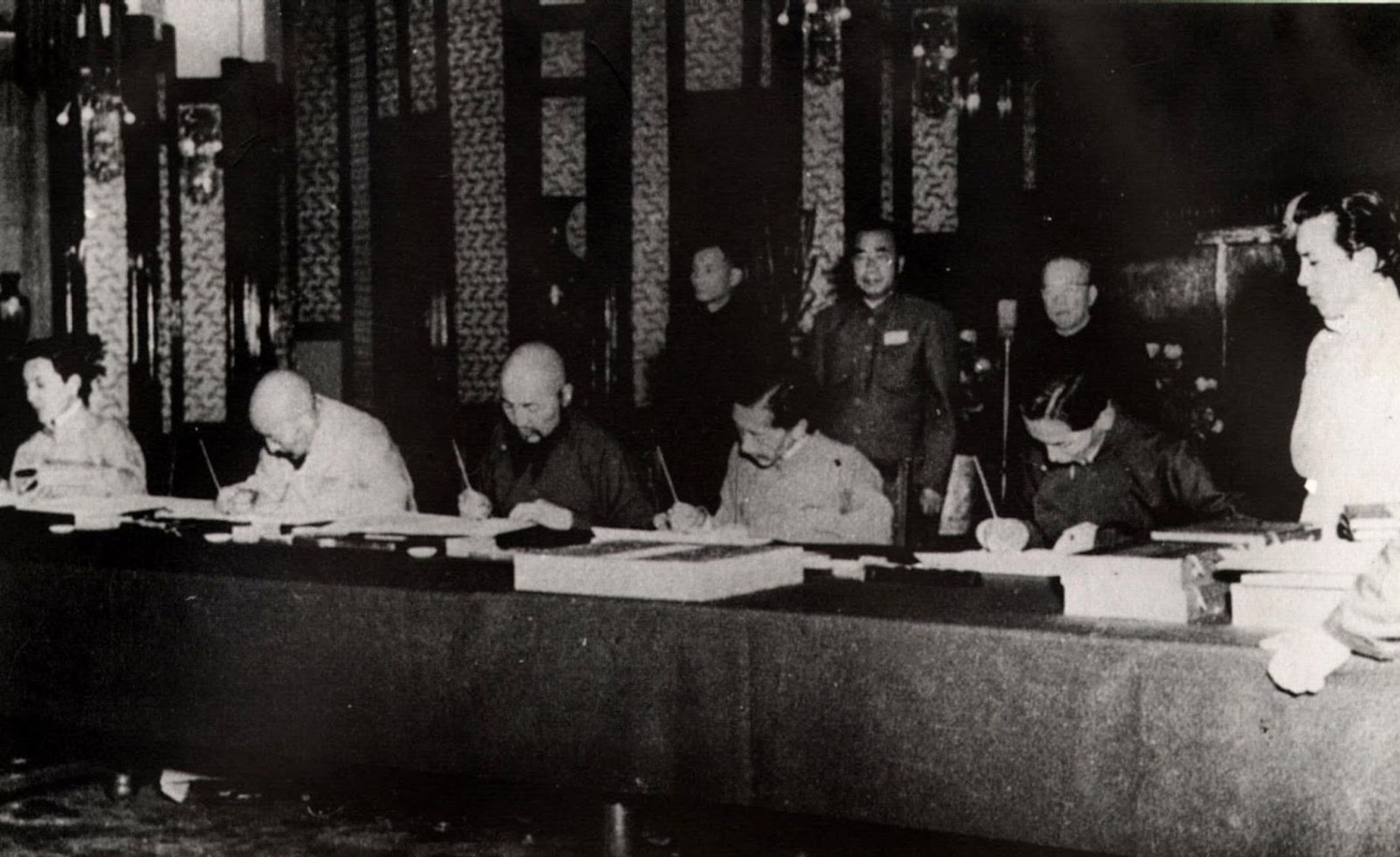
When he eventually came of age, the communist pressure on Tibet was already being felt and under duress, his officials signed an agreement with Chairman Mao for the “peaceful liberation” of Tibet.
Of course, by liberation, the communists meant suppression.
Still remarkably young, the Tibetan leader tried to appease Mao in the hope that the territory could maintain some of its independence, or at least its religious freedom.
At a banquet in Beijing, Mao impressed the Dalai Lama with his charm, and at one stage even applied to join the Communist Party. Any hopes that there could be peaceful co-existence were dashed, however, with many monks in open rebellion and a growing Chinese military presence.
Trouble flared in the capital Lhasa in March 1959, and amid fears that he might be captured by the Chinese, the Dalai Lama fled his palace. He crossed the border into India after an epic 15-day journey on foot over the Himalayan mountains.
Once the religious leader had gone into exile, the communist invaders seemed to lose all restraint and their opponents were often subjected to beatings and ritualised humiliation.
The death of Chairman Mao seemed to signal a softening of the treatment of Tibet. The new leader Deng Xiaoping fostered these hopes and even wanted the exiled Dalai Lama to return.
But exiled Tibetans who were invited to return on fact-finding missions encountered extreme poverty and intolerance of their religion. Monasteries had been destroyed, temples were used as slaughterhouses, and schoolchildren were not allowed to learn their own language.
In 2011, the Dalai Lama renounced his claim to lead his people as head of state in favour of a democratically elected layman. He now sees his role as that a teacher.
According to Alexander Norman, this makes perfect sense. The word lama is the Tibetan translation of the Sanskrit word guru – a spiritual guide. Communist tyrants may still hold a grip on China, but across the world, the teachings of the Tibetan holy man have echoed more loudly than the thoughts of Chairman Mao.
Indo Review
Whole Equilibrium – Balancing the Force – Tibetan David vs Chinese Goliath. Victory is Just a Stone’s Throw Away.Whole Equilibrium – Balancing the Force – Tibetan David vs Chinese Goliath. Victory is Just a Stone’s Throw Away.
Whole Trouble – Troubles of Tibet – Red China’s Cyberspace Expansionism
In my analysis, Communist China’s Beidou Satellite Navigation Network may succeed in the invasion of Tibetan Cyberspace but will utterly fail in defending China from an attack from Heavenly Domain.
Rudra Narasimham Rebbapragada
SPECIAL FRONTIER FORCE
Red China – Evil Empire-Isaiah 47: 10 and 11
Big data system keeps real-time track of visitors in Tibet – Global Times
Whole Trouble – Troubles of Tibet – Red China’s Cyberspace Expansionism
A Tibetan opera competition held in a park during the traditional Shoton Festival in Lhasa, Tibet Autonomous Region, on August 12, 2018, attracts numerous Tibetan people and tourists from home and abroad. Photo: VCG
Whole Trouble – Troubles of Tibet – Red China’s Cyberspace Expansionism
Tibet University installs a real-time monitoring electronic screen which can display the number of tourists in a given period and the specific number at any tourist attraction. Photo: Courtesy of Nyima Tashi
Whole Trouble – Troubles of Tibet – Red China’s Cyberspace Expansionism
This big data screen made its debut at this year’s Tourism and Culture Expo that kicked off in Lhasa, the capital of Tibet, in early September. The screen shows the distribution of Tibet’s natural resources including lakes, lands and rare wild species. Photo: Courtesy of Wang Sheng
As China enters the era of big data, a key university in Southwest China’s Tibet Autonomous Region is using this technical method to monitor the flow of tourists.
Analysts said the move will not only boost the tourism industry but also help safeguard regional stability and promote national unity.
Tibet University, the largest university in the region with an internationally renowned department of Tibetan studies, has established a big data center based on tourism information.
The center was jointly built by the university’s information and technology school and Beijing-based Wiseweb Technology Company, one of China’s leading companies that provide big data smart software and services. It was officially launched in early September.
Nyima Tashi, dean of the school, told the Global Times on Friday that the center aims to provide data support for the regional government to boost the local tourism industry and further accelerate the region’s openness to the world.
Nyima said the school installed a real-time monitoring electronic screen which could display the number of tourists in a given period and the specific number at any tourist attraction.
Moreover, it can show the background information of local tourist attractions and exhibit any trends of changing tourist preferences.
“In near future, the screen could also show more information about tourists, such as the origin of domestic and overseas tourists and their preferences of scenic spots, as long as the information does not invade personal privacy,” Nyima noted.
The big data screen made its debut at this year’s tourism and culture expo that kicked off in Lhasa, the capital of Tibet, in early September.
Wang Sheng, deputy manager of Wiseweb, told the Global Times on Thursday that the data aims to provide a reference for the regional government to monitor tourism market dynamics.
For example, the screen could display important events held in Tibet, ticket information, and the number of tourists in different scenic spots, he said.
“The real-time monitoring could give a warning to the government on negative social events,” Wang noted.
According to Wang, some data is captured from open sources on the internet while other data is purchased from tourist companies. For the next step, the company will obtain more data from different levels of government. “Possibly, the screen will show more information about overseas tourists,” said Wang.
The big data center impressed foreign visitors. Han Woo-duck, director of South Korea Central Daily China Institute, said in an article published on its website on September 18 that what marveled him most during his four-day visit to Tibet was not the Potala Palace or the Jokhang Monastery, but the big data center at Tibet University.
Han said the university’s staff led him to the center, and the changing data on the screen, shown as pie charts and bar graphs, could demonstrate the changes of tourists in real-time.
“It means that the Tibet University, in the deep heart of China, is building up a big data center. It marks a clear comparison with South Korea, where there is not any real-time information about the number of tourists in scenic spots or the major gathering spots of overseas tourists,” Han said in the article.
Tibet received a record 25.6 million domestic and foreign tourists in 2017, up 10.6 percent compared with the previous year, the Xinhua News Agency reported in January, citing regional authorities.
Tourism has become one of the pillar industries in the region. Tourism revenue during 2017 reached 37.9 billion yuan ($5.9 billion), with a year-on-year increase of 14.7 percent. Statistics showed that for the past five years, total tourism revenue in the region topped 130 billion yuan, said Xinhua.
Due to special ethnic traditions and environmental protection concerns, overseas tourists must get a permit from the regional tourist bureau before entering into Tibet.
From January to April, Tibet received nearly 40,000 foreign tourists, up 50.5 percent compared with the previous year.
“A big data system incorporating tourism information will help local governments manage the industry in a more orderly way and avoid accidents,” Xiong Kunxin, a professor of ethnic studies at the Minzu University of China in Beijing, told the Global Times on Friday.
In addition to sharing the beautiful scenery and cultural heritage with the outside world, developing tourism in Tibet is also an important move to safeguard regional stability, promote national unity, and guard against separatist forces, said Xiong.
Whole Trouble – Troubles of Tibet – Red China’s Cyberspace Expansionism