TIBET CONSCIOUSNESS – SAVE TIBETAN PLATEAU. KINGHO GROUP’S MINING OPERATION ENDANGERS QINGHAI PLATEAU.
To save Tibetan Plateau, we need to utterly defeat Red China’s Imperialism, a policy that seeks domination of world by exploiting raw materials, and natural resources and manipulation of global markets to flood nations with Made in China consumer goods.
Rudra Narasimham Rebbapragada Ann Arbor, MI 48104-4162 USA Special Frontier Force-Establishment 22-Vikas Regiment
UCANEWS.COM
November 27, 2015
FAITH, POLITICS AND WATER COLLIDE IN BID TO SAVE TIBETAN PLATEAU
Crucial water source needs protection, but politics could get in the way during Paris climate summit
TIBET CONSCIOUSNESS – SAVE TIBETAN PLATEAU. DEFEAT RED CHINA’S IMPERIALISM.
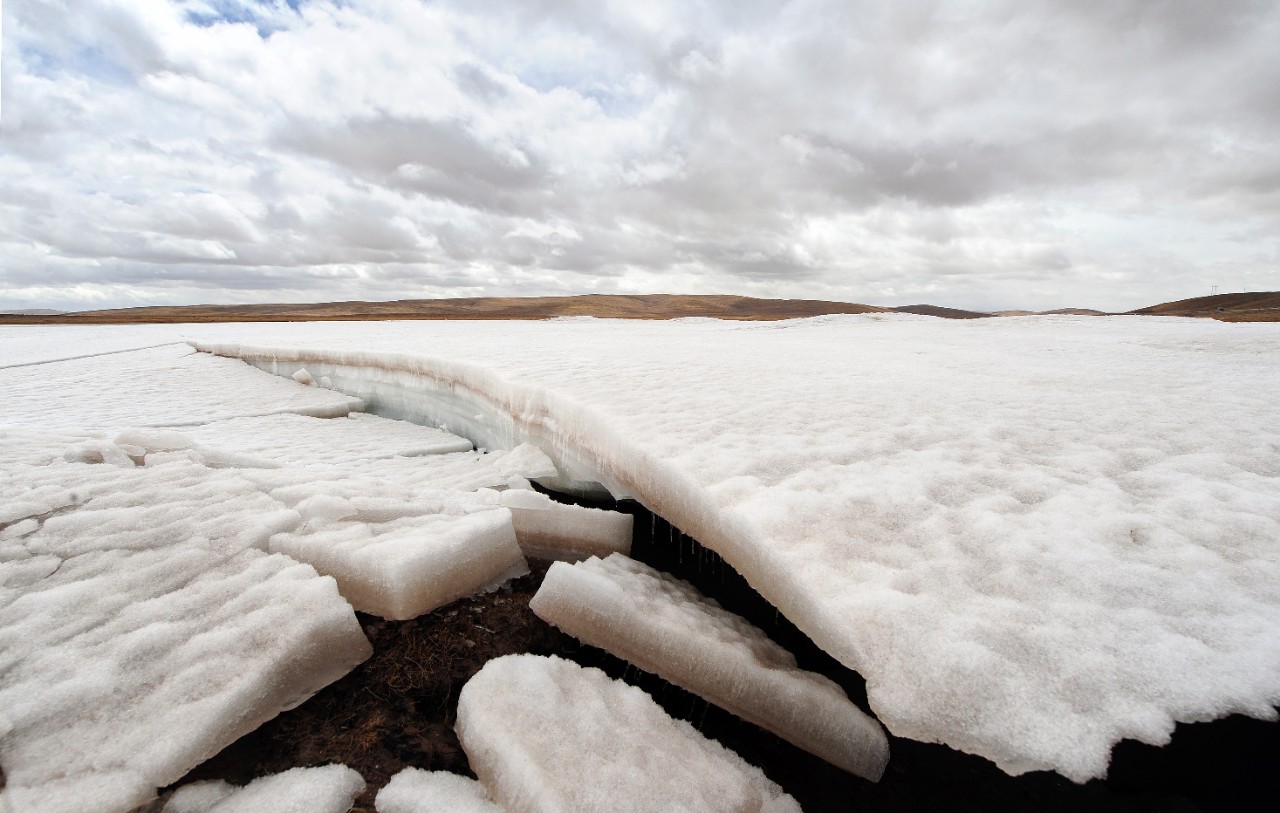
Ice melts from a glacier outside of Maduo, Qinghai province, on the Tibetan Plateau, known as the “roof of the world.” (Photo by Frederic J. Brown/AFP)
ucanews.com reporter, Beijing
China
November 27, 2015
When the Dalai Lama and state-run Chinese Academy of Sciences recently issued separate takes on environmental dangers facing the Tibetan Plateau, there was rare agreement.
The academy warned of dangerous rises in temperature above the world average on the “roof of the world,” while Tibet’s spiritual leader delivered an emotional warning that two-thirds of the region’s glaciers could disappear by 2050.
“The Tibetan Plateau needs to be protected, not just for Tibetans but for the environmental health and sustainability of the entire world,” said the Dalai Lama. But his demands for a stake in the critical climate talks in Paris, which begin Nov. 30, enraged the Chinese government.
“The Dalai Lama clique” was angling for Tibetan independence with “sinister intentions,” state-run news site Tibet.cn said in an editorial on Nov. 23.
As Beijing officials, state-approved nongovernmental groups, representatives of Tibet’s exiled government and activists head to Paris, all sides claim to represent the best interests of this fragile Himalayan region. Can they finally strike a balance to curb alarming signs of environmental degradation?
THE THIRD POLE
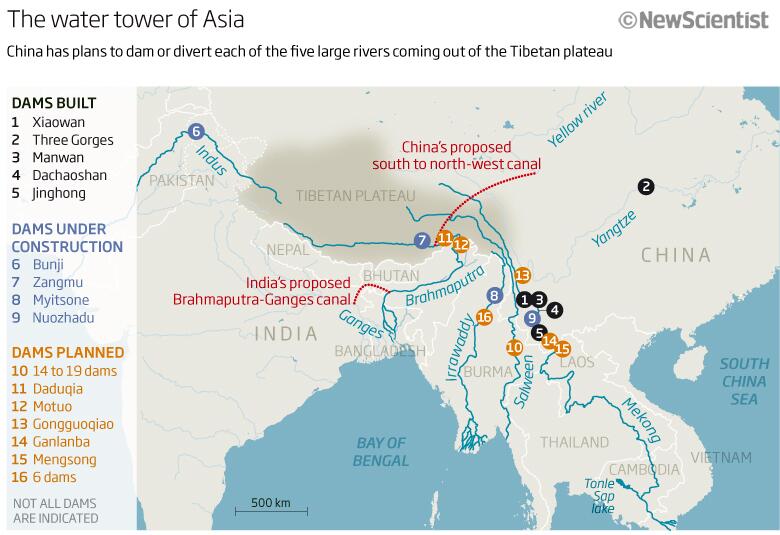
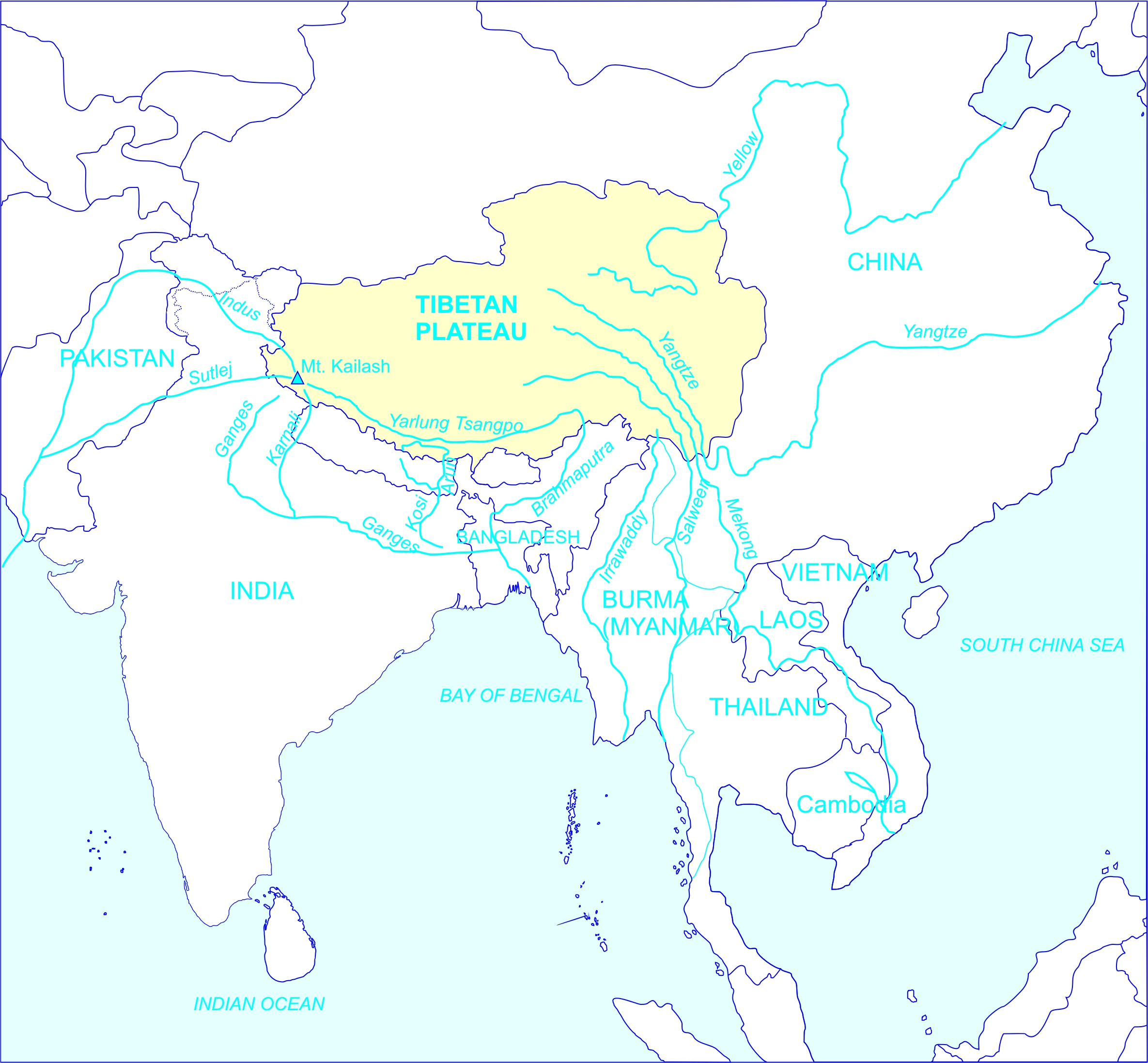
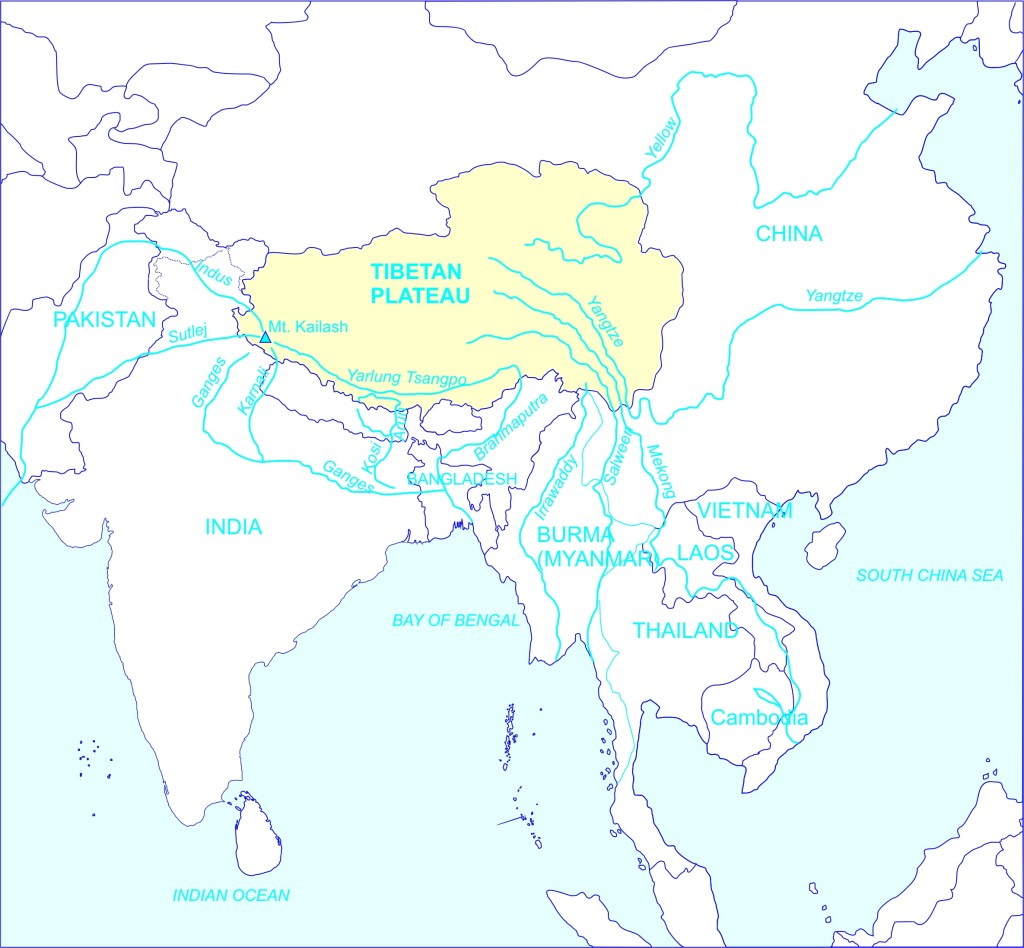
Known as the “third pole” — the largest source of freshwater outside of the Arctic and the Antarctic — the Tibetan Plateau represents a water tower of glaciers, permafrost and freshwater lakes that trickle down to form among the mightiest rivers in the world. The Yellow River, the third-largest in Asia, originates here, so too India’s holy Ganges and the Brahmaputra, which join before emptying into the Bay of Bengal.
About 25 percent of the world’s population depend on rivers originating from the snow and ice on the Tibetan Plateau.
When Chinese officials arrive in Paris for the United Nations climate change conference, they will submit a report that points to worrying trends. Glaciers are melting at faster speeds than during the 1990s, and the number of fresh water lakes on the plateau has increased from 1,081 to 1,236 due to melting glaciers or permafrost — scientists don’t agree on this yet. Meanwhile, natural disasters on the Tibetan Plateau are increasing in number. The cause: Temperatures here are rising more than the world average, according to the Chinese Academy of Sciences report.
TIBET CONSCIOUSNESS – SAVE TIBETAN PLATEAU. DEFEAT RED CHINA’S IMPERIALISM TO SAVE MEKONG RIVER AND OTHERS.
A boat travels across the Mekong River near Phnom Penh, Cambodia. About 25 percent of the world’s population depend on rivers originating from the snow and ice on the Tibetan Plateau. (Photo by Tang Chhin Sothy/AFP)
While the warnings are stark, it remains unclear whether Beijing is telling us the full picture. Chinese scientists have become increasingly willing to share their data on Tibet in recent years.
But there is still a sense that findings are being held back, said Walter Immerzeel, a hydrologist at Holland-based consultants FutureWater, who has worked on and around the Tibetan Plateau for more than a decade.
“The most critical, I think, is for hydrological data in particular of the large river systems like the Brahmaputra, which flows in Bangladesh,” he said. “There are geopolitical tensions between those countries and this is usually why hydrological data is restricted. So even though it’s there, it’s usually not accessible to the scientific community.”
Countries like Bangladesh have complained that Beijing essentially controls the levers to the floodgates that determine water flow downstream following the construction of hydropower dams on the Tibetan Plateau. Beijing argues they are vital for providing clean energy as the country moves away from coal.
The Chinese Academy of Sciences report to be presented in Paris will note government policies to combat climate change that “have received remarkable results,” according to the nationalistic tabloid Global Times.
In recent years, China has gone from zero to hero during global environmental meetings. Last September, China signed a landmark agreement with the United States targeting a one-fifth reduction in carbon dioxide emissions — currently the highest in the world — by 2030. Beijing has also been more proactive in punishing river and air polluters, at least in more developed eastern China, while dramatically increasing the use of renewable energy including solar, wind and hydropower.
But critics warn a drive to develop Tibet’s economy — while restricting access to this politically sensitive region — means that while polluting industries are being scaled back in the booming east, on the Tibetan plateau in the west they are expanding.
‘A GROWING CANCER’
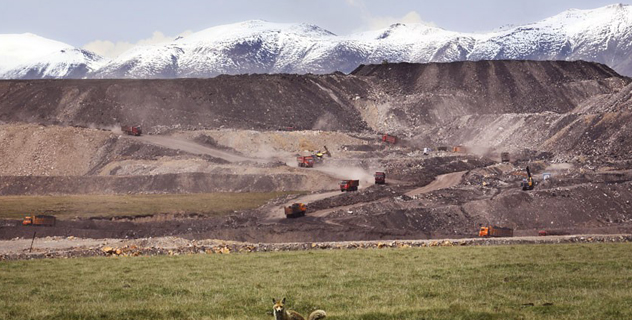
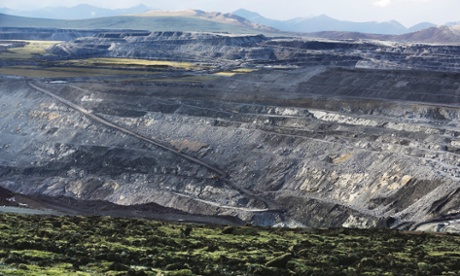
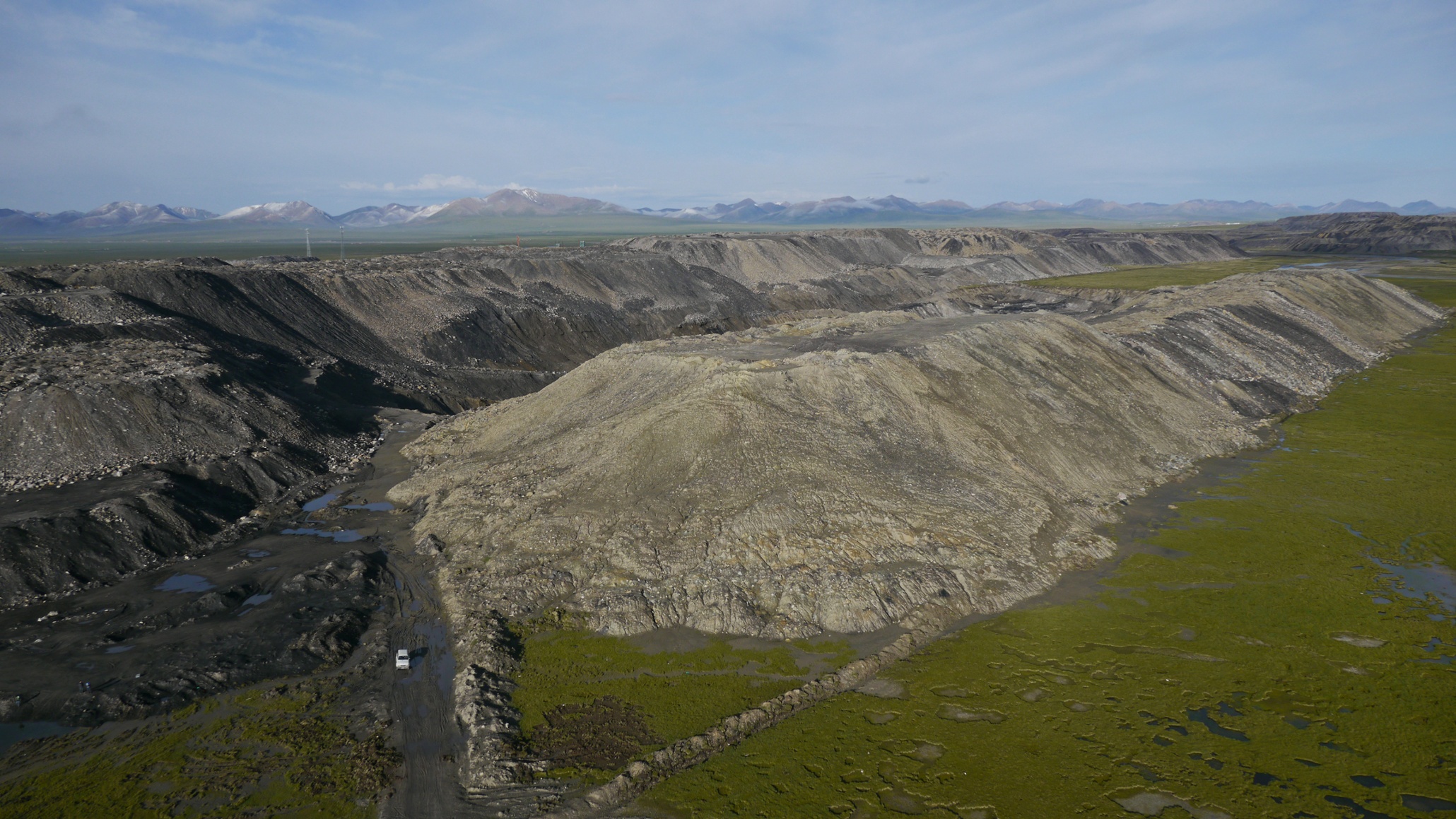
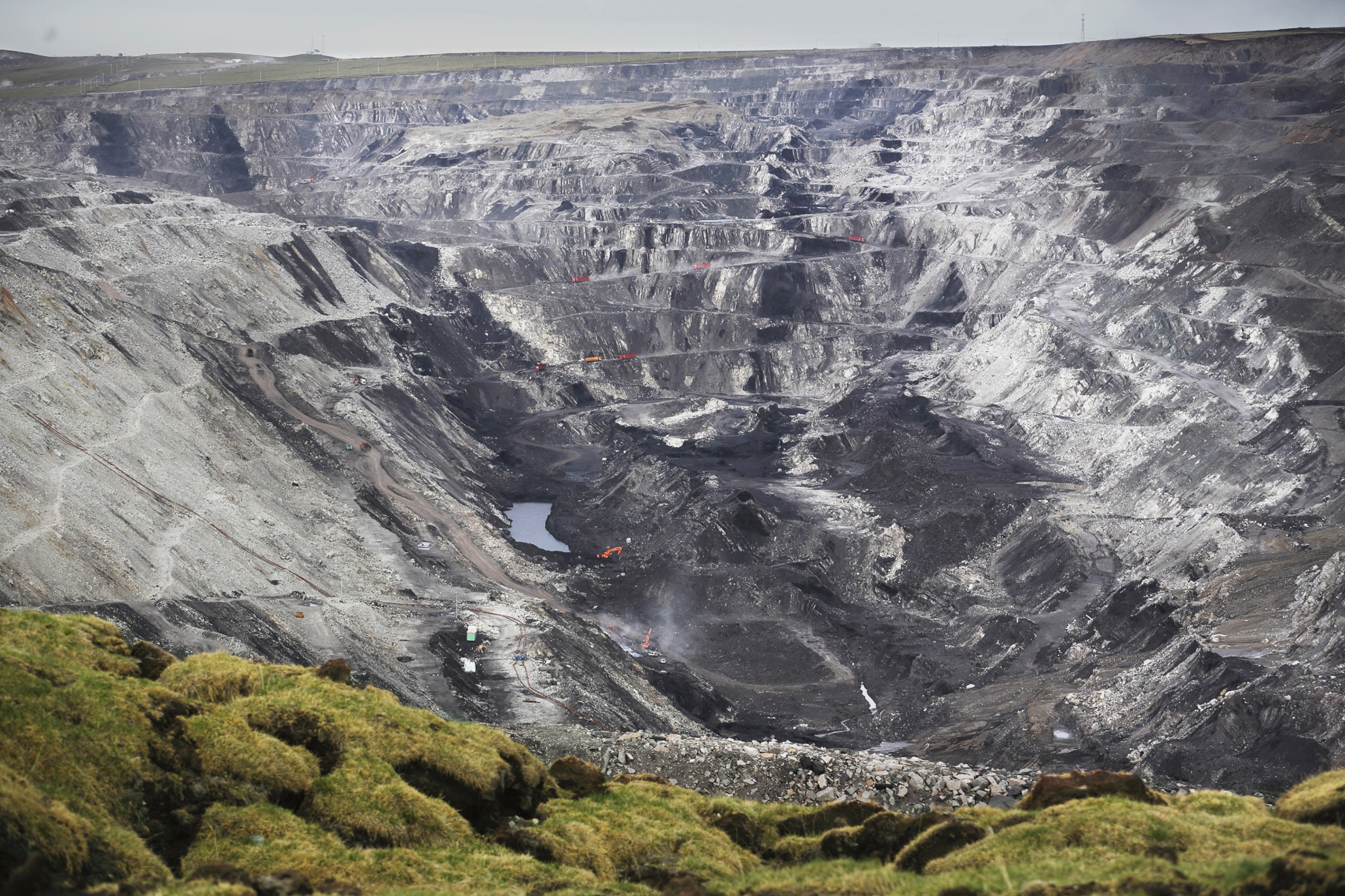
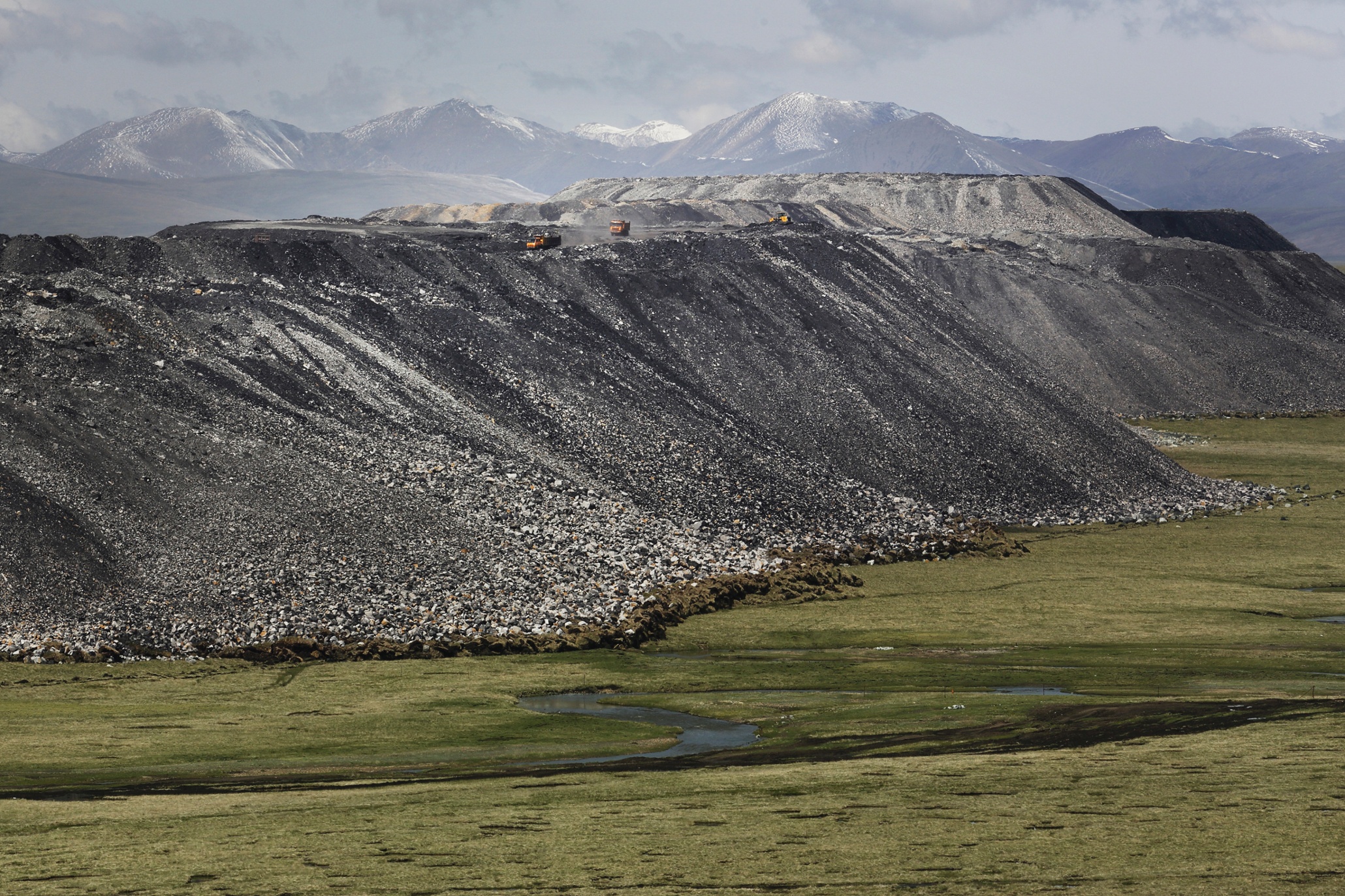
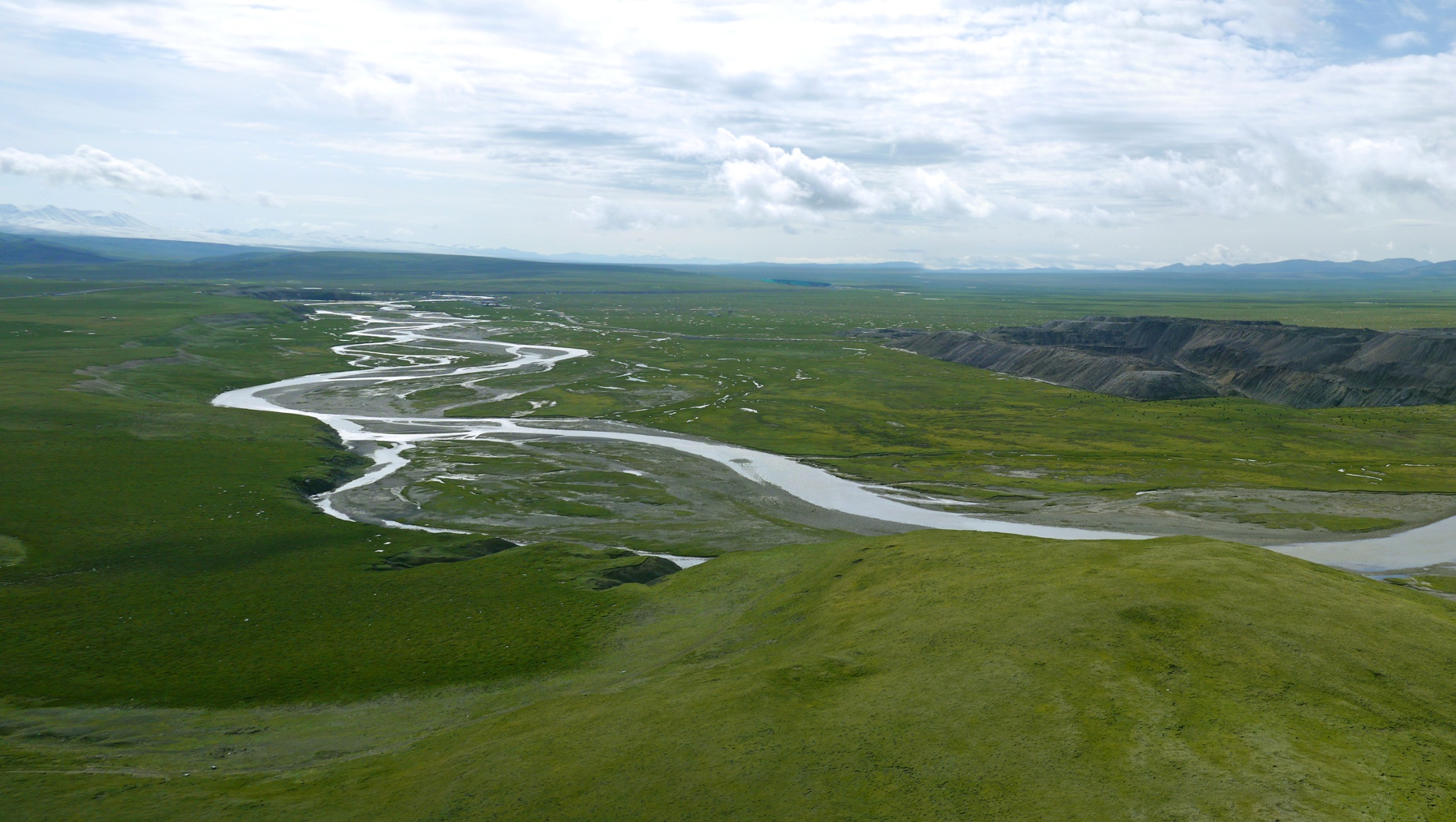
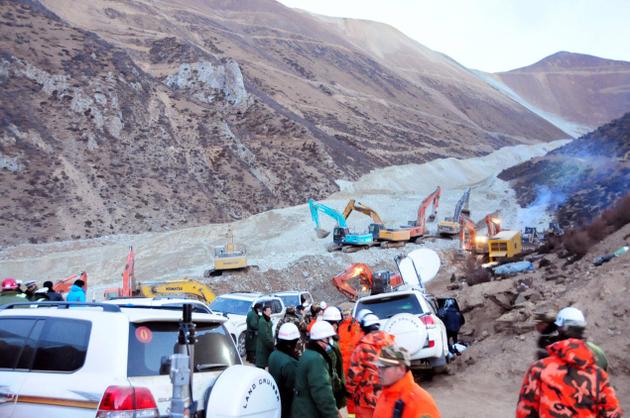
In August last year, Greenpeace reported a huge illegal coal mine on the Tibetan Plateau in Qinghai province risked polluting the source of the Yellow River. Fourteen times the size of London, the Muli coalfield had “destroyed” alpine meadows connecting glaciers to the plateau.
“The Muli coalfield is a growing cancer on an otherwise intact alpine ecological system,” Greenpeace said.
China Kingho, the company operating the coal field, says on its website the local area had benefitted from its construction of a highway where once there was only a single road “which gives easy access to major traffics [sic].” The company did not respond to emailed questions.
Among the estimated 7.5 million-plus Tibetans who live on the plateau, the majority of whom are Buddhist, protests against mining and hydropower projects remain common.
In October 2013, a contaminated pond at a mine overflowed into nearby rivers in Tagong township on the eastern edge of the plateau, causing fish and livestock to die up to 30 kilometers away, London-based Tibet Watch reported in February.
“If you don’t stop doing this, one day we will die like the fish killed by contaminated water,” wrote one of many angry Tibetans on the microblogging site Weibo. Locals dumped dead fish outside of government offices as they took their protest to county officials, who promised to raise the issue with higher authorities. But nothing was ever done, reported Tibet Watch.
While Chinese consider all protests in Tibet a challenge to Communist Party rule and therefore the unity of China, ordinary Tibetans see environmental damage as a blow against everything: livelihood, life and faith.
“The very nature of life on this planet is that of interdependence,” Karmapa Trinley Thaye Dorje, the third-most senior Tibetan spiritual leader, told ucanews.com. “Therefore if the environment suffers, we suffer as well.”
A decade after fleeing Tibet in 1999, Karmapa set up an association of monasteries in India, Nepal and Bhutan to set up environmental projects, including solar power and reforestation aimed at reversing climate change on the Tibetan Plateau.
Remaining cautiously optimistic about the crucial climate summit in Paris, he said there were growing signs environmental problems were being taken more seriously by many governments — without naming China.
“I sincerely pray that a global agreement emerges from the Paris negotiations and it serves the greater good rather than a handful of countries,” he said.
Next week in the French capital, China will be represented by an army of state officials as it engages in complex negotiations designed to thrash out a global cap on emissions. By contrast, the exiled Tibetan government’s delegation is made up of just one person, said Mandie Keown, a campaign coordinator for the International Tibet Network.
A team of campaigners in and around the meetings will meet with ministers while others generate discussion on social media, she said — the aim being to generate awareness of issues hushed up by Beijing, including hydropower.
“It’s obviously a battle doing that because China is seen as one of the main countries that is going to help alleviate climate change,” Keown told ucanews.com. “So it is a very difficult time to raise these serious issues. It’s such a closed off region.”
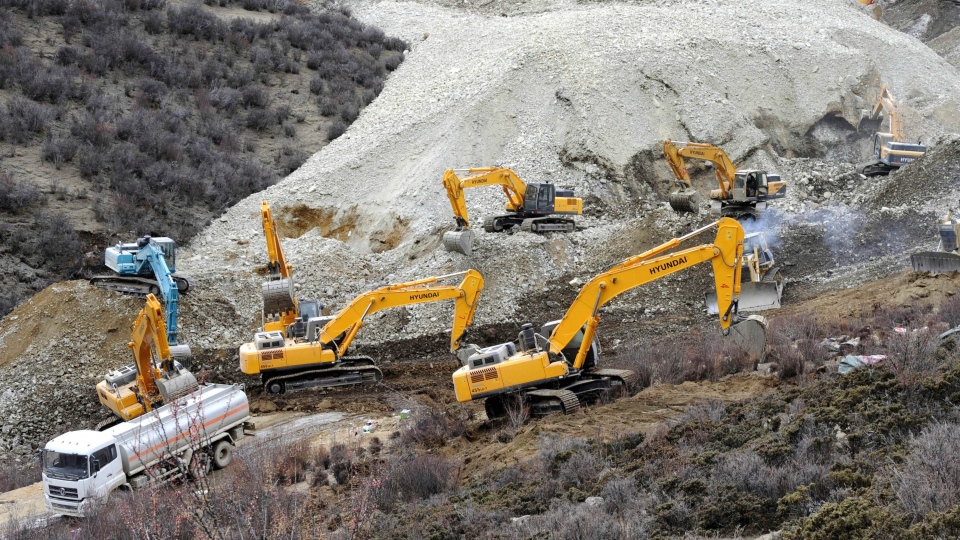
TIBET CONSCIOUSNESS – SAVE TIBETAN PLATEAU. DEFEAT RED CHINA’S IMPERIALISM. ILLEGAL COAL MINE SYMBOLIZES TIBET’S EXPLOITATION.TIBET CONSCIOUSNESS – SAVE TIBETAN PLATEAU. DEFEAT RED CHINA’S IMPERIALISM. MULI COALFIELD RUN BY THE KINGHO ENERGY GROUP, QINGHAI, TIBET.TIBET CONSCIOUSNESS – SAVE TIBETAN PLATEAU. DEFEAT RED CHINA’S IMPERIALISM. ILLEGAL COAL MINE IMPACTS YELLOW RIVER UPPER BASIN.TIBET CONSCIOUSNESS – SAVE TIBETAN PLATEAU. DEFEAT RED CHINA’S IMPERIALISM. ILLEGAL COAL MINE IMPACTS YELLOW RIVER UPPER BASIN.TIBET CONSCIOUSNESS – SAVE TIBETAN PLATEAU – DEFEAT RED CHINA’S IMPERIALISM. ILLEGAL COAL MINE IMPACTS YELLOW RIVER UPPER BASIN.TIBET CONSCIOUSNESS – SAVE TIBETAN PLATEAU. DEFEAT RED CHINA’S IMPERIALISM. SAVE YELLOW RIVER FROM IMPACTS BY CHINA’S ILLEGAL COAL MINING ACTIVITY.
Tibet Awareness – Red China Looting and Plundering Tibet
Red China’s practices in Tibet; her indiscriminate taking of Tibetan national assets causing severe environmental pollution with toxic chemicals, massive hydro projects leading to major ecological disaster in Tibet, have to be treated as War Crimes. Red China must be tried by a War Crimes Tribunal and held accountable for stealing Tibet’s national wealth and property.
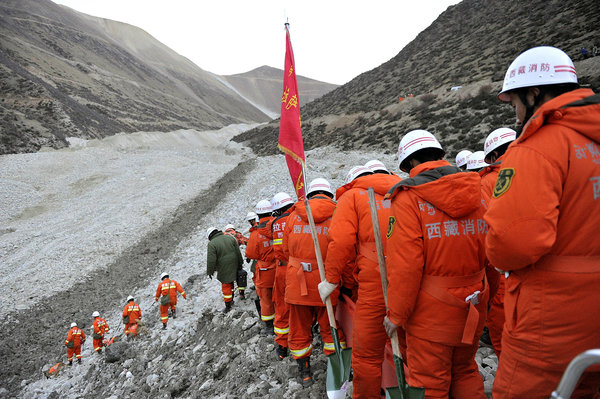
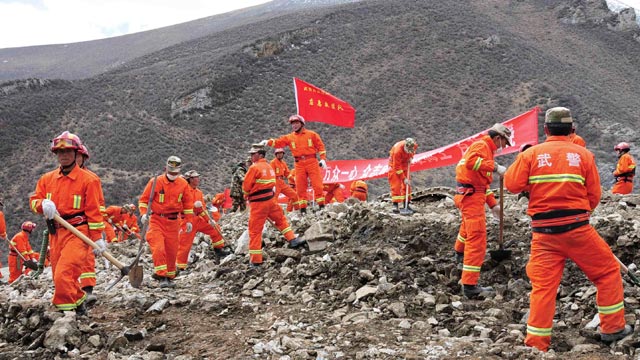
Red China used her military force to attack Tibet and occupied the country since 1950. After driving His Holiness the 14th Dalai Lama into exile, Red China unleashed a systematic campaign to loot, plunder, pillage, sack, ransack, steal, and despoil Tibetan natural resources without any concern for international law. Red China is encouraging foreign companies to join her in illegal exploration for mineral wealth and criminal mining operations. Such activities get media attention if a disaster strikes mining operation. Gold and Copper mining operations in Gyama Valley, Maizhokunggar County of Lhasa came to world’s attention when a massive landslide on March 29, 2013 killed 83 employees of Tibet Huatailong Mining Development Company, subsidiary of the state-run China National Gold Group. Red China is world’s largest producer of Gold and other Rare Earth Minerals. Red China’s practices in Tibet; her indiscriminate taking of Tibetan national assets causing severe environmental pollution with toxic chemicals, massive hydro projects leading to major ecological disaster in Tibet, have to be treated as War Crimes. Red China must be tried by a War Crimes Tribunal and held accountable for stealing Tibet’s national wealth and property.
Rudra Narasimham Rebbapragada Ann Arbor, MI 48104-4162, USA Special Frontier Force-Establishment 22-Vikas Regiment
Red China’s practices in Tibet; her indiscriminate taking of Tibetan national assets causing severe environmental pollution with toxic chemicals, massive hydro projects leading to major ecological disaster in Tibet, have to be treated as War Crimes. Red China must be tried by a War Crimes Tribunal and held accountable for stealing Tibet’s national wealth and property.Red China’s practices in Tibet; her indiscriminate taking of Tibetan national assets causing severe environmental pollution with toxic chemicals, massive hydro projects leading to major ecological disaster in Tibet, have to be treated as War Crimes. Red China must be tried by a War Crimes Tribunal and held accountable for stealing Tibet’s national wealth and property.Red China’s practices in Tibet; her indiscriminate taking of Tibetan national assets causing severe environmental pollution with toxic chemicals, massive hydro projects leading to major ecological disaster in Tibet, have to be treated as War Crimes. Red China must be tried by a War Crimes Tribunal and held accountable for stealing Tibet’s national wealth and property.Red China’s practices in Tibet; her indiscriminate taking of Tibetan national assets causing severe environmental pollution with toxic chemicals, massive hydro projects leading to major ecological disaster in Tibet, have to be treated as War Crimes. Red China must be tried by a War Crimes Tribunal and held accountable for stealing Tibet’s national wealth and property.Red China’s practices in Tibet; her indiscriminate taking of Tibetan national assets causing severe environmental pollution with toxic chemicals, massive hydro projects leading to major ecological disaster in Tibet, have to be treated as War Crimes. Red China must be tried by a War Crimes Tribunal and held accountable for stealing Tibet’s national wealth and property.Red China’s practices in Tibet; her indiscriminate taking of Tibetan national assets causing severe environmental pollution with toxic chemicals, massive hydro projects leading to major ecological disaster in Tibet, have to be treated as War Crimes. Red China must be tried by a War Crimes Tribunal and held accountable for stealing Tibet’s national wealth and property.Red China’s practices in Tibet; her indiscriminate taking of Tibetan national assets causing severe environmental pollution with toxic chemicals, massive hydro projects leading to major ecological disaster in Tibet, have to be treated as War Crimes. Red China must be tried by a War Crimes Tribunal and held accountable for stealing Tibet’s national wealth and property.
China Stages Mass Spectacle in Tibet to Mark 50 Years’ Rule
BEIJING — Sep 8, 2015, 9:22 AM ET
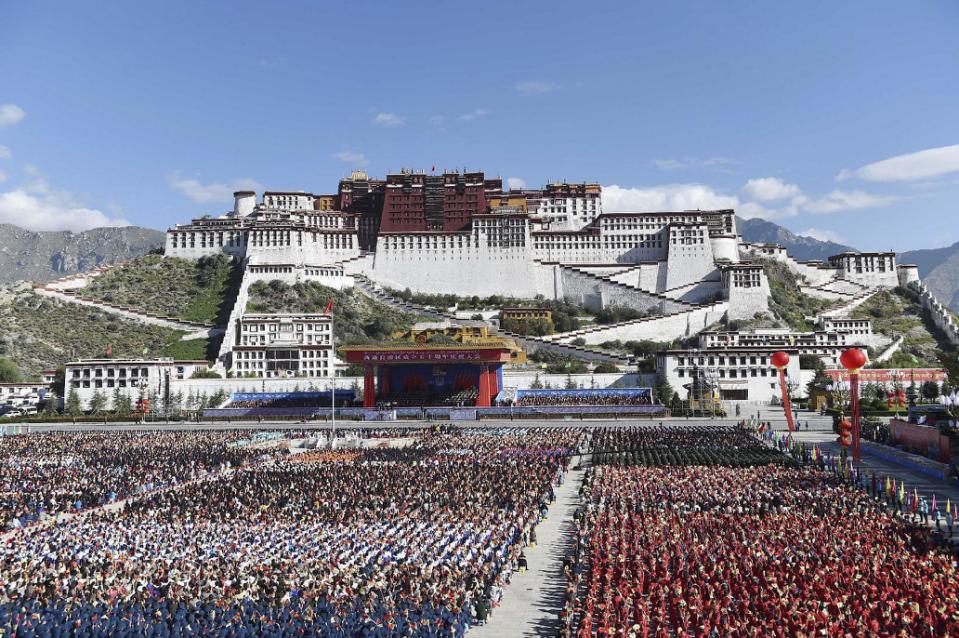
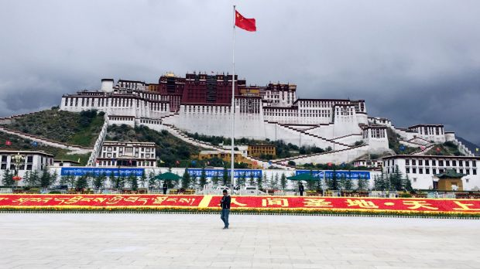
In this photo released by China’s Xinhua News Agency, a grand ceremony marking the 50th anniversary of the founding of the Tibet Autonomous Region is held at the square of the Potala Palace in Lhasa, capital of Tibet Autonomous Region, Tuesday, Sept. 8, 2015. (Chen Yehua/Xinhua via AP) Red China’s practices in Tibet; her indiscriminate taking of Tibetan national assets causing severe environmental pollution with toxic chemicals, massive hydro projects leading to major ecological disaster in Tibet, have to be treated as War Crimes. Red China must be tried by a War Crimes Tribunal and held accountable for stealing Tibet’s national wealth and property.
In this photo released by China’s Xinhua News Agency, a grand ceremony marking the 50th anniversary of the founding of the Tibet Autonomous Region is held at the square of the Potala Palace in Lhasa, capital of southwest China’s Tibet Autonomous Region, Tuesday, Sept. 8, 2015. (Chen Yehua/Xinhua via AP) The Associated Press
Schoolchildren waved flags and paramilitary troops marched in full battle dress at a mass spectacle China staged Tuesday to mark 50 years since establishing Tibet as an ethnic autonomous region firmly under Beijing’s control.
The event lauded Tibet’s economic successes under Communist Party rule, even as activists criticized its record on human rights.
Top political adviser Yu Zhengsheng stressed Tibet’s unity with the rest of China in his address to thousands gathered in front of the stunning Potala Palace in the regional capital of Lhasa, once home to the Dalai Lama and now a museum.
“During the past 50 years the Chinese Communist Party and the Tibetan people have led the transformation from a backward old Tibet to a vibrant socialist new Tibet,” Yu told the audience of schoolchildren, soldiers, armed police and party officials applauding and waving flags.
People’s living standards have improved, infrastructure has been built across Tibet and its gross domestic product had grown 68 times, Yu said at the ceremony broadcast live on state television.
Yu’s speech was followed by a parade of goose-stepping marchers carrying the national emblem of China, along with portraits of past and present leaders, including President Xi Jinping. Dancers and musicians in traditional Tibetan dress also performed, although there was no visible participation by representatives of the Buddhist clergy that forms the backbone of the Himalayan region’s traditional culture.
Beijing sent troops to occupy the Himalayan region following the 1949 communist revolution. The government says the region has been part of Chinese territory for centuries, while many Tibetans say it has a long history of independence under a series of Buddhist leaders.
The region’s traditional Buddhist ruler, the Dalai Lama, fled in 1959 amid an abortive uprising against Chinese rule, and continues to advocate for a meaningful level of autonomy under Chinese rule.
China established the Tibetan autonomous region in 1965, one of five ethnic regions in the country today. While Tibet is nominally in charge of its own affairs, its top officials are appointed by Beijing and expected to rule with an iron fist. The region incorporates only about half of Tibet’s traditional territory, is closed to most foreign media and has been smothered in multiple layers of security ever since deadly anti-government riots in 2008.
Reinforcing the importance of strict control from Beijing, the party’s central committee said in a statement that; “Only by sticking to the CPC’s (Communist Party’s) leadership and the ethnic autonomy system, can Tibetans be their own masters and enjoy a sustainable economic development and long-term stability.” Referring to the Dalai Lama, Yu said activities by him and others to “split China and undermine ethnic unity have been defeated time and time again.”
Free Tibet, a London-based rights group, said Beijing was trying to define Tibetan identity according to its priorities, and that Tibetans suffered restrictions on movement, censorship and lived in a system designed to punish opposition to the Beijing government.
“If Tibet’s people have a good news story to tell, why doesn’t Beijing let them freely tell it or give the world’s media the opportunity to freely see it?” the group said. The 80-year-old Dalai Lama is in Britain this month for speaking engagements and had no immediate comment.
Tuesday’s event reflects Xi’s taste for organized spectacle, in a throwback to the mass rallies common in the early decades of communist rule. It comes less than a week after a massive military parade in Beijing to mark 70 years since Japan’s surrender at the end of World War II.
Red China’s practices in Tibet; her indiscriminate taking of Tibetan national assets causing severe environmental pollution with toxic chemicals, massive hydro projects leading to major ecological disaster in Tibet, have to be treated as War Crimes. Red China must be tried by a War Crimes Tribunal and held accountable for stealing Tibet’s national wealth and property.Red China’s practices in Tibet; her indiscriminate taking of Tibetan national assets causing severe environmental pollution with toxic chemicals, massive hydro projects leading to major ecological disaster in Tibet, have to be treated as War Crimes. Red China must be tried by a War Crimes Tribunal and held accountable for stealing Tibet’s national wealth and property.Red China’s practices in Tibet; her indiscriminate taking of Tibetan national assets causing severe environmental pollution with toxic chemicals, massive hydro projects leading to major ecological disaster in Tibet, have to be treated as War Crimes. Red China must be tried by a War Crimes Tribunal and held accountable for stealing Tibet’s national wealth and property.Red China’s practices in Tibet; her indiscriminate taking of Tibetan national assets causing severe environmental pollution with toxic chemicals, massive hydro projects leading to major ecological disaster in Tibet, have to be treated as War Crimes. Red China must be tried by a War Crimes Tribunal and held accountable for stealing Tibet’s national wealth and property.Red China’s practices in Tibet; her indiscriminate taking of Tibetan national assets causing severe environmental pollution with toxic chemicals, massive hydro projects leading to major ecological disaster in Tibet, have to be treated as War Crimes. Red China must be tried by a War Crimes Tribunal and held accountable for stealing Tibet’s national wealth and property.
The term ‘tyrant’ describes any person who exercises authority in an oppressive manner, a cruel master, despot, absolute ruler who is unwilling for arbitration. Red China governs as a tyrant
The term ‘tyrant’ describes any person who exercises authority in an oppressive manner, a cruel master, despot, absolute ruler who is unwilling for arbitration. Red China governs as a tyrant. Apart from being harsh, cruel, oppressive, and unjust, the tyrannical rule imposed by Red China over illegally occupied Tibet is characterized by Red China’s use of any kind of pretext to justify its tyranny. When the oppressor intends to be unjust, no argument will succeed. A tyrant will always find a pretext for his tyranny and it is useless for the victim to try by reasoning to get justice. Red China to justify its military grip over Tibet claims that She liberated Tibet and emancipated Tibetan people from feudal Lords.
The stories popularly known as Aesop’s Fables include a story titled ‘The Wolf and The Lamb’ in which, a Lamb finds no choice other than that of losing his life for the Wolf, a tyrant is unwilling to accept any reasoning with which Lamb pleaded to save his life.
The Wolf and the Lamb:
The term ‘tyrant’ describes any person who exercises authority in an oppressive manner, a cruel master, despot, absolute ruler who is unwilling for arbitration. Red China governs as a tyrant
Once upon a time, a Wolf was lapping at a stream, when looking up, the Wolf saw a Lamb just beginning to drink a little lower down the stream.
“There’s my supper”, thought the Wolf, “If only I can find some excuse to seize it.” Then he called out to the Lamb, “How dare you muddle the water from which I am drinking?”
“Nay, Master, nay,” said Lambikin, “If the water be muddy up there, I cannot be the cause of it, for it runs down from you to me.”
“Well then,” said the Wolf, “Why did you call me bad names this time last year?”
“That cannot be,” said the Lamb, “I am only six months old.”
“I don’t care,” snarled the Wolf, “If it was not you it was your father,” and with that he rushed upon the poor little Lamb, seized him and ate him up saying, “Well I won’t remain supperless even though you refute every one of my imputations.”
But before he died, Lamb gasped out, “Any excuse will serve a tyrant.”
In my view, the United States and its allies in Asia cannot win their argument about territorial boundaries in South China Sea. Red China is a tyrant who will use any excuse to justify her actions to expand her maritime boundaries. To address the problem of Red China’s tyranny, the global community of nations must begin with ‘The Great Problem of Tibet’ and evict the illegal occupier of Tibet.
Rudra Narasimham Rebbapragada Ann Arbor, MI 48104-4162, USA
U.S. HOPES CHINESE ISLAND-BUILDING WILL SPUR ASIAN RESPONSE
Reuters
By David Alexander
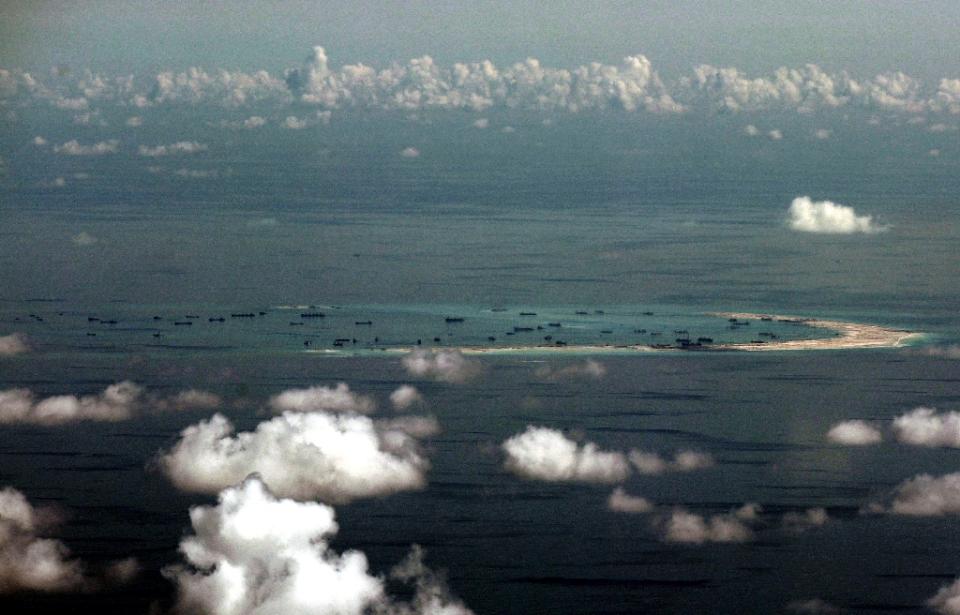
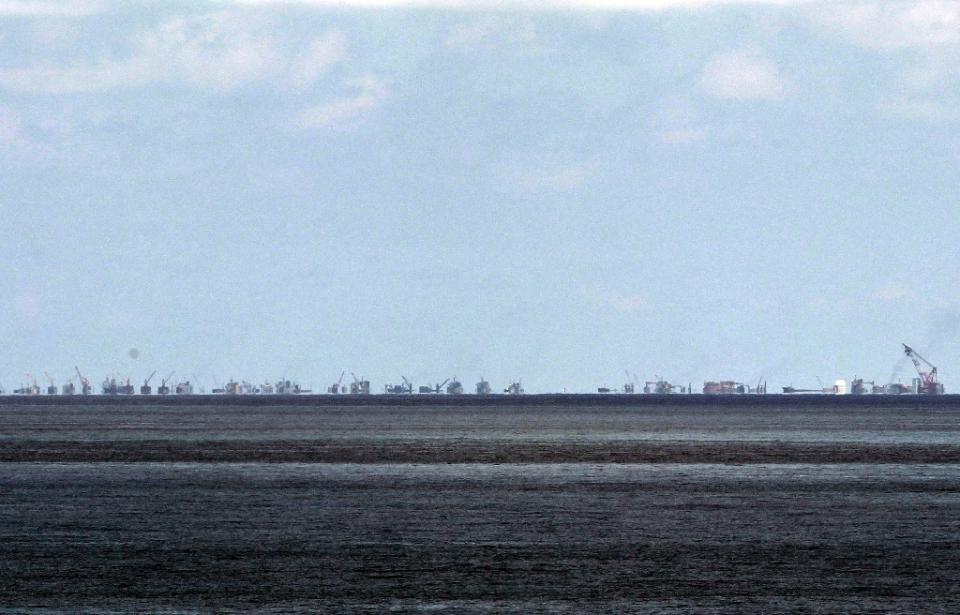
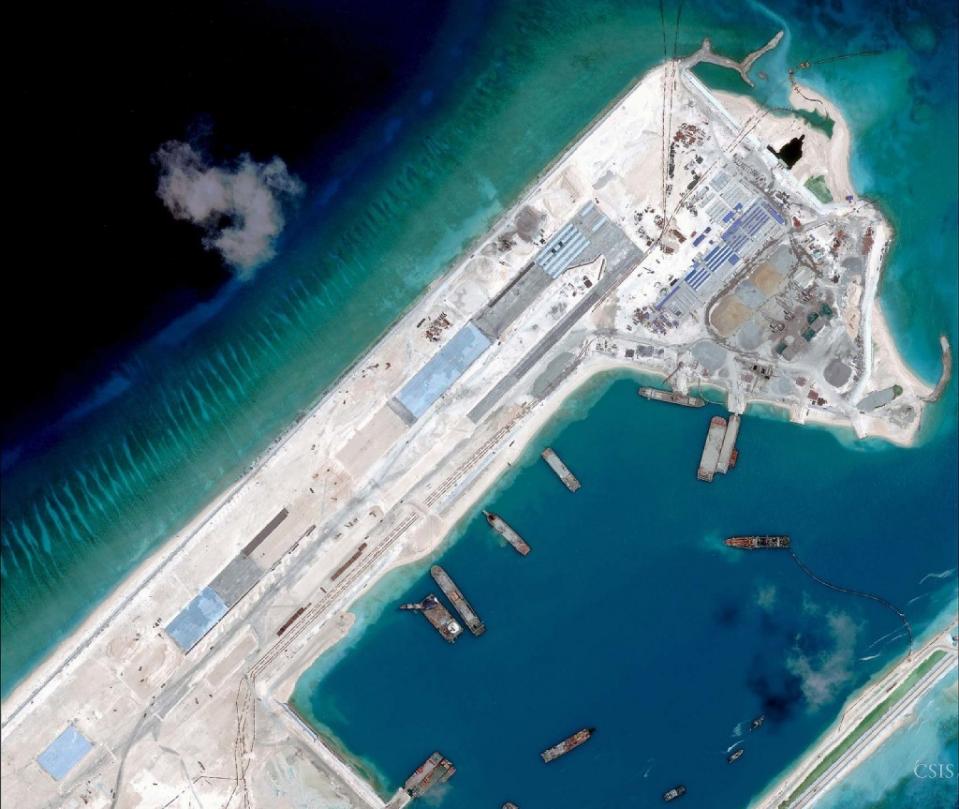
By releasing video of Beijing’s island reclamation work and considering more assertive maritime actions, the United States is signaling a tougher stance over the South China Sea and trying to spur Asian partners to more action.
The release last week of the surveillance plane footage – showing dredgers and other ships busily turning remote outcrops into islands with runways and harbors – helps ensure the issue will dominate an Asian security forum starting on Friday attended by U.S. Defense Secretary Ash Carter as well as senior Chinese military officials.
As it pushes ahead with a military “pivot” to Asia partly aimed at countering China, Washington wants Southeast Asian nations to take a more united stance against China’s rapid acceleration this year of construction on disputed reefs.
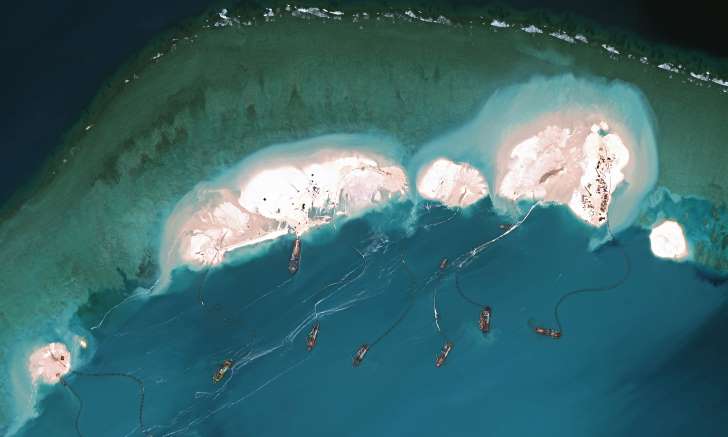
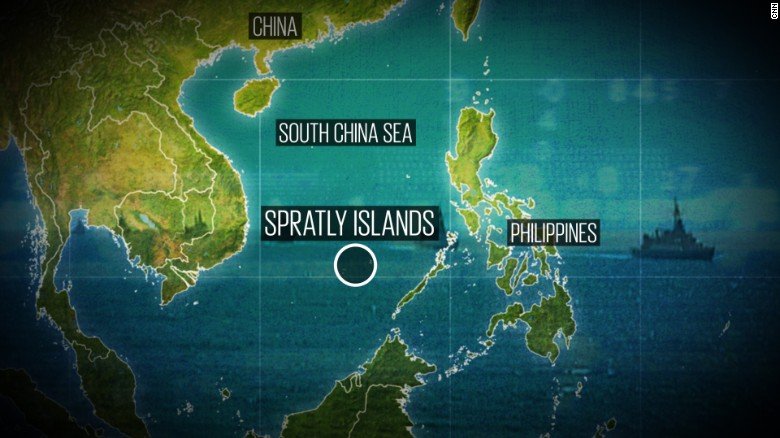
The meeting, the annual Shangri-La Dialogue in Singapore, will be overshadowed by the tensions in the South China Sea, where Beijing has added 1,500 acres to five outposts in the resource-rich Spratly islands since the start of this year.
“These countries need to own it (the issue),” one U.S. defense official said on condition of anonymity, adding that it was counterproductive for the United States to take the lead in challenging China over the issue.
Red China – Land Reclamation Activity in South China Sea.
More unified action by the partners, including the 10-member Association of Southeast Asian Nations (ASEAN), needed to happen soon because “if you wait four years, it’s done,” the official said.
While some ASEAN members, including U.S. ally the Philippines and fellow claimant Vietnam, have been vocal critics of Chinese maritime actions, the group as a whole has been divided on the issue and reluctant to intervene.
But in a sign of growing alarm, the group’s leaders last month jointly expressed concern that reclamation activity had eroded trust and could undermine peace in the region.
Experts dismiss the idea of ASEAN-level joint action any time soon in the South China Sea. “It’s absolute fantasy,” said Ian Storey of Singapore’s Institute on South East Asian Studies.
But stepped-up coordination between some states is possible. Japan’s military is considering joining the United States in maritime air patrols over the sea. Japan and the Philippines are expected to start talks next week on a framework for the transfer of defense equipment and technology and to discuss a possible pact on the status of Japanese military personnel visiting the Philippines.
Carter, speaking in Honolulu en route to Singapore, repeated Washington’s demand that the island-building stop, saying China was violating the principles of the region’s “security architecture” and the consensus for “non-coercive approaches.”
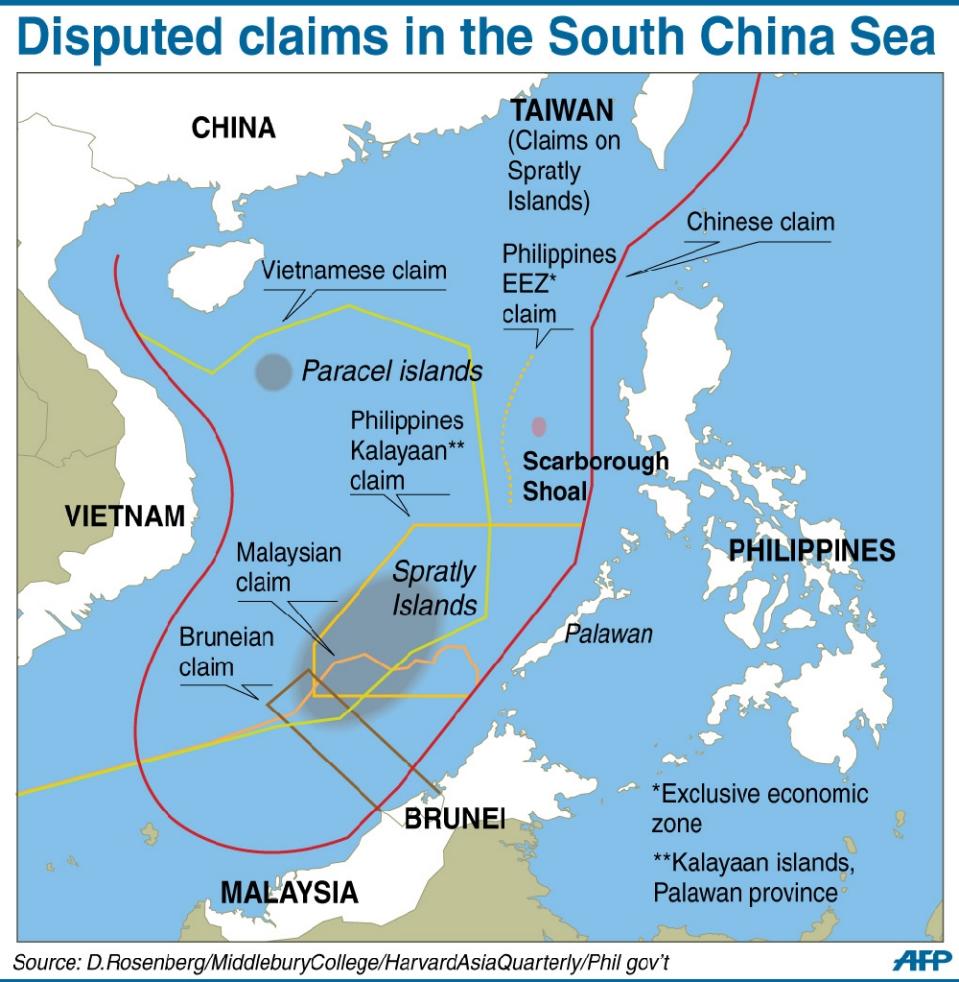
China claims 90 percent of the South China Sea, which is believed to be rich in oil and gas, with overlapping claims from Brunei, Malaysia, the Philippines, Vietnam and Taiwan.
SHOWING CHINA SOME “RESOLVE”
As part of Washington’s drive to energize its allies, a U.S. Navy P-8 reconnaissance plane allowed CNN and Navy camera crews to film Chinese land reclamation activity in the Spratly islands last week and release the footage.
“No one wants to wake up one morning and discover that China has built numerous outposts and, even worse, equipped them with military systems,” Assistant Secretary of State Daniel Russel said.
Ernest Bower, a Southeast Asia expert at the Center for Strategic and International Studies think tank in Washington, said the U.S. goal was to convince China to buy into the international system for dispute resolution rather than impose its sweeping territorial claims on the region.
But in the near term, he added: “I think the Americans are going to have to show China some resolve.”
U.S. officials have said Navy ships may be sent within 12 miles (19 kms) of the Chinese-built islands to show that Washington does not recognize Beijing’s insistence that it has territorial rights there.
Washington is also pressing ahead with its rebalancing towards Asia, four years after President Barack Obama announced the strategic shift, even as some countries say it is slow to take shape.
The United States has updated its security agreements with treaty allies Japan and the Philippines and is bolstering missile defenses in Japan with an eye on North Korea.
U.S. Marines are training in Australia on a rotational basis, littoral combat ships are operating out of Singapore and new P-8 reconnaissance planes stationed in Japan have flown missions across the region.
Overall, defense officials said, the Navy will increase its footprint by 18 percent between 2014 and 2020. The aim is to have 60 percent of Navy ships oriented toward the Pacific by 2020, compared to 57 percent currently.
Military officials in the Philippines say the U.S. shift has been noticeable, including military exercises, training and ship and aircraft visits. The emphasis has shifted from anti-terrorism to maritime security, one official said.
China has not shown any sign of being deterred. On Tuesday it held a groundbreaking ceremony for two lighthouses in the South China Sea, vowed to increase its “open seas protection,” and criticized neighbors who take “provocative actions” on its reefs and islands.
(Additional reporting by Greg Torode in Hong Kong, Nobuhiro Kubo in Tokyo, Manuel Mogato in Manila, Sui Lee Wee in Beijing; editing by David Storey and Stuart Grudgings.)
The term ‘tyrant’ describes any person who exercises authority in an oppressive manner, a cruel master, despot, absolute ruler who is unwilling for arbitration. Red China governs as a tyrantThe term ‘tyrant’ describes any person who exercises authority in an oppressive manner, a cruel master, despot, absolute ruler who is unwilling for arbitration. Red China governs as a tyrantThe term ‘tyrant’ describes any person who exercises authority in an oppressive manner, a cruel master, despot, absolute ruler who is unwilling for arbitration. Red China governs as a tyrantThe term ‘tyrant’ describes any person who exercises authority in an oppressive manner, a cruel master, despot, absolute ruler who is unwilling for arbitration. Red China governs as a tyrantThe term ‘tyrant’ describes any person who exercises authority in an oppressive manner, a cruel master, despot, absolute ruler who is unwilling for arbitration. Red China governs as a tyrantThe term ‘tyrant’ describes any person who exercises authority in an oppressive manner, a cruel master, despot, absolute ruler who is unwilling for arbitration. Red China governs as a tyrantThe term ‘tyrant’ describes any person who exercises authority in an oppressive manner, a cruel master, despot, absolute ruler who is unwilling for arbitration. Red China governs as a tyrantThe term ‘tyrant’ describes any person who exercises authority in an oppressive manner, a cruel master, despot, absolute ruler who is unwilling for arbitration. Red China governs as a tyrant
The Cold War in Asia – The US Strategy Putting Communist China ahead of Tibet totally Failed
Whole Strategy – “America First, Tibet on the Back Burner” Strategy totally FailedWhole Strategy – “America First, Tibet on the Back Burner” Strategy totally Failed
The Cold War in Asia began with the spread of Communism to mainland China. It is no surprise if President Trump thinks of China as a ‘Security Threat’. However, American infatuation with Communist China is not over. Americans are not yet ready to come to grips with realities of world dominated by Socialism with Chinese Characteristics. “America First – Tibet on The Back Burner” Strategy has totally failed.
Whole Strategy – “America First, Tibet on the Back Burner” Strategy totally Failed
Rudra Narasimham Rebbapragada Special Frontier Force-Establishment 22-Vikas Regiment
The Cold War in Asia began with the spread of Communism to mainland China. It is no surprise if President Trump thinks of China as a ‘Security Threat’. However, American infatuation with Communist China is not over. Americans are not yet ready to come to grips with realities of world dominated by Socialism with Chinese Characteristics. “America First – Tibet on The Back Burner” Strategy has totally failed.
China condemns the US Cold War Mentality on National Security
The Cold War in Asia began with the spread of Communism to mainland China. It is no surprise if President Trump thinks of China as a ‘Security Threat’. However, American infatuation with Communist China is not over. Americans are not yet ready to come to grips with realities of world dominated by Socialism with Chinese Characteristics. “America First – Tibet on The Back Burner” Strategy has totally failed.
Image copyright Getty Images Image caption Chinese President Xi Jinping has enjoyed a cordial relationship with Donald Trump.
China has condemned the “Cold War mentality” of the White House after the publication of a new US national security policy. The document labels China and Russia as “rival powers” and lays out a number of potential threats they pose. The new strategy said Beijing and other governments were determined to challenge American power. But China’s foreign ministry criticized the strategy report, saying Washington should “abandon outdated notions.” Spokeswoman Hua Chunying said: “No country or report will succeed in distorting facts or deploying malicious slander. “We urge the US side to stop intentionally distorting China’s strategic intentions and to abandon outdated ideas of Cold War mentality and the zero-sum game.” Russia also responded to the new strategy by saying it “cannot accept” that it is treated as a threat.It also criticized what it said was the “imperialist character” of the document.
Trump’s pragmatic view of troubled world
The Cold War in Asia began with the spread of Communism to mainland China. It is no surprise if President Trump thinks of China as a ‘Security Threat’. However, American infatuation with Communist China is not over. Americans are not yet ready to come to grips with realities of world dominated by Socialism with Chinese Characteristics. “America First – Tibet on The Back Burner” Strategy has totally failed.
In the new US national security strategy, China and Russia are said to “challenge American power, influence and interests, attempting to erode American security and prosperity”. “They are determined to make economies less free and less fair, to grow their militaries, and to control information and data to repress their societies and expand their influence.”
The Cold War in Asia began with the spread of Communism to mainland China. It is no surprise if President Trump thinks of China as a ‘Security Threat’. However, American infatuation with Communist China is not over. Americans are not yet ready to come to grips with realities of world dominated by Socialism with Chinese Characteristics. “America First – Tibet on The Back Burner” Strategy has totally failed.
The new national security strategy contains a range of claims about China, including: China and Russia “are developing advanced weapons and capabilities” that could threaten the US. Competitors such as China “steal US intellectual property valued at hundreds of billions of dollars” China and Russia are investing in the developing world “to expand influence and gain competitive advantages” over the US. In Europe, China is gaining a foothold “by expanding its unfair trade practices and investing in key industries.” China also “seeks to pull the [Central America] region into its orbit through state-led investments and loans.” Some of the claims have been made before, but the new document casts them as part of a battle for dominance.
Analysis: Friends or rivals?
The BBC’s Robin Brant in Shanghai First at his golf club in Florida, then at the Forbidden City in Beijing, President Trump has taken every opportunity to say how close a friendship he’s built with his Chinese counterpart Xi Jinping. But now the official version is rivals – not friends. The classification sends a clear message about America’s changing stance towards a rising China, a China that’s made no secret of its plan to significantly expand its navy, assert more regional authority and expand its influence further abroad through a massive state-backed investment push. Economic rivalry is crucial to this dynamic. The Trump administration is investigating China for what it alleges is the dumping of artificially cheap aluminum products on US markets. It has threatened to do the same on steel exports. Ahead of the document’s publication, there were reports that the National Security Strategy would classify China as an economic “aggressor”, but that did not appear in the final version. Strategy documents are often released with little ceremony, but President Trump appeared at a special event to mark the release of the new strategy.In a speech about his new strategy, Mr. Trump said the US faced a new era of competition, and that China and Russia were the primary threats to US economic dominance.But, he said, the US must attempt to build a “great partnership with them”. Mr. Trump described “four pillars” to his new plan: protecting the homeland, promoting American prosperity, demonstrating peace through strength and advancing American influence. The 68-page document, which White House officials began work on 11 months ago, suggests a return to Mr. Trump’s campaign promise of “America First.”
The Cold War in Asia began with the spread of Communism to mainland China. It is no surprise if President Trump thinks of China as a ‘Security Threat’. However, American infatuation with Communist China is not over. Americans are not yet ready to come to grips with realities of world dominated by Socialism with Chinese Characteristics. “America First – Tibet on The Back Burner” Strategy has totally failed.
In his speech, Mr. Trump referred to his election victory, saying that in 2016 voters chose to “Make America Great Again.”Previous American leaders had “drifted” and “lost sight of America’s destiny” he said, standing before a backdrop of American flags. “Now less than one year later I am proud to report that the entire world has heard the news and has seen the signs,” he said. “America is coming back and America is coming back strong.” He also outlined his campaign promise to build a wall on the border with Mexico, as well as reform of the immigration visa system. The new policy stresses economic security but does not recognize climate change as a national security threat.His predecessor, Barack Obama, in 2015 declared climate change an “urgent and growing threat to our national security”.
The Cold War in Asia began with the spread of Communism to mainland China. It is no surprise if President Trump thinks of China as a ‘Security Threat’. However, American infatuation with Communist China is not over. Americans are not yet ready to come to grips with realities of world dominated by Socialism with Chinese Characteristics. “America First – Tibet on The Back Burner” Strategy has totally failed.
Red China’s Colonial War in Tibet: Red China’s Fate is Sealed. Beijing Doomed. Red China will fall into the grave she prepared to bury Tibetan Identity.Red China’s Colonial War in Tibet: Red China’s Fate is Sealed. Beijing Doomed. Red China will fall into the grave she prepared to bury Tibetan Identity.
Red China’s Colonial War against Tibet is doomed to fail and Tibet will declare ‘Victory Through Patience’. Tibetans have demonstrated the quality of endurance under trials. Their patience gives them freedom from cowardice or despondency. Patience is mainly an attitude of mind with respect to external events. Longsuffering imparts patience by changing attitude with respect to people. Patience best develops under trials or trying times. Tibetans are waiting calmly for something they deeply cherish. They are bearing suffering and trouble with self-control, steadiness and fortitude. Tibetans are showing restraint under great provocation and are refraining from retaliation, tolerating repressive measures used by Red China. Tibetan endurance of suffering without flinching will ensure their victory over Red China’s Colonial War.
Red China’s Colonial War in Tibet: Red China’s Fate is Sealed. Beijing Doomed. Red China will fall into the grave she prepared to bury Tibetan Identity.
Red China with her passionate desire to colonize Tibet, started preparing graves to bury Tibetan Culture, Tibetan Religion, and Tibetan Identity. As the saying goes, people who dig graves for others are at risk of falling into the pits they prepare. Red China is digging her own grave and has set herself on a path of Self-Destruction.
Red China’s Colonial War in Tibet: Red China’s Fate is Sealed. Beijing Doomed. Red China will fall into the grave she prepared to bury Tibetan Identity.
Rudra Narasimham Rebbapragada Ann Arbor, MI 48104-4162, USA Special Frontier Force-Establishment 22-Vikas Regiment
XI’S TIBET POLICY IS NOTHING NEW, BUT AN OLD COLONIAL WAR AGAINST TIBET – CNN iREPORT
By SHAMBALA Posted August 28, 2015. McLeod Ganj, India
Red China’s Colonial War in Tibet: Red China’s Fate is Sealed. Beijing Doomed. Red China will fall into the grave she prepared to bury Tibetan Identity.
More from Shambala
World must pressure China on human rights violations in Tibet Genocide in the 20th Century: Massacres in Tibet: 1966-76 Is China wittingly replacing temples in Tibet with propaganda centers? Tibet and the global economy: is today’s China poisoning the West? Tibetans and Chinese in Tibet: Who are the real terrorist?
CNN PRODUCER NOTE
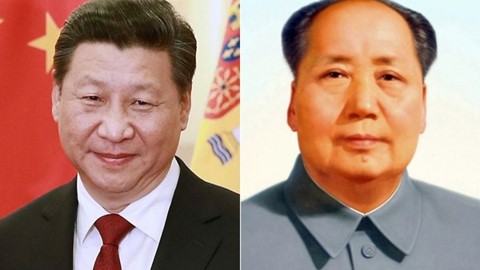
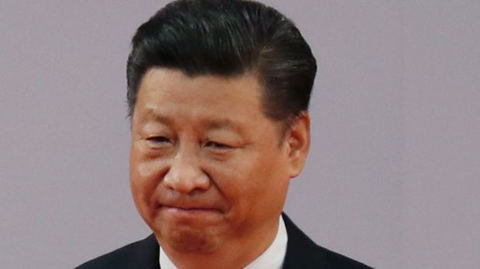
Dharamshala — The Chinese President Xi Jinping’s commitment to “Ethnic Unity”, “Economy Development” and “Social Stability” in Tibet under the banner of “Peaceful Liberation”, which nether seeks a peaceful solution nor a signal for a new reform of more openness. But it clearly shows China is further strengthening an integral element of another “cultural revolution” project in Tibet. One must say Xi is revealing the true nature of a Communist regime in Tibet, a similar sense of strategic inviolability characterized the 20th century’s greatest mass murderer, Mao Zedong.
Invaded by China in 1949, the independent country of Tibet was forced to face the direct loss of 1.2 million lives that comes from military invasion and, soon after, the loss of universal freedoms that stemmed from Communist ideology and its programs such as the Cultural Revolution (1966-76). However, it is erroneous to believe that the worst has passed. The fate of Tibet’s unique national, cultural and religious identity is seriously threatened and manipulated by the Chinese authorities in the past six decades.
Chinese government’s policy of occupation and oppression has resulted in no more or less than the destruction of Tibet’s national independence, culture and religion, environment and the universal human rights of its people. Time and time again, the infliction of this destruction sees China break international laws with impunity, while attempting to transform Tibet’s 2.5 million square kilometers into complete China.
On the 50th anniversary of the so-called “peaceful liberation”, Chinese President Xi Jinping called more the government’s efforts in “Promoting Economic,” “Ethnic Unity” and “Social Development” in Tibet, shows no different claims, revealing the unpredictable nature of a regime bent on maintaining stability even through terror, exposing the depth of China’s present illness.
Xi’s concepts of repressive policies reflect the deep uncertainty that aiming at the core of the another “Cultural Revolution” strategy in further colonizing Tibet, showing the whole world once again the real terror nature of the Communist regime.
Ever since its colonial project was set in motion, the “Cultural Revolution” has insisted that it seeks to colonize Tibet “peacefully”, indeed that its colonization of the country will not only not harm the Tibetan population, but that it was successful to be of benefit to millions of illegal Chinese settlers.
The main reasons behind the dirty politics of why Xi is “calling for more educational campaigns to promote ethnic unity and a sense of belonging to the same Chinese nationality,” is that Tibetans would become real Chinese and must speak Mandarin, allowing coexistence with the Chinese settlers who would be happy and grateful for being colonized and civilized by the communist regime; and a secret, logistical and practical strategy to vanquish the Tibetan population from Tibet, which threatens the very existence of Tibetan culture, religion and national identity.
The impacts of mass immigration of Ethnic Chinese into Tibet was and is a barbaric act with aim to destroy Tibet completely— a target for the worst excesses of the Chinese regime. Tibetan exiles claim 7.5 million Chinese now live in Tibet overwhelming the six million Tibetans. These figures are unconfirmed, but recent Chinese figures suggest this trend is accurate.
Mass murder Mao Zedong killed an estimated 49-78 million people during China’s Cultural Revolution between 1966 and 1976. From Mao to Hu Jintao, one after another, the Chinese dictators have taken full control over the lives of their citizens. The similarities shared with previous dictators from Mao to Hu, Xi’s approach of declaring peaceful intentions for “Ethnic Unity and “Economy Development” behind which he sought to hide Mao’s “Marxism” inherited from “Sovietism”, a violent strategy of conquering and terrorizing the land of Tibet into pieces, adopting wholesale thenceforward, which continues to be the cornerstone of the repressive policy to the present.
Chinese hard-line policies in creating a new socialist paradise, seeking hearts and minds with Tibetan people will never fulfill its dreams. Indeed, within the framework of the 17 Point Agreement between China and Tibet, the PLA troops marching into Tibet shall abide by all the above-mentioned policies and shall also be fair in all buying and selling and shall not arbitrarily take a single needle or thread from the people. However, in the past six decades, Tibetans are denied of the basic rights of expression, speech, movement, and religion under the hard-line policies, including political repression, economic marginalization, environmental destruction, cultural assimilation and denial of religious freedom.
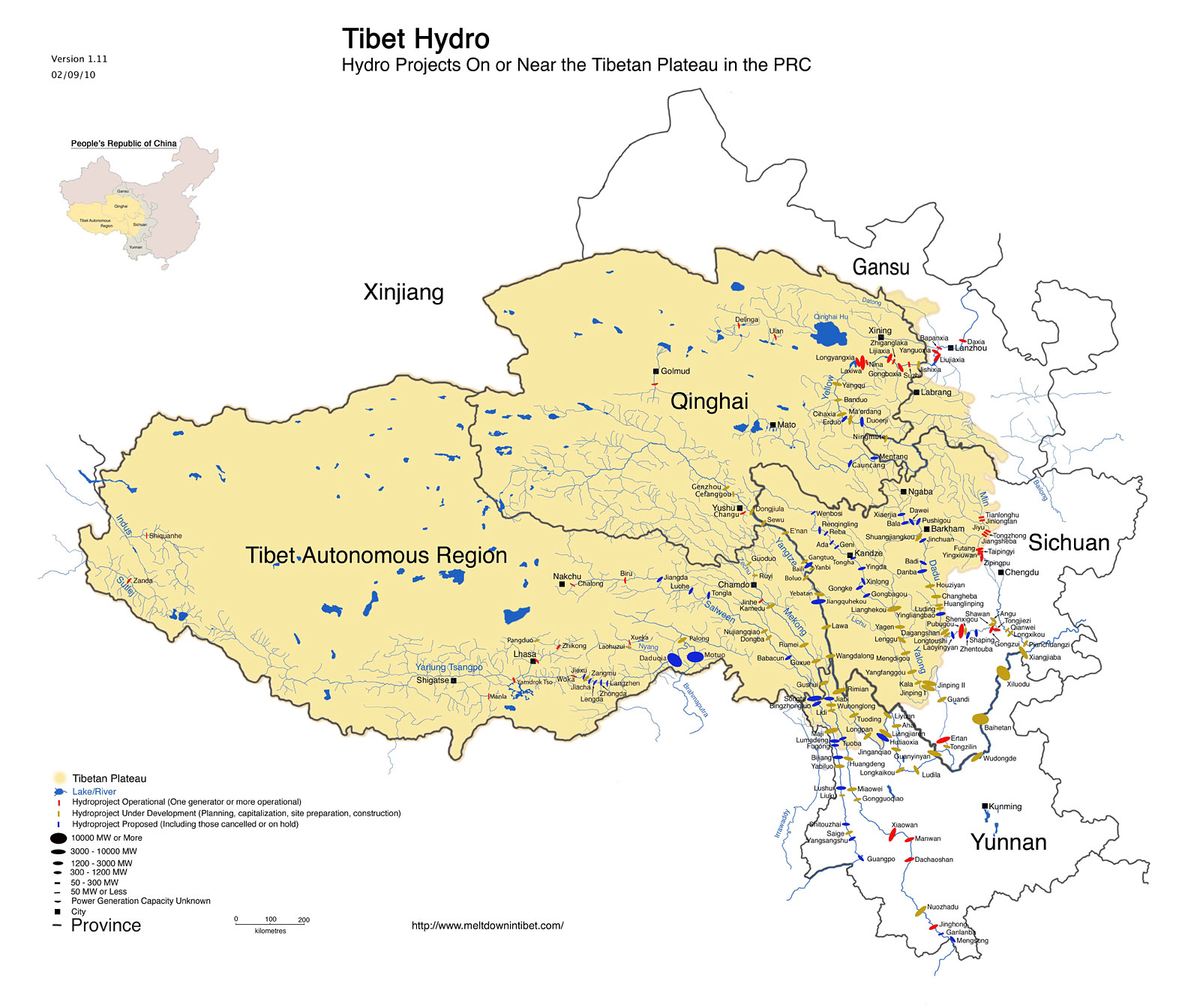
As China became the 3rd of the top ten militaries in the world, according to “Global Firepower”, why China’s strategists have increasingly acknowledged that the stability in Tibet is central to China’s national interest, and particularly as present as the early 1980s. The term “Economy Development” and “Stability” has nothing to do with Tibetan people. But the Tibetan plateau, dubbed the “Third Pole”, holds the third largest store of water-ice in the world and is the source of many of Asia’s rivers. The glaciers, snow peaks, rivers, lakes, forest and wetlands of Tibet provide major environmental services to Asia, from Pakistan to Vietnam to northern China.The climate in Tibet generates and regulates monsoon rains over Asia. An estimated 70% of water in China is heavily polluted from uncontrolled dumping of chemicals. Instead of dealing with this the Chinese regime is diverting water from Tibet to north and west China to supply over 300 million Chinese people. It is also damming rivers to generate hydroelectricity which is in turn used to power industrial developments in China. Dams on rivers and their major tributaries cause massive interruptions to wild mountain rivers and the ecosystems dependent on them. They also give China strategic power over neighboring countries.
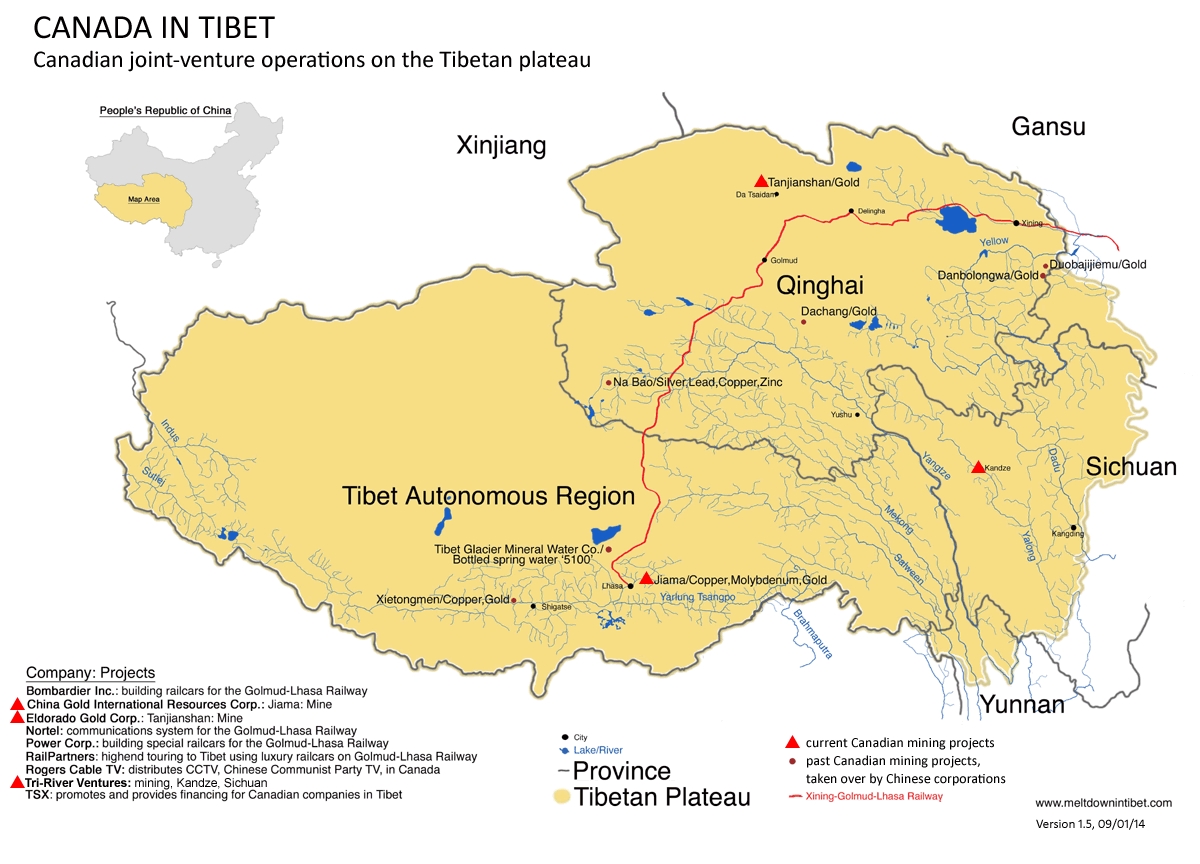
Chinese state-owned mining companies are quickening their extraction of copper, gold and silver in Tibet. These mines are usually based close to rivers. Tibet is also rich in other resources including lead, zinc, molybdenum, asbestos, uranium, chromium, lithium and much more. Tibet is China’s only source of chromium and most of its accessible lithium is in Tibet. These raw materials are used in manufacturing of household goods, computers and smart phones, among much else.
China is the world’s largest producer of copper and the world’s second biggest consumer of gold. The World Gold Council predicts that the consumption in China will double within a decade. Tibet’s reserves of copper and gold are worth nearly one trillion dollars. Chinese companies have traditionally mined on a small-scale but now large-scale extractions are taking place, mainly by large companies, owned by or with close links to the State.
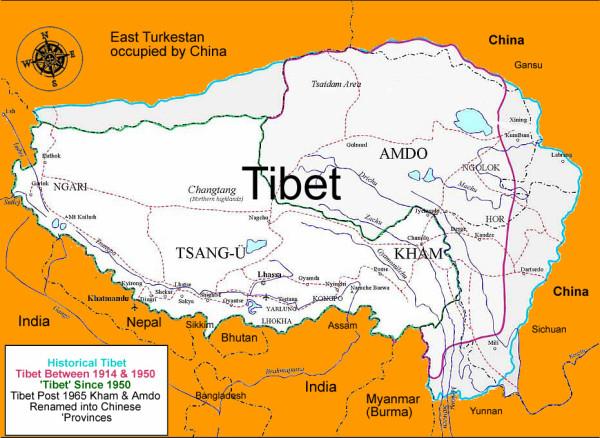
More importantly, in connection with the size of Tibet it needs to be pointed out that the so-called ‘Tibet Autonomous Region’ – which is what the some parts of world mistakenly see as ‘Tibet’ – is only the truncated half of Tibet. The North-Eastern Province of Amdo; has been separated from the rest of Tibet and renamed ‘Qinghai.’ Also; large parts of Eastern Tibet; the traditional Kham Province; have been incorporated into neighboring Chinese Provinces.
Economic growth mostly benefits The Chinese settlers and businesses and workers, as most workers in Tibet mines are Chinese and the extraction takes place without regard to the local environment and areas of religious significance. Most of Tibet is vulnerable to earthquakes and highly volatile. Threats posed by this instability are exacerbated by mining and damming projects. In 2013 a landslide in the Gyama Valley is a great example, which highlighted the fatal destruction of Tibet’s environment. In almost all areas in Tibet, Tibetans have frequently protested against Chinese government, where there are mining projects in Tibet, particularly in recent years. China has recently drilled a 7 km bore hole, to reach and explore Tibet’s oil and natural gas resources. China National Petroleum Corporation estimates the basin’s oil reserves at 10 billion tons.
As well as global climate change, industrial projects such as mining, damming and deforestation are leading to the Tibetan glacier melting at a faster rate, contributing in turn to further global warming. Before the Chinese occupation there was almost no Tibetan industrialization, damming, draining of wetlands, fishing and hunting of wildlife. Tibet remained unfenced, its grasslands intact, its cold climate able to hold enormous amounts of organic carbon in the soil.
China has now moved millions of Tibetan nomads from their traditional grasslands to urban settlements, opening their land for the extraction of resources and ending traditional agricultural practices which have sustained and protected the Tibetan environment for centuries.
The mining companies also benefit from state financing of railways, power stations and many other infrastructure projects. Much of China’s significant transport infrastructure developments in Tibet have been intended to facilitate the movement of military forces into the country and the removal of natural resources from it. companies also benefit from finance at concessional rates to corporate borrowers, tax holidays, minimal environmental standards and costs, no requirement to compensate local communities and subsidized rail freight rates to get concentrates to smelters or metal to markets.These above valid reasons for saying Tibetans inside Tibet will never sense happier life in a so-called “Maoist socialist paradise.” Instead, we have, and always had the fears and sense of the totalitarian nature of Chinese regime.
However, the authoritarians in Beijing always have popularised the expression of Tibet as a “Peaceful Liberation” since the occupation in 1949— the totalitarianism understood well that its colonial strategy depended on a deliberate and insistent confusion of the binary terms “Liberation” and “Unity”, so that each of them hides behind the other as one and the same strategy: “Unity” will always be the public name of a colonial war, and “Liberation”, once it became necessary and public in the form of total invasions, would be articulated as the principal means to achieve the sought after “ethnic unity”.
Why Xi said the country should “firmly take the initiative” in the fight against separatism, vowing to crack down on all activities seeking to separate the country and destroy social stability. Waging colonial war under banner of “Unity” is so central to totalitarianism and Chinese propaganda that China’s 1949 invasion of Tibet, which killed 1.2 million Tibetans and destroyed over six thousand monasteries and temples and historical structures looted and all beyond repair, was termed the “Peaceful Liberation of Tibet”. “Liberation” and “Ethnic Unity”, therefore, are the same means whose only and ultimate strategic goal is Chinese colonization of Tibet and the subjugation and expulsion of Tibetan population.
To bring about the expulsion of the Tibetans and the establishment of the Chinese settler colony, the CCP sought the patronage of the powers that controlled the fate of Tibet. Mao to Xi whereas their assiduous efforts to court the Mao’s old leadership and persuade to grant them a charter failed, however the soviet style leadership after Mao adopted the same strategy under various banners and successfully secured the patronage of world, and became the master of Tibet.
Tibet remained largely isolated from the rest of the world’s civilizations. After 1949, the CCP successfully secured support for their colonial project. After more than 40 years the world recognize that Mao was responsible for genocide of millions of Chinese, Tibetans, Mongolians and Uyghurs. Even Deng Xiaoping actually believed that Mao was about 80% wrong, prove not only that mass massacre happened from 1959-61 but also that these were mainly the result of policy errors that the current regime continues to draw from.
None of these, however, meant morally justifiable and acceptable, but a true nature that the deadly ideology of communism while abandoned their public claims that their “peaceful liberation” colonization of Tibet would not be harmful to the Tibetan people while employing, at the same time, the most violent means to evict the Tibetans off their land.
The totalitarian leader, Mao, following Stalin’s strategy of securing the patronage of major world powers articulated the Soviet position thus. Soviet type colonization must either stop, or else proceed regardless of the native population. Which means that it can proceed and develop only under the protection of a power that is independent of the native population -behind an iron wall, which the native population cannot breach. That is repressive policy; not what it should be, but what it actually is, whether we admit it or not. We clearly understand why Xi is calling for more “patriotic education campaigns” to promote “ethnic unity” and a sense of belonging to the same “Chinese nationality”.
Despite officially introducing more environment-friendly policies in recent years, China continues to flood Tibet with potentially destructive mega development projects such as railway routes, oil and gas pipelines, petrochemical complexes, hydro dams, construction of airports, highways, military bases and new cities for migrants from Mainland China. Is this for a sense of belonging to the same “Chinese nationality”?
What need we have, otherwise, of the Peaceful Liberation? Or of the Mandate? Their value to us is that outside Power has undertaken to create in the country such conditions of administration and security that if the native population should desire to hinder our work, they will find it impossible.It was, in fact, this regime’s commitment to “peaceful liberation” with the Tibetans, whose land they sought to total control, that provoked the ire of terror group that gradually transformed the CCP. The CCP leaders’ assumption that the Tibetans were bribe-able, that they could be bought, and that they would accept Chinese domination in exchange for nominal economic benefits was challenged by Mao. He once stated that the communist army’s “only foreign debt” was that incurred to the Tibet and its people while on the Long March in 1930s.
As the idea of peaceful liberation of Tibet as a means to establish more colonial conquests continued to be entrenched in Maoist considerations, it would be pursued alongside invisible war even after 1949, as evidenced by the multiple invasions of Tibet in the 1950s, and in the new century. These wars would be waged explicitly as part of China’s pursuit of “peaceful liberation” to achieve its colonial aims, and Nor-eastern Tibet capitulated completely to Chinese colonialism, while continuing the war against those Tibetans who continued to resist Maoist colonial logic.
Human rights monitoring and protection has become an unusual challenge to the de facto impunity of the government system. Acquiring accurate information from the so-called ethnic minority regions of Tibet had become extremely difficult due to the secretive nature of operations and so-called lack of transparency. Tibetans in their own home country have become victims of deep-seated prejudice. A carefully chiseled policy has led to a cultural genocide in Tibet due to denial of basic fundamental rights, freedoms and justice over a period of 60 years. The Human Rights situation has not improved in Tibet.
The ongoing suppression of the Tibetan people has been openly carried out whether intentionally or unintentionally. The Chinese government continues to accelerate the political, economic, social and geographical integration of Tibet into China. There is no let-up on many unpopular measures of control imposed by China on the Tibet region such as the “Patriotic re-education Campaign” under policy of “Unity and Peace,” despite how-many-ever protests from Tibetans. This Chinese policy with the active support of the military presence in Tibet, at least a quarter of a million strong, strictly governs the territory, after all China still claims a “peaceful liberation” of Tibet and President Xi Jinping vowed to follow same old way. Is this what China really wanted the whole world to witness in an occupied Tibet in the 21st century?
The Chinese President Xi Jinping’s commitment to “Ethnic Unity”, “Economy Development” and “Social Stability” in Tibet under the banner of “Peaceful Liberation”, which nether seeks a peaceful solution nor a signal for a new reform of more openness. But it clearly shows China is further strengthening an integral element of another “cultural revolution” project in Tibet. One must say Xi is revealing the true nature of a Communist regime in Tibet, a similar sense of strategic inviolability characterized the 20th century’s greatest mass murderer, Mao Zedong.
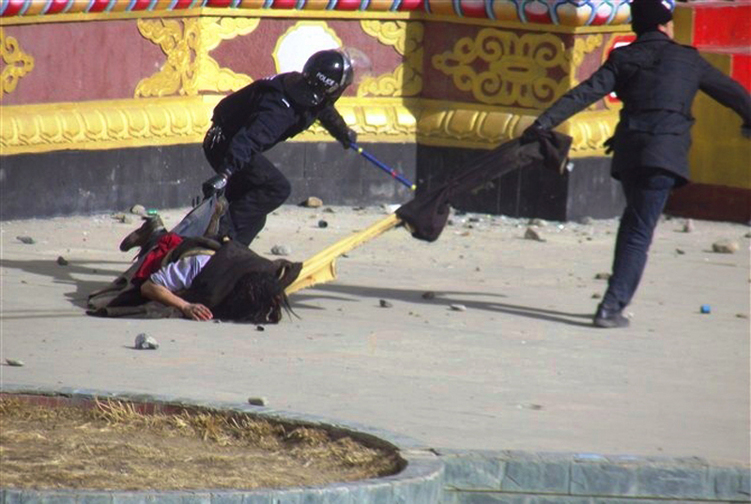
Photo caption: China’s aggressive Violence Against Tibetan People in their homeland, in 2012. Photo: file
The Chinese President Xi Jinping’s commitment to “Ethnic Unity”, “Economy Development” and “Social Stability” in Tibet under the banner of “Peaceful Liberation”, which nether seeks a peaceful solution nor a signal for a new reform of more openness. But it clearly shows China is further strengthening an integral element of another “cultural revolution” project in Tibet. One must say Xi is revealing the true nature of a Communist regime in Tibet, a similar sense of strategic inviolability characterized the 20th century’s greatest mass murderer, Mao Zedong.The Chinese President Xi Jinping’s commitment to “Ethnic Unity”, “Economy Development” and “Social Stability” in Tibet under the banner of “Peaceful Liberation”, which nether seeks a peaceful solution nor a signal for a new reform of more openness. But it clearly shows China is further strengthening an integral element of another “cultural revolution” project in Tibet. One must say Xi is revealing the true nature of a Communist regime in Tibet, a similar sense of strategic inviolability characterized the 20th century’s greatest mass murderer, Mao Zedong.The Chinese President Xi Jinping’s commitment to “Ethnic Unity”, “Economy Development” and “Social Stability” in Tibet under the banner of “Peaceful Liberation”, which nether seeks a peaceful solution nor a signal for a new reform of more openness. But it clearly shows China is further strengthening an integral element of another “cultural revolution” project in Tibet. One must say Xi is revealing the true nature of a Communist regime in Tibet, a similar sense of strategic inviolability characterized the 20th century’s greatest mass murderer, Mao Zedong.The Chinese President Xi Jinping’s commitment to “Ethnic Unity”, “Economy Development” and “Social Stability” in Tibet under the banner of “Peaceful Liberation”, which nether seeks a peaceful solution nor a signal for a new reform of more openness. But it clearly shows China is further strengthening an integral element of another “cultural revolution” project in Tibet. One must say Xi is revealing the true nature of a Communist regime in Tibet, a similar sense of strategic inviolability characterized the 20th century’s greatest mass murderer, Mao Zedong.The Chinese President Xi Jinping’s commitment to “Ethnic Unity”, “Economy Development” and “Social Stability” in Tibet under the banner of “Peaceful Liberation”, which nether seeks a peaceful solution nor a signal for a new reform of more openness. But it clearly shows China is further strengthening an integral element of another “cultural revolution” project in Tibet. One must say Xi is revealing the true nature of a Communist regime in Tibet, a similar sense of strategic inviolability characterized the 20th century’s greatest mass murderer, Mao Zedong.The Chinese President Xi Jinping’s commitment to “Ethnic Unity”, “Economy Development” and “Social Stability” in Tibet under the banner of “Peaceful Liberation”, which nether seeks a peaceful solution nor a signal for a new reform of more openness. But it clearly shows China is further strengthening an integral element of another “cultural revolution” project in Tibet. One must say Xi is revealing the true nature of a Communist regime in Tibet, a similar sense of strategic inviolability characterized the 20th century’s greatest mass murderer, Mao Zedong.
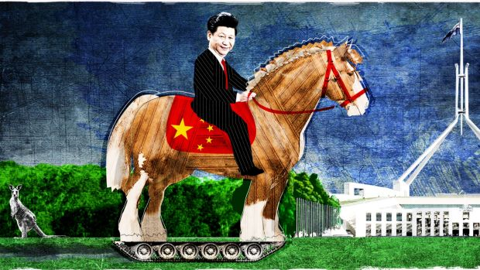
I describe Red China’s Communist Face using terms such as Evil, Aggressor, Public Enemy No. 1,Tyrant, Occupier, Subjugator, Wicked, Cunning, Jackal, Expansionist, Neocolonialist, Obstructionist, Jackass, and Trojan Horse.
Red China’s global ambitions cannot be trusted because of her One-Party Governance with no Public Accountability and Transparency. I describe Red China’s Communist Face using terms such as Evil, Aggressor, Public Enemy No. 1,Tyrant, Occupier, Subjugator, Wicked, Cunning, Jackal, Expansionist, Neocolonialist, Obstructionist, Jackass, and Trojan Horse.
Rudra Narasimham Rebbapragada
Special Frontier Force – Establishment 22 – Vikas Regiment
CHINA’S GLOBAL AMBITIONS: ARE THERE LESSONS TO BE LEARNT FROM TIBET?
I describe Red China’s Communist Face using terms such as Evil, Aggressor, Public Enemy No. 1,Tyrant, Occupier, Subjugator, Wicked, Cunning, Jackal, Expansionist, Neocolonialist, Obstructionist, Jackass, and Trojan Horse.
The man who replaced the Dalai Lama as the head of Tibet’s government-in-exile has brought a troubling message to Australia. The Chinese military forcibly annexed Tibet in the 1950s, sending the Dalai Lama into hasty exile in India. The Dalai Lama retains his role as spiritual leader. But the Tibetan diaspora elected Lobsang Sangay as their political leader six years ago. He spoke at the National Press Club in Canberra earlier this month. The Harvard-educated lawyer’s message to Australia: “It happened to Tibet – you could be next.”
This is a disturbing idea, but surely a fanciful one? As president of the Tibetan government-in-exile, Sangay’s main agenda is to stir international empathy for Tibet. Encouraging us to identify with Tibet, putting us in Tibet’s shoes, is surely a clever technique for achieving his aim.
Does have anything to support his assertion? His case: “If you understand the Tibetan story, the Chinese government [before the military takeover] started building a road – our first ever highway in Tibet.
“Now, we were promised peace and prosperity with the highway, and our parents and grandparents joined in building the road. In fact, they were paid silver coins to help them build the road…
I describe Red China’s Communist Face using terms such as Evil, Aggressor, Public Enemy No. 1,Tyrant, Occupier, Subjugator, Wicked, Cunning, Jackal, Expansionist, Neocolonialist, Obstructionist, Jackass, and Trojan Horse.
“So my parents told me the Chinese soldiers with guns were so polite, so nice, the kids used to taunt them and taunt them, they always smiled. They never said anything. Then they built the road. Once the road reached Lhasa – the capital city of Tibet – first trucks came, then guns came, then tanks came. Soon, Tibet was occupied. So it started with the road.
“Then another strategy that they deployed was divide and rule, co-opting our ruling elite… They were paid, I think, in Australian context, huge consultation fees.” This brought knowing guffaws from the Australian audience.
“So,” Sangay concluded, “what you see in Australia and around the world – co-optation of ruling elites, getting high consultation fees, business leaders supporting the Chinese line of argument, and even the religious figures – we have seen all that in Tibet. So it started with the road.”
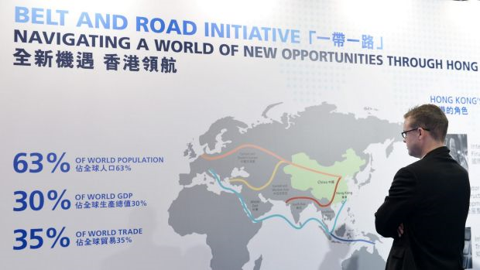
And he compared China’s current international infrastructure project with that road: “So that was the consequence of One Belt, One Road in Tibet.”
One Belt, One Road is President Xi Jinping’s signature foreign policy project. So far, 68 countries have signed up to the mighty vision of an interconnected system of road, rail, ports and bridges embracing most of the world’s population and connecting Europe to Asia and the Pacific through China on land and at sea.
I describe Red China’s Communist Face using terms such as Evil, Aggressor, Public Enemy No. 1,Tyrant, Occupier, Subjugator, Wicked, Cunning, Jackal, Expansionist, Neocolonialist, Obstructionist, Jackass, and Trojan Horse.
However, this is just a beginning; One Belt, One Road was only launched formally in May. Beijing’s plan ultimately encompasses more than 100 countries and at an estimated total cost of between $US1 trillion ($1.26 trillion) and $US4 trillion or more. China has offered to link it with Australia’s Northern Australia Infrastructure Fund, although the Turnbull government has so far declined.
I describe Red China’s Communist Face using terms such as Evil, Aggressor, Public Enemy No. 1,Tyrant, Occupier, Subjugator, Wicked, Cunning, Jackal, Expansionist, Neocolonialist, Obstructionist, Jackass, and Trojan Horse.
In the weekend edict from Beijing clamping down on Chinese foreign investment for fear of excess capital flight, Xi’s government nonetheless encouraged Chinese firms to redirect their money into projects in the One Belt, One Road plan.
Could Chinese infrastructure be a Trojan horse for Chinese takeover of foreign countries? In May, Pakistan’s English-language newspaper Dawn exposed a detailed, 231-page Chinese plan for its 15-year infrastructure rollout in Pakistan. The newspaper’s Khurram Husain described it as “a deep and broad-based penetration of most sectors of Pakistan’s economy as well as its society by Chinese enterprises and culture”.
In Australia, some of China’s proposed infrastructure investments have been prohibited on national security grounds. Last year the Turnbull government blocked a $10 billion Chinese plan to buy into NSW power distribution company Ausgrid. China’s Huawei communications firm has been barred from any investment in Australia’s National Broadband Network. And, as Fairfax’s David Wroe reported on the weekend, the federal intelligence agencies are troubled by Huawei’s buy-in to the proposed 4500 kilometer fiber optic cable connecting the Solomon Islands to Sydney. They fear it is a Chinese state-sponsored effort to find a backdoor into Australia’s critical infrastructure.
A Chinese firm’s purchase of the Port of Darwin raised deep concerns in Washington. Ructions over the decision moved the federal government to change the way the Foreign Investment Review Board reviews proposals – the board is now chaired by a former head of ASIO.
I describe Red China’s Communist Face using terms such as Evil, Aggressor, Public Enemy No. 1,Tyrant, Occupier, Subjugator, Wicked, Cunning, Jackal, Expansionist, Neocolonialist, Obstructionist, Jackass, and Trojan Horse.
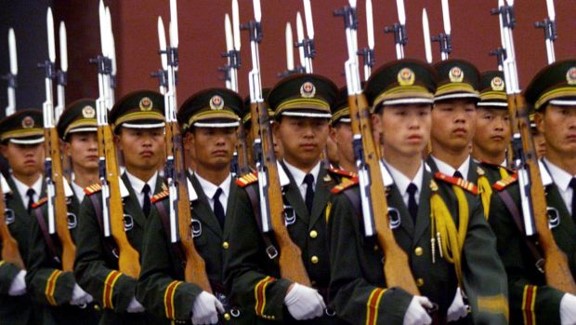
Chinese soldiers with fixed bayonets attend the flag-raising ritual at dawn in Tiananmen Square.
Is Sangay right? Geremie Barme, former head of ANU’s Centre for China in the World, is both deeply knowledgeable about China and highly skeptical of its party-state apparatus. He says that Sangay is wrong on two counts. First, says Barme, it’s a “false comparison” to put Tibet with Australia and other countries in the Chinese worldview. “China went into Tibet to extract resources and for military reasons, it was not a big market for China,” says Barme, now an independent scholar and publisher of chinaheritage.net. “China as an economic and political entity is deeply implicated with global economics and politics and it needs not only resources, it needs markets.” Tibet was about resources, in other words, while it sees most of the rest of the world as markets.
I describe Red China’s Communist Face using terms such as Evil, Aggressor, Public Enemy No. 1,Tyrant, Occupier, Subjugator, Wicked, Cunning, Jackal, Expansionist, Neocolonialist, Obstructionist, Jackass, and Trojan Horse.
Second, the Chinese ruling class has not yet decided the scope of their global ambitions, according to Barme. “There is a debate in China at the moment – what responsibilities will they take in the world, and what can they afford?
“They have been studying the US imperium closely for 70 years, and studying why the Soviet Union collapsed. They do know that imperial expansion comes at a very heavy price, and are they prepared to pay that price? They don’t know yet. They do debate it.”
Depending on China’s choice, Lobsang Sangay will turn out to be either a far-seeing prophet or Chicken Little.
Peter Hartcher is the international editor.
I describe Red China’s Communist Face using terms such as Evil, Aggressor, Public Enemy No. 1,Tyrant, Occupier, Subjugator, Wicked, Cunning, Jackal, Expansionist, Neocolonialist, Obstructionist, Jackass, and Trojan Horse.
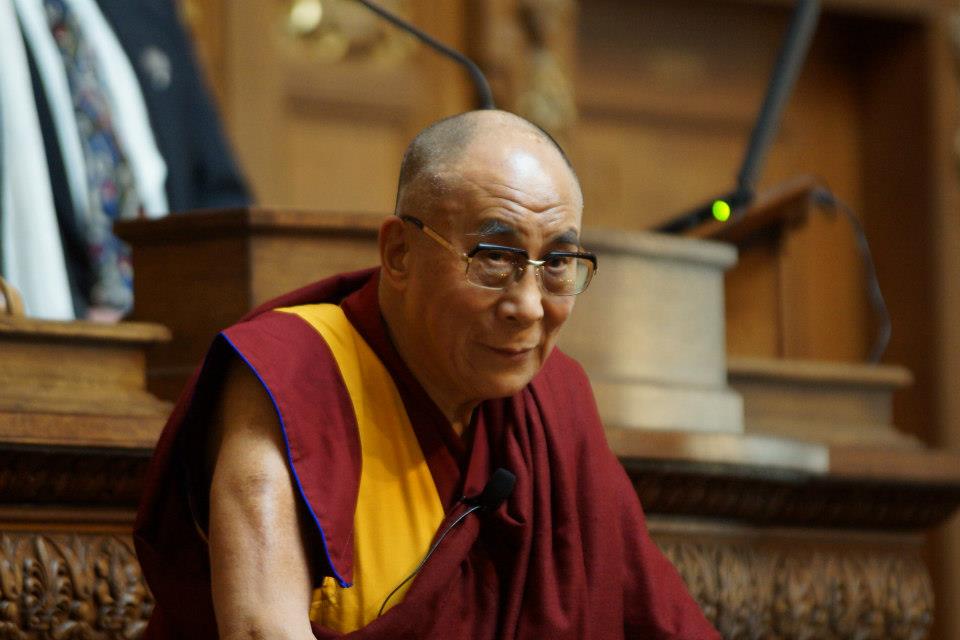
The Dalai Lama, shown here speaking to the Wisconsin Legislature in 2013, will be back in Madison on March 9, 2016 to participate in a gathering billed as “The World We Make.”
As of today, our World is in awful shape. Actually, we did not make this World. Just as in the case of Tibet, troubles are imposed upon innocent people who simply mind their own business without causing inconvenience to others. There is no choice other than that of remaking this World to give Peace and Justice to all people.
Rudra Narasimham Rebbapragada Ann Arbor, MI 48104-4162 USA Special Frontier Force, Establishment 22, Vikas Regiment
THE CAP TIMES
Madison, Wisconsin
Bill Berry: Wake up, Wisconsin, to impact of Dalai Lama, climate change
BILL BERRY | state columnist Jan 25, 2016 JOHN HART – State Journal
The Dalai Lama, shown here speaking to the Wisconsin Legislature in 2013, will be back in Madison on March 9 to participate in a gathering billed as “The World We Make.”An international spiritual leader, the Dalai Lama has worked for decades to building better understanding among the scientific and spiritual communities. John Hart/State Journal111
News that didn’t but should have stopped the presses as we came out of post-Christmas hibernation:
Welcome back: The Dalai Lama will make his 10th visit to Madison come March 9, as reported last week in Madison media. Beyond the Madison market, chances are the word won’t get out much on the visit from this international spiritual, ethical and moral leader. Its too bad. His international impact is immense. He’ll participate in a Capitol Theater event billed as The World We Make, a gathering of world leaders in science, health care and the media, according to its sponsor, the Center for Healthy Minds at UW-Madison. Among his many accomplishments, the Dalai Lama has been able to build better understanding among the scientific and spiritual communities.
The connection between the Dalai Lama and UW-Madison is well known in the Madison area. Outstate, not so much. But people might like to know that the connection has led to vibrant research on the healthy mind at the center, headed by Richard Davidson, and elsewhere on the UW campus. The simple idea that we can learn about humans by studying the healthy mind is transformational. Its also part of a vibrant body of research that stretches well beyond the Madison campus.
Bill Berry of Stevens Point writes a semimonthly column for The Capital Times. billnick
About the columnist
Bill Berry is a self-employed writer and editor who contributes to state and national publications. His Capital Times columns cover an array of topics, but he specializes in conservation, agriculture and sustainable land use.
Trouble in Tibet – Red China’s Doctrine of Neocolonialism – The Forced Resettlement of Tibetan Nomads
‘Trouble in Tibet’ has several faces and one of them is Resettlement of Nomads. This Policy of Resettlement of Tibetan Nomads symbolizes Red China’s Neocolonialism; extension of political and economic control over Tibet using organizational, and technological superiority.
‘Trouble in Tibet’ has several faces and one of them is Resettlement of Nomads. This Policy of Resettlement of Tibetan Nomads symbolizes Red China’s Neocolonialism; extension of political and economic control over Tibet using organizational, and technological superiority.
‘Trouble in Tibet’ has several faces and one of them is Resettlement of Nomads. This Policy of Resettlement of Tibetan Nomads symbolizes Red China’s Neocolonialism; extension of political and economic control over Tibet using organizational, and technological superiority.‘Trouble in Tibet’ has several faces and one of them is Resettlement of Nomads. This Policy of Resettlement of Tibetan Nomads symbolizes Red China’s Neocolonialism; extension of political and economic control over Tibet using organizational, and technological superiority.
STRUGGLE IN THE CITY FOR TIBETAN NOMADS
By Benjamin Haas
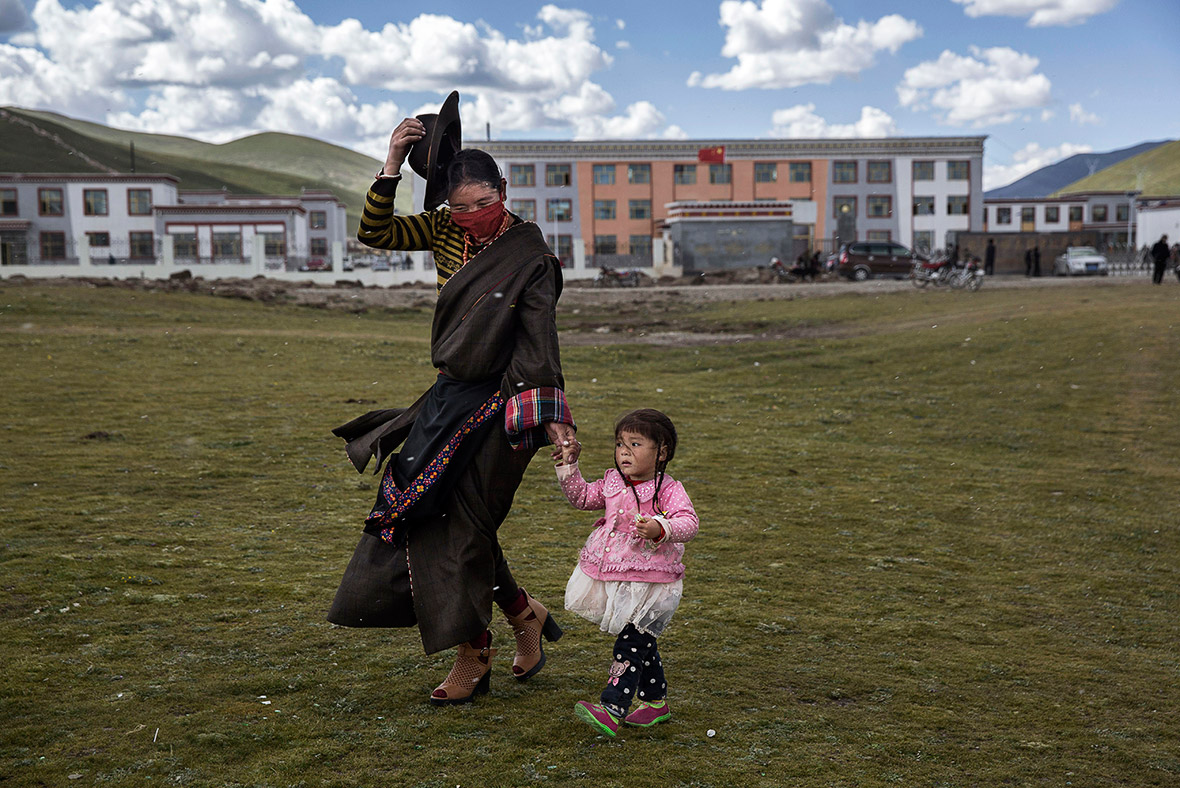
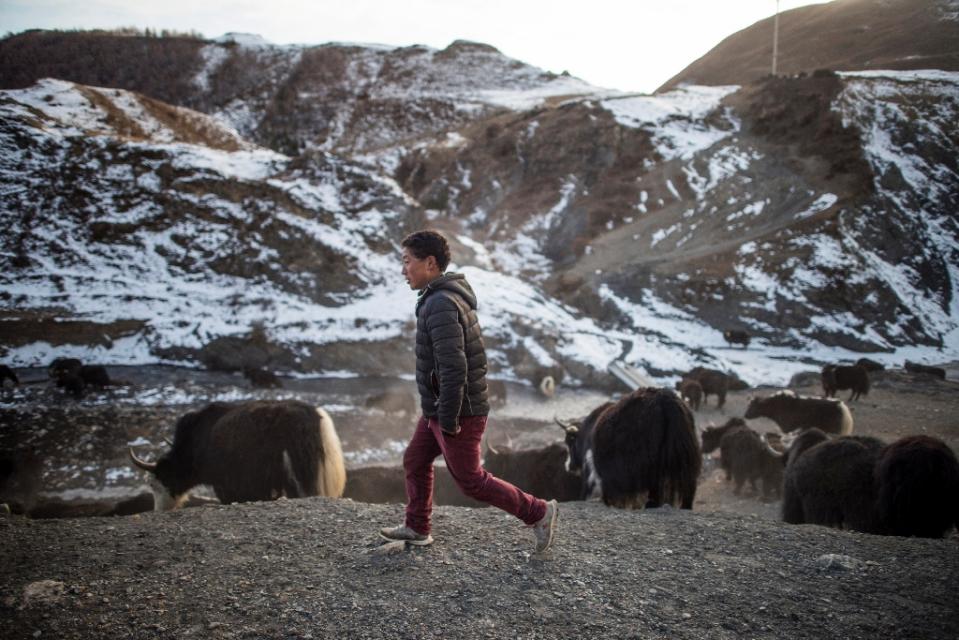
Aba (China) (AFP) – By mid-morning, Lobsang’s leather cowboy hat is askew, his black robes dishevelled, and his breath stinks of booze. Once a nomad herder roaming the high Tibetan plateau, instead he stumbles around his sparse new concrete house.
For decades he and his wife grazed yaks and sheep, living a life little changed in centuries, until they acquiesced three years ago to government calls to give up their yak-hair tents for permanent housing.
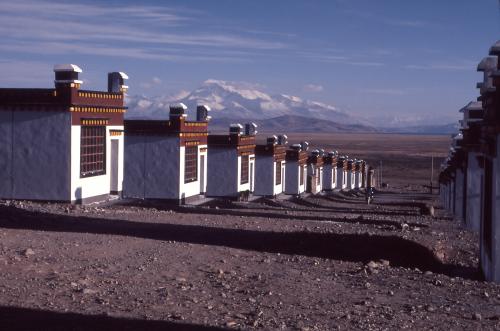
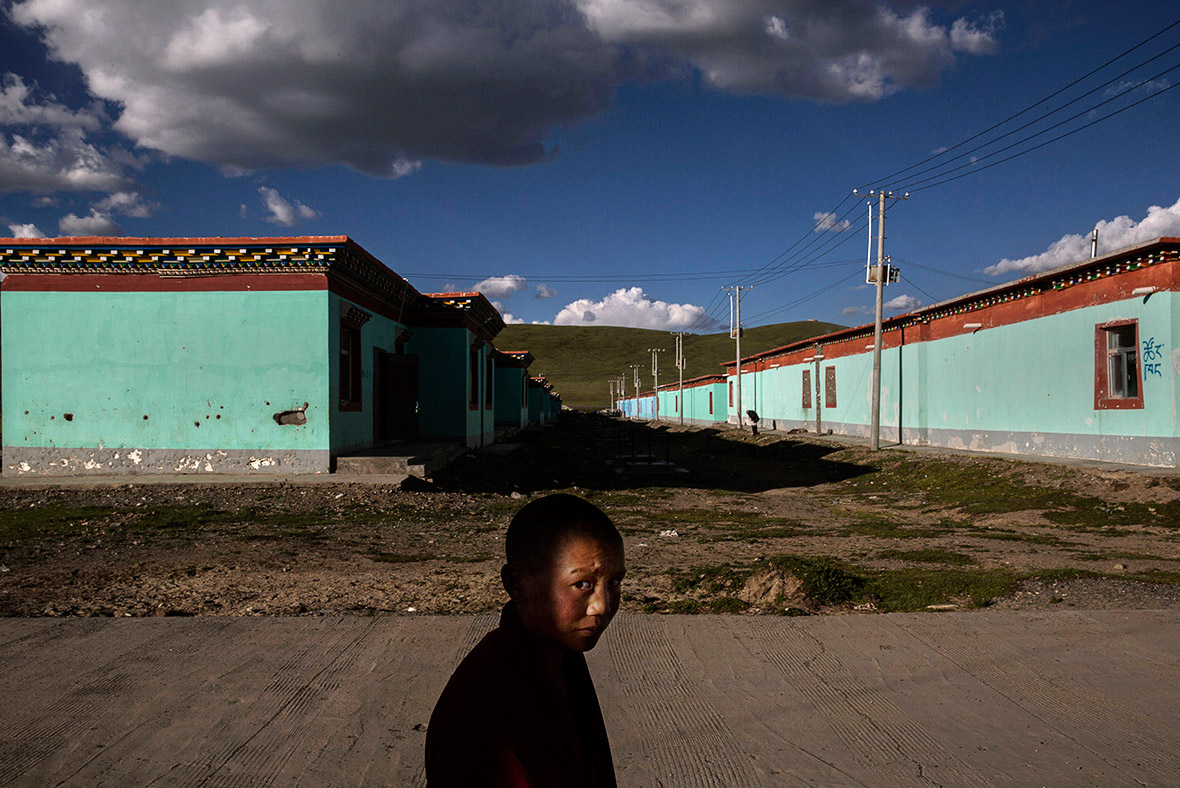
Now they live in a resettlement village, row after row of identical blue-roofed grey shells, an hour’s drive from Aba in Sichuan province along winding mountain roads.
“Everything changed when we moved to this town,” said Tashi, who like her husband is in her 40s but not sure of her exact age. “First we ran out of money, then he couldn’t find suitable work and then he started drinking more and more.”
Chinese authorities say urbanisation in Tibetan areas and elsewhere will increase industrialisation and economic development, offering former nomads higher living standards and better protecting the environment.
Those who move receive an urban hukou — China’s strictly controlled internal residence permits that determine access to social services. The government offers free or heavily subsidised houses, medical insurance, and free schooling.
TROUBLE IN TIBET – RESETTLEMENT OF TIBETAN NOMADS. KANDING, THE GANZI PREFECTURE. RED CHINA’S NEOCOLONIALISM.‘Trouble in Tibet’ has several faces and one of them is Resettlement of Nomads. This Policy of Resettlement of Tibetan Nomads symbolizes Red China’s Neocolonialism; extension of political and economic control over Tibet using organizational, and technological superiority.
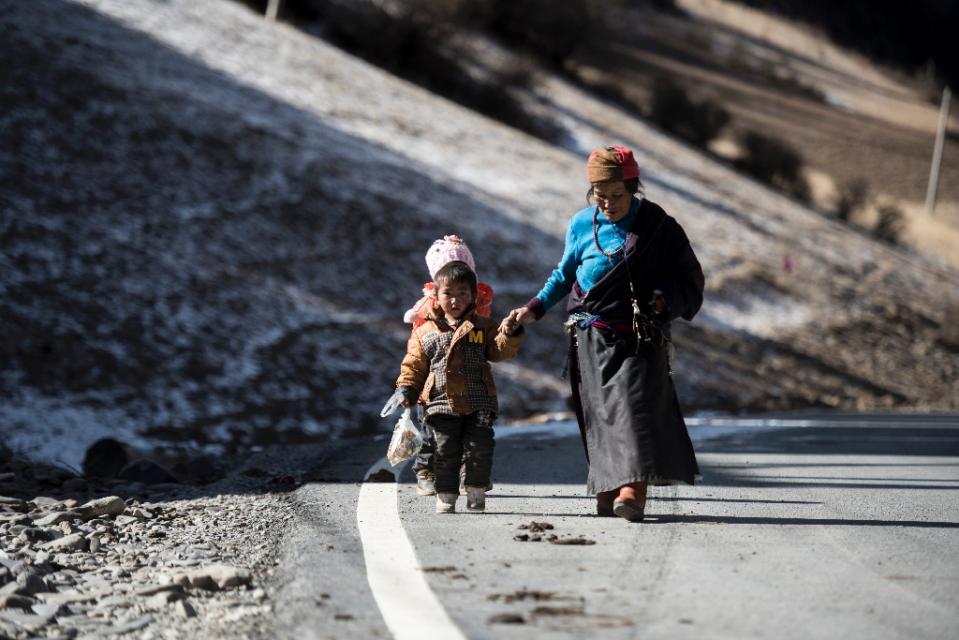
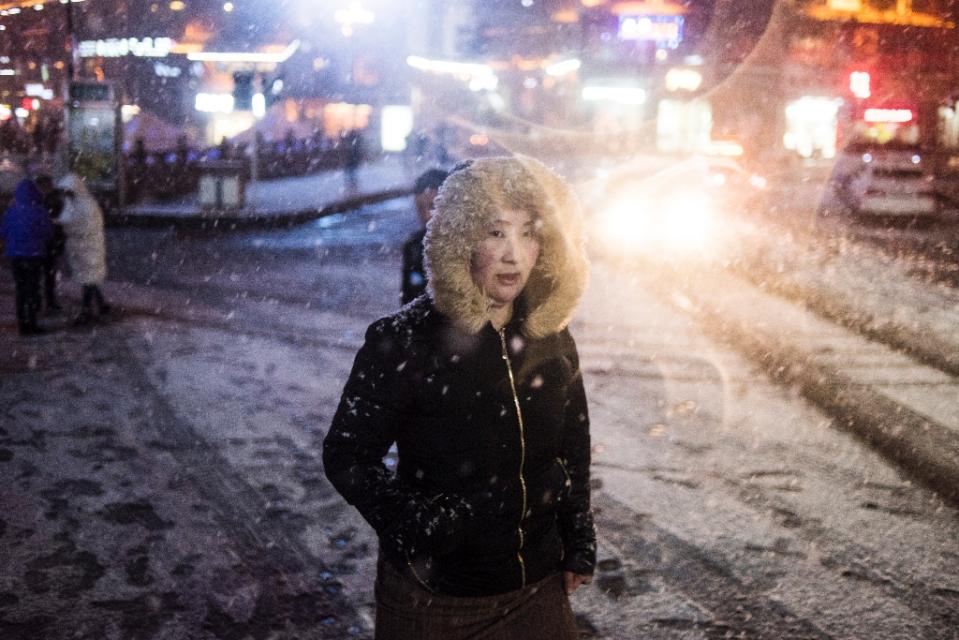
A woman walks in the snow in Kangding in the Ganzi Tibetan Autonomous Prefecture, southwestern China.
But critics say the drive has a one-size-fits-all approach and many former pastoralists have not prospered, despite its promises.
Unlike the voluntary urbanisation of the early 2000s, when many adults maintained subsistence lifestyles while sending children and the elderly into towns, Andrew Fischer, of the International Institute of Social Studies at Erasmus University in Rotterdam, said: “The policy lock, stock and barrel shoves nomads into these resettlements thinking that is good for them.
“But then that gives rise to a variety of related problems like unemployment, social problems, alcoholism, et cetera, which are typical hallmarks of rapid social dislocation,” he told AFP.
‘TOO LATE’
‘Trouble in Tibet’ has several faces and one of them is Resettlement of Nomads. This Policy of Resettlement of Tibetan Nomads symbolizes Red China’s Neocolonialism; extension of political and economic control over Tibet using organizational, and technological superiority.
At the resettlement facility, many relocated former herders complained to AFP they lacked work or training. Critics of China’s urbanization drive say it has a one-size-fits-all approach and many former pastoralists have not prospered.
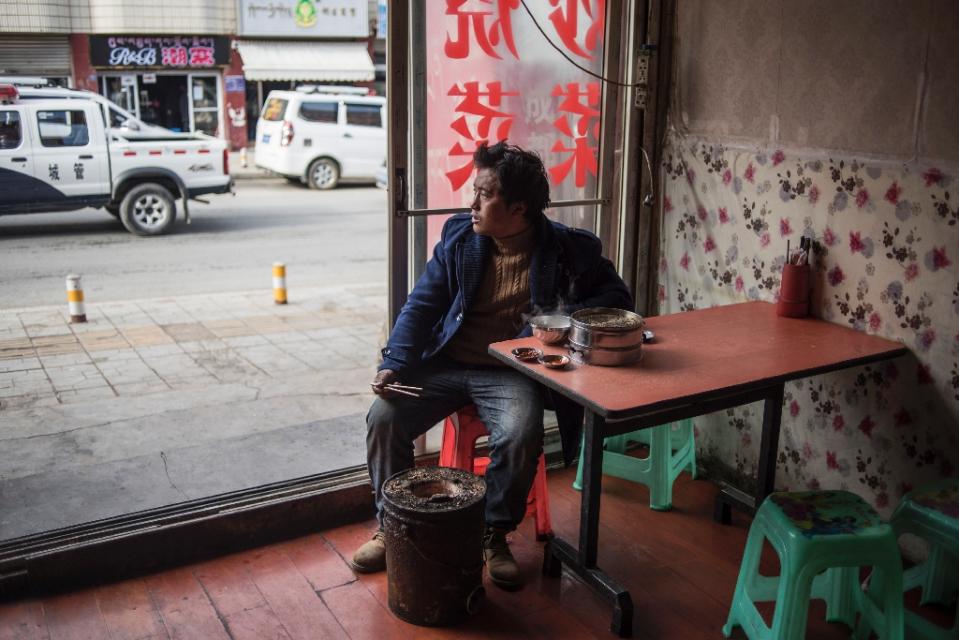
Dolkar, 42, sold his last 13 yaks for 85,000 yuan (now $13,000) two years ago, a decision he now regrets, and has yet to find stable employment. “I thought this was a lot of money, but I didn’t realise things in the town would be so expensive,” he lamented.
“A person from the government came and convinced me I should move, but now I see I’ve lost so much. I want to go back, but it’s too late.”
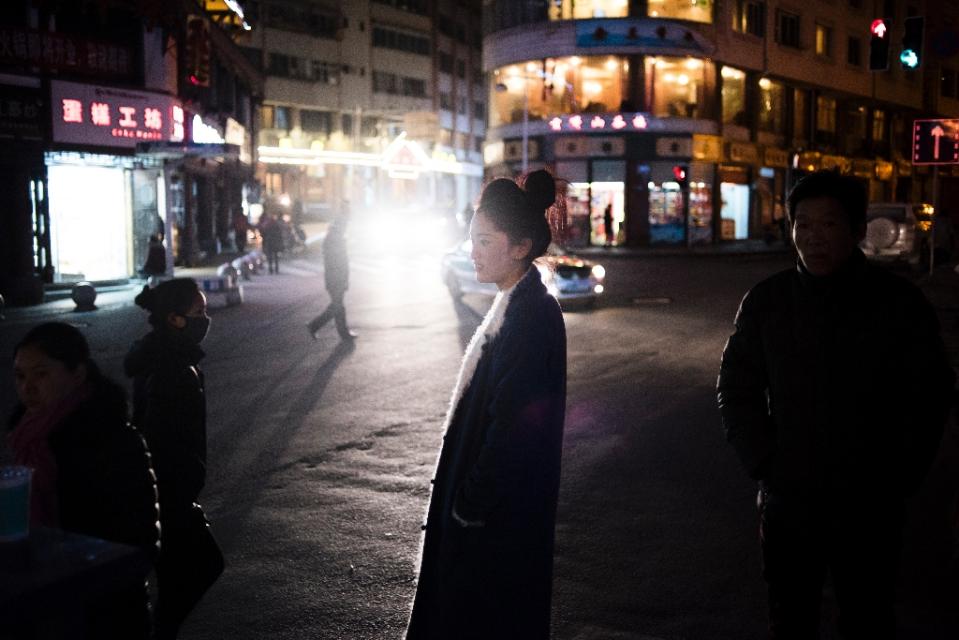
Now available urban jobs are low-wage, manual positions in construction or sanitation. But many nomads shun menial labour, having enjoyed wealthy status in the Tibetan community by virtue of their valuable livestock holdings.
‘Trouble in Tibet’ has several faces and one of them is Resettlement of Nomads. This Policy of Resettlement of Tibetan Nomads symbolizes Red China’s Neocolonialism; extension of political and economic control over Tibet using organizational, and technological superiority.
Critics say one goal of the urbanisation campaign is to give authorities more oversight over the people of Tibet.
“It’s not like everyone can become a petty entrepreneur selling dumplings in the marketplace, the jobs need to be there and in the absence of that, the government moving them to urban areas isn’t going to help.”
SEPARATIST FORCES
Critics say one goal of the urbanisation campaign is to give authorities more oversight over the people of Tibet, which has been ruled by Beijing since 1951.
The resettlement village AFP visited is in what was Kham, the eastern part of pre-invasion Tibet, where Khampa warriors fought Communist forces, sometimes with CIA backing, until the late 1960s.
‘Trouble in Tibet’ has several faces and one of them is Resettlement of Nomads. This Policy of Resettlement of Tibetan Nomads symbolizes Red China’s Neocolonialism; extension of political and economic control over Tibet using organizational, and technological superiority.
Across China, urbanisation is a top economic priority, with Premier Li Keqiang calling it the country’s ‘Grand Strategy for Modernisation’.
The region’s top Party official, Chen Quanguo, has said each village should become a “fortress” to “guard against and combat the infiltration of Tibetan separatist forces”.
Urbanisation efforts “concentrate people into areas where they are far easier to surveil and where they become more dependent on state subsidies to survive —- in other words, where they are easier to control”, Sophie Richardson, China director at Human Rights Watch, told AFP.
Environmental experts also say that rather than protecting mountain pastures, the policy has damaged their ecology, allowing invasive weeds to proliferate and change the nature of the soil.
“Not using these grasslands long-term doesn’t work,” said Sun Jie, deputy director of the Grassland Research Institute at the Inner Mongolia Academy of Agricultural & Animal Husbandry Sciences.
“It’s always been natural for grasslands to be used for grazing, the plants and the soil need it for healthy growth,” she added. “Otherwise poor quality foliage moves in and contributes to soil decline.”
Across China, urbanisation is a top economic priority, with Premier Li Keqiang calling it the country’s “grand strategy for modernisation” at a 2014 policy meeting.
But benefits such as running water have come at the cost of Tibetan former nomads’ sense of identity, with many complaining their sons and daughters are taught almost entirely in Mandarin.
“My children will never know our history, they won’t understand our Tibetan traditions,” said Dorje, who moved into the resettlement camp six years ago and occasionally works odd jobs. “My grandchildren will never know I used to be a respected and wealthy man, they will only know poverty.”
‘Trouble in Tibet’ has several faces and one of them is Resettlement of Nomads. This Policy of Resettlement of Tibetan Nomads symbolizes Red China’s Neocolonialism; extension of political and economic control over Tibet using organizational, and technological superiority.
The US-India-Tibet Relations complicated by Pakistan’s military invasion of Kashmir
Whole Problem -Defense of Kashmir complicates the problem of military occupation of Tibet
Communist China apart from its illegal military occupation of Tibet during 1949-50, had illegally occupied Indian territory in the Aksai Chin region of Ladakh Province in the State of Jammu and Kashmir prior to its sudden, military attack during 1962 all along the Himalayan Frontier. India’s Prime Minister Jawahar Lal Nehru failed to request military assistance from the United States to oppose this military occupation and land grab by Communist China due to concerns over the US support for Pakistan’s aggression in Kashmir.
The United States was willing to check Communist China’s expansionist policy, but, unfortunately, India could not take advantage of the US policy for the US simultaneously supports Pakistan’s occupation of Kashmir.
On behalf of Special Frontier Force, I confirm Special Frontier Force’s deployment in Ladakh Province to defend Jammu and Kashmir. In the context of role of foreign powers in Kashmir, it is important to recognize Special Frontier Force as a military organization in which the U.S., India, and Tibet participate as allies. It may be noted that Special Frontier Force had a role in India’s Kargil War.
It is of interest to note that United Kingdom and the United States simultaneously extend military and economic aid to Pakistan in support of its illegal political and military campaigns to annex Jammu and Kashmir. If not United Kingdom, the United States is playing on both sides of fence of parties involved in this dispute.
Both United States and United Kingdom need cooperation of India to contain Communist China’s Expansionist Doctrine. China’s Maritime Expansionism poses direct challenge to Japan, Philippines, Taiwan, Vietnam, Indonesia, Malaysia. China’s Expansionism needs to be addressed in comprehensive manner. There is no choice other than that of addressing the issue of China’s military occupation of Tibet; the first victim of China’s Expansionism. Pakistan cannot be trusted and cannot be counted as ally in any initiative that aims to Checkmate China’s Expansionism. Supplying sophisticated military hardware to Pakistan has not helped the United States. Pakistan shared designs of US military equipment with China helping China to advance her fighting capabilities. China manipulates Pakistan’s Nuclear and Missile Programs and for that reason Pakistan has to be counted as serious Security Risk.
Pakistan with her role in Balochistan, and Afghanistan created more enemies for the United States. The War against Soviet Expansionism got transformed into War on Terrorism as Pakistan used Afghan Campaign to make profits for her military bosses.
India from the beginning tried for peaceful resolution of Kashmir issue following the guidelines given by United Kingdom when it granted Independence to Pakistan and India in 1947. United States and United Kingdom made huge financial investment in Pakistan and as of today, it failed to promote Democracy, Peace, and Justice in South and Central Asia.
Whole Problem -Defense of Kashmir complicates the problem of military occupation of Tibet. Special Frontier Force Defends Jammu and Kashmir in Partnership With Indian Army. Siachen.
Jammu and Kashmir burning? Jammu and Kashmir burning? Media and trouble makers thrive on mischief. Everyday, Kashmir is in the news, and its usually portrayed maliciously.
JAMMU AND KASHMIR BURNING?
Media and trouble makers thrive on mischief. Everyday, Kashmir is in the news, and its usually portrayed maliciously by many of these elements that India is inhuman, steeped in illegality and is evil.
First the facts. As per international law, all of Jammu and Kashmir is integral part of India. This was effected by the treaty of accession signed between the Maharajah of Kashmir and India on 27th Oct 1947. 1. Jammu, Kashmir and Ladakh consists of 22 districts, separatist are present only in 5 districts – which represents a mere 15% of the state, and they are all Sunni Muslim. The voices and faces you see on television like Omar Abdullah, Mehbooba Mufti, Yasin Malik, Shabbir Shah, Gilani, Asiya Andrabi and Lone are from this region and sect. 2. The state has 12% Shia Muslims, 12-14% Gujjar Muslims and 8% Pahadi Rajput Muslims. It also has significant population of Sufis, Christians, Sikhs, Buddhists and Hindus. None of these communities have any separatist demands. 3. The larger two of the three regions of the state consisting of Jammu and Ladakh covering an area of 85,000 square kilometers are not Muslim majority areas, and there has never been any demand of separatism. 4. When terrorist Afzal Guru was hanged, the media made it appear as if the entire state was out on the streets. The reality was that out of 22 districts, there was not a single demonstration in 17 districts and only 5 districts in the Valley saw staged demonstrations. 5. Poonch has 90% and Kargil 90% Muslims, but there was no protest in these areas. 6. Our perception about Jammu and Kashmir is that a battle between nationalism and separatism is going on for the past 68 years. Nationalism has neither been lost nor will it, because in most areas of the state, majority of the people are nationalists. 7. The only legal dispute tenable under international law is, How India should get back areas that are under the illegal occupation of Pakistan and China?
‘Separatism’, ‘dispute’ and ‘autonomy’ are three myths raised by Pakistan and her agents within Kashmir and other parts of India The State should be considered as one entity like Jammu (with maximum of the ground area), Ladakh and only thereafter Kashmir. Pakistan and India baiters have been harping on United Nations Security Council Resolution 47. The resolution identifies Pakistan as an occupying force and states that in order to bring peace and harmony, the following steps will be undertaken in sequence.
1. First Pakistan must demilitarize and withdraw ALL its military forces and nationals used for the purpose of fighting from Kashmir. 2. Subsequently India must demilitarize Kashmir 3. A plebiscite may be held to determine the will of the people of Kashmir. Since Pakistan failed to demilitarize, the entire process of normalization went into a tailspin. That was in 1947, it is now 2016. In November 2010 the United Nations removed Jammu and Kashmir from its list of disputed territories.This UN Resolution is thus dead. Secondly, the resolution was passed by United Nations Security Council under chapter VI of UN Charter.Resolutions passed under Chapter VI of UN charter are considered non binding and have no mandatory enforceability. Since the government and the armed forces do not speak on the issue, the reporting is left mainly to separatist leaders and politicians, Jihadi terrorists, and the media. That most of these people and organizations who owe their loyalty and livelihood to foreigners, the reports will unjustifiably portray India in a bad light. Muslim Pakistan’s national identity is defined by a single dimension of being anti India and the destruction of secular India. Fake issues and imaginary threats from India are constantly raked up to provide justification for the Pakistan army to control the reins of power.
Pakistan has lost all the wars they have waged against India. Pakistan claims concern for Muslim brothers in Kashmir, while simultaneously abducting, torturing and exterminating large number of Baluchis,and Pashtuns, shows its desire for conflict with India. Pakistan because of its terrorist activities and toxic behavior, is on very bad terms and in conflict with all its neighbors be it India, Afghanistan or Bangladesh. The Pakistani leadership and Army have bankrupted and impoverished Pakistan by wasting money and resources on useless confrontations. Pakistan is using Kashmir merely as an issue to harm India by waging a proxy war using terrorism, with the hope of bleeding India with a thousand cuts. In spite of Pakistan’s best efforts, Kashmir will always remain an integral part of India, and we will grow stronger with time. Write and Posted: Aug 2016 – by Gurvinder Singh
Whole Problem -Defense of Kashmir complicates the problem of military occupation of TibetWhole Problem -Defense of Kashmir complicates the problem of military occupation of TibetWhole Problem -Defense of Kashmir complicates the problem of military occupation of TibetWhole Problem -Defense of Kashmir complicates the problem of military occupation of TibetWhole Problem -Defense of Kashmir complicates the problem of military occupation of TibetWhole Problem -Defense of Kashmir complicates the problem of military occupation of TibetWhole Problem -Defense of Kashmir complicates the problem of military occupation of TibetWhole Problem -Defense of Kashmir complicates the problem of military occupation of TibetWhole Problem -Defense of Kashmir complicates the problem of military occupation of Tibet. Special Frontier Force Defends Jammu and Kashmir in Partnership with Indian Army. Siachen.
India-Tibet-US Relations Complicated by Pakistan’s Invasion of Kashmir on 22 October 1947
The Kashmir issue poses a great danger severely undermining India’s ability to exercise full freedom to formulate an independent Tibet Policy. India needs the support of the United States to counter China’s military superiority and at the same time, India has to balance the US involvement in Kashmir in support of Pakistan’s aggression. Meeting between Indian Prime Minister Jawaharlal Nehru and US President Harry Truman in 1949.
In my analysis, India-Tibet relations from the very beginning were impacted by Pakistan’s invasion of Kashmir in October 1947. The United States was willing to check Communist China’s expansionist policy, but, unfortunately, India could not take advantage of the US policy for the US simultaneously supports Pakistan’s occupation of Kashmir
The Kashmir issue poses a great danger severely undermining India’s ability to exercise full freedom to formulate an independent Tibet Policy. India needs the support of the United States to counter China’s military superiority and at the same time, India has to balance the US involvement in Kashmir in support of Pakistan’s aggression.
Book Review: Tibet: When the Gods Spoke by Claude Arpi
The History of Special Frontier Force-Establishment No. 22: The military occupation of Tibet by Communist China had shaped the historical, cultural, religious relationship between India, and Tibet. It commenced an entirely new era in which both India, and Tibet are driven by the same kind of security concerns. Prime Minister Chou En-Lai represents the face of that danger that forced Prime Minister to know and appreciate the nature of Tibetan Nation as represented by the 14th Dalai Lama, and the 10th Panchen Lama Rinpoche.
Claude Arpi shows that the 1954 Panchsheel Agreement’s guiding principle of non-interference in and respect for each other’s territorial integrity left China to do in Tibet whatever it willed
BOOKS Updated: Aug 17, 2019 10:10 IST
572pp, Rs1,650; United Service Institution & Vij Books
Thubten Samphel
Hindustan Times
The History of Special Frontier Force-Establishment No. 22: India desired to promote international peace and tried to avoid armed conflicts. The burden imposed by China’s military occupation of Tibet was viewed with concern, but India tried the use of diplomacy and avoid war. A ceremony to honor Prime Minister Chou En-Lai , and the 14th Dalai Lama during their visit to New Delhi.
In the run-up to signing the Panchsheel agreement: Jawaharlal Nehru with Zhou Enlai, the first Premier of the People’s Republic of China (both center) at Palam Airport on 25 June 1954. (HT Photo)
Claude Arpi’s third volume on relations between India and Tibet covers the deepening Chinese penetration of the plateau and Beijing’s administrative and military consolidation there. The freehand given to China in its consolidation in Tibet was made possible when the two Asian giants signed the Panchsheel Agreement on Tibet in 1954. This was the document with which India withdrew its effective presence in Tibet in the form of two trade agencies and military escorts, though India’s mission in Lhasa operated as before. The agreement’s guiding principle of non-interference in and respect for each other’s territorial integrity left China to do in Tibet whatever it willed. Beijing imposed land ‘reforms’ and new leadership and administrative structure that led to the 1959 uprising against Chinese rule.
Digging deep into India’s national archival treasure trove, Claude Arpi has pulled out a real gem. This gem is the assessment of the various Indian officers, and of the character and motives of those figures, both political and spiritual, within the Tibetan leadership structure. The comments by India’s Tibet hands include the urgent need for Tibet to reform its social structure, making it fair and just for all Tibetans. This Indian examination of the strength and weakness of the Tibetan leadership came for closer scrutiny when the Dalai and Panchen Lamas visited India in 1956 for the Buddha Jayanti commemorations.
These lengthy and fascinating reports were submitted to New Delhi by Apa Pant, the political officer based in Gangtok, who dealt with affairs of Tibet, Bhutan and Sikkim, PN Menon, the former Indian consul general in Lhasa, and PN Luthra, special officer of border areas in the Ministry of External Affairs.
Apa Pant was convinced that “Old Tibet cannot fight new dynamic China.” He suggested that “In Tibet, unless the high monks, thinkers, and saints start seriously the re-organizing of the whole social and economic structure which is today based on privileges and is corrupt, there is no point in calling Tibet a Buddhist land…”
Apa Pant also suggested that “The Chinese have also a doctrine of social revolution and change which they are certain will help the common man. The Tibetans shall have to have an equally powerful dynamic policy of social change.”
Apa Pant made this fearful prediction. With China creating the conditions for the settlement of Tibet by Chinese migrants, “Tibet, as we know it today, will be annihilated, the process for its complete absorption into China (has) started.”
Colonel PN Luthra was assigned to the Panchen Lama’s party in its travels throughout India. About China’s designs on Tibet, the astute colonel has this to say. China, he wrote, “was eating Tibet like an artichoke, leaf by leaf.”
As for the time he spent with the Panchen Lama, Luthra wrote, “At a certain stage of the tour, it became possible to freely and frankly discuss any matter, however delicate, with the Panchen Lama himself or some of his principal associates.” Luthra was impressed by the Panchen Lama’s ability to recognize faces. He was, Luthra wrote, careful to “recognize the humbler staff such as motor drivers and dispatch-riders.” The Panchen Lama told Luthra that he did not believe in the “superstitious practices of Tibetan society. The Dalai Lama’s consultation with his oracle to decide the date of his departure to India had caused the Panchen Lama much amusement.” Luthra wrote, “I once asked the Panchen Lama what it felt like to be the incarnation of Amitabha. He replied that he had no such consciousness nor does he possess any supernatural powers. He struck me as a man without pretensions.”
According to Luthra, despite the traditional rivalry between Lhasa and Shigatse and the court politics of the two Lamas, “There seems to exist personal friendly accord as one would imagine between two youths who have so much in common… I have seen them cutting jokes, thumping each other’s backs and exchanging warm greetings.”
In 1959 when the Tibetan people rose up against Chinese rule in Tibet, the Dalai Lama along with an estimated 87,000 Tibetans fled Tibet to India, Nepal, and Bhutan. The Panchen Lama chose to remain in Tibet. In 1962, the Panchen Lama after extensive research and tour of all Tibet submitted the 70,000-character petition to the Chinese Communist Party, laying bare the Party’s disastrous mistakes on the plateau, nearly falling short of accusing the Party of genocide. Mao Zedong called the Panchen Lama’s constructive criticism “a poisoned arrow” aimed at the Party. For this, the Panchen Lama spent 14 long years in prison. After Mao’s death in 1976, he was released. In 1989, he confided publicly to the Tibetan people that Tibet had lost more than it gained under Chinese rule. That year under mysterious circumstances, the Panchen Lama died.
The third major voice to offer his commentary on the Tibetan political scene is that of PN Menon. He spent two years as India’s consul general in Tibet. In 1956 he was assigned to the Dalai Lama’s party. According to Menon, the weakness of the Tibetan struggle was “the real lack of a sense of unity and political consciousness in the way we understand it. At times the conflicting advice seemed to make the Dalai Lama rather confused…” But according to Menon, the Tibetan leader’s basic common sense seemed to “guide him away from the pitfalls of some of the advice offered.”
Contemporary and future generation of researchers of this period of Tibet’s relations with India will remain grateful to Claude Arpi for making these documents accessible. They will appreciate his bringing alive, loud and clear, the sterling character of these India’s frontier officials and their insights into the ominous events unfolding in overwhelmed and beleaguered Tibet.
Thubten Samphel is an independent researcher and a former director of the Tibet Policy Institute
First Published: Aug 16, 2019, 18:31 IST
The Kashmir issue poses a great danger severely undermining India’s ability to exercise full freedom to formulate an independent Tibet Policy. India needs the support of the United States to counter China’s military superiority and at the same time, India has to balance the US involvement in Kashmir in support of Pakistan’s aggression.