Whole Separation – The Separation of Spirit from Tibetan Nation

The Institution of Dalai Lama is important to preserve Tibetan Political Identity. The Government of Tibet is represented by this Seal of Ganden Phodrang. The Seal represents the Spirit of Tibetan Nation that governs Tibet.
View of the Potala Palace from the foothill of...
The Institution of Dalai Lama is important to preserve Tibetan Political Identity. The Government of Tibet is represented by this Seal of Ganden Phodrang. The Seal represents the Spirit of Tibetan Nation that governs Tibet.

A Turning Point in the History of Tibet

A historical occasion: The Separation of Church and State: The Separation of Spiritual and Temporal Powers of the Dalai Lama.

The institution of Dalai Lama or Gaden Phodrang dates back to 1642 when the Great 5th Dalai Lama assumed Tibet’s political leadership role. The 3rd Dalai Lama while on a visit to the Mongol Chief Altan Khan, received from that ruler the honorific title “TA-LE” which got anglicized as “DALAI”, the Mongolian equivalent of the Tibetan “RGYA-MTSHO” meaning “Ocean”. Tibet existed in a serene and unperturbed state for several centuries until October 1950 when Communist China’s People’s Liberation Army invaded Tibetan soil. Tenzin Gyatso, the present 14th Dalai Lama fled from Tibet following the failed Tibetan National Uprising in 1959.

52nd Anniversary of the Tibetan National Uprising – March 10, 2011 :     

The 14th Dalai Lama has voluntarily relinquished his political powers. The Tibetan Parliament-in-Exile must derive its power from The Constitution of Tibet. The power of the people of Tibet must be now vested in the Constitution of Tibet. Amendments in Charter of Tibetans in Exile to pass political authority to an elected leadership would not suffice.

March 10, 2011 could be marked as a historical moment in the long history of Tibet. The 14th Dalai Lama had issued a statement to voluntarily relinquish his political leadership role. The Dalai Lama formally communicated his decision to the 15th Tibetan Parliament-in-Exile on March 14, 2011. He has recommended a democratic system of governance for the Tibetan polity. He has recommended Amendments in Charter of Tibetans in Exile to pass political authority to an elected leadership.

The Separation of Temporal and Spiritual Powers:

The Tibetan Parliament-in-Exile must derive its authority and power from the Constitution of Tibet. Amendments in Charter of Tibetans-in-Exile will not help this transition of political power from the Dalai Lama to the people of Tibet.

I welcome this statement from the 14th Dalai Lama seeking the separation of temporal and spiritual powers from the Institution of Dalai Lama or Gaden Phodrang. The Dalai Lama Institution will continue to exist and the Dalai Lama continues as the Spiritual Leader of the people of Tibet. The Living Tibetan Spirits tell me that they would accept this decision made by the 14th Dalai Lama. Now, the people of Tibet need to derive their rights from a duly established Constitution of Tibet, a written document that states the fundamental laws and the principles of governance for Tibetan people. The Tibetan Parliament-in-Exile must derive its authority and power from the Constitution of Tibet. Amendments in Charter of Tibetans-in-Exile will not help this transition of political power from the Dalai Lama to the people of Tibet. The Tibetan community in Exile must draft the Constitution of Tibet and get it ratified by all people of Tibetan origin and Tibetans inside Tibet should be given an opportunity to ratify this Constitution of Tibet at a later date when the foreign occupier of Tibet is evicted from the Land of Tibet. Tibetans are not seeking separation from China. Tibet is not a part of China and the Problem of Tibet is its military occupation. Special Frontier Force is a multinational defense plan that aims to establish freedom and democracy in the Land of Tibet.

Rudra Narasimham, Rebbapragada,

Ann Arbor, Michigan, 48104-4162

How Does the Dalai Lama Change the Tibet Question?

By Bhaskar Roy

Although the 14th Dalai Lama has been talking about stepping down from the leadership of the Tibetan Government in Exile for some time, his final decision announced on March 10, did shock his people to an extent, and posed big question mark to the world at large. The effect has not fully sunk in yet. It will, when the new Kalon Tripa (Prime Minister) is elected on March 20 by the All Tibetan People’s Deputies (ATPD), which gathered in Dharamsala from March 14.

It is to be noted that the Dalai Lama chose March 10, the 52nd anniversary of the Tibetan peaceful uprising against the Chinese. Some may interpret this as the Dalai Lama’s decision to give up his peaceful struggle for the autonomy of Tibet within the Chinese constitution. This is not correct, though the outgoing Kalon Tripa, Prof. Samdong Rimpoche was dismayed that the way the Dalai Lama was received around the world was unique, and his political successor may not achieve such status.

While that is true, one needs to carefully study his March 10 statement. The 76-year-old religious leader revered all over the world said his desire to devolve authority had nothing to do with a wish to shirk responsibility. It would benefit the Tibetans in the long run, and that he was committed to playing his part in the just cause for Tibet. The Dalai Lama made it clear that the Tibet cause and the Tibetan people would remain his highest consideration. He would be available for consultations and advice. He would be travelling the globe where he is welcome, meet the world’s leaders both political and religious but as a monk reminding the world that Tibetan Buddhism, language and culture was on the verge of extinction in China controlled Tibet. As a religious leader, these activities are well within his bound. Although the Chinese leaders and officials will continue to attack him, they would risk doing so without legitimate basis.

Within hours of the Dalai Lama’s announcement, Chinese Foreign Ministry spokesperson Jiang Yu said “He has talked often about retirement in the past few years”’ adding these were “tricks to deceive the international community”. This was brave face but other official statements do not effuse a lot of confidence.

Tibet’s Communist Party Secretary Zhang Qingli, used insulting language describing the Dalai Lama as a “wolf in monk’s robes”, and again charged him for trying to “split” China. But ethnic Tibetan leaders of Tibet were a little more circumspect. Qiangba Puncog, Chairman of the Standing Committee of Tibet autonomous region’s people’s congress commented that he could not deny that the Dalai Lama, as Living Buddha and a religious leader did have some influence on his believers, and his death would have “ some minor impact on Tibet”. Padma Choling, Chairman of the Tibet autonomous regional government went even further. He told the official China Daily that the reincarnation of the institutions of the Dalai Lama and Panchen Lama have been carried on for several hundred years, these historical institutions and religious rituals of Tibetan Buddhism must be respected, and it was not up to anyone to abolish the reincarnation institutions.

It must be said that both the ethnic Tibetan leaders, though sworn to protect the party and government, allowed a glimpse into their inner thinking. They made it clear that while they were committed to perform their official duties, they do not condone insult of the Dalai Lama and do not contribute to the Chinese government’s policy appointing their own Living Buddhas especially the Dalai Lamas and the Panchen Lamas. This mind-set will play a significant role in the future politics in Tibet.

The Dalai Lama’s decision to devote his political responsibility was deeply thought over for several years. He is also similarly thinking whether he should leave the directions for the search of the 15th Dalai Lama after his death, and who should be appointed with the responsibility for the search. There could be problems like the search for the 17th Gyalwa Karmapa of the Karma-Kargyu sect, where the four regents fought and there is now more than one claimant to the 17th Karmapa’s throne. The Chinese would get into the fray as they did in the case of the 17 Karmapa, and declare their own 15th Dalai Lama. The gap between the 14th Dalai Lama’s death and finding the real successor will be very crucial. Hence a purely political set up to fill this gap would be very important. If need be, only the political leadership would continue with the Tibetan agenda.

There is also the question of Ughen Thinley Dorjee (UTD), the most talked about 17th Karmapa, though Thaye Dorjee, then other claimant has also significant following among the Karma-Kargyu community both inside and outside Tibet. Both have following among foreigners in the West and South East Asia. This is a very difficult problem. The Dalai Lama would have to resolve it in some manner.

The Indian government is hardly in any position to intervene in and resolve the 17th Karma dispute. It has taken the only sensible step it could. The seat of the Karma-Kargyu sect, Rumtek monastery in Sikkim, has been locked in the interest of peace till the real 17th Karmapa is agreed to by all concerned. India has been keeping away any kind of Tibetan politics including against China, and the Chinese acknowledge that officially.

Ughen Thinley Dorjee is recognized by both the Chinese and the Dalai Lama. The Dalai Lama played no direct role in the UTD case. He only accorded his recognition in 1992 while he was in Rio de Janero, when Tai Situ Rimpoche, the Regent promoting UTD, told him over telephone that UTD was recognized by all the Rumtek Regents as a consensus.

Sections of the Indian media created a mess recently when they called UTD a Chinese “spy” over unaccounted foreign currency found at his monastery. The confusion was due to the fact that UTD’s office failed to follow the process to legalize the donation from his followers the world over including from China.

There has been a lingering doubt about UTD and his loyalty especially because the manner by which escaped from Lhasa to India over five days and four nights without being detected by the Chinese security. Further, the Chinese government never criticised him, nor has UTD stood up vocally for the aspirations of the Tibetans. He is, therefore, not yet a candidate to take the Dalai Lama’s place as a religious or political leader of the Tibetans. UTD will have to prove his position one way or the other. He is 24-year-old, and the Dalai Lama demonstrated his religious and political leadership at a younger age.

What is moot, however, is how the new structure in Dharamsala will impact the main support bases of the Dalai Lama and the issue of human rights in Tibet. The mainstay has been the US especially the White House. The Dalai Lama has significant support in Europe, but not always steady. There are Japan, Taiwan and Australia. But the Chinese have used their economic muscle to buy out the western human rights critics. Nevertheless, the instrument of pressure on China are very much there and could be turned on and off depending on China’s political and strategic behaviour.

There will be quite some challenges for the Tibetan movement in the initial stages. But eventually the move can work out right. The Dalai Lama would have more time to concentrate on religious groups in the USA and Europe who have significant political influence and are livid with Beijing’s religious persecution. The fires can be stoked. And such fire can easily spread to China’s western region of Xinjiang which witnessed bloody anti-Han riots by Muslim Uighurs in July 2009. That region remains restive.

The political Tibetan government in-exile would have a much freer hand. They are not expected to foment unrest inside Tibet. They are wise enough to know that just simple unrest cannot stand up to the Chinese security forces and the army. But the people inside Tibet do not need orders from outside. Most of these are coming to an understanding they are losers any way, and will keep opposing the Chinese regime.

The political leadership of the Tibetan government in exile, though not recognised officially by any country, will have the latitude to lobby more actively in the United Nations, the Unrepresented Nations and People’s Organization (UNPO) in Europe, and important capitals of the world. If they get sufficient support and work unitedly without squabbling among themselves, they can raise a huge movement which could seriously challenge Beijing’ unreasonable attitude.

India may face a politically sensitive situation with China. The Chinese are convinced that it is the Americans who are at the root of the strength of the Tibetan movement. They are not sure how much India is a party to this conspiracy, but they will harden their attitude towards India. India must tell the political government in-exile that there are boundaries in India that cannot be crossed. But at the same time, must allow them to work within what India’s constitution and laws allow them to. New Delhi must also weigh its policies in the light of revelations how China and Chinese agencies have been assisting Indian insurgents in the north-east to wage war against the state. It will have to be a balanced approach.

In sum, the future is not yet clear. But in the long-term the Dalai Lama’s decision could greatly change the dimensions of the Tibetan movement in their favour unless they directly confront Beijing. Big issues must be left to big powers.

(The author is an eminent China analyst with many years of experience. )

The Institution of Dalai Lama is important to preserve Tibetan Political Identity. The Government of Tibet is represented by this Seal of Ganden Phodrang. The Seal represents the Spirit of Tibetan Nation that governs Tibet.


Whole Quest – Tibet declares its own Full Independence

Tibet Awareness – Tibet’s Quest to Declare Full Independence

“The Great Game” of rivalry between the empires of Czarist Russia and Queen Victoria’s Great Britain to control Asia changed the fortunes of Tibet forever.

The Great Fifth Dalai Lama founded the ‘Ganden Phodrang’ Government of Tibet in 1642. The successive Dalai Lamas have headed Tibetan State for nearly four centuries without any disruption despite Mongol conquest of Tibet in 1279. During the reign of Seventh Dalai Lama (1708-57), Tibet came under nominal protection of Ch’ing or Manchu Dynasty (1644 – 1912) that ruled China while Tibetans enjoyed their natural freedom and independence. At no time in history, the Chinese Emperor required Tibet to pay taxes or tribute. Qing, Ch’ing, or Manchu China made no attempt to directly rule or govern Tibet. Manchu China’s influence in Tibet was almost nonexistent. “The Great Game” of rivalry between the empires of Czarist Russia and Queen Victoria’s Great Britain to control Asia changed the fortunes of Tibet forever.
TIBET AWARENESS - TIBET'S QUEST FOR FULL INDEPENDENCE. THE INSTITUTION OF DALAI LAMA, GANDEN PHODRANG GOVERNMENT OF TIBET BEGAN IN 1642.
“The Great Game” of rivalry between the empires of Czarist Russia and Queen Victoria’s Great Britain to control Asia changed the fortunes of Tibet forever.

During the reign of Thirteenth Dalai Lama, who ascended the throne at Potala Palace in 1895, Tibet repeatedly rebuffed overtures from Great Britain who at first saw Tibet as a trade route to Manchu China and later as countenancing Czarist Russian advances that might endanger British India. Eventually, in 1903, after failure to get Manchu China to control Tibet, Great Britain dispatched a political mission to Lhasa from British India to secure understanding on frontier and trade relations. When Tibet resisted, Great Britain sent a military expedition in 1904 forcing the Dalai Lama to seek shelter in Mongolia in June 1904. The British Expedition in 1905 imposed a treaty that made Tibet a protectorate of Britain without Chinese adherence. After declaring Tibet as her Protectorate, Great Britain lost interest in keeping that commitment, went ahead and achieved a treaty with Qing China without Tibetan participation. In this treaty of 1906, Great Britain conceded to Qing China’s suzerainty over Tibet as Britain was only interested in blocking Czarist Russia’s expansion of power from Central Asia. In 1906, the 13th Dalai Lama returned to Kumbun monastery in southern Tibet and stayed there for over a year. Qing China in an attempt to control Tibet dispatched a military force that launched a brutal attack on Kham killing several Tibetans including monks. In his quest for Tibetan Independence, the 13th Dalai Lama visited Peking during September 1908 to initiate direct diplomatic efforts with Qing Court and other foreign missions in Peking. However, the 13th Dalai Lama could not find any success in Peking, returned to Lhasa at the end of 1909. This success in keeping Britain away from Tibet emboldened Qing China to seek direct control of Tibet by using force against the Tibetans for the first time in 10 centuries. Soon after the 13th Dalai Lama’s arrival in Lhasa, in early 1910, Chinese General Zhao Erfeng marched into Tibet. Great Britain was unwilling to take any role in the dispute between China and Tibet. He had narrowly escaped getting captured by the Chinese and fled to India reaching there on February 21, 1910. The British allowed him to live in Darjeeling, and Kalimpong. The situation in Lhasa changed suddenly in 1911, when the Xinhai Revolution overthrew the Qing Dynasty and established the Republic of China. Taking advantage of the fall of Qing China, the 13th Dalai Lama directed operations from Sikkim defeating the Chinese occupying force in 1912. Tibet expelled all Chinese nationals including diplomats living in Lhasa. He returned to Lhasa in January 1913 and made public the “five-point” statement fully asserting Tibet’s Independence on February 13, 1913.

That dying burst of military aggression by the Qing or Manchu Dynasty converted Tibetan indifference into enmity.  From 1913, Tibet functioned as an independent government and defended its frontier against China in occasional fighting as late as 1931. The Great 13th Dalai Lama died on December 17, 1933 while Tibet existed as a fully independent nation. In 1949, Red China, the Evil Empire founded by China’s Communist Party Chairman Mao Zedong, heralded “Liberation” of Tibet. In 1950, Red Army invaded eastern Tibet, overwhelming the poorly equipped Tibetan troops. An appeal by the Fourteenth Dalai Lama to the United Nations was denied as support from Republic of India, and Great Britain was not forthcoming. A Tibetan delegation summoned to Peking in 1951 had to sign a treaty dictated by the Communist conquerors. Red China, a Liar, a Jackal, used deception, and trickery while she promised to guarantee Tibetan autonomy in exchange for keeping her civil and military headquarters at Lhasa. This story of enmity between Tibet and China that began with Manchu China’s military invasion of Tibet in 1910 continues to survive and majority of Tibetans seek full independence and not a meaningful autonomy to which the 14th Dalai Lama has agreed to find a ‘Middle Way’ to placate Red China. As Doomsayer of Doom Dooma, I predict the downfall of Red China and announce Tibet’s destiny to regain full Independence.

Rudra Narasimham Rebbapragada
Ann Arbor, MI 48104-4162, USA
Special Frontier Force-Establishment 22-Vikas Regiment

“The Great Game” of rivalry between the empires of Czarist Russia and Queen Victoria’s Great Britain to control Asia changed the fortunes of Tibet forever.

THE 13th DALAI LAMA’S DIPLOMATIC PARLEYS IN PEKING IN 1908

August 19, 2015 11:54 pm

The Thirteenth Dalai Lama, Thupten Gyatso
“The Great Game” of rivalry between the empires of Czarist Russia and Queen Victoria’s Great Britain to control Asia changed the fortunes of Tibet forever.

The Thirteenth Dalai Lama, Thupten Gyatso

This article appeared in the March-April 2015 edition of Tibetan Review.

Matteo Miele
“The Great Game” of rivalry between the empires of Czarist Russia and Queen Victoria’s Great Britain to control Asia changed the fortunes of Tibet forever.

Matteo Miele* examines the diplomatic activities of the 13th Dalai Lama in Beijing during his escape there in the aftermath of the British invasion of Tibet in 1903-04, which explains why he made the 1912 declaration of Tibet’s independence: that whereas Tibet viewed itself as an independent country forced to remain subservient to the wishes of its powerful neighbour, China not only considered Tibet a part of its empire but also looked to fully integrate it in ways unprecedented in history and which the communist Chinese eventually carried out in 1959.

The western diplomats

The thirteenth Dalai Lama Thubten Gyatsho (Thub-bstan-rgya-mtsho) arrived in Peking on September 28, 1908[1]. He reached the city by train, at two in the afternoon, greeted by representatives of the Wai-wu pu[2], Li-fan yüan[3] and of the imperial family[4].
Among the conditions for the audience that the Emperor Kuang-hsü and the Empress Dowager Tz’u-hsi would have granted the Dalai Lama there was the k’ou-tou[5], or the act of prostration before the emperor. The reason for the different treatment given to the thirteenth Dalai Lama, in comparison to the one of the visit in the seventeenth century by the Great Fifth, was the intervention of Chang Yin-t’ang who had advised the government on the procedure to follow with the spiritual leader of the Gelug-pa[6]. Thubten Gyatsho had made no secret of his opposition to such a gesture, which would have been therefore replaced by a simple kneel[7]. The successor of Thubten Gyatsho, the fourteenth and current Dalai Lama Tenzin Gyatsho (Bstan-’dzin-rgya-mtsho), gave a purely religious interpretation to that genuflection: Tibetans considered the emperor as the body of manifestation of the bodhisattva Mañjuśrī (tib. ’Jam-dpal-dbyangs) and therefore Thubten Gyatsho knelt to the sprul-sku and not to the political leader of the Empire[8]. The audience, originally scheduled for October 6, also because of ceremonial matters, was then fixed for October 14, 1908[9].
While in Peking, Thubten Gyatsho had the opportunity to have direct or indirect contacts with several Western representatives: an envoy had gone to the British, Russian, German, American and French legations and Ministers of Washington and Paris had a private audience with the Dalai Lama. This created a certain discomfort with the Government of China[10]. For this reason, on October 8, 1908, the Wai-wu pu informed the Doyen of Diplomatic Body the days and times at which the foreign delegates could meet with the Dalai Lama, and only after they have been received and presented by a Chinese officer[11]. Just two days before, on October 6, the Dalai Lama met with William Woodville Rockhill, the US ambassador[12]. At the meeting there were no Chinese, and the American diplomat found Thubten Gyatsho “in a much less happy frame of mind than when I had seen him last; he was evidently irritable, preoccupied, and uncommunicative”[13]. A couple of weeks later, Dorjiev, who was in Peking with the Dalai Lama, shared the latter’s worries with Rockhill: Thubten Gyatsho saw his temporal power over Tibet threatened: after less than two centuries of substantial autonomy within the Manchu imperial system, Ch’ing Dynasty was rethinking the political and administrative status of Tibet[14]. The country, to be divided into administrative districts «as in China proper», would have been then hit by a series of reforms, to regulate the military, the infrastructures, monetary system, education and agriculture[15].

The US ambassador, however, although he was a connoisseur of historical and cultural issues of Asia, could not avoid comparing the Ch’ing Empire with a federal state and about this he wrote to President :
If these were really the reforms contemplated, I could not see what objections the Dalai Lama could have to them. Furthermore, military questions, relations with foreign States, educational questions (in some countries) were all Imperial matters which could not be left to the various States to deal with independently[16].
The Dalai Lama was concerned about a marginalization of Dge-lugs school and asked to continue to exercise the right to submit memorials to the emperor, after consultation with the Amban in Lhasa, without being obliged to go through the Viceroy of Ssu-ch’uan and the Li-fan yüan, a right that had been denied to him during his stay in Peking by the Li-fan yüan itself[17].

Before any meeting with the Dalai Lama, the British Ambassador to China Sir John Jordan consulted with his Russian counterpart Korostovetz, agreeing on a «purely ceremonial visit», to be made after the audience of the Dalai Lama to the court, and in any case informing the Wai-wu pu[18]
The problem was the political nature that the Dalai Lama seemed intent on giving to these contacts with Western diplomats. In fact, the envoy of the Dalai Lama had spoken to Korostovetz about the contrariety of Thubten Gyatsho about the k’ou-tou and reiterated the claims on the temporal power of Tibet[19].
Shortly after, the meetings with the Russians and the British were held[20]. The visit of Jordan took place on October 20, 1908[21]. After passing the entrance, controlled by two Tibetan soldiers with Russian rifles, the English delegates found themselves in front of the thirteenth Dalai Lama who «was seated cross-legged on yellow satin cushions placed on an altar-like table about 4 feet high, which stood in a recess or alcove»[22]. To his left, five seats for the delegation, to his right, the abbot of Drepung (’Bras-spungs) and the Tibetan-Chinese interpreter, a lama from the bordering area with Ssu-ch’uan[23]. The only Chinese in the room was a young interpreter of the Wai-wu pu, translating into English the Chinese and vice versa[24]. It was a very formal meeting, which lasted about eight minutes[25]. The Dalai Lama expressed his desire to erase the conflicts of the past, wishing a happy new course in relations between Tibet and the Raj and Jordan agreed to his request of handing his message of friendship to Edward VII[26].

The meeting with the Prince of Sikkim

On 25 November 1908, the Dalai Lama also met with Sidkeong Tulku Namgyel (Srid-skyong-sprul-sku-rnam-rgyal), Prince of Sikkim («Maharaj Kumar»)[27]. The young man had arrived at the Yellow Temple[28] around two in the afternoon, and stayed with the Dalai Lama for over two hours[29]. The two talked about their experiences abroad, the Prince in England and Europe, while the Dalai Lama of his travels after the escape from Lhasa and during which he had the opportunity to learn the Mongolian and Chinese languages[30]. In particular, during his stay in Mongolia, the Dalai Lama had been able to meet the Buddhist Mongols and receive affection and respect from them and hoped «to strengthen this influence and to extend it still further over other Buddhist countries in course of time»[31]. The Dalai Lama did not have a good impression of the Jetsun Dampa (Rje-btsun dam-pa)[32]. With regard to the relations with China, the Sikkimese Prince became aware that Thubten Gyatsho had little sympathy towards the Empire, with which he had to continue a forced coexistence[33]. At the same time the Dalai Lama had shown himself well-disposed towards the British and the Raj[34]. In this regard he was interested in the visit of the Panchen Lama in India and the very good hospitality that he had received from the British authorities[35]. Furthermore the Dalai Lama «said that he had been told that the English were the most honest amongst all the nations, and was that so? The Kumar replied in the affirmative, and added that they were the most powerful as well»[36]. The Dalai Lama had the intention, after his return to the Potala, to send some Tibetan students to the Raj to study medicine and other scientific subjects[37]. Another topic of conversation was the project to return the control to the Buddhists of the shrine of Bodh Gaya (at the time controlled by the Hindus), the place where Siddhārtha attained enlightenment[38]. The Dalai Lama would have participated actively in the project, at the request of the Prince, as «joint President» (together with the Panchen Lama) of the company that had to bring the issue forward and of which the Prince would have been the vice-president[39].

Going back to Lhasa

On November 14, 1908, the Emperor Kuang-hsü died, probably poisoned on the orders of Tz’u-hsi[40]. The Empress Dowager died the following day. The Celestial Empire was in the hands of a two-year old child, P’u-i. The thirteenth Dalai Lama left Peking on the morning of December 21, 1908[41]. He headed towards the monastery of Kumbum (Sku-’bum byams-pa gling), in Amdo (A-mdo), waiting “until he receives an Imperial letter, when he will be free to proceed to Lhassa”[42]. While the Dalai Lama was travelling, Sir Jordan received in
Peking, on January 4, 1909, a letter from the Secretary of State for Foreign Affairs Sir Edward Grey informing him of the response of a grateful Edward VII to the Dalai Lama[43]. Of course, at the time, it was not possible to deliver the message directly to Thubten Gyatsho and Jordan was not enthusiastic of the idea to go through the Wai-wu pu[44]. The alternative, suggested by Jordan, was to inform him through the Government of India on his arrival in Lhasa[45].

However, within the ceremonial dimension, the new friendship between the head of Tibet and the British was now clear. The meetings with foreign diplomats and the audience at court were the prelude to a radical reversal of the geopolitical map in which Tibet was inserted. Those that between 1903 and 1904 had invaded the Land of Snows would become, in early 1910, the new protectors of the Dalai Lama, again fleeing from Lhasa, but this time running away from a Manchu imperial power that will show its most cruel face in its last months of life.

* Matteo Miele (Frosinone, 1984) holds a PhD in Political and Social Sciences, Program in Geopolitics from the University of Pisa,
where he is a Cultore della materia at the Department of Political Sciences. Between August, 2011 and July, 2012 he was a lecturer at the Sherubtse College, Royal University of Bhutan.

[1] The National Archives, Kew (TNA), Sir J. Jordan to Sir Edward Grey, September 30, 1908, FO 535/11, No. 112, p. 96.
[2] Ministry of Foreign Affairs.
[3] The ministry responsible for outer territories; in Manchu language: Tulergi golo be dasara jurgan. Rowe, William T., China’s Last Empire: The Great Qing, The Belknap Press of Harvard University Press, Cambridge, Ma, 2009, p. 39.
[4] TNA, Sir J. Jordan to Sir Edward Grey, September 30, 1908, FO 535/11, No. 112, p. 96.
[5] TNA, Rules for the Reception of the Dalai Lama sent from the Grand Council to the Board of Dependencies, the Board of the Interior, and the Comptrollers of the Imperial Household, Inclosure in No. 112 (Sir J. Jordan to Sir Edward Grey, September 30, 1908), FO 535/11, pp. 97-98.
[6] Ya Han-chang, Ta lai la ma chuan, Jen min ch’u pan she: Hsin hua shu tien fa hsing, Pei-ching, 1984, p. 215.
[7] TNA, Sir J. Jordan to Sir Edward Grey, October 12, 1908, No. 114, FO 535/11, p. 99.
[8] Laird, Thomas, The Story of Tibet. Conversations with the Dalai Lama, Grove Press, New York, 2006, p. 232.
[9] TNA, Sir J. Jordan to Sir Edward Grey, October 12, 1908, No. 114, FO 535/11, p. 100. The visit and its political and religious meanings were analysed with particular attention in Jagou, Fabienne, The Thirteenth Dalai Lama’s Visit to Beijing in 1908: In Search of a New Kind of Chaplain-Donor Relationship, in Kapstein, Matthew T. (ed.), Buddhism Between Tibet and China, Wisdom Publications, Boston, 2009, pp. 349-378.
[10] TNA, Sir J. Jordan to Sir Edward Grey, October 12, 1908, FO 535/11, No. 114, pp. 98-99.
[11] Ivi, p. 99; TNA, Wai-wu Pu to Doyen of Diplomatic Body, October 8, 1908, FO 535/11, Inclosure in No. 114, p. 99.
[12] TNA, Mr. Rockhill to President Roosevelt, November 8, 1908, Inclosure 1 in No. 3, FO 535/12, p. 3.
[13] Ibidem.
[14] Ivi, pp. 3-4.
[15] Ibidem.
[16] Ibidem.
[17] Ibidem; TNA, Draft of Paragraphs which the Dalai Lama wished to include in his Memorial to the Empress-Dowager thanking for honours conferred, but which the Li-fan Pu refused to allow him to do. (Given to Mr. Rockhill by one of the Dalai Lama’s Khampos in Chinese, November 5, 1908.), FO 535/12, Inclosure 3, in No. 3, pp. 6-7.
[18] TNA, Sir J. Jordan to Sir Edward Grey, October 12, 1908, FO 535/11, No. 114, pp. 98-99.
[19] Ivi, p. 99.
[20] TNA, Sir J. Jordan to Sir Edward Grey, October 25, 1908, FO 535/11, No. 117, p. 101.
[21] Ibidem.
[22] TNA, Memorandum by Mr. Mayers, FO 535/11, Inclosure in No. 117 (Sir J. Jordan to Sir Edward Grey, October 25, 1908), pp. 102.
[23] Ivi, pp.102-103.
[24] Ivi, p. 103.
[25] Ibidem.
[26] Ibidem.
[27] TNA, Memorandum of an interview between the Dalai Lama and the Maharaj Kumar of Sikkim held at the Yellow Temple Peking on November 25th 1908 (signed by W.A. O’Connor, Major), FO 800/244, pp. 260-262. Sidkeong Tulku was born in 1879, the second son of the ninth Choegyal of Sikkim Thutob Namgyal (Mthu-stobs-rnam-rgyal). Ascending to the throne in 1914, he would die the same year, succeeded by his younger brother Tashi Namgyel (Bkra-shis-rnam-rgyal). Chos dbang gting skyes dgon pa byang mkhan po chos dbang, Sbas yul ’bras mo ljongs kyi chos srid dang ’brel ba’i rgyal rabs lo rgyus bden don kun gsal me long, Rnam rgyal bod kyi shes rig nyams zhib khang, Gangtok, 2003, TBRC Resource ID: W00EGS1016728, p. 273 and p. 280.
[28] Chinese: Huang-ssu.
[29] TNA, Memorandum of an interview between the Dalai Lama and the Maharaj Kumar of Sikkim held at the Yellow Temple Peking on November 25th 1908 (signed by W.A. O’Connor, Major), FO 800/244, p. 260.
[30] Ivi, p. 260 and p. 262.
[31] Ivi, p. 260.
[32] Ivi, p. 262. Indeed, the popular devotion of the Mongols had fuelled some jealousy on the part of the Jetsun Dampa and the latter had subjected the Dalai Lama to several provocations forcing him to move to another monastery. Zhwa sgab pa dbang phyug bde ldan, Bod kyi srid don rgyal rabs, Vol. II, T. Tsepal Taikhang, Kalimpong, W.B., 1976, TBRC Resource ID: W28263, pp. 135-136.
[33] TNA, Memorandum of an interview between the Dalai Lama and the Maharaj Kumar of Sikkim held at the Yellow Temple Peking on November 25th 1908 (signed by W.A. O’Connor, Major), FO 800/244, p. 261.
[34] Ibidem.
[35] Ibidem.
[36] Ibidem.
[37] Ibidem.
[38] Ivi, p. 262.
[39] Ibidem.
[40] Crossley, Pamela Kyle, The wobbling pivot, China since 1800: an interpretive history, Wiley-Blackwell, New York, 2010, p. 141.
[41] TNA, Sir J. Jordan to Sir Edward Grey, December 21, 1908, FO 535/11, No. 119, p. 104.
[42] Ibidem.
[43] TNA, Sir Edward Grey to Sir J. Jordan, January 4, 1909, FO 535/12, No. 1, p. 1.
[44] TNA, Sir J. Jordan to Sir Edward Grey, January 6, 1909, FO 535/12, No. 2, p. 1.
[45] Ibidem.

tibetan-review-ads.jpg

© Copyright 2015 — TIBETAN REVIEW. All Rights Reserved.

“The Great Game” of rivalry between the empires of Czarist Russia and Queen Victoria’s Great Britain to control Asia changed the fortunes of Tibet forever.

Whole Sin – The Model for Great Power Relations

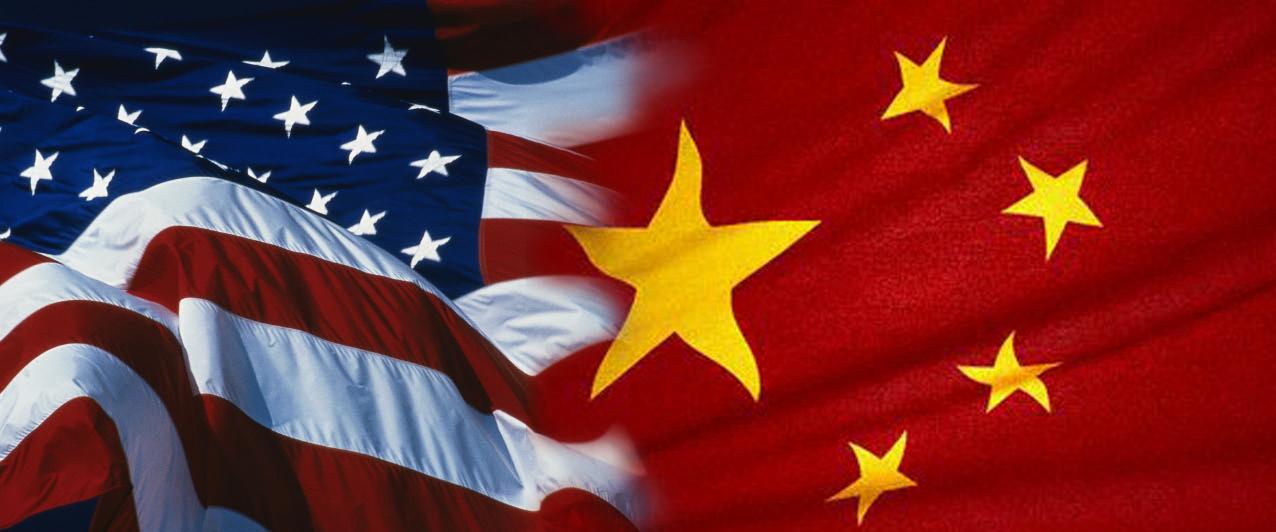
Tibet Awareness – A New Model for US-China Relations

Whole Sin – The Model for Great Power Relations: Red China is on a slippery slope and marching towards her self-destruction which no other nation can stop or intervene to help her.

Red China is on a slippery slope and marching towards her self-destruction which no other nation can stop or intervene to help her.

Whole Sin – The Model for Great Power Relations: Red China is on a slippery slope and marching towards her self-destruction which no other nation can stop or intervene to help her.

Rudra Narasimham Rebbapragada
Ann Arbor, MI 48104-4162, USA
Special Frontier Force-Establishment 22-Vikas Regiment

Whole Sin – The Model for Great Power Relations: Red China is on a slippery slope and marching towards her self-destruction which no other nation can stop or intervene to help her.
BBC

China seeks ‘new model’ for relations with US

CARRIE GRACIE  CHINA EDITOR
21 September 2015
From the section CHINA

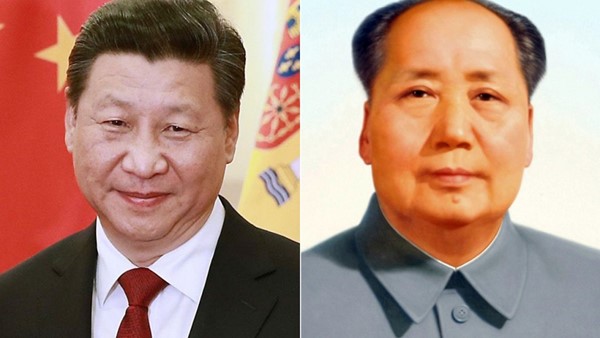
President Xi and President Obama, pictured in 2013
Whole Sin – The Model for Great Power Relations: Red China is on a slippery slope and marching towards her self-destruction which no other nation can stop or intervene to help her.

Image copyright Getty Images

Do you have expectations of this week’s summit between President Obama and President Xi? If so, I suggest you lower them.

The sombre fact is that despite the enormous range and complexity of the US-China relationship, it is becoming ever harder to manage. The smiles and ceremony of a 21-gun salute and state dinner will conceal gritted teeth and crossed fingers.

A game of brinkmanship is afoot and on cyber-hacking and contested atolls, it would need a reclamation project bigger and swifter than the one under way in the South China Sea for guest and host to find a piece of common ground to stand on.

But spin it another way and there should be something to celebrate.

Four and a half decades, five Chinese communist leaders, eight American presidents, and a transition from a world in which China is isolated and marginal to one in which it is increasingly able to meet the United States on equal terms.

And through it all, the US-China relationship has broadly held to the course that President Nixon set out in 1972 as he prepared to travel to Beijing to end two decades of enmity:

“The government of the People’s Republic of China and the government of the United States have had great differences. We will have differences in the future. But what we must do is to find a way to see that we can have differences without being enemies in war.”

TIBET AWARENESS - UNITED STATES - CHINA RELATIONS . WHOLE VILLAIN - WHOLEVILLAIN - #WHOLEVILLAIN
Whole Sin – The Model for Great Power Relations: Red China is on a slippery slope and marching towards her self-destruction which no other nation can stop or intervene to help her.

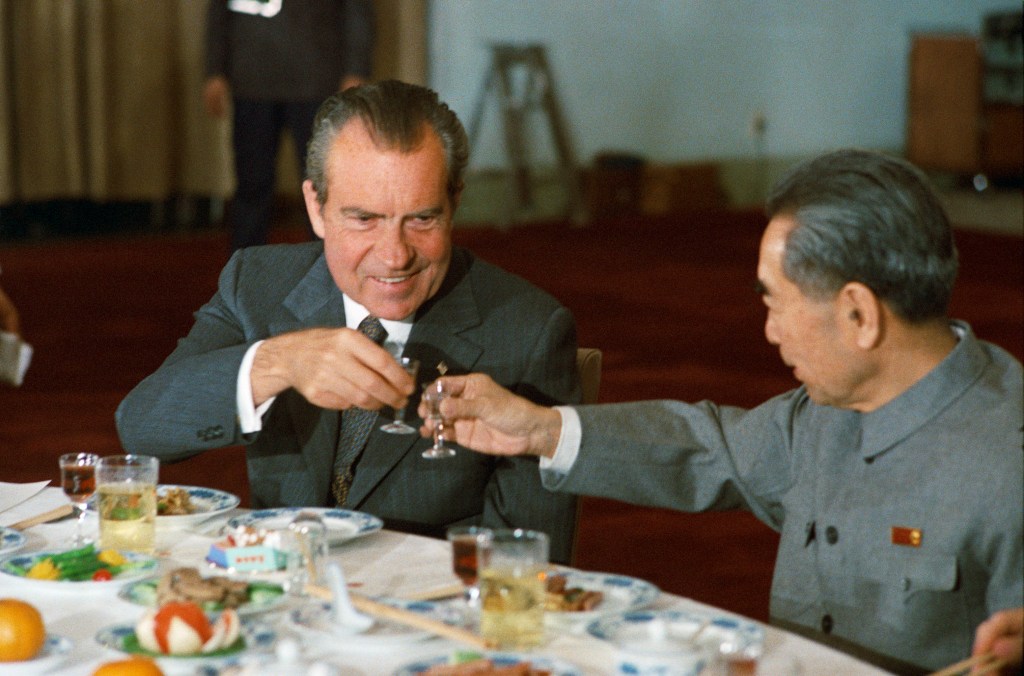
Image copyright Getty Images Image caption Richard Nixon shares a toast with Chinese PM Zhou Enlai in Beijing in 1972 during the first visit by a US president to the People’s Republic of China

Forty-three years later an ambitious Chinese leader is coming for his first state visit in the opposite direction and the challenge is still the same. But now the stakes are even higher for this relationship and it has all the advantages of experience and proven resilience. What makes it so hard then?

‘Properly manage differences

Only last week, President Obama issued a blunt warning to China on cyber-hacking: “There comes a point at which we consider this a core national security threat… we can choose to make this an area of competition, which I guarantee you we’ll win if we have to.”

Only a scrambled visit by China’s security chief for what the White House described as “candid, blunt discussions” seems to have averted American sanctions.

Meanwhile, in the South China Sea, the latest satellite imagery from this month suggests that even during a summit countdown, Beijing is ready to defy American warnings and possibly even renege on its own promises to continue reclamation work to turn contested atolls into military outposts.

Is President Xi about to waste a huge opportunity? Ahead of the state visit he said: “Both sides must accommodate each other’s core interests, avoid strategic miscalculation, and properly manage and control differences.”

TIBET AWARENESS - UNITED STATES - CHINA RELATIONS. PRESIDENTIAL CANDIDATE DONALD TRUMP CLAIMED THAT CHINA IS STEALING JOBS.
TIBET AWARENESS – UNITED STATES – CHINA RELATIONS. PRESIDENTIAL CANDIDATE DONALD TRUMP CLAIMED THAT CHINA IS STEALING JOBS.

Image copyright Getty Images Image caption Donald Trump has spoken of China stealing American jobs.

But he needs a much, much better speech writer if he is to get heard amid the US media frenzy of a presidential campaign and a papal visit. Already Republican candidates led by Donald Trump are lining up to complain that China is stealing American jobs and some have said President Xi’s visit should be cancelled or downgraded. US public opinion is increasingly negative on China. President Obama told the media China’s peaceful, orderly rise is in the US’s interest and good for the world.

But President Xi urgently needs to reach out to American politicians and public to explain how it is in the US’s interest. A mix of reassurance, vision and rigour are required, and a measure of charm would no doubt help.

But with a schedule focused on closed-door sessions with big business and tightly choreographed photo opportunities with tame members of the American public, it looks as if President Xi has opted for a risk-averse strategy with minimal substance and candour.

Return to form

Don’t forget this is the man with the Chinese Dream, a plan for what he calls “the great rejuvenation of the Chinese nation”. Implicit is the argument that a great China is not a novelty but a return to form.

For most of the past 2,000 years, China’s economy has accounted for between a quarter and a third of world output and after traumatic shocks delivered by outsiders in the 19th and 20th Centuries, China is on track to overtake the US within the decade and regain its status as the world’s biggest economy.

TIBET AWARENESS - UNITED STATES - CHINA RELATIONS. RED CHINA - ECONOMIC EXPANSIONISM A THREAT TO PEACE AND SECURITY.
Whole Sin – The Model for Great Power Relations: Red China is on a slippery slope and marching towards her self-destruction which no other nation can stop or intervene to help her.

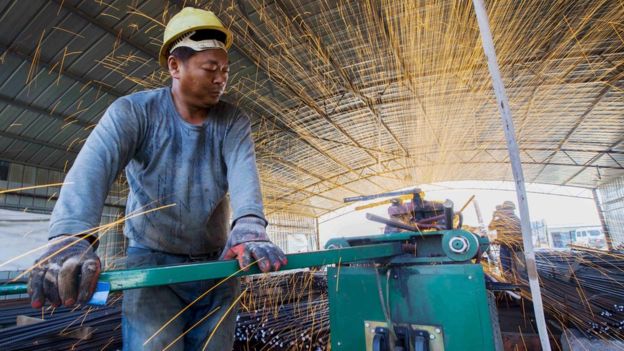
Image copyright Reuters Image caption China wants a foreign policy that reflects its economic rise.

What’s more, China is intent on building military force and diplomatic clout to match its economic might. The swiftest, surest and cheapest way to all three is through US co-operation, and, sound and fury notwithstanding, it has come to count on that co-operation, at least in the economic sphere.

Without American help, how could China have become the world’s largest manufacturing and trading nation in such breathtakingly short order? Without American help how can China confront the daunting economic challenges it faces today?

But expect no warm speeches on that score from President Xi in Washington.

Model v dream

Deaf to American concerns about market access or technology theft, the Chinese narrative of the relationship presents a version of itself as a much-maligned partner, uncomplainingly creating wealth and bankrolling spendthrift American consumers. China does not export its ideology or send troops abroad, it points out.

President Xi’s preferred slogan for the relationship involves not a dream but a model. He raised it again on the eve of the summit, “the new model of great power relations”. This is shorthand for a future in which the US assists China’s inexorable advance in order to avoid the wars and convulsions which have accompanied the rise of other great powers in world history.

Seen from inside his model, the US record is far from benign. Instead, the US threatens China’s political system by pushing democracy, undermines its territorial integrity by supplying arms to Taiwan and schemes to contain China by surrounding it with American alliances and military deployments.

TIBET AWARENESS - UNITED STATES - CHINA RELATIONS . TIME TO DEMAND FREEDOM, PEACE, AND JUSTICE IN OCCUPIED TIBET.
Whole Sin – The Model for Great Power Relations: Red China is on a slippery slope and marching towards her self-destruction which no other nation can stop or intervene to help her.

Image copyright Reuters Image caption Activists want President Obama to call on President Xi to halt the crackdown on Tibetans and Uighurs, and civil society in China.

In fact, part of Mr Xi’s dream is that a rejuvenated China will no longer need to put up with an American security order in Asia at all.
But Americans are famous dreamers too.

And especially since China’s opening up and integration into the world economy, many have hoped that in Beijing they might one day have a democratic partner and “responsible stakeholder in keeping the world safe”.

Hostilities

That American version of the Chinese dream is an affront to Mr Xi’s own and as he goes through the protocol motions on the American red carpet, it is no exaggeration to say that he sees his hosts as outright ideological enemies.

He is at least as hostile to their politics as Chairman Mao was in the days of Nixon’s visit, probably more so because of the close and present danger those politics present in a globalised world.

In his first three years in power, President Xi has used anti-corruption and ideological campaigns to stiffen the sinews of the Communist Party and buttress one-party rule. He has censored the discussion of universal values like democracy and freedom of speech, locking up academics, human rights lawyers, civil society activists, journalists, Christians and bloggers.

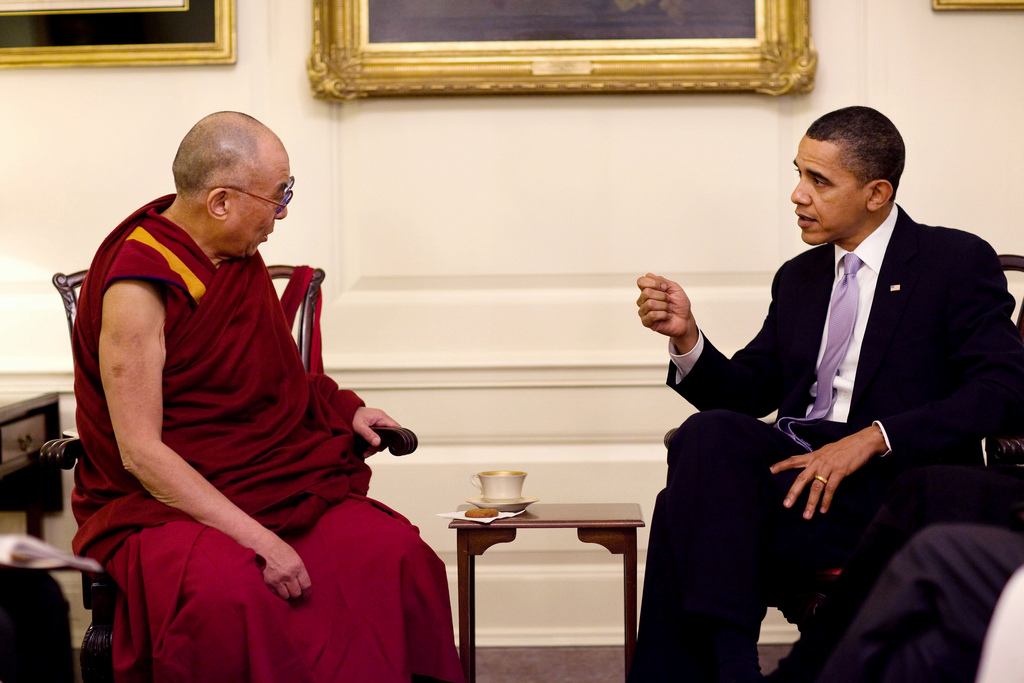
President Barack Obama meets with His Holiness the Dalai Lama in the Map Room of the White House, Feb. 18, 2010.  (Official White House Photo by Pete Souza) This official White House photograph is being made available only for publication by news organizations and/or for personal use printing by the subject(s) of the photograph. The photograph may not be manipulated in any way and may not be used in commercial or political materials, advertisements, emails, products, promotions that in any way suggests approval or endorsement of the President, the First Family, or the White House.
President Barack Obama meets with His Holiness the Dalai Lama in the Map Room of the White House, Feb. 18, 2010. (Official White House Photo by Pete Souza)
This official White House photograph is being made available only for publication by news organizations and/or for personal use printing by the subject(s) of the photograph. The photograph may not be manipulated in any way and may not be used in commercial or political materials, advertisements, emails, products, promotions that in any way suggests approval or endorsement of the President, the First Family, or the White House.

Image copyright The White House Image caption Chinese media has been critical of President Obama’s meetings with the Dalai Lama

Chinese propaganda teaches that the US is just the latest in a long line of hostile foreign powers trying to keep China down with a range of ideological weapons including meddling in Hong Kong and befriending the Dalai Lama.

President Xi makes no apology for his politics. “Shoes do not have to be the same but simply to fit the wearer,” he says. He is an authoritarian by conviction who believes China needs discipline and a sense of shared mission to realize its “great rejuvenation.” All of this is admittedly a difficult message to articulate for an American public. But some truths should be attempted for the sake of candour and connection.

President Xi could say that China still has enormous challenges at home and will avoid clashes with the US where possible. But that at the same time he wants a foreign policy that reflects the reality of China’s rise. And that on a range of issues, including rules for investment and climate change, he will co-operate with the US to the advantage of both countries.

He would be wise to attempt a much more nuanced and persuasive case on areas of competition like cybersecurity and the South China Sea. And he needs to show that he can listen and respond to the concerns of Americans. If not always with agreement, at least with understanding.

Now that would truly be powerful and might even presage a “new model of great power relations”.

Copyright © 2015 BBC. The BBC is not responsible for the content of external sites.

Whole Sin – The Model for Great Power Relations: Red China is on a slippery slope and marching towards her self-destruction which no other nation can stop or intervene to help her.

Whole Future – The Problem of finding Peace, Harmony and Tranquility in Occupied Tibet

The Future of Tibet – Can Red China Save herself from the consequences of Evil plans?

The Future of Tibet – Can Red China Save herself from the consequences of Evil plans?

Doom Dooma Doomsayer understands the problems faced by Tibetans; the Great Trouble in Tibet following Tibet’s military conquest. I am not a monk, a priest, or a member of clergy. I am not a prophet. However, my rational analysis of events leads me to announce Beijing’s Doom. Without recourse to any kind of human intervention, Red China faces Eviction From Occupied Tibet.

Rudra Narasimham Rebbapragada
Ann Arbor, Michigan, U.S.A. 48104 – 4162.
Doom Dooma Doomsayer

The Future of Tibet – Can Red China Save herself from the consequences of Evil plans?

TIBET – THE PLATEAU, UNPACIFIED

Tibetans’ culture is changing, by their own will as well as by force

Sep 17th 2016 | YUSHU

Doom Dooma Doomsayer understands the problems faced by Tibetans; the Great Trouble in Tibet following Tibet’s military conquest. I am not a monk, a priest, or a member of clergy. I am not a prophet. However, my rational analysis of events leads me to announce Beijing’s Doom. Without recourse to any kind of human intervention, Red China faces Eviction From Occupied Tibet.

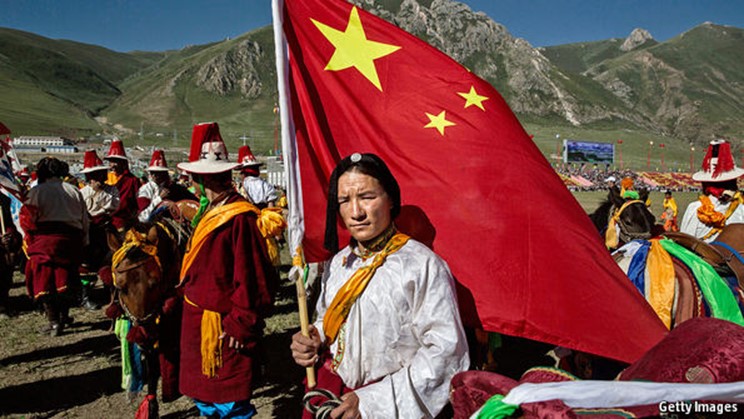
An elderly woman with long, grey plaits, wearing a traditional Tibetan apron of wool in colorful stripes, has spent her day weaving thread outside her home near the southern end of Qinghai Lake, high on the Tibetan plateau. She is among hundreds of thousands of Tibetan nomads who have been forced by the government in recent years to settle in newly built villages. She now lives in one of them with her extended family and two goats. Every few months one of her sons, a red-robed monk, visits from his monastery, a place so cut off from the world that he has never heard of Donald Trump. Her grandson, a 23-year-old with slick hair and a turquoise rain jacket, is more clued in. He is training to be a motorcycle mechanic in a nearby town. Theirs is a disorienting world of social transformation, sometimes resented, sometimes welcome.

Chinese and foreigners alike have long been fascinated by Tibet, romanticizing its impoverished vastness as a haven of spirituality and tranquility. Its brand of Buddhism is alluring to many Chinese—even, it is rumored, to Peng Liyuan, the wife of China’s president, Xi Jinping. Many Tibetans, however, see their world differently. It has been shattered by China’s campaign to crush separatism and eradicate support for the Dalai Lama, their spiritual leader who fled to India after an uprising in 1959. The economic transformation of the rest of China and its cities’ brash modernity are seductive, but frustratingly elusive.

The story of political repression in Tibet is a familiar one. The Dalai Lama accuses China’s government of “cultural genocide”, a fear echoed by a tour guide in Qinghai, one of five provinces across which most of the country’s 6m Tibetans are scattered (the others are Gansu, Sichuan, Yunnan and the Tibet Autonomous Region, or TAR—see map). “We know what happened to the Jews,” he says. “We are fighting for our existence.” Less commonly told is the despair felt by many young Tibetans who feel shut out of China’s boom. They are victims of Tibet’s remote and forbidding topography as well as of racial prejudice and the party’s anti-separatist zeal. They often cannot migrate to coastal factories, and few factories will come to them. Even fluent Mandarin speakers rarely find jobs outside their region.

Doom Dooma Doomsayer understands the problems faced by Tibetans; the Great Trouble in Tibet following Tibet’s military conquest. I am not a monk, a priest, or a member of clergy. I am not a prophet. However, my rational analysis of events leads me to announce Beijing’s Doom. Without recourse to any kind of human intervention, Red China faces Eviction From Occupied Tibet.

Yet Tibetans are not cut off from the rapidly evolving culture of the rest of China, where more than 90% of the population is ethnic Han. Mayong Gasong Qiuding, a 26-year-old hotel worker in Yushu in southern Qinghai, listens to Mandarin, Tibetan and Western pop music in tandem. He can rattle off official slogans but can recite only short Tibetan prayers. His greatest wish, he says, is to go to the Maldives to see the sea. Tibetan women in Qinghai use skin-whitening products, following a widespread fashion among their Han counterparts; a teenager roller-skates anticlockwise around a Buddhist stupa, ignoring a cultural taboo. Young nomads frustrate their elders by forsaking locally-made black, yak-hair tents for cheaper, lighter canvas ones produced in far-off factories.

Han migration, encouraged by a splurge of spending on infrastructure, is hastening such change. Although Tibetans still make up 90% of the permanent population of the TAR, its capital Lhasa is now 22% Han, compared with 17% in 2000. Many Tibetans resent the influx. Yet they are far more likely to marry Han Chinese than are members of some of China’s other ethnic groups. Around 10% of Tibetan households have at least one member who is non-Tibetan, according to a census in 2010. That compares with 1% of households among Uighurs, another ethnic minority whose members often chafe at rule by a Han-dominated government.

Core features of Tibetan culture are in flux. Monasteries, which long ago played a central role in Tibetan society, are losing whatever influence China has allowed them to retain. In recent years, some have been shut or ordered to reduce their populations (monks and nuns have often been at the forefront of separatist unrest). In July buildings at Larung Gar in Sichuan, a sprawling center of Tibetan Buddhist learning, were destroyed and thousands of monks and nuns evicted. Three nuns have reportedly committed suicide since. Of the more than 140 Tibetans who have set fire to themselves since 2011 in protest against Chinese rule, many were spurred to do so by repressive measures at their own monastery or nunnery.

Cloistered life is threatened by social change, too. Families often used to send their second son to a monastery, a good source of schooling. Now all children receive nine years of free education. “The young think there are better things to do,” says a monk at Rongwo monastery in Tongren, a town in Qinghai, who spends his days “praying, teaching [and] cleaning”. New recruits often come from poorly educated rural families.

Mind your language

In the TAR (which is closed to foreign journalists most of the time), the Tibetan language is under particular threat. Even nursery schools often teach entirely in Mandarin. A generation is now graduating from universities there who barely speak Tibetan. Some people have been arrested for continuing to teach in the language. In April last year Gonpo Tenzin, a singer, was sentenced to three-and-a-half years in prison for his album, “No New Year for Tibet”, encouraging Tibetans to preserve their language and culture.

In some areas outside the TAR, however, the government is less hostile to Tibetan. Since the early 2000s, in much of Qinghai, the number of secondary schools that teach in Tibetan has risen, according to research there by Adrian Zenz of the European School of Culture and Theology at Korntal, Germany. The range of degrees taught in Tibetan has expanded too. Unlike elsewhere, someone who has studied mainly in Tibetan can still get a good job in Qinghai. A third of all government roles advertised there between 2011 and 2015 required the language. Despite this, many parents and students chose to be taught in Mandarin anyway, Mr. Zenz found. They thought it would improve job prospects.

Doom Dooma Doomsayer understands the problems faced by Tibetans; the Great Trouble in Tibet following Tibet’s military conquest. I am not a monk, a priest, or a member of clergy. I am not a prophet. However, my rational analysis of events leads me to announce Beijing’s Doom. Without recourse to any kind of human intervention, Red China faces Eviction From Occupied Tibet.

But work can be difficult to get, despite years of huge government aid that has helped to boost growth. Government subsidies for the TAR amounted to 111% of GDP in 2014 (see chart), according to Andrew Fischer of Erasmus University Rotterdam. Eleven airports serve Qinghai and the TAR—they will have three more by 2020. A 156-mile train line from Lhasa (population 560,000) to Shigatse (population 120,000), which was completed in 2014, cost 13.3 billion yuan ($2.16 billion). A second track to Lhasa is being laid from Sichuan, priced at 105 billion yuan.

Better infrastructure has fueled a tourism boom—domestic visitors to the TAR increased fivefold between 2007 and 2015—but most income flows to travel agents elsewhere. Tourists stay in Han-run hotels and largely eat in non-Tibetan restaurants (KFC opened its first Lhasa branch in March). Tibetan resentment at exclusion from tourism- and construction-related jobs was a big cause of rioting in Lhasa in 2008 that sparked plateau-wide protests. Other big money-spinners—hydropower and the extraction of minerals and timber—are controlled by state-owned firms that employ relatively few Tibetans. The Chinese name for Tibet, Xizang, means “western treasure house”. But Tibetans have little share in its spoils. The rehousing of nomads has helped provide some with building jobs, but has also brought suffering: those relocated sometimes find it harder to make a living from herding.

In most other parts of China, villages have been rapidly emptying as people flock to work in cities. In the country as a whole, the agricultural population dropped from 65% to 48% as a share of the total between 2000 and 2010. On the plateau it fell only slightly, from 87% to 83%. It is hard for Tibetans to migrate to places where there are more opportunities. Police and employers treat them as potential troublemakers. In 2010 only about 1% of Tibetans had settled outside the plateau, says Ma Rong of Peking University. They cannot move abroad either. In 2012 Tibetans in the TAR had to surrender their passports (to prevent them joining the Dalai Lama); in parts of Qinghai officials went house-to-house confiscating them.

Doom Dooma Doomsayer understands the problems faced by Tibetans; the Great Trouble in Tibet following Tibet’s military conquest. I am not a monk, a priest, or a member of clergy. I am not a prophet. However, my rational analysis of events leads me to announce Beijing’s Doom. Without recourse to any kind of human intervention, Red China faces Eviction From Occupied Tibet.

For university graduates, the prospects are somewhat better. There are few prospects for secure work in private firms on the plateau. But to help them, the government has been on a hiring spree since 2011. Almost all educated Tibetans now work for the state. A government job is a pretty good one: salaries have been rising fast. Few Tibetans see such work as traitorous to their cause or culture. But the government may not be able to keep providing enough jobs for graduates, especially if a slowdown in China’s economy, which is crimping demand for commodities, has a knock-on effect on the plateau.

Many of the problems faced by Tibetans are common in traditional pastoral cultures as they modernize. But those of Tibetans are compounded by repression. They are only likely to increase when the Dalai Lama, now 81, dies. The central government will try to rig the selection of his successor, and no doubt persecute Tibetans who publicly object.

In private, officials say they are playing a waiting game: they expect the “Tibetan problem” to be more easily solved when he is gone. They are deluding themselves. They ignore his impact as a voice of moderation: he does not demand outright independence and he condemns violence. Tibetan culture may be under duress, but adoration of the Dalai Lama shows no sign of diminishing. Poverty, alienation and the loss of a beloved figurehead may prove an incendiary cocktail.

Inserted from <http://www.economist.com/news/china/21707220-tibetans-culture-changing-their-own-will-well-force-plateau-unpacified>

Doom Dooma Doomsayer understands the problems faced by Tibetans; the Great Trouble in Tibet following Tibet’s military conquest. I am not a monk, a priest, or a member of clergy. I am not a prophet. However, my rational analysis of events leads me to announce Beijing’s Doom. Without recourse to any kind of human intervention, Red China faces Eviction From Occupied Tibet.

Whole Future – The Future of Tibet Hangs in the Balance

The Future of Tibet Hangs in the Balance


TIBET EQUILIBRIUM – BALANCE OF POWER IN OCCUPIED TIBET. THE GREAT TIBET PROBLEM WILL EXIST UNTIL BALANCE OF POWER IS RESTORED IN OCCUPIED TIBET.

Trouble in Tibet as Future of Tibet Hangs in the Balance. Tibetans enjoyed natural sense of Independence for several centuries which includes extended periods of foreign conquests by Mongol China and Manchu China. As Dalai Lama admits the need for ‘Skepticism’, Tibetans have become highly skeptical as Future of Tibet got intertwined with the vexing problem of Red China’s oppressive regime. I predict the sudden, catastrophic downfall of the mighty Chinese Empire any time before or after the Dalai Lama.

Whole Future – The Future of Tibet hangs in the balance. I predict the sudden, catastrophic downfall of the mighty Chinese Empire any time before or after the Dalai Lama.

Rudra Narasimham Rebbapragada
Ann Arbor, MI 48104-4162 USA
Special Frontier Force-Establishment 22-Vikas Regiment

TIBET EQUILIBRIUM – BALANCE OF POWER IN OCCUPIED TIBET. THE GREAT TIBET PROBLEM WILL EXIST UNTIL BALANCE OF POWER IS RESTORED IN OCCUPIED TIBET.


WWW.SLTRIB.COM
JUN 24, 2016

More from the Dalai Lama on the afterlife, science, China and Tibet’s future

Peggy Fletcher Stack
First Published Jun 22 2016 09:51AM • Last Updated Jun 22 2016 12:14 pm

THE FUTURE OF RED CHINA WITHOUT DALAI LAMA. I PREDICT SUDDEN CATASTROPHIC DOWNFALL OF THE EVIL RED EMPIRE AFTER DALAI LAMA WITH OR WITHOUT HIS REINCARNATION.

(The Dalai Lama waves goodbye to the crowd after speaking at the Huntsman Center at the University of Utah in Salt Lake City, Tuesday, June 21, 2016. (Chris Detrick/The Salt Lake Tribune) via AP) 

The Dalai Lama captivated thousands of Utahns this week with his speech Tuesday at the Huntsman Center, emphasizing the power of individuals in bringing about change and pointing out that actions, more than prayer, can lead to global peace.

But the Tibetan Buddhist leader touched on many more topics — from the afterlife to Chinese relations and the value of science — during a question-and-answer session. Here are some of his responses:

What does he say about the afterlife to a man whose father committed suicide?

“That is sufficient reason to feel sad, but then think that sadness will not bring your father back,” he said. “Now you should work hard and make an effort to fulfill your late father’s wish, and somehow he will know of your condition.”

• What happens after death?


That, he said, is “a more complicated question.” In some Indian traditions, including Hinduism and Buddhism, there is no central authority as creator, “just self-creation,” he said. “Actions bring positive or negative results or karma. … Basically the life continues, no beginning or end until people reach nirvana,” akin to enlightenment, and escape from the cycle.

• What is the most effective approach to climate change?

“I don’t know,” he said. “Ask some specialist.”

• What role does scientific education play in universal responsibility?

“I especially like scientific research that involves the brain,” he said. ” … Such research is now showing interest in the nature of compassion — love — based on the oneness of the individual … and how anger and fear destroy the mind and the physical health.”

The Dalai Lama said he has had many discussions with scientists who are “neutral and unbiased — so that’s a true scientist — that mental attitude is very necessary to further research or knowledge. … There is no progress without investigation. Your mind must be open. It is also necessary to have skepticism. That brings questions and questions bring an effort to find any answer. … If you are contented, if you feel ‘I know everything,’ then no further progress.” ” … I am nearly 81, but I consider myself still a student,” said the Nobel Peace Prize laureate.

• Will he ever return to Tibet?


Nine years after the Chinese took over Tibet in 1950, the Dalai Lama fled to India with a small party of his associates. He has lived in exile for more than five decades, he said Tuesday, and most of the people with his group are either dead or too old to travel. “I don’t know if they will see Tibet or not,” he said, “but most of us feel that one day will come when we meet back home.”

China, of course, sees Tibet as part of its sovereign territory and has opposed any move toward independence, which the Dalai Lama also has given up. But the Tibetan leader hopes China will allow the Tibetans to continue their traditions and culture. “I feel for their own [Chinese] future and for society,” he said, “if they don’t change.”

Younger Chinese who travel, study, tour or do business outside the country are more open, he said. “If you have an opportunity to meet them, tell them the reality.” He was, he said, “optimistic.”

Peggy Fletcher Stack

Copyright @ 2016, The Salt Lake Tribune

THE FUTURE OF RED CHINA’S EXPANSIONISM – BEIJING DOOMED.


Whole Dude – Whole Future – Evolution vs Extinction

Man’s Future – Evolution or Extinction?

Man’s Future: Evolution or Extinction?

Like all other living creatures of this planet Earth, man is a mortal being. Whosoever had arrived on this planet must also depart. As a biological species, what are man’s chances of survival in the future? Man arrived on planet Earth as a created being and exists as an Individual with Individuality without any choice. Life has always survived several major and minor extinction events and the issue of survival demands the existence of a human population, a mob of individuals with individuality.

Could Man Evolve into a new Species?

Man’s Future: Evolution or Extinction?

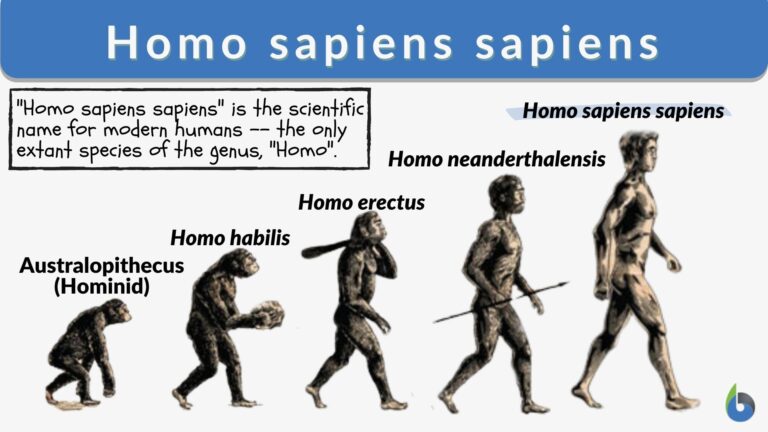
Man is a member of the order of Primates, which is a part of the class Mammalia. The Anatomically Modern humans belong to the species Homo sapiens which is further identified as subspecies sapiens. Man is the only species in the genus Homo of the family Hominidae that is living today. All other ancestral forms of the genus Homo are extinct. The early Homo sapiens was possibly present in southeastern Europe 350,000 years ago. The numbers and range of early humans has increased about 100,000 years ago.

Man’s Future: Evolution or Extinction?

The rate of expansion of human population is related to technological advancements that increase the availability of food, or of major medical advances that reduce the number of deaths. Man not only fully inhabits and utilizes a wide range of environments but also alters these environments to his own ends. With a variety of sophisticated technologies interposed between man and the natural environment, the environment cannot exert pressures on the human species in the same way that it has on other species.

Future of Man: Evolution or Extinction? Expression of Biological Information. DNA & Genetic Information. Operon. Abilities of DNA. Produce polypeptide. Forming new DNA. DNA as genetic material. Gene hypothesis. Protein synthesis. Griffith (1931) Beadle & Tatum (1944) Replication. Avery et. al (1944) Hershey & Chase.

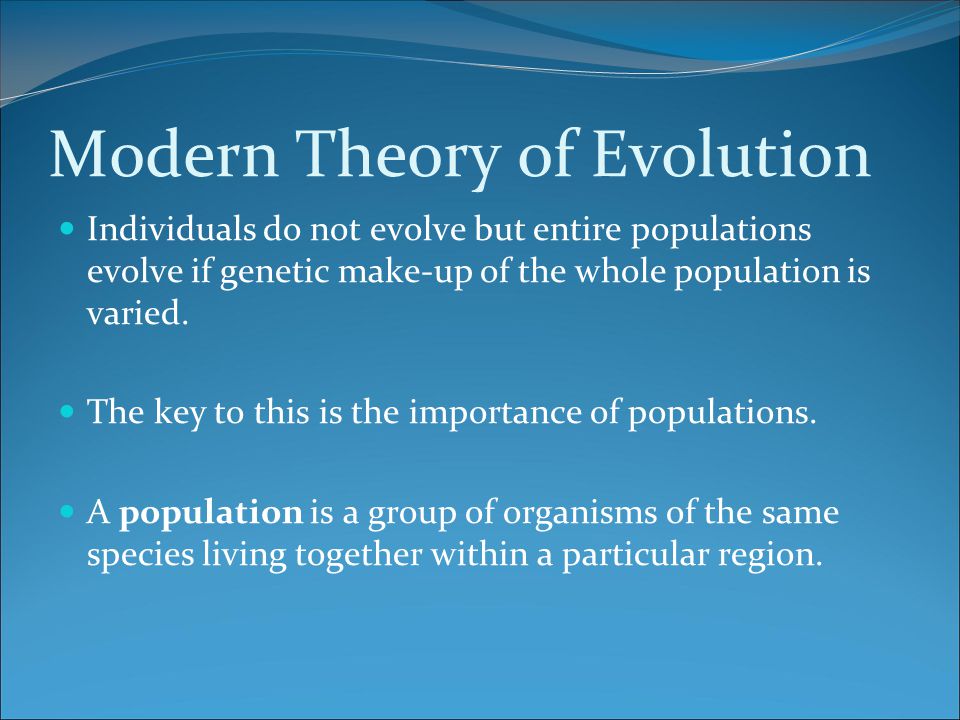
Essentially, the modern synthetic view of evolution could be defined as a change in gene frequency. Evolution could be described as change in the genetic composition of a population through time. For purposes of speciation or separation into new species, we need to demonstrate cumulative and important changes in the population gene pool. In the last 250,000 years there is no evidence to show any important changes in the population gene pool. Practically speaking, man’s evolution into a new species is arrested because of the intervention of culture between man and his environment.

Man’s Future: Evolution or Extinction?

The Biological Phenomenon of Extinction

Man’s Future: Evolution or Extinction?

In biology, extinction refers to the dying out or termination of a race or species of animals or plants. Extinction occurs when a species can no longer reproduce at replacement levels and all the surviving members perish at the end of their life spans which could be shortened by harsh environmental stresses. The causes of extinction include the following: 1. extra -terrestrial, 2. geological-climatical, and 3. biological. Most extinctions are thought to have resulted from environmental changes. A species could be affected in either of two ways:

1. The doomed species is not able to adapt to the changed environment and would totally perish without descendants;

2. The doomed species may adapt but, in the process, may evolve into a distinctly new species. When this transformation is completed, the doomed species would be identified as an extinct species. It should be noted that this kind of transformation of one species into a new distinct species is not actually observed by any person. The chances of man evolving into a new species is less likely because man has to some extent arrested this process due to the development of his abilities to manipulate nature.

Extinction is an ongoing feature of the Earth’s flora and fauna. The fossil record has served to demonstrate the history of most major groups of animals and plants. The record indicates the occurrence of fairly sudden extinctions of certain groups at certain times, and the fossil record also reveals the occurrence of a number of mass extinctions each involving the demise of vast number of species. A typical species becomes extinct within 10 million years of its first appearance and only one in a thousand species that have existed remain today. Some 99.9 percent of all species that have ever lived on Earth are now extinct. Mass extinctions are ecological disasters but they may also create opportunities by removing once dominant groups.

Cretaceous-Tertiary Extinction Event (K-T EVENT)

Man’s Future: Evolution or Extinction. CRETACEOUS-TERTIARY EXTINCTION EVENT OR K-T EVENT, ABOUT 65 MILLION YEARS AGO, WIPED OUT APPROXIMATELY 80 PERCENT OF ALL SPECIES OF ANIMALS INCLUDING A GREAT VARIETY OF DINOSAURS .

A drastic example of extinctions is provided by the dinosaurs. About 65 million years ago, at the end of the Cretaceous period all the major groups of dinosaurs and several forms of marine life became extinct more or less simultaneously. It has great significance because it ended the reign of the dinosaurs and opened the way for mammals to become the dominant land vertebrates. Some biologists conclude that humans owe our present dominance because of this K-T Event that saw the end of the dinosaurs.

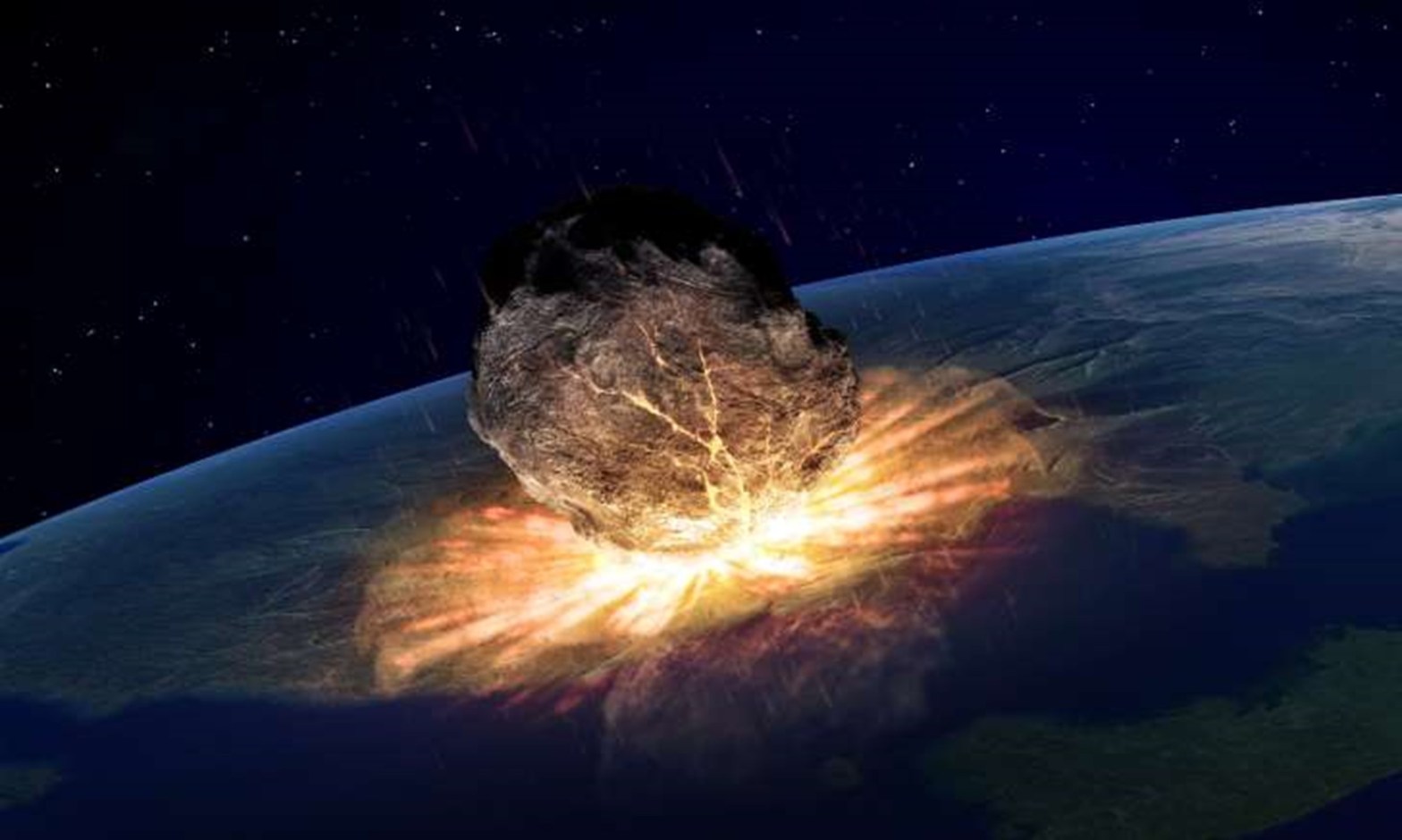
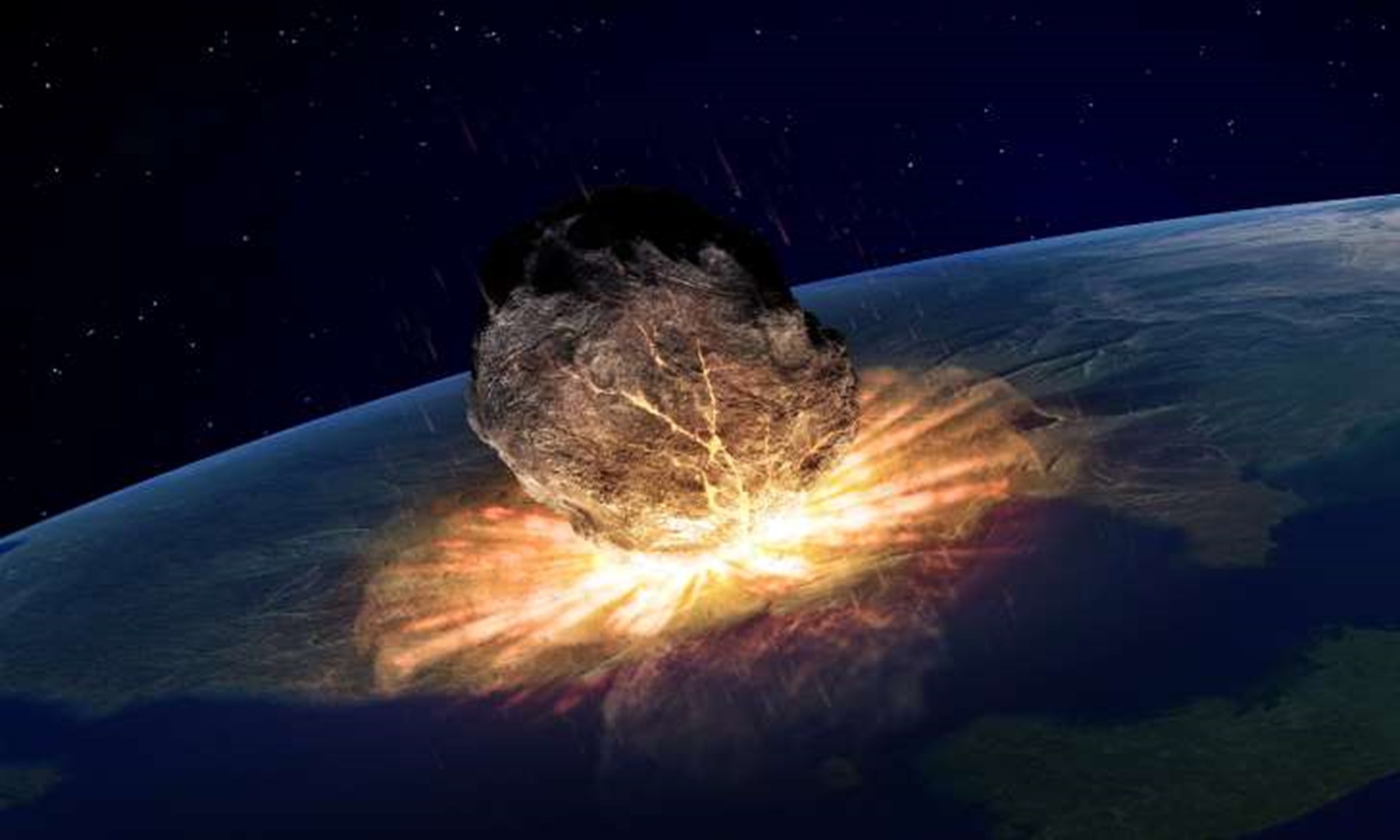
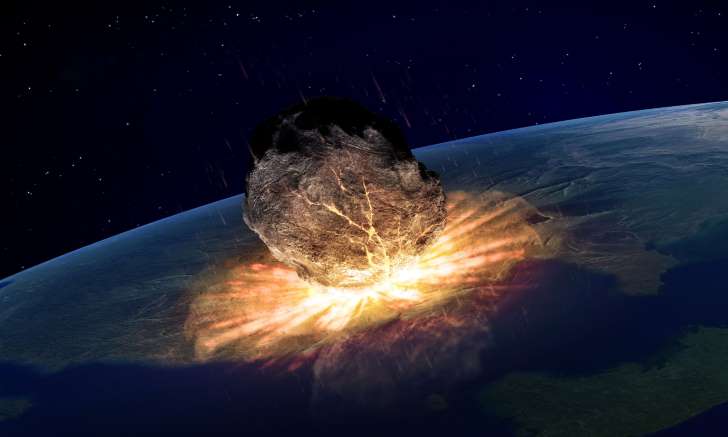
Man’s Future – Evolution or Extinction: Dinosaur Extinction.Asteroid strike near Mexico may have caused Major Extinction Event called K-T Event. Impact site 1600km from Central America.

Evidence points to the impact of an asteroid hitting the Earth as the cause of this extinction. An important aspect of such impacts by heavenly objects would be the creation of tremendous amounts of ionizing radiation which has played a devastating role in wiping out the marine life. It is suspected that catastrophic events such as an asteroid impact/radiation may have triggered other mass extinctions as well. In fact, mass extinctions appear to have taken place approximately every 26 million years. Some paleontologists proposed that a cyclical cosmic event cause these periodic die-offs.

The Lessons from Dinosaur Extinction

The history of Dinosaurs: LONG-LASTING VOLCANIC ERUPTIONS IN DECCAN TRAPS REGION OF INDIA MAY HAVE CAUSED EXTINCTION OF DINOSAURS. EACH DINOSAUR CREATURE LIVED AS INDIVIDUAL WITH INDIVIDUALITY.

The history of dinosaurs upon planet Earth clearly tells us and warns us about the vulnerability of human existence. The structural differentiation and the sophisticated functional organization of man makes him a very complex organism. Such complexity actually places man in a position of disadvantage when a cataclysmic cosmic event actually happens. Organisms that are structurally simple and functionally primitive and those that feed upon dying or decaying organic matter may survive better and ride over the chaos caused by a massive collision.

The theory of evolution would not be able to offer a sense of hope to humanity and just like the dinosaurs, man would be the next doomed species. Life forms have become extinct and yet life continued. A living thing is a composite of form, and substance. We tend to pay attention to the form and disregard the nature of the substance. The living matter or substance has endured all extinction events over period of 3.5 billion years after the first appearance of Life on planet Earth. This living substance survives and displays the quality or the characteristic of being imperishable, immutable, immovable, and eternal. There is hope that the living substance would again survive a future major extinction event.

Man’s Future: Evolution or Extinction?

What about the life form that we recognize as man? Man could derive some comfort from the Book of Genesis, chapter 8, verse 22 which promises:

Man’s Future: Evolution or Extinction?

“As long as the earth endures,

seed-time and harvest,

cold and heat,

summer and winter,

day and night

will never cease.”

Man’s Future: Evolution or Extinction?