Trouble in Tibet – Dalai Lama Portraits Confiscated
Confiscation of Dalai Lama portraits in Occupied Tibet is a sign and symptom of deep Trouble in Tibet. To give relief from Trouble, Tibet needs Freedom From Occupation. The Dalai Lama will not reincarnate in a Land where his portraits are confiscated.
Confiscation of Dalai Lama portraits in Occupied Tibet is a sign and symptom of deep Trouble in Tibet. To give relief from Trouble, Tibet needs Freedom From Occupation. The Dalai Lama will not reincarnate in a Land where his portraits are confiscated.
Rudra Narasimham Rebbapragada Ann Arbor, MI 48104-4162 USA SPECIAL FRONTIER FORCE
Confiscation of Dalai Lama portraits in Occupied Tibet is a sign and symptom of deep Trouble in Tibet. To give relief from Trouble, Tibet needs Freedom From Occupation. The Dalai Lama will not reincarnate in a Land where his portraits are confiscated.
DALAI LAMA PORTRAITS CONFISCATED IN CHINA: REPORT
February 3, 2016 12:40 AM
A man prays below a portrait of the Dalai Lama at Kirti Monastery in Aba, a Tibetan area of China’s Sichuan province, on December 9, 2015 (AFP Photo/Benjamin Haas)
Beijing (AFP) – A Chinese province with a large Tibetan population has ordered shopkeepers to hand in portraits of the Dalai Lama, state-run media said Wednesday, quoting Beijing experts likening the Nobel laureate to executed Iraqi leader Saddam Hussein.
Sichuan in the southwest, which includes several ethnically Tibetan areas, set up a “law enforcement squad” of cultural bureau personnel, police and other officials to enforce the drive, reported the Global Times, which is close to the ruling Communist party.
The aim was to “crack down on pornography and illegal publications, which include portraits of the Dalai Lama” ahead of the Lunar New Year, it quoted Gou Yadong, director of the provincial publicity department, as saying.
People were more than welcome to put on show pictures of the country’s past and present leaders, he added, referring to former heads of the ruling party. The Global Times also cited Lian Xiangmin, of the China Tibetology Research Centre in Beijing, as saying that for Chinese people, hanging his picture was the same as displaying Saddam Hussein’s image would be for Americans.
The former Iraqi leader was executed in 2006 after being convicted of crimes against humanity, while the Dalai Lama, who fled Tibet after a failed uprising against Chinese rule, was awarded the 1989 Nobel Peace prize.
The move in Sichuan comes as Beijing steps up a campaign against the spiritual leader, who is still widely revered by Tibetans. Beijing brands him a dangerous separatist, despite his repeated statements condemning violence, and in Tibet it tightly controls images of him as part of what many Tibetans see as official repression of their religion and culture.
China denies repression of minorities and says its massive investment in Tibet has brought development to a formerly poverty stricken region. Some Tibetan areas in Sichuan had seen laxer enforcement in recent years, with business owners displaying his portrait in shops.
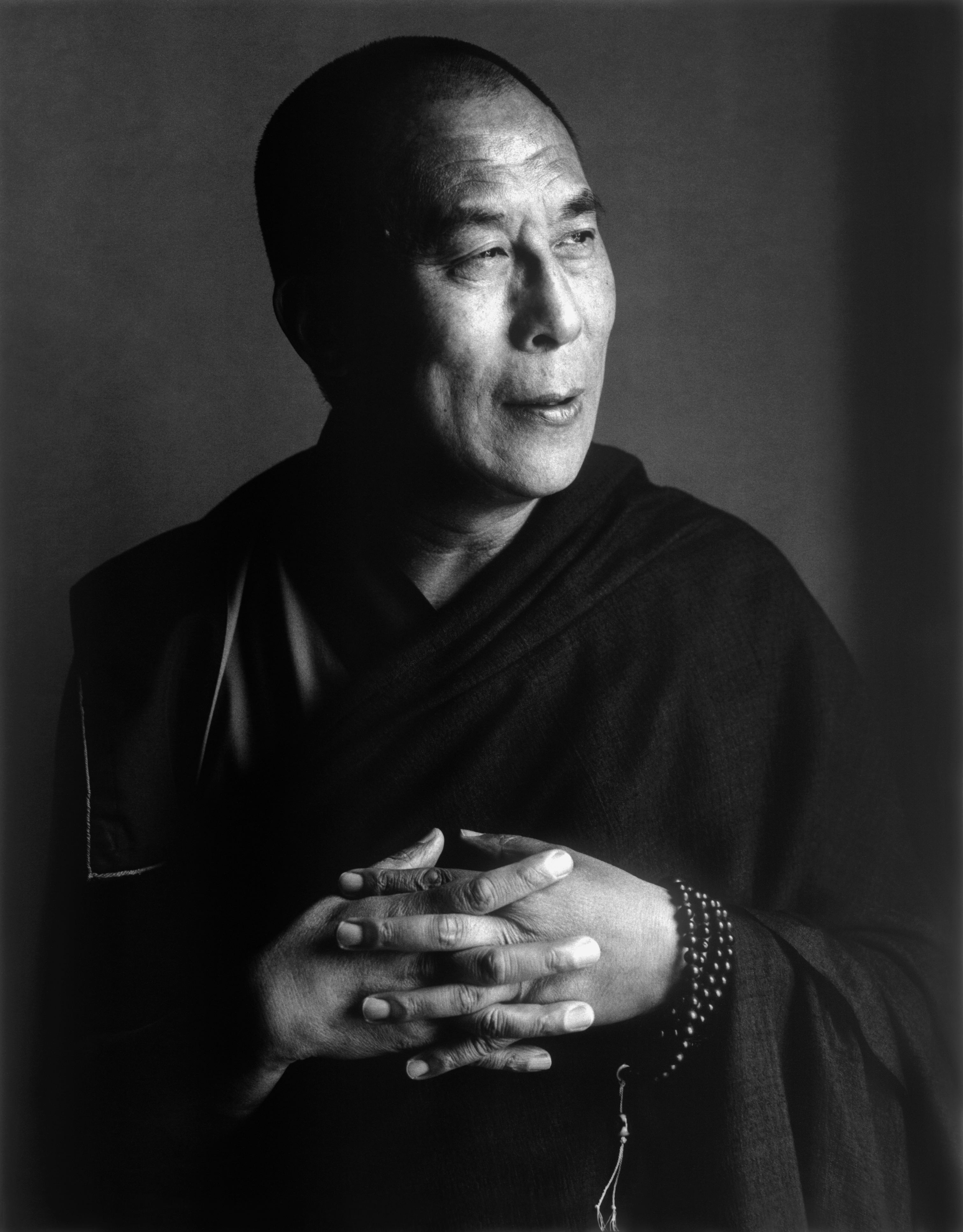
TROUBLE IN TIBET – DALAI LAMA PORTRAITS CONFISCATED IN OCCUPIED TIBET. 1987 Photography by Herb Ritts.Confiscation of Dalai Lama portraits in Occupied Tibet is a sign and symptom of deep Trouble in Tibet. To give relief from Trouble, Tibet needs Freedom From Occupation. The Dalai Lama will not reincarnate in a Land where his portraits are confiscated.
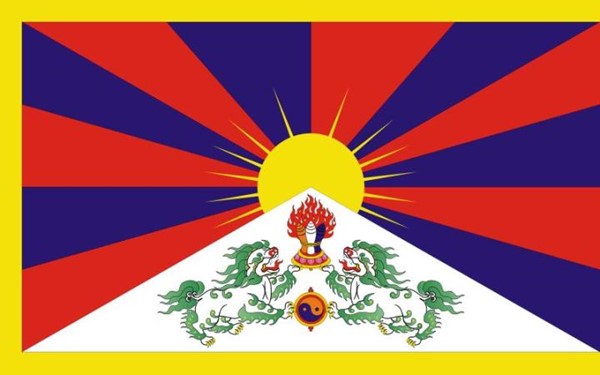
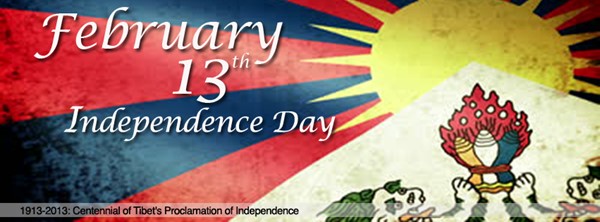
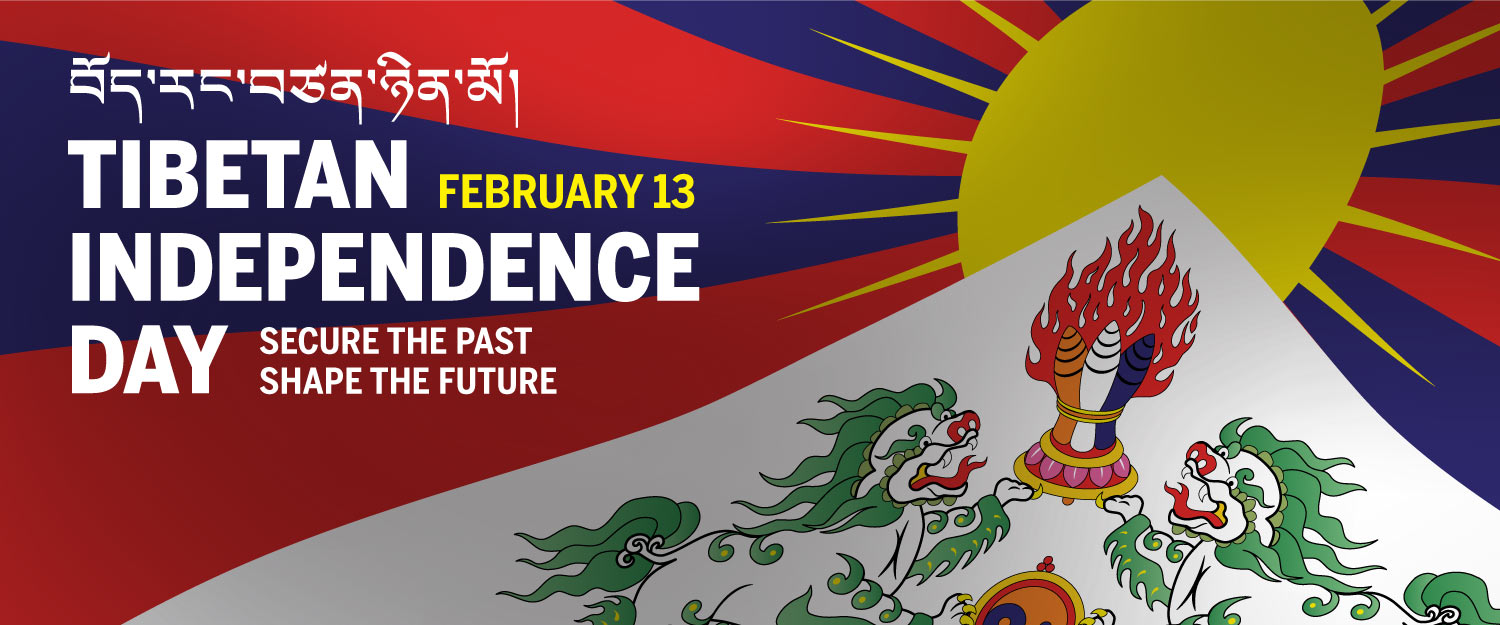
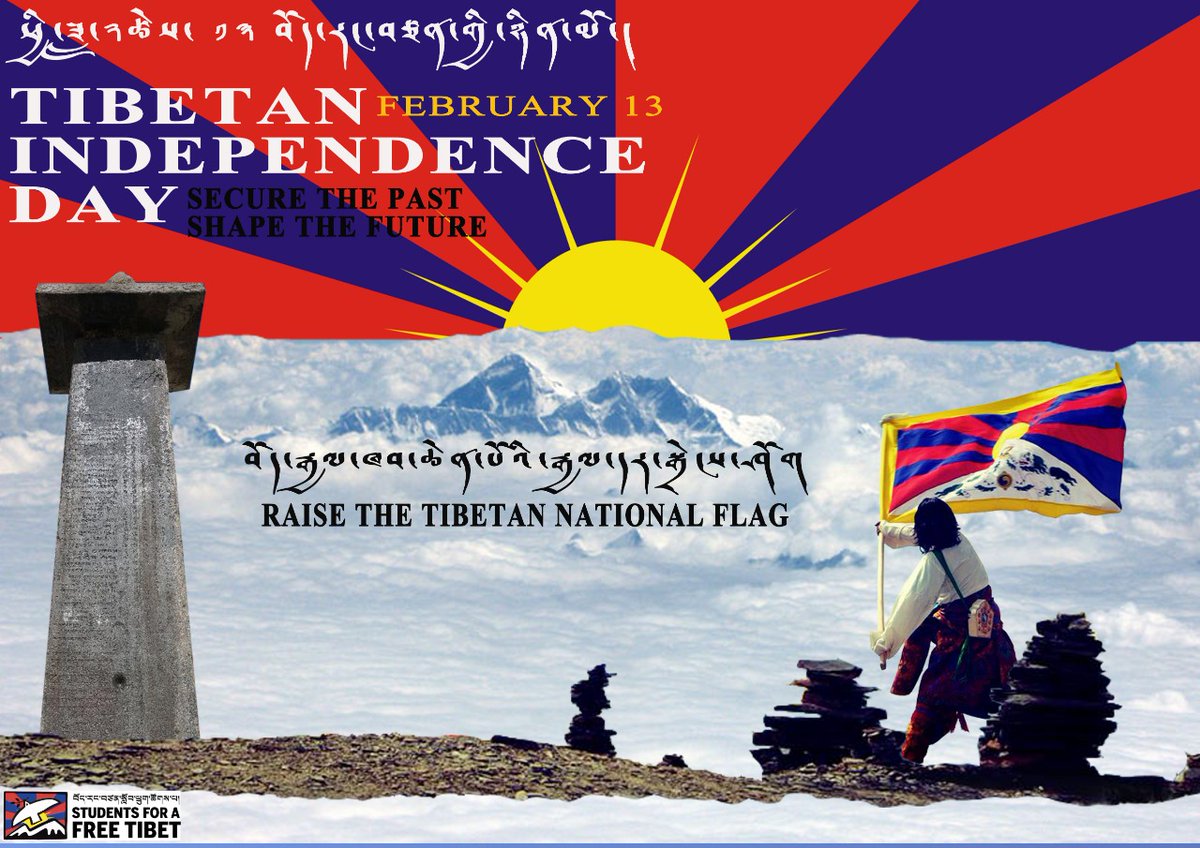
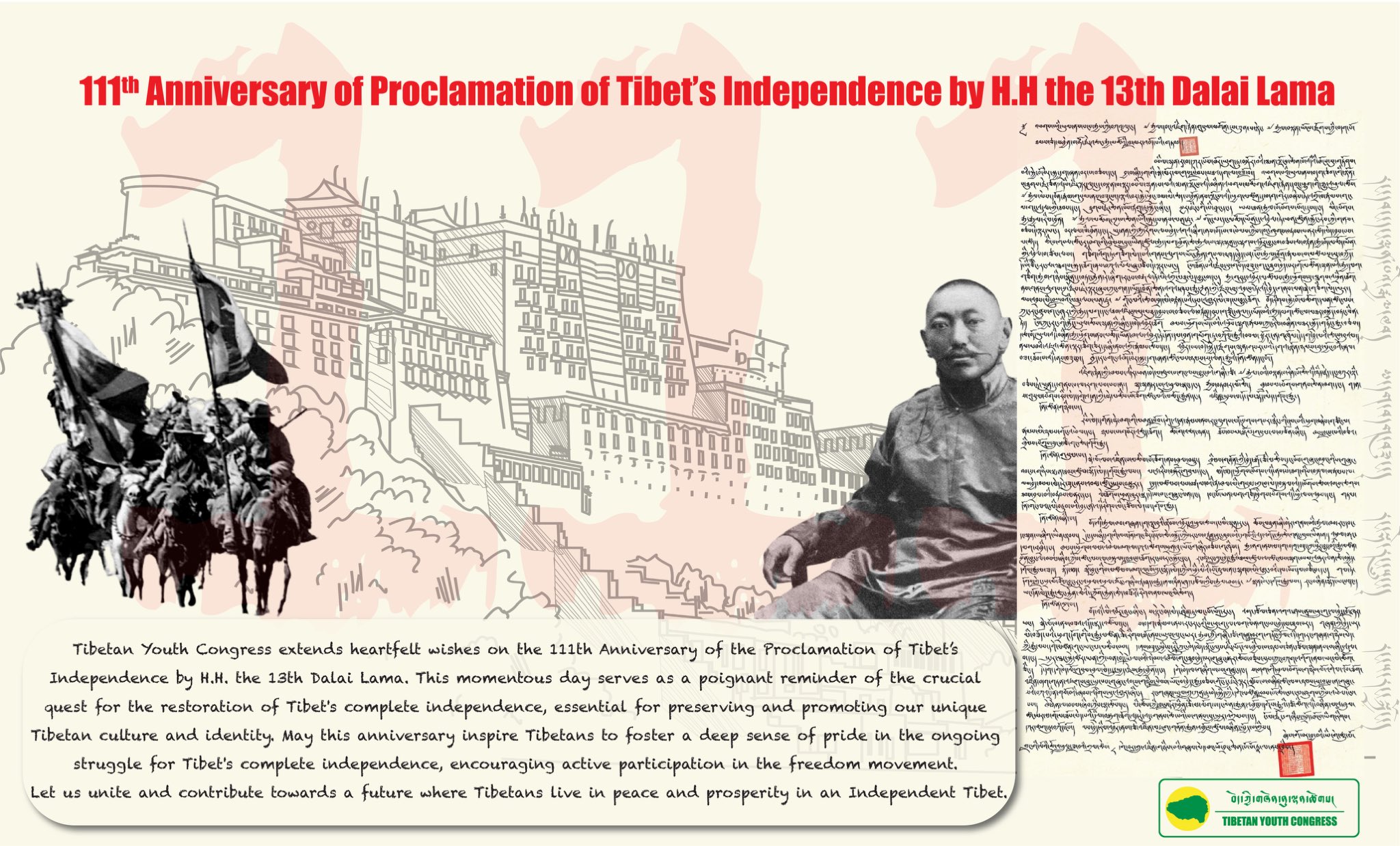
February 13, 2025. The 112th Anniversary of Tibetan Independence Day
February 13, 2025. The 112th Anniversary of Tibetan Independence Day
FEBRUARY 13, 1913. ON THIS DAY TIBET DECLARED FULL INDEPENDENCE
February 13, 2025. The 112th Anniversary of Tibetan Independence Day
I ask historians to record Tibet’s Proclamation of Independence as the most significant event of the recent human history.
February 13, 2025. The 112th Anniversary of Tibetan Independence Day
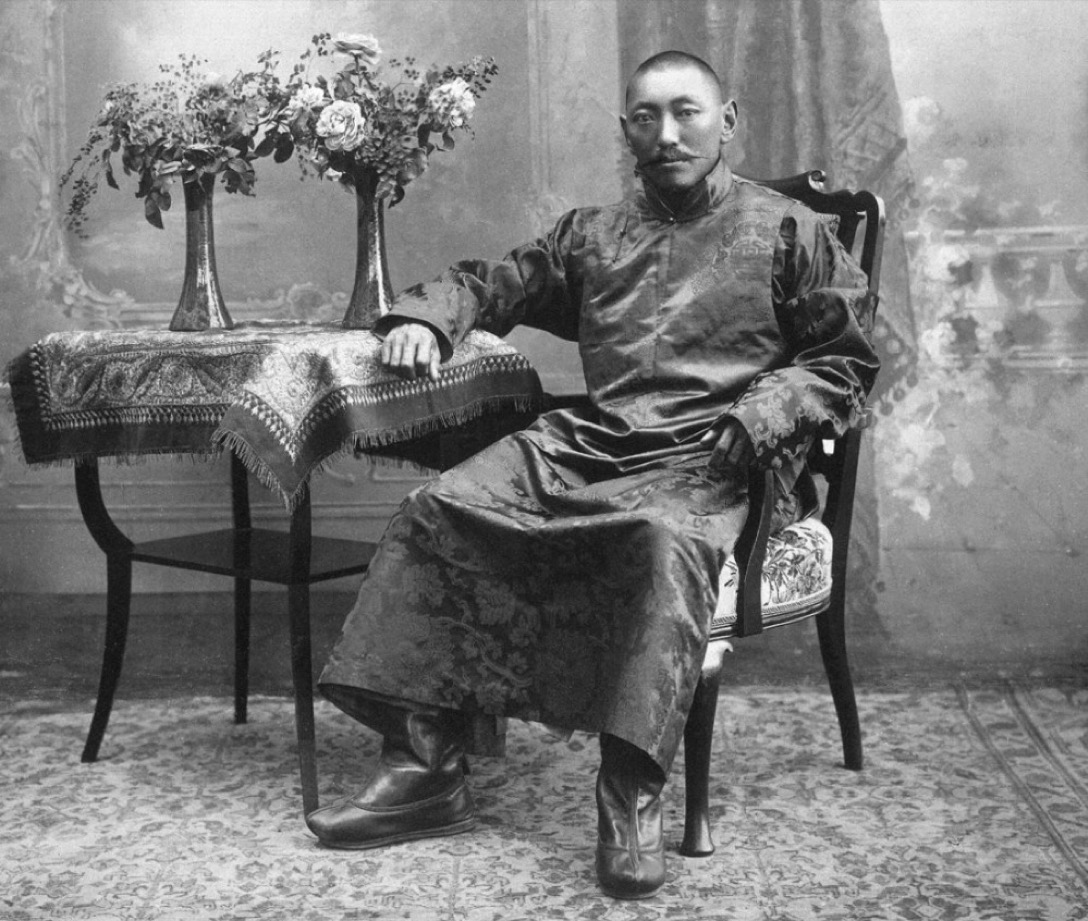
Proclamation of Independence of Tibet (1913) by Thubten Gyatso
February 13, 1913. On This Day Tibet Declared Full Independence.
Proclamation of Independence Issued by the 13th Dalai Lama (1913) PROCLAMATION ISSUED BY H.H. THE DALAI LAMA XIII, ON THE EIGHTH DAY OF THE FIRST MONTH OF THE WATER-OX YEAR (February 14th, 1913)
Translation of the Tibetan Text
I, the Dalai Lama, most omniscient possessor of the Buddhist faith, whose title was conferred by the Lord Buddha’s command from the glorious land of India, speak to you as follows:
I am speaking to all classes of Tibetan people. Lord Buddha, from the glorious country of India, prophesied that the reincarnations of Avalokitesvara, through successive rulers from the early religious kings to the present day, would look after the welfare of Tibet.
During the time of Genghis Khan and Altan Khan of the Mongols, the Ming dynasty of the Chinese, and the Ch’ing Dynasty of the Manchus, Tibet and China cooperated on the basis of benefactor and priest relationship. A few years ago, the Chinese authorities in Szechuan and Yunnan endeavored to colonize our territory. They brought large numbers of troops into central Tibet on the pretext of policing the trade marts. I, therefore, left Lhasa with my ministers for the Indo-Tibetan border, hoping to clarify to the Manchu emperor by wire that the existing relationship between Tibet and China had been that of patron and priest and had not been based on the subordination of one to the other. There was no other choice for me but to cross the border, because Chinese troops were following with the intention of taking me alive or dead.
On my arrival in India, I dispatched several telegrams to the Emperor; but his reply to my demands was delayed by corrupt officials at Peking. Meanwhile, the Manchu empire collapsed. The Tibetans were encouraged to expel the Chinese from central Tibet. I, too, returned safely to my rightful and sacred country, and I am now in the course of driving out the remnants of Chinese troops from DoKham in Eastern Tibet. Now, the Chinese intention of colonizing Tibet under the patron-priest relationship has faded like a rainbow in the sky. Having once again achieved for ourselves a period of happiness and peace, I have now allotted to all of you the following duties to be carried out without negligence:
1. Peace and happiness in this world can only be maintained by preserving the faith of Buddhism. It is, therefore, essential to preserve all Buddhist institutions in Tibet, such as the Jokhang temple and Ramoche in Lhasa, Samye, and Traduk in southern Tibet, and the three great monasteries, etc.
2. The various Buddhist sects in Tibet should be kept in a distinct and pure form. Buddhism should be taught, learned, and meditated upon properly. Except for special persons, the administrators of monasteries are forbidden to trade, loan money, deal in any kind of livestock, and/or subjugate another’s subjects.
3. The Tibetan government’s civil and military officials, when collecting taxes or dealing with their subject citizens, should carry out their duties with fair and honest judgment so as to benefit the government without hurting the interests of the subject citizens. Some of the central government officials posted at Ngari Korsum in western Tibet, and Do Kham in eastern Tibet, are coercing their subject citizens to purchase commercial goods at high prices and have imposed transportation rights exceeding the limit permitted by the government. Houses, properties and lands belonging to subject citizens have been confiscated on the pretext of minor breaches of the law. Furthermore, the amputation of citizens’ limbs has been carried out as a form of punishment. Henceforth, such severe punishments are forbidden.
4. Tibet is a country with rich natural resources; but it is not scientifically advanced like other lands. We are a small, religious, and independent nation. To keep up with the rest of the world, we must defend our country. In view of past invasions by foreigners, our people may have to face certain difficulties, which they must disregard. To safeguard and maintain the independence of our country, one and all should voluntarily work hard. Our subject citizens residing near the borders should be alert and keep the government informed by special messenger of any suspicious developments. Our subjects must not create major clashes between two nations because of minor incidents.
5. Tibet, although thinly populated, is an extensive country. Some local officials and landholders are jealously obstructing other people from developing vacant lands, even though they are not doing so themselves. People with such intentions are enemies of the State and our progress. From now on, no one is allowed to obstruct anyone else from cultivating whatever vacant lands are available. Land taxes will not be collected until three years have passed; after that the land cultivator will have to pay taxes to the government and to the landlord every year, proportionate to the rent. The land will belong to the cultivator.
Your duties to the government and to the people will have been achieved when you have executed all that I have said here. This letter must be posted and proclaimed in every district of Tibet, and a copy kept in the records of the offices in every district.
From the Potala Palace.
(Seal of the Dalai Lama)
February 13, 2025. The 112th Anniversary of Tibetan Independence DayFebruary 13, 2025. The 112th Anniversary of Tibetan Independence DayFebruary 13, 2024. The 111th Anniversary of Tibetan Independence Day
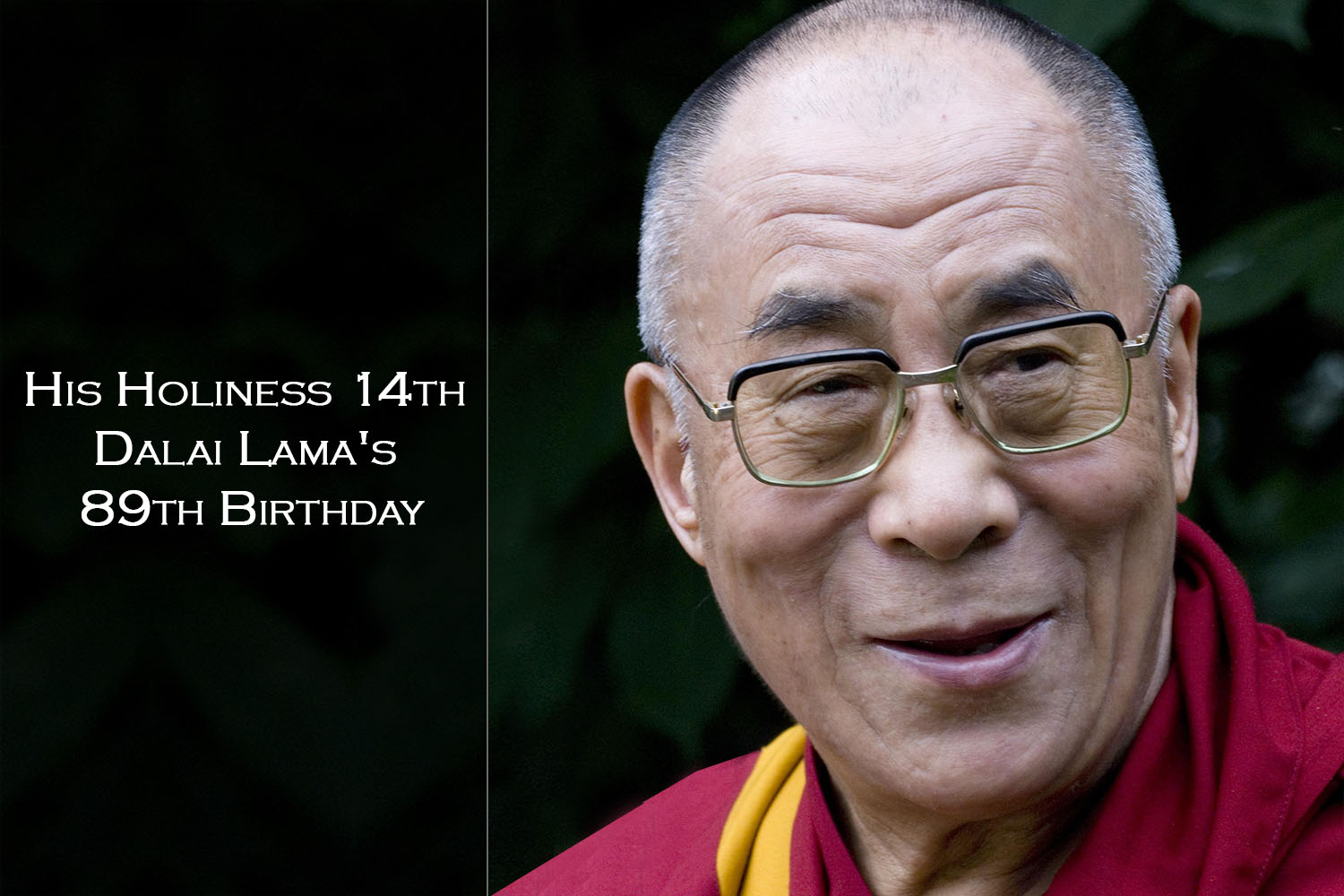
The Supreme Ruler of Tibet celebrates his 89th birthday in exile
Whole Dude – Whole Day – World Tibet Day. The Supreme Ruler of Tibet celebrates his 89th birthday in exileWhole Dude – Whole Day – World Tibet Day. The Supreme Ruler of Tibet celebrates his 89th birthday in exile
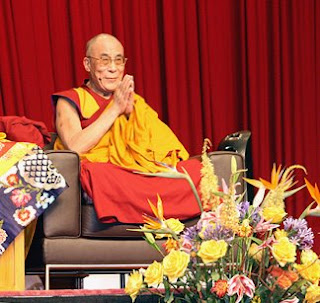
On Saturday, July 06, 2024, the Living Tibetan Spirits greet His Holiness the 14th Dalai Lama on his 89th birthday to acknowledge him as the Supreme Ruler of Tibet. For Tibetans, the title Dalai Lama is all about the Institution of the Dalai Lama that rules and governs Tibet. No other institution of government can replace Supreme Ruler of Tibet during his lifetime.
The Living Tibetan Spirits offer their prayers for a safe return of the Supreme Ruler of Tibet to the Potala Palace for a happy reunion with Tibetans living in his Land.
Whole Dude – Whole Day – World Tibet Day. The Supreme Ruler of Tibet celebrates his 89th birthday in exile
Celebrating His Holiness the Dalai Lama’s 88th Birthday
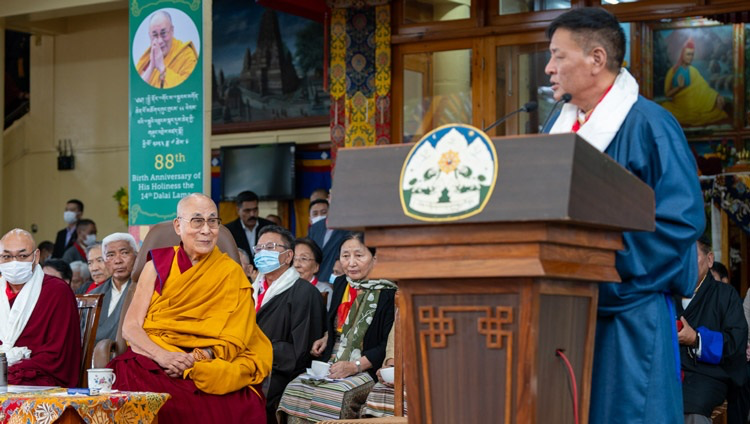
Whole Dude – Whole Day – World Tibet Day. The Supreme Ruler of Tibet celebrates his 88th birthday in exileHis Holiness the Dalai Lama being presented with the traditional ‘Chema Changphu’ on his arrival at the Main Tibetan Temple courtyard to attend celebrations to mark his 88th birthday in Dharamsala, HP, India on July 6, 2023. Photo by Tenzin Choejor
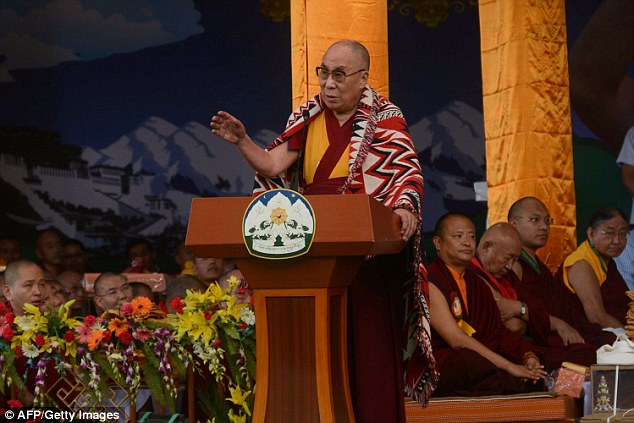
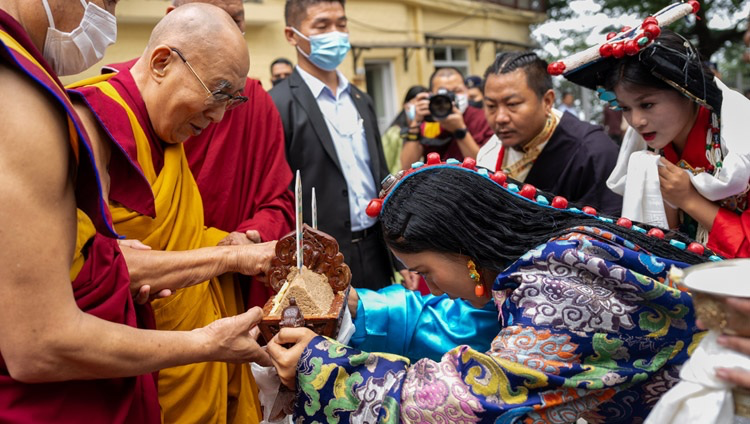
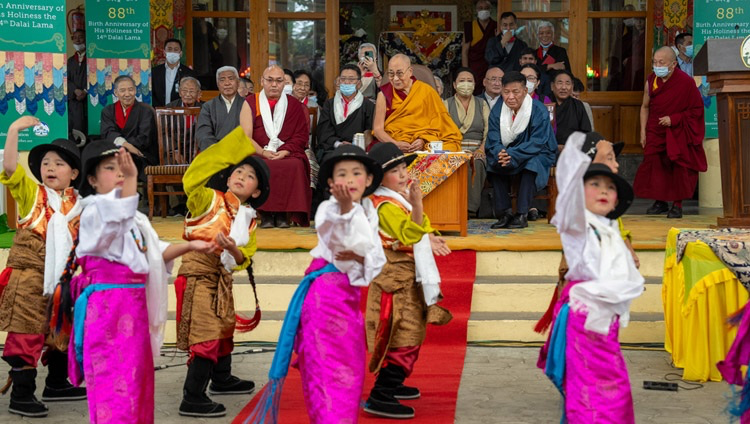
Thekchen Chöling, Dharamsala, India – This morning, His Holiness the Dalai Lama stepped into the temple courtyard adjacent to his residence, a radiant smile on his face. He was presented with the traditional ‘Chema Changphu’ as artistes from the Tibetan Institute of Performing Arts (TIPA) sang their welcome to him on his birthday. He took his seat below the temple at the head of the courtyard with members of his family sitting directly behind him and members of the Central Tibetan Administration (CTA), past and present, behind him on either side.
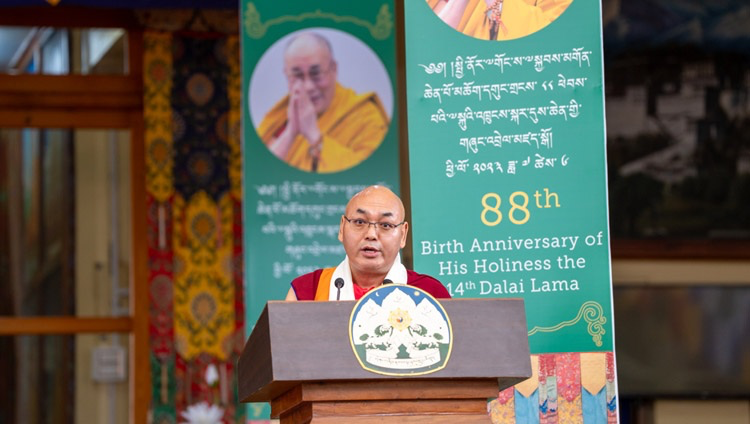
Sikyong Penpa Tsering speaking at the celebrations marking His Holiness the Dalai Lama’s 88th birthday at the Main Tibetan Temple courtyard in Dharamsala, HP, India on July 6, 2023. Photo by Tenzin ChoejorKhenpo Sonam Tenphel, Speaker of the Tibetan Parliament in Exile, addressing the crowd at the celebrations marking His Holiness the Dalai Lama’s 88th birthday at the Main Tibetan Temple courtyard in Dharamsala, HP, India on July 6, 2023. Photo by Tenzin ChoejorChildren from the TCV Day School in McLeod Ganj performing during the celebrations marking His Holiness the Dalai Lama’s 88th birthday at the Main Tibetan Temple courtyard in Dharamsala, HP, India on July 6, 2023. Photo by Tenzin Choejor
At this point the moderator invited His Holiness to address the gathering.
“Today,” he responded, “I’d like to tell all my friends that my daily prayer is as follows:
As long as space endures, And as long as sentient beings remain, Until then, may I too remain To help dispel the misery of the world.
“As long as there are living sentient beings who want happiness, I will come in life after life to help them.
“Due to karma and prayers I have made in the past, I was born in Amdo and since then I’ve done the best I could to help all sentient beings.
“Today, you are celebrating my 88th birthday, but when I look in the mirror, I feel I look as if I’m still in my 50s. My face doesn’t look old, it isn’t wrinkled with age. What’s more I still have all my teeth so there’s nothing I can’t eat or chew.
“I was born in Tibet and I bear this name Dalai Lama, but in addition to working for the cause of Tibet, I’ve been working for the welfare of all sentient beings. I’ve done whatever I could without losing hope or allowing my determination to flag. I’m angry with no one, not even those Chinese leaders who have adopted a harsh attitude towards Tibet. Indeed, China has historically been a Buddhist country as witnessed by the many temples and monasteries I saw when I visited that land.
“I believe there is knowledge within Tibetan culture and religion that can benefit the world at large. However, I also respect all other religious traditions because they encourage their followers to cultivate love and compassion.
“According to indications in my own dreams and other predictions, I expect to live to be more than 100 years old. I’ve served others until now and I’m determined to continue to do so. Please pray for my long life on that basis.
“At our last meeting Mao Zedong praised my scientific outlook but criticized religion as poison. I think the point of religion isn’t just to say prayers but to engage in helping and serving others. I believe there’s a resonance of this even in the communist way of thinking and I sometimes wonder if I met Mao today whether I couldn’t talk him round. Religion is about living a good life in the service of others.
“As I already mentioned, there are indications that I will live for another 15 or 20 years and in that time, there is hope for change in the world—for the elimination of weapons and the use of military force. May people learn to live in peace and friendship.
“The scriptures suggest that eventually the world may be consumed by fire, but until that happens, we must learn to live in a more peaceful, friendly way. If we practise well now while we can, in due course we will take our message to other world systems.
“I’m not very concerned with the name Dalai Lama, what interests me much more is being of service to others. Of course, I need food and drink to survive, but not much else. My prime concern is to serve other beings—thank you.”
The Supreme Ruler of Tibet celebrates his 89th birthday in exileWhole Dude – Whole Day – World Tibet Day. The Supreme Ruler of Tibet celebrates his 89th birthday in exile
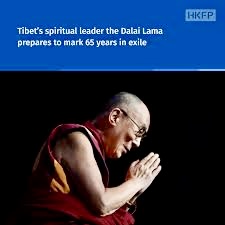
The Supreme Ruler of Tibet Marks 65 Years in Exile
Supreme Ruler of Tibet Marks 65th Milestone of Life’s Journey in Exile. On Sunday, March 31, 2024, the Supreme Ruler of Tibet Marks 65th Milestone of Life’s Journey in Exile.Supreme Ruler of Tibet Marks 65th Milestone of Life’s Journey in Exile.
From March 31, 1959 to March 31, 2024, the Living Tibetan Spirits record Sixty-Five Years of Life’s Journey in Exile. The Struggle is not over and yet it is time to take a deep breath and say Thank You India and Thank You America.
In the Indian Tradition, the number 60 is very significant for Indians recognize Sixty specific names to mark Years for purposes of timekeeping. The Cyclical Flow of Time continues in sets of Sixty Years.
Living Tibetan Spirits of Special Frontier Force – Establishment 22 – Vikas Regiment record Life in Exile
Supreme Ruler of Tibet Marks 65th Milestone of Life’s Journey in Exile. Supreme Ruler of Tibet Marks 65th Milestone of Life’s Journey in Exile. Supreme Ruler of Tibet Marks 65th Milestone of Life’s Journey in Exile. Supreme Ruler of Tibet Marks 65th Milestone of Life’s Journey in Exile. Supreme Ruler of Tibet Marks 65th Milestone of Life’s Journey in Exile. Supreme Ruler of Tibet Marks 65th Milestone of Life’s Journey in Exile. Supreme Ruler of Tibet Marks 65th Milestone of Life’s Journey in Exile.
DALAI LAMA: ‘DON’T KNOW HOW LONG STRUGGLE FOR TIBET WILL LAST’
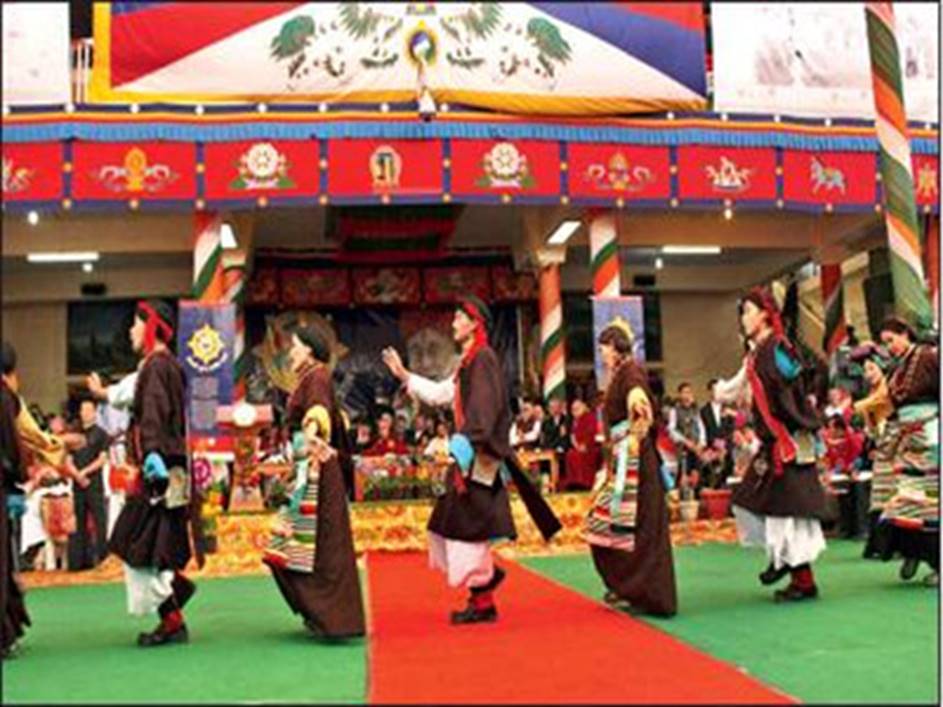
Supreme Ruler of Tibet Marks 65th Milestone of Life’s Journey in Exile. “Thank You India” a cultural program organized in McLeod Ganj, Dharamshala, India on Saturday, March 31, 2018 to mark the 60th Anniversary of Life in Exile.
I do not know for how long the Tibetan struggle will go on. However, the struggle will remain alive till the spirit of Tibetans remains,” the spiritual leader of Tibetans The Dalai Lama said at the “Thank You India” program being held at McLeod Ganj on Saturday, March 31, 2018 to mark his arrival in India, exactly 60 years ago.
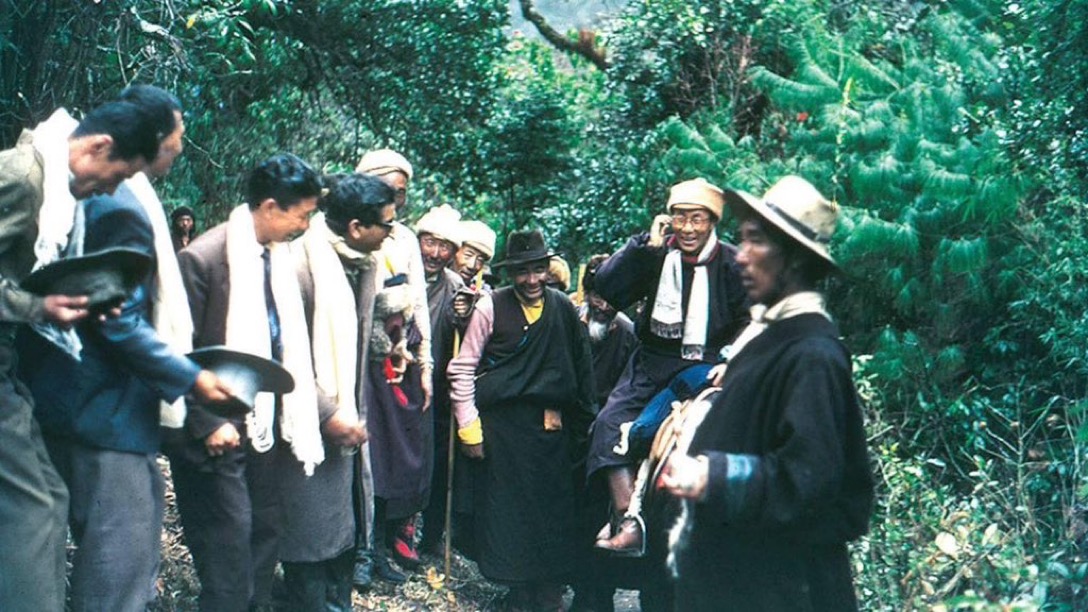
On March 14, 1959, the Dalai Lama was forced to flee Tibet following failed uprising against China. After he took shelter in India, Tibetan community across globe under his leadership launched struggle for free Tibet but till date have not succeeded. During last few years, the demand has changed into one for autonomous Tibet.
While interacted with media persons, the Dalai Lama, when questioned about the possibility of Tibetans returning to their homeland one day, replied that Tibetan issue is an issue of justice. While commenting on the equation between India and China, he said that both were most populated countries of the World and both have ability to destroy each other.
“Any sensible person would want ‘Hindi-Chini Bhai Bhai’ to live together. None of them can be disloyal to each other, so other things will go on by the side,” he said. “Confrontation does not yield any result and amicable solution of Tibet problem is the only way out,” the Nobel Peace Laureate said.
“The Chinese are following a socialist form of government, which means everybody should have equal rights. We are not demanding separation from China, but the Tibetan people should have the autonomy to preserve their culture, language, environment and religion,” he added.
Earlier, the Dalai Lama recalled his journey in exile. He said that no time was wasted in these years. “It is a matter of pride that Tibetans have preserved their tradition and culture, wherever they are living across the globe,” he said.
He said that as there was need to preserve Tibetan culture and language, a logical analysis was also the need of hour. “When everybody is praising Tibetans it becomes our responsibility too to check where we were lacking,” he said.
Glimpses of 65 Years Life in Exile
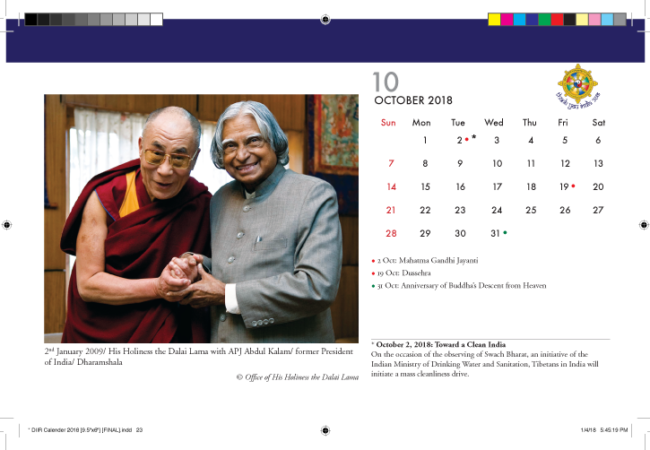
Supreme Ruler of Tibet Marks 65th Milestone of Life’s Journey in Exile. “Thank You India” a cultural program organized in McLeod Ganj, Dharamshala, India on Saturday, March 31, 2018 to mark the 60th Anniversary of Life in Exile. Supreme Ruler of Tibet Marks 65th Milestone of Life’s Journey in Exile. “Thank You India” Year 2018 Calendar marks the 60th Anniversary of Life in Exile. His Holiness the Dalai Lama with Indian Prime Minister Jawaharlal Nehru in Mussoorie, on April 04, 1959. Supreme Ruler of Tibet Marks 65th Milestone of Life’s Journey in Exile. “Thank You India” Year 2018 Calendar marks the 60th Anniversary of Life in Exile. His Holiness the Dalai Lama with Indian President Dr. Rajendra Prasad on April 17, 1961.Supreme Ruler of Tibet Marks 65th Milestone of Life’s Journey in Exile. “Thank You India” Year 2018 Calendar marks the 60th Anniversary of Life in Exile. His Holiness the Dalai Lama with Indian Prime Minister Lal Bahadur Shastri on October 27, 1965.Supreme Ruler of Tibet Marks 65th Milestone of Life’s Journey in Exile. “Thank You India” Year 2018 Calendar marks the 60th Anniversary of Life in Exile. His Holiness the Dalai Lama with Indian President Dr. Sarvepalli Radhakrishnan on May 08, 1964.Supreme Ruler of Tibet Marks 65th Milestone of Life’s Journey in Exile. “Thank You India” Year 2018 Calendar marks the 60th Anniversary of Life in Exile. His Holiness the Dalai Lama with Indian Prime Minister Indira Gandhi on August 06, 1966.Supreme Ruler of Tibet Marks 65th Milestone of Life’s Journey in Exile. “Thank You India” Year 2018 Calendar marks the 60th Anniversary of Life in Exile. His Holiness the Dalai Lama with Indian Prime Minister Morarji Desai on July 22, 1977.Supreme Ruler of Tibet Marks 65th Milestone of Life’s Journey in Exile. “Thank You India” Year 2018 Calendar marks the 60th Anniversary of Life in Exile. His Holiness the Dalai Lama with Indian Prime Minister Charan Singh in 1979.Supreme Ruler of Tibet Marks 65th Milestone of Life’s Journey in Exile. “Thank You India” Year 2018 Calendar marks the 60th Anniversary of Life in Exile. His Holiness the Dalai Lama with Gianni Zail Singh, President of India on August 05, 1985.Supreme Ruler of Tibet Marks 65th Milestone of Life’s Journey in Exile. “Thank You India” Year 2018 Calendar marks the 60th Anniversary of Life in Exile. His Holiness the Dalai Lama with Indian Prime Minister Atul Bihari Vajpayee on July 03, 2001.Supreme Ruler of Tibet Marks 65th Milestone of Life’s Journey in Exile. “Thank You India” Year 2018 Calendar marks the 60th Anniversary of Life in Exile. His Holiness the Dalai Lama with Dr. APJ Abdul Kalam, President of India on January 02, 2009. Supreme Ruler of Tibet Marks 65th Milestone of Life’s Journey in Exile. “Thank You India” Year 2018 Calendar marks the 60th Anniversary of Life in Exile. His Holiness the Dalai Lama with Indian Prime Minister Dr. Manmohan Singh on September 22, 2014.Supreme Ruler of Tibet Marks 65th Milestone of Life’s Journey in Exile. “Thank You India” Year 2018 Calendar marks the 60th Anniversary of Life in Exile. His Holiness the Dalai Lama with Pranab Mukherjee, President of India on December 10, 2016.
Whole Dude – Whole Emptiness: The Seal of The Ganden Phodrang Institution of the Dalai Lama, the Government of Tibet.Whole Dude – Whole Emptiness: THE LIVING TIBETAN SPIRITS WELCOME HIS HOLINESS THE DALAI LAMA TO ANN ARBOR, MICHIGAN.
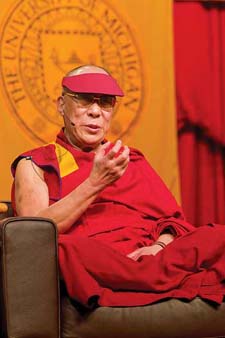
His Holiness the 14th Dalai Lama spoke on “Engaging Wisdom and Compassion” on April 19-20, 2008 at Crisler Arena, the University of Michigan, Ann Arbor.
Whole Dude – Whole Emptiness: The Living Tibetan Spirits Welcome His Holiness the 14th Dalai Lama to Ann Arbor, MI, USA.
The concept of ‘Sunyata’ (Emptiness or Nothingness):
Whole Dude – Whole Emptiness: The Living Tibetan Spirits Welcome His Holiness the 14th Dalai Lama to Ann Arbor, MI, USA.
The emptying of the mind and the attainment of an undifferentiated unity is a theme of the ‘Sunyata’ doctrine developed by Acharya Nagarjuna. ‘Sunyata’ can be stated as a state of “pure consciousness” in which the mind has been emptied of all particular objects and images. The emptied mind reflects or manifests the undifferentiated reality in which the world appears without distinction and multiplicity.
H.H. Dalai Lama’s presentation:
Whole Dude – Whole Emptiness: The Living Tibetan Spirits Welcome His Holiness the 14th Dalai Lama to Ann Arbor, MI, USA.
“At the root of all our suffering lies a form of ignorance, a form of unknowing”. The origin of suffering is attachment. “Self-grasping (or self-focus) gives rise to suffering. It is the root of all afflictions.” “Self-grasping” leads to attachment to impermanent things or thoughts which gives rise to suffering. Emptiness is created by casting aside the attachment to everyday things and worries.
H.H. Dalai Lama advised practicing loving kindness to eliminate the afflictions caused by attachment. The goal, he said is,”Cultivating the Wisdom of no self,” a sense of grand emptiness that leaves behind everyday pollutants that can take both physical or emotional form.
THE SPIRITS OF SPECIAL FRONTIER FORCE:
Whole Dude – Whole Emptiness: The Living Tibetan Spirits Welcome His Holiness the 14th Dalai Lama to Ann Arbor, MI, USA.
Special Frontier Force is a multinational defense plan to defend freedom and democracy in the occupied Land of Tibet. I emptied my mind of all desires. The Spirits that inhabit my Consciousness seek Freedom in their Land of origin.
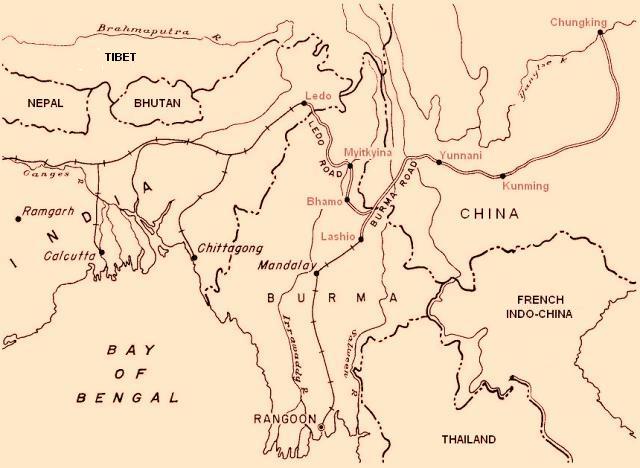
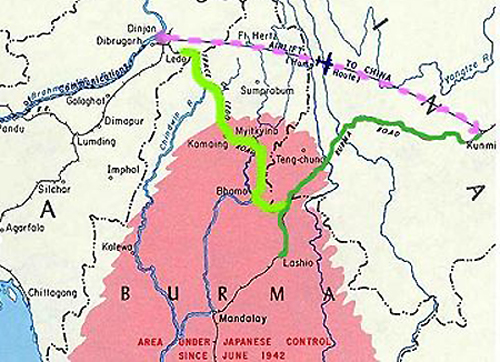
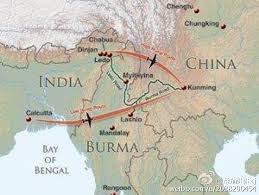
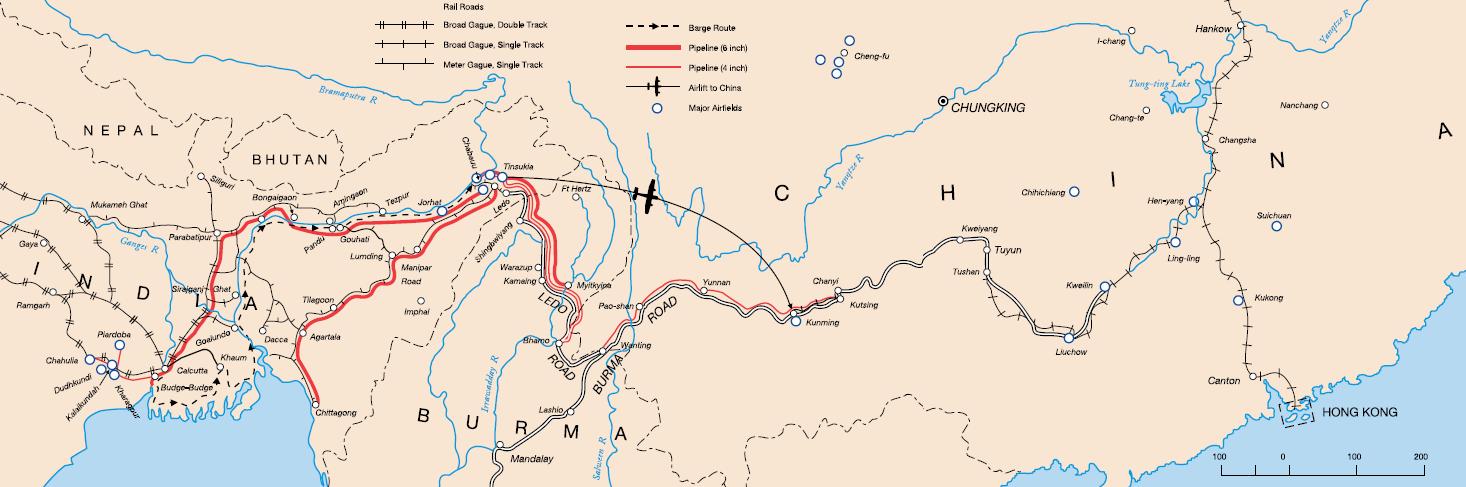
Special Frontier Force Reviews Hump Airlift Operation 1942 – 1945. I am able to review the Hump Airlift Operation for I served at Dum Duma Airfield near Chabua Airfield shown in this Map.
“The world’s first strategic airlift,” the U.S. Air Force calls it.
Special Frontier Force Reviews Hump Airlift Operation 1942 – 1945
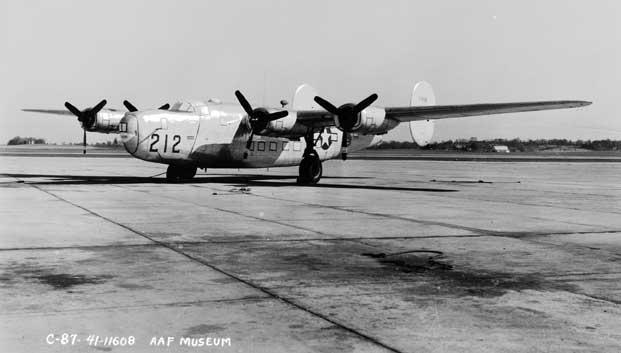
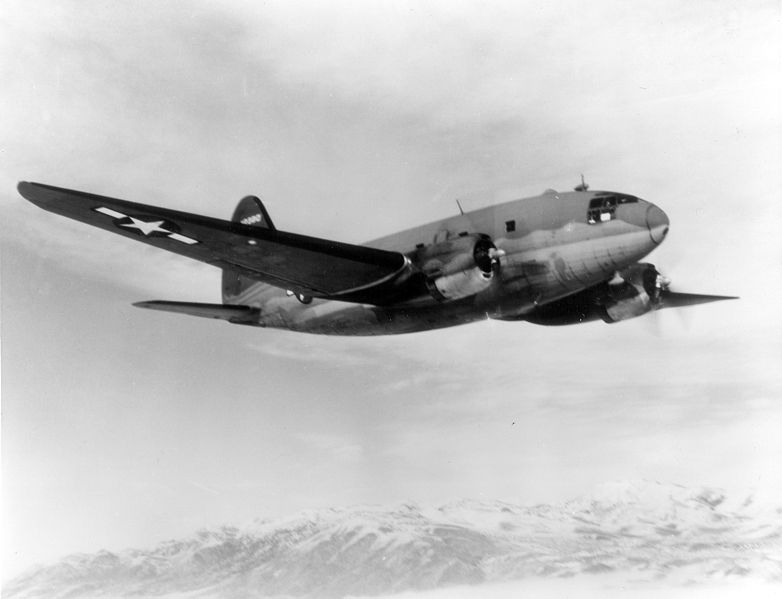
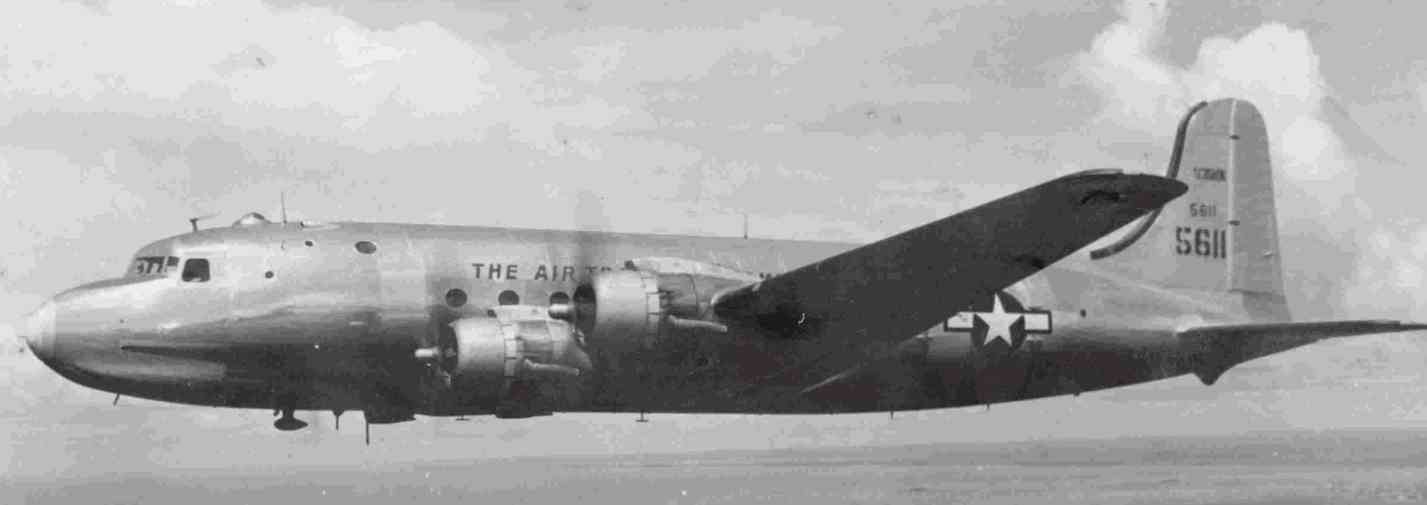
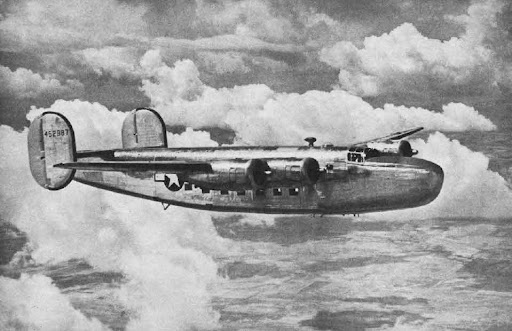
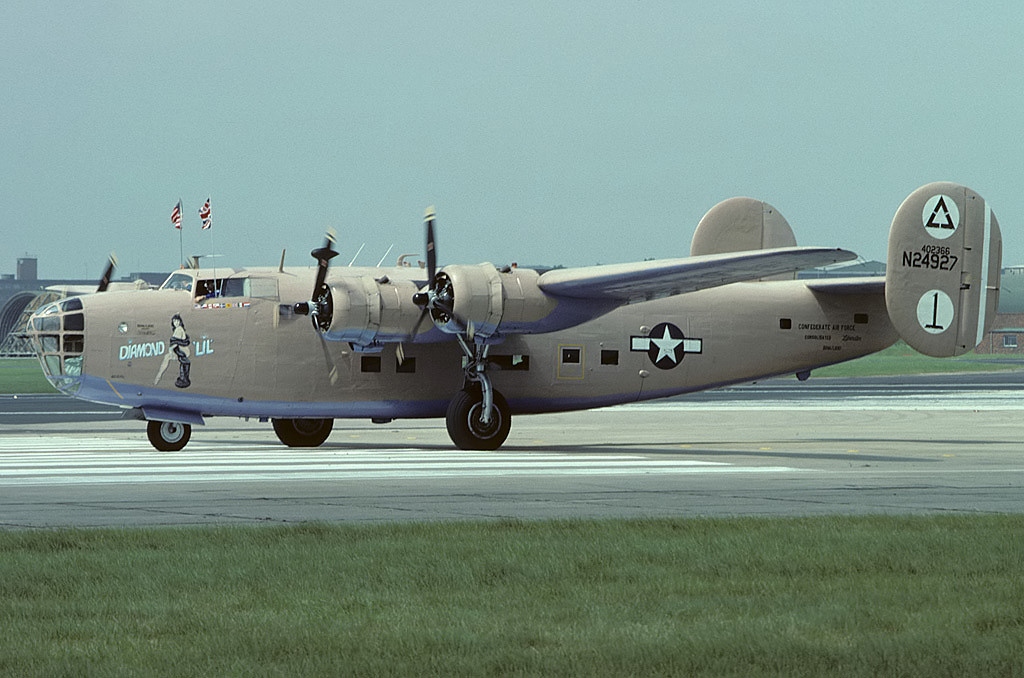
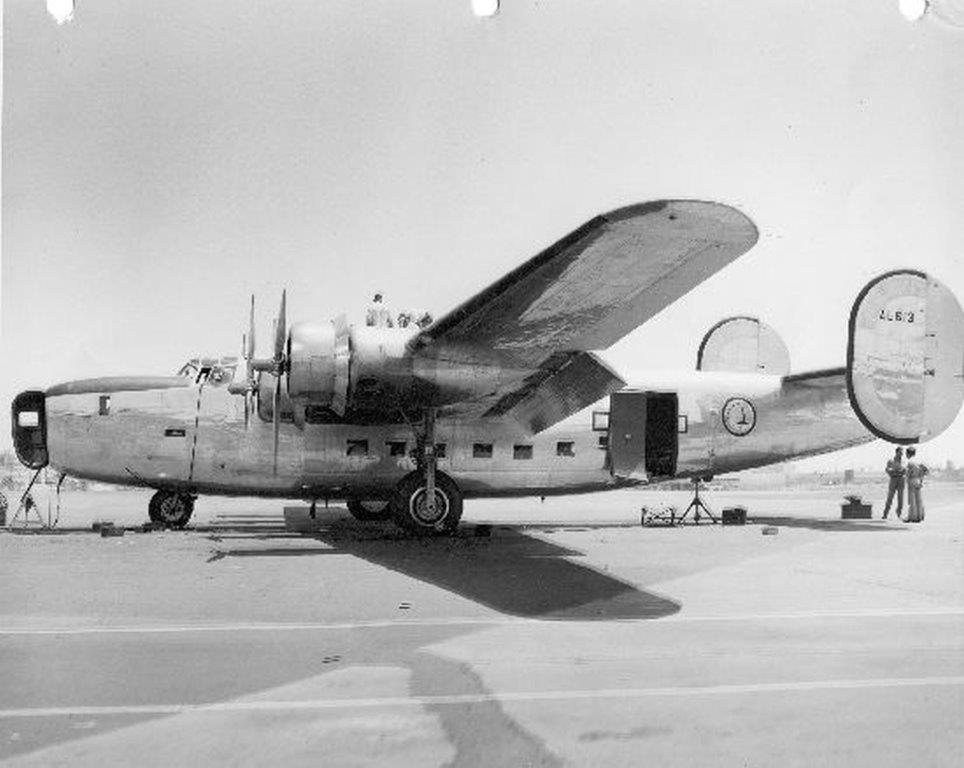
Special Frontier Force Reviews Hump Airlift Operation 1942 – 1945. THE LEGACY OF THE HUMP OPERATION LIVES TO THIS DAY.Special Frontier Force Reviews Hump Airlift Operations of 1942-1945. This US Transport Plane C-87 Liberator Express was used for delivering arms and ammunition to Tibet during Hump Airlift Operations of 1942-45.
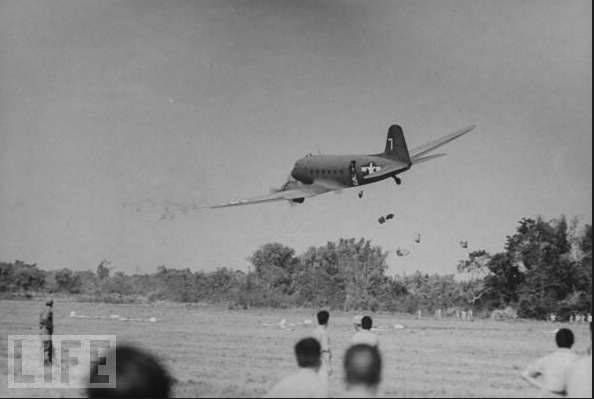
Excerpt: On behalf of Special Frontier Force, I review the “HUMP” airlift operation during the course of The Pacific War 1941 – 1945. The legacy of the “HUMP” cargo flight service operation endures to this day as the same US transport aircraft shaped the beginning of the Tibetan Resistance Movement in 1948-49. Some Hump flights delivered arms and ammunition to Tibet but Tibet failed to use the opportunity to formulate diplomatic and military alliance with the US. Special Frontier Force which represents the Tibetan Resistance Movement acquired some of the US aircraft that provided cargo flights flying the “hump” route. I have flown in these aircraft in the Indian sector of The China-Burma-India Theater of World War II and visited various airfields in Assam, northeast India built by US forces who arrived in response to Japan’s successful military campaign in Southeast Asia during 1941- 42. In my analysis, the Supreme Ruler of Tibet and his regents failed to seize the great opportunity to fully prepare Tibet from the threat of Chinese Expansionism.
Special Frontier Force Reviews Hump Airlift Operation 1942 – 1945. The Legacy of the Hump Operation lives to this day.
About 80 years ago (April 04, to June 22, 1944) during the Battles of Kohima, and Imphal, Allied troops, mainly Indians, drove back the invading Japanese forces from India’s borders. “Hump” airlift operation was primarily intended to support Chiang Kai-shek’s Nationalist China at their capital Chungking. The Pacific War ended on August 14, 1945, but the “hump” cargo flights continued until September or November 1945 as Nationalist China fought a bitter civil war with Red Army supported by China’s Communist Party. However as US relations with Nationalist China cooled off, US Special Representative to China placed an embargo on further shipment of US arms to Nationalist China during August 1946.
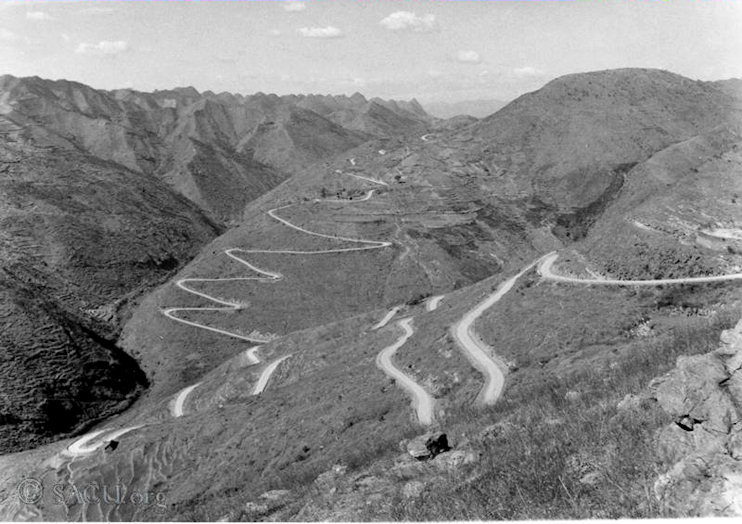
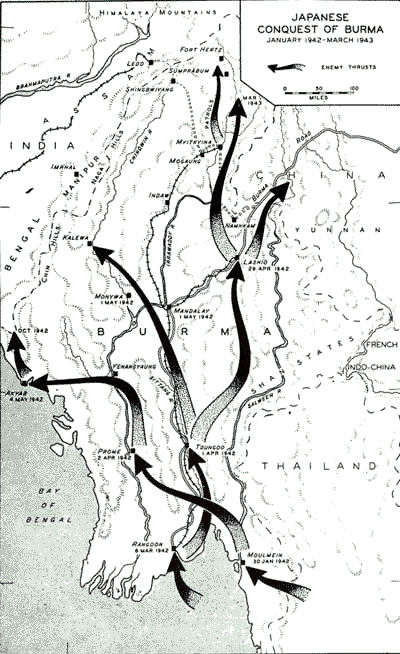
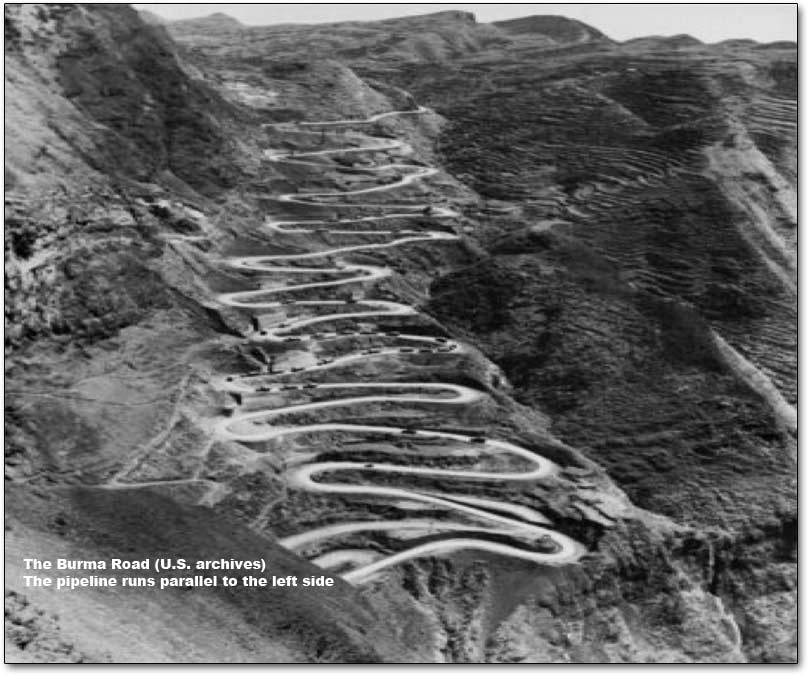
I am sharing an article titled “The Hump was the Deadliest Cargo Flight in History” authored by David Axe. This author mostly refers to findings from Francis B Pike’s book titled ‘HIROHITO’S WAR – THE PACIFIC WAR 1941 – 1945’. To understand the “hump” airlift operation, it will be necessary to know about ‘Burma Road’, a road extending about 700 miles from Kunming, Yunnan Province., S.China, to Lashio, a railhead in Burma. It was built-in 1937- 38 over mountainous terrain by the Chinese. It achieved its greatest importance during World War II, when Japan controlled the East Asian coast and the road served as a vital artery for the transport of Allied military supplies to Chinese forces fighting Japanese. On December 25, 1941, Japan captured Hong Kong. Japanese forces based in Thailand invaded Burma on February 08, 1942. Japanese captured Rangoon on March 08, and Allied Forces lost control over Lashio on April 30, 1942, which closed the Burma Road ending overland supply to Nationalist China. By the end of May 1942, the Japanese held most of Burma and the Allies were left with no supply route to engage Japan on Chinese territory. The solution was found in an air route from Assam in India’s Northeast to Kunming, and various airports in Yunnan Province, Southwest China, the “Dangerous” hump route along the southern edge of Himalaya mountain range. The “hump” route covered a distance of about 525 miles passing over the mountainous region of far north Burma and Western China. The height of mountains in Burma, North-South spur of the main East-West Himalaya mountain range, varied from 16,000 to 12,000 feet. In March 1942, the China National Aviation Corporation (CNAC) began freight service over the “hump” and the US began a transport program in April 1942. In 1944 Japan advanced toward Assam to cut Allied supply lines or capture the airfields at the Western end of the “hump.” Japan’s attack on Assam (March to July 1944) was defeated with help from transport planes withdrawn from the “hump.”
US Army’s Air Transport Command using elements of the 10th Air Force began flying cargo over the “hump” using Dakota C- 47 Skytrains, C – 46 Commandos which gradually expanded into first sustained, long-range, 24-hour around the clock, all-weather aerial cargo flight operation in history. Initially, the “hump” operation involved about 27 planes and about 1,100 pilots and support personnel. By December 1943, cargo planes carried tons of supplies equivalent to the tonnage carried along the Burma Road at the peak of its overland supply operation. In the fall of 1944, Consolidated C – 87s, Douglas C – 54 four engine aircraft were pressed into cargo flight service. In August 1945, the “hump” operation involved 622 aircraft, 34,000 military personnel, and about 47,000 civilian employees. During the course of the “hump” operation, the United States lost 509 downed aircraft identified, and 81 aircraft were listed as missing. The loss of aircraft was mostly contributed by weather-related problems and a few due to enemy action. The United States lost 1,314 crew members killed in action, and 1,171 personnel survived bailouts. US officials reported 345 as Missing in Action (MIA). The search and accounting of MIA have mostly concluded by 1950s and in recent times, there has been a renewed demand to continue search operations following the discovery of cargo plane crash sites in the jungles of Northern Burma along the “hump” flight routes.
At Special Frontier Force I derive consolation from the fact that the legacy of the “HUMP” operation endures. The US transport planes played a role in shaping the Tibetan Resistance Movement from its early beginning during 1948-49 as United States, India, and Tibet recognized the security threats posed by growing Communist military power in mainland China.
Special Frontier Force Reviews Hump Airlift Operation 1942 – 1945. The Legacy of the Hump Operation endures to this day for the US transport aircraft supported Tibetan Resistance Movement since 1948-49.
Rudra Narasimham Rebbapragada Ann Arbor, MI 48104-4162, USA The Spirits of Special Frontier Force
Special Frontier Force Reviews Hump Airlift Operation 1942 – 1945 for its Legacy endures to this day. The Hump aircraft shaped The Tibetan Resistance Movement.
THE HUMP WAS ONE OF THE DEADLIEST CARGO FLIGHTS IN HISTORY
Special Frontier Force Reviews Hump Airlift Operation 1942 – 1945. The legacy of the Hump Operation survives to this day. US transport aircraft shaped Tibetan Resistance Movement since 1948-49.
A third of Allied aircrews died hauling supplies to China in World War II
by DAVID AXE
Few people appreciate it today, but for a period of more than three years during World War II, a force of mostly American airmen undertook one of history’s most complex — and deadliest — logistical operations, flyingthousands of tons of supplies from India over the Himalayas into China in rickety, under-powered cargo planes.
“The world’s first strategic airlift,” the U.S. Air Force calls it.
These flights over “the Hump” were indispensable to China’s war effort against the Japanese, and thus a major factor in the Allies’ ultimate victory.
But at a tremendous cost. No fewer than 700 Allied planes crashed or got shot down and 1,200 airmen died. “Every 340 tons delivered cost the life of a pilot,” historian Francis Pike writes in his exhaustive new history.
Hirohito’s War: The Pacific War, 1941–1945.
Within a few months after bombing Pearl Harbor in December 1941, the armies of Imperial Japan occupied a swath of Asia extending from China and Korea south into Burma and what is now Indonesia, eastward all the way to isolated islands in the middle of the Pacific.
Tokyo’s march seemed inexorable. And Japan’s expansion might have been much, much more aggressive if not for the valiant and bloody resistance that Chinese Generalissimo Chiang Kai-shek and his fighters offered up in the portions of their country the Japanese did not fully control.
Chiang’s soldiers tied up no fewer than 1.5 million of Tokyo’s own troops, Pike asserts in his dense new tome, which at nearly a thousand pages defies conventional review. But the Chinese were strapped for weapons, ammo, and supplies. The Allies — and America, in particular — were desperate to keep China fighting and, by extension, keep Japan bogged down.
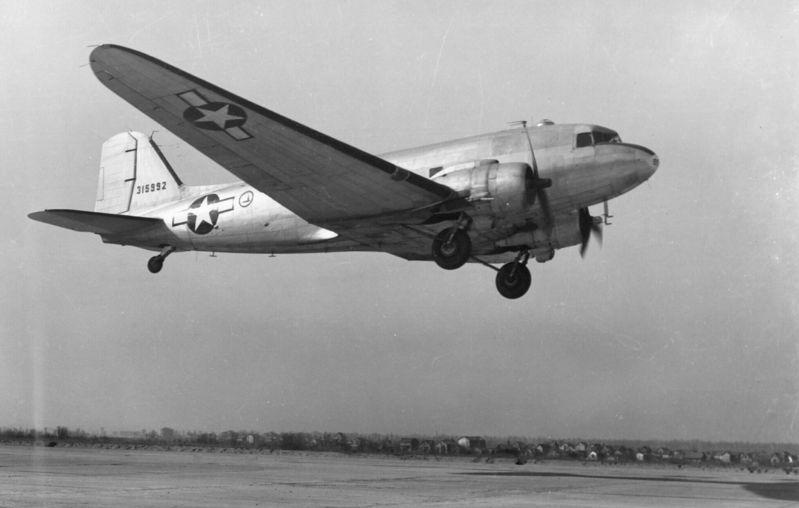
As Pike explains, prior to May 1942 the Allies maintained a land route from India through Burma into China. But Tokyo’s conquest of Burma shifted the burden of supplying Chiang’s forces to a contingent of initially just 25 planes — a mix of Douglas DC-3s, C-39s, C-47s and C-53s that was wholly inadequate for the mission’s demands.
“When fully loaded, Douglas DC-3s could not climb high enough to clear all the peaks and were forced to weave a perilous path through the mountains, a task that was virtually impossible when the treacherous Himalayan weather closed in,” Pike writes.
Turbulence could force a plane to drop thousands of feet in mere seconds. “Flight operations were a pilot’s nightmare,” according to the Air Force.
Planes crashed. Japanese fighters shot down others. In April 1943 the U.S. Army Air Corps rushed the bigger and more powerful Curtis-Wright C-46 into production to help out with Hump ops, but the new plane’s engines had a tendency to ice up. “The bugs were worked out over the Hump,” Pike quotes one pilot as explaining.
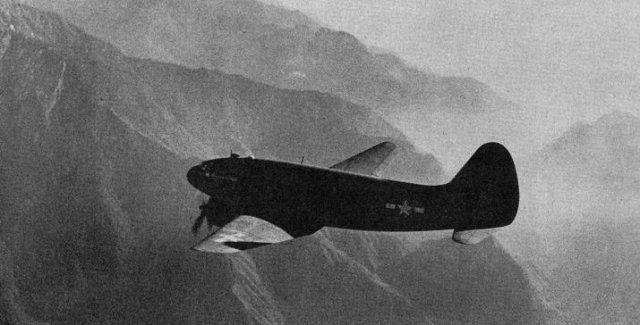
Special Frontier Force Reviews Hump Airlift Operation – China-Burma-India Theater, World War II. C-46 Transport Plane flying east of Salween River. “HUMP” refers to Mountains that separate Salween and Mekong Rivers.Special Frontier Force Reviews Hump Airlift Operation 1942 – 1945.
At the top — a C-46 over the Hump. At right — view from over the Hump. Photo by Gifford Bull
By the end of 1943, the Allies’ Air Transport Command had 142 types of transport and five crews for each plane. ATC eventually swelled to 700 planes supported by 84,000 military personnel flying 1,000 miles round trip delivering up to 10,000 tons of supplies a month, “with a plane crossing the Hump every two minutes,” according to Pike.
Granted, the airplanes and aircrews were just part of what was, in fact, an unbelievably vast effort, also involving cargo ships that deposited supplies in Calcutta and trains that hauled the material to the airfields — not to mention roughly two million Indian and Chinese laborers who built the airstrips in their respective countries by hand.
But the aircrews arguably suffered the most of all the people involved in the Hump operation. “There was an approximately one in three chance of being killed,” Pike writes — one of the worst wartime survival rates ever. Of the 700 planes (US official estimate 590 planes) that went down trying to cross the Hump between 1942 and 1945, some 500 (US official estimate 81 missing aircraft and 509 downed planes fully identified) remain missing more than 70 years later.
Published on Jun 18. All rights reserved by the author.
FRANCIS B PIKE DESCRIBED THE HUMP CARGO FLIGHT OPERATION OF 1942 – 1945 IN HIS BOOK TITLED ‘HIROHITO’S WAR. SPECIAL FRONTIER FORCE REVIEWED THE HUMP OPERATION FOR ITS LEGACY CONTINUES TO THIS DAY.SPECIAL FRONTIER FORCE REVIEWS HUMP AIRLIFT OPERATION 1942 – 1945. FRANCIS B PIKE MAY NOT HAVE KNOWN THAT THE LEGACY OF THE HUMP OPERATION LIVES TO THIS DAY.Special Frontier Force Reviews Hump Airlift Operation 1942 – 1945. THE BURMA ROAD DURING WORLD WAR IISpecial Frontier Force Reviews Hump Airlift Operation 1942 – 1945. Japan’s conquest of Burma in 1942 cut off the overland supply route known as the Burma Road forcing the choice of an aerial route to deliver military supplies to Nationalist China.Special Frontier Force Reviews Hump Airlift Operation 1942 – 1945. The Legacy of the Hump Operation still survives to this day.Special Frontier Force Reviews Hump Airlift Operation 1942 – 1945. Its Legacy continues to this day.Special Frontier Force Reviews Hump Airlift Operation 1942 – 1945. Its legacy continues to this day. US Cargo planes used in Burma Drop supported the Tibetan Resistance Movement since 1948-49.Special Frontier Force Reviews Hump Airlift Operation 1942 – 1945 as its Legacy continues to this day.Special Frontier Force Reviews the Legacy of Hump Airlift Operation 1942 – 1945.Special Frontier Force Reviews The Legacy of Hump Airlift Operation 1942 – 1945.Special Frontier Force Reviews Hump Airlift Operation 1942 – 1945.
Special Frontier Force Reviews the Discovery of wreckage of a Hump Airlift Operation Transport Plane
Special Frontier Force Reviews the Discovery of wreckage of a Hump Airlift Operation Transport Plane. This US Transport Plane C-87 Liberator Express was used for delivering arms and ammunition to Tibet during Hump Airlift Operations of 1942-45.
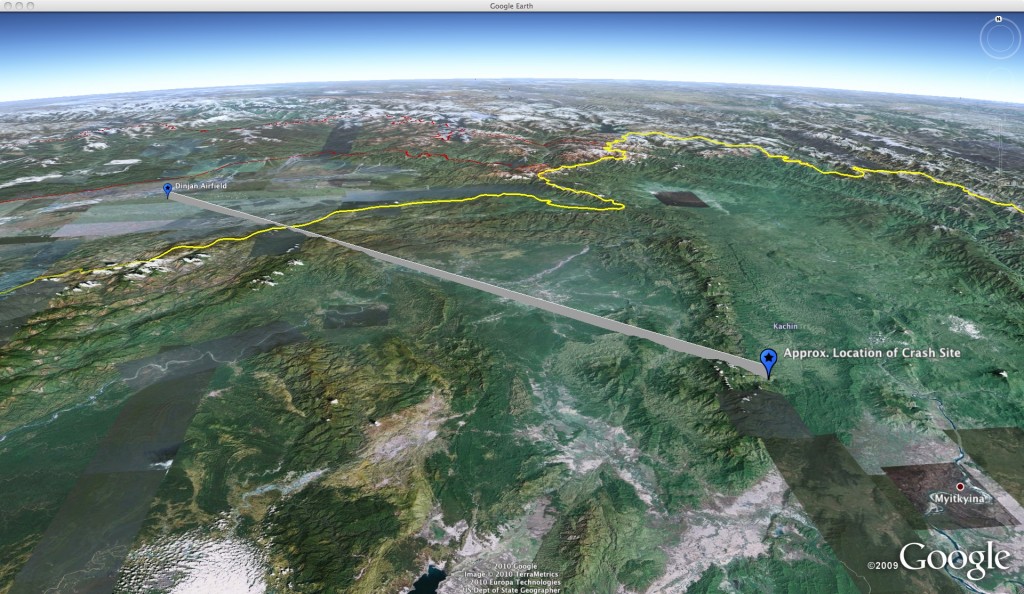
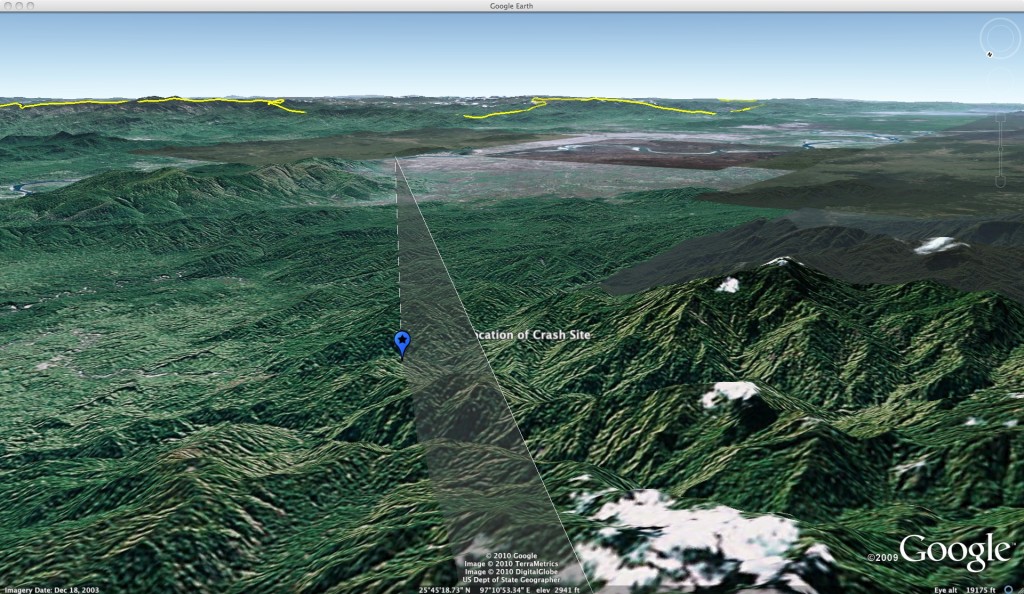
Special Frontier Force shares interest in the discovery of wreckage of a Hump Transport Plane that crashed in Tibet 80 years ago. In a previous post on this subject, I have shared the maps of Hump Flight routes and majority of crashes occurred either in Burma or Southwest China, and not in Tibet.
Wreckage of a Hump Transport Plane That Crashed in Tibet 80 Years Ago Now En Route to the Jianchuan Museum in Chengdu, China
Special Frontier Force Reviews the Discovery of wreckage of a Hump Airlift Operation Transport Plane.
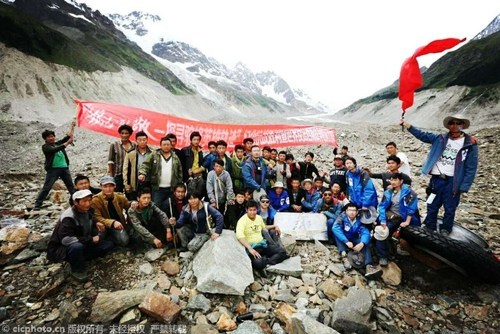
On August 5, Xinhua News Agency photo center photographer embedded into the search party took a group photo with volunteers in the 4,100-meter-high unpopulated area
On August 5, volunteers collected wreckage in the 4,200-meter-high area.
Special Frontier Force Reviews the Discovery of wreckage of a Hump Airlift Operation Transport Plane. On August 5, Xinhua News Agency photo center photographer embedded into the search party took a group photo with volunteers in the 4,100-meter-high unpopulated area (PRNewsFoto/Xinhua News Agency)
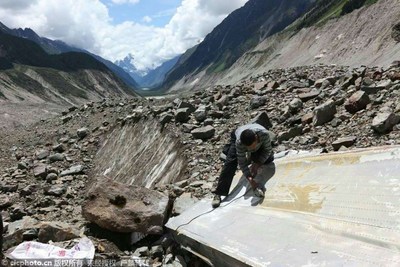
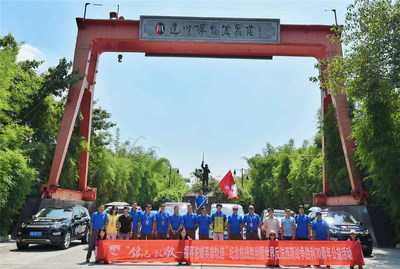
CHENGDU, China, Aug. 13, 2015 /PRNewswire/ — Wreckage of an air freighter that was navigating over the Hump, the name given by Allied World War II pilots to the eastern part of the Himalayas due to the difficult challenge the mountain range posed to the pilots, when it crashed into a glacier 70 years ago and where its debris have since remained, was moved from Bomi County, Tibet, to Chengdu, Sichuan province on August 11. The valuable historical relics which are an important part of the story of Sino-US cooperation during WWII will be sent to China’s largest private museum, Jianchuan Museum.
The remains belong to the United States army’s Consolidated C-87 Liberator Express, serial 41-24688, which crashed in the winter of 1943. The C-87 plane and the remains of five U.S. pilots were discovered in the area, 4,100 meters above sea level, by local hunter Luo Song in September 1993. China and the U.S. later confirmed that the remains belonged to an airplane which had crashed at that time. The two countries held a transfer of remains ceremony at which then U.S. President Bill Clinton paid final respects to the deceased. However, the majority of the remains of the plane were left on the glacier.
Jianchuan Museum security director Choenyi Choedak took part in the search. He told reporters that the search team found many remains including three pairs of army boots, including a pair of thigh-high boots, two pairs of hunting boots and one pair of low boots.
“Those boots are the same ones that I saw in the 1990s,” Luo Song, an inhabitant of Zhongbei Village, Yigong, who guided the search team to the glacier and one of five local people who first discovered the crashed remains in 1990, said.
Beset by the limitations in terms of transport, the search team could only move about 50 pieces of the valuable wreckage, including a 4.5-meter-long and 2-meter-wide wing with an engraved white five-pointed star, as well as the dashboard, the engine and cabin parts. A reporter described seeing words and acronyms, among them, “Chicago,” “USA,” “FBE-18” and “PAT” on some parts of what was collected.
Yang Jianchao, head of the search team and deputy director of Jianchuan Museum, said that it was especially difficult to climb onto the glacier as there are no roads or bridges. The members of the search team had to build makeshift roads and bridges while climbing and then carried the remains on their backs and descended the mountain with the help of 41 Tibetan porters.
The route over the Hump was established during the World War II and served as an “aerial lifeline” to transport strategic supplies from Allied positions further west into China. It is the longest-running, hardest and most costly airborne route in the history of wartime aviation. The Hump pilots transported about 850,000 tons of strategic supplies and roughly 1,500 American planes crashed along the route in southwest China.
“The route can be clearly seen from the light reflected by the wreckage of our companions’ crashed planes on a clear day and we call the valley with the scattered wreckage of airplanes ‘Aluminum Valley’, a name as cold as the metal,” citing The Time’s descriptions of the Hump during World War II. Yang, the museum deputy director, explained that during the war, thousands of aircraft flying the Hump crashed, but few of them have ever been found. It is the first time that such a considerable collection of remains is being brought together in a museum.
The search was initially planned six years ago. In 2009, Jianchuan Museum curator Fan Jianquan, learned from his comrade-in-arms that the wreckage of a U.S. transport airplane along the WWII Hump route remained in the depopulated zone in Nyingchi Prefecture in Tibet. He immediately developed a strong desire to find and bring in what he knew had to be a behemoth of a plane to Chengdu.
“Six years ago I told myself that I must take the remains to Chengdu, but I was unable to do what I had hoped to do as conducting a search over such uninhabitable terrain combined with the need to properly handle and preserve such cultural relics needed the assistance of professionals,” Fan elaborated. “My wish finally came true this year, after years of elaborate planning.”
One of the halls in the museum, the Flying Squad Hall, houses many U.S. army relics from the World War II period, in commemoration of the aid provided by the U.S. Air Force to China during the war.
“I felt all the hard work had been more than worthwhile when I saw the wreckage,” said Hu Zhiyang, a volunteer who was nearly hit by a rock that had fallen off the side of the mountain during the climb. Despite the elaborate planning, the actual search proved far more difficult than expected. Another team leader Jiang Fan said that he felt he could vividly imagine the ordeal of the pilots when he first came upon the wreckage. “These pilots were the very the best flyers of that era. It is heart rendering to think that they travelled so far from their homelands to fight for the world peace,” Jiang said.
Search team member Ni Jian said that he felt that it was a worthy search, although the expedition was exhausting and he suffered badly from altitude sickness. Kuailu Investment, where Ni works, invested over 300 million yuan (approx. US$50 million) in making a film to be named The Bombing, depicting the horror that can be inflicted by military aggression by showing the ruthless bombing of Chongqing by the Japanese army during the Sino-Japanese war and the history of Chinese and American air forces joining together in the bloody battle. He said, “We will share the spiritual wealth of this search journey with the movie crew, encouraging all to remember the history and making this anti-war movie even richer in content.” According to sources, the 3D movie, made possible as a result of a Sino-US partnership, is already 70 per cent finished, and is expected to be completed this October and be released next February.
The remains will go on display at Jianchuan Museum and be opened to the public on or about August 15. In addition, Xinhua News Agency chief editor Chen Xiaobo and a renowned exhibition curator, will host the exhibition where large sections of the plane will be on display, entitled “Broken wings – searching for C-87”.
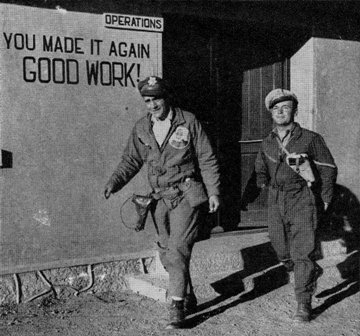
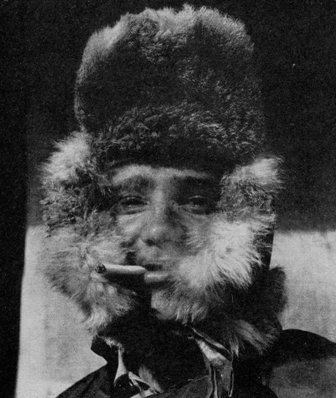
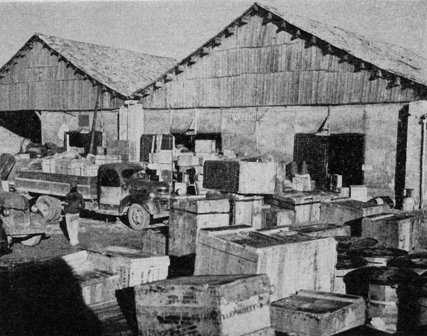
Special Frontier Force reviews Hump Airlift Operations of 1942-1945. Consolidated C-87 Liberator Express Transport aircraft delivered arms and ammunition to Tibet during World War II while they flew over Tibet.Special Frontier Force Reviews Hump Airlift Operation – China-Burma-India Theater-World War II – Brigadier General Tom Hardin, Commander, Hump Fliers.Special Frontier Force Reviews Hump Airlift Operation, China-Burma-India Theater, World War II. Hump Fliers Captain “Bamboo” Joe Barube and Lieutenant Ernest Lajoie returning from China Operations Office.Special Frontier Force Reviews Hump Airlift Operation, China-Burma-India Theater, World War II. Hump Flier Assistant Engineer John Huffman, a bail out survivor wearing Tibetan clothes.Special Frontier Force Reviews Hump Airlift Operation, China-Burma-India Theater World War II. Hump Flight Maintenance Field in India.Special Frontier Force Reviews Hump Airlift Operation, China-Burma-India Theater, World War II. Air Depot in China showing freight received from India. Freight included even trucks, jeeps, and ambulances apart from guns and bombs.Special Frontier Force Reviews Hump Airlift Operation, China-Burma-India Theater, World War II. Anything that can be broken down into four-ton-Units have gone over the “HUMP.”
Whole Dude – Whole Supreme: The White House of Supreme Ruler of Tibet.
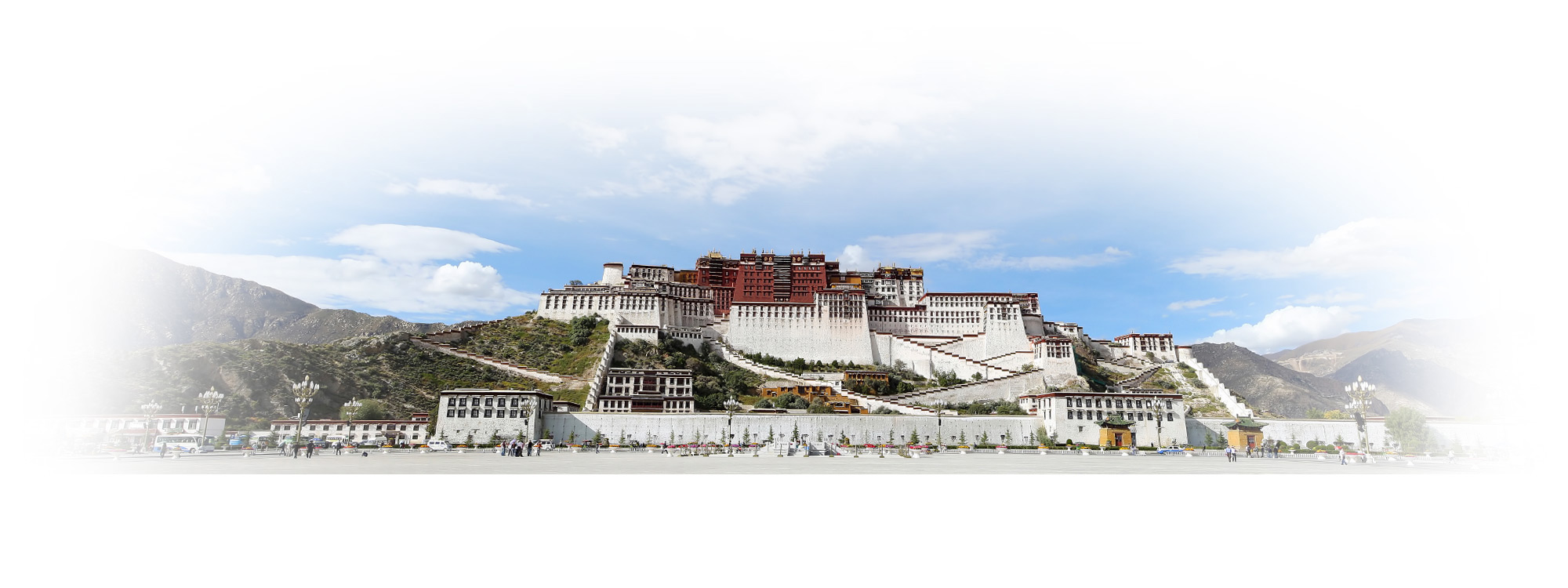
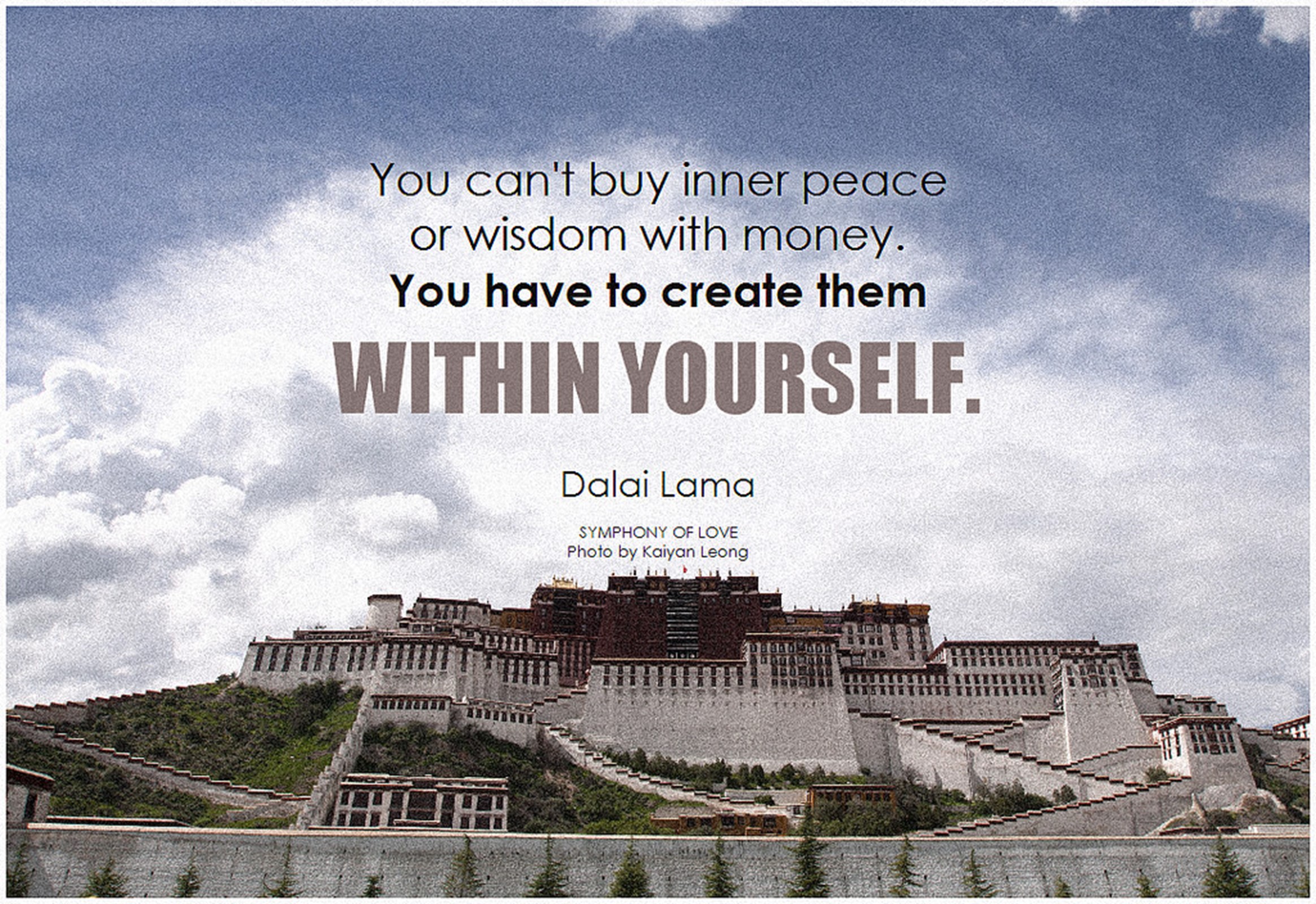
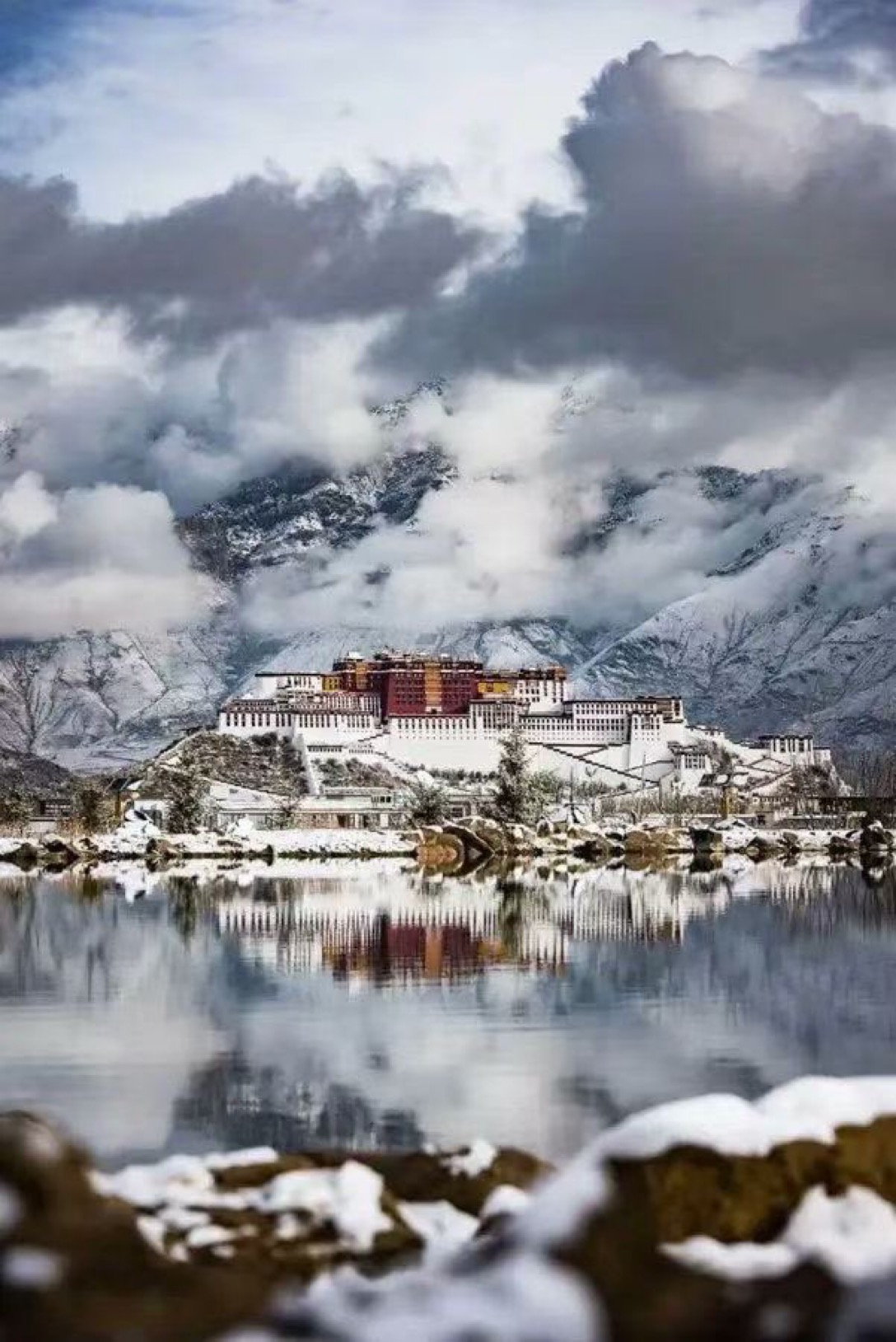
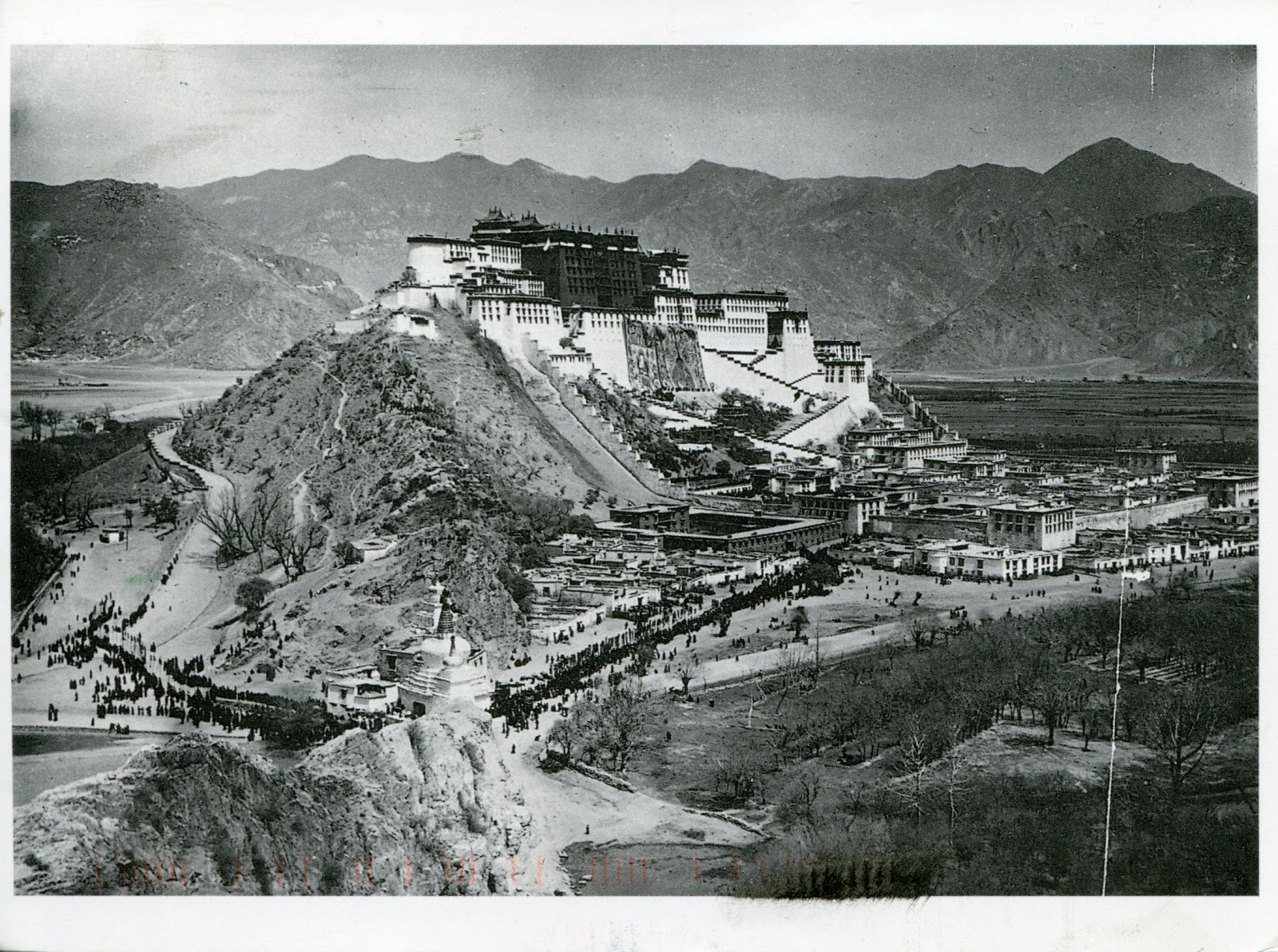
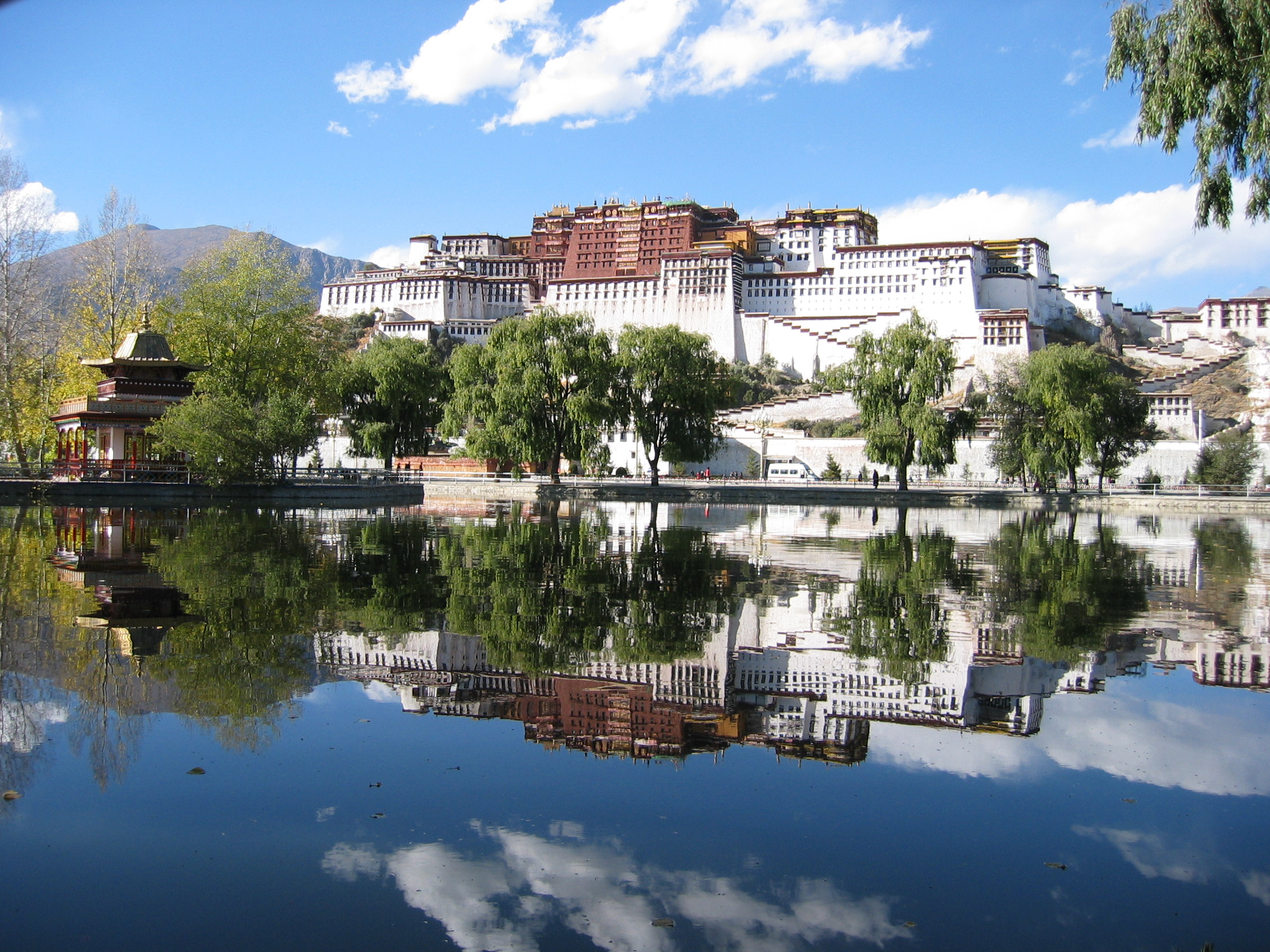
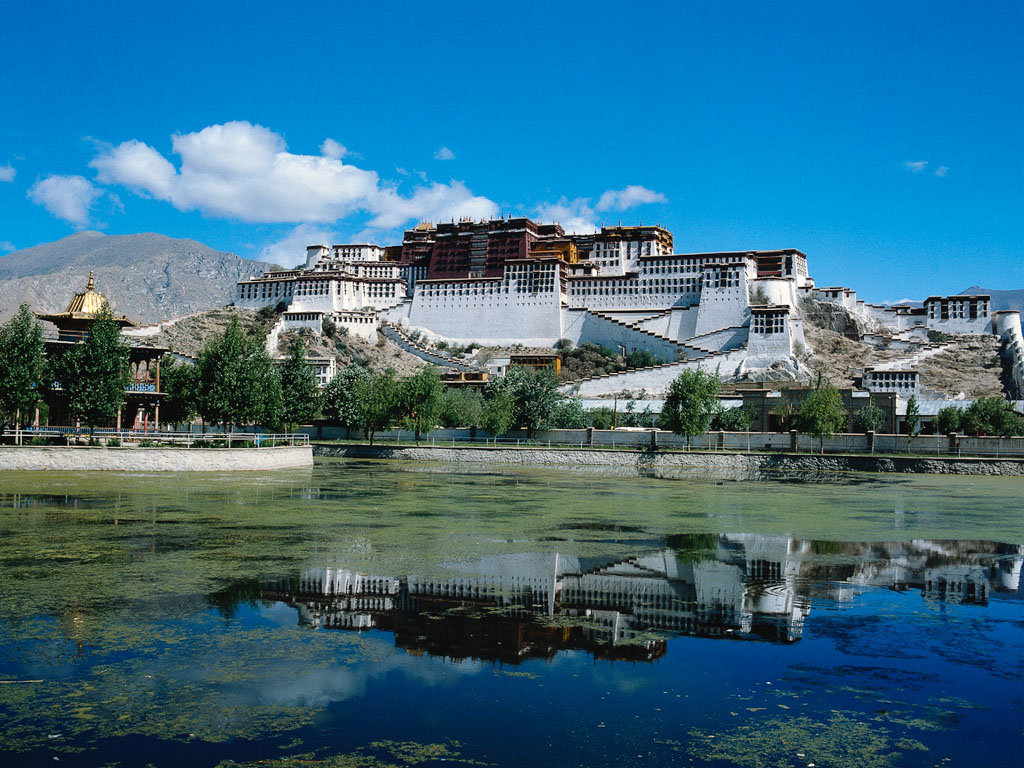
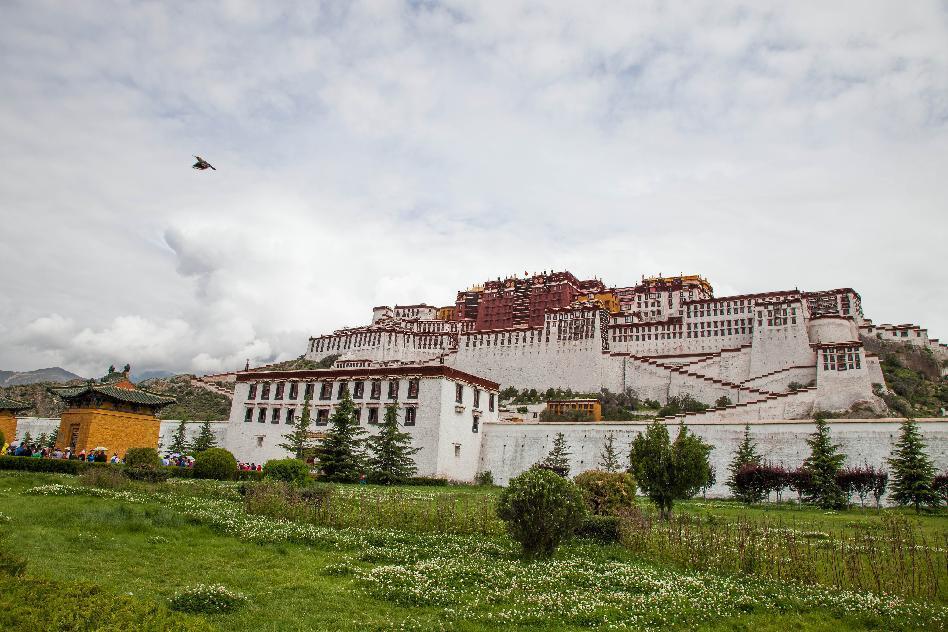
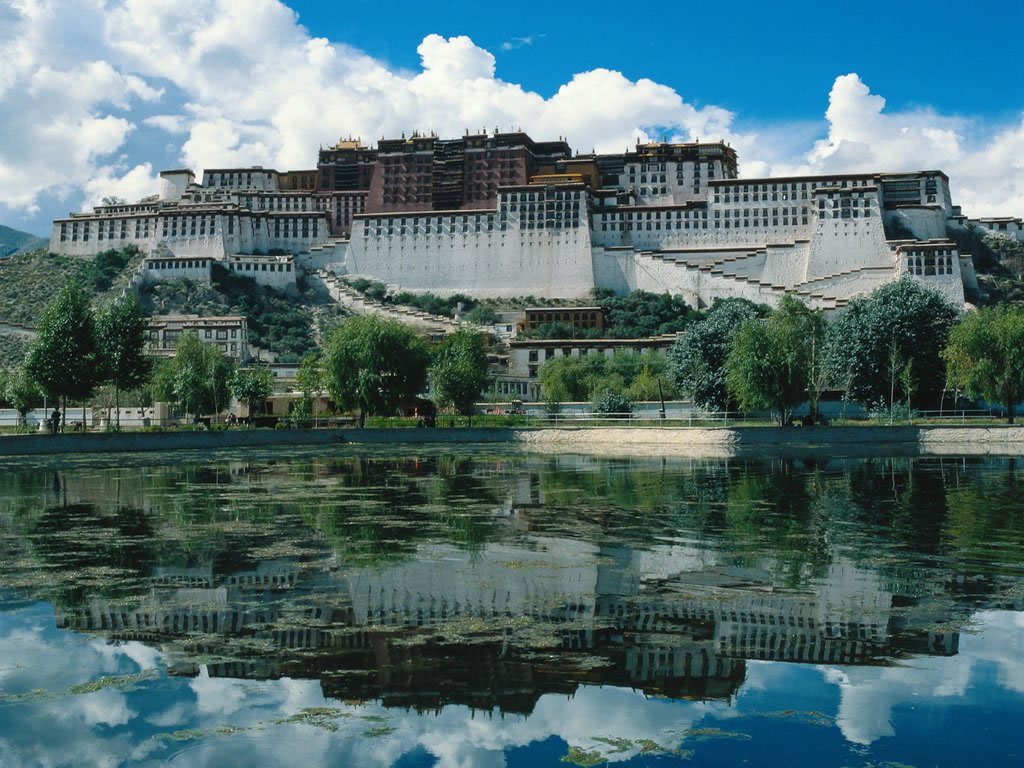
Living Tibetan Spirits present a guide to Potala Palace, Lhasa, Tibet. Potala Palace serves the same purpose as The White House of the US President.
The Potala Palace on the Red Hill in Lhasa was built during the reign of Lobsang Gyatso (1617-1682), the Great Fifth Dalai Lama. The Sovereign Authority of the Dalai Lama as the Ruler of Tibet was established before the US President became the Chief Executive of the United States.
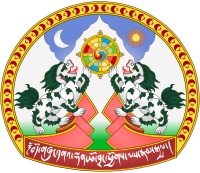
Whole Supreme – The Supreme Ruler of Tibet: The political institution of Dalai Lama is formally known as ‘Ganden Phodrang’ and this is the Official Seal of the Tibetan Government.
Potala is the Seat of Tibetan Government called The Dalai Lama Institution of Tibet.
Whole Supreme – The Supreme Ruler of Tibet: The White House of Supreme Ruler of Tibet.
A GUIDE TO POTALA PALACE, LHASA, TIBET
Whole Supreme – The Supreme Ruler of Tibet: The White House of Supreme Ruler of Tibet
Potala Palace is one of the most well-known spiritual sanctums in the world
Whole Supreme: His Holiness the 14th Dalai Lama, Supreme Ruler of Tibet lives in exile to defend Freedom in Tibet. Potala Palace in Lhasa is witness to the long history of Tibetan Independence.
At 12,139 feet above sea level, Potala is the highest palace in the world. The 1,300-year-old structure was originally built as a gesture of love, commissioned by Tibetan king Songtsen Gambo for his marriage to Princess Wencheng of the Chinese Tang Dynasty. Eventually, monks came to rule Tibet and the palace was expanded and converted into the winter residence for the Dalai Lama. But when the Dalai Lama was exiled to India in 1959, the Chinese government took over and made the grounds into a museum.
Whole Supreme – The Supreme Leader of Tibet: Lhasa, Potala und Medizinberg von Osten. My Prayers to Lhasa River.
Still, the Potala Palace remains an iconic part of the region and a mecca for Buddhists around the world. The name Potala is a nod to a sacred mountain in India, where the Buddha of compassion is said to dwell. Year-round, thousands of religious pilgrims circle the perimeter of the palace with prayer wheels and beads to ask for a blessing. Many have traveled thousands of miles by foot just to pay their respects.
Whole Supreme – The Supreme Leader of Tibet: TIBET AWARENESS – HISTORY OF TIBET’S UNREST. POTALA PALACE, LHASA, TIBET.
With more than a thousand rooms, 10,000 painted scrolls, 698 murals, and thousands of exquisite statues made from precious alloys and jewels, the structure has become one of the most famous spiritual sanctums in the world. Inside are the tombs of eight Dalai Lamas, hundreds of sacred Buddhist scrolls, and numerous shrines. Butter lamps light the hallways and watchful monks are stationed in nearly every public room to ensure that decorum is maintained.
Whole Supreme – The Supreme Leader of Tibet: The Potala Palace on the Red Hill in Lhasa was built during the reign of Lobsang Gyatso (1617-1682), the Great Fifth Dalai Lama. The Sovereign Authority of the Dalai Lama as the Ruler of Tibet was established before the US President became the Chief Executive of the United States.
The building is divided into two sections—the Red Palace and the White Palace. The former serves as the religious section and the latter as the administrative area. They are literally colored red and white; a fresh coat of paint made up of milk, honey, and sugar is applied every autumn.
Whole Supreme – The Supreme Leader of Tibet: Potala Palace is the symbol of Tibets Independence
The Potala Palace was named a World Heritage site in 1994 by UNESCO, and the neighboring Jokhang Temple and Norbulingka and were added on as extensions in 2000 and 2001, respectively. The Jokhang Temple is considered the most sacred temple in Tibet and the Norbulingka was the former summer residence of the Dalai Lama. All three structures are outstanding embodiments of Tibetan culture and despite waves of natural and human-induced damage, they are international icons that have remained spiritually relevant and intact over the centuries.
How to get there
Whole Supreme – The Supreme Leader of Tibet: Potala Palace is the Institution of Tibetan National Identity
Fly into the Lhasa Gonggar Airport or take a train into the city. Visitors must obtain a Tibet Tourism Bureau permit through a local tour agency in advance (allow up to 14 days) to enter Tibet by plane or train.
How to visit
Whole Supreme – The Supreme Leader of Tibet: In this July 12, 2013, photo, the Potala Palace, once the residence of the Dalai Lama, is seen in Lhasa, Tibet, China. Tibet has been a source of controversy ever since Beijing sent troops to occupy the Himalayan region following the 1949 communist revolution. It says the region has been part of Chinese territory for centuries, while many Tibetans say it has a long history of independence under a series of Buddhist leaders. (AP Photo/Penny Yi Wang)
All visitors must visit the Potala Palace with a tour group. Groups are allocated an hour inside the premises and photos are not allowed. While the palace and its adjacent temples are very much tourist attractions, many of the guests are Tibetan pilgrims who have come to the sacred sites to pray.
When to visit
Whole Supreme – The Supreme Leader of Tibet: Potala Palace represents the Institution of Dalai Lama known as Ganden Phodrang
As one of the highest cities in the world, Lhasa can get quite frosty during the winter. Summer is the best time to visit. June to August is peak tourist season.
Whole Supreme – The Supreme Leader of Tibet: The White House of Supreme Ruler of Tibet. These Tibetans are not pilgrims visiting the Potala Palace. They came to defend their Political Rights.
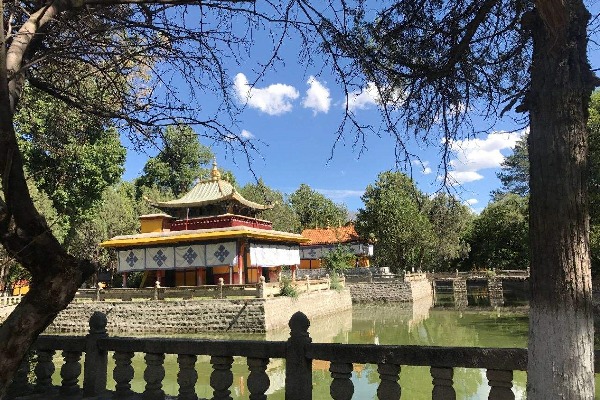
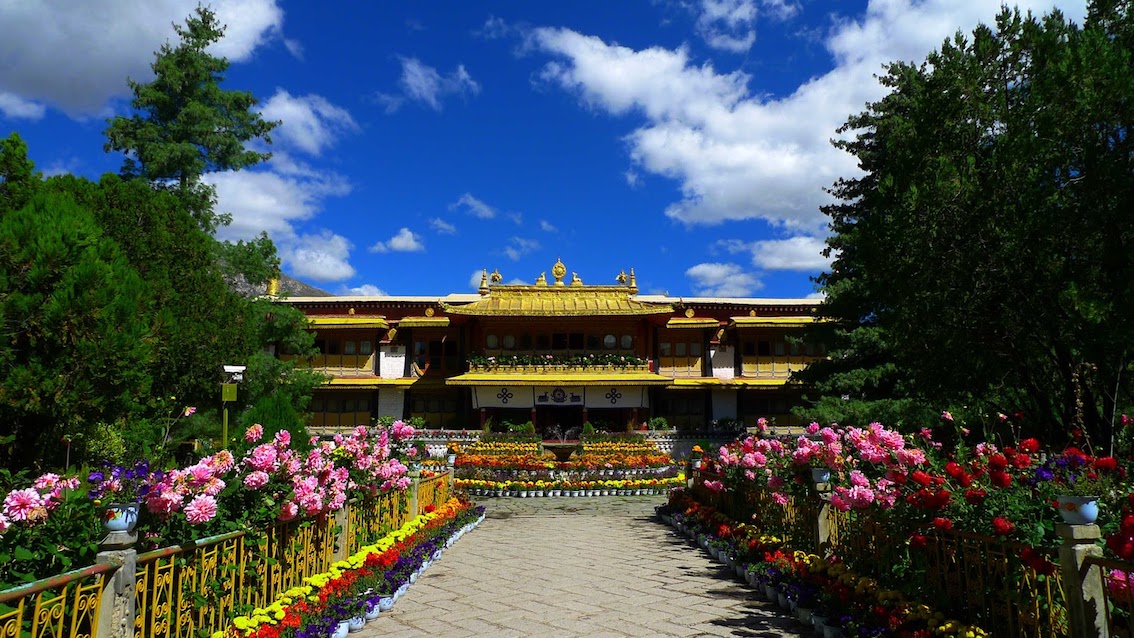
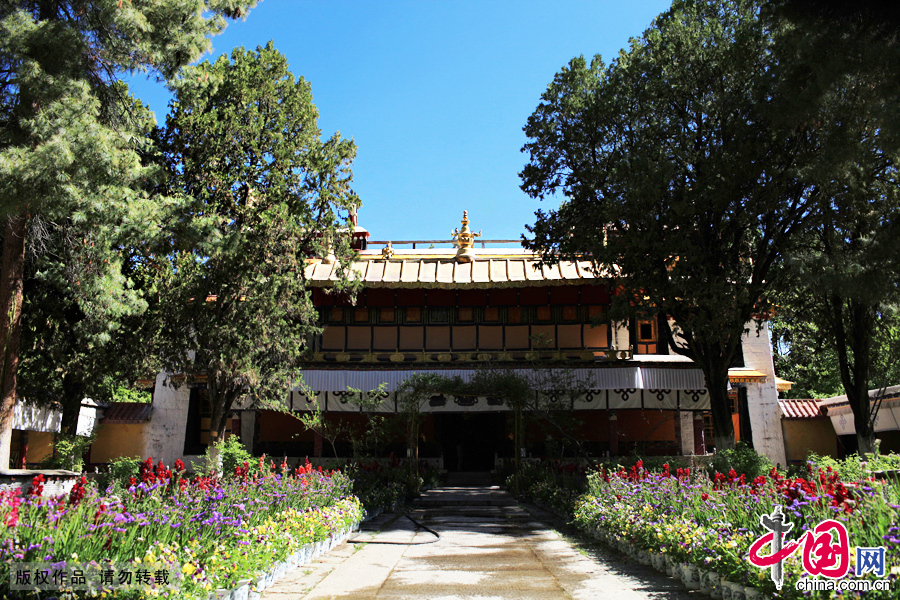
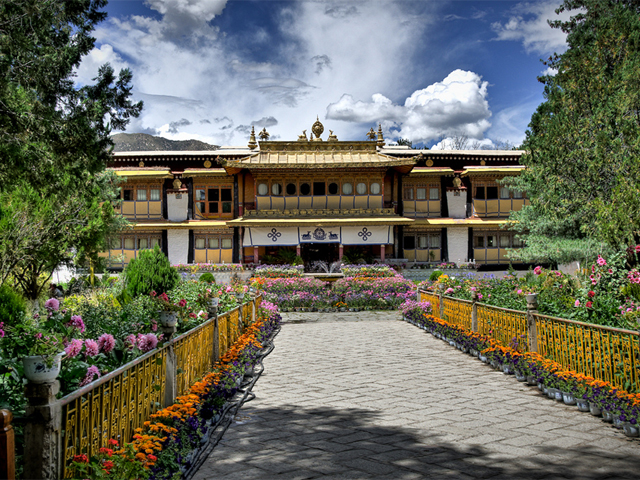
LIVING TIBETAN SPIRITS SHARE GLIMPSES OF NORBULINGKA – SUMMER PALACE OF THE DALAI LAMA, SUPREME RULER OF TIBET
Whole Dude – Whole Palace: Glimpses of Norbulingka, Summer Palace of Supreme Ruler of Tibet Whole Dude – Whole Palace: Glimpses of Norbulingka, Summer Palace of Supreme Ruler of Tibet
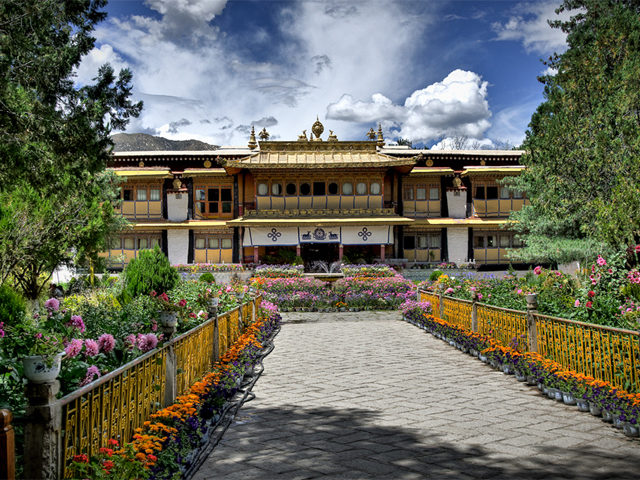
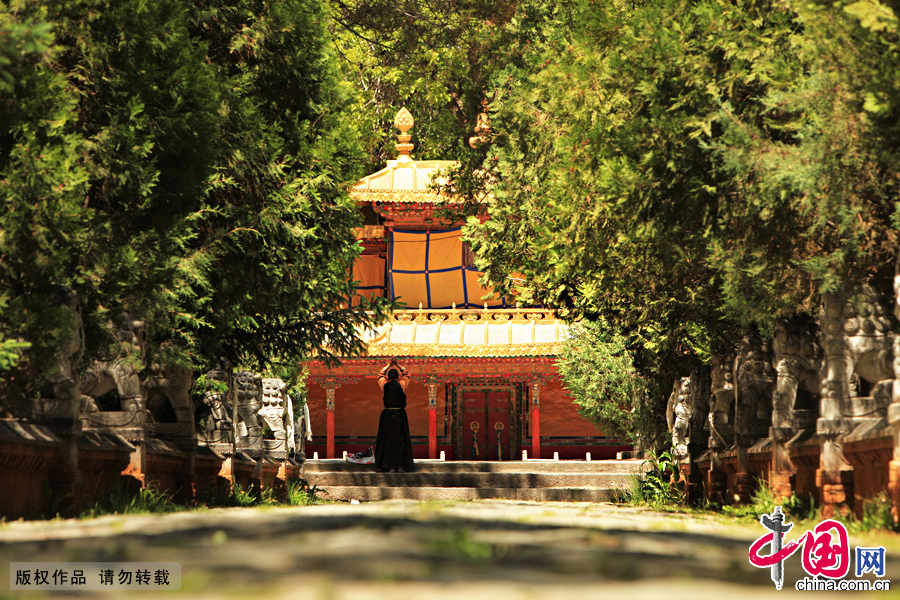
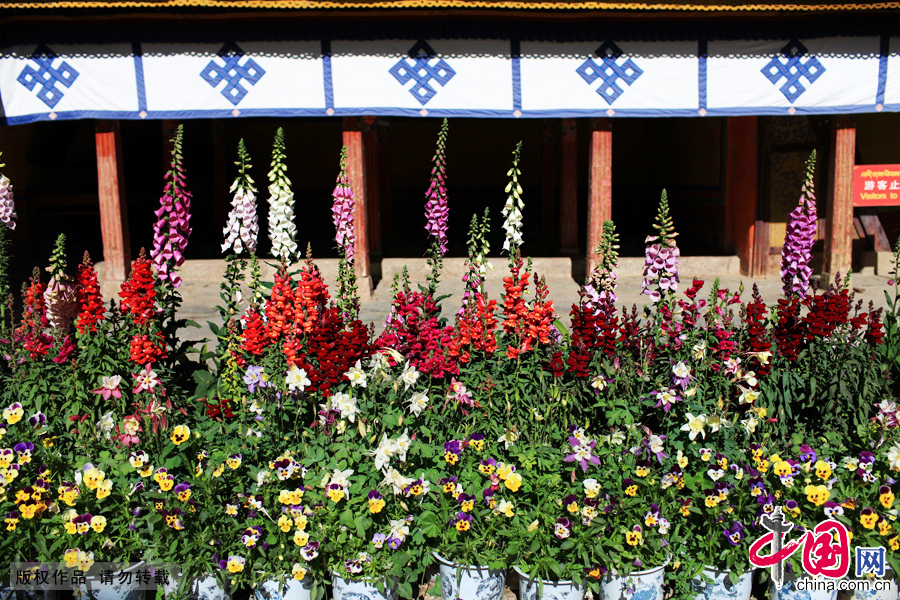
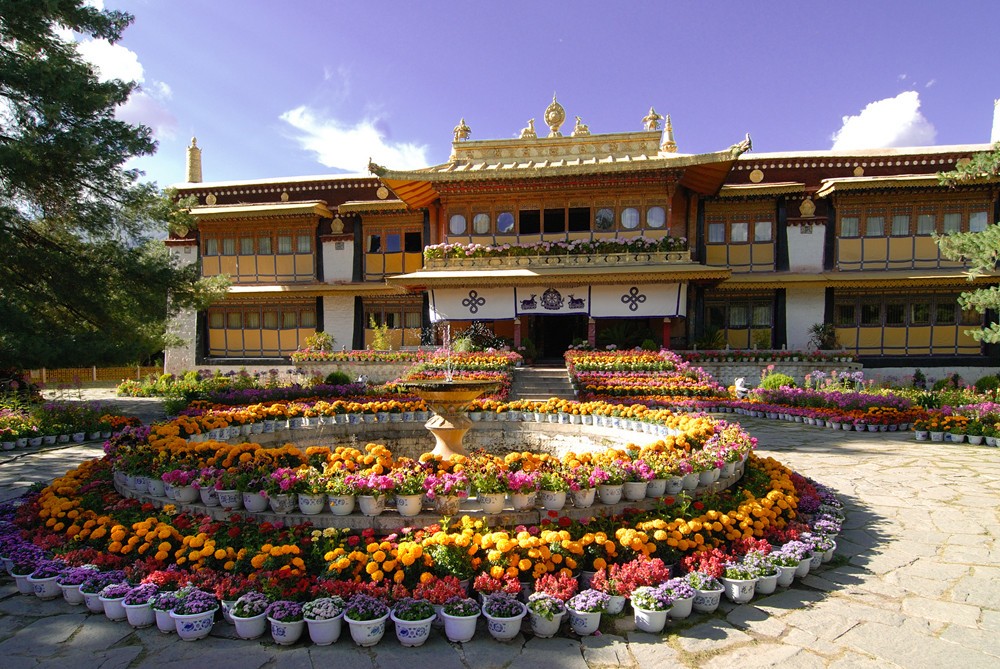
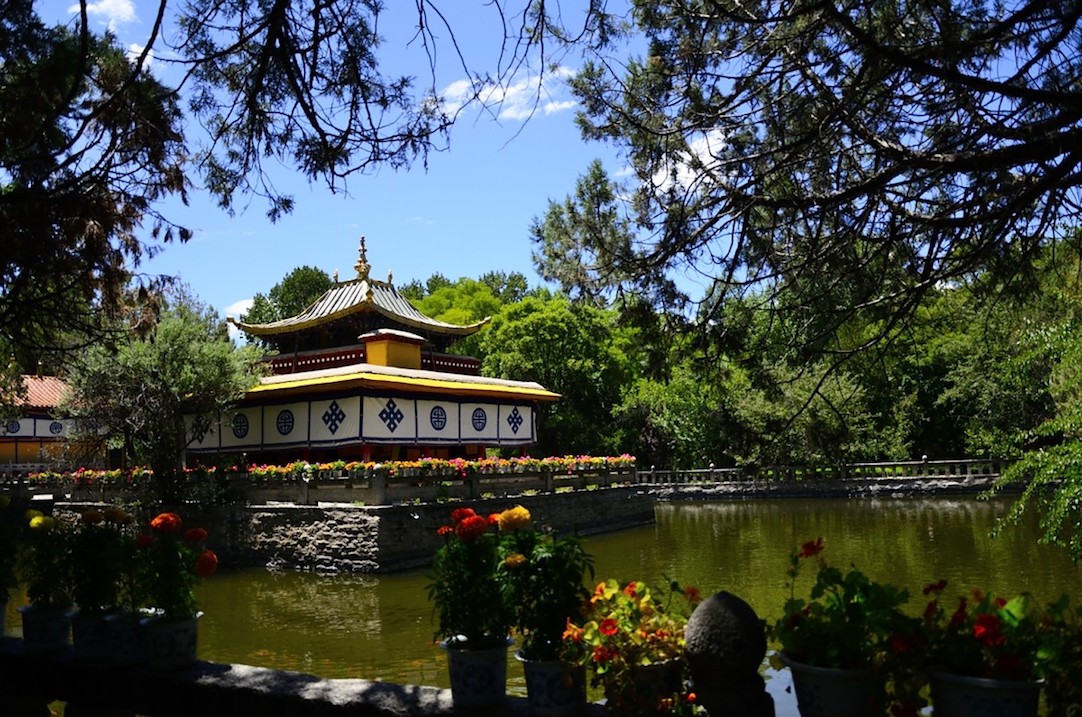
Norbulingka, literally the “Jeweled Garden,” is a palace and its surrounding parks located in a western suburb of Lhasa. It was constructed in the 1740s as a summer palace for the Dalai Lama, Supreme Ruler of Tibet and later served the whole governmental administration. The place boasts typical Tibetan palace architecture, as well as gentle streams, dense and lush forestry, birds and animals. Covering an area of around 36 hectares, it is considered to be the largest man-made garden in Tibet.
Whole Dude – Whole Palace: Glimpses of Norbulingka, Summer Palace of Supreme Ruler of Tibet
Being part of the “Historic Ensemble of the Potala Palace,” Norbulingka is recognized as a UNESCO World Heritage Site, and was added as an extension to this Historic Ensemble in 2001.[China.org.cn]
Whole Dude – Whole Palace: Glimpses of Norbulingka, Summer Palace of Supreme Ruler of Tibet
LIVING TIBETAN SPIRITS SHARE GLIMPSES OF NORBULINGKA, SUMMER PALACE OF SUPREME RULER OF TIBET
Whole Dude – Whole Palace: Glimpses of Norbulingka, Summer Palace of Supreme Ruler of TibetWhole Dude – Whole Palace: Glimpses of Norbulingka, Summer Palace of Supreme Ruler of Tibet
Norbulingka, literally the “Jeweled Garden,” is a palace and its surrounding parks located in a western suburb of Lhasa. It was constructed in the 1740s as a Summer Palace for the Dalai Lama, Supreme Ruler of Tibet and later served the whole governmental administration. The place boasts typical Tibetan palace architecture, as well as gentle streams, dense and lush forestry, birds and animals. Covering an area of around 36 hectares, it is considered to be the largest man-made garden in Tibet. Being part of the “Historic Ensemble of the Potala Palace,” Norbulingka is recognized as a UNESCO World Heritage Site, and was added as an extension to this Historic Ensemble in 2001.[China.org.cn]
Whole Dude – Whole Palace: Glimpses of Norbulingka, Summer Palace of Supreme Ruler of Tibet.
LIVING TIBETAN SPIRITS SHARE GLIMPSES OF NORBULINGKA, SUMMER PALACE OF SUPREME RULER OF TIBET
Whole Palace: Glimpses of Norbulingka, Summer Palace of the Supreme Ruler of TibetWhole Palace: Glimpses of Norbulingka, Summer Palace of the Supreme Ruler of Tibet
Norbulingka, literally the “Jeweled Garden,” is a palace and its surrounding parks located in a western suburb of Lhasa. It was constructed in the 1740s as a summer palace for the Dalai Lama and later served the whole governmental administration. The place boasts typical Tibetan palace architecture, as well as gentle streams, dense and lush forestry, birds and animals. Covering an area of around 36 hectares, it is considered to be the largest man-made garden in Tibet.
Whole Palace: Glimpses of Tibetan Culture
Being part of the “Historic Ensemble of the Potala Palace,” Norbulingka is recognized as a UNESCO World Heritage Site, and was added as an extension to this Historic Ensemble in 2001.
Whole Palace: Glimpses of Norbulingka, Summer Palace of Supreme Ruler of Tibet Whole Palace: Glimpses of Norbulingka, Summer Palace of Supreme Ruler of Tibet






























 Whole Dude - Whole Concept