Whole Secret – Ask Red China to share the truth about its 1962 India-China War

On October 20, 2024, 62-Years after the 1962 War, ask China to share the truth

REMEMBERING A WAR – THE 1962 INDIA-CHINA WAR : India’s Spiritual response to the plight of Tibetans is the real cause of the 1962 India-China War. In this photo image dated September 04, 1959, Indira Gandhi, daughter of India’s Prime Minister Jawaharlal Nehru is seen with His Holiness the 14th Dalai Lama. I take absolute pride in this moment and if War is the price to defend Tibet and its Dignity, as an Indian, I am happy to pay the price.
REMEMBERING THE 1962 INDIA – CHINA WAR : Communist China apart from its illegal military occupation of Tibet during 1949-50, illegally occupied Indian territory in Aksai Chin Region of Ladakh Province in the State of Jammu and Kashmir prior to its sudden, military attack during 1962 all along the Himalayan Frontier.
The Disputed Territory : Shown in green is Kas...
The Disputed Territory : Shown in green is Kashmiri region under Pakistani occupation. The orange-brown region represents Indian-controlled Jammu and Kashmir while the Aksai Chin is under Chinese occupation. The entire territory is Indian Union State of Jammu and Kashmir.
REMEMBERING THE 1962 INDIA – CHINA WAR : The McMahon Line in India’s North East Frontier Agency or the State of Arunachal Pradesh. The Top Secret of 1962 War is the number of Chinese soldiers that were killed and injured during their military attack. Communist China must take courage and admit the true numbers. This War was not a total loss. India learned its lesson. We had a spectacular Military Victory during 1971 during our Bangladesh Liberation War.
During 1962, I was a student at Giriraj Government Arts College, Nizamabad, Telangana, India. The entire student community joined together to voice their protest against Communist China’s act of brutal aggression. We raised donations to support the National Defense Fund and people across the entire Nation united to express their Love to the members of Indian Armed Forces who were fighting the battle. By 1971, I had finished my military training and was posted to an Unit that defends the Himalayan Frontier along the McMahon Line.
REMEMBERING A WAR:THE 1962 INDIA-CHINA WAR : This is a photo image taken in 1972, ten years after the 1962 War, while I proudly served the Nation in North East Frontier Agency. There was no schism or division among the Officers Corps. The Men and the Officers were totally united and were fully motivated to fight the Enemy and we had patrolled the border along the McMahon Line and went beyond the border for Operational reasons. There was no Fear and we were Prepared for the Challenge.

Kindly read the attached story titled “Remembering a War : The 1962 India-China War” and share your comments and views. The attached story is attributed to Neville Maxwell (1923 to 1974), a British journalist who worked for China’s Intelligence service. He published a book titled “India’s China War” and I call him a “Peddler” for he indulged in peddling information provided by China’s Intelligence Service. Neville Maxwell’s story is inspired by Communist China’s Intelligence Service and I am happy to give a public response to their Communist Propaganda that aims to promote fear psychosis among gullible Indian citizens and others. They must know that the people of the world are getting united to oppose China’s military occupation of Tibet.

I have the following problems with this story about “The 1962 India-China War.” You may also share it with others who have Service experience in India and Southeast Asia.

1. The author justifies Communist China’s military invasion of Tibet during 1949-50.

2. The author claims that Communist China respects the McMahon Line. In reality China occupied Aksai Chin region prior to the 1962 War. China has no legal authority inside Tibet and China cannot tell India not to cross the McMahon Line. We have valid reasons to ignore and refuse China’s legitimacy inside Tibet.

3. The author uses slander and innuendo to discredit General Kaul and there is no substance or proof to verify any of those claims. General Kaul’s only fault is that; Kaul is a Kashmiri Brahmin. His promotion and creation of a new Army Corps Commander position are justified because of enemy’s hostility and threats.

4. The author blames Mr. N. B. Mullik, the Director of Intelligence Bureau for doing his job. Mr. Mullik did his best under the given circumstances. To gather intelligence, we need to have aggressive patrolling and we must cross the McMahon Line to verify enemy’s strength and intentions. I did the same thing during 1972 while I was posted in North East Frontier Agency. I went with foot patrol parties and had deliberately, and intentionally crossed the border to know and detect enemy activities. A person with basic Infantry training knows the purpose of a patrol. It is not a picnic. India has a natural right to gather intelligence about the activities of its enemy. The enemy has no jurisdictional rights or legal authority (other than the fact of its military occupation) in that area of Indian security operations.

5. The report gives no credit to Simla Agreement of 1914 and McMahon Treaty that established the legitimate boundary between Tibet and India. Manchu China had signed this Treaty apart from Tibet. Red China invaded and occupied Tibet during 1949-50 and changed the situation for India. Since China had occupied Tibet, there was no good reason for India to initiate bilateral talks with China about border demarcation as the issue was already decided by McMahon Treaty. The essay criticizes India’s effort to control its own legitimate territory. It says India had provoked an angry reaction from China as India wanted to send armed patrols to a few selected border posts. Why should not India send patrols to define its own territory? The story says that India was a bit aggressive. Look at the aggressiveness of China which had already occupied the whole of Tibet and crushed all Tibetan resistance to its military occupation.

6. India played a reasonable role to protect its interests and used its Army with the resources they had at that time. If we are facing a superior force, it does not mean that we should remain entirely passive on our side of border. The only mistake made by Indian Prime Minister Nehru was that of not getting help from the United States to fully confront the military threat posed by Communist China. The Indian Prime Minister was constrained by the US military support for Pakistan’s acts of military aggression.

We had a very good chance to kick the Chinese out of Tibet during 1949-50 and we missed a golden opportunity on account of Pakistan’s War of Aggression in Kashmir. I still believe that India must prepare for this military challenge and stand up to defend Arunachal Pradesh and Ladakh. Unfortunately, we lost Aksai Chin to China without fighting them. After Chinese unilateral occupation of Aksai Chin, India must have joined United States to fight the threat posed by Communist China. We lost territory to China in Pakistan-occupied Kashmir. India must not relent on this border issue and our goal must be that of evicting the military occupier from Tibet.

7. This essay justifies Communist China’s military invasion of Tibet and blames India for defending its borders in the face of China’s superior strength. It has no word to blame China and its Expansionism. The author may even suggest and say that India had offended Alexander the Great and hence he had to fight and conquer India.

8. The 1962 War is not a total loss. The Top Secret of the 1962 India-China War is the number of Chinese killed and wounded in this military invasion. If Communist China has any courage, I ask them to disclose the true numbers. I am glad for we could kill the Enemy on the battlefield.

9. While I served on the Himalayan frontier (1971-December,1974), I had always medically inspected each soldier and made assessment of each soldier’s physical and mental fitness. Each was physically, and mentally fully prepared to face the challenge and fight the Enemy. I have never sent a soldier to get a medical opinion from an Army Psychiatrist. The essay talks about the divisions among the Officer Corps. I have personally met several Officers who served during 1962. In 1971, India had won a great Military Victory in the conduct of Bangladesh Operations. Indian Army, the Officers and men are totally united and worked together with no differences of opinion and executed the operation on the Battlefield. I had no personal or direct contact with very senior Officers but I know all Officers of the rank of Brigadier and below within my Formation. Both during 1962 and during 1971, the men and the Officer Corps of Indian Army were fully united to oppose the enemy and were willing to fight the enemy.

10. All said and done, the 1962 War was a good lesson and we are better prepared and more willing to fight this War again.

Neville Maxwell, a British Journalist, a paid agent of China’s Intelligence Service had named “HARRY ROSSITSKY” as the CIA Station Head in New Delhi. What was the source of this information? How did he come to this conclusion about the Identity of CIA’s Station Head in New Delhi? I welcome China’s Intelligence Service to come and verify our Identities on the Battlefield. CIA does not fight this Battle. When I served in Indian Army along the Himalayan Frontier, it was me, the Officers, and all Ranks of the Units in which I had served who trained and prepared to fight the Enemy. China must face us and not CIA on the Battlefield. There is a legitimate border between India and Tibet. As far as Communist China is concerned, I ask Indian people to define their territory by accepting the Challenge posed by Communist China’s illegal occupation of Tibet.
REMEMBERING THE 1962 INDIA – CHINA WAR : I remember visiting and paying my respects at the War Memorial erected at WALONG in remembrance of the Battle fought at Namtifield or Namti Plains, near Walong, Arunachal Pradesh (North East Frontier Agency of Indian Union). Deputy Commissioner Bernard S Dougal paid his tribute in the following verse:
The Sentinel hills that round us stand
Bear witness that we loved our Land;
Amidst shattered rocks and flaming Pine,
We fought and died on Namti Plain.
O’ Lohit gently by us glide,
Pale stars above us softly shine,
As we sleep here in Sun and rain.
REMEMBERING THE 1962 INDIA – CHINA WAR : I remember visiting and paying my respects at the War Memorial erected in WALONG in remembrance of the Battle fought at Namtifield or Namti Plains, near Walong, – Lohit River: Walong War Memorial
REMEMBERING THE 1962 INDIA – CHINA WAR : I remember visiting and paying my respects at the War Memorial erected in WALONG in remembrance of the Battle fought at Namtifield or Namti Plains, near Walong, Lohit River: “WALONG WILL NEVER FALL AGAIN.”

Dr. R. Rudra Narasimham, B.Sc., M.B.B.S.,
Personal Number. MS-8466 Rank. Captain, AMC/SSC,
Medical Officer, South Column, Operation Eagle (1971-72),
Personal Number. MR-03277K Rank. Major, AMC/DPC
Medical Officer, Headquarters Establishment No. 22 C/O 56 APO (1971-74),
Directorate General of Security,
Office of Inspector General Special Frontier Force,
East Block V, Level IV, R. K. Puram,
New Delhi – 110 022 – India.

The story titled, “Remembering  A War: The 1962 India – China War” is another face of Communist China’s propaganda warfare. China has been selling this story to gullible Indians and claims that China is a victim of India’s attack on China. This entire piece does not mention the word TIBET and Communist China’s illegal occupation of Tibet and the uprising in Tibet and H.H. Dalai Lama’s getting asylum in India. Communist China had used a massive force of Peoples’ Liberation Army to attack India all across the Himalayan frontier. The political mistake made by Prime Minister Nehru was that of not seeking help from the United States to prevent this attack. United States was willing to check Communist China’s expansionist policy and we should have kicked China out of Tibet during 1949-50.

REMEMBERING A WAR: THE 1962 INDIA-CHINA WAR A STORY POSTED BY CHINA’S INTELLIGENCE SERVICE AND CONTRIBUTED BY NEVILLE MAXWELL:

After the 1962 war, the Indian Army commissioned Lt Gen Henderson Brooks and Brig PS Bhagat to study the debacle. As is wont in India, their report was never made public and lies buried in the government archives. But some experts have managed to piece together the contents of the report. One such person is Neville Maxwell, who has studied the 1962 war in depth and is the author of ‘India’s China War’. 

In the articles that follow, Indians will be shocked to discover that, when China crushed India in 1962, the fault lay at India, or more specifically, at Jawaharlal Nehru and his clique’s doorsteps. It was a hopelessly ill-prepared Indian Army that provoked China on orders emanating from Delhi, and paid the price for its misadventure in men, money and national humiliation. This is a three part series of articles by Neville Maxwell:-
Part I – The Genesis of the 1962 Sino-Indian War.
Part 2 – How the East was Lost.
Part 3India’s Shameful Debacle.

Part I – The Genesis of the 1962 Sino-Indian War

When the Army’s report into its debacle in the border war was completed in 1963, the Indian government had good reason to keep it TOP SECRET and give only the vaguest, and largely misleading, indications of its contents. At that time the government’s effort, ultimately successful, to convince the political public that the Chinese, with a sudden ‘unprovoked aggression,’ had caught India unawares in a sort of Himalayan Pearl Harbour was in its early stages, and the Report’s cool and detailed analysis, if made public, would have shown that to be self-exculpatory mendacity.
But a series of studies, beginning in the late 1960s and continuing into the 1990s, revealed to any serious enquirer the full story of how the Indian Army was ordered to challenge the Chinese military to a conflict it could only lose. So, by now, only bureaucratic inertia, combined with the natural fading of any public interest, can explain the continued non-publication – the Report includes no surprises and its publication would be of little significance but for the fact that so many in India still cling to the soothing fantasy of a 1962 Chinese ‘aggression.’
It seems likely now that the Report will never be released. Furthermore, if one day a stable, confident and relaxed government in New Delhi should, miraculously, appear and decide to clear out the cupboard and publish it, the text would be largely incomprehensible, the context, well known to the authors and therefore not spelled out, being now forgotten. The Report would need an Introduction and gloss – a first draft of which this paper attempts to provide, drawing upon the writer’s research in India in the 1960s and material published later.
Two Preambles are required, one briefly recalling the cause and course of the border war; the second to describe the fault-line, which the border dispute turned into a schism, within the Army’s officer corps, which was a key factor in the disaster — and of which the Henderson Brooks Report can be seen as an expression.
Origins of the border conflict
India, at the time of Independence, can be said to have faced no external threats. True, it was born into a relationship of permanent belligerency with its weaker Siamese twin, Pakistan, left by the British inseparably conjoined to India by the chronically enflamed member of Kashmir, vital to both new national organisms; but that may be seen as essentially an internal dispute, an untreatable complication left by the crude, cruel surgery of Partition.
In 1947, China, wracked by civil war, was in what appeared to be death throes and no conceivable threat to anyone. That changed with astonishing speed, however, and, by 1950, when the new-born People’s Republic re-established in Tibet the central authority which had lapsed in 1911, the Indian government will have made its initial assessment of the possibility and potential of a threat from China, and found those to be minimal, if not non-existent.
First, there were geographic and topographical factors, the great mountain chains which lay between the two neighbours and appeared to make large-scale troop movements impractical (few could then see in the German V2 rocket the embryo of the ICBM). More important, the leadership of the Indian government – which is to say, Jawaharlal Nehru – had for years proclaimed that the unshakable friendship between India and China would be the key to both their futures, and therefore Asia’s, even the world’s.
The new leaders in Beijing were more chary, viewing India through their Marxist prism as a potentially hostile bourgeois state. But, in the Indian political perspective, war with China was deemed unthinkable and, through the 1950s, New Delhi’s defence planning and expenditure expressed that confidence. By the early 1950s, however, the Indian government, which is to say Nehru and his acolyte officials, had shaped and adopted a policy whose implementation would make armed conflict with China not only “thinkable” but inevitable.
From the first days of India’s Independence, it was appreciated that the Sino-Indian borders had been left undefined by the departing British and that territorial disputes with China were part of India’s inheritance. China’s other neighbours faced similar problems and, over the succeeding decades of the century, almost all of those were to settle their borders satisfactorily through the normal process of diplomatic negotiation with Beijing.
The Nehru government decided upon the opposite approach. India would, through its own research, determine the appropriate alignments of the Sino-Indian borders, extend its administration to make those good on the ground and then refuse to negotiate the result. Barring the inconceivable – that Beijing would allow India to impose China’s borders unilaterally and annex territory at will – Nehru’s policy thus willed conflict without foreseeing it.
Through the 1950s, that policy generated friction along the borders and so bred and steadily increased distrust, growing into hostility, between the neighbours. By 1958, Beijing was urgently calling for a standstill agreement to prevent patrol clashes and negotiations to agree on boundary alignments. India refused any standstill agreement, since it would be an impediment to intended advances and insisted that there was nothing to negotiate, the Sino-Indian borders being already settled on the alignments claimed by India, through blind historical process. Then it began accusing China of committing ‘aggression’ by refusing to surrender to Indian claims.
From 1961, the Indian attempt to establish an armed presence in all the territory it claimed and then extrude the Chinese was being exerted by the Army and Beijing was warning that if India did not desist from its expansionist thrust, the Chinese forces would have to hit back. On Oct 12, 1962, Nehru proclaimed India’s intention to drive the Chinese out of areas India claimed. That bravado had by then been forced upon him by public expectations which his charges of ‘Chinese aggression’ had aroused, but Beijing took it as in effect a declaration of war. The unfortunate Indian troops on the frontline, under orders to sweep superior Chinese forces out of their impregnable, dominating positions, instantly appreciated the implications: ‘If Nehru had declared his intention to attack, then the Chinese were not going to wait to be attacked.’
On Oct 20, the Chinese launched a pre-emptive offensive all along the borders, overwhelming the feeble – but, in this first instance, determined – resistance of the Indian troops and advancing some distance in the eastern sector. On Oct 24, Beijing offered a ceasefire and Chinese withdrawal on the condition that India agrees to open negotiations: Nehru refused the offer even before the text was officially received. Both sides built up over the next three weeks, and the Indians launched a local counterattack on Nov 15, arousing in India fresh expectations of total victory.
The Chinese then renewed their offensive. Now many units of the once crack Indian 4th Division dissolved into rout without giving battle and, by Nov 20, there was no organised Indian resistance anywhere in the disputed territories. On that day, Beijing announced a unilateral ceasefire and intention to withdraw its forces: Nehru, this time, tacitly accepted.
Naturally the Indian political public demanded to know what had brought about the shameful debacle suffered by their Army. On Dec 14, a new Army Cdr, Lt Gen JN Chaudhuri, instituted an Operations Review for that purpose, assigning the task of enquiry to Lt Gen Henderson Brooks and Brig PS Bhagat.

Part II – How the East was Lost

All colonial armies are liable to suffer from the tugs of contradictory allegiance and, in the case of India’s, that fissure was opened in the Second World War by Japan’s recruitment from prisoners of war of the Indian National Army to fight against their former fellows. By the beginning of the 1950s, two factions were emerging in the officer corps:-

· One patriotic but above all professional and apolitical, and orthodox in adherence to the regimental traditions established in the century of the Raj;
· The other nationalist, ready to respond unquestioningly to the political requirements of their civilian masters and scorning their rivals as fuddy-duddies still aping the departed rulers, and suspected as being of doubtful loyalty to the new ones. The latter faction soon took on an eponymous identification from its leader, B M Kaul.
At the time of Independence, Kaul appeared to be a failed officer, if not one disgraced. Although Sandhurst-trained for infantry service, he had eased through the war without serving on any frontline and ended it in a humble and obscure post in public relations. But his courtier wiles, irrelevant or damning until then, were to serve him brilliantly in the new order that Independence brought, after he came to the notice of Nehru, a fellow Kashmiri Brahmin and, indeed, distant kinsman.
Boosted by the prime minister’s steady favoritism, Kaul rocketed through the Army structure to emerge in 1961 at the very summit of the Army HQ. Not only did he hold the key appointment of Chief of General Staff but the Army Commander, Thapar, was, in effect, his client. Kaul had, of course, by then acquired a significant following, disparaged by the other side as ‘Kaul boys’ (‘call-girls’ had just entered usage), and his appointment as CGS opened a putsch in HQ, an eviction of the old guard, with his rivals, until then his superiors, being not only pushed out but often hounded thereafter with charges of disloyalty.
The struggle between those factions both fed on and fed into the strains placed on the Army by the government’s contradictory and hypocritical policies – on the one hand, proclaiming China an eternal friend against whom it was unnecessary to arm; on the other, exerting armed force to seize territory it knew China regarded as its own.
Through the early 1950s, Nehru’s covertly expansionist policy had been implemented by armed border police under the Intelligence Bureau, whose director, NB Mullik, was another favourite and confidant of the prime minister. The Army high command, knowing its forces to be too weak to risk conflict with China, would have nothing to do with it. Indeed when the potential for Sino-Indian conflict inherent in Mullik’s aggressive forward patrolling was demonstrated in the serious clash at the Kongka Pass in Oct 1959, Army HQ and the MEA united to denounce him as a provocateur and insisted that control over all activities on the border be assumed by the Army, which thus could insulate China from Mullik’s jabs.
The takeover by Kaul and his ‘boys’ at Army HQ in 1961 reversed that. Now, regular infantry would take over from Mullik’s border police in implementing what was formally designated a ‘forward policy,’ one conceived to extrude the Chinese presence from all territory claimed by India. Field commanders receiving orders to move troops forward into territory the Chinese both held and regarded as their own warned that they had no resources or reserves to meet the forceful reaction they knew must be the ultimate outcome: they were told to keep quiet and obey orders.
That may suggest that those driving the forward policy saw it in kamikaze terms and were reconciled to its ending in gunfire and blood – but the opposite was true. They were totally and unshakably convinced that it would end not with a bang but a whimper – from Beijing. The psychological bedrock upon which the forward policy rested was the belief that, in the last resort, the Chinese military, snuffling from a bloody nose, would pack up and quit the territory India claimed.
The source of that faith was Mullik, who from beginning to end proclaimed as oracular truth that, whatever the Indians did, there need be no fear of a violent Chinese reaction. The record shows no one squarely challenging that mantra at higher levels than the field commanders who throughout knew it to be dangerous nonsense: there were civilian ‘Kaul boys’ in the ministries of external affairs and defence too and they basked happily in Mullik’s fantasy. Perhaps the explanation for the credulousness lay in Nehru’s dependent relationship with his Intelligence Bureau chief: since the prime minister placed such faith in Mullik, it would be at the least lese majeste, and even heresy, to deny him a kind of papal infallibility.
If it be taken that Mullik was not just deluded, what other explanation could there be for the unwavering consistency with which he urged his country forward on a course which, in rational perception, could lead only to war with a greatly superior military power and, therefore, defeat? Another question arises: who, in those years, would most have welcomed the great falling-out which saw India shift in a few years from strong international support for the People’s Republic of China to enmity and armed conflict with it? From founding and leading the Non-Aligned Movement to tacit enlistment in the hostile encirclement of China which was Washington’s aim? Mullik maintained close links with the CIA station head in New Delhi, Harry Rossitsky. Answers may lie in the agency’s archives.
China’s stunning and humiliating victory brought about an immediate reversal of fortune between the Army factions. Out went Kaul, out went Thapar, out went many of their adherents – but by no means all. Gen Chaudhuri, appointed to replace Thapar as Army chief, chose not to launch a counter-putsch. He and his colleagues of the restored old guard knew full well what had caused the debacle: political interference in promotions and appointments by the prime minister and Krishna Menon, defence minister, followed by clownish ineptitude in the Army HQ as ‘Kaul boys’ scurried to force the troops to carry out the mad tactics and strategy laid down by the government.
It was clear that the trail back from the broken remnants of the 4th Division limping onto the plains in the north-east, up through intermediate commands to the Army HQ in New Delhi and then, on to the source of political direction, would have ended at the prime minister’s door – a destination which, understandably, Chaudhuri had no desire to reach. (Mullik was anyway to tarnish him with the charge that he was plotting to overthrow the discredited civil order, but, in fact, Chaudhuri was a dedicated constitutionalist – ironically, Kaul was the only one of the generals who harbored Caesarist ambitions.)

The Investigation

While the outraged humiliation of the political class left Chaudhuri with no choice but to order an inquiry into the Army’s collapse, it was up to him to decide its range and focus, indeed its temper. The choice of Lt Gen Henderson Brooks to run an Operations Review (rather than a broader and more searching board of inquiry) was indicative of a wish not to make the already bubbling stew of recriminations boil over.
Henderson Brooks (until then in command of a corps facing Pakistan) was a steady, competent but not outstanding officer, whose appointments and personality had kept him entirely outside the broils stirred up by Kaul’s rise and fall. That could be said too of the officer Chaudhuri appointed to assist Henderson Brooks, Brig PS Bhagat (holder of a WW II Victoria Cross and commandant of the military academy). But the latter complemented his senior by being a no-nonsense, fighting soldier, widely respected in the Army, and the taut, unforgiving analysis in the Report bespeaks the asperity of his approach.
There is further evidence that Chaudhuri did not wish the inquiry to dig too deep, range too widely, or excoriate those it faulted. The following were the terms of reference he set:-
· Training;
· Equipment;
· System of command;
· Physical fitness of troops;
· Capacity of commanders at all levels to influence the men under their command.
The first four of those smacked of an inquiry into the sinking of the Titanic briefed to concentrate on the management of the shipyard where it was built and the health of the deck crew; only the last term has any immediacy, and there the wording was distinctly odd – commanders do not usually ‘influence’ those they command, they issue orders and expect instant obedience.
But Henderson Brooks and Bhagat (henceforth HB/B) in effect ignored the constraints of their terms of reference and kicked against other limits Chaudhuri had laid upon their investigation, especially his ruling that the functioning of Army HQ during the crisis lay outside their purview. ‘It would have been convenient and logical’, they note, ‘to trace the events [beginning with] Army HQ, and then move down to the Commands for more details… ending up with field formations for the battle itself’. Forbidden that approach, they would, nevertheless, try to discern what had happened at Army HQ from documents found at lower levels, although those could not throw any light on one crucial aspect of the story – the political directions given to the Army by the civil authorities.
As HB/B began their inquiry, they immediately discovered that the short rein kept upon them by the Army chief was by no means the least of their handicaps. They found themselves facing determined obstruction in Army HQ, where one of the leading lights of the Kaul faction had survived in the key post of director of military operations – Brigadier DK Palit.
Kaul had exerted his power of patronage to have Palit made DMO although others senior to him were listed for the post, and Palit, as he was himself to admit, was ‘one of the least qualified among [his] contemporaries for this crucial General Staff appointment.’ Palit had thereafter acted as enforcer for Kaul and the civilian protagonists of the ‘forward policy,’ Mullik foremost among the latter, issuing the orders and deflecting or over-ruling the protests of field commanders who reported up their strategic imbecility or operational impossibility.
Why Chaudhuri left Palit in this post is puzzling: the Henderson Brooks Report was to make quite clear what a prominent and destructive role he had played throughout the Army high command’s politicization, and, through inappropriate meddling in command decisions, even in bringing about the debacle in the north-east. Palit, though, would immediately have recognized that the HB/B inquiry posed a grave threat to his career and so did that entire he could to undermine and obstruct it.
After consultation with Mullik, Palit took it upon himself to rule that HB/B should not have access to any documents emanating from the civil side – in other words, he blindfolded the inquiry, so far as he could, as to the nexus between the civil and military. As Palit smugly recounts his story, in an autobiography published in 1991, he personally faced down both Henderson Brooks and Bhagat, rode out their formal complaints about his obstructionism, and prevented them from prying into the ‘high level policies and decisions’ which he maintained were none of their business.
In fact, however, the last word lies with HB/B – or will do if their report is ever published. In spite of Palit’s efforts, they discovered a great deal that the Kaul camp and the government would have preferred to keep hidden; and their report shows that Palit’s self-admiring and mock-modest autobiography grossly misrepresents the role he played.
The Henderson Brooks Report is long (its main section, excluding recommendations and many annexes, covers nearly 200 typed foolscap pages), detailed and, as far as the restrictions placed upon its authors allowed, far-ranging. This introduction will touch only upon some salient points, to give the flavor of the whole (a full account of the subject they covered is in the writer’s 1970 study, India’s China War).

Part III – India’s Shameful Debacle


The Forward Policy


This was born and named at a meeting chaired by Nehru on Nov 2, 1961, but it had been alive and kicking in the womb for years before that – indeed its conception dated back to 1954, when Nehru issued an instruction for posts to be set up all along India’s claim lines, ‘especially in such places as might be disputed.’ What happened at this 1961 meeting was that the freeze on provocative forward patrolling, instituted at the Army’s insistence after Mullik had engineered the Kongka Pass clash, was ended – with the Army, now under the courtier leadership of Thapar and Kaul, eagerly assuming the task which Mullik’s armed border police had carried out until the Army stopped them.
HB/B note that no minutes of this meeting had been obtained, but were able to quote Mullik as saying that ‘the Chinese would not react to our establishing new posts and that they were not likely to use force against any of our posts even if they were in a position to do so.’ That opinion contradicted the conclusion Army Intelligence had reached 12 months before: that the Chinese would resist by force any attempts to take back territory held by them.
HB/B then trace a contradictory duet between the Army HQ and the Western Army Command, with HQ ordering the establishment of ‘penny-packet’ forward posts in Ladakh, specifying their location and strength, and the Western Command protesting that it lacked the forces to carry out the allotted task, still less to face the grimly foreseeable consequences. Kaul and Palit ‘time and again ordered, in furtherance of the “forward policy,” the establishment of individual posts, overruling protests made by the Western Command’. By Aug 1962 about 60 posts had been set up, most manned with less than a dozen soldiers, all under close threat by overwhelmingly superior Chinese forces. The Western Command submitted another request for heavy reinforcements, accompanying it with this admonition:
‘[I]t is imperative that political direction is based on military means. If the two are not correlated, there is a danger of creating a situation where we may lose both in the material and moral sense much more than we already have. Thus, there is no short cut to military preparedness to enable us to pursue effectively our present policy…’
That warning was ignored, reinforcements were denied, orders were affirmed and, although the Chinese were making every effort, diplomatic, political and military, to prove their determination to resist by force, again it was asserted that no forceful reaction by the Chinese was to be expected. HB/B quote Field Marshall Roberts: ‘The art of war teaches us to rely not on the likelihood of the enemy not coming, but on our own readiness to receive him; not on the chance of his not attacking, but rather on the fact that we have made our position unassailable’ But, in this instance, troops were being put in dire jeopardy in pursuit of a strategy based upon an assumption – that the Chinese would not resist with force – which the strategy would itself inevitably prove wrong. HB/B notes that from the beginning of 1961, when the Kaulist putsch reshaped Army HQ, crucial professional military practice was abandoned:
This lapse in Staff Duties on the part of the CGS [Kaul], his deputy, the DMO [Palit] and other Staff Directors is inexcusable. From this stemmed the unpreparedness and the unbalance of our forces. These appointments in General Staff are key appointments and officers were handpicked by Gen Kaul to fill them. There was therefore no question of clash of personalities. General Staff appointments are stepping stones to high command, and correspondingly carry heavy responsibility. When, however, these appointments are looked upon as adjuncts to a successful career and the responsibility is not taken seriously, the results, as is only too clear, are disastrous. This should never be allowed to be repeated and the Staff as of old must be made to bear the consequences of their lapses and mistakes. Comparatively, the mistakes and lapses of the Staff sitting in Delhi without the stress and strain of battle are more heinous than the errors made by the commanders in the field of battle.


War and Debacle


While the main thrust of the Forward Policy was exerted in the western sector of the border, it was also applied in the east from Dec 1961. There the Army was ordered to set up new posts along the McMahon Line (which China treated – and treats – as the de facto boundary), and, in some sectors, beyond it. One of these trans-Line posts, named Dhola Post, was invested by a superior Chinese force on Sep 8, 1962, the Chinese thus reacting there exactly as they had been doing for a year in the western sector. In this instance, however, and although Dhola Post was known to be north of the McMahon Line, the Indian government reacted aggressively, deciding that the Chinese force threatening Dhola must be attacked forthwith, and thrown back.
Now, again, the duet of contradiction began, the Army HQ and, in this case, Eastern Command (headed by Lt Gen L P Sen) united against the commands below: 33 Corps (Lt Gen Umrao Singh), 4 Div (Maj Gen Niranjan Prasad) and 7 Bde (Brig John Dalvi). The latter three stood together in reporting that the ‘attack and evict’ order was militarily impossible to execute.
The point of confrontation, below Thagla ridge at the western extremity of the McMahon Line, presented immense logistical difficulties to the Indian side and none to the Chinese, so whatever concentration of troops could painfully be mustered by the Indians could instantly be outnumbered and outweighed in weaponry. Tactically, again the irreversible advantage lay with the Chinese, who held well-supplied, fortified positions on a commanding ridge feature.
The demand for military action and the victory it was expected to bring was political, generated at top level meetings in Delhi. ‘The Defence Minister [Krishna Menon] categorically stated that in view of the top secret nature of conferences no minutes would be kept [and] this practice was followed at all the conferences that were held by the Defence Minister in connection with these operations’. HB/B commented: ‘This is a surprising decision and one which could and did lead to grave consequences. It absolved in the ultimate analysis anyone of the responsibility for any major decision. Thus it could and did lead to decisions being taken without careful and considered thought on the consequences of those decisions.’
Army HQ by no means restricted itself to the big picture. In mid-Sep it issued an order to troops beneath Thagla ridge to:-
(a) Capture a Chinese post 1,000 yards NE of Dhola Post.
(b) Contain the Chinese concentration S of Thagla.

HB/B comment: ‘The General Staff, sitting in Delhi, ordering an action against a position 1,000 yards NE of Dhola Post is astounding. The country was not known, the enemy situation vague, and for all that there may have been a ravine in between [the troops and their objective], but yet the order was given. This order could go down in the annals of History as being as incredible as the order for “the Charge of the Light Brigade.”


Worse was to follow


Underlying all the meetings in Delhi was still the conviction or by now, perhaps, prayer, that even when frontally attacked the Chinese would put up no serious resistance, still less react aggressively elsewhere. Thus it came to be believed that the problem lay in weakness, even cowardice, at lower levels of command. Gen Umrao Singh (33 Corps) was seen as the hub of the problem, since he was backing his div and brigade commanders in their insistence that the eviction operation was impossible.
‘It was obvious that Lt Gen Umrao Singh would not be hustled into an operation, without proper planning and logistical support. The Defence Ministry and, for that matter, the General Staff and Eastern Command were prepared for a gamble on the basis of the Chinese not reacting to any great extent.’ So the political leadership and Army HQ decided that if Umrao Singh could be replaced by a commander with fire in his belly all would come right, and victory be assured.
Such a commander was available – Gen Kaul. A straight switch, with Kaul relinquishing the CGS post to replace Umrao Singh, would have raised too many questions, so it was decided instead that Umrao Singh would simply be moved aside, retaining his corps command but no longer being concerned with the situation on the border. That would become the responsibility of a new formation, 4 Corps, whose sole task would be to attack and drive the Chinese off Thagla ridge. Gen Kaul would command the new corps.
HB/B noted how even the most secret of government’s decisions were swiftly reported in the press, and called for a thorough probe into the sources of the leaks.
Many years later Palit, in his autobiography, described the transmission procedure. Palit had hurried to see Kaul on learning of the latter’s appointment to command the notional new Corps: ‘I found him in the little bedsitter den where he usually worked when at home. I was startled to see, sitting beside him on the divan, Prem Bhatia, editor of The Times of India, looking like the proverbial cat who has just swallowed a large yellow songbird. He got up as I arrived, wished [Kaul] good luck and left, still with a greatly pleased smirk on his face.’
Bhatia’s scoop led his paper next morning. The ‘spin’ therein was the suggestion that whereas, in the western sector, Indian troops faced extreme logistical problems, in the east that situation was reversed and, therefore, with the dashing Kaul in command of a fresh ‘task force,’ victory was imminent. The truth was exactly the contrary, those in NEFA faced even worse difficulties than their fellows in the west, and victory was a chimera.
Those difficulties were compounded by persistent interference from the Army HQ. On orders from Delhi, ‘troops of [the entire 7 Bde] were dispersed to outposts that were militarily unsound and logistically unsupportable.’ Once Kaul took over as Corps Commander, the troops were driven forward to their fate in what HB/B called ‘wanton disregard of the elementary principles of war.’
Even in the dry, numbered paragraphs of their report, HB/B’s account of the moves that preceded the final Chinese assault is dramatic and riveting, with the scene of action shifting from the banks of the Namka Chu, the fierce little river beneath the menacing loom of Thagla ridge along which the under-clad Indian troops shivered and waited to be overwhelmed, to Nehru’s house in Delhi – whither Kaul rushed back to report when a rash foray he had ordered was crushed by a fierce Chinese reaction on Oct 10. To follow those events, and on into the greater drama of the ensuing debacle is tempting but would add only greater detail to the account already published.
Given the nature of the dramatic events they were investigating, it is not surprising that HB/B’s cast of characters consisted in the main of fools and/or knaves on the one hand, their victims on the other. But they singled out a few heroes too, especially the jawans, who fought whenever their commanders gave them the necessary leadership, and suffered miserably from the latter’s often gross incompetence. As for the debacle itself, ‘Efforts of a few officers, particularly those of Capt NN Rawat’ to organize a fighting retreat, ‘could not replace a disintegrated command;’ nor could the cool-headed Brig Gurbax Singh do more than keep his 48 Brigade in action as a cohesive combat unit until it was liquidated by the joint efforts of higher command and the Chinese.
HB/B place the immediate cause of the collapse of resistance in NEFA in the panicky, fumbling and contradictory orders issued from Corps HQ in Tezpur by a ‘triumvirate’ of officers they judge to be grossly culpable: Gen Sen, Gen Kaul, and Brig Palit. Those were, however, only the immediate agents of disaster: its responsible planners and architects were another triumvirate, comprised of Nehru, Mullik and again, Kaul, together with all those who accompanied them into the fantasy that a much stronger neighbor could be confronted and overcome through guile and puny force.

The Great Lesson Learned from the 1962 India-China War:

I shared my view in my blog post titled “Tibet’s Independence is India’s Security.” Kindly view the same at this page:

http://Bhavanajagat.com/2010/10/25/Tibets-Independence-is-Indias-Security/

REMEMBERING THE 1962 INDIA – CHINA WAR :”AHIMSA PARAMO DHARMA; DHARMA HIMSA TATHAIVA CHA” – Non-Violence is the highest principle, and so is Violence (use of Force or HIMSA ) in defense of the Righteous. I am not opposed to use of the force or violence to defend this Flag of Tibet and restore the true Tibetan Identity and its Independence. The Great Lesson learned from the 1962 War: EVICT THE MILITARY OCCUPIER FROM THE LAND OF TIBET.

Whole Misery – The Birth of Red China on October 01, 1949

The Red Revolution – Long Life is a Burden

Whole Dude – Whole Misery: October 01, 1949 – I can never ever live my life as a normal person. Long life is indeed a burden when it’s spent in Misery. Questions are a burden to others; answers are a prison for oneself.

Excerpt: The content discusses the historical event of October 1, 1949, when Mao Zedong, Chairman of the Communist Party, announced the creation of the People’s Republic of China. The author refers to the immediate imposition of misery on the Tibetan population and the author’s personal life as not being ‘normal’. The piece reflects on the US’s reaction to communist China, the nuclear threat from the Soviet Union, and accusations of the Truman administration mishandling the situation. It also recounts US refusal to acknowledge communist China and the eventual diplomatic recognition in 1979 as part of President Richard Nixon’s visit.

OCTOBER 01, 1949 – I CAN NEVER EVER LIVE MY LIFE AS A NORMAL PERSON

Whole Dude – Whole Misery: October 01, 1949 – I can never ever live my life as a normal person. Long life is indeed a burden when it’s spent in Misery. Questions are a burden to others; answers are a prison for oneself.

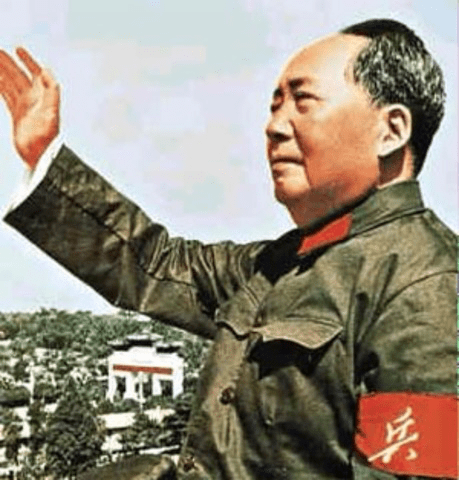
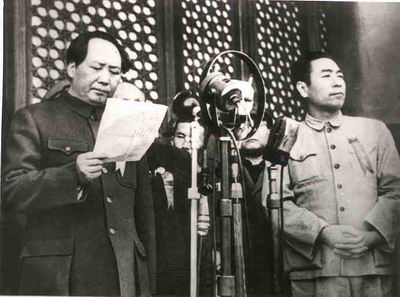
On ‘This Day in History’, October 01, 1949, Communist Party Chairman Mao Zedong proclaimed the founding of People’s Republic of China with profound consequences to lives of individuals as well as nations of Asia and World. Communist China wasted no time to impose a life of Whole Misery on the lives of Tibetan people.

Whole Dude – Whole Misery: October 01, 1949 – I can never ever live my life as a normal person. Long life is indeed a burden when it’s spent in Misery. Questions are a burden to others; answers are a prison for oneself.

Long life is indeed a burden when it’s spent in misery. Questions are a burden to others; answers are a prison for oneself. On Tuesday, October 01, 2024, I live in a free country without freedom for I am a refugee without a refuge.

Whole Dude – Whole Misery: October 01, 1949 – I can never ever live my life as a normal person. Long life is indeed a burden when it’s spent in Misery. Questions are a burden to others; answers are a prison for oneself.

Clipped from: http://www.history.com/this-day-in-history/mao-zedong-proclaims-peoples-republic-of-china?

Cold War

1949

Whole Dude – Whole Misery: October 01, 1949 – I can never ever live my life as a normal person. Long life is indeed a burden when it’s spent in Misery. Questions are a burden to others; answers are a prison for oneself. RED CHINA IS OBSESSED WITH A PASSIONATE DESIRE TO EXPAND HER INFLUENCE IN THE ENTIRE WORLD .

Naming himself head of state, communist revolutionary Mao Zedong officially proclaims the existence of the People’s Republic of China; Zhou Enlai is named premier. The proclamation was the climax of years of battle between Mao’s communist forces and the regime of Nationalist Chinese leader Chiang Kai-Shek, who had been supported with money and arms from the American government. The loss of China, the largest nation in Asia, to communism was a severe blow to the United States, which was still reeling from the Soviet Union’s detonation of a nuclear device one month earlier.

State Department officials in President Harry S. Truman’s administration tried to prepare the American public for the worst when they released a “white paper” in August 1949. The report argued that Chiang’s regime was so corrupt, inefficient, and unpopular that no amount of U.S. aid could save it. Nevertheless, the communist victory in China brought forth a wave of criticism from Republicans who charged that the Truman administration lost China through gross mishandling of the situation. Other Republicans, notably Senator Joseph McCarthy, went further, claiming that the State Department had gone “soft” on communism; more recklessly, McCarthy suggested that there were procommunist sympathizers in the department.

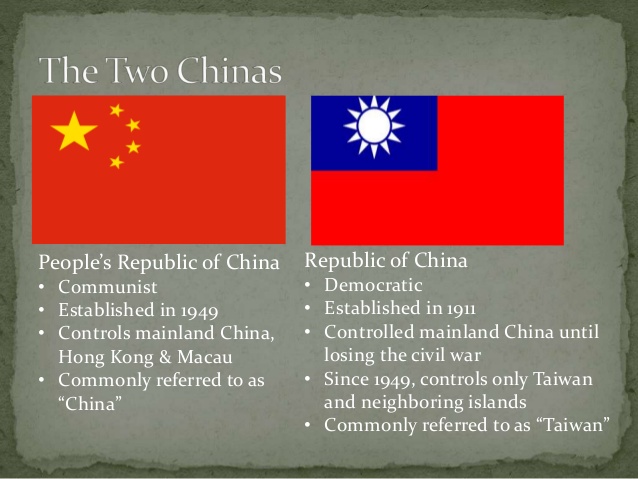
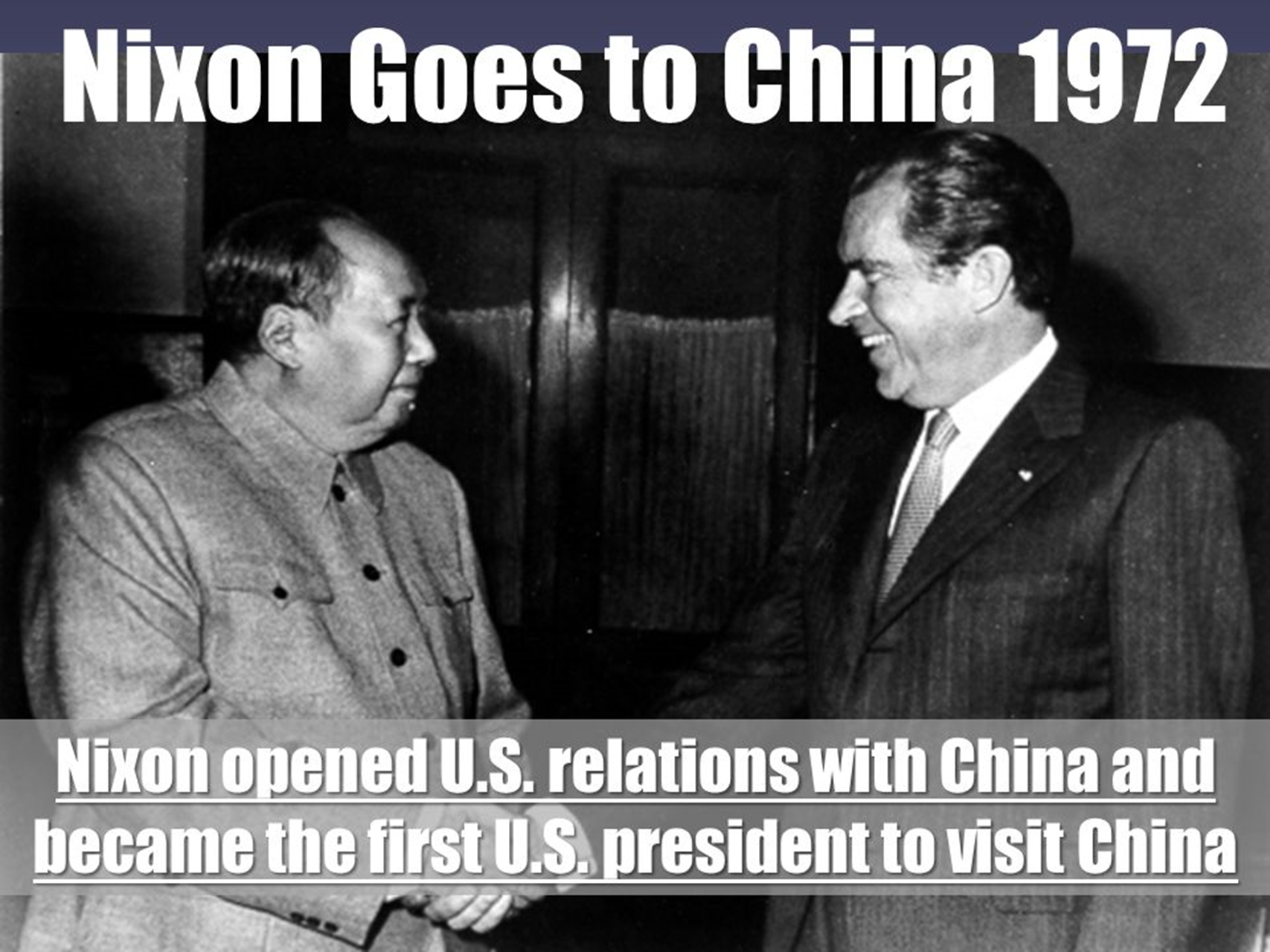
The United States withheld recognition from the new communist government in China. The outbreak of the Korean War in 1950, during which communist Chinese and U.S. forces did battle, drove an even deeper wedge between the two nations. In the ensuing years, continued U.S. support of Chiang’s Republic of China, which had been established on the island of Taiwan, and the refusal to seat the People’s Republic of China at the United Nations made diplomatic relations impossible. President Richard Nixon broke the impasse with his stunning visit to communist China in February 1972. The United States extended formal diplomatic recognition in 1979.

Also on this day

Whole Dude – Whole Misery: October 01, 1949 – I can never ever live my life as a normal person. Long life is indeed a burden when it’s spent in Misery. Questions are a burden to others; answers are a prison for oneself. Yosemite, Yo-Che-Ma-Te (Some Among Them Are Killers) National Park.

1890

Yosemite National Park established

On this day in 1890, an act of Congress creates Yosemite National Park, home of such natural wonders as Half Dome and the giant sequoia trees. Environmental trailblazer John Muir (1838-1914) and his colleagues campaigned for the congressional action, which was signed into law by President Benjamin Harrison.

Congress creates Yosemite National Park

On this day in 1890, the United States Congress decrees that about 1,500 square miles of public land in the California Sierra Nevada will be preserved forever as Yosemite National Park.

Once the home to Indians whose battle cry Yo-che-ma-te (“some among them are killers”) gave the park its name.

Whole Dude – Whole Misery: October 01, 1949 – I can never ever live my life as a normal person. Long life is indeed a burden when it’s spent in Misery. Questions are a burden to others; answers are a prison for oneself. Yosemite, Yo-Che-Ma-Te (Some Among Them Are Killers) National Park.
Whole Dude – Whole Misery: October 01, 1949 – I can never ever live my life as a normal person. Long life is indeed a burden when it’s spent in Misery. Questions are a burden to others; answers are a prison for oneself. RED CHINA IS OBSESSED WITH A PASSIONATE DESIRE TO EXPAND HER INFLUENCE IN THE ENTIRE WORLD .

Whole Subversion – Red China’s appointment of 11th Panchen Lama

Tibet Consciousness – Red China’s Policy of Subversion

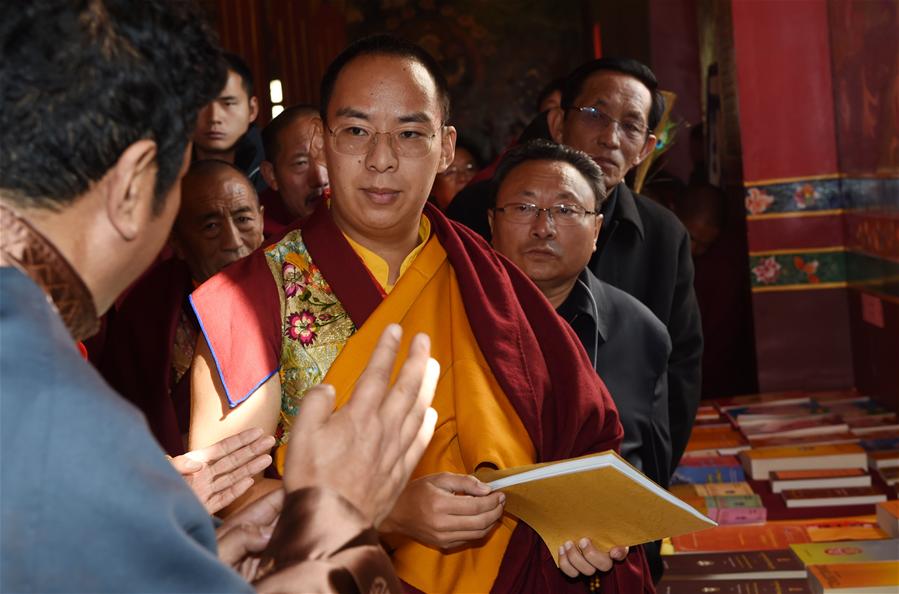
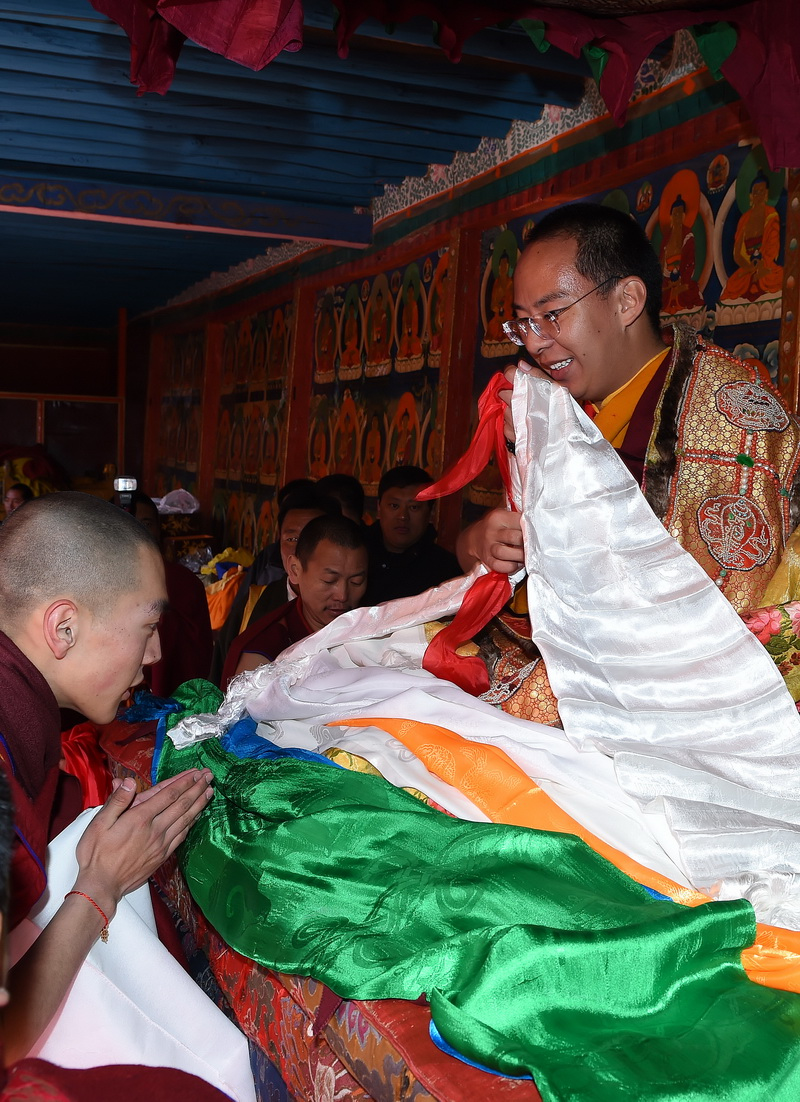
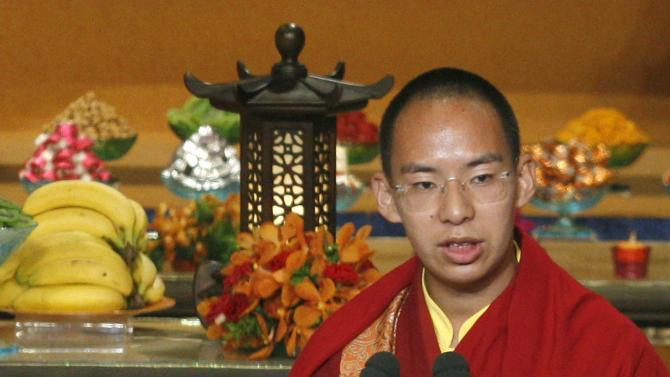
Whole Subversion -Red China’s appointment of 11th Panchen Lama. Red China’s Panchen Lama is a political appointee. Gyaltsen Norbert, the False 11th Panchen Lama symbolizes Red China’s Policy of Subversion.

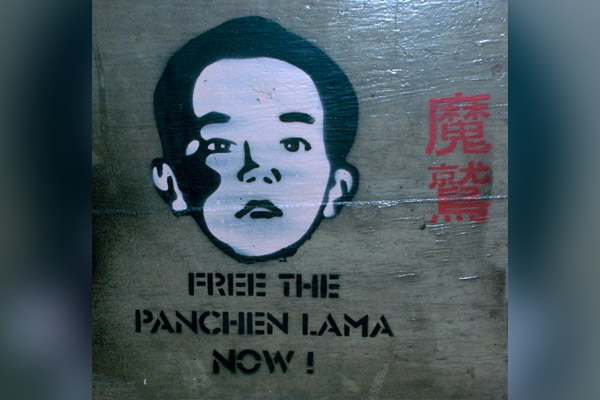
Subversion means to undermine or corrupt established institutions and belief systems using people who act as figures of authority or of importance that followers can easily recognize. Most Tibetan Buddhists can easily recognize a person known as Panchen Lama. Red China’s policy of Subversion becomes very apparent in the manner in which Red China appointed a Panchen Lama without any concern for Tibet’s true Cultural Institutions. Tibet demands Red China to return true or real 11th Panchen Lama.

REUTERS

China’s Tibet party boss urges senior monk to shun Dalai Lama

Tue Dec 8, 2015 8:25am EST

BEIJING

Whole Subversion -Red China’s appointment of 11th Panchen Lama. Red China’s Panchen Lama is a political appointee. Gyaltsen Norbert, the False 11th Panchen Lama symbolizes Red China’s Policy of Subversion.

Tudeng Kezhu, a Tibetan delegate, touches the hand of Gyaltsen Norbu, the 11th Panchen Lama and a delegate, with his forehead during the opening session of the Chinese People’s Political Consultative Conference (CPPCC) at the Great Hall of the People in Beijing, March 3,…
Reuters/Jason Lee/Files

BEIJING China’s Communist Party boss in Tibet has urged the Panchen Lama, the second-highest figure in Tibetan Buddhism, to reject the Himalayan region’s exiled spiritual leader, the Dalai Lama, state media said on Tuesday.

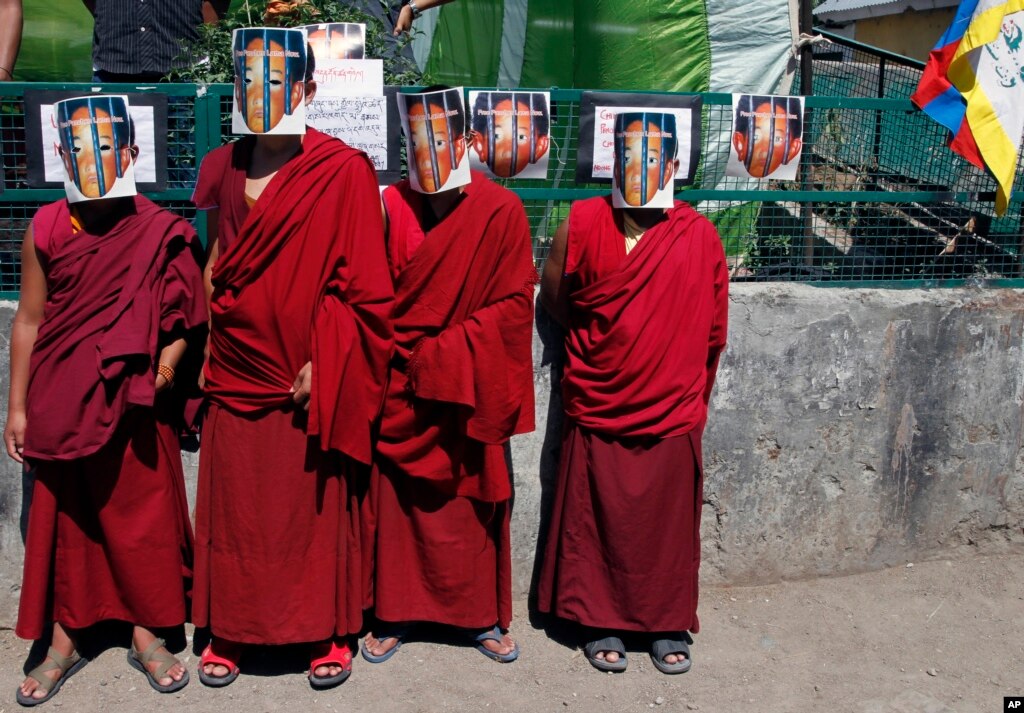
Controversy surrounds the position of the Panchen Lama since the boy the Dalai Lama named as the reincarnation of the leader disappeared when he was six years old.

The fate of the missing Panchen Lama, one of China’s most zealously guarded state secrets, is just one area of contention between China and the Dalai Lama over Tibet, and continues to worry many Tibetans.

Tibetan Buddhism holds that the soul of a senior lama is reincarnated in the body of a child on his death.
The Dalai Lama and China’s officially atheist Communist Party have repeatedly tussled over who has final authority on the issue of reincarnation.

China’s Communist Party has long maintained that the Dalai Lama’s choice, Gendun Choekyi Nyima, now 26, is not the real Panchen Lama, and in 1995, the government selected Gyaltsen Norbu as the 11th Panchen Lama.

Chen Quanguo, the party secretary of Tibet, said he hoped Beijing’s Panchen Lama would “unswervingly walk with the party” and safeguard national unity, the official Tibet Daily said.
“Resolutely draw a clear line between the 14th Dalai Lama and firmly reject all subversive separatist activities,” Chen told the Panchen Lama in the Tibetan city of Shigatse during a meeting on Monday marking 20 years since the monk’s investiture.

“Tibetan Buddhism is at its best period of development in history and religious circles and believers enjoy full religious freedom,” the paper quoted Beijing’s Panchen Lama as telling Chen.
Tibet’s exiled leadership in India said Beijing’s bid to involve itself on the issue of reincarnation had no moral or legal standing.

“Beijing authorities or the atheist communist party of China have neither legitimacy nor credibility on this matter,” Lobsang Sangay, the political head of the government-in-exile, based in the northern hill town of Dharamsala, told Reuters.

The 80-year-old Dalai Lama fled to India after a failed uprising against Chinese rule in 1959. Beijing says he is a violent separatist but the monk denies espousing violence and says he only wants genuine autonomy for Tibet.

The Chinese government sees the appointment of the next Dalai Lama as key to consolidating state control over Tibet, where separatist movements have flared since the 1950s.

Tibetans fear Beijing will use the issue of the Nobel peace laureate’s eventual death and succession to split Tibetan Buddhism, with one new Dalai Lama named by exiles and one by the government.

Beijing insists it must approve the next Dalai Lama, though the title’s current holder has said the role could end when he dies.

(Reporting by Michael Martina; Additional reporting by Abhishek Madhukar in DHARAMSALA; Editing by Clarence Fernandez)

THOMSON REUTERS

Whole Subversion -Red China’s appointment of 11th Panchen Lama. Red China’s Panchen Lama is a political appointee. Gyaltsen Norbert, the False 11th Panchen Lama symbolizes Red China’s Policy of Subversion.
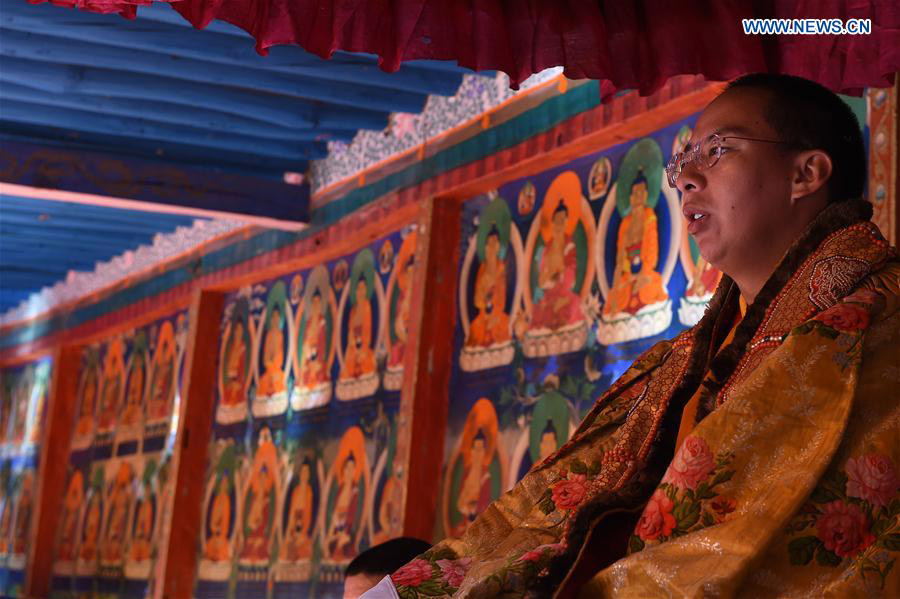
Whole Subversion -Red China’s appointment of 11th Panchen Lama. Red China’s Panchen Lama is a political appointee. Gyaltsen Norbert, the False 11th Panchen Lama symbolizes Red China’s Policy of Subversion. 20 years after Disappearance, Tibet wants China to Return True or Real Panchen Lama.
The false Panchen Lama presided over a symposium organized by the Tibetan Branch of the CCP-controlled China Buddhist Association in Lhasa during 2023 summer. From Weibo. The False Panchen Lama Tells Tibetans to Obey Xi Jinping Unconditionally. His “religious” message centers on establishing the guiding role of President Xi and his ideology


Whole Dude – Whole Sin

Whole Dude Reports Whole Sin

The term ‘sin’ is portrayed using a variety of terms. The biblical writers describe sin as that condition and activity of human beings that is offensive to God. Sin is revolt against holiness and sovereign will of God. It is both a condition of the heart, mind, will, affections and the practical outworking of that condition in thoughts, words, and deeds that offend God and transgress His holy law. In secular terms, sin means any offense against good morals, any offense against established law of the Land, and any violation of standard code for human behavior and action.

Whole Dude – Whole Declaration:

WHOLE DUDE - WHOLE SIN : Sin is that condition of the heart, mind, will, affections and the practical outworking of that condition in thoughts, words, and deeds that offend this Declaration of Independence and sin is any action that transgress the intent of this Declaration of Independence upon which the nation called the United States of America is created.
WHOLE DUDE REPORTS WHOLE SIN : Sin is that condition of the heart, mind, will, affections and the practical outworking of that condition in thoughts, words, and deeds that offend this Declaration of Independence and sin is any action that transgress the intent of this Declaration of Independence upon which the nation called the United States of America is created.

The Declaration of Independence adopted July 04, 1776 to pronounce the creation of the United States spells in very clear, and transparent terms the American ideal of Government based on the Theory of Natural Rights. This Declaration states the philosophy of Human Freedom and the Nation and its Government is formed by Social Contract. United States and its elected officials who represent the entity called Government have to adhere to these founding principles and they must be guided by the Laws of Nature which guarantee unalienable rights of man. Governments are instituted among men to secure their unalienable rights and Governments derive their just powers from the consent of the governed. And for the support of this Human Freedom, we must mutually pledge to each other our Lives, our Fortunes, and our sacred Honor.

I define the term “Whole Sin” as a condition of the heart, mind, will, affections and the practical outworking of that condition in thoughts, words, and deeds that offend the Declaration of Independence and transgress the Laws of Nature.

Whole Dude – Whole Memorial:

Whole Dude Reports Whole Sin: NIXON-KISSINGER VIETNAM TREASON

Memorial is anything that serves to help people to remember some person or event. I would like to share the photo images of the Vietnam Veterans War Memorials to remind people that we fought these wars to contain the threat posed by Communism to the doctrine of Human Freedom, and the Rule of Governance called Democracy.

Whole Dude - Whole Sin : Remember the Vietnam War. America called its sons and daughters to pledge their Lives, their Fortunes and their sacred Honor to fight the Enemy called Communism.
Whole Dude Reports Whole Sin: Remember the Vietnam War. America called its sons and daughters to pledge their Lives, their Fortunes and their sacred Honor to fight the Enemy called Communism.
WHOLE DUDE - WHOLE SIN - SAN ANTONIO TEXAS VIETNAM VETERANS MEMORIAL . This monument reminds people that the sons and daughters of the United States of America have pledged their Lives, their Fortunes, and their sacred Honor to defend Human Freedom, and Democracy and fought the Enemy called Communism.
WHOLE DUDE REPORTS WHOLE SIN: SAN ANTONIO, TEXAS VIETNAM VETERANS MEMORIAL . This monument reminds people that the sons and daughters of the United States of America have pledged their Lives, their Fortunes, and their sacred Honor to defend Human Freedom, and Democracy and fought the Enemy called Communism.

Whole Dude Reports Whole Sin: The Original Sin of Nixon and Kissinger:

WHOLE DUDE - WHOLE SIN : The prophesy revealed by Father Moses in The Old Testament, The Fifth Book of Moses, The Book of Deuteronomy, Chapter 28, verses 47 to 50 has come true in the lives of American people. The RED DRAGON, The People's Republic of China, The Communist nation is the Enemy that Americans will be forced to serve like slaves.
WHOLE DUDE REPORTS WHOLE SIN: The prophesy revealed by Father Moses in The Old Testament, The Fifth Book of Moses, The Book of Deuteronomy, Chapter 28, verses 47 to 50 has come true in the lives of American people. The RED DRAGON, The People’s Republic of China, The Communist nation is the Enemy that Americans will be forced to serve like slaves.
WHOLE DUDE - WHOLE SIN : The photo image evidence for the "Original Sin." Chairman Mao Zedong, and Prime Minister Zhou-Enlai are guilty of the crime called "GENOCIDE." The UN Convention of 1949 defined the crime of Genocide; the systematic destruction by government of a racial, religious, or ethnic group. Dr. Henry Alfred Kissinger of National Security Affairs is guilty of the crime called the misuse and abuse of power. His sinful actions represent the violation of the Supreme Law established by the Constitution of The United States of America. He usurped the powers entitled to the Secretary of State. He conducted secret diplomacy before he was administered the oath to the Office and before he pledged his allegiance to the Constitution.
WHOLE DUDE REPORTS WHOLE SIN: This photo image is the evidence for the “Original Sin.” Chairman Mao Zedong, and Prime Minister Zhou-Enlai are guilty of the crime called “GENOCIDE.” The UN Convention of 1949 defined the crime of Genocide; the systematic destruction by government of a racial, religious, or ethnic group. Dr. Henry Alfred Kissinger of National Security Affairs is guilty of the crime called the misuse and abuse of power. His sinful actions represent the violation of the Supreme Law established by the Constitution of The United States of America. He usurped the powers entitled to the Secretary of State. He conducted secret diplomacy before he was administered the oath to the Office and before he pledged his allegiance to the Constitution.

In the history of the nation called The United States of America, President Richard Milhous Nixon (37th president of the US 1969-1974), and Dr. Henry Alfred Kissinger (initially appointed by President Nixon in 1969 as an adviser, National Security Affairs and later the Secretary of State from September 1973-1977) are guilty of the offense called ‘The Original Sin’ for they transgressed the Supreme Law of this nation.

We have to recognize China’s Cultural Revolution of 1966 – 1969 as a mass campaign sponsored by the Communist government to commit Genocide. Many thousands died and there was no proper accounting of the atrocities committed and there was never a full inquiry of this human tragedy. The Cultural Revolution officially ended in 1969, but we all know that many of its excesses continued until the death of Communist Party leader Mao – TseTung in 1976.

Whole Dude Reports Whole Sin: The Original Sin of Nixon-Kissinger

In the words that I choose from The Old Testament, The Fifth Book of Moses, The Book of Deuteronomy, Chapter 28, verses 47 to 50, I describe their actions of “Whole Sin” and its consequences as follows:

Whole Dude Reports Whole Sin: The Original Sin of Nixon-Kissinger

“Because you did not serve the LORD your God joyfully and gladly in the time of prosperity, therefore in hunger and thirst, in nakedness and dire poverty, you will serve the enemies the LORD sends against you. The LORD will bring a nation against you from far away, from the ends of the Earth, like an eagle swooping down, a nation whose language you will not understand, a fierce-looking nation without respect for the old or pity for the young.” 

I would like to share some of these photo images that reveal the transgression of Natural Law and its consequences. The people of The United States of America having failed to serve the LORD GOD joyfully and gladly in the time of prosperity, will now serve the Enemy that LORD sent against them.

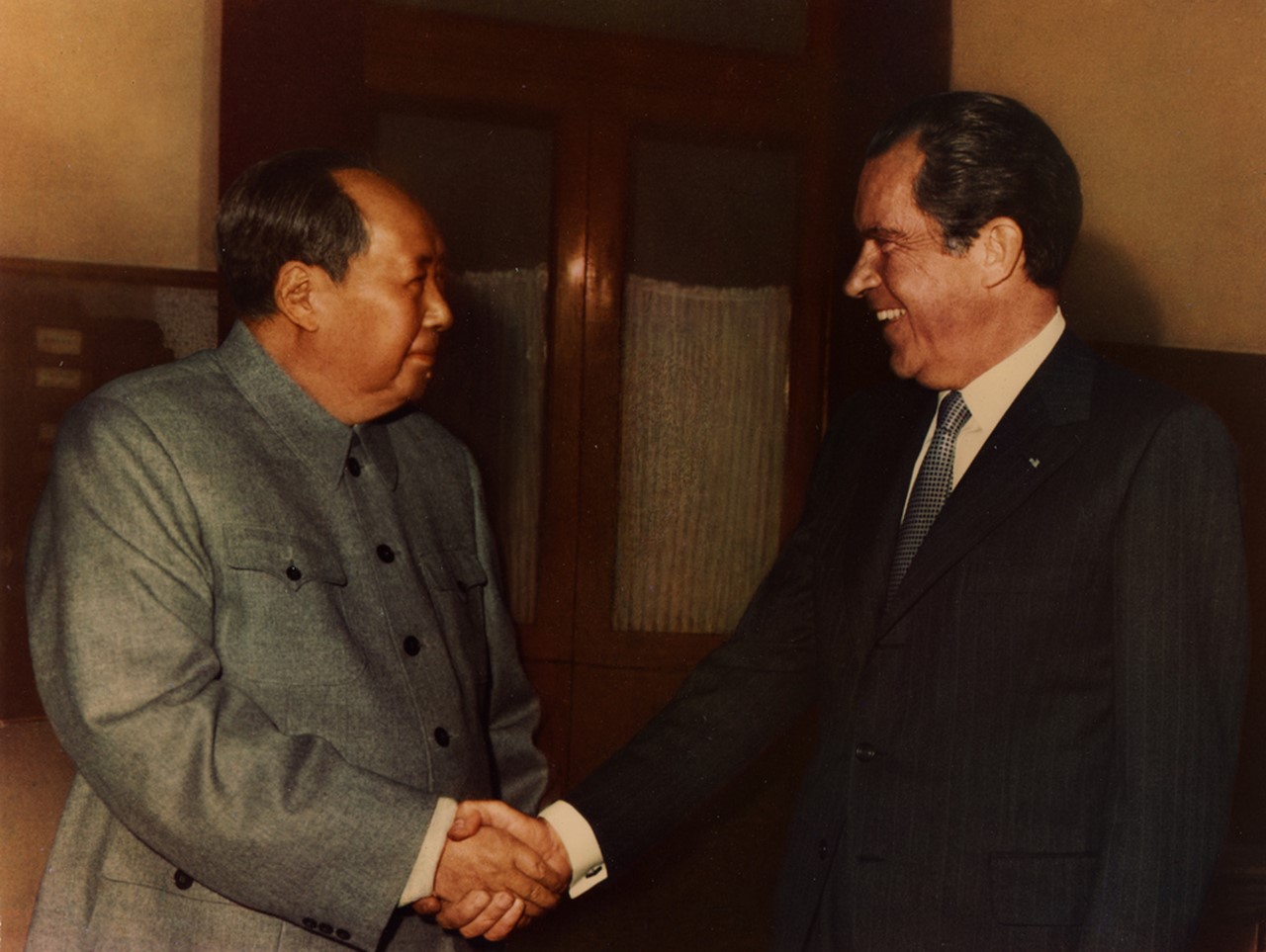
WHOLE DUDE WHOLE SIN : February 21, 1972. President Richard Nixon with Communist leader Mao-Tse Tung in Peking(Beijing). Chairman Mao represents the Face of Crimes Against Humanity.
WHOLE DUDE REPORTS WHOLE SIN: February 21, 1972. President Richard Nixon with Communist leader Mao-Tse Tung in Peking(Beijing). Chairman Mao represents the Face of Crimes Against Humanity. The UN Convention of 1949 has defined the crime of Genocide as a systematic destruction by a government of a racial, religious, or ethnic group. When this photo was taken, the United States was officially engaged in a battle in Vietnam to contain the direct threat posed by Communism. China’s Communist Party leader is the face of that Enemy.
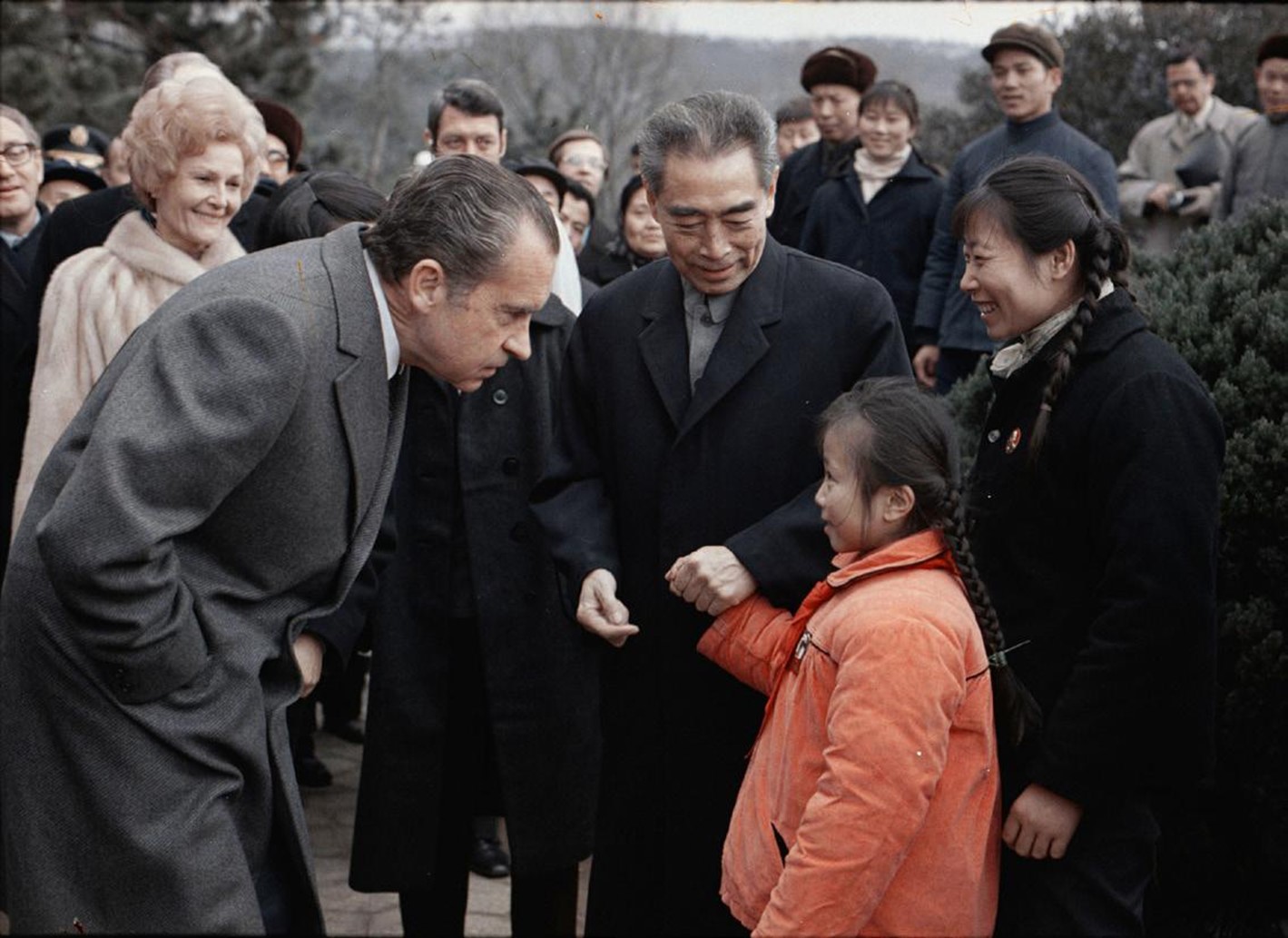
WHOLE DUDE - WHOLE SIN : Communist China's Premier Zhou En-Lai and the US National Security Adviser Dr. Henry Alfred Kissinger are the faces that represent the Original Sin, they are guilty of the offense called transgression of Law.
WHOLE DUDE REPORTS WHOLE SIN: Communist China’s Premier Zhou En-Lai and the US National Security Adviser Dr. Henry Alfred Kissinger are the faces that represent the Original Sin, they are guilty of the offense called transgression of Law. William P. Rogers was the Secretary of State from 1969 to 1973. Dr. Kissinger had usurped the powers of the Secretary of State and had misused and had abused his office to conduct secret diplomatic negotiations with the Enemy while the United States was openly fighting a grim battle to contain the threat of Communism in Vietnam.
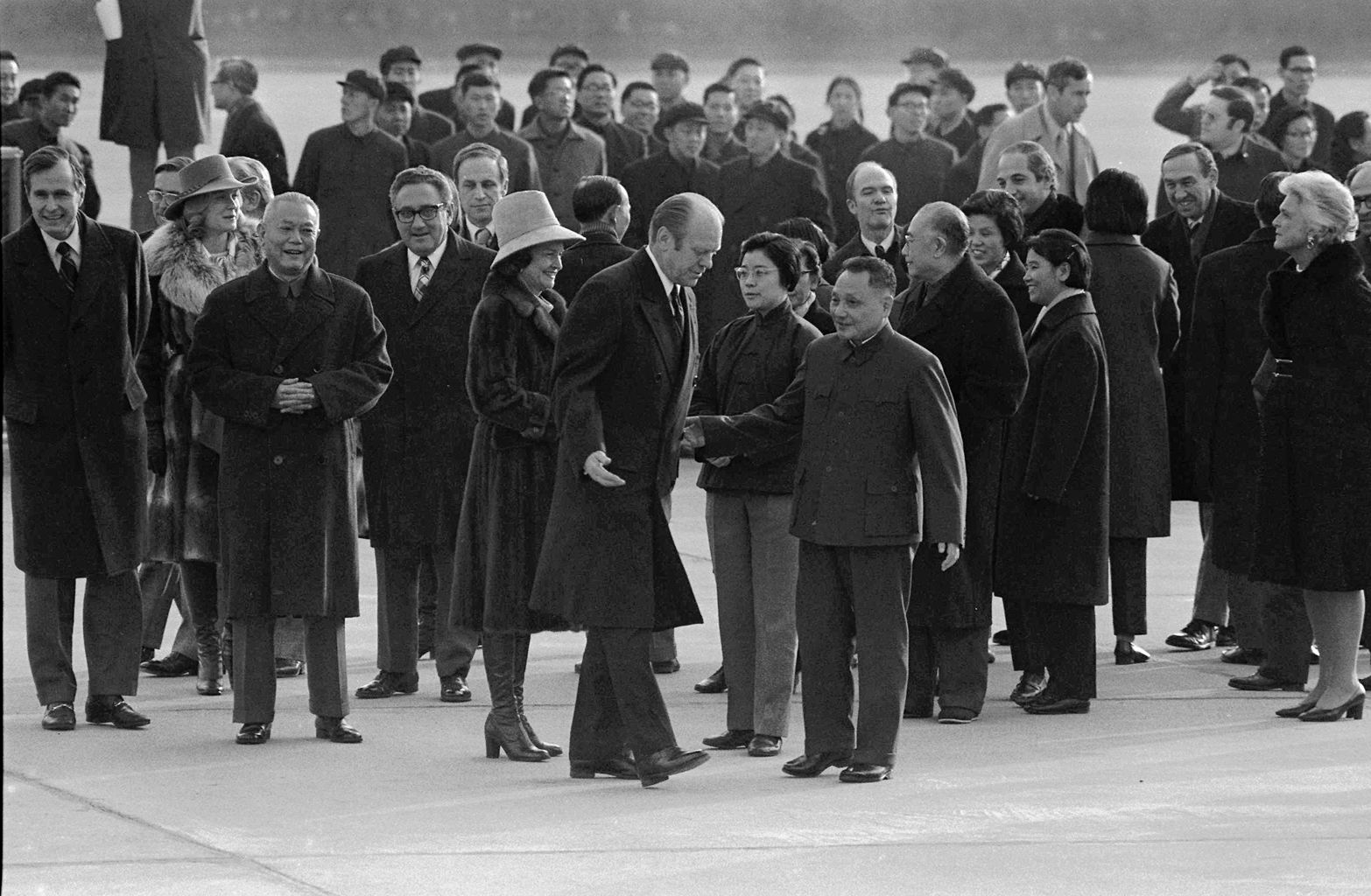
WHOLE DUDE - WHOLE SIN : December 01, 1975. President Gerald Ford with Deng Xiaoping in Beijing. George Herbert Walker Bush who later became CIA's Director on January 30, 1976 is also seen in this photo. Both President Ford and George Bush were fully aware of America's partnership with India, and Tibet to fight the military threat posed by Communism.
WHOLE DUDE REPORTS WHOLE SIN: December 01, 1975. President Gerald Ford with  China’s Communist leader Deng Xiaoping in Beijing. George Herbert Walker Bush who later became CIA’s Director on January 30, 1976 is also seen in this photo. Both President Ford and George Bush were fully aware of America’s partnership with India, and Tibet to fight the military threat posed by Communism.
Whole Dude - Whole Sin
Whole Dude Reports Whole Sin: January 30, 1979. The White House Ceremony. President James Earl Carter (39th president of the US 1977-1981) with Chinese Communist Party leader Teng Hsiao Ping. Does the Declaration of Independence envisage friendly relations with the Communists?
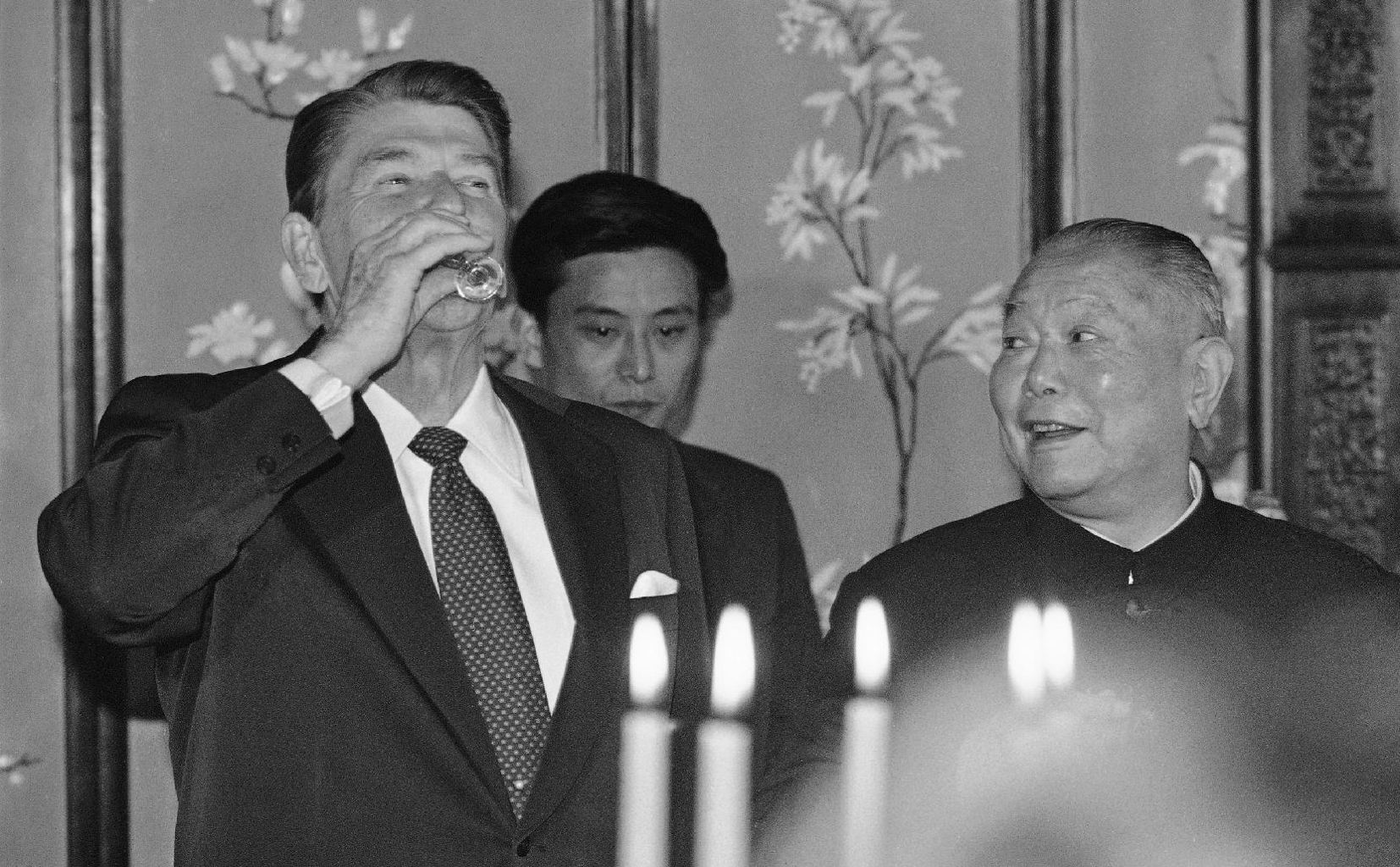
Whole Dude-Whole Sin-April 26-1984-President Li Xiannian-President Ronald Reagan-Peking
Whole Dude Reports Whole Sin: April 26, 1984. President Ronald Wilson Reagan (40th president of the US 1981-1989) with China’s Communist Party leader and President Li Xiannian. President Reagan, who demanded the tearing down of the ‘Berlin Wall’, could not be a friend of the Communists.
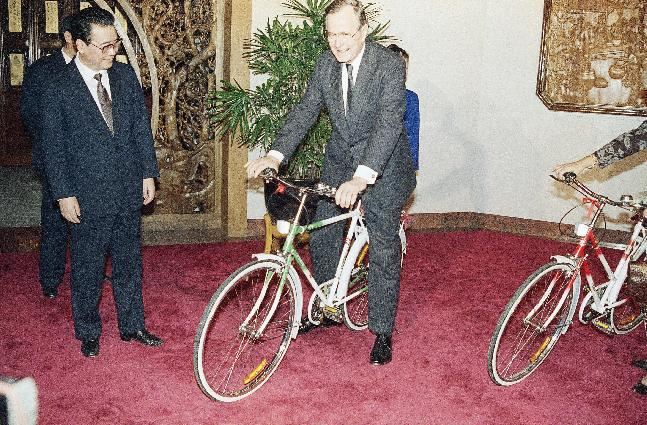
Whole Dude -Whole Sin
Whole Dude Reports Whole Sin: February 25, 1989. President George Herbert Walker Bush (41st president of the US 1989-1993) riding the bike given by China’s Communist Party leader, Premier Li Pang in Beijing. President Bush who had earlier served as the Director of CIA is fully aware of the US military alliance/pact with India, and Tibet to face the military threat posed by Communist China’s occupation of Tibet since 1950.
Whole Dude - Whole Sin-June 27 1998
Whole Dude Reports Whole Sin: June 27, 1998. President William Jefferson Clinton (42nd president of the US 1993-2001) with China’s Communist Party leader and Premier Li Peng in Beijing. A willingness to serve the Enemy.
Whole Dude - Whole Sin
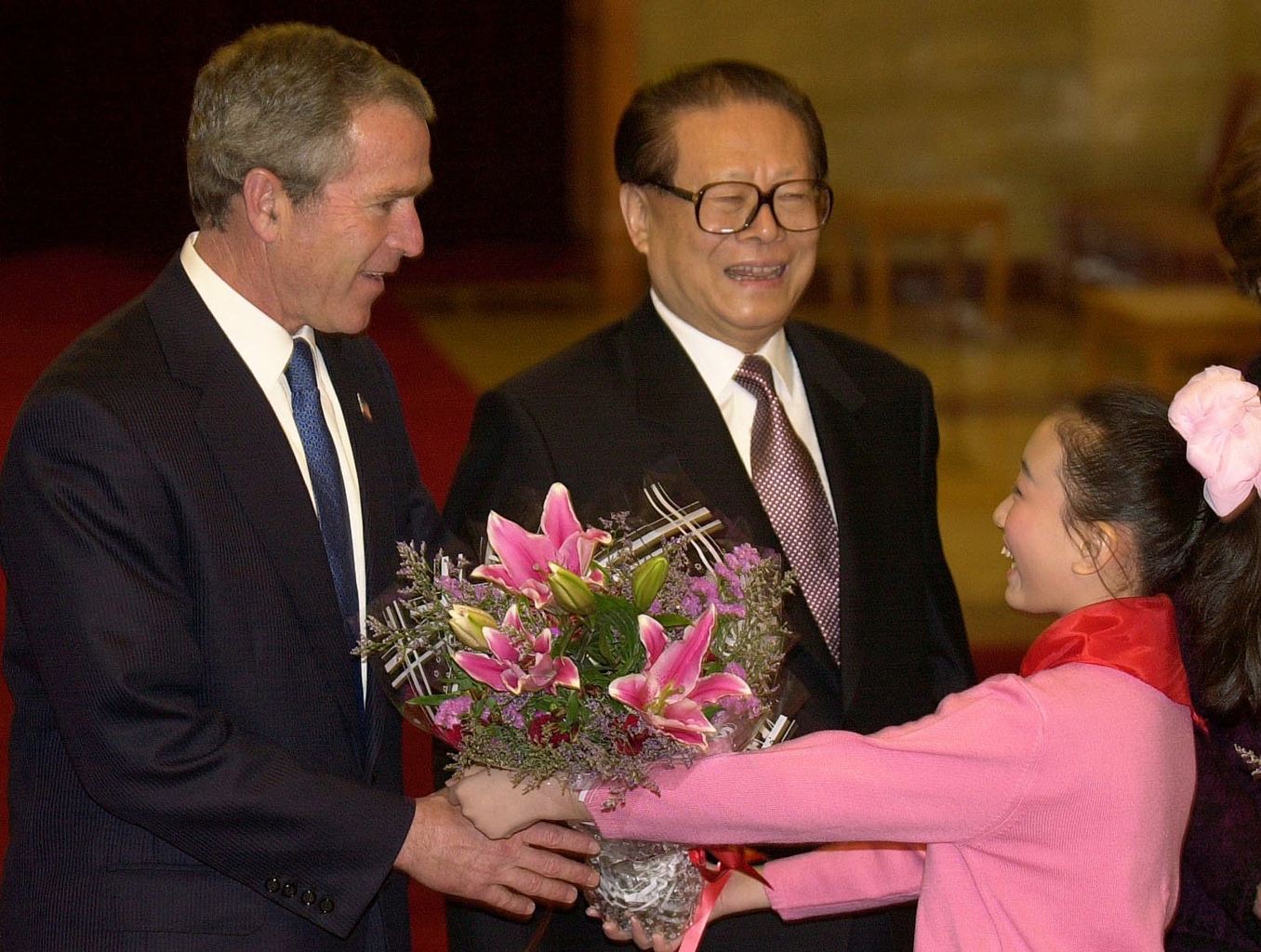
Whole Dude Reports Whole Sin: February 21, 2002. President George W. Bush (43rd president of the US) with China’s Communist Party leader, President Jiang Zemin in Beijing. Communist China’s lack of respect for Human Rights should deter the United States from pursuing this path of self-destruction.
Whole Dude - Whole Sin
Whole Dude Reports Whole Sin: Friday, June 07, 2013. President Barack Obama with China’s Communist Party leader and President Xi Jinping. The prophesy predicted in the Book of Deuteronomy, Chapter 28, verses 47-50 is coming true.
Whole Dude - Whole Sin
Whole Dude Reports Whole Sin: Saturday, June 08, 2013. Rancho Mirage, California. President Barack Obama with China’s Communist Party leader, President Jiang Zemin. The word ‘Mirage’ describes an Optical Illusion, something that falsely appears to be real. American Citizens have to wake up to the reality of the Enemy who has arrived on their shores from a distant land. (The Book of Deuteronomy, Chapter 28, verses 47-50)

The Supreme Law of the United States of America is called The Constitution of The United States of America. The Constitution was preceded by The Declaration of Independence, the written document that pronounced the creation of the nation called The United States of America. I am respectfully claiming that the elected representatives and other officials that constitute the Government have transgressed the Laws of the nation when they began the unholy relationship with Communist China which is opposed to Human Freedom, and the principle of governance by Social Contract called Democracy.

Whole Dude Reports Whole Sin: The Original Sin of Nixon-Kissinger

Whole Evil – Red China’s Never Ending Saga of Cultural Genocide in Tibet

CULTURAL REVOLUTION: THE CRIMES AGAINST HUMANITY

The Government of China and it’s Communist Party committed numerous Crimes against Humanity in the name of the Cultural Revolution.

I ask the US citizens to demand the investigation of President Nixon’s Foreign Policy that initiated the US-China relations in 1971-72 without concern for the Crimes Against Humanity described by Communist China as ‘Cultural Revolution’. The Never Ending Saga of Cultural Genocide in Tibet remains as the most important threat to Tibetan National Identity and Tibetan Existence.

Whole Evil – Red China’s Never Ending Saga of Cultural Genocide in Tibet
Cultural Revolution was designed by Mao Zedong to preserve true Communist ideology by removing capitalist and traditional elements from society in China. Was a move to recover political power by Mao. The movement insisted that revisionists, people in China who promoted capitalism, had to be removed through violent class struggle. Red Guard was a movement of Chinese Youth to perpetuate these goals. Millions of people were persecuted, cultural icons were destroyed, religious sites were ransacked.

Cultural Revolution – HISTORY

Whole Evil: The Never Ending Saga of Cultural Genocide in Occupied Tibet.

Clipped from: https://www.history.com/topics/china/cultural-revolution

In 1966, China’s Communist leader Mao Zedong launched what became known as the Cultural Revolution in order to reassert his authority over the Chinese government. Believing that current Communist leaders were taking the party, and China itself, in the wrong direction, Mao called on the nation’s youth to purge the “impure” elements of Chinese society and revive the revolutionary spirit that had led to victory in the civil war 20 decades earlier and the formation of the People’s Republic of China. The Cultural Revolution continued in various phases until Mao’s death in 1976, and its tormented and violent legacy would resonate in Chinese politics and society for decades to come.

The Cultural Revolution Begins 

In the 1960s, Chinese Communist Party leader Mao Zedong came to feel that the current party leadership in China, as in the Soviet Union, was moving too far in a revisionist direction, with an emphasis on expertise rather than on ideological purity. Mao’s own position in government had weakened after the failure of his “Great Leap Forward” (1958-60) and the economic crisis that followed. Mao gathered a group of radicals, including his wife Jiang Qing and defense minister Lin Biao, to help him attack current party leadership and reassert his authority.

Mao launched the so-called Cultural Revolution (known in full as the Proletarian Cultural Revolution) in August 1966, at a meeting of the Plenum of the Central Committee. He shut down the nation’s schools, calling for a massive youth mobilization to take current party leaders to task for their embrace of bourgeois values and lack of revolutionary spirit. In the months that followed, the movement escalated quickly as the students formed paramilitary groups called the Red Guards and attacked and harassed members of China’s elderly and intellectual population. A personality cult quickly sprang up around Mao, similar to that which existed for Josef Stalin, with different factions of the movement claiming the true interpretation of Maoist thought.

Lin Biao’s Role in the Cultural Revolution

WHOLE VILLAIN: Defense Minister and Communist Party Vice Chairman, the successor of Chairman Mao Tsetung was apparently assassinated by Prime Minister Chou En-lai and Chairman Mao Tsetung on September 13, 1971, as he tried to escape from the country. After his killing, most of the People’s Liberation Army’s Generals of high command were purged. It totally amazes me to know that the US National Security Adviser Henry Kissinger would request Prime Minister Chou En-Lai to launch a military attack on India during that time to stop India from taking military action to resolve the humanitarian crisis in East Pakistan.

 During this early phase of the Cultural Revolution (1966-68), President Liu Shaoqi and other Communist leaders were removed from power. (Beaten and imprisoned, Liu died in prison in 1969.) With different factions of the Red Guard movement battling for dominance, many Chinese cities reached the brink of anarchy by September 1967, when Mao had Lin send army troops in to restore order. The army soon forced many urban members of the Red Guards into rural areas, where the movement declined. Amid the chaos, the Chinese economy plummeted, with industrial production for 1968 dropping 12 percent below that of 1966.

In 1969, Lin was officially designated Mao’s successor. He soon used the excuse of border clashes with Soviet troops to institute martial law. Disturbed by Lin’s premature power grab, Mao began to maneuver against him with the help of Zhou Enlai, China’s premier, splitting the ranks of power atop the Chinese government. In September 1971, Lin died in an airplane crash in Mongolia, apparently while attempting to escape to the Soviet Union. Members of his high military command were subsequently purged, and Zhou took over greater control of the government. Lin’s brutal end led many Chinese citizens to feel disillusioned over the course of Mao’s high-minded “revolution,” which seemed to have dissolved in favor of ordinary power struggles.

Cultural Revolution Comes to an End 

Tibet Consciousness – Undying Hope for Freedom. US President Richard M Nixon can be best described as Backstabber of Tibet.

Zhou acted to stabilize China by reviving the educational system and restoring numerous former officials to power. In 1972, however, Mao suffered a stroke; in the same year, Zhou learned he had cancer. The two leaders threw their support to Deng Xiaoping (who had been purged during the first phase of the Cultural Revolution), a development opposed by the more radical Jiang and her allies, who became known as the Gang of Four. In the next several years, Chinese politics teetered between the two sides. The radicals finally convinced Mao to purge Deng in April 1976, a few months after Zhou’s death, but after Mao died that September, a civil, police and military coalition pushed the Gang of Four out. Deng regained power in 1977 and would maintain control over the Chinese government for the next 20 years.

Some 1.5 million people were killed during the Cultural Revolution, and millions of others suffered imprisonment, seizure of property, torture or general humiliation. The Cultural Revolution’s short-term effects may have been felt mainly in China’s cities, but its long-term effects would impact the entire country for decades to come. Mao’s large-scale attack on the party and system he had created would eventually produce a result opposite to what he intended, leading many Chinese to lose faith in their government altogether.

Whole Villain – Original Sin: The mockery of the US Constitution. The US National Security Adviser, Dr. Henry A.Kissinger misused and abused his official position to meet foreign Heads of State to develop US foreign relations without the participation of the US Secretary of State. I call this villainous act as Original Sin. Both Chairman Mao Tsetung and Prime Minister Chou En-Lai were leaders of the “Cultural Revolution” during 1966-69 to unleash crimes against humanity.
Whole Evil – Red China’s Never Ending Saga of Cultural Genocide in Tibet. THE SUBJUGATION OF TIBET: RED CHINA’S ILLEGAL, AND UNJUST OCCUPATION OF TIBET IS A CRIME AGAINST HUMANITY.

Whole Liar -Red China a Liar

Tibet Awareness: Red China, a Liar

Tibet Awareness. Red China, a Liar. Red China has no justification for her Tyranny, Oppression, and Suppression of Tibetan Freedom.

Red China’s military invasion and occupation of Tibet is illegal, and it has nothing to do with the Tibetan Institution of Governance called the Dalai Lama. Red China has no justification for her Tyranny, Oppression, and Suppression of Tibetan Freedom.

Tibet Awareness. Red China, a Liar. Red China has no justification for her Tyranny, Oppression, and Suppression of Tibetan Freedom.

China denies Tibet support for Dalai Lama | Daily Mail Online

Clipped from: https://www.dailymail.co.uk/wires/afp/article-6777709/China-denies-Tibet-support-Dalai-Lama.html

Tibet Awareness. Red China, a Liar. Red China has no justification for her Tyranny, Oppression, and Suppression of Tibetan Freedom.

There is no widespread support for the Dalai Lama in Tibet and ordinary people are grateful to the Communist Party for “bringing them a happy life”, Chinese officials insisted Wednesday.

This week marks the 60th anniversary of a failed uprising which led to Tibet’s Buddhist spiritual leader, the Dalai Lama, fleeing into exile in India.

Beijing — which claims it “peacefully liberated” the Himalayan area — stands accused of political and religious repression in the region.

But China insists that Tibetans enjoy extensive freedoms and argues it has brought economic growth.

“Since defecting, the Dalai Lama has not done a single good thing for the Tibetan people,” Tibet party boss Wu Yingjie said during a meeting at the sidelines of China’s annual parliamentary meeting.

“Tibetan people have gratitude in their hearts. They are grateful to the Communist Party for bringing them a happy life.”

At least 150 Tibetans have set themselves on fire since 2009 to protest Beijing’s presence in Tibet, most of whom have died from their injuries.

Tibet Awareness. Red China, a Liar. Red China has no justification for her Tyranny, Oppression, and Suppression of Tibetan Freedom.

China had reached out to the Dalai Lama in 2002 to negotiate but after nine rounds of dialogue that lasted through till 2010, many believed that Beijing was intentionally dragging on pointless talks, hoping international pressure over Tibet would end with the passing of the Dalai Lama.

At 83, the Nobel Peace Prize winner enjoys rapturous crowds around the world.

Many Tibetan Buddhists fear Beijing may seek to impose their choice of spiritual leader after the Dalai Lama’s death.

It is unclear how, or even whether, his successor will be named — the centuries-old practice requires senior monks to interview sometimes hundreds of young boys to see whether they recognize items that belonged to the Dalai Lama and pick one as a reincarnation.

But the 14th Dalai Lama announced in 2011 that he may be the last, seeking to preempt any attempt by China to name its own successor.

China’s officially atheist Communist Party has repeatedly said it has the right to control the process of reincarnation.

Tibet Awareness. Red China, a Liar. Red China has no justification for her Tyranny, Oppression, and Suppression of Tibetan Freedom.


ICE-BREAKING OR HEART-BREAKING? NIXON’S HISTORIC 1972 TRIP TO PEKING

ICE-BREAKING OR HEART-BREAKING? NIXON’S HISTORIC 1972 TRIP TO PEKING

Ice-Breaking or Heart-Breaking? President Nixon’s historic 1972 trip to Peking. Nixon’s Peking Deal breaks the heart of Tibet Nation.

The Richard Nixon Foundation may celebrate the 40th Anniversary of the establishment of diplomatic relations between the US and China. I characterize this 1972 “ice-breaking” trip as “Heart-Breaking.” President Nixon shook hands with Chairman Mao Zedong with his right hand while backstabbing Tibet with his left hand.

Rudranarasimham Rebbapragada

SPECIAL FRONTIER FORCE

Ice-Breaking or Heart-Breaking? President Nixon’s historic 1972 trip to Peking. Deal-Making while Backstabbing Tibet.

Nixon’s historic 1972 trip to China was ‘ice-breaking’

By LIU YINMENG in Yorba Linda, California | China Daily USA | Updated: 2019-01-15 23:28

“ICE-BREAKING OR HEART-BREAKING?” PRESIDENT NIXON’S HISTORIC 1972 TRIP TO PEKING HIDES A PAINFUL TRUTH, THE BACKSTABBING OF TIBET.

President Richard Nixon and Premier Zhou Enlai greet a young girl at Hangzhou West Lake Park in China on Feb 26, 1972. photo provided by Nixon Library

The Richard Nixon Foundation was a fitting place to celebrate the 40th anniversary of the establishment of diplomatic relations between China and the United States.

An elaborate dinner was held on Sunday at the foundation, the resting place of the American president whose “ice-breaking” trip to China in 1972 opened a significant chapter in the history of the two countries.

Elected officials, representatives of the Chinese Consulate General in Los Angeles, Chinese-American leaders, musicians and business leaders who participated called for goodwill and mutual understanding at a crucial juncture in the Sino-American relationship.

“For many years, Southern California has been running at the forefront in leading US-China subnational exchange and cooperation. It provides a good example of the mutually beneficial nature of our relations,” said Zhang Ping, Chinese consul general in Los Angeles.

He said the fact that President Xi Jinping and US President Donald Trump had reached an important consensus during their meeting at the G20 on Dec 1 is encouraging, and “it’s important that we make concerted efforts to implement their consensus”.

“As we look at the journey that bilateral relations have gone through, we are gratifying to see that our people are always standing behind the relationship,” Zhang said.

The event, co-hosted by the Roundtable of Chinese-American Organizations and the Richard Nixon Foundation, was attended by around 450 people.

The commemorative event kicked off with an “East Meets West” concert that included the national anthems of China and the US performed by the Orange County Music and Dance School.

Attendees also enjoyed performances by soprano Feng Wei and pianist Bai Chao Lan, as well as a selection of songs played by the Orange County-based Pacific Symphony, which made its debut tour in China in May.

Foundation President William Baribault called Nixon’s opening with China a “truly transformational foreign policy”.

“Because of President Nixon’s long and deep reading and understanding of history, he knew that China was a great power, and from his long and deep practice and understanding of statecraft, he knew that a truly stable, secure, prosperous and peaceful world requires the inclusion of all great powers at the table,” Baribault said.

Nixon’s 1972 trip, which he dubbed “the week that changed the world”, marked the first time a US president set foot in China.

It led to the issuance of the Shanghai Communiqué at the end of the trip and the signing of accords between US president Jimmy Carter and Chinese vice- premier Deng Xiaoping in 1979, which formally established US-China diplomatic ties.

“His weeklong tour is one of the world’s most significant diplomatic milestones in the 20th century that has a lasting impact on our future,” said Guo Song, chairwoman of the Roundtable of Chinese-American Organizations.

She said Chinese Americans abroad, who have experienced up close the ups and downs of the relationship, treasured the deep and everlasting friendships between the US and China.

Contact the writer at teresaliu@chinadailyusa.com

To accomplish this historic mission, the US President backstabbed Tibet.

AMAZING TIBET – BRUTAL MILITARY OCCUPATION

AMAZING TIBET – BRUTAL MILITARY OCCUPATION

AMAZING TIBET. BRUTAL MILITARY OCCUPATION.

I am not a photographer, but my heart captures the brutality of Tibet’s military occupation without the use of any lens.

Rudranarasimham Rebbapragada

SPECIAL FRONTIER FORCE

AMAZING TIBET – PHOTOS SHOT BY XINHUA PHOTOGRAPHERS

AMAZING TIBET. BRUTAL MILITARY OCCUPATION.

The aerial photo was taken on March 4, 2018, shows a newly-built bridge across the Lhasa River, a tributary of the Yarlung Zangbo River, Tibet. Amazing shots of Tibet in 2018 are seen through lenses of Xinhua photographers. (Xinhua/Jigme Dorje)

AMAZING TIBET. BRUTAL MILITARY OCCUPATION.

An archer shoots on horseback in an equestrian event in Jiangjiao Village of Lhasa, capital of Tibet, Feb. 25, 2018. Amazing shots of Tibet in 2018 are seen through lenses of Xinhua photographers. (Xinhua/Jigme Dorje)

AMAZING TIBET. BRUTAL MILITARY OCCUPATION.

The photo was taken on Jan. 6, 2018 shows red deer in a forest of the nature reserve in Shannan City, Tibet. Amazing shots of Tibet in 2018 are seen through lenses of Xinhua photographers. (Xinhua/Zhang Rufeng)

AMAZING TIBET. BRUTAL MILITARY OCCUPATION.

A woman carrying forage grass on her back is seen with her daughter in Dingri County in Xigaze, Tibet, Sept. 13, 2018. Amazing shots of Tibet in 2018 are seen through lenses of Xinhua photographers. (Xinhua/Purbu Zhaxi)

AMAZING TIBET. BRUTAL MILITARY OCCUPATION.

Tourists walk into the Potala Palace in Lhasa, Tibet, Nov. 15, 2018. Amazing shots of Tibet in 2018 are seen through lenses of Xinhua photographers. (Xinhua/Purbu Zhaxi)

A woman looks after her child during the break of mowing on a pasture in Damxung County, Tibet, Oct. 2, 2018. Amazing shots of Tibet in 2018 are seen through lenses of Xinhua photographers. (Xinhua/Purbu Zhaxi)

An aerial photo shows the snow-covered Potala Palace in Lhasa, capital of Tibet, Dec. 19, 2018. Amazing shots of Tibet in 2018 are seen through lenses of Xinhua photographers. (Xinhua/Purbu Zhaxi)

Buddhists and tourists participate in the sacred “sunning of the Buddha” ceremony to mark the start of the annual Shoton festival at the Zhaibung Monastery in Lhasa, capital of Tibet, Aug. 11, 2018. Amazing shots of Tibet in 2018 are seen through lenses of Xinhua photographers. (Xinhua/Purbu Zhaxi)

The aerial photo was taken on March 10, 2018 shows a black-necked crane in Linzhou County,Tibet. Amazing shots of Tibet in 2018 are seen through lenses of Xinhua photographers. (Xinhua/Purbu Zhaxi)

Photo taken on Sept. 11, 2018, shows the starry sky in Ngari, Tibet. The Ngari area has an average altitude of over 4,000 meters above sea level. Amazing shots of Tibet in 2018 are seen through lenses of Xinhua photographers. (Xinhua/)

Photo taken on March 30, 2018, shows the Potala Palace after a snowfall in Lhasa, Tibet. Amazing shots of Tibet in 2018 are seen through lenses of Xinhua photographers. (Xinhua/Chogo)

Wild monkeys cling to a car along the Provincial Highway No. 306 at Gyaca County, Tibet, April 23, 2018. Amazing shots of Tibet in 2018 are seen through lenses of Xinhua photographers. (Xinhua/Jigme Dorgi)

A monk is seen during the butter lamps lighting event at the Jokhang Temple in Lhasa, Tibet, Dec. 2, 2018. Amazing shots of Tibet in 2018 are seen through lenses of Xinhua photographers. (Xinhua/)

Aerial photo taken on May 27, 2018, shows the scenery of the Yamdrok Lake in Nagarze County of Shannan City, Tibet. Amazing shots of Tibet in 2018 are seen through lenses of Xinhua photographers. (Xinhua/Jigme Dorgi)

People enjoy “lingka”, meaning leisure time in woods, in the outskirts of Lhasa, Tibet, Aug. 4, 2018. Amazing shots of Tibet in 2018 are seen through lenses of Xinhua photographers. (Xinhua/Liu Jie)

A model presents a creation during a folk costume show at the 5,200-meter-high base camp of the world’s highest peak Qomolangma, in Tibet, Aug. 18, 2018. Amazing shots of Tibet in 2018 are seen through lenses of Xinhua photographers. (Xinhua/Liu Dongjun)

Photo taken on Nov. 7, 2018 shows a roof decoration of the Potala Palace in Lhasa, capital of southwest China’s Tibet Autonomous Region. The golden roofs of the Potala Palace shine in glory after more than 18 months of renovation work. Amazing shots of Tibet in 2018 are seen through lenses of Xinhua photographers. (Xinhua/Purbu Zhaxi)

Photo taken on Sept. 8, 2018, shows sand dunes near the source of the Yarlung Zangbo River in Zhongba County of Xigaze, Tibet. Amazing shots of Tibet in 2018 are seen through lenses of Xinhua photographers. (Xinhua/)

A cyclist rides during a cycling race around the holy lake Mapham Yutso in Pulan County of Ngari Prefecture, Tibet, Sept. 9, 2018. Amazing shots of Tibet in 2018 are seen through lenses of Xinhua photographers. (Xinhua/Purbu Zhaxi)

Rigzin, 49, smiles while grazing a flock of sheep in Rungma Town of Nyima County, Tibet, June 14, 2018. Rigzin and his family are to be relocated to a new home in Lhasa. Amazing shots of Tibet in 2018 are seen through lenses of Xinhua photographers. (Xinhua/Chogo)

AMAZING TIBET. BRUTAL MILITARY OCCUPATION.


NEW REPORT ON TIBET – ONCE BITTEN TWICE SHY

NEW REPORT ON TIBET – ONCE BITTEN, TWICE SHY

New Report on Tibet – Once Bitten, Twice Shy

The Department of Information and International Relations (DIIR) of Central Tibetan Administration (CTA) released a new report on Tibet titled ‘Tibet Was not Part of China But Middle Way Remains a Viable Solution’.

New Report on Tibet – Once Bitten, Twice Shy. Tibet’s attempt to secure meaningful autonomy on May 23, 1951, was disastrous.

But, we tried this Middle Way Approach on May 23, 1951, with disastrous consequences. As the saying goes, “Once Bitten, Twice Shy” Tibet cannot afford to bite the Bullet twice. Communist China insists that she has the right to control the Reincarnation of the Dalai Lama. The discussion about ‘Meaningful Autonomy’ has become redundant for Chinese Colonization of Tibet includes total Subjugation of all Social and Political Institutions of Tibet that give “Meaning” to Tibetan Identity.

Rudranarasimham Rebbapragada

SPECIAL FRONTIER FORCE

https://wholedude.com/2015/06/09/the-evil-red-empire-red-china-subjugator-of-tibet/
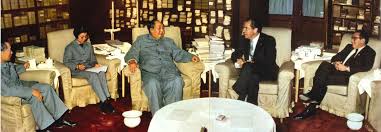
New report on Tibet highlights self-immolations, reincarnation of Dalai Lama

Clipped from: https://www.newkerala.com/news/read/63436/new-report-on-tibet-highlights-self-immolations-reincarnation-of-dalai-lama.html

Oct 31, 2018

IANS

New Report on Tibet – Once Bitten, Twice Shy.

New Delhi, Oct 30: From incidents of self-immolations, human rights, cultural genocide to the history of Tibet’s status and reincarnation of His Holiness the Dalai Lama — a new report released on Tuesday highlights the contemporary and prevalent issues faced by Tibet.

The report titled ‘Tibet Was Never A Part Of China But The Middle Way Approach Remains a Viable Solution’ was launched by the Department of Information and International Relations (DIIR) of Central Tibetan Administration (CTA).

The report, organized into nine chapters, covers self-immolations, human rights, cultural genocide, the history of Tibet’s status, the environment, urbanization, economic development, the reincarnation of His Holiness the Dalai Lama, and the Middle Way Policy.

“The chapters aim to be comprehensive but digestible. Given that each topic could be a book of its own, the report serves as an overview of the most pressing issues in Tibet for those involved with or interested in the Tibetan cause,” DIIR’s Information Secretary Dhardon Sharling said during the launch of the report.

Published in Tibetan, English and Chinese languages, the report was unveiled by Prof. Anand Kumar and Dr Lobsang Sangay, President, Central Tibetan Administration here.

“For Tibetans, information is a precious commodity. Severe restrictions on expression accompanied by a relentless disinformation campaign engender facts, knowledge and truth to become priceless. This has long been the case with Tibet. This report marks the CTA’s current contribution to this effort,” said CTA President Dr Lobsang Sangay.

New Report on Tibet – Once Bitten, Twice Shy.


Whole Awareness – Colonization of Tibet poses risks to all living downstream

Colonization of Tibet poses risks to all living downstream

Colonization of Tibet poses risks to all living Downstream.

The major rivers of Asia take origin in Tibet. People living downstream are facing increasing risks as the rivers are drying up due to Communist China’s colonization of Tibet.

Colonization of Tibet poses risks to all living Downstream.

Arunachal Pradesh: Authorities warn of flash floods in East Siang as landslide blocks river in Tibet

Clipped from: https://scroll.in/latest/898863/arunachal-pradesh-authorities-warn-of-flash-floods-in-east-siang-as-landslide-blocks-river-in-tibet

Over 6,000 people were evacuated from Tibet’s Menling County after the landslide led to the formation of a barrier lake.

Colonization of Tibet poses risks to all living Downstream.

Sections of the Siang river in Arunachal Pradesh dried up due to landslide upstream | HT photo

The Arunachal Pradesh government has warned of flash floods downstream of the Siang River after China informed India that a landslide has blocked a section of the river in the Tibet region, The Times of India reported on Friday.

The Yarlung Tsangpo is the upper stream of the Brahmaputra river. It is known as the Siang river once it enters Arunachal Pradesh and the Brahmaputra when it enters Assam.

The East Siang district administration has asked people not to venture near the Siang river and asked them to stay alert. The water level in the Siang river has reduced due to the landslide blocking the flow of water. The landslide has led to the formation of a lake and there are fears of large-scale floods downstream if the lake breaches, reported the Hindustan Times.

“We got a report from the Central Water Commission about the landslide in Tibet,” said Deputy Commissioner of Upper Siang district Duly Kamduk. “The water level in Siang river has gone down by around 2 meters at Tuting in Arunachal Pradesh.”

A statement issued by the East Siang district administration asked people living on the banks of the river in Jarku, Paglek, SS Mission, Jarkong, Banskota, Berung, Jampani, Sigar, Ralling, Borguli, Seram, Kongkul, Namsing, Mer, Gadum not to remove driftwood, tree barks on the banks of the river as these will serve as a natural flood control mechanism, reported Northeast Today.

Meanwhile, in China, over 6,000 people were evacuated after a barrier lake was formed following the landslide in the Yarlung Tsangpo River in Tibet’s Menling County, reported Xinhua. The amount of water in the lake is above 300 million cubic meters.

In August, several people were airlifted from Assam’s Dhemaji district as Siang river got flooded due to heavy rainfall in the Chinese portion.

Colonization of Tibet poses risks to all living Downstream.
Colonization of Tibet poses risks to all living Downstream