Whole Alert – Red China’s Policy of Brinkmanship

Red China – Red Alert – The policy of Brinkmanship

RED DRAGON - RED CHINA - RED ALERT - BRINKMANSHIP - MILITARY DOMINANCE : AN IMMINENT THREAT TO PEACE AND SECURITY OF ALL NATIONS.
RED DRAGON – RED CHINA – RED ALERT – BRINKMANSHIP – MILITARY DOMINANCE : AN IMMINENT THREAT TO PEACE AND SECURITY OF ALL NATIONS.

The term ‘brink’ means the edge, especially at the top of a steep place. Very often ‘brink’ is used figuratively such as “At the brink of War.” Brinkmanship refers to the policy of pursuing a hazardous course of action to the brink of catastrophe. Red China’s Policy of Economic Expansionism draws support from her Policy of Military Expansionism. Red China’s pursuit of world’s territories, and natural resources is accompanied by her aggressive expansion of political influence over other nations to cause nations to become subservient to Red China’s ambitions. Red China’s Policy of ‘Brinkmanship’ has to be exposed, has to be effectively contained and has to be resisted at every place apart from South China Sea where the dispute is receiving attention of news media.

5 MILLION REASONS CHINA MAY BE DRAWN INTO GLOBAL CONFLICTS

By DAVID TWEED

BLOOMBERG

With five million offshore citizens to protect and billions of investment dollars at stake, China is rethinking its policy of keeping out of other countries’ affairs.

China has long made loans conditional on contracts for its companies. In recent years it has sent an army of its nationals to work on pipelines, roads and dams in such hot spots as South Sudan, Yemen and Pakistan. Increasingly, it has to go across borders to protect or rescue them.

That makes it harder to stick to the policy espoused by then-premier Zhou Enlai in 1955 of not interfering in “internal” matters, something that has seen China decline to back international sanctions against Russia over Ukraine or the regime of Syrian President Bashar al-Assad.

As President Xi Jinping’s “Silk Road” program of trade routes gets under way, with infrastructure projects planned across Central Asia, the Indian Ocean and the Middle East to Europe, China’s footprint abroad will expand from the $108 billion that firms invested abroad in 2013, up from less than $3 billion a decade earlier.

That is forcing China to take a more proactive approach to securing its interests and the safety of its people. With more engagement abroad there’s a risk that China, an emerging power with a military to match, is sucked into conflicts and runs up against the U.S. when tensions are already flaring over China’s disputed claims in the South China Sea.

“It is going to be a long, hard haul,” said Kerry Brown, director of the University of Sydney’s China Studies Centre. “You either have disruption as a new power rips up the rule book and causes bedlam or you’ve got a gradual transition where China is ceded more space but also expected to have more responsibility.”
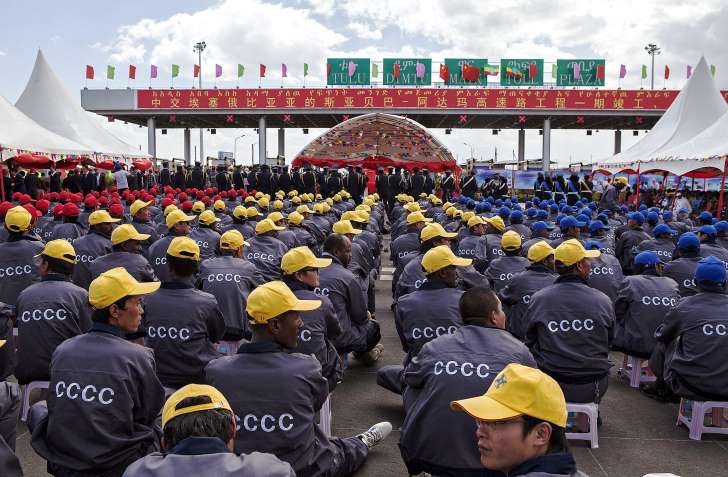
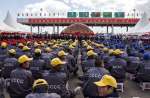
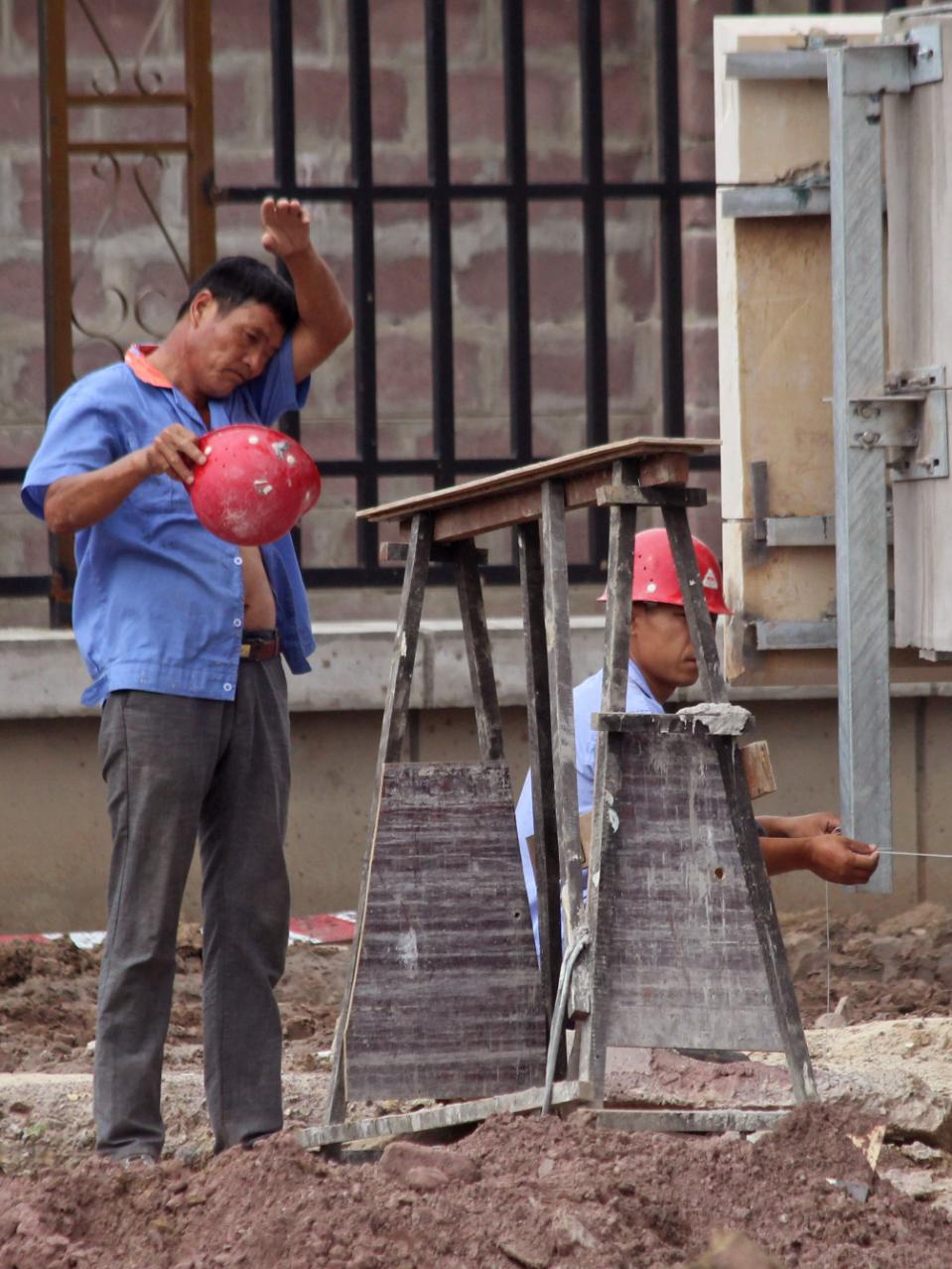
RED CHINA - RED ALERT - BRINKMANSHIP : RED CHINA IS INVESTING BILLIONS OF DOLLARS AND DISPATCHING MILLIONS OF CHINESE WORKERS TO FURTHER ITS EXPANSIONIST POLICY THAT MAKES CONFLICTS WITH OTHER NATIONS INEVITABLE. IN THIS PHOTO IMAGE, ETHIOPIAN AND CHINESE CONSTRUCTION WORKERS SEEN WAITING NEAR CHINA COMMUNICATION CONSTRUCTION COMPANY BUILDING ADDIS ABABA - ADAMA TOLL ROAD.
RED CHINA – RED ALERT – BRINKMANSHIP : RED CHINA IS INVESTING BILLIONS OF DOLLARS AND DISPATCHING MILLIONS OF CHINESE WORKERS TO FURTHER ITS EXPANSIONIST POLICY THAT MAKES CONFLICTS WITH OTHER NATIONS INEVITABLE. IN THIS PHOTO IMAGE, ETHIOPIAN AND CHINESE CONSTRUCTION WORKERS SEEN WAITING NEAR CHINA COMMUNICATION CONSTRUCTION COMPANY BUILDING ADDIS ABABA – ADAMA TOLL ROAD.

© Zacharias Abuker/AFP/Getty Images Ethiopian and Chinese workers of the China Communication Construction Company sit at the site of the Addis Ababa-Adama toll road on May 5, 2014. The site was christened by Chinese Prime Minister Li Keqiang. Li arrived in Ethiopia for the start of a four-nation African tour, his first visit to the continent since assuming his position a little over a year ago.

Yemen, Myanmar

For more than a half century China stuck to Zhou’s policy predicated on non-interference and respect for the sovereignty of others. The policy partly reflected a focus on domestic stability and economic development by governments that lacked the means or interest to play a more active role offshore. It also led President Barack Obama to last year describe China’s leaders as “free riders” while others carried the global security burden.

China’s greater involvement in projects around the world comes along its military expansion, as it seeks to project its power abroad and challenge decades of U.S. dominance of the global economic and strategic order. U.S. policymakers are debating whether to find ways to accommodate China’s rise or to seek to contain it.
As China’s policy evolves its leaders are dipping their toe into areas once considered taboo, including the practice of dealing only with a country’s leaders.

Myanmar Meeting

Xi met Myanmar opposition leader Aung San Suu Kyi in Beijing on June 11 to lay the foundation for improved ties ahead of a November election in Myanmar, and there are reports China has hosted peace talks between the Afghan government and Taliban.

On June 9 China called for a cease-fire in Yemen, during a teleconference between China’s ambassador Tian Qi and the United Nations envoy to Yemen, according to a posting on the website of China’s embassy.

China sent naval vessels into Yemen’s waters in April to rescue 629 Chinese citizens and 279 foreign nationals from escalating violence, the first time the People’s Liberation Army helped other countries evacuate their citizens.

“Protection of nationals and interests abroad particularly with big new projects like the Silk Road in the works, is likely to be long-term very significant for China’s evolution as a great power,” said Jonas Parello-Plesner, a diplomat at the Danish embassy in Washington, DC. “How China behaves in other parts of world will be a litmus test on its road to great power status.”

Five Million

Chinese investment abroad picked up from 2002 after then Premier Jiang Zemin championed a “going out” policy, even as he repeated China would not meddle in the internal affairs of other countries.

Parello-Plesner and Mathieu Duchatel, who co-wrote “China’s Strong Arm: Protecting Citizens and Assets Abroad” estimate there are five million workers offshore, based on research and interviews with officials, a figure that’s about five times larger than that given by the Ministry of Commerce.

The official data reflect a lack of systemic consular registration and the absence of formal reporting by subcontractors sending workers abroad, according to Parello- Plesner and Duchatel, who estimate about 80 Chinese nationals were killed overseas between 2004 and 2014. Duchatel is a Beijing-based senior researcher at the Stockholm International Peace Research Institute.

‘Greater Range’

“There are now several countries that – in terms of the number of Chinese citizens there – are ‘too big to fail’,” said Parello-Plesner. “The business-oriented ‘going-out’ strategy now has to be squared with broader strategic calculations.”

China’s foreign-policy evolution is becoming institutionalized. The concept of protecting nationals was added to the priority list at the 18th Communist Party Congress in 2012. The PLA’s role in protecting China’s interests abroad was enshrined in the 2013 Defense White Paper for the first time.

This year’s Defense White paper went further, noting the “national security issues facing China encompass far more subjects, extend over a greater range, and cover a longer time span than at any time in the country’s history.”

“While China is not likely to publicly drop the non – interference principle what we’ll see is increasing fluctuation in how it is applied — or not applied,” said Alexander Sullivan, an associate fellow at the Center for a New American Security in Washington.

South Sudan

“The departures from this policy that we have seen thus far have been driven generally by commercial and resource interests that for one reason or another come under threat.”
Sullivan said Sudan and South Sudan have been a testing ground for China policy. After the outbreak of civil war in South Sudan, China persuaded other members of the Security Council in May last year to extend the United Nations peacekeeping mandate to South Sudan, where China National Petroleum Corp. has oilfield investments. China has sent 700 troops to join that mission.

China’s biggest overseas intervention was in Libya in 2011, when 35,000 workers were transported out at the start of the uprising against Muammar Qaddafi’s regime, mostly by air and sea.

As the trade route projects get under way, Pakistan will pose one of the biggest risks to the security of Chinese workers. The first investment of China’s $40 billion Silk Road infrastructure fund is $1.65 billion for the Karot dam on the Jhelum river in northern Pakistan.

Pakistan Force

Before announcing the project, Pakistan agreed to train a 10,000-strong security force to protect Chinese nationals building a $45 billion economic corridor from China to the deep – water port of Gwadar on the Arabian Sea. The route runs through Baluchistan, a thinly populated Pakistan province where an insurgency has killed thousands.

“Chinese foreign policy is taking a bigger role in global problem solving,” said Pang Zhongying, dean of the Institute of International Affairs at Sun Yat-sen University in Guangzhou. “The Silk Road is in essence bringing a lot of foreign policy changes but we still know little about its prospects.”

–With assistance from Kamran Haider in Islamabad and Daniel Petrie in Sydney.
 

RED DRAGON – RED CHINA – RED ALERT – BRINKMANSHIP – MILITARY DOMINANCE : AN IMMINENT THREAT TO PEACE AND SECURITY OF ALL NATIONS.

RED DRAGON – RED CHINA – RED ALERT – HEGEMONIST

RED DRAGON – RED CHINA – RED ALERT – HEGEMONIST

RED DRAGON - RED CHINA - RED ALERT - HEGEMONIST : UNITED STATES IN RECOGNITION OF RED CHINA'S HEGEMONISM MUST COUNTERACT AND CONTAIN RED CHINA'S INFLUENCE OVER HER WEAK NEIGHBORS.
RED DRAGON – RED CHINA – RED ALERT – HEGEMONIST : UNITED STATES IN RECOGNITION OF RED CHINA’S HEGEMONISM MUST COUNTERACT AND CONTAIN RED CHINA’S INFLUENCE OVER HER WEAK NEIGHBORS.

On behalf of Special Frontier Force I issuing a ‘RED ALERT’ to warn US citizens of imminent danger as United States holds three days of cabinet-level meetings with more than 400 Chinese officials. Under the wide-ranging Strategic and Economic Dialogue(S &ED)framework, eight US Cabinet Secretaries are involved in these talks and consultations with Chinese officials. The top Chinese officials meet US President Barack Obama at The White House on Wednesday, June 24, 2015.

RED DRAGON - RED CHINA - RED ALERT - HEGEMONIST : THIS SEVENTH STRATEGIC AND ECONOMIC DIALOGUE BETWEEN UNITED STATES AND CHINA MUST ADDRESS THE PROBLEM OF RED CHINA'S HEGEMONISM.
RED DRAGON – RED CHINA – RED ALERT – HEGEMONIST : THIS SEVENTH STRATEGIC AND ECONOMIC DIALOGUE BETWEEN UNITED STATES AND CHINA MUST ADDRESS THE PROBLEM OF RED CHINA’S HEGEMONISM.

The term ‘HEGEMONY’ describes dominance of one state or nation over others. Hegemonism is the Policy or Practice of a nation in aggressively expanding its influence over other nations. Red China formulated her Hegemonistic Policy in 1950 when she conquered Tibet bringing Tibetan people under her control or subjection. Red China subdued Tibetan Government and forced Tibet’s Head of State to live in exile. Red China’s Hegemonic Practice forces Tibetan people to become subservient to Peking(or Beijing). United States has to recognize Red China as “HEGEMONIST” and counteract to contain Red China’s growing political, economic, military power which she uses to expand her influence over other nations of our world.

Rudranarasimham Rebbapragada
Ann Arbor, MI 48104-4162, USA
The Spirits of Special Frontier Force

image
The Spirits of Special Frontier ForceSpecial Frontier Force is a military organization funded by United States to secure Freedom &…
View on www.facebook.com Preview by Yahoo

U.S. AND CHINA OPEN ANNUAL DIALOGUE WITH ‘CANDID, TO-THE-POINT’ TALKS

BY DAVID BRUNNNSTROM

The United States and China held “candid and to-the-point” talks at the start of three days of cabinet-level meetings aimed at managing the highly complex relationship between the world’s two biggest economies, a senior U.S. official said.

The U.S. side, led on Monday by Deputy Secretary of State Antony Blinken, reiterated U.S. concerns about China’s pursuit of territorial claims in the South China Sea, the official said.

U.S. worries about cybersecurity following massive attacks on government computers that U.S. officials have blamed on Chinese hackers would also be addressed “in very direct terms,” the official said.

red alert us and chinese flags at tiananmen square president obama beijing visit
RED DRAGON – RED CHINA – RED ALERT – HEGEMONIST: US and Chinese flags at Tiananmen Square President Obama’s Peking(Beijing) Visit.


© REUTERS/Petar Kujundzic U.S. and
Chinese national flags flutter on light post at Tiananmen Square ahead of welcoming ceremony for U.S. President Obama, in Beijing

More than 400 Chinese officials are in Washington for the annual talks under the wide-ranging Strategic and Economic Dialogue (S&ED) framework, which will involve eight U.S. cabinet secretaries.

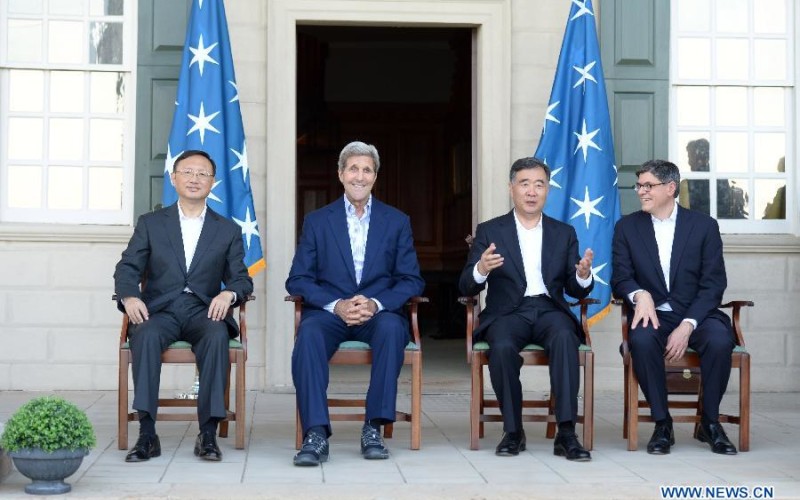
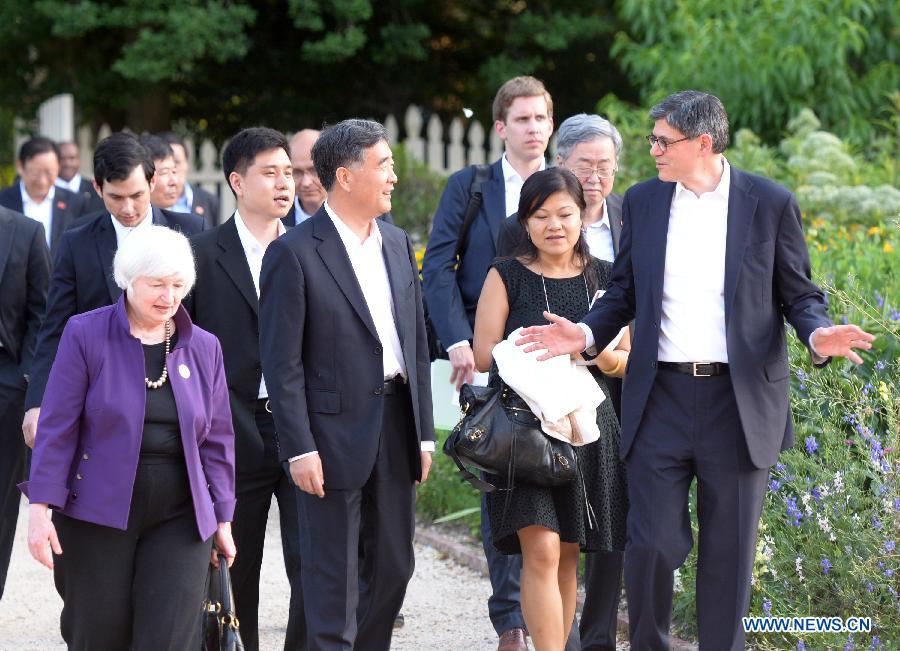
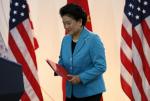
RED DRAGON - RED CHINA - RED ALERT - HEGEMONIST : RED CHINA'S VICE PREMIER WANG YANG IN MT VERNON, VIRGINIA.
RED DRAGON – RED CHINA – RED ALERT – HEGEMONIST : RED CHINA’S VICE PREMIER WANG YANG IN MT VERNON, VIRGINIA.

The meetings come at a time of waning trust and widening differences between the two countries, even though they maintain robust economic ties worth $590 billion in two-way trade last year.

U.S. concerns have been mounting about Beijing’s challenge to its dominance of global finance and about restrictions on U.S. businesses in China.

U.S. President Barack Obama is struggling to secure backing from Congress for legislation needed to speed a 12-nation trade deal, which is the economic plank of his Asia policy intended as a counterweight to China’s growing influence.

The two sides will try to ease tensions by stressing areas of cooperation, including climate change, shared concerns about Iran and North Korea’s nuclear programs, the fight against Islamist militancy, and support for global development.

“We have agreed with the Chinese that we are going to try to expand those areas where our interests overlap and expand cooperation in those areas,” the U.S. official said. But the aim was not to “paper over” contentious issues, or to “agree to disagree,” but to narrow differences to avoid miscalculations.

Despite the considerable areas of tension, China is hoping for a smooth set of meetings to prepare for a visit to Washington by President Xi Jinping in September.
Prospects for substantial outcomes from the cabinet-level meetings appeared slim, with any scant progress likely to be held over for announcement during Xi’s visit, analysts said.

The sides are expected to discuss a Bilateral Investment Treaty that has been seven years in discussion but has been held up by restrictions on both sides, while China is likely to press its bid to add the yuan to the International Monetary Fund’s basket of reserve currencies.

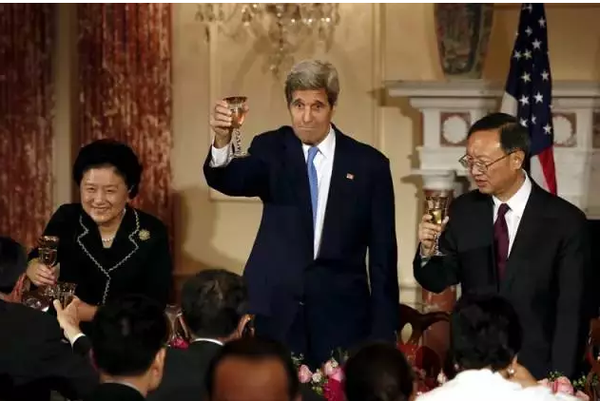
Blinken and Secretary of State John Kerry will chair the security side of the talks with State Councillor Yang Jiechi and Vice Foreign Minister Zhang Yesui on the Chinese side.

RED DRAGON - RED CHINA - RED ALERT - HEGEMONIST: BEAWARE OF RED CHINA'S HEGEMONISM.
RED DRAGON – RED CHINA – RED ALERT – HEGEMONIST: BEAWARE OF RED CHINA’S HEGEMONISM.


U.S. Treasury Secretary Jack Lew and Chinese Vice Premier Wang Yang will chair the economic elements, and the top Chinese officials will meet Obama at the White House on Wednesday.

(Reporting by David Brunnstrom; Additional reporting by Jason Lange, Krista Hughes, Anna Yukhananov, Megan Cassella and Idrees Ali in Washington and Michael Martina in Beijing; Editing by Christian Plumb)

THE EVIL RED EMPIRE – RED CHINA – LIAR

THE EVIL RED EMPIRE – RED CHINA – LIAR

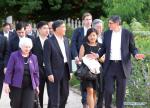
THE  EVIL  RED  EMPIRE -  RED  CHINA - LIAR :  GENERAL  FAN CHANGLONG, VICE-CHAIRMAN CENTRAL MILITARY COMMISSION, BEIJING  VISITED  PENTAGON  ON  JUNE 11, 2015.
THE EVIL RED EMPIRE – RED CHINA – LIAR : GENERAL FAN CHANGLONG, VICE-CHAIRMAN CENTRAL MILITARY COMMISSION, BEIJING VISITED PENTAGON ON JUNE 11, 2015.

Liar refers to a person who tells lies. Red China, a national entity has chosen a State Policy to conduct her affairs telling lies. The term ‘LIE’ describes a statement that one knows is false, and is especially made with intent to deceive. Red China is an habitual liar for she makes such false statements deliberately with intent to deceive her gullible neighbors. Tibet agreed to sign Seventeen Point or 17-Article Agreement for the Peaceful Liberation of Tibet on May 23, 1951 fully trusting lies, false assurances, and fraudulent promises given by Red China. Similarly, Republic of India agreed to sign ‘Panchsheel Agreement’ in 1954, fully trusting lies mouthed by Red China. The act of deception means to bring, put, or accomplish something by lying. Red China has mastered The Art of Deception and she makes statements that have characteristics such as 1. Prevaricate: to quibble or confuse the issue in order to evade the truth, 2. Equivocate: implies the deliberate use of ambiguity in order to deceive or mislead, 3. Fabricate: suggests invention of a false story, excuse, etc., intended to deceive, 4. Subterfuge: suggests an artifice or stratagem used to deceive others and to evade something, or gain some personal benefit at cost of another person or entity, and 5. Trickery: implies the use of tricks or ruses in deceiving others.

For Red China is a born Liar, she uses ‘DECEPTION’ as her State Policy and she dishonestly deprives others of their property, rights, freedom, etc.,

Rudranarasimham Rebbapragada
Ann Arbor, MI 48104-4162, USA
The Spirits of Special Frontier Force

 
  image          
The Spirits of Special Frontier ForceSpecial Frontier Force is a military organization of India, Tibet, United States to resist Red…
 
View on www.facebook.com Preview by Yahoo


PENTAGON CHIEF URGES CHINA TO STOP ISLAND BUILDING

Chinese Gen. Fan Changlong Vice Chairman of China's Central Military Commission, arrives at the Pentagon on June 11, 2015, and stands with US Secretary of Defense Secretary Ashton Carter(R) in Washington, DC
.

Chinese Gen. Fan Changlong Vice Chairman of China’s Central Military Commission, arrives at the Pentagon on June 11, 2015, and stands with US Secretary of Defense Secretary Ashton Carter(R) in Washington, DC (AFP Photo/Paul J. Richards)

Washington (AFP) – US Secretary of Defense Ashton Carter called Thursday on Beijing to stop building artificial islands in the disputed waters of the South China Sea, as he hosted a top Chinese general.

The visit to the Pentagon of General Fan Changlong, vice chairman of China’s Central Military Commission, was relatively low-key amid simmering tensions over the maritime dispute and a massive hack of US federal employees.

China insists it has sovereignty over nearly all of the South China Sea, a major global shipping route believed to be home to oil and gas reserves, but rival claimants accuse it of expansionism.

“Carter reiterated US concerns on the South China Sea and called on China and all claimants to implement a lasting halt on land reclamation, cease further militarization and pursue a peaceful resolution of territorial disputes in accordance with international law,” the Pentagon said in a statement.

Carter had previously accused China of being out of step with international rules in its conduct in the South China Sea.
Unlike previous trips, including one last year, there was no joint press conference.

“The Chinese did request that there not be a lot of media attention around this trip,” Pentagon spokesman Colonel Steven Warren said.
Also raising tensions is this month’s revelation by the US government that hackers accessed the personal data of at least four million current and former federal employees.

The vast cyberattack is suspected to have originated in China, though Beijing has said the charge was “irresponsible” and stressed that Chinese laws prohibit cybercrimes.
Prior to visiting Washington, Fan went to California and Texas.

His trip is part of a years-long effort to build a regular dialogue between the American and Chinese armed forces to defuse potential tensions and avoid miscalculations.
Carter’s predecessor, Chuck Hagel, visited China in 2014 in a trip that was marked by friction, with each side trading sharply worded criticism.

  • South China Sea
  • Ashton Carter
  • Pentagon

© 2015 AFP

Yahoo – ABC News Network

Whole Evil – Red China – Subjugator of Tibet

Red China – Subjugator of Tibet

red china subjugator occupation tibet
Red China – Subjugator of Tibet

The word “SUBJUGATE” means to bring under control, or subjection, conquer, to cause to become subservient, subdue, and to bring under yoke. Subjugation is the exact opposite of ‘Liberation’, or ‘Emancipation’. Subjugation is associated with tyranny, oppressive and unjust government, very cruel and unjust use of power or authority. Subjugation is the symptom of loss of Freedom. Red China with her military conquest of Tibet in 1950 imposed her authority with harshness, rigor, severity and uses her power in arbitrary manner using coercion. Red China is a Tyrant, one who seizes sovereignty of another nation illegally, Usurper, and a Subjugator of Tibet.

red china subjugator of tibet
Red China – Subjugator of Tibet. The 17-point Plan signed on May 23, 1951 represents a plan for Subjugation of Tibet and not of Peaceful Liberation of Tibet.

Very often, Red China makes reference to Seventeen-Point Agreement, or 17-Point Plan, or 17-Article Agreement between the Central People’s Government and the Local Government of Tibet on Measures for the Peaceful Liberation of Tibet. Five Tibetan delegates headed by Ngapoi Ngawang Jigmei and Representatives of the Central People’s Government met in Peking(Beijing) and signed an Agreement on May 23, 1951 in presence of Red China’s Vice President Zhu De, Vice President Li Jishena, and Vice-Premier Chen Yi. This 17-Point Plan promised that there should be no coercion on the part of the Central Government of China in implementing any of its measures. During the following years, 1951-1956, Tibet recognized Red China’s true ‘evil’ intentions to subject Tibetan people to her military occupation. Both Tibet, and Republic of India conducted a series of diplomatic negotiations with Red China to loosen her military grip over Tibet. By 1957, it became very apparent that Red China is using her authority to eliminate any opposition to her direct rule. Red China has taken measures to control every aspect of Tibetan Nation giving no chance or opportunity to Tibetan people to live their lives with a natural right to freedom, an independent way of living that Tibet enjoyed during centuries of foreign rule by Mongols, and Manchu China’s Qing Dynasty(1644-1911). Seventeen-Point Agreement of 1951 is a phony agreement with lies, empty assurances and it is evidence of Red China’s treachery, cunningness, craftiness, and wickedness for which I name Red China a ‘Jackal’.

red china subjugator pla chinese army 1951
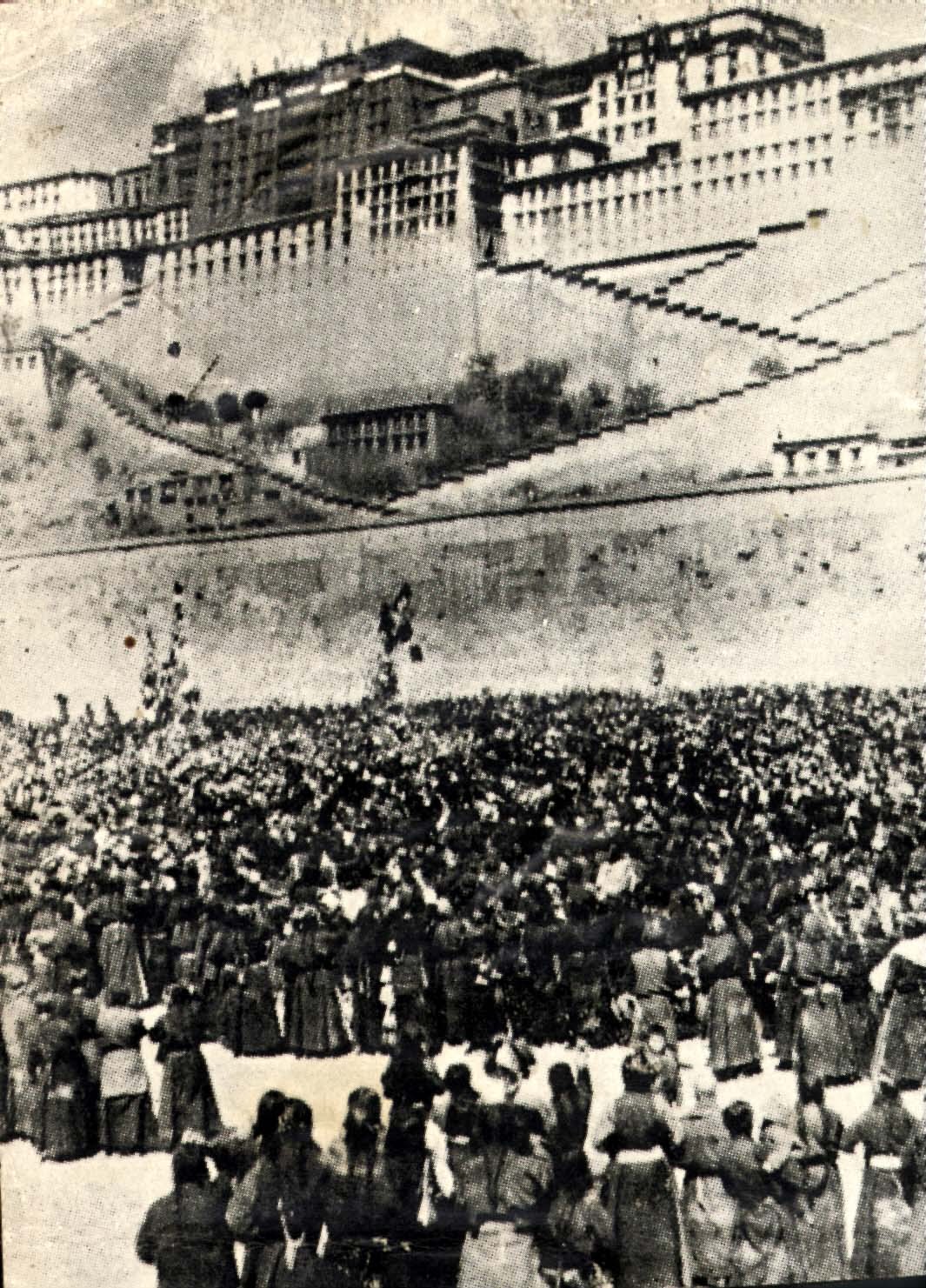
Red China – Subjugator of Tibet. The military conquest of Tibet.

At Special Frontier Force, I recognized that Red China has violated 17-Article Agreement signed on May 23, 1951. The history of Tibetan Resistance Movement that formulated the finding of Special Frontier Force bears testimony to the fact of Tibet’s subjugation under a tyrannical rule imposed by Red China.

Top Chinese officer pays visit to US: Pentagon

Fan Changlong (R), vice chairman of China’s Central Military Commission, meets with U.S. Army Chief of Staff General Raymond Odierno in Beijing, capital of China, Feb. 21, 2014. (Xinhua/Li Tao)

US army Chief of Staff General Ray Odierno (L) meets with Fan Changlong, Deputy Chairman of the Central Military Commission at Bayi Building in Beijing on February 21, 2014 (AFP Photo/Lintao Zhang)

Washington (AFP) – A top Chinese military officer began a six-day visit to the United States on Monday amid rising tensions over Beijing’s assertive stance in the South China Sea.

General Fan Changlong, vice-chairman of China’s Central Military Commission, started his tour in San Diego with a stop at the USS Ronald Reagan aircraft carrier and will hold talks on Thursday at the Pentagon with US Defense Secretary Ashton Carter, officials said.

Carter and other top US officials have recently castigated China over its push to build artificial islands in the disputed waters of the South China Sea.
At a recent security conference in Singapore, Carter called for an immediate end to land reclamation by countries in the region, and accused China of being out of step with international rules.

“Turning an underwater rock into an airfield simply does not afford the rights of sovereignty or permit restrictions on international air or maritime transit,” the Pentagon chief said at the International Institute for Strategic Studies conference.

President Barack Obama earlier this month also warned Beijing over its tactics, saying territorial disputes could not be solved by “throwing elbows.”
Before heading to Washington, Fan was due to visit a Boeing factory in Seattle and a US Army base at Fort Hood in Texas.

Fan is considered a counterpart to Carter, US officials said.

The general’s visit is part of a years-long effort to build a regular dialogue between the American and Chinese armed forces to defuse potential tensions and avoid miscalculations.
Carter’s predecessor, Chuck Hagel, paid a visit to China in 2014 in a trip that was marked by friction, with each side trading sharply worded criticism.

© 2015 AFP

Yahoo – ABC News Network

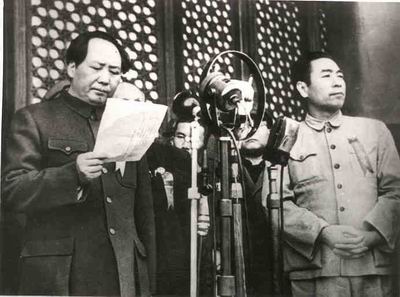
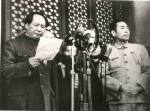
Mao Zedong proclaims the founding of the People's Republic of China in Beijing on Oct. 1, 1949.
Mao Zedong proclaims the founding of the People’s Republic of China in Beijing on Oct. 1, 1949.
THE  EVIL  RED  EMPIRE  -  RED  CHINA  -  SUBJUGATOR  OF  TIBET .
THE EVIL RED EMPIRE – RED CHINA – SUBJUGATOR OF TIBET .
red china subjugator may231951 beijing
Red China Subjugator of Tibet –  May 23, 1951 – PEKING ( Beijing)
red china subjugator 17 point plan
Red China Subjugator of Tibet: 17-Point Plan of May 23, 1951.
red china subjugator 17 article agreement
Red China Subjugator of Tibet. 17 Article Agreement of May 23, 1951
red china subjugator banquet in beijing
Red China Subjugator of Tibet – Banquet in PEKING ( Beijing).
red china subjugator 17 point agreement beijing
Red China Subjugator of Tibet – 17- Point Agreement, May 1951 – PEKING( Beijing).
red china subjugator march12 1959
Red China Subjugator of Tibet – Tibetan Uprising – March 12,  1959.
red china oppression in tibet1
Red China – Oppression in Tibet

THE EVIL RED EMPIRE – RED CHINA – COMMUNIST

THE  EVIL  RED  EMPIRE  -  RED  CHINA  -  COMMUNIST :  ONE - PARTY  GOVERNANCE  OF  RED  CHINA  HAS  NO  RESPECT  FOR  NATURAL  RIGHTS  OF  PEOPLE .
THE EVIL RED EMPIRE – RED CHINA – COMMUNIST: ONE – PARTY GOVERNANCE OF RED CHINA HAS NO RESPECT FOR NATURAL RIGHTS OF PEOPLE .

I am asking my readers to acknowledge Red China’s one-party governance as “COMMUNIST.” In the years ahead, the United States and others will be left with no political alternatives as there is fundamental incompatibility between the systems of governance called ‘Democracy’, and ‘Communism’.

THE  EVIL  RED  EMPIRE  -  RED  CHINA  -  COMMUNIST  :   COMMUNISM  LAYS  EMPHASIS  ON  THE  REQUIREMENTS  OF  THE  STATE  WITH  NO  CONCERN  FOR  INDIVIDUAL  LIBERTIES .  COMMUNIST  GOVERNANCE  IS  NOT  BASED  UPON  SOCIAL  CONTRACT .  COMMUNISTS  RULE  WITHOUT  CONSENT  OF  THEIR  PEOPLE .
THE EVIL RED EMPIRE – RED CHINA – COMMUNIST : COMMUNISM LAYS EMPHASIS ON THE REQUIREMENTS OF THE STATE WITH NO CONCERN FOR INDIVIDUAL LIBERTIES . COMMUNIST GOVERNANCE IS NOT BASED UPON SOCIAL CONTRACT . COMMUNISTS RULE WITHOUT CONSENT OF THEIR PEOPLE .

Communism is the form of government by a one-party political structure which lays emphasis on the requirements of the State rather than on individual liberties. State is primarily involved in planning and control of economy without transparency and public accountability. Democracy is a form of government based on the theory of “Natural Rights” and the doctrine of government by “Social Contract.” In Democracy, government is instituted among men deriving its just powers from consent of the governed. Communism includes an unmistakable design to establish tyranny.

Red China’s Communist Party Chairman Mao Tse-Tung or Mao Zedong established a national entity on October 01, 1949 where the Communist Party can rule or govern people without their consent. Red China entered the Korean War against UN forces in 1950, participating on a large scale until the armistice of 1953. Red China invaded and occupied its weak neighbor Tibet during October 1950. A liberal “Hundred Flowers” period of 1957 was followed by a harsh crackdown on intellectuals. Red China demonstrated its ambitions to become a global superpower by exploding an atomic bomb in 1964 and the launching of its first satellite in 1970. Nixon-Kissinger “TREASON” in Vietnam paved the way for Red China’s entry to the United Nations. While the United States was engaged in a bloody war in Vietnam to resist and contain Communism, Nixon-Kissinger visited Peking in February 1972. US and Red China normalized diplomatic relations on January 01, 1979.

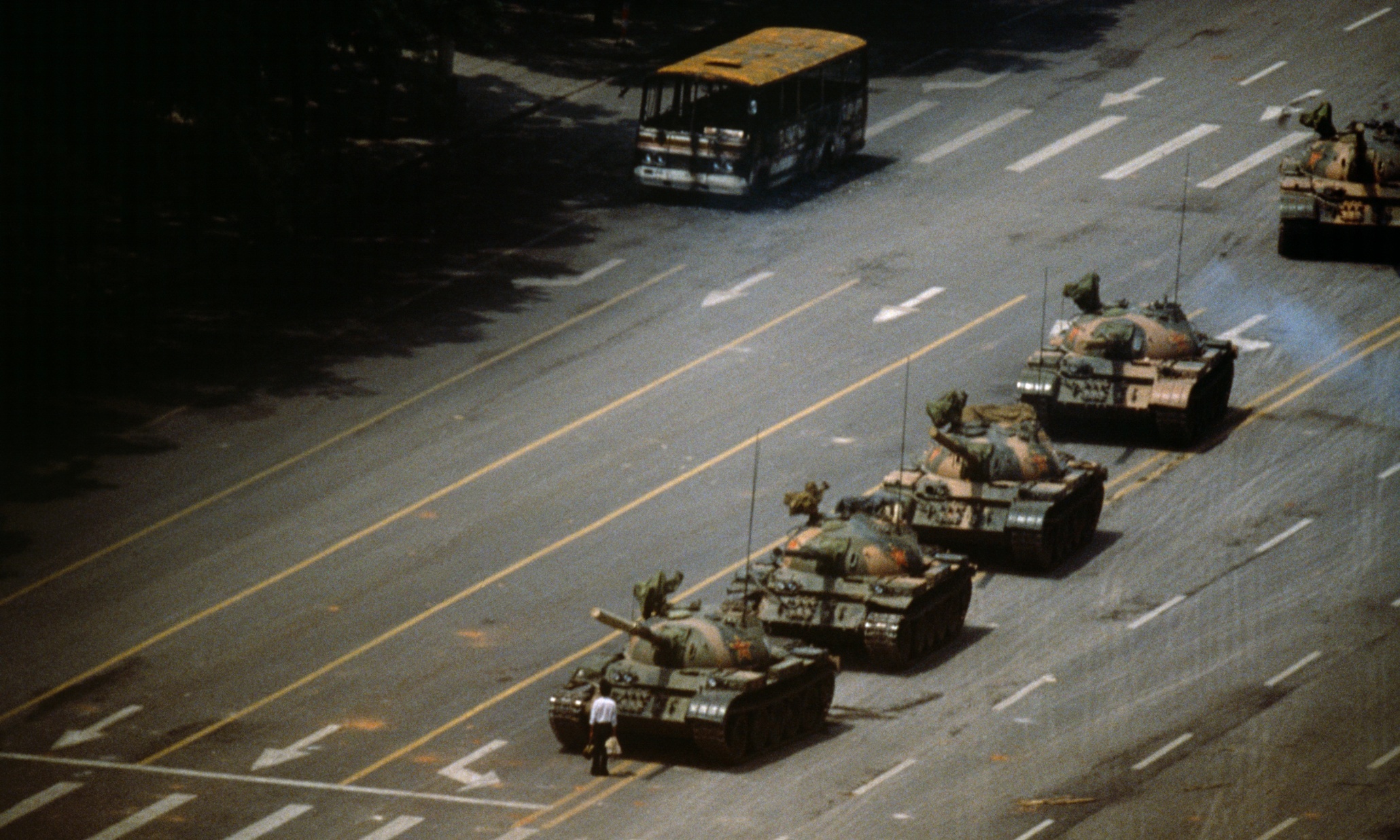
In 1981, Red China’s Communist Party severely criticized Mao Tse-Tung’s policies in the last years of his life in a public document and in 1982 Maoist ideology and political structure were curbed through the adoption of new Party and national constitution. The events commonly described as “TIANANMEN SQUARE MASSACRE” during May-June 1989 is clear evidence of a system of governance inspired by ideology of Communism which has no respect for “Natural Rights” of people.

THE EVIL RED EMPIRE - RED CHINA - COMMUNIST :  Beijing. Tien An Men Square. 'The Tank Man' stopping the column of T59 tanks. 4th June 1989.
THE EVIL RED EMPIRE – RED CHINA – COMMUNIST: Beijing. Tien An Men Square. ‘The Tank Man’ stopping the column of T59 tanks. 4th June 1989.

Red China has not accounted for her “Crimes Against Humanity” during a period of her history called the “Cultural Revolution.” Communist Party Chairman Mao Tse-Tung launched a massive upheaval in August 1966 to physically destroy all ‘liberal’ elements who in his view posed a threat to China’s “Red Revolution.” It was a mass campaign to revitalize revolutionary fervor by attacking people and cultural institutions perceived as liberal or so-called “BOURGEOIS” elements in cultural circles. Tibetan religious and political institutions that define Tibetan national character and Tibetan national identity became the targets of vicious attacks that aimed to physically destroy persons and material properties associated with Tibetan Culture using State-sponsored violence. Cultural Revolution ended in 1976 with the death of Chairman Mao and the purging of the “Gang of Four.” However, Communist misrule, xenophobia, and anti-intellectualism continue unabated in Occupied Tibet.

Rudra Narasimham Rebbapragada
Ann Arbor, MI 48104-4162, USA
The Spirits of Special Frontier Force


Here’s how The Washington Post covered Tiananmen Square in 1989

By SWATI SHARMA June 4

In 1989, the chinese military descended on Tiananmen Square and moved to end pro-democracy demonstrations. The event, which resulted in several hundred to several thousand dead, is considered one of the most brutal crackdowns in modern history. At the height of the protests, which were sparked by the death of a Communist Party leader who wanted reform, at least a million people were estimated to have participated in the demonstrations. Here is a look back at the Tiananmen Square massacre through the pages of The Washington Post.

May 20: Students defy martial law orders

“[T]he government today declared martial law ‘in certain areas’ of the capital to meet the growing defiance by Chinese citizens. Martial law provisions included a ban on demonstrations, and restrictions on the movements of Chinese citizens and the activities of foreign journalists.”

may20
June 3: Troops are blocked for a second time

Although 200,000 troops surrounded Tiananmen Square, citizens were able to stop them from entering. “The citizens shouted ‘Go home,’ and called on people in the area to join them in opposition to the troops. The troops continued to press forward but were channeled into the left-hand side of the street, when a mass of people now numbering more than 1,000 stopped the soldiers in their tracks. The troops then seemed to give up.”

june3military
Tiananmen Square Massacre June 1989

June 3: Frightened students worry about what comes next

After troops were blocked from entering the square twice, concerned students and media contemplate the military’s next move. Staff writer Jay Mathews poses a simple question: “Would they come?”

june3students
Tiananmen Square Massacre June 1989.

June 4: The massacre

Here is the front page, leading with staff reporter Daniel Southerland’s coverage.

june4
Tiananmen Square Massacre June 1989.

June 4: The legacy of Tiananmen Square

The front of The Post’s Outlook section: “‘There’s been nothing like it in human history,’CBS’s Charles Kuralt proclaimed on Sunday morning.”

june-4-legacy1.jpg&w=480
Tiananmen Square Massacre June 1989.

June 5: Death in Tiananmen

june5
Tiananmen Square Massacre June 1989.

June 6: An infamous photo is born

june6
July 1: An avenue full of corpses

Shen Tong became the first Chinese student to speak publicly about the massacre. He told reporters: “People around me were being shot because they could not believe the army was shooting at them, so they did not move.”

july1
Massacre in Tiananmen Square June 1989.

Note: This post was originally published on June 3, 2014.

Swati Sharma is a digital editor for World and National Security and previously worked at the Boston Globe.

red china communist protest june03 1989
The Evil Red Empire: Red China Communist: PRO-DEMOCRACY  PROTEST  June 03, 1989
red china communist tien an men square 1989
The Evil Red Empire: Red China Communist t. Tiananmen Square Protests 1989
1989, Beijing, China, Bodies of protestors shot by the Chinese army piled up in the corner of Capital hospital after the Chinese army occupation of Tiananmen Square on the 4th June, 1989.,; date created: 2008:05:06; Tiananmen Square Massacre
1989, Beijing, China, Bodies of protestors shot by the Chinese army piled up in the corner of Capital hospital after the Chinese army occupation of Tiananmen Square on the 4th June, 1989. Tiananmen Square Massacre
red china communist bodies mangled bicycles 1989
The Evil Red Empire: Red China Communist. Bodies and mangled bicycles. Pro Democracy Protests 1989.
red china communist pro democracy protests june05 1989
The Evil Red Empire: Red China Communist. Pro Democracy protests June 05 1989

THE EVIL RED EMPIRE – RED CHINA – CYBER CRIMINAL

THE EVIL RED EMPIRE – RED CHINA – CYBER CRIMINAL

red china espionage sun tzu wisdom

Espionage is described as ‘Intelligence’ gathering, securing of information about one nation for the benefit of another. Spying is a term used to describe clandestine intelligence gathering activity. Spying involves the use of spies or agents by a government to learn the secrets of other nations. Espionage involves obtaining information using spies, secret agents, and illegal monitoring devices.

red china espionage sun tzu the art of war

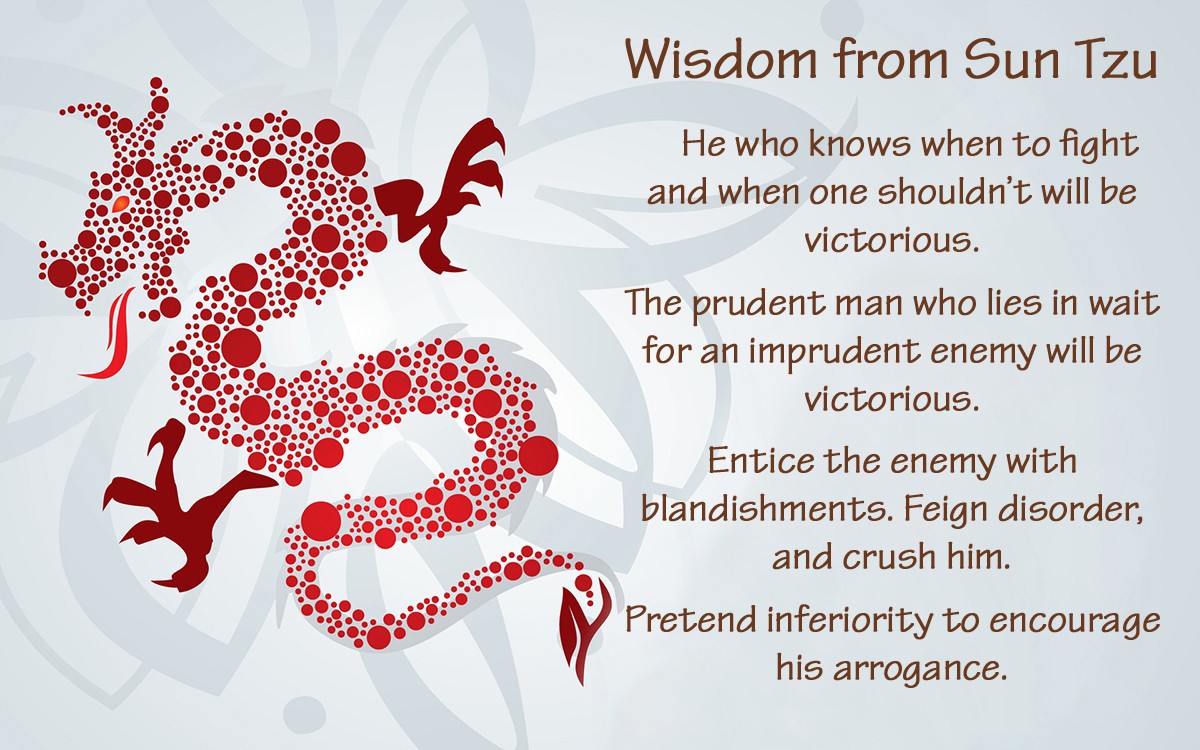
In government operations, intelligence involves evaluated information concerning the strength, activities and probable course of action of its opponents. The concept of intelligence is not new. The military treatise “Ping-fa”(The Art of War) written c.400 B.C. by military philosopher Sun-tzu mentions the use of secret agents and importance of good intelligence. To obtain knowledge of enemy’s intentions, intelligence systems have been in use from ancient times. The Intelligence Service of Red China belongs to Ministry of State Security.

At Special Frontier Force, I am familiar with Red China’s espionage and her intelligence gathering operations which often target individuals serving in Special Frontier Force to identify them with specificity. Intelligence gathering in cyberspace or cyberespionage is manifestation of digital age. At Special Frontier Force, I am trained to recognize Red China as an adversary, an opponent, and an enemy. I would not expect Red China to extend her cooperation to apprehend those criminals who with a series of computer hacks have stolen vast amounts of data from a database maintained by the Office of Personnel Management in the United States. While nations may face the compulsion to gather intelligence, stealing private information of millions of civilian employees is unfair, unethical, and is totally unwarranted. As such, I would recognize Red China as a Cyber Criminal and Red China has to bear full responsibility for criminal actions of her employees or agents she hired.

Rudranarasimham Rebbapragada
Ann Arbor, MI 48104-4162, USA
SPECIALFRONTIERFORCE.ESTABLISHMENT22

The Washington Post

With a series of major hacks, China builds a database on Americans


AP7800370634461370635261-1616.jpg?uuid=uKJWxPmaEeShPBk7EkHVGg

American and Chinese flags are adjusted before a press conference in Beijing in 2012. (Feng Li/ASSOCIATED PRESS)

By ELLEN NAKASHIMA June 5 at 5:55 PM

China is building massive databases of Americans’ personal information by hacking government agencies and U.S. health-care companies, using a high-tech tactic to achieve an age-old goal of espionage: recruiting spies or gaining more information on an adversary, U.S. officials and analysts say.

Groups of hackers working for the Chinese government have compromised the networks of the Office of Personnel Management(OPM) which holds data on millions of current and former federal employees, as well as the health insurance giant Anthem, among other targets, the officials and researchers said.

“They’re definitely going after quite a bit of personnel information,” said Rich Barger, chief intelligence officer of ThreatConnect, a Northern Virginia cybersecurity firm. “We suspect they’re using it to understand more about who to target [for espionage], whether electronically or via human ­recruitment.”

The targeting of large-scale data­bases is a relatively new tactic and is used by the Chinese government to further its intelligence-gathering, the officials and analysts say. It is government espionage, not commercial espionage, they say.

China hacked into the federal government’s network, compromising four million current and former employees’ information. The Post’s Ellen Nakashima talks about what kind of national security risk this poses and why China wants this information. (Alice Li/The Washington Post)

“This is part of their strategic goal — to increase their intelligence collection via big data theft and big data aggregation,” said a U.S. government official, who, like others, spoke on condition of anonymity to discuss a sensitive topic. “It’s part of a strategic plan.”

One hack of the OPM, which was disclosed by the government Thursday, dates at least to December, officials said. Earlier last year, the OPM discovered a separate intrusion into a highly sensitive database that contains information on employees seeking or renewing security clearances and on their background investigations.

Once harvested, the data can be used to glean details about key government personnel and potential spy recruits, or to gain information useful for counter­intelligence. Records in OPM’s database of background investigations, for instance, could contain a complete history of where an individual has lived and all of his or her foreign contacts in, say, China. “So now the

Chinese counterintelligence authorities know which American officials are meeting with which Chinese,” a China cyber and intelligence expert said.
The data could help Chinese analysts do more effective targeting of individuals, said a former National Security Agency official. “They can find specific individuals they want to go after, family members,” he said.

The trend has emerged and accelerated over the past 12 to 18 months, the official said. An increase in Chinese capability has opened the way “for bigger data storage, for bigger data theft,” he said. “And when you can gain it in bulk, you take it in bulk.”

The Chinese government, he said, is making use of Chinese companies that specialize in aggregating large sets of data “to help them in sifting through” the information for useful details. “The analogy would be one of our intelligence organizations using Google, Yahoo, Accenture to aggregate data that we collected.”

China on Friday dismissed the allegation of hacking as “irresponsible and unscientific.”

Chinese Foreign Ministry spokesman Hong Lei said Beijing wanted to cooperate with other nations to build a peaceful and secure cyberspace.
“We wish the United States would not be full of suspicions, catching wind and shadows, but rather have a larger measure of trust and cooperation,” he told a regular news briefing,

The OPM disclosed that the latest hack of one of its systems exposed personal data of up to 4 million current and former employees — the largest hack of federal employee data in recent years.

U.S. officials privately said China was behind it. The stolen information included Social Security numbers and performance evaluations.

“This is an intelligence operation designed to help the Chinese government,” the China expert said. “It’s a new phase in an evolution of what they’re doing. It certainly requires greater sophistication on their part in terms of being able to take out this much data.”

Barger’s firm has turned up technical evidence that the same Chinese group is behind the hacks of Premera Blue Cross and Empire BlueCross, which were discovered at roughly the same time earlier this year.

The first OPM incident has been linked to the health-care hacks by Barger and another security researcher, John Hultquist, senior manager for cyberespionage threat intelligence at iSight Partners. Hultquist said the same group is responsible for all of them, and for other intrusions into commercial databases containing large sets of Americans’ personal information.
“They would leverage this data to get to diplomatic, political, military and economic intelligence that they typically target,” said Hultquist, who declined to comment on who was behind the attacks.

Though much Chinese cyber­espionage is attributed to the People’s Liberation Army, these hacks, Barger said, appeared to be linked to the Ministry of State Security, which is a spy agency responsible for foreign espionage and domestic counterintelligence.

Other Chinese entities, including the military, may also be involved in the campaign, analysts said.

Chinese government hackers “are like a vacuum cleaner” in sucking up information electronically, said Robert “Bear” Bryant, a former top counterespionage official in the government. “They’re becoming much more sophisticated in tying it all together. And they’re trying to harm us.”

Security researchers have pointed to a cyber tool or family of malicious software called Derusbi that has been linked exclusively to Chinese actors. One group that has used Dersubi is Deep Panda, a name coined by the firm CrowdStrike, which has linked that group to the Anthem hack.

Disclosed in February, that incident exposed the Social Security numbers, addresses, phone numbers, e-mail addresses and member IDs of tens of millions of customers. No medical data such as diagnosis or treatment information was compromised, the company said.

Researchers note that in contrast to the hacks of Home Depot and Target, personal data that might have been stolen from the OPM, Anthem and the other companies have not shown up on the black market, where it can be sold to identity thieves. That is another sign, they said, that the intrusions are not being made for commercial purposes.
“Usually if there’s a criminally or financially motivated breach like that, we see the data making its way into the black market soon after that,” Barger said.

The big data approach being taken by the Chinese might seem to mirror techniques used abroad by the NSA, which has come under scrutiny for its data-gathering practices under executive authority. But in China, the authorities do not tolerate public debate over the proper limits of large-scale spying in the digital age.

“This is what all intelligence services do if they’re good,” said the China cyber expert. “If you want to find a needle, first you have to gather a haystack of needles.”
The massive data harvesting “reflects a maturity in Chinese” electronic intelligence gathering, the expert said. “You have to put in place structured data repositories. You have to have big data management tools to be able to store and sift and analyze.”

Barger said that “with a large pool of data, they can prioritize who is the best to target electronically and who is the best to target via human recruitment.”
The U.S. official noted that the Chinese “would not take [the data] if they did not have the opportunity to aggregate it.” And, he added, “they are taking it.”

Simon Denyer in Beijing contributed to this report.

nakashimaem.jpg?ts=1432642558011&w=180&h=180

Ellen Nakashima is a national security reporter for The Washington Post. She focuses on issues relating to intelligence, technology and civil liberties.

AP7800370634461370635261-1612.jpgAP7800370634461370635261-1612.jpg

  • © 1996-2015 The Washington Post

THE EVIL RED EMPIRE – RED CHINA – A JACKAL

THE EVIL RED EMPIRE – RED CHINA – A JACKAL :

THE  EVIL  RED  EMPIRE  -  RED  CHINA  -  A  JACKAL .
THE EVIL RED EMPIRE – RED CHINA – A JACKAL .

Jackals are wild dogs of Asia and North Africa. The word Jackal is often used to describe a person who does dishonest or humiliating tasks for one’s own gain. Jackal is the other name for a cheat or a swindler. I am specifically using the term ‘JACKAL’ to describe the nature of Red China’s statecraft or statesmanship. It helps my readers to recognize Red China’s sly, secretive, or wily nature. Sly implies a working to achieve one’s ends by evasiveness, insinuation, furtiveness, duplicity, circumvention, plot, subterfuge, stratagem, craftiness, subtle blandishments, ruses, cunning underhandedness, mischievous or roguish behavior. Red China could be called “FOXY” for its tricks are sharpened by experience. Red China deals with her neighbors using her proficiency in deception. Red China is subtly deceitful for she knows to defraud others by deliberately misleading them to obtain their rights and property. Red China often takes pleasure in demonstrating the gullibility of her victims.

At Special Frontier Force, we have personal experience of Red China’s sly, wily, cunning, dishonest, and deceitful nature.

Rudranarasimham Rebbapragada
Ann Arbor, MI 48104-4162, USA
The Spirits of Special Frontier Force

Pentagon chief criticizes Beijing’s South China Sea
moves

Associated Press

By LOLITA C. BALDOR and MATTHEW PENNINGTON

SINGAPORE — China’s land reclamation in the South China Sea is out of step
with international rules, and turning underwater land into airfields won’t
expand its sovereignty, Defense Secretary Ash Carter told an international
security conference Saturday, stepping up America’s condemnation of the
communist giant as Beijing officials sat in the audience.

Carter told the room full of Asia-Pacific leaders and experts that the U.S.
opposes “any further militarization” of the disputed lands.

His remarks were immediately slammed as “groundless and not constructive” by
a Chinese military officer in the audience.

Carter’s comments came as defense officials revealed that China had put two
large artillery vehicles on one of the artificial islands it is creating in the
South China Sea. The discovery, made at least several weeks ago, fuels fears in
the U.S and across the Asia-Pacific that China will try to use the land
reclamation projects for military purposes.

The weaponry was discovered at least several weeks ago, and two U.S.
officials who are familiar with intelligence about the vehicles say they have
been removed. The officials weren’t authorized to discuss the intelligence and
spoke only on condition of anonymity.

The Pentagon would not release any photos to support its contention that the
vehicles were there.

China’s assertive behavior in the South China Sea has become an increasingly
sore point in relations with the United States, even as President Barack Obama
and China’s President Xi Jinping have sought to deepen cooperation in other
areas, such as climate change.

Pentagon spokesman Brent Colburn said the U.S. was aware of the artillery,
but he declined to provide other details. Defense officials described the
weapons as self-propelled artillery vehicles and said they posed no threat to
the U.S. or American territories.
© AP Photo/Wong Maye-E U.S. Secretary of Defense Ashton

Carter delivers his speech about “The United States and Challenges to
Asia-Pacific Security” during the 14th International Institute for Strategic
Studies Shangri-la Dialogue, or IISS, Asia Security Summit, Saturday, May 30,
2015, in Singapore.

While Carter did not refer directly to the weapons in his speech, he told the
audience that now is the time for a diplomatic solution to the territorial
disputes because “we all know there is no military solution.”

“Turning an underwater rock into an airfield simply does not afford the
rights of sovereignty or permit restrictions on international air or maritime
transit,” Carter told the audience at the International Institute for Strategic
Studies summit.

China’s actions have been “reasonable and justified,” said Senior Col. Zhao
Xiaozhuo, deputy director of the Center on China-America Defense Relations at
the People’s Liberation Army’s Academy of Military Science.

Zhao challenged Carter, asking whether America’s criticism of China and its
military reconnaissance activities in the South China Sea “help to resolve the
disputes” and maintain peace and stability in the region.

Carter responded that China’s expanding land reclamation projects are
unprecedented in scale. He said the U.S. has been flying and operating ships in
the region for decades and has no intention of stopping.

While Carter’s criticism was aimed largely at China, he made it clear that
other nations who are doing smaller land reclamation projects also must
stop.

One of those countries is Vietnam, which Carter is scheduled to visit during
this 11-day trip across Asia. Others are Malaysia, the Philippines and
Taiwan.

Asked about images of weapons on the islands, China’s Foreign Ministry
spokeswoman Hua Chunying said she was “not aware of the situation you
mention.”

She also scolded Carter, saying the U.S. should be “rational and calm and
stop making any provocative remarks, because such remarks not only do not help
ease the controversies in the South China Sea, but they also will aggravate the
regional peace and stability.”

Carter appeared to strike back in his speech, saying that the U.S. is
concerned about “the prospect of further militarization, as well as the
potential for these activities to increase the risk of miscalculation or
conflict.” And he said the U.S. “has every right to be involved and be
concerned.”

But while Carter stood in China’s backyard and added to the persistent
drumbeat of U.S. opposition to Beijing’s activities, he did little to give
Asia-Pacific nations a glimpse into what America is willing to do to achieve a
solution.

He said the U.S. will continue to sail, fly and operate in the region, and
warned that the Pentagon will be sending its “best platforms and people” to the
Asia-Pacific. Those would include, he said, new high-tech submarines,
surveillance aircraft, the stealth destroyer and new aircraft carrier-based
early-warning aircraft.

U.S. Sen. John McCain, R-Ariz., who also is attending the Singapore
conference, told reporters that the U.S. needs to recognize that China will
continue its activities in the South China Sea until it perceives that the costs
of doing so outweigh the benefits.

He said he agreed with Carter’s assertion that America will continue flights
and operations near the building projects, but “now we want to see it translated
into action.”
© AP Photo/Wong Maye-E U.S. Secretary of Defense Ashton

Carter delivers his speech about “The United States and Challenges to
Asia-Pacific Security” during the 14th International Institute for Strategic
Studies Shangri-la Dialogue (IISS) Asia Security Summit, Saturday, May 30, 2015,
in Singapore.

One senior defense official has said the U.S. is considering more military
flights and patrols closer to the projects in the South China Sea, to emphasize
reclaimed lands are not China’s territorial waters. Officials also are looking
at ways to adjust the military exercises in the region to increase U.S. presence
if needed. That official was not authorized to discuss the options publicly and
spoke on condition of anonymity.

One possibility would be for U.S. ships to travel within 12 miles of the
artificial islands, to further make the point that they are not sovereign
Chinese land. McCain said it would be a critical mistake to recognize any
12-mile zone around the reclamation projects.

The U.S. has been flying surveillance aircraft in the region, prompting China
to file a formal protest.

U.S. and other regional officials have expressed concerns about the island
building, including worries that it may be a prelude to navigation restrictions
or the enforcement of a possible air defense identification zone over the South
China Sea. China declared such a zone over disputed Japanese-held islands in the
East China Sea in 2013.

China has said the islands are its territory and that the buildings and other
infrastructure are for public service use and to support fishermen.

Pennington reported from Washington. AP news assistant Liu Zheng in Beijing
contributed to this report.

THE EVIL RED EMPIRE – RED CHINA – COLONIAL RULE OVER TIBET

THE EVIL RED EMPIRE – RED CHINA – COLONIAL RULE OVER TIBET:

THE  EVIL  RED  EMPIRE  -  RED  CHINA  -  COLONIAL  RULE  OVER  TIBET .
THE EVIL RED EMPIRE – RED CHINA – COLONIAL RULE OVER TIBET .

Neocolonialism describes the revival of Colonialist exploitation by a foreign power of a region that has achieved independence. Colonialism is the system or policy by which a country maintains foreign colonies especially in order to exploit them economically. Colonization refers to  extension of political and economic control over an area by an occupying state that has organizational or technological superiority. Imperialism has been a major colonizing force. The Colony’s population is subdued to assimilate them to the Colonizer’s way of life.

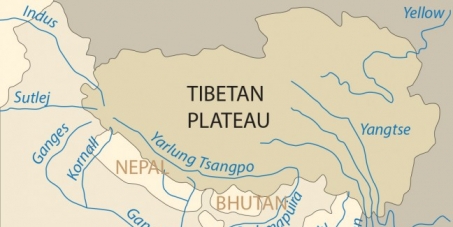
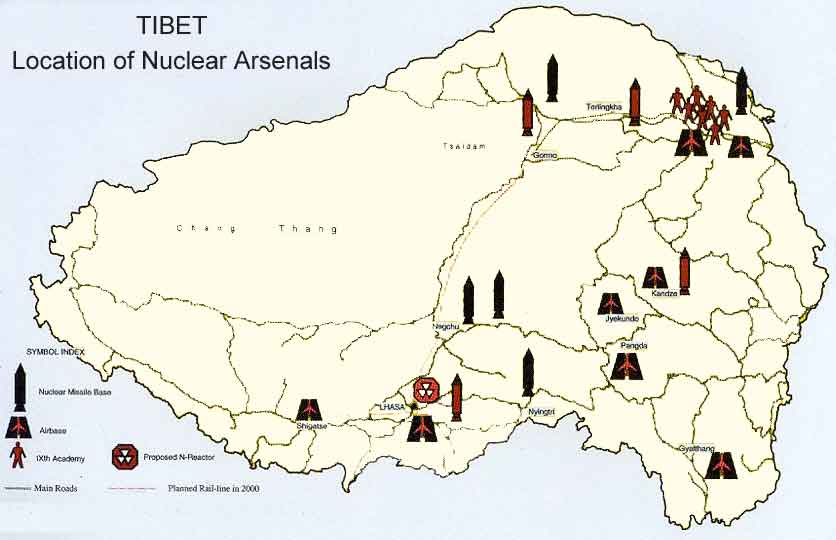
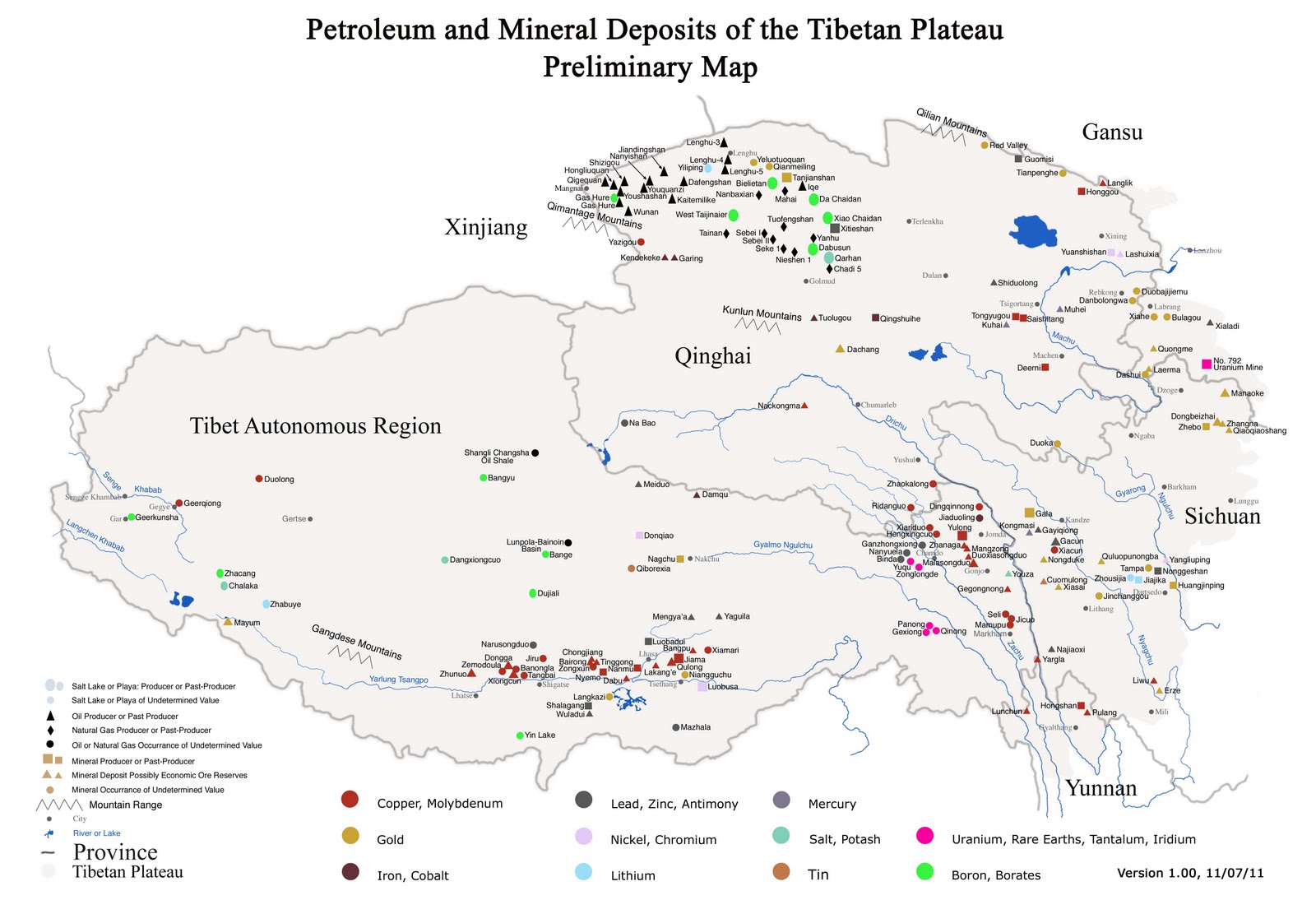
The Great 13th Dalai Lama of Tibet declared Tibet’s independence from Manchu China(Qing or Ch’ing Dynasty) on February 13, 1913. Tibet expelled Manchu China’s diplomats and its military contingent posted in Lhasa, Tibet’s Capital. For centuries, Tibet came under foreign conquests by Mongols and Manchu China but Tibet was never colonized. Red China’s military invasion of Tibet in 1950 describes the typical features of Colonialism. Tibet’s population is repressed by brutal force in an attempt to fully assimilate Tibetans to the Colonizer’s way of life. Red China’s Colonial Rule is a direct threat to  existence of Tibetan way of life shaped by centuries of Natural Freedom. Apart from wiping out Tibetan System of Governance known as Ganden Phodrang, The Institution of Dalai Lama at Potala Palace, Lhasa, the tyrannical rule of Red China is destroying every attribute of Tibetan Culture including Tibetan language, and Tibetan religious institutions putting Tibetan Identity at a great peril. Red China’s colonization of Tibet is defacing and degrading Tibetan territory and its fragile environment totally upsetting its delicate ecological balance. The Land of Tibet is scarred by Red China’s reckless mining activities, deforestation, diversion of rivers, and dumping of toxic chemical and nuclear wastes.

THE  EVIL  RED  EMPIRE  -  RED  CHINA  -  COLONIAL  RULE  OVER  TIBET :  TIBET  IS  POISONED  WITH  LONGLIVING  NUCLEAR  WASTE  FROM  RED  CHINA'S  NUCLEAR  EXPANSIONISM .
THE EVIL RED EMPIRE – RED CHINA – COLONIAL RULE OVER TIBET : TIBET IS POISONED WITH LONG LIVING NUCLEAR WASTE FROM RED CHINA’S NUCLEAR EXPANSIONISM .

Colonization was the vehicle of European expansion from the 15th century into Africa, the Americas, and Asia. The Spanish, Portuguese, English, French, and Dutch established Colonies worldwide that have for the most part obtained independence from imperial system only in the 20th century.

red china neocolonialist mineral deposits tibet
red china neocolonialist mineral deposits Tibet

red china neocolonialist canadian mining projects tibet
red china neocolonialist Canadian mining projects Tibet

Red China determines the economic development of other countries from which it extracts vast amounts of raw materials. With the sole exception of Tibet, Red China is able to get raw materials and flood world markets with Made in China products without the need to fight the wars of the previous Colonial Era. With threats of its muscle power, Red China has entered a new era of Colonialism. People of the World have to awaken to the threat imposed by Red China – Neocolonialist.

Rudranarasimham Rebbapragada
Ann Arbor, MI 48104-4162, USA
The Spirits of Special Frontier Force

image
The Spirits of Special Frontier ForceSpecial Frontier Force is a military organization of India, Tibet, United States to resist Red…
View on www.facebook.com Preview by Yahoo

CONGO ASSESSES $6.7 BILLION CONTRACTS WITH CHINESE

Congo assesses $6.7 billion contracts with Chinese

By SALEH MWANAMILONGO

In this photo taken on May 20, 2015, Chinese workers travel on the back of a trailer pulled by a tractor on their way to work in Kinshasa, Democratic Republic of Congo. Congo’s government is bringing in outside experts including officials from the World Bank and the United Nations, to investigate the long-term impact of some $6.7 billion in contracts with Chinese companies that critics have said could exploit the central African nation’s mineral riches.(AP Photo/John Bompengo)
.

  • In this photo taken on May 20, 2015, Chinese workers travel on the back of a trailer pulled by a tractor  on their way to work in Kinshasa, Democratic Republic of Congo.  Congo’s government is bringing in outside experts including officials from the World Bank and the United Nations, to investigate the long-term impact of some $6.7 billion in contracts with Chinese companies that critics have said could exploit the central African nation’s mineral riches.(AP Photo/John Bompengo)
    In this photo taken on May 20, 2015, Chinese workers travel on the back of a trailer pulled by a tractor on their way to work in Kinshasa, Democratic Republic of Congo. Congo’s government is bringing in outside experts including officials from the World Bank and the United Nations, to investigate the long-term impact of some $6.7 billion in contracts with Chinese companies that critics have said could exploit the central African nation’s mineral riches.(AP Photo/John Bompengo)

    .

  • In this photo taken on May 20, 2015, Chinese workers inside a new hotel being built for the use by  Congo government officials when completed in Kinshasa, Democratic Republic of Congo.  Congo’s government is bringing in outside experts including officials from the World Bank and the United Nations, to investigate the long-term impact of some $6.7 billion in contracts with Chinese companies that critics have said could exploit the central African nation’s mineral riches.(AP Photo/John Bompengo)
    In this photo taken on May 20, 2015, Chinese workers inside a new hotel being built for the use by Congo government officials when completed in Kinshasa, Democratic Republic of Congo. Congo’s government is bringing in outside experts including officials from the World Bank and the United Nations, to investigate the long-term impact of some $6.7 billion in contracts with Chinese companies that critics have said could exploit the central African nation’s mineral riches.(AP Photo/John Bompengo)

    In this photo taken on May 20, 2015, Chinese workers at the building site of a new hotel to be used by Congo government officials when completed in Kinshasa, Democratic Republic of Congo. Congo’s government is bringing in outside experts including officials from the World Bank and the United Nations, to investigate the long-term impact of some $6.7 billion in contracts with Chinese companies that critics have said could exploit the central African nation’s mineral riches. (AP Photo/John Bompengo)
    In this photo taken on May 20, 2015, Chinese workers at the building site of a new hotel to be used by Congo government officials when completed in Kinshasa, Democratic Republic of Congo. Congo’s government is bringing in outside experts including officials from the World Bank and the United Nations, to investigate the long-term impact of some $6.7 billion in contracts with Chinese companies that critics have said could exploit the central African nation’s mineral riches. (AP Photo/John Bompengo)
  • In this photo taken on May 20, 2015, Chinese workers travel on the back of a trailer pulled by a tractor on their way to work in Kinshasa, Democratic Republic of Congo. Congo’s government is bringing in outside experts including officials from the World Bank and the United Nations, to investigate the long-term impact of some $6.7 billion in contracts with Chinese companies that critics have said could exploit the central African nation’s mineral riches.(AP Photo/John Bompengo)
    In this photo taken on May 20, 2015, Chinese workers travel on the back of a trailer pulled by a tractor on their way to work in Kinshasa, Democratic Republic of Congo. Congo’s government is bringing in outside experts including officials from the World Bank and the United Nations, to investigate the long-term impact of some $6.7 billion in contracts with Chinese companies that critics have said could exploit the central African nation’s mineral riches.(AP Photo/John Bompengo)

    KINSHASA, Congo (AP) — Congo’s government is bringing in outside experts to investigate the long-term impact of some $6.7 billion in contracts with Chinese companies that critics say could exploit the central African nation’s mineral riches.

Congo’s government has a 32 percent stake while China has 68 percent in the mining project called Sicomines. It was created in 2008 but construction did not officially start until three years later, said Jean Nzenga Kongolo, deputy general manager of Sicomines.

It now employs about 3,000 people, of whom 70 percent are Congolese, said Kongolo.

To assess the project’s impact, officials from the World Bank and the United Nations visited the mines this week.

The project “is truly in the right lines and objectives of the World Bank which is to fight against poverty,” said World Bank representative Ahmadou Moustapha Ndiaye. The U.N. official also praised the project.

However, critics say a more thorough evaluation of the contract still must be done.

In this photo taken on May 20, 2015, Chinese workers at the building site of a new hotel to be used by Congo government officials when completed in Kinshasa, Democratic Republic of Congo. Congo’s government is bringing in outside experts including officials from the World Bank and the United Nations, to investigate the long-term impact of some $6.7 billion in contracts with Chinese companies that critics have said could exploit the central African nation’s mineral riches.(AP Photo/John Bompengo)

In this photo taken on May 20, 2015, Chinese workers at the building site of a new hotel to be used by Congo government officials in Kinshasa.

“The Chinese contract was never a win-win … It was badly negotiated,” said civil society leader Jonas Tshiombela.

As part of the deal, China’s Railway Engineering Corporation and Sinohydro Corp. are constructing about 3,000 kilometers of roads and railways in Congo. Universities, hospitals and health centers are also being built, according to the agreement.

Tshiombela said the quality of the construction work “leaves much to be desired.” One road in the capital of Kinshasa — Sendwe Boulevard — already has potholes just a year after it was completed, he said.

Sun Rui Wen, the director general representing China’s interest in Sicomines, defended the project, saying it is based on “equality and mutual benefit.”

The deal also allows the Chinese companies to mine copper, cobalt and gold, according to the agreement seen by The Associated Press.

Congo should be able to repay the investment after 25 years, said Moise Ekanga Lushyma, executive secretary coordinating the project for the Congolese government. At that point they will pay management fees or negotiate another loan — not necessarily with the Chinese — to produce minerals, he said.

  • KINSHASA, Congo

World Bank

Copyright 2015 The Associated Press. All rights reserved. This material may not be published, broadcast, rewritten or redistributed.

Yahoo – ABC News Network