Whole Trouble – Stop the Cultural Genocide in Tibet

Trouble in Tibet – Stop the Cultural Genocide

TROUBLE IN TIBET - STOP THE CULTURAL GENOCIDE.
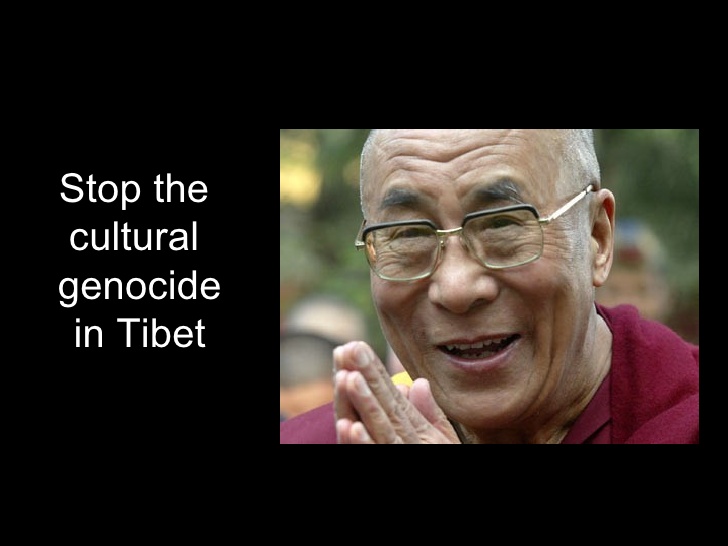
TROUBLE IN TIBET – STOP THE CULTURAL GENOCIDE. Disorienting social and economic change is under way in Tibet. The exiled Dalai Lama accuses China of “cultural genocide” (monasteries are being harassed, and in some parts of the plateau Chinese-language education erodes traditional ways).

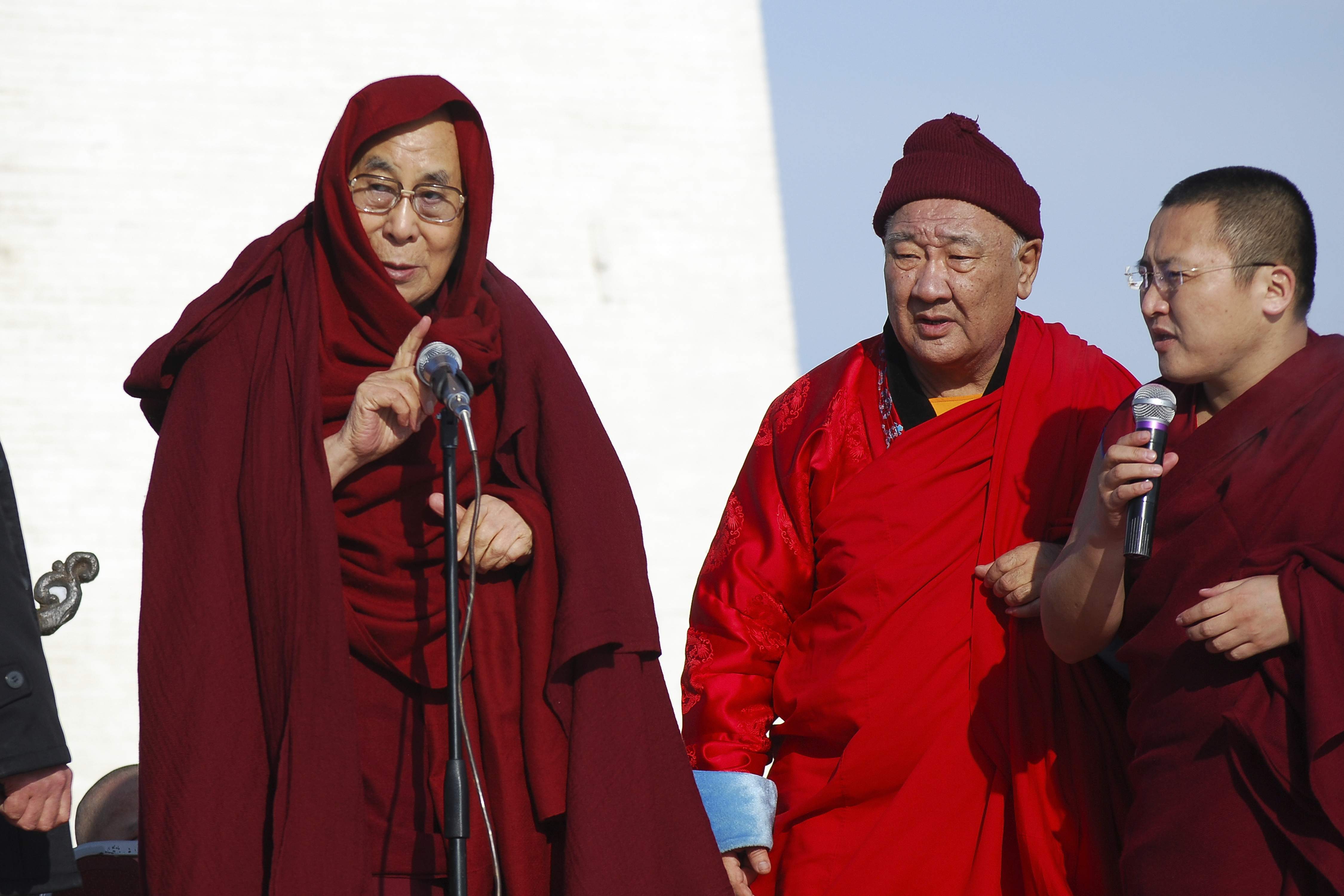
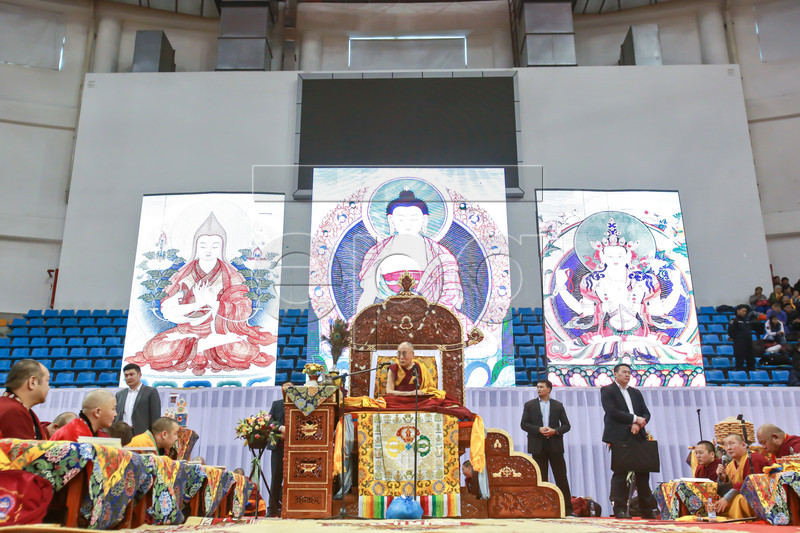
The Exiled Supreme Ruler of Tibet His Holiness the 14th Dalai Lama expressed deep concern about Cultural Genocide in Occupied Tibet.

TROUBLE IN TIBET – STOP THE CULTURAL GENOCIDE: Disorienting social and economic change is under way in Tibet. The exiled Dalai Lama accuses China of “cultural genocide” (monasteries are being harassed, and in some parts of the plateau Chinese-language education erodes traditional ways).

UNPACIFIED PLATEAU: TIBET

Disorienting social and economic change is under way in Tibet. The exiled Dalai Lama accuses China of “cultural genocide” (monasteries are being harassed, and in some parts of the plateau Chinese-language education erodes traditional ways).

Government infrastructure investment in the Tibetan Autonomous Region has spurred mass tourism, but Tibetan resentment at missing out on tourism – and construction-related jobs was a big cause of rioting in Lhasa and elsewhere in 2008. Nor do the 6 million Tibetans (seen as troublemakers by China) migrate much to places with more opportunities: only around 1% have settled outside the plateau. The few private-sector jobs in Tibet mostly go to Han Chinese, so educated Tibetans mostly work for the government. The Chinese name for Tibet, Xizang, means “western treasure house” but Tibetans have little share in its spoils.

Disorienting social and economic change is under way in Tibet. The exiled Dalai Lama accuses China of “cultural genocide” (monasteries are being harassed, and in some parts of the plateau Chinese-language education erodes traditional ways).

SUPREME RULER OF TIBET RECOMMENDS CONSTRUCTIVE CRITICISM OF CHINA

SUPREME RULER OF TIBET RECOMMENDS CONSTRUCTIVE CRITICISM OF CHINA

Supreme Ruler of Tibet on his Europe's Visit urges for constructive criticism of China. Visited Swiss Parliament on September 16, 2016.
Supreme Ruler of Tibet on his Europe’s Visit urges constructive criticism of China. Visited Swiss Parliament on September 16, 2016.

Supreme Ruler of Tibet His Holiness the 14th Dalai Lama, during his visit to Council of Europe in Strasbourg, France, September 15, 2016, urges constructive criticism of China. I share several thoughts to Expose Red China’s Real Face.

Supreme Ruler of Tibet on his Europe’s Visit urges constructive criticism of China.

Rudranarasimham Rebbapragada

Ann Arbor, MI 48104-4162 USA
SPECIAL FRONTIER FORCE


Supreme Ruler of Tibet on his Europe's Visit urges constructive criticism of China. Red China's Real Face Exposed.
Supreme Ruler of Tibet on his Europe’s Visit urges constructive criticism of China. Red China’s Real Face Exposed.

Supreme Ruler of Tibet on his Europe's Visit urges constructive criticism of China. Red China's Real Face is Exposed; Rabid Fox.
Supreme Ruler of Tibet on his Europe’s Visit urges constructive criticism of China. Red China’s Real Face is Exposed; Rabid Fox.

Supreme Ruler of Tibet on his Europe's Visit urges Constructive Criticism of China.
Supreme Ruler of Tibet on his Europe’s Visit urges Constructive Criticism of China. Global Community of Nations need Protection from unpredictable, aggressive behavior of Red China.

Thu Sep 15, 2016 | 11:18am EDT
Dalai Lama, in Europe, urges ‘constructive criticism’ of China

Tibet's exiled spiritual leader the Dalai Lama (R) jokes with Nils Muiznieks, Commissioner for Human Rights of the Council of Europe, during his visit at the Council of Europe in Strasbourg, France, September 15, 2016.  REUTERS/Vincent Kessler
Tibet’s exiled spiritual leader the Dalai Lama (R) jokes with Nils Muiznieks, Commissioner for Human Rights of the Council of Europe, during his visit at the Council of Europe in Strasbourg, France, September 15, 2016. REUTERS/Vincent Kessler

 Tibet’s exiled spiritual leader the Dalai Lama (R) jokes with Nils Muiznieks, Commissioner for Human Rights of the Council of Europe, during his visit at the Council of Europe in Strasbourg, France, September 15, 2016. REUTERS/Vincent Kessler

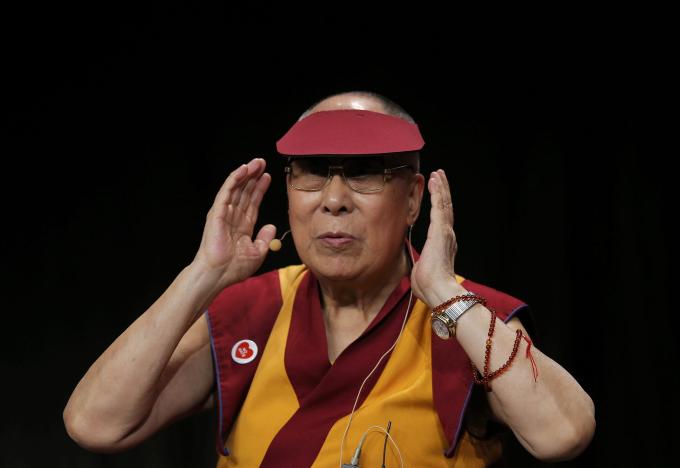
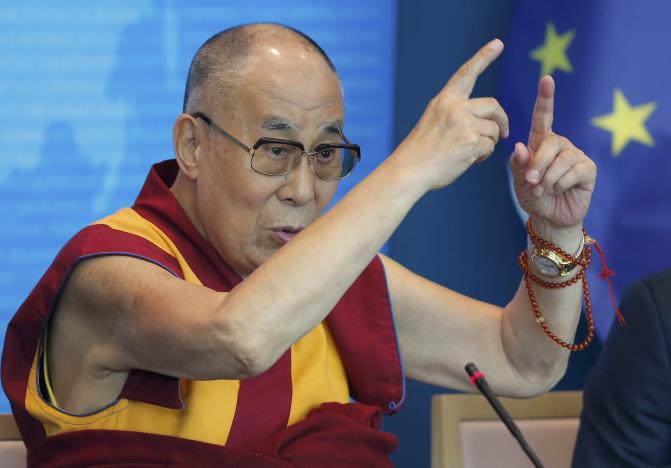
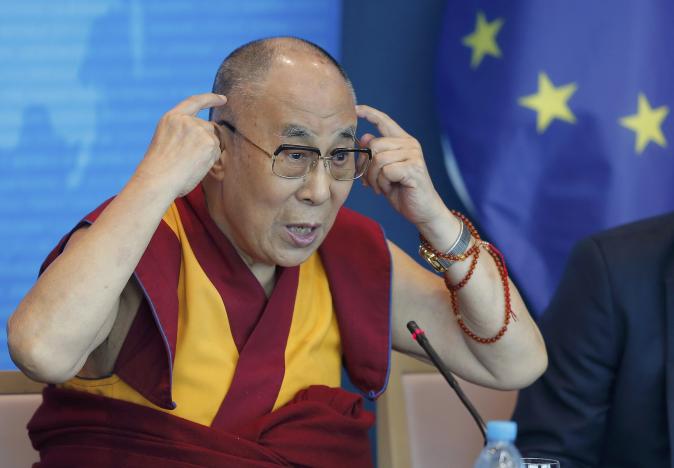
Tibet's exiled spiritual leader the Dalai Lama gestures as he attends a meeting with youth in Strasbourg, France, September 15, 2016. REUTERS/Vincent Kessler
Tibet’s exiled spiritual leader the Dalai Lama gestures as he attends a meeting with youth in Strasbourg, France, September 15, 2016. REUTERS/Vincent Kessler

Tibet’s exiled spiritual leader the Dalai Lama gestures as he attends a meeting with youth in Strasbourg, France, September 15, 2016. REUTERS/Vincent Kessler

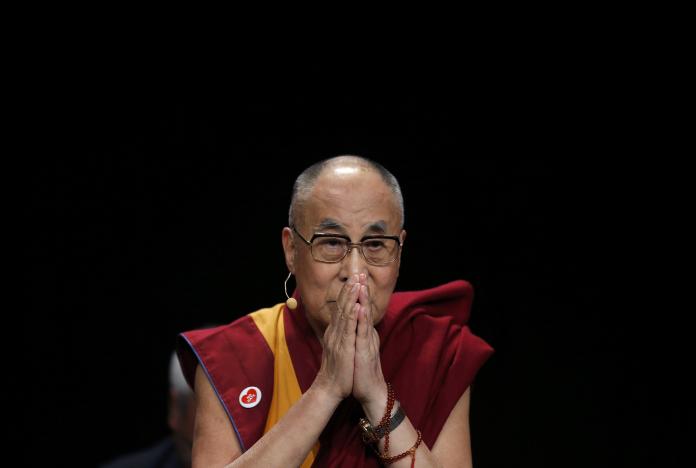
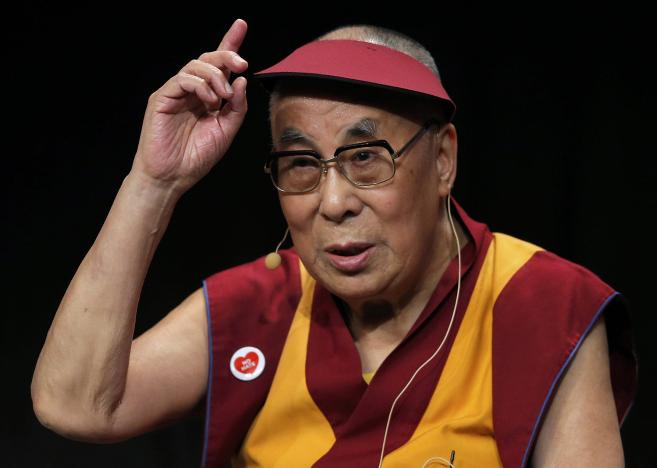
Tibet's exiled spiritual leader the Dalai Lama attends a meeting with youth in Strasbourg, France, September 15, 2016. REUTERS/Vincent Kessler
Tibet’s exiled spiritual leader the Dalai Lama attends a meeting with youth in Strasbourg, France, September 15, 2016. REUTERS/Vincent Kessler

Tibet’s exiled spiritual leader the Dalai Lama attends a meeting with youth in Strasbourg, France, September 15, 2016. REUTERS/Vincent Kessler

Tibet's exiled spiritual leader the Dalai Lama gestures as he delivers a speech at the Council of Europe in Strasbourg, France, September 15, 2016. REUTERS/Vincent Kessler
Tibet’s exiled spiritual leader the Dalai Lama gestures as he delivers a speech at the Council of Europe in Strasbourg, France, September 15, 2016. REUTERS/Vincent Kessler

Tibet’s exiled spiritual leader the Dalai Lama gestures as he delivers a speech at the Council of Europe in Strasbourg, France, September 15, 2016. REUTERS/Vincent Kessler

Tibet's exiled spiritual leader the Dalai Lama gestures as he attends a meeting with youth in Strasbourg, France, September 15, 2016. REUTERS/Vincent Kessler
Tibet’s exiled spiritual leader the Dalai Lama gestures as he attends a meeting with youth in Strasbourg, France, September 15, 2016. REUTERS/Vincent Kessler

Tibet’s exiled spiritual leader the Dalai Lama gestures as he attends a meeting with youth in Strasbourg, France, September 15, 2016. REUTERS/Vincent Kessler

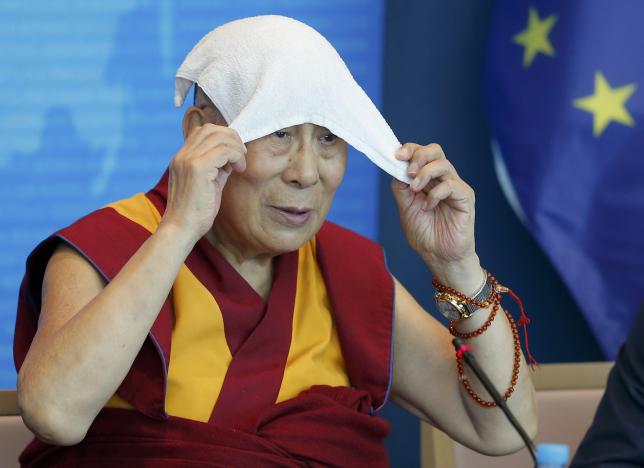
Tibet's exiled spiritual leader the Dalai Lama puts a towel on his head during a visit at the Council of Europe in Strasbourg, France, September 15, 2016. REUTERS/Vincent Kessler
Tibet’s exiled spiritual leader the Dalai Lama puts a towel on his head during a visit at the Council of Europe in Strasbourg, France, September 15, 2016. REUTERS/Vincent Kessler

Tibet’s exiled spiritual leader the Dalai Lama puts a towel on his head during a visit at the Council of Europe in Strasbourg, France, September 15, 2016. REUTERS/Vincent Kessler

Tibet's exiled spiritual leader the Dalai Lama gestures as he attends a meeting with youth in Strasbourg, France, September 15, 2016. REUTERS/Vincent Kessler
Tibet’s exiled spiritual leader the Dalai Lama gestures as he attends a meeting with youth in Strasbourg, France, September 15, 2016. REUTERS/Vincent Kessler

Tibet’s exiled spiritual leader the Dalai Lama gestures as he attends a meeting with youth in Strasbourg, France, September 15, 2016. REUTERS/Vincent Kessler

Tibet's exiled spiritual leader the Dalai Lama gestures as he delivers a speech at the Council of Europe in Strasbourg, France, September 15, 2016. REUTERS/Vincent Kessler
Tibet’s exiled spiritual leader the Dalai Lama gestures as he delivers a speech at the Council of Europe in Strasbourg, France, September 15, 2016. REUTERS/Vincent Kessler

Tibet’s exiled spiritual leader the Dalai Lama gestures as he delivers a speech at the Council of Europe in Strasbourg, France, September 15, 2016. REUTERS/Vincent Kessler

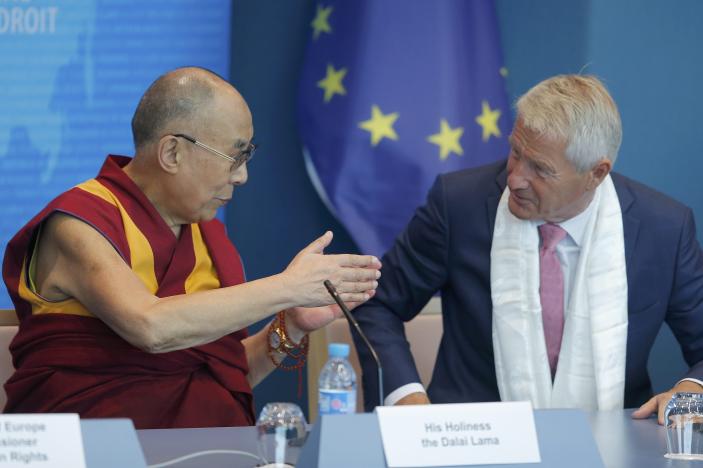
Tibet's exiled spiritual leader the Dalai Lama (L) talks with Secretary General of the Council of Europe Thorbjorn Jagland, during his visit at the Council of Europe in Strasbourg, France, September 15, 2016. REUTERS/Vincent Kessler
Tibet’s exiled spiritual leader the Dalai Lama (L) talks with Secretary General of the Council of Europe Thorbjorn Jagland, during his visit at the Council of Europe in Strasbourg, France, September 15, 2016. REUTERS/Vincent Kessler

Tibet’s exiled spiritual leader the Dalai Lama (L) talks with Secretary General of the Council of Europe Thorbjorn Jagland, during his visit at the Council of Europe in Strasbourg, France, September 15, 2016. REUTERS/Vincent Kessler

Tibet's exiled spiritual leader the Dalai Lama gestures as he attends a meeting with youth in Strasbourg, France, September 15, 2016. REUTERS/Vincent Kessler
Tibet’s exiled spiritual leader the Dalai Lama gestures as he attends a meeting with youth in Strasbourg, France, September 15, 2016. REUTERS/Vincent Kessler

Tibet’s exiled spiritual leader the Dalai Lama gestures as he attends a meeting with youth in Strasbourg, France, September 15, 2016. REUTERS/Vincent Kessler

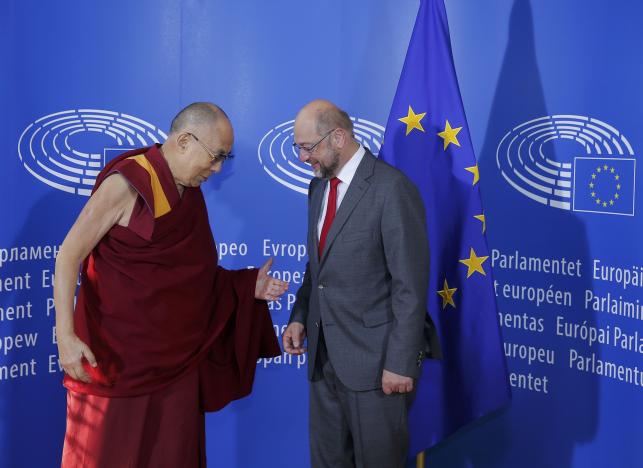
Tibet's exiled spiritual leader the Dalai Lama (L), is welcomed by European Parliament president Martin Schulz at his arrival at the European Parliament in Strasbourg, France, September 15, 2016. REUTERS/Vincent Kessler
Tibet’s exiled spiritual leader the Dalai Lama (L), is welcomed by European Parliament president Martin Schulz at his arrival at the European Parliament in Strasbourg, France, September 15, 2016. REUTERS/Vincent Kessler

Tibet’s exiled spiritual leader the Dalai Lama (L), is welcomed by European Parliament president Martin Schulz at his arrival at the European Parliament in Strasbourg, France, September 15, 2016. REUTERS/Vincent Kessler

Tibet's exiled spiritual leader the Dalai Lama (L), is welcomed by European Parliament president Martin Schulz at his arrival at the European Parliament in Strasbourg, France, September 15, 2016. REUTERS/Vincent Kessler
Tibet’s exiled spiritual leader the Dalai Lama (L), is welcomed by European Parliament president Martin Schulz at his arrival at the European Parliament in Strasbourg, France, September 15, 2016. REUTERS/Vincent Kessler

Tibet’s exiled spiritual leader the Dalai Lama (L), is welcomed by European Parliament president Martin Schulz at his arrival at the European Parliament in Strasbourg, France, September 15, 2016. REUTERS/Vincent Kessler

Tibet's exiled spiritual leader the Dalai Lama gestures as he arrives to deliver a speech at the Council of Europe in Strasbourg, France, September 15, 2016. REUTERS/Vincent Kessler
Tibet’s exiled spiritual leader the Dalai Lama gestures as he arrives to deliver a speech at the Council of Europe in Strasbourg, France, September 15, 2016. REUTERS/Vincent Kessler

Tibet’s exiled spiritual leader the Dalai Lama gestures as he arrives to deliver a speech at the Council of Europe in Strasbourg, France, September 15, 2016. REUTERS/Vincent Kessler

Tibet's exiled spiritual leader the Dalai Lama gestures as he delivers a speech at the Council of Europe in Strasbourg, France, September 15, 2016. REUTERS/Vincent Kessler
Tibet’s exiled spiritual leader the Dalai Lama gestures as he delivers a speech at the Council of Europe in Strasbourg, France, September 15, 2016. REUTERS/Vincent Kessler

Tibet’s exiled spiritual leader the Dalai Lama gestures as he delivers a speech at the Council of Europe in Strasbourg, France, September 15, 2016. REUTERS/Vincent Kessler

STRASBOURG, France Tibet’s spiritual leader, the Dalai Lama, said on Thursday the European Union should offer “constructive criticism” of China.

Speaking at the European Parliament in Strasbourg, he said he hoped that the Tibetan issue would be resolved but urged the outside world and the European Union in particular not to hold back from criticizing Beijing.

Communist troops marched in and took control of Tibet in 1950 in what Beijing calls a “peaceful liberation”. The Dalai Lama fled to India in 1959 following a failed uprising against the Chinese.

“Some constructive criticism is sometime necessary, helpful,” the Dalai Lama told reporters.

Beijing denounces the Dalai Lama as a dangerous separatist who wants an independent Tibet. He denies espousing violence and says he only wants genuine autonomy for his Himalayan homeland.

Contact between the Dalai Lama and foreign governments is frequently a source of friction with Beijing. Although a guest of the European Parliament in Strasbourg, the Dalai Lama did not meet French government officials while in France.

(Reporting by Gilbert Reilhac; Writing by Matthias Blamont; Editing by Leigh Thomas and Dominic Evans)


BEIJING’S DOOM IS NEAR – STONE’S THROW AWAY

Telegram
BEIJING’S DOOM IS NEAR – STONE’S THROW AWAY

BEIJING’S DOOM IS NEAR – JUST A STONE’S THROW AWAY.

The New Testament Book ‘REVELATION’, Chapter 18 gives full account of sudden, unexpected Fall of Evil Empire. Beijing’s Doom is Near – Just A Stone’s Throw Away.

Rudranarasimham Rebbapragada
Ann Arbor, MI 48104-4162 USA
SPECIAL FRONTIER FORCE

Beijing's Doom is Near - Stone's Throw Away.
Beijing’s Doom is Near – Stone’s Throw Away.

Beijing's Doom is Near. Just a Stone's Throw Away.
Beijing’s Doom is Near. Just a Stone’s Throw Away.

Beijing's Doom is Near - Just a Stone's Throw Away.
Beijing’s Doom is Near – Just a Stone’s Throw Away.

Beijing's Doom is Near - Just a Stone's Throw Away.
Beijing’s Doom is Near – Just a Stone’s Throw Away.

Beijing's Doom is Near - Stone's Throw Away. Stones anointed for Red Dragon.
Beijing’s Doom is Near – Stone’s Throw Away. Stones anointed for Red Dragon.

Beijing's Doom is Near - Stone's Throw Away.
Beijing’s Doom is Near – Stone’s Throw Away.

Beijing's Doom is Near - Just a Stone's Throw Away.
Beijing’s Doom is Near – Just a Stone’s Throw Away.

Beijing's Doom is Near - Just a Stone's Throw Away.
Beijing’s Doom is Near – Just a Stone’s Throw Away.

Beijing's Doom is Near - Just a Stone's Throw Away.
Beijing’s Doom is Near – Just a Stone’s Throw Away.

facebook.png

The Spirits of Special Frontier Force | Facebook
 

Paperless Post

DOOMSAYER OF DOOM DOOMA – SLAYER OF RED DRAGON IN TIBET

DOOMSAYER OF DOOM DOOMA – SLAYER OF RED DRAGON IN TIBET

DOOMSAYER OF DOOM DOOMA – SLAYER OF RED DRAGON IN TIBET. I SERVED IN DOOM DOOMA TO CONFRONT RED DRAGON IN TIBET WITHOUT WEAPON.

Dragons exist in Tibetan mythology as well as in cultural traditions of China and other countries. When I served in Doom Dooma, Assam, India, I confronted the threat posed by ‘Red Dragon’ that occupied Tibet. I joined foot patrols of Himalayan Frontier without personal weapon. In Old Testament story, David faced Goliath with pebbles and sling apart from faith in his heart.

Doomsayer of Doom Dooma - Slayer of Red Dragon in Tibet. Extinction of Dinosaurs is not Myth.
Doomsayer of Doom Dooma – Slayer of Red Dragon in Tibet. Extinction of Dinosaurs is not Myth.

I am not a ‘Knight in Shining Armor’ and I am not writing Fairy Tale. Red Dragon in Tibet is not Myth from Fairy Tales.I am confronting Red Dragon in Tibet; not with weapon, and not even a slingshot. I am “Slayer of Red Dragon” for God unsealed the Prophecy that pronounces “Beijing is Doomed.” The story of Dinosaur Extinction is not Myth. Death of Red Dragon in Tibet will be Reality that Science can verify.

Rudranarasimham Rebbapragada
Ann Arbor, MI 48104-4162 USA
SPECIAL FRONTIER FORCE

Doomsayer of Doom Dooma - Slayer of Red Dragon in Tibet. Red Dragon in Tibet is not Myth from Fairy Tales.
Doomsayer of Doom Dooma – Slayer of Red Dragon in Tibet. Red Dragon in Tibet is not Myth from Fairy Tales.

Doomsayer of Doom Dooma - Slayer of Red Dragon in Tibet. At Doom Dooma, I confronted threat of Red Dragon without weapon. If God is Willing, the Dragon will be wiped out by Heavenly Force. Beijing is Doomed.
Doomsayer of Doom Dooma – Slayer of Red Dragon in Tibet. At Doom Dooma, I confronted the threat of Red Dragon without weapon. If God is Willing, the Dragon will be wiped out by Heavenly Force. Beijing is Doomed.


NewsGram


Giant Dragon fell from the sky in Tibet? Scientists skeptical about their Existence!

In ancient times real dragons in Tibet existed in myths as a symbol of power and fortune

By

NEWSDESK2

September 12, 2016

Doomsayer of Doom Dooma – Slayer of Red Dragon in Tibet.

Representation of Dragon in several mythological texts. Wikimedia Commons

Sept 12, 2016: Last month in August, a YouTube video that featured a monolithic dragon corpse, went viral on the social media and it was shared by Radio Valley 99, a radio station in Bhutan, which attracted millions of people and once again made people think of dragons in Tibet. The Concept of Dragon has always been a topic of fascination for the people around the world. Could this video be the evidence of real dragons in the Tibet?

If we turn pages back to the history there have been clues about dragons in ancient texts. “Dainel was said to kill a dragon in the apocryphal chapters of the Bible’’. Nevertheless, ancient civilizations have depicted them, believing that they were like any exotic animal. Apparently, dragons were thought to be useful and protective but when Christianity spread, people started to see them in a new light. There are even explanations in artworks drawn by ancient civilizations from long ago. So dragon’s existence have always been a question for the world?

Doomsayer of Doom Dooma – Slayer of Red Dragon in Tibet.

Architecture representing Dragon. Pixabay

If this video is true, could this change the course of science and history books all over the world?

In ancient times real dragons in Tibet existed in myths as a symbol of power and fortune. Scientists even do not completely disagree with the concept of dragons but they are not considered as real as dinosaurs who walked the earth millions of years ago. The skeptical behavior of Researchers about the idea of dragons is due to their giant structure because they are too giant to fly.

This leads us back to the alleged Real Dragons in Tibet. Is any of it real? Let us find out!

The real dragons in Tibet video itself showed dead dragon that is actually a sculpture. We have to give the artists some credit. With a dragon that looks that realistic, anyone could’ve been fooled! The dragon was a sculpture but it got a lot of attention from netizens, mentioned fxnewscall.com report.

As to the truth behind the incident of a dragon that fell from the sky in Tibet, Snopes, a website known for debunking hoaxes, claimed that video was nothing but fake.
The real dragon found is actually just a sculpture created for a TV show in Spain titled Cuatro Milenio, featuring myths and creatures of legends.

Dragons appear in mythologies of almost all countries around the world. Sometimes they’re protectors, other times teachers, guardians, or even villains. Regardless of the legitimacy of the video, dragons have always been a fascinating creature. They are still a wonder for the human mind hence people continue imagining them in books and movies alike. Fanatics of dragons will have to please their curiosity with Targaryen dragons on the Game of Thrones series for now! Real or not, dragons will never stop capturing our imagination.

– prepared by Aakash Mandyal of NewsGram

newsgram_c2opy-2-1-300x212.png

http://www.newsgram.com/
This account represents the NewsGram Team.


Anubhuti Gupta: “IF THEY EVER FIND A DRAGON, IT’LL PROBABLY JUST BE AN EVOLVED SPECIES OF DINOSAUR.”

newsgram-footer

© NewsGram from Chicago, USA/ Editor-in-Chief: Dr. Munish Kumar Raizada

Doomsayer of Doom Dooma - Slayer of Red Dragon in Tibet.
Doomsayer of Doom Dooma – Slayer of Red Dragon in Tibet.

Doomsayer of Doom Dooma - Slayer of Red Dragon in Tibet.
Doomsayer of Doom Dooma – Slayer of Red Dragon in Tibet.

Doomsayer of Doom Dooma - Slayer of Red Dragon in Tibet.
Doomsayer of Doom Dooma – Slayer of Red Dragon in Tibet.

Doomsayer of Doom Dooma - Slayer of Red Dragon in Tibet.
Doomsayer of Doom Dooma – Slayer of Red Dragon in Tibet.

Doomsayer of Doom Dooma - Slayer of Red Dragon in Tibet.
Doomsayer of Doom Dooma – Slayer of Red Dragon in Tibet.

Doomsayer of Doom Dooma - Slayer of Red Dragon in Tibet.
Doomsayer of Doom Dooma – Slayer of Red Dragon in Tibet.

Doomsayer of Doom Dooma - Slayer of Red Dragon in Tibet.
Doomsayer of Doom Dooma – Slayer of Red Dragon in Tibet.

Doomsayer of Doom Dooma - Slayer of Red Dragon in Tibet.
Doomsayer of Doom Dooma – Slayer of Red Dragon in Tibet.

Doomsayer of Doom Dooma - Slayer of Red Dragon in Tibet.
Doomsayer of Doom Dooma – Slayer of Red Dragon in Tibet.

Doomsayer of Doom Dooma - Slayer of Red Dragon in Tibet.
Doomsayer of Doom Dooma – Slayer of Red Dragon in Tibet. Red Dragon in Tibet brings Calamity, Catastrophe, and Disaster. Beijing is Doomed.

Doomsayer of Doom Dooma - Slayer of Red Dragon in Tibet.
Doomsayer of Doom Dooma – Slayer of Red Dragon in Tibet. Red Dragon in Tibet is unlike all other Dragons.

Doomsayer of Doom Dooma - Slayer of Red Dragon in Tibet.
Doomsayer of Doom Dooma – Slayer of Red Dragon in Tibet. Red Dragon in Tibet represents Tyranny, Oppression, Subjugation, and Occupation in Tibet.

Doomsayer of Doom Dooma - Slayer of Red Dragon in Tibet.
Doomsayer of Doom Dooma – Slayer of Red Dragon in Tibet. Red Dragon in Tibet is not my Creation. It represents Evil Doer, Evil One.

Doomsayer of Doom Dooma - Slayer of Red Dragon in Tibet.
Doomsayer of Doom Dooma – Slayer of Red Dragon in Tibet.

Doomsayer of Doom Dooma - Slayer of Red Dragon in Tibet.
Doomsayer of Doom Dooma – Slayer of Red Dragon in Tibet.

Doomsayer of Doom Dooma - Slayer of Red Dragon in Tibet.
Doomsayer of Doom Dooma – Slayer of Red Dragon in Tibet.

DOOMSAYER OF DOOM DOOMA – MY NIXON-FORD CONNECTION

DOOMSAYER OF DOOM DOOMA – MY NIXON-FORD CONNECTION

DOOMSAYER OF DOOM DOOMA – MY NIXON-FORD CONNECTION. I SERVED IN SPECIAL FRONTIER FORCE DURING PRESIDENCY OF NIXON AND FORD. MY CONNECTION SURVIVED THE TEST OF TIMES.

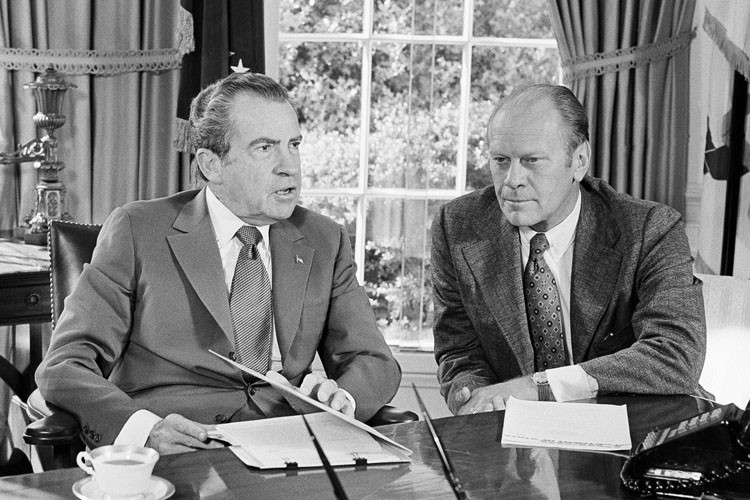
I account for events in my life using the Doctrine of Predestination. On September 08, 1974, President Gerald R. Ford grants ‘Full Pardon’ to Richard M Nixon, 37th President of the United States of America. I served in Special Frontier Force during the presidency of Nixon and Ford. I live in Ann Arbor, Michigan, a short distance away from Gerald R. Ford’s Presidential Library on University of Michigan Campus. My Nixon-Ford Connection survived the test of times.

DOOMSAYER OF DOOM DOOMA – MY NIXON-FORD CONNECTION. I SERVED IN SPECIAL FRONTIER FORCE DURING PRESIDENCY OF NIXON AND FORD. MY CONNECTION SURVIVED THE TEST OF TIMES.

In my opinion, President Ford’s ‘Full Pardon’ may not include pardon of Nixon’s Vietnam Treason. I cannot grant pardon to Nixon for he had never admitted his crime of Betrayal, Treachery in the conduct of Vietnam War. I still recognize Nixon as Backstabber of Tibet nation.

Rudranarasimham Rebbapragada
Ann Arbor, MI 48104-4162 USA
SPECIAL FRONTIER FORCE

This Day in History: Ford pardons Nixon

DOOMSAYER OF DOOM DOOMA - MY NIXON-FORD CONNECTION OF SEPTEMBER 08, 1974. THIS CONNECTION SURVIVES IN ANN ARBOR, MICHIGAN, USA.
DOOMSAYER OF DOOM DOOMA – MY NIXON-FORD CONNECTION OF SEPTEMBER 08, 1974. THIS CONNECTION SURVIVES IN ANN ARBOR, MICHIGAN, USA.

Author: History.com Staff Website Name: History.com

URL: http://www.history.com/this-day-in-history/ford-pardons-nixon

Publisher: A+E Networks

In a controversial executive action, President Gerald Ford pardons his disgraced predecessor Richard Nixon for any crimes he may have committed or participated in while in office. Ford later defended this action before the House Judiciary Committee, explaining that he wanted to end the national divisions created by the Watergate scandal.

The Watergate scandal erupted after it was revealed that Nixon and his aides had engaged in illegal activities during his reelection campaign–and then attempted to cover up evidence of wrongdoing. With impeachment proceedings underway against him in Congress, Nixon bowed to public pressure and became the first American president to resign. At noon on August 9, Nixon officially ended his term, departing with his family in a helicopter from the White House lawn. Minutes later, Vice President Gerald R. Ford was sworn in as the 38th president of the United States in the East Room of the White House. After taking the oath of office, President Ford spoke to the nation in a television address, declaring, “My fellow Americans, our long national nightmare is over.”

Ford, the first president who came to the office through appointment rather than election, had replaced Spiro Agnew as vice president only eight months before. In a political scandal independent of the Nixon administration’s wrongdoings in the Watergate affair, Agnew had been forced to resign in disgrace after he was charged with income tax evasion and political corruption. Exactly one month after Nixon announced his resignation, Ford issued the former president a “full, free and absolute” pardon for any crimes he committed while in office. The pardon was widely condemned at the time.

Decades later, the John F. Kennedy Library Foundation presented its 2001 Profile in Courage Award to Gerald Ford for his 1974 pardon of Nixon. In pardoning Nixon, said the foundation, Ford placed his love of country ahead of his own political future and brought needed closure to the divisive Watergate affair. Ford left politics after losing the 1976 presidential election to Democrat Jimmy Carter. Ford died on December 26, 2006, at the age of 93.


© 2016, A&E Television Networks, LLC. All Rights Reserved.

Doomsayer of Doom Dooma - My Nixon-Ford Connection. Nixon, Ford and Ladybird Mrs Johnson. I served in Special Frontier Force during Presidency of Nixon and Ford.
Doomsayer of Doom Dooma – My Nixon-Ford Connection. Nixon, Ford and Ladybird Mrs Johnson. I served in Special Frontier Force during Presidency of Nixon and Ford.

Doomsayer of Doom Dooma - My Nixon-Ford Connection. I served in Special Frontier Force on September 08, 1974 when Ford granted Full Pardon to Nixon.
Doomsayer of Doom Dooma – My Nixon-Ford Connection. I served in Special Frontier Force on September 08, 1974 when Ford granted Full Pardon to Nixon.

Doomsayer of Doom Dooma - My Nixon-Ford Connection. I served in Special Frontier Force during Presidency of Nixon and Ford. Now, I live in Ann Arbor, Michigan, a short distance from this Presidential Library.
Doomsayer of Doom Dooma – My Nixon-Ford Connection. I served in Special Frontier Force during Presidency of Nixon and Ford. Now, I live in Ann Arbor, Michigan a short distance away from this Presidential Library.

Doomsayer of Doom Dooma - My Nixon-Ford Connection. I served in Special Frontier Force during Presidency of Nixon and Ford. Now, I live in Ann Arbor, Michigan a short distance away from this Presidential Library.
Doomsayer of Doom Dooma – My Nixon-Ford Connection. I served in Special Frontier Force during Presidency of Nixon and Ford. Now, I live in Ann Arbor, Michigan a short distance away from this Presidential Library.

Doomsayer of Doom Dooma - My Nixon-Ford Connection. Gerald R. Ford Presidential Library on University of Michigan Campus in Ann Arbor speaks of my Nixon-Ford Connection since 1970s.
Doomsayer of Doom Dooma – My Nixon-Ford Connection. Gerald R. Ford Presidential Library on University of Michigan Campus in Ann Arbor speaks of my Nixon-Ford Connection since 1970s.


BEIJING IS DOOMED – STRIKE BY SPACE SUPERPOWER

BEIJING IS DOOMED – STRIKE BY SPACE SUPERPOWER

BEIJING IS DOOMED – STRIKE BY SPACE SUPERPOWER. DOWNFALL OF BABYLON. BOLIDE COLLISION AND DINOSAUR EXTINCTION. REVELATION 18: 1-24.

During 2016, Red China spends over Six Billion Dollars to become World’s Space Superpower. Unlike the weird Quantum Phenomenon called “entanglement,” Red China’s “ENTANGLEMENT” with EVIL is no mystery. It is Known to ‘Space Superpower’, or “My Father in Heaven.” The word “EVIL” means Calamity, Catastrophe, Apocalypse, or Disaster. In due recognition of Red China’s Evil actions, ‘Doomsayer of Doom Dooma’ announces, “Beijing Is Doomed.” Red China’s “Roaming Dragon” will watch helplessly when Space Superpower Strikes Pudong Dragon’s Field called Shanghai. Bolide Collision caused Dinosaur Extinction and it takes another Bolide to wipe out Red Dragon.

Rudranarasimham Rebbapragada
Ann Arbor, MI 48104-4162 USA
SPECIAL FRONTIER FORCE

Beijing Is Doomed – Strike By Space Superpower. “Roaming Dragon” will watch helplessly as Space Superpower Strikes Pudong Dragon’s Field.

CHINA: THE NEW SPACE SUPERPOWER

For years, its space programme was shrouded in secrecy. Now, with plans for Lunar and Mars Missions, and crowds at its launch sites, China is ready for liftoff.

BEIJING IS DOOMED
BEIJING IS DOOMED – STRIKE BY SPACE SUPERPOWER

The Long March 7 carrier rocket blasts off on 25 June 2016 at the Wenchang launch site in the Hainan province of China. Photograph: VCG/Getty Images

STUART CLARK

Sunday 28 August 2016 04.00 EDT

At 8 pm Beijing time on 25 June this year the tropical darkness over China’s Hainan province was temporarily banished by a blinding orange light. Accompanied by the thunderous roar of engines, a 53m-tall rocket pushed itself into the sky.

China is developing rapidly into one of the major space players

Fabio Favata, European Space Agency

An increasing number of Chinese rockets have launched in the past few years but this one was significant for three reasons. It was the first launch of the new Long March 7 rocket, designed to help the Chinese place a multi-module space station in orbit. It was the first liftoff from China’s newly constructed Wenchang launch complex, a purpose-built facility set to become the focus for Chinese space ambitions. And it was the first Chinese launch where tourists were encouraged to go along and watch.

For a space programme that has long been shrouded in secrecy, it’s a major step. The Wenchang complex has been designed with large viewing areas, and in the sultry heat of that June night, tens of thousands of spectators stood cheering as the rocket began its 394km journey above the Earth and into orbit.

“China is developing very rapidly into one of the major space players,” says Fabio Favata, head of the programme coordination office at the European Space Agency’s (ESA) directorate of science. 

BEIJING IS DOOMED - SPACE SUPERPOWER.
BEIJING IS DOOMED – STRIKE BY SPACE SUPERPOWER.

The Long March 7 carrier rocket moves vertically to the launch tower in Wengchang, 22 June 2016. Photograph: VCG via Getty Images

China launched a pioneering “hack proof” quantum communication satellite, called Quantum Experiments at Space Scale, on 16 August from its older Jiuquan launch centre in the Gobi Desert. This is the first large-scale satellite designed to investigate the weird quantum phenomenon called “entanglement” that so unnerved Albert Einstein he once called it “spooky”. In addition, China is preparing to launch another new rocket design, a new space station, an X-ray telescope and a crewed mission before the year is out.

China is estimated to spend around $6bn a year on its space programme. Although that is almost $1bn more than Russia, it is still a fraction of the American Space Budget, which is around $40bn a year. Despite its large budget, the US made only 19 successful space launches in 2013, compared with China’s 14 and Russia’s 31. With numbers like this, it is clear that China has arrived in space, and is set to become stronger.

To use a Chinese phrase, they want to bring their own mat to the table. They want respect from the space community

“You will see the Chinese quite visibly begin to match the capacity of the other spacefaring powers by 2020,” predicts Brian Harvey, space analyst and author of China in Space: The Great Leap Forward. Key to this will be the large manned space station, Tiangong, which they plan to have in orbit by then. Although not as physically large as the International Space Station America, Russia, Europe, Japan and other countries have been building and using since 1998, China’s space station will have a broadly similar capacity to perform science.

“Science is becoming more and more important in the Chinese space programme,” says Wang Chi of the National Space Science Centre, Chinese Academy of Sciences. “We are not [just] satisfied with the achievements we have made in the fields of the space technology and space application. With the development of the Chinese space programme, we are trying to make contributions to human knowledge about the universe.”

Beijing is Doomed.
Beijing is Doomed – Strike By Space Superpower.


Chinese astronauts of the Shenzhou 10 manned spacecraft mission, Wang Yaping, Nie Haisheng and Zhang Xiaoguang. Photograph: ChinaFotoPress via Getty Images

Perhaps most impressive is the broad front on which the Chinese space programme is advancing. They are making strides in everything from human space flight to space science and planetary exploration.

So do the Chinese want to take over space? Brian Harvey, space analyst and author of China in Space: The Great Leap Forward, believes the Chinese simply want to be seen as equals. “To use a Chinese phrase, I think they are wanting to bring their own mat to the table,” he says. “They are looking for equality, they want respect from the world’s space community.”

To that end, China’s biggest inroad has been made with the ESA through the space science programme. Soon after the turn of the century. ESA launched the Cluster Mission to study so-called “space weather” and the electrical malfunctions this could cause on satellites. The Chinese were keen to learn more about space weather too and came to the European agency with a proposal: they would build extra satellites to enhance the Cluster mission if ESA would collaborate with them.

“They understood that space weather was a key challenge as we rely more and more on technology in orbit,” says Christopher Carr, a physicist at Imperial College, London, who worked on the Cluster mission. ESA took care of the negotiations, allowing scientists, including Carr, to build the instruments unhindered. Although there were some differences in working methods that had to be ironed out, Carr says: “Overall it was an enjoyable collaboration.”

The Double Star mission was launched in 2003 and became China’s first scientific satellite. Cluster and Double Star have so far produced 2,300 peer-reviewed science papers. “That is an enormously successful, astonishing scientific output,” says Carr.

China has gone from strength to strength. In December 2015, it launched the Dark Matter Particle Explorer, a satellite to look for the mysterious non-atomic matter that astronomers believe makes up a large fraction of the universe. This December, it plans to launch the Hard X-ray Modulation Telescope to look for black holes. ESA and China are working together on a new mission – the Solar Wind Magnetosphere Ionosphere Link Explorer (Smile), which is slated for launch in 2021.

The Chinese know that the value of these collaborations extends way beyond the science. “We are the newcomers in space science, and don’t have much experience,” says Wang Chi. “International collaborations are the shortcut for China to catch up with the world. In addition, science, especially space science, should be the responsibility of all humans around the globe. International collaboration is the effective way to obtain the maximum science return from any space mission.”

Favata agrees: “At ESA we collaborate with all major spacefaring nations. If Smile works well it is likely to be the pathfinder for future missions. ”

In stark contrast is America, where there is a blanket ban on working with China that dates back years. The most obvious consequence of this has been the exclusion of China from the International Space Station. But far from slowing the Chinese down, the cold shoulder has actually speeded them up.

Circling above us at the moment is the disused shell of China’s first space station. The eight-ton Tiangong 1 (Heavenly Palace) was launched on 29 September 2011 and hosted two three-person crews between 2012 and 2013. It is now abandoned and expected to re-enter Earth’s atmosphere some time later this year.

The Chinese will launch Tiangong 2, a second test station, next month. It will lead to a substantial orbital facility that will be in use by 2020. Known simply as Tiangong, it will be a key base for space research, with two large science modules joined together by a connecting service module.

“They can do a lot of science on it. It will have a research capacity that the ISS didn’t reach nearly as quickly,” says Harvey.

China is not planning to keep Tiangong all to itself. In June, it signed an agreement with the UN Office for Outer Space Affairs to open the station to experiments and astronauts from UN member states, specifically developing countries that find space too expensive at the moment.

And running the experiments is where China’s astronaut programme comes in. There have been just five crewed space flights since 2003, and none at all since 2013. This is deliberate. “The idea is to take a significant step forward each time,” says Harvey, “and they’re not going to cut corners in terms of safety.”

Beijing is Doomed.
Beijing is Doomed – Strike By Space Superpower.


2011: the Long March II-F rocket carrying the China’s first space station module Tiangong 1 at the Jiuquan Satellite Launch Center in north-west China’s Gansu Province. Photograph: AP

For the next decade, the Tiangong space station is likely to be the principal destination. Their crew capsule is called Shenzhou (divine vessel). It looks similar to the Russian Soyuz modules probably because the Chinese bought Soyuz technology in the mid-90s. This same agreement saw the training of two Chinese astronauts at the Yuri Gagarin Cosmonaut Training Centre in Russia, who then returned to China and trained more astronauts themselves.

Twelve Chinese astronauts have now been into space, including Liu Yang who became the first Chinese woman in space on Shenzhou 9 in 2012. Assuming the Tiangong 2 gets to orbit in September, then Shenzhou 11 will follow on 16 October, carrying two people whose identities have yet to be made public who are scheduled to spend a month on board.

“I think the military element in the Chinese space programme is quite overstated” : Brian Harvey, space analyst

Looking to the future, the Chinese have already begun testing the larger replacement of the Shenzhou capsule. A scaled-down version flew on the June flight of the Long March 7 from Hainan. This larger vehicle will be capable of taking up to six crew to the full Tiangong space station or on missions to lunar orbit.

It was the secondary payload, Aolong 1 (Roaming Dragon), on that launch that raised eyebrows, and stoked fears in some quarters that the civilian space programme is just a front for more covert operations. Aolong 1 has a robotic arm that can grab another satellite and guide it to burn up in Earth’s atmosphere. Officially, it is to remove space debris from orbit but it could also be used as a weapon, bringing down a rival’s satellite.

Although this is true of any space debris removal system, doubts remain because China does not have an unblemished record in anti-satellite weaponry. In 2007, the Chinese shot down one of their own orbiting spacecraft in what was probably a thinly veiled warning to America. Chinese concerns had been growing since 2002 when the US withdrew from 1972’s Anti-Ballistic Missile treaty, which paved the way for President George W Bush’s administration to develop space-based weapons systems.

Since that time, concern over China’s militarization of space has persisted in America. To others, however, that is little more than paranoia. “I think the military element in the Chinese space programme is overstated,” says Harvey. “It’s based on a misreading of the fact that their facilities are protected by the military. It’s a bit like saying the US military controlled the Apollo programme because the US navy took the returning astronauts out of the ocean. It doesn’t stand up.”

Beijing is Doomed - Space Superpower.
Beijing is Doomed – Strike By Space Superpower.

The Long March 2D carrier rocket carrying the remote sensing satellite Yaogan IV blasts off in December 2008. China claimed the satellite was used for scientific research purposes. Some western analysts believed they were spy satellites. Photograph: ChinaFotoPress/Getty Images

The military may not be in the driving seat, but it does launch about 15-20% of China’s space missions. The Yaogan series of satellites are billed as remote sensing missions but analysts believe they are actually spy satellites. “I suspect they are entirely military missions. I’ve never seen any scientific papers from the Yaogan missions,” says Harvey.

It is this American fear of China’s military that’s been driving the ban on collaboration, in particular the prevention of technologies being transferred to China by mistake. But now ESA has found a way to allow collaboration without the loss of control. It is “an elegant solution”, says astrophysicist Graziella Branduardi-Raymont at University College London, who is working on Smile. “China builds the basic spacecraft and sends it to Europe. ESA and its collaborators then attach the payload module, which holds the science instruments, and launches the mission. That way, no western tech goes to China.”

The Russians never got much further than paper studies in the 1970s. This is real, the spacecraft is already built

When it comes to rockets, China continues to develop a formidable arsenal of launch vehicles. Their rockets are called Long March and have been in development since the 1970s. The mainstay of their complement is gradually being replaced by the Long March 5, 6 and 7.

While the Long March 7 in June was capable of lifting about 13 tonnes into low Earth orbit, it is the Long March 5 that analysts are really excited about. Due to make its maiden flight this autumn, it’s capable of lifting 25 tonnes to low Earth orbit, rivaling anything the Americans, Russians or Europeans currently have. It is not yet known what the Long March 5 will send into orbit, but the giant rocket’s second flight, scheduled for next year, will be carrying a very special cargo. It will be a robotic mission designed to land on the lunar surface and send back samples of moon rock to the Earth for Chinese scientists to analyse.

Beijing is Doomed - Space Superpower.
Beijing is Doomed – Strike By Space Superpower.


China’s Shenzhou 10 rocket blasts off from the Jiuquan space centre in the Gobi Desert in June 2013. Photograph: AFP/Getty Images

The Chinese call their lunar exploration mission Chang’e, after the Chinese goddess of the moon. In December 2013 Chang’e 3 hit the headlines after it successfully deployed a small rover on the lunar surface. Despite some technical problems, it continued to return data until just a few weeks ago.

Now, China plans to land a similar mission on the far side of the Moon in 2018. This will be a world first. “The Russians did think about such a mission in the 1970s but they never got much further than paper studies. This is real, the spacecraft is already built,” says Harvey.

Also in the advanced planning stages is a rover to go to Mars. Penciled in for launch in 2020, the Chinese Mars mission is going to find itself racing NASA and the ESA, which have their own Mars rover missions launching that year too.

But what about a human landing on the moon? There could be no bigger sign of Chinese competency than that. Sure, America did it almost 50 years ago but with each passing year Apollo seems to have less relevance to the modern exploration of space. NASA has held back from committing to a new round of lunar landings. Russia and ESA would both like to go to the moon but can’t go it alone. The Chinese, however, seem to have the lunar surface in their sights. Designs for a Long March 9 rocket are currently being studied. With the first launch for the Long March 9 due in 2025, China could very well be in a position to land astronauts on the moon by 2030. This puts it roughly neck-and-neck with America, which currently plans to send astronauts to lunar orbit in 2023 but which has made no commitment to returning to the surface.

Beijing Is Doomed – Strike By Space Superpower.

Liu Yang, China’s first female astronaut, waves during a departure ceremony before becoming the first Chinese woman in space in June 2012. Photograph: Jason Lee/Reuters

Almost certainly this will be a flashpoint, but the ignition of a new space race would be a mistake. The Apollo programme of the 1960s cost the equivalent of hundreds of billions of dollars for little more than technological one-upmanship. Better now, surely, to cooperate, spreading the cost and the benefit across the world.

The Chinese space programme is gaining momentum year upon year. Its power lies not in unlimited funds but in carefully chosen projects, and the pursuit of clearly targeted goals – something the traditional space powers could learn from, especially when is comes to the crewed programmes.

At present there is no agreement on what to do when the current agreements to use the International Space Station come to an end in 2024. With America continuing to talk about hugely expensive missions to Mars, but with no real plans or budget in place to do this, Russia and ESA could increasingly find that their space ambitions are more aligned with those of the Chinese.

Beijing Is Doomed – Strike By Space Superpower.

Mission control at the Jiuquan space centre in the Gobi Desert after China’s longest manned space mission in 2013. Photograph: AFP/Getty Images

What is clear is that the Chinese space programme is more willing than ever to cooperate. With the signing of the UN agreement to host foreign experiments and eventually astronauts on their space station, the Chinese are opening up. It is of course hard to imagine Russia and in particular ESA abandoning Nasa altogether, but it is not inconceivable. In the aftermath of 2008’s credit crunch, Nasa pulled out of a number of high-profile joint missions with Europe, including robotic Mars exploration and space-based observatories. This left ESA floundering for new partners, or frantically rescoping its missions. Increasingly, China will play a role in the international exploration of space, and although it is early days they have so far they have proved to be highly reliable.

A seismic shift in space power is taking place. Europe could pivot either way or balance in the middle. Although most still talk about China “becoming” a space superpower, it is likely that history will record the tipping point as 25 June this year, when a giant rocket split the sky amid the cheers of more than 20,000 tourists.

© 2016 Guardian News and Media Limited or its affiliated companies. All rights reserved.

Beijing Is Doomed - Strike By Space Superpower. Genesis 19. Sodom and Gomorrah Destroyed.
Beijing Is Doomed – Strike By Space Superpower. Genesis 19. Sodom and Gomorrah Destroyed.

Beijing Is Doomed - Strike By Space Superpower. Genesis 19. Downfall of Sodom and Gomorrah.
Beijing Is Doomed – Strike By Space Superpower. Genesis 19. Downfall of Sodom and Gomorrah.

Beijing Is Doomed - Strike By Space Superpower. Genesis 19. Burning of Sodom and Gomorrah.
Beijing Is Doomed – Strike By Space Superpower. Genesis 19. Burning of Sodom and Gomorrah.

Beijing Is Doomed - Strike by Space Superpower. Genesis 19: 24-25. Burning of Sodom and Gomorrah.
Beijing Is Doomed – Strike by Space Superpower. Genesis 19: 24-25. Burning of Sodom and Gomorrah.

Beijing Is Doomed - Strike by Space Superpower. Genesis 19. Sodom and Gomorrah Destroyed.
Beijing Is Doomed – Strike by Space Superpower. Genesis 19. Sodom and Gomorrah Destroyed.

Beijing Is Doomed - Strike By Space Superpower. Genesis 19. Regime Change By Burning Sulfur.
Beijing Is Doomed – Strike By Space Superpower. Genesis 19. Regime Change By Burning Sulfur.

BEIJING IS DOOMED - STRIKE BY SPACE SUPERPOWER.. GENESIS 19: 24-25.
BEIJING IS DOOMED – STRIKE BY SPACE SUPERPOWER.. GENESIS 19: 24-25.


MAGIC KINGDOM IN SHANGHAI – MAGIC OF REGIME CHANGE IN PUDONG DRAGON’S FIELD

MAGIC KINGDOM IN SHANGHAI – MAGIC OF REGIME CHANGE IN PUDONG DRAGON’S FIELD

MAGIC KINGDOM IN SHANGHAI – MAGIC OF REGIME CHANGE IN PUDONG DRAGON’S FIELD. DOWNFALL OF BABYLON. REVELATION 18: 1-24.

Communist Party of China makes huge capital investment to open Disneyland Amusement Park ‘Magic Kingdom’ in Shanghai. Communist Party of China will know Magic of Regime Change in Pudong Dragon’s Field. Prophecy of Babylon’s sudden Downfall Unsealed.

Rudranarasimham Rebbapragada
Ann Arbor, MI 48104-4162 USA
SPECIAL FRONTIER FORCE

MAGIC KINGDOM IN SHANGHAI – MAGIC OF REGIME CHANGE IN PUDONG DRAGON’S FIELD. FALL OF BABYLON, REVELATION 18: 1-24.

Business News

Shanghai Disneyland: Communist Party emerges largest backer

Though capitalism and socialism make strange bedfellows, it is less known that the largest backer of Disneyland is the Communist Party itself

By: ANURAG VISWANATH Published: August 13, 2016 6:21 AM

Magic Kingdom in Shanghai - Magic of Regime Change. Fall of Babylon in Pudong Dragon's Field. Revelation 18: 1-24.
Magic Kingdom in Shanghai – Magic of Regime Change. Fall of Babylon in Pudong Dragon’s Field. Revelation 18: 1-24.

This summer, Walt Disney’s $5.5-billion Disneyland—an extravaganza of a narrowly-construed “American fantasy”—finally opened its doors in Shanghai, China. This was to a largely curious domestic audience who, up until now, had been unable to afford the luxury of next-door Hong Kong’s Disneyland. Certainly, the mad rush at Shanghai’s Disneyland—located at the south-eastern fringes of Pudong, which until 1990s was marshes, farmland and herdsmen, so-to-speak an area on Shanghai’s fringe—is to be seen to be believed. In the metamorphosis of the Pudong marshes and the coming of Mickey Mouse to Mao’s land, hangs many a tale.

But first the euphoria. Despite the exorbitantly-priced entry ticket to Disneyland (RMB 499 for peak season, about R4,900), folks, both urban and rural, young and old, have not stopped making a beeline—and this in a country where the average disposable income is RMB 1,830 (about R18,000). Three-hour serpentine queues for flight simulator “Soaring Over the Horizon”, the partial closure of “Adventure Isle Roaring Rapids” and the scorching Shanghai summer heat didn’t deter crowds who flocked armed with parasols, water bottles and a few sporting the ubiquitous Mickey Mouse T-shirts. Disneyland is expecting 20 million visitors in 2017. Chinese Tourism spending is estimated at $610 billion in China and abroad. There are about 120 million outbound Chinese tourists—six times the number of outbound Indian tourists (20 million). China’s domestic tourism is high during the two “golden weeks” (National Day in October and Spring Festival in February) and is on the upsurge. Mickey Mouse wants to cash in.

What does the arrival of Mickey Mouse in China mean? While there are little doubts about the sheer elasticity of China’s “socialism with Chinese characteristics”, the bottom line is Communist Party’s propensity for hard-nosed economics—where tourism and, de facto, consumption is the new mojo.

Certainly, Disneyland did not happen overnight, but came with the careful cultivation of Pudong.

Nothing exemplifies Pudong more than China’s moderniser-par-excellence Deng Xiaoping’s adage “build nests, the birds will come”. Pudong, an area on the wrong side of the Huangpu River, was long barren until it was identified as the “dragon-head of reforms” by none other than Deng Xiaoping in 1992. Since then, the urbanisation of Pudong has been phenomenal—attested by the world’s second-tallest skyscraper, Shanghai Tower. Pudong is a mirror to China’s urbanisation, from 17.9% in 1978 to 53.7% in 2013. Today, urbanisation—a la Pudong—has been identified as the core strategy for development by the National Urbanisation Plan (2014-20), with the objective of 60% urbanisation by 2020. Of course, Pudong has been successful, but the blind precipitous imitation of the Pudong strategy elsewhere by local governments has backfired. In fact, scholars and critics decry the same as “forced urbanisation”.

That said, the sheer weight of state-led initiative to urbanise Pudong is no less laudatory.

Second, while business in India depends on political weather and ideological rhetoric, Disneyland was embraced with flexibility, if you please, to accommodate ideological lightweights such as Mickey and his friends. Disneyland witnessed little or no political upheavals (notwithstanding political succession struggles at Beijing)—when the Communist Party gave the commitment, it was for the long haul—start to finish.

While India continues to struggle with land acquisition, with the onus for acquisition resting on states, China does it swiftly and top-down. Disneyland covers 960 acres, nine times the size of Commonwealth Games Village, New Delhi—leading up to the relocation of 150 factories and the resettlement of 2,000 households belonging to four townships. At last count, there was no social assessment project, but there was no widespread bungling of finances in the resettlement either.

Thus, business in China largely rides on the diktat of the Party, which has a long-term vision. Disneyland was a hard-won fight with lobbying and negotiations, starting in the late 1990s. The chief executive of Disney, Robert Iger, first visited Communist Party leader Yu Zhengsheng in Shanghai in 2008. To Disney’s credit, a photograph of senior Xi (father of current Chinese President Xi Jinping) shaking hands with Mickey Mouse at Disneyland (presumably in California) in 1980 appeared as a token of friendship—no doubt, a veritable diplomatic coup.

Though capitalism and socialism make strange bedfellows, Disney’s entry was not all about diplomatic manoeuvres only. It is less known that the largest backer of Disneyland is the Communist Party itself—in the shape of Disney’s local partner, state-owned, joint-investment holding Shanghai Shendi Group.

While Disney owns 43% of the resort, the Shanghai Shendi Group, in addition to 30% control of the Disney management company, takes “57% stake in the Shanghai resort, which includes revenue from hotels, restaurants and merchandise sold on the grounds.” This has been a cut-throat deal as opposed to Disney’s presence in Hong Kong (2005), which literally cajoled Disney to set up shop.

Third, Pudong, the dragon-head, has spurred a multiplier effect. Now, Shanghai Shendi Group has concluded a deal with US outlet developer Value Retail to build an outlet and a seven-star hotel, Shanghai Atlantis resort will follow.

At Beijing, Universal Studios has said that its sixth theme park globally—after Hollywood and Orlando in the US, and in Spain, Singapore and Tokyo—will be operational by 2019.

Fourth, at the home front, Chinese billionaire and largest commercial property developer Wang Jianlin (head of the Dalian Wanda Group which signed a preliminary agreement with Indian authorities to develop Wanda Industrial New City in Haryana) has likened Disney to a “lone tiger” against a “pack of wolves”, indicating competition at the home turf.

For now, the pack of wolves seem to emanate from the Wanda stable and should not be underestimated. A lavish array of theme parks have been set afloat by Wanda in tier-2 cities—such as Wuxi (near Shanghai), Nanchang (730-km east of Shanghai), Hefei (460-km east of Shanghai), Harbin (2,300-km north of Shanghai) and Xishuangbanna (2,900-km south of Shanghai)—which are centred not around Mickey Mouse or even Pokemon, but elements of local Chinese ethnic culture, geography or tradition. Reportedly, Xishuangbanna theme park features adventures around the old Tea Road (route) and a jungle adventure with a rainforest theme. In other words, will Wanda give Disneyland a run for its money?

Disneyland in Shanghai has a sense of “Chineseness”—as it does in Japan with a certain “Japaneseness”. But Mickey Mouse has also come with American prices in China—RMB 60 doughnut, RMB 60 balloon (about R600) and an overpriced ticket. Ten years ago, Disneyland would have been a monopoly, but what about today? Those who have been to the string of mid-range Wanda hotels know that it cuts no corners and so it is with the Wanda theme parks. In other words, while the euphoria is palpable, Disneyland’s fate in the long run is the big question.

Last but not the least, be it Mickey Mouse or Wanda’s Tea Road adventure, grant it to the Communist Party, which has done its math well—an eye on tourism, the burgeoning middle-class
and a ride to the bank. With global and China’s slowdown in exports, a thrust towards domestic consumption, Disneyland (and Wanda parks) all help drive up consumer spending.

The author is a Singapore-based Sinologist and adjunct fellow at the Institute of Chinese Studies,
New Delhi. She is the author of “Finding India in China”

Copyright © The Indian Express [P] Ltd. All Rights Reserved.

Magic Kingdom in Shanghai - Magic of Regime Change in Pudong Dragon's Field. Fall of Babylon, Revelation 18: 1-24.
Magic Kingdom in Shanghai – Magic of Regime Change in Pudong Dragon’s Field. Fall of Babylon, Revelation 18: 1-24.

Magic Kingdom in Shanghai - Magic of Regime Change in Pudong Dragon's Field.
Magic Kingdom in Shanghai – Magic of Regime Change in Pudong Dragon’s Field.

Magic Kingdom in Shanghai - Magic of Regime Change in Pudong Dragon's Field.
Magic Kingdom in Shanghai – Magic of Regime Change in Pudong Dragon’s Field.

Magic Kingdom in Shanghai - Magic of Regime Change in Pudong Dragon's Field.
Magic Kingdom in Shanghai – Magic of Regime Change in Pudong Dragon’s Field.

Magic Kingdom in Shanghai - Magic of Regime Change in Pudong Dragon's Field.
Magic Kingdom in Shanghai – Magic of Regime Change in Pudong Dragon’s Field.

Magic Kingdom in Shanghai - Magic of Regime Change in Pudong Dragon's Field. Fall of Babylon, Revelation 18: 1-24.
Magic Kingdom in Shanghai – Magic of Regime Change in Pudong Dragon’s Field. Fall of Babylon, Revelation 18: 1-24.

Downfall of Red Dragon - Regime Change By Bolide Impact. Refer to REVELATION, 18:1-24. Bolide Impact Dinosaur Extinction.
Magic Kingdom in Shanghai – Magic of Regime Change in Pudong Dragon’s Field. Downfall of Babylon – Regime Change By Bolide Impact. REVELATION 18: 1-24. 


DOWNFALL OF RED DRAGON – REGIME CHANGE BY BOLIDE IMPACT

DOWNFALL OF RED DRAGON – REGIME CHANGE BY BOLIDE IMPACT

DOWNFALL OF RED DRAGON - REGIME CHANGE BY BOLIDE IMPACT. REFER TO REVELATION, 18:1-24.
DOWNFALL OF RED DRAGON – REGIME CHANGE BY BOLIDE IMPACT. REFER TO REVELATION, 18:1-24.

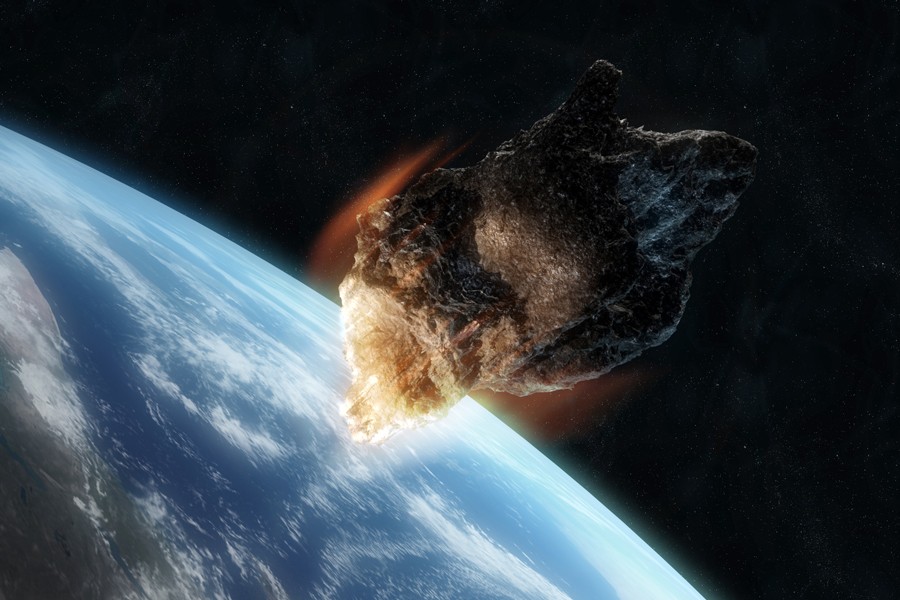
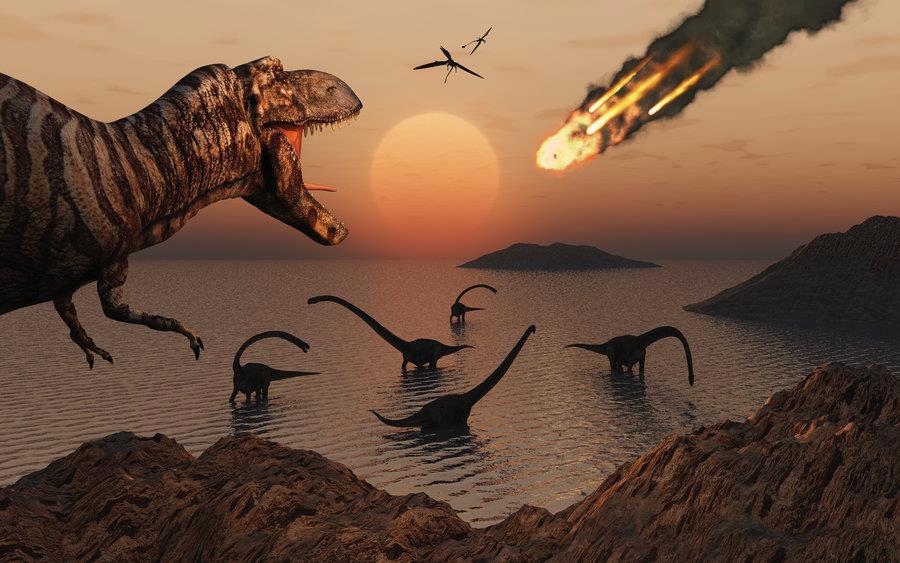
Natural History of planet Earth records sudden demise of Dinosaurs that lived for about 160 million years. Dinosaur Extinction is called Cretaceous – Tertiary or K-T Mass Extinction Event. This downfall of Dinosaurs is attributed to “BOLIDE” impact; a large Meteor or asteroid, or comet exploding in Earth’s atmosphere.

In Human History, powerful regimes have risen and have fallen down. But, there is no historical record of any empire’s downfall caused by ‘Bolide’ impact. Interestingly, The New Testament Book ‘REVELATION’ in Chapter 18 predicts Fall of Babylon by ‘Bolide’ impact. This prophecy has not yet come true.

I unsealed this prophecy for I am destined to be known as ‘Doomsayer of Doom Dooma’. For the first time in recorded Human History, I expect Regime Change by ‘Bolide’ Impact causing sudden Downfall of Evil Red Empire which is often represented by ‘Red Dragon’.

Rudranarasimham Rebbapragada
Ann Arbor, MI 48104-4162 USA
SPECIAL FRONTIER FORCE

THIS DAY IN HISTORY: 08/12/1990 – SKELETON OF T-REX DISCOVERED

Downfall of Red Dragon – Regime Change by Bolide Impact. Tyrannosaurus rex Skeleton Discovered on August 12, 1990.


A full Tyrannosaurus Rex skeleton is discovered on This Day in History. The date is August 12th. Susan Hendrickson, a paleontologist, discovers the T Rex in Faith, South Dakota.

Author: History.com Staff URL:http://www.history.com/this-day-in-history/skeleton-of-tyrannosaurus-rex-discovered Publisher: A+E Networks

On this day in 1990, fossil hunter Susan Hendrickson discovers three huge bones jutting out of a cliff near Faith, South Dakota. They turn out to be part of the largest-ever Tyrannosaurus rex skeleton ever discovered, a 65 million-year-old specimen dubbed Sue, after its discoverer.

Amazingly, Sue’s skeleton was over 90 percent complete, and the bones were extremely well-preserved. Hendrickson’s employer, the Black Hills Institute of Geological Research, paid $5,000 to the land owner, Maurice Williams, for the right to excavate the dinosaur skeleton, which was cleaned and transported to the company headquarters in Hill City. The institute’s president, Peter Larson, announced plans to build a non-profit museum to display Sue along with other fossils of the Cretaceous period.

In 1992, a long legal battle began over Sue. The U.S. Attorney’s Office claimed Sue’s bones had been seized from federal land and were therefore government property. It was eventually found that Williams, a part-Native American and member of the Cheyenne River Sioux tribe, had traded his land to the tribe two decades earlier to avoid paying property taxes, and thus his sale of excavation rights to Black Hills had been invalid. In October 1997, Chicago’s Field Museum purchased Sue at public auction at Sotheby’s in New York City for $8.36 million, financed in part by the McDonald’s and Disney corporations.

Sue’s skeleton went on display at the Field Museum in May 2000. The tremendous T.rex skeleton–13 feet high at the hips and 42 feet long from head to toe–is displayed in one of the museum’s main halls. Another exhibit gives viewers a close-up view of Sue’s five foot-long, 2,000-pound skull with its 58 teeth, some as long as a human forearm.

Sue’s extraordinarily well-preserved bones have allowed scientists to determine many things about the life of T.rex. They have determined that the carnivorous dinosaur had an incredible sense of smell, as the olfactory bulbs were each bigger than the cerebrum, the thinking part of the brain. In addition, Sue was the first T.rex skeleton to be discovered with a wishbone, a crucial discovery that provided support for scientists’ theory that birds are a type of living dinosaur. One thing that remains unknown is Sue’s actual gender; to determine this, scientists would have to compare many more T.rex skeletons than the 22 that have been found so far.

© 2016, A&E Television Networks, LLC. All Rights Reserved.

Downfall of Red Dragon - Regime Change by Bolide Impact. Refer to REVELATION, 18:1-24. Bolide Events 1994 - 2014.
Downfall of Red Dragon – Regime Change by Bolide Impact. Refer to REVELATION, 18:1-24. Bolide Events 1994 – 2013.

Downfall of Red Dragon - Regime Change By Bolide Impact. Refer to REVELATION, 18:1-24. Bolide is large METEOR.
Downfall of Red Dragon – Regime Change By Bolide Impact. Refer to REVELATION, 18:1-24. Bolide is large METEOR.

Downfall of Red Dragon - Regime Change By Bolide Impact. Refer to REVELATION, 18:1-24. Bolide Impact Dinosaur Extinction.
Downfall of Red Dragon – Regime Change By Bolide Impact. Refer to REVELATION, 18:1-24. Bolide Impact Dinosaur Extinction.

Whole Trouble – A Total Wake-Up Call for Regime Change in Tibet

Trouble in Tibet – Regime Change through Meditation

Whole Trouble – A Total Wake-Up Call for Regime Change in Tibet. How to change the Regime in Occupied Tibet? The Role of Meditation. The Great Masters of Nalanda. Acharya Kamalashila explained Three Stages of Meditation.

The problem of military occupation in Tibet needs resolution which demands a ‘Regime Change’. If military occupation poses problem, it exists outside the mind of a person experiencing the problem of occupation. Meditation may bring about some change in electrical activity of the brain and that change in activity can only be experienced by the person who practices meditation. However, there is no reason to suggest or expect any change in electrical activity of brain of a person who imposes the burden called military occupation. Can I hope to change the mental activity of Red China’s President through the practice of very rigorous meditation?

Meditation helps to bring Regime Change if the practitioner of meditation takes full advantage of changes in the electrical activity of his brain induced by the practice of meditation to perform specific physical actions to vacate the problem of occupation by evicting the Occupier.

Trouble in Tibet – Regime Change through Meditation. Can I hope to change the mental activity of Red China’s President through the practice of very rigorous meditation?

“Since you cannot tame the minds of others, until you have tamed your own, begin by taming your own mind.” – Acharya Atisha.

Neuroscientist Richie Davidson Says Dalai Lama Gave Him ‘a Total Wake-Up Call’ that Changed His Research Forever

By Lauren Effron

Jul 27, 2016, 2:00 PM ET

TROUBLE IN TIBET – REGIME CHANGE THROUGH MEDITATION. Dr. RICHIE DAVIDSON, NEUROSCIENTIST INVESTIGATES EFFECTS OF MEDITATION ON HUMAN BRAIN.

Dr. Richie Davidson, a neuroscientist at the University of Wisconsin-Madison, has been meditating for more than 40 years, but it was the Dalai Lama himself who convinced him to dedicate his life to researching the effects of meditation on the brain.

“He challenged me, saying, ‘You’ve been using the tools of modern neuroscience to mostly study anxiety, depression and fear, all these negative feelings. Why can’t you use these same tools to study qualities like kindness and compassion and equanimity?’ And I didn’t have a very good answer for him,” Davidson said. “It was a total wake-up call for me and really was a pivotal catalyst.”

Davidson, who founded the Center for Healthy Minds, met the Dalai Lama in 1992 and has since gone on to conduct multiple studies on mindfulness, compassion and cognitive therapy training. He talked about his research and personal meditation practice with ABC News’ Dan Harris for his “10% Happier” live stream/podcast show.

Early in his career, Davidson said he “became a closet meditator and didn’t talk to any of my colleagues about my interest in meditation … [the Dalai Lama] played a major role in me coming out of the closet and encouraging serious scientific research in this area.”

His relationship with His Holiness led to Davidson and his colleagues to conduct a study a few years ago looking at the brain scans of Buddhist monks as they meditated. The Dalai Lama had granted permission for his monks to have their brains studied at the University of Wisconsin-Madison, home to one of the most renowned brain labs in the world.

Davidson’s team flew in monks from Tibet and Nepal for the study and asked them to meditate while undergoing EEG, MRI and FMRI (functional magnetic resonance imaging) scans. When they first looked at the scans, Davidson said the results were so shocking, he thought the equipment was malfunctioning.

“What we saw in these individuals, not a burst of gamma, but a long duration [of activity] for minutes while they were meditating, which is crazy,” Davidson said. “This had never been seen in a human brain before.” Typically in an “untrained mind,” Davidson said, a burst of activity would last for about one second, but the monks could sustain it.
“And [they] can turn it on pretty much at will,” he said. “Any of us can have it and we may not be able to sustain it, that’s the difference … a thought will come into our mind and we’ll get lost in it for a few minutes, and so the ability to sustain it I think really requires much more practice.”

As a scientist, Davidson has been criticized in the past for his close relationship with the Dalai Lama, a religious figure. Davidson also has been questioned about whether he is biased toward a certain outcome in his research because he has been practicing meditation for decades. But Davidson argued that his personal practice and the Dalai Lama’s support are beneficial to his work.

“I understand the concern and really my push back is simply that we are trying to do the science at the highest possible level with the most integrity,” Davidson said. “And I actually believe that if you’re going to study meditation scientifically then you’ve got to meditate yourself…. It would be like telling a cardiologist that they can’t do any physical exercise for the rest of their active career because they’re biased.”

Every morning, Davidson said he will do a period of meditation and then take two to three minutes to scan his calendar for meetings. Then for a few seconds, Davidson said he pauses to reflect on how he can bring “the right stuff” to each meeting in order to “be present and be most helpful.”

“I can go through a day where I have 10 straight hours of meetings and at the end of that period feel totally nourished and refreshed,” he said.

His advice for those who want to start meditating was to commit to a daily practice for at least 30 days, but set a reasonable amount of time.

“There are published studies which show as little as eight minutes of meditation can actually produce a measurable objective change, but again it says nothing about how long these changes will last,” Davidson said. “It doesn’t matter how small that number is, but do it every day.”

Whole Trouble – A Total Wake-Up Call for Regime Change in Tibet. How to change the Regime in Occupied Tibet? Tibetan Resistance: The Doctrine and the Philosophy of Tibetan Resistance to China’s War of Occupation is based on the Force or Power of an Idea that concludes that the Enemy has no Power over your Mind and the Enemy cannot exercise authority over your Mind. Resistance begins when man sets his Mind Free. Resistance is Freedom in Action without any sense of Fear.
Whole Trouble – A Total Wake-Up Call for Regime Change in Tibet. How to change the Regime in Occupied Tibet? Tibetan Resistance: The Doctrine and the Philosophy of Tibetan Resistance to China’s War of Occupation is based on the Force or Power of an Idea that concludes that the Enemy has no Power over your Mind and the Enemy cannot exercise authority over your Mind. Resistance begins when man sets his Mind Free. Resistance is Freedom in Action without any sense of Fear. Great Masters of Nalanda. Acharya Atisha.

Whole Trouble – The Legacy of the Biggest Mass Murderer of the World

Trouble in Tibet – The Legacy of the Biggest Mass Murderer of the World

TROUBLE IN TIBET – LEGACY OF THE BIGGEST MASS MURDERER OF THE WORLD.

Trouble in Tibet stands for Legacy of the Biggest Mass Murderer of the world. It is not a past historical event. His Legacy is alive today for the Monster that he created lives in pursuit of the Doctrine of Expansionism.

The Washington Post

Remembering the biggest mass murder in the history of the world

BY ILYA SOMIN AUGUST 03

Victims of the Great Leap Forward.
Remembering the biggest mass murder in the history of the world. Chinese peasants suffering from the effects of the Great Leap Forward.

Chinese peasants suffering from the effects of the Great Leap Forward.

Who was the biggest mass murderer in the history of the world? Most people probably assume that the answer is Adolf Hitler, architect of the Holocaust. Others might guess Soviet dictator Joseph Stalin, who may indeed have managed to kill even more innocent people than Hitler did, many of them as part of a terror famine that likely took more lives than the Holocaust. But both Hitler and Stalin were outdone by Mao Zedong. From 1958 to 1962, his Great Leap Forward policy led to the deaths of up to 45 million people – easily making it the biggest episode of mass murder ever recorded.
Historian Frank Dikötter, author of the important book Mao’s Great Famine recently published an article in History Today, summarizing what happened:

Mao thought that he could catapult his country past its competitors by herding villagers across the country into giant people’s communes. In pursuit of a Utopian paradise, everything was collectivised. People had their work, homes, land, belongings and livelihoods taken from them. In collective canteens, food, distributed by the spoonful according to merit, became a weapon used to force people to follow the party’s every dictate. As incentives to work were removed, coercion and violence were used instead to compel famished farmers to perform labour on poorly planned irrigation projects while fields were neglected.

A catastrophe of gargantuan proportions ensued. Extrapolating from published population statistics, historians have speculated that tens of millions of people died of starvation. But the true dimensions of what happened are only now coming to light thanks to the meticulous reports the party itself compiled during the famine….
What comes out of this massive and detailed dossier is a tale of horror in which Mao emerges as one of the greatest mass murderers in history, responsible for the deaths of at least 45 million people between 1958 and 1962. It is not merely the extent of the catastrophe that dwarfs earlier estimates, but also the manner in which many people died: between two and three million victims were tortured to death or summarily killed, often for the slightest infraction. When a boy stole a handful of grain in a Hunan village, local boss Xiong Dechang forced his father to bury him alive. The father died of grief a few days later. The case of Wang Ziyou was reported to the central leadership: one of his ears was chopped off, his legs were tied with iron wire, a ten kilogram stone was dropped on his back and then he was branded with a sizzling tool – punishment for digging up a potato.

The basic facts of the Great Leap Forward have long been known to scholars. Dikötter’s work is noteworthy for demonstrating that the number of victims may have been even greater than previously thought, and that the mass murder was more clearly intentional on Mao’s part, and included large numbers of victims who were executed or tortured, as opposed to “merely” starved to death. Even the previously standard estimates of 30 million or more,would still make this the greatest mass murder in history.

While the horrors of the Great Leap Forward are well known to experts on communism and Chinese history, they are rarely remembered by ordinary people outside China, and has had only a modest cultural impact. When Westerners think of the great evils of world history, they rarely think of this one. In contrast to the numerous books, movies, museums, and and remembrance days dedicated to the Holocaust, we make little effort to recall the Great Leap Forward, or to make sure that society has learned its lessons. When we vow “never again,” we don’t often recall that it should apply to this type of atrocity, as well as those motivated by racism or antisemitism.

The fact that Mao’s atrocities resulted in many more deaths than those of Hitler does not necessarily mean he was the more evil of the two. The greater death toll is partly the result of the fact that Mao ruled over a much larger population for a much longer time. I lost several relatives in the Holocaust myself, and have no wish to diminish its significance. But the vast scale of Chinese communist atrocities puts them in the same general ballpark. At the very least, they deserve far more recognition than they currently receive.

I. Why We so Rarely Look Back on the Great Leap Forward

What accounts for this neglect? One possible answer is that the most of the victims were Chinese peasants – people who are culturally and socially distant from the Western intellectuals and media figures who have the greatest influence over our historical consciousness and popular culture. As a general rule, it is easier to empathize with victims who seem similar to ourselves.

But an even bigger factor in our relative neglect of the Great Leap Forward is that it is part of the general tendency to downplay crimes committed by communist regimes, as opposed to right-wing authoritarians. Unlike in the days of Mao, today very few western intellectuals actually sympathize with communism. But many are reluctant to fully accept what a great evil it was, fearful – perhaps – that other left-wing causes might be tainted by association.

The social-political movement launched in May 1966 by Mao Zedong followed a botched industrialization campaign where millions starved. It’s a sensitive period in modern China’s history. That’s why this museum filled with relics from China’s “Red Era”, is one of a kind. From busts to badges, plates to posters – Chairman Mao and his vision are everywhere. (Reuters)

In China, the regime has in recent years admitted that Mao made “mistakes” and allowed some degree of open discussion about this history. But the government is unwilling to admit that the mass murder was intentional and continues to occasionally suppress and persecute dissidents who point out the truth.

This reluctance is an obvious result of the fact that the Communist Party still rules China. Although they have repudiated many of Mao’s specific policies, the regime still derives much of its legitimacy from his legacy. I experienced China’s official ambivalence on this subject first-hand, when I gave a talk about the issue while teaching a course as a visiting professor at a Chinese University in 2014.

II. Why it Matters.

For both Chinese and westerners, failure to acknowledge the true nature of the Great Leap Forward carries serious costs. Some survivors of the Great Leap Forward are still alive today. They deserve far greater recognition of the horrible injustice they suffered. They also deserve compensation for their losses, and the infliction of appropriate punishment on the remaining perpetrators.

In addition, our continuing historical blind spot about the crimes of Mao and other communist rulers, leads us to underestimate the horrors of such policies, and makes it more likely that they might be revived in the future. The horrendous history of China, the USSR, and their imitators, should have permanently discredited socialism as completely as fascism was discredited by the Nazis. But it has not – so far – fully done so.

Just recently, the socialist government of Venezuela imposed forced labor on much of its population. Yet most of the media coverage of this injustice fails to note the connection to socialism, or that the policy has parallels in the history of the Soviet Union, China, Cuba, and other similar regimes. One analysis even claims that the real problem is not so much “socialism qua socialism,” but rather Venezuela’s “particular brand of socialism, which fuses bad economic ideas with a distinctive brand of strongman bullying,” and is prone to authoritarianism and “mismanagement.” The author simply ignores the fact that “strongman bullying” and “mismanagement” are typical of socialist states around the world. The Scandinavian nations – sometimes cited as examples of successful socialism- are not actually socialist at all, because they do not feature government ownership of the means of production, and in many ways have freer markets than most other western nations.

Venezuela’s tragic situation would not surprise anyone familiar with the history of the Great Leap Forward. We would do well to finally give history’s largest episode of mass murder the attention it deserves.


Somin_Ilya_90x90.jpg&w=180&h=180
Ilya Somin is Professor of Law at George Mason University. His research focuses on constitutional law, property law, and popular political participation. He is the author of “The Grasping Hand: Kelo v. City of New London and the Limits of Eminent Domain” and “Democracy and Political Ignorance: Why Smaller Government is Smarter.”

1163

© 1996-2016 The Washington Post On http://www.glogster.comOn http://www.telegraph.co.uk

Trouble in Tibet – The Legacy of the Biggest Mass Murderer of the World.