India-China Himalayan Frontier Standoff-To Play or Not to Play the ‘Tibet Card’

India-China Himalayan Frontier Standoff-To Play or Not to Play the ‘Tibet Card’. Public funeral ceremony for Company Leader Nyima Tenzin of Special Frontier Force-Vikas Regiment in Leh, Ladakh on Monday, September 07, 2020.

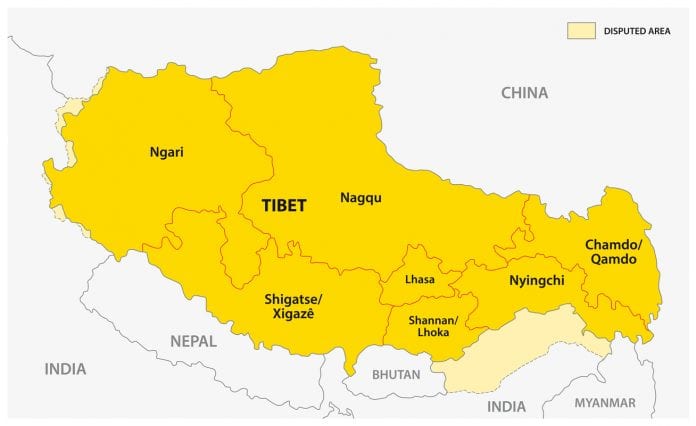
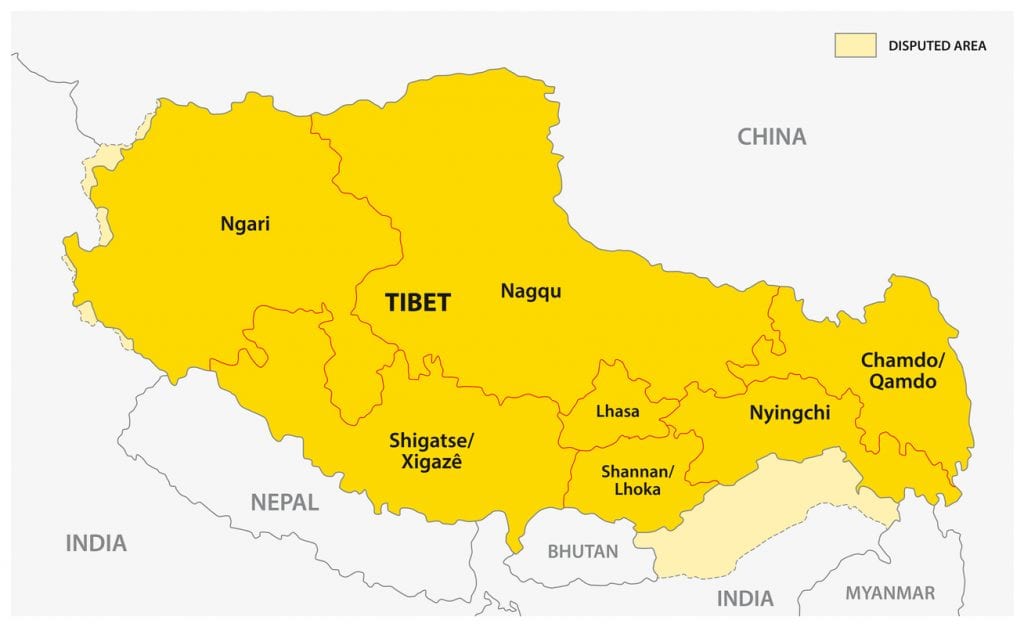
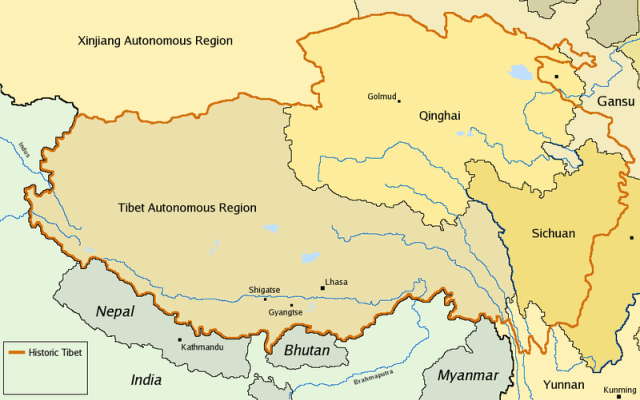
In my analysis, India-China Standoff across the Himalayan Frontier involves the territory of Tibet, an independent nation under military occupation. Any kind of dispute across the Himalayan Frontier involves Tibet as the Natural Force that created Tibet is still at work forcing the Indian Landmass to collide with the Asian Landmass. The reality of Tibet cannot be ignored as Mother Nature nurtures the Tibetan Identity.

Rudra Narasimham Rebbapragada

Special Frontier Force-Establishment No.22-Vikas Regiment

India waving SFF and Tibet cards won’t scare China. Can’t pull levers you don’t have

Bending foreign policy to serve domestic politics is proving to be costly for India. Hyping the use of the Tibetan-majority SFF against China is one such example.

Shyam Saran, September 14, 2020.

India-China Standoff across the Himalayan Frontier-To Play or Not to Play the ‘Tibet Card’.

The Tibet issue played a major role in precipitating the India-China war of 1962. There were localized skirmishes along the border, but these began to be seen in a more ominous light by China in the wake of the Tibetan revolt of 1959 followed by the exile of His Holiness the Dalai Lama to India. The setting up of Indian posts and increased patrolling on our borders were seen as part of a sinister Indian design to subvert Chinese rule in Tibet. The status of the Dalai Lama and the Tibetan issue have remained a shadow over India-China relations even though New Delhi has recognized Chinese sovereignty over Tibet and has under-played official relations with the Dalai Lama.

The Tibet government-in-exile is allowed to function at Dharamsala but is not recognized by the Indian government. For China, Tibet is a “core issue” just as Taiwan and Xinjiang are.

A changing relationship

During the tenure of the Narendra Modi government, there have been instances of open courtship of the Tibetan government-in-exile.

Its ‘Prime Minister’ Lobsang Sangay was an invitee to the swearing-in ceremony of Prime Minister Modi in 2014. The Chief Minister of Arunachal Pradesh, Pema Khandu, declared that his state had a border with Tibet and not with China, in 2017.

But after the Modi-Xi Jinping summit in Wuhan in April 2018, there appeared a rethink on the Tibet issue with the Ministry of External Affairs reissuing instructions to government functionaries to avoid public association with the Dalai Lama and Tibetan representatives of the government-in-exile. An international Buddhist conference, which the Dalai Lama had been encouraged to convene, was cancelled. The Tibetans were advised that the 60th anniversary, in 2019, of the Dalai Lama’s entry into India, should be a low-key affair.

The second Modi-Xi summit in Mamallapuram in October 2019 reinforced this trend. The Modi government was signalling that it was prepared to put the Tibet issue in cold storage while advancing bilateral relations with China.

The wrong card

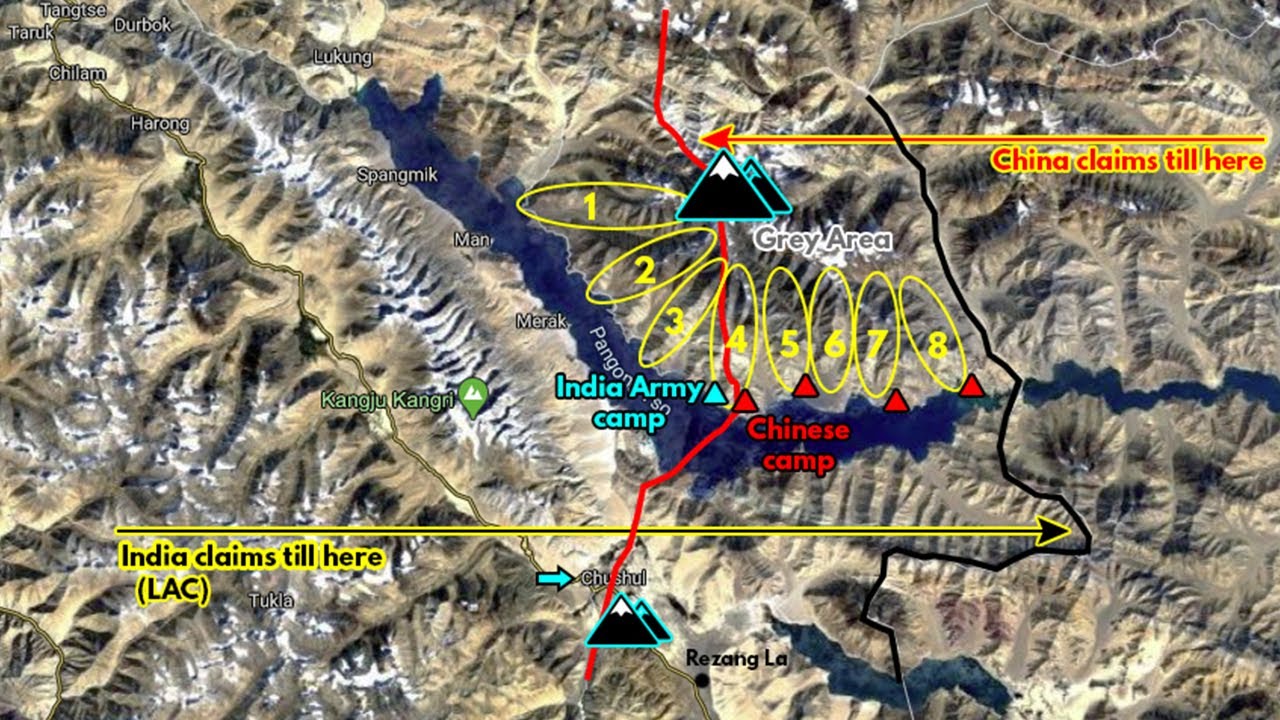
During the recent clashes between the Indian and Chinese armed forces on the border in eastern Ladakh, the Tibet issue has resurfaced and will add to mutual distrust and suspicion. A deliberately leaked report to the media revealed that the secretive Special Frontier Force (SFF), recruited mainly from the Tibetan community in India, was used in the operations in southern Pangong Tso. One of its soldiers, Tenzin Nyima, died in a mine blast and at his funeral, independent Tibet’s flags were displayed. BJP leader Ram Madhav attended the funeral and tweeted about it. He subsequently took it down, presumably at the behest of the Ministry of External Affairs.

Several commentators were quick to welcome the report on the SFF, no longer secret, as a reminder to China that India still held the “Tibet card” and would be ready to use it to bring it to heel. Like much of the bizarre fantasizing that seems to have taken hold in India, this, too, may only heighten mistrust and hostility in Beijing without inflicting any real pain. In any negotiations with an adversary, one should never provoke a confrontation over an issue where the other side has greater equity and stake than oneself. This is clearly the case here. It is also intriguing that this story was highlighted on the eve of External Affairs Minister S. Jaishankar’s meeting with his Chinese counterpart Wang Yi in Moscow. At the very least, it would have made his interaction more challenging.

The SFF has been in existence for several years. Its efficacy lies in its rigorous training, high morale and professionalism. It should not have become yet another pawn in a political game to convince public opinion that India has more levers of influence than it actually has. In doing so, the potential efficacy of the SFF has been undermined and Chinese suspicions over India’s intentions regarding Tibet would have been aroused to a new intensity.

A crisis of credibility

The tactical use of the Tibetan issue and of the Dalai Lama is both cynical and counter-productive. Ever since his arrival in India, he has enjoyed respect and reverence across the Indian political spectrum as a religious leader. We have consistently maintained the position that he is our welcome guest as a high religious personage and that we do not endorse political activities engaged in by him or the Tibetan community. This has helped manage Tibet as an issue in India-China relations, reducing its salience as an irritant. Unfortunately, this consistent and longstanding position has been severely compromised.

In any India-China border settlement, an understanding over Tibet will need to be arrived at. The best-case scenario for India would be a reconciliation between the Dalai Lama and the Chinese regime, and this seemed possible during the first few years of Xi Jinping’s rule. In our informal conversations with Chinese counterparts, we have conveyed that their assumption of the Tibetan issue being permanently resolved once the Dalai Lama was no longer in the scene was misplaced. In fact, we pointed out, the situation may become even more fraught once the restraining hand of the Dalai Lama was no longer available. The Tibetan community in India, particularly the youth, could become more radicalized.

In Tibet, reconciliation between its people and the Chinese state would be more likely with the blessings of the Dalai Lama rather than in his absence. Both countries, we conveyed, need to have an early and quiet dialogue on this issue and not allow it to become a festering problem for the future. There was receptivity on the Chinese side to these views. However, this waving of the Tibet card, which serves only to irritate and annoy, puts paid to any such engagement on a sensitive issue, with serious implications for the future. It undermines the immense goodwill and gratitude that New Delhi has all along enjoyed with the Dalai Lama and the Tibetan community in India and abroad. The community is disturbed by the manner in which the Indian government plays hot and cold towards it and has become anxious about its future.

The bending of foreign policy issues to serve domestic political ends is proving to be costly for India. The most valuable asset a country and its political leadership possess is credibility with both friends and adversaries alike. When image-making gets unlatched from reality, credibility is the first casualty. And India indeed faces a crisis of credibility.

India-China Standoff across the Himalayan Frontier-To Play or Not to Play the ‘Tibet Card’. Shyam Saran, India’s former Foreign Secretary.

The author is a former Foreign Secretary, and a Senior Fellow at CPR.  

India-China Standoff across the Himalayan Frontier-To Play or Not to Play the ‘Tibet Card’.
What is China’s Status in Tibet?

What is China’s Status in Tibet?

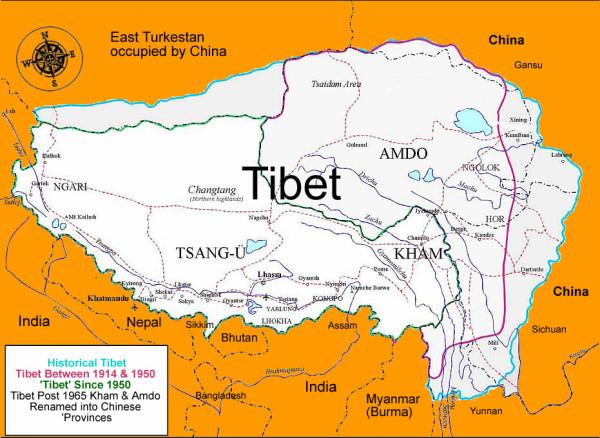
Recent events in Tibet have intensified the dispute over its legal status. The People’s Republic of China (PRC) claims that Tibet is an integral part of China. The Tibetan government-in-exile maintains that Tibet is an independent state under unlawful occupation.

India asks China to pull back troops, arms in Ladakh region

By ASHOK SHARMA, Associated Press  


NEW DELHI (AP) — India’s defense minister said Thursday the country faces challenges in its border dispute with China and urged Beijing to sincerely implement an understanding they reached previously to completely disengage forces from the Ladakh region.

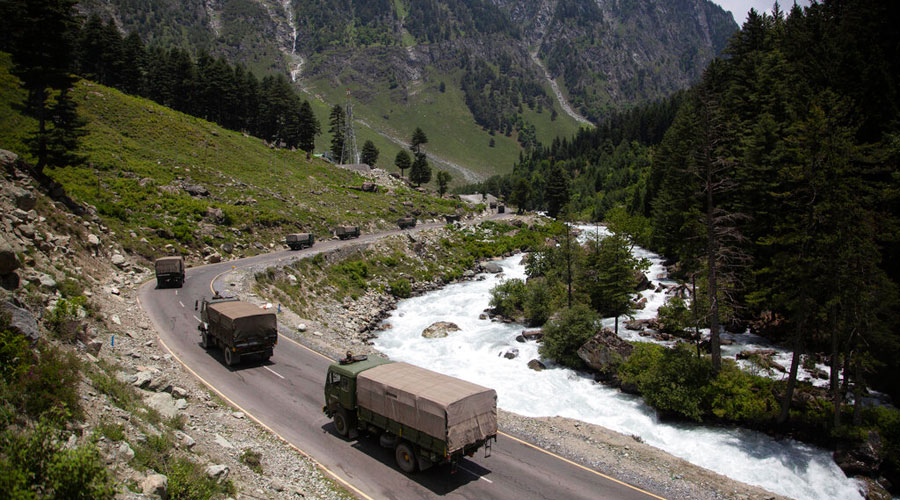
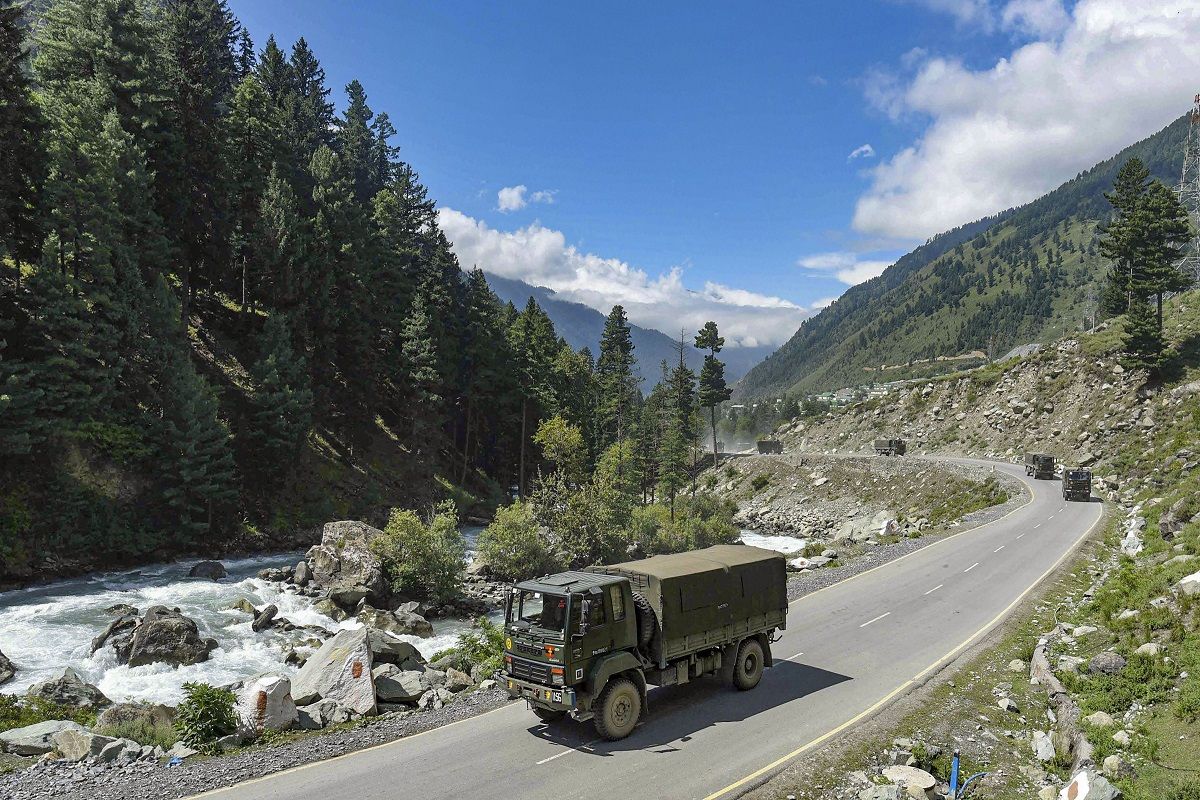
What is China’s Status in Tibet? An Indian army convoy moves on the Srinagar- Ladakh highway at Gagangeer, northeast of Srinagar, Indian-controlled Kashmir, Wednesday, Sept. 9, 2020. India’s defense minister said Thursday, Sept. 17, the country faces challenges in its border dispute with China and urged Beijing to sincerely implement an understanding they reached previously to completely disengage forces in the Ladakh region. Rajnath Singh said in a statement in the upper house of Parliament that China has amassed troops and armaments in Ladakh in violation of bilateral agreements reached in 1990s and it was creating friction by trying unilaterally to alter the status quo in the region through aggressive postures. (AP Photo/ Dar Yasin)
What is China’s Status in Tibet? In this Sept. 14, 2017, file photo, a banner erected by the Indian army stands near Pangong Tso lake near the India-China border in India’s Ladakh area. India’s defense minister said Thursday, Sept. 17, 2020, the country faces challenges in its border dispute with China and urged Beijing to sincerely implement an understanding they reached previously to completely disengage forces in the Ladakh region. Rajnath Singh said in a statement in the upper house of Parliament that China has amassed troops and armaments in Ladakh in violation of bilateral agreements reached in 1990s and it was creating friction by trying unilaterally to alter the status quo in the region through aggressive postures. (AP Photo/Manish Swarup, File)

Rajnath Singh told the upper house of Parliament that China has amassed troops and weapons in Ladakh in violation of agreements reached in the 1990s and is trying to alter the status quo in the region through aggressive actions.

He said that was not acceptable and that India is seeking a peaceful resolution through talks.

The two countries’ foreign ministers met in Moscow a week ago and agreed to deescalate tensions in Ladakh, but Singh’s words to Parliament suggested they have not significantly declined and that settling the impasse will be a long process.

He also said India has counter-deployed troops that have foiled “transgression attempts by China.”

“We should be confident that our armed forces will handle the situation successfully,” Singh said.

He said it was “apparent from Chinese activities that their words don’t match their actions.”

In Beijing, Chinese foreign ministry spokesperson Wang Wenbin again laid the onus on India to relieve the tensions and said Chinese border troops have “always strictly abide by the (agreements) between the two countries and are committed to safeguarding China’s territorial sovereignty and maintaining peace and tranquility in the border areas.”

“What is pressing now is that the Indian side should immediately correct its mistake, disengage on the ground as soon as possible and take concrete actions to ease the tension and lower the temperature along the border,” Wang said at a daily briefing.

Relations between the two countries have often been strained, partly due to their undemarcated border.

They fought a border war in 1962 that spilled into Ladakh and ended in an uneasy truce. Since then, troops have guarded the undefined border area, occasionally brawling. The standoff escalated to a deadly clash on a high ridge on June 15 that left 20 Indian soldiers dead.

Singh said India inflicted “heavy” casualties on Chinese forces, but did not provide any numbers. China has not given any details on its casualties.

After that clash, the two countries partially disengaged from the site in the Galwan Valley and at least two other places, but the crisis has continued in at least three other areas, including glacial Pangong Lake.

He said the impasse was due to differing perceptions of the fiercely contested Line of Actual Control that separates Chinese and Indian-held territories from Ladakh in the west to India’s eastern state of Arunachal Pradesh.

Singh said India has doubled its budget on building roads, bridges and other infrastructure along the border to match the Chinese infrastructure to accelerate mobility of forces.

“We are fully prepared to protect the sovereignty and territorial integrity of our country,” he said, adding that China continued to occupy nearly 38,000 square kilometres (14,670 square miles) of Indian land in Ladakh.

What is China’s Status in Tibet?

India-China Standoff is driven by the illegal military occupation of Tibet

India-China Standoff is driven by the illegal military occupation of Tibet.

AP Explains: What’s driving India-China military standoff

By AIJAZ HUSSAIN, Associated Press  

SRINAGAR, India (AP) — Tensions along the disputed India-China border seem to be getting worse, three months after their deadliest confrontation in decades.

India-China Standoff is driven by the illegal military occupation of Tibet. In this July 20, 2011 file photo, tourists ride double hump camels at Nubra valley, in Ladakh, India. Tensions along the disputed India-China border seem to be getting worse rather than better, three months after their deadliest confrontation in decades in June. The Asian giants accused each other this week of sending soldiers into each other’s territory and fired warning shots for the first time in 45 years, raising the specter of full-scale military conflict. (AP Photo/Channi Anand, File)

The Asian giants accused each other this week of sending soldiers into the other’s territory and fired warning shots fired for the first time in 45 years, raising the specter of full-scale military conflict.

India-China Standoff is driven by the illegal military occupation of Tibet. In this June 18, 2020 file photo, Indian army officers walk past the pyre of their colleague Colonel B. Santosh Babu, who was killed during a clash with Chinese soldiers in Ladakh region, during his funeral at Suryapet, about 140 kilometres (87.5 miles) from Hyderabad, India. Tensions along the disputed India-China border seem to be getting worse rather than better, three months after their deadliest confrontation in decades in June. The Asian giants accused each other this week of sending soldiers into each other’s territory and fired warning shots for the first time in 45 years, raising the specter of full-scale military conflict. (AP Photo/Mahesh Kumar A, File)

Their foreign ministers are expected to discuss the simmering dispute in Moscow on Thursday on the sidelines of a regional security and economic meeting.

The high-altitude standoff along the eastern section of what’s known as the Line of Actual Control — a loose demarcation — risks dramatically altering the already fraught relationship between the nuclear-armed neighbors.

India-China Standoff is driven by the illegal military occupation of Tibet. In this June 22, 2020 file photo, Indian traders burn Chinese products and a poster president Xi Jinping during a protest in New Delhi, India. Tensions along the disputed India-China border seem to be getting worse rather than better, three months after their deadliest confrontation in decades in June. The Asian giants accused each other this week of sending soldiers into each other’s territory and fired warning shots for the first time in 45 years, raising the specter of full-scale military conflict. (AP Photo/Manish Swarup, File)

The face-off began in early May with a fierce brawl before exploding into hand-to-hand combat with clubs, stones and fists on June 15 that left 20 Indian soldiers dead. China is believed to have taken casualties, but has given no numbers.

DECADES OF MISTRUST

India and China inherited their territorial disputes from the period of British colonial rule.

Three years after India’s independence in 1947 and a year after the communists came to power in China, the new government in Beijing began strongly asserting its claims and repudiating earlier treaties it says were signed under duress, but which India says are fixed.

Beijing’s approach has strengthened under Xi Jinping, China’s most powerful leader in decades who has sworn not to surrender even an inch of territory.

In the 1950s, China started building a strategic road on the uninhabited Aksai Chin Plateau to connect its restive regions of Tibet and Xinjiang. India objected and claimed Aksai Chin as part of Ladakh, itself belonging to the former principality of Kashmir now divided between India and Pakistan.

India-China Standoff is driven by the illegal military occupation of Tibet. In this July 10, 2020 file photo, members of the Tibetan Youth Congress participate in a street protest calling for the boycott of Chinese goods in Dharmsala, India. Tensions along the disputed India-China border seem to be getting worse rather than better, three months after their deadliest confrontation in decades in June. The Asian giants accused each other this week of sending soldiers into each other’s territory and fired warning shots for the first time in 45 years, raising the specter of full-scale military conflict. (AP Photo/Ashwini Bhatia, File)

Relations were further strained after India allowed Tibet’s spiritual leader, the Dalai Lama, to establish a self-declared government-in-exile in the northern Indian town of Dharmsala after he fled his homeland in 1959 during an abortive uprising against Chinese rule.

India-China Standoff is driven by the illegal military occupation of Tibet. An Indian army convoy moves on the Srinagar- Ladakh highway at Gagangeer, northeast of Srinagar, Indian-controlled Kashmir, Wednesday, Sept. 9, 2020. Tensions along the disputed India-China border seem to be getting worse rather than better, three months after their deadliest confrontation in decades in June. The Asian giants accused each other this week of sending soldiers into each other’s territory and fired warning shots for the first time in 45 years, raising the specter of full-scale military conflict. (AP Photo/ Dar Yasin)

The differences led to a bitter month-long war in 1962. Firefights broke out again in 1967 and 1975, leading to more deaths on both sides. They’ve since adopted protocols, including an agreement not to use firearms, but those protocols have fractured in this year’s clashes.

China, in the meantime, began cementing its relations with India’s arch-rival Pakistan and backing it on the issue of Kashmir.

India-China Standoff is driven by the illegal military occupation of Tibet. In this file photo taken Friday, Sept. 4, 2020, China’s Minister of National Defence Wei Fenghe, left, Russian Defense Minister Sergei Shoigu, center, and Indian Defense Minister, Rajnath Singh, right, pose for a photo with their colleagues at a Joint Meeting of Defense Ministers of Shanghai Cooperation Organisation, Commonwealth of Independent States and Collective Security Treaty Organization Member States in Moscow, Russia. India and China are accusing each other of violating agreements along their disputed mountain border, even as they engage in talks to end increasing military tensions. (Host Photo Agency sco-russia2020.ru via AP, File)

THE LINE OF ACTUAL CONTROL

The fiercely contested LAC separates Chinese and Indian held territories from Ladakh in the west to India’s eastern state of Arunachal Pradesh, which China claims in its entirety. It is broken in parts where the Himalayan nations of Nepal and Bhutan border China.

India-China Standoff is driven by the illegal military occupation of Tibet. Map shows Ladakh region in disputed area between India and China, where the countries accused each other of firing warning shots;

According to India, the de facto border is 3,488 kilometres (2,167-mile) long, although China promotes a considerably shorter figure. As its name suggests, it divides the areas of physical control rather than territorial claims.

In all, China claims some 90,000 square kilometres (35,000 square miles) of territory in India’s northeast, including Arunachal Pradesh with its mainly Buddhist population.

India says China occupies 38,000 square kilometres (15,000 square miles) of its territory in the Aksai Chin Plateau, which India considers part of Ladakh, where the current face-off is happening.

Despite more than three dozen rounds of talks over the years, and multiple meetings between Indian Prime Minister Narendra Modi and Chinese President Xi Jinping, they are nowhere near settling their dispute.

ECONOMIC AND STRATEGIC RIVALRY

Since the 1962 war, both economies have grown substantially, but China has far outpaced India while enjoying a large trade surplus with its neighbor.

The growing economic rivalry has added to territorial and geostrategic differences. India has tried to capitalize on China’s rising labor costs, and deteriorating ties with the United States and Europe, to become a new base for foreign manufacturers.

India grew concerned after China recently built a road through Pakistani-controlled Kashmir as part of Xi’s signature foreign policy push, the multi billion-dollar Belt and Road Initiative, which India has vehemently opposed.

Meanwhile, India’s growing strategic alliance with the U.S. has ruffled feathers in Beijing, which sees the relationship as a counterweight against China’s rise. Indian fears of Chinese territorial expansion are bolstered by the growing presence of the Chinese navy in the Indian Ocean and Beijing’s efforts to strengthen ties with not only Pakistan but also Sri Lanka and Nepal.

India is jockeying for strategic parity with China, massively ramping up its military infrastructure along the LAC. China for its part has been building roads and defensive positions in the disputed Doklam region and in recent weeks has conducted high-altitude parachute drops and stationed strategic bombers in Tibet.

Adding to the tension, India unilaterally declared Ladakh a federal territory and separated it from disputed Kashmir in August 2019, ending its semi-autonomous status.

Shortly after, lawmakers in India’s ruling party began advocating taking control of some China-run areas, alarming Beijing.

FEARS OF WIDER CONFLICT

Border tensions have persisted despite talks at military, diplomatic and political levels. With strong nationalists leading both countries, the border has taken on a prominence not seen in years.

Having emerged relatively unscathed from the COVID-19 pandemic, China is also perceived regionally as ramping up military ambitions against its neighbors, particularly through the use of “salami slicing” tactics to incrementally gain territory.

While Chinese soldiers remain in what India says is its territory in Ladakh, India occupied at least one unmanned mountain top last week, leading Beijing to furiously demand that New Delhi vacate the area.

Experts warn that if military hostilities are not stopped, war could be next.

“If diplomacy fails, guns talk. That is the natural culmination of what we have been witnessing during last four months,” said Lt. Gen. D.S. Hooda, who was head of the Indian military’s Northern Command from 2014 to 2016. “Things are fast escalating out of control unless there is a breakthrough in talks.”

Wang Lian of Peking University’s international relations department considers the possibility of a wider conflict less likely, despite preparations being made on both sides.

“China has shown restraint in bilateral relations with India, and India may restrain itself from overdoing it in the future,” Wang said.

India-China Standoff is driven by the illegal military occupation of Tibet.The Indian Army will continue to sit it out along the 1,597 km Line of Actual Control in East Ladakh till China restores status quo ante. The PLA, a senior army officer said, wants India to move back from its traditional points where it has had an advantage before it vacates locations where it had moved in April-May.(HT Photo)

Special Frontier Force Begins the Eviction of the military occupier of Tibet

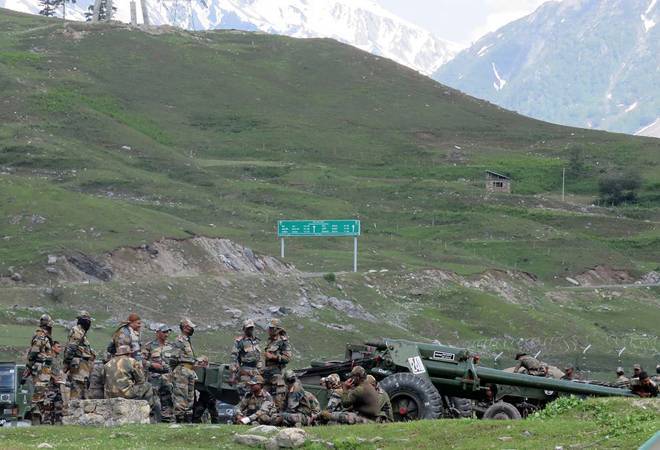
Special Frontier Force personnel were used  by Indian Army to occupy these strategic peaks in the Southern banks of Pangong Tso. This took the Chinese army by surprise. The occupation of these heights has shown Indian resolve to take the fight to the Chinese side. 

Special Frontier Force begins the eviction of the military occupier of Tibet with action in the Pangong Tso Lake Sector, Ladakh, Kashmir, India.

India thwarts another Chinese incursion in Ladakh

DECCAN CHRONICLE | PAWAN BALI

PublishedSep 1, 2020.

Pre-emptive move by Indian Army to secure another LAC position signals its intent to dig in for the winter.

Special Frontier Force Begins the Eviction of the military occupier of Tibet

The Pangong Tso lake in Ladakh on the banks of which India and China have been engaged in a standoff for four months. India claimed on Monday that it pre-empted a move by the Chinese army to occupy Indian territory at a new point in the region. (AP file photo)

New Delhi: The Indian army said on Monday that it “pre-empted” an attempt by Chinese troops to transgress and grab land on the southern banks of Pangong Tso on the intervening night of 29-30 August 2020.

This was an attempt by the Chinese to open a new front in the Ladakh sector. India and China were until now in a standoff  in the “Finger area” on the northern banks of the Pangong Tso. But now they are also looking to infiltrate in the Chushul sector.

In a statement issued on Monday, the Indian Army said PLA troops carried out provocative military movements to change the status quo on the night of 29-30 August 2020. “Indian troops pre-empted this PLA activity on the Southern Bank of Pangong Tso Lake, undertook measures to strengthen our positions and thwart Chinese intentions to unilaterally change facts on the ground,” it said.

The statement added that the Indian Army is committed to maintaining peace and tranquility through dialogue, but is also equally determined to protect India’s territorial integrity.

 A brigade commander level flag meeting was held at Chushul to resolve the issue.

As per initial reports, the Army had received information that the Chinese started building up forces to occupy Indian territory on the southern banks of Pangong Tso. The Indian Army physically occupied the area as soon as the PLA tried its transgression. There was no physical clash between the troops.

The Indian Army’s “pre-emptive” move comes days after Chief of Defense staff (CDS) Gen. Bipin Rawat warned that India has “military options” to deal with Chinese transgression in Ladakh if talks between the countries at the military and diplomatic level don’t yield any result.

The Chinese army’s Western Theater Command accused India of crossing the Line of Actual Control and deliberately launching provocations. “China strongly opposes the acts and urges India to immediately withdraw the troops that have illegally crossed the LAC,” it said.

It said that Chinese troops are taking necessary measures in response to Indian troops provocations and will closely follow the situation and resolutely safeguard national sovereignty, peace and stability at the border area.

The military standoff between India and China in Ladakh will complete four months this week. The two armies are involved in a standoff in Pangong Tso, Hot Springs area and Despang-DBO sector in Ladakh.

A series of military and diplomatic talks between India and China have failed to persuade China to disengage. Instead China has used this time of negotiations with India to bring in more forces at the LAC, position heavy weaponry, construct helipads, build air defense systems, and deploy missiles at new positions.

In the Northern Bank of Pangong Tso, China has illegally occupied 8 km of Indian territory between finger 4 and 8. Despite a series of diplomatic and military dialogues China has refused to vacate the area between finger 5 and 8 which it had illegally occupied in May 2020. China has built up bunkers, gun positions and brought heavy artillery in the finger area.     

The Chinese attempt to occupy new areas comes despite a series of engagements at the diplomatic and military level to disengage and deescalate the situation in the Ladakh sector.  The latest confrontation means that the situation is unlikely to deescalate any time soon and will continue in the winter too. India has already started preparations for winter and is stocking up supplies required for thousands of new troops deployed in the area. 

Special Frontier Force personnel were used  by Indian Army to occupy these strategic peaks in the Southern banks of Pangong Tso. This took the Chinese army by surprise. The occupation of these heights has shown Indian resolve to take the fight to the Chinese side. 

Special Frontier Force Begins the Eviction of the military occupier of Tibet. The 1962 India-China War Memorial, Chushul, Ladakh, Kashmir, India.

Communist China’s Sinister Plan of Sinicization of Tibet

Communist China’s Sinister Plan of Sinicization of Tibet.

India is facing the inevitable consequences of Communist China’s Sinister Plan of Sinicization of Tibet using its military power since 1950.

Rudra Narasimham Rebbapragada

Special Frontier Force-Establishment No. 22-Vikas Regiment

Special Frontier Force personnel were used  by Indian Army to occupy these strategic peaks in the Southern banks of Pangong Tso. This took the Chinese army by surprise. The occupation of these heights has shown Indian resolve to take the fight to the Chinese side. 

The Pangong Tso lake in Ladakh on the banks of which India and China have been engaged in a standoff for four months. India claimed on Monday that it pre-empted a move by the Chinese army to occupy Indian territory at a new point in the region. (AP file photo)

India says troops hold Himalayan hilltops after face-off with Chinese forces

By Devjyot Ghoshal  

Communist China’s Sinister Plan of Sinicization of Tibet. Reuters/Mukesh Gupta FILE PHOTO: A view of Pangong Tso lake in Ladakh region

NEW DELHI (Reuters) – A senior Indian official said on Tuesday Indian troops had deployed on four strategic hilltops after what New Delhi called an attempted Chinese incursion along the disputed Himalayan border, underlining simmering tensions between the Asian giants.

China denied that it had moved first, with an embassy spokeswoman in New Delhi accusing Indian troops of trespassing across the Line of Actual Control (LAC) – the de facto border – and conducting “flagrant provocations”.

Indian and Chinese troops have been locked in a high-altitude border confrontation for months in the western Himalayan region of Ladakh. The two sides have disputed the course of the frontier for more than half a century.

The Indian official, who was briefed on the latest incident, said the Indian troop move responded to an attempt by a large number of Chinese infantry to push through a key mountain pass late on Saturday.

“We mobilized and occupied the four heights,” the official said, adding all four hilltops were on India’s side of the LAC.

The Indian official said the Chinese soldiers were backed up by military vehicles and drew close enough to engage Indian troops in verbal arguments, but there were no clashes.

He said the incident occurred on the southern bank of Pangong Tso, a picturesque lake in the snow desert region where Indian and Chinese troops have been facing off since April.

The Indian official said the Chinese had also been consolidating positions on the northern bank of the lake with what appeared to be new defensive positions.

But Ji Rong, a spokeswoman for the Chinese embassy in New Delhi, said Indian troops had violated the LAC at Pangong Tso’s southern bank and near another mountain pass.

“What India has done runs counter to the efforts made by both sides for a period of time to ease and cool down the situation on the ground, and China is resolutely opposed to this,” she said.

“India … said it pre-empted Chinese military activity,” China’s state-backed Global Times said in an editorial. “The word ‘pre-empt’ shows it was Indian troops that first took destructive action, and the Indian troops initiated the stand-off this time.”

In June, 20 Indian soldiers were killed in hand-to-hand combat with Chinese troops in Ladakh’s Galwan area, the most serious clash between the two countries in 50 years.

Both sides then agreed to pull back with military chiefs in the region holding five rounds of talks. But the Indian military said this week Beijing had reneged on the deal by carrying out “provocative military movements to change the status quo”.

(Reporting by Devjyot Ghoshal; Editing by Sanjeev Miglani and Mark Heinrich)

In this June 17, 2020, file photo, an Indian army convoy moves on the Srinagar- Ladakh highway at Gagangeer, north-east of Srinagar.
AP
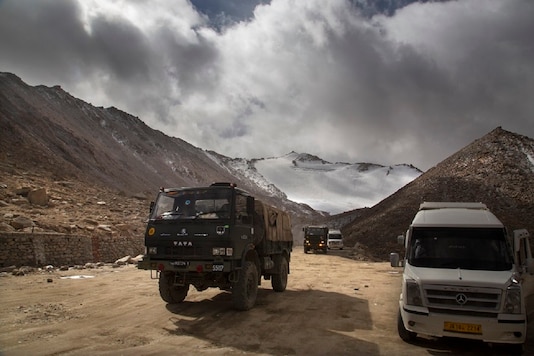
An Indian Army truck crosses Chang la pass near Pangong Lake in Ladakh region, India. (AP File Photo)
Indian Army thwarts fresh attempts by China’s PLA to change status quo in Pangong lake area in Ladakh
Indian Army is committed to maintaining peace and tranquility through dialogue, but is also equally determined to protect India’s territorial integrity: Spokesperson
PTI
Chinese troops carried out fresh “provocative action” in Pangong Tso Lake areas in Eastern Ladakh on Monday
Chinese armoured vehicles and battle tanks are positioned near the foothills of ‘Kala Top’, which is occupied by Indian forces
China took provocative action 31 August as talks were on, says India
Ladakh Clash: A Brigade Commander level flag meeting is in progress at Chushul. (File)

https://www.indiatoday.in/video/India/embed/MTcxNzA5NA==

The latest skirmish between the two sides took place along the Southern bank of the Pangong Tso, a glacial lake at 14,000 feet. This photo taken on September 14, 2018, shows a general view of Pangong Lake from the Indian-controlled side.
Indian Border Security Force (BSF) soldiers guard a highway leading towards Leh, bordering China, in Gagangir on June 17, 2020.
Communist China’s Sinister Plan of Sinicization of Tibet.

President Xi Jinping’s Plan for Tibet vs Nature’s Plan for Tibet

President Xi Jinping’s Plan for Tibet vs Nature’s Plan for Tibet

In my analysis, President Xi Jinping’s Plan for Tibet is not consistent with Mother Nature’s Plan for Tibet. Besides geographical isolation, Mother Nature nurtured a sense of Freedom giving the Tibetan people the experience of Peace, Harmony, and Tranquility in their daily lives. The military occupation of Tibet is fundamentally inconsistent with the Nature’s Plan for Tibet.

Rudra Narasimham Rebbapragada

Special Frontier Force-Establishment No. 22-Vikas Regiment

Sinicize Tibetan Buddhism, build fortress around Tibet, says Xi Jinping

Exiled Tibetan groups, led by exiled spiritual leader the Dalai Lama, and rights groups say Beijing’s rule amounts to “cultural genocide”.

Sutirtho Patranobis | Edited by Sohini Sarkar
Hindustan Times, Beijing

President Xi Jinping’s Plan for Tibet vs Nature’s Plan for Tibet. Chinese President Xi Jinping was addressing the country’s top leadership at a two-day forum on future governance in Tibet in Beijing, which concluded on Saturday.(REUTERS PHOTO.)

It is important to promote the “sinicization” of Tibetan Buddhism and build an “impregnable fortress” to maintain stability in Tibet, President Xi Jinping said on Saturday.

Xi added it was necessary to strengthen border defense and frontier security of the Tibet Autonomous Region (TAR), which borders India and Bhutan, adding it was necessary to educate Tibetans to strengthen the struggle against separatism.

The Chinese President was addressing the country’s top leadership at a two-day forum on future governance in Tibet in Beijing, which concluded on Saturday.

Beijing seized control over Tibet in 1950, in what is described in the Chinese narrative as a “peaceful liberation”, which aided the high-altitude Himalayan region to throw off its “feudalistic” past.

Exiled Tibetan groups, led by exiled spiritual leader the Dalai Lama, and rights groups say Beijing’s rule amounts to “cultural genocide”.

Political and ideological education needed to be strengthened in Tibet’s schools in order to “plant the seeds of loving China in the depths of the hearts of every youth”, Xi said in remarks published by state news agency Xinhua.

Xi was quoted as calling for efforts to ensure national security and enduring peace and stability, steadily improve people’s lives, maintain a good environment, solidify border defense and ensure frontier security.

“It is necessary to strengthen the education and guidance of the masses, extensively mobilize the masses to participate in the struggle against separatism, and form a copper wall and iron wall (which translates as ‘impregnable fortress” in Mandarin) for maintaining stability,” he said.

“Efforts must be made to build a new modern socialist Tibet that is united, prosperous, culturally advanced, harmonious and beautiful,” Xi said.

“It is necessary to actively guide Tibetan Buddhism to adapt to the socialist society and promote the Sinicization of Tibetan Buddhism,” he said.

Sinicization of religion could be broadly defined as an effort to mold religious beliefs and doctrine to bring them in line with the Communist Party of China’s principles and objectives, and with the culture of the majority Han community. Xi in 2015 spoke about sinicising the five major religions practiced in China: Catholicism, Protestantism, Islam, Buddhism and Daoism.

In 2019, Chinese state media announced that China had drawn up an outline to sinicize Islam by 2022 in an effort to redefine the practice of the religion and align the beliefs of Muslims with the CPC.

China’s policies towards Tibet have come under the spotlight again this year amid Beijing’s deteriorating ties with Washington.

In July, US Secretary of State Mike Pompeo said the US would restrict visas for some Chinese officials involved in blocking diplomatic access to Tibet and engaging in “human rights abuses”, adding that Washington supported “meaningful autonomy” for Tibet.

In a retaliatory move, China said it would impose visa restrictions on US citizens who have engaged in what it called “egregious” behavior over Tibet.

President Xi Jinping’s Plan for Tibet vs Nature’s Plan for Tibet

India vs China Dispute. Tibet is not a part of China

India vs China Dispute. Tibet is not a part of China.TIBET EQUILIBRIUM.

In my analysis, the dispute between India and China relates to the status of Tibet. China is in Tibet. But, Tibet is not a part of China. The dispute can be resolved by the eviction of the military occupier of Tibet.

Rudra Narasimham Rebbapragada

Special Frontier Force-Establishment No. 22-Vikas Regiment

A border dispute with China may push India closer to some of Beijing’s top rivals

CNN June 18, 2020, 12:59 AM EDT

Relations between China and India have always been complicated.

During British colonialism, India was the source of opium foreign traders forced onto Chinese markets, sparking war between the UK and the Qing Empire that ended in humiliation for China. Since independence, India’s relations with its largest neighbor have been tested by issues such as Tibet, Pakistan and the countries’ shared Himalayan border.

This week, that border blew up into renewed conflict, in the bloodiest engagement in 40 years, which left more than 20 soldiers dead after a brutal fight with fists and clubs high in the mountains amid freezing temperatures and scant oxygen.

While both governments are now scrambling to deescalate, the conflict could provide the final push for a pivot already begun by New Delhi, away from Beijing and towards China’s traditional rivals, the United States and Japan, as well as a growing regional one, Australia. As India seeks to push back against what many in the country view as Chinese aggression, it will rely on these allies more than ever.

“The sacrifice made by our soldiers will not go in vain,” Indian Prime Minister Narendra Modi said Wednesday. “India’s integrity and sovereignty is supreme for us, and no one can stop us from defending it. Nobody should have an iota of doubt about this. India wants peace. But when provoked, India will give a befitting reply.”

Rahul Gandhi, leader of the main opposition Congress Party, put it more bluntly: “How dare China kill our soldiers? How dare they take our land?”

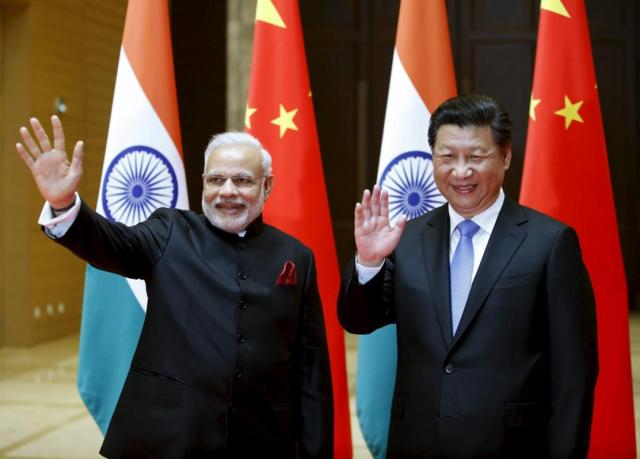
India vs China Dispute. Tibet is not a part of China. Indian Prime Minister Narendra Modi (L) and Chinese President Xi Jinping wave to journalists before they hold a meeting in Xian, Shaanxi province, China, May 14, 2015. REUTERS/Kim Kyung-Hoon

Encircling China

In an editorial Wednesday, the influential Hindustan Times said that “China wants to limit New Delhi’s power and ambition; it wants India to accept Beijing’s primacy in Asia and beyond.”

In response, the newspaper urged, New Delhi should “double down on its partnership with the US, make Quad … a more permanent arrangement, and be a part of any club that seeks to contain Chinese power.”

The Quad, or Quadrilateral Security Dialogue, is an informal strategic forum for the US, Japan, Australia and India, featuring semi-regular summits, information exchanges and military drills. While not a formal military alliance like NATO, it is seen by some as a potential counterweight to growing Chinese influence and alleged aggression in Asia-Pacific.

While members have emphasized the more benign aspects of the relationship, such as recent cooperation on the coronavirus pandemic, the potential for military encirclement by countries has not gone unnoticed by Beijing.

As early as 2007, when the first Quad meetings were proposed, China issued formal diplomatic protests to all parties involved, and later that year Australia pulled out over fears of offending Beijing, and the alliance was put on hold until 2017, when meetings resumed, in large part due to growing concerns over Chinese advances in the South China Sea.

Potentially, an anti-China bloc led by the US could be far larger than the Quad. During a telephone call earlier this month between Modi and US President Donald Trump, the American leader invited India to join the next G7 summit. They also, according to White House spokeswoman Kayleigh McEnany, discussed “the situation on the India-China border.”

Trump has previously spoken of wanting to expand the traditional grouping of mostly European and North American states to include Washington’s allies Australia and South Korea, as well use this year’s planned meeting to “discuss China’s future.”

India has traditionally been wary of getting too close to the US, seeking to balance that relationship with strong economic — if not always diplomatic — ties to Beijing. Amid growing pressure on its border, however, and what appears to be a strong personal bond between Trump and Modi, this could be the perfect time for such a pivot.

Greater Indian participation in both the Quad and other military alliances with the US would have benefits for Washington, according to foreign affairs analyst Amrita Jash, who wrote this week that “India’s strong foothold in the Indo-Pacific provides a counterbalance to China’s growing footprint in the Indian Ocean.”

Not without cost

Both Delhi and Beijing have spoken of the desire to deescalate and preserve a peaceful relationship following this week’s clash in the Himalayas, but many experts are skeptical about how feasible, or sustainable this is.

Aidan Milliff, an expert on political violence and South Asia at the Massachusetts Institute of Technology, predicted this month that the latest conflict could “portend the development of a Sino-Indian situation that reflects an ‘ugly stability’ between India and Pakistan: persistent low-level conflicts and political-military crises that simmer below the threshold of conventional war.”

Already shaky ties between Beijing and Delhi had already been harmed by the coronavirus pandemic, with many in India blaming China for its initial mishandling of the crisis and Chinese officials frustrated by their Indian counterparts’ perceived failure to express support for Beijing at the World Health Organization and other international forums.

Any major shift towards the Quad or Washington alone would likely only take place if Delhi believes relations with Beijing are beyond repair, however, as they could come with high costs for both India and China.

Under Modi, India’s economic engagement with China has been increasing. Together, the two countries account for 17.6% of the global economy. But although China is India’s largest trading partner, their estimated $84 billion bilateral trade in 2017/18 was a mere fraction of the US-China trade volume, which stood at almost $600 billion.

Before the coronavirus pandemic, China was gradually emerging as a major foreign investor in the growing Indian market, but that trend has been halted by new investment rules passed by Delhi widely seen as aimed at Chinese firms.

Economic pain is not the only thing that will be jointly shared. While Beijing may be loathe to see India cosying up to the US and Japan, it can respond by increasing support for Delhi’s major rival: Pakistan.

China has close economic, diplomatic and military ties with Pakistan, making it one of the nation’s closest allies in the region. Between 2008 and 2017, Islamabad purchased more than $6 billion of Chinese arms, according to think tank CSIS. China has also invested billions in the China-Pakistan Economic Corridor, an integral part of Xi’s Belt and Road trade and infrastructure mega-project.

Protecting that corridor was seen by some analysts as a driving factor behind the recent spat in the Himalayas, another factor in which was recent Indian moves over Kashmir, in which China supported Pakistan in a failed attempt to censure Delhi at the United Nations.

Similarly, China has made diplomatic and economic inroads in countries traditionally considered as within Delhi’s sphere of influence, including Nepal, Sri Lanka and Bangladesh.

India’s South Asian neighbors have also increasingly looked to China for assistance during the coronavirus pandemic, accelerating a trend that seen Beijing invest heavily in the region.

The willingness of Nepal, in particular, to work with Beijing has led to concerns in Delhi of potential geopolitical realignment. Nepal, which is sandwiched between India and China, and has recently butted heads with its southern neighbor over a decision to approve a revised map that includes areas claimed by Delhi.

Part of the problem in the region are the messy, widely disputed borders that many of the countries share. If relations continue to worsen between Beijing and Delhi, however, they may seem like nothing compared to the nightmare of geopolitical complications that could arise across all of Asia-Pacific.

India vs China Dispute. Tibet is not a part of China.

China’s Population Transfer Policy. The Chinese Settlers outnumber the Native Population of Tibet, Manchuria, Inner Mongolia, and East Turkestan (Xinjiang). The Sinicization of Occupied territories.

China’s Population Transfer Policy. The Chinese Settlers outnumber the Native Population of Tibet, Manchuria, Inner Mongolia, and East Turkestan. The Sinicization of Occupied territories.

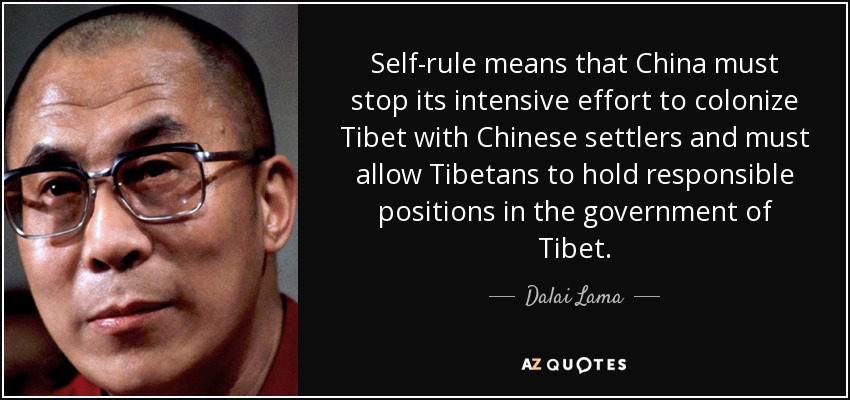
In his 5 point peace plan  the Dalai Lama called to stop Chinese colonization of Tibet and described the past and present situation.
When the newly formed People’s Republic of China invaded Tibet in 1949/50, it created a new source of conflict.  
 

TIBET NOT PART OF CHINA – INDIA SHARES NO BORDER WITH CHINA. China’s Population Transfer Policy. The Chinese Settlers outnumber the Native Population of Tibet, Manchuria, Inner Mongolia, and East Turkestan. The Sinicization of Occupied territories.

“When the newly formed People’s Republic of China invaded Tibet in 1949/50, it created a new source of conflict.  

“This was highlighted when, following the Tibetan national uprising against the Chinese and my flight to India in 1959, tensions between China and India escalated into the border war in 1962.  

“Today large numbers of troops are again massed on both sides of the Himalayan border and tension is once more dangerously high. 

“The real issue, of course, is not the Indo-Tibetan border demarcation.  

“It is China’s illegal occupation of Tibet, which has given it direct access to the Indian sub-continent.  

“The Chinese authorities have attempted to confuse the issue by claiming that Tibet has always been a part of China. 

“This is untrue.  Tibet was a fully independent state when the People’s Liberation Army invaded the country in 1949/50. 

 “Since Tibetan emperors unified Tibet, over a thousand years ago, our country was able to maintain its independence until the middle of this century.  

“At times Tibet extended its influence over neighbouring countries and peoples and, in other periods, came itself under the influence of powerful foreign rulers – the Mongol Khans, the Gorkhas of Nepal, the Manchu Emperors and the British in India. 

 “It is, of course, not uncommon for states to be subjected to foreign influence or interference. 

“Although so-called satellite relationships are perhaps the clearest examples of this, most major powers exert influence over less powerful allies or neighbours.  

“As the most authoritative legal studies have shown, in Tibet’s case, the country’s occasional subjection to foreign influence never entailed a loss of independence. 

” And there can be no doubt that when Peking’s communist armies entered Tibet, Tibet was in all respects an independent state…

“Human rights violations in Tibet are among the most serious in the world.  

“Discrimination is practiced in Tibet under a policy of ‘apartheid’ which the Chinese call ‘segregation and assimilation’.  

“Tibetans are, at best, second class citizens in their own country. 

“Deprived of all basic democratic rights and freedoms, they exist under a colonial administration in which all real power is wielded by Chinese officials of the Communist Party and the army. 

“Although the Chinese government allows Tibetans to rebuild some Buddhist monasteries and to worship in them, it still forbids serious study and teaching of religion.

“Only a small number of people, approved by the Communist Party, are permitted to join the monasteries. 

“While Tibetans in exile exercise their democratic rights under a constitution promulgated by me in 1963, thousands of our countrymen suffer in prisons and labour camps in Tibet for their religious or political convictions… 

“The massive transfer of Chinese civilians into Tibet in violation of the Fourth Geneva Convention (1949), threatens the very existence of the Tibetans as a distinct people.  

China’s Population Transfer Policy. The Chinese Settlers outnumber the Native Population of Tibet, Manchuria, Inner Mongolia, and East Turkestan. The Sinicization of Occupied territories.

“In the eastern parts of our country, the Chinese now greatly outnumber Tibetans.  

“In the Amdo province, for example, where I was born, there are, according to the Chinese statistics, 2.5 million Chinese and only 750,000 Tibetans.  Even in the so-called Tibet Autonomous Region (i.e., central and western Tibet), Chinese government sources now confirm that Chinese outnumber Tibetans. 

“The Chinese population transfer policy is not new.  It has been systematically applied to other areas before. 

“Earlier in this century, the Manchus were a distinct race with their own culture and traditions. 

“Today only two to three million Manchurians are left in Manchuria, where 75 million Chinese have settled. 

China’s Population Transfer Policy. The Chinese Settlers outnumber the Native Population of Tibet, Manchuria, Inner Mongolia, and East Turkestan (Xinjiang). The Sinicization of Occupied territories.

“In Eastern Turkestan, which the Chinese now call Sinkiang, the Chinese population has grown from 200,000 in 1949 to 7 million, more than half of the total population of 13 million.  In the wake of the Chinese colonization of Inner Mongolia, Chinese number 8.5 million, Mongols 2.5 million. 

“Today, in the whole of Tibet 7.5 million Chinese settlers have already been sent, outnumbering the Tibetan population of 6 million. 

“In central and western Tibet, now referred to by the Chinese as the “Tibet Autonomous Region”, Chinese sources admit the 1.9 million Tibetans already constitute a minority of the region’s population.  

“These numbers do not take the estimated 300,000-500,000 troops in Tibet into account – 250,000 of them in so-called Tibet Autonomous Region.

 “For the Tibetans to survive as a people, it is imperative that the population transfer is stopped and Chinese settlers return to China. 

“Otherwise, Tibetans will soon be no more than a tourist attraction and relic of a noble past. ” 

China’s Population Transfer Policy. The Chinese Settlers outnumber the Native Population of Tibet, Manchuria, Inner Mongolia, and East Turkestan. The Sinicization of Occupied territories.


TIBET PROBLEM IS ON THE BACK BURNER WHILE TIBET IS WARMING UP UNDER OCCUPATION

TIBET PROBLEM IS ON THE BACK BURNER WHILE TIBET IS WARMING UP. UNDER OCCUPATION.

The great problem of Tibet is on the Back Burner while Tibet is warming up due to progress and development contributed by Tibet’s Occupation and Subjugation by a Colonialist Power.

Rudra Narasimham Rebbapragada

Special Frontier Force-Establishment No. 22-Vikas Regiment

Tibet average temperature up 0.4 degrees Celsius every decade

The “roof of the world” has become warmer and wetter over the past 39 years, according to the climate center in Tibet.

Data from the Climate Bulletin of Tibet in 2019, released Thursday, shows that during the 1981-2019 period, the region’s annual average temperature rose 0.4 degrees Celsius every 10 years, while the annual precipitation was up 11.1 mm on average in a decade.

The average temperature of Tibet in 2019 was 5.2 degrees Celsius, 0.5 degrees higher than in normal years. The average precipitation was 468.4 mm last year, close to normal years’ 460.2 mm.

Ma Pengfei, an official with the climate center, said that in the context of global warming, the warming effect is more significant in the high-altitude Qinghai-Tibet Plateau than in other regions.

Coaches carrying herdsmen from Shuanghu County of Nagqu City run on a road while heading for relocation destinations in Tibet, Dec. 23, 2019. Tibet has built or renovated a total of 43,400 km of rural roads over the past five years, according to local authorities. The regional government has invested 95.7 billion yuan (around 13.7 billion U.S. dollars) over the period in paving modern roads to 2,276 villages, according to the regional transport department. (Xinhua/Chogo)

Photo taken on June 4, 2019 shows a road leading to the rural area in Qamdo City, Tibet. Tibet has built or renovated a total of 43,400 km of rural roads over the past five years, according to local authorities. The regional government has invested 95.7 billion yuan (around 13.7 billion U.S. dollars) over the period in paving modern roads to 2,276 villages, according to the regional transport department. (Xinhua/Jigme Dorje)

Aerial photo taken on Aug. 3, 2019 shows a road along the Pangong Tso lake in Ngari, Tibet. Tibet has built or renovated a total of 43,400 km of rural roads over the past five years, according to local authorities. The regional government has invested 95.7 billion yuan (around 13.7 billion U.S. dollars) over the period in paving modern roads to 2,276 villages, according to the regional transport department. (Xinhua/Jigme Dorje)

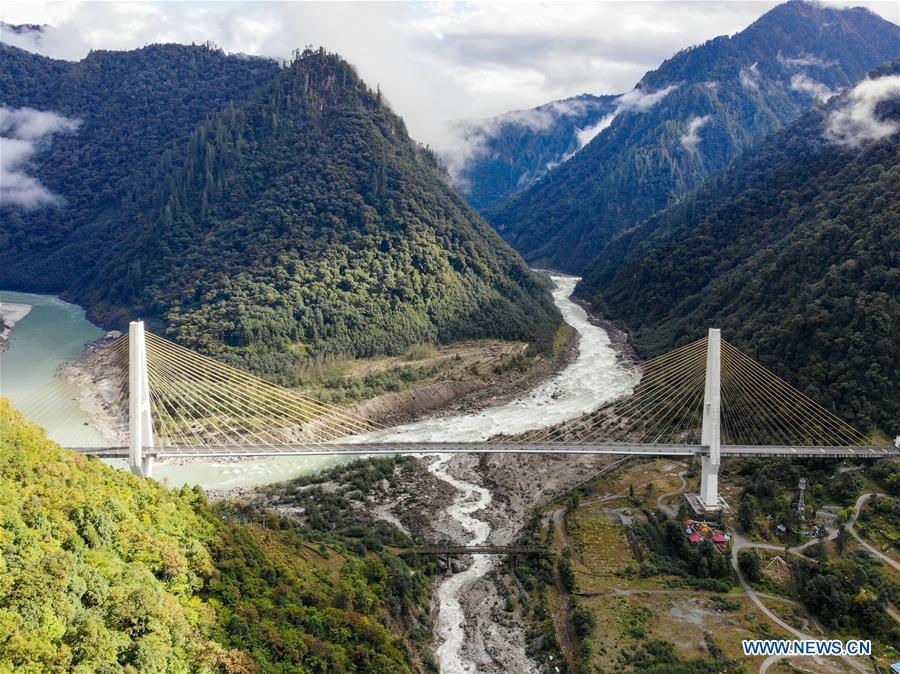
Aerial photo taken on Oct. 27, 2019 shows a long-span bridge on the Sichuan-Tibet Highway in Tangmai, Tibet. Tibet has built or renovated a total of 43,400 km of rural roads over the past five years, according to local authorities. The regional government has invested 95.7 billion yuan (around 13.7 billion U.S. dollars) over the period in paving modern roads to 2,276 villages, according to the regional transport department. (Xinhua/Sun Fei)

Tibet is warming up under Occupation. Electricians work on power transmission facilities in Nakarze county, Lhokha city in Tibet, Aug 27, 2019. [Photo/sipaphoto/com]
TIBET CONSCIOUSNESS – TIBET PROBLEM ON THE BACK BURNER SINCE 1850s WHILE TIBET IS WARMING UP UNDER OCCUPATION.