Whole Aggression – Red China uses maps for launching acts of aggression


Red China’s doctrine of Expansionism

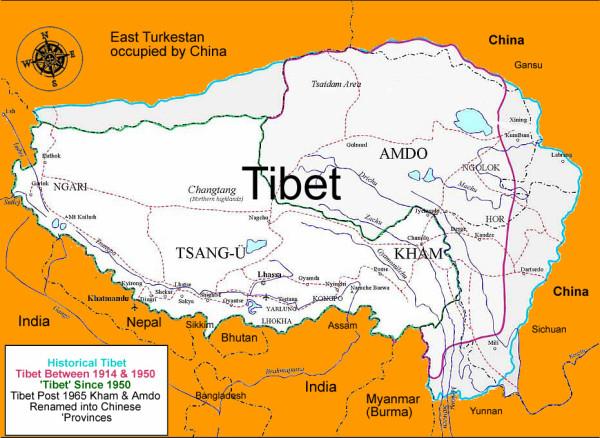
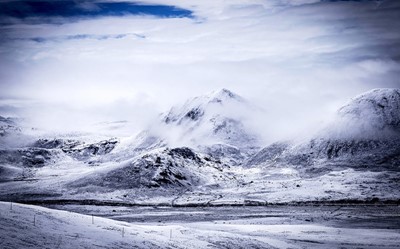
THE EVIL RED EMPIRE – RED CHINA – THE GREAT PROBLEM OF TIBET: TIBET HAS LAND AREA OF 870, 000 SQUARE MILES. TIBET IS LARGER IN SIZE COMPARED TO ASIAN NATIONS LIKE JAPAN, TAIWAN, PHILIPPINES, INDONESIA, MALAYSIA, VIETNAM, AND BRUNEI. TIBET IS THREE-TIMES LARGER THAN TEXAS STATE OF UNITED STATES .

Red China released a new map showing the totality of Beijing’s territorial claims. The word ‘cartography’ describes the art or work of making maps or charts. Red China claims this “10-Dash” new map serves to educate Chinese people about their country and her territory. I consider this map as an act of ‘cartographical’ or ‘cartographic’ aggression. Military always prepares maps and charts to plan its war operations much ahead of launching offensive or defensive military actions. Publication of this map is an act of hostility, a prelude to military aggression, and preparation forWar. As such all affected nations must not hesitate to take retaliatory actions to resist Red China’s acts of aggression. The first step is to prepare people to recognize Red China as an Enemy, Adversary, and an Opponent whose actions have to be challenged.

On behalf of Special Frontier Force, I reject Red China’s new map for I do not recognize Beijing’s claim of Tibet and its territory. Republic of India does not share a border with Red China.

Rudra Narasimham Rebbapragada
Ann Arbor, MI 48104-4162, USA
Special Frontier Force-Establishment 22-Vikas Regiment

The Washington Post

Could this map of China start a war?

By ISHAAN THAROOR June 27, 2014

(Hunan Map Press/Xinhua)
On behalf of Special Frontier Force, I reject Red China’s new map for I do not recognize Beijing’s claim of Tibet and its territory. Republic of India does not share a border with Red China.

(Hunan Map Press/Xinhua)

Chinese authorities unveiled this week a new map showing the totality of Beijing’s territorial claims. It supplants an earlier map which had a cutaway box displaying China’s declared claims over the South China Sea. Now, Chinese citizens can “fully, directly know the full map of China,” wrote the People’s Daily, a state paper. “Readers won’t ever think again that China’s territory has primary and secondary claims,” said the editor of the map press that published it.

On the face of it, the map shouldn’t be too much of a surprise to China’s neighbors. It counts Taiwan, which Beijing considers a renegade province, as part of China. It shows China’s longstanding belief in its suzerainty over the Spratlys and Paracels, the two main archipelagos of the South China Sea, which are contested to varying degrees by Vietnam, the Philippines and a number of other Southeast Asian nations. A 10-dash line (as opposed to China’s earlier nine-dash line) encircles most of the South China Sea, a body of water which sees some $5.3 trillion worth of trade pass through it every year.

Here’s a useful interactive built by the Council on Foreign Relations on the overlapping maritime claims

The new map also shows China’s claim over the Indian state of Arunachal Pradesh. China and India have one of the world’s most intractable and long-running land border disputes, which flared during a brief, bloody war in 1962. Arunachal Pradesh is fully integrated into India’s federal system, with regular state elections. But China claims most of it as part of “Southern Tibet.”

While it may seem silly to some, maps like this routinely flare tensions in Asia, where many nations are still wrangling with the complicated geography left behind by lapsed empires. Two years ago, a map published in new Chinese passports sparked a diplomatic firestorm , with foreign ministries in Vietnam and India both voicing protests and adopting counter-measures.

(Laris Karklis/The Washington Post)
On behalf of Special Frontier Force, I reject Red China’s new map for I do not recognize Beijing’s claim of Tibet and its territory. Republic of India does not share a border with Red China.

Laris Karklis/The Washington Post)

China’s economic rise has led to an increasing assertiveness in the region, with its expanding navy worrying neighbors and challenging U.S. dominance in the Pacific. It has triggered an arms race in Asia, punctuated by a growing number of dangerous incidents, including frequent maritime standoffs and altercations with Vietnamese and Philippine vessels and risky fighter jet flybys over Japanese ships.

While other countries complain, Beijing is steadily changing facts on the ground. It is building up a city in the Paracels. In May, China deployed a $1 billion oil rig in waters claimed by Vietnam, which led to violent protests and riots in Ho Chi Minh City. China is now moving in a second oil rig, despite the vociferous objections of Vietnamese officials.

The new map is an echo of this provocative worldview. But Beijing officials have sought to play it down. “The goal is to serve the Chinese public,” said a Foreign Ministry spokesperson. “As for the intentions, I think there is no need to make too much of any association here.”

tharooris.jpeg?ts=1402006601019&w=180&h=180

Ishaan Tharoor writes about foreign affairs for The Washington Post. He previously was a senior editor at TIME, based first in Hong Kong and later in New York.

© 1996-2015 The Washington Post

On behalf of Special Frontier Force, I reject Red China’s new map for I do not recognize Beijing’s claim of Tibet and its territory. Republic of India does not share a border with Red China.


Whole Threat – Red China’s Imperialism poses a Global Threat

The Evil Red Empire poses a Global Threat

THE  EVIL  RED  EMPIRE -  RED  CHINA  -  IMPERIAL  POWER -  A  GLOBAL  THREAT  TO  PEACE :  RED  CHINA'S  $ 1 BILLION  HAIYANG - SHIYOU  OIL  RIG  981 .
THE EVIL RED EMPIRE – RED CHINA – IMPERIAL POWER – A GLOBAL THREAT TO PEACE : RED CHINA’S $ 1 BILLION HAIYANG – SHIYOU OIL RIG 981 .

During 1970-71, Nixon-Kissinger changed direction of US Foreign Policy that has consistently addressed the problem of Communism and the threat it posed to World Peace. Nixon-Kissinger utterly failed to evaluate dangers posed by Red China’s Expansionist Policy which is extending Chinese territory by conquering her weak neighbors like Tibet. Red China is using her economic and military power in forming and maintaining an Empire to control natural resources and thereby dominate world markets.

Red China’s Expansionism is imposing a severe stress and strain as weaker nations like Vietnam, and Philippines have to increase their defense spending in an attempt to safeguard their national interests.

Rudra Narasimham Rebbapragada
Ann Arbor, MI 48104-4162, USA
Special Frontier Force-Establishment 22-Vikas Regiment

The Washington Post

THE $1 BILLION CHINESE OIL RIG THAT HAS VIETNAM IN FLAMES

By ADAM TAYLOR May 14, 2014

http://Wapo.st/RQKpTz

Protests spurred by the planned construction of a Chinese oil rig in a disputed area of the South China Sea escalated Tuesday into Wednesday in Binh Duong province, Vietnam. (Sarah Parnass/The Washington Post)

Early Wednesday, protesters began looting and burning factories at industrial parks near Ho Chi Minh City, in what is being called the worst outbreak of public disorder in Vietnam for years. Up to 20,000 people had been involved in relatively peaceful protests on Tuesday in Binh Duong province, according to the Associated Press, but smaller groups of men later ran into foreign-owned factories and caused mayhem.

Although some of the factories were owned by companies from Taiwan and South Korea, they were not thought to be the real target of the protesters’ anger.

(Laris Karklis / The Washington Post)
Red China’s Expansionism is imposing a severe stress and strain as weaker nations like Vietnam, and Philippines have to increase their defense spending in an attempt to safeguard their national interests.

(Laris Karklis / The Washington Post)

That prize belongs to China and its now-infamous “nine-dash line.”

The protests were sparked when Beijing deployed an oil rig in waters claimed by Vietnam on May 1. The Haiyang Shiyou 981 now sits about 70 miles inside the exclusive economic zone (EEZ) that extends 200 miles from the Vietnamese shore as part of the 1982 U.N. Convention on the Law of the Sea.

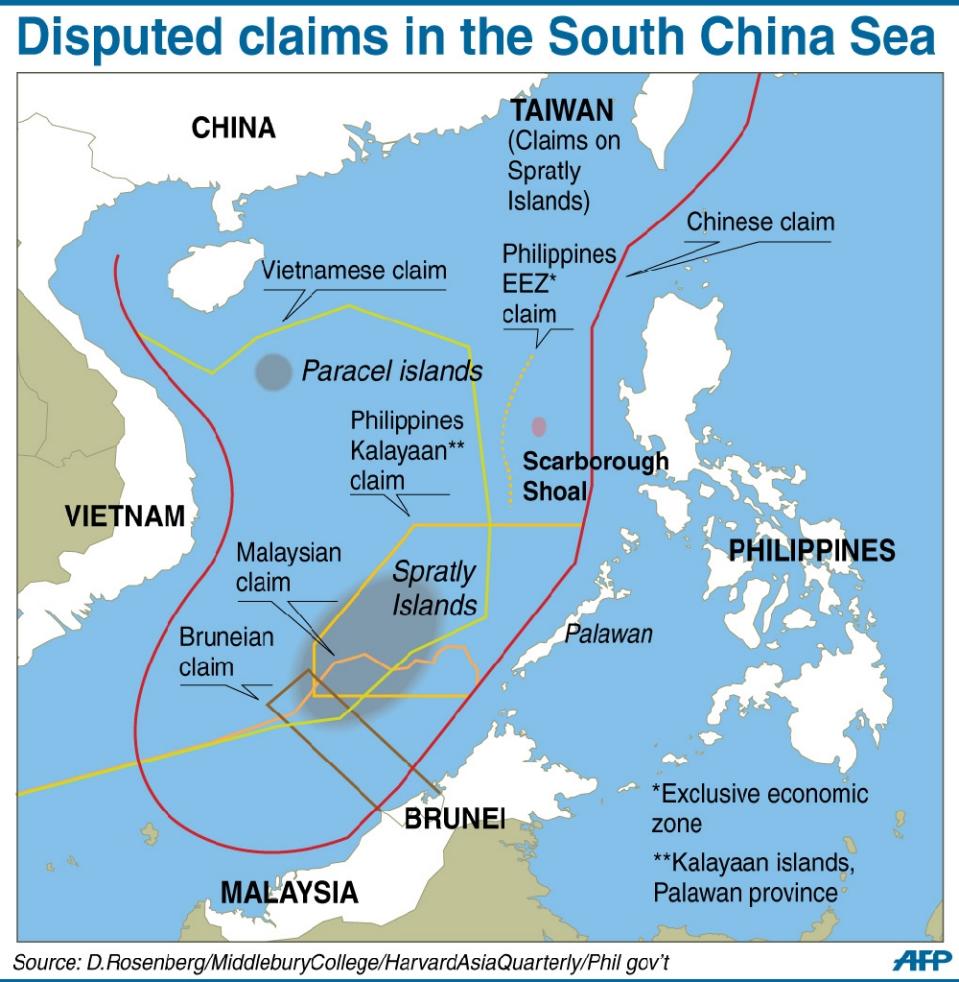
The problem is that China doesn’t really care about Vietnam’s EEZ. What matters to Beijing is the nine-dash line: A loosely defined maritime claim based on historical arguments which China uses to claim much of the land mass in the South China Sea. That nine-dash line (which, as the name implies, looks like nine dashes on a map) runs remarkably close to Vietnam’s shoreline, and though its nature is imprecise, Beijing seems to claim economic rights within the line.

Beijing has been using maps featuring the line since the 1950s, but it was only in the late 1960s that the issue really became a problem, after a U.N. report concluded that the area has large hydrocarbon deposits.

It has caused big rifts between China and Vietnam, which have a complicated relationship at the best of times. In 1974, after attempts by the South Vietnamese government to expel Chinese fishing ships, the Chinese navy seized the historically unoccupied Paracel Islands after a short battle and has held them since, despite a 1988 skirmish that left more than 70 Vietnamese soldiers dead. China later built a city on the largest island in the archipelago, long claimed by Vietnam, and it appears to claim an EEZ around the islands which includes the location of the Haiyang Shiyou 981.

The nine-dash line isn’t a problem just for Vietnam. Going by its U-shaped curve, the larger group of the Spratly Islands also falls within Chinese territory, despite competing claims by the Philippines, Brunei, Malaysia, Taiwan and Vietnam. The 200 or so mostly uninhabitable islands and rocks also are thought to be rich in oil and gas. In addition, China has a serious maritime dispute with Japan in the East China Sea.

A ship of Chinese Coast Guard is seen near Chinese oil rig Haiyang Shi You 981 in the South China Sea, about 210 km (130 miles) off shore of Vietnam May 14, 2014. Vietnamese ships were followed by Chinese vessels as they neared China's oil rig in disputed waters in the South China Sea on Wednesday, Vietnam's Coast Guard said. Vietnam has condemned as illegal the operation of a Chinese deepwater drilling rig in what Vietnam says is its territorial water in the South China Sea and has told China's state-run oil company to remove it. China has said the rig was operating completely within its waters. REUTERS/Nguyen Minh (POLITICS MARITIME ENERGY)
Red China’s Expansionism is imposing a severe stress and strain as weaker nations like Vietnam, and Philippines have to increase their defense spending in an attempt to safeguard their national interests.

A Chinese coast guard ship is seen near the Chinese oil rig Haiyang Shiyou 981 in the South China Sea, about 130 miles off Vietnam’s shore. (Nguyen Minh/Reuters)

Vietnam and China had shown some signs of rapprochement in recent years, signing an agreement in 2011 aimed at solving the South China Sea Disputes and Hanoi had already offered the waters near where the rig is sitting for exploration by energy companies. However, with the arrival of the oil rig – said to have cost $1 billion to produce – relations are looking their worst in years. The timing of the move is worth noting, coming shortly after President Obama’s trip to Asia and just before a recent meeting of the Association of Southeast Asian Nations.

It’s a big problem for Vietnam, which is largely impotent in any battle against China. As a recent Washington Post Editorial noted, Vietnam lacks strong military ties with the United States and is ruled by a powerful Communist Party that includes a strong pro-Beijing faction. It can’t hope to compete with China’s navy, and Chinese President Xi Jinping has made it clear that he would use military strength to protect what he views as Chinese territory: A graphic example of that is the videos posted online last week that appeared to show the oil rig’s Chinese escort ramming and shooting water cannons at Vietnamese boats trying to stop the flotilla.

The protests within Vietnam seem to be a result of that impotence. Although unauthorized protests are rarely tolerated in Vietnam, the anti-China demonstrations seem to have the government’s blessing. The AP reports that signs have been handed out at protests that read : “We entirely trust the party, the government and the people’s army.”
It is unclear whether the violence Wednesday morning was part of the plan, however, and Hanoi may find itself torn between two difficult choices – facing the military and economic wrath of China or its own increasingly furious domestic audience.

CORRECTION: An earlier version of this post incorrectly described the basis for China’s territorial claim there. China asserts sovereignty over land features in South China Sea that lie within a so-called nine dash line on Chinese maps; it does not assert a claim to all waters within that line. China’s assertion of a right to deploy the oil rig in its current location appears to be based a Chinese claim to the nearby Paracel Islands, not the waters themselves. The article also incorrectly stated the islands were historically unoccupied; in fact, they were once sparsely populated.

taylorad.jpg?ts=1401482429561&w=180&h=180

Adam Taylor writes about foreign affairs for The Washington Post. Originally from London, he studied at the University of Manchester and Columbia University.

The Washington Post

Red China’s Expansionism is imposing a severe stress and strain as weaker nations like Vietnam, and Philippines have to increase their defense spending in an attempt to safeguard their national interests.

Whole Loot and Whole Plunder – Looting and Plundering of Tibet

Tibet Awareness – Red China Looting and Plundering Tibet

Tibet Awareness - Red China- Looting and Plundering of Tibet. Map of Mineral deposits of the Tibetan plateau.
Red China’s practices in Tibet; her indiscriminate taking of Tibetan national assets causing severe environmental pollution with toxic chemicals, massive hydro projects leading to major ecological disaster in Tibet, have to be treated as War Crimes. Red China must be tried by a War Crimes Tribunal and held accountable for stealing Tibet’s national wealth and property.

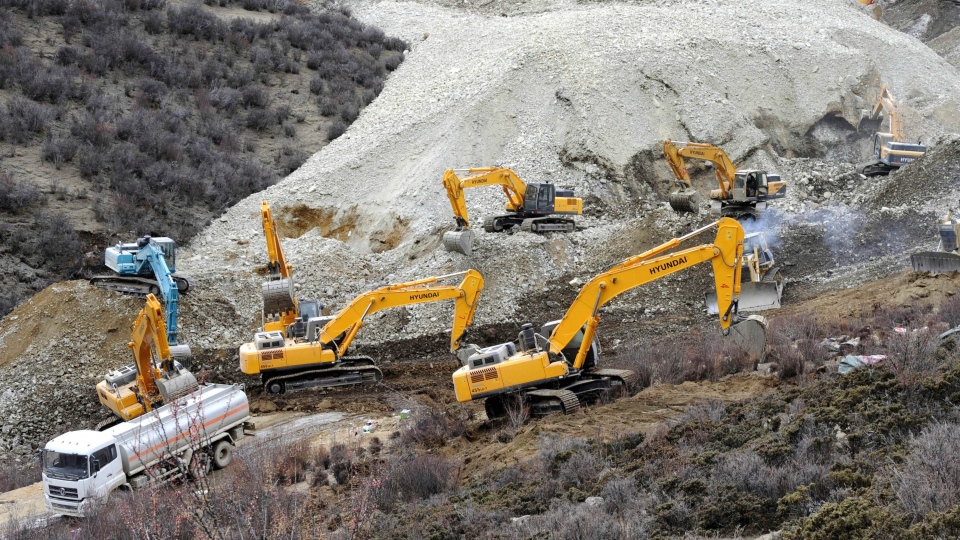
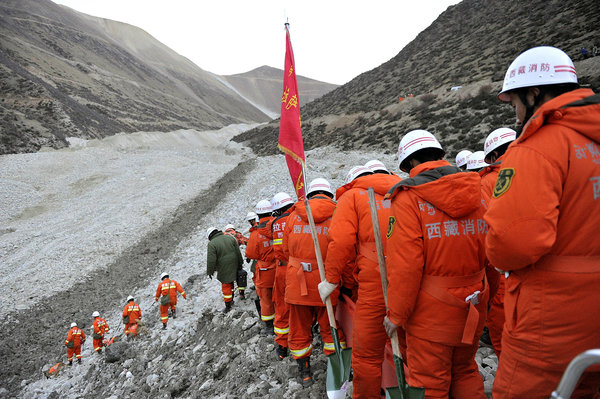
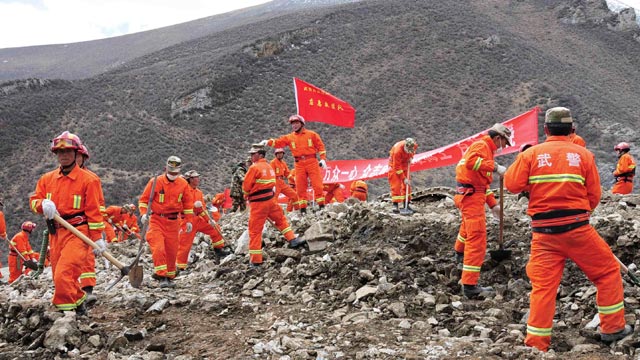
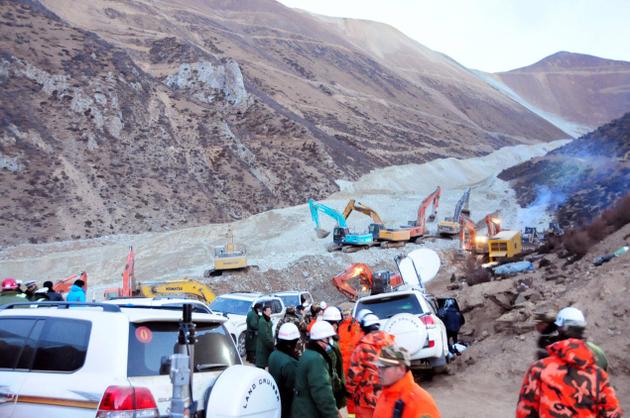
Red China used her military force to attack Tibet and occupied the country since 1950. After driving His Holiness the 14th Dalai Lama into exile, Red China unleashed a systematic campaign to loot, plunder, pillage, sack, ransack, steal, and despoil Tibetan natural resources without any concern for international law. Red China is encouraging foreign companies to join her in illegal exploration for mineral wealth and criminal mining operations. Such activities get media attention if a disaster strikes mining operation. Gold and Copper mining operations in Gyama Valley, Maizhokunggar County of Lhasa came to world’s attention when a massive landslide on March 29, 2013 killed 83 employees of Tibet Huatailong Mining Development Company, subsidiary of the state-run China National Gold Group. Red China is world’s largest producer of Gold and other Rare Earth Minerals. Red China’s practices in Tibet; her indiscriminate taking of Tibetan national assets causing severe environmental pollution with toxic chemicals, massive hydro projects leading to major ecological disaster in Tibet, have to be treated as War Crimes. Red China must be tried by a War Crimes Tribunal and held accountable for stealing Tibet’s national wealth and property.

Rudra Narasimham Rebbapragada
Ann Arbor, MI 48104-4162, USA
Special Frontier Force-Establishment 22-Vikas Regiment

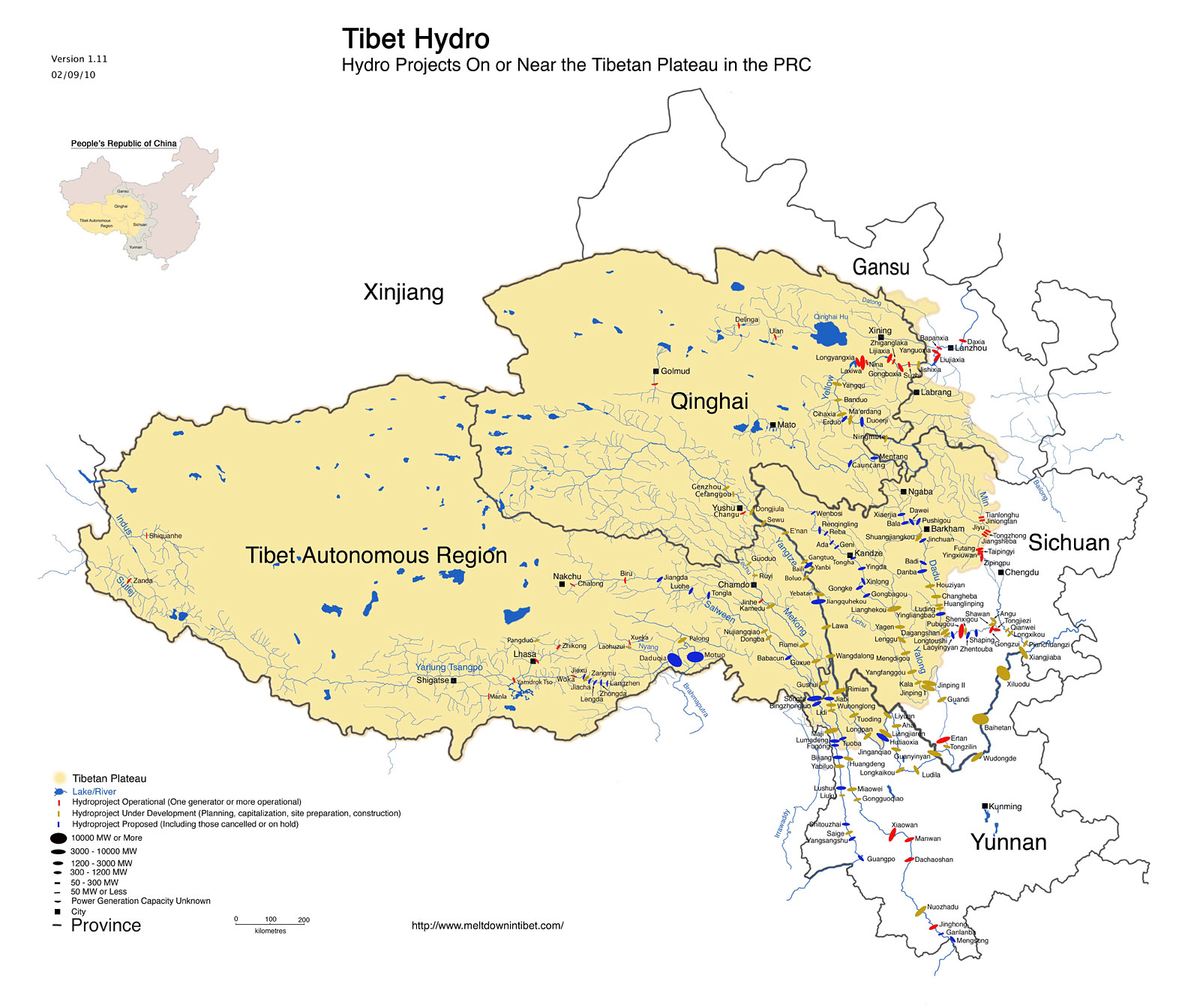
Tibet Awareness - Red China - Looting and Plundering of Tibet. Hydro projects. Ecological Devastation.
Red China’s practices in Tibet; her indiscriminate taking of Tibetan national assets causing severe environmental pollution with toxic chemicals, massive hydro projects leading to major ecological disaster in Tibet, have to be treated as War Crimes. Red China must be tried by a War Crimes Tribunal and held accountable for stealing Tibet’s national wealth and property.
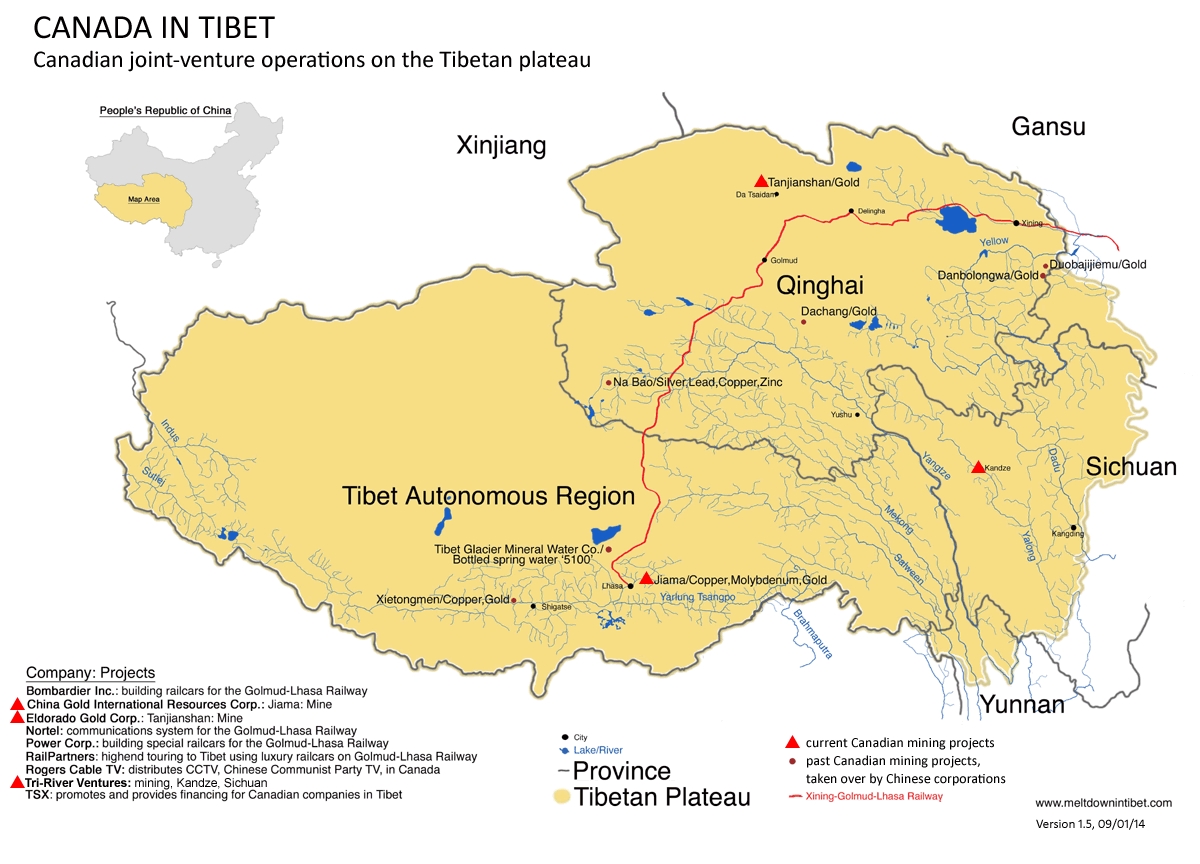
Tibet Awareness - Looting and Plundering of Tibet. Canadian mining projects in Tibet.
Red China’s practices in Tibet; her indiscriminate taking of Tibetan national assets causing severe environmental pollution with toxic chemicals, massive hydro projects leading to major ecological disaster in Tibet, have to be treated as War Crimes. Red China must be tried by a War Crimes Tribunal and held accountable for stealing Tibet’s national wealth and property.
Tibet Awareness - Looting and Plundering of Tibet. Canadian Companies operating in Tibet
Red China’s practices in Tibet; her indiscriminate taking of Tibetan national assets causing severe environmental pollution with toxic chemicals, massive hydro projects leading to major ecological disaster in Tibet, have to be treated as War Crimes. Red China must be tried by a War Crimes Tribunal and held accountable for stealing Tibet’s national wealth and property.
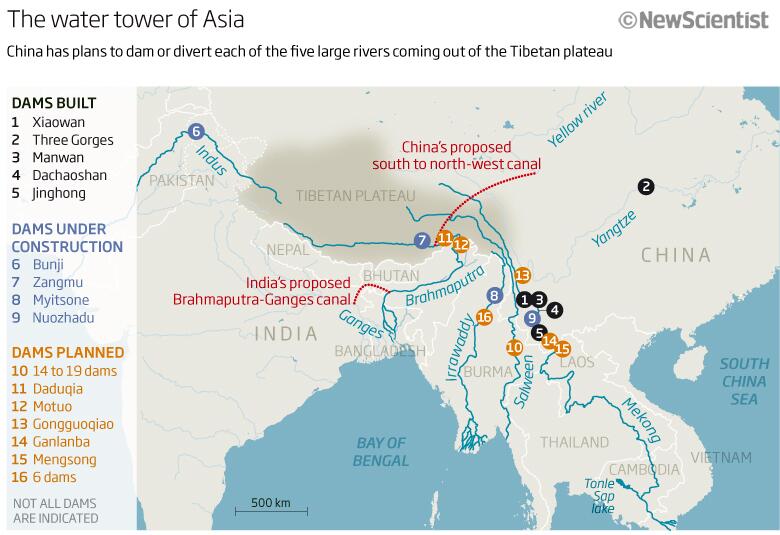
Tibet Awareness - Red China - Looting and Plundering of Tibet. Diversion of River water. Ecological Disaster.
Red China’s practices in Tibet; her indiscriminate taking of Tibetan national assets causing severe environmental pollution with toxic chemicals, massive hydro projects leading to major ecological disaster in Tibet, have to be treated as War Crimes. Red China must be tried by a War Crimes Tribunal and held accountable for stealing Tibet’s national wealth and property.
Tibet Awareness - Red China - Looting and Plundering Tibet. Tibet 5100 Ecological Disaster.
Red China’s practices in Tibet; her indiscriminate taking of Tibetan national assets causing severe environmental pollution with toxic chemicals, massive hydro projects leading to major ecological disaster in Tibet, have to be treated as War Crimes. Red China must be tried by a War Crimes Tribunal and held accountable for stealing Tibet’s national wealth and property.
Tibet Awareness - Red China - Looting and Plundering of Tibet. Depletion of aquifers. Ecological disaster. Tibet spring water bottling operation.
Red China’s practices in Tibet; her indiscriminate taking of Tibetan national assets causing severe environmental pollution with toxic chemicals, massive hydro projects leading to major ecological disaster in Tibet, have to be treated as War Crimes. Red China must be tried by a War Crimes Tribunal and held accountable for stealing Tibet’s national wealth and property.
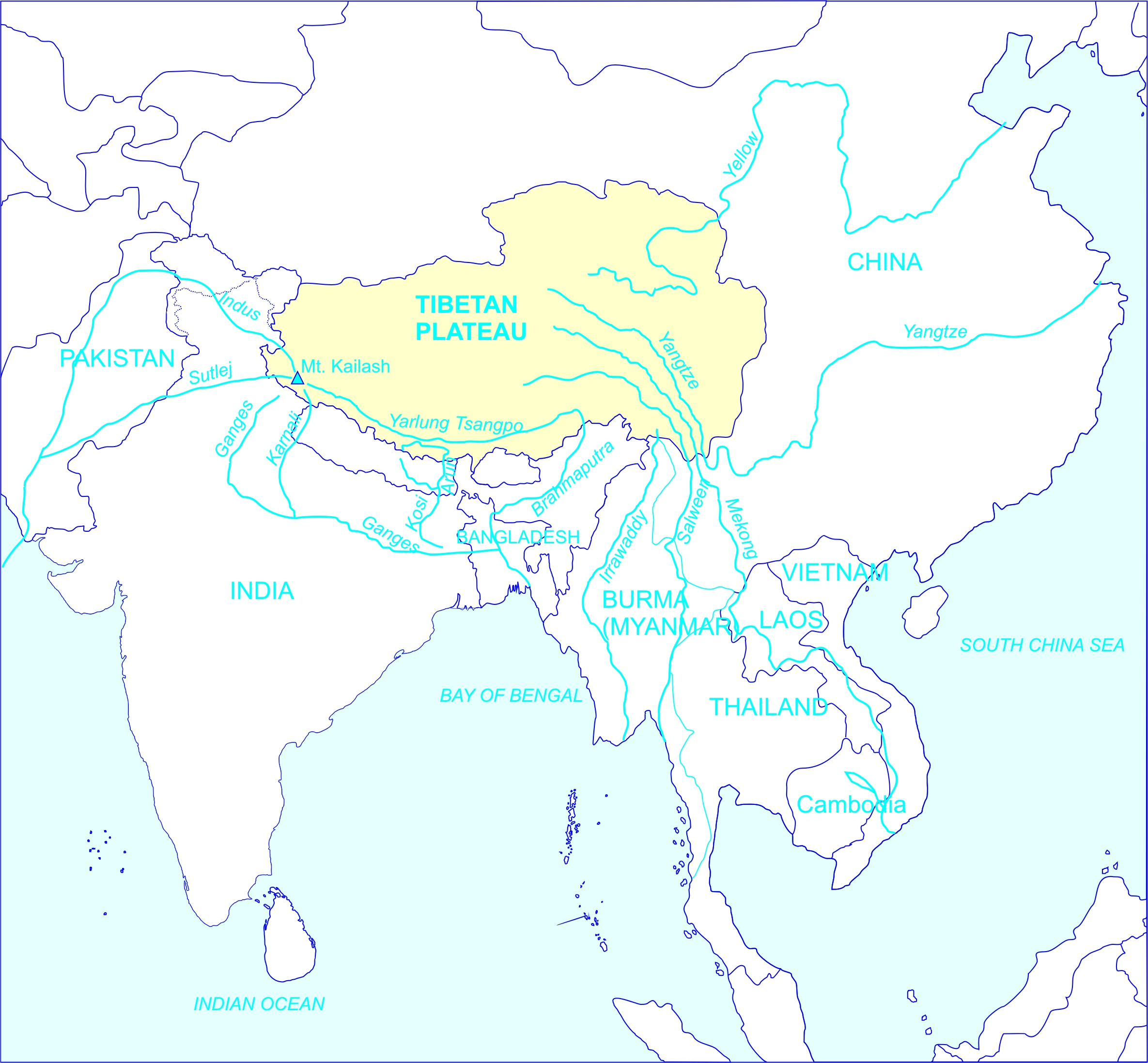
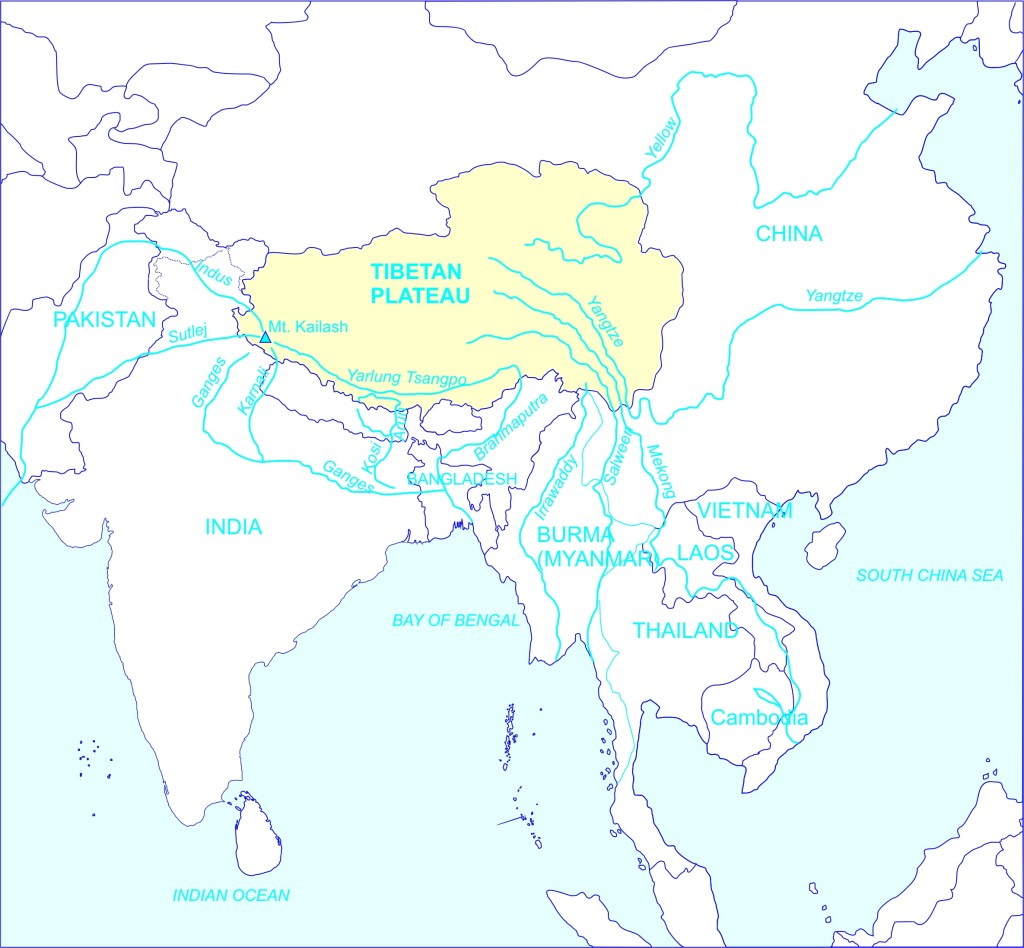
Tibet Awareness. Major rivers of Asia. Red China diverting waters from major Rivers of Asia.
Red China’s practices in Tibet; her indiscriminate taking of Tibetan national assets causing severe environmental pollution with toxic chemicals, massive hydro projects leading to major ecological disaster in Tibet, have to be treated as War Crimes. Red China must be tried by a War Crimes Tribunal and held accountable for stealing Tibet’s national wealth and property.

Yahoo!-ABC News Network | © 2015 ABC News Internet Ventures. All rights reserved.

China Stages Mass Spectacle in Tibet to Mark 50 Years’ Rule

BEIJING — Sep 8, 2015, 9:22 AM ET

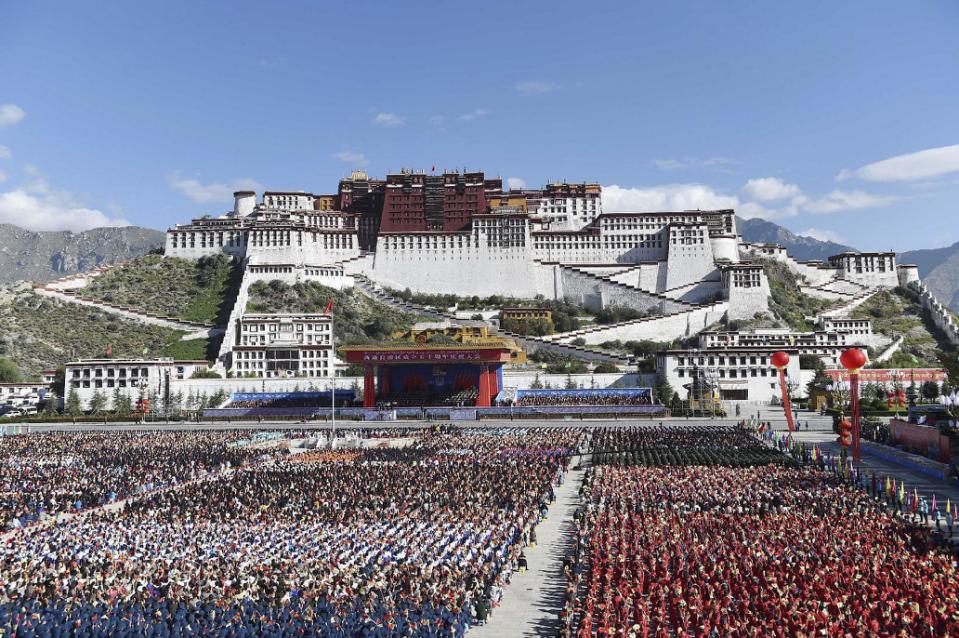
In this photo released by China’s Xinhua News Agency, a grand ceremony marking the 50th anniversary of the founding of the Tibet Autonomous Region is held at the square of the Potala Palace in Lhasa, capital of Tibet Autonomous Region, Tuesday, Sept. 8, 2015. (Chen Yehua/Xinhua via AP) Red China’s practices in Tibet; her indiscriminate taking of Tibetan national assets causing severe environmental pollution with toxic chemicals, massive hydro projects leading to major ecological disaster in Tibet, have to be treated as War Crimes. Red China must be tried by a War Crimes Tribunal and held accountable for stealing Tibet’s national wealth and property.

In this photo released by China’s Xinhua News Agency, a grand ceremony marking the 50th anniversary of the founding of the Tibet Autonomous Region is held at the square of the Potala Palace in Lhasa, capital of southwest China’s Tibet Autonomous Region, Tuesday, Sept. 8, 2015. (Chen Yehua/Xinhua via AP) 
The Associated Press

Associated Press

Schoolchildren waved flags and paramilitary troops marched in full battle dress at a mass spectacle China staged Tuesday to mark 50 years since establishing Tibet as an ethnic autonomous region firmly under Beijing’s control.

The event lauded Tibet’s economic successes under Communist Party rule, even as activists criticized its record on human rights.

Top political adviser Yu Zhengsheng stressed Tibet’s unity with the rest of China in his address to thousands gathered in front of the stunning Potala Palace in the regional capital of Lhasa,
once home to the Dalai Lama and now a museum.

“During the past 50 years the Chinese Communist Party and the Tibetan people have led the transformation from a backward old Tibet to a vibrant socialist new Tibet,” Yu told the audience of schoolchildren, soldiers, armed police and party officials applauding and waving flags.

People’s living standards have improved, infrastructure has been built across Tibet and its gross domestic product had grown 68 times, Yu said at the ceremony broadcast live on state television.

Yu’s speech was followed by a parade of goose-stepping marchers carrying the national emblem of China, along with portraits of past and present leaders, including President Xi Jinping. Dancers and musicians in traditional Tibetan dress also performed, although there was no visible participation by representatives of the Buddhist clergy that forms the backbone of the Himalayan region’s traditional culture.

Beijing sent troops to occupy the Himalayan region following the 1949 communist revolution. The government says the region has been part of Chinese territory for centuries, while many Tibetans say it has a long history of independence under a series of Buddhist leaders.

The region’s traditional Buddhist ruler, the Dalai Lama, fled in 1959 amid an abortive uprising against Chinese rule, and continues to advocate for a meaningful level of autonomy under Chinese rule.

China established the Tibetan autonomous region in 1965, one of five ethnic regions in the country today. While Tibet is nominally in charge of its own affairs, its top officials are appointed by Beijing and expected to rule with an iron fist. The region incorporates only about half of Tibet’s traditional territory, is closed to most foreign media and has been smothered in multiple layers of security ever since deadly anti-government riots in 2008.

Reinforcing the importance of strict control from Beijing, the party’s central committee said in a statement that; “Only by sticking to the CPC’s (Communist Party’s) leadership and the ethnic autonomy system, can Tibetans be their own masters and enjoy a sustainable economic development and long-term stability.”
Referring to the Dalai Lama, Yu said activities by him and others to “split China and undermine ethnic unity have been defeated time and time again.”

Free Tibet, a London-based rights group, said Beijing was trying to define Tibetan identity according to its priorities, and that Tibetans suffered restrictions on movement, censorship and lived in a system designed to punish opposition to the Beijing government.

“If Tibet’s people have a good news story to tell, why doesn’t Beijing let them freely tell it or give the world’s media the opportunity to freely see it?” the group said.
The 80-year-old Dalai Lama is in Britain this month for speaking engagements and had no immediate comment.

Tuesday’s event reflects Xi’s taste for organized spectacle, in a throwback to the mass rallies common in the early decades of communist rule. It comes less than a week after a massive military parade in Beijing to mark 70 years since Japan’s surrender at the end of World War II.

© 2015 ABC News Internet Ventures. All rights reserved.

Red China’s practices in Tibet; her indiscriminate taking of Tibetan national assets causing severe environmental pollution with toxic chemicals, massive hydro projects leading to major ecological disaster in Tibet, have to be treated as War Crimes. Red China must be tried by a War Crimes Tribunal and held accountable for stealing Tibet’s national wealth and property.

Whole Evil – The Tyrannical Rule of China over occupied Territories

The Evil Red Empire – The Tyranny of Expansionism

RED CHINA - THE EVIL RED EMPIRE - RED ALERT - A TYRANT
The term ‘tyrant’ describes any person who exercises authority in an oppressive manner, a cruel master, despot, absolute ruler who is unwilling for arbitration. Red China governs as a tyrant

The term ‘tyrant’ describes any person who exercises authority in an oppressive manner, a cruel master, despot, absolute ruler who is unwilling for arbitration. Red China governs as a tyrant. Apart from being harsh, cruel, oppressive, and unjust, the tyrannical rule imposed by Red China over illegally occupied Tibet is characterized by Red China’s use of any kind of pretext to justify its tyranny. When the oppressor intends to be unjust, no argument will succeed. A tyrant will always find a pretext for his tyranny and it is useless for the victim to try by reasoning to get justice. Red China to justify its military grip over Tibet claims that She liberated Tibet and emancipated Tibetan people from feudal Lords.

The stories popularly known as Aesop’s Fables include a story titled ‘The Wolf and The Lamb’ in which, a Lamb finds no choice other than that of losing his life for the Wolf, a tyrant is unwilling to accept any reasoning with which Lamb pleaded to save his life.

The Wolf and the Lamb:

THE EVIL RED EMPIRE - RED CHINA - TYRANT : THE TYRANT WILL ALWAYS FIND AN EXCUSE FOR HIS TYRRANY.
The term ‘tyrant’ describes any person who exercises authority in an oppressive manner, a cruel master, despot, absolute ruler who is unwilling for arbitration. Red China governs as a tyrant

Once upon a time, a Wolf was lapping at a stream, when looking up, the Wolf saw a Lamb just beginning to drink a little lower down the stream.

“There’s my supper”, thought the Wolf, “If only I can find some excuse to seize it.” Then he called out to the Lamb, “How dare you muddle the water from which I am drinking?”

“Nay, Master, nay,” said Lambikin, “If the water be muddy up there, I cannot be the cause of it, for it runs down from you to me.”

“Well then,” said the Wolf, “Why did you call me bad names this time last year?”

“That cannot be,” said the Lamb, “I am only six months old.”

“I don’t care,” snarled the Wolf, “If it was not you it was your father,” and with that he rushed upon the poor little Lamb, seized him and ate him up saying, “Well I won’t remain supperless even though you refute every one of my imputations.”

But before he died, Lamb gasped out, “Any excuse will serve a tyrant.”

In my view, the United States and its allies in Asia cannot win their argument about territorial boundaries in South China Sea. Red China is a tyrant who will use any excuse to justify her actions to expand her maritime boundaries. To address the problem of Red China’s tyranny, the global community of nations must begin with ‘The Great Problem of Tibet’ and evict the illegal occupier of Tibet.

Rudra Narasimham Rebbapragada
Ann Arbor, MI 48104-4162, USA

U.S. HOPES CHINESE ISLAND-BUILDING WILL SPUR ASIAN RESPONSE

Reuters

By David Alexander

By releasing video of Beijing’s island reclamation work and considering more assertive maritime actions, the United
States is signaling a tougher stance over the South China Sea and trying to spur Asian partners to more action.

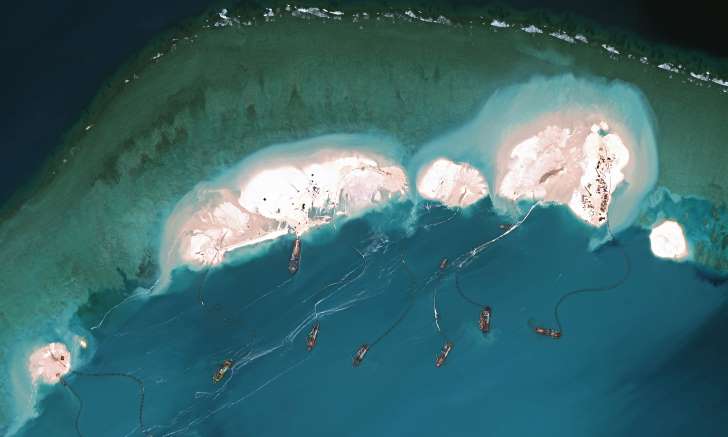
The release last week of the surveillance plane footage – showing dredgers and other ships busily turning remote outcrops into islands with runways and harbors – helps ensure the issue will dominate an Asian security forum starting on Friday attended by U.S. Defense Secretary Ash Carter as well as senior Chinese military officials.

As it pushes ahead with a military “pivot” to Asia partly aimed at countering China, Washington wants Southeast
Asian nations to take a more united stance against China’s rapid acceleration this year of construction on disputed reefs.

The meeting, the annual Shangri-La Dialogue in Singapore, will be overshadowed by the tensions in the South China
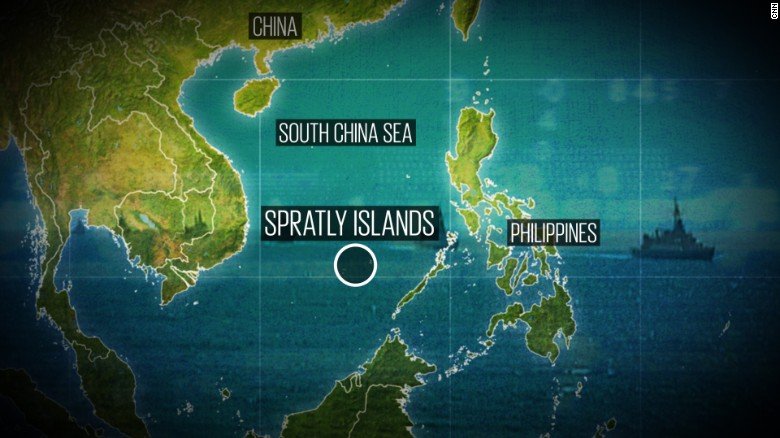
Sea, where Beijing has added 1,500 acres to five outposts in the resource-rich Spratly islands since the start of this year.

“These countries need to own it (the issue),” one U.S. defense official said on condition of anonymity, adding that
it was counterproductive for the United States to take the lead in challenging China over the issue.

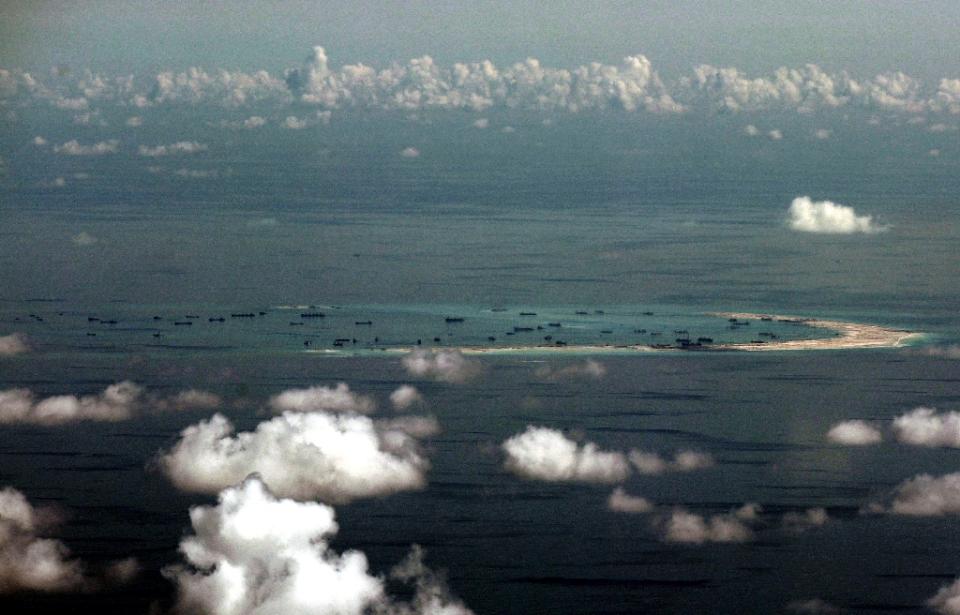
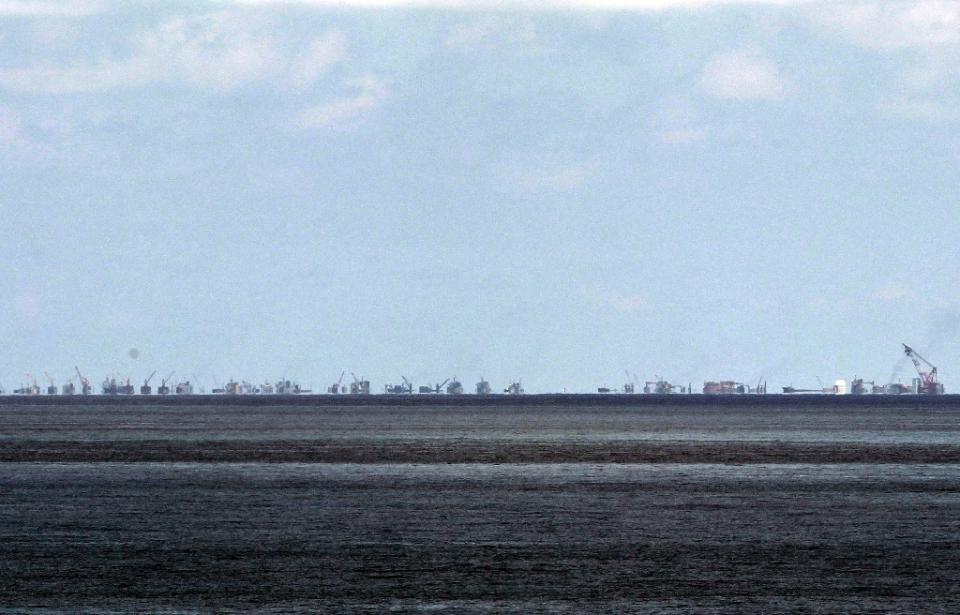
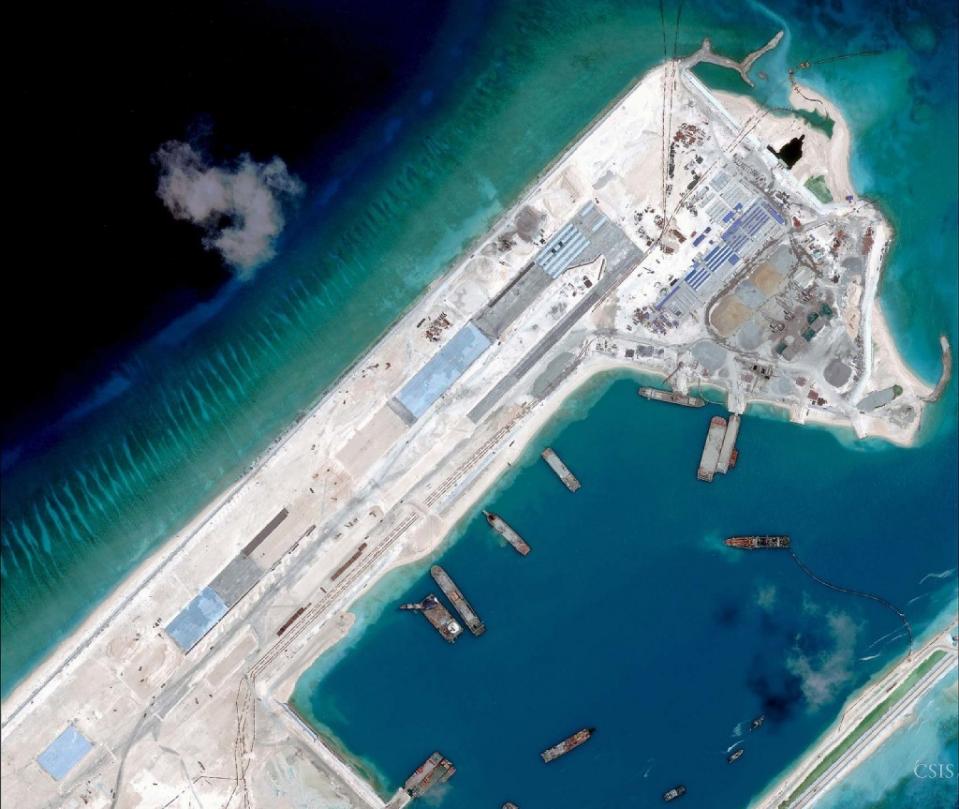
Red China -  Land Reclamation Activity in   South China Sea.
Red China – Land Reclamation Activity in South China Sea.

© REUTERS/U.S. Navy/Handout via Reuters Still image from United States Navy video purportedly shows Chinese dredging vessels in the waters around Mischief Reef in the disputed Spratly Islands.

More unified action by the partners, including the 10-member Association of Southeast Asian Nations (ASEAN), needed
to happen soon because “if you wait four years, it’s done,” the official said.

While some ASEAN members, including U.S. ally the Philippines and fellow claimant Vietnam, have been vocal critics of
Chinese maritime actions, the group as a whole has been divided on the issue and reluctant to intervene.

But in a sign of growing alarm, the group’s leaders last month jointly expressed concern that reclamation activity
had eroded trust and could undermine peace in the region.

Experts dismiss the idea of ASEAN-level joint action any time soon in the South China Sea. “It’s absolute fantasy,” said
Ian Storey of Singapore’s Institute on South East Asian Studies.

But stepped-up coordination between some states is possible. Japan’s military is considering joining the United States in
maritime air patrols over the sea. Japan and the Philippines are expected to start talks next week on a framework for the transfer of defense equipment and technology and to discuss a possible pact on the status of Japanese military
personnel visiting the Philippines.

Carter, speaking in Honolulu en route to Singapore, repeated Washington’s demand that the island-building stop, saying
China was violating the principles of the region’s “security architecture” and the consensus for “non-coercive approaches.”

China claims 90 percent of the South China Sea, which is believed to be rich in oil and gas, with overlapping claims
from Brunei, Malaysia, the Philippines, Vietnam and Taiwan.

SHOWING CHINA SOME “RESOLVE”

As part of Washington’s drive to energize its allies, a U.S. Navy P-8 reconnaissance plane allowed CNN and Navy
camera crews to film Chinese land reclamation activity in the Spratly islands last week and release the footage.

“No one wants to wake up one morning and discover that China has built numerous outposts and, even worse, equipped them
with military systems,” Assistant Secretary of State Daniel Russel said.

Ernest Bower, a Southeast Asia expert at the Center for Strategic and International Studies think tank in Washington,
said the U.S. goal was to convince China to buy into the international system for dispute resolution rather than impose its sweeping territorial claims on the region.

But in the near term, he added: “I think the Americans are going to have to show China some resolve.”

U.S. officials have said Navy ships may be sent within 12 miles (19 kms) of the Chinese-built islands to show that
Washington does not recognize Beijing’s insistence that it has territorial
rights there.

Washington is also pressing ahead with its rebalancing towards Asia, four years after President Barack Obama announced
the strategic shift, even as some countries say it is slow to take shape.

The United States has updated its security agreements with treaty allies Japan and the Philippines and is
bolstering missile defenses in Japan with an eye on North Korea.

U.S. Marines are training in Australia on a rotational basis, littoral combat ships are operating out of Singapore and
new P-8 reconnaissance planes stationed in Japan have flown missions across the region.

Overall, defense officials said, the Navy will increase its footprint by 18 percent between 2014 and 2020. The aim is
to have 60 percent of Navy ships oriented toward the Pacific by 2020, compared to 57 percent currently.

Military officials in the Philippines say the U.S. shift has been noticeable, including military exercises, training
and ship and aircraft visits. The emphasis has shifted from anti-terrorism to maritime security, one official said.

China has not shown any sign of being deterred. On Tuesday it held a groundbreaking ceremony for two lighthouses in
the South China Sea, vowed to increase its “open seas protection,” and criticized neighbors who take “provocative actions” on its reefs and islands.

(Additional reporting by Greg Torode in
Hong Kong, Nobuhiro Kubo in Tokyo, Manuel Mogato in Manila, Sui Lee Wee in
Beijing; editing by David Storey and Stuart Grudgings.)

The term ‘tyrant’ describes any person who exercises authority in an oppressive manner, a cruel master, despot, absolute ruler who is unwilling for arbitration. Red China governs as a tyrant

Whole Trouble – The Policy of Forced Resettlement of Tibetan Nomads

Trouble in Tibet – Red China’s Doctrine of Neocolonialism – The Forced Resettlement of Tibetan Nomads

‘Trouble in Tibet’ has several faces and one of them is Resettlement of Nomads. This Policy of Resettlement of Tibetan Nomads symbolizes Red China’s Neocolonialism; extension of political and economic control over Tibet using organizational, and technological superiority.

‘Trouble in Tibet’ has several faces and one of them is Resettlement of Nomads. This Policy of Resettlement of Tibetan Nomads symbolizes Red China’s Neocolonialism; extension of political and economic control over Tibet using organizational, and technological superiority.

‘Trouble in Tibet’ has several faces and one of them is Resettlement of Nomads. This Policy of Resettlement of Tibetan Nomads symbolizes Red China’s Neocolonialism; extension of political and economic control over Tibet using organizational, and technological superiority.

STRUGGLE IN THE CITY FOR TIBETAN NOMADS

 By Benjamin Haas

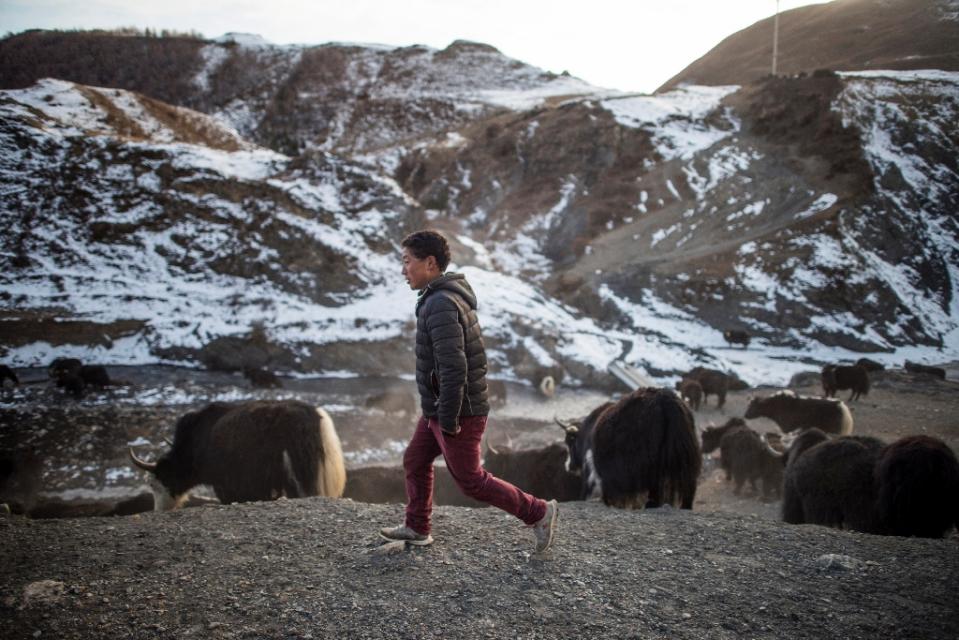
Aba (China) (AFP) – By mid-morning, Lobsang’s leather cowboy hat is askew, his black robes dishevelled, and his breath stinks of booze. Once a nomad herder roaming the high Tibetan plateau, instead he stumbles around his sparse new concrete house.

For decades he and his wife grazed yaks and sheep, living a life little changed in centuries, until they acquiesced three years ago to government calls to give up their yak-hair tents for permanent housing.

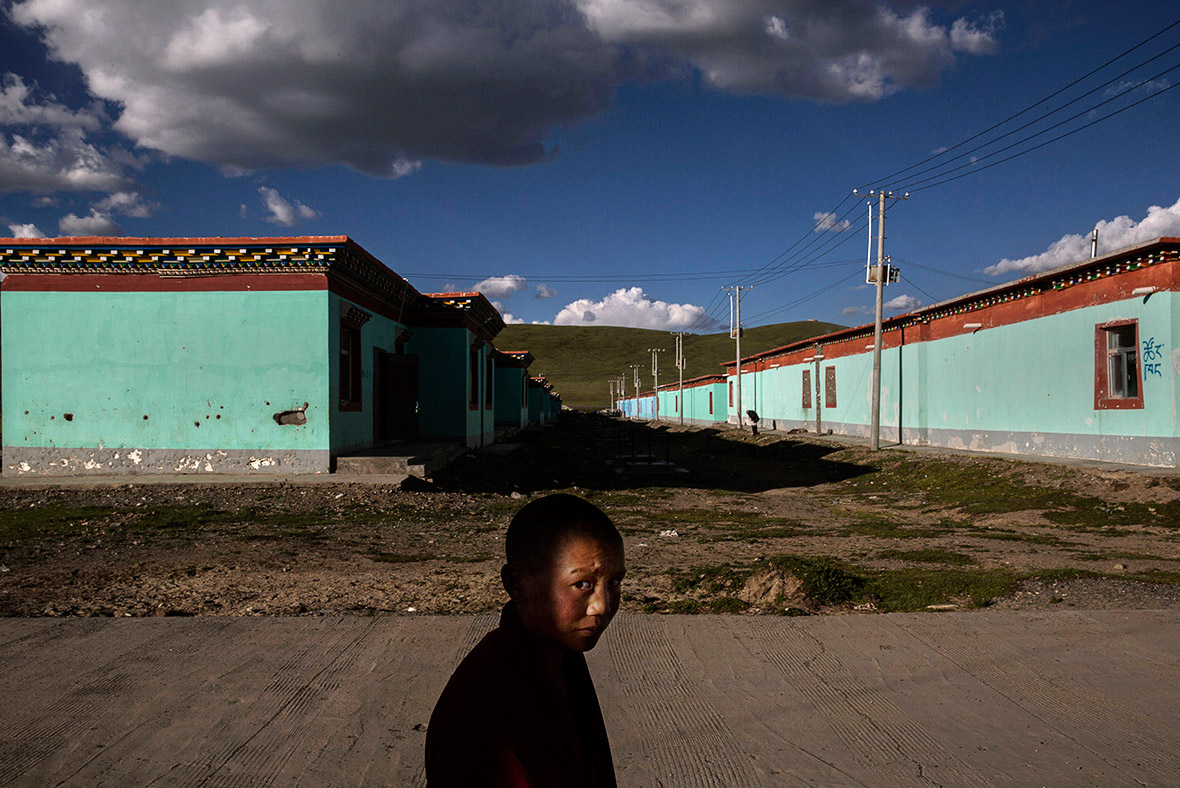
Now they live in a resettlement village, row after row of identical blue-roofed grey shells, an hour’s drive from Aba in Sichuan province along winding mountain roads.

“Everything changed when we moved to this town,” said Tashi, who like her husband is in her 40s but not sure of her exact age. “First we ran out of money, then he couldn’t find suitable work and then he started drinking more and more.”

Chinese authorities say urbanisation in Tibetan areas and elsewhere will increase industrialisation and economic development, offering former nomads higher living standards and better protecting the environment.

Those who move receive an urban hukou — China’s strictly controlled internal residence permits that determine access to social services. The government offers free or heavily subsidised houses, medical insurance, and free schooling.

TROUBLE IN TIBET - RESETTLEMENT OF TIBETAN NOMADS.
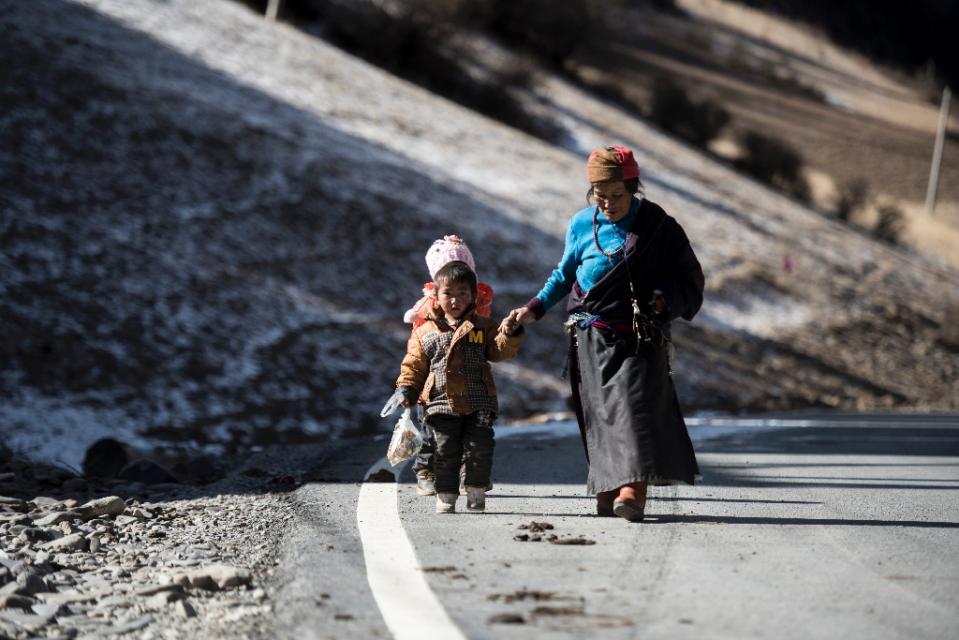
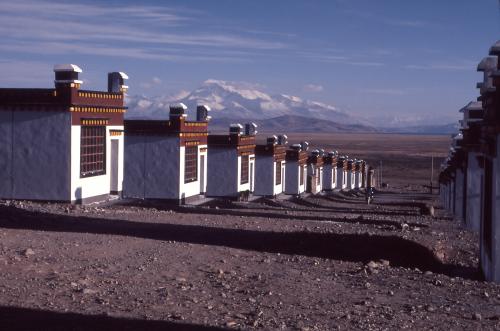
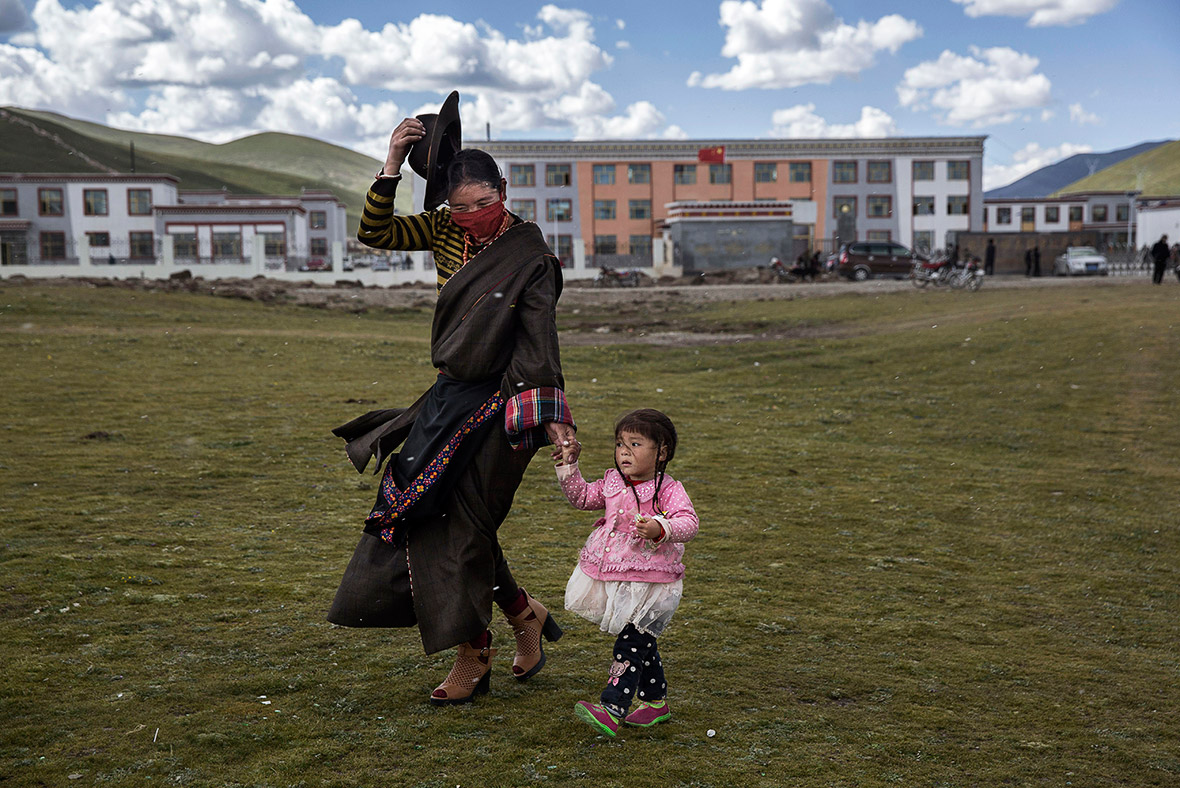
TROUBLE IN TIBET – RESETTLEMENT OF TIBETAN NOMADS. KANDING, THE GANZI PREFECTURE. RED CHINA’S NEOCOLONIALISM. ‘Trouble in Tibet’ has several faces and one of them is Resettlement of Nomads. This Policy of Resettlement of Tibetan Nomads symbolizes Red China’s Neocolonialism; extension of political and economic control over Tibet using organizational, and technological superiority.

A woman walks in the snow in Kangding in the Ganzi Tibetan Autonomous Prefecture, southwestern China.

But critics say the drive has a one-size-fits-all approach and many former pastoralists have not prospered, despite its promises.

Unlike the voluntary urbanisation of the early 2000s, when many adults maintained subsistence lifestyles while sending children and the elderly into towns, Andrew Fischer, of the International Institute of Social Studies at Erasmus University in Rotterdam, said: “The policy lock, stock and barrel shoves nomads into these resettlements thinking that is good for them.

“But then that gives rise to a variety of related problems like unemployment, social problems, alcoholism, et cetera, which are typical hallmarks of rapid social dislocation,” he told AFP.

‘TOO LATE’

TROUBLE IN TIBET - RESETTLEMENT OF TIBETAN NOMADS.
‘Trouble in Tibet’ has several faces and one of them is Resettlement of Nomads. This Policy of Resettlement of Tibetan Nomads symbolizes Red China’s Neocolonialism; extension of political and economic control over Tibet using organizational, and technological superiority.

At the resettlement facility, many relocated former herders complained to AFP they lacked work or training.
Critics of China’s urbanization drive say it has a one-size-fits-all approach and many former pastoralists have not prospered.

Dolkar, 42, sold his last 13 yaks for 85,000 yuan (now $13,000) two years ago, a decision he now regrets, and has yet to find stable employment.
“I thought this was a lot of money, but I didn’t realise things in the town would be so expensive,” he lamented.

“A person from the government came and convinced me I should move, but now I see I’ve lost so much. I want to go back, but it’s too late.”

Now available urban jobs are low-wage, manual positions in construction or sanitation. But many nomads shun menial labour, having enjoyed wealthy status in the Tibetan community by virtue of their valuable livestock holdings.

TROUBLE IN TIBET - RESETTLEMENT OF TIBETAN NOMADS.
‘Trouble in Tibet’ has several faces and one of them is Resettlement of Nomads. This Policy of Resettlement of Tibetan Nomads symbolizes Red China’s Neocolonialism; extension of political and economic control over Tibet using organizational, and technological superiority.

Critics say one goal of the urbanisation campaign is to give authorities more oversight over the people of Tibet.

“It’s not like everyone can become a petty entrepreneur selling dumplings in the marketplace, the jobs need to be there and in the absence of that, the government moving them to urban areas isn’t going to help.”

SEPARATIST FORCES

Critics say one goal of the urbanisation campaign is to give authorities more oversight over the people of Tibet, which has been ruled by Beijing since 1951.

The resettlement village AFP visited is in what was Kham, the eastern part of pre-invasion Tibet, where Khampa warriors fought Communist forces, sometimes with CIA backing, until the late 1960s.

TROUBLE IN TIBET - RESETTLEMENT OF TIBETAN NOMADS
‘Trouble in Tibet’ has several faces and one of them is Resettlement of Nomads. This Policy of Resettlement of Tibetan Nomads symbolizes Red China’s Neocolonialism; extension of political and economic control over Tibet using organizational, and technological superiority.

Across China, urbanisation is a top economic priority, with Premier Li Keqiang calling it the country’s ‘Grand Strategy for Modernisation’.

The region’s top Party official, Chen Quanguo, has said each village should become a “fortress” to “guard against and combat the infiltration of Tibetan separatist forces”.

Urbanisation efforts “concentrate people into areas where they are far easier to surveil and where they become more dependent on state subsidies to survive —- in other words, where they are easier to control”, Sophie Richardson, China director at Human Rights Watch, told AFP.

Environmental experts also say that rather than protecting mountain pastures, the policy has damaged their ecology, allowing invasive weeds to proliferate and change the nature of the soil.

“Not using these grasslands long-term doesn’t work,” said Sun Jie, deputy director of the Grassland Research Institute at the Inner Mongolia Academy of Agricultural & Animal Husbandry Sciences.

“It’s always been natural for grasslands to be used for grazing, the plants and the soil need it for healthy growth,” she added. “Otherwise poor quality foliage moves in and contributes to soil decline.”

Across China, urbanisation is a top economic priority, with Premier Li Keqiang calling it the country’s “grand strategy for modernisation” at a 2014 policy meeting.

But benefits such as running water have come at the cost of Tibetan former nomads’ sense of identity, with many complaining their sons and daughters are taught almost entirely in Mandarin.

“My children will never know our history, they won’t understand our Tibetan traditions,” said Dorje, who moved into the resettlement camp six years ago and occasionally works odd jobs.
“My grandchildren will never know I used to be a respected and wealthy man, they will only know poverty.”

© 2016 AFP Yahoo – ABC News Network

‘Trouble in Tibet’ has several faces and one of them is Resettlement of Nomads. This Policy of Resettlement of Tibetan Nomads symbolizes Red China’s Neocolonialism; extension of political and economic control over Tibet using organizational, and technological superiority.

ROAD BUILDING IN TIBET: THE TENTACLES OF NEOCOLONIALISM

ROAD BUILDING IN TIBET: THE TENTACLES OF NEOCOLONIALISM

Road Building in Tibet: The Tentacles of Neocolonialism grasping Tibetans.

In my analysis, the road building projects in Tibet represent the tentacles of Neocolonialism spreading a sense of deep fear, hopelessness, and frustration grasping Tibetans under perpetual oppression, suppression, and repression imposed by China’s military conquest of Tibet in 1950.

Rudranarasimham Rebbapragada

SPECIAL FRONTIER FORCE

World’s highest super-long tunnel opens in Tibet

Clipped from: https://www.asiaone.com/china/worlds-highest-super-long-tunnel-opens-tibet

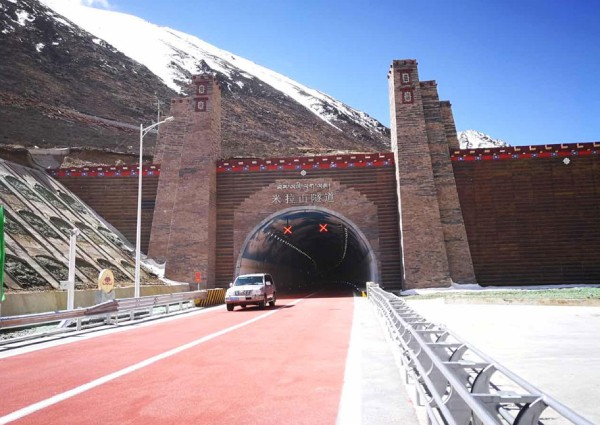
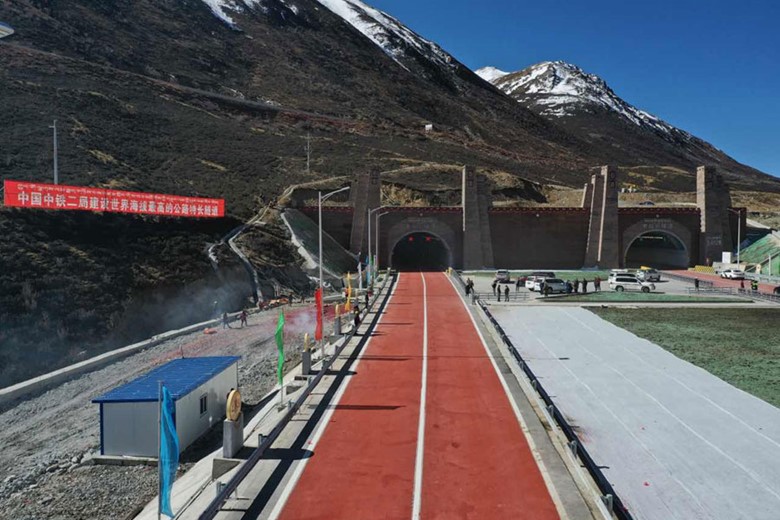
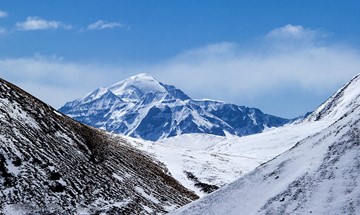
Road Building in Tibet: The Tentacles of Neocolonialism grasping the Mila Mountain.

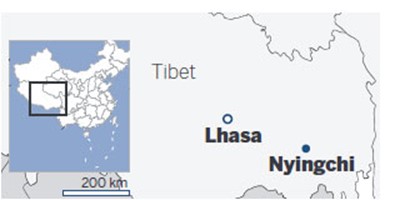
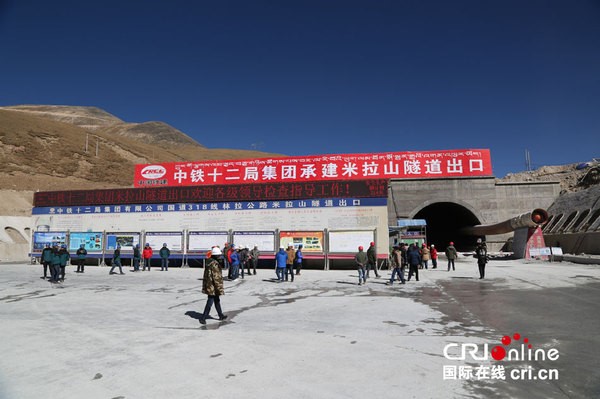
The Mila Mount Tunnel on the Lhasa-Nyingchi Highway in China’s Tibet autonomous region began operations on Friday, symbolizing the full operation of another vital traffic line in the region.

The tunnel is located at the junction of Lhasa and Nyingchi at an average altitude of 4,750 meters above sea level, according to the China Railway Erju Construction Co., Ltd, which constructed the project.

As a key section of the Lhasa-Nyingchi Highway on the National Highway 318, the left lane of the tunnel is 5,727 meters and the right lane is 5,720 meters long respectively, according to the company.

Construction of the Mila Mount tunnel started in April 2015, and it has become the world’s highest super-long tunnel, the company said.

Road Building in Tibet: The Tentacles of Neocolonialism grasping the Mila Mountain.

The Mila Mount Tunnel on the Lhasa-Nyingchi Highway of China’s Tibet autonomous region began operations on Friday (April 26).Photo: China Daily/Asia News Network

Linking the regional capital city Lhasa with the region’s eastern tourism city of Nyingchi, the 409-kilometre highway has reduced travel time from the previous eight hours to the current four.

Road Building in Tibet: The Tentacles of Neocolonialism grasping the Mila Mountain.
Road Building in Tibet. The Tentacles of Neocolonialism grasping the Mila Mountain.


CHINA’S ECONOMIC EXPANSIONISM MUST BE BLUNTED BY TRADE AND DIPLOMATIC SANCTIONS

CHINA’S ECONOMIC EXPANSIONISM MUST BE BLUNTED BY TRADE AND DIPLOMATIC SANCTIONS

China's Economic Expansionism.
China’s economic expansionism must be blunted by trade and diplomatic sanctions.

China’s economic expansionism poses grave dangers as China routinely steals intellectual property of the US companies, provides illegal subsidies to Chinese companies, imposes regulations to hamper the trade activities of the US corporations. China and Chinese companies violate the US sanctions or export control laws to indulge in illegal trading practices.

The US response to China’s economic expansionism must include the imposition of diplomatic sanctions as trade sanctions will not be sufficient to blunt the attack of the expansionist regime.

Rudranarasimham Rebbapragada

SPECIAL FRONTIER FORCE

U.S. lawmakers introduce bipartisan bills targeting China’s Huawei and ZTE | Reuters

WASHINGTON (Reuters) – A bipartisan group of U.S. lawmakers introduced bills on Wednesday that would ban the sale of U.S. chips or other components to Huawei Technologies Co Ltd [HWT.UL], ZTE Corp (000063.SZ) or other Chinese telecommunications companies that violate U.S. sanctions or export control laws.

China’s Economic Expansionism must be blunted by trade and diplomatic sanctions.

FILE PHOTO: The Huawei logo is pictured outside their research facility in Ottawa, Ontario, Canada, December 6, 2018. REUTERS/Chris Wattie

The proposed law was introduced shortly before the Wall Street Journal reported federal prosecutors were investigating allegations that Huawei stole trade secrets from T-Mobile U.S. Inc (TMUS.O) and other U.S. businesses.

The Journal said that an indictment could be coming soon on allegations that Huawei stole T-Mobile technology, called Tappy, which mimicked human fingers and was used to test smartphones.

The action is the latest in a long list of actions taken to fight what some in the Trump administration call China’s cheating through intellectual property theft, illegal corporate subsidies and rules hampering U.S. corporations that want to sell their goods in China.

In November, the U.S. Department of Justice unveiled an initiative to investigate China’s trade practices with a goal of bringing trade secret theft cases.

At that time, Washington had announced an indictment against Chinese chipmaker Fujian Jinhua Integrated Circuit Co Ltd for stealing trade secrets from U.S. semiconductor company Micron Technology (MU.O) relating to research and development of memory storage devices.

Jinhua, which has denied any wrongdoing, was put on a list of entities that cannot buy goods from U.S. firms.

On Capitol Hill, Senator Tom Cotton and Representative Mike Gallagher, both Republicans, along with Senator Chris Van Hollen and Representative Ruben Gallego, both Democrats, introduced the bills which would require the president to ban the export of U.S. components to any Chinese telecommunications company that violates U.S. sanctions or export control laws.

The bills specifically cite ZTE and Huawei, both of which are viewed with suspicion in the United States because of fears that their switches and other gear could be used to spy on Americans. Both have also been accused of failing to respect U.S. sanctions on Iran.

“Huawei is effectively an intelligence-gathering arm of the Chinese Communist Party whose founder and CEO was an engineer for the People’s Liberation Army,” Cotton wrote in a statement. “If Chinese telecom companies like Huawei violate our sanctions or export control laws, they should receive nothing less than the death penalty – which this denial order would provide.”

The proposed law and investigation are two of several challenges that Huawei, the world’s biggest telecommunications equipment maker, faces in the U.S. market.

In addition to allegations of sanctions-busting and intellectual property theft, Washington has been pressing allies to refrain from buying Huawei’s switches and other gear because of fears they will be used by Beijing for espionage.

Huawei’s founder, Ren Zhengfei, denied this week that his company was used by the Chinese government to spy.

Huawei founder says firm does not spy for China

Canada detained Ren’s daughter, Meng Wanzhou, who is Huawei’s chief financial officer, in December at the request of U.S. authorities investigating an alleged scheme to use the global banking system to evade U.S. sanctions against Iran.

For its part, ZTE agreed last year to pay a $1 billion fine to the United States that had been imposed because the company breached a U.S. embargo on trade with Iran. As part of the agreement, the U.S. lifted a ban in place since April that prevented ZTE from buying the U.S. components it relies on heavily to make smartphones and other devices.

Reporting by Diane Bartz and Karen Freifeld; Editing by Steve Orlofsky and James Dalgleish.

China’s Economic Expansionism must be blunted by Trade and Diplomatic Sanctions.


CHINESE ‘STRING OF PEARLS’ TIGHTENS NOOSE AROUND SRI LANKAN NECK

CHINESE’ STRING OF PEARLS’ TIGHTENS NOOSE AROUND SRI LANKAN NECK
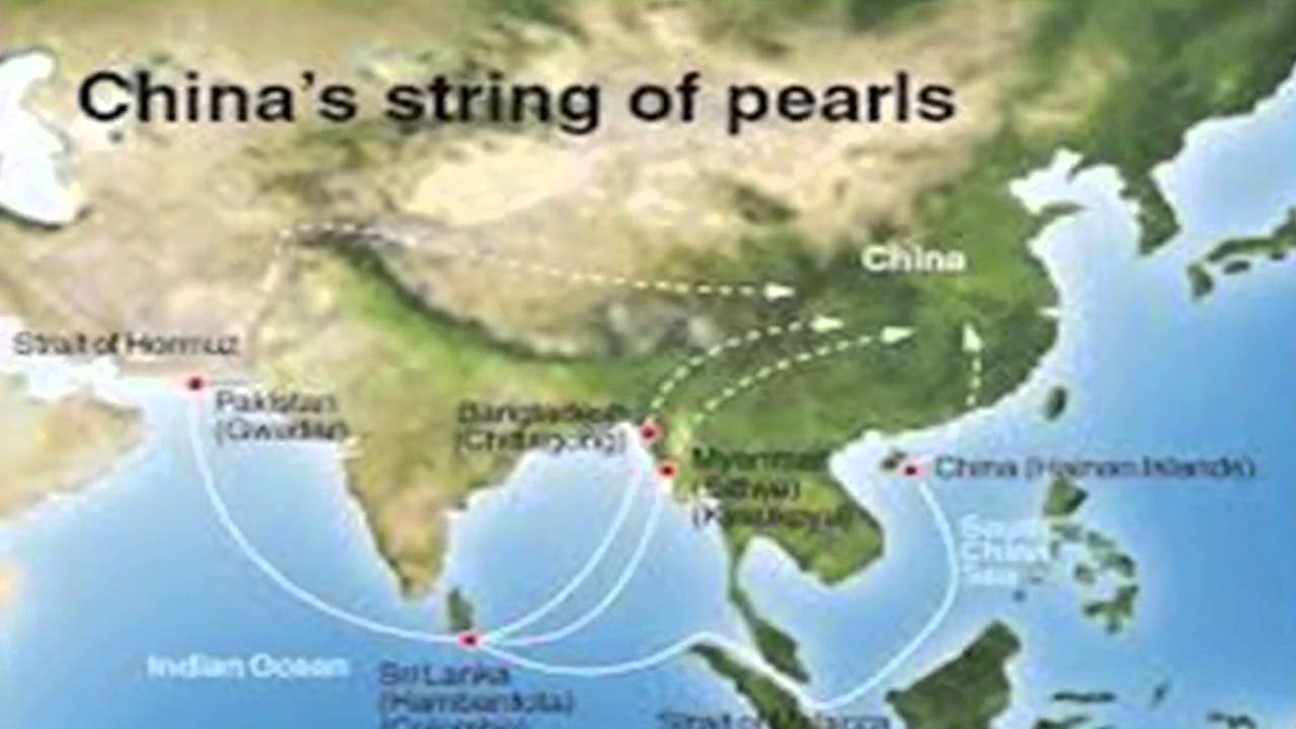
China’s Neocolonialism is tightening the noose around necks of cash-strapped economies of countries in Asia and Africa while the United States watches helplessly as a silent spectator.

Rudranarasimham Rebbapragada

SPECIAL FRONTIER FORCE

WITH SRI LANKAN PORT ACQUISITION, CHINA ADDS ANOTHER ‘PEARL’ TO ITS ‘STRING’ – CNN

Clipped from: https://www.cnn.com/2018/02/03/asia/china-sri-lanka-string-of-pearls-intl/index.html
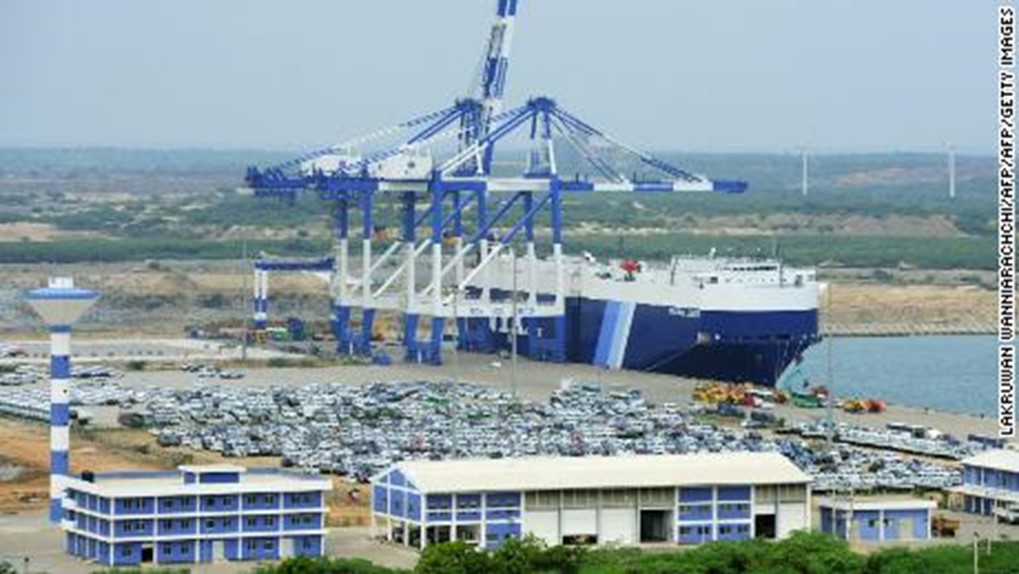
The Hambantota port facility, 2015

(CNN)When Sri Lanka’s government first looked to develop a port on its southern coast that faced the Indian Ocean, it went not to China, but to its neighbor, India.

The venture was considered economically unviable and indeed, in the years that followed, the port sat empty and neglected, and Sri Lanka’s debt ballooned.

But India’s economic foresight might have cost it in terms of strategic geopolitics, since the debt incurred on the port and the surrounding infrastructure undertakings now belong to its great rival.

China’s official licensing of the port in December last year gives it yet another point of access over a key shipping route, and the prospect of providing it with a sizeable presence in India’s immediate backyard and traditional sphere of influence, bringing China closer to India’s shores than New Delhi might like.
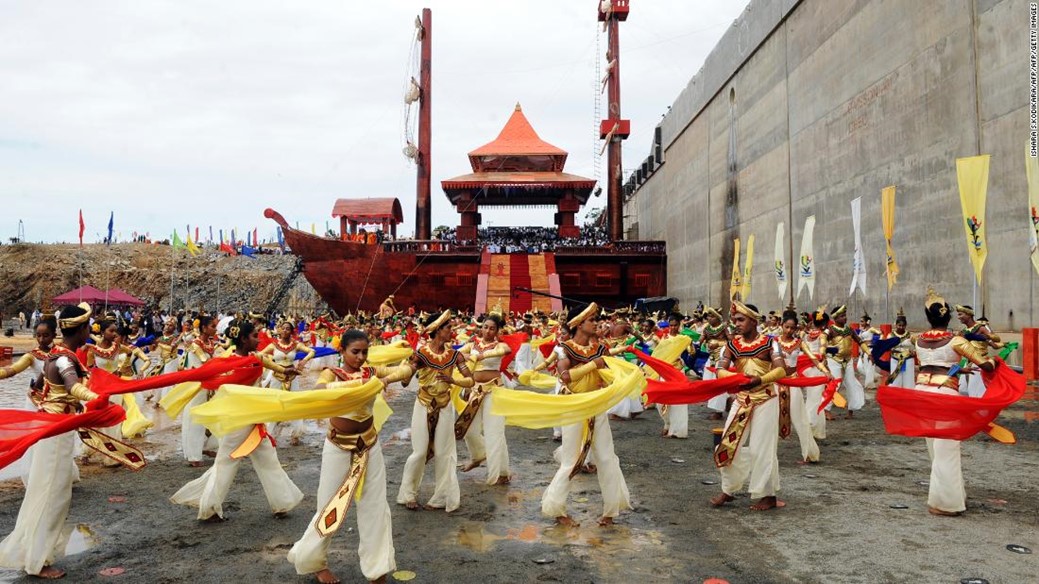
Sri Lankan dancers perform at the site of the Hambantota port during a ceremony marking the first phase of construction, August 15, 2010.

Moreover, Sri Lanka’s decision to sign a 99-year lease with a Chinese state-owned company for the Hambantota port to service some of the billions it owes to Beijing has some observers concerned other developing nations doing business with China as part of China’s One Belt One Road initiative might fall into similar financial straits.

A trap, they warn, that may well have them owing more than just money to Beijing.

“China is, in many cases, the only party with the interest and the capital to deliver on these projects,” said Jeff Smith, a research fellow on South Asia at the Heritage Foundation in Washington DC. “The relevant question for everyone is: at what cost?”

‘A determined strategy by China’

China has for decades invested in Sri Lanka, particularly during moments in recent history when much of the international community held off.

As the European Union sought to punish Sri Lanka over human rights abuses during the decades-long civil war between government forces and the Tamil Tigers, China acted on its behalf diplomatically at the United Nations. It also supplied the Rajapaksa government with military aid and it promised to spend to rebuild the country’s damaged infrastructure. India had also sent in military help, but nowhere near the levels Beijing dispatched.

The civil war ended in 2009. Between 2005 and 2017, China spent nearly $15 billion in Sri Lanka. By comparison, the International Finance Corporation, which is part of the World Bank group, says that between 1956 and 2016, it invested over $1 billion.
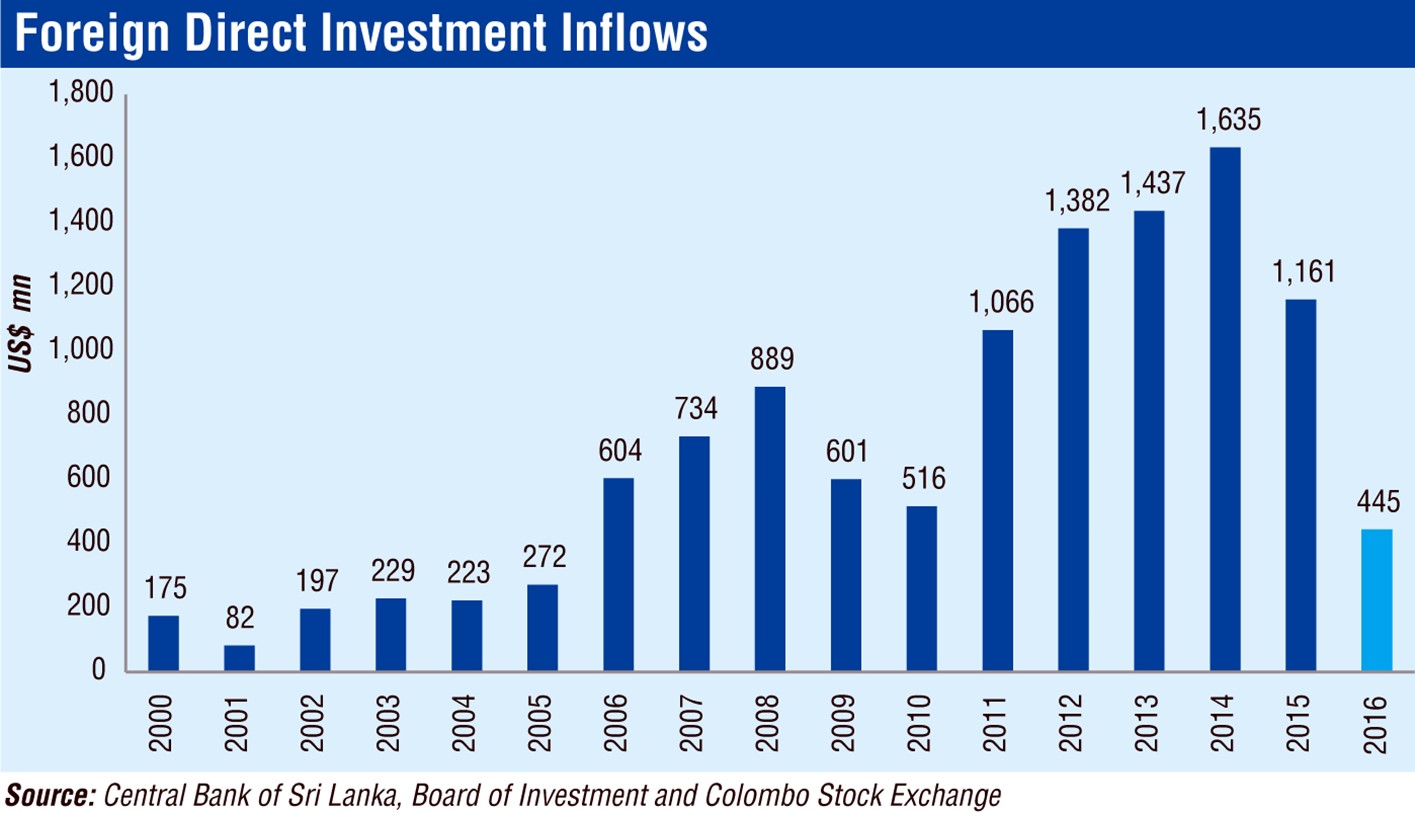
Jeff Smith points out that along with the Hambantota port investments, Beijing loaned Sri Lanka $200 million in 2010 for a second international airport and a year later a further $810 million for the “second phase of the port project.”

There was more. $272 million for a railway in 2013 and more than $1 billion for the Colombo Port City project, ventures that hired mostly Chinese workers (one Sri Lankan report put the number of Chinese workers dedicated to projects in 2009 at 25,000), and all with money Sri Lanka could barely afford to repay.

By 2015, Sri Lanka owed China $8 billion, and Sri Lankan government officials predicted that accumulated foreign debt — both owed to China and other countries — would eat up 94% of the country’s GDP.

After an equity swap, an IMF bailout and more control over the projects ceded to Beijing, the terms of the debt were restructured, giving Sri Lanka some breathing space.

In 2017, however, the Hambantota port proved too costly for Sri Lanka to sustain.

“They (the Chinese) called in the debt, and the debt has been paid by Sri Lanka giving them the (Hambantota) port. That port then gives them not only a strategic access point into India’s sphere of influence through which China can deploy its naval forces, but it also gives China an advantageous position to export its goods into India’s economic sphere, so it’s achieved a number of strategic aims in that regard,” said Malcolm Davis, senior analyst at the Australian Strategic Policy Institute in Sydney.

“This is part of a determined strategy by China to extend its influence across the Indian Ocean at the expense of India and it’s using Sri Lanka to achieve it,” he said.

Details of the new agreement between China and Sri Lanka have not been made public.

The port is an “important project aimed at spurring local economic growth based on equality and mutual benefits,” according to the Chinese Ministry of Foreign Affairs. It declined to answer further when asked by reporters.
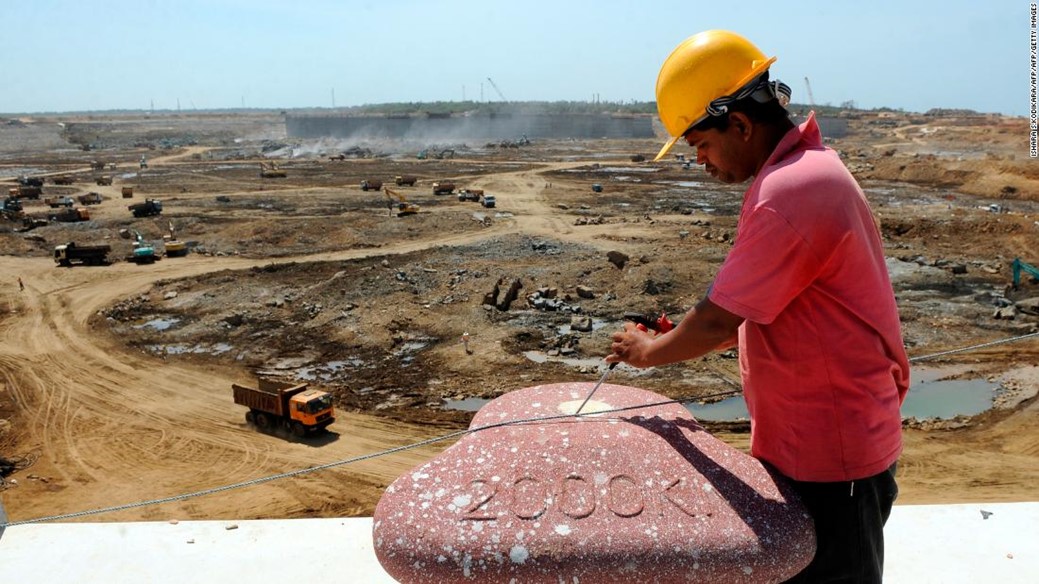
Construction workers operate heavy equipment at the base of Sri Lanka’s Hambantota port August 1, 2010. Some 350 Chinese staff helped in the first phase of construction.

‘Creating demand for Chinese goods’

China’s claiming of controlling stakes in strategic ports along critical shipping lanes — what analysts have taken to referring to as its “string of pearls” — beginning at the Straits of Malacca and dotting the Indian Ocean, should signal Beijing’s ultimate ambitions, said Davis.

“There’s a bigger picture here, that the more you invest in the Belt and Road initiative, the more the Chinese are in a position to force your country to align politically in terms of policy,” Davis told CNN.

“So you become dependent on their investment and their largesse, and you’re less likely to be critical of them and you’re more likely to accommodate their interests strategically.”

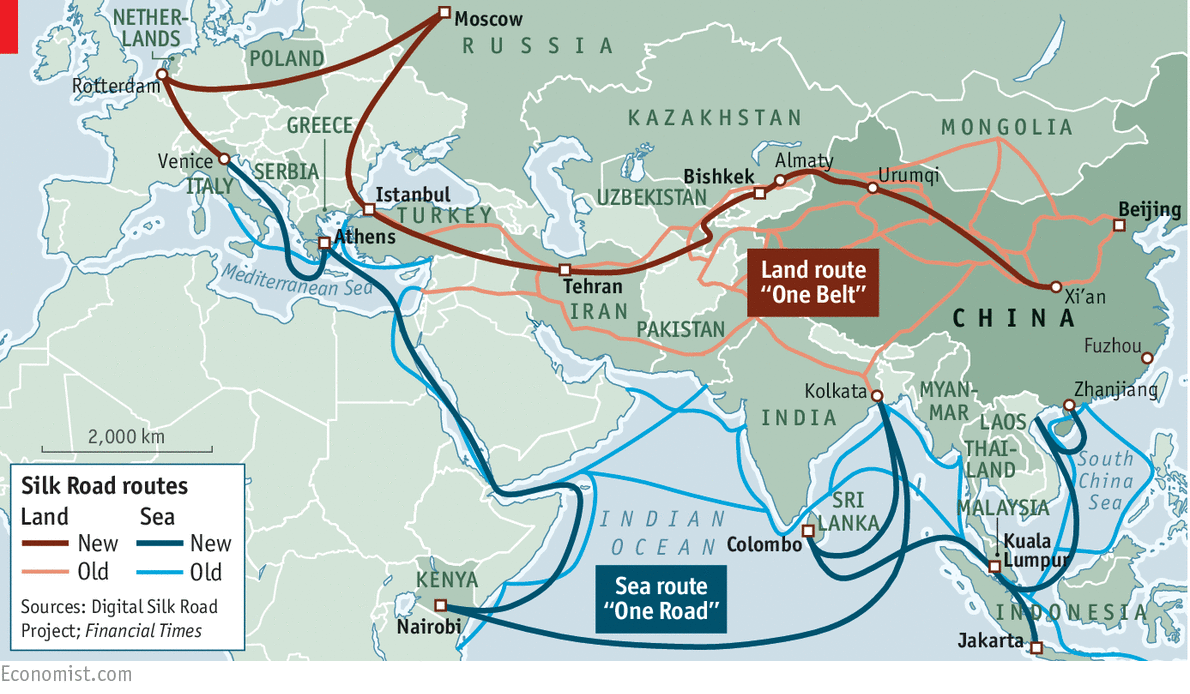
China launched its ambitious One Belt One Road (OBOR) development strategy in 2013, investing in projects that include thousands of miles of highways in Pakistan, an international airport in Nepal and a rail link between China and Laos. The initiative would come to span more than 68 countries and encompass 4.4 billion people and up to 40% of global GDP. Consisting of two distinct parts, the Silk Road Economic Belt would stretch from China to Europe and include a host of trade and infrastructure projects, and the 21st Century Maritime Silk Road would be a sea-based network of shipping lanes and port developments throughout Asia and the Pacific.

Beijing’s other potential partners are finding difficulty with some of their own joint projects.

Last November the government in Nepal scrapped a $2.5 billion deal with a Chinese company to build the biggest hydropower plant in the Himalayan country because of “irregularities” in the award process. The current Nepalese government, which had replaced the cabinet that had approved the earlier deal, announced the contract would instead go to a state-owned Nepali company.

In Myanmar, a $3.6 billion dam project has stalled. The then-military backed government suspended work on the Myitsone dam in the north of the country in 2011, with talks regarding its future ongoing.

Pakistan withdrew from a $14 billion agreement with China for a dam last November because the conditions of the deal included China taking ownership of the project and were “not doable and against our interests,” Pakistan’s Water and Power Development Authority chairman Muzammil Hussain was quoted as saying. Like Nepal, Pakistan has since indicated it would also look to shoulder the cost of the dam rather than go to an outside investor.

China’s Ministry of Foreign Affairs claimed to be unaware of this when asked about the situation by reporters in Beijing in December. The country’s top economic planning agency later said that the two countries were discussing cooperating on the dam project but that there’d been no discussion of proposals to move it forward. The agency said “Pakistan media’s reporting on this project has been inaccurate, or only represented the views of certain officials.”

But China is still spending in Pakistan. It is building a hydroelectric power station in the Rawalpindi district, and it is developing the port of Gwadar, strategically located on the Arabian Sea.

In Malaysia, China is spending $7.2 billion on a new deep sea port in the Straits of Malacca and working on infrastructure projects on the country’s eastern seaboard.

China’s trade deal with the Maldives government included investments in developing the international airport and a bridge, but the Maldives in return has taken on a significant number of controversial loan obligations.

Last July, former President Mohamed Nasheed said the loan interest the traditionally Indian ally pays to service its foreign debt to China is more than 20% of the country’s budget. He said that part of the deal included China’s receipt of 16 “strategically located islands” in navigation sea-lanes.
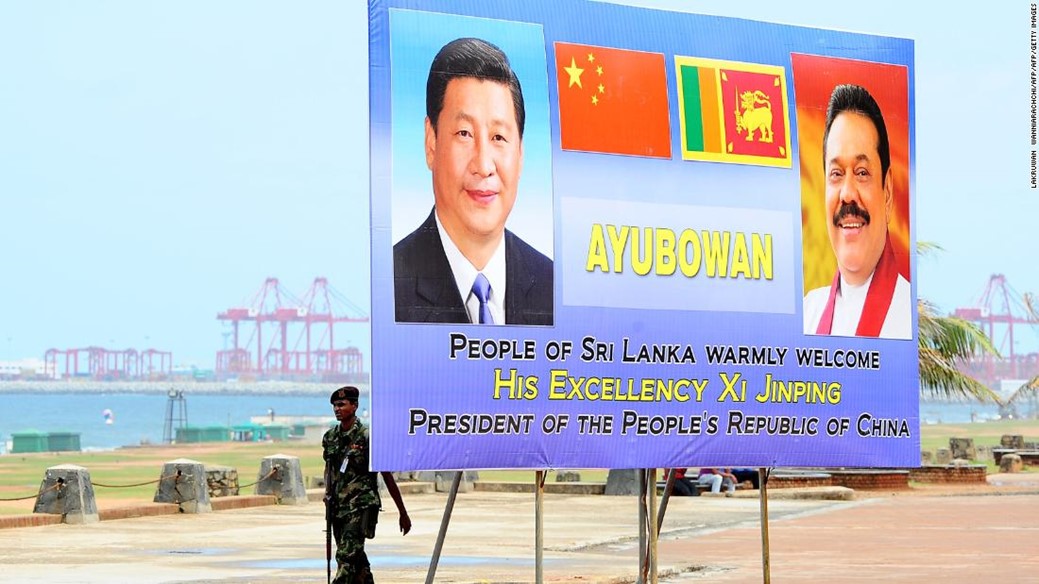
A Sri Lankan soldier walks past a billboard bearing portraits of Chinese President Xi Jinping and Sri Lankan President Mahinda Rajapaksa, ahead of Xi’s visit to the Sri Lankan capital Colombo, September 15, 2014.

Dean Cheng, a senior fellow at the Heritage Foundation in Washington, DC, said that the initial wave of Chinese investments in the Indian Ocean, the so-called string of pearls, was largely driven by economic considerations. The investments, he said, “would facilitate economic growth, which would benefit Chinese companies. Moreover, the construction projects would entail Chinese workers (a feature of most Chinese projects abroad, bringing their own work force), and create a demand base for Chinese goods.”

At the same time, he said the Chinese are clearly intent on creating a friendly political network of states. “There’s nothing inherently dangerous about political considerations in economic investments,” he told CNN. “It would be foolish to think that any state is wholly driven by economic considerations.”
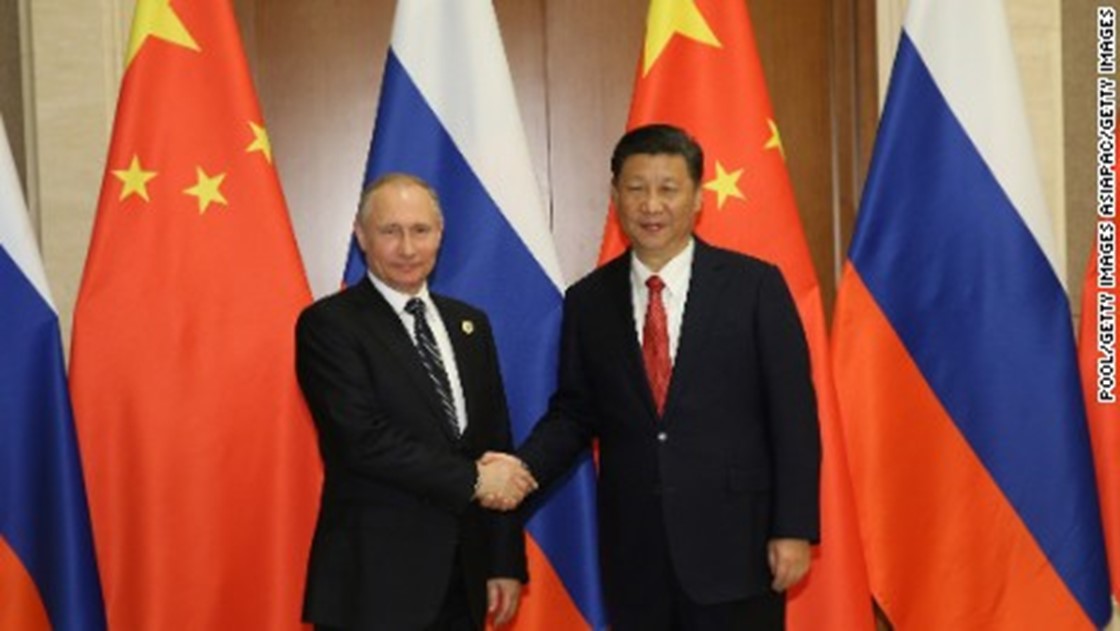
Leaders attend China’s Belt and Road Forum

Whither India?

The ever-encroaching Chinese presence into India’s sphere of political and economic influence has been noted, but so far, says Manoj Joshi, New Delhi purports to be unruffled, as long as Hambantota remains a commercial port, and no Chinese naval vessels suddenly appear in the vicinity.

“In 2014 a Chinese submarine was spotted in Colombo harbor and that was the first time we saw that and the Indian side was a bit concerned,” said Joshi, a distinguished fellow at the Observer Research Foundation in New Delhi. At the time Indian defense officials expressed “serious concern” to their Sri Lankan counterpart, and naval chiefs from both countries met to discuss the incidents. Then-Defense Minister Arun Jaitley said the government “keeps a constant watch on all developments concerning our national security and economic interests and takes necessary measures to safeguard them.”

A Chinese submarine and a Chinese warship were allowed to dock at the Colombo port in November 2014, just under two months after another Chinese submarine called into the same port. At the time both China and Sri Lanka dismissed New Delhi’s concerns, saying the vessels were on refueling stops during anti-piracy missions. Colombo port regularly hosts ships from numerous navies, including the US. But as China’s own navy becomes more ‘blue water’ [as in, able to move in open oceans around the world and not just in its own surrounding waters] these appearances will be more commonplace.
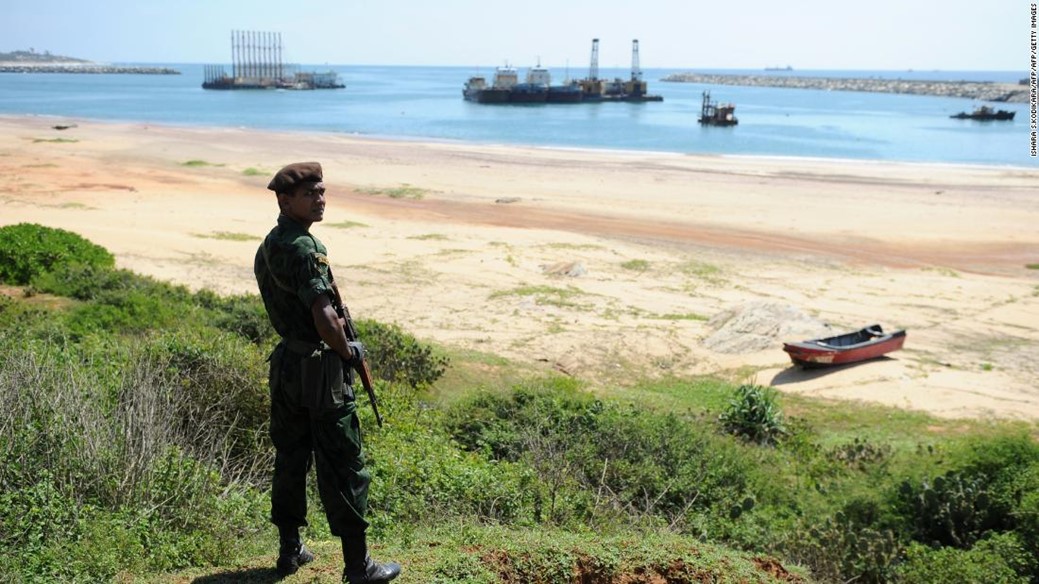
A Sri Lankan commando stands guard on the Hambantota construction site, November 18, 2010.

“It’s geopolitical competition and India sees itself as the foremost nation in Asia and with the Chinese building a port, building and airport, building roads in Sri Lanka, they’ve emerged as big investors there and the Indians are obviously feeling somewhat nervous because India doesn’t have those kind of resources to compete with,” Joshi told CNN.

“What we worry about is, we already have a border problem with China and now that competition goes to the Indian Ocean region. That could be against our interests.”

India and China share a 2,500 mile-long border, and have regularly faced off over perceived intrusions on each other’s terrain as well as activity in uninhabited territory claimed by China and Bhutan, an Indian ally.

“Everybody talks about China and India being major rivals, I think China doesn’t see India as a genuine long-term rival, I think it looks at India and sees a classic case of democracy gone wrong,” said Yvonne Chiu, assistant professor in the politics department at the University of Hong Kong.

“India is incredibly corrupt, its infrastructure is terrible, and it is riddled with religious and demographic problems,” she told CNN. “Except it is very large. It does have a big population as well and it’s on the border. So it’s a regional rival, but I don’t think they take India seriously as a global rival.”
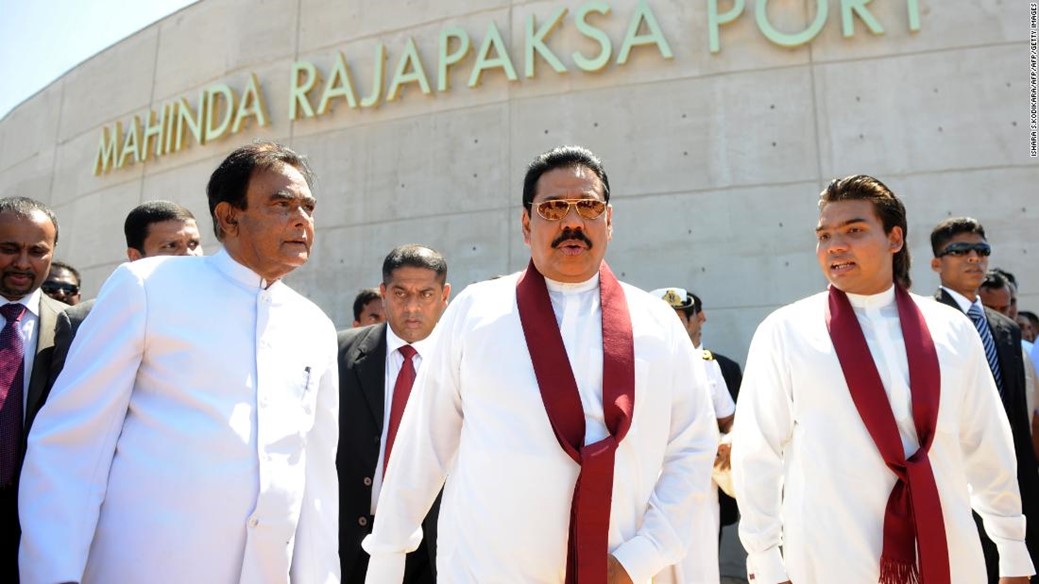
Sri Lanka’s President Mahinda Rajapaksa, center, flanked by his eldest son and parliamentarian Namal Rajapaksa, right, and Prime Minister D. M. Jayaratne, left, tour the Hambantota construction site, November 18, 2010.

For its part, India is now taking an active interest in Hambantota. The government of Prime Minister Narendra Modi is reported to be in talks with Sri Lanka about taking over the airport near the port, which was built using Chinese funds that Beijing itself wants to manage and is pushing for control with the Sri Lankan government. During a media briefing last November, Raveesh Kumar, an official spokesperson for the Ministry of External Affairs, would only say that New Delhi has “a lot of developmental projects” going on in Sri Lanka and declined to elaborate further. Colombo has yet to make a decision involving the airport.

And New Delhi continues to actively participate in large-scale naval exercises in regional waters alongside allies Japan, and the US, and into the future, possibly Australia too, all to Beijing’s continued consternation.

Last year’s Malabar exercises in the Bay of Bengal involving the US, Japan and India were the largest the region has seen in more than two decades.

“India, of course, remains highly influential in Sri Lanka, and would not look kindly on any effort to pressure the government on matters related to defense and national security,” said Jeff Smith. “Nor would the Sri Lankan military, which values its exchanges with the US.”

Modi will be in Singapore in June, attending the Shangri-La dialogue, an annual meeting of defense ministers, military chiefs and defense officials from the Asia-Pacific. His keynote address will be carefully watched for words on China’s maritime expansion.
A White House unable to compete with China

South Asia’s problems are not on Washington’s radar right now, says Hong Kong University professor Chiu. The White House has much of its focus — along with a substantial naval presence — directed towards the Korean Peninsula and the ongoing crisis there. And while the US is distracted, China is slowly and incrementally changing the seascape in the Asia Pacific. China claims disputed islands in the South China Sea as part of its territory and has been militarizing some of those islands, reclaiming land on others and turning sandbars into islands to assert sovereignty over the area.

“Everything that they do, like building these islands (in the South China Sea) and stuff that is illegal internationally, but nobody wants to get into a conflict over, it adds up and you have a new status quo and it’s too late to do anything about it,” Chiu said.

“China can’t afford to go to war over anything … it would most likely lose against a major power … but these kind of small incremental things, people will let them get away with. As long as they’re patient, it could have the same effect as going to war.”

Even as China has taken the long view, Dean Cheng argues it’s never too late for the US and its allies to do something to counter Beijing’s ambitions.

“The US, in cooperation with India, Japan and possibly the European Union, could offer alternative financing,” Cheng said. “They could help train local officials, lawyers, etc., to become better negotiators. They can push for transparency, especially in Chinese-sponsored institutions to make clear the terms of the loans, payback processes, as well as how contracts are rewarded.”
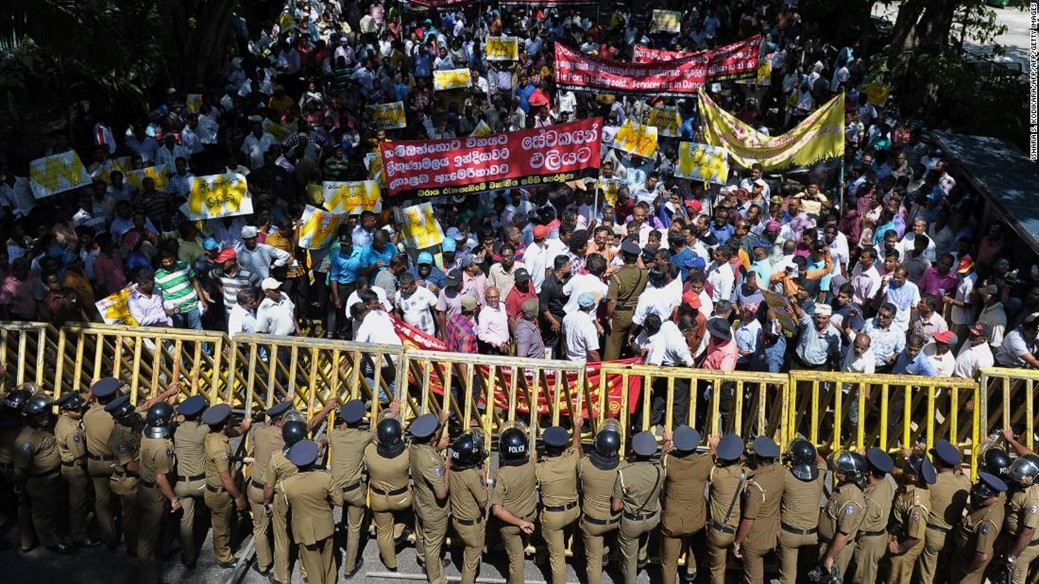
Sri Lankan police stand guard during a protest in Colombo against the lease of the loss-making Hambantota port to China, February 1, 2017.

Last October US Secretary of State Rex Tillerson gave a speech on the US relationship with India. Tillerson said it was up to New Delhi and Washington to “do a better job leveraging our collective expertise to meet common challenges while seeking even more avenues of cooperation.”

“We must also recognize that many Indo-Pacific nations have limited alternatives when it comes to infrastructure investment programs and financing schemes, which often fail to promote jobs or prosperity for the people they claim to help,” Tillerson said. “It’s time to expand transparent, high-standard regional lending mechanisms, tools that will actually help nations instead of saddle them with mounting debt.”

Tillerson told reporters that during the East Asia ministerial summit in August that the US had started “a quiet conversation with others about what they were experiencing, what they need.”

However, he also admitted Washington’s constraints. “We will not be able to compete with the kind of terms that China offers,” said Tillerson. “But countries have to decide, what are they willing to pay to secure their sovereignty and their future control of their economies? And we’ve had those discussions with them as well.”

China’s resources are nowhere near as limited as the US and its allies, says Yvonne Chiu from the University of Hong Kong.

“Right now, it can play on multiple fronts at once,” Chiu notes. “And they take a very long view. If you’re a power like the US, you’re really far away. That distance is going to limit how much attention you can pay to the region. The US has to pick and choose and it’s chosen East Asia. So, unless something really major happens, that’s probably where their attention is going to stay.”

A Chinese worker at the construction site of a Chinese-funded $1.4 billion reclamation project in Colombo, Sri Lanka in October 2017.

As 2017 wrapped up, the Chinese state news agency Xinhua published a dispatch from Colombo, describing how the Hambantota port was “now racing along a developmental fast-track.”

Chinese and Sri Lankan workers were building a highway north of the port, along with a bridge, and the Chinese Harbor Engineering Company is negotiating with the Sri Lankan government to develop a Logistics Zone that will include a natural gas power plant and refineries, the agency reported.

On the first day of the new year, the Chinese flag flew beside Sri Lanka’s at the port for the first time ever.

The Chinese Harbor Engineering Company began 2018 with a $1 billion investment to build three 60-story office towers in Colombo.

Rather than resist getting into further debt, Sri Lanka’s government appears to be making more deals with China that it will may yet struggle to pay back.
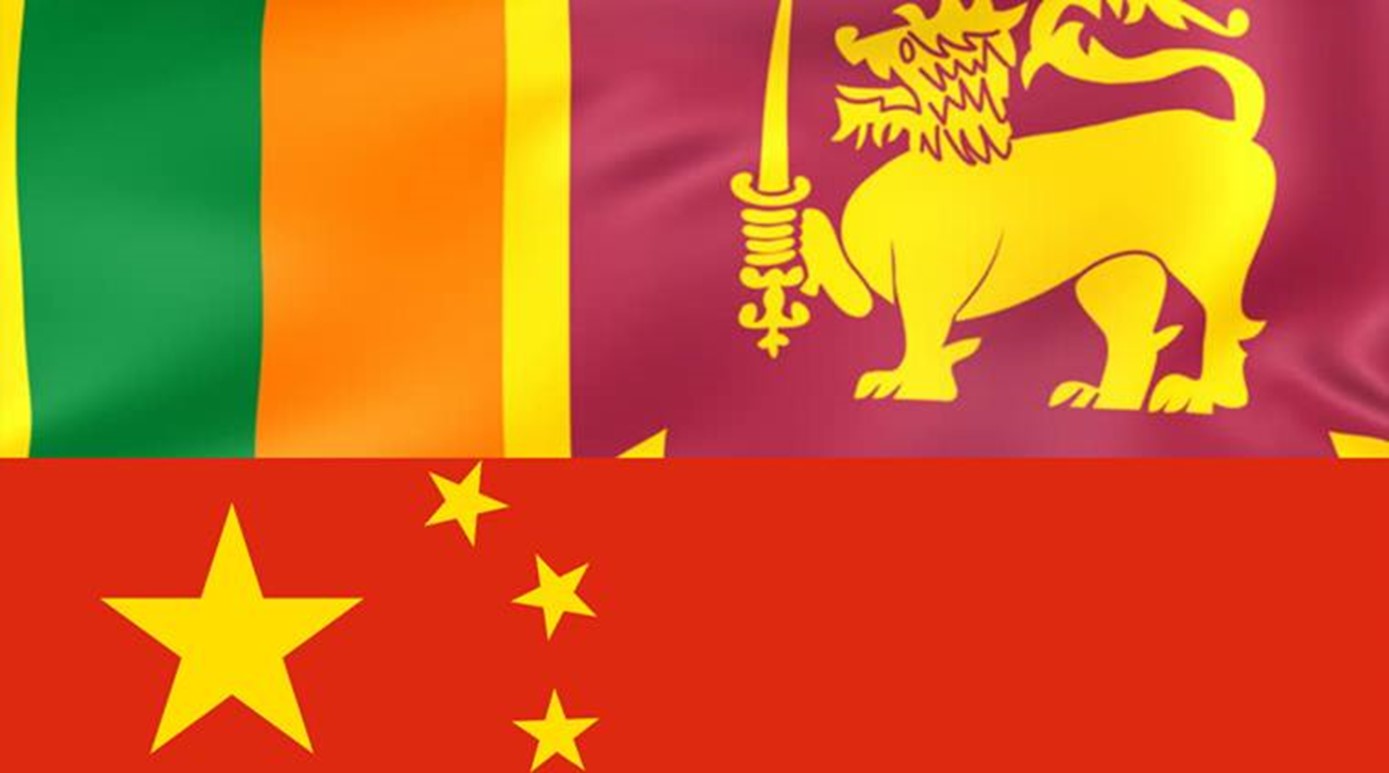
 

Whole Trouble – A Strategy in support of Imperialism and Neocolonialism

Trouble in Tibet – ‘One Belt, One Road’ Strategy of Imperialism and Neocolonialism

The Chinese national flag is raised during a ceremony marking the 96th anniversary of the founding of the Communist Party of China (CPC) at Potala Palace in Lhasa, Tibet Autonomous Region, China, July 1, 2017. CNS/He Penglei via REUTERS/Files

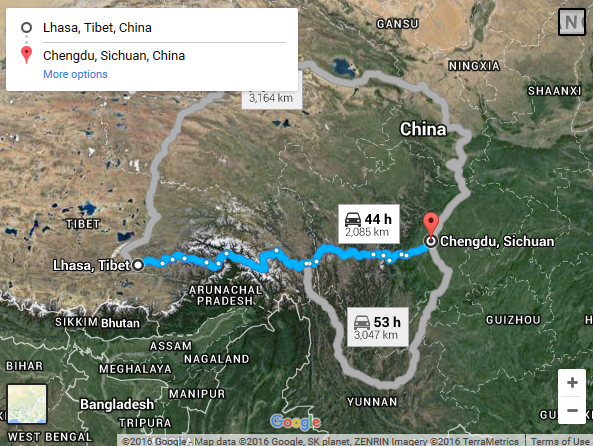
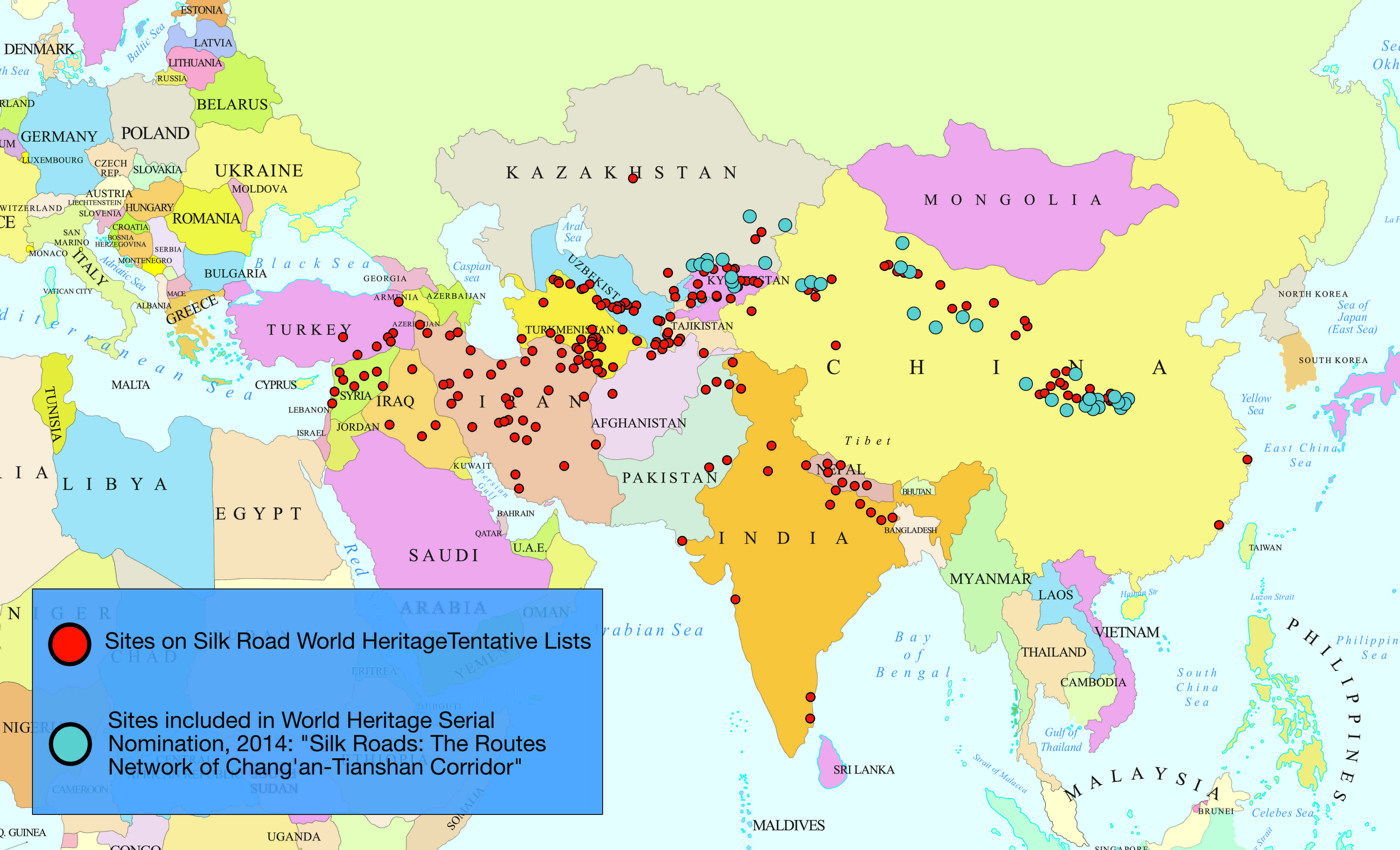
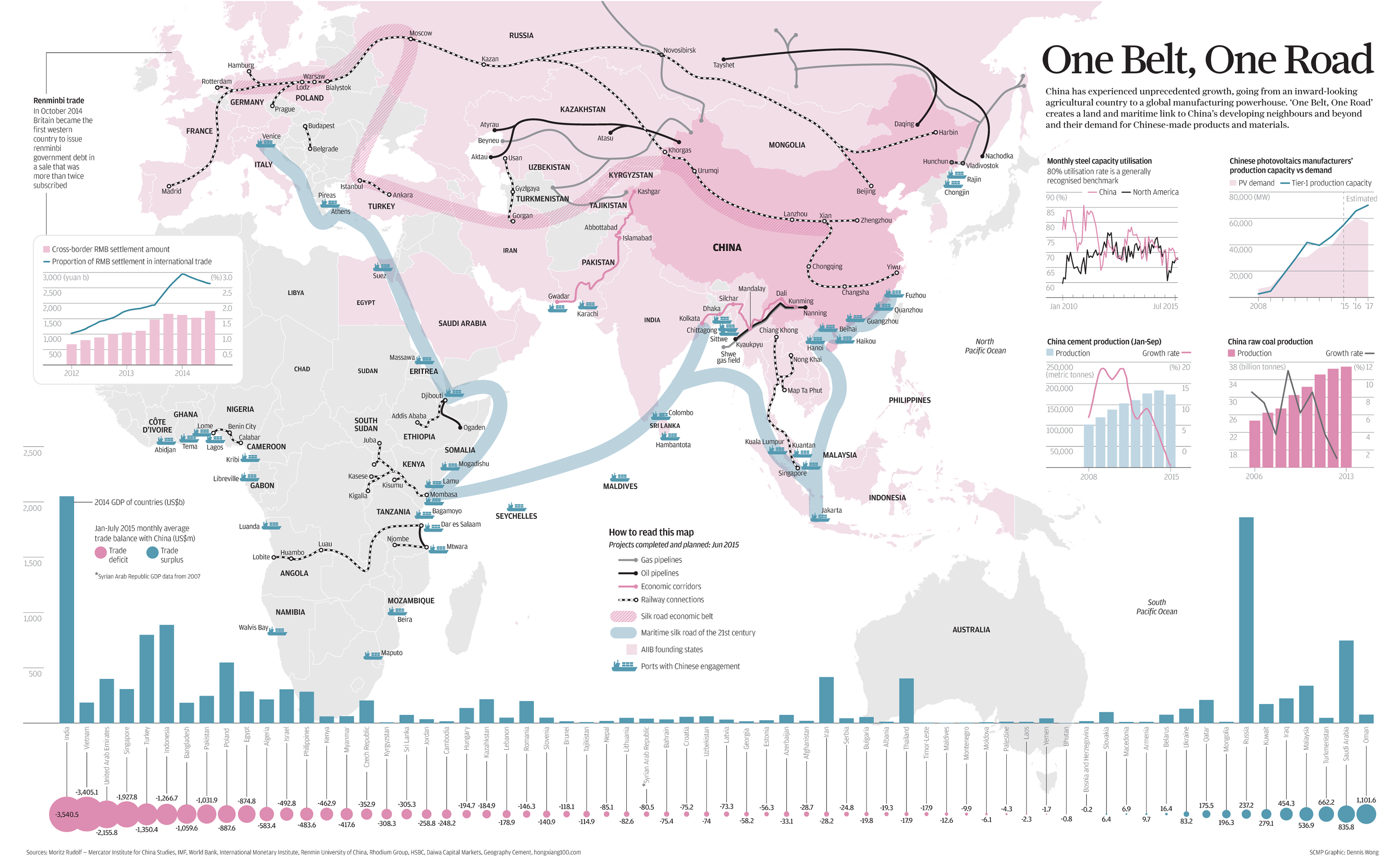
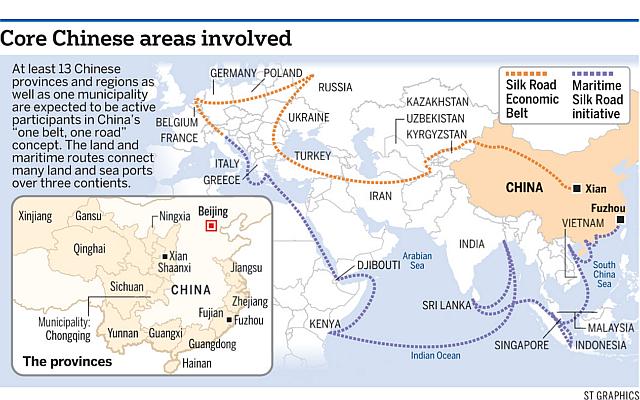
Red China’s Chengdu-Lhasa Railway Project serves just one purpose; Security of Tibet’s military Occupation. Red China’s Policy of “One Belt – One Road” or ‘OBOR’ Initiative, Solidarity Strategy stands for her Imperialism and Neocolonialism.


The Diplomat

CHINA POWER

Trouble in Tibet – One Belt, One Road Policy of Imperialism and Neocolonialism. Chengdu-Lhasa Railroad secures military occupation of Tibet.

Image Credit: Tibet Railroad image via Shutter Stock

China’s Chengdu-Lhasa Railway: Tibet and ‘One Belt, One Road’

Tibet highway – Lhasa – Chengdu

A newly planned railway linking Tibet with central China will serve to provide stability for the Belt and Road.

By Justin Cheung for The Diplomat
May 27, 2016

It is no secret that Tibetan independence movements have long drawn the ire of Chinese authorities. Alongside heightened rhetoric in recent years over Tibetan unrest and the growing publicity of riots and self-immolations, China has sought to augment its capacity for crackdown in the restive province.

The swiftness of Chinese response to previous swells of separatist sentiment is best illustrated in the 2008 Tibetan unrest. During that time, the BBC reported that within days of the start of anti-government riots, over 400 troop carriers of the People’s Armed Police were mobilized. Ultimately, the speed with which the Chinese government was able to ferry troops into sites of unrest was a crucial factor in quelling the upheaval.
In more recent times, China’s “One Belt, One Road” (OBOR) policy – Xi Jinping’s plan to expand the reach of Chinese trade routes to Europe through a land route in Central Asia and a sea route through the Indian Ocean and around the horn of Africa – has taken center stage as a cornerstone of modern Chinese foreign policy. Access to Pakistan and Central Asia are crucial to ensure the success of these trade routes, which incidentally must start or pass through Tibet or Xinjiang, historically separatist provinces. This has put particularly urgent pressure on the Chinese government to bring stability to its westernmost regions.

Furthermore, the implementation of the OBOR policy comes at a critical time for China. Recent downturns in economic growth and output have put leaders such as Xi Jinping in a bind, spending a great deal of political capital to restrict and cripple any seeds of social dissent. On a geopolitical level, ensuring robust strategic control over Tibet has never been more essential, for both propaganda and economic reasons.

With that said, China’s newly planned Chengdu-Lhasa railway – over 2,000 km of tracks – would serve as a crucially efficient connection between Sichuan province in central China with the heart of Tibet. The construction of the railway was recently announced; such an infrastructural feat would facilitate rapid travel between the two locations, bringing a multi-day trip down to just fifteen hours. A recent report by The Economist cited a Chinese expert as saying the railroad could be feasibly completed by 2030.

The implications of this railway’s construction are particularly diverse, but they all center on a particular purpose: expedited control. In an age where social media platforms such as Twitter and Facebook can cause riots to explode into revolutions overnight (see: the Arab Spring), China must ensure that its ability to quickly muster a physical military presence can match the speed of modern rebellions. The Chengdu-Lhasa railway provides a means of quickly mobilizing armed forces and also facilitates the movement and migration of Han Chinese from more central regions of China into Tibet, a policy that China has long pushed in order to smother ethnic dissent.

This is not the first time that China has used “railway power projection” to assert its power in Tibet or Xinjiang. However, it is the most recent and the most ambitious project thus far. Most importantly, the timing of this undertaking highlights the effort and investment that Chinese leaders are willing to make to ensure that the crossroads of its budding OBOR policy remain firmly under Chinese control. Tibet is an important starting point for the China-Pakistan Economic Corridor (CPEC) and an equally important entryway to the Central Asian states where trade through the Caspian, Caucasus, and to Europe must begin.

As such, the construction of the Chengdu-Lhasa railway is separate from previous Chinese attempts to quell separatist movements. This time, there is much more at stake. The railway plays an important duality in optimizing China’s foreign and domestic geo-policy today: the necessity of political stability within its borders to ensure economic success from the outside.

Justin Cheung is a student in Stony Brook University’s 8 Year BE/MD Engineering Scholars for Medicine Program. He has been published in the Center for International Relation’s International Affairs Forum as well as in Soft Matter and ACS Macro Letters.

© 2016 The Diplomat. All Rights Reserved.

THE EVIL RED EMPIRE – THE ROAD TO CONQUEST AND SUBJUGATION, AND DOMINATION OF GLOBAL MARKETPLACE.
THE EVIL RED EMPIRE – THE ROAD TO CONQUEST AND SUBJUGATION. RED CHINA’S NEOCOLONIALISM.
Trouble in Tibet – One Belt, One Road Solidarity Strategy Reflects Red China’s Policy of Imperialism and Neocolonialism.
THE EVIL RED EMPIRE – THE ROAD TO CONQUEST AND SUBJUGATION. RED CHINA’S PROJECT, ONE BELT, ONE ROAD REFLECTS THE DOCTRINE OF NEOCOLONIALISM.


CHINA’S FATE IS SEALED – BEIJING IS DOOMED

CHINA’S FATE IS SEALED – BEIJING IS DOOMED

RED CHINA'S FATE IS SEALED - BEIJING IS DOOMED.
RED CHINA’S FATE IS SEALED – BEIJING IS DOOMED.

Red China after her act of military aggression in 1950 and occupying Tibet had several opportunities to make amends to her evil actions and return to peaceful relationships with her neighbors. By choosing to use evil force, Red China has sealed her own fate. She has opted to “Live by the Sword, surely, she will Die by the Sword.” What she conquered by Sword, she will lose by Sword.

Rudranarasimham Rebbapragada
Ann Arbor, MI 48104-4162, USA
SPECIALFRONTIERFORCE.ESTABLISHMENT22

RED CHINA'S FATE IS SEALED - BEIJING IS DOOMED: RED CHINA HAD A CHANCE TO MAKE AMENDS AND EMBRACE INSTEAD OF CONQUEST BY SWORD.
RED CHINA’S FATE IS SEALED – BEIJING IS DOOMED: RED CHINA HAD A CHANCE TO MAKE AMENDS AND EMBRACE INSTEAD OF CONQUEST BY SWORD.

 
  image          
The Spirits of Special Frontier ForceAt Special Frontier Force, I host ‘The Living Tibetan Spirits’ to promote Tibet Awareness. 
 
View on www.facebook.com


ANI NEWS

China denies all universal rights to Tibet even after 50 years of rule (Part-II) , AniNews.in

Beta Sep 1 2015, 9:07 am


China denies all universal rights to Tibet even after 50 years of rule (Part-II)

Sep 1, 8:27 am

china.jpg

HONG KONG, Sep.1(ANI): Its been more than 50 years since China established complete control over Tibet and in this period China has institutionalised a system of two policies – one for the Chinese people and another for the Tibetans.
Hong Kong based Tibet watchers who on the condition of not being identified for fear of Chinese reprisal outlined a series of instances which prove that China has treated Tibet as nothing more than a Colony and as a strategic buffer against India.
Experts point to the fact that China has accepted the Universal Declaration of Human Rights (UDHR) as a member of the United Nations.
The declaration forms the basic charter of rights for all global citizens. However over the past many decades, adherence to the UDHR has been minimal at best as far as Tibet is concerned.
When it comes to Tibet and Tibetans, they count for less than an average Han Chinese citizen, and actually don’t enjoy the rights they are entitled to as per international laws.
The UDHR calls on governments to grant every human being these rights, but the reality is that not one of the UDHR rights is extended to the people of Tibet.
For example Article 16 of the UDHR says that men and women of full age, without any limitation due to race, nationality or religion, have the right to marry and to create a family. They are also entitled to equal rights as when to marry, how to manage their marriage, and to decide when to dissolve it.
The family, according to the UDHR, is the natural and fundamental group unit of society and is entitled to protection by society and the state.
But, when comes to Tibet, since 1980, China has passed a series of measures related to marriage laws. Beijing has stopped the practice of polygamy in TAR, and has been actively promoting the mixed marriages between Tibetans and Han Chinese.
The local administration has reportedly announced offers of special treatment to children born of such unions. Such incentives are publicised heavily by the state media.
Tibetan poet Tsering Woeser says that “authorities use it as a tool”, and compared it to the Japanese police being encouraged to marry local women during Japan’s occupation of Taiwan.
On the issue of owning property, the UDHR says no one shall be arbitrarily deprived of his or property, but in China-dominated TAR seizure of farmland for industry is arbitrary and common.
Joel Brinkley of the Chicago Tribune adds that “China has evicted more than 400,000 Tibetans from their homelands” over the past few years, and believes that the intent behind this is to exploit Tibet’s vast mineral and water resources.
The UDHR’s Article 18 talks about the right to freedom of thought, conscience and religion, but evidence has surfaced of the People’s Armed Police firing on unarmed Tibetan protestors calling for a semblance of religious freedom.
During the Cultural Revolution, most, if not all, Tibetan monasteries (97 percent were actually closed down) were reportedly ransacked by the Communist Party.
Currently, every monastery and nunnery is constantly under surveillance and subject to random checks by Communist Party officials. So-called Monastery Management Committees have been set up in increasing numbers to keep check on the activities of monks and nuns, and to control their numbers, particularly in the largest ones of Drepung, Sera and Ganden.
Such checks extend to night raids for images of the Dalai Lama and other such “subversive” objects.
For example, recently, a 13-year old nun, after participating in a peaceful protest, was held, interrogated, beaten and tortured.
She was sentenced for singing nationalist songs – which does not exactly exemplify “freedom of thought”.
On the issue of everyone having the right to express their opinion without interference and to seek, receive and impart information and ideas through any media and regardless of frontiers, which is enjoined in Article 19 of the UDHR, China routinely cuts off internet and phone-messaging services after each incident of self-immolation in TAR, of which there have been over 140 in the past six years.
As for the right to expression and freedom of opinion, the armed crackdowns, the surprise arrests and the extrajudicial killings are indicative of a general intolerance to such niceties.
The right to freedom of peaceful assembly and association as enshrined in Article 20, is regularly stamped out and quickly, with violence if required.
Tibet and the Tibetan people have been compelled to identify with the People’s Republic of China. In April 2015, the Communist Party demanded that all Buddhist monasteries display the Chinese flag, or face punishment.
This latest move is part of a drive to make places of worship ‘secularised’, and in line with Beijing’s ideologues.
Article 21 of the UDHR allows every individual to take part in the government of his or her country, directly, or through freely chosen representatives, but in the case of China, democracy does not exist in the sense that it is understood the world over.
The political representatives of the Chinese are not freely chosen, but are designated by the Communist Party. As such, not only Tibetans, but all citizens under the authority of the People’s Republic of China have no right of participation in their governance.
Recently, China arrested ten Tibetans for protesting against the denial of welfare benefits to their community.
Tibetans have been subject to “city moats” which prevent their access to their own cities.
The ‘will of the people’ is a concept almost entirely alien to any Chinese citizen in conceptual and real terms.
The right to social security, as enshrined in Article 22 of the UDHR, which calls for realisation both through national effort and international co-operation, is used to violate the rights of Tibetans further.
Article 23 says everyone has the right to work, and to have free choice of employment, but in Chinese – ruled TAR, the resettlement policy violates this article, depriving Tibetan nomads of their free choice of employment.
As far as just conditions of work, Tibetans are forced to learn Chinese in order to access any gainful employment, even as a construction worker.
Tibetans claim that Chinese workers receive higher wages; the loss of jobs due to political activities is also very common.
Even China admits that there is no minimum wage in the TAR.
The right to rest and leisure, as well as reasonable limitation of working hours and periodic holidays with pay does not exist in Chinese-ruled TAR.
Here, re-education is promoted through labor camps, and there is no semblance of worker’s rights to be defended here.
Holidays, too, are out of the question, and there is no reasonable limitation on working hours.
What about the right to an adequate standard of living, as enshrined in Article 25 of the UDHR?
It simply does not exist in TAR. Pulmonary diseases are the most widespread affliction in Tibet. While prefectural and city hospitals are adequate in responding to such illnesses, there is very little recourse to proper medical care for nomadic tribes as village and township hospitals are extremely poor.
The medical system is “clearly inequitable.” Distances across Tibet have also led to Chinese healthcare works failing to immunize children as “they don’t want to travel so far.”
Access to medication is clearly segregated: Tibetan doctors are unable to purchase drugs from pharmaceutical companies, as only Chinese government workers and ‘officials with connections to the Chinese’ are given access.
While officially, China’s ‘One Child’ policy does not extend to Tibetans as a community, in practice, birth control has actively been promoted in the TAR.
Sterilisation can take place on the basis of volunteering or through forced abortions, which leaves a very chilling picture of healthcare in TAR.
Article 26 of the UDHR talks of the right to education and the right to have free education at the elementary and fundamental stages, but in TAR, schooling is compulsory until secondary education, nominally “bilingually”, and guidelines are applied arbitrarily.
The emphasis is on creating Chinese-medium schools in Tibetan areas despite the fact that Tibetan students want to be taught in Tibetan and learn more effectively when they are.
Tibet has six institutes of higher learning, but only 60 percent of those selected for university in TAR are ethnic Tibetans, compared to the 97 percent share of population they reportedly enjoy.
This demonstrates the fact that access to higher education is highly coloured by discriminatory policies. Indeed, state funds go disproportionally to schools where Chinese students predominate.
Chinese authorities in TAR are on record, as saying that the purpose of giving an education to Tibetans is to see whether they are “opposed to or turn their hearts to the Dalai Clique and in whether they are loyal to or do not care about our great motherland and the great socialist cause..”
China does not promote tolerance, but actively seeks to destroy it in TAR.
The right freely to participate in the cultural life of the community as enjoined in the UDHR’s Article 27, is absent in TAR. The Chinese, admittedly, are very happy to impose limits on Tibetan intellectual production.
Insofar as duties to the community are concerned, while keenly desired by the Tibetan people, is trounced upon, and all vestiges of rights for the minorities are virtually non-existent.
China has a long history of using the justifications of human rights and economic prosperity “for all” to oppress those in Tibet, and nothing seems likely to change.
The recently concluded 6th Tibet Work Forum on August 24 and 25 did not offer any guarantees for the future, but harped instead on the need to maintain stability, a buzzword to Tibetans that they can expect an even harsher regime ahead.(ANI)

Copyright © 2010 aninews.in All rights reserved.