Whole Gateway – Sikkim Gateway to Tibet’s Declaration of Independence in 1913

Sikkim Gateway to Tibet’s Independence

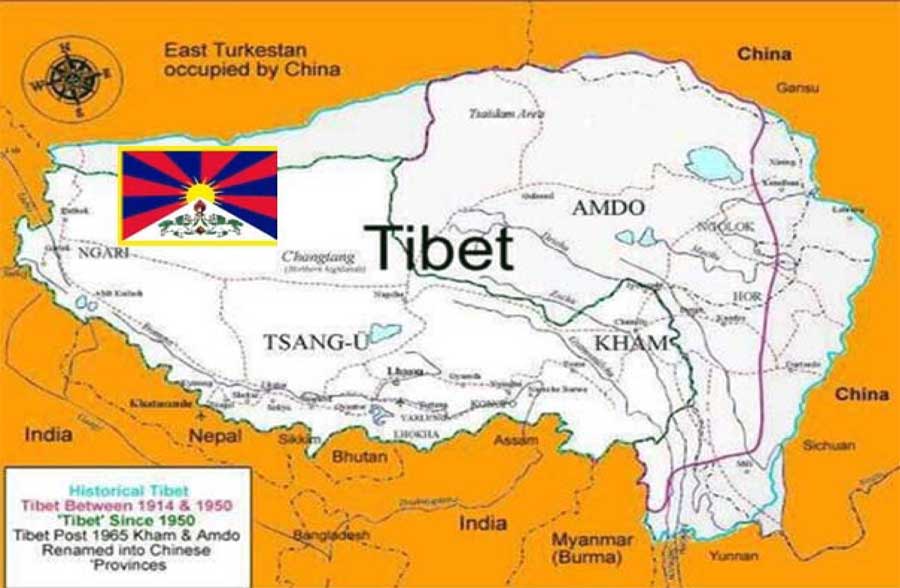
While living in Sikkim, the 13th Dalai Lama directed attacks on Chinese forces in Lhasa forcing them to leave Tibet. He returned to Lhasa and took advantage of the downfall of Qing Dynasty in China. On February 13, 1913, Tibet declared Full Independence.

In 1910, Ch’ing or Qing China dispatched a military expedition to attack Lhasa to arrest the Great 13th Dalai Lama’s aspirations for Tibet’s Independence. He escaped to India. While living in Sikkim, the 13th Dalai Lama directed attacks on Chinese forces in Lhasa forcing them to leave Tibet. He returned to Lhasa and took advantage of the downfall of Qing Dynasty in China. On February 13, 1913, Tibet declared Full Independence.

File:Qing Dynasty 1820.png - Wikipedia, the free encyclopedia

Rudra Narasimham Rebbapragada

Ann Arbor, MI 48104-4162 USA
Special Frontier Force-Establishment 22-Vikas Regiment

MAJOR GENERAL SHERU THAPLIYAL’S ACCOUNT OF INDO-CHINESE CLASHES IN 1967.

While living in Sikkim, the 13th Dalai Lama directed attacks on Chinese forces in Lhasa forcing them to leave Tibet. He returned to Lhasa and took advantage of the downfall of Qing Dynasty in China. On February 13, 1913, Tibet declared Full Independence.

Indian and Chinese Armies clashed alongside Sikkim Tibet border on 11–14 September 1967 at Nathu La & 1 October 1967 at Cho La. Indian Army beat the Chinese badly with heavy casualties to Chinese and established strong control over Nathu La and Cho La. The Chinese were driven back 3km at Cho La.

Following is an account of Maj. Gen Sheru Thapliyal, (Retd.) who commanded the Nathu La brigade and an Infantry division in the Ladakh sector..

After the debacle of 1962, nothing could have enhanced the self esteem of the Indian Army than the mauling that was given to the Chinese at Nathu La in Sikkim on 11th September 1967 and at Chola on 1st October 1967. It must have come as a rude shock to the Chinese Army and also its political leadership. And by a happy coincidence, the Indian Army leadership which got the better of this eyeball-to-eyeball confrontation was the same that went on to create Bangladesh in 1971. Maj Gen Sagat Singh was GOC Mountain Division in Sikkim, Lt Gen Jagjit Aurora was the Corps Commander and Sam Manekshaw was the Eastern Army Commander.

I too served in Nathu La. After finishing my young officer’s course, it was on 21 July 1967 that I reported to my Unit, a mule pack artillery regiment in Sikkim. Those days young officers were made to have their professional mailing by sending them on long-range patrols (LRP) for area familiarisation, take part in khad race to increase their stamina and sending them to remote observations ports on Sikkim-Tibet border for a month. Having done my share of LRPs and having taken part in the khad race, I was sent to the main Sabu La observation post on the Sikkim-Tibet Border. This observation post is about a kilometre south-west of Nathu La. It dominates Nathu La by virtue of taking on higher ground and commands an excellent view of the pass as also the Chinese defense on the feature known as North shoulder. There were two observation posts at Sabu La and had a good old radio set 62 and PRC-10 and of course line communications to the guns deployed in the rear.

Nathu La at 14200 feet is an important pass on the Tibet-Sikkim border through which passes the old Gangtok-Yatung-Lhasa Trade Route. Although the Sikkim-Tibet boundary is well defined by the Anglo-Chinese Convention of 17 March 1890, the Chinese were not comfortable with Sikkim being an Indian protectorate with the deployment of the Indian Army at that time. During the 1965 War between India and Pakistan, the Chinese gave an ultimatum to India to vacate both Nathu La and Jelep La passes on the Sikkim-Tibet border. For some strange reason, the Mountain Division, under whose jurisdiction Jelep La was at that time, vacated the pass. It remains under Chinese possession till date. However, Lt. Gen Sagat Singh, true to form, refused to vacate Nathu La. Incidentally it is at Nathu La where Chinese and Indian forces are deployed barely thirty yards apart, closest anywhere on the 4000 km Sino-Indian border and the border remains undemarcated. Chinese hold the northern shoulder of the pass while Indian Army holds the southern shoulder. Two dominating features south and north of Nathu La namely Sebu La and Camel’s back were held by the Indians. Artillery observation post officers deployed on these two features have an excellent observation into Chinese depth areas whereas from Northern shoulder, Chinese have very little observations into Indian depth areas. This factor proved crucial in the clash that ensued. At the time of the clash, 2 Grenadiers was holding Nathu La. This battalion was under the command of Lt Col (Later Brigadier) Rai Singh. The battalion was under the Mountain Brigade being commanded by Brig MMS Bakshi, MVC.

The daily routine at Nathu La used to start with patrolling by both sides along the perceived border which almost always resulted in arguments. The only one on the Chinese side who could converse in broken English was the Political Commissar who could be recognised by a red patch on his cap. Sentries of both the forces used to stand barely one meter apart in the centre of the Pass which is marked by Nehru Stone, commemorating Pandit Jawaharlal Nehru’s trek to Bhutan through Nathu La and Chumbi Valley in 1959. Argument between the two sides soon changed to pushing and shoving and on 6 September 1967 a scuffle took place in which Political Commissar fell down and broke his spectacles. These incidents only added to the excitement. I developed excellent rapport with Capt Dagar of 2 Grenadiers and a few days before the clash we had gone to Gangtok together on “liberty” to see a movie. Little did I know that within a week, Dagar would be a martyr.

In order to de-escalate the situation it was decided by the Indian military hierarchy to lay a wire in the centre of the Pass from Nathu La to Sebu La to demarcate the perceived border. This task was to be carried out by the jawans of 70 Field Company of Engineers assisted by a company of 18 Rajput deployed at Yak La pass further north of Nathu La. The wire laying was to commence at first light on the fateful morning of 11 September 1967.

That morning dawned bright and sunny unlike the normal foggy days. The engineers and jawans started erecting long iron pickets from Nathu La to Sebu La along the perceived border while 2 Grenadiers and Artillery Observation Post Officers at Sebu La and Camel’s Back were on alert. Immediately the Chinese Political Commissar, with a section of Infantry came to the centre of the Pass where Lt. Col Rai Singh, CO 2 Grenadiers was standing with his commando platoon. The Commissar asked Lt Col Rai Singh to stop laying the wire. Orders to the Indian Army were clear. They were not to blink. An argument started which soon built up into a scuffle. In the ensuing melee, the commissar got roughed up. Thereafter the Chinese went up back to their bunkers and engineers resumed laying the wire.

Within a few minutes of this, a whistle was heard on the Chinese side followed by murderous medium machine gun fire from north shoulder. The pass is completely devoid of cover and the jawans of 70 Field Company and 18 Rajput were caught in the open and suffered heavy casualties which included Col Rai Singh who was wounded. He was awarded MVC later. Two brave officers – Capt Dagar of 2 Grenadiers and Major Harbhajan Singh of 18 Rajput rallied a few troops and tried to assault the Chinese MMG but both died a heroic death. They were posthumously awarded Vir Chakra and MVC respectively. 2 Grenadier opened small arms fire on North shoulder but it was not very effective. Within the first ten minutes, there were nearly seventy dead and scores wounded lying in the open on the pass. Within half an hour, Chinese artillery opened up on the pass as well as in the depth areas but it was mostly prophylactic fire due to lack of observation and failed to do much damage. Meanwhile we as artillery observation post officers asked for artillery fire, permission for which came a little later. Because of excellent domination and observation from Sebu La and Camel’s back, artillery fire was most effective and most of the Chinese bunkers on North shoulder and in depth were completely destroyed and Chinese suffered very heavy casualties which by their own estimates were over 400. The artillery duel thereafter carried on day and night. For the next three days, the Chinese were taught a lesson. On 14 September, Chinese threatened use of Air Force if shelling did not stop. By then the lesson had been driven home and an uneasy ceasefire came about. The Chinese, true to form, had pulled over dead bodies to their side of the perceived border at night and accused us of violating the border. Dead bodies were exchanged on 15 September at which time: Sam Manekshaw, Aurora and Sagat were present on the Pass.

Every battle has its own share of heroism, faint heartedness, drama and humour. The Nathu La skirmish was no exception. 2 Grenadiers were initially shaken up due to the loss of Capt Dagar and injury to their CO but found their man of the moment in Lieutenant Atar Singh who went round from trench to trench to rally the troops and was later promoted as Captain on the spot. On the lighter side was one artillery observation post officer, my colleague at Sebu La whose radio set was damaged due to shelling and he was out of communication with his guns. He rightly decided to go back to the base at Sherathang in the depth to get another radio set. While he was on his way back, Commander Artillery Brigade was coming up. He stopped the young captain, accused him of running away from the battle and sent him back after reducing him to his substantive rank of a second lieutenant. Casualties could not be evacuated for three days and nights as any move to do so invited a hail of Chinese bullets. Some wounded may well have succumbed to cold and rain. There were awards for bravery as also court martial for cowardice. However, what stood out was the steadfastness of the commanders and bravery of the jawans and junior officers. Indians refused to blink and the mighty Chinese dragon was made to look ordinary.

The situation again flared up twenty days later when on 1 October 1967 a face-off between India and China took place at Cho La, another pass on the Sikkim-Tibet border a few kilometers north of Nathu La. Despite initial casualties, 7/11 GR and 10 JAK RIF stood firm and forced the Chinese to withdraw nearly three kilometers away to a feature named Kam Barracks where they remain deployed till date. Cho La Pass is firmly in Indian hands. Indian Army had got better of the Chinese yet again.

No wonder, Sino-Indian border has remained peaceful ever since to the extent that today Chinese soldiers come and ask their Indian counterparts at Nathu La for cigarettes, rum and tea, mail is exchanged twice in a week in a hut constructed specially for this purpose and border personnel meeting takes place there twice a year. It was my privilege to command the Nathu La Brigade many years later and conduct the first border personnel meeting at Nathu La is 1995.

Whole Fascination – A tribute to musician David Bowie

Tibet Fascination – A tribute to David Bowie

Tibet is a fascinating place with equally fascinating people. The following tribute to musician David Bowie (January 08, 1947 to January 10, 2016) captures an interesting facet of this artist.

Tibet is a fascinating place with equally fascinating people. The following tribute to musician David Bowie (January 08, 1947 to January 10, 2016) captures an interesting facet of this artist.

Rudra Narasimham Rebbapragada
Ann Arbor, MI 48104-4162 USA
Special Frontier Force-Establishment 22-Vikas Regiment

PATHEOS

David Bowie’s fascination with Tibet and Buddhism

January 11, 2016 by JUSTIN WHITAKER

David Bowie 00s - David Bowie Photo (37030347) - Fanpop

With the very sad passing of the great David Bowie, tributes have poured in from around the world. Bowie, as the NYTimes writes, “Transcended Music, Art and Fashion.” Among them a number have noted his youthful connections with Buddhism, which was growing in popularity in the England of the 1960s. Of particular interest is an in-depth blog dedicated to the songs of Bowie, aptly named “Pushing Ahead of the Dame: David Bowie, song by song.” In one post there, the author, Chris O’Leary, recounts Bowie’s early fascination with the Tibet and Buddhism of Heinrich Harrer’s 1952 book “Seven Years In Tibet”:

David Bowie discovered Buddhism in his early teens, thanks to his step-brother Terry’s beatnik leanings, the novels of Jack Kerouac and a few Penguin paperbacks that gave him the basic schematics of the religion. It was Harrer’s book that set him a-boil: “When I was about nineteen I became an overnight Buddhist,” he recalled in 1997. “At that age a very influential book for me was called “Seven Years In Tibet”…[Harrer] was one of the very first Westerners to ever spend any time in Tibet; in fact, one of the very first Westerners actually to go into Tibet and discover for himself this extraordinary existence and this incredibly sublime philosophy.” “Silly Boy Blue,” Bowie’s first Buddhist song, was inspired by Harrer’s descriptions of Lhasa and the Dalai Lama’s winter palace of Potala, the song opening with the yak-butter statues made for celebration days.
– Pushing Ahead of the Dame | Seven Years in Tibet

Rod Meade Sperry at Lion’s Roar writes that Bowie nearly became a Buddhist at Samye Ling, the monastery of up-and-coming “Crazy Wisdom” guru Chögyam Trungpa Rinpoche, in Scotland in 1967:
“I was within a month of having my head shaved, taking my vows, and becoming a monk,” Bowie has said about that period of his life. But, as the story goes, he was torn and so sought Trungpa’s counsel. His reply to the famous young seeker? That he should remain a musician, for that was how he could be of the most benefit.

Writing for the Guardian in 2013, Sean O’Hagen casts doubt on how influential Buddhism was on the young Bowie:

In the mid to late 1960s, he immersed himself deeply, but often briefly, in whatever caught his imagination, whether Buddhism – he went on a retreat to a Buddhist community in Scotland in 1967 – or mime – studying seriously under Lindsay Kemp, his first artistic mentor.

Aligned to all this cosmic adventurism, though, was his oddly old-fashioned attraction to showbusiness, vaudeville and musicals. As the pop-culture historian Jon Savage points out, Bowie’s eponymously titled debut album, released in 1967, is “almost defiant in the way that it contains almost no trace of contemporary pop modes. Despite Bowie’s deep interest in Buddhism, he had no sympathy with the hippy package: the record was a strange mixture of exaggerated, cockney vocals – inspired both by Anthony Newley and Syd Barrett – intricate arrangements and songs that constantly shifted tone and mood, from horror to farce, from Edwardiana to fairytales and back again.”

At the Hollowverse, Tom Kershaw writes that:

Like so many aspects of this man, Bowie is difficult to pin down–even to himself. By his own account, he’s tried about every religion in the book, saying:

I was young, fancy free, and Tibetan Buddhism appealed to me at that time. I thought, ‘There’s salvation.’ It didn’t really work. Then I went through Nietzsche, Satanism, Christianity… pottery, and ended up singing. It’s been a long road.

But in his advanced years, Bowie’s real spiritual views have come out. He said:

I’m not quite an atheist and it worries me. There’s that little bit that holds on: Well, I’m almost an atheist. Give me a couple of months. [in
2003]

The Hollowverse | The religion and political views of David Bowie

However, returning once more to “Pushing Ahead of the Dame” we find it argued that Buddhism was indeed an influence on early Bowie songs. There O’Leary writes that Bowie “meant for the backing chorus of his [1965] single “Baby Loves That Way” to sound like chanting monks.” Have a listen:
YouTube Preview Image
And his 1967 “Silly Boy Blue” tells the story of a rule-breaking boy in the streets of Tibet’s capital city Lhasa:

Though some of his colleagues and friends in the late Sixties considered Bowie’s Buddhist leanings to be hip affectations, others saw a more fervent side of him. The journalist George Tremlett and Bowie’s housemate/lover Mary Finnigan attested that Bowie was serious about Buddhism, speaking to them for hours about it. Whether he truly meant to join a Tibetan Buddhist monastery in Scotland, which he visited in late 1967, is very questionable. What’s not is that the symbols of Buddhism, its sutras, its concepts like reincarnation (see “Quicksand”), the Oversoul and astral projection (see “Did You Ever Have a Dream“), were essential to Bowie’s growth as a songwriter. Buddhism gave him a reservoir of imagery to use: it gave him a spiritual scaffolding.
Pushing Ahead of the Dame | Seven Years in Tibet

The Chinese invasion and occupation of Tibet further spurred Bowie’s interest in and sympathy for Tibetan Buddhism.

When you’re kind of young and idealist we were protesting the invasion of Tibet by China. And thirty years later they’re still there. Nothing has really moved. And more than anything else it was the lectures that the Dalai Lama has been doing over the last couple of years that really prodded me a bit. Made me feel quite guilty that I’ve known about this situation quite well and quite intimately for many, many years—that I hadn’t actually come out and made my stance on what I feel about it. So I guess that song [Seven Years in
Tibet, below] in a way was to make some kind of amends.

Bowie, radio interview, 1997. [from Pushing Ahead of the Dame | Seven Years in Tibet]

In that year he released the very dark “Seven Years in Tibet” with lyrics including: ‘Are you OK? | You’ve been shot in the head | And I’m holding your brains,’ | The old woman said…

Speaking of the song, Bowie noted:

The subtext of the song is really some of the desperation and agony felt by young Tibetans who have had their families killed and themselves have been reduced to mere ciphers in their own country.
Bowie, 1997. [from Pushing Ahead of the Dame | Seven Years in
Tibet]

A figure sitting cross-legged on the floor he’s clogged and clothed in saffron robes
His beads are all he owns
Slow down, slow down
Someone must have said that slow him down
Slow down, slow down
It’s pictured on the arms of the karma man
Karma Man (1967)

R.I.P. David Bowie (January 8, 1947 – Jan 10, 2016)

Copyright 2008-2015, Patheos. All rights reserved.

David Bowie - David Bowie Photo (18033459) - Fanpop

Bowie - David Bowie Photo (350471) - Fanpop

Pisando con Arte: ENTREVISTA DE DAVID BOWIE A ALEXANDER MCQUEEN

David Bowie – The Berlin Trilogy

David Bowie

bowie - David Bowie Photo (32025054) - Fanpop

bowie - David Bowie Photo (6946500) - Fanpop

David Bowie by David Wedgbury (David as Twiggy)

Seven Years in Tibet (Семь лет в Тибете) — David Bowie

... tibet first performance fragment 1996 seven years in tibet seven years

David Bowie | David Bowie | Pinterest

Tibet is a fascinating place with equally fascinating people. The following tribute to musician David Bowie (January 08, 1947 to January 10, 2016) captures an interesting facet of this artist.

Whole Separation – The Separation of Spirit from Tibetan Nation

The Institution of Dalai Lama is important to preserve Tibetan Political Identity. The Government of Tibet is represented by this Seal of Ganden Phodrang. The Seal represents the Spirit of Tibetan Nation that governs Tibet.
View of the Potala Palace from the foothill of...
The Institution of Dalai Lama is important to preserve Tibetan Political Identity. The Government of Tibet is represented by this Seal of Ganden Phodrang. The Seal represents the Spirit of Tibetan Nation that governs Tibet.

A Turning Point in the History of Tibet

A historical occasion: The Separation of Church and State: The Separation of Spiritual and Temporal Powers of the Dalai Lama.

The institution of Dalai Lama or Gaden Phodrang dates back to 1642 when the Great 5th Dalai Lama assumed Tibet’s political leadership role. The 3rd Dalai Lama while on a visit to the Mongol Chief Altan Khan, received from that ruler the honorific title “TA-LE” which got anglicized as “DALAI”, the Mongolian equivalent of the Tibetan “RGYA-MTSHO” meaning “Ocean”. Tibet existed in a serene and unperturbed state for several centuries until October 1950 when Communist China’s People’s Liberation Army invaded Tibetan soil. Tenzin Gyatso, the present 14th Dalai Lama fled from Tibet following the failed Tibetan National Uprising in 1959.

52nd Anniversary of the Tibetan National Uprising – March 10, 2011 :     

The 14th Dalai Lama has voluntarily relinquished his political powers. The Tibetan Parliament-in-Exile must derive its power from The Constitution of Tibet. The power of the people of Tibet must be now vested in the Constitution of Tibet. Amendments in Charter of Tibetans in Exile to pass political authority to an elected leadership would not suffice.

March 10, 2011 could be marked as a historical moment in the long history of Tibet. The 14th Dalai Lama had issued a statement to voluntarily relinquish his political leadership role. The Dalai Lama formally communicated his decision to the 15th Tibetan Parliament-in-Exile on March 14, 2011. He has recommended a democratic system of governance for the Tibetan polity. He has recommended Amendments in Charter of Tibetans in Exile to pass political authority to an elected leadership.

The Separation of Temporal and Spiritual Powers:

The Tibetan Parliament-in-Exile must derive its authority and power from the Constitution of Tibet. Amendments in Charter of Tibetans-in-Exile will not help this transition of political power from the Dalai Lama to the people of Tibet.

I welcome this statement from the 14th Dalai Lama seeking the separation of temporal and spiritual powers from the Institution of Dalai Lama or Gaden Phodrang. The Dalai Lama Institution will continue to exist and the Dalai Lama continues as the Spiritual Leader of the people of Tibet. The Living Tibetan Spirits tell me that they would accept this decision made by the 14th Dalai Lama. Now, the people of Tibet need to derive their rights from a duly established Constitution of Tibet, a written document that states the fundamental laws and the principles of governance for Tibetan people. The Tibetan Parliament-in-Exile must derive its authority and power from the Constitution of Tibet. Amendments in Charter of Tibetans-in-Exile will not help this transition of political power from the Dalai Lama to the people of Tibet. The Tibetan community in Exile must draft the Constitution of Tibet and get it ratified by all people of Tibetan origin and Tibetans inside Tibet should be given an opportunity to ratify this Constitution of Tibet at a later date when the foreign occupier of Tibet is evicted from the Land of Tibet. Tibetans are not seeking separation from China. Tibet is not a part of China and the Problem of Tibet is its military occupation. Special Frontier Force is a multinational defense plan that aims to establish freedom and democracy in the Land of Tibet.

Rudra Narasimham, Rebbapragada,

Ann Arbor, Michigan, 48104-4162

How Does the Dalai Lama Change the Tibet Question?

By Bhaskar Roy

Although the 14th Dalai Lama has been talking about stepping down from the leadership of the Tibetan Government in Exile for some time, his final decision announced on March 10, did shock his people to an extent, and posed big question mark to the world at large. The effect has not fully sunk in yet. It will, when the new Kalon Tripa (Prime Minister) is elected on March 20 by the All Tibetan People’s Deputies (ATPD), which gathered in Dharamsala from March 14.

It is to be noted that the Dalai Lama chose March 10, the 52nd anniversary of the Tibetan peaceful uprising against the Chinese. Some may interpret this as the Dalai Lama’s decision to give up his peaceful struggle for the autonomy of Tibet within the Chinese constitution. This is not correct, though the outgoing Kalon Tripa, Prof. Samdong Rimpoche was dismayed that the way the Dalai Lama was received around the world was unique, and his political successor may not achieve such status.

While that is true, one needs to carefully study his March 10 statement. The 76-year-old religious leader revered all over the world said his desire to devolve authority had nothing to do with a wish to shirk responsibility. It would benefit the Tibetans in the long run, and that he was committed to playing his part in the just cause for Tibet. The Dalai Lama made it clear that the Tibet cause and the Tibetan people would remain his highest consideration. He would be available for consultations and advice. He would be travelling the globe where he is welcome, meet the world’s leaders both political and religious but as a monk reminding the world that Tibetan Buddhism, language and culture was on the verge of extinction in China controlled Tibet. As a religious leader, these activities are well within his bound. Although the Chinese leaders and officials will continue to attack him, they would risk doing so without legitimate basis.

Within hours of the Dalai Lama’s announcement, Chinese Foreign Ministry spokesperson Jiang Yu said “He has talked often about retirement in the past few years”’ adding these were “tricks to deceive the international community”. This was brave face but other official statements do not effuse a lot of confidence.

Tibet’s Communist Party Secretary Zhang Qingli, used insulting language describing the Dalai Lama as a “wolf in monk’s robes”, and again charged him for trying to “split” China. But ethnic Tibetan leaders of Tibet were a little more circumspect. Qiangba Puncog, Chairman of the Standing Committee of Tibet autonomous region’s people’s congress commented that he could not deny that the Dalai Lama, as Living Buddha and a religious leader did have some influence on his believers, and his death would have “ some minor impact on Tibet”. Padma Choling, Chairman of the Tibet autonomous regional government went even further. He told the official China Daily that the reincarnation of the institutions of the Dalai Lama and Panchen Lama have been carried on for several hundred years, these historical institutions and religious rituals of Tibetan Buddhism must be respected, and it was not up to anyone to abolish the reincarnation institutions.

It must be said that both the ethnic Tibetan leaders, though sworn to protect the party and government, allowed a glimpse into their inner thinking. They made it clear that while they were committed to perform their official duties, they do not condone insult of the Dalai Lama and do not contribute to the Chinese government’s policy appointing their own Living Buddhas especially the Dalai Lamas and the Panchen Lamas. This mind-set will play a significant role in the future politics in Tibet.

The Dalai Lama’s decision to devote his political responsibility was deeply thought over for several years. He is also similarly thinking whether he should leave the directions for the search of the 15th Dalai Lama after his death, and who should be appointed with the responsibility for the search. There could be problems like the search for the 17th Gyalwa Karmapa of the Karma-Kargyu sect, where the four regents fought and there is now more than one claimant to the 17th Karmapa’s throne. The Chinese would get into the fray as they did in the case of the 17 Karmapa, and declare their own 15th Dalai Lama. The gap between the 14th Dalai Lama’s death and finding the real successor will be very crucial. Hence a purely political set up to fill this gap would be very important. If need be, only the political leadership would continue with the Tibetan agenda.

There is also the question of Ughen Thinley Dorjee (UTD), the most talked about 17th Karmapa, though Thaye Dorjee, then other claimant has also significant following among the Karma-Kargyu community both inside and outside Tibet. Both have following among foreigners in the West and South East Asia. This is a very difficult problem. The Dalai Lama would have to resolve it in some manner.

The Indian government is hardly in any position to intervene in and resolve the 17th Karma dispute. It has taken the only sensible step it could. The seat of the Karma-Kargyu sect, Rumtek monastery in Sikkim, has been locked in the interest of peace till the real 17th Karmapa is agreed to by all concerned. India has been keeping away any kind of Tibetan politics including against China, and the Chinese acknowledge that officially.

Ughen Thinley Dorjee is recognized by both the Chinese and the Dalai Lama. The Dalai Lama played no direct role in the UTD case. He only accorded his recognition in 1992 while he was in Rio de Janero, when Tai Situ Rimpoche, the Regent promoting UTD, told him over telephone that UTD was recognized by all the Rumtek Regents as a consensus.

Sections of the Indian media created a mess recently when they called UTD a Chinese “spy” over unaccounted foreign currency found at his monastery. The confusion was due to the fact that UTD’s office failed to follow the process to legalize the donation from his followers the world over including from China.

There has been a lingering doubt about UTD and his loyalty especially because the manner by which escaped from Lhasa to India over five days and four nights without being detected by the Chinese security. Further, the Chinese government never criticised him, nor has UTD stood up vocally for the aspirations of the Tibetans. He is, therefore, not yet a candidate to take the Dalai Lama’s place as a religious or political leader of the Tibetans. UTD will have to prove his position one way or the other. He is 24-year-old, and the Dalai Lama demonstrated his religious and political leadership at a younger age.

What is moot, however, is how the new structure in Dharamsala will impact the main support bases of the Dalai Lama and the issue of human rights in Tibet. The mainstay has been the US especially the White House. The Dalai Lama has significant support in Europe, but not always steady. There are Japan, Taiwan and Australia. But the Chinese have used their economic muscle to buy out the western human rights critics. Nevertheless, the instrument of pressure on China are very much there and could be turned on and off depending on China’s political and strategic behaviour.

There will be quite some challenges for the Tibetan movement in the initial stages. But eventually the move can work out right. The Dalai Lama would have more time to concentrate on religious groups in the USA and Europe who have significant political influence and are livid with Beijing’s religious persecution. The fires can be stoked. And such fire can easily spread to China’s western region of Xinjiang which witnessed bloody anti-Han riots by Muslim Uighurs in July 2009. That region remains restive.

The political Tibetan government in-exile would have a much freer hand. They are not expected to foment unrest inside Tibet. They are wise enough to know that just simple unrest cannot stand up to the Chinese security forces and the army. But the people inside Tibet do not need orders from outside. Most of these are coming to an understanding they are losers any way, and will keep opposing the Chinese regime.

The political leadership of the Tibetan government in exile, though not recognised officially by any country, will have the latitude to lobby more actively in the United Nations, the Unrepresented Nations and People’s Organization (UNPO) in Europe, and important capitals of the world. If they get sufficient support and work unitedly without squabbling among themselves, they can raise a huge movement which could seriously challenge Beijing’ unreasonable attitude.

India may face a politically sensitive situation with China. The Chinese are convinced that it is the Americans who are at the root of the strength of the Tibetan movement. They are not sure how much India is a party to this conspiracy, but they will harden their attitude towards India. India must tell the political government in-exile that there are boundaries in India that cannot be crossed. But at the same time, must allow them to work within what India’s constitution and laws allow them to. New Delhi must also weigh its policies in the light of revelations how China and Chinese agencies have been assisting Indian insurgents in the north-east to wage war against the state. It will have to be a balanced approach.

In sum, the future is not yet clear. But in the long-term the Dalai Lama’s decision could greatly change the dimensions of the Tibetan movement in their favour unless they directly confront Beijing. Big issues must be left to big powers.

(The author is an eminent China analyst with many years of experience. )

The Institution of Dalai Lama is important to preserve Tibetan Political Identity. The Government of Tibet is represented by this Seal of Ganden Phodrang. The Seal represents the Spirit of Tibetan Nation that governs Tibet.


Whole Demand – Demanding Trump – Dalai Lama Meeting to Resolve Tibet-China Border Dispute

The Cold War in Asia – Resolve Tibet-China Border Dispute

The Cold War in Asia – Resolve Tibet-China Border Dispute

On behalf of Special Frontier Force, I demand Trump – Dalai Lama Meeting. It is “only logical” for we work together to uphold the doctrine of Democracy when it engages, contains, confronts, and opposes the doctrine of Communism. Tibet is the very first victim of the spread of Communism to Asia. Tibet-China Border Dispute is a mere symptom of the Cold War in Asia.

SPECIAL FRONTIER FORCE DEMANDS TRUMP – DALAI LAMA MEETING. IT IS LOGICAL FOR BOTH OPPOSE COMMUNISM.
The Cold War in Asia – Resolve Tibet-China Border Dispute

TIBET LEADER SAYS IT IS ‘ONLY LOGICAL’ TRUMP MEETS DALAI LAMA AFTER VISIT TO 3 MAJOR SACRED PLACES

Tibet’s PM in exile is disappointed that Trump did not visit the Buddhist monk despite touring the Vatican and Saudi Arabia.

BY NANDINI KRISHNAMOORTHY

May 25, 2017 07:06 BST

SPECIAL FRONTIER FORCE DEMANDS TRUMP – DALAI LAMA MEETING. PRESIDENT TRUMP WITH POPE FRANCIS.

Donald Trump meets with Pope Francis in the Vatican. Reuters

After embarking on a visit to Muslim, Jewish and Christian lands during his first official overseas tour, it is now “logical “for US President Donald Trump to visit the Tibetan spiritual leader, the Dalai Lama, Tibet’s prime minister in exile Lobsang Sangay has said.

Trump is scheduled to meet NATO leaders on Thursday (25 May). Earlier in the week, he visited Saudi Arabia, Israel and Palestine and met Pope Francis at the Vatican on Wednesday.

More from IBTimes UK

“Donald Trump … has been to all three major sacred places of three major traditions,” Sangay said on Wednesday (24 May). “So, what is left is Buddhism and his holiness the Dalai Lama is the most prominent Buddhist leaders in the world,” Sangay.

The leader in exile is currently on a visit to Washington and was speaking at the Heritage Foundation think tank there, Reuters reports.

“If he [Trump] can meet with all leaders of major traditions, I think it’s just logical that he meets the most prominent Buddhist leader,” he said.

The Dalai Lama has met all the four previous US presidents, greatly angering China.

Beijing considers Tibet a breakaway province and has accused the Dalai Lama of promoting independence for Tibet from the rest of China. The Nobel Peace Prize-winning monk has been saying that he only wants a higher degree of freedom for his homeland Tibet. He fled his hometown after a failed uprising against Chinese rule in 1959.

Although the Dalai Lama has not yet been invited to meet Trump, Sangay said: “We are Tibetans. We are perennially optimistic.”

If Trump were to meet the spiritual leader, it could put in jeopardy negotiations with Beijing as the US is relying on China to do more to rein in an increasingly belligerent North Korea and its pursuit of nuclear and missile programme. Because of this it would be premature to talk about a meeting between Trump and the Buddhist monk, a Trump administration official told Reuters this week.

Special Frontier Force Demands Trump – Dalai Lama Meeting. It is only logical for both oppose Communism.

The Dalai Lama has met all the four previous US presidents, greatly angering China. Reuters file photo.

The Dalai Lama was reportedly planning to visit the US in April, but it was pushed to June because of a hectic schedule. Washington is still not part of the monk’s June itinerary, Sangay said earlier this month.

China had recently asked Washington to “carefully handle” the Tibetan issue after top US lawmakers, including Nancy Pelosi, visited the Dalai Lama at his headquarters in north India in a bid to draw attention to human rights in Tibet.

The lawmakers vowed to stand by the monk and not give up in their campaign to protect human rights in Tibet, much to the fury of Beijing.

© Copyright 2017 IBTimes Co., Ltd. All Rights Reserved.

Inserted from <http://www.ibtimes.co.uk/tibet-leader-says-it-only-logical-trump-meets-dalai-lama-after-visit-3-major-sacred-places-1623278>

SPECIAL FRONTIER FORCE DEMANDS TRUMP – DALAI LAMA MEETING. IT IS ONLY LOGICAL FOR BOTH OPPOSE COMMUNISM.

Whole Identity – Tibetan Identity is the Work of Mother Nature

Tibet Consciousness – Glimpses of Tibetan Identity – Images of Yamdrok Lake

TIBET CONSCIOUSNESS – THE YAMDROK LAKE – LET IT SNOW, LET IT SNOW, LET IT SNOW FOR FREEDOM IS NEAR. TIBET’S FREEDOM AS WHITE AS SNOW.

Tibet, known as the Land of Snows, is a country of immense natural beauty. The landscape is intrinsically linked to the lives of holy enlightened beings and imbued with the mystique of powerful mountain gods and goddesses. There are many places of power and natural beauty in the country and one such place is Yamdrok Yumtso Lake.

Yamdrok Yumtso is a freshwater lake that lies around 90 kilometres to the east of Gyantse and 100 kilometres southwest of Lhasa. The largest lake in all of southern Tibet, it is roughly 638 kilometres2 and its average depth is about 30 metres, although it can reach 60 metres at its deepest. Its waters are a deep turquoise which is where it gets its name — roughly translated as ‘Turquoise Lake of the Upper Pasture‘ — and is fed by numerous streams from the surrounding snow-capped mountains.

Yamdrok Yumtso is considered to be one of the four largest sacred lakes of Tibet, the other three being Lhamo La Tso, Namtso and Manasarovar. According to local legend, the lake is the physical manifestation of the goddess known as Dorje Geg Kyi Tso.

The landscape of Tibet is sacred to the Tibetan people. Just as how mountains are believed to be the homes of gods and goddesses, so are Tibet’s great lakes. As they are considered the earthly abodes of powerful protective deities, Tibet’s lakes are intrinsically invested with spiritual power. Yamdrok Yumtso is one such lake and is believed to have the power to grant divinatory visions to those who meditate upon her serene yet supernatural waters.

Local villagers and high lamas alike make the pilgrimage to her shores, and they can be seen walking along the lake’s shores in prayer. To complete a circumambulation of the lake within seven days is said to purify tremendous amounts of negative karma.

DorjeGegkyiTso012
Tibet, known as the Land of Snows, is a country of immense natural beauty. The landscape is intrinsically linked to the lives of holy enlightened beings and imbued with the mystique of powerful mountain gods and goddesses. There are many places of power and natural beauty in the country and one such place is Yamdrok Yumtso Lake.

Her waters are said to have powerful properties, which include healing diseases, granting long-life and increasing one’s intellect. The lake is so revered that it is said if her waters dry up, the entire land of Tibet will no longer be habitable for humans.

Together with Lhamo La Tso, it is one of two lakes which are said to provide visions that can help locate the reincarnations of high lamas. According to tradition, an appointed search party will travel to the lake to engage in lengthy prayers. Throwing a khata, a Tibetan silk scarf, into the waters along with other ritual objects and medicines, one of the party then has visions. When correctly interpreted, these visions can lead to the successful recognition of a high lama’s reincarnation.

Dorje Geg Kyi Tso, the goddess of Yamdrok Yumtso, is part of a group of such deities known as the Tenma Chunyi, who opposed the growth of Buddhism in Tibet.

The lake and its islands are closely associated with Guru Rinpoche or Padmasambhava, the great 8th century Indian mahasiddha who was invited to Tibet to tame the local deities that hindered the spread of Buddhism in the country.

Dorje Geg Kyi Tso, the goddess of Yamdrok Yumtso, is part of a group of such deities known as the Tenma Chunyi, who opposed the growth of Buddhism in Tibet.

I am pleased to share pictures of The Yamdrok Lake taken on October 31, 2015. The Lake is covered with fresh snow and its pure whiteness gives me a sense of Hope and my heart tells me that ‘Freedom is Near.’

TIBET CONSCIOUSNESS - LET IT SNOW, LET IT SNOW, LET IT SNOW, FOR I HEAR THE BELLS OF FREEDOM RINGING, FREEDOM IS NEAR, TIBET WILL BE BLANKETED BY FREEDOM.
TIBET CONSCIOUSNESS – LET IT SNOW, LET IT SNOW, LET IT SNOW, FOR I HEAR THE BELLS OF FREEDOM RINGING, FREEDOM IS NEAR, TIBET BLANKETED BY FREEDOM.

Let it Snow, Let it Snow, Let it Snow,

For I hear the Bells of Freedom ringing,

Freedom is Near, Tibet blanketed by Freedom. 

Rudra Narasimham Rebbapragada
Ann Arbor, MI 48104-4162 USA
Special Frontier Force-Establishment 22-Vikas Regiment

Snow scenery of Yamdrok Lake in Tibet

2015-11-02 10:22 Xinhua Editor:Li Yan 1

TIBET CONSCIOUSNESS – THE YAMDROK LAKE – LET IT SNOW, LET IT SNOW, LET IT SNOW, FREEDOM IS NEAR, TIBET’S FREEDOM ASWHITE AS SNOW.

Photo taken on Oct. 31 shows the snow scenery at the Yamdrok Lake in Nagarze County of Shannan Prefecture, southwest Tibet.The Yamdrok Lake, about 100 kilometers south of Lhasa, is one of the four holy lakes in Tibet. (Photo: Xinhua/Liu Dongjun)

TIBET CONSCIOUSNESS - THE YAMDROK LAKE - FRREDOM IS NEAR.
TIBET CONSCIOUSNESS – THE YAMDROK LAKE – LET IT SNOW, LET IT SNOW, LET IT SNOW FOR FRREDOM IS NEAR. TIBET’S FREEDOM AS WHITE AS SNOW.
TIBET CONSCIOUSNESS - THE YAMDROK LAKE - FREEDOM IS NEAR.
TIBET CONSCIOUSNESS – THE YAMDROK LAKE – LET IT SNOW,LET IT SNOW, LET IT SNOW FOR FREEDOM IS NEAR. TIBET’S FREEDOM AS WHITE AS SNOW.
TIBET CONSCIOUSNESS - THE YAMDROK LAKE - LET IT SNOW. FREEDOM IS NEAR.
TIBET CONSCIOUSNESS – THE YAMDROK LAKE – LET IT SNOW, LET IT SNOW, LET IT SNOW FOR FREEDOM IS NEAR. TIBET’S FREEDOM AS WHITE AS SNOW.
TIBET CONSCIOUSNESS - THE YAMDROK LAKE - LET IT SNOW. FREEDOM IS NEAR.
TIBET CONSCIOUSNESS – THE YAMDROK LAKE – LET IT SNOW, LET IT SNOW, LET IT SNOW FOR FREEDOM IS NEAR. TIBET’S FREEDOM AS WHITE AS SNOW.
TIBET CONSCIOUSNESS - THE YAMDROK LAKE - LET IT SNOW - FREEDOM IS NEAR.
TIBET CONSCIOUSNESS – THE YAMDROK LAKE – LET IT SNOW, LET IT SNOW, LET IT SNOW FOR  FREEDOM IS NEAR. TIBET’S FREEDOM AS WHITE AS SNOW.
TIBET CONSCIOUSNESS - THE YAMDROK LAKE - LET IT SNOW - FREEDOM IS NEAR.
TIBET CONSCIOUSNESS – THE YAMDROK LAKE – LET IT SNOW, LET IT SNOW, LET IT SNOW FOR  FREEDOM IS NEAR. TIBET’S FREEDOM AS WHITE AS SNOW.
TIBET CONSCIOUSNESS - THE YAMDROK LAKE - LET IT SNOW. FREEDOM IS NEAR.
TIBET CONSCIOUSNESS – THE YAMDROK LAKE – LET IT SNOW, LET IT SNOW, LET IT SNOW FOR FREEDOM IS NEAR. TIBET’S FREEDOM AS WHITE AS SNOW.
TIBET CONSCIOUSNESS - THE YAMDROK LAKE - LET IT SNOW. FREEDOM IS NEAR.
TIBET CONSCIOUSNESS – THE YAMDROK LAKE – LET IT SNOW, LET IT SNOW, LET IT SNOW FOR FREEDOM IS NEAR. TIBET’S FREEDOM AS WHITE AS SNOW.
TIBET CONSCIOUSNESS – THE YAMDROK LAKE – FREEDOM IS NEAR.THE BELLS OF FREEDOM RINGING IN TIBET.
TIBET CONSCIOUSNESS – THE YAMDROK LAKE – FREEDOM IS NEAR. I HEAR THE RINGING OF BELLS OF FREEDOM.
TIBET CONSCIOUSNESS – THE YAMDROK LAKE – FREEDOM IS NEAR. I HEAR THE RINGING OF BELLS OF FREEDOM. TIBET’S FREEDOM AS WHITE AS SNOW.
TIBET CONSCIOUSNESS – THE YAMDROK TSO LAKE. FREEDOM IS NEAR. I HEAR THE RINGING OF BELLS OF FREEDOM.
TIBET CONSCIOUSNESS – THE YAMDROK LAKE – A LAKE TO HERALD DAWN OF FREEDOM IN TIBET. FREEDOM BELLS RINGING IN TIBET.
TIBET CONSCIOUSNESS – THE YAMDROK LAKE WELCOMES SNOW. LET IT SNOW, LET IT SNOW, LET IT SNOW FOR FREEDOM IS NEAR.
TIBET CONSCIOUSNESS – THE YAMDROK LAKE WELCOMES FREEDOM IN TIBET.
TIBET CONSCIOUSNESS – LET THE HOLY LAKES OF TIBET GIVES THE TASTE OF FREEDOM. LET US HEAR THE BELLS OF FREEDOM RINGING IN TIBET.
TIBET CONSCIOUSNESS – THE YAMDROK YUMTSO LAKE – BRING US GOOD TIDINGS OF FREEDOM. LET THE BELLS OF FREEDOM RING IN TIBET.
TIBET CONSCIOUSNESS – LET CHARMING HOLY LAKE YAMDROK GIVE US BLESSINGS OF FREEDOM. I HEAR THE RINGING OF BELLS OF FREEDOM.
TIBET CONSCIOUSNESS – LET HEAVENLY LAKES OF TIBET DELIVER US HEAVENLY JOY OF FREEDOM. I HEAR THE BELLS OF FREEDOM RINGING IN TIBET.
TIBET CONSCIOUSNESS – THE YAMDROK LAKE – LAKE IS EXOTIC BEAUTY. FREEDOM IS SIMPLE AND ELEGANT. I HEAR THE BELLS OF FREEDOM RINGING IN TIBET.
TIBET CONSCIOUSNESS – BEAUTIFUL LAKE – LET YAMDROK GIVE US BLESSINGS OF PEACE, JOY, AND FREEDOM.
TIBET CONSCIOUSNESS – I HEAR THE FREEDOM BELLS RINGING IN TIBET. FREEDOM IS NEAR. DISCOVER FREEDOM IN TIBET.

Whole Buddhism – Tibetan School of Tantric Buddhism

Tibet Consciousness – Tantric Buddhism

Lhasa is the cultural and historical Capital of the Land of Tibet. The reincarnation of the Spirit of Dalai Lama may happen at a place according to the manner chosen by the present Dalai Lama. The child, a male or a female could take birth inside occupied territory of Tibet or in a place where Tibetan exiles currently live. United States and India must demand to establish their Consular Services at Lhasa to protect the cultural and religious rights and practices of Tibetans and of Tibetan Buddhism.

Tibetan Buddhism is comprised of four main schools: Nyingma, Kagyu, Sakya, and Gelug. Each school has its own unique lineage, philosophical emphasis, and practices, while all sharing the common goal of liberation from suffering. 

The Four Schools: 

  1. Nyingma (Ancient School):The oldest of the four, Nyingma emphasizes the early translations of Buddhist texts from India into Tibetan. It is known for its emphasis on Dzogchen (Great Perfection) practice, which is considered the highest and most direct path to enlightenment. 
  2. Kagyu (Oral Transmission School):Kagyu emphasizes the lineage of oral instructions passed down from teacher to student, particularly the Mahamudra (Great Seal) teachings. The Kagyu school is known for its practice of meditation and its focus on direct experience of reality. 
  3. Sakya (Pale Earth School):Sakya is known for its emphasis on the philosophical teachings of the Bodhisattva path, particularly the union of sutrayana (teachings on emptiness) and tantrayana (teachings on skillful means). The Sakya school is also known for its scholarly approach to Buddhism. 
  4. Gelug (Virtuous Ones School):Gelug emphasizes monastic discipline, scholarship, and rigorous debate. The Gelug school is known for its emphasis on the sutra path and its systematic approach to Buddhist philosophy. The Gelug school was founded by Je Tsongkhapa in the 14th century and is often associated with the Dalai Lamas. 

Key Differences: 

While all four schools share the common goal of liberation and the path of the Bodhisattva, they differ in their emphasis and specific practices. Nyingma emphasizes Dzogchen, Kagyu emphasizes Mahamudra, Sakya emphasizes the union of sutra and tantra, and Gelug emphasizes monastic discipline and scholarship. 

Special Frontier Force extends appreciation and gives thanks to Culture24 Reporter for publishing an interesting story on Wellcome Museum, London hosting Exhibition on Body, Mind, Meditation in Tantric Buddhism.

TIBET CONSCIOUSNESS – TANTRIC BUDDHISM – BODY, MIND AND MEDITATION METHODOLOGY AT LUKHANG TEMPLE, LHASA.

Rudra Narasimham Rebbapragada

Ann Arbor, MI 48104-4162 USA

Special Frontier Force-Establishment 22-Vikas Regiment

CULTURE 24

Tibet’s Secret Temple: Wellcome opens Body, Mind and Meditation in Tantric Buddhism exhibition

By Culture24 Reporter | 18 November 2015

the lukhang temple lhasa murals

Inspired by a series of intricate murals adorning the walls of the Lukhang Temple in Lhasa, Tibet, the Wellcome’s new exhibition illuminates the secrets of the temple once used exclusively by Tibet’s Dalai Lamas

Lukhang Temple with Potala Palace on left hand side © Pitt Rivers Museum, University of Oxford

The Lukhang

Lukhang means ˜Temple to the Serpent Spirits” and refers to its origins in a vision that came to Tibet’s Fifth Dalai Lama (1617 – 1682). A serpent-like water deity called a lu appeared to him during his meditations and warned that construction of the Potala Palace was disturbing the subterranean realm of the lu.

In an act of reconciliation, the Fifth Dalai Lama vowed to build a temple to appease the lu once the Potala Palace was completed. This promise was fulfilled during the lifetime of the Sixth Dalai Lama (1683 – 1706) who made the resulting island temple his primary residence.

Once there, he satisfied his controversial preference for romantic trysts and poetic composition over affairs of state. Over succeeding centuries the Lukhang continued to serve Tibet’s Dalai Lamas as a place of spiritual inspiration and contemplative retreat.

The Lukhang Temple Lhasa c 1936

Lukhang Temple with Potala Palace in the background © Pitt Rivers Museum, University of Oxford

The wall paintings in the Lukhang’s uppermost chamber illustrate Dzogchen, or Great Perfection, teachings of the eighth-century Tantric master Padmasambhava.

The wall paintings in the Lukhang’s uppermost chamber illustrate Dzogchen, or Great Perfection, teachings of the eighth-century Tantric master Padmasambhava. These teachings were revealed in a text by Orgyen Pema Lingpa (1450 – 1521), an enlightened Tantric master from Bhutan who was a direct ancestor of Tibet’s Sixth Dalai Lama.

The Lukhang murals are believed to have been commissioned by Desi Sangye Gyatso (1653 -1705), the acting governor of Tibet between the death of the Fifth Dalai Lama in 1682 and the enthronement of the Sixth Dalai Lama in 1697.

In the same period, Sangye Gyatso also commissioned a series of 79 scroll paintings outlining Tibetan medicine’s understanding of the human body and approach to optimal health.

TIBET AWARENESS – DALAI LAMA’S WELCOME TO BRITISH BUDDHISTS IN SEPTEMBER 1922.

Rising out of a copse of willows on an island beneath the Dalai Lama’s Potala Palace, the Lukhang could originally only be reached by boat.

The temple’s symmetrical design and ascending levels form a three-dimensional mandala, a Buddhist representation of the integral harmony of the cosmos and the human psyche.

This ideal of harmony is further reflected in the Lukhang’s integration of three distinct architectural styles Tibetan, Chinese and Mongolian representing Tibet’s complex political alliances at the turn of the 17th century.

The Lukhang’s lower level, built in Tibetan style, honours the elemental, serpentine forces of nature that Tibetans call lu. The temple’s second storey, in Chinese style, houses a shrine to the mythical Lord of the lu, flanked by statues of the Sixth Dalai Lama and Padmasambhava, the revered Indian master who introduced Tantric Buddhism to Tibet in the eighth century.

A sweeping Mongolian-style roof shelters the meditation chamber on the Lukhang’s uppermost floor and its wall paintings depicting advanced practices of Tantric yoga and Great Perfection teachings on the essence of enlightenment.

A thousand-armed statue of Avalokites´vara, the embodiment of universal compassion that Tibet’s Dalai Lamas are said to represent, stands at the heart of the once-secret chamber.

Attributes of Brahma, Tantric Banner © Wellcome Library, London

Tantra: embodying enlightenment

Tantra arose in medieval India as a cultural movement that sought to reconcile spirituality with sensory experience and the creative imagination. With the Sanskrit root tan, meaning to expand, and tra, meaning methodology, Buddhist texts called Tantras expanded the scope of existing Buddhist doctrines and extended their applicability beyond monastic institutions.

The core texts of Tantric Buddhism appeared in India between the eighth and 11th centuries. The anonymously authored works modulate Buddhism’s earlier emphasis on life’s inevitable dissatisfactions and promote actively cultivating joy and compassion.

Unbound from Buddhism’s originally ascetic character, the indestructible vehicle of Vajrayana (or Tantric) Buddhism offered a means for positive change in individual and collective lives. To that end, Tantric deities were not conceived as objects of worship but as representations of the human potential to transcend egocentric concerns and embody universal qualities of wisdom and compassion.

The Interconnecting Blood Vessels: Back View (Thangka 10) © Wellcome Library, London

The Tantric journey depicted in the Lukhang murals encompasses rapture, terror and self-transcendence. The murals and the following rooms present specific methods used in Tantric Buddhism for freeing the mind from its limitations and embracing all experience with insight and compassion.

The daemonic divine

Tibetan monasteries typically include chapels dedicated to wrathful guardian deities representing wisdom and compassion in dynamic form. As can be seen on this panel, the doors leading into the Lukhang’s ground-floor chapel are adorned with intertwining lu volatile serpent spirits that also signify untamed energies of human consciousness.

The Tantric Buddhist deity visible at the shrine beyond Senge Dra rides on a snow lion and, wielding a ritual trident, both subdues and illuminates the psychic forces that the lu embody.

Pilgrims in Tibet typically pay homage to these integral forces of mind and body in their journey towards a state of being beyond self-identification, suffering and strife.

Beyond Tibetan Buddhism’s outward forms lies a hidden world of yogic practices that cultivate subtle awareness through physical exercises, breath control and focused visualisation.

Mandala of Vajrayogini. Scroll Painting (thangka), Tibet © Wellcome Library, London

Based on Tantric principles of bringing all aspects of experience onto the spiritual path, practices of Tibetan yoga range from masked dance ceremonies to sequenced exercises that concentrate attention, energy and sensation in the body’s central core to induce self-transcendent awareness.

 YOGAS OF FIRE AND LIGHT

In Tibetan Buddhism, the physically demanding practices of trul khor commonly precede more subtle Tantric practices undertaken during states of waking, sexual union, sleeping, dreaming and dying.

The so-called Six Yogas are designed to cultivate lucid awareness within all phases of human experience and, as shown in the photograph on this panel, to focus energy and concentration in the heart centre.

Yama, ‘Lord of Death’© The Trustees of the British Museum

Visualising the body as a translucent network of energy channels (Illusory Body Yoga), practitioners engage in the Yoga of Inner Fire (tummo) to increase vitality and sensation.

The Yoga of Radiant Light and the Yoga of Conscious Dreaming are practised while sleeping and reveal possibilities that normal waking consciousness obscures.

The Yoga of Transitional States (bardo) prepares practitioners for the possibility of psychological continuity after death, and the Yoga of Transference (powa) offers a method of projecting the mind into a paradisiacal Buddha Realm at the moment of death.

Lamas at Talung in Sikkim, East India © Royal Geographical Society

The supplementary Yoga of Union, practiced either with a real or visualised partner, further enhances subjective states of bliss and luminosity.

Mindfulness, meditation and beyond

The Tibetan word for meditation is gom, meaning mindfulness of one’s inherent Buddha nature, a self-transcendent state of empathy, insight and spontaneous altruism.

Although Tantric Buddhism includes a multitude of meditation techniques, the Lukhang murals reveal a system of mental cultivation called Dzogchen, or Great Perfection, that was introduced in Tibet in the eighth century by Padmasambhava.

Vajra Yogini Shrine, Tibet (19th century) © The Trustees of the British Museum

Based on present moment awareness of the mind’s intrinsic freedom from discursive thought processes and conditioned behaviour, Dzogchen is presented as the innate human potential to live beyond limiting beliefs or psychological stress.

When integrated into all aspects of one’s experience, Dzogchen is upheld as the culmination of the spiritual path in which mind and body, reason and intuition, and intention and application function in unison.

Although physical yoga, breathing practices and mindfulness training help to align the mind with its fundamental nature, Dzogchen ultimately does not require them.

This picture was taken at a nunnery in Chatang, Tibet © David Bickerstaff 2015

Padmasambhava described Dzogchen as the mind looking directly into its own essence, a seamless continuum of perceiver, perceived and the act of perception. This open presence and non-dual awareness at the heart of Tantric Buddhism is vividly illustrated throughout the Lukhang murals.

Tibetan Buddhism, meditation and mindfulness today

The Tibetan Buddhist teachings depicted on the walls of the Lukhang are widely practised today both within and outside of Tibet. Tibetan Buddhism’s diverse approaches to mental cultivation are also the subject of scientific investigations into their potential impact on physiological and psychological health and the enhancement of human potential.

The health benefits of diverse meditation practices from an array of Asian Buddhist lineages awakened the interest of Western scientists in the 1960s, when fascination with Eastern spiritual traditions was burgeoning in the West.

A pectoral made of carved human bone strung on threads © Science Museum / Science and Society Picture Library

Collaborations between Tibetan Buddhism and Western science began after the (current) Fourteenth Dalai Lama’s first visit to the USA in 1979.

His interest in science coupled with his willingness to allow Tibetan Buddhist monks to participate in scientific experiments encouraged a range of investigations into the neurological correlates of meditation, which continue to this day through initiatives of the Mind and Life Institute and related organisations.

The health benefits of mindfulness, a practice central to all Buddhist lineages, have also been the subject of scientific research in the past 35 years, which has led to the development of a variety of stress-reduction programmes.

A monk drumming at Lukhang temple © David Bickerstaff 2015

Mindfulness-based cognitive therapy, for example, has become a clinical tool recognised by the UK’s National Institute for Health and Care Excellence for the treatment of anxiety and depression.

With the encouragement of the Dalai Lama, scientists are beginning to investigate the reputed physiological and cognitive benefits of Tibet’s once highly secret Tantric yogas of breath control and dynamic movement, as illustrated in the Lukhang murals.


  • Tibet’s Secret Temple: Body, Mind and Meditation in Tantric Buddhism is at the Wellcome Collection, London from November 19 2015 to February 28 2016.

Copyright © Culture24 unless otherwise stated.Information published here was believed to be correct at the time of publication.

Tibet Consciousness – Lukhang Temple in early summer.
Tibet Consciousness – Tantric Buddhism – Yoga Practices. Mural in The Lukhang Temple.
Tibet Consciousness – Tantric Buddhism – Mural in The Lukhang Temple.
Tibet Consciousness – Tantric Buddhism – Lord Avalokitesvara.
Tibet Consciousness – Tantric Buddhism – Mural in The Lukhang Temple.
Tibet Consciousness – Tantric Buddhism – Awareness without Dualism.
Tibet Consciousness – Tantric Buddhism
Tibet Consciousness – Lord Maitreya.
Tibet Consciousness – Tantric Buddhism


Whole Nexus – The complexity of international relations in Cold War Asia

Tibet Consciousness – The Complex Relations between Tibet, Taiwan and the United States

Tibet represents one-quarter of Red China’s landmass. Tibet is about 965, 000 square miles in area and it includes Tibet Autonomous Region (TAR), and Tibetan territory found in Qinghai, Gansu, Sichuan, and Yunnan provinces.

Tibet represents one-quarter of Red China’s landmass. Tibet is about 965, 000 square miles in area and it includes Tibet Autonomous Region (TAR), and Tibetan territory found in Qinghai, Gansu, Sichuan, and Yunnan provinces. Tibet is apparently three times larger than Texas (Area. 267, 338 square miles), the largest state in the coterminous United States. Tibet is by far the largest nation in Asia when compared to Red China’s regional neighbors like Taiwan (Area. 13, 885 square miles), Philippines (Area. 115, 830 square miles), Japan (Area. 142, 811 square miles), Malaysia (Area. 128, 430 square miles), Vietnam (Area. 125, 622 square miles), Indonesia (Area. 741, 096 square miles), and Brunei (Area. 2, 228 square miles). Taiwan has population of about 23, 434, 000 people and ranks No. 54 among 196 countries.

United States policy towards Tibet is flawed for it failed to take into account the size of Tibetan territory and its geopolitical importance to hold the Balance of Power in Asia. It is encouraging to note Taiwan’s support for Free Tibet. The resolution of Tibet-China Border dispute will help to resolve all other border disputes of China and its regional neighbors.

Rudra Narasimham Rebbapragada
Ann Arbor, MI 48104-4162 USA
Special Frontier Force-Establishment 22-Vikas Regiment

United States policy towards Tibet is flawed for it failed to take into account the size of Tibetan territory and its geopolitical importance to hold the Balance of Power in Asia.

The Republic of China (ROC)

The term “Republic of China” (ROC) refers to the government that ruled mainland China from 1912 to 1949. This era, also known as the Republican Era, saw the overthrow of the Qing Dynasty and the establishment of a republic based on Sun Yat-sen’s Three Principles of the People. After a period of internal struggles including warlordism and a civil war between the Nationalist Kuomintang (KMT) and the Chinese Communist Party (CCP), the ROC government retreated to Taiwan in 1949 following the Communist victory on the mainland. 

Since then, the Republic of China has continued to exist on Taiwan and its surrounding islands (Penghu, Kinmen, and Matsu), while the Communist Party established the People’s Republic of China (PRC) on mainland China. Both the ROC and the PRC claim to be the legitimate government of all of China

The resolution of Tibet-China Border dispute will help to resolve all other border disputes of China and its regional neighbors.

THE DIPLOMAT

It is encouraging to note Taiwan’s support for Free Tibet. The resolution of Tibet-China Border dispute will help to resolve all other border disputes of China and its regional neighbors.

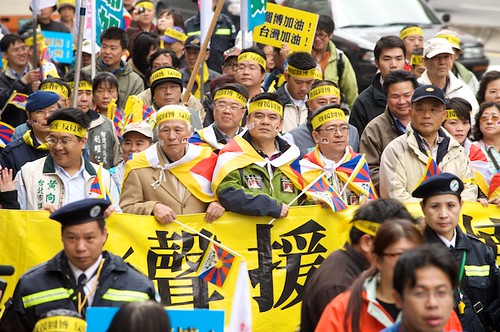
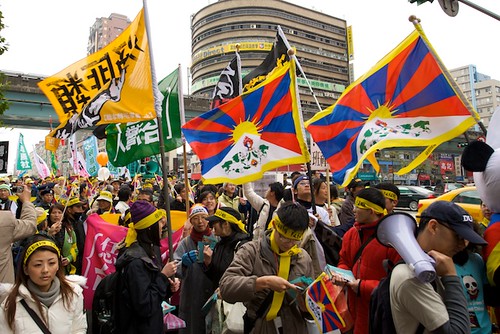
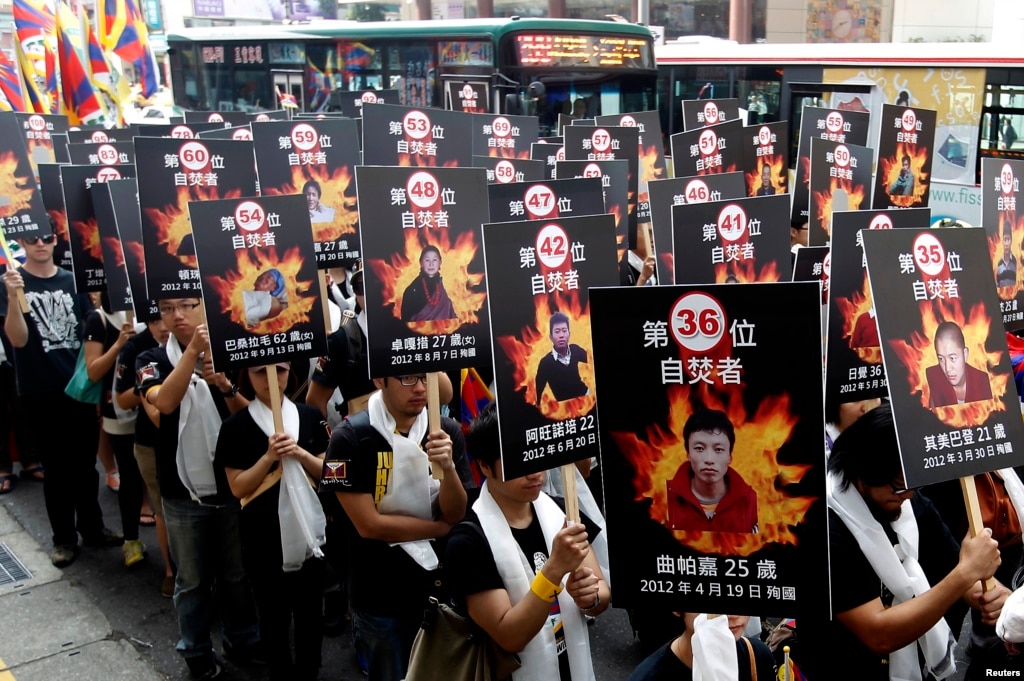
A pro-Tibet rally in Taipei
Image Credit: REUTERS/Pichi Chuang

TIBET, TAIWAN AND CHINA – A COMPLEX NEXUS

TIBET CONSCIOUSNESS – TIBET, TAIWAN, AND UNITED STATES RELATIONS. TAIWAN FOR FREE TIBET. FREE TIBET RALLY, CHIANG KAI SHEK MEMORIAL SQUARE, TAIPEI, TAIWAN.

Recent developments in cross-strait relations raise interesting questions for Tibet’s leadership in exile.

By Tshering Chonzom Bhutia for The Diplomat
November 24, 2015

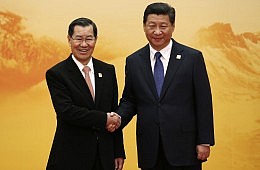
The historic meeting between Chinese President Xi Jinping and Taiwanese President Ma Ying-jeou is relevant to the Tibet issue in many ways. In 1979, when the post-Mao Chinese leadership decided to “solve old problems,” Tibet and Taiwan were both on the list. After having reached out to the Dalai Lama through his brother in 1978, Beijing turned its attention to Taiwan. “A Message to Compatriots in Taiwan” was issued by the Standing Committee of the National People’s Congress (NPC) on January 1, 1979 that sought to end the military confrontation across the straits and resolve the crisis through dialogue. This marked a shift in Beijing’s Taiwan policy from “military liberation of Taiwan” to “peaceful reunification of the motherland.”

Later, in September 1981, Beijing issued a “Nine Point Proposal” to Taiwan. It was enunciated by Ye Jianying, the then NPC Standing Committee chairman, which promised the island a “high degree of autonomy as a special administrative region,” retention of its armed forces, socio-economic system, way of life, and cultural and economic relations with foreign countries, and non-interference in its local affairs. Later, Deng suggested that this proposal could also be considered as “one country, two systems.” This was the first (p.23) time that such a concept was put forward. It was later formalized during the second session of the sixth NPC in 1984.

On July 28, 1981, about two months before the proposal to Taiwan, Beijing had issued a “Five Point Proposal to the Dalai Lama.” It basically echoed Chinese concerns in mid-1981 about how to achieve the return of the Dalai Lama and “his followers.” Since Beijing was not comfortable with the idea of having the Dalai Lama live in the Tibetan region (point four) – possibly fearing that his presence there might evoke nationalist sentiment – it was proposed that he return, but reside in Beijing. The Dalai Lama was promised that he would “enjoy the same political status and living conditions as he had before 1959,” while the returnees were promised better jobs and living conditions. This was nowhere close to what the Tibetans had in mind.
Even though the Dalai Lama had decided by the early 1970s that he would not seek independence/separation from China, the Five Point Proposal was not an acceptable proposition, for it sought to reduce the Tibet issue to that of the Dalai Lama.

Meanwhile, Taiwan too had rejected the Nine Point proposal put forward by Beijing. Interestingly, the Tibetan delegates during the talks in 1982 argued that if Taiwan was being offered such concessions, then the same or greater concessions should be granted to Tibet, given the fact that the Tibetans were different from the Chinese in race, culture, religion, customs, language, natural habitat, and history.

INCOMPARABLE

Tibet and Taiwan were incomparable for Beijing, which argued, “Tibet has already been liberated 33 years ago and decisions have already been made. Because Taiwan is not liberated that is the reason why we presented these nine-point offer. It is not the case for Tibet.” For that matter, without bringing up Taiwan, in its White Paper on Tibet in 2004, “Regional Ethnic Autonomy in Tibet,” Beijing rightly alleged that the Dalai Lama was seeking “one country, two systems…after the model of Hong Kong and Macao.” Such an “argument [was] totally untenable” according to China. A similar argument was made:

“The situation in Tibet is entirely different from that in Hong Kong and Macao. The Hong Kong and Macao issue was a product of imperialist aggression against China; it was an issue of China’s resumption of exercise of its sovereignty. Since ancient times Tibet has been an inseparable part of Chinese territory, where the Central Government has always exercised effective sovereign jurisdiction over the region. So the issue of resuming exercise of sovereignty does not exist.”

The differences in Beijing’s approach to the Tibetans on the one hand and to Hong Kong, Macao and Taiwan on the other, has not gone unnoticed among the Tibetan leadership. The Tibetan leader, Sikyong Lobsang Sangay, in an interview with the World Policy Institute in 2012 wondered whether Beijing’s discriminatory approach owed to the fact that the Tibetans are “racially different” from the Han Chinese?

TIBET – TAIWAN RELATIONS

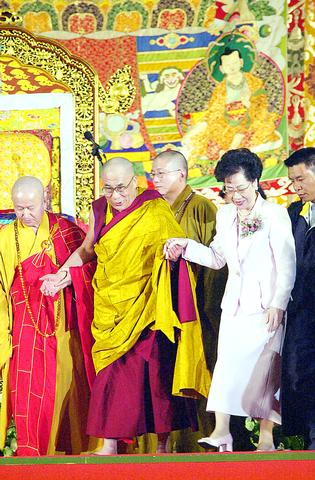
Meanwhile, following a changing of the guard in Taiwanese leadership and politics starting from the early 1990s, Beijing’s two primary opponents, the Tibetans and the Taiwanese, began to coalesce. Prior to 1992, Tibet-Taiwan relations were almost non-existent, and what exchange existed was in fact quite contentious. One factor was the role played by Taiwan’s Mongolian and Tibetan Affairs Commission (MTAC), an agency set up under the Kuomintang (KMT) government to administer Republican China’s sovereignty over Tibet. The Tibetan government in exile always held that the MTAC had for a very long time been funding “conflicts and discords in the Tibetan community.” Since 1992, after relations began to normalize, the Dalai Lama has travelled three times to Taiwan, in March 1997, March 2001, and September 2009. The first trip was during the tenure of President Lee Teng-hui, the second was after the victory of the Democratic Progressive Party (DPP) under the leadership of President Chen Shui-bian, and the third was right after the KMT had been reelected to power under President Ma Ying-jeou. All visits evoked fierce condemnation from China.

The Dalai Lama’s visit to Taiwan in 1997 resulted in Beijing adding a third precondition to restarting the Sino-Tibetan talks: “As long as the Dalai Lama makes a public commitment that Tibet is an inalienable part of China and Taiwan is a province of China, then the door to dialogue and negotiation is open.” Beijing’s reformulation of the preconditions to include Taiwan was perhaps its response to the increasing closeness in Taiwan-Tibet relations. A symposium on “International Relations vs Tibetan Issue” organized jointly by the International Relations College of Peking University and China’s Tibet on September 10, 2000, dismissed the coming together of Tibetans and Taiwanese as meaningless, though it agreed that “it deserves our close attention” (China’s Tibet 2000).

But is this coalescing of Tibet-Taiwan forces meant to counter Beijing? At least the Dalai Lama’s strategic imperative for building a coalition with the Taiwanese seems to be limited in its scope and goals. Even though it may be considered as an attempt at building coalition, it did not necessarily mean that the Dalai Lama was contravening his position on dialogue with China through the middle way approach. For instance, in his March 10 statement in 1994, when the Tibetans had just begun stabilizing relations with Taiwan, the Dalai Lama had argued that better relations with the “Chinese living in free countries, especially in Taiwan” would help in explaining the Tibetan situation to them, which he hoped “will gradually percolate to China.”

A similar view was expressed in 1997, when he said that the Taiwan trip might serve “as a gesture of reconciliation.” An additional reason was “to stop the misdeeds of these people forthwith.” The Dalai Lama was referring to the secret agreement signed between the exile organization Chushi Gangdruk and Taiwan on March 31, 1994, without consulting the exile leadership. By the terms of the agreement, the Taiwanese are reported to have promised that once China is “unified under a free, democratic system” they would guarantee “rights of self-governance for Tibet” and recognize the Dalai Lama as “the political and religious leader of the Tibetan people.” The Tibetan leadership in exile were probably concerned because the agreement not only questioned the authority of the exile government to represent the Tibetans in exile, but also had the potential to give rise to a trend of separate agreements by groups with either the PRC or the ROC/Taiwan. The seriousness of the issue is evident in the fact that a referendum was held in exile on the matter.

According to a source in Taiwan’s National Security Bureau, the possibility of establishing bilateral diplomatic relations between Taipei and the Central Tibetan Administration was raised by the Taiwanese during the visit of the Dalai Lama to Taiwan in March 1997, but both sides decided to shelve the matter for fear that the PRC authorities would accuse them of “cooperating in activities to split the Chinese motherland.” The same source said that an invitation to the Dalai Lama to attend Chen Shui-bian’s inauguration in 2000 did not materialize because the Dalai Lama did not want to provoke Beijing.

These inhibitions were later cast aside somewhat as Taiwan set up the Taiwan-Tibet Exchange Foundation in January 2003, with a view to phasing out the Mongolian Tibetan Affairs Commission (MTAC). Though this foundation was touted as “a nongovernmental agency charged with handling relations with the Tibetan government-in-exile,” its launch was presided over by President Chen Shui-bian himself. The leader openly invited the “Tibetan government in exile to join Taiwan in defying China,” thus suggesting a DPP-led Taiwan’s interest in forming a coalition with the Tibetans. The Tibetan leadership in exile seems to have been wary, given that talks were ongoing with Beijing on an annual basis since 2002. The then Kalon Tripa Samdhong Rinpoche, for instance, distanced the Dharamsala establishment from the Taiwan-Tibet Exchange Foundation by commenting that it had no role in the founding of the foundation. Taiwan has also yet to do away with the MTAC, since the DPP lost power to the KMT in 2008. In fact, increasingly, the body has come under fire for focusing on relations with the Inner Mongolia and Tibetan regions in China, for its lack of engagement with the Tibetan exile government, and for “failing to provide any report on alleged Chinese human rights violations in Tibet.” This again is owing to Taiwan’s own political dynamics, as much of the aforementioned criticism of the MTAC has come from DPP legislators. Taiwan’s KMT leader Ma Ying-jeou has focused his attention on normalization of cross-strait economic relations under his policy of “Three Nos”: No unification, No independence and No use of force.

If the DPP is triumphant in the upcoming Taiwan elections, Taiwan’s ties with the Tibetan government in exile are bound to increase. The MTAC may be dissolved, as previously planned. Might Taiwan even consider making a formal statement on the status of Tibet? If so, it would be interesting to see Beijing’s response, and the implications for Sino-Tibetan relations. To recall, the Dalai Lama’s trip to Taiwan in 1997 coincided with the opening of informal channels of communication between the exiled Tibetan leadership and Beijing. The 2001 visit was followed by the opening of formal talks in 2002. By this logic, perhaps it is time for the Dalai Lama to make a fourth visit to Taiwan. Earlier in the year, that is in March 2015, a 12-member Taiwanese delegation met with the Dalai Lama in Dharamsala and presented him with an invitation from “15 Taiwanese civic organizations,” to which the Dalai Lama readily gave consent. As we have seen though, the visits also led to the addition of Taiwan to the list of preconditions Beijing set for the restart of a Sino-Tibetan dialogue.

Historically, while Beijing’s outreach to the Tibetans preceded its formal outreach to Taiwan, contemporaneously, Sino-Tibetan talks have lagged far behind. The last round of formal meetings between the Dalai Lama’s representatives and Chinese leaders were held in 2010. How likely is a meeting between Xi Jinping and the Dalai Lama, similar to the one between Xi and Ma? Not very.

One problem is the proliferation over the past few years of the Chinese bureaucracy overseeing Tibet. For a long time, Beijing’s lack of insight into Tibet and the misrepresentation of the ground reality by local leaders were considered key reasons for the failure of Beijing’s Tibet policy. Increasingly, though, bureaucratization and the creation of groups with a vested interest in the status quo are seen as a major hurdle to any substantive talks. Still, many in the Dharamsala establishment seem optimistic that Xi will be able to overcome this hurdle and initiate a major breakthrough on Tibet in his second term when he has consolidated his position.

In late 1978, when Deng decided to get in touch with the Dalai Lama’s brother Gyalo Thondup to discuss the Tibet issue, he may have wanted to make Tibet an example of Chinese sincerity in resolving its outstanding issues. Certainly, the Tibetan delegates who went to Beijing for talks in 1982 were reported to have felt this way. Yang Jingren, the Chinese interlocutor to the talks, is reported to have conveyed to the Tibetan delegates China’s interest in solving the Tibetan problem as an important step to normalizing relations with India.

So, we see an interesting nexus of issues and imperatives that Beijing may be looking at, and, if not, then the Tibetans have been pushing China to consider the links. For example, the Dalai Lama in his March 10 statements of 1994 and 1996 suggested that successful negotiations on Tibet would positively influence sentiment in Hong Kong and Taiwan towards China. These statements were made at a time when the Sino-Tibetan talks had reached a stalemate and all communication had ceased between the two sides. When the announcement of the Xi-Ma meeting in Singapore was made, the Tibetan leadership in exile is likely to have assessed it positively and as an affirmation of their belief in Xi. As to whether that assessment is justified, only Xi can tell.

Tshering Chonzom Bhutia is an Associate Fellow at the Institute of Chinese Studies, in Delhi, India.

It is encouraging to note Taiwan’s support for Free Tibet. The resolution of Tibet-China Border dispute will help to resolve all other border disputes of China and its regional neighbors.

© 2015 The Diplomat. All Rights Reserved.The Diplomat

TIBET CONSCIOUSNESS – TIBET, TAIWAN, AND UNITED STATES. TAIWAN FOR FREE TIBET. DALAI LAMA’S VISIT TO TAIWAN IN 2001.
It is encouraging to note Taiwan’s support for Free Tibet. The resolution of Tibet-China Border dispute will help to resolve all other border disputes of China and its regional neighbors.
Tibet Consciousness – Taiwan for Free Tibet. Dalai Lama praying for village destroyed by typhoon Morakot.
Tibet Consciousness – Taiwan For Tibet. Dalai Lama’s visit to Taiwan.
TIBET CONSCIOUSNESS – TAIWAN FOR FREE TIBET. RALLY IN TAIPEI TO SHOW SUPPORT FOR FREE TIBET.
It is encouraging to note Taiwan’s support for Free Tibet. The resolution of Tibet-China Border dispute will help to resolve all other border disputes of China and its regional neighbors.
TIBET CONSCIOUSNESS – TAIWAN FOR FREE TIBET. PRO-TIBET RALLY IN TAIPEI ON TIBETAN NATIONAL UPRISING DAY, MARCH 10, 2013.
It is encouraging to note Taiwan’s support for Free Tibet. The resolution of Tibet-China Border dispute will help to resolve all other border disputes of China and its regional neighbors.

Whole Suffering – The Reality of Tibetan Suffering in Visual Arts

Tibet Consciousness – Art and Reality of Tibetan Suffering

TIBET AWARENESS – TIBET BURNING – CAMPAIGN TO SAVE TIBET.


It is not easy to visualize the reality of Tibetan pain and suffering by using the power of imagination. Some artists have ventured to capture this reality using their artistic talent to transform pictures into short films. World has to honor the memories of these Tibetans who gave their precious lives to get our attention to their pain and suffering.

Rudra Narasimham Rebbapragada
Ann Arbor, MI 48104-4162 USA
Special Frontier Force-Establishment 22-Vikas Regiment

ODISHA SUN TIMES

Art for a Tibetan cause

New Delhi, Dec 17:
A video, “Funeral #1” follows Ani Palden Choetso, a Buddhist nun and her trail of self-immolation on a street corner in Tawu town in eastern Tibet.

The eight-minute footage, smuggled out of Tibet, shows Choetso standing rock still, engulfed in flames, before collapsing. Later, a crowd gathers and prevents security officials from taking her body away. It shows her funeral at the local monastery, where thousands hold a sombre candlelight vigil. Two days later, a hurriedly filmed mobile phone video shows soldiers attacking the monastery.

The video is a part of a of mixed media installations and video works of the exhibition “Burning Against the Dying of the Light”, by veteran film makers Ritu Sarin and Tensing Sonam, who are also the founders of the Dharamshala International Film Festival. On display at Khoj Studios, the exhibition brings forth the struggle of a land that those living in exile in India and elsewhere still hope to return to.

“We had a lot of footage lying around for many years. We decided to put together a show because it will help the Tibetan struggle to move in the right direction, said Sarin, who along with Sonam made the Tibetan feature film, “Dreaming Lhasa”, that premiered at the 2006 Toronto International Film Festival.

“Burning Against the Dying of the Light” – also the centrepiece of the show – examines the recent self-immolation protests in Tibet. A number of these fiery protests have been captured on mobile phones and, at great risk to the sender, secretly made available to the outside world. These bring home in graphic and horrific detail, the physical reality of self-immolations. In this, the Wheel of Light and Darkness is created like a mixed-media sculpture.

Then there is the “Funeral #2” video which had made headlines in the capital three years ago. It follows the self-immolation and cremation of Jamphel Yeshi who set himself alight during a peaceful demonstration in the heart of Delhi on March 26, 2012.

Another work, “Nets in the Sky, Traps on the Ground, Video, printed material” is a series of Orwellian phrases taken from official Chinese documents that describe some of the many control mechanisms and restrictive measures aimed at Tibetans will be projected on the walls and ceiling.

“Memorial”, a mixed-media installation, consists of a recreation of the self-immolator, Jamphel Yeshi’s sleeping area in his rented room in Majnu ka Tila, the Tibetan refugee settlement in Delhi, exactly as he left it on the morning of his self-immolation.

The “Taking Tiger Mountain by Storm” video installation, being shown for the first time, redeploys recently acquired Chinese police footage of a large-scale raid on a small village in Central Tibet, converting it from a security apparatus archival record to a parody of what Communism means today in Tibet.

“Two Friends” is a 10-minute-long single-channel video of Ngawang Norphel, 22, and Tenzin Khedup, 24, both monks, who took a vow to die together.

Apart from these works, the “Stranger in My Native Land” documentary by Tenzing Sonam, a poignant and personal account of his first visit to his homeland, is also being shown.

The show is on at Khoj Studios, S-17, Khirkee Extension till December 31 from 11 a.m. to 7 p.m. (IANS)

Tibetan Folk Performers - Dharamshala International Film Festival

Whole Suffering – Sixth Self Immolation Tibet in 2015

Whole Land – Occupied Tibet is No Man’s Land

Tibet Consciousness – Tibet Under Occupation is No Man’s Land

TIBET CONSCIOUSNESS – OCCUPIED TIBET – NO MAN’S LAND. NOTES FROM TSERING WANGMO DHOMPA.

The loss of natural freedom in Occupied Tibet has alienated Tibetans from their own Land. Tibet is the natural home for Tibetans and they have a natural right to reclaim Tibet as their own.

Rudra Narasimham Rebbapragada
Ann Arbor, MI 48104-4162 USA
Special Frontier Force-Establishment 22-Vikas Regiment

NOTES FROM NO MAN’S LAND

By Shevlin Sebastian

Published: 02nd January 2016 10:00 PM

TIBET CONSCIOUSNESS – OCCUPIED TIBET – NO MAN’S LAND. NOTES FROM TSERING WANGMO DHOMPA.

Tsering Wangmo Dhompa | Albin Mathew

In 1994, Tsering Wangmo Dhompa went from Kathmandu to Nangchen in East Tibet, to meet her aunt Parchen, as well as her cousins. Her aunt had recently been freed after being imprisoned for 20 years. Her husband had been a part of the resistance movement against the Chinese. He was killed and Parchen was jailed, for being his wife.

And very often, they would do physical labour. One day, the authorities made the prisoners dig a part of a hillside. As Parchen was doing so, she saw several dogs running around. And she thought, ‘‘How lucky the dogs were.’’

“It was a moving moment for me,” says Tsering, the first female Tibetan poet writing in English. “Parchen did not feel bitter. She would laugh and sometimes cry when she recounted her experiences.”

Later, when Tsering went to Tibet’s capital, Lhasa, she was taken aback by the presence of a large number of policemen and the near-total surveillance. “That feeling of always being watched is a terrifying experience,” she says.

In Lhasa, today, the Chinese outnumber the Tibetans. The younger Tibetans have no option, but to study at Chinese universities. “Unfortunately, they feel marginalised, because they are not treated as equals,” says Tsering, whose parents fled to India in 1959. “But such experiences have helped them to develop a sense of identity.”

Later, Tsering made three more trips to Tibet, the last being in 2009. Her sojourns laid the seeds for her well-received non-fiction book, A Home in Tibet (2013). “While growing up, I read books on Tibet, but they were by Westerners,” she says. “I wanted to read a book by a Tibetan who lived outside, but could also be on the inside. So I thought I would write such a book targeted towards young Tibetans in exile.”

Here is an extract which reflects the pain of exile: ‘‘The flowers in Tibet were always taller, more fragrant and vivid. My mother’s descriptions, imprecise but unchanging, from year to year, had led me to an inevitable acceptance that her past was unequalled by our present lives. She would tell me of the knee-deep fields of purple, red and white, that over time served to create an idea of her fatherland, as a riotous garden. ’’

Tsering had recently come to Kochi, at the invitation of the Kochi chapter of Friends of Tibet, to interact with literature students at the St. Albert’s and Union Christian colleges. She read a few of her poems, and gave them an idea of life in Tibet. “The students asked many questions, because it was so far outside their experience,” she says.

One experience which all of them did not have is to live without a country. “To be stateless is painful,” says Tsering. “Initially, when I wanted to travel to the US, I had to apply for an identity certificate.” This is not a passport, but is recognised internationally. However, an explanation has to be given to every immigration officer about it. In India, Tsering had a refugee card which is issued by the Central government.

But Tsering has no problems living in India. “I was treated very well,” she says. “In my school [Wynberg Allen school at Mussoorie], and college [Lady Shri Ram at Delhi], I have never experienced any discrimination. But the sense of not being at home is an inner feeling. This happens, regardless of where you live.”

Today, Tsering is a naturalised US citizen and lives in San Francisco. She is a doctoral candidate at the University of California, Santa Cruz. And her subject is Tibetan nationalism and identity.
Tsering has published three books of poetry: Rules of the House, (a finalist for the 2003 Asian Literary Awards), My Rice Tastes Like the Lake, and In the Absent Everyday.

“In my poetry, I have always returned to the idea of place, memory and storytelling,” she says. “Stories help people, who are stateless, to experience a sense of place.”

Notes from No Man’s Land

Copyright © 2015, The New Indian Express. All rights reserved.

TIBET CONSCIOUSNESS – OCCUPIED TIBET – NO MAN’S LAND. NOTES FROM TSERING WANGMO DHOMPA.
TIBET CONSCIOUSNESS – OCCUPIED TIBET – NO MAN’S LAND – NOTES FROM TSERING WANGMO DHOMPA.
TIBET CONSCIOUSNESS – OCCUPIED TIBET – NO MAN’S LAND. CRY OF THE SAINTS. A CALL FOR HELP.


Whole Activism – A Tribute to Tibetan Activist Lhadon Tethong

Tibet Awareness – A Tribute to Lhadon Tethong for promoting Digital Awareness

TIBET CONSCIOUSNESS – TRIBUTE TO ACTIVIST LHADON TETHONG, TIBET ACTION INSTITUTE, CANADA AND FORMER EXECUTIVE DIRECTOR OF STUDENTS FOR FREE TIBET.

I dedicate this blog post to Tibetan Freedom Movement activist Ms. Lhadon Tethong as my special tribute in recognition of her untiring efforts to promote Tibet Awareness particularly using the tool of digital hygiene practices.

Rudra Narasimham Rebbapragada
Ann Arbor, MI 48104-4162 USA
Special Frontier Force-Establishment 22-Vikas Regiment

EMPOWERING DIGITAL TIBET: AN INTERVIEW WITH ACTIVIST LHADON TETHONG

Rignam Wangkhang for IFEX 9 December 2015


Tibet Consciousness – Tribute to Activist Lhadon Tethong. Design by Tenzing Gaychey.

Design by Tenzing Gaychey


Photo. Alex John Beck

Lhadon Tethong is one of the most prominent and recognizable leaders in the Tibetan freedom movement. She first became a spokeswoman on Tibetan issues after her speech at the 1998 TIBETAN FREEDOM CONCERTS inspired a new generation of Tibetan supporters. Lhadon then went on to serve as Executive Director of Students for a Free Tibet, where she led a high-profile global campaign to condemn China’s rule of Tibet in the lead-up to and during the 2008 Beijing Olympic Games. In 2011, she was awarded the first annual James Lawson Award for Nonviolent Achievement by the International Center on Nonviolent Conflict.

A Tibetan born in Canada, she recently founded the Tibet Action Institute, which combines digital communication tools with strategic nonviolent action to build and strengthen the Tibet movement for human rights and freedom.

In this interview, Lhadon speaks with Rignam Wangkhang about her work, Chinese cyber surveillance, and the future of digital rights in Tibet.

According to Freedom House’s recent ‘Freedom on the Net’ 2015 report, China was the year’s worst abuser of internet freedom. How would you rank Tibet?

In terms of digital rights in Tibet, we just have to assume it’s the worst of the worst. When we compare the ability of a Chinese person to speak their mind to that of a Tibetan in Tibet, the cost for Tibetans, and the surveillance over Tibetans, is usually much higher. China is extremely paranoid about any challenge to its authority from Tibet.

What is the general situation with respect to surveillance?

Tibetans inside Tibet understand surveillance. Whether it’s online or not, they have been living with unbelievably restrictive and pervasive surveillance inside central Tibet, which the Chinese government calls the Tibetan Autonomous Region (TAR). Outside of the TAR, and in most of the areas of historical Tibet that had been absorbed into the Chinese provinces of Qinghai, Sichuan, Yunnan and Gansu, Tibetans have faced increasing restrictions and surveillance in recent years.

It’s not that you just make a comment online and you might get caught. People are stopped at roadblocks, and in Lhasa their phones will be taken and searched.

Post-2008, in the wake of the uprising that rocked the entire Tibetan plateau, the Chinese went to great lengths to physically search, digitally monitor, and root out the key people they believed to be behind the protests. They couldn’t accept that it was a spontaneous and a true expression of Tibetan frustration and anger with their treatment under Chinese occupation.

How is the removal, blocking and filtering of content affecting internet freedom inside and outside Tibet?

It’s very easy for Chinese authorities, who have unlimited resources, to take down websites or take content offline. One day it’s there, then the next day, the next minute, it’s gone – whether it’s a comment or an entire website.

Tom-Skype is a special version of Skype that they use in China and Tibet. We know for a fact that certain keywords are filtered. You can send a message that won’t be delivered because that message has been blocked and censored in transit, by the company itself.

Almost every Tibetan uses WeChat [Chinese messaging and
social media app]. We know that in times of heightened sensitivity, people will be arrested for what they post on WeChat. A Tibetan man in Qinghai, Eastern Tibet, in Tibet’s traditional province of Amdo, posted content related to the Dalai Lama’s 80th birthday. He was arrested, disappeared, and no one has any information on his whereabouts.

Even those who self-censor, and aren’t necessarily doing anything political, are mapped, and their channels of communication are understood. The biggest risk is that when Tibetans are all using a single service, like WeChat, it’s very easy for the Chinese government to centralize surveillance and map people’s networks.

“The biggest risk is that when Tibetans are all using a single service, like WeChat, it’s very easy for the Chinese government to centralize surveillance and map people’s networks.”

In this photo released by China’s Xinhua news agency, lamas try laptop computers at the square before the Potala Palace in central Lhasa, capital of southwest China’s Tibet Autonomous Region
AP Photo/Xinhua, Gaesang Dawa

Some people tell me that Tibetans cannot let fear consume them, and everyone needs to go back to posting online content as they see fit. They bring up Amdo as an example of people posting so much that the Chinese government began allowing certain things, because they can’t arrest everyone.

Tibetans need to express themselves and I think they do that. Some people are very outspoken and take greater risks than others who speak more in metaphors. Other people are more reticent, and from this place of comfort and freedom that I sit in the U.S., I can’t say what Tibetans inside should or shouldn’t do. Those of us on the outside should not assume we know what’s best, but rather try to hear what they’re talking about, what they’re doing, and support them.

How do we navigate this landscape without self-censoring ourselves?

I think with the case of WeChat, the key is to understand how the technology works, and understand the potential obstacles or risks that can come from using it. Tibetans need to know how to do it in a more smart and secure way, to protect sources on the ground and protect communities.

From your personal experience, how extensive and sophisticated is the surveillance apparatus of the Chinese government?

A lot of the attacks that they launch, hacking attacks or phishing attacks towards Tibetans, aren’t very sophisticated. The reality is that the way Chinese online attackers are going after Tibetans can be pretty crude. Sometimes, because Tibetans aren’t updating their software, it’s as simple as that they’re using an outdated version of Word. If they’re using an outdated version of software, it is more prone to viruses that have been circulating around the web.

We tend to believe Chinese cyber attacks must be sophisticated, but even when the attacks are on the highest levels of the American government, it can be simply that they sent an instant message to some government employee with the right level of clearance and pretended to be that person’s mother, and the person got tricked into clicking on a link and letting the Chinese in. That’s just human error that can be corrected through basic education and awareness. It is a good indication that we have more control than we think.

To me, the situation requires a holistic approach. I don’t think we gain anything from scaring people and disempowering them. It’s a good thing that Tibetans are not easily scared, and I think that is the most hopeful, and encouraging foundational reality of our movement.

Knowing that, how are you educating Tibetans on these matters and what has been the most effective way to educate them so far?

First, by focusing broadly on public awareness and education campaigns. We’ve thought of it like a public health campaign. If there are ways to help people stay healthy and alive online, then that’s where we will put our efforts. There is a need for broad scale public education and awareness about better digital hygiene practices. We’re actually ahead of the curve in the Tibetan world because of our situation.

Next to that is targeted trainings. We can know this afternoon whether a protest happened in Tibet last night. We can see video footage or photos of that protest, and this is an incredible development. By doing targeted training with Tibetan activists and people who are actively getting information out of Tibet, or communicating with people inside Tibet, we hope to establish digital hygiene best practices.

Linkedin is trying to expand into China, and due to pressure from government authorities, it is proactively restricting politically sensitive material from its users in China. Why is this happening?

I think it’s an absolute shame, there’s no other way to put it. I think that these tech giants, whether it is LinkedIn, Facebook, Google or Twitter, have incredible influence and opportunity to push the Chinese government in the right direction, and instead, it’s a race to the bottom. People are so eager to get into the Chinese market, we’re going to see more tech companies doing anything the Chinese ask them to. The entire reason that these tech giants have become giants is because they have built their success on the free and open internet. To then go and help the Chinese government shut it down for Chinese citizens and Tibetans is short sighted.


“The entire reason that these tech giants have become giants is because they have built their success on the free and open internet. To then go and help the Chinese government shut it down for Chinese citizens and Tibetans is short sighted.”


How do you create change with regard to internet freedoms and surveillance in countries like China and Tibet that do not have the same potential for legislative or judicial change as the West?

First and foremost, those of us living in a free and democratic world can lead by example. Stigmatizing encryption tools as something only terrorists use, like in the U.K., is counter productive to the cause of freedom around the world. It’s in the interest of our governments to educate the public about how these tools work, to be more digitally literate, and understand safety and security online. Once people understand these tools and technology more, they will be less likely to have a knee jerk reaction to ban encryption tools. They’ll understand the importance of people being able to have secure speech online.

Next, American, British or Canadian companies like Gamma International and Hacking Team, who are actively helping authoritarian governments use surveillance over their citizens, must be held accountable. These corporations should be outlawed, controlled, fined, made pariahs. That kind of behaviour should not be tolerated, but whether the political will is there is another question.

And finally, no one is engaging with China directly. There are plenty of diplomatic tools in the toolbox to help Tibetans in Tibet and citizens in China who are fighting for rights and freedoms, and our governments should not shy away from engaging with the Chinese openly and directly.

Tendor’s [prominent Tibetan writer and activist] monograph on “The History of Tibetan Non-Violence Struggle” states that the Tibetan struggle is going through transformative resistance. How does this apply to the digital sphere, and what does the future of resistance in Tibet look like with regard to internet freedom, security and digital activism?

The ability for Tibetans to share ideas, joys and sorrows, and hopes and dreams through these advances in ICTs [information and communication technologies] has completely revolutionized the struggle. More Tibetans than ever before are informed and connected to their brothers and sisters in all corners of the world.

We have seen Tibetans wield culture as a weapon, an unbelievably powerful weapon in the struggle. All of this has been fuelled and spread through social media, mobile phones and the Internet. We have this incredible back-and-forth between Tibetans inside Tibet and Tibetans in exile, young Tibetans studying in China. Ultimately nothing that the Chinese do can stem the tide of this change that has started.

The protests in 2008 were predominately non-violent protests by Tibetans as young as middle school, and from all walks of life. Not just monks and nuns, but schoolteachers, farmers, nomads, students. What started then is not finished, and in fact the next generation has become empowered, emboldened and intrigued by what’s out there.

I don’t think that anything can really stand in their way or in the way of the Chinese who want and deserve the same rights and freedoms as we have. The question will just be how quickly the big change comes, and whether our governments and we as individuals and organizations help or stand in the way of that change.
Rignam Wangkhang is the Campaigns and Advocacy Officer at Canadian Journalists for Free Expression (CJFE). He is also a freelance writer who is a board member with Students for a Free Tibet Canada.

IFEX9

555 Richmond Street West, Suite 1101, P.O. Box 407

Toronto, ON, Canada, M5V 3B1
Tel: +1 416 515 9622
Fax: +1 416 515 7879

IFEX publishes original and member-produced free expression news and reports. Some member content has been edited by IFEX. We invite you to contact to request permission to reproduce or republish in whole or in part content from this site.

for a Free Tibet India – Official Blog | Students for a Free Tibet ...
On lhasarising.wordpress.com

... for everyone who volunteered for our Victoria event. Free Tibet
On sftcanada.wordpress.com

Students For A Free Tibet Pune
On studentsforafreetibetpune.blogspot.no

the tibetan freedom concert 1998 with luscious jackson performing ...
On www.siliconinvestor.com

Pin by Kate Donahue on *Radiohead | Pinterest
On pinterest.com

Tibetan Freedom Concert
On vesinstruments.com

TIBET CONSCIOUSNESS – TIBET CLIMATE ACTION. DEMANDING FREEDOM, PEACE, AND JUSTICE FOR TIBET.