Whole Dude – Whole Ganges: Defining Indian Identity – The Spirit of Nationalism. Mother Ganges is the Spirit of the Nation called India or Bharat.Whole Dude – Whole Ganges: The Spirit of India
“….The Ganges,above all is the river of India,which has held India’s heart captive and drawn uncounted millions to her banks since the dawn of history.The story of the Ganges,from her source to the sea,from old times to new,is the story of India’s civilization and culture,of the rise and fall of empires,of great and proud cities,of adventures of man….”
Discovery of India, Jawaharlal Nehru
Whole Dude – Whole Ganges: Jawaharlal Nehru, India’s First Prime Minister speaks eloquently about River Ganges shaping the lives of Indians throughout History. Mother Ganges is the Spirit of the Nation.
Jis Desh Mein Ganga Behati Hai (The Country Where River Ganges Flows)
Whole Dude – Whole Ganges: WHAT IS INDIA? INDIA IS DEFINED AS THE LAND OR COUNTRY WHERE RIVER GANGES FLOWS. INDIA CAME INTO EXISTENCE WHEN GANGES STARTED FLOWING THROUGH THIS LAND. RIVER GANGES IS THE SPIRIT OF THIS NATION
Raj Kapoor won Filmfare’s Best Actor Award in 1961 for his portrayal of ‘Raju’, a song writer, in his film titled ‘Jis Desh Mein Ganga Behati Hai’. The picture was released during 1960 when I was twelve years old and was studying in VI-Form (S.S.L.C. Class of March 1961) in Danavaipeta Municipal High School, Rajahmundry, East Godavari District, Andhra Pradesh, India.We had a beautiful marble statue of Mahatma Gandhi right in front of our school.I studied Indian History as part of my school curriculum.I used to score well in my History tests. It was not too difficult for me to remember all those dates,names and other facts that constitute the subject matter of History. I have a deep sense of appreciation for all those leaders who orchestrated the political struggle against the British Rule.The Freedom Movement did indeed foster a sense of purpose and united people to achieve a common goal. It could be true that the fight against the Colonial powers gave a sense of Identity and very often the freedom fighters were called ‘Satyagrahis’. I have great admiration for their sense of patriotism and I am ever grateful for the sacrifices they made to win our independence. I saw this movie ‘ Jis Desh Mein ‘ just once and may have heard the title song on the radio on a few occasions.But the song , “Hotoan pe sachhai rahati hai, jahan dil me safaai rahati hai, Hum uss desh ke vaasi hai, Hum uss desh ke vaasi hai, Jis Desh Mein Ganga Behati Hai” never faded from my memory.
Whole Dude – Whole Ganges: Defining Indian Identity – Mother Ganges is the Spirit of the Nation called India or BharatWhole Dude – Whole Ganges: Defining Indian Identity – Mother Ganges is the Spirit of the Nation called India or Bharat
Ten years after seeing the movie, in the year 1970, at the age of 22 years , I was granted President’s Commission and joined the Indian Armed Forces in the rank of Lieutenant.While joining Service,we accept the risks that naturally accompany such an occupation and reflect upon the motivation that shapes the decision.I understand that the Freedom Struggle was important but that Struggle does not define my sense of National Identity.I have known that the country that we call India has existed long before the invasion by the Mughals,the country that we call India has existed during centuries of British Rule and now the country that we call India exists in spite of the changes in the political landscape and the political fortunes of the Parties that we elect from time to time. My sense of National Identity is not dependent upon the political history of our country. My sense of National Identity does not depend upon the language that I speak at home and it is not related to the regional customs pertaining to food or dress. I have known my country from its Cultural Traditions. In 1970,I joined the Indian Army to defend the country which lives in my mind as the Land where River Ganga flows.
Whole Dude – Whole Ganges: Mahatma Gandhi is revered as the Father of the Nation and had promoted the Spirit of Nationalism during India’s long Struggle for Freedom. But, Mother Ganges is the Spirit of this Nation called India or Bharat.
In my opinion, the country that we call India is not a mere political entity. It is true that India gained its political freedom in 1947. The country is existing ever since the River Ganges started flowing across its Land.
I am not surprised that the song “Jis Desh Mein” still plays and I still hear the golden voice of immortal Mukesh, whenever my heart dreams about India. Most certainly, the Spirit of Nationalism is inspired by a history which reaches back to a period earlier than the British occupation of India.
Jis Desh Mein Ganga Behti Hai Lyric
Whole Dude – Whole Ganges: Defining Indian Identity – Mother Ganges is the Spirit of the Nation called India or Bharat.
hothon pe sachchaaee rahatee hain, jahaan dil mein safaee rahatee hain hum us desh ke waasee hain, jis desh mein gangaa bahatee hain hothon pe sachchaaee rahatee hain, jahaan dil mein safaee rahatee hain hum us desh ke waasee hain, jis desh mein gangaa bahatee hain mehmaan jo humaaraa hotaa hain, wo jaan se pyaaraa hotaa hain mehmaan jo humaaraa hotaa hain, wo jaan se pyaaraa hotaa hain jyaadaa kee nahee laalach hum ko, thode mein gujaaraa hotaa hain thode mein gujaaraa hotaa hain
bachchon ke liye jo dharatee maan, sadiyon se sabhee kuchh sahatee hain
hum us desh ke waasee hain, jis desh mein gangaa bahatee hain
kuchh log jo jyaadaa jaanate hain, insaan ko kam pahachaanate hain kuchh log jo jyaadaa jaanate hain, insaan ko kam pahachaanate hain
ye poorab hain, poorabawaale, har jaan kee kimat jaanate hain milajul ke raho aaur pyaar karo, ik cheej yahee jo rahatee hain
jo jisase milaa sikhaa hum ne, gairon ko bhee apanaayaa hum ne jo jisase milaa sikhaa hum ne, gairon ko bhee apanaayaa hum ne matalab ke liye andhe ho kar, rotee ko nahee poojaa hum ne rotee ko nahee poojaa hum ne
ab hum to kyaa saaree duniyaan, saaree duniyaan se kahatee hain
hum us desh ke waasee hain, jis desh mein gangaa bahatee hain
Whole Dude – Whole Ganges: Defining Indian Identity – Mother Ganges is the Spirit of the Nation called India or Bharat.
Whole Dude – Whole Baptism: Defining Indian Identity – The Tradition of River Worship. River Godavari at RajahmundryWhole Dude – Whole Baptism: Defining Indian Identity. The tradition of River Worship. River Godavari at Rajahmundry.
CULTURAL UNIFICATION OF INDIA – THE PRACTICE OF TIRTHA SNAN ( BATHING IN HOLY RIVERS )
Whole Dude – Whole Baptism: Defining Indian Identity. The tradition of River Worship. River Godavari at Rajahmundry.
Water plays an important role in a variety of Cultures and religious practices prevalent in this world.The role of water constitutes one of the most remarkable aspects of Indian religious life. Hindu religion is often described as Sanatana Dharma. The practice of bathing in a river is an unusual example of the continuance of an ancient tradition and hence I can refer to the practice of Tirtha Snan (The ritual of River Bathing) as “Sanatana” (of great antiquity) in its origin. Simply touching water is a purifying gesture in the Vedas. Pilgrimages (Tirtha Yatras) to holy rivers (Tirtha) was already known in Vedic and Epic times and it remains extremely popular up to the present day. In fact,my impression is that the practice has become more popular and a far greater number of people are participating due to the availability of modern time conveniences for travel and lodging.The news media consistently report that our river festivals such as “Kumbh Mela” and “Pushkarams” have established world records as the largest gathering of human beings upon this earth in one single day and for one single purpose.
The sacredness of a place is often due to the sanctity it derives from its location on the bank of a holy river (Tirtha Sthan or Tirtha Kshetra). The following verse is an example of such belief. The simple act of remembering the various places that River Ganges traverses through, is equivalent to the worship of all Gods and it bestows great blessings (Punya).
Tatra tatra sthita Ganga, Sarva Punya phala prada
Bhaveth smarana maatrena, Sarva Deva namaskruta.
Apart from bathing (Snan), holy waters are used in the ritualistic worship of deities,and the water used in the worship is used to sprinkle upon the heads of the devotees and also consumed by the devotee in acceptance of the blessings from the Deity. The devotee hopes for deliverance from sin or pollution (“Paap”), seeks preservation or enrichment of his religious merit (“Punya”), hopes for a reward such as rebirth in a heaven (“Swarg Lok”)and even total emancipation (“Moksha or Mukti”). There are instances when people had actually traveled to the holy city of Varanasi to die near the holy River Ganges. More often, the cremated remains, the ashes are carried by the loved ones and are physically sprinkled and immersed in the holy rivers such as Ganges to help the onward journey of the departed soul.
Whole Dude – Whole Baptism: Defining Indian Identity. The tradition of River Worship. River Godavari at Rajahmundry.
The worship of rivers and the practice of bathing is a belief that is connected with the traditional Indian views of earthly life. Indians believe in the theory of Karma. They believe that the acts of their present lives and their past lives would be a factor that determines the condition into which a being is reborn. The Karma binds the soul and compels it to go through an endless series of births and deaths. The cycle of birth, death and rebirth is called Samsara. In my previous entry, I described the fear of Samsara as the defining attribute of Indian Identity. The practice of bathing in a holy river is an example of the doctrine of Individualism. Even when millions of people travel and gather together to bathe in a river on one day, each is acting strictly to earn his own merit and to reap his own benefit and the community does not expect any share of the rewards that the bather may be granted. I bathe and wash my own sins and I can not be of any help to others if they carry the burden of their own sins. Each person has to accept individualistic responsibility for their own actions and if necessary they can seek help from others to get to the river and ask for assistance to bathe in the river.
Whole Dude – Whole Baptism: River worship appears to be a communal event but its usefulness is strictly individualistic in nature.
River worship appears to be a communal event but its usefulness is strictly individualistic in nature. Bathing is not viewed as a simple act of personal hygiene, it constantly reminds us of the need to seek purification and makes us aware of our responsibility for own actions and challenges us to face the consequences in our future lives. People are encouraged to seek the blessings that bathing in holy rivers would contribute even while they may be showering at home. The following verse is an example of our connection to the rivers that flow across our Land.
Meaning: 1: O Holy Rivers Ganga and Yamuna, and also Godavari and Saraswati, 2: O Holy Rivers Narmada, Sindhu and Kaveri; Please be Present in this Water (and make it Holy).
My introduction to River Worship
Whole Dude – Whole Baptism: Defining Indian Identity. The tradition of River Worship. The celebration of Godavari River.
Culture represents ideas and thoughts transmitted by one generation to the next. It indeed gives me a great pleasure to recall my learning of this unique Cultural Tradition while I lived at my Grandfather’s mansion in Innespeta of Rajahmundry town in East Godavari District of Andhra Pradesh. During 1950s, I lived with my parents,two brothers, grand mother, her sister and my great grand mother. The house had bath rooms and we had regular piped water supply from the municipality. We would generally shower at home and on important festival days, we would bathe in River Godavari. My great grand mother was an exception to this bathing practice. She firmly believed in the practice of river worship and adhered to it every single day and almost till her final days of earthly existence. She was of short stature and she was already in her ninety’s and due to her age, her spine curved and made her even smaller. Her vision had deteriorated and she was able to see only a few feet ahead of her. Our house was located at the corner of Kalabargivari Street and the Ramalayam street.The Lord Sri Rama Temple of Innespeta is a well known land mark and it stands next to the protective river embankment. The river bank is fairly wide, it includes the railway tracks and a motor-able road. Much later, the second rail cum road bridge was built across Godavari River using these railway tracks. My great grand mother would walk to the river all by herself and used a walking stick to support herself. The walk to the river is short but she faced a lot of dangers on the street. Those days, the vehicular traffic was not a problem and crossing the railway tracks was not a problem. The biggest threat was posed by the stray animals such as goats and cows that roam freely on the streets. She was practically defenseless. As young boys at home, myself and my elder brother were often given the chore of escorting my great grand mother during her walk to the river. When we followed her as her escort, the animals always behaved better and would not come to attack her. The reward myself and my brother Pratap reaped was that of getting into the emerald green, crystal clear, cool waters of River Godavari and frolic in the shallow waters as my great grand mother did her worship. But for my great grand mother’s tenacity and perseverance, myself and my brother would never have ventured to make a trip to the river in the morning.
Whole Dude – Whole Baptism: Defining Indian Identity. The tradition of River Worship. Pilgrims at Godavari River.
It was a joyful experience and the Tradition of River Worship gave us some very fond memories of our life in Rajahmundry. The following verse speaks of the importance that we attach to rivers of India and they are treated with great respect as they are deemed to be the same as Ganges:
Whole Dude – Whole Baptism: Defining Indian Identity. The tradition of River Worship.
Kaveri,Tungabhadra cha, Krishnaveni cha, Gautamee
Bhagirathi cha vikhyata, Pancha Ganga prakirtita.
Whole Dude – Whole Baptism: Defining Indian Identity. The tradition of River Worship. River Godavari Bridge in Rajahmundry.Whole Dude – Whole Baptism: River worship appears to be a communal event but its usefulness is strictly individualistic in nature.
Whole Dude – Whole Family – Vasudhaika Kutumbam, the concept of One Global Family with One Universal Divine Mother.
Parvati is Mother, Lord Shiva is Father, His devotees are relatives and all the three worlds (Bhu Loka, Bhuvar Loka and Suvar Loka – Earth, Sky and Heaven/SAT, CHIT, ANANDA) are my native place.
The Theory of Samsara and the Social Concept of Vasudhaika Kutumbam
Whole Dude – Whole Family – Vasudhaika Kutumbam, the concept of One Global Family
As a student of Natural Science, the study of relationships has always interested me.The scientific study of Ecology describes the interconnectedness, the interrelatedness and the interdependence of living creatures in a given environment.A study of Ecosystems deals with the concepts of Mineral Sharing, Energy Flow and Population Control.Living organisms belong to social communities.The understanding of ecological principles would help us to come together as one large global community and it would enable us to treat life with a sense of respect and appreciate the intrinsic beauty and value of all living creatures.
Whole Dude – Whole Family: The concept of Vasudhaika Kutumbakam, the concept of One Global Family
By birth, I belong to the Land of India where I inherited my views about human existence and the social community.The word ‘relative’ when used as a noun describes a person who is connected to the other by way of birth or by way of marriage.
Whole Dude – Whole Family: The concept of One Global Family
By birth, I am connected to the Land of India and by acquiring the theory of ‘SAMSARA’, I am related to all the living creatures of this planet Earth. My soul while transmigrating over several cycles of birth and rebirth has become connected not only to the human beings but also developed relationships with plants and animals.This is a fundamental concept that defines my Indian Identity. I am an eternal being and I am related to a myriad of life forms.
Whole Dude – Whole Family: Vasudhaika Kutumbam, the concept of One Global Family.
While living in Ann Arbor, Michigan I met with a group of young students of Pakistani descent at the local Huron High School. I am a total stranger to this group of young people. The older kid in the group came forward and addressed me as Uncle.This is precisely my own social experience.While growing up as a kid in India, I was always encouraged to recognize other members of the community as if I am related to them by birth. The social norm is to address others in an appropriate manner and even total strangers are treated with respect and are included as a part of an extended circle of family members.I greeted people living in my neighborhood as uncles and aunts. Amongst the members of the Armed Forces and their families this kind of affiliation and a sense of togetherness is much more pronounced. While I served in Uniform, the members of Service families always spoke to me as if I am their brother or their uncle. This social custom of inclusiveness is reflected in our popularly expressed sentiments. Mahatma Gandhi is recognized as “BAPU”(Father). As a child, I grew up knowing the Prime Minister Jawaharlal Nehru as “CHA CHA” (Uncle)Nehru.
Whole Dude – Whole Family – Vasudhaika Kutumbam, the concept of one Global Family. BOTH ANIMATE AND INANIMATE MATTER DERIVE THEIR IDENTITY BECAUSE OF UNVARYING OR UNCHANGING NATURE OF CHEMICAL ELEMENTS THAT CONTINUOUSLY FLOW IN NATURAL NUTRIENT CYCLES.
Plants obtain their minerals and other nutrients from the soil. Calcium is an important mineral constituent of my bones and it helps to define my physical identity. Iron is the other mineral which is important to the blood that flows through my body and sustains my physical existence. By sharing the minerals and from the energy that flows into my life from plants and animals, I get connected to the soil and I get related to the Land of my birth. I further strengthened my connection to the Land by choosing to serve it and defend it.
Whole Dude – Whole Family – Vasudhaika Kutumbam, the concept of One Global Family: Life depends on the interwoven and interdependent relationships between living organisms and the environment. No organism leads a truly independent existence of its own. Each organism lives by either consuming other organisms or the products from other organisms. In a Biological Community, Life and Death have a relationship which has a Spiritual Basis.
We are all connected and we are all related to each other. Either you could explain it in terms of Cellular Biology and Ecology or you could see it as a consequence of the cycles of birth and rebirth and transmigration of the soul through living entities.
Whole Dude – Whole Family: Vasudhaika Kutumbakam, the concept of One Global Family.
Sanatana Dharma of India. Theertham, Tirtha, Tirthasthan, Tirtha Yatra, Tirtha Snan, and the ritual of Bathing and Purification.
The ancient traditions of India are often described as ‘Sanatana Dharma’. Indians for a very long time recognized the significance of Water and use it in various rituals, particularly for the purification of the human body which is prone to sickness or illness attributed to sinful thoughts, words, and actions. The term ‘Theertham’ refers to water that is sanctified by prayerful thought and by using it in the devotional worship of God.
Sanatana Dharma of India – Theertam, Tirtha, Tirthasthan, Tirtha Yatra, Tirtha Snan and the ritual of Bathing and Purification.
The term ‘Tirtha’ refers to a body of water such as a well, pond, lake, river, or sea which gets an elevated status because of its geographical association with a physical location, place, or position named ‘Sthan’ or ‘Kshetra’. The physical journey to visit the place of Tirthasthan is called Tirtha Yatra.
Sanatana Dharma of India – Theertham, Tirtha, Tirthasthan, Tirtha Yatra, Tirtha Snan, and the ritual of Bathing and Purification.
The act of taking a bath or dipping into the water at a Tirthasthan is called Tirtha Snan.
Sanatana Dharma of India – Theertham, Tirtha, Tirthasthan, Tirtha Yatra, Tirtha Snan, and the rituals of Bathing and Purification.Sanatana Dharma of India – Theertham, Tirtha, Tirthasthan, Tirtha Yatra, Tirtha Snan, and the rituals of Bathing and Purification.
I ask my readers to reflect on the divine attributes of the Water Molecule. The original, sweet taste of fresh water cannot be discovered by the study of the properties of the Chemical Elements, Hydrogen and Oxygen which combine to form the Chemical Compound called Water. Man, like several other terrestrial creatures, depends upon Fresh Water delivered from Heaven.
Kumbh Mela: Millions of Indians take a holy dip – BBC News
Sanatana Dharma of India – The rituals of Bathing and Purification.
Image copyright Ankit Srinivas
Millions of people have taken to the waters at the confluence of India’s sacred Ganges and Yamuna rivers as part of the Kumbh Mela festival – humanity’s largest gathering.
Officials told the BBC some 15m people bathed on Tuesday. They expect about 120m visitors over 49 days.
Hindus believe bathing at the rivers will cleanse their sins and bring salvation.
The holy men were among the first procession to arrive early Tuesday.
Sadhus – or ascetics – smeared ash on their bodies as they came out of the water and chanted “Har Har Gange”, or “Mother Ganges”, and danced while posing for photographers.
Sanatana Dharma of India – The rituals of Bathing and Purification.
Image copyright Ankit Srinivas
The Naga sadhus are the biggest draw of the festival – held in the northern city of Allahabad, recently renamed Prayagraj – and arrived early in the morning in massive colorful processions.
Thousands of the Sadhus – naked and wearing marigold garlands around their necks – were escorted by police to the river as they chanted slogans invoking Shiva, the Hindu god of destruction. Many were waving tridents and swords.
At the last Kumbh in 2013, female ascetics were allowed to bathe at the confluence of the rivers – known as the Sangam – for the first time. A few hundred transgender people were among those who bathed on Tuesday morning.
More than a million foreign pilgrims will also take part in the festival, senior administration official Rajeev Rai told the BBC.
He and other organizers had been preparing for more than a year for the event, which dwarfs the annual Hajj pilgrimage to Islam’s holiest sites in Saudi Arabia.
Sanatana Dharma of India – The Rituals of Bathing and Purification.
Image copyright Ankit Srinivas Image caption Religious sects arrived in processions to take a dip
The mela (meaning “fair” in Hindi) has been held in Allahabad for centuries now, but it has grown into a mega event in the past two decades.
Sanatana Dharma of India – The Rituals of Bathing and Purification
Image copyright Getty Images
This year the gathering will be particularly huge and many believe India’s Hindu nationalist government has organized it with an eye on key general elections due in the summer.
Massive billboards of Prime Minister Narendra Modi dot Allahabad city and the Mela ground. Huge cardboard cut-outs have been placed strategically at the bathing areas.
Sanatana Dharma of India: The Rituals of Bathing and Purification
Image copyright Ankit Srinivas
A temporary tent city spread over 32 sq km (12 sq miles) has been set up to accommodate the masses, complete with hundreds of kilometers of new roads. Hospitals, banks, and fire services have been set up just for the festival, along with 120,000 toilets.
Hundreds of new train services are running to and from Allahabad to tackle the rush of pilgrims and more than 30,000 police and paramilitaries have been deployed to provide security and manage the crowds.
In the run-up to the festival, religious sects held daily processions marked by much pomp and show.
Sanatana Dharma of India – The Rituals of Bathing and Purification
Image copyright Ankit Srinivas
At one such procession on Sunday night, there were elephants, camels, and horses. Brass bands and drummers played, as religious leaders sitting atop several vehicles threw marigold flowers to thousands of devotees.
On Monday – a day before the official start of the festival – tens of thousands of pilgrims bathed at the Sangam. Some then lit clay lamps and floated them along with flowers in the Ganges.
Sanatana Dharma of India: The Rituals of Bathing and Purification
Image copyright Ankit Srinivas
Sanatana Dharma of India: The Rituals of Bathing and Purification
Image copyright Ankit Srinivas
The atmosphere at the mela is festive, and the authorities have announced a calendar of music and dance performances. But there’s plenty of impromptu entertainment taking place by the roadside, with children performing rope tricks and shows by drummers and ballad singers.
Most pilgrims, however, say they are here to “answer the call of Mother Ganges”.
“We believe that bathing here will destroy our sins,” farmer Pramod Sharma said.
“The waters here have regenerative properties. Bathing here can cure your ailments. It also removes obstacles from your way,” Shahbji Raja said.
Sanatana Dharma of India: The Rituals of Bathing and Purification.
Kumbh Mela at a glance
A pilgrimage in which Hindus gather at points along the Ganges, Yamuna and mythical Saraswati rivers
This year’s event expects 120 million visitors over seven weeks, dwarfing last year’s Hajj pilgrimage in Saudi Arabia which drew about 2.4 million
Astrology determines most aspects of the festival, including its date, duration, and location
The most recent full Kumbh, held in 2013 in Allahabad, was also a Maha (or great) Kumbh, which happen every 144 years. It attracted an estimated 100 million visitors
A lost-and-found camp was set up in 1946 and has since helped reunite countless family members and friends who get separated in the vast crowds
This year, 15 lost-and-found camps have been set up. These computerized centers are interconnected and their announcements will be heard across the Mela grounds. Details will also be uploaded on Facebook and Twitter to help trace the missing
India’s Sanatana Dharma. Theertham, Tirtha, Tirtha Yatra, and Tirtha Snan. The Rituals of Bathing and Purification.
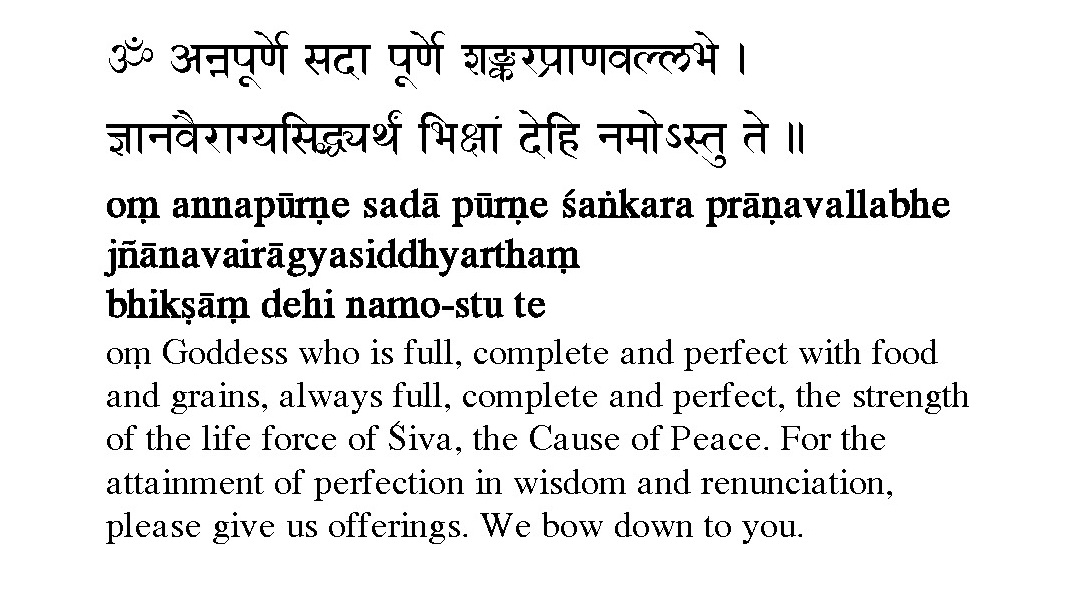
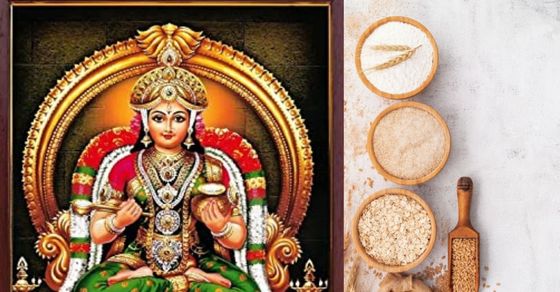
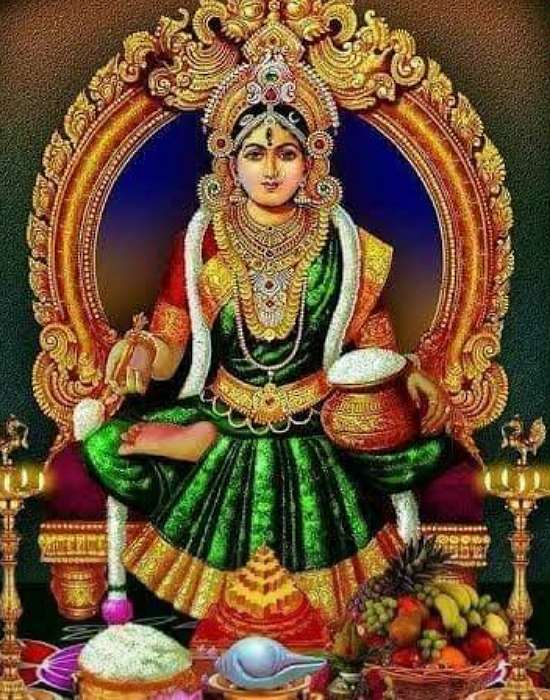
Whole Dude – Whole Hymn – Whole Concept: My favorite prayer song. Salutations to Mother Annapurna the Original Source of Whole or Purna Concept (Always Full, Complete, and Perfect). My mother’s name translates to Whole Foods. Whole Dude – Whole Hymn – Whole Concept: Salutations to Mother Annapurna the Original Source of Whole or Purna Concept (Always Full, Complete and Perfect). My mother’s name translates to Whole Foods.Whole Dude – Whole Hymn – Whole Concept: Salutations to Mother Annapurna the Original Source of Whole or Purna Concept (Always Full, Complete and Perfect). My mother’s name translates to Whole Foods.
Annapurna (Annapoorna, Annapurneshwari, or Annada) is the Goddess of Food and Nourishment. Hence, Annapurna is a form of Shakti, Power, Force, and Energy and is described as a special manifestation of Goddess Parvati, the consort of Lord Shiva, the Lord who sustains the creation and may eventually cause its dissolution.
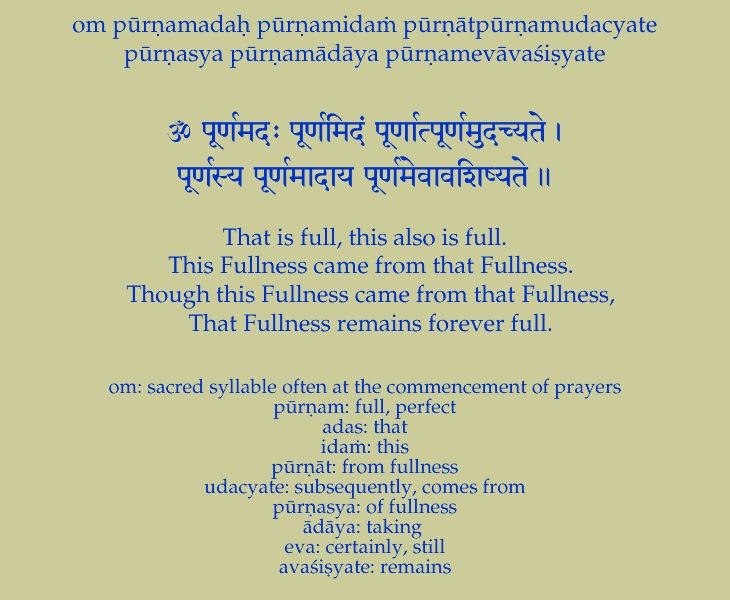
The word Anna is translated as Food and Grains and the word Purna means Whole, Full, or Complete. The Sanskrit words, Anna + Purna or Food + Whole gets transformed into the phrase Whole Foods in English. Fullness comes from Fullness and Fullness remains forever Full. Just like the concept of Sunya or Zero in Mathematics, the concept of Purna or Whole belongs to Bharat, the Land of India.
Whole Dude – Whole Hymn – Whole Concept: The Sanskrit name Annapurna is the Original Source of Whole or Purna Concept (Always Full, Complete and Perfect). My mother’s name translates to Whole Foods.Whole Dude – Whole Hymn – Whole Concept: The name Annapoorna or Annapurna is the original source of Whole or Purna Concept (Always Full, Complete and Perfect). My mother’s name translates to Whole Foods.
अन्नपूर्णे सदापूर्णे शंकर प्राणवल्लभे । ज्ञान वैराग्य सिध्यर्थं भिक्षां देहिच पार्वति ॥
Whole Dude – Whole Hymn – Whole Concept: The name Annapurna is the Original Source of Whole or Purna Concept (Always Full, Complete and Perfect). My mother’s name translates to Whole Foods.
माता च पार्वती देवी पिता देवो महेश्वरः । बान्धवाः शिवभक्ताश्च स्वदेशो भुवनत्रयम् ॥
Whole Dude – Whole Hymn – Whole Concept: The name Annapurna is the Original Source of Whole or Purna Concept (Always Full, Complete and Perfect). My mother’s name translates to Whole Foods.
Whole Dude – Whole Hymn – Whole Concept: The name Annapurna is the Original Source of Whole or Purna Concept (Always Full, Complete and Perfect). My mother’s name translates to Whole Foods.
Whole Dude – Whole Hymn – Whole Concept: The name Annapurna is the Original Source of Whole or Purna Concept (Always Full, Complete and Perfect). My mother’s name translates to Whole Foods.Whole Dude – Whole Hymn – Whole Concept: My favorite prayer song. Salutations to Mother Annapurna. The name Annapurna is the Original Source of Whole or Purna Concept (Always Full, Complete and Perfect). My mother’s name translates to Whole Foods.
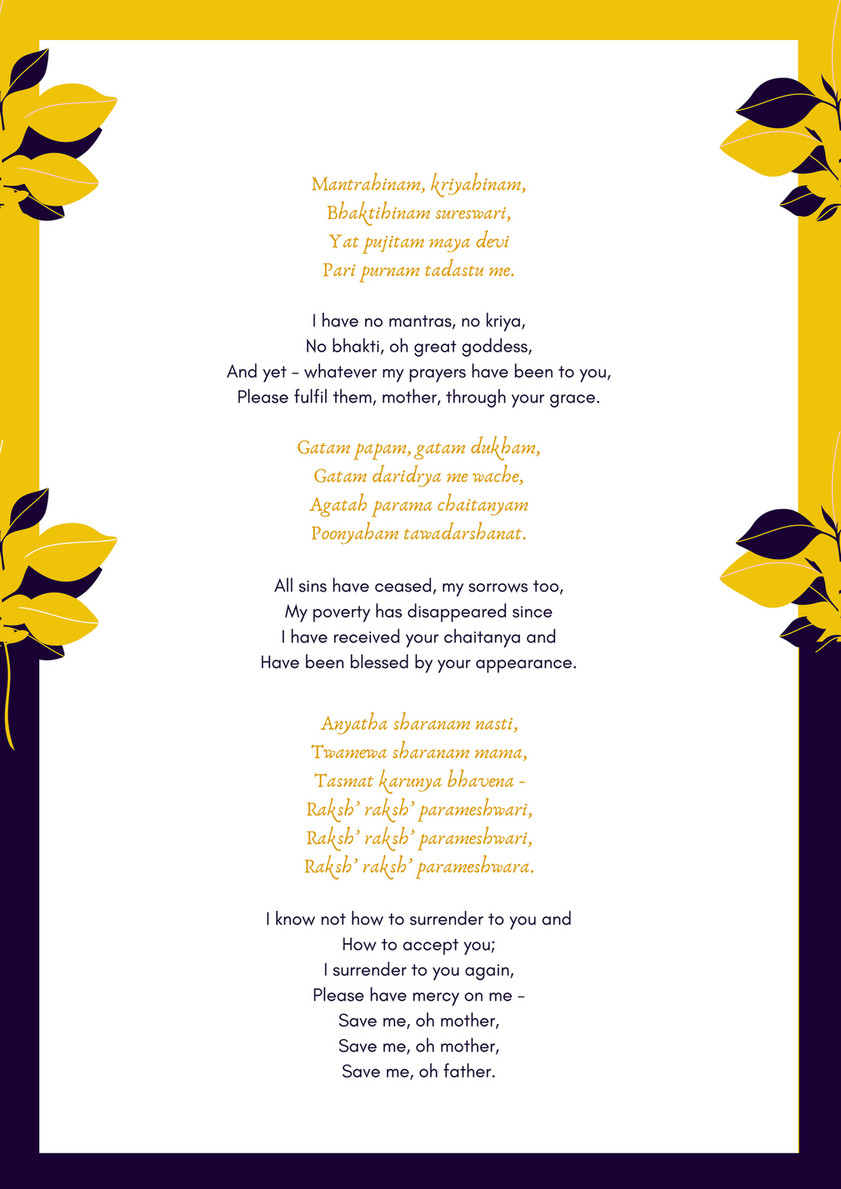
Salutations to Mother Annapoorna: O Mother Annapoorna, You who are always full (with the gift of Food and Blessings), You who are the beloved of Shankara (Shiva), O Mother Parvati, Please grant me the alms of your Grace, to awaken within me Spiritual Knowledge (Jnana) and detachment, freedom from all worldly desires (Vairagya).
Salutations to Mother Annapoorna, my Mother Devi Parvati, and my Father, Deva Maheswara (Shiva). My friends are the devotees of Lord Shiva, and my residence is all the Three Worlds (whose Lord is none other than Shiva-Parvati).
My favorite prayer song:
Whole Dude – Whole Hymn – Whole Concept: My favorite prayer song. A prayer to Lord Krishna.
With the fragrant kasturi-mark on the forehead, the precious Kaustubha gem on the chest, the lovely pearl-jewel at the nose tip, the flute in the palm and the kankan (bangle) encircling the hand, the scented sandalwood paste all over the body, the pearl-necklace around the beautiful neck, surrounded by milk-maids – may victory be yours, O crown gem of Gopalas.
Whole Dude – Whole Hymn – Whole Concept: My favorite prayer song from prayer book Prarthana Tarangini.
Several years ago,my father sent me a prayer book, Prarthana Tarangini. The book originally belonged to my mother and she signed her name on the first page and dated the copy on 1-2-89 (January 02, 1989). Apparently,she liked some prayers more than others and she check marked her favorite selections in the prayer book.I liked her choice of “Bruhi Mukundeti.”
Whole Dude – Whole Hymn – Whole Concept: The Sweetness of uttering the name Krishna
The name Sri Krishna is received by the ears of the listener with a sense of sweetness which is described as sweet as the heavenly nectar called Amrut.
Whole Dude – Whole Hymn – Whole Concept: Nine Ways to Worship Lord God Creator
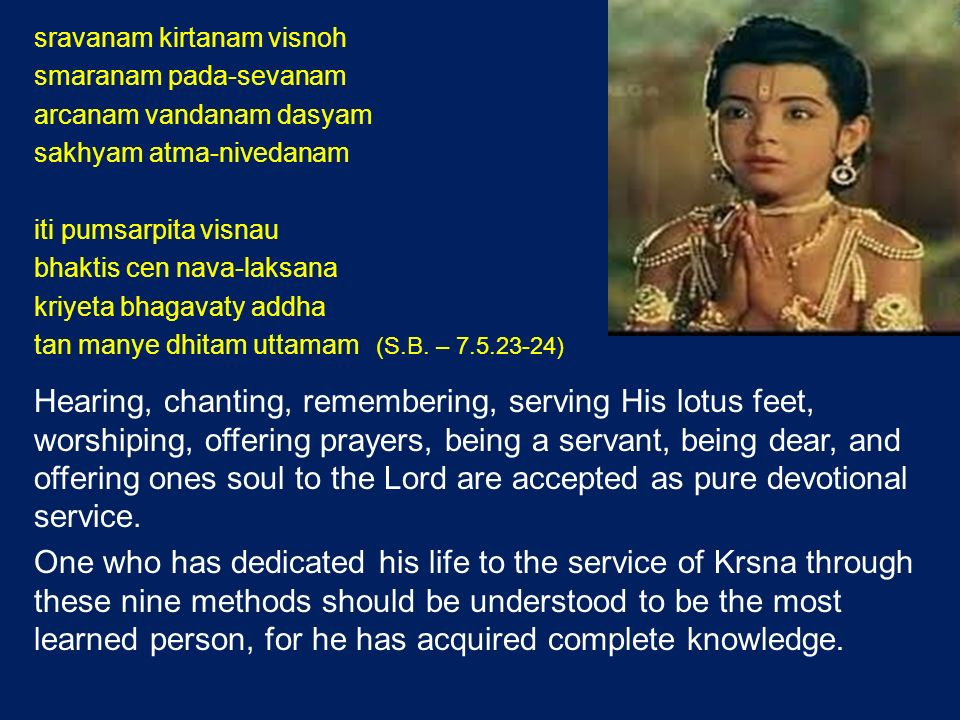
Prahlada, a great devotee of Lord Vishnu described nine ways to worship Vishnu. The acts of Smaranam (Remembering the Lord by recalling His glorious names from memory), Kirtanam (Singing the holy names of the Lord), and Sravanam (Listening or hearing the names of the Lord) could be combined into a single act of worship by simply repeating the various sweet names with which Lord Krishna is known.The best thing about this prayer is that one need not ask for any grant of wishes and need not express the desires of your heart. Kuchela who had traveled to Dwaraka to meet with Krishna and seek His favors, had actually forgotten to mention the purpose of his visit and was feeling sorry on his way back home for he thought that he had missed a great opportunity to speak his mind to Krishna. Kuchela,when he eventually got back home, he was in for a big surprise. Krishna knew his problems and granted his wishes and much more even without hearing a word about it. The sweetness of the name makes it easier to carry on the burdens of life and comforts you during your journey. The sweet name cheers up your heart, brightens your mood, sooths your aching joints, and gives hope when there is nothing else you can do. Let that sweet name fulfill your unexpressed,unstated and unspoken desires of your heart.
Whole Dude – Whole Hymn – Whole Concept: My favorite prayer song. Lord Madhava, and his consort of Madhavi (the name derived from the word Madhu which means nectar, honey, sugar, and Wine) bestow Krupa (the blessings of mercy, compassion, and grace) and the blessings impart the taste experience of Sweetness known as Madhurya.
Meaning: (I take Refuge in Sri Hanuman) 1: Who is Swift as the Mind and Fast as the Wind, 2: Who is the Master of the Senses, and Honoured for His Excellent Intelligence, Learning and Wisdom, 3: Who is Son of the Wind God and Chief among the Vanaras (Who were part of the Devas incarnated in the species of the monkeys to serve Sri Rama during His Incarnation), 4: To that Messenger of Sri Rama, I take Refuge (by prostrating before him).
I take refuge in Hanuman who was born from the womb of mother Anjani, and who was the most excellent minister of the king of monkeys (i.e. Sugriva), who is extremely dear to Sri Rama; I bow to you, O Hanuman, please protect me always.
Favorite prayer of my brother Prof. R. Subbarao:
Whole Dude – Whole Hymn – Whole Concept: My favorite prayer song. Sri Lalitha Sahasranama Stotram.
May we meditate on the divine mother whose body has the red hue of vermilion, who has three eyes, who wears a beautiful crown studded with rubies, who is adorned with the crescent moon, whose face sports beautiful smile indicating compassion, who has beautiful limbs, whose hands hold a jewel-studded golden vessel filled with nectar, and in the other a red lotus flower.
Favorite prayers of my pilot Uncle Capt. R. R. Rao:
Whole Dude – Whole Hymn – Whole Concept: My favorite prayer song. Sri Vakra tunda Mahaa kaaya, Koti Surya samaprabha; Nirvighnam kuru me Deva, Subha karyeshu Sarvada.
O the one who is with a single tusk and with a mighty body that looks resplendent like that of molten gold Who is having a huge belly, pleasant and broad eyes, I bow to you Lord Ganesha, the leader of Ganas.
In chanting his name again and again, ‘śrīrāma rāma rāma,’ I discover joy in Lord Rāma who pleases my heart and whose face is a blessing. His name is equal to the one thousand names of Lord Vişnu.
Whole Dude – Whole Hymn – Whole Concept: My favorite prayer song.Whole Dude – Whole Hymn – Whole Concept: The name Annapurna is the Original Source of Whole or Purna Concept (Always Full, Complete and Perfect). My mother’s name translates to Whole Foods.Whole Dude – Whole Hymn – Whole Concept: The name Annapurna is the Original Source of Whole or Purna Concept (Always Full, Complete and Perfect). My mother’s name translates to Whole Foods.Whole Dude – Whole Hymn – Whole Concept: The name Annapurna is the Original Source of Whole or Purna Concept (Always Full, Complete and Perfect). My mother’s name translates to Whole Foods.WHOLE DUDE – WHOLE CONCEPT: AT WHOLE FOODS MARKET, ANN ARBOR, MICHIGAN, WHOLE DUDE ANNOUNCED ON WEDNESDAY, JULY 30, 2014 HIS EPIC DISCOVERY OF THE EXPERIENCE CALLED “WHOLE LOVE.” ON SUNDAY, SEPTEMBER 24, 2023, WHOLE FOODS, ANN ARBOR CELEBRATED THE 20th ANNIVERSARY OF ITS OPENING.
When you breathe in smoke that comes from the end of a lit cigarette, cigar, or pipe ( often described as ‘sidestream smoke‘ ), or when you breathe in smoke that is exhaled by a smoker(often described as ‘mainstream smoke’ ), you are exposed to the risk of secondhand smoke. You will be inhaling almost the same amount of chemicals as the smoker breathes in. Tobbaco smoke contains more than 4,000 different chemical compounds, and more than 50 of them are known to cause Cancer. Some of these known carcinogens are Hydrogen Cyanide, Benzene, Formaldehyde, and Carbon monoxide. Involuntary or passive smoking can kill. There is no amount of exposure to secondhand smoke that is considered as a safe level of exposure. The more secondhand smoke that you breathe in, the more your health risk increases. Secondhand smoke exposure causes nearly 50,000 deaths per year in adult nonsmokers in the United States. 3,000 deaths are from Lung Cancer, and 46,000 deaths are from heart disease. Nonsmokers increase their risk of developing Lung Cancer by 20% to 30%, and heart disease by 25% to 30% when they are exposed to secondhand smoke. The risks of Breast Cancer and Cervical Cancer and other types of Cancer are also higher. Women who are exposed to secondhand smoke face a 69% higher risk of heart disease and a 56% higher risk of Stroke than those who are not exposed to smoke. Children are particularly vulnerable to the effects of secondhand smoke because of their bodies are still growing and they breathe at a faster rate than adults. The effects of smoking can be very significant especially for those who live or work with a smoker. In reality, most of the smoke from a burning cigarette doesn’t get sucked down into smoker’s lungs- it simply escapes into the air where it can be inhaled by anyone unfortunate enough to be nearby. Living under the shadow of a great person may give some benefits, protection, and a sense of security. But, life under the shadow of secondhand smoke is a prescription for death. There was such an unfortunate victim who had lived under the shadow of a great leader known as Mohammed Ali Jinnah.
Mohammad Ali Jinnah, Qaid-e-Azam, the great leader and founder of Pakistan. What is the risk of Living under the Shadow of a great leader?
Jinnah, Indian Muslim politician was the founder and first Governor General of Pakistan (1947-1948). His parents arranged for an early marriage for him before he left for England at the age of 16. While in London, Jinnah suffered the loss of his wife and mother. In 1895, at the age of 19, he was called o the Bar on completion of his formal studies to become a barrister. He had supported the election of Dadabhai Naoroji, a Parsi leader, a leading Indian nationalist who ran for the English Parliamnet. Naoroji became the first Indian to sit in the British House of Commons. In 1896, Jinnah returned to Karachi and then moved to Bombay to start his legal practice. He met Ruttenbai, the daughter of Dinshaw Petit, a Bombay Parsi millionaire. Jinnah had married this young and beautiful lady over tremendous opposition from her parents and others. The great love and the marriage withered and proved to be an unhappy union. The stress imposed by exposure to secondhand smoke was not known and was not recognized those days. Jinnah’s addiction to Tobacco and the price paid by his wife describe the other side of Jinnah which many people in Pakistan and India tend to ignore.
The Other side of Mohammed Ali Jinnah :
Jinnah, a great leader with a simple addiction to Tobacco.
This young and beautiful lady had great feelings of love for Jinnah and those tender feelings withered while she had lived under the Shadow of Secondhand Smoke.
I would like to share the very interesting and powerful story about the life of Ruttenbai who had lived under the shadow of Mohammed Ali Jinnah . Unfortunatley, this story posted below my post fails to mention the nature of cancer that had killed this beautiful lady at such an young age. I am very sure about the nature of her illness. She died of Lung Cancer. She developed Cancer because of inhaling tobacco smoke and it is a very well recognized risk factor now. Secondhand Tobacco smoke kills people and even now the chances of survival are not good. I had personally witnessed a similar case and had narrated that story at my Home page of BhavanaJagat and the story is titled ‘Living Under the Shadow – A Prescription for Death’. A young, beautiful lady, the first wife of Chief of Army Staff (under Prime Minister Rajiv Gandhi), General K S Sundarji ( who is well-known for Operation Blue Star ) died of Lung Cancer in Army Hospital, New Delhi during 1978. The connection between smoking and Lung Cancer was well understood but at that time the risk of Lung Cancer due to Secondhand Tobacco Smoke was not properly recognized.
The Chief of Army Staff, General Krishnaswamy Sundarrajan, PVSM - I had served under his Command while he was the General Officer Commanding of the First Armoured Division during 1976 to 1978. His first wife, Padma Sundarji had lived her life under the shadow of Secondhand Smoke.
More than 61 years have passed since the death of founder of Pakistan , Quaid-i-Azam Mohammad Ali Jinnah. But even today, nothing about Jinnah seems ordinary —not his legal career, politics, personal life, his legacy and even the property he left behind.
The great South Asian intellectual Eqbal Ahmed once described Jinnah as an enigma of modern history. His aristocratic English lifestyle, Victorian manners, and secular outlook rendered him a most unlikely leader of India ’s Muslims. Yet, he led them to separate statehood, creating history, and in Saad R. Khairi’s apt phrase, “altering geography”.
Much has been written about Jinnah’s legal career, politics, his role as a founder of Pakistan and his vision, but even today, very little is known about Jinnah’s personal life. This was probably because Jinnah never had time to write a diary or an autobiography and whatever little he wrote was formal and matter of fact. For most of his life, he remained reserved, taciturn and secretive. He wrote his will in May, 1939, but it was only after his death that Liaquat Ali Khan, his close associate and the first Prime Minister of Pakistan, came to know that he was its trustee and executor.
His only child, Dina Wadia, has hardly ever spoken about her father in public. So furious was Jinnah with Dina that he disowned her after she married a Parsi man against his wishes, and yet he left two lacs for her in his will. Akbar Ahmed’s movie Jinnah had just ten to fifteen minutes on Jinnah’s personal life, which are nowhere near enough.
Life Under The Shadow – Ruttie in Jinnah’s Shadow
image004
image005
image006
Jinnah’s first wife, fourteen year old Emibai from Paneli village, died just eight months after he left for London at age sixteen in 1892, to join Graham’s Shipping and Trading Company, which conducted business with his father in Karachi. It was a forced marriage, as Jinnah’s mother was afraid that if he went to England , he might end up marrying an English girl. He barely knew Emibai.
Jinnah’s second marriage with the most beautiful girl of Bombay – Ruttie: The Flower of Bombay – was like a fairy tale. It began in the summer of 1916 in Darjeeling or “Town of the Thunderbolt” (how appropriate considering what was to happen there).
Jinnah had established himself as a lawyer and a politician by then and had become friends with Sir Dinshaw Maneckjee Petit, the son of one of the richest and most devoutly orthodox Parsis of the 19th century.
The Petit`s chateau overlooked Mount Everest and it was there Jinnah met his only daughter Ruttenbai Petit or Ruttie as she was popularly called. Merely sixteen at that time, Ruttie was a charming young girl. Stanley Wolpert writes in Jinnah of Pakistan :“Precociously bright, gifted in every art, beautiful in every way. As she matured, all of her talents, gifts and beauty were magnified in so delightful and unaffected a manner that she seemed a fairy princess”.
A dazzling beauty and full of life, Ruttie had exquisite taste and affable manners. Quick-witted, she was easily one of the best dressed and most popular women among the elitist circles of Bombay . She was intellectually far more mature than other girls of her age, with diverse interests ranging from poetry (Oscar Wilde being her favorite, whom she often recited) to politics. Her large collection of books, which remained in Jinnah’s possession after her death, reflected her deep interest in poetry, literature, history, occultism, mysticism and sorcery. She was an excellent horse-rider. She attended all public meetings and was inspired by Annie Besant’s Home Rule League.
A fierce supporter of India for Indians, Ruttie was once asked about rumors of Jinnah’s possible knighthood and whether she would like to be Lady Jinnah. She snapped that she would rather be separated from her husband than take on an English title.
Jinnah on the other hand also had a special interest in acting and in Shakespeare’s dramas. While in London , he had acted in some Shakespearean plays and even considered seriously taking up acting as a profession. It was his dream to play Romeo at The Globe in London . Khwaja Razi Haider thinks it was probably Jinnah’s deep interest in Shakespeare that gave him insight into the intricacies of the human character, which he was to use for grasping the essentials of Indian politics. Jinnah was thirty-nine and Ruttie sixteen, but the age difference proved no obstacle in their love. Love has no logic.
He was enamored by her beauty and charm and she was awe- struck by “Jay”, as she called him. Jinnah asked Sir Dinshaw for Ruttie’s hand in marriage, who became furious and refused. Jinnah repeatedly pleaded his case but Dinshaw never gave in, as Jinnah had a different faith and he was more than twice Ruttie’s age. Their friendship ended and Dinshaw forbade Ruttie from meeting Jinnah while she lived in his house. He even got a court injunction restraining Jinnah from meeting her (a pity no biographer has yet traced the court papers).
The couple continued to meet secretly, and patiently waited for two years until February 1918 when Ruttie turned eighteen, and was free to marry. She walked out of her parental home to which she was never to return, and converted to Islam at Bombay ’s Jamia Mosque, under the Muslim Shiite doctrine, on April 18, 1918.
The very next day, Jinnah and Ruttie got married in a quiet ceremony at Jinnah’s Malabar Hill house in Bombay . Located in a most highly-priced area today, with Maharashtra’s Chief Minister as its next-door neighbor, Jinnah House remains a dispute between India , Pakistan and Dina Wadia. Jinnah owned another house at 10 Aurangzeb Road , Delhi , which he sold just before Partition for Rs 3 lacs. The Dutch Ambassador to India lives there now. The Raja Sahib of Mahmudabad, who signed as Jinnah’s witness, and a few other friends, attended the wedding. Maulana Muhammad Hasan Najafi was Ruttie’s witness. Jinnah presented the wedding ring to Ruttie, a gift from Raja Sahab, and paid Rs 125,000 as haq mehr . Nobody from Ruttie’s family attended the wedding. Interestingly, the Nikah Nama stated “Ruttenbai” as the bride’s name instead of Marium, her Islamic name. The honeymoon was first at Raja Sahab’s Nainitaal mansion, and then at the Maidens Hotel, a magnificent property just beyond the Red Fort.
Quaid’s Nikahnama
Quaid’s house in Bombay
Gandhi’s grandson Raj Mohan Gandhi writes about the wedding in his book Understanding the Muslim Mind: “For the first time in his life, a girl had absorbed Jinnah’s emotions. Living for sometime now in a large but somber Malabar Hill house, bowing to ladies (on occasional parties) and praising their sarees but otherwise keeping a distance from them, (he) fell in love with Ruttenbai. Joy and laughter entered Jinnah’s life. The Malabar Hill house became brighter.’ She presented him with a daughter, Dina. But, ‘Alas the happiness was not destined to last; Sarojni’s veiled prediction of trouble came true”.
Sarojni Naidu was a huge admirer of Jinnah, wrote several poems and prose pieces on him, and many historians believe she was in love with him.
She wrote this about the wedding in a letter to Sir Syed’s son, Syed Mahmud: “So Jinnah has at last plucked the Blue Flower of his desire. It was all very sudden and caused terrible agitation and anger among the Parsis; but I think the child has made far bigger sacrifices than she yet realises. Jinnah is worth it all – he loves her; the one really human and genuine emotion of his reserved and self-centred nature. And he will make her happy.”
The first few years of the marriage were a dream for Ruttie and Jinnah, the happiest time of their lives. They traveled across India , Europe and North America together. Ruttie watched with a great sense of pride the feverish political activity of her husband. She would be seen in the visitors’ gallery when Jinnah was due to speak, accompanied him to the High Court, and even attended the Nagpur session of the Congress in December 1920.
According to Wolpert: “They were a head- turning couple; he in his elegant suits, stitched in London , she with her long, flowing hair decked in flowers. There was no limit to their joy and satisfaction at that time. Their only woe was Ruttie’s complete isolation and ostracism from her family.”
Kanji Dwarkadas, a veteran leader of Congress and a close friend of the couple, who looked after Ruttie during her last days, wrote in his book Ruttie Jinnah: The story of a great friendship: “For Jinnah, who was not generous in many matters, no expense was too great to satisfy the extravagant claims of the baronet’s spoilt child. During a visit to Kashmir , she spent Rs 50,000 in refurnishing the boathouse and Jinnah gladly paid all the bills. He treated her wonderfully well, and paid without a murmur all the bills necessitated by the luxurious life she led.Ruttie’s fabulous beauty, spontaneous wit, and immense charm have been praised to the neglect of her serious interests.”
Even though Ruttie was much younger than Jinnah, she made him a very happy man. They had no separate existence and Jinnah found her a great source of inspiration.
He resigned from the Orient Club where he used to play chess and billiards. He was so deeply in love with Ruttie that he would return from the law courts on time each day and talk to her for hours on end.
Unfortunately, their happiness was short- lived and the marriage started to crack after 1922-3. What caused the ruination of the Jinnah-Ruttie marriage? Was it Jinnah’s busy political life and his inability to give enough time to Ruttie, their age difference, or their incompatibility of temperaments? He was cold, introverted and domineering. She was young, extroverted, glamorous. There is no clear answer but the fact remains that Ruttie and Jinnah still loved each other despite the rift in their marriage.
It is evident in every letter Ruttie wrote during that period, and every book written on their relationship. She moved to London with Dina in 1922 and from there too, her heart was still set on her life with Jinnah.
She wrote in a letter to Kanji in India :“And just one thing more – go and see Jinnah and tell me how he is – he has a habit of overworking himself and now that I am not there to tease and bother him, he will be worse than ever.”
After her return, the couple tried one more time to save their failing marriage and took a five-month tour to Europe and North America together. But the rift grew and by January 1928 they were virtually separated, when Ruttie became seriously ill with cancer. Shortly before her death, she wrote a letter to Jinnah from Marseilles , France where she had gone for treatment. It turned out to be her last letter to him (larger view of original hand-written letter with typed text here
Life Under The Shadow – Ruttie’s Letter to Jinnah
image011
S. S. Rajputana,
Marseilles 5 Oct 1928 Darling – thank you for all you have done. If ever in my bearing your once tuned senses found any irritability or unkindness – be assured that in my heart there was place only for a great tenderness and a greater pain – a pain my love without hurt. When one has been as near to the reality of Life (which after all is Death) as I have been dearest, one only remembers the beautiful and tender moments and all the rest becomes a half veiled mist of unrealities. Try and remember me beloved as the flower you plucked and not the flower you tread upon.
I have suffered much sweetheart because I have loved much. The measure of my agony has been in accord to the measure of my love. Darling I love you – I love you – and had I loved you just a little less I might have remained with you – only after one has created a very beautiful blossom one does not drag it through the mire. The higher you set your ideal the lower it falls.
I have loved you my darling as it is given to few men to be loved. I only beseech you that the tragedy which commenced in love should also end with it.
Darling Goodnight and Goodbye Ruttie
image013
image014
It is a pity that none of the letters that Jinnah wrote to Ruttie have ever been made public. M.C. Chagla, a former Chief Justice of the Bombay High Court and a diplomat at the UN, has described the last days of Ruttie and Jinnah’s marriage in his book “Roses in December”. Chagla knew the couple very well, as he assisted Jinnah at his chambers during that time. He idealized Jinnah but severed all ties when he began working on the idea of an independent state for the Muslims of India. He writes: By 1927, Ruttie and Jinnah had virtually separated. Ruttie’s health deteriorated rapidly in the years after they returned from their final trip together. Ruttie lived at the Taj Hotel in Bombay, almost a recluse as she became more and more bed-ridden. Kanji continued to be her constant companion. By February 18, 1929 she had become so weak that all she could manage to say to him was a request to look after her cats.Two days later, Ruttie Petit Jinnah died. It was her 29th birthday. She was buried on February 22 in Bombay according to Muslim rites. Jinnah sat like a statue throughout the funeral but when asked to throw earth on the grave, he broke down and wept. That was the only time when I found Jinnah betraying some shadow of human weakness. It’s not a well publicised fact that as a young student in England it had been one of Jinnah’s dreams to play Romeo at The Globe. It is a strange twist of fate that a love story that started like a fairy tale ended as a haunting tragedy to rival any of Shakespeare’s dramas.”
The second time Jinnah ever broke down was in August 1947 when he visited Ruttie’s grave one last time before leaving for Pakistan . The architect of Pakistan paid a high price for Partition by leaving two of his most beloved possessions on ‘the other’ side of the border, the Jinnah House on Malabar Hill where he had the happiest moments of his life, and his beloved wife Ruttie who remains buried in Bombay. Jinnah left India in August 1947, never to return again, but he left behind a piece of his heart in a little grave in a cemetery in Bombay .
A PICTURE OF INDIA’S GRIEF OVER JIHADIST ATTACKS IN MUMBAI
TERROR ATTACKS ON INDIA :
Recent news reports are stating that the terror attacks on India have not seen its end and they are predicting the possibilities of more attacks similar to the Mumbai carnage on November 26, 2008. “India will continue to face a serious jihadist threat from Pakistan-based terrorist groups, and neither Indian nor U.S. policy is likely to reduce that threat in the near future”, said Angel Rabasa, lead author of the study and a senior Political Scientist with RAND, a non-profit think tank based in Santa Monica, California. According to RAND, the other extremist groups in Pakistan will find inspiration in the Mumbai attacks and there can be more attacks from groups with high body counts and symbolic targets.THE CONCEPT OF JIHAD :The term Jihad in Arabic means struggle and is often viewed as a religious duty. A person engaged in Jihad is called a ‘mujahid’, the plural is ‘mujahideen’. The Mumbai attackers identified themselves with the name of ‘Deccan Mujahideen’. The aim of Jihad includes the expansion and defense of the Islamic State and warfare against non-believers. Jihad ideology has historically inspired the conquest of non-Muslim population and the transformation of civil society which is viewed as corrupt, arrogant, and disobedient. The Holy Book of Quran, Surah 25, verse 52 states : “Therefore, do not obey the disbelievers, and strive against them with this, a great striving”. The objectives of armed warfare include uprooting unbelief and establishing supremacy of God, through Islam, in the world.”And fight them on until there is no tumult or oppression, and there prevail justice and faith in Allah altogether and everywhere.”
THE HISTORY OF JIHAD IN INDIA :
Sir Jadunath Sarkar, a historian, and former Vice-Chancellor of Calcutta University had contended that several Muslim invaders waged a systematic Jihad against Indians. Sultan Mahamud of Ghazna(present day Ghazni city,Afghanistan) conducted more than twenty Jihadist attacks on North India between 1001 and 1027. In particular the records kept by al-Utbi, Sultan Ghazni’s secretary in the ‘Tarikh-i-Yamini’ document several episodes of bloody campaigns. Persian historian Ferishta records that Sultan Ghazni wants to “root out the worship of idols from the face of all Hindustan(India)”. He looked upon the destruction of temples as an act of Jihad. Mahamud Ghazni specifically directed his campaigns to temple towns of Nagarkot, Thanesar(1011), Mathura(1018), Kannauj(1019), Kalinjar(1023), and Somnath(1024). He had also destroyed temples at Varanasi, Ujjain, Maheshwar, Jwalamukhi, and Dwaraka. Mahmud Ghazni was of Turkic origin but had patronized the use of New Persian language and gave employment to writers such as al-Biruni, and Ferdowsi who gave detailed descriptions of the enormous booty and idols brought back to Ghazni city. Asaru-L-Bilad, a 13 th century geographer also described in great detail the destruction of Somnath. Apart from his regular troops, Mahmud Ghazni had assistance from 30,000 volunteer horsemen who had participated in the Jihad. To resist the attack on Somnath, Ghogha Rana at the age of 90 sacrificed himself and his clan. There are no census documents but after an analysis of all historical documents, historian K.S.Lal had estimated that about 2 million people died during Sultan Ghazni’s attacks on Indian temple towns.Similarly, Sikandar Lodhi of Delhi earned the epithet of ‘But Shikan’- the destroyer of idols. Babur the founder of Mughal empire in India in 1527 ordered a JIHAD against Rajputs at the battle of KHANUA. He had encouraged his men to fight the infidels and asked them to become either a Ghazi(soldier of Islam) or a Shaheed(Martyr of Islam). The Mughal Emperor Aurangzeb waged Jihad against Hindus as well as Shia Muslims whom he identified as heterodox. In South India, the Hindu kingdom of Vijaynagar came under repeated attacks of annual Jihad which had started in 1501 and each attack included destruction of temples. In the historical Third Battle of Panipat(January 1761), Ahmad Shah Abdali declared a Jihad against the Marathas. Estimates from historical documents indicate that about 60 to 80 million people in India died between 1000 and 1525 CE.INDIA’S RIGHT TO SELF-DEFENSE :Indian traditions have clearly established the rules of warfare. A ‘JUST WAR’ or ‘DHARMA YUDDHA’ is a duty and is an obligation of the Ruler. We believe in the principles of protecting all non-combatants. They should not be touched or harmed in any manner. We recognize the right of self-protection, self-defense, and self-preservation. When an enemy attacks you, it would be an act of cowardice if the enemy is not engaged in a battle. In the context of defending people against Jihadist attacks, we are not only defending our territory, our property, our personal lives but also we are defending our right to think for ourselves and cherish the ideas and values that are important to our existence. We have a fundamental right to worship as we please and safeguard the traditional way of life. Since Jihadist attack is actually a war against our fundamental right to practice religion, the propagation of ideas of Jihadist warfare should be prohibited and violators should be punished. The term Self-Defense means defense of one’s rights, beliefs, and existence. The Right to defend oneself with whatever force is reasonably necessary against actual or threatened violence is universally recognized by Law. Self-Defense is a natural, inborn instinct. A National Entity has a Right and also a Duty to defend itself from attacks sponsored by an enemy or an Enemy State. The act of Self-Defense could be expressed in several different forms; a retaliation involving the use of military force, economic and trade sanctions, diplomatic sanctions, imposing travel restrictions, and other punitive or defensive actions as needed.
Dr. R. Rudra Narasimham,
Kurnool Medical College, Kurnool, Andhra Pradesh, India,
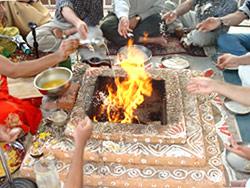
YAGNA, A VEDIC RITUAL OF SACRIFICE-‘HOTREE’ OR ‘YAGNA PERFORMER’ OFFERS ‘HAVIS’ TO FIRE (LORD AGNI)
THE UNIVERSE AS GOD’S BODY
The word ‘omnipresent’ is defined as present everywhere at the same time. The property of being present everywhere is one of the Divine attributes. In western theism it has attracted less attention and the idea of ‘omnipresence’ is explained in a bit unclear way. In Judeo-Christian, and Islamic Cultures, God is not immersed in the substance of creation even though He is able to interact with it as He chooses. They tend to the view that God is in “HEAVEN”, and that God is above and outside of all creation. They explain ‘omnipresence’ in terms of His ‘ESSENCE’ as He is present to all as the cause of their being, His ‘POWER’ as all things are subject to His power, and His ‘KNOWLEDGE’ as He constantly watches all that goes on in the world and all things are bare and open to His eyes and hence He is naturally present in every aspect of the natural order. Whereas Indian thinkers tend to believe that a thing is said to be substantially or essentially in that place in which its substance is. Hence, people in the Land of India traditionally hold the view that God is related to the universe as though it is His body. The entire creation is seen as a manifestation of the Supreme Person. The theory of transcendent(exists apart from material universe) and immanent(actually present throughout the material universe)’omnipresence’ explains the meaning of the word ‘BRAHMAN’, the Ultimate Reality. Indian people reflect this belief in their worship of creation, and the idea that God is immersed in the substance of His creation could be recognized as a core value, the foundation upon which the Cultural traditions of India are established over thousands of years of their continued existence. The rituals of temple worship and the Vedic rituals of Yagna always include aspects of Worship of Creation and the Scriptures reveal that the Gods also Worship Creation to the same extent and the Indian way of life could be stated as a quest for unity with the Divine.
A HYMN TO SEEK PROTECTION FROM THE CREATOR
Yaa srushti srashtu raadyaa vahiti vidhihutam, yaa havi ryaacha hotree
We seek the protection of God who physically manifests Himself with the eight bodies of
1. WATER- Lord VARUNA who was created prior to the creation of all other creation(of living entities).
2. FIRE- Lord Agni who receives ‘HAVIS’, the oblations or offerings given to God.
3. HOTREE- the person who is performing ‘YAGNA’, the Vedic ritual of sacrifice.
4. SUN- Lord Surya, the marker of day time.
5. MOON- Lord Chandra, the marker of night-time.
6. SKY- or ETHER which helps in the propagation of SOUND and is spread across the entire universe.
7.EARTH- Mother Earth, Goddess Bhu Devi, who bears the burden of harboring all living entities.
8. WIND- Lord VAYU who is the ‘Breath of life'(or PRANA) of all living entities that breathe.
THE FUNDAMENTAL RIGHT TO WORSHIP CREATION
The act of Creation Worship defines Indian Identity. All other Cultural Traditions that are existing in India proceed from this foundational principle. Indians seek their well-being, prosperity, happiness and eventually salvation through acts of worship. The foreign forces that occupied and ruled India tried hard to take away this Right to Worship as per our belief that God is immanent. We need to recognize the Right to Worship Creation as a Fundamental Right. Citizens while they are free to profess their religion , should not be free to ‘PROPAGATE’ a religion or idea which basically interferes with a Fundamental Right. No person could have a Fundamental Right to PROPAGATE at the expense of denying and devaluing other core values. To that extent, we should seek an amendment to PART III, Article 25 of the Constitution of India which deals with Freedom of Religion. The Constitution of India must recognize the Worship of Creation as a Foundational Principle of the Land of India and hence should be considered a Fundamental Right and should prohibit PROPAGATION of religion which infringes upon this Core Value. Such an amendment is vital to defend the Freedom of Religion as religious doctrines of Islam and Christianity are opposed to the idea of divinity of all created objects. These religious faiths divide humanity into two categories; the believers, and the non-believers. They also further express the claim that they possess a divine sanction to punish or modify the beliefs of the non-believers. In the global community, the adherents of Hindu religious faith are only a minority and they need special protection to defend the Right to Freedom of Religion.
Whole Dude – Whole Worship: The Lord God or the Principal Presiding deity at Malibu Hindu Temple is known as Lord Venkateshwara who represents the physical manifestation of the Supreme Being, Lord Vishnu in the material realm. Since the LORD is present in this terrestrial realm, He knows the Brahman Spirit that is in Prison.
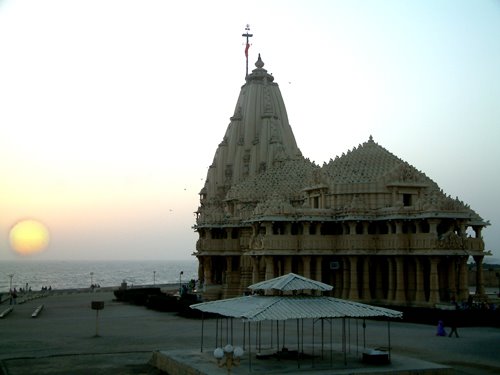
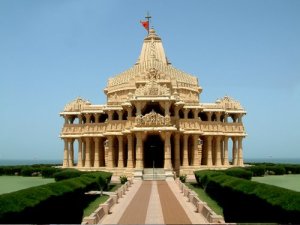
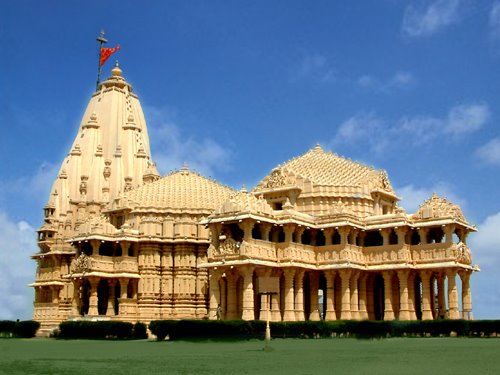
The Temple of Lord Somnath. The Battle between the Power of Creation and the Power of Destruction:
Kindly pay homage to Sardar VallabhbhaiPatel, India’s first Deputy Prime Minister who had recreated the Temple of Lord Somnath and vanquished the evil forces which visited Somnath repeatedly to utterly destroy this sacred place of Hindu worship.
Whole Dude – Whole ConvictionWhole Dude – Whole ConvictionKindly pay homage to Sardar VallabhbhaiPatel, India’s first Deputy Prime Minister who had recreated the Temple of Lord Somnath and vanquished the evil forces which visited Somnath repeatedly to utterly destroy this sacred place of Hindu worship.Kindly pay homage to Sardar VallabhbhaiPatel, India’s first Deputy Prime Minister who had recreated the Temple of Lord Somnath and vanquished the evil forces which visited Somnath repeatedly to utterly destroy this sacred place of Hindu worship.
THE TEMPLE OF LORD SOMNATH IS THE EVIDENCE FOR THE POWER OF CREATION OVER THE POWER OF DESTRUCTION.
This entry is dedicated to the memory of Sardar Vallabhbhai Patel, India’s first Deputy Prime Minister.
THE SHRINE ETERNAL :
Somnath Temple is in the ‘Prabhas Kshetra’, near the seaport city of Veraval in Junagadh District, Kathiawar Peninsula of Saurashtra , on the shores of Arabian Sea,the western coast of Gujarat, India. This holy place of pilgrimage is a place of great antiquity and recent excavations there have revealed a settlement dating from about 1500 B.C. As per Indian traditions, the place is of significance as it is considered as the place from where Lord Krishna departed from this world. The presiding deity of this temple is Lord Shiva and He is known by the name of SOMNATHA or the Lord of the Moon. The present temple as it exists today is known as ‘Kailash Mahameru Prasada and is built-in CHALUKYA style of temple architecture. The site lied in a state of ruin for centuries and the decision to rebuild it was made by Sardar Vallabhbhai Patel during his visit on 13 November, 1947. The temple was inaugurated on December 1, 1951 by Dr. Rajendra Prasad, the first President of the Republic of India. He had remarked that, “The Somnath temple signifies that the power of creation is always greater than the power of destruction”. The temple symbolizes the enduring fame of Sardar Patel who during the first three years of Indian independence after 1947, had served as Deputy Prime Minister, Minister of Home Affairs, Minister of Information, and Minister of States. He was considered as practical and decisive. He was the architect of the Indian Union and his greatest contribution was the achievement of the peaceful integration of over 535 princely states into the Indian Union. The principality of Junagadh, and the princely State of Hyderabad had initially resisted the offer to join the Indian Union. Having failed in his attempts to join Pakistan, the Nawab of Junagadh fled away from the country. Mr. Bhutto,( the father of Mr. Z.A. Bhutto, who served as Pakistan’s Prime minister) acting in his capacity of the ‘DEWAN’ of the court of Junagadh, had invited Lord Mountbatten to accept the accession of Junagadh to India. In the State of Hyderabad, a militant movement called the Razakars was launched seeking independence but Sardar Patel restored peace in September 1948 and the ruler Nizam had accepted the terms of accession to the Indian Union. This part of Indian history and the integration of princely states into Indian Union has again become relevant after the enemy’s brutal attack in Mumbai which I had mentioned in my previous entry. The enemy had described himself as ‘Deccan Mujahedeen’, and the media reports indicate that the enemy had specific designs to gobble Junagadh, and Hyderabad apart from encouraging insurgency in the border State of Kashmir. The enemy’s intentions will force us to defend SOMNATH in Junagadh District which is resurrected after repeated attacks over centuries.
THE HISTORY OF SOMNATH :
Jyotirlinga Temple at Somnath is mentioned in Hindu prayers in praise and worship of Lord Shiva:”Sauraashtra dese visadeti ramye, Jyotirmayam Chandra Kalaa vatamsam, Bhakti pradaanaaya Krupaa vateernam, Tam Somanaatham Saranam prapadye.”Somnath, the confluence of three rivers, River Sarasvati, River Hiranya, River Ilanki and Kapila is mentioned in ancient Hindu Scriptures known as Rig Veda.
LORD SOMNATH TEMPLE-THE SHRINE ETERNAL- TESTIMONY TO THE POWER OF CREATION OVER THE POWER OF DESTRUCTION.
Somnath finds its mention in the ancient text of RIG VEDA. It is associated with the holy names of GANGA, YAMUNA, and SARASWATI, popularly known as ‘TIRTH DHAM’ where Indians traditionally offer worship by a practice described as ‘River Worship’. The ancient river of Saraswati may have merged into the Sea at Somnath apart from smaller rivulets known by the names of Hiranya, Kapila and Ilanki. The place is extensively described as a place of pilgrimage and its importance is narrated in the ancient texts of ‘SKANDA PURANA’, ‘BHAGAVATA PURANA’, and ‘SHIVA PURANA’. Lord Shiva in His radiant form known as ‘Jyotir Linga’ resides at Twelve different places in India and Somnath is listed as the first place of residence of ‘DWADASA JYOTIR LINGA’.Tradition claims that the original Temple of Somnath was built by Lord Moon, and was later built by King Ravana of Lanka who is a central figure in the story of Indian epic poem of RAMAYANA. The SINDH area of the Indian subcontinent came under Arab conquest in 7th century A.D. The Somnath Temple built by the YADAVA kings of Vallabhi of Saurashtra around 649 A.D. was destroyed in 725 A.D. by the Arab governor of Sindh. The Pratihara King Nagabhata II rebuilt it in red stone. Between 1001 A.D. and 1027 A.D. , the road to conquest of India was prepared by Sultan Mahmud of Ghazna( modern GHAZNI in Afghanistan) who conducted more than twenty raids into North India. His raids were mainly for plunder. They revealed the wealth of India and demonstrated the vulnerability of India to military attacks. During one of his raids, in 1024 A.D. , marching across India’s Thar Desert, Mahmud of Ghazna had plundered and destroyed the Somnath Temple. The amount looted was estimated at 20 thousand, thousand ‘Dinars’. The enormous treasures found at Somnath have been a theme of wonder for all who have written on that conquest. The Paramara King of Bhoj of Malwa, Solanki King Bhima of Anhilwara/Patan between 1026 A.D. and 1042 A.D. rebuilt the Temple. By 1297/98 A.D. , Gujarat was conquered by Ala-ud-Din Khalij, Sultan of Delhi and the Temple was razed.Solanki King Kumarapala built a Temple of stone and this was destroyed again in 1394 A.D. For the last time, the Temple was destroyed in 1706 A.D by the Mughal Emperor Aurangzeb and the site remained in ruins till India’s independence in 1947. The rebirth of the Temple on December 1, 1951 demonstrates the vitality of the Indian spirit.
A HYMN IN PRAISE OF LORD SOMNATH :
Saurashtra dese visadeti ramye
Jyotirmayam, Chandra kala vatamsam
Bhakti prada naya Krupa vatirnam
Tam Somanatham saranam prapadye.
Lord Somanatha is dwelling in His great splendor in the Province of Saurashtra. May this Lord Somanatha who is full of radiance, and the crescent-shaped Moon shines in His matted hair, with His extreme compassion grant me a great sense of devotion with which I would seek my protection and let Him be my refuge.
Jyotirlinga Temple at Somnath is mentioned in Hindu prayers in praise and worship of Lord Shiva:”Sauraashtra dese visadeti ramye, Jyotirmayam Chandra Kalaa vatamsam, Bhakti pradaanaaya Krupaa vateernam, Tam Somanaatham Saranam prapadye.”































 Whole Dude - Whole Concept