TIBET EQUILIBRIUM – MAN vs NATURE

TIBET EQUILIBRIUM – MAN vs NATURE
TIBET EQUILIBRIUM – MAN vs NATURE. NATURAL FORCE OR NATURE IN THE ROLE OF THE “BALANCER” OR “HOLDER OF THE BALANCE IN PHYSICAL WORLD.

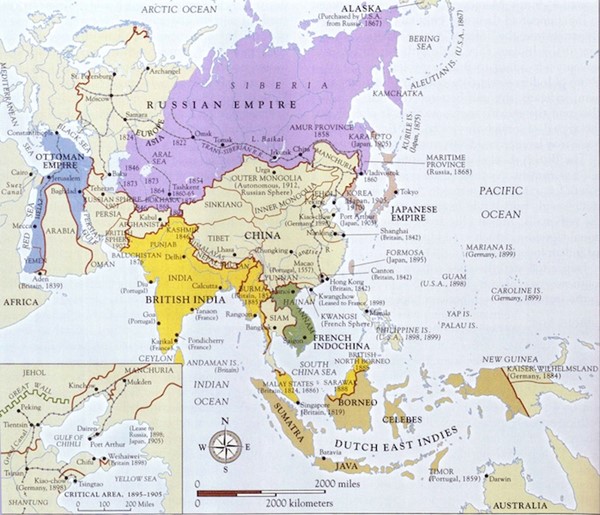
Man has been shaping face of Earth by creating political boundaries to define the extent of territory under his domination. Man uses his physical power or military force to subdue his opponents while he expands his territory. Red China describes her military conquest of foreign territory as ‘Liberation’. In Man’s History, Empires have risen and fallen reshaping political boundaries.

Nature is also at work reshaping Earth from its beginning. Earth’s Natural History is full of remarkable events such as Continental Drift. Himalaya Mountain range came into existence due to force of collision generated by Indian Landmass thrusting against Asia. Apart from creating Himalaya Mountains, collision of Indian Plate caused uplift of Tibetan Plateau which began about 45 million years ago. This force is still acting slowly pushing Nepal towards Tibetan Plateau.

Tibet Equilibrium – Man vs Nature. Promoting global awareness of suppression, oppression, and repression in Occupied Tibet. How to reset Balance of Power?

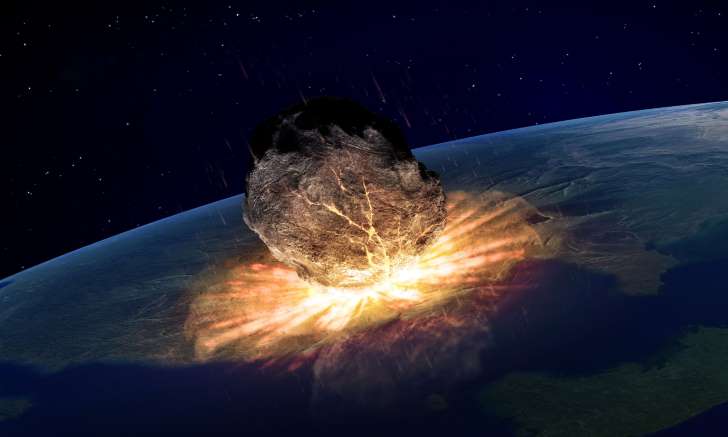
Nature causes Major and Minor ‘Extinction Events’ altering shape of Earth and the lifeforms that live on Earth. Natural History records several episodes of heavenly objects striking Earth with devastating consequences. Earth witnessed on June 30, 1908 an event called Tunguska Event caused by asteroid collision.’Asteroid Day’ promotes global awareness of such collision events.

In my analysis, such Heavenly Strike is natural remedy for Man’s Pride and Arrogance with which Man desires domination of planet Earth.

Tibet Equilibrium – Man vs Nature. Natural Balance of Power instituted by Nature.

I use the term or phrase ‘Tibet Equilibrium’ to describe Natural Balance of Power instituted by Natural Factors, Natural Mechanisms, Natural Conditions, Natural Forces that act together to restore Natural Freedom in Tibet, the Freedom that prevailed before Red China’s military conquest of Tibet.

Rudranarasimham Rebbapragada

DOOM DOOMA DOOMSAYER

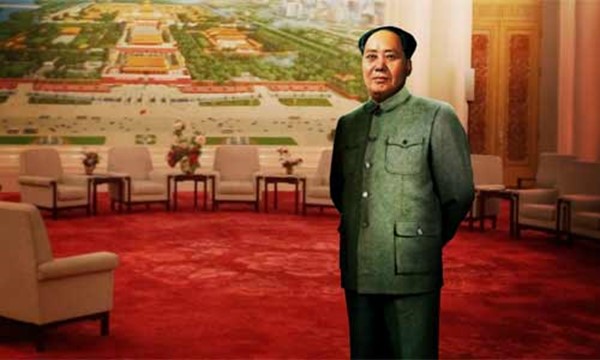
DEFENCE NEWS: TIBET IS CHINA’S RIGHT HAND AND LADAKH, NEPAL, SIKKIM, BHUTAN AND ARUNACHAL ARE ITS FINGERS – MAO ZEDONG
Clipped from: http://defencenews.in/article/Tibet-is-Chinas-Right-Hand-and-Ladakh,-Nepal,-Sikkim,-Bhutan-and-Arunachal-are-its-Fingers—Mao-Zedong-262888

TIBET EQUILIBRIUM – MAN vs NATURE. MAO ZEDONG’S EXPANSIONIST DOCTRINE RESULTS IN POWER IMBALANCE IN ASIA.

China’s legendary revolutionary leader Mao Zedong, standing in front of Beijing’s Tiananmen Square in the 1950s, talked about Tibet and the Himalayas: “Xizang (Tibet) is China’s right hand’s palm, which is detached from its five fingers — of Ladakh, Nepal, Sikkim, Bhutan and Arunachal (formerly NEFA). As all of these five are either occupied by, or under the influence of India, it is China’s responsibility to ‘liberate’ the five to be rejoined with Xizang (Tibet).”

Beijing and New Delhi are two capitals of two of the most populated nations of the world, with the Himalayas forming the most formidable barrier to an extensive interaction between them. The Himalayas, however, have much more to do with Hindu history, culture and the traditions of South Asia than that of China owing to its remote distance from China. Beijing owes its glorious rice culture more to the Hwang Ho and Yangtze rivers than to the Himalayan rivers of the Sindhu, Ganga and Brahmaputra.

Just like Jerusalem is the cradle of both Christianity and Judaism, and Mecca and Medina the Centre of Islam, the Himalayas and its waters have played a seminal role in the rise, growth and development of Hinduism, Buddhism, Jainism and Sikhism. The Chinese owe the origin and development of their glorious civilization more to the twin non-Himalayan river valleys of the Hwang Ho and Yangtze than to the remote Himalayas, the abode of snow. The name originates from the combination of two Sanskrit words “him (snow)” and “alaya (abode)”.

Let’s study the distance of the Himalayan “five fingers” from the two capitals of New Delhi and Beijing. Leh (Ladakh) is 1,258 km by road from Delhi and 3,490 km from Beijing; Kathmandu (Nepal) is 1,160 km from Delhi and 3,160 km from Beijing; From Nathula (Sikkim) to Delhi is 1,636 km, while to Beijing it is 2,888 km; Thimphu (Bhutan) is 1,782 km from Delhi and 2,820 km from Beijing; and lastly, from Tawang (Arunachal) Delhi is 2,315 km, while Beijing is 2,640 km from there.

Indeed, the “five fingers” of Beijing are rather too far when compared to the distance thereof from Delhi. Nevertheless, let us see things from Beijing’s point of view as well, in the light of its BRI/CPEC and SCO objectives. Several of its “economic” projects have been given different names to keep the non-Chinese guessing. That is the Chinese way, which could be to look different without being different. Why? Because the goal is always fixed. It’s the way to the acquisition of land and money, in the old Chinese tradition of kowtowing by rivals. Even when things do not exist, there is a need to make them “exist”. Almost like that of Voltaire’s logic: “Even if God did not exist, it would be necessary to invent him”. The belief has to prevail. If not today, in the long term and in the long run. The Chinese can go on hammering. The wall is bound to crack and crumble inevitably one day.

Ladakh is still with India, forced Chinese part-occupation notwithstanding. Nepal is independent and pursues its policy with great élan, despite its abolition of the monarchy and the tag of being a Hindu state. Sikkim joined India on its own volition in 1975, and there doesn’t seem to be any sign of a reverse gear. Bhutan too can’t be penetrated, as it is too steadfast in its approach. The proposed Chinese embassy in Thimphu is still a long way off. Arunachal Pradesh is one of the 29 states of India, and there is little to suggest that it can be anything other than that.

Therefore, the direct approach to “liberate” the “five fingers” of Xizang needs to change to an indirect one. How? By the application of “economics”. Development, investment, people-to-people contacts, profit, infrastructure, connectivity and corridor are alluring words. The Chinese aim to entice them, cajole them, as they are all landlocked terrain. All are “helpless” at the mercy of others. They need “liberation” by or under someone. Dissatisfaction and resentment is the key to their changing sides.

To begin with, a country has to have proximity to sea outlets. Five landlocked fingers cannot operate from Gwadar Port on the Arabian Sea. It is remote and turbulent. It has to be the Bay of Bengal, with its six ports of Kolkata, Haldia, Khulna, Chalna, Cox’s Bazar and Chittagong. Nathu-La to Kolkata is 727 km, Dhaka 640 km, Chittagong 900 km.

No wonder China is anxious to open its embassy in Bhutan to balance New Delhi’s influence and to breach Siliguri’s “Chicken’s Neck” of less than 80 km to reach the shoreline of the Bay of Bengal. It does not matter what it takes to achieve the so-called economic goal. It matters little whether or not turbulence is created to breach the established polity of India and reach the beaches of West Bengal and Bangladesh. It is simply “economics”!

One of the priorities is the Sino-Bhutan border “issue”. The year 2017 has seen hectic Chinese activity in Bhutan — with very little effect though. They are trying hard in the Chumbi Valley tri-junction of Bhutan, Sikkim and Tibet. The Yadong railway will also reach Kathmandu via Gyirong (Tibet). The Chinese want a railway line through Bhutan, West Bengal and Bangladesh as well. Not too soon, it appears, as tension and turbulence go on increasing in the highly vulnerable Chicken’s Neck area of India, that in turn may well contaminate all four nations in the neighborhood — Bangladesh, Bhutan, India and Nepal. Paradoxically, however, the adverse effect on these four nations is likely to be advantageous to China.

The Chinese hopes still revolve around Mao Zedong’s unfulfilled dreams. Hence, the renewed Chinese keenness to go to the east as well as the Northeast in Indian territory. India is the gateway to all the five (landlocked) fingers. The gate must be prized open — the sooner the better. It is the all-embracing “Chinese economics”: which Beijing sees as the only way to “liberate the “five fingers”.
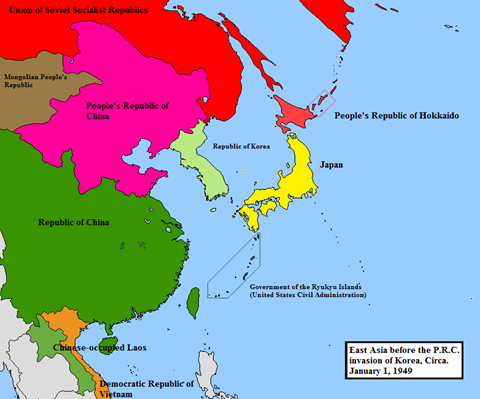
TIBET EQUILIBRIUM – MAN vs NATURE. ON FEBRUARY 13, 1913 TIBET DECLARED FULL INDEPENDENCE AFTER DOWNFALL OF CH’ING OR QING CHINESE DYNASTY.


DOOMED AMERICAN CHINA FANTASY – NIXON-KISSINGER BACKSTAB TIBET

DOOMED AMERICAN CHINA FANTASY – NIXON-KISSINGER BACKSTAB TIBET

DOOMED AMERICAN CHINA FANTASY – NIXON-KISSINGER BACKSTAB TIBET. PLIGHT OF TIBETANS IN INDIA.

In February 1972, Nixon-Kissinger Backstab Tibet to win Communist China’s Friendship. The plight of Tibetan refugees in India is the result of Doomed American China Fantasy.

Rudranarasimham Rebbapragada

DOOM DOOMA DOOMSAYER

DECADES AFTER FLEEING TIBET, REFUGEES STILL HAVE LIMITS ON RIGHTS IN INDIA

Doomed American China Fantasy – Nixon-Kissinger Backstab Tibet. Plight of Tibetans in India.

Clipped from: https://www.voanews.com/a/decades-after-fleeing-tibet-refugees-still-have-limits-rights-india/3911014.html

Doomed American China Fantasy – Nixon-Kissinger Backstab Tibet. Plight of Tibetans in India.

A Tibetan exile carries her child as she walks toward the Tsuglagkhang temple in Dharamsala, India, March 19, 2016.

DHARAMSALA / NEW DELHI — 

Event organizer Lobsang Wangyal has to travel overseas often, but as a Tibetan refugee born in India, he did not have a passport and sometimes had to wait days to get the mandatory permits every time he went abroad.

So Wangyal, whose parents fled Tibet as teenagers, went to court to demand his right to an Indian passport.

In response to his petition, the Delhi High Court said authorities must abide by an earlier ruling that all Tibetans born in India between January 1950 and July 1987 are Indian citizens by birth, and can be issued passports.

The order came into effect in March, and Wangyal got his Indian passport shortly thereafter, using it to go to Thailand.

For the first time, he was spared the additional scrutiny that his documents always got from immigration officials.

“I feel like a real person now, having obtained a passport,” said Wangyal, 47, who was born in a Tibetan settlement in eastern Odisha state and now lives in the hill town Dharamsala.

Doomed American China Fantasy – Nixon-Kissinger Backstab Tibet. Plight of Tibetans in India.

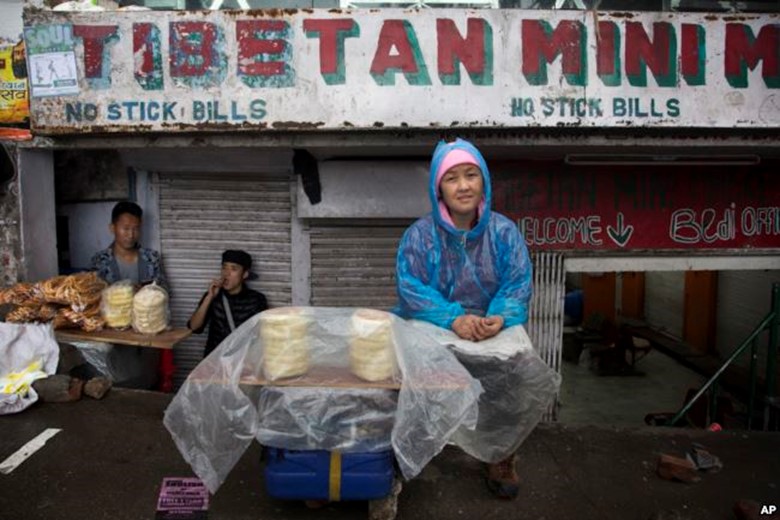
Pema Kyi, a 40-year-old exile Tibetan, sells Tibetan bread by the roadside in Dharmsala, India, June 20, 2017.

“Tibetans are seen as refugees and as stateless in India. Being seen that way after having been born and lived our whole lives in India is unfair and impractical,” he said.

‘Emotional turmoil’

Tibetans have been seeking asylum in India since the Dalai Lama fled Lhasa in 1959 after a failed uprising against Chinese occupation.

The Tibetan spiritual leader has since lived mostly in Dharamsala in the northern state of Himachal Pradesh, where his supporters run a small government in exile and advocate for autonomy for Tibet by peaceful means.

More than 100,000 Tibetans live in 39 formal settlements and dozens of informal communities across India. They generally arrive via Nepal, after a perilous trek across the Himalayas.

The Indian government has funded schools to provide free education for Tibetans, and reserved seats in medical and engineering colleges. Those eligible can get voter identification cards.

But Tibetans do not have citizenship rights, which limits their access to government jobs and freedom of movement within and outside India. They cannot own land or property.

Doomed American China Fantasy – Nixon-Kissinger Backstab Tibet. Plight of Tibetans in India.

Passang Topgyal, a 38-year-old exile Tibetan, tests a Tibetan stringed musical instrument called a piwang at his instrument shop in Dharmsala, India, June 20, 2017.

In some states, they cannot get driving licenses or bank loans. Those without identity documents are at risk of harassment, arrests and deportation to China.

“The status of statelessness is demoralizing and frustrating. There’s a lot of emotional turmoil,” said Tenzin Tselha, an activist with Students for a Free Tibet, whose father served in the Indian army.

“Sometimes I eat rice and daal [lentils] more than thukpa [Tibetan noodle soup], but I never feel Indian; I am Tibetan. It drains my energy, this struggle to always prove who I am and where I am from,” she said.

Foreigners by law

India is not a signatory to the 1951 Refugee Convention, which spells out refugee rights and state responsibilities to protect them.

Nor does it have a domestic law to protect the more than 200,000 refugees it currently hosts, including Tibetans, Sri Lankans, Afghans, Bangladeshis and Rohingyas from Myanmar. They are all considered foreigners by law.

Tibetan refugees get “enough rights and benefits,” and not everyone wants citizenship, said Sonam Norbu Dagpo, a spokesman for the Central Tibetan Administration, the government in exile.

“Even those Tibetan refugees who qualify for Indian citizenship do not apply for citizenship,” he said.

Doomed American China Fantasy – Nixon-Kissinger Backstab Tibet. Plight of Tibetans in India.

A young Tibetan exile stands backstage as she waits to perform during celebrations marking the 80th birthday of exiled Tibetan spiritual leader Dalai Lama, at Majnu Ka Tila, a Tibetan refugee camp in New Delhi, India, July 6, 2015.

While the number of refugees across the world has risen in recent years, the number of Tibetans arriving in India has fallen significantly since 2008, following a crackdown by China, which considers Tibet a renegade province.

Only 87 Tibetans registered in Dharamsala in 2015, compared with about 2,500 each year before 2008.

“India’s policy towards refugees has always been dictated by geopolitical compulsions,” said Saurabh Bhattacharjee, a professor at the National University of Juridical Sciences in Kolkata.

But beyond ensuring basic protections and civic amenities for all refugees, India must consider the status of Tibetan refugees more carefully, he said.

“Will they always remain refugees,” he said, “or should they be given some sort of permanent resident status, as they have been here for so long and have little chance of being repatriated?”

More rights

Recent court orders and the Tibetan Rehabilitation Policy of 2014 promise more rights and benefits.

The policy proposes, for the first time, to give refugees welfare benefits on par with Indians, subsidies for some college courses, more job options and greater ease in getting documents.

Doomed American China Fantasy – Nixon-Kissinger Backstab Tibet. Plight of Tibetans in India.

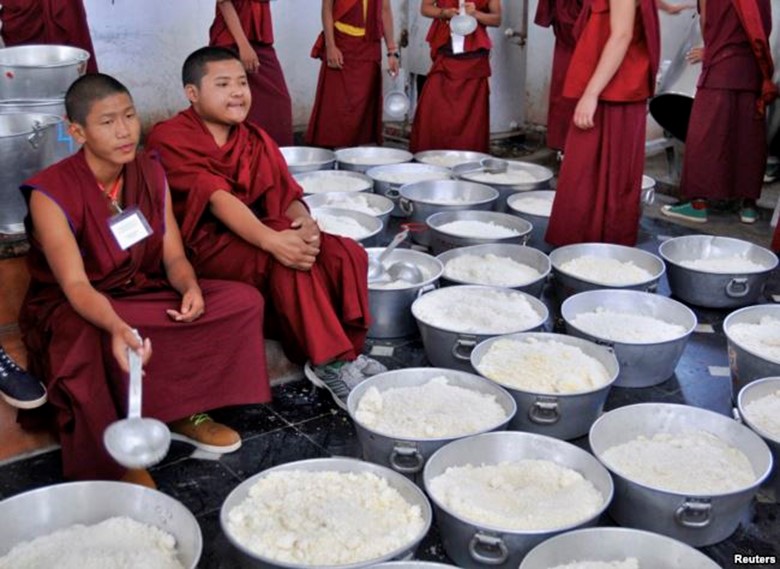
Young Buddhist monks wait to serve cooked rice to the attendees of the Jangchup Lamrim teachings conducted by the exiled Tibetan spiritual leader the Dalai Lama (unseen) at the Gaden Jangtse Thoesam Norling Monastery in Mundgod in the southern Indian state of Karnataka, Dec. 28, 2014.

It does not address property ownership, getting government jobs, or traveling freely within and outside India.

But the issue of rights and citizenship is also an emotional one that divides the community.

“I don’t think it’s important to have citizenship rights or to have an Indian passport,” said Dorjee Tsering, 28, who works in a store in Dharamsala selling Free Tibet T-shirts and sweatshirts. “We may face some problems, but we should sacrifice a little to preserve our heritage and identity.”

But for Wangyal, who fought for a passport, more rights are necessary.

“I would like the right to own property. A little house and a small business would be good to live a decent life,” he said. “Tibetans will fight on for Free Tibet, but at the same time we have to live our lives now.”

Doomed American China Fantasy – Nixon-Kissinger Backstab Tibet. Plight of Tibetans in India.

CHINA’S TIBET POLICY – RECIPE FOR NATURAL DISASTER

CHINA’S TIBET POLICY – RECIPE FOR NATURAL DISASTER

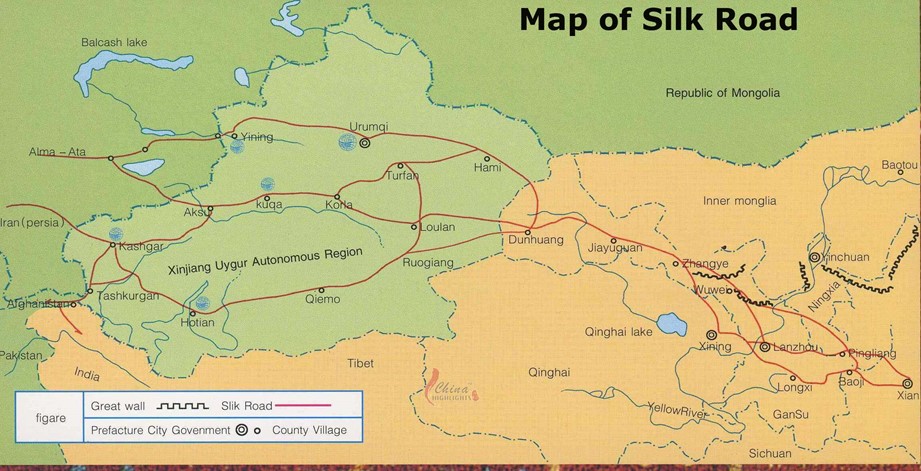
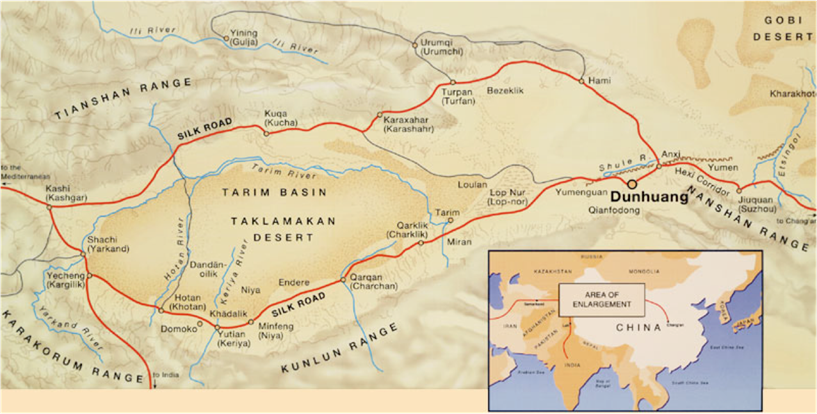
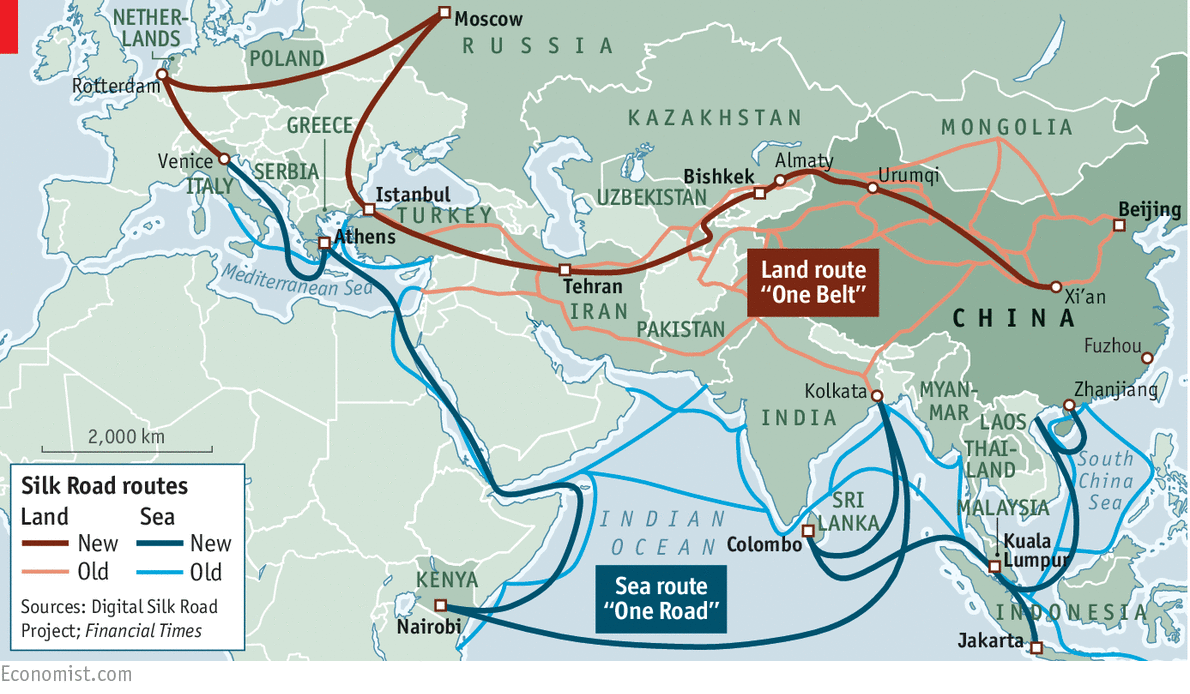
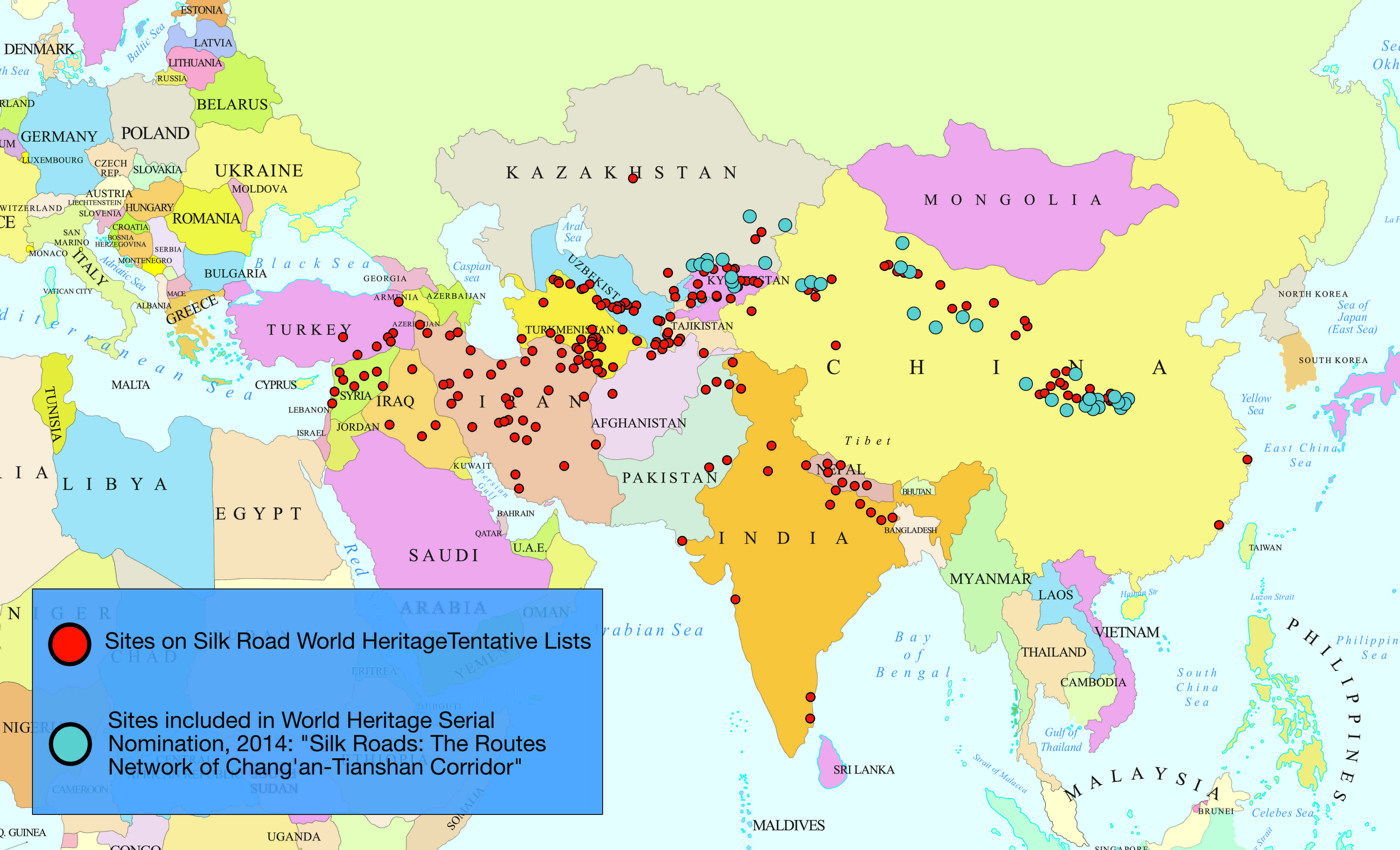
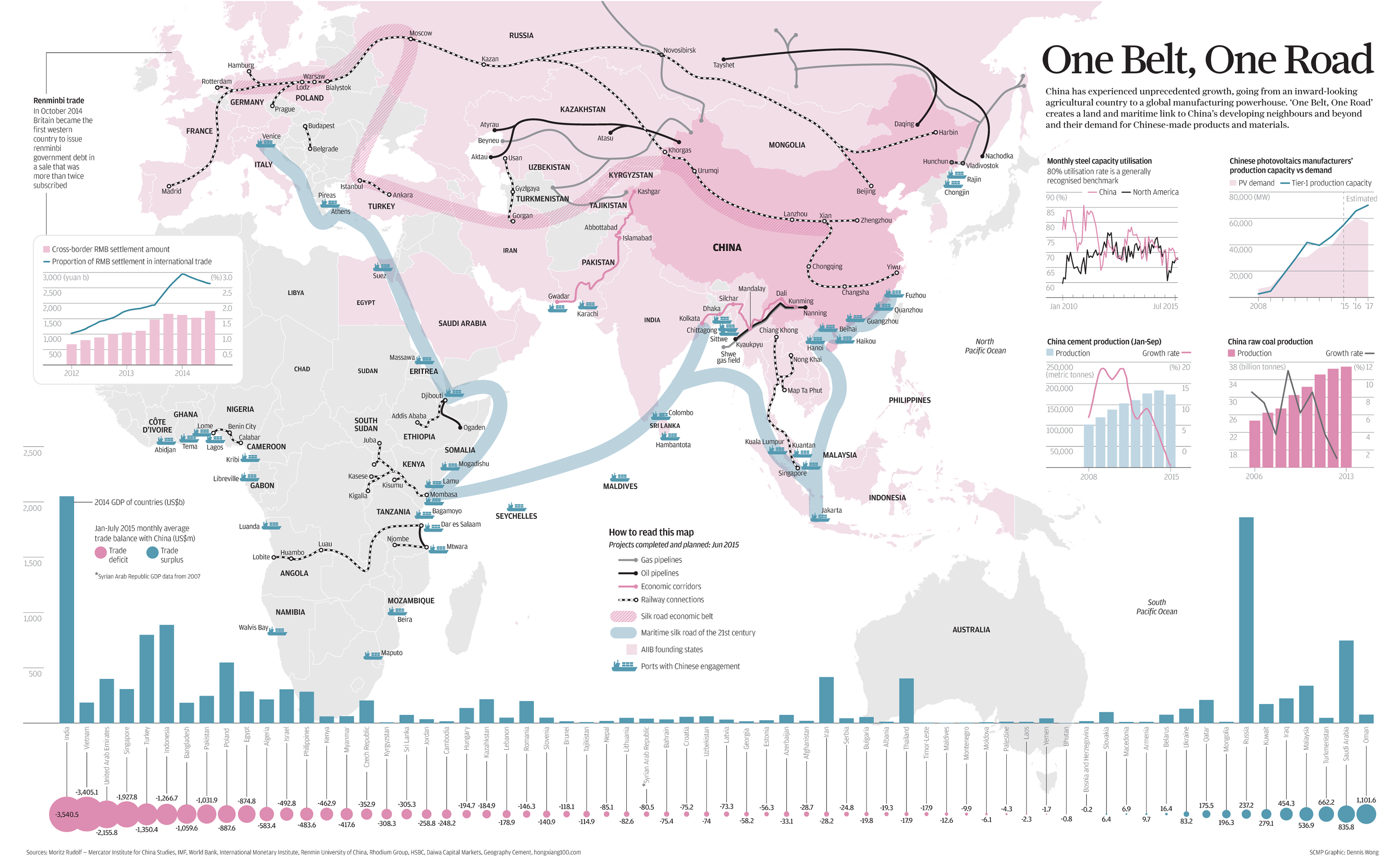
CHINA’S TIBET POLICY – RECIPE FOR NATURAL DISASTER. ONE BELT, ONE ROAD POLICY OF NEOCOLONIALISM. GEOGRAPHY OF SILK ROAD.

Red China’s Tibet Policy is driven by Expansionist Doctrine proclaimed by Communist Party Chairman Mao Zedong in 1949. China’s Neocolonialism includes Territorial Expansionism, Military Expansionism, Economic Expansionism, Political Expansionism, and Cultural Expansionism. Red China accomplishes her Mission using tools of Oppression, Repression, and Suppression to subjugate people in all occupied territories.

In my analysis, China’s Tibet Policy in Tibet and Xinjiang is Recipe for Natural Disaster. Nature designed its own plan for this geographical region and for thousands of years, the denizens of this region lived in harmony with Nature’s Plan. I claim, “Beijing Doomed,” for in my expectation, Nature has Plan for Change of Regime in Beijing.

Rudranarasimham Rebbapragada

DOOM DOOMA DOOMSAYER

CHINA’S TIBET POLICY IS RECIPE FOR NATURAL DISASTER. ONE BELT, ONE ROAD POLICY – NEOCOLONIALISM.

CHINA’S ‘TIBET RECIPE’ IN XINJIANG SHOULD PUT INDIA ON ALERT

Clipped from: http://www.dailyo.in/politics/china-tibet-xinjiang-uyghurs-belt-and-road-initiative-obor/story/1/17965.html

The stability of the Muslim region is vital for Beijing and its gigantic BRI project.

At the end of August 2016, Wu Yingjie takes over as party secretary of the Tibetan Autonomous Region (TAR) from Chen Quanguo who is sent to “pacify” the Xinjiang Uyghur Autonomous Region (XUAR). The Politburo of the Chinese Communist Party has taken this crucial decision during the annual closed-door meeting in the summer resort of Beidaihe.

Chen replaces Zhang Chunxian as XUAR party secretary. It is indeed a promotion for Chen, given the fact that Xinjiang’s party secretaries often serve in the politburo.

Infrastructure

His selection is linked to the “Tibet Recipe”, the way Chen managed to “pacify” the TAR. Once in Urumqi, Chen immediately started applying the formula that he used in Tibet to Xinjiang. But what is this recipe?

First, Chen transformed the Roof of the World into a vast Disneyland. In 2006, the arrival of the train on the plateau changed everything for Beijing and unfortunately for the Tibetans. Wave after wave of Chinese tourists could be poured into Tibet to experience the “Paradise on Earth” with its blue sky, pristine lakes and rivers, its luxuriant forests and deep canyons (the latter in Southern Tibet).

In 2016, 25 million tourists, mainly from the Mainland, are said to have visited the Land of Snows. For this, infrastructure needed to be developed, airports opened, four-way highways constructed, hotels and entertainment parks built; this was done in Tibet on a war-footing.

China’s Tibet Policy – Recipe for Natural Disaster. One Belt, One Road Policy – Neocolonialism.

Wave after wave of Chinese tourists poured into Tibet.

In passing, the Tibetan intangible heritage had to be preserved, often with Chinese characteristics. The same formula has now to be replicated in Xinjiang.

Second, in order to “stabilize” the plateau, Chen imposed restrictions on the local population like never before. Similar policies will be used in Xinjiang. Human Rights Watch (HRW), an organization based in the US, just released a “glossary” of special slogans or “formulations” (tifa) used by the Chinese officials and the media when referring to party policies on the plateau.

HRW explains: “China’s authorities place extraordinary emphasis on the importance of ‘propaganda’ in sustaining their rule. This phenomenon is particularly evident in Tibet, where there has been a long history of human rights violations, extreme hostility towards political rights, and heavy restrictions on the rights to freedom of expression and access to information.”

“Poetic” tifas such as Social Management, Comprehensive Rectification, Preventive Control, Eliminate-Unseen-Threats, Nets-in-the-Sky-Traps-on-the-Ground or Copper-Ramparts-Iron Walls, are recurrently used. The latter one for example, translates into “an impenetrable public security defense network consisting of citizen patrols, border security posts, police check posts, surveillance systems, internet controls, identity card monitoring, travel restrictions, informant networks, and other mechanisms.”

The implementation of these tifas, which originated during Chen’s tenure in Tibet, is often dreadful… but efficient for Beijing.

Rights

Chen has taken these tifas with him to Xinjiang and started making good use of them. The “stability” of the Western province is vital for China, as it is the geographical hub for the Belt and Road Initiative: it will connect the New Silk Road (Central Asia) to the China Pakistan Economic Corridor.

Chen now plans to bring millions of tourists to Xinjiang in order to “dilute” the Uyghur characteristics. In a “White Paper on Xinjiang” recently published by Beijing, the Communist Party hides its failure by saying: “Legitimate rights of religious organizations have been effectively safeguarded. Xinjiang has published translations of the religious classics of Islam, Buddhism, and Christianity in multiple languages,” adding 1.76 million copies of the Quran have been printed and distributed.

But on the ground the situation is different. To take just one example, Beijing has decided to collect DNA samples from all Xinjiang’s residents. This week, Xinhua reported China’s decision to dispatch 10,000 teachers to the restive XUAR and TAR “to support local education could help solve the educational problems.”

Stability

Beijing says that the main problem is the lack of eligible bilingual teachers in the regions, but will the teachers from the mainland teach the Turkish language of the Uyghurs or Mandarin? Not difficult to guess. Language, in Tibet or Xinjiang, is an instrument of assimilation.

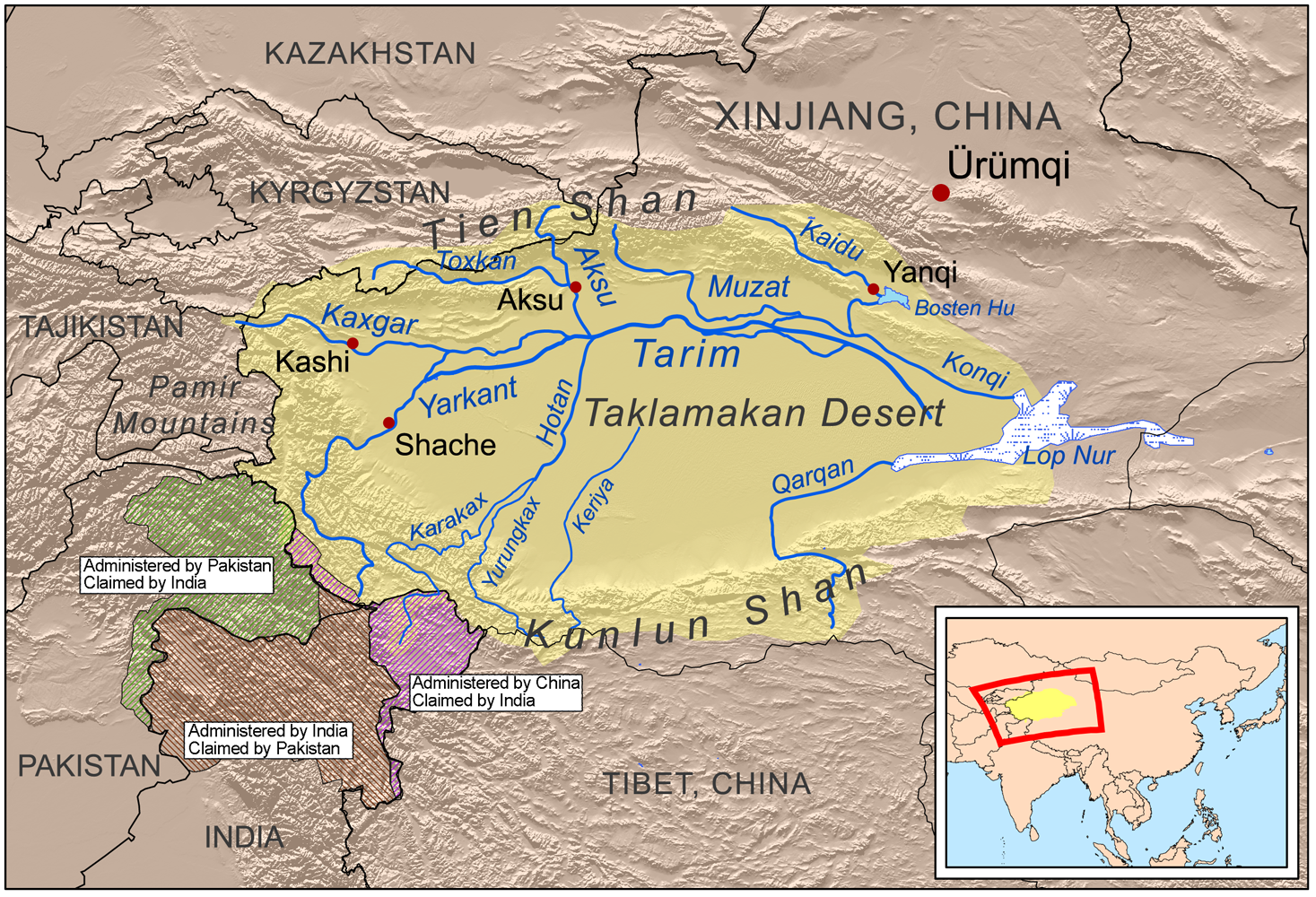
Chen is also working hard to improve the infrastructure. Last week, Xinhua announced the construction of 10 new airports to be built in Xinjiang by 2020; further, six older airports will be renovated and expanded. It has implications for India. One of these airports will be built in Yutian (also known as Keriya), a county of Hotan Prefecture not far from the disputed Aksai Chin.

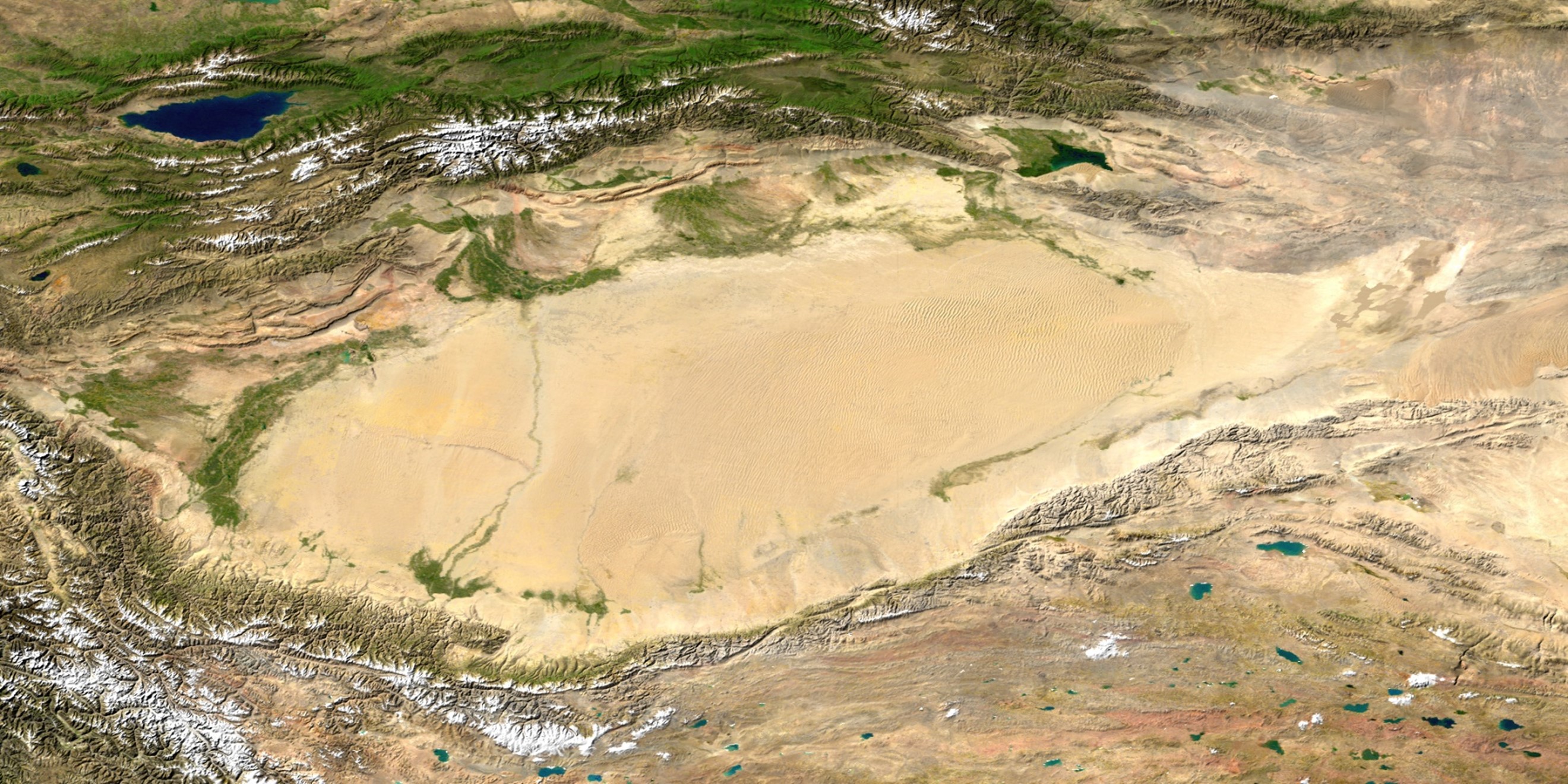
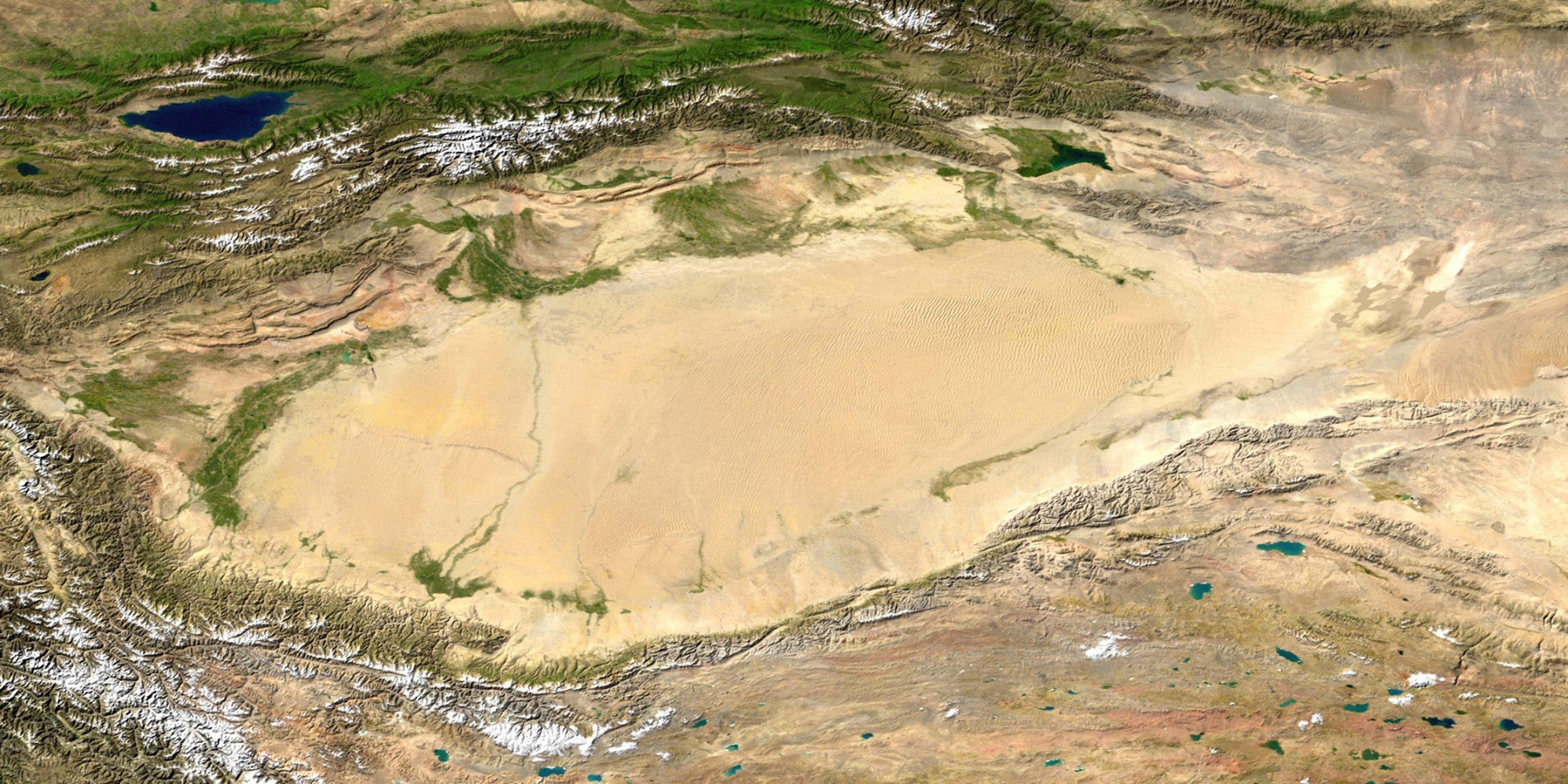
Located south of the Taklamakan desert and north of the Kunlun range, Keriya has always been a major stopover on the ancient Silk Road. In view of the proximity of the Indian border, it makes sense for China to have a new “civil” airport at Keriya, considering that there is no such thing as a “civil” airport in China, especially so close to the Indian border.

Keriya airport is designed to annually handle 1,80,000 passengers and 400 tons of cargo; it will have a 3,200-meter runway, a 3,000-square-meter terminal building and cost 104 million US dollars, says Xinhua. There is no doubt that Chen has been mandated to apply the “Tibet Recipe” in Xinjiang. Will he succeed is another question.

It is however certain that the stability of the Muslim region is vital for the Middle Kingdom and its gigantic BRI “linking” project; India needs to watch and be prepared.

(Courtesy: Mail Today)

China’s Tibet Policy – Recipe for Natural Disaster. One Belt, One Road Policy – Neocolonialism.
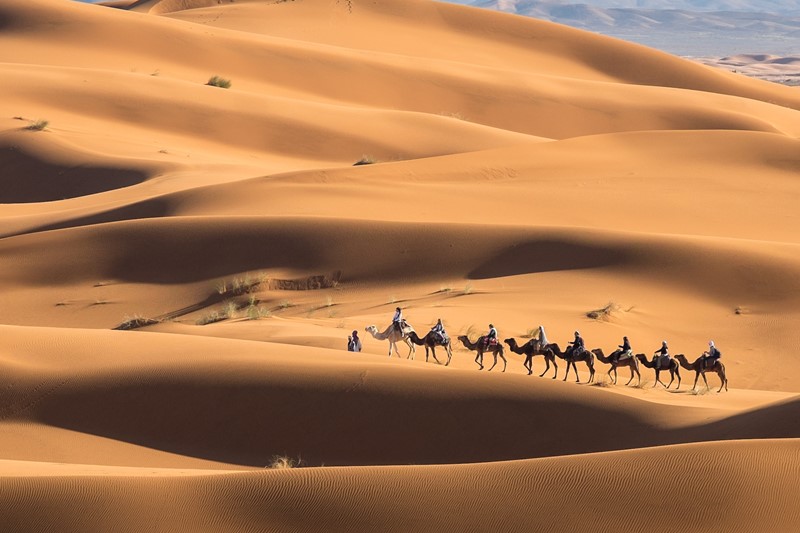
China’s Tibet Policy – Recipe for Natural Disaster. One Belt, One Road Policy – Neocolonialism. Taklamakan Desert, Silk Route.
China’s Tibet Policy – Recipe for Natural Disaster. One Belt, One Road Policy – Neocolonialism. Satellite images of Keriya River changing courses.
China’s Tibet Policy – Recipe for Natural Disaster. One Belt, One Road Policy – Neocolonialism.
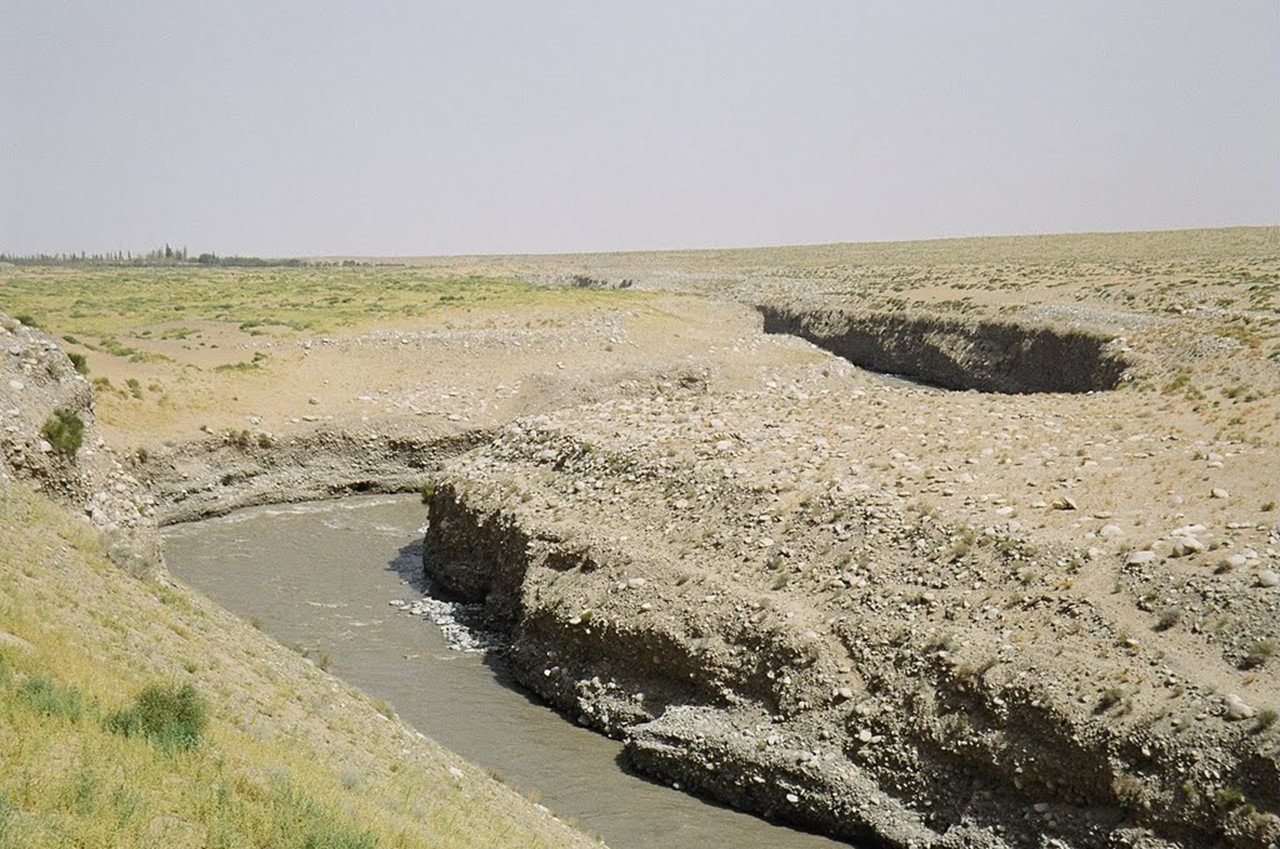
China’s Tibet Policy – Recipe for Natural Disaster. One Belt, One Road Policy – Neocolonialism. Keriya River.
China’s Tibet Policy – Recipe for Natural Disaster. One Belt, One Road Policy – Neocolonialism.
CHINA’S TIBET POLICY – RECIPE FOR NATURAL DISASTER. NATURE’S PLAN FOR REGIME CHANGE IN BEIJING.

ZERO FUNDING FOR TIBET – NATURAL MECHANISM FOR REGIME CHANGE IN BEIJING

ZERO FUNDING FOR NATURAL FREEDOM IN TIBET – NATURAL MECHANISM FOR REGIME CHANGE IN BEIJING. THE SWORD OF DAMOCLES HANGING OVER THE NECK OF BEIJING. 

ZERO FUNDING FOR TIBET – NATURAL MECHANISM FOR REGIME CHANGE IN BEIJING

President Trump’s 2018 Budget provides no funding in support of Natural Freedom in Tibet.

I am presenting view shared by Ms. Olivia Enos in which she appeals to President Trump not to forget Tibet. In her view, it appears that Natural Order is always determined by choices and actions performed by Man.

As student of Natural Science, I examine Natural Factors, Natural Conditions, Natural Mechanisms, and Natural Events that impact, or reset Natural Balance, Natural Order, and Natural Equilibrium that underlies human experience called Natural Freedom. For example, Natural Event called K-T Extinction Event totally wiped out ruling clan of Dinosaurs from face of planet Earth to introduce new clan of rulers called Anatomically Modern Man.

In Natural History of Man, powerful, mighty Empires have risen and fallen altering political boundaries imposed by Man over Natural Boundaries that define terrestrial life. Man brings about Regime Change using physical force using tools invented by Man. However, to expect Regime Change through Natural Event such as Bolide Collision cannot be dismissed as figment of human imagination.

In fact, Saint John describes, Book of REVELATION, Chapter 18, a mechanism for Regime Change in Evil Empire code-named Babylon. He visualizes heavenly strike such as Bolide Collision that destroys Evil Empire Babylon. Man may interpret sudden, unexpected Downfall of Babylon as Natural Disaster, Natural Calamity, Catastrophe, Cataclysm, Doom, or Apocalypse.

I am not concerned about President Trump’s Budget Plan with Zero Funding for Natural Freedom in Tibet. In my Natural Expectation, Evil Red Empire will experience Natural Downfall triggered by Natural Event called Bolide Collision. I seek Tibet Equilibrium to restore Balance of Power in South Asia that grants Natural Freedom to Tibetans. The Sword of Damocles is hanging over the neck of Beijing.

Rudranarasimham Rebbapragada

DOOM DOOMA DOOMSAYER

PRESIDENT TRUMP, DON’T FORGET ABOUT TIBET

Clipped from: https://www.forbes.com/sites/oliviaenos/2017/06/09/president-trump-dont-forget-about-tibet/#105138fd7f9a

Zero Funding in President Trump’s 2018 Budget in support of Natural Freedom in Tibet. Natural Mechanism may restore Tibet Equilibrium.

Olivia Enos ,  

Contributor

I write on international human rights and national security.

I am a researcher in the Asian Studies Center at The Heritage Foundation where I write on international human rights issues including human trafficking, transnational crime, religious freedom, and democratic freedoms, among other social issues in Asia. I also work on human rights challenges facing the Middle East including ISIS genocide and U.S. refugee policy. My work has been featured in The National Interest, RealClearWorld, Providence: A Journal of Christianity and Foreign Policy, and Georgetown Journal of International Affairs, among other publications. I received my BA from Patrick Henry College and am completing my MA in Asian Studies at Georgetown University. I live with my husband Zach on Capitol Hill in Washington, D.C.

The author is a Forbes contributor. The opinions expressed are those of the writer.

President Trump’s 2018 Budget provides Zero Funding in support of Natural Freedom in Tibet. Natural Mechanism for Regime Change in Beijing.

UNSPECIFIED, CHINA – APRIL 23: Tibetan Buddhist monks use the iPhone in the courtyard of the Kumbum Monastery on April 23, 2017 in Xining, Qinghai Province. Kumbum was founded in 1583 in a narrow valley close to the village of Lusar in the Tibetan cultural region of Amdo. (Photo by Wang He/Getty Images)

President Trump’s proposed 2018 budget would zero out funding critical to advancing freedom in Tibet. Proposed budget cuts would eliminate all USAID programming for Tibet and funding for the Ngawang Choephel Fellows program, which finances educational and cultural exchanges for Tibetan refugees. What might happen with efforts to protect Tibetan refugees in South Asia is unclear.

The State Department said that many “tough choices” were made during budget negotiations. Economic development programs in Tibet will take the most significant hit. In addition to the cuts outlined above, there is a question as to how much funding—if any—will be allocated for the Tibet Fund. Nor does the budget proposal outline how cuts to the National Endowment for Democracy (NED) will impact programs toward Tibet.

Defunding efforts to empower Tibetans sends the signal that the U.S. no longer cares about advancing liberty in places like Tibet and Xinjiang where China today uses human rights abuse to maintain control over these territories.

Just last year, the Chinese government began demolishing one of the world’s largest Tibetan Buddhist academies, the Larung Gar, reducing the population of monks and nuns from 12,000 to less than 5,000 after its partial destruction in 2016. Additionally, at least 150 Tibetans have self-immolated since February 2009.

At a recent event at The Heritage Foundation, Dr. Lobsang Sangay, president of the Central Tibetan Administration, reaffirmed Tibet’s commitment to the “Middle Way” approach. This policy approach seeks freedom for Tibetans within the framework of the Chinese constitution.

“The Middle Way approach” explained Sangay, “is in the middle of seeking separation or independence from China but at the same time ending the present repressive policies of the Chinese government.”

It is a peaceful initiative, one that embraces dialogue with the Chinese government. The last two U.S. administrations affirmed that policy, but it remains to be seen whether it will be supported by the Trump administration which has said little to nothing on Tibet.

U.S policy toward Tibet has historically been led by Congress and is enshrined in the 2002 law, the Tibetan Policy Act, which initiated or affirmed the programs the Trump administration plans to cut. If budget cuts are solidified, members of Congress should take steps to reaffirm U.S. support for Tibet.

One of the other ways Sangay suggests the U.S. can support Tibet is by meeting with the Dalai Lama. Sangay highlighted that on his first international trip, President Trump visited Saudi Arabia, Israel and the Vatican traveling to “all three major sacred places of three major traditions.” Sangay continued, “If he can meet with all leaders of major traditions, I think it’s just logical that he meet with the most prominent Buddhist leader”.

Advancing freedom in Asia – and around the world, for that matter – is in the interest of the U.S. China is not the only country to use human rights violations or the threat of abuse to keep the population in check and maintain their grip on power. These authoritarian tendencies are encouraged when actors like the U.S. refrain from supporting freedom where they can. The U.S. should not grant de facto impunity to China by abandoning the Tibetan people in their time of need. Secretary of State Rex Tillerson in a recent speech to the State Department said that human rights would factor into the Trump administration’s foreign policy paradigm. To make good on that promise, the Trump administration should consider ways to promote human rights and norms in China. The effort can begin with protecting rights and freedom in Tibet.
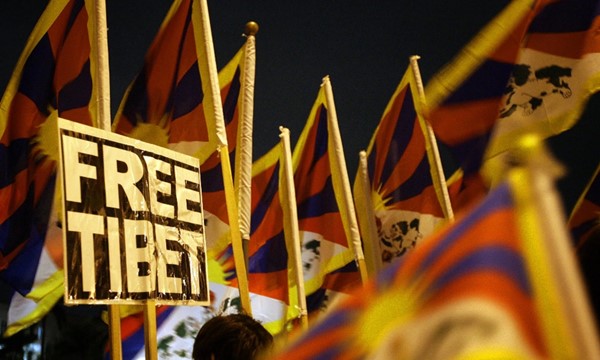
President Trump’s 2018 Budget provides Zero Funding in support of Natural Freedom in Tibet. Natural Mechanism for Regime Change in Beijing may restore Tibet Equilibrium. The Sword of Damocles hanging over the neck of Beijing.
Zero Funding in support of Natural Freedom in Tibet. Natural Mechanism for Regime Change in Beijing. The Sword of Damocles hanging over the neck of Beijing.
Zero Funding in support of Natural Freedom in Tibet. Natural Mechanism for Regime Change in Beijing. The Sword of Damocles hangs over the neck of Beijing.

DOOMED AMERICAN CHINA FANTASY vs US POLICY ON TIBET

DOOMED AMERICAN CHINA FANTASY vs US POLICY ON TIBET

US President Donald Trump (2nd L) holds a bilateral meeting with China’s President Xi Jinping (R) at Trump’s Mar-a-Lago estate in Palm Beach, Florida, US, on April 7, 2017. Photo: Reuters

US Policy on Tibet is not working. It will not work until and unless the US revises US Policy on Communist China. If Communism remains the ruling doctrine of China, no US Policy on Tibet will work. United States has no choice other than that of containing, engaging, confronting, and opposing China’s Communism.

Rudranarasimham Rebbapragada

DOOM DOOMA DOOMSAYER

US CONGRESSMAN CALLS FOR NEW US POLICY ON TIBET

Clipped from: https://www.voanews.com/a/us-congressman-new-tibet-policy/3891693.html

DOOMED AMERICAN CHINA FANTASY. US CONGRESSMAN JIM McGOVERN, D-Mass., CALLS FOR NEW US  POLICY ON TIBET.

FILE – Rep. Jim McGovern, D-Mass., speaks on Capitol Hill in Washington, May 7, 2014. McGovern is calling for a new U.S. policy on Tibet.

WASHINGTON

Congressman Jim McGovern is calling for a new U.S. policy on Tibet, saying “the status quo isn’t working” and urging U.S. businesses to raise the issue of human rights in Tibet with Chinese business partners.

“It’s important that the U.S. have a policy toward Tibet because the status quo isn’t working,” McGovern, a Democrat from Massachusetts, told VOA Mandarin. “The Chinese government is just getting worse on a whole range of issues — jailing more and more Tibetans in Tibet and in the Tibetan region, so I think we need to re-assess. … We need to start walking the walk.”

US Congressman Calls for New US Policy on Tibet

China says the Himalayan region has been part of its realm for more than seven centuries and considers the Dalai Lama, the Tibetan spiritual leader, to be a dangerous separatist.

Many Tibetans insist they were essentially independent for most of that time and have protested what they regard as China’s heavy-handed rule since Chinese army units crossed the Yangtze River into eastern Tibet in 1950.

Congressional visit

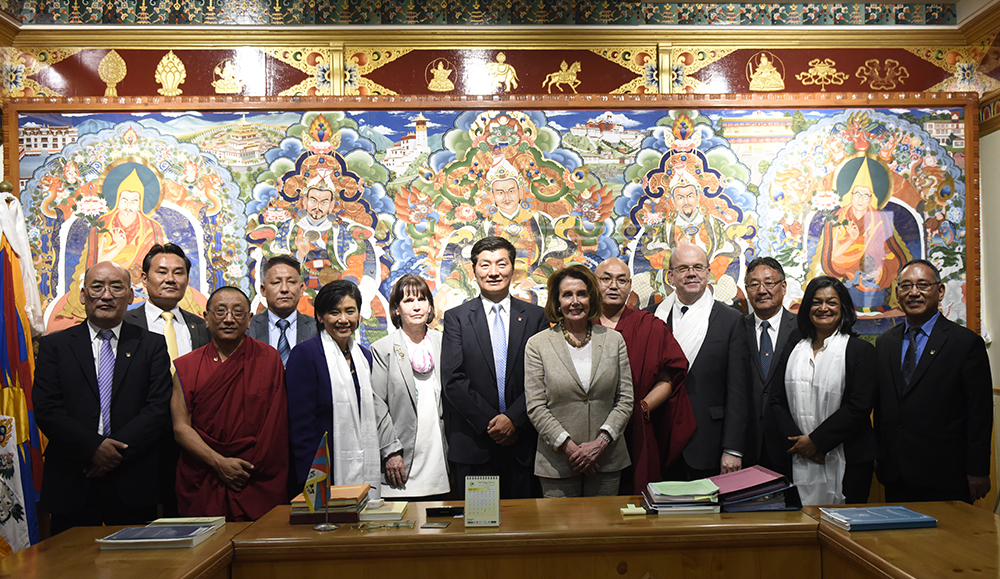
Last month, McGovern traveled to Nepal and the north Indian hill town of Dharamsala, where the Dalai Lama has been in exile from Tibet for almost 60 years. The eight-person House delegation led by Rep. Nancy Pelosi, a Democrat from California, wanted to make China aware that they would not stand down in their campaign for human rights in Tibet.

Watch: US Congressman Calls for China to Show Flexibility on Tibet

The delegation, including a lone Republican, Wisconsin’s Jim Sensenbrenner, met with the Dalai Lama.

“His Holiness is not a separatist … but he wants to go home and so do his people,” McGovern said.

“China is one of the great powers of the world, they’re doing great things on climate change,” he said, adding he’s always puzzled that China “is paranoid over this monk, and paranoid over his message.”

McGovern is the sponsor of the Reciprocal Access to Tibet Act of 2017. He introduced the bipartisan bill in the House in April with Congressman Randy Hultgren, a Republican from Illinois. Marco Rubio, a Republican from Florida, and Tammy Baldwin, a Democrat from Wisconsin, introduced a companion bill in the Senate.

US Congressman Poses Reciprocal Access to Tibet Act

Travel in US

McGovern described his bill as saying, “we will treat you like you treat us” in that it calls for restricting where Chinese can visit in the United States in the same way China restricts United States officials, journalists and other citizens in Tibetan areas of the People’s Republic of China.

“If China wants its citizens and officials to travel freely in the U.S., Americans must be able to travel freely in China, including Tibet,” McGovern echoes on his website.

He also wants the U.S. to “publicly call on the Chinese government to restart the direct dialog that used to exist between the Chinese government and the Tibetan people. That needs to be restarted.”

McGovern said he wants the United States to appoint a special coordinator on Tibet as soon as possible to help elevate these issues.

“We’ve also talked about working with other countries and establishing what we call A Group of Friends on Tibet who would meet regularly and publicly to assess the situation in Tibet, and whether there’s been progress or not,” he added.

US Congressman: US Firms Can Raise Issue of Tibet With Chinese Counterparts

McGovern, who is co-chair of the bipartisan Tom Lantos Human Rights Commission, told VOA that while U.S. and Chinese companies profit from trading with each other, if U.S. companies “know what’s happening and you don’t say anything [about human rights in Tibet], then you’re complicit. China wants to do business with you. You want to do business with China but that doesn’t mean you can’t raise the issue of human rights.”

In the interview with VOA Mandarin, McGovern, who has been arrested three times protesting human rights violations in Sudan, said he is also concerned about human rights in Hong Kong, and China’s treatment of the ethnic minority group, the Uighurs.

‘We’re not perfect’

Listing hate crimes and attacks against members of the Muslim community, threats against Jewish community centers and hate crimes against the LGBTQ community, McGovern said he also worries about human rights in the United States, “so we’re not perfect.”

None of that, however, should lessen the attention paid to Tibet, McGovern said.

“I think the Chinese government thinks this issue will just go away. The Dalai Lama is in his 80s, and they think at some point he won’t be around and everybody will forget,” McGovern said.

But, he stressed, “we’re not going away, and this issue is not going away, and we’re going to keep on bringing it up over, and over, and over again until there’s some change.”

This story originated with VOA Mandarin.

DOOMED AMERICAN CHINA FANTASY – US HOUSE REPRESENTATIVE JIM McGOVERN CALLS FOR NEW US POLICY ON TIBET.

TIBET EQUILIBRIUM vs THUCYDIDES TRAP – UNFINISHED VIETNAM WAR

TIBET EQUILIBRIUM vs THUCYDIDES TRAP – UNFINISHED VIETNAM WAR

TIBET EQUILIBRIUM vs THUCYDIDES TRAP – UNFINISHED VIETNAM WAR. RED CHINA’S EVIL ACTIONS DESTINED US-CHINA WAR.

Special Frontier Force represents military organization that symbolizes ‘Unfinished Vietnam War’. The US fought bloody War in Vietnam to contain, to engage, to confront, and to oppose the spread of Communism in South Asia. Red China’s Evil actions Destined US-China War. ‘Tibet Equilibrium’ is good reason to fight Unfinished Vietnam War to its rightful conclusion.

Rudranarasimham Rebbapragada

SPECIAL FRONTIER FORCE

TIBET EQUILIBRIUM vs THUCYDIDES TRAP – UNFINISHED VIETNAM WAR. RED CHINA’S EVIL ACTIONS DESTINED US-CHINA WAR.

Could the U.S. and China end up in a terrible war that neither wants?

May 30 at 6:00 AM

TIBET EQUILIBRIUM vs THUCYDIDES TRAP – UNFINISHED VIETNAM WAR. RED CHINA’S EVIL ACTIONS DESTINED US-CHINA WAR.

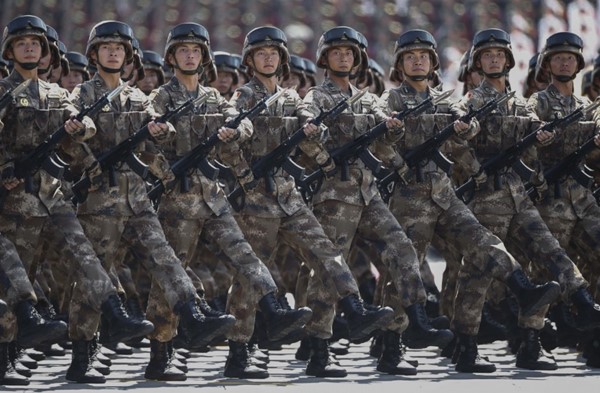
Chinese troops marching to commemorate the 70th Anniversary of the ‘Victory of Chinese People’s Resistance against Japanese Aggression and World Anti-Fascist War’ at Tiananmen Square in Beijing on Sept. 3, 2015. China planned to increase its defense budget in 2016 by 7 to 8 percent (European Pressphoto Agency/Rolex Dela Pena/poll/file)

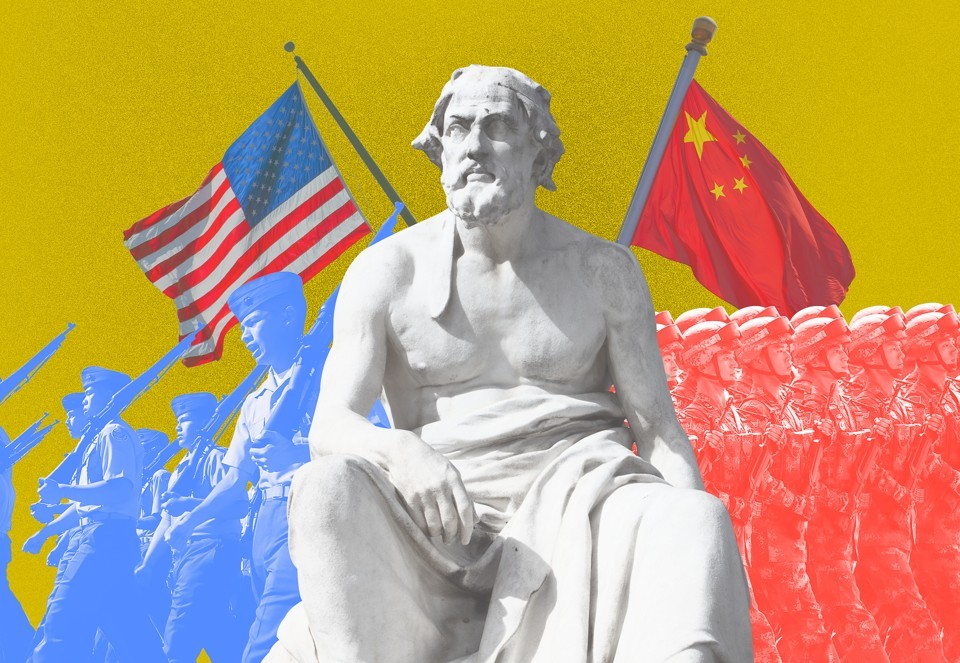
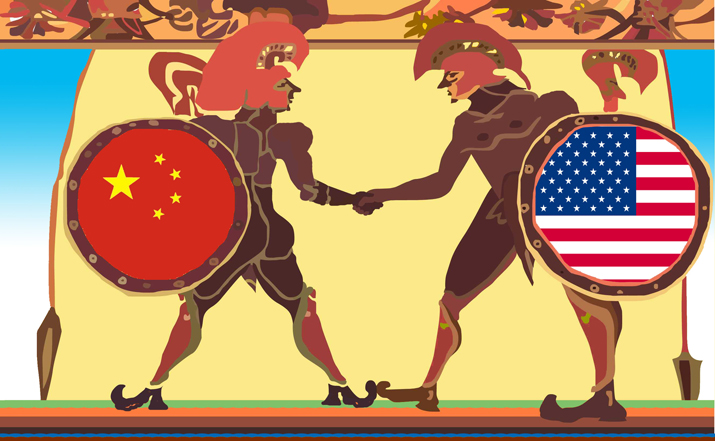
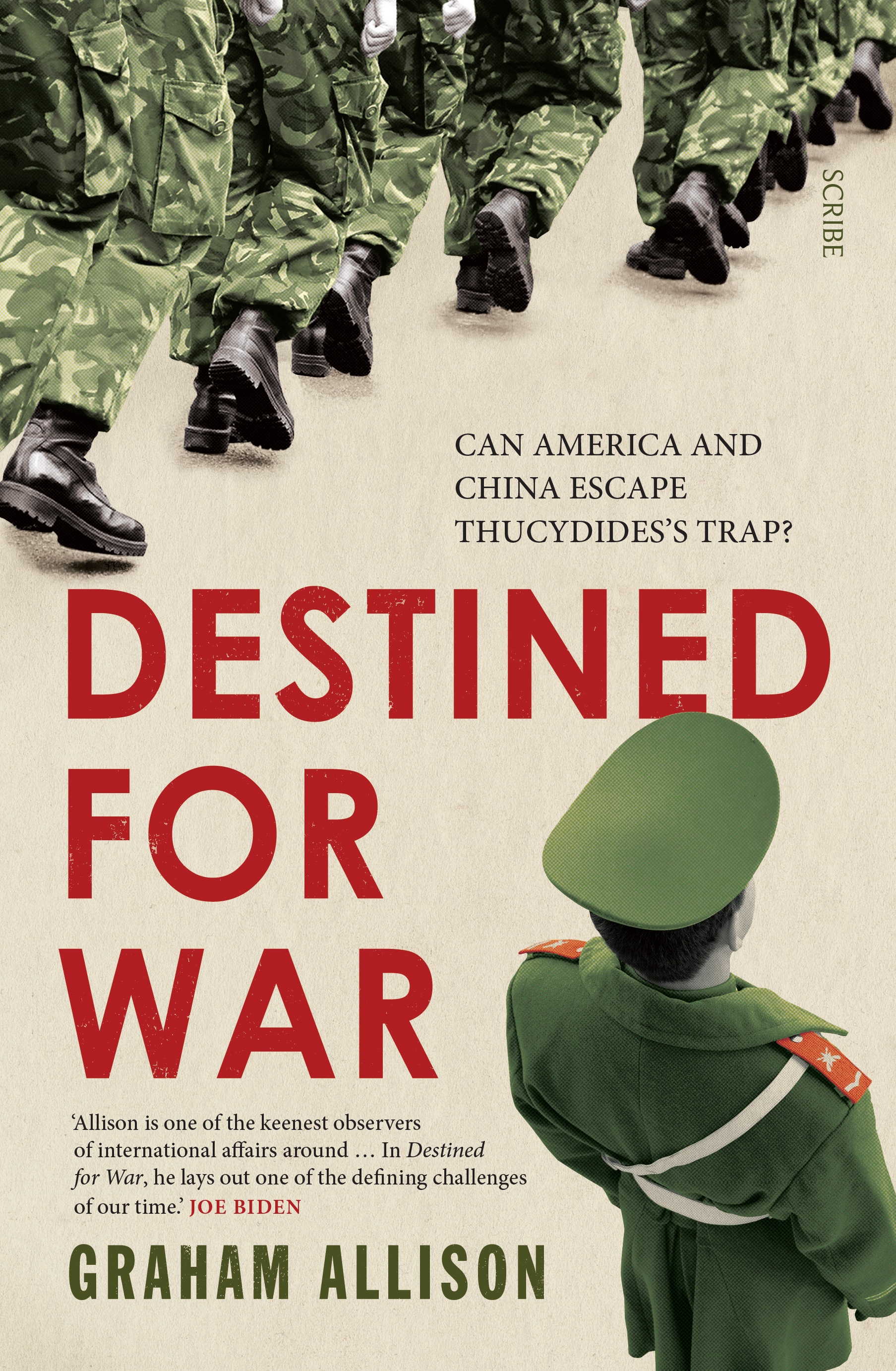
Is a dangerous pattern emerging in U.S.-China relations? International relations scholar Graham Allison coined the term “Thucydides Trap” in 2012 to explain how a rising power can instill fear in an existing power, leading to hostility and mistrust that can escalate into war.

In his new book, Allison argues that China and the United States are falling into this trap, which owes its name to Greek historian Thucydides’s famous history of the Peloponnesian War between Athens and Sparta, which proved disastrous for both sides. Fast-forward a couple of millennia, and some observers worry that Washington and Beijing are heading toward the same fate.


But the focus on whether the United States and China will follow this path has obscured another insight from Thucydides’ classic work, “The Peloponnesian War” — how the geography of East Asia would shape what a U.S.-China war might look like, and just how dangerous and destructive such a war may be.

There is another way to look at rising powers

The Thucydides Trap we often see in debates about rising powers is actually a simple version of power transition theory, which dates back to the 1950s. The idea is that a war between great powers is more likely when a rising state seeks to topple the international pecking order. It is easy to see why this idea might be applicable to contemporary U.S.-China relations.

There are other ways to view the situation. Some scholars have argued that things may be more stable when two leading powers are at similar strength; others argue that the sources of war lie elsewhere. And the empirical record does not provide a lot of evidence that rising and dominant powers fight directly, or for the reasons that power transition theorists suggest. This leads some scholars to suggest that the power transition model is a poor guide to understanding U.S.-China relations.

None of this discussion means that U.S. and Chinese analysts should ignore Thucydides, although perhaps they should look for inspiration from other parts of his book.

The other Thucydides Trap isn’t pretty

Thucydides is best remembered for his short argument about the causes of war, but he said much more about its conduct. His insights are quite relevant for a hypothetical clash between the United States and China. This is especially the case in his commentary on the first few years of the Peloponnesian War, where he describes how Athens and Sparta stumbled into a protracted fight that neither side expected.

How they got there has to do with a very different kind of Thucydides trap. They wanted a quick victory, and they wanted to avoid their respective enemies’ comparative military advantages. Both opponents fell victim to delusions about bloodless victory without hard fighting. After their early efforts failed, they faced a terrible dilemma: capitulate or settle into a long and uncertain war.

And both sides faced the same basic challenge when the war began in 431 B.C. — how to avoid engaging on terms that favored the enemy. Sparta (like China today) was a dominant land power while Athens was the dominant naval power (like today’s United States). Sparta needed to figure out how to defeat Athens without challenging its navy directly. Meanwhile, Athens needed Sparta to concede without taking the risk of a pitched battle on land against the formidable Spartan army.


Neither side had a good solution — but they pursued operational fantasies about how to win without having to challenge the enemy’s main area of strength. Athens wanted to use its navy to assist land forces that would conduct raids on Sparta’s allies, while simultaneously encouraging a slave insurrection in the Spartan homeland. Sparta, for its part, thought that others would take on the Athenian navy on its behalf — and then it could focus instead on fighting on land.

Not much came out of these plans for the first few years. As long as Sparta and Athens were unwilling to challenge their counterparts directly, neither was able to hurt the enemy enough to force surrender. Neither side was willing to back down. And because they could both retreat to reliable sanctuaries — Sparta on land, Athens at sea — they didn’t need to seek terms.

A toxic blend of geography and politics conspired against the Greek great powers, and the result was an exhausting war that no one wanted. Geography enabled retreat, while political pressures encouraged continued fighting. Meanwhile the military balance held, with Sparta dominant on land and Athens controlling the water. What followed were years of costly but indecisive campaigns. Neither side was strong enough to win — nor weak enough to lose.

Geography would factor into any U.S.-China war

Here’s how this applies to U.S.-China relations today. As I explain in a forthcoming article in the Journal of Strategic Studies, the United States and China risk slipping into this pattern.

War is far from inevitable, of course. But if it did break out, the United States and China — like Athens and Sparta — would each be able to retreat safely in the event of early wartime setbacks. When we read about potential flash points that could spark a confrontation, especially over Taiwan and disputed maritime claims, this geographic risk lurks in the background.

Wartime setbacks that send each side retreating to its safe haven are possible, perhaps even likely, given that both sides are placing their bets on elaborate plans to win quickly. In this scenario, China and the United States would each put a premium on interfering with the other’s communications and blinding its intelligence capabilities to inject confusion on the battlefield and make it hard to coordinate complex operations.

For the United States, the goal would be to seize the initiative, ensuring freedom of movement in the waters near the Chinese mainland, overcoming anti-access weapons, and buying time for superior reinforcements to arrive in the region. For China, it means forcing the United States to fight farther from the shore, which might prevent it from effectively defending its regional allies and partners.

These plans might sound good in theory, but both sides are investing in efforts to secure their communications against debilitating attacks. The normal fog and friction of war also work against operational plans that depend on precise attacks with little margin for error. Leaders might also become so concerned about nuclear escalation that they scale back their opening moves, further decreasing their effectiveness. For all these reasons, both sides may end up disappointed by the result of the first volley.

A quick political settlement might be the rational response in this case, but the fact that both sides were willing to take the gigantic risk of war suggests they will find it hard to stomach the prospect of backing down, especially if they haven’t suffered many casualties. This is a recipe for a long and grinding war.

This is the kind of Thucydides trap that looms over any U.S.-China conflict. Geography, politics and the maritime-land balance in East Asia create a situation likely to lead to prolonged fighting. The central task for strategists is figuring out how to escape it. If they cannot, the only alternative is avoiding war in the first place.

Joshua Rovner holds the John Goodwin Tower Distinguished Chair in National Security and International Politics at Southern Methodist University, where he also serves as director of the Security and Strategy Program (SAS@SMU).

Comments

Rudranarasimham Rebbapragada

10:32 AM EDT

On behalf of Special Frontier Force, I confirm the possibility of war between the US and China. We wanted to fight this War to relieve pressure on the US Armed Forces fighting bloody war in Vietnam. President Nixon-Kissinger continued using bombing campaign while knowing that it was not effective. Special Frontier Force as a military organization symbolizes the Unfinished Vietnam War. US was fighting against the spread of Communism in South Asia. The fall of Soviet Union has not eliminated the problem of Power Equilibrium in Asia. If not the tensions of South and North China Sea disputes, the great problem of ‘Tibet Equilibrium’ will be a good reason to check, to contain, to engage, and to oppose Red China.

mustquestion

10:20 AM EDT

Odd that it does not include North Korea in the discussion. The most likely scenario is a US – N. Korea conflict with China taking sides with N Korea. But that does not fit the simplistic model of dominant vs challenging state that is the book’s theme.

Rudranarasimham Rebbapragada

10:46 AM EDT

Tibet is the second largest nation of this region sharing border with China. In terms of size, Tibet is second to China. Korea receives plenty of media attention. The problem of Balance of Power demands action to accomplish ‘Tibet Equilibrium’.

nqb123

7:54 AM EDT

I don’t see how the US and China could stumble onto war. What’s the motive for a war when there is so much trade going between these 2 countries? There is no common border between the two, no known historical animosity between the two people, no known problem that only a war could solve. The Taiwan problem is likely to be solved sometime in the future by the Chinese themselves. If the US wanted to defend Taiwan in the first place, Taiwan and the US would already have a mutual defense treaty. I don’t see any US military base in Taiwan either.

Rudranarasimham Rebbapragada

10:52 AM EDT

That’s not correct reading of the US history. President Harry Truman tried his best to avert Communist victory in China. Apart from giving support to Nationalists, the US made modest efforts to deliver arms and ammunition to Tibet during 1948-49. Tibet maintained policy of Isolationism until China’s military conquest in 1950s. Since that time, the US is helping Tibetan Resistance. The plans for a future war are not yet buried.

Douglas Levene

7:42 AM EDT

Excellent article, thank you. I’ve been teaching in China for the past seven years and worry about what to do if war breaks out – can I make it across the border into Hong Kong? Would the Chinese expel all Americans or intern them or worse? From this end of the pond, it’s pretty easy to see how rising Chinese confidence could lead to miscalculations, spilled blood and war. The Chinese think they can overcome US supremacy in submarines by building out a huge network of sea floor sensors in the South China Sea – who knows what that type of arms race combined with territorial expansion could lead to?

kcs1760

7:22 AM EDT

A good article, but I would have liked to read how the author feels our economic inter-dependency would factor into the equation.

Rudranarasimham Rebbapragada

10:56 AM EDT

In the past, Communist Powers like Soviet Union encouraged people and nations to oppose European Colonial Rulers. Now, the world of geopolitics and geoeconomics have changed. Now, the US would encourage people and nations to oppose Red China’s Neocolonialism.

William Billeaud

7:10 AM EDT

Only someone with a worldview based in the capitol of the U.S. Bible Belt would spew this. What horse shout; I subscribed to Wash Post for this?

Rudranarasimham Rebbapragada

11:00 AM EDT

Don’t worry about your subscription. You can still read this story without being a subscriber. The realities of the world are described by Red China’s occupation of the second largest nation of South Asia. As long as that occupation prevails, there will be Power Imbalance. Tibet Equilibrium cannot be dismissed as wishful thinking.

TIBET EQUILIBRIUM vs THUCYDIDES TRAP – UNFINISHED VIETNAM WAR. RED CHINA’S EVIL ACTIONS DESTINED US-CHINA WAR.

Inserted from <https://www.washingtonpost.com/news/monkey-cage/wp/2017/05/30/could-the-u-s-and-china-end-up-in-a-terrible-war-that-neither-wants/?utm_term=.37b806c4ec1a#comments>

TIBET EQUILIBRIUM vs THUCYDIDES TRAP – UNFINISHED VIETNAM WAR.RED CHINA’S EVIL ACTIONS DESTINED US-CHINA WAR.

THE FUTURE OF RED CHINA’S EXPANSIONISM – BEIJING DOOMED

THE FUTURE OF RED CHINA’S EXPANSIONISM – BEIJING DOOMED

THE FUTURE OF RED CHINA’S EXPANSIONISM – BEIJING DOOMED.

People’s Republic of China in 1949 embraced Communism as State Doctrine and lost no time to announce ambitious plan of Territorial, Maritime, Economic, and Political Expansionism. While others painfully reflect upon ‘The Future of the Tibetan Resistance Movement’, I express optimism by announcing Beijing’s Doom, sudden downfall, as consequence of her own evil actions. This predestined Disaster, Catastrophe, Cataclysm, Calamity, Apocalypse, Doom will bring Regime Change and The Evil Red Empire cannot ward it off by paying ransom.

THE FUTURE OF RED CHINA’S EXPANSIONISM. BEIJING DOOMED.

Rudranarasimham Rebbapragada

DOOM DOOMA DOOMSAYER

TIBETAN PROTEST MOVEMENT – THE NEWS LENS INTERNATIONAL EDITION

Friday, May 26, 2017

PODCAST: Tibet, Protest and China; The Future of the Tibetan Protest Movement

The Future of Red China’s Expansionism. Beijing Doomed.

Photo Credit: Reuters

TNL Staff

These small acts have reverberations and impact way beyond what we can see through the media and numbers. – Tenzin Dorjee.

Earlier this month, Radio Free Asia reported that a Tibetan monk, Jamyang Losal, had died after setting himself on fire in China’s northwestern Qinghai province. Losal was the 150th Tibetan to self-immolate since 2009 when Tibetan monks started taking their own lives in protest of China’s rule. But it seems these desperate protests are having little impact on China as it continues to crack down on any signs of dissent in Tibet.

In this episode of The News Lens Radio, we are bringing you the views of three Tibetan leaders to discuss the efforts to keep the protest movement alive both inside and outside Tibet. They say not only is the Chinese government continuing to rule Tibet with an iron fist, it is also increasingly working beyond its own borders to shut down the movements calling for Tibetan autonomy or independence from China.

About today’s guests

Tenzing Jigme is the president of the Tibetan Youth Congress, an international organization with about 30,000 members advocating for Tibetan independence.

Pema Yoko is the interim executive director of the New York-headquartered Students for a Free Tibet.

Tenzin (Tendor) Dorjee is a U.S.-based author and program director with the Tibet Action Institute. He is also the former executive director of Students for a Free Tibet.

This podcast is available via SoundCloud, Stitcher and iTunes apps.

Editor: Olivia Yang

2017/05/22

Cold Shoulder: Why Beijing Snubbed Singapore at the Belt and Road Summit

The Future of Red China’s Expansionism. Beijing Doomed. Singapore was not invited to ‘Belt and Road’ event hosted by Beijing.

ANGELA HAN

Angela Han is a Research Associate in the Polling Program. She holds a Masters in European and International Studies from the University of Trento and a Graduate Diploma in Transnational Governance from Scuola Superiore Sant’Anna. She has also spent six months abroad learning Mandarin at the China University of Political Science and Law in Beijing. Prior to undertaking her Masters, Angela spent two years as a researcher of labor and economic policies in her home country of Singapore.

Beijing did not invite Singapore’s Prime Minister to attend the Belt and Road event in Beijing this week, signifying strain in Sino-Singapore relations.

Among the 29 Heads of State who converged on Beijing for the Belt and Road Summit earlier this week were leaders of seven of the ten ASEAN states. One leader was noticeably missing: Singapore’s Prime Minister Lee Hsien Loong.

Various observers have noted this absence, including Hugh White, who suggested it was no co-incidence that, like others – Japan, India, Australia and “most western countries” – who had not sent their national leaders to Beijing, Singapore was aligned with the U.S. and uneasy about China’s rise – “or perceived to be so.”

However, it has since emerged that Singapore was never given the choice. China had not invited Singapore’s prime minister in the first place.

This is surprising, especially as Singapore has been one of the biggest advocates of the Belt and Road Initiative (BRI). While many other states were initially hesitant in signing up to BRI, including some of its ASEAN neighbors, Singapore’s support has been unequivocal from the beginning. Many high-level cooperation talks between China and Singapore on the subject have taken place, with both sides warmly welcoming cooperation on BRI.

In light of this past co-operation, Beijing’s snub is significant. It is fair to conclude that, if China continues to freeze out Singapore, there could be significant implications on at least three levels.

What it might mean for Sino-Singapore relations

First, this marks a low point in Sino-Singapore relations. Since its independence 50 years ago, managing the U.S.-China dichotomy has been a key tenet of Singapore’s foreign policy. Despite close defense partnerships with the U.S., China has referred to Singapore as an “important partner and a special friend of China.” This long-standing relationship has been fostered not only by historical and cultural linkages, but also the deep bond that existed between former leaders, Lee Kuan Yew and Deng Xiaoping. When Lee Kuan Yew died in 2015 there were video tributes on Chinese state media, and he was described as “an old friend of the Chinese people” by President Xi Jinping.

Of late, however, the bilateral relationship has been less than smooth, particularly since remarks made by the Singaporean prime minister at a White House state dinner in August last year. At that event, Lee Hsien Loong praised the U.S. rebalance and endorsed the arbitral tribunal ruling on the South China Sea. In a separate incident, a Chinese tabloid accused Singapore of bringing up the tribunal ruling at the Non-Aligned Movement Summit, which led to a very public spat between the Global Times editor and Singapore’s Ambassador to China.

Singapore is not a claimant state but the fear that China might extend its reach in the South China Sea is nevertheless acute for the tiny island-state. Given its trade volumes are 3.5 times its GDP, any instability in the region would affect Singapore’s trade routes, and therefore its economy. When Singapore advocates for a rules-based order, it is not just values that it seeks to defend but its economic lifeblood.

Singapore’s stance on the South China Sea did not please China. In November nine of Singapore’s armored troop carriers were impounded in Hong Kong on their way back from Taiwan. At the time, many saw Beijing’s heavy hand at work behind the scenes and believed the incident reflected China’s displeasure with Singapore’s joint military exercises with Taiwan, even though these dates back decades.

In their usual quiet diplomatic style, Singapore diplomats worked hard behind the scenes to eventually secure the vehicles’ return after two months. This was then quickly followed up by a high-level bilateral cooperation forum, postponed the previous year due to strained ties. Yet, China still raises the South China Sea matter at bilateral forums.

Implications for other middle powers

China’s snub is yet another example of the narrowing diplomatic space that small states like Singapore have in which to maneuver. Relying on its hard-nosed pragmatism has, for half a decade, served Singapore well. But with most of its ASEAN neighbors increasingly willing to set aside the South China Sea disputes in return for a massive influx of Chinese investment, it is increasingly difficult for Singapore to both protect its national interest and maintain an independent foreign policy of not picking sides.

This has implications for other countries like Australia, which occupy a very similar position in the world. Like Singapore, Australia has strong historical, security and defense ties to the United States, while China is now far and away from its biggest trading partner. Perhaps one lesson from this incident is that it is becoming harder to compartmentalize politics and economics.

Implications for China’s role in the world

Finally, what does the incident say about the Belt and Road Initiative and more broadly, China’s role as architect of global initiatives? Although the BRI is as much about geoeconomics as geopolitics, it is undeniable that just on the basis of scale, access to and participation in Chinese initiatives have a tendency to draw lines in the sand; clearly distinguishing between who is a friend of China, and who is not.

The snub demonstrates Beijing now has another diplomatic tool in its arsenal. Such “sanctions with Chinese characteristics” are proving to be increasingly effective at asserting dominance and deterring actions counter to China’s interest. It is clear that China’s already considerable diplomatic and economic clout is increasing and its reach is becoming more pervasive. This too makes it more difficult for states that seek to steer a middle course.

This article originally appeared in the Lowy Interpreter. The News Lens has been authorized to republish this article.

TNL Editor: Edward White

NEWS WORTH KNOWING, VOICES WORTH SHARING

Copyright © 2016 The News Lens
Inserted from <https://international.thenewslens.com/article/69284>

THE FUTURE OF RED CHINA’S EXPANSIONISM – BEIJING DOOMED.

BEIJING DOOMED – MORAL VICTORY FOR TIBET

BEIJING DOOMED – MORAL VICTORY FOR TIBET

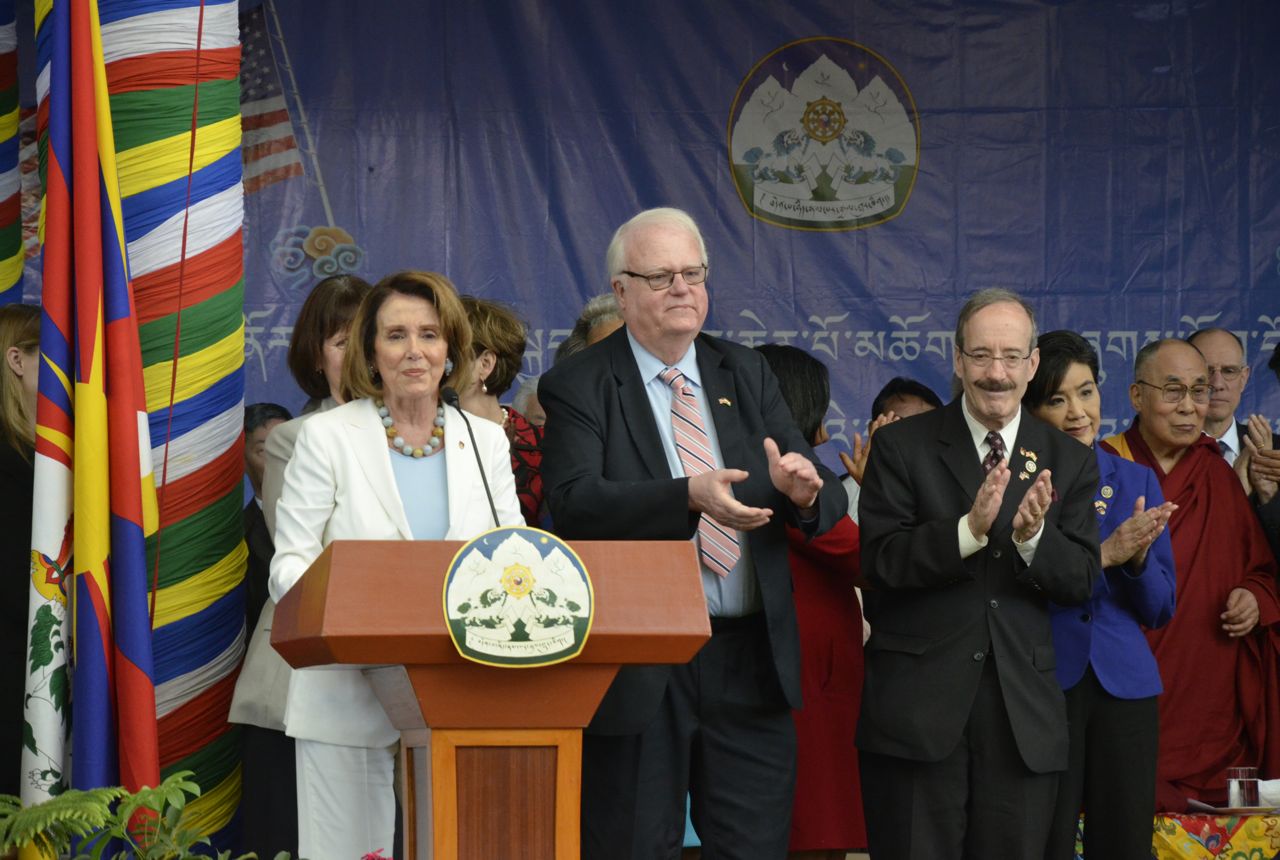
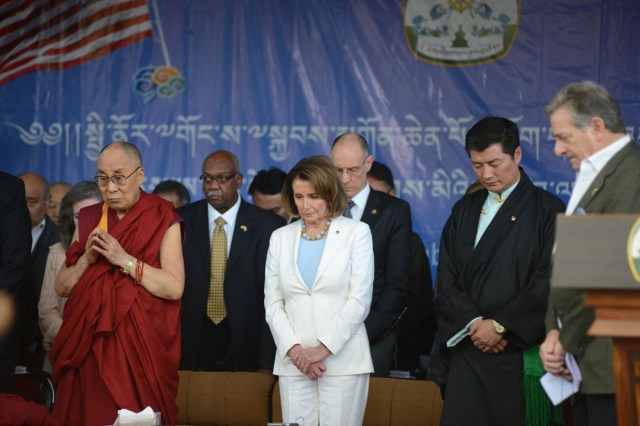
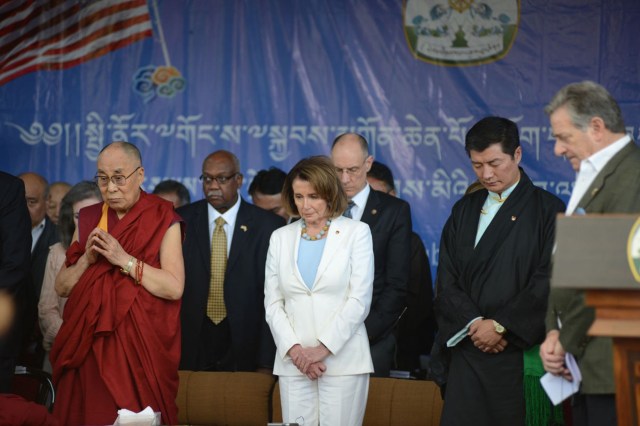
BEIJING DOOMED – MORAL VICTORY FOR TIBET. PELOSI DELEGATION IN DHARAMSHALA.

Tibetans believe in moral principles that govern lives of individuals and of their chosen leaders. I believe in Moral Principles that govern or rule both man and national entities created by man. I predict Red China’s Doom or Downfall for her “EVIL” actions for Evil means Calamity, Catastrophe, Cataclysm, Disaster, and Apocalypse.

Rudranarasimham Rebbapragada

Doom Dooma Doomsayer

U.S. OFFICIALS VISIT DHARAMSHALA, EXPRESS SUPPORT FOR TIBET, DALAI LAMA

Tibetan Spiritual leader the Dalai Lama (left) and Democratic leader of the U.S. House of Representatives Nancy Pelosi stand onstage as they prepare to address exiled Tibetans gathered at the Tsuglakang Temple in McLeod Ganj, May 10, 2017. Democratic leader of the U.S. House of Representatives Nancy Pelosi is visiting the northern Indian town of Dharamshala, home to thousands of Tibetans living in exile. (Lobsang Wangyal/AFP/Getty Images)

U.S. Officials Visit Dharamshala, Express Support for Tibet, Dalai Lama

  • KATY DAIGLE and ASHWINI BHATIA, Associated Press
  • May 10, 2017
  • Tibetan Spiritual leader the Dalai Lama (left) and Democratic leader of the U.S. House of Representatives Nancy Pelosi stand onstage as they prepare to address exiled Tibetans gathered at the Tsuglakang Temple in McLeod Ganj, May 10, 2017. Democratic leader of the U.S. House of Representatives Nancy Pelosi is visiting the northern Indian town of Dharamshala, home to thousands of Tibetans living in exile. (Lobsang Wangyal/AFP/Getty Images)

    DHARAMSHALA — As President Donald Trump appears to be warming to China, a bipartisan group from the U.S. House of Representatives took aim May 10 at one of Beijing’s sore spots: Tibet.

    Representative Nancy Pelosi accused China of using economic leverage to crush Tibetan calls for autonomy. During a meeting with Tibetans and the Dalai Lama at his main temple in the Indian hill town of Dharamshala, she urged the community not to give up.

    “You will not be silenced,” said Pelosi, a California Democrat. “The brutal tactics of the Chinese government to erase race, culture and language of Tibetan people challenges the conscience of the world. We will meet that challenge.”

    The visit by Pelosi and seven other U.S. representatives irritated Beijing, where a spokesman for the Foreign Ministry reiterated China’s stance that the Dalai Lama is a dangerous separatist.

    “The visit by U.S. congressmen to Dharamshala and their meeting with the Dalai Lama has sent a very wrong signal to the outside world about supporting Tibetan independence, which violates the U.S. government’s commitment not to support independence for Tibet,” the spokesman, Geng Shuang, told reporters.

    He said Beijing had complained to the U.S. government over the matter, and urged the American representatives “to stop any kind of contact with the Dalai Lama, and take immediate measures to eliminate the negative impact.”

    But Representative Jim Sensenbrenner assured that the U.S. Congress stood in “solidarity with the cause of the Tibetan people to be free from the repression that has been put upon them for a very, very long time from Beijing.”

    “Without justice there is no freedom,” said the Wisconsin Republican, noting that the U.S. Constitution has prohibited government restrictions on the free exercise of religion for more than 220 years. “Today there is no justice in Tibet for Tibetans, for their religion, for their culture, for their language, and for His Holiness The Dalai Lama. … This is a civil rights issue.”

    China says the Himalayan region has been part of the country for more than seven centuries. Many Tibetans insist they were essentially independent for most of that time. At least 148 Tibetans have set themselves on fire since 2009 to protest China’s rule.

    In many cases, China has offered aid packages to foreign governments on the condition that they support China’s position on issues such as Tibet and Taiwan, the self-governing island that Beijing has pledged to take control of, by force if necessary. Mongolia said in December that it would no longer allow visits by the Dalai Lama after a recent trip by the exiled Tibetan spiritual leader led China to suspend talks on a major loan.

    “China uses its economic leverage to silence the voices of friends of Tibet,” Pelosi said May 10. “But if we don’t speak out against repression in Tibet and the rest of China because of China’s economic power, we lose all moral authority to talk about human rights anywhere else in the world.”

    Pelosi told the gathering that she would limit her comments on China’s “brutal tactics” because the Dalai Lama had “prayed for me that I would rid myself of my negative attitude about dwelling on the negative too much.”

    The Dalai Lama, meanwhile, said Tibetans do not need weapons in their struggle for autonomy, and again prescribed a path of nonviolence and compassion. While he has devolved political power to an elected government, the Dalai Lama is still widely revered by Tibetans as their most influential leader.

    Tibetans who remain in the closely guarded region “are living in fear and anxiety. Their life is at risk, but they are still preserving our traditions,” said the Dalai Lama, who fled Tibet to India in 1959 during an abortive uprising.

    “We all are dedicated to the Tibetan cause, but should not think of harming the Chinese people as such. We need to befriend them,” he said, adding that compassion was needed to resolve the Tibetan issue.

    The timing of the U.S. congressional visit may irk Trump, who just weeks ago boasted of enjoying cozy conversations and chocolate cake with Chinese President Xi Jinping at Trump’s Florida resort. During Xi’s official visit last month, Beijing also provisionally approved several trademark applications for Ivanka Trump, the president’s daughter.

    President Trump’s rhetoric on China has warmed considerably since the U.S. presidential campaign, when he repeatedly called the Asian giant a currency manipulator and an economic adversary of the United States.

    Many in the crowd at the May 10 gathering in Dharamshala said they were delighted, and relieved, to see a bipartisan U.S. delegation address the Tibetan issue.

    “It perhaps shows that there is huge support for Tibet in the U.S. Congress. With Trump at the helm, things are uncertain,” said internet security analyst Lobsang Gyatso, 34.

    Rinchen, a 27-year-old antiques dealer who fled Tibet as a teenager in 2006, said the visit had burnished the Tibetan cause and sent a strong message to China.

    “The mere fact that this delegation is visiting Dharamshala gives importance to Tibet and the Dalai Lama,” said Rinchen, who uses only one name, as is common in the region. When people inside Tibet hear of the visit, “they will know that the support is real,” he said.

    – Daigle reported from New Delhi. Associated Press writers Louise Watt in Beijing and Ashok Sharma contributed to this report.

    Tags

  • Dalai Lama
  • Tibet
  • Nancy Pelosi

Contact Information

indiawest.com

933 MacArthur Blvd

San Leandro, CA 94577

Phone: 510-383-1140

Email: web@indiawest.com


DOOMED AMERICAN CHINA FANTASY – ONE BELT, ONE ROAD TO OPPRESSION

DOOMED AMERICAN CHINA FANTASY – ONE BELT, ONE ROAD TO OPPRESSION

DOOMED AMERICAN CHINA FANTASY – ONE BELT, ONE ROAD TO OPPRESSION.

America’s participation in Red China’s One Belt, One Road Initiative accomplishes continued Occupation, Oppression, and Suppression in Tibet undermining American core values of Freedom, Peace, Democracy, and Natural Justice.

Rudranarasimham Rebbapragada
Ann Arbor, MI 48104-4162 USA
SPECIAL FRONTIER FORCE


Doomed American China Fantasy – One Belt, One Road to Oppression.


http://m.dailyhunt.in/news/india/english/oneindia-epaper-oneindia/us+u+turn+on+china+puts+india+in+a+fix-newsid-67592793?ss=twt&s=wi

US U-turn on China puts India in a fix

Doomed American China Fantasy – One Belt, One Road to Oppression.

In a step which could see India put under tremendous pressure, the United States of America has decided to take a U-Turn from its initial position and is set to participate in China’s One Belt, One Road (OBOR) initiative, being organised in Beijing.

The event, is to showcase and build momentum for its new 21st-century silk route, both land and maritime, and other similar initiatives which would lead to increasing connectivity with Asian and European countries and solidify its place in the world as a major trading partner.
In India, along with concerns over its sovereignty, it is also seen as a continuation of Chinese strategy of ‘strings of pearls’ which China uses to flex its muscle in India’s neighbourhood.

The step of the US has put India in a dilemma as the change in its stance is early signal that the Trump administration is reframing the US-China relationship, according to Jagannath Panda, from the Institute for Defense Studies and Analysis, New Delhi.

India, which is still undecided on whether to send its representatives to the event to be held this Sunday and Monday, maintains that China has not built an environment of trust to carry out the belt and road projects.

The country’s concerns on the Chinese project stem from what it perceives to be a lack of regard shown to issues raised by it that projects which are part of OBOR impinge its sovereignty.

For example, the China-Pakistan Economic Corridor, which is a part of the larger project, by which China is set to link the Xinjiang province with the Gwadar port in Pakistan and is to be built-in Balochistan, passes through Gilgit-Baltistan region which India claims as its own.

Concerns such as these have led to the serious thoughts whether to send representatives to the event or not and if yes, officials of what level are to attend. Reports have claimed that the country may be represented by junior embassy level officials.
The thinking is that even if it does not attend, it may not lead to any immediate material loss to it as OBOR is not a membership-based organisation, and may even get India praise in certain quarters for taking a principled stand.

Other than officials, academics from India may be present at the meet which is to see representation from over 50 countries including organisations such the World Bank.

The US has now decided to send senior representation to the event, with an inter-agency delegation led by Matthew Pottinger, a top adviser to the Trump administration and National Security Council senior director for East Asia to take part.

But many see it to be a trade-off between the country and China after the latter’s commitment to buy American beef as part of the Donald Trump’s 100-day plan’ agreement, and in return, the US will not only attend the event but also allow Chinese banks to expand their operation in the US.

The decision seems to be a direct result of the meeting between Trump and the Chinese President Xi Jinping when the Chinese leader visited the US last month. Chinese vice-finance minister Zhu Guangyao is reported to have said, ‘We welcome all countries to attend. And we welcome the United States’ attendance as the world’s largest economy.’

Out of the representatives of different countries, head of state’s of more than 29 countries are to be present for the programme. And now with the entry of the US into the fray, along with countries like Britain and Germany, China’s dominant position in the programme may be somewhat diluted.

Other countries that are taking part include Japan and South Korea, which have military differences with China, as well as other countries engaged in territorial disputes with China over the South China Sea issue, including Vietnam and Indonesia. Pakistan, Nepal and Sri Lanka will also take part.

China may be put under pressure on the issue of transparency as other developed countries may ask for more details related to its plans, and whether it would follow internationally accepted standards on environment and labour in the projects which include six economic corridors but have not seen any reliable map made available.

According to reports, Tom Miller, author of a recent book, China’s Asian Dream, said, ‘What actually gets built will depend on what deals Chinese companies or the government make with other countries, abroad or on the deals that the Chinese government makes with other governments abroad, and no one knows exactly what those are going to be.’

OneIndia News

Doomed American China Fantasy – One Belt, One Road to Oppression. On tibettruth.com
Doomed American China Fantasy – One Belt, One Road to Oppression. On forcechange.com


Whole Colonialism – Red China’s Road to Conquest and Subjugation

The Evil Red Empire – The Road to Conquest and Subjugation

Whole Colonialism – Red China’s Road to Conquest and Subjugation

Red China, often recognized as ‘The Evil Red Empire’ is reshaping the world as per its doctrine of Neocolonialism. In the historical past, Colonial Powers of Europe conquered countries using military power to establish Colonies with intent to dominate Land, People and their economic resources. Red China’s Neocolonialism involves use of Economic Power to gain acceptance of other countries to its plan of Expansionism. Red China achieved this military and economic power after her successful military conquest of Tibet in 1950s. Red China’s ‘One Belt-One Road’ (OBOR) simply reflects the reality of Military Conquest and Political Subjugation of Tibet.

The Evil Red Empire – The Road to Conquest and Subjugation

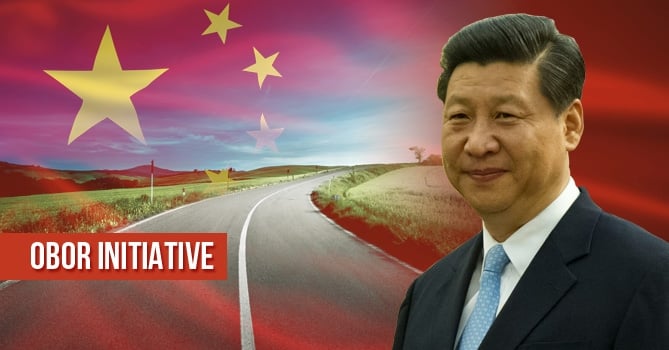
Xi’s $500 billion push to reshape the World in China’s image

Clipped from: http://www.msn.com/en-us/money/markets/xis-dollar500-billion-push-to-reshape-the-world-in-chinas-image/ar-BBB26Nn?li=BBmkt5R&ocid=spartandhp

China is one of the few countries in the world today with money to spend, and Xi Jinping is ready to write some checks.

China’s president will host some 28 world leaders in Beijing on Sunday at the first Belt and Road Forum, the centerpiece of a soft-power push backed by hundreds of billions of dollars for infrastructure projects. More than 100 countries on five continents have signed up, showing the demand for global economic cooperation despite rising protectionism in the U.S. and Europe.

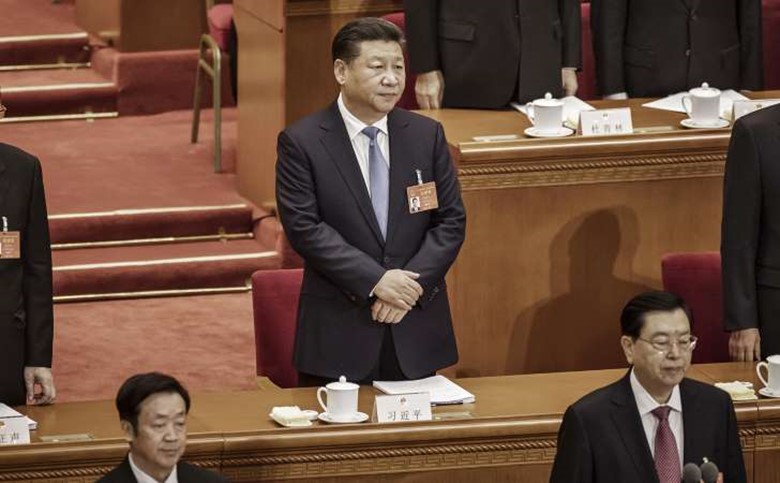
For Xi, the initiative is designed to solidify his image as one of the world’s leading advocates of globalization while U.S. President Donald Trump cuts overseas funds in the name of “America First.” The summit aims to ease concerns about China’s rise and boost Xi’s profile at home, where he’s become the most powerful leader since Deng Xiaoping died in 1997.

The Belt and Road Initiative “will likely be Xi’s most lasting legacy,” said Trey McArver, the London-based director of China research for TS Lombard, an investment research company. “It has the potential to remake global — particularly Asian — trade and economic patterns.”

The strategy also carries risks. The initiative is so far little more than a marketing slogan that encompasses all sorts of projects that China had initiated overseas for years, and major world leaders like Trump, Angela Merkel and Shinzo Abe are staying away. How Xi answers a range of outstanding questions will go a long way in determining its success.

Key to reducing uncertainty will be addressing the concerns of strategic rivals like India, Russia and the U.S., particularly as China’s growing military prowess lets it be more assertive over disputed territory. Chinese moves to spend more than $50 billion on an economic corridor in Pakistan, build a port in Djibouti and construct oil pipelines in central Asia are all creating infrastructure that could be used to challenge traditional powers.

“China needs to recognize that the way it perceives the Belt and Road Initiative is not necessarily the same way others will,” said Paul Haenle, a former China director on the U.S. National Security Council who now heads the Carnegie-Tsinghua Center in Beijing. For countries like the U.S., he said, “it’s impossible not to view the BRI through a geopolitical lens — a Chinese effort to build a sphere of influence.”

Xi’s $500 billion push to reshape the World in China’s image

© Bloomberg News Chinese president Xi Jinping

Excess Capacity

In September 2013, when Xi first pitched the plan at an obscure Kazakhstan university, he focused on the Eurasia landmass. Since then, it has repeatedly changed names and expanded to include the entire world, with the main goal of rebuilding the ancient trading routes from China to Europe overland and by sea.

One key driver was economic: China wants to spur growth in underdeveloped hinterlands and find more markets for excess industrial capacity. With more than $3 trillion in international reserves — more than a quarter of the world’s total — China has more resources than developed economies struggling to hit budget targets.

The plan gained steam last year when populist movements spurred a backlash against trade and immigration in the U.S. and Europe. Brexit raised questions about the European Union’s viability, while Trump’s withdrawal from the Trans-Pacific Partnership gutted the biggest U.S. push to shape global economic rules.

Trade Champion

“It was very disappointing, and it makes us feel that there is a big vacuum that Belt and Road can help to fill,” Cheah Cheng Hye, chairman and co-chief investment officer at the Hong Kong-based Value Partners Group. “So all of sudden, we begin to appreciate this Chinese initiative.”

Xi wasted no time filling the void. With exporting nations looking for a free-trade champion, he told the global elite in Davos, Switzerland, to resist protectionism and join China in boosting global commerce.

The U.S. and Europe “almost unwittingly” created space for Xi to push China’s interests, according to Peter Cai, research fellow at the Lowy Institute for International Policy.

“China is offering an alternative to the U.S. version of globalization,” Cai said. “In the Chinese case, it’s globalization paved by concrete: railways, highways, pipelines, ports.”

Related gallery: 33 giant Chinese infrastructure projects that are reshaping the world (provided by Business Insider)

Xi’s $500 billion push to reshape the World in China’s image

33 giant Chinese infrastructure projects that are reshaping the world

Draft Communique

This year, five European countries — Denmark, Finland, Switzerland, France and Italy — openly voiced support for the initiative. On trips to China in February, Italian President Sergio Mattarella proposed plans for the ports of Genoa and Trieste, while French Prime Minister Bernard Cazeneuve attended the arrival ceremony of a freight train from Lyon.

The summit will feature the likes of Russia’s Vladimir Putin, Greece’s Alexis Tsipras and the Philippines’ Rodrigo Duterte. The U.S. and most Western countries are expected to send lower-level representatives.

A draft communique circulated before the event combined a commitment to open markets with endorsements of China’s diplomatic goals, Bloomberg reported Wednesday, citing people familiar with the document. It also generated some controversy among Beijing-based diplomats who said they didn’t have enough time to vet the document, underscoring the initiative’s potential to cause conflict.

$500 Billion

China has invested more than $50 billion in Belt and Road countries since 2013, according to the official Xinhua News Agency. Credit Suisse Group AG said this month that China could pour more than $500 billion into 62 countries over five years.

China’s state-run companies like China National Petroleum Corp. and China Mobile Ltd. — the world’s largest wireless carrier — are positioned to reap the rewards. Executives from six of China’s largest state-run firms sought to reassure the public this week that the risks were manageable.

China’s three development banks, its Silk Road Fund and China-led Asian Infrastructure Investment Bank were involved in $143 billion of lending outside of the country last year, up more than 140 percent from 2014, according to data compiled by Bloomberg.

Read More: Chinese Largesse Lures Countries to Its Belt and Road Initiative

Still, financial hurdles are starting to appear. China’s slowing economic growth has left fewer resources to spend overseas. Its international reserves have fallen about 6 percent over the past year, and China needs a healthy amount to defend the yuan.

Some previous Chinese ventures abroad have turned sour. While China’s no-strings-attached approach to investment is generally welcomed by developing countries, they often have poor credit ratings and questionable governance. China has struggled to recoup loans in Venezuela and Africa, and several projects in Central Asia have spurred protests. Announcements with big dollar signs often fail to materialize.

Nonetheless, Chinese scholars see the sum of Xi’s plan as bigger than any individual project. It represents a “profound change” in how China interacts with the world, according to Wang Yiwei, director of at Renmin University’s Institute of International Affairs in Beijing, who has written three books on the initiative.

“China has moved from a participant of globalization to a main leader,” he said. “It’s Globalization 2.0.”

To contact Bloomberg News staff for this story: Ting Shi in Hong Kong at tshi31@bloomberg.net, Miao Han in Beijing at mhan22@bloomberg.net.  To contact the editors responsible for this story: Daniel Ten Kate at dtenkate@bloomberg.net, Brendan Scott 

Xi’s $500 billion push to reshape the World in China’s image