TOUGH TIMES NEVER LAST, BUT TOUGH PEOPLE DO: THE ENDURING SAGA OF THE DALAI LAMA

TOUGH TIMES NEVER LAST, BUT TOUGH PEOPLE DO: THE ENDURING SAGA OF THE DALAI LAMA


Sixty Years ago, His Holiness the 14th Dalai Lama survived a very tough ordeal to serve his Land and People to the best of his abilities.


Rudranarasimham Rebbapragada

SPECIAL FRONTIER FORCE


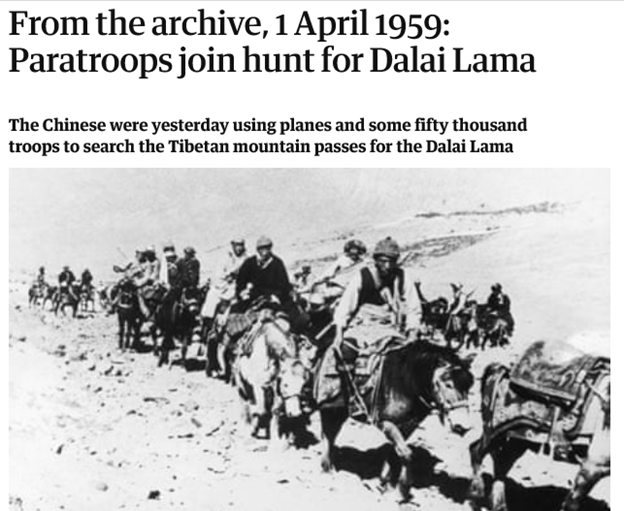
Clipped from: https://www.theguardian.com/theguardian/2011/apr/01/archive-dalai-lama-flees-to-india-1959


 The 14th Dalai Lama flees from Tibet to India across the Himalayas, 1959. He is riding a white pony, third from the right. Photograph: Popperfoto/Getty Images

The Chinese were yesterday using planes and some fifty thousand troops, including paratroops, to search the Tibetan mountain passes for the Dalai Lama. But according to reports from Kalimpong, in North-east India, the Tibetan religious leader, moving only by night, was expected to cross the frontier within a few days.

Meanwhile in New Delhi, Mr. Silun Lukhangwa, a former Tibetan Premier, said it was hoped to send a delegation to the United Nations to protest against Chinese action in his country. He was speaking after two Tibetan groups had appealed for Indian aid in the crisis in an interview with Mr. Nehru. An Indian official press release merely said: “Mr. Nehru spoke to them briefly, expressing the hope that the present difficulties in Tibet would end peacefully. He made it clear that India was not in a position to intervene and in fact would not like to take any steps which might aggravate the situation there.”

The Dalai Lama is accompanied on his flight by his mother and sisters, as well as most members of the Tibetan Cabinet, it was learned yesterday. His progress on the 200-mile trek to safety is slow, but it was believed in Kalimpong yesterday that reports that he had been injured in a fall were incorrect. The territory through which he is believed to be moving is the roadless mountainous region of the Tibetan plateau, south-east of Lhasa, bordering Bhutan and the Indian North-east Frontier Agency. The Indian north-east frontier region has been closed to anyone without a permit, and it was stated in New Delhi that no permits could be issued at present.

Reports said the Chinese were dropping paratroopers in an effort to intercept the Dalai Lama. Other troops were going from village to village and monastery to monastery “harassing” inhabitants and monks to try to extort information about him. Strong cordons of Chinese soldiers were being thrown round many monasteries, including the one at Rongbuk, near Mount Everest.

The Tibetan delegation gave Mr. Nehru a memorandum asking him:

1. To lend his active support in securing the personal safety of the Dalai Lama.

2. To send immediately a mercy mission to Tibet with medical supplies.

3. To sponsor the Tibetan cause before the United Nations.

4. To permit Tibetan refugees to cross over freely into India.

It was thought in New Delhi that Mr. Nehru might well pass on the memorandum to the Chinese for their information. The Tibetan groups’ leader, Mr. Lukhangwa, told reporters: “The Dalai Lama’s wishes are the wishes of the people of Tibet. Whatever he says, we will follow him.”


MARCH 29, 1973: THE UNFINISHED WAR TO CONTAIN COMMUNISM

MARCH 29, 1973: THE UNFINISHED WAR TO CONTAIN COMMUNISM


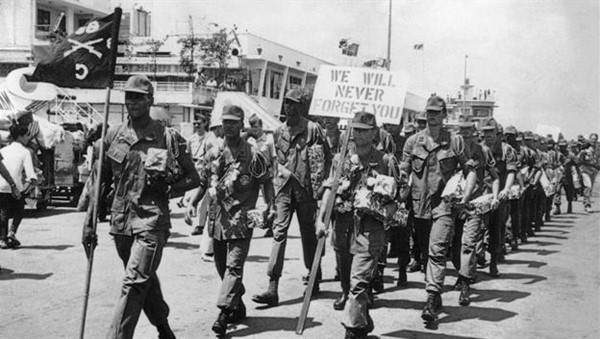
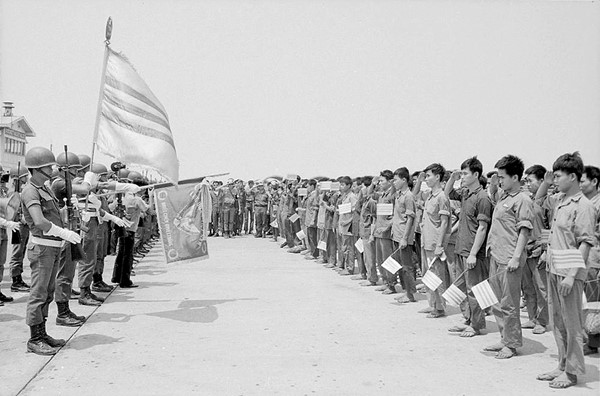
On March 29, 1973, the U.S. withdraws combat troops from Vietnam after the signing of the Vietnam Peace Agreement in Paris on January 29, 1973. However, the War to contain the threat posed by the spread of Communism to Asia is not over.


Rudranarasimham Rebbapragada

SPECIAL FRONTIER FORCE


Clipped from:

U.S. Withdraws from Vietnam-History


1973

U.S. withdraws from Vietnam


March 29. U.S. withdraws from Vietnam


Two months after the signing of the Vietnam peace agreement, the last U.S. combat troops leave South Vietnam as Hanoi frees the remaining American prisoners of war held in North Vietnam. America’s direct eight-year intervention in the Vietnam War was at an end. In Saigon, some 7,000 U.S. Department of Defense civilian employees remained behind to aid South Vietnam in conducting what looked to be a fierce and ongoing war with communist North Vietnam.

In 1961, after two decades of indirect military aid, U.S. President John F. Kennedy sent the first large force of U.S. military personnel to Vietnam to bolster the ineffectual autocratic regime of South Vietnam against the communist North. Three years later, with the South Vietnamese government crumbling, President Lyndon B. Johnson ordered limited bombing raids on North Vietnam, and Congress authorized the use of U.S. troops. By 1965, North Vietnamese offensives left President Johnson with two choices: escalate U.S. involvement or withdraw. Johnson ordered the former, and troop levels soon jumped to more than 300,000 as U.S. air forces commenced the largest bombing campaign in history.


During the next few years, the extended length of the war, the high number of U.S. casualties, and the exposure of U.S. involvement in war crimes, such as the massacre at My Lai, helped turn many in the United States against the Vietnam War. The communists’ Tet Offensive of 1968 crushed U.S. hopes of an imminent end to the conflict and galvanized U.S. opposition to the war. In response, Johnson announced in March 1968 that he would not seek reelection, citing what he perceived to be his responsibility in creating a perilous national division over Vietnam. He also authorized the beginning of peace talks.


Thanks for watching!

In the spring of 1969, as protests against the war escalated in the United States, U.S. troop strength in the war-torn country reached its peak at nearly 550,000 men. Richard Nixon, the new U.S. president, began U.S. troop withdrawal and “Vietnamization” of the war effort that year, but he intensified bombing. Large U.S. troop withdrawals continued in the early 1970s as President Nixon expanded air and ground operations into Cambodia and Laos in attempts to block enemy supply routes along Vietnam’s borders. This expansion of the war, which accomplished few positive results, led to new waves of protests in the United States and elsewhere.


Finally, in January 1973, representatives of the United States, North and South Vietnam, and the Vietcong signed a peace agreement in Paris, ending the direct U.S. military involvement in the Vietnam War. Its key provisions included a cease-fire throughout Vietnam, the withdrawal of U.S. forces, the release of prisoners of war, and the reunification of North and South Vietnam through peaceful means. The South Vietnamese government was to remain in place until new elections were held, and North Vietnamese forces in the South were not to advance further nor be reinforced.


However, the agreement was little more than a face-saving gesture by the U.S. government. Even before the last American troops departed on March 29, the communists violated the cease-fire, and by early 1974 full-scale war had resumed. At the end of 1974, South Vietnamese authorities reported that 80,000 of their soldiers and civilians had been killed in fighting during the year, making it the costliest of the Vietnam War.


On April 30, 1975, the last few Americans still in South Vietnam were airlifted out of the country as Saigon fell to communist forces. North Vietnamese Colonel Bui Tin, accepting the surrender of South Vietnam later in the day, remarked, “You have nothing to fear; between Vietnamese there are no victors and no vanquished. Only the Americans have been defeated.” The Vietnam War was the longest and most unpopular foreign war in U.S. history and cost 58,000 American lives. As many as two million Vietnamese soldiers and civilians were killed.


LIVING TIBETAN SPIRITS BEWITCHED BY “PEACEFUL LIBERATION” OF TIBET

LIVING TIBETAN SPIRITS BEWITCHED BY “PEACEFUL LIBERATION” OF TIBET

Living Tibetan Spirits bewitched by “peaceful liberation” of Tibet.

Living Tibetan Spirits are bewitched by “Peaceful Liberation” of Tibet. Occupation is a Lie. Tibet is Never a Part of China.

Rudranarasimham Rebbapragada

SPECIAL FRONTIER FORCE

Living Tibetan Spirits bewitched by “Peaceful Liberation” of Tibet.

China says Tibet human rights critics ‘bewitched’ by Dalai Lama | Reuters

Clipped from: https://www.reuters.com/article/us-china-tibet/china-says-tibet-human-rights-critics-bewitched-by-dalai-lama-idUSKCN1R80A3

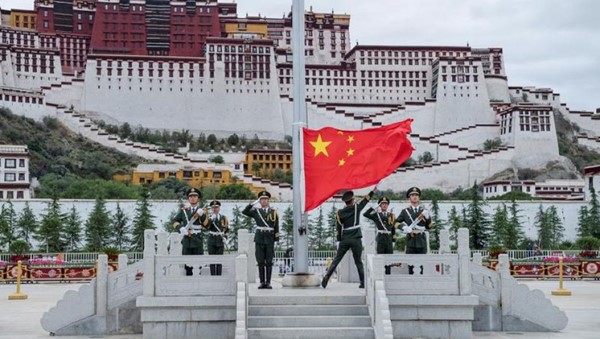
BEIJING (Reuters) – Those who criticize China over human rights in Tibet have been “bewitched” by the Dalai Lama, a senior Chinese official said on Wednesday, days before the 60th anniversary of the Tibetan spiritual leader’s flight into exile in India.

Living Tibetan Spirits Bewitched by “Peaceful Liberation” of Tibet.

People cross a road under flags marking Tibetan Serfs’ Emancipation Day on March 28, in Lhasa, Tibet Autonomous Region, China March 26, 2019. Picture taken March 26, 2019. REUTERS/Stringer

China says it “peacefully liberated” Tibet in 1950 and has since exerted enormous effort to bring the remote region into the modern era, abolishing feudal practices while protecting its Buddhist people’s right to freely practise their religion and maintain their culture.

Critics, including the United States, say China rules with an iron fist and has overseen widespread rights abuses.

Deputy Tibet governor Norbu Dondrup said Tibetan society was “very dark and very cruel” before Communist Party rule. He was speaking in Beijing on the release of a policy paper marking six decades since China began what it calls “democratic reforms” in Tibet.

He said ordinary people – or “serfs” – could be bought and sold, thrown in jail, or even killed at will when the Dalai Lama was in charge in Tibet.

“The Dalai Lama attacking our human rights totally has ulterior motives. He tramples on human rights, and has no right, no qualifications, and is unworthy of talking about human rights,” Norbu Dondrup said.

“As for some countries slamming our human rights, they either don’t understand or believe the Dalai clique’s rumors and bewitchments,” he said.

The human rights situation in Tibet was extremely good, he said, listing examples such as free medical care and an abundance of food.

Asked whether China would ever allow an independence referendum in Tibet, as has happened in Scotland and Quebec, Norbu Dondrup said Tibet has been an inseparable part of China since ancient times.

“We have never recognized Tibet independence, and neither has any other country,” he said. “Moreover, the peoples of Tibet in the extended family of the peoples of the motherland now have very happy lives.”
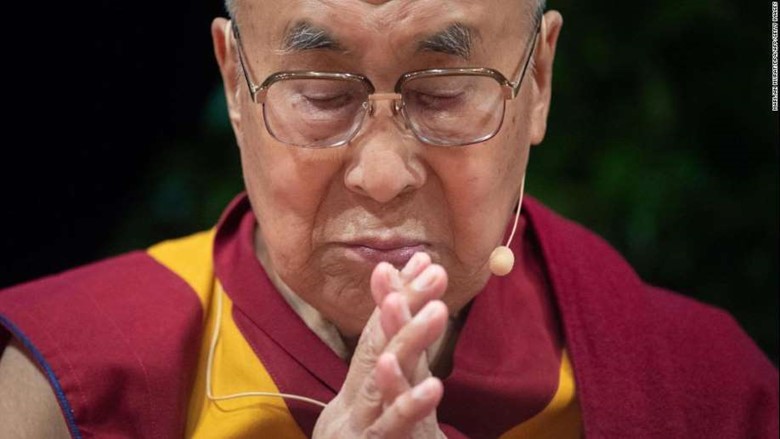
China reviles the Dalai Lama, who crossed the border into exile in India on March 31, 1959, after a failed uprising against Chinese rule.

Seen by Beijing as a dangerous separatist, he says he seeks merely genuine autonomy for his mountainous homeland and denies espousing violence.

The Dalai Lama told Reuters last week it was possible that, once he dies, his incarnation could be found in India and warned that any other successor named by China would not be respected.

The officially atheist Communist Party says it must approve his and other reincarnations of Tibetan lamas.

The Tibet issue has also become another irritant in China-U.S. ties after President Donald Trump signed into law a Reciprocal Access to Tibet Act in December.

That seeks to press China to open the region by denying U.S. entry to officials deemed responsible for restricting access to Tibet. China has denounced the law.

Reporting by Ben Blanchard; Editing by Paul Tait

Living Tibetan Spirits Bewitched by “Peaceful Liberation” of Tibet.


THE BATTLE FOR TIBET. TRUTH vs GUN


THE BATTLE FOR TIBET. TRUTH vs GUN


“Our strength, our power is based on truth. Chinese power based on gun,” the Dalai Lama said. “So, for short term, gun is much more decisive, but long term truth is more powerful.”


In my analysis, the Battle for Tibet will not be decided by either Chinese Gun or American Gun. Truth will prevail. China will reap the consequences of her own Evil actions. Tibet’s Identity is shaped by Natural Forces, Natural Causes, and Natural Factors that condition the nature of Tibetan Existence. Nature will unleash physical force to compel China to withdraw from illegally occupied Tibetan Territory.


Rudranarasimham Rebbapragada

Special Frontier Force


Exclusive: Dalai Lama contemplates Chinese gambit after his death. Reuters


Clipped from: https://www.reuters.com/article/us-china-tibet-dalai-lama-exclusive/exclusive-dalai-lama-contemplates-chinese-gambit-after-his-death-idUSKCN1QZ1NS?feedType=RSS&feedName=topNews


DHARAMSHALA, India (Reuters) –

The Dalai Lama, the spiritual leader of Tibetan Buddhism, said on Monday it was possible that once he dies his incarnation could be found in India, where he has lived in exile for 60 years, and warned that any other successor named by China would not be respected.

Sat in an office next to a temple ringed by green hills and snow-capped mountains, the 14th Dalai Lama spoke to Reuters a day after Tibetans in the northern Indian town of Dharamshala marked the anniversary of his escape from the Tibetan capital, Lhasa, disguised as a soldier.

He fled to India in early 1959 after a failed uprising against Chinese rule and has since worked to draw global support for linguistic and cultural autonomy in his remote and mountainous homeland.

China, which took control of Tibet in 1950, brands the 83-year-old Nobel peace laureate a dangerous separatist.

Pondering what might happen after his death, the Dalai Lama anticipated some attempt by Beijing to foist a successor on Tibetan Buddhists.

“China considers Dalai Lama’s reincarnation as something very important. They have more concern about the next Dalai Lama than me,” said the Dalai Lama, swathed in his traditional red robes and yellow scarf.

“In future, in case you see two Dalai Lamas come, one from here, in free country, one chosen by Chinese, then nobody will trust, nobody will respect (the one chosen by China). So that’s an additional problem for the Chinese! It’s possible, it can happen,” he added, laughing.

China has said its leaders have the right to approve the Dalai Lama’s successor, as a legacy inherited from China’s emperors.

But many Tibetans – whose tradition holds that the soul of a senior Buddhist monk is reincarnated in the body of a child on his death – suspect any Chinese role as a ploy to exert influence on the community.

Born in 1935, the current Dalai Lama was identified as the reincarnation of his predecessor when he was two years old.

Speaking in Beijing at a daily news briefing on Tuesday, Chinese foreign ministry spokesman Geng Shuang said the 14th Dalai Lama himself was chosen by following centuries-old religious rituals and history, which were “respected and protected” in rules and ordinances regulating religion.

“Therefore reincarnations, including that of the Dalai Lama, should observe the country’s laws and regulations and follow the rituals and history of religion,” Geng said.

UP FOR DISCUSSION

Many of China’s more than 6 million Tibetans still venerate the Dalai Lama despite government prohibitions on displays of his picture or any public display of devotion.

The Dalai Lama said contact between Tibetans living in their homeland and in exile was increasing, but that no formal meetings have happened between Chinese and his officials since 2010.

Informally, however, some retired Chinese officials and businessman with connections to Beijing do visit him from time to time, he added.

He said the role of the Dalai Lama after his death, including whether to keep it, could be discussed during a meeting of Tibetan Buddhists in India later this year.

He, however, added that though there was no reincarnation of Buddha, his teachings have remained.

“If the majority of (Tibetan people) really want to keep this institution, then this institution will remain,” he said. “Then comes the question of the reincarnation of the 15th Dalai Lama.”


FILE PHOTO: Tibetan spiritual leader the Dalai Lama, Patron of Children in Crossfire, speaks during a press conference in Londonderry, Northern Ireland September 11, 2017. REUTERS/Clodagh Kilcoyne/File Photo

If there is one, he would still have “no political responsibility”, said the Dalai Lama, who gave up his political duties in 2001, developing a democratic system for the up to 100,000 Tibetans living in India.

SEMINAR IN CHINA?

During the interview, the Dalai Lama spoke passionately about his love for cosmology, neurobiology, quantum physics and psychology.

If he was ever allowed to visit his homeland, he said he’d like to speak about those subjects in a Chinese university.

But he wasn’t expecting to go while China remained under Communist rule.

“China – great nation, ancient nation – but it’s political system is totalitarian system, no freedom. So therefore, I prefer to remain here, in this country.”

The Dalai Lama was born to a family of farmers in Taktser, a village on the northeastern edge of the Tibetan plateau, in China’s Qinghai province.

During a recent Reuters visit to Taktser, police armed with automatic weapons blocked the road. Police and more than a dozen plain-clothed officials said the village was not open to non-locals.

“Our strength, our power is based on truth. Chinese power based on gun,” the Dalai Lama said. “So, for short term, gun is much more decisive, but long term truth is more powerful.”

Reporting by Krishna N. Das; Additional reporting by Philip Wen in BEIJING; Editing by Simon Cameron-Moore


I SAY GOD MUST REINCARNATE TO DEFY THE CHINESE RULE OVER TIBET

I SAY GOD MUST REINCARNATE TO DEFY THE CHINESE RULE OVER TIBET

I say God must reincarnate to defy the Chinese Rule over Tibet.

I say God must reincarnate to defy the Chinese Rule over Tibet. If not, I ask God to give me a few pebbles to knock down The Goliath.

Rudranarasimham Rebbapragada

SPECIAL FRONTIER FORCE

China says Dalai Lama reincarnation ‘must comply’ with Chinese laws

Clipped from: https://www.telegraph.co.uk/news/2019/03/21/china-says-dalai-lama-reincarnation-must-comply-chinese-laws/

I say God must reincarnate to defy the Chinese Rule over Tibet.

The Dalai Lama, the Tibetan spiritual leader, warned that the successor chosen by China could not be trusted Credit: BIJU BORO/AFP/Getty Images

The Dalai Lama has warned of a possible “double reincarnation” with one from a “free country” after Beijing reiterated that his next incarnation must comply with Chinese law.

The Tibetan Buddhist leader on Monday warned that a successor chosen by Beijing after his eventual death could not be trusted.

He said it is possible that his reincarnation could be found in India, where he has lived in exile for 60 years upon fleeing Tibet following a failed uprising against Chinese rule.

“In future, in case you see two Dalai Lamas come, one from here, in free country, one chosen by Chinese, then nobody will trust, nobody will respect [the one chosen by China].

“So that’s an additional problem for the Chinese! It’s possible, it can happen,” he told Reuters in an interview.

I say God must reincarnate to defy the Chinese Rule over Tibet.

The Dalai Lama has lived in exile in northern India since the failed uprising, along with other Tibetans Credit: MONEY SHARMA/AFP/Getty Images

China stated in response that its leaders have the right to approve the Dalai Lama’s successor. The selection process “must comply with Chinese laws and regulations,” according to Geng Shuang, a spokesman for the foreign ministry.

Chinese state media highlighted those laws, titled “New Regulations on Religious Affairs and the Rules on the Management of the Reincarnation of Tibetan Living Buddhas.”

Many Tibetans, who believe that the soul of a senior Buddhist monk is reincarnated into the physical body of a child upon his death, worry a successor chosen by Beijing will be under the thumb of the ruling Communist Party.

The current Dalai Lama was identified as the reincarnation of his predecessor when he was two years old.

Now at 83, it’s getting harder for him to travel the world to boost awareness, and his influence is waning just as China’s is growing on the world stage.

I say God must reincarnate to defy the Chinese Rule over Tibet.

The Dalai Lama is now 83 Credit: STR/AFP/Getty Images

Beijing has recently cracked down heavily on religion under president Xi Jinping, after the government vowed to “Sinicize” faith. The wave of repression has affected Muslims, Christians, and Buddhists.

“China considers Dalai Lama’s reincarnation as something very important,” the Dalai Lama said in an interview with Reuters. “They have more concern about the next Dalai Lama than me.”

Beijing has previously co-opted the spiritual reincarnation process with a goal of bringing Tibetan Buddhism within party lines.

In 1995, the Dalai Lama named a young Tibetan boy as the reincarnation of the previous Panchen Lama – the second highest in spiritual authority after himself. But the child was then put under what Chinese officials described as protective custody.

Beijing put forth another successor and the Dalai Lama’s choice – then only six years old – disappeared from public.

‘Chinese interference is routine’

I say God must reincarnate to defy the Chinese Rule over Tibet.

The Chinese government has sought to discredit the Dalai Lama. In February, Wu Yingjie, leader of a parliamentary delegation from Tibet, said that Tibetans didn’t love the Dalai Lama at all.

“Since Dalai Lama defected from Tibet, he has never done a single thing that was for the benefit for the Tibetan people,” Mr. Wu said. Instead, “they are grateful for what the Party brings to them.”

Last May, Tashi Wangchuk, a Tibetan businessman, was given a five-year prison sentence by China for promoting the Tibetan language, based on comments made in interviews with the New York Times.

The Tibet Autonomous Region, in China’s far west, is considered a homeland to many Tibetans and remains on lockdown. Travel in and out of the region is difficult, even for Tibetans.

Foreign journalists cannot visit without government permission, and those requests are frequently denied. Chinese officials have said they are concerned this is out of concern that foreigners may find it difficult to acclimate to the high altitudes on the Tibetan plateau.

I say God must reincarnate to defy the Chinese Rule over Tibet.


MY LIFE’S STRUGGLE IN THE SHADOWS OF TIBET’S STRUGGLE

MY LIFE’S STRUGGLE IN THE SHADOWS OF TIBET’S STRUGGLE

My Life’s Struggle in the Shadows of Tibet’s Struggle.

I can best describe my life as an incessant struggle in the Shadows of Tibet’s Struggle for Freedom, Peace, and Justice in Occupied Tibet.

Rudranarasimham Rebbapragada

SPECIAL FRONTIER FORCE

Tibet struggle’s slow slide off the global radar as Dalai Lama ages

Clipped from: https://news.yahoo.com/tibet-struggles-slow-slide-off-global-radar-dalai-074037209.html

My Life’s Struggle in the Shadows of Tibet’s Struggle.

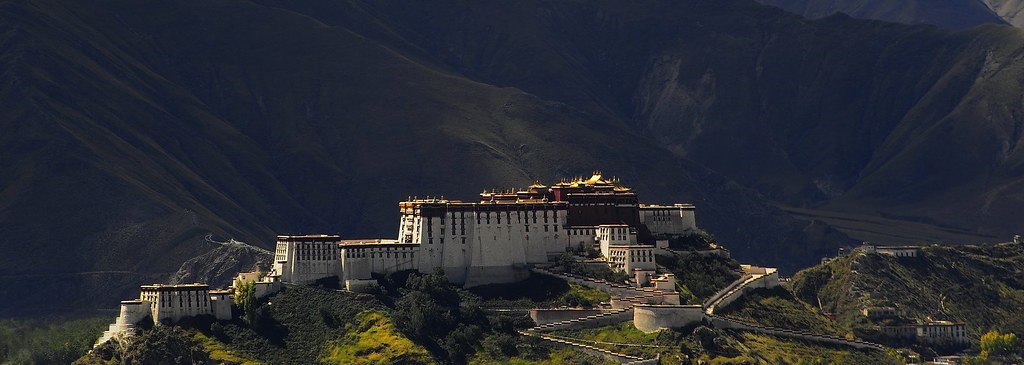
The iconic Potala Palace in Tibet’s regional capital of Lhasa (AFP Photo/JOHANNES EISELE)

Sixty years after the Dalai Lama fled into permanent Indian exile, the cause of Tibetan freedom that earned him a Nobel prize and a celebrity-studded international following has lost much of its momentum — neutralized, analysts say, by the passage of time and China’s rising global power.

Inside Tibet, Beijing has effectively wiped out any organized opposition to its iron-clad rule, while outside, the once-vocal support of sympathetic governments and world leaders has dwindled to near-silence in recent years despite the 14th Dalai Lama’s enduring personal popularity.

“The fate of Tibet is in the hands of the Chinese state… Tibetans outside the region are not very relevant to the fate of Tibet, and this includes the Dalai Lama”, said Nathan Hill, convener of Tibetan studies at the School of Oriental and African Studies (SOAS) in London.

In 2007, the Buddhist spiritual leader said his homeland was facing its “darkest period in 2,000 years”. The following year, with the world’s eyes on China in the run-up to the 2008 Olympics, protests unfurled across Tibet, sparking a furious response from Beijing.

“You don’t see protests like that anymore,” said Kate Saunders of the US-based International Campaign for Tibet, attributing the shift in part to Tibetans abiding by the Dalai Lama’s message of non-violence and to massive Chinese state surveillance.

Although the Dalai Lama’s campaign largely focused on autonomy rather than independence, negotiations with China stalled in 2010, amid suspicion that Beijing was intentionally dragging on pointless talks, hoping international pressure would ease with his eventual death.

The 83-year-old has sought to pre-empt any attempt by Beijing to name his reincarnated successor, even announcing in 2011 that he may be the last in the lineage.

The officially atheist Communist Party has already shown it will intervene in the reincarnation of important figures in Tibetan Buddhism, such as the Panchen Lama who traditionally plays a significant role in choosing the Dalai Lama’s successor.

The boy chosen by the Dalai Lama to serve as the Panchen Lama was detained by Chinese authorities at the age of six and has not been seen since, with Beijing appointing its own candidate in 1995.

Although the exiled leader remains a hugely popular speaker, he has cut back on his global engagements and has not met a world leader since 2016 — while governments have been wary of extending invitations to him for fear of angering Beijing.

“The craze for Tibet among Westerners in the 1980s and the following decades has decreased significantly”, said Katia Buffetrille, a Tibetologist at the Ecole Pratique des Hautes Etudes in Paris.

Even India, which offered asylum to the Dalai Lama in 1959 when he made a daring escape across the Himalayas dressed as a soldier, has turned its back, with the government reportedly warning officials against attending events featuring him, citing diplomatic sensitivities.

– Buying freedom –

As the exile-led movement loses momentum, Tibetans at home are struggling to keep their traditions alive.

“Tibetans live in a totalitarian police state — if they challenge restrictions, they face the consequences,” said Gray Tuttle, a professor of modern Tibetan studies at Columbia University.

“Previous protests from the 1980s on… have yielded no tangible benefits, rather they have generated a worse political outcome and further clampdown.”

At least 150 Tibetans have set themselves on fire since 2009 in protest against Beijing, most of whom have died from their injuries. But the frequency of self-immolations has lessened.

China’s investment in the region includes a huge outlay on security to build a surveillance state that makes it harder to organize protests. Rights groups say that a government campaign targeting the family and friends of protesters has also helped suppress dissent.

Beijing insists that Tibetans enjoy extensive freedoms and argues it has brought economic growth to the mountainous region.

The oppression of Uighurs in Xinjiang has also overtaken Tibet as the focus of China’s human rights critics.

When Germany’s top human rights official Barbel Kofler asked to visit Xinjiang last year, she was taken instead to Tibet — an indication of how much Beijing feels secure about the situation there, even though foreign journalists are still barred from reporting independently in the region.

Many locals accuse Beijing of repressing their religion and diluting their culture, but nonetheless the economic growth — boosted by government subsidies — has even seen Tibetan exiles return to the region.

Tibetologist Francoise Robin, who visits the region every year, told AFP that Beijing had effectively sidelined any talk of freedom by pumping money into Tibet.

“This is what is paradoxical in the case of Tibet, compared to other similar situations, because China is a country… that is on the rise. Often, in order for a rebellion, for a mass movement to rise, you need economic despair.”

burs-amu/fox/fa

My Life’s Struggle in the Shadows of Tibet’s Struggle.


Whole Dude – Whole Welcome – Spring 2019

Welcome to Spring Season on Wednesday, March 20, 2019

LORD OF SEASONS – WELCOME TO SPRING. CELEBRATING FIRST DAY OF SPRING. I seek Blessings of Lord Madhava and Goddess Madhavi to renew my creative energy and to guide expression of my thoughts using sweet words and to promote the well-being of all my readers and become a source of Happiness to all people.

In the Indian tradition, the creative energy is personified as Goddess Madhavi, and Her consort Lord Madhava is the Controller of Creative Energy. Today, I seek Blessings of Lord Madhava and Goddess Madhavi to renew my creative energy and to guide expression of my thoughts using sweet words and to promote the well-being of all my readers and become a source of Happiness to all people.

I seek Blessings of Lord Madhava and Goddess Madhavi to renew my creative energy and to guide expression of my thoughts using sweet words and to promote the well-being of all my readers and become a source of Happiness to all people.

LORD OF SEASONS – WELCOME TO SPRING. CELEBRATING THE FIRST DAY OF SPRING ON WEDNESDAY, MARCH 20, 2019.

I wish all my readers, ‘Happy First Day of Spring’.

Welcome to Spring Season 2019. I seek Blessings of Lord Madhava and Goddess Madhavi to renew my creative energy and to guide expression of my thoughts using sweet words and to promote the well-being of all my readers and become a source of Happiness to all people.

LORD OF SEASONS – WELCOME TO SPRING ON WEDNESDAY, MARCH 20, 2019. EVERY CHANGING PHENOMENON IN NATURE IS OPERATED BY UNCHANGING REALITY.

Every changing phenomenon in nature is operated by Unchanging Reality. Spring Season brings a change, and this change is possible for it is governed by Unchanging Reality. In Indian tradition, Spring Season is glorified for it symbolizes LORD MADHAVA, Lord of Seasons.

Welcome to Spring Season 2019. I seek Blessings of Lord Madhava and Goddess Madhavi to renew my creative energy and to guide expression of my thoughts using sweet words and to promote the well-being of all my readers and become a source of Happiness to all people.

The Divine Song called Bhagavad Gita, Chapter X, ‘The Infinite Glories of the Ultimate Truth’- ‘VIBHUTI VISTARA YOGA’, describes LORD God Creator’s Infinite Divine Attributes. In verse # 35, Lord Krishna describes Himself as The Lord of Spring Season – The Flowery Season: “Rtunam Kusumakarah.”

Welcome to Spring Season 2019. I seek Blessings of Lord Madhava and Goddess Madhavi to renew my creative energy and to guide expression of my thoughts using sweet words and to promote the well-being of all my readers and become a source of Happiness to all people.

LORD OF SEASONS – WELCOME TO SPRING. LORD KRISHNA AS MADHAVA SYMBOLIZES THE SEASON OF FLOWERS, SEASON OF JOY.

Welcome to Spring Season 2019. I seek Blessings of Lord Madhava and Goddess Madhavi to renew my creative energy and to guide expression of my thoughts using sweet words and to promote the well-being of all my readers and become a source of Happiness to all people.

The word ‘Spring’ describes the move upward or forward from the ground, it denotes resilience or bounce, and it means to grow or develop or come into existence quickly. Among the Seasons, the Spring Season is the time during which plants begin to grow after lying dormant all Winter. In the North Temperate Zone, the Spring Season includes the months of March, April, and May, the period between the Vernal Equinox and the Summer Solstice.

Welcome to Spring Season 2019. I seek Blessings of Lord Madhava and Goddess Madhavi to renew my creative energy and to guide expression of my thoughts using sweet words and to promote the well-being of all my readers and become a source of Happiness to all people.

LORD OF SEASONS – WELCOME TO SPRING. The Spring Season begins on Wednesday, March 20, 2019, Vernal Equinox or Spring Equinox, the day on which duration of Light and Darkness (Day and Night) are equal in all parts of the world.

LORD MADHAVA – LORD OF THE SPRING SEASON:

Welcome to Spring Season 2019. I seek Blessings of Lord Madhava and Goddess Madhavi to renew my creative energy and to guide expression of my thoughts using sweet words and to promote the well-being of all my readers and become a source of Happiness to all people.

LORD OF SEASONS – WELCOME TO SPRING. In Indian tradition, Spring Season is called ‘BASANT’, ‘VASANT’,’KUSUMAKARA’ or ‘MADHAVAM’. A chief, alluring feature of this Season is the flowering of plants. Mangifera indica, MANGO plant, a native of India bears flowers and promises to deliver its sweet, and delicious fruits.

The Spring Season is a time for rebirth, regeneration, renewal, and regrowth after a period of dormancy. Man derives a sense of joy and happiness when the plants start their growing process and quickly bear attractive flowers. It gives the experience of ‘Sweetness’ which is called ‘Madhurya’ in the Sanskrit language. It is a manifestation of a creative process, or operation of creative energy that makes human existence possible giving the man the sensation associated with consuming nectar, honey, or sweet wine. In Indian tradition, this creative energy is personified as Goddess Madhavi, and Her consort Lord Madhava is the Controller of Creative Energy. Today, I seek Blessings of Lord Madhava and Goddess Madhavi to renew my creative energy and to guide expression of my thoughts using sweet words and to promote the well-being of all my readers and become a source of Happiness to all people.

Welcome to Spring Season 2019. I seek Blessings of Lord Madhava and Goddess Madhavi to renew my creative energy and to guide expression of my thoughts using sweet words and to promote the well-being of all my readers and become a source of Happiness to all people.
Spring Season brings a sense of Joy, uplifts the mood of man. The Joy could be compared to the sweetness of nectar that is gathered by butterflies from various Spring Season flowers.

THE EXILED TIBETAN RULER LIVES IN THE HEARTS OF NATIVE TIBETANS

The Official Enthronement Ceremony of the 14th Dalai Lama in Lhasa.
THE EXILED TIBETAN RULER LIVES IN THE HEARTS OF NATIVE TIBETANS

Six decades ago, the Supreme Ruler of Tibet, His Holiness the 14th Dalai Lama was forced to live in exile. He still lives in the hearts of native Tibetans of Occupied Tibet.

Rudranarasimham Rebbapragada

SPECIAL FRONTIER FORCE

Clipped from: https://www.reuters.com/article/us-china-tibet-idUSKBN1QT32M

After 60 years in exile, Dalai Lama’s still remembered in his homeland

Philip Wen

TAKTSER, China (Reuters) – It may have been six decades since the Dalai Lama fled into exile, but in the isolated mountain hamlet where he was born, he remains very much on the minds of devotees and Chinese authorities alike.

The Exiled Tibetan Ruler lives in the hearts of the Native Tibetans in Occupied Tibet.

Buddhist monks enter a prayer hall at Rongwo Monastery in the largely ethnic Tibetan town of Rebkong, Qinghai province, China March 9, 2019. The picture was taken on March 9, 2019. REUTERS/Thomas Peter

On the northeastern edge of the Tibetan plateau, Taktser, in Qinghai province, where the Dalai Lama was born in 1935 to parents who farmed buckwheat and barley, is a magnet to worshippers and foreign tourists – and security personnel.

During a recent Reuters visit to Taktser, known in Chinese as Hongya, police armed with automatic weapons blocked the winding road leading into the village of some 60 houses.

The Exiled Tibetan Ruler Lives in the hearts of the Native Tibetans in Occupied Tibet.

Police and more than a dozen plain-clothed officials who declined to identify themselves refused Reuters entry, saying the village was private and not open to the public.

The Qinghai government and China’s State Council Information Office, which doubles as the Communist Party’s spokesman’s office, did not respond to requests for comment.

Beijing views the Nobel Peace Prize laureate as a dangerous separatist and has denounced the 83-year-old spiritual leader as a “wolf in monk’s robes”. The Dalai Lama denies espousing violence and says he only wants genuine autonomy for Tibet.

The Exiled Tibetan Ruler Lives in the hearts of the Native Tibetans in Occupied Tibet.

Many of China’s more than 6 million Tibetans still venerate the Dalai Lama, despite government prohibitions on displays of his picture or any public display of devotion.

This Sunday marks 60 years since the Dalai Lama, disguised as a soldier, fled the Potala Palace in Lhasa, the Tibetan capital after rumors that Chinese troops were planning his abduction or assassination fomented an abortive popular uprising.

The Dalai Lama crossed into India two weeks later and has not set foot in Tibet since.

Despite the passage of time, during sensitive political anniversaries, China’s security apparatus routinely restricts access to the village where the Dalai Lama’s old family is located, behind a pair of wooden doors and high concrete walls.

‘IN YOUR HEART’

One 29-year-old Tibetan man in the largely ethnic Tibetan town of Rebkong, set in a precipitous valley in Qinghai with a large monastery adorned in rich colors, enthusiastically recounted to Reuters his pilgrimage to Taktser years ago.

He said Tibetans were well aware of the upcoming 60th anniversary of the Dalai Lama’s exile, even if public commemorations of any sort were banned.

“You can only bury it in your heart, we just don’t speak about it,” he said, declining to be identified due to the sensitivity of the matter.

“We have no ability to go against politics, we can only just go with society.”

Born Lhamo Thondup, the Dalai Lama was just two years old when identified by a search party as the new incarnation of Tibet’s most important spiritual leader, and was whisked from the family home to live in Lhasa.

The anniversary of his escape over the mountains into exile in India is one of several politically sensitive dates in China this year, including the 30th anniversary of the crackdown on pro-democracy demonstrators in Tiananmen Square in June, that the ruling Communist Party wants to ensure passes without controversy.

Speaking on the sidelines of China’s annual meeting of parliament this month, Tibet’s Communist Party chief Wu Yingjie said the Tibetan people felt greater affection toward the government than the Dalai Lama, who “hasn’t done a single good thing for the people of Tibet”.

As the Dalai Lama ages, many Tibetans fear that Beijing will simply appoint its own replacement.

The Dalai Lama has suggested that his incarnation might be found outside Chinese-controlled territory, or that the centuries-old Dalai Lama institution could die with him.

The Exiled Tibetan Ruler Lives in the Hearts of the Native Tibetans in Occupied Tibet.


A Buddhist monk walks outside Rongwo Monastery in the largely ethnic Tibetan town of Rebkong, Qinghai province, China March 9, 2019. The Picture was taken on March 9, 2019. REUTERS/Thomas Peter
The Exiled Tibetan Ruler Lives in the Hearts of the Native Tibetans in Occupied Tibet.


Monks walk in the Tibetan Buddhist Kumbum Monastery outside Xining, Qinghai province, China March 10, 2019. The picture was taken on March 10, 2019. REUTERS/Thomas Peter
The Exiled Tibetan Ruler Lives in the Hearts of the Native Tibetans in Occupied Tibet.


A monk circles the Tibetan Buddhist Kumbum Monastery during a prayer ritual outside Xining, Qinghai province, China March 10, 2019. The picture was taken on March 10, 2019. REUTERS/Thomas Peter

Reporting by Philip Wen; Editing by Tony Munroe, Robert Birsel

TIBET: THE UNTOLD STORY

TIBET: THE UNTOLD STORY

Tibet: The Untold Story. The Land and its People exploited by the Military Occupier.

While the world pays due attention to the flight of His Holiness the Dalai Lama in 1959, I remind my readers to reflect upon the lives of countless number of innocent Tibetans who lost their lives on account of the brutal and oppressive Communist Regime. Apart from the people, Tibet is ruthlessly exploited and plundered by the military Occupier of Tibet.

Rudranarasimham Rebbapragada

SPECIAL FRONTIER FORCE

Pictures: the Tibetan uprising and the Dalai Lama’s exile — Quartz

Clipped from: https://qz.com/1568762/pictures-the-tibetan-uprising-and-the-dalai-lamas-exile/

Today (March 10) marks the 60th anniversary of the 1959 Tibet uprising against Chinese rule. The rebellion ultimately failed, leading to the decades-long exile of the 14th Dalai Lama, the Tibetan Buddhist spiritual leader.

In the six decades since he escaped to India, the Dalai Lama has evolved into an international icon of nonviolence and spiritual aspirations, traveling frequently and being hosted by political and religious leaders as well as celebrities around the world.

Here is a look at his journey from living among his people at age 23 to his status now as an 83-year-old man unable to return home.

Tibet: The Untold Story. The Land and its People exploited by the Military Occupier.

AP Photo

Chinese Red Army troops fire heavy artillery guns in Lhasa Valley, Tibet, on March 17, 1959, crushing a Tibetan uprising against the Chinese occupation.

AFP/Getty Images

Tibetans gather during armed uprising against Chinese rule March 10, 1959, in front of the Potala Palace (former home of the Dalai Lama) in Lhasa.

Tibet: The Land and its People exploited by the Military Occupier.

AP Photo

The 23-year-old Dalai Lama and his escape party is shown on the fourth day of their flight to freedom as they cross the Zsagola pass, in Southern Tibet, while being pursued by Chinese military forces, on March 21, 1959, after fleeing Lhasa.

Tibet: The Untold Story. The Land and its People exploited by the Military Occupier.

AFP/Getty Images

Tibetan monks, surrounded by soldiers of the Chinese Popular Liberation Army, lay down arms in April 1959, somewhere in the Tibetan mountains after an unsuccessful armed uprising against Chinese rule.

Tibet: The Untold Story. The Land and its People exploited by the Military Occupier.

AP Photo

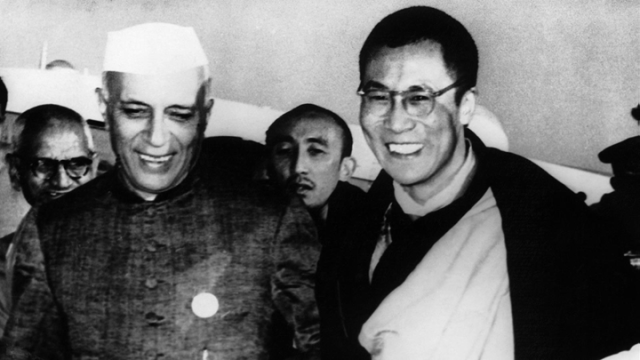
An Indian official greets the Dalai Lama on the latter’s arrival at a military camp on the frontier of Assam April 18, 1959, in India.

Tibet: The Untold Story. The Land and its People exploited by the Military Occupier.

AP Photo


Armed with a sword, a member of the Dalai Lama’s Tibetan bodyguard is shown at Birla House, Missouri, India, April 21, 1959.

AP Photo

The Dalai Lama of Tibet poses with his hosts, the wealthy Indian Birla brothers and their families April 28, 1959, at Birla house, Mussoorie, India.

AP Photo

The Dalai Lama of Tibet, right, sitting under a portrait of the Buddha, inaugurates the 2,503rd birthday of the Buddha at Birla House in Mussoorie, India on May 22, 1959.

AP Photo

The Dalai Lama at a press conference on June 25, 1959.

AP Photo/Fred Waters

The Dalai Lama of Tibet visits the Taj Mahal in Agra, India on Dec. 8, 1959.

AP Photo

Behind rain-spattered window of car bearing him to his Tokyo hotel, the Dalai Lama greets crowd at the city’s International Airport after arrival from India on Sept. 25, 1967.

AP Photo

The Dalai Lama converted about 2,000 Hindu untouchables to Buddhism at a colorful ceremony in New Delhi on March 11, 1973.

AP Photo/Gene Kramer

Tibet’s Dalai Lama in Simla, India on Oct. 24, 1978, as he nears his 20th anniversary in exile from his native homeland of Tibet.

AP Photo/T. Matsumoto

Welcomed in Tokyo in 1978.

AP Photo/Dan Grossi

Television talk show host Tom Snyder shares a joke with the Dalai Lama during the taping of NBC’s “Tomorrow” show in New York, Sept. 5, 1979.

AP Photo/Robert H. Houston

The Dalai Lama met with then-San Francisco Mayor Diane Feinstein and her fiancé Richard Blum at San Francisco City Hall, Sept. 26, 1979.

AP Photo

Pope John Paul II shakes hands with Dalai Lama, exiled spiritual leader of more than 6 million Tibetans, during a private meeting in Vatican City in Oct. 9, 1980.

AP Photo/Sondeep Shankar

Tibetan spiritual and political leader Dalai Lama offers a scarf during a special prayer meeting Oct. 7, 1987, in the Himalayan foothill town Dharmasala for the estimated 14 dead during the unrest in Lhasa, the Tibetan capital.

AP Photo/Neal Ulevich

The ruins of a Tibetan Buddhist monastery sit on a hill outside Lhasa, July 16, 1985. Before the 1959 revolt against China and the subsequent chaos of the 1966-76 Cultural Revolution, Tibet had more than 2,700 monasteries.

AP Photo/Dave Caulkin

Mother Teresa of Calcutta meets with the Dalai Lama, at the Global Survival Conference in Oxford, England April 12, 1988.

AP Photo/Reed Saxon

The Dalai Lama of Tibet is flanked by actor and activist Richard Gere, left, and model and actress Cindy Crawford, at a dinner to benefit the American Himalayan Foundation at the Beverly Wilshire Hotel in Beverly Hills, California on Sept. 17, 1993.

Reuters

The Dalai Lama waves to the crowd at the Smithsonian Folklife Festival on the mall in Washington on July 2, 2000.

Reuters/Mike Segar

The Dalai Lama, speaks to a crowd estimated at over 40,000 in New York’s Central Park on Aug. 15, 1999.

Reuters/David Gray

The Dalai Lama speaks to a large crowd in Sydney on May 26, 2002.

Reuters/Claro Cortes IV

Chinese military police keep watch on the roof of Potala Palace in Lhasa on Aug. 12, 2002.

Reuters/Boris Roessler/Pool

The Dalai Lama salutes a crowd near Frankfurt, Germany on Sept. 22, 2007.

Reuters/Rupak De Chowdhuri

Tibetan monks take part in a candle light rally on the outskirts of the Indian city of Siliguri in support of the protests in Tibet on March 15, 2008.

Reuters/Adnan Abidi

Police arrest a Tibetan exile outside the Chinese embassy in New Delhi on March 17, 2008.

Reuters/Adnan Abidi

Tibetan monks shout slogans during a protest in New Delhi on March 17, 2008.

Reuters/Shannon Stapleton

The Dalai Lama greets Buddhist monks before a teaching session at Radio City Music Hall in New York on May 20, 2010.

Reuters

The Dalai Lama poses for a picture with the students of a Tibetan school after inaugurating its auditorium at Gurupura in the southern Indian state of Karnataka on July 14, 2013.

Reuters

A young Tibetan monk holds a portrait of the Dalai Lama, during celebrations marking his 80th birthday anniversary in the northern hill town of Dharamsala, India on July 6, 2015.

Reuters/Anuwar Hazarika

The Dalai Lama waves to his followers before delivering teachings at the Thupsung Dhargyeling Monastery in Dirang, in the northeastern state of Arunachal Pradesh, India on April 6, 2017.

Tibet: The Untold Story. The Land and its People exploited by the Military Occupier.

Reuters/Arnd Wiegmann

Dalai Lama arrives for his visit to the Tibet Institute Rikon in Rikon, Switzerland on Sept. 21, 2018.

Tibet: The Untold Story. The Land and its People exploited by the Military Occupier.


CHINA CAN’T HANDLE THE HEIGHTS OF TIBETAN UPRISING

CHINA CAN’T HANDLE THE HEIGHTS OF TIBETAN UPRISING

60th Anniversary of Tibetan National Uprising Day. China Can’t Handle the Heights of Tibetan Uprising.

In my analysis, China imposed travel restrictions for China can’t handle the Heights of Tibetan Uprising which is climbing to a new peak after 60-Years of pent up resentment opposing the military occupation of Tibet.

Rudranarasimham Rebbapragada

SPECIAL FRONTIER FORCE

No head for heights: China defends Tibet travel restrictions | Reuters

Clipped from: https://www.reuters.com/article/us-china-parliament-tibet-idUSKCN1QN1AW

BEIJING (Reuters) – Foreigners can’t handle Tibet’s high altitude so China needs to restrict access, the top Chinese official in charge of the remote and mountainous region said on Wednesday, defending tough government restrictions on who can go there.

60th Anniversary of Tibetan National Uprising Day. China Can’t Handle the Heights of Tibetan Uprising.

Communist Party Secretary of Tibet Autonomous Region Wu Yingjie and Governor of Tibet Autonomous Region Qizhala attend a news conference during the National People’s Congress (NPC) in Beijing, China, March 6, 2019. REUTERS/Thomas Peter

Access to Tibet, which China says it “peacefully liberated” in 1950, has become another irritant in ties with the United States after President Donald Trump signed into law a Reciprocal Access to Tibet Act in December.

That seeks to press China to open the region by denying U.S. entry to officials deemed responsible for restricting access to Tibet. China has denounced the law.

Speaking on the sidelines of China’s annual meeting of parliament, Tibet’s Communist Party boss Wu Yingjie said many Americans visit Tibet, especially older ones, and some foreign tourists “meet with mishap” at high altitude.

Tibetans have been finding foreigners who have died because of the harsh conditions, he said.

“The ordinary people tell us, there’s a tent, the people inside have been dead for many days, with the lack of oxygen,” Wu said. It was not clear what he was referring to and he did not elaborate.

“After considering the special geographical and climatic conditions, we adopted a series of regulations on foreigners entering Tibet in accordance with the law. This is not only for Americans. Other foreigners also have to complete these procedures.”

Tibet’s main city, Lhasa, is at about 3,650 meters (nearly 12,000 feet). Altitude sickness can affect some people at that height.

While some foreigners thank the government for the concern and help given them, only Americans “brood” about it, Wu said.

“This is really odd. If you have the opportunity go tell this to the American people.”

Non-Chinese visitors must apply for a special permit to travel to Tibet, which is usually granted for tourists provided they travel with approved tour companies but rarely for journalists and diplomats.

The government pledged in January to make access easier for foreign tourists.

60th Anniversary of Tibetan National Uprising Day. China Can’t Handle the Heights of Tibetan Uprising.

Rights groups and overseas activists say ethnic Tibetans face widespread restrictions under Chinese rule and the U.N. High Commissioner for Human Rights said in June conditions were “fast deteriorating”.

China routinely denies such accusations and says its rule of Tibet ended serfdom and brought prosperity to what was a backward region, and that it fully respects the rights of the Tibetan people.

This year marks the 60th anniversary of a failed Tibetan uprising against Chinese rule in 1959, which resulted in Tibet’s Buddhist spiritual leader, the Dalai Lama, fleeing into exile in India.

China views the Nobel Peace laureate as a dangerous separatist. The Dalai Lama denies espousing violence and says he only wants genuine autonomy for Tibet.

Many Tibetans in China still deeply venerate the Dalai Lama, despite government restrictions on displays of his picture, especially in what China calls the Tibet Autonomous Region.

Wu said the Dalai Lama was not popular in Tibet.

“Since defecting, the Dalai Lama hasn’t done a single good thing for the people of Tibet,” he said.

“The people of Tibet have weighed things up, and really thank the Communist Party for the happy life they have brought them.”

Reporting by Michael Martina and Gao Liangping; Writing by Ben Blanchard; Editing by Robert Birsel