WHOLE SPIRITUALITY – WHOLE COGNITION

SPIRITUALISM – THE COGNITIVE SCIENCE OF SPIRITUALITY :

The term cognition is derived from Latin word ‘cognitio’ which means knowledge which is related to the Latin word ‘cognoscere( co-, together + gnoscere, know) which means the act or process of knowing. Cognitive Science involves the study of all human activities related to knowledge. These activities include attention, creativity, memory, perception, problem solving, thinking, and the use of language. Cognition is the process involved in knowing, or the act of knowing which includes awareness and judgment. Cognition is often viewed as a psychological function and its nature is described as the relationship between the knowing mind and external reality. The Cognitive Science of Spirituality that I would like to describe is related to the cognitive abilities of a living cell or living organism; the abilities such as recognition, responsiveness, communication using signals, memory, ability to process, store, retrieve, and use information that could be innate or acquired, the ability of adaptation to changing internal or external environmental conditions, and the fact of awareness of its own existence; the awareness of its internal condition, and the awareness of its external environment.

Amoeba proteus and The Cognitive Science of Spiritualism. To understand the human person as a Spiritual being, we need to know and understand the Spiritual nature of Living Matter or Living Substance and describe its Cognitive abilities.

The purpose of the Cognitive Science of Spirituality is not that of describing a cognitive theory of human personality. The Behavioral Science is primarily involved in the study of stimuli and responses; it observes human activities particularly social behavior and not that of higher mental processes which are not available to direct examination. While Cognitive Science is concerned with mind’s ability to acquire, process, store, and use information, the information processed need not be represented in cortical awareness. Cognitive Psychology does not rely on conscious introspection or mental reflection. The Cognitive Science of Spirituality that I describe does not involve acts of Meditation or mental introspection to discover the spiritual nature of man. I suggest that Spiritualism can be understood without regard to the machinery of brain/mind’s information processing. The organism that we all know as Amoeba( Greek word – ‘Amoibe’ which means change) is a spiritual entity as it is Conscious or Aware of its existence, it shows responsiveness by changing its shape as it likes, it is Intelligent for it uses, processes, stores, retrieves, and uses information to perform its metabolic functions, and it displays abilities such as adaptation and memory of its acquired experience. I tend to view these biological functions and characteristics as an attribute of the spiritual nature of its living substance and this spiritual nature brings functional harmony to sustain its existence as a biological entity.

THE THEORY OF KNOWLEDGE AND THE COGNITIVE SCIENCE OF SPIRITUALISM :
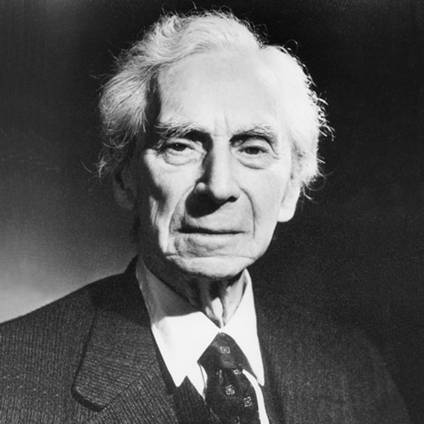
Bertrand Arthur William Russel, b. May. 18, 1872, d. February. 02, 1970. English logician and philosopher, best known for his work in mathematical logic, his advocacy of both Pacifism and Nuclear Disarmament. He received the Nobel Prize for Literature in 1950.

I am not concerned about Bertrand Russell’s skeptical atheist temperament. The Spiritualism that I describe is not about religious faith or belief and the Spirituality that I write about is not concerned with religious practices or rituals. I claim that man is a Spiritual being because of the spiritual nature of his living matter or living substance. It is important to know that Russell was determined not to be beguiled by human pretensions to knowledge. He had never supported unbacked assumptions either about the foundations of knowledge or about what may be said to exist. He endorsed the application of rationality to all aspects of human thought and language. He was seriously concerned with the application of logical analysis to epistemological questions and attacked this problem by trying to breakdown human knowledge into minimum statements that were verifiable by empirical observation, reason, and logic. He was convinced that all knowledge is dependent on sense experience. His primary aim was to inquire with skeptical intent, “how much we can be said to know and with what degree of certainty or doubtfulness.” In 1898, with Trinity Fellow G.E. Moore, he rebelled against Idealism and became an Empiricist, a Positivist, and a Physical Realist or a Materialist. He held that the scientific view of the world is largely the correct view. He addressed the problem of the pretensions of human knowledge in his books, An Inquiry into Meaning and Truth(1940) and Human Knowledge, Its Scope and Limits(1948). His aim was also analytic and he assumed that it is possible to infer something about the world from the language in which it is correctly described. Russell analyzed that language must be used to state its minimum requirements, its atomic facts and avoid the use of descriptive phrases which may postulate the existence of objects. He held that a proposition is a picture of the facts that it asserts and must have in a sense the same structure. He stressed the importance of similarity of structure as a criterion in inferring causal relationships. In a Lecture titled ‘Why I am not a Christian’ given on March 06, 1927, Russell explained the nature of his beliefs about God and Mortality. In his opinion and personal belief, he held the view that Life suitable to Protoplasm could be possible under certain physical conditions like temperature. Russell’s speculative assumption about the existence of Life or Protoplasm is not supported by scientific evidence. He had no scientific data to support his view. The ideal conditions for Life and Protoplasm exist right now and what we know is that Life is always born from previously existing Life. However, he had concluded his Lecture by stating that, “it needs hope for the future……., the future that our intelligence can create.” His assumption that human intelligence is the basis for man’s biological existence is incorrect and is not consistent with the scientific reality about human existence and its nature. At a very fundamental level, man’s ability to acquire energy from an external source in the physical environment does not depend upon his physical or mental work or effort. If green plants with Chloroplasts have the ability to trap Sun’s energy, it could not be attributed to man’s intelligence and the fact of Chloroplasts and their ability is not dependent on man having any kind of intelligence. Russell’s theoretical claims have no relationship with observational evidence and his opinions could be easily refuted for lack of validity. Physical Sciences and Biological Sciences provide accepted body of information about the world and human body. We need to arrange this information into a meaningful pattern and interpret it to describe the reality. The purpose of the Cognitive Science of Spiritualism is to describe and codify observations and experiences to explain the biological basis for human organism in its given environment as an individual, and as a member of a biological community.

WHOLE SPIRITUALITY – WHOLE TRUTH

WHOLE DUDE – WHOLE TRUTH:

Georg Wilhelm Friedrich Hegel(b. August. 27, 1770, d. November. 14, 1831), German Idealist Philosopher, author of Phenomenology of Mind or Phenomenology of Spirit(1807), Science of Logic(1812-16), Encyclopedia of the Philosophical Sciences(1817).He insisted that Reality can only be understood as a totality:”the Truth is the Whole.”

Hegel developed theories of Reality, Absolute Spirit, Absolute Mind, Absolute Reason, Whole Truth, World Soul and others. He had influenced most facets of modern philosophy. According to Hegel, reality is Absolute Mind, Reason or Spirit which manifests itself in both natural and human history. This Mind is universal and therefore cannot be identified with the mind of any particular person. He treated all reality as the creation of Mind or Spirit. The philosophy of Idealism makes the attempt to account for all objects in nature and experience as representatives of the mind( ideas ). Hegel identified the whole of Reality with what he called ‘the Absolute’ and interpreted the whole of human history as the progressive self-realization of this Absolute Spirit. His famous dictum: “The real is rational and the rational real”, is an expression of the identity of reality and the rational process. Because reality is rational, it acts in accordance with the laws of reasoning. To understand the nature of thought, then, is to understand the nature of reality as a whole. Hegel held that all previous philosophical speculations had failed to give a clear view of reality. As per his view, the attempt to understand the apparently individual and unconnected phenomena of nature, history, and human life through separate categories of thought is utterly mistaken. He insisted that Reality can only be understood as a totality: “the Truth is the Whole.” At the center of the universe, Hegel posited an enveloping Absolute Spirit that guides all reality, including human reason. His absolute Idealism envisages a World-Soul that develops from, and is known through a process of change and progress termed as Hegelian Dialectic. He described the dialectical nature of Mind’s activity. According to the Laws of Dialectic, one idea or concept or proposition (‘thesis’) inevitably generates its opposite (‘antithesis’), their conflict or interaction generates a new concept or ‘Synthesis’ which in turn becomes the ‘thesis’ of a new triad. Thus he developed the concept of Mind or Spirit that manifested itself in a set of contradictions and oppositions that it ultimately integrated and united without eliminating either pole or reducing one to the other. His philosophy enables human beings to comprehend the historical unfolding of the ‘Absolute’. He traced the progression of consciousness from sense perception to absolute knowledge. He had influenced people such as Jean Paul Sartre (Existentialism) and Karl Marx (Dialectical Materialism and Communism), and had influenced the development of Positivism (Auguste Comte), and Analytic Philosophy.

WHOLE SPIRITUALITY – WHOLE SYNTHESIS

Spiritualism – The New Synthesis:

Dr. Edward Osborne Wilson,American biologist, an expert in the Study of Ants(Myrmecology), former Professor of Zoology, Harvard University, founder of Sociobiology, has studied the genetic basis of the social behavior of all animals including humans. He had presented his theories about the biological basis of Social Behavior in his book, Sociobiology : The New Synthesis(1975). The biological basis of Social Behavior must include the study of the Behavioral Ability of the Living Substance.

Dr. Edward Osborne Wilson is recognized as the world’s leading authority on ants. He is the foremost proponent of Sociobiology, the study of the genetic basis of the social behavior of all animals including humans. In his book, Sociobiology: The New Synthesis (1975) he presents his theories about the biological basis of social behavior. It involves the application of the Theory of Evolution to the study of animal and human social behavior. It holds that the Theory of Evolution by ‘natural selection’ applies to behavior in the same way that it applies to structure and physiological functions. He holds that behavior patterns are genetically determined and are governed by the process of ‘natural selection’. Accordingly, he explains that social behavior relies upon the principle that genes are able to influence behavior and will be selected if the behaviors they encourage contribute ultimately to the reproductive success of the individual carrying those genes. The ‘Darwinian Fitness’ of an organism or a gene is a measure of the ability of that organism or gene to project copies of itself into future generations. Because, ‘natural selection’ would influence genetically controlled behavior, he believes that individuals will tend to behave in ways that maximize their ‘Darwinian Fitness’. However, he attributes 10 percent of human behavior as genetically induced, the rest being attributable to environment.

In my analysis, it could be indeed true that some behavioral abilities depend upon underlying genetic mechanisms which support the neural and hormonal mechanisms that are required in the performance of actions by organisms. Dr. Wilson recognizes the essentially biological principles on which animal societies are based and could apply those principles to human social behavior. One of Dr. Wilson’s most notable theories is that a characteristic such as ‘altruism’ could be genetically based and may have evolved through the process of ‘natural selection’. Dr. Wilson maintains that altruistic behavior is consistent with ‘natural selection’ in that the sacrifice is made to save closely related individuals who share many of the sacrificed organism’s genes.

Altruism and Sociobiology:

Ants, approximately 8,000 species of the Insect family Formicidae ( Order Hymenoptera )are social in habit and live together in organized colonies. Worker ants are maximally ‘altruistic’ and devote their whole lives to caring for the Queen to reproduce, constructing and protecting the nest, foraging for food, and tending the larvae while they are sterile. The worker ants display unselfish concern for the welfare of others and they have no chance to reproduce.

The term ‘altruism’ (French – altruisme) was coined by Auguste Comte, the founder of Positivism and Sociology. It is considered as antithesis to Egoism. Altruism is behavior that benefits others at some cost to the individual displaying altruistic behavior. Social scientists refer to altruism as the behavior of an individual who consciously comes to the aid of another, without expecting anything in return. Such behavior is influenced by empathy, an emotional response that results from being aware of another person’s emotions. In Ethics, altruism is described as a theory of conduct that regards the good of others as the end of moral action. It describes unselfish concern for the welfare of others.

However, biologists view altruism as any behavior that reduces the ‘Darwinian Fitness’ (reproductive success) of the altruist while increasing the fitness of another. It is common for animals to share food, help provide for another’s young, defend others against predators, and give alarm calls when a predator appears. Such animal altruism is common and it does not require psychological abilities and functions like sharing of emotions, feelings, and thoughts. Altruism as a behavior  is not always a psychological function or ability. It is displayed as pure altruism in the social behavior of worker bees, ants, and wasps.

Spiritualism – The New Synthesis:

It must be understood that behavior is a fundamental characteristic of life and of all living entities. All species, whether single-celled protozoans or the largest of mammals possess the capacity to respond to stimuli in their environment. This ability called responsiveness is the fundamental attribute of all kinds and types of behavior.

Psychologists like B.F. Skinner tend to focus on the learned components of behavior and stress the importance of environment and its influence on behavior. Biologists like Konrad Lorenz tend to focus primarily on the analysis of the innate components of behavior. Sociobiologists tend to recognize the role of genes and the influence of environment and describe that  behavioral abilities depend on underlying genetic mechanisms that develop the structures and physiological mechanisms that are important to display a given behavior. It may be noted that both Psychologists and Biologists are describing behavior in the context of social relations and interactions between individual and groups of living organisms. Living things behave in ways to maximize their chances of survival. In the entire animal kingdom, most living organisms display parental or social instincts. All animals display social behavior. There is no animal that is ever completely isolated from some kind of environment that includes members of the same species or other species. Animals form parental societies to care for their offspring. Bacteria come together to live as colonies. Hence, it will be important to recognize social behavior that is displayed by individual living cells.

I define Spiritualism as the capacity or the biological ability of an individual living cell to formulate harmonious relations with others and to participate in or contribute constructively to changes in the social environment. The potency called Spiritualism is reflected in the biological functions of Consciousness and Intelligence.

Red Blood Cells – Altruism – Spiritualism – The New Synthesis: Unlike most cells of the human organism, mature Red Blood Cells do not have nuclei, have no mitochondria, and have no other organelles. The Red Blood Cells cannot divide and reproduce and lead a short life while they exist to support the life and survival of trillions of other cells in the body.

At a cellular level, the social aspect of Consciousness is reflected by the biological abilities of the cell such as  association, cooperation, communication, recognition of other living cells in its immediate environment, and performing actions which have characteristics of functional subservience to provide benefits like survival and reproductive success to other cells. A very good example of Spiritualism is that of altruism displayed by the mature Red Blood Cells of the man. The mature Red Blood Cells have no nuclei and hence cannot divide or reproduce. Each Red Blood Cell has a very limited life span of its own. They sustain their meagre energy needs by a form of anaerobic respiration as they do not have mitochondria like the trillions of other cells of the human body. The Red Blood Cells are passive in nature and they simply exist to provide Oxygen to other cells and tissues, collect Carbon Dioxide while being swept along by the blood stream. Since the mature Red Blood Cells have no nuclei, their behavior is not operated by genes or genetic mechanisms which could be important in their formation, development, and maturation. The social aspects of the Red Blood Cell behavior is related to the spiritual nature of its living substance.

I would ask Biologists to give attention to the nature, functional abilities of the living substance apart from the consideration of genes and genetic mechanisms. It may be very clearly understood that the nucleus, the chromosomes, and the genes have no independent existence of their own and they perform their cellular functions while they derive energy and nutritional support from the living substance or Protoplasm that has the biological abilities of Consciousness, and Intelligence which is reflected in its properties like responsiveness, the power of nutrition, and reproduction.

Spiritualism is the Science of New Synthesis; the New Synthesis that formulates the relationships between Substance, Structure, Function, Heredity of a Living Organism and its Environment, Behavior, and Social Community.

Related articles
Spiritualism – The New Synthesis. The Behavior pf the Red Blood Cell can be described as Altruism. Red Blood Cells are packed with hemoglobin. Each Red Cell contains over 600 million hemoglobin molecules.

WHOLE SPIRITUALITY – WHOLE POSITIVE

Spiritualism – The Positive Science of Spirituality:

Whole Spirituality – Whole Positive. The Positive Science of Spirituality.

Positivism is described as a system of thought which maintains that the goal of knowledge is simply to describe the phenomena experienced. It confines itself to the data of experience and excludes a priori or metaphysical speculation that cannot be verified by science or logic. I seek the vision to establish my thoughts on Spiritualism as the basis for finding the Positive Science of Spirituality. The biological existence of man is governed by The Law of Spiritualism that establishes and maintains interactions between an entity with Consciousness and Intelligence with matter and other entities that are also Conscious and Intelligent. The scientific data, observations, and empirical information that pertain to the understanding of the nature of man’s biological existence provide the explanation for man’s growth and development from the stage of a single cell to that of a very complex multicellular organism which in its essence functions as a ‘Social Group’. In other words, man from the stage of existence as a single cell develops into a Social Being, a plurality of individual cells in recurring interaction; and the interactions between cells with differentiated roles is controlled by common norms and functional unity that brings peace, harmony, and tranquility to provide the benefit of survival and reproductive success to the human being who lives because of the individual functions of cells that came into association, partnership, relationship, and bonding to form the ‘Social Group’. The spiritual nature and potency of man’s living Substance establishes man as a Spiritual Being and the Spiritual Being develops into a functioning Social Being which in its reality is a Biological Community or a ‘Social Group’ of living cells. 

Whole Spirituality – Whole Positive. BLESSINGS FOR WHOLE PEACE: “Om, Sarvesham Swastir Bhavatu (May Well-being be unto all), Sarvesham Shantir Bhavatu (May Peace be unto all), Sarvesham Purnam Bhavatu (May Fulfillment be unto all), Sarvesham Mangalam Bhavatu (May Prosperity be unto all), Om Shanti, Shanti, Shanti.”

The goal for establishing The Positive Science of Spirituality is to promote peace, harmony, and tranquility within the Individual and in his interactions with other Individuals so that people of all races, of all religions, of all cultures, and of all nations could live together in Peace, Harmony, and Tranquility. This goal is inspired by a thought that is expressed in Sanskrit language as: “SARVESHAM SWASTIR BHAVATU” which seeks the well-being of all people and the well-being is reflected as Peace, Harmony, and Tranquility.

The Positive Science of Sociology:

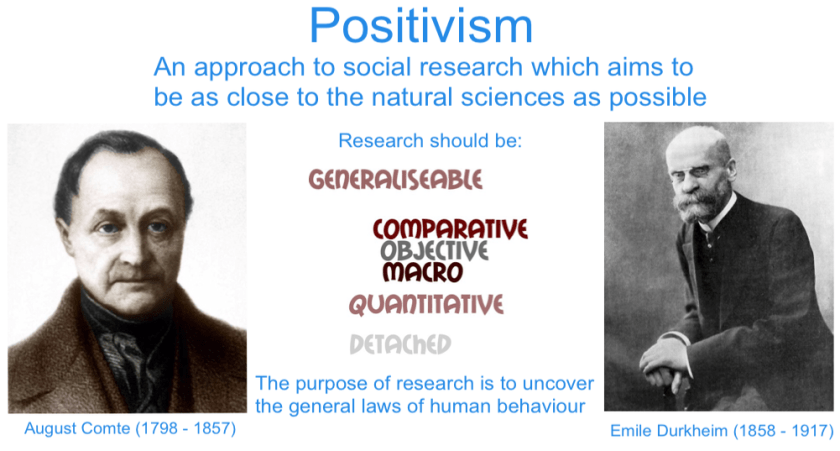
Whole Spirituality – Whole Positive: Auguste Comte (b. January. 19, 1798. d. September. 05, 1857), French Philosopher, founder of the School of Philosophy known as Positivism and the founder of the modern positive science of Sociology. His goal was that of a Society in which both individuals and nations could live in harmony and comfort.

Auguste Comte author of ‘The Course in Positive Philosophy’ (Cours de philosophie positive, 1830-42) explains his goal as that of a society in which both individuals and nations could live in harmony and comfort. He originates the term ‘Sociology’ which he regards as the method by which this harmony and well-being could be achieved. He formulates his theory of “Law of Three Stages” which visualizes human intellectual and social development in three stages; 1. Theological Stage, in which the world and man’s destiny within it are explained in terms of gods, demons, spirits, and  belief in the supernatural mythological beings, 2. Metaphysical Stage, in which reality is explained in abstractions such as essence, existence, substance, accident, and final cause and this transitional stage progresses to the modern  scientific stage 3. The Positive Stage, in which phenomena are explained by observation, hypothesis, and experimentation. This Stage is distinguished by an awareness of the limitations of human knowledge. Knowledge could only be relative to man’s nature as a species and to his varying social and historical situations. Comte gets satisfied if he could discover laws that could explain the regular connections among phenomena. In the final Stage or Positive Stage, explanations could be based only on scientific laws discovered through experimental observation, or logic. He identifies Mathematics, Astronomy, Physics, Chemistry, and Biology as scientific. He seeks to complete the Positive Stage by making Sociology as the new unifying science among the “hierarchy of the sciences.” In his book, System of Positive Polity (1854) he formulates Sociology which describes 1. Social Statics or the nature of Society, 2. Social Dynamics, the history of changes in Society, 3. Man – the individual, and 4. the study of morality and moral progress as the central preoccupation of human knowledge and effort, and its requirement of polity or political organization.

Whole Spirituality – Whole Positive. The Positive Science of Sociology.

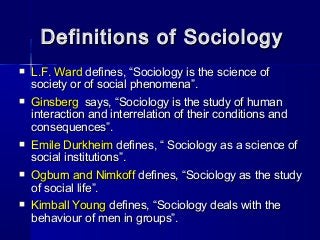
Comte applies the scientific method to social problems, and his Sociology could be described as the Science of Society. Sociology lays claim to the whole of human life beyond the biological level because virtually all human activities possess a social aspect. Comte believes that the scientific study of social organization would make possible a reconstitution of the social order based on principles of moral progress. Sociologists while studying human social relations or group life have developed a number of concepts in their analysis of the social aspects of human activity.

Whole Spirituality – Whole Positive. The Understanding of Man as a Social Group of trillions of Individual Cells.

The term ‘Society’ is used to refer to all the social relations and groups formed by human beings; as a singular Unit it refers to members of a particular population occupying a particular territory. ‘Social Interactions’, or the mutual responses of two or more individuals is the elementary component of all the relationships and groups constituting human society. Human interaction both creates and is governed by Social Norms or rules or imagined models of conduct present in  people’s mind that guide and control their interactions. Social Norms lead to the development of ‘Social Expectations’ to which people feel an obligation to conform when they are called ‘Social Roles’, the clusters of Norms and Expectations that apply to different classes of persons. Examples of Social Roles include those of father, mother, son, daughter, brother, sister, old man, warrior, and teacher. A ‘Social Group’ is a plurality of individuals in recurring interaction, their interactions controlled by common ‘Social Norms’, and differentiated ‘Social Roles’. The members of a group are at least partially aware of their membership and perceive the ‘Group’ as a coherent, fairly permanent entity. Any recurring pattern of interaction among individuals playing different roles leads to the constitution of a ‘Social Structure’, or ‘Social Organization’. The branch of Sociology called ‘Social Psychology’ studies ‘Social Structures’ of interlinked ‘Social Roles’ and ‘Social Groups’ and the impact of Norms, Roles, and Groups on the individual personality. Social Psychologists study as to how individual personality is shaped through the experience of socialization, or the formation of character and outlook under the influence of the Family, the School, the Peer Group, and other Socializing Agencies. 

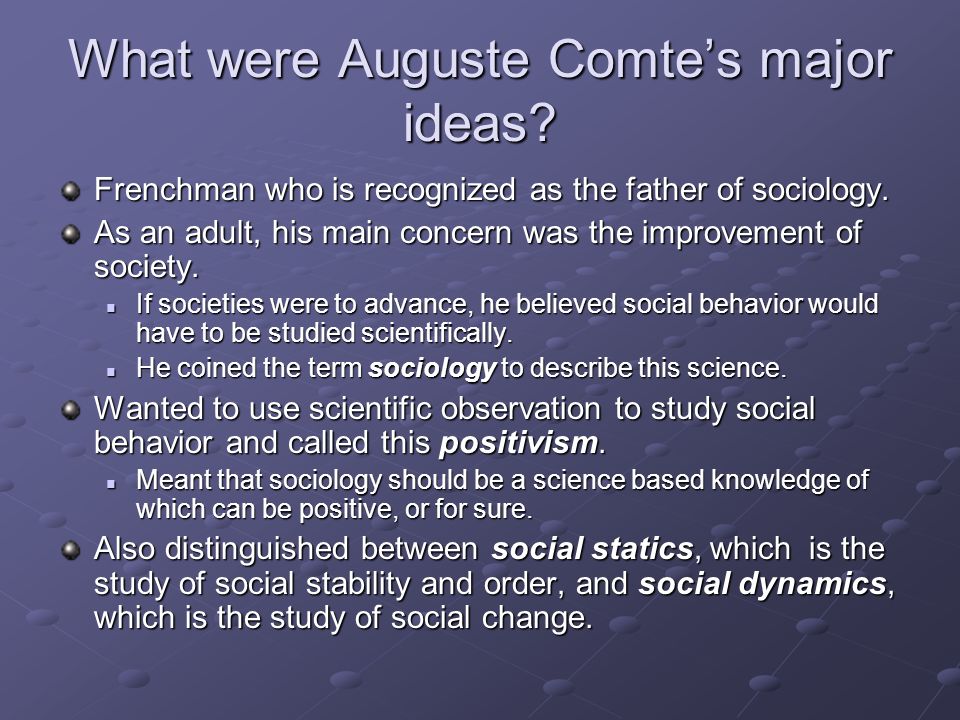
Whole Spirituality – Whole Positve: Frenchman who is recognized as the father of sociology. As an adult, his main concern was the improvement of society. If societies were to advance, he believed social behavior would have to be studied scientifically. He coined the term sociology to describe this science. Wanted to use scientific observation to study social behavior and called this positivism. Meant that sociology should be a science based knowledge of which can be positive, or for sure. Also distinguished between social statics, which is the study of social stability and order, and social dynamics, which is the study of social change.

I commend Comte for his efforts to discover laws of human society that resemble the laws of nature by applying the methods of factual investigation that are used in the Physical Sciences.

The Positive Science of Spirituality:

The Positive Science of Spirituality. The Biotic Community that formulates the Human Being as a Social Being.

The Positive Science of Sociology, to establish its relevance, must investigate the nature of the human organism; the causes and effects of social or biotic interactions among individual living cells and between individual living cells and groups of cells that function together as various tissues, organs, and organ systems within the human individual. Sociology studies human customs, social structures, and social institutions as well as the effects on individuals of participation in Groups and Organization. The focus of the Positive Science of Spirituality would be that of the Biological Group or Biotic Community called human being who in reality comprises of about 100 trillion individual living cells. At the same time there are about 10 times 100 trillion microorganisms that inhabit the human gastrointestinal tract. Man is a natural host to these microbes and during the entire course of his life man seeks a mutually beneficial relationship with the microbes that reside in his body.

The Positive Science of Spirituality intends to explore the social aspect of Consciousness and Intelligence that is reflected in the abilities of living cells. Spirituality Science seeks to define the underlying mechanism that develops the social connections, social interactions, and further develops association, partnership, relationship, and bonding using functional attributes such as mutual cooperation, mutual tolerance, mutual assistance, and mutual functional subservience in establishing a Social Structure or Social Organization that represents the complex human living system as a Social Being.  

Spirituality – Soul, Consciousness, and the God-Connection.

Related articles

WHOLE SPIRITUALITY – WHOLE DOCTRINE

Protoplasm
Protoplasm, the living, corporeal substance, is the source of energy, knowledge, and work that supports the living form that lives and is known. (Photo credit: salimfadhley)

SPIRITUALISM – THE MEDICAL DOCTRINE OF DIALECTICAL SPIRITUALISM :

Georg Wilhelm Friedrich Hegel(b. August. 27, 1770, d. November. 14, 1831),German Idealist Philosopher, author of Phenomenology of Spirit or Phenomenology of Mind(1807), Science of Logic(1812-16), and Encyclopedia of the Philosophical Sciences(1817) and other works and lectures. He developed theories of Ethics, Aesthetics, History, Politics, and Religion. He developed a Dialectical scheme that influenced the development of Existentialism, Marxism, Positivism, and Analytic Philosophy.

Georg Wilhelm Friedrich Hegel influenced most facets of modern philosophy. At the center of the universe, Hegel posited an enveloping absolute Spirit that guides all reality including human reason. His absolute ‘Idealism’ envisages a world-Soul, that develops from, and is known through, a process of change and progress termed as the Hegelian Dialectic. The doctrine of ‘Idealism’ makes the attempt to account for all objects in nature and experience as representations of the mind, and sometimes it assigns to such representations a higher order of existence. According to Hegel, reality is Absolute Mind, Reason, or Spirit which manifests itself in both natural and human history. His famous dictum, “the real is rational and the rational real”, is an expression of the identity of reality and the rational process. Because reality is rational, it acts in accordance with the laws of reasoning. Hegel suggested that understanding the nature of thought will lead to understanding the nature of reality as a whole. Dialectics is a form of logical argumentation that could be applied to diverse fields including thought, nature, and history. Hegel identified dialectic as the tendency of a notion, or idea to pass over into its own negation as the result of conflict between its inherent contradictory aspects. He developed the concept that Mind or Spirit manifested itself in a set of contradictions and oppositions that it ultimately integrated and united without eliminating either pole or reducing one to the other. According to Hegelian principles, one concept or ‘thesis’ inevitably generates its opposite or ‘antithesis’; their conflict or interaction generates a new concept or ‘synthesis’ which in turn becomes the ‘thesis’ of a new triad. Hegel developed a dialectical scheme that emphasized the progress of history and ideas from ‘thesis’ to ‘antithesis’ and then to a higher and richer ‘synthesis’. His main contribution is that of giving a clear view of reality; Reality can only be understood as a totality, “The Truth is the Whole”, and that the attempt to understand the apparently individual and unconnected phenomena of nature, history, and human life through separate categories of thought is utterly mistaken. I would like to endorse his view and submit that Reality must be known as a Whole.

THE MEDICAL DOCTRINE OF DIALECTICAL SPIRITUALISM :

Amoeba proteus and the understanding of Reality as a Whole or the ‘Whole Truth’. To understand the reality of human life, we need to know and understand the Reality of a material substance that is common to all living organisms. This common substance called Protoplasm is found in all living cells including the cells of human brain, an anatomical organ that is associated with thinking,and Mind the seat of thoughts. However, I would ask all of my readers to know and understand Protoplasm, the substance in which thoughts are generated and reside. I give attention to the Spiritual Nature of this substance and divert attention from Mind and Brain.

 Hegel in his book, Phenomenology of Mind or Phenomenology of Spirit has traced the progression of consciousness from sense perception to Absolute Knowledge. In my view, Amoeba proteus is conscious and intelligent. I speak about Spirit or Soul in relation to a material substance called Protoplasm. I would hesitate to equate Mind with Spirit as that would mislead people to think of consciousness and intelligence as the exclusive biological functions of an anatomical organ called brain. At the same time, it must be clearly understood that brain and mind perform their specialized functions using the same living matter or substance that is found inside Amoeba proteus. The fact that brain and mind perform very complex functions should not hide the fact of the true or real nature of Protoplasm. There is inherent conflict in the nature of Protoplasm. It is inherently unstable; the living matter is thermodynamically unstable, and without continuous supply of energy from an external source, it will dissolve into its constituent inorganic molecules and non-living physical elements. This nature of energy dependence and the risk of its dissolution is the ‘thesis’ and it is opposed by its potency and potential to remain immutable, or unchanging, the ‘antithesis’. Protoplasm is unstable and is stable at the same time. It has survived and has continuously lived on the surface of planet Earth for billions of years after having come into existence. We have account of several major and minor extinction events and yet Protoplasm has remained and existed without any apparent change in its properties, characteristics, and functions. Protoplasm has demonstrated the potentiality called Imperishability, indestructibility, Immortality and the ability of Eternal or Everlasting Life. The interaction or conflict between unstable(‘thesis’) and stable(‘antithesis’) nature of Protoplasm has generated a new ‘synthesis’ called Immortality or Everlasting Life. I call this higher state of existence as ‘Dialectical Spiritualism’. Man is a physical, Mortal Being and his body substance is Perishable. Through the process of Dialectical Spiritualism, the conflict and interaction between the unstable and stable nature of Protoplasm which is a Spiritual substance, man progresses towards his goal of becoming a Complete or Whole Spiritual Being and his body substance will exist in its higher state of existence of  Imperishability. The Medical Doctrine of Dialectical Spiritualism proposes the hypothesis of Man’s Immortality or Everlasting Life as a higher state of existence of a mortal or perishable substance that has developed the potentiality and progressed towards its natural goal of Imperishability and indestructibility.

Dr. R. Rudra Narasimham, B.Sc., M.B.B.S.,

Kurnool Medical College, Kurnool, Andhra Pradesh, India,

M.B.B.S.  Class  of  April,  1970.


WHOLE DUDE – WHOLE TRANQUILITY

Osama bin Laden Compound Italiano: Il compless...
Osama bin Laden Compound Italiano: Il complesso di Osama Bin Laden (Photo credit: Wikipedia)

April 07, 2012

BhavanaJagat
Ann Arbor, MI 48104
http://bhavanajagat.com


TO :

Her Excellency Ambassador Sherry Rehman,
Embassy of The Islamic Republic of Pakistan,
3517 International Court, NW,
Washington, D.C. 20008.


Your Excellency Ambassador Sherry Rehman,


1. I am writing this letter after reciting Al-Fatihah, “The Opening”, Surah I, Fatihatu’l – Kitab, “The Opening of the Scripture of Holy Book of Quran. You would need no introduction to this Surah I, as it is the Daily Prayer, and Muslims recite this to offer Salaat or Namaaz. However, kindly permit me to quote the opening sentence and the second verse which read as follows :

Bismillahi r – rahmani r- rahim ( In the name of Allah the most Beneficent, the most Merciful )

Ar rahmani r – rahim ( The most Beneficent, the most Merciful )


2. I am writing this letter in response to the news story that stated that a Court of Law in Pakistan has sentenced Osama bin Laden’s three widows and two daughters to 45 days imprisonment or house detention for living illegally in Pakistan. This action will be followed by deportation of Osama bin Laden’s family members to their countries of origin. I want to submit to you and to the Judge of that Court of Law and other concerned officials of Pakistan’s Law Enforcement, that this punitive action is not consistent with the Daily Prayer that Muslims recite. While we all need the Mercy of the most Beneficent, and the most Merciful Being, we may have to project our prayer for Mercy in our actions towards others. In Islamic tradition and culture, wife(wives), and unmarried children are expected to live in obedience and follow the directions given by the husband/father. It is a natural principle and people of all faiths to some extent believe in the unity of family and the stewardship of family by husband/father. Any punitive action against the members of Osama bin Laden’s family for simply following the rules of tradition is unfair and is unjust. They have not displayed any intention to disobey the Laws of the Land of Pakistan and may not have indulged in any criminal or illegal act. We need to understand their action or desire to enter and live in Pakistan with the same attitude and expectation with which we address Allah as the most Beneficent, and the most Merciful. I would like to ask you and the citizens of Pakistan to act in the manner that reflects the nature of their Daily Prayer. The family members of Osama bin Laden need love, care, and comfort and may need physical and moral support to maintain their family unity after they lost the husband/father, their natural guardian. The family of Osama bin Laden may be given an opportunity to live together and if they wish and desire, they should be helped to continue their residence in Pakistan with a sense of mental peace, harmony and tranquility.


3. I define man as a spiritual being who is known from the nature of his existence seeking Peace, Harmony, and Tranquility within himself and with others in his environment and community. There are no exceptions to this spiritual nature of man. We often get mentally confused when man displays hostility, animosity, and aggressiveness in his interactions with others. Spiritualism is the potency that brings man’s essence and existence to come together to sustain his biological existence in the material, physical world. Aggression is caused by ignorance and by man’s lack of understanding of his real or true human nature. On the eve of Holy Easter, I would suggest that all of us must seek Peace, Harmony, and Tranquility in all of our actions and in our interactions with others.


4. I would also seek the favour of your assistance to extend my feelings of sympathy to the three widows and two daughters of Osama bin Laden and any of his other children and relatives. Kindly assure them that they are not alone in this world. I cannot ask Allah for the favour of His Mercy without communicating my feelings to these innocent victims and give them some comfort by sharing my thoughts and prayers for their well-being and safety.


5. I would much appreciate to hear from you and I would thank you in advance for taking action on my simple request to convey a message to this family who lost a husband or father.


Thanking You,


Yours Faithfully,


Dr. R. Rudra Narasimham, B.Sc., M.B.B.S.,
Ex- Number. MS-8466 Rank Lieutenant/Captain AMC/SSC,
Medical Officer, South Column, Operation Eagle(1971-72),
Ex- Number. MR-03277K Rank Captain/Major AMC/DPC
Medical Officer, Headquarters Establishment No. 22 C/O 56 APO(1971-74),
Directorate General of Security,
Office of Inspector General Special Frontier Force,
East Block V, Level IV, R. K. Puram,
New Delhi – 110 022
http://bhavanajagat.com/