
Whole Dude – Whole Friend: Special Frontier Force Remembers the 41st US President

Excerpt: Both the US Government and the Central Intelligence Agency maintain their silence about the support given to the Tibetan Resistance Movement and the eventual creation of Establishment -22/Special Frontier Force, a military alliance/pact between the US, Tibet, and India to fight the military threat posed by Communist China when it occupied Tibet in 1950 and forced His Holiness the 14th Dalai Lama to lead a life in exile. Indeed, that is the Whole Secret. The US, India and Tibet agreed to keep the US role in Tibet as a Secret and I signed a Declaration in Chakrata, India during September 1971 to keep the Tibet Operation as a Secret under the provisions of the Official Secret Acts of India.

Special Frontier Force remembers the 41st US President George Herbert Walker Bush for he served as the Director of the US Central Intelligence Agency. In President Gerald Ford’s final year in office, Bush was appointed Director of the Central Intelligence Agency, which was in disarray after years of scandalous revelations. Though he was only there a year, he was credited for restoring the agency’s morale, and he was well thought of by longtime hands. The main building at the agency’s headquarters in Langley, Va., was renamed in his honor in 1999.

Special Frontier Force deeply mourns the loss of President George H W Bush while acknowledging the role of the US Central Intelligence Agency in fostering friendly relationships between the people of the US, India, and Tibet.
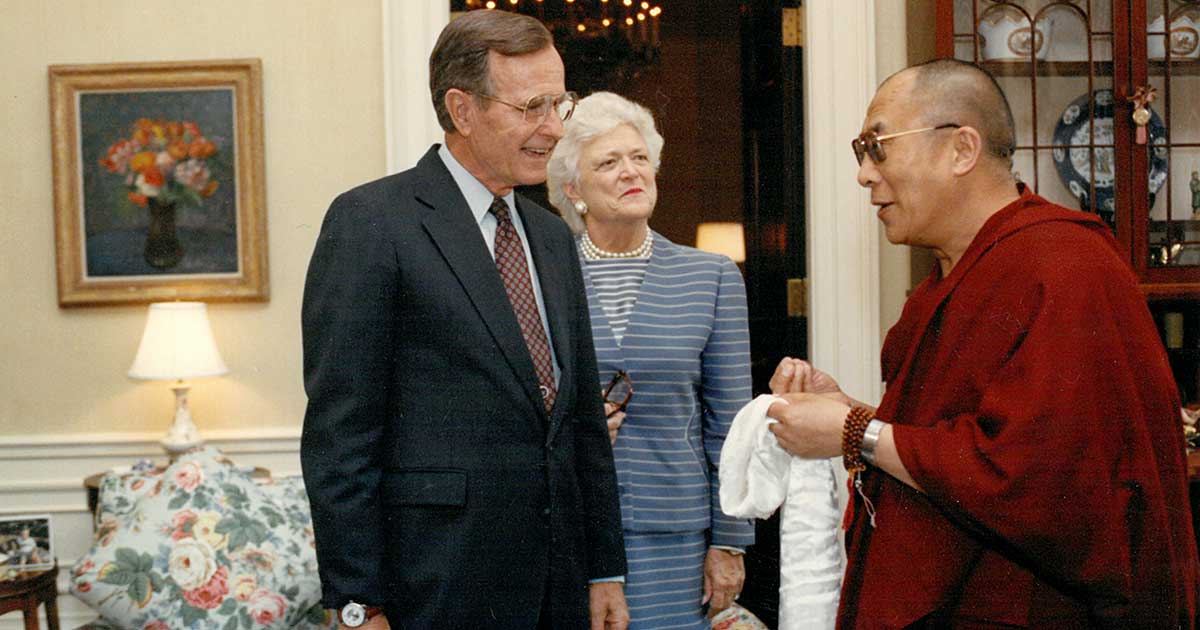
CIA Remembers Former Director, Former President George H.W. Bush
Statement by Director of the Central Intelligence Agency Gina C. Haspel
“We’ve lost a great champion of the Agency—an accomplished Director, faithful advocate, and dear friend—with the passing of former President George H.W. Bush. As a heroic Navy pilot in the Second World War, a skilled statesman who deftly managed the collapse of the Soviet Union and liberated Kuwait from Saddam Husayn’s aggression, and a committed citizen who remained engaged in public service throughout his later years, President Bush exemplified the virtues of patriotism, duty, and compassion. Officers here at the George Bush Center for Intelligence and deployed around the globe honor the memory of a great American. On behalf of the men and women of CIA, I extend our heartfelt condolences to the Bush family.”
A STATESMAN REMEMBERED
Clipped from: https://www.msn.com/en-us/news/politics/a-statesman-remembered/ar-BBQkdg1?li=BBnbcA1&ocid=BHEA000
© Hearst Newspapers
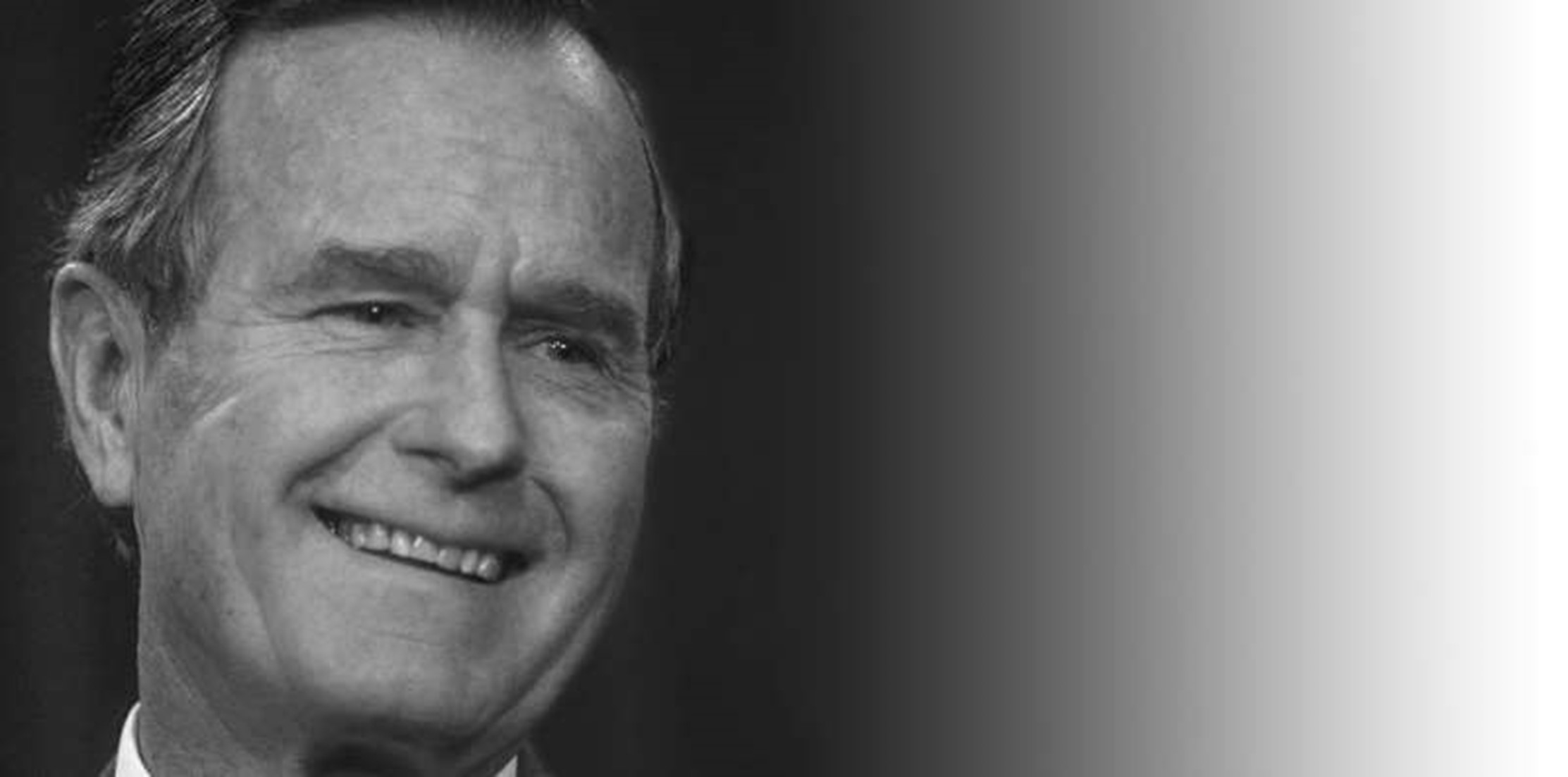
George Herbert Walker Bush, whose lone term as the 41st president of the United States ushered in the final days of the Cold War and perpetuated a family political dynasty that influenced American politics at both the national and state levels for decades, died Friday evening. He was 94.
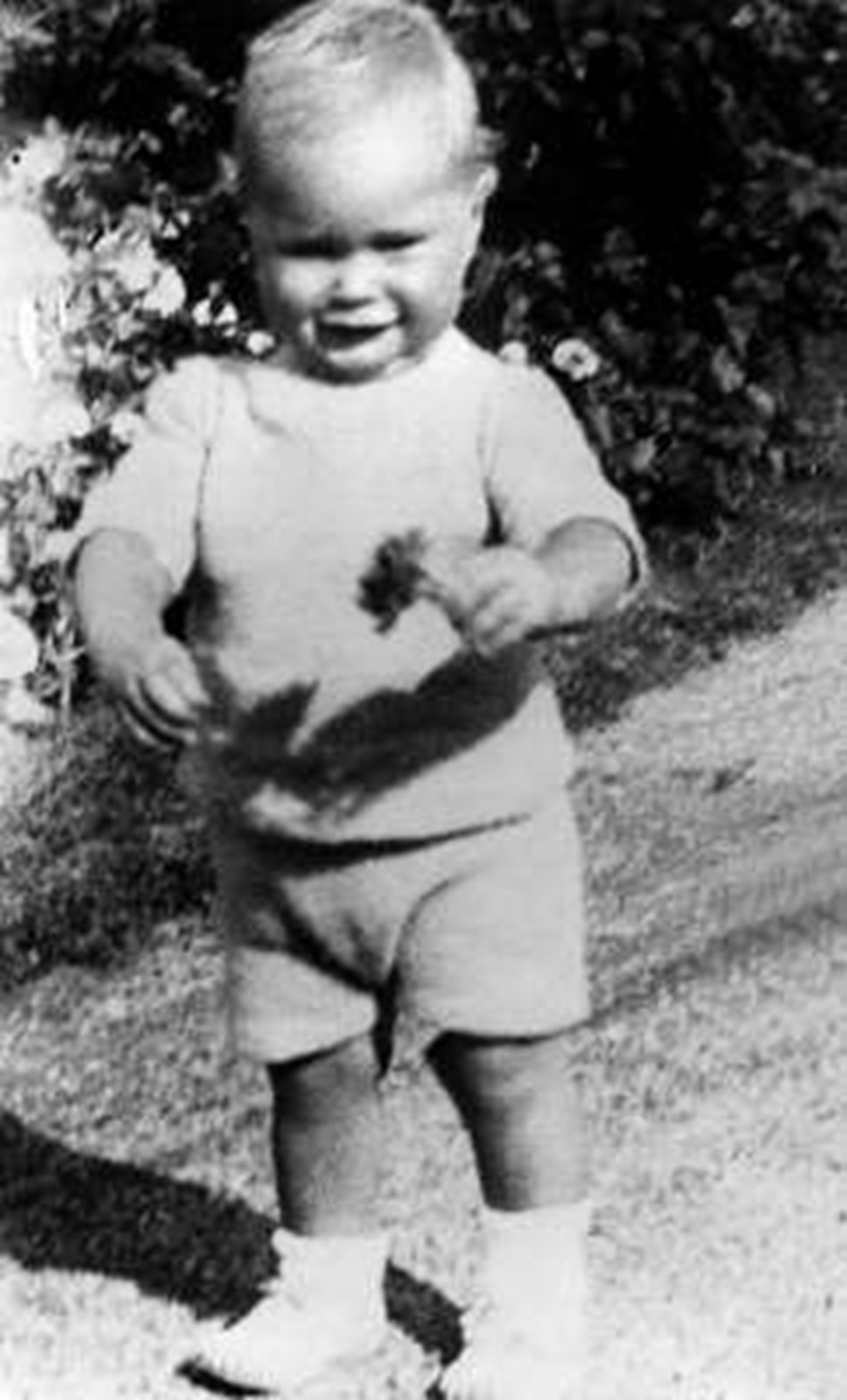
© AFP, AFP/Getty Images George H.W. Bush is pictured when he was one and a half year old. Born 12 June 1924 in Milton, Massachussetts, George Bush yale graduated with a degree in Economics in 1948, made a fortune drilling oil before entering politics in 1964. (FILM) (Photo credit should read /AFP/Getty Images)
Bush was the last president to have served in the military during World War II and the last whose worldview had been shaped by the imperative to contain Communist expansionism.
His experience in international diplomacy served him well as he dealt with the unraveling of the Soviet Union as an oppressive superpower, and later the rise of China as a commercial behemoth and potential partner.

© ASSOCIATED PRESS 1930, George Bush with his sister in 1930. (AP Photo)
As cautious and restrained as he was in foreign matters, Bush had an inclination for personal risk-taking that showed up early in his life, when he became a carrier pilot in the war — one of the most dangerous jobs in the military — and then stuck out on his own at war’s end, eschewing a comfortable job in New York to become an oilman in Texas.

© ASSOCIATED PRESS George H.W. Bush at summer camp in this 1939 photo. (AP Photo)
Likewise, when his interest turned to politics a decade or so later, he was more than willing to give up his executive suite for a chance at public office.

© ASSOCIATED PRESS George Bush, left, with unknown boy, as finalists in the Field Club Jr. Tournament in 1939.
Steeped in noblesse oblige and the importance of public service, Bush always felt the lure of political life. It finally snared him in 1962 when he was chosen to head Houston’s fledgling GOP. He spent the next three decades in the political limelight, enjoying a roller-coaster career that saw more defeats than victories yet improbably landed him in the White House.
© AP George H. W. Bush poses in his baseball uniform as a student at Yale University in New Haven, Conn. Bush was the first baseman on the Yale team that lost to California in the first College World Series in Kalamazoo, Mich. in 1947.
Bush was elected president in 1988 as the successor to Ronald Reagan, a conservative icon whom he ran against and then served as vice president. Unlike Reagan, he was a pragmatic leader guided by moderation, consensus building, and a sense for problem-solving shorn of partisan rhetoric. Like his father, who served in the U.S. Senate, he swore no allegiance to orthodox tenets. That put him at odds with a take-no-prisoners attitude of a new breed of Republicans and helped do in his reelection bid, sending him home to Houston in forced retirement.

© Tom Harvey, Admiral Nimitz Museum One of a series of photos from the George Bush Gallery at the Admiral Nimitz Museum in Fredericksburg Texas. Photo shows a young George Bush in the cockpit writing in his logbook during WWII. Former President Bush during his World War II days. For use with FLYBOYS story to run 10-18 in Houston section.
Most of Bush’s political career was spent in appointed jobs, where he demonstrated loyalty and a quick-study competence, rarely making headlines. Expectations were modest when he became president. Many in his party hoped he would simply follow in Reagan’s footsteps. Instead, he quickly distinguished himself as the postwar order began to undergo dramatic changes.
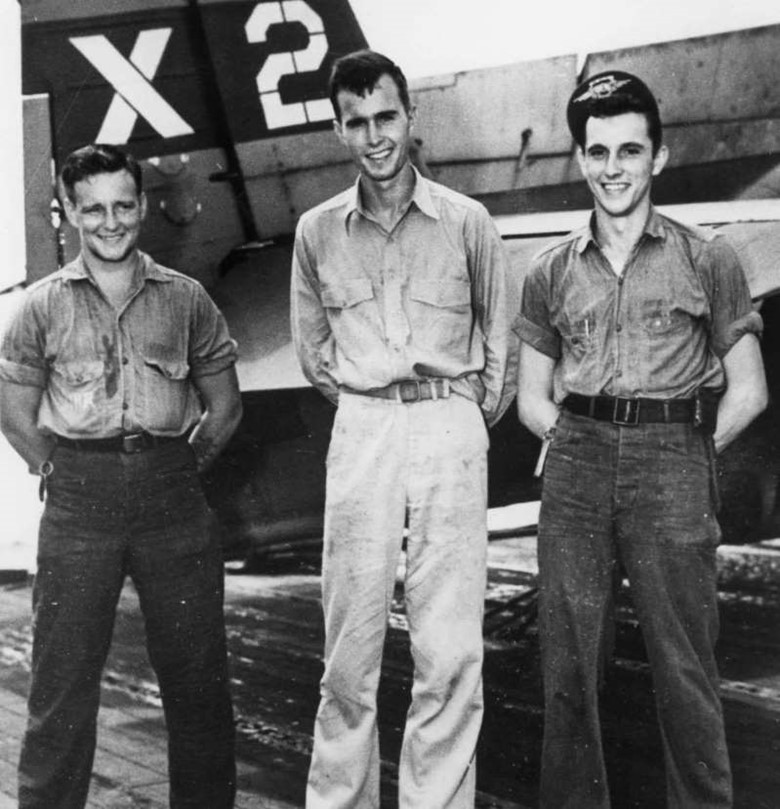
© ROBERT B. STINNETT NATL ARCHIVES, ARTS & ENTERTAINMENT NETWORK A young George Bush (center), Joe Reichert (L), Leo Nadeau (R) photographed December 31, 1942.
Bush was put to the test shortly after taking office. Surging movements in Eastern Europe saw opportunity to free themselves from the Soviet yoke, thanks in part to the liberalizing influence of Soviet leader Mikhail Gorbachev. Bush’s measured response allowed events to unfold, including the destruction of the Berlin Wall, without triggering potentially catastrophic responses from Soviet hard-liners.
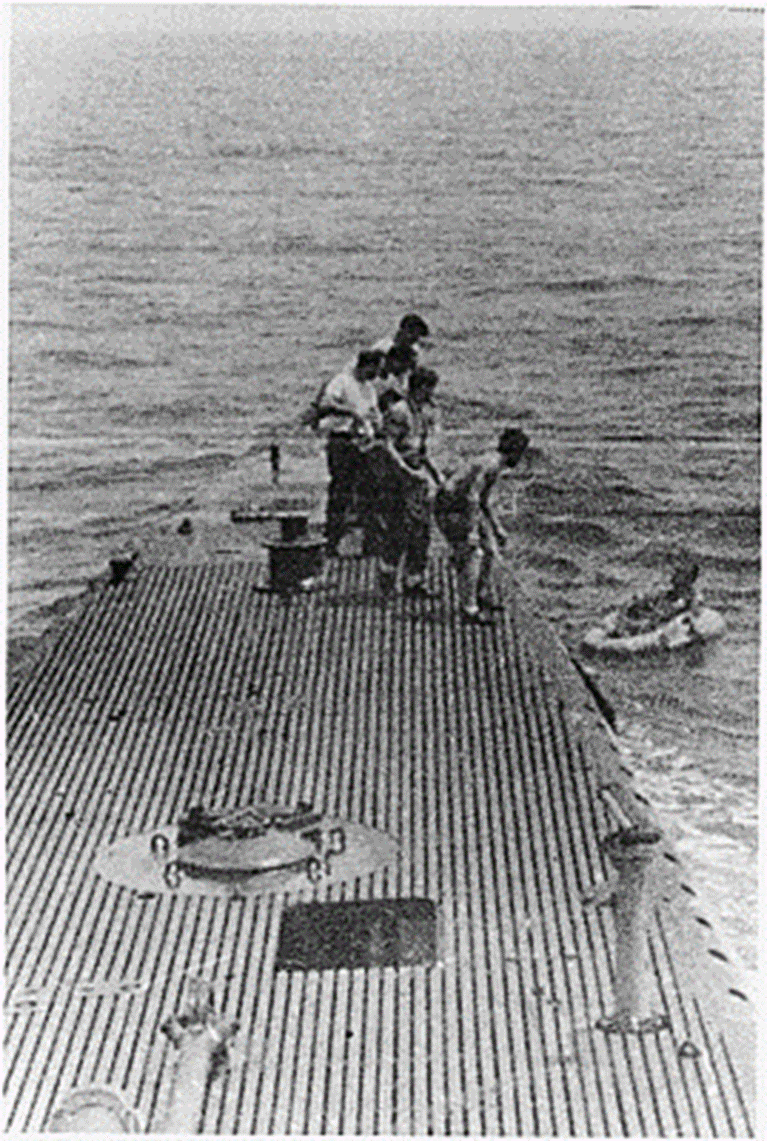
© Hearst Newspapers George Bush being rescued by the submarine, the U.S.S. Finback, after being shot down while on a bombing run of the Island of Chi Chi Jima on August 2, 1944.
Bush again displayed his diplomatic skills in the summer of 1990 when he coordinated a multinational response to the military invasion of tiny Middle East nation Kuwait by neighboring Iraq and its dictator, Saddam Hussein. The victorious Operation Desert Storm brought high approval ratings that appeared to guarantee a second term.
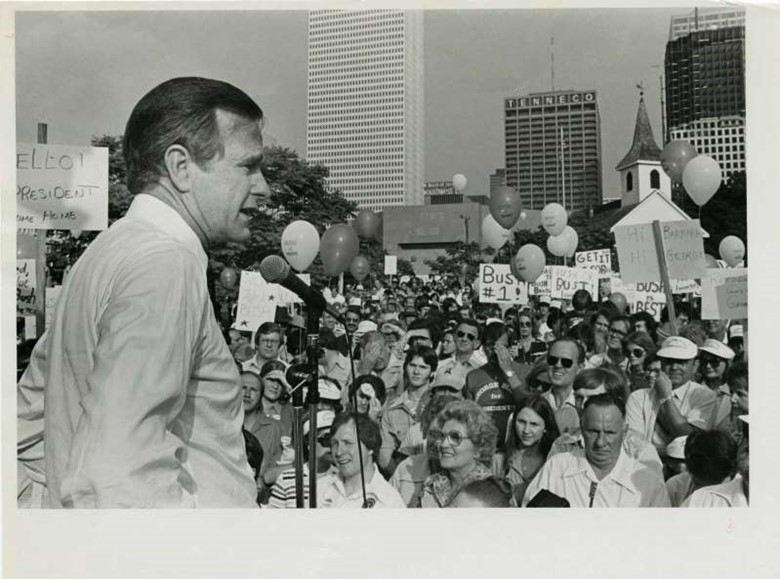
© Joel Draut, Houston Chronicle 05/06/1979 – George Bush, candidate for the Republican nomination for president, addresses supporters at rally in Sam Houston Park at the start of his Texas campaign tour. Joel Draut / Houston Post
Domestic matters proved a different sort of challenge. Plagued by inherited budget deficits and a Congress under the control of Democrats, Bush was pushed into a tax increase that belied his explicit promise to allow none. He agreed to it because he recognized it was in the country’s best interest, but the political damage was severe. His reelection bid fell short, a failing that haunted him for years. Uncharacteristically, it even caused him to wonder whether history would regard him as a failed president.
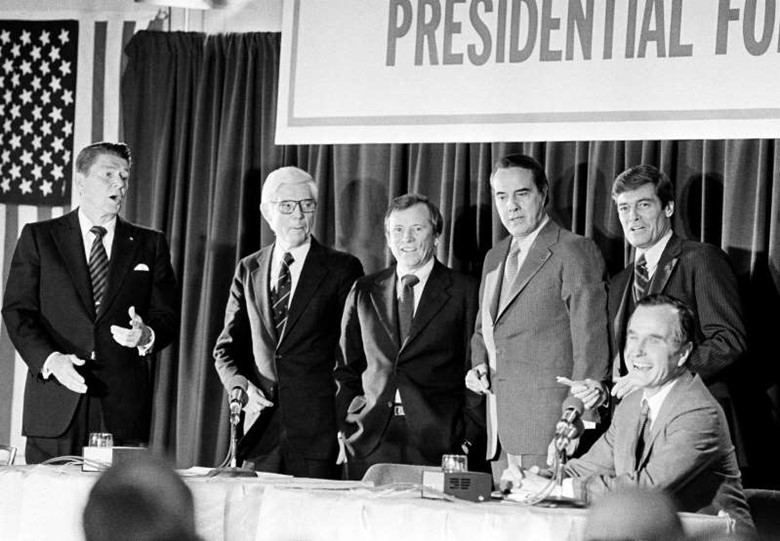
© Anonymous, ASSOCIATED PRESS Republican presidential hopefuls Ronald Reagan, left, John Anderson, Howard Baker, Robert Dole Philip Crane who all showed up for a debate that was to be between Ronald Reagan and George Bush Saturday night, February 23, 1980, at Nashua Senior High School in Nashua, N.H.
It has not.
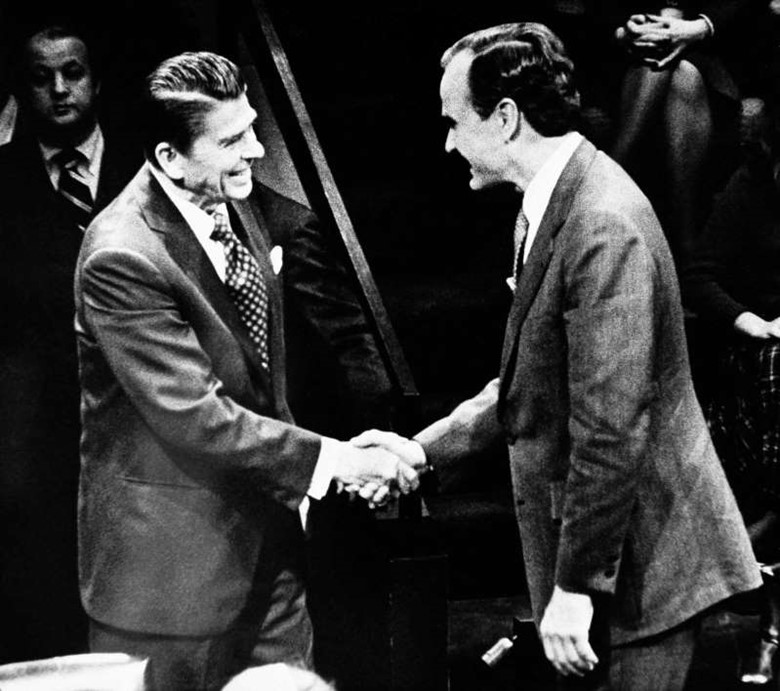
© Anonymous, AP Republican presidential candidates Ronald Reagan, left, and George H.W. Bush, right, greet prior to their Thursday night debate February 28, 1980 on public television.
“I think over the years he fares well,” said presidential historian Henry Brands, the author of seven presidential biographies and a professor at the University of Texas. “If voters have a referendum and they vote you down, that automatically puts you down a rung. It’s unfair. Bush always was rated very highly by historians more than he was by the public. I think that is changing.”

© Anonymous, ASSOCIATED PRESS George Bush peeks around a partition which has a poster of Ronald Reagan, one of his opponents for the Republican party presidential nomination, before he speaks at Columbia, S.C., March 4, 1980.
Bush was born into privilege and reared in the cradle of America’s economic aristocracy, yet from an early age, he refused to ride the coattails of entitlement. Approaching his graduation from Yale University in 1948, he was offered a job at his family’s Wall Street investment firm, close to his native Connecticut. He turned it down. Whatever his destiny, he vowed that it would be fully earned.

© Bob Child, AP George Bush, who is seeking the Republican presidential nomination, watches as his grandson, George, 4, meets another child at “Bush for President” headquarters,in Hartford, Conn., March 24, 1980.
So began a remarkable journey that would lead him from the elegant estates of New England to the dusty plains of West Texas, to the leafy precincts of Houston’s nicest neighborhoods, to foreign capitals and back to America’s own, into political campaigns at the humblest level and one that ultimately netted him the White House.
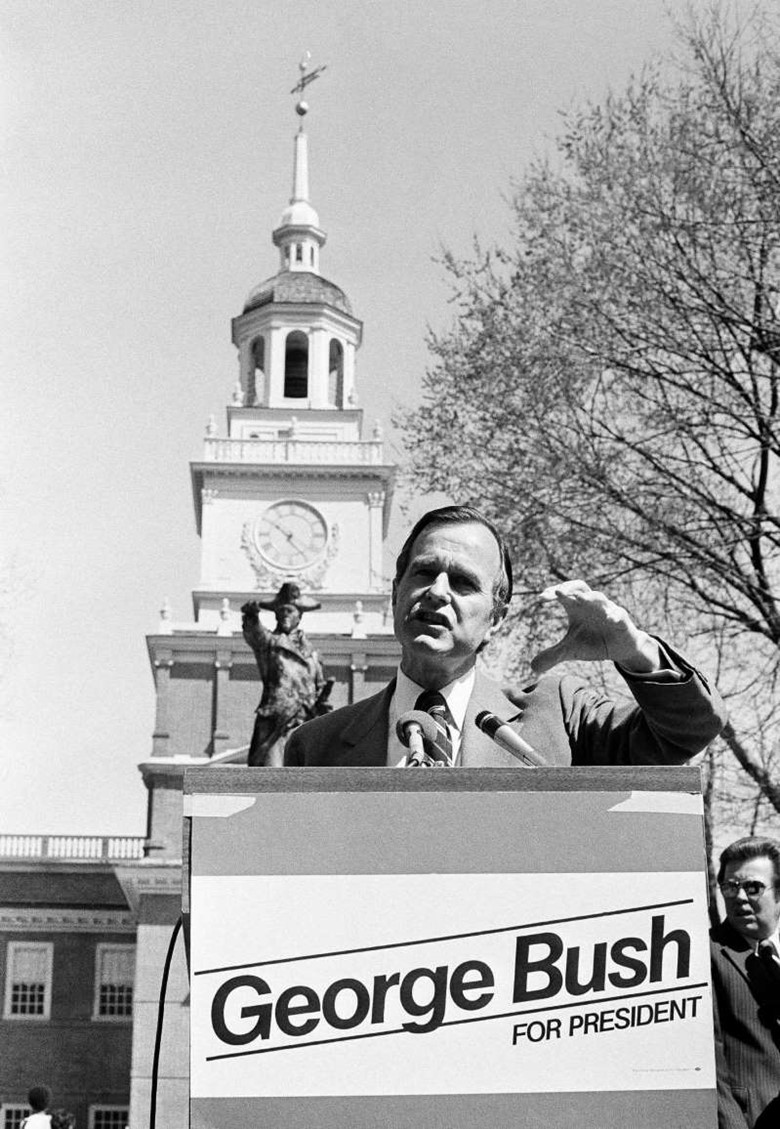
© Bill Ingraham, AP Using Independence Hall as a backdrop, Republican presidential hopeful George Bush addresses supporters and newsmen April 9, 1980 in Philadelphia. Bush is seeking votes in the April 22 Pennsylvania primary.
Bush’s long life encompassed the full arc of the 20th century, beginning in an era of steamships and a new ideology called communism, and ending as American spaceships explored distant planets and the hammer-and-sickle was mostly a fading emblem on old flags. He was to be the last president of his generation, which came of age during the Great Depression, participated in a cataclysmic world war, and ushered in unprecedented American power and prosperity.

© Joe Kennedy, MBR On July 14, 1980, the Republican National Convention convened at Joe Louis Arena in Detroit, Michigan. Former Gov. Ronald Reagan of California was nominated for president and former congressman George H.W. Bush of Texas for vice president. (Joe Kennedy/Los Angeles Times/MCT)
Turning away from the preordained comfortable life, Bush struck out for Texas and found success, first as an independent oilman and later as a young Congressman from Houston. The misfortune of bad timing hurt him at times in his pursuit of higher office, yet a string of high-profile appointed positions reflected the faith others had in his ability and kept alive his dream of fulfilling his father’s prediction that someday he would become president.

© ASSOCIATED PRESS George Bush, foreground, raises his arms as a floor demonstration erupts before speaking to the Republican Convention delegates in Detroit, Mich., Wednesday evening, July 16, 1980. Republican presidential candidate Ronald Reagan later announced Bush as his running mate.
“The world was fortunate to have his background and instincts at a turning point,” said Robert Gates, who served as Bush’s CIA director and deputy national security adviser. “The collapse and end of the Cold War look sort of pre-ordained in hindsight, but for those who were there, it was not clear how it would happen.”

© ASSOCIATED PRESS Republican vice presidential candidate George Bush reacts to applause from the assembled Republican delegates at the Republican National Convention at Joe Louis Arena in Detroit, Mich., Thursday evening, July 17, 1980. Bush was selected by Ronald Reagan as his running mate on Wednesday. (AP Photo)
Gates, who served in eight presidential administrations, suggested that Bush never received the credit he deserved for quietly “greasing the skids” that saw communists slide from power in the Soviet Union.

© David Breslauer, Houston Chronicle PHOTO FILED: GEORGE HW BUSH-GROUP. 07/19/1980 – George Bush, left, returned in triumph to greet his neighbors near his southwest Houston home Saturday after being tapped by Ronald Reagan for the GOP vice presidential nomination. He took time off from having breakfast at his home with Reagan and a joint appearance at a Galleria rally to shake hands with neighbors Walter and Lois Taber and their children, Keith and Tom. David Breslauer / Houston Chronicle
“There is no precedent in all of history for the collapse of a heavily armed empire without a major war,” Gates said. “He was a figure of enormous historical importance.”

© Curtis McGee, Houston Chronicle PHOTO FILED: RONALD REAGAN-HOUSTON VISIT. 07/19/1980 – The GOP nominees – George Bush and Ronald Reagan and their wives, Barbara and Nancy – make their first post-convention appearance at the Houston Galleria shopping mall. (l-r): GOP VP Nominee George H.W. Bush, Barbara Bush, Nancy Reagan, GOP Pres. nominee Ronald Reagan. Curtis McGee / Houston Chronicle HOUCHRON CAPTION (07/20/1980): It was hand-waving and cowboy hats Saturday at the Galleria as the Republican Party nominees made their first post-convention campaign appearance. Ronald Reagan, the GOP standard-bearer, and George Bush of Houston, his running mate, spoke to several thousand at the shopping center. Responding to cheers are, from left, Bush, wife Barbara, Nancy Reagan and Reagan.
Though Bush came to be widely respected by foreign leaders and diplomats, his political profile at home was different. He had long been dogged by assertions that he was a bland and hazy character, aloof and dilettantish. The image baffled him and many who knew him. He was chided for a lack of apparent vision, yet it was not his nature to view himself as a visionary.

© David Breslauer, Houston Chronicle PHOTO FILED: RONALD REAGAN-HOUSTON VISIT. 07/19/1980 – Vice presidential nominee George Bush, Barbara Bush, Nancy Reagan and GOP presidential nominee Ronald Reagan. The GOP nominees make their first post-convention appearance at the Houston Galleria shopping mall. David Breslauer / Houston Chronicle
“What’s wrong with trying to help people,” he once asked. “What’s wrong with trying to bring peace? What’s wrong with trying to make the world a little better?”

© Wally Fong, ASSOCIATED PRESS Republican presidential candidates Ronald Reagan, left, and George H.W. Bush, right, greet prior to their Thursday night debate February 28, 1980 on public television.
To some, Bush paled in comparison to his strong-willed predecessor in the White House, but he was simply a different breed of politician: a traditional Republican whose belief in limited government was in no way at odds with his view that public service was a calling.

© Jerry Click, Houston Chronicle 11/04/1980 – (L-R) Barbara Bush leads her mother-in-law, Dorothy Walker Bush, and husband, GOP Vice Presidential candidate George Herbert Walker Bush. through a hallway at the Houston Oaks Hotel in Houston. The Bushes gathered with familly and supporters at the hotel to await the 1980 presidential election results. By the end of the evening family and supporters celebrated his election as the next Vice President of the United States. Jerry Click / Houston Post
Reagan’s famous maxim that government was not the solution to a problem but the problem itself was not Bush’s view, which might explain why his single term arguably resulted in more significant legislative achievements than Reagan’s two, among them the Americans with Disabilities Act, a bolstered Clean Air Act, and an increased minimum wage.

© Bill Thompson, Houston Chronicle 11/04/1980 – (L-R) Barbara Bush and husband, George Herbert Walker Bush, celebrate his election as the next Vice President of the United States at the Houston Oaks Hotel in Houston. The Bushes gathered with familly and supporters at the hotel to await the 1980 presidential election results. Bill Thompson / Houston Post HPOST CAPTION (11/05/1980): Bush, wife Barbara celebrate victory at Houston Oaks Hotel
Bush’s career from start to finish, especially as president, was largely free of scandal or great controversy, with one troubling exception — his role as vice president in the Iran-Contra scandal.

© Hearst Newspapers **FILE** U.S. President-elect Ronald Reagan, left, and Vice President-elect George Bush share a laugh during their first news conference in which they announced their transitional team in Los Angeles, Ca., in this Nov. 6, 1980 file photo. Reagan, the cheerful crusader who devoted his presidency to winning the Cold War, trying to scale back government and making people believe it was “morning again in America,” died Saturday, June 5, 2004 after a long twilight struggle with Alzheimer’s disease. He was93. (AP Photo, file) (AP)
His ethical standards rarely were questioned. His judgment was the product of studied deliberation and ample give-and-take with advisers. He regularly entertained Democratic leaders at the White House and made a great effort to develop personal relationships over drinks and a game of horseshoes, just as he had in the diplomatic world over many years.

© Betty Tichich, Houston Chronicle 11/10/1980 – Vice-President elect George Bush holds a press conference in Houston before leaving for Washington, DC where he will meet with President-elect Ronald Reagan and begin work on the transition. Betty Tichich / Houston Post
“President Bush was inclined to forgive and forget past slights, defeats, and even outrages,” said longtime aide Chase Untermeyer. “Thus did he offer rides to Maine for Senator George Mitchell, make the daughter of Senator Sam Nunn the head of the Points of Light Foundation, and — to clinch the case — become buddies with Bill Clinton.”
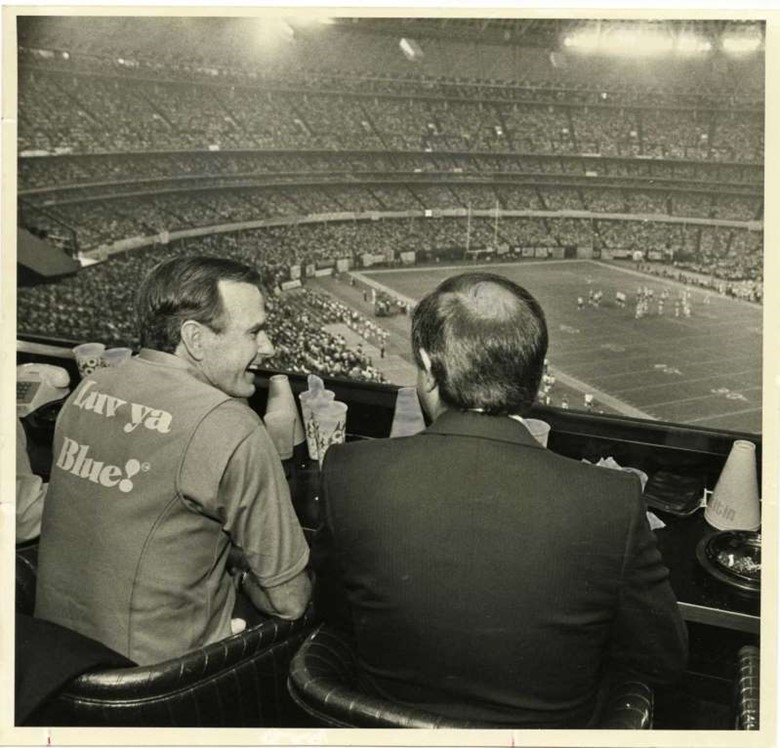
© John Everett, Houston Chronicle PHOTO FILED: GEORGE HW BUSH-GROUP. 11/10/1980 – Vice president-elect George Bush wearing a “Luv ya Blue” vest, enjoys a laugh with NFL Commissioner Pete Rozelle during Monday night football game between Houston and New England in the Astrodome.
Bush was by nature a practical manager. He believed his job was to get something done, taking incremental steps when big ones were unobtainable. He had no use for those who would sacrifice progress on the altar of philosophical purity, nor did he regard opponents as enemies.
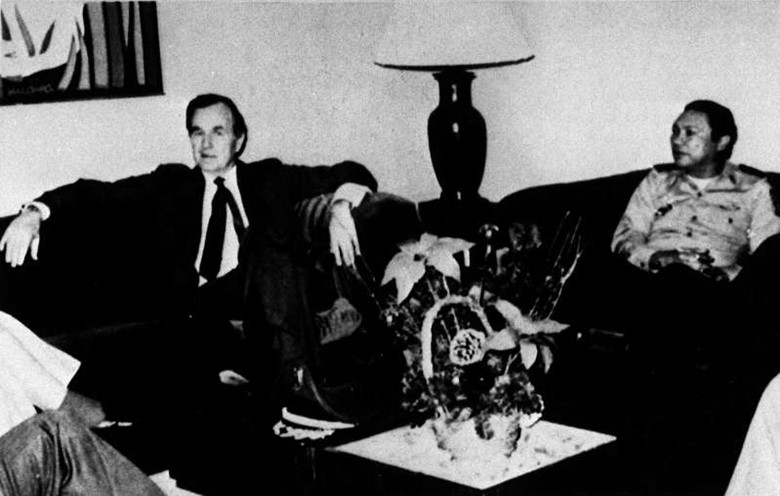
© ASSOCIATED PRESS Vice President Bush and Panamanian leader Manuel Antonio Noriega are seen at Panama City Airport, Dec. 10, 1983, in a photo from Britain’s Thames Television.
He was defeated in an unusual three-way contest with Democrat Clinton and Texas billionaire Ross Perot — a sour coda to a stellar career. Though he had been ambivalent about even running for reelection, the loss would gnaw on him. He believed that he left the job he signed up for unfinished.
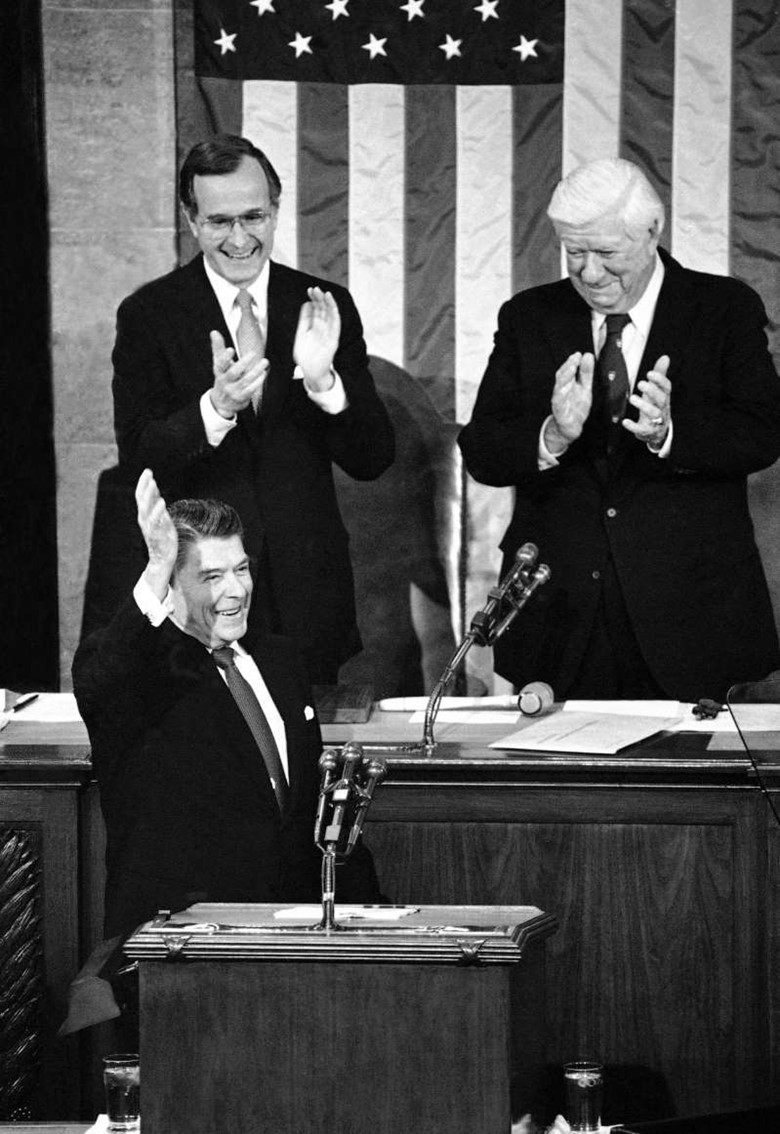
© Bob Daugherty, Associated Press Ronald Reagan State of the Union 1984 – VP George HW Bush; Speaker of the House Thomas “Tip” O’Neill
Even years later, Bush recalled the sick feeling he carried inside for having let down the people who believed in him.

© AP Former Chinese Premier and General Secretary of the Communist Party Zhao Ziyang, right, shakes hands with then Vice President George Bush Jan.11,1984, at a reception in Washington.
“That was the sad part for me,” he told an interviewer, “and I felt very strongly about that. I still do.”

© DC, ASSOCIATED PRESS President Ronald Reagan, left, and Vice President George H. Bush don western-style straw hats presented to them by two cheerleaders at an outdoor political rally on Wednesday, July 25, 1984 in Austin, Texas. Houston Oilers? cheerleader Cathy Ludwig, with Reagan, and University of Texas? cheerleader Leslie Scott, with Bush, made the presentation. (AP Photo)
Bush was born on June 12, 1924 in Milton, Mass., to Prescott and Dorothy Bush, the second of five children, four of them boys. His was an idyllic childhood spent among the nation’s economically privileged, with numerous trips to family estates in Maine and South Carolina.

© Barry Thumma, STF President Reagan and Vice President Bush make an appearance on the North Portico of the U.S. Capitol in Washington on Sunday, Jan. 20, 1985 after the President was sworn in for his second term. (AP Photo/Barry Thumma)
Although the hardships of the Great Depression did not severely affect the Bushes, his parents tried to stress that good fortune should not be taken for granted, insisting on modesty at all times, along with concern for those going through hard times. Work mattered. Life, they insisted, was no country club affair.
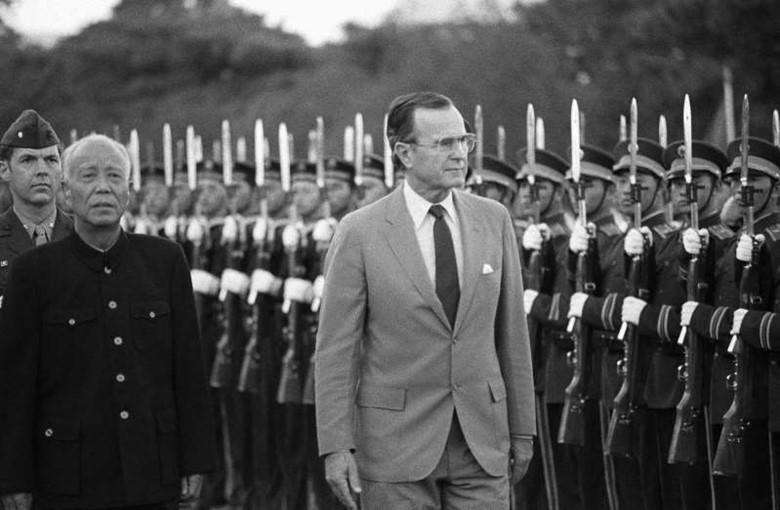
© Neal Ulevich, ASSOCIATED PRESS U.S. Vice President George Bush, accompanied by Chinese Vice Premier Wan Li, reviews a Chinese armed forces honor guard during a ceremony to welcome him to Peking October 13, 1985.
Bush attended Phillips Academy, a famous boarding school in Andover, Mass., where he excelled academically and athletically. He was a favorite of his classmates, often chosen to captain the teams he was on and known to call out bullies who bedeviled the less popular students.

© Ron Heflin, Associated Press George H W Bush NL Baseball 1986
As he grew to adulthood, he slowly soaked up the history of generations of Walkers and Bushes and began to understand the expectations for those of his class and background — a demand for service to the public good largely divorced from personal gain. It made a deep impression on him.

© MARY URECH ROBERTS, Houston Chronicle 10/12/1987 – Vice President George HW Bush officially launched his 1988 presidential campaign in the main ballroom of the Hyatt Regency Hotel. The announcement party moved from the ballroom to the hotel’s massive lobby where the elevators were decorated with lights spelling out “Bush 88.” Mary Urech Roberts / Houston Chronicle
“Bush was a figure of an older, fading order of American power,” wrote Bush biographer Jon Meacham in “Dynasty and Power,” a 2015 authorized biography. “When his family and … friends looked at him, they saw a man who could have spent his life making and spending money, but who had chosen to obey the biblical injunction, drilled into him by his parents, that to whom much is given much is expected.”
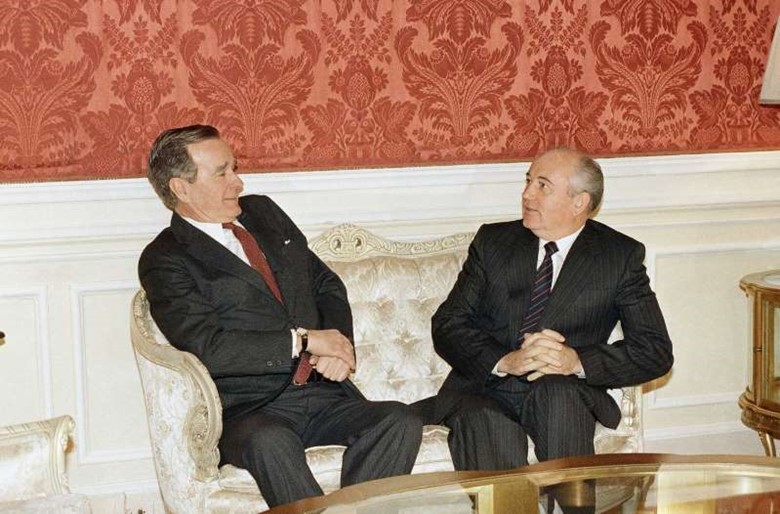
© Scott Applewhite, ASSOCIATED PRESS Vice President George H.W. Bush sits with Soviet leader Mikhail Gorbachev, prior to a breakfast at the Soviet Embassy in Washington on Thursday, Dec. 10, 1987. (AP Photo/J. Scott Applewhite)
Bush’s first great test came as his days at Andover were ending, graduating in the face of a world succumbing to a widening war. He might have been able to use connections for a service academy appointment or a plum job that did not place him in harm’s way. Like many of his friends and others of his class, including Joseph and John Kennedy, he chose the opposite path.
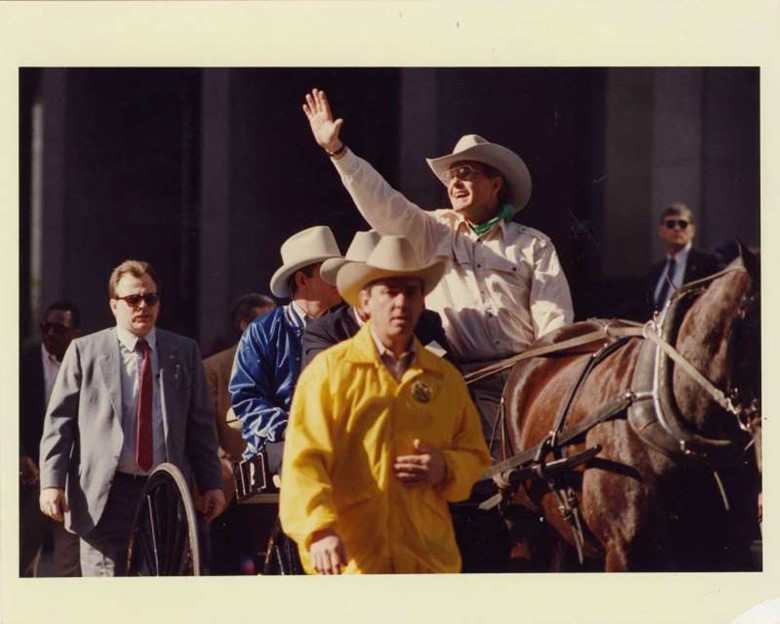
© Jerry Click, HP Staff Then Vice President George Bush serves as grand marshal of the Houston Livestock Show and Rodeo parade in 1988.
Bush enlisted in the U.S. Navy upon finishing high school in 1942 and hoped to become a pilot. He earned his wings and was commissioned an ensign before his 19th birthday. His wartime duty was spent in the Pacific flying a three-man Avenger torpedo bomber.

© Bruce Bennett, Houston Chronicle 03/08/1988 – Celebrating his Super Tuesday election night victory, Vice President George Bush holds up a “Bush ’88, Texas Victory” t-shirt at the Westin Oaks Hotel ballroom in Houston. The shirt was presented to him by GOP state co-chair, Tom Loeffler. His wife, Barbara, stands beside him. Bruce Bennett / Houston Post
Bush piloted 58 combat missions from the carrier USS San Jacinto, but one stood out. During a Sept. 2, 1944, attack on Japanese positions on Chichi-Jima, one of the Bonin Islands, his Avenger was badly hit by flak. He was able to complete the bombing run but ordered the other two crewmen to “hit the silk” as the plane headed toward the water. He did likewise and was able to haul himself into a life raft after popping up from the sea, dazed and out of breath. His crew mates were never found.
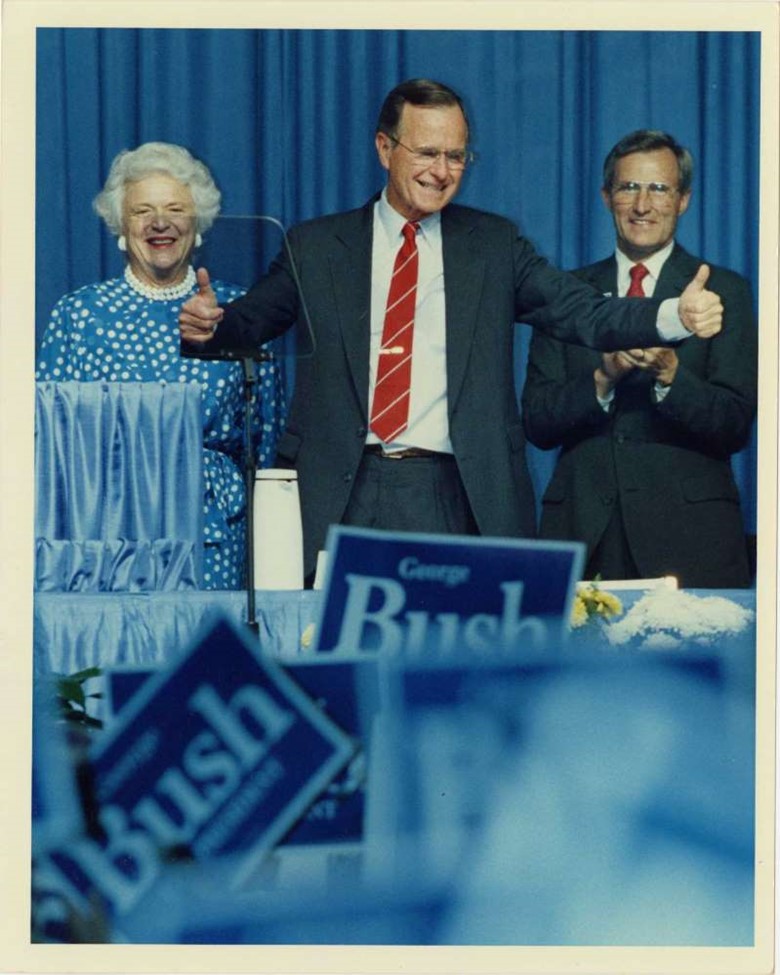
© Craig Hartley, Houston Chronicle 06/09/1988 – Vice President George Bush waves to delegates attending the Texas Republican Party convention at the George R. Brown Convention Center. Behind him are his wife, Barbara Bush, and Texas GOP Chairman George Strake. Craig Hartley / Houston Post
Bush was awarded the Distinguished Flying Cross, yet never considered himself a war hero despite the efforts of later political advertising. “They wrote it up as heroism,” Bush said late in his life of the paperwork leading to the decoration, “but it wasn’t — it was just doing your job.”

© Scott Applewhite, ASSOCIATED PRESS Vice President George Bush is nuzzled by granddaughter Marshall Bush as she is hold by Laura Bush on Thursday, Aug. 17, 1988 in New Orleans.
In January 1945, while on leave, Bush wed his pre-war fiancee, Barbara Pierce. The two had met at a dance when he was at Phillips and she at a tony boarding school in South Carolina. Her family, like his, came from old money, and among her ancestors were early New England settlers. A distant relative, Franklin Pierce, was the 14th American president.

© Ira Strickstein, Houston Chronicle 09/22/1988 – Pres. Ronald Reagan and Vice Pres. George Bush at the Brown Convention Center at Republican Victory ’88 fund-raiser for Bush’s campaign for US presidency. Ira Strickstein / Houston Post
After the war, Bush and his new wife moved to New Haven, Conn., where he would begin his college education at Yale, the alma mater of his father and four other relatives.

© Eric Gay, ASSOCIATED PRESS Vice President George Bush tosses a football back to members of the traveling press corps after arriving in Houston on Monday, Nov. 7, 1988. Bush, in the last full day of campaigning, returned to Houston where he will vote on Tuesday. (AP Photo/Eric Gay)
He graduated in under three years because of an accelerated program offered to veterans eager to make up for lost time. He again excelled at sports and captained the baseball team, for which he played first base. He was just as adept in the classroom, gaining Phi Beta Kappa distinction and an economics degree. Yet, as he acknowledged, what should have been idyllic college years had been altered by the war. The class of 1948 were serious men intent on getting out and getting going.

© Carlos Antonio Rios, Houston Chronicle CONTACT FILED: GEORGE BUSH. 11/09/1988 – Vice President George Bush press conference day after election for President of the United States. HOUCHRON CAPTION (11/05/2000): None (George Bush Mug) HOUCHRON CAPTION (11/05/2000): Then-President-elect George Bush in 1988 HOUSTON CHRONICLE SPECIAL SECTION/TEXAS MAGAZINE: 100 TALL TEXANS.
As graduation approached, Bush balked at an offer to join a prominent investment bank started by his maternal grandfather. To a friend he wrote that it bothered him to take advantage of “the benefits of my social position.”

© Ed Kolenovsky, ASSOCIATED PRESS Vice President George Bush and wife, Barbara, wave to supporters that turned out in Houston, Tex., to hear him announce he was a candidate for the Republican nomination for president of the United States, Oct. 12, 1987.
A close family friend encouraged him to think of the oil business, which would take him to Texas. Oil drilling was as foreign to him as tightrope walking or fashion design, but it appealed to his taste for risk and held the promise of great wealth.

© Herb Swanson, Associated Press George H W Bush 1988 family at Kennebunkport
In the summer of 1948, Bush loaded up his new Studebaker, a graduation gift, and pointed it southwest, ending up in Odessa several days later. Barbara and their new baby, George, flew down after he had found lodging in a weathered duplex, their first Texas home. Their new life began. The family friend had provided an entry-level sales position with an oilfield tool company, the bottom rung on the ladder. It should be noted this was no ordinary friend — Neil Mallon was the head of Dresser Industries, a leading oilfield equipment company.

© Carlos Rosales, Houston Chronicle Vice President George Bush, right, and Indiana Sen. Dan Quayle wave to the crowd after Bush announced Quayle would be his running mate following a riverboat cruise in New Orleans on Aug. 16, 1988.
By 1950, he, Barbara, and their two young children were living in Midland, where he had formed an oil company with a neighbor, John Overbey. Financial backing came from Bush’s father and some of his father’s friends and business contacts.
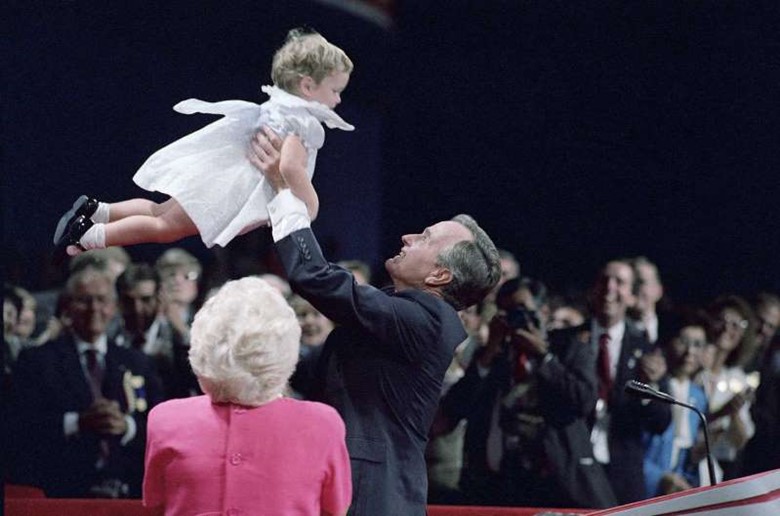
© Mark Duncan, Associated Press George H W Bush 1988 family at RNC convention
With no geologic or engineering background, Bush learned the business from the ground up, “walking fields, talking to people, and trying to make deals,” Overbey later recalled in an interview. Three years later, he and Overbey joined up with two brothers, Hugh and William Liedtke, to form Zapata Petroleum. An offshore subsidiary was formed a year later.
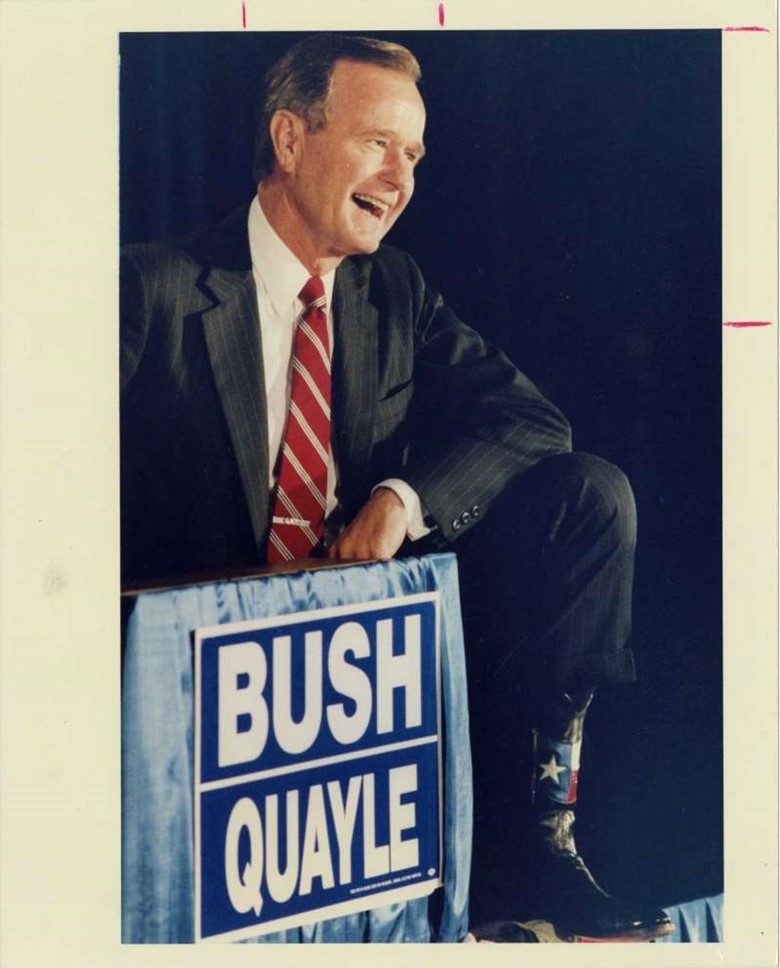
© Ira Strickstein, Houston Chronicle 08/27/1988 – Republican presidential candidate George Bush shows his Texas stripes, displaying a pair of cowboy boots emblazoned with the state flag during a Republican Victory 88 meeting at Houston’s Stouffer’s Hotel Saturday, Aug. 27, 1988.
Zapata raised more money and gambled on an interest in a field in Coke County that skeptics claimed was played out. One of the brothers, Bill Liedtke, said years later that the young company drilled 130 wells and never had a dry hole. As for politics, there wasn’t much time for it, though Bush did later mention his modest role as a Republican precinct worker. In one particular primary, he later recalled, perhaps apocryphally, only three GOP voters showed up: him, his wife, and a drunken Democrat who wandered into the wrong polling station.
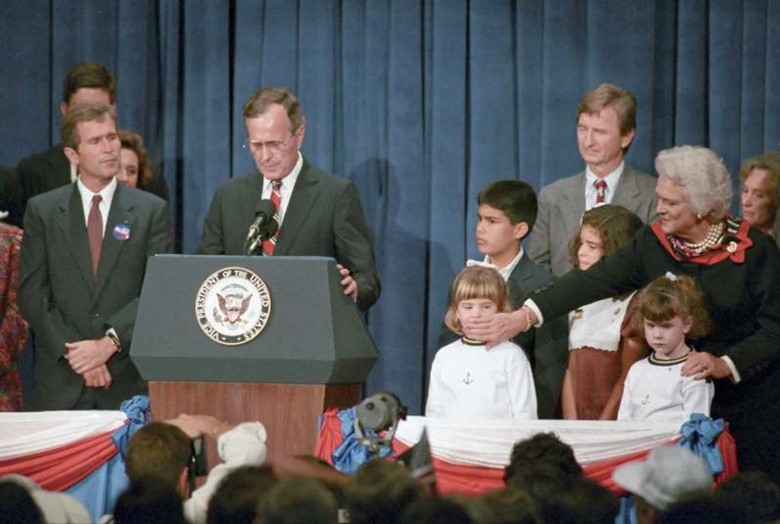
© Richard Carson, © Houston Chronicle Photographer Richard J. Carson recorded the historical significance of Bush’s acceptance speech and the lighter side of the event 11/08/1988 when Barbara Bush puts her hand over her granddaughter’s yawn as George Bush gives a speech.
Bush enjoyed his time in Midland, learning a business, tending to a growing family and making friends who would prove important later. The closeness of the city’s business community was evident when the Bush family’s life was interrupted by tragedy. The second of the children, daughter Robin, was diagnosed with leukemia in 1953, before the disease became largely curable.

© AP ** FILE ** In this Nov. 9, 1988, President-elect George H. W. Bush holds his hands up to acknowledge the crowds applause, and ask them to allow him to continue his speech during his victory rally with grandson, George P. Bush, right, and son, George W. Bush, left, in Houston, Texas. Bush trounced Michael Dukakis 426-111 in the electoral vote, but the popular vote was closer, 53 percent to 46 percent.
His fledgling business career was all but put on hold for more than six months as he, Barbara and Robin made repeated trips to Sloan Kettering Cancer Center in New York. Barbara tried to approach their new circumstances with stoic resolve, to the point of booting visitors out of Robin’s hospital room if they cried. Her husband became increasingly emotional and often was the one who had to leave the room. Robin died later in 1953.

© King Chou Wong, Houston Chronicle 11/09/1988 – President-elect George Bush, his wife, Barbara, and his grandchildren, Jenna (left) and Barbara wave to well-wishers before they board a jet at Ellington Field the day after his election victory. At right can be seen a congratulatory sign prepared by the crew. King Chou Wong / Houston Post
“I hadn’t cried at all when Robin was alive, but after she died, I felt I could cry forever,” she recalled in a 1988 interview with Texas Monthly. “George had a much harder time when she was sick. He was just killing himself, while I was very strong. That’s the way a good marriage works. Had I cried a lot, he wouldn’t have. But then things reversed after she died. George seemed to accept it better.”
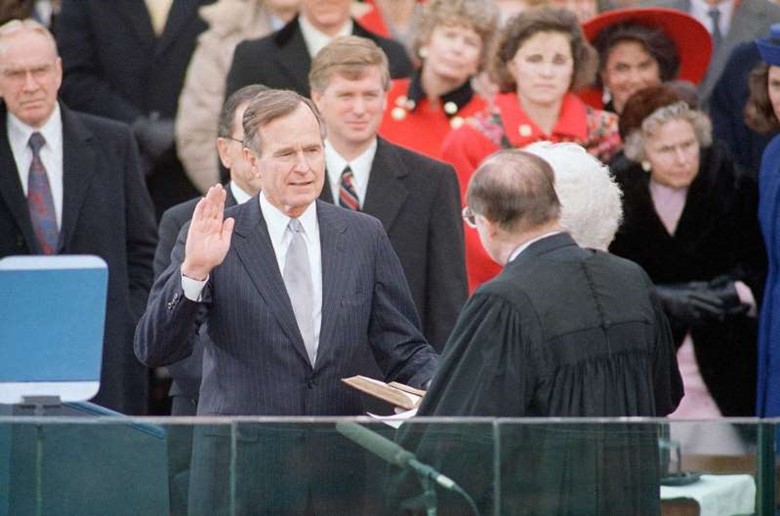
© Ron Edmonds, Associated Press George HW Bush being sworn in as President of the United States
The Bushes lived in Midland for almost a decade. It was where he made his first real money — his own money — and where he established his image as a true, if transplanted, Texan, one who could down to a bowl of chili at lunch and a chicken-fried steak at dinner, snacking in between on pork rinds. Everyone in town knew George Bush — “Poppy,” his childhood nickname, had been jettisoned along with the Brooks Brothers suits — but isolated West Texas was not where he needed to be.

© J. SCOTT APPLEWHITE, ASSOCIATED PRESS Former President Ronald Reagan, left, his wife Nancy Reagan, new first lady Barbara Bush and her husband President George Bush, right, walk down the Capitol steps after the inaugural ceremony in Washington, D.C., Friday, Jan. 20, 1989. President Bush was sworn in as the nation’s 41st president. The Reagans are heading to an awaiting helicopter to take them to Andrews Air Force Base, Md., and onto California. (AP Photo/J. Scott Applewhite)
A disagreement over the direction of the company led Bush to buy out the other investors in Zapata Offshore in 1959, and he soon moved the company to Houston.

© Hearst Newspapers President and Mrs. Bush walk along Pennsylvania Avenue after the President’s Inauguration on January 20, 1989.
During the early 1960s, Bush began to feel the political itch, or to be more precise, respond to an itch that had been there for years, and waded into a successful race for Harris County GOP Chairman to make sure it did not fall into the hands of perceived extremists in the party’s right wing, many of whom were members of the conspiracy-hawking John Birch Society.
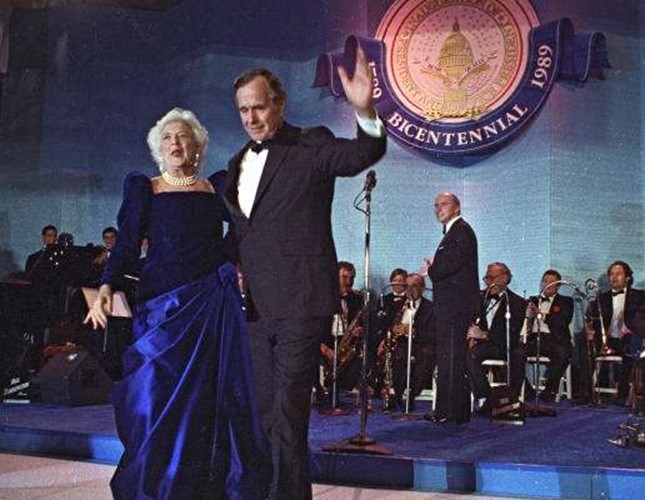
© Hearst Newspapers Barbara Bush had a reputation as a grandmotherly figure when her husband took office in 1989, but she proved that grandmothers can be fashionable in this royal blue gown with velvet bodice, square neck and diagonal dropped waist designed by Arnold Scaasi.
Perhaps because his father had just left the U.S. Senate, Bush then brashly decided to take on incumbent U.S. Sen. Ralph Yarborough in 1964.

© Hulton Archive, Getty Images Portrait of the forty-first president of the United States George Bush, circa 1989.
Though little known outside of Houston and Midland, Bush campaigned vigorously as a different sort of Republican, less in step with the northeastern wing of his father and closer to the politics of Barry Goldwater and George Wallace. He went full-tilt conservative, opposing, among other socially progressive initiatives, the pending Civil Rights Act.

© BARRY THUMMA, ASSOCIATED PRESS Republican National Committee Chairman Lee Atwater, left, attends a meeting with Pres. Bush and Republican congressional leaders at the White House, March 8, 1989.
Yarborough portrayed Bush as an extremist and won easily, gaining 56 percent of the vote as Lyndon Johnson swamped Goldwater in the presidential race.
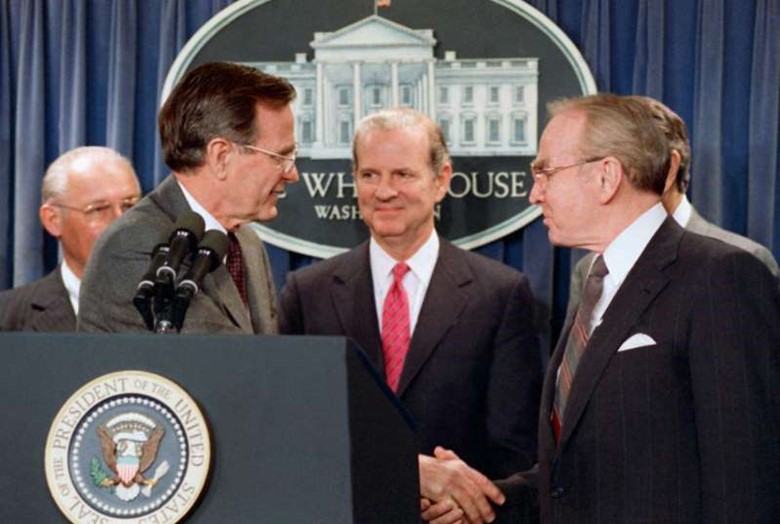
© Barry Thumma, ASSOCIATED PRESS President George H.W. Bush turns and shakes hand with House Speaker Jim Wright of Texas after he announced in the White House briefing room in Washington, on Friday, March 24, 1989 that he is unveiling a Bipartisan Contra aid plan as the first plank of his emerging foreign policy. Center is Secretary of State James Baker and left is House Minority Leader Robert Michel of Ill.
After his defeat, Bush struggled to reconcile his moderate views with an election that had seen him embrace, however tentatively, an anti-progressive tone and a segregationist posture.

© Ron Edmonds, ASSOCIATED PRESS President George H.W. Bush holds one of first dog Millie’s six puppies for the press on Wednesday, March 29, 1989 at the White House in Washington.
“This mean, humorless philosophy which says everybody should agree on absolutely everything is not good for the Republican Party or our state,” Bush wrote to a friend after the loss. “When the word moderate becomes a dirty word, we have some soul-searching to do.”
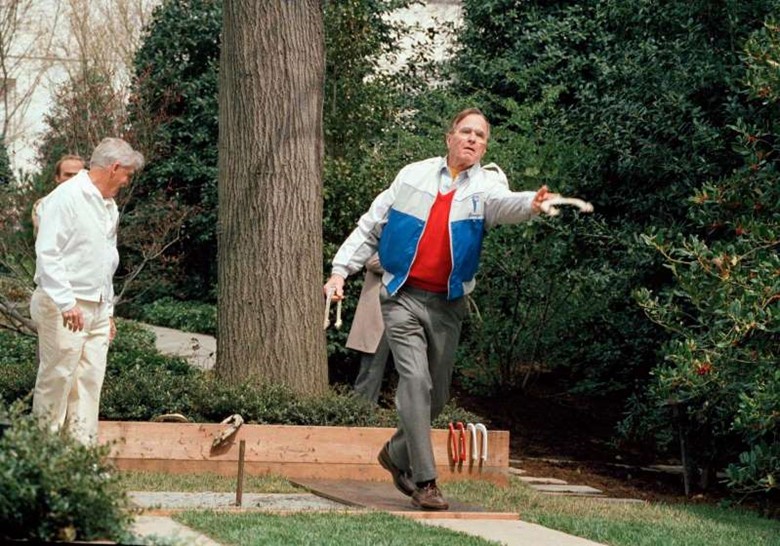
© Barry Thumma, AP President George H.W. Bush lets loose of a horseshoe during the dedication of the new horseshoe pit on the White House lawn Saturday April 1, 1989 in Washington. Other people are unidentified.
In November 1966, Bush ran for Congress and won, becoming the first Republican from Houston and the star of the growing Texas GOP. He ended up with a plum appointment to the Ways and Means committee — a party nod to the importance of Texas. His voting record was predictably conservative, though not as hard right as his previous rhetoric suggested, and he ended up voting for the Civil Rights Act, as a result receiving stacks of hate mail and some death threats.

Mike Tolson is a senior Chronicle reporter who specializes in long-term projects. He can be reached by e-mail at Mike.Tolson@chron.com.
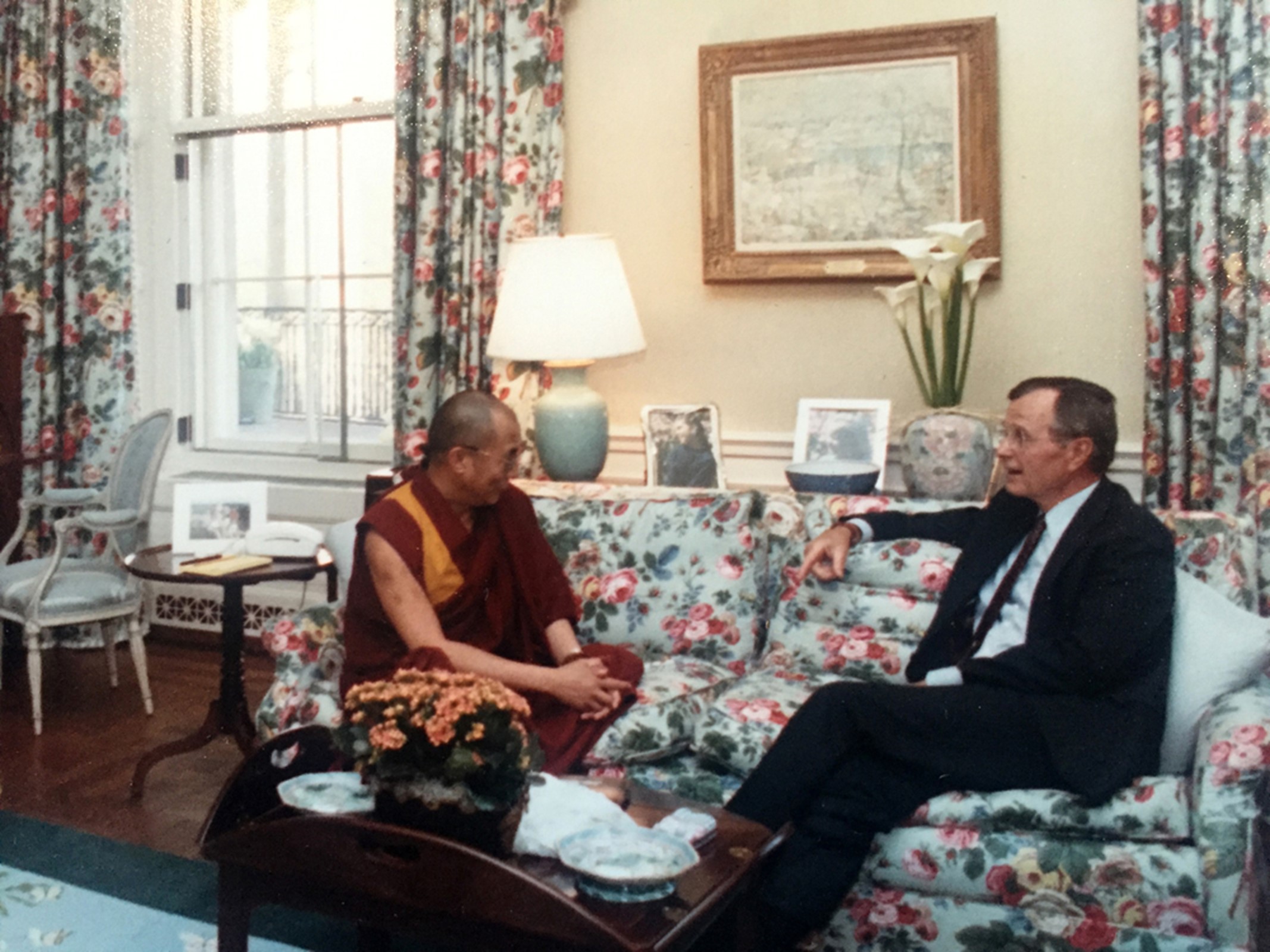


 Whole Dude - Whole Concept