What is Matter? and What is Spirit? If materialism is about the influence of material wealth, I would like to use the Power/Force/Energy called Money to talk about Life and Death. The Laws of Conservation are applicable to both the living, and the non-living matter. Hence, it can be stated that “Life can neither be created nor destroyed.” If any person can refute my claim using valid, scientific information, I would give the person a US $1,000 bill as a reward.
HUMAN NATURE AND HUMAN FORMS: ‘SARVESHAM SVASTIR BHAVATU’
Greek Philosophers Plato and Aristotle – To understand Human Nature, we must know the Human Form, its actions and behavior.
What is man? The motivation to ask this question comes from a statement expressed in the Sanskrit language, ‘Sarvesham Svastir Bhavatu’, which seeks the well-being of all men, of all races, of all cultures, of all religions, and of all nations. Our efforts to support the well-being of man would be affected by our understanding the ‘real’ or ‘true’ nature of man. Aristotle describes corporeal substances are composite of two principles, form and matter. It is important to seek proper understanding of human form and to know the truth about human nature by describing the form. Being born relates the man to the Subjective Reality of his physical existence and the human nature is related to the fact of man’s existence in the physical world and universe. If the Objective Reality of man is non-material, we still need to know as to what exists in the world, and as to how it exists.
PLATO’S THEORY OF FORMS – THE DUALISM OF BODY AND SOUL:
Greek philosopher Plato (427 B.C. to 347 B.C.) describes the human nature by his Theory of Forms. He describes four aspects of human being; 1. The Logical Form, 2. The Epistemological Form, 3. The Moral Form, and 4. The Metaphysical Form.
The Logical Form: It describes the physical being, the physical form and its identity. Each human being has characteristic physical features using which he can be identified as a member of the genus Homo and he has very specific features that establishes his identity that is shared by all the members of a species known as Homo sapiens sapiens. Each member of this species could be further identified as an individual using the present Identification technology. This specific human individual will not exist with the same identifying features during his entire duration of his physical existence. The Logical Form of human is impermanent and is subject to change and eventual death. However, the existence of this physical form is important to support the existence of man and to know his nature. Existence precedes human nature or Essence. The Essence (Who You Are) is defined and is preceded by the Reality of Existence. The human being belongs to a social group, and always exists as an Individual with Individuality while his physical form changes and passes through various stages such as infancy, boyhood, teenage, adult and old age. The Logical Form is subject to change, decay, and death. Hence, the reality of this Form is often doubted. It must be noted that Plato has not known man as a multicellular organism and his description of the Logical Form is not based upon study of Human Anatomy and Human Physiology.
The Epistemological Form: The term epistemology deals with the Theory of Knowledge. It describes the possible kinds of knowledge and the degrees of certainty for each kind of knowledge. Plato describes the knowledge that human being can acquire through education, a process of learning from sensory experiences, and teaching imparted by others. Plato expects to obtain full knowledge of human forms through proper education. Such knowledge is important to know the Metaphysical Form of man. Self-Knowledge leads to the understanding of man’s true or real nature. The perception of impermanent, material, human body is described by Plato as only opinion or belief and he considers that such perception is not true knowledge of human form. Plato has not given attention to knowledge that is innate or that is not acquired by the learning process. To perform the living functions in support of his existence, man uses biological information that is inherited and not knowledge that has to be acquired through learning.
The Moral Form: It describes qualities such as Courage and Justice, the observable aspects of human nature that could be described from human action and human behavior.
The Metaphysical Form: Plato claims that the Metaphysical Form is not perceivable by any of the senses. The Metaphysical Form is the real form of the human being as compared to the Logical Form which is considered to be unreal. The Metaphysical Form is not present in space or time, as it is beyond the world of changeable and destructible things. It belongs to the realm of unchanging, eternal forms. This form being true can be fully known through knowledge.
Plato’s Theory of Body-Soul Dualism:
Plato divides human being into two categories; 1.Body, a material entity, and 2. Mind or Soul, a non-material entity which can exist apart from the Body. Plato maintains that the Mind or Soul is indestructible, it existed eternally before birth and will exist eternally after death. He further describes the three parts of Soul as 1. Appetite – the seat of desires and passion such as hunger, thirst, and sexual desire, 2. Reason – the seat of discernment that chooses right from wrong and makes distinctions between good and evil, and 3. Spirit – the seat of self-assertion, self-interest, anger, indignation, and self-pride. Plato considers that the well-being of man depends upon harmonious interactions of the three aspects of the Soul. Plato thinks that such harmonious interactions would only be possible when Reason controls both Spirit and Appetite. To strike this balance and to maintain harmony, man has to obtain knowledge of the eternal, unchanging form. Plato thinks that Justice is revealed as a principle of each thing performing the function most appropriate to its nature, a principle of the proper adjudication of activity and being. The principle of Justice is revealed or discovered in the individual human Soul when each part of the Soul performs its proper and appropriate function. Plato believed that the Human Soul rules the Human Body. The Rule of Reason is required to combine the virtue of temperance with self-mastery and harmony results when all elements agree as to which should do what.
The Five Aspects of Human Existence:
I describe five Forms of human being and each Form can be identified by its own behavior; 1. The Physical Form as described by Human Anatomy and Human Physiology, 2. The Mental Form as described by sciences such as Psychology and Psychiatry, the Form that has intellectual and emotional aspects, 3. The Social Form as described by Social Sciences, the social aspects of man, his activities, and the structure and organization of all human institutions, 4. The Moral Form as described by man’s power of discernment or conscience to make moral and ethical choices, and 5, The Spiritual Form, the aspect that formulates harmonious interactions between the cells, the tissues, and the organs of the human body whose individual functions support the well-being of the singular entity recognized as man. The man’s existence would be at risk if any of these five aspects is adversely impacted. Unless we seek clear, visual images of Human Form in all its aspects, we will fail to understand the man and his purpose in life.
What is Matter? and What is Spirit? If materialism is about the influence of material wealth, I would like to use the Power/Force/Energy called Money to talk about Life and Death. The Laws of Conservation are applicable to both the living, and the non-living matter. Hence, it can be stated that “Life can neither be created nor destroyed.” If any person can refute my claim using valid, scientific information, I would give the person a US $1,000 bill as a reward.
What is Matter? and What is Spirit? If materialism is about the influence of material wealth, I would like to use the Power/Force/Energy called Money to talk about Life and Death. The Laws of Conservation are applicable to both the living, and the non-living matter. Hence, it can be stated that “Life can neither be created nor destroyed.” If any person can refute my claim using valid, scientific information, I would give the person a US $1,000 bill as a reward.
SPIRITUALISM AND INTELLIGENCE:
Spiritualism and Intelligence :I would like to pay my tribute to Albert Einstein ( b. March 14, 1879, d. April 18, 1955), German-American Physicist who won the Nobel Prize for Physics in 1921 and who developed the Special and General Theories of Relativity, Photon Theory of Light, Photoelectric Law, and work in theoretical Physics such as the equivalence of Mass and Energy. The scientific inquiry of Intelligence would establish its biological basis and show that all living organisms are Intelligent.
What is Man? I would begin this investigation by sharing my motivation for asking this question. The motivation comes from a statement that is expressed in Sanskrit language: “SARVESHAM SVASTIR BHAVATU”, a statement that seeks the well-being of all people, of all races, of all cultures, of all religions, and of all nations.
WHAT IS MAN? SPIRITUAL BEING AND SELF-REALIZATION. SPIRITUALITY IS NOT LEARNED OR ACQUIRED EXPERIENCE.
The meaning and purpose of life are affected by whatever we think is the real or true nature of man. It is important to recognize that our efforts to support the well-being of man would require correct understanding and knowledge of the real or true man.
WHAT IS INTELLIGENCE?
SPIRITUALISM AND CONSCIOUSNESS: Amoeba proteus is a living organism as it has the ability to perform vital, living functions.
Intelligence can only exist in living matter and living entities. The word Intelligence (Latin. Intelligentia) involves perception, discernment, the ability to learn or understand from experience, and the ability to acquire and retain knowledge. Intelligence is associated with all-around effectiveness of a living organism to maintain its existence. Intelligence influences a broad range of living functions and could be observed in the performance of those functions. The potentiality or capacity called Intelligence has a biological basis. However, in popular usage, Intelligence is used to describe the cognitive (knowing) component distinct from the affective (emotional), and motivational (drive) components of human behavior. Very often, people use the term Intelligence to describe the variations in the ability to learn, to function in society and to behave according to contemporary social expectations. I would like to differ from this conception of Intelligence as an innate ‘brain- power’- a mental faculty which distinguishes the more highly evolved animals from simple organisms, and tries to measure Intelligence levels and the differences among individuals and separate geniuses from average persons. It is not reasonable to think of Intelligence as an exclusive function or faculty of the mind. Psychologists who describe the psychological basis of Intelligence tend to view Intelligence as a combination of the innate characteristics of an individual’s Central Nervous System which is molded by experience, learning, heredity, and environmental factors. Psychologists describe Intelligence as a collection of a large number of highly varied, although overlapping mental skills and abilities. Intelligence may include about 120 specific abilities which are grouped under three categories as: 1. logical processes, 2. the kinds of information processed, and 3. the products of such information processed (eg. classes, systems, relations). It is understandable to know Intelligence as multidimensional and Intelligence serves as the basis for the performance of a wide variety of functions that involve knowing information, use or application of information, and physical performance or observed behavior which could be called Intelligent Behavior. Still, there is no single definition of Intelligence. There is no agreement if Intelligence could be directly observed and be accurately measured. Intelligence remains as a hypothetical ability. There is an abstract faculty that apprehends, conceptually and perceptually, relations among objects. I would like to present this abstract function of Intelligence to recognize relations among objects as a feature of a living cell and its ability to recognize the presence of other living cells present in its environment, its ability to recognize substances present in its environment, its ability to selectively use or dispose of molecules, its ability to express cooperation, tolerance, mutual assistance, defence, communication, and functional subordination in various biotic interactions with its own being, or in its interactions with other living species. My purpose is that of recognizing the fact of Intelligence as the characteristic of all living organisms and living cells and it could be important to recognize the association between Intelligence and Consciousness as the basis for a living entity to exist in its environment. We cannot afford to ignore the fact that millions of human beings have perished because of Intelligence displayed in operation and behavior of a variety of Viruses, Bacteria, Protozoa, other parasites, venomous creatures (eg. spiders, scorpions, and snakes) and carnivorous animals.
SPIRITUALISM AND INTELLIGENCE:
The single fertilized egg cell grows, develops, and differentiates to produce all the tissues and organ systems of the human being. Brain, the chief organ of the Central Nervous System is derived from this fertilized egg cell. This Egg Cell is Intelligent and Intelligence represents an Innate ability and capacity to learn and adapt, to acquire, to retain, and to use Knowledge in the performance of a wide range of living functions.Spiritualism and Intelligent Behavior: Human Embryo Implantation at about 6 days after fertilization of egg cell is an example of Intelligent Behavior. Intelligence is identified as the Cognitive or Knowing aspect that is distinct from the Affective or Emotional aspect, and Motivation or Drive aspect of Human Behavior. Human Embryo is Conscious and Intelligent for it knows about its condition, or state, and the fact of living.
I suggest that we need to make a distinction between Intelligence and Intellect, the mental function which is associated with thinking. Brain like all other organs and tissues of the human body has grown and developed from the protoplasm of a single, fertilized egg cell. The intellectual abilities of brain are dependent upon the basic, underlying nature and ability of its living matter or protoplasm. Intelligence represents innate ability or capacity to learn and adapt. It has the ability to acquire new knowledge from experience. This potentiality and capacity of Intelligence is reflected in mental abilities like creative thinking and analytical thinking. In my view, both Consciousness, and Intelligence are the defining features of Soul or Spirit and hence I submit that the living matter or protoplasm is of Spiritual nature as it knows to formulate its relations with other living entities with a nature that exhibits traits of Compassion, Sympathy, and Understanding to achieve both internal, and external Harmony, Tranquility, and Peace to support its existence and living condition. Man because of his intellectual abilities entertains thoughts about immortality, eternal life, and everlasting life as he recognizes the potentiality and capacity of his Intelligence that sustains and maintains his living condition.
What is Matter? and What is Spirit? If materialism is about the influence of material wealth, I would like to use the Power/Force/Energy called Money to talk about Life and Death. The Laws of Conservation are applicable to both the living, and the non-living matter. Hence, it can be stated that “Life can neither be created nor destroyed.” If any person can refute my claim using valid, scientific information, I would give the person a US $1,000 bill as a reward.
What is Matter? and What is Spirit? If materialism is about the influence of material wealth, I would like to use the Power/Force/Energy called Money to talk about Life and Death. The Laws of Conservation are applicable to both the living, and the non-living matter. Hence, it can be stated that “Life can neither be created nor destroyed.” If any person can refute my claim using valid, scientific information, I would give the person a US $1,000 bill as a reward.
THE MAN’S ESSENCE AND THE MAN’S EXISTENCE:
The Vitruvian Man c. 1492. The painting by Leonardo da Vinci displays the spirit of scientific inquiry. Could we know and understand the human nature or the man’s essence by investigating the man’s mind using the psychoanalytic principles? How does the man exist? What is the basis for the man’s Existence? If there are hidden mental entities, how could they help or support the man’s existence? How could the man display his essence if his existence is not supported? Spiritualism is that potency that sustains the human existence and is reflected as human nature in the structures and functions of the human being.
What is man? The tradition of knowing oneself is a longer tradition than any other Science. This is a study in which the Knower and the Known are one. The object of the scientific inquiry is the nature of the scientist. The motivation to know man comes from a statement expressed in the Sanskrit language, “Sarvesham Svastir Bhavatu” which seeks the well-being of all the men of all races, of all cultures, of all religions, and of all nations.
WHAT IS MAN? THE THEORY OF HUMAN NATURE. THE PURSUIT OF PEACE, HARMONY, AND TRANQUILITY IN THE HUMAN LIVING EXPERIENCE.
Our efforts to support the well-being of man would be affected by our ability to discover the universal principles that describe the ‘real’ or ‘true’ nature of man. All human literary, philosophical, religious, and scientific traditions make assumptions about human nature. The basic assumption about human nature is that of finding it displayed in feelings, thoughts, moods, and mental states of the human individual from where human actions and behavior proceed. All such actions and behaviors that emanate from mental states show individualistic variations. It will not be easy to discover universal principles that could clearly establish the basis of true and real human nature by simply studying human mind and its functions. The structure and behavior of things contribute to their individual being and function. To understand human behavior, we may have to know the structure and behavior of the human living matter or substance to which we attach human identity and recognize it as the human person. I try to know the human nature from the functional characteristics that are observable in biotic interactions of cells, tissues, organs and organ systems formed and developed by the human living matter and constitute the human organism. If a man is viewed as a multicellular organism, I try to discover the human nature of a subject who objectively exists because of the living functions of cells, tissues, organs and organ systems that provide the biological basis for that existence. In this context, I have explored the theories shared by biologist Konrad Lorenz, psychologist Dr. B.F. Skinner, philosopher Jean Paul Sartre and now I would like to review the Theory of psychoanalysis formulated by Dr. Sigmund Freud. It must be noted that all of them and several others have explained the human nature without explaining the connection between the nature that is observed and the biological basis for the existence of the human individual whose behavior and actions they have studied.
PSYCHOANALYSIS AND THE PRINCIPLE OF DETERMINISM:
Dr. Sigmund Freud (1856 to 1939) claims, “No knowledge can be obtained from Revelation, Intuition, or Inspiration.” However, he reasons that knowledge could be obtained from unseen and unobservable mental entities whose existence cannot be tested empirically.
Dr. Sigmund Freud is known as the creator of Psychoanalysis. He is the author of several books; The Interpretation of Dreams (1900), The Psychopathology of Everyday Life (1901), Three Essays on the Theory of Sexuality (1905), Five Lectures on Psycho-Analysis (1909), Introductory Lectures on Psycho-Analysis (1915 -1917), Beyond the Pleasure Principle (1920), The Ego and the Id (1923), The Future of an Illusion (1927), An Outline of Psycho-Analysis (1938), and others. He assumes that all phenomena are determined by the laws of Physics and Chemistry. He considers that man is a product of Natural Evolution and is subject to the same laws of mechanistic principles. According to Freud, every event has preceding sufficient causes within the realm of the mind. He investigated for hidden causes in a person’s mind. Freud suggests that there are uncontrollable causes in every individual’s mind that determine the choices the individual makes. Freud contends that the mind includes ‘unconscious’ items of which the person has no ordinary knowledge. Freud postulates that the ‘unconscious’ mental state is dynamic in nature and that it actively exerts pressures and influences on what a person is and what he does. Freud coined the term Psychoanalysis to describe both the theories of Personality and the method of treating mental illness. Freud profoundly influenced man’s view of himself. Psychoanalysis involves the possibility of ‘unconscious’ mental states which have causal effects on people’s mental life. Psychoanalysis is based upon the idea that people could suffer from some idea or memory or emotion of which they are not conscious, but from which they could be cured by somehow bringing it into consciousness. Freud applied Psychoanalytic theory to the whole of normal mental life, not just to pathological conditions. He evolved a method of treatment to address the problems of neurotic mental disorders. The Freudian concept thus describes the powerful influence of the ‘unconscious’ mind on conscious thought and behavior and the equally powerful influence of the apparently forgotten past on the present. Apart from using terms such as ‘unconscious’, ‘preconscious’, and ‘conscious’, he distinguished three major structural systems within the human mind or personality; the ‘id’ which contains all the instinctual drives seeking immediate satisfaction, the ‘ego’ which deals with the real world outside the person, mediating between ‘ego’ and the ‘id’, and the ‘superego’, a special part of the ‘ego’ which contains the conscience, the social norms acquired in childhood. Whatever can become ‘conscious’ or items that could be ‘preconscious’ is in the ‘ego’ and everything in the ‘id’ is permanently ‘unconscious’. Freud’s concept of man includes his theory of the ‘instincts’ or ‘drives’, the motive forces within the mind. Freud also shares the historical theory of individual human character and the adult character depends upon the experience of infancy and childhood. Freud says that individual well-being or mental health depends on a harmonious relationship between the various parts of the mind and between the person and the real world in which man has to live. When we apply the Psychoanalytic theory to verify the contents of man’s ‘conscious’ or ‘unconscious’ mind, the basic assumption of Freud that man is governed by laws of Physics and Chemistry gets disproved. Human beings are vastly different from the entities studied by Physics and Chemistry. Psychoanalysis could only have individualistic applications. Psychoanalysis does not provide data that could be further tested empirically. We cannot test the usefulness or judge the efficacy of Psychoanalytic treatment in the same manner that is used to evaluate other therapeutic interventions.
SPIRITUALISM AND CONSCIOUSNESS:
Dr. Sigmund Freud uses terms such as ‘preconscious’, ‘conscious’, and ‘unconscious’ without explaining the anatomical and physiological basis to describe the mental function. Consciousness has two components, 1. The Contents of Consciousness, and 2. The Capacity of Consciousness. Freud is concerned with only consciousness that is projected to the cortical areas of the brain and ignores as to how consciousness is composed by the Reticular Formation and other nuclei in the Brain Stem. Apart from being a neurological function, each living individual cell is conscious and is aware of the fact of its existence, it knows its internal condition and it reacts and responds to the conditions of its external environment.
I would like to explain ‘Spiritualism’ as the potency that is evidenced as the presence of consciousness in any given living organism or living cell. It is the chief biological characteristic of living matter. Spiritualism is the power that causes consciousness and awareness that is exhibited in the biological properties of living matter; biological properties such as Motion, Nutrition, and Reproduction by Cell Division. Spiritualism is the biological basis for human existence and it explains human nature which is expressed as an internal, mutually beneficial partnership, relationship, association, connection, and bonding between the cells, the tissues, and the organ systems of the human organism and the Whole Organism that represents the Human Person in the world he lives. Clinical Medicine provides the opportunities to promote the well-being of all people as it includes the principle of verification of the objective, biological basis of human existence. Dr. Freud may explain as to why a man may choose to drink alcohol or use tobacco. But, his Psychoanalysis will not determine the behavior, action, and response of the man’s liver, heart, lungs, blood vessels and other cells, tissues, and organ systems to the choices that the man makes. While man makes mental choices for his actions and behavior, he has no freedom, no free will to make choices on behalf of his cells, tissues, and organ systems. While Freud lays the emphasis on a harmonious relationship between the various parts of the mind and between the person, I speak about harmonious relationships in the Whole Person and not simply between a few unobservable mental entities. We need a theory that recognizes the spiritual nature of man’s living matter and the spiritual relationships that it formulates while developing and building the very complex multicellular human organism.
What is Matter? and What is Spirit? If materialism is about the influence of material wealth, I would like to use the Power/Force/Energy called Money to talk about Life and Death. The Laws of Conservation are applicable to both the living, and the non-living matter. Hence, it can be stated that “Life can neither be created nor destroyed.” If any person can refute my claim using valid, scientific information, I would give the person a US $1,000 bill as a reward
What is Matter? and What is Spirit? If materialism is about the influence of material wealth, I would like to use the Power/Force/Energy called Money to talk about Life and Death. The Laws of Conservation are applicable to both the living, and the non-living matter. Hence, it can be stated that “Life can neither be created nor destroyed.” If any person can refute my claim using valid, scientific information, I would give the person a US $1,000 bill as a reward.Spiritualism – The New Synthesis. Dr. Edward Osborne Wilson is recognized as the world’s leading authority on ants. He is the foremost proponent of Sociobiology, the study of the genetic basis of the social behavior of all animals including humans.
Dr. Edward Osborne Wilson is recognized as the world’s leading authority on ants. He is the foremost proponent of Sociobiology, the study of the genetic basis of the social behavior of all animals including humans. In his book, Sociobiology : The New Synthesis (1975) he presented his theories about the biological basis of social behavior. It involves the application of the Theory of Evolution to the study of animal and human social behavior. It holds that the Theory of Evolution by ‘natural selection’ applies to behavior in the same way that it applies to structure and physiological functions. He holds that behavior patterns are genetically determined and are governed by the process of ‘natural selection’. Accordingly, he explains that social behavior relies upon the principle that genes are able to influence behavior and will be selected if the behaviors they encourage contribute ultimately to the reproductive success of the individual carrying those genes. The ‘Darwinian Fitness’ of an organism or a gene is a measure of the ability of that organism or gene to project copies of itself into future generations. Because, ‘natural selection’ would influence genetically controlled behavior, he believes that individuals will tend to behave in ways that maximize their ‘Darwinian Fitness’. However, he attributes 10 percent of human behavior as genetically induced, the rest being attributable to environment. It could be indeed true that some behavioral abilities depend upon underlying genetic mechanisms which support the neural and hormonal mechanisms that are required in the performance of actions by organisms. Dr. Wilson recognizes the essentially biological principles on which animal societies are based and could apply those principles to human social behavior. One of Dr. Wilson’s most notable theories is that a characteristic such as ‘altruism’ could be genetically based and may have evolved through the process of ‘natural selection’. Dr. Wilson maintains that altruistic behavior is consistent with ‘natural selection’ in that the sacrifice is made to save closely related individuals who share many of the sacrificed organism’s genes.
ALTRUISM AND SOCIOBIOLOGY:
Spiritualism – The New Synthesis.Altruism as a behavior is not always a psychological function or ability. It is displayed as pure altruism in the social behavior of worker bees, ants, and wasps.
The term ‘altruism’ (French – altruisme) was coined by Auguste Comte, the founder of Positivism and Sociology. It is considered as antithesis to Egoism. Altruism is behavior that benefits others at some cost to the individual displaying altruistic behavior. Social scientists refer to altruism as the behavior of an individual who consciously comes to the aid of another, without expecting anything in return. Such behavior is influenced by empathy, an emotional response that results from being aware of another person’s emotions. In Ethics, altruism is described as a theory of conduct that regards the good of others as the end of moral action. It describes unselfish concern for the welfare of others. However, biologists view altruism as any behavior that reduces the ‘Darwinian Fitness'(reproductive success) of the altruist while increasing the fitness of another. It is common for animals to share food, help provide for another’s young, defend others against predators, and give alarm calls when a predator appears. Such animal altruism is common and it does not require psychological abilities and functions like sharing of emotions, feelings, and thoughts. Altruism as a behavior is not always a psychological function or ability. It is displayed as pure altruism in the social behavior of worker bees, ants, and wasps.
SPIRITUALISM – THE NEW SYNTHESIS:
Spiritualism – The New Synthesis: A very good example of Spiritualism is that of altruism displayed by the mature Red Blood Cells of humans.
It must be understood that behavior is a fundamental characteristic of life and of all living entities. All species, whether single-celled protozoans or the largest of mammals possess the capacity to respond to stimuli in their environment. This ability called responsiveness is the fundamental attribute of all kinds and types of behavior. Psychologists like B.F. Skinner tend to focus on the learned components of behavior and stress the importance of environment and its influence on behavior. Biologists like Konrad Lorenz tend to focus primarily on the analysis of the innate components of behavior. Sociobiologists tend to recognize the role of genes and the influence of environment and describe that behavioral abilities depend on underlying genetic mechanisms that develop the structures and physiological mechanisms that are important to display a given behavior. It may be noted that both Psychologists and Biologists are describing behavior in the context of social relations and interactions between individual and groups of living organisms. Living things behave in ways to maximize their chances of survival. In the entire animal kingdom, most living organisms display parental or social instincts. All animals display social behavior. No animal is ever completely isolated from some kind of environment that may not include members of the same species or other species. Animals form parental societies to care for their offspring. Bacteria come together to live as colonies. Hence, it will be important to recognize social behavior that is displayed by individual living cells. I define Spiritualism as the capacity or the biological ability of an individual living cell to form harmonious relations with others and to participate in or contribute constructively to changes in the social environment. The potency called Spiritualism is reflected in the biological functions of Consciousness and Intelligence. At a cellular level, the social aspect of Consciousness is reflected by the biological abilities of the cell such as association, cooperation, communication, recognition of other living cells in its immediate environment, and performing actions which have characteristics of functional subservience to provide benefits like survival and reproductive success to other cells. A very good example of Spiritualism is that of altruism displayed by the mature Red Blood Cells of the man. The mature Red Blood Cells have no nuclei and hence cannot divide or reproduce. Each Red Blood Cell has a very limited life span of its own. They sustain their meagre energy needs by a form of anaerobic respiration as they do not have mitochondria like the trillions of other cells of the human body. The Red Blood Cells are passive in nature and they simply exist to provide Oxygen to other cells and tissues, collect Carbon Dioxide while being swept along by the blood stream. Since the mature Red Blood Cells have no nuclei, their behavior is not operated by genes or genetic mechanisms which could be important in their formation, development, and maturation. The social aspects of the Red Blood Cell behavior is related to the spiritual nature of its living substance. I would ask Biologists to give attention to the nature, functional abilities of the living substance apart from the consideration of genes and genetic mechanisms. It may be very clearly understood that the nucleus, the chromosomes, and the genes have no independent existence of their own and they perform their cellular functions while they derive energy and nutritional support from the living substance or Protoplasm that has the biological abilities of Consciousness, and Intelligence which is reflected in its properties like responsiveness, the power of nutrition, and reproduction. Spiritualism is the Science of New Synthesis; the New Synthesis that formulates the relationships between Substance, Structure, Function, Heredity of a Living Organism and its Environment, Behavior, and Social Community.
Spiritualism – The New Synthesis. The Behavior pf the Red Blood Cell can be described as Altruism. Red Blood Cells are packed with hemoglobin. Each Red Cell contains over 600 million hemoglobin molecules.
What is Matter? and What is Spirit? If materialism is about the influence of material wealth, I would like to use the Power/Force/Energy called Money to talk about Life and Death. The Laws of Conservation are applicable to both the living, and the non-living matter. Hence, it can be stated that “Life can neither be created nor destroyed.” If any person can refute my claim using valid, scientific information, I would give the person a US $1,000 bill as a reward.
What is Matter? and What is Spirit? If materialism is about the influence of material wealth, I would like to use the Power/Force/Energy called Money to talk about Life and Death. The Laws of Conservation are applicable to both the living, and the non-living matter. Hence, it can be stated that “Life can neither be created nor destroyed.” If any person can refute my claim using valid, scientific information, I would give the person a US $1,000 bill as a reward.
THE THEORY OF HUMAN NATURE: “SARVESHAM SVASTIR BHAVATU”
The Vitruvian Man c. 1492. The painting by Leonardo da Vinci displays the Spirit of Scientific Inquiry about Human Nature.
What is Man? The motivation for asking this question comes from a statement expressed in Sanskrit language, “Sarvesham Swastir Bhavatu” which seeks the well-being of all humans of all races, of all cultures, of all religions, and of all nations.
WHAT IS MAN? SPIRITUAL BEING AND SELF-REALIZATION. SPIRITUALITY IS NOT LEARNED OR ACQUIRED EXPERIENCE.
Our efforts to support the well-being of man would be affected by our understanding the ‘real’, or ‘true’ nature of man. All human traditions including several philosophical and scientific traditions make assumptions about human nature. The basic assumption about human nature is that of finding it displayed in feelings, thoughts, moods, action, and behavior. I try to know human nature from the functional characteristics that are observable in biotic interactions of cells, tissues, and organs that constitute the human organism. If man is viewed as a multicellular organism, I need to discover the human nature of this subject who lives because of the functions of the cells, tissues, and organs that provide the structural basis of the human organism.
THE KEY TO HUMAN NATURE – EVOLUTION vs CREATION:
Charles Darwin’s great contributions to Biology: “The Origin of Species by means of Natural Selection: Or the Preservation of Favoured Races in the Struggle of Life” (1859), The Descent of Man (1871), The Expression of the Emotions in Man and Animals (1872).
The Anatomically Modern Man’s evolution from ape-like ancestors is thought to be the key to our true human nature. Ethology or the scientific study of animal behavior is based on the Theory of Evolution. In order to explain human condition, ethological theories of human nature appeal to the evolutionary past of man.
Konrad Zacharias Lorenz (November 1903 to February 1989), Austrian Zoologist, founder of modern Ethology which involves scientific study of animal behavior by means of comparative zoological methods. He won the Nobel Prize for Physiology along with two other animal behaviorist.
Lorenz sees the man as an animal who has evolved from other animals. He thinks that human behavior is subject to the same causal laws of nature as all animal behavior. Many patterns of animal behavior show “hereditary coordination” or “instinctive movements” that are innate rather than learned. The ‘instinctual’ behavior is fixed and may not be eliminated or altered by the environment. Instinct is inherited and it is essentially unlearned behavior. Some of the most important aspects of animal behavior are innate. Lorenz studied the nature of instinctive behavioral acts. The instinctual behavior is caused by a ‘drive’ which causes the behavior to appear spontaneously. The “four big-drives” are feeding, reproduction, flight, and aggression. Very often, behavior is activated by two or more basic drives. To account for an instinctive behavior pattern in a species, reference is made to its survival value it has for the genes for that behavior. To explain the existence of any particular organ or behavior pattern, Lorenz looks for its survival value for the species. In his book, “On Aggression” (1963), he explains the natural history of man’s aggressive behavior. He considers that man has an innate drive to aggressive behavior towards his own species like many other animals. Fighting and warlike behavior in man have an inborn basis. He seeks an evolutionary explanation for human innate aggressiveness or ‘Intraspecific’ aggression which is concerned with fighting and threats between members of the same species. The most destructive aspect of human aggression is its communal nature and the fighting is not between individuals but between groups. Humans fight as groups and human beings are the only animals to indulge in mass slaughter of their own species. He explains that this innate aggressive behavior has evolved from the communal defense response of our pre-human ancestors. However, Lorenz made no scientific study of behavior displayed by apes. Among the members of Homo genus, man is the only surviving representative of the Homo sapiens species and hence it will not be easy to validate his conclusions about evolutionary origin of innate human aggressive behavior. If aggression is viewed as a hereditary behavior which is based upon its survival value for the genes for that behavior, it must be noted that all human ancestors had perished and have gone extinct and the behavior of aggression could not be of value in defending their survival as a species.
COMPASSION WITHIN THE INDIVIDUAL AND BETWEEN INDIVIDUALS:
Compassion or sympathy (sym=together + pati=suffer) describes the emotional feelings of sorrow for the sufferings or troubles of another person or others accompanied by an urge to help. Compassion describes an understanding arising from the sameness of emotional feeling. When a man recognizes pain or sorrow in the lives of others, it spontaneously arouses the emotional feelings of compassion. This understanding and the emotional response to the pain and suffering in the lives of others appears to be instinctive. Apart from the “four big-drives,” compassion is operated by an innate drive or it is a motivated behavior. Compassion and altruism (any behavior that appears to favor another individual’s chances of survival) is a response generated by human nature. Compassion acts like a physical force, power, or energy. It has the power to uplift a man from physical pain and mental, or emotional pain or sorrow. The instinct of compassion comes into play and acts as a force, power, or energy when a man experiences sorrow and reacts to the suffering or troubles of another man. I am also suggesting that the emotionally motivated behavior of compassion is found within individuals apart from between individuals. If my experience of pain or suffering does not elicit the emotional response of compassion from others, fortunately, I can derive the benefit of the uplifting power of compassion by simply knowing the source of compassion that exists within myself. When a person is enjoying a state of good health, we find that the cells, tissues, and organs of that human person are interacting with each other in a harmonious manner and these intraspecific biotic interactions display characteristics such as mutual assistance, mutual cooperation, mutual tolerance, and mutual functional subservience to provide a benefit to the human individual who lives because of the functions of these cells, tissues, and organs. The constituent parts of the human body interact with each other with a sense of devotion, sympathy, compassion, and understanding. We often try to find compassion in the actions performed by others in response to the pain, and suffering that we may experience. We describe compassion from the thoughts, emotional feelings, understanding, and sympathetic response that we witness in the behavior and action of others. I recognize compassion in the nature of the interactions between the cells, tissues, and organs of my body and consider that such compassion always operates to keep me the human person in good and positive health. I understand the reality of human existence and suggest that the existence is made possible because compassion is innate to human nature guiding the normal living functions both in health and sickness. I observe the operation of compassion in the wound healing mechanism that is described as ‘Inflammation and Repair’. The emotional feelings of compassion are important for the survival of man who exists to find emotional satisfaction from his living experience. The instinctive behavior of compassion supports the survival of man as it provides an emotional sense of satisfaction and contentment which contributes to the experience of joy and happiness in life.
COMPASSION IS THE KEY TO HUMAN NATURE:
The Key to Human Nature could be discovered by knowing the Cell Structure and Functions. If hereditary behavior is operated by information present in genes, it must be noted that the genes have no independent existence of their own. The nucleus and the genes perform their cellular functions deriving energy from the cytoplasm or protoplasm of the cell. The biological properties, characteristics, and the biological nature of the living substance or protoplasm could account for the instinctive behavior pattern of compassion.
The biological properties, characteristics, and the biological nature of the living substance or protoplasm could account for an instinctive behavior pattern like compassion. Biological functions and characteristics such as nutrition, recognition, awareness, responsiveness, and communication with other living cells have not evolved because of their survival value for the species. At a fundamental level, certain living characteristics or nature is innate or implanted in matter at the beginning of life. The nature called compassion is implanted or innate to the living substance or matter known as protoplasm.
What is Matter? and What is Spirit? If materialism is about the influence of material wealth, I would like to use the Power/Force/Energy called Money to talk about Life and Death. The Laws of Conservation are applicable to both the living, and the non-living matter. Hence, it can be stated that “Life can neither be created nor destroyed.” If any person can refute my claim using valid, scientific information, I would give the person a US $1,000 bill as a reward
What is Matter? and What is Spirit? If materialism is about the influence of material wealth, I would like to use the Power/Force/Energy called Money to talk about Life and Death. The Laws of Conservation are applicable to both the living, and the non-living matter. Hence, it can be stated that “Life can neither be created nor destroyed.” If any person can refute my claim using valid, scientific information, I would give the person a US $1,000 bill as a reward.
Human Nature and Human Behavior: “Sarvesham Svastir Bhavatu”
Spiritualism: Human Behavior and Human Nature. The Vitruvian Man. c. 1492. The painting by Leonardo da Vinci displays the spirit of Scientific Inquiry.
What is man? The motivation for asking this question comes from a statement expressed in Sanskrit language: “Sarvesham Svastir Bhavatu”, which seeks the well-being of all men, of all races, of all religions, of all cultures, and of all nations.
WHAT IS MAN? SPIRITUAL BEING AND SELF-REALIZATION. SPIRITUALITY IS NOT LEARNED OR ACQUIRED EXPERIENCE.
Our efforts to support the well-being of man would be affected by our understanding the ‘real’ or ‘true’ nature of man. I recognize that man exists with the following seven forms, 1. the Physical Being as described by Human Anatomy, Human Physiology and other Medical Sciences, the human being in health and sickness, 2. the Mental Being, the intellect and emotional aspects as described by Psychology and Psychiatry, 3. the Social Being as described by Social Sciences, 4. the Moral Being as described by Morals and Ethics, the power of discernment used by man to make the distinction between good and evil, and right and wrong, 5. the Spiritual Being as described by the spiritual nature of man’s corporeal substance that develops and builds the cells, tissues, and organs of the human body. 6. the Creative Being that constitutes the man as a specific Individual with Individuality without any further choice, and 7. the Rational Being, the dimension of the man who cannot avoid the use of the reasoning process to know himself and the world in which he exists.
Spiritualism: Human Nature and Human Behavior. BIOTIC INTERACTIONS – SPIRITUALISM VS PARASITISM. RED BLOOD CELLS HAVE INDIVIDUAL LIFESPANS OF SHORT DURATIONS AND THEY EXIST PERFORMING TASKS FOR THE BENEFIT OF REST OF HUMAN ORGANISM THAT HAS A LIFESPAN OF ITS OWN.
While most religious and philosophical traditions explore spirituality by understanding human thoughts, and feelings, I try to know this spiritual aspect of human nature by observing the functional behavior that is displayed in the interactions of cells, tissues, and organs that constitute the human organism. If man is viewed as a multicellular organism, human behavior must be observed in the biotic interactions of cells, tissues, and organs because of whose functions man lives in the world. The five aspects of man contribute to the five kinds of behavior of man; the physical, mental, social, moral, and spiritual behavior. A muscle cell displays the behavior of contraction in response to a stimulus and it is able to contract because of its contractile nature which gives it the power of contracting. I would like to explain that Spiritualism is the human nature that gives the man the power or ability to perform his living functions and display his characteristic behaviors like feeding, and reproduction.
HUMAN BEHAVIOR AND ENVIRONMENT:
Burrhus Frederic Skinner (1904 – 1990), Professor of Psychology at Harvard University (1948 – 1974) proposes that the empirical study of human behavior is the only way to arrive at a true theory of human nature. He had published several books, The Behavior of Organisms:An Experimental Analysis (1938), Science and Human Behavior (1953), and Verbal Behavior (1957).
B. F. Skinner studied behavior and the environmental causes of behavior mediated through conditioning mechanisms. In his opinion, all behavior is a function of environmental variables. He proposed a thesis of ‘Universal Determinism, and thinks that every human event including all human choices has a set of preceding environmental causes. In Indian tradition, the Bhagavad Gita also explains the relation between human behavior and environment or ‘Prakriti’. Chapter XIV, verse 5 states : “Sattvam, rajas, tama iti gunah prakriti sambhavah”, the modes of human behavior such as Sattva (the mode of goodness), Rajas (the mode of passion), and Tamas(the mode of ignorance) are generated by the interactions between human body and the environment in which he lives. At the same time, Indian tradition makes a very clear distinction between true human nature and the three modes of human behavior. The real, or true man is described by the spiritual characteristic of human nature.
Spiritualism: Human Nature vs Human Behavior
The Bhagavad Gita in Chapter XVIII, verse 20 claims that all living entities share a single reality even while they are divided into innumerable forms (“Sarva bhuteshu yenaikam bhavam avyayam iksate” ) and directs us to recognize that spiritual nature as the true reality that is common among different living forms. B.F. Skinner paid attention to the external causes or influences that generate or modify human behavior and has totally avoided the study of innate or inner cause of behavior. He did not give any importance to the role of heredity in human behavior. This internal influence on an organism’s behavior is not directly observable and an experimenter cannot manipulate such internal influences to conduct experimental studies of behavior. Skinner’s findings about external influences and environmental conditioning mechanisms explain several aspects of human behavior but they do not explain the relationship between human behavior and human existence.
Spiritualism: Human Behavior and Human Nature. Purkinje Fibers and Cardiac Contraction. The spiritual nature of protoplasm brings functional unity among the cells, tissues, and organ systems of the human body.
To understand human existence, we have to learn about the nature of man’s substance and the behavior of the cells, tissues, and organs that provide the structural and functional basis of the human organism. Man is a very complex living organism that shows structural differentiation and the functional organization of various tissues and organ systems. The specialized functions of tissues and organs is possible because of the functional subordination of the cells to the requirements of the organism as a whole. In other words, the specialized functions of tissues and organs could be described as ‘altruistic’ behavior, a behavior that promotes the well-being and appears to favor the individual’s chances of survival and reproduction. Man may exhibit behavior under the influence of environment and may act in the modes of behavior such as goodness (Sattva), passion (Rajas), or ignorance (Tamas), but his existence is made possible by his innate human nature which acts as an internal influence and determines the characteristics of the biotic interactions between the cells, the tissues, and organs of his own body.
What is Matter? and What is Spirit? If materialism is about the influence of material wealth, I would like to use the Power/Force/Energy called Money to talk about Life and Death. The Laws of Conservation are applicable to both the living, and the non-living matter. Hence, it can be stated that “Life can neither be created nor destroyed.” If any person can refute my claim using valid, scientific information, I would give the person a US $1,000 bill as a reward.
What is Matter? and What is Spirit? If materialism is about the influence of material wealth, I would like to use the Power/Force/Energy called Money to talk about Life and Death. The Laws of Conservation are applicable to both the living, and the non-living matter. Hence, it can be stated that “Life can neither be created nor destroyed.” If any person can refute my claim using valid, scientific information, I would give the person a US $1,000 bill as a reward. The Material Basis of the Spirituality Science.
The objective of this presentation is to define ‘Spiritualism’ as an internal, mutually beneficial partnership, relationship, association, or bonding between individual living cells of the same organism, or between two different organisms. Spiritualism has to be explained in the context of biotic interactions and consciousness determines the nature and characteristics of such biotic interactions.
Dr. Heinrich Anton de Bary (1831 – 1888), German Physician, Botanist, Founder of Modern Mycology, Microbiologist, Founder of Plant Pathology coined the term ‘Symbiosis’.
Dr. Heinrich Anton de Bary had coined the term ‘Symbiosis’ in 1879. It describes the living together of unlike organisms; the intimate association of two dissimilar organisms from which each organism benefits. Symbiosis (sym – together; bios – life) refers to various kinds of close and permanent associations between members of different species and the term could also be used to describe the nature of social relations between different human beings.
CARIBOU LICHEN – In 1866, Dr. Barry was the first to show that Lichens consist of a fungus and an alga in intimate association for mutual benefit.
WHAT IS A BIOTIC COMMUNITY?
A biotic community is a biological or natural community consisting of two or more interacting and interdependent populations of living cells or living organisms. No species, and no individual member lives in isolation from other species or other living members in a biological community. The life of the community and of all its members, and of all organisms in it requires energy.
NO MAN IS AN ISLAND, ENTIRE OF ITSELF:
John Donne (1572 – 1631), Jacobean metaphysical poet, author of Devotion Upon Emergent Occasions (1624).
Ernest Hemingway’s novel “For Whom The Bell Tolls” gives this modern version of the quote from John Donne’s Meditation XVII, “Devotion Upon Emergent Occasions” : “No man is an island, entire of itself; every man is a piece of the continent a part of the main.” In this blog post I would like to examine the biological basis for human existence and understand the nature of man and the status of man as an organism existing at a given place, and given environment because of mutually beneficial biotic interactions.
WHAT ARE BIOTIC INTERACTIONS?
Science and Spiritualism – Spiritualism represents a biotic interaction like Mutualism
Living organisms interact with each other competitively and sometimes beneficially. Some of these interactions are temporary, casual and of minor importance whereas others are permanent, vital and of major significance. Many interactions are highly specialized and complicated involving adaptive changes in structure, function, behavior, and ecology. Some interactions create negative effects on the interactants, reducing survival or reproductive success; other interactions produce effects increasing survival or reproductive success. In some cases, members of an interaction are apparently unaffected. Biotic interactions could be divided into two categories; a. Intraspecific Interactions; interactions between the individual living cells that comprise the same multicellular orgainsm, or interactions between members of the same species, and b. Interspecific Interactions; interactions between members of two or more different species. The biotic interactions may involve nutritional benefits, support of other metabolic functions, space in which to live, shelter, or protection, transport, or reproductive capability. Biotic interactions are significant not only because they influence individual species but also because they constitute the principal stabilizing, connective linkages among the various species contained in a biotic community. Individual members of any given species in a biological community persist in relative harmony because of biotic interactions despite individual gains and losses. As a consequence of this web of interactions, the biotic community as a whole persists with all of its members ultimately contributing to its continuation. The consequences of biotic interactions could be positive, negative, or neutral. Mutualism is an association of two different species that result in mutual benefit or gain. Facultative Mutualism or Protocooperation involves facultative interactions between plants and animals in ways that are general and indirect but beneficial to both species. The interactions that occur between soil bacteria and fungi and between them and higher plants growing in the soil are Protocooperative. In the zone of plant roots, soil bacteria and fungi interact with each other, some producing nutrients or metabolites required by others and all obtaining nutrients ultimately from root exudates and decaying organic matter. Plants benefit from the actions of this microflora by acquiring needed minerals, and nitrogen compounds. The important association of nitrifying bacteria in the process called Nitrogen Fixation, the extraction of Nitrogen from the environment by the roots of leguminous plants is well-known. Collectively all microflora and higher plants, with associated soil fauna, participate in determining soil composition, soil structure, and soil fertility. Man exists in nature as a terrestrial organism because of these biotic interactions that transform the characteristics of soil and its ability to support life. Biotic communities that are based on Obligative Mutualism are characterized by stable, persistent, and interdependent associations between species. Coexistence in a given habitat is always required as this association is mandatory for the survival of each participant. This kind of association is perpetrated from one generation to the next. To guarantee the coexistence of the partners, the species involved show relationships based upon structure, behavior, and life history. In lichens, the fungal member penetrates algal cells with feeding tubes or haustoria, thus effecting an intimate physical interconnection. This nutrient exchange helps the algal cells to develop resistance to drying or to extreme temperatures. Commensalism is an association in which one member benefits while the other remains unaffected. Physical Commensalism involves the need for living space and the examples are provided by woody plants that physically support numerous orchids and ferns. Nutritional Commensalism is well illustrated by the many organisms found in the alimentary tracts of man and other higher animals. Such microbial gut flora use host waste products for food and acquire water and a suitable climate in which to live. No harm is done to the hosts. In Parasitism, the smaller organism benefits at the expense of the larger organism. Both plants and animals are attacked by parasites. Many parasites cause disease and death of the host organism. Parasitism constitutes a considerable burden on a host population. Many disease causing organisms are parasites carried from host to host by some other organism; for example Malaria is caused by a protozoan parasite transmitted by mosquitoes. In such situations, the biotic interactions involve three necessarily coexisting species: the pathogen, the carrier or vector species, and the host. An intermediate host interposed between the target host and parasite adds ecological complications to host-parasite interactions: the parasite, host, and intermediate host must all be present in the same community in suitable numbers at the same time. Consumption describes organisms eating organims. It is the most important class of biotic interactions. Herbivory describes animals eating plants. Predation refers to a large or strong animal that consumes a small or weak animal. Scavengers eat or consume dead or decaying organisms and organic material. Consumption is the basic food association( trophic link ) through which the composition dynamics and variation of biological community’s structure takes place. All organisms form links in the community food chains and food webs, the nutritional pathways characteristic of given biological community. Amensalism is an association between organisms of two different species in which one is inhibited or destroyed and the other is unaffected. There are two basic modes of Amensalism; 1. Competition occurs when two species utilize a common, limited resource such as food, space, and water, and in doing so, one species interferes with, injures, or deprives the other species. Competition may involve a larger or stronger organism that excludes a smaller or weaker one from living space or deprives it of food; Intraspecific Competition occurs when competitors are of the same species. Competitive interactions may lead to Competitive Exclusion or Competitive Displacement, and 2. Antibiosis, in which one organism is unaffected but the other is damaged or killed by a chemical secretion. The classic example of Antibiosis is the discovery of Penicillin antibiotic by Dr. Alexander Fleming who had observed that the bread mold Penicillium notatum had effects upon the growth of colonies of bacteria. Mutual Antagonism occurs when a biotic interaction between two species results in harm or death to both.
INTERACTIONS WITHIN A SPECIES: THE ROLE OF NEGATIVE INTERACTIONS:
Intraspecific Competition provides the ultimate force limiting the abundance of a species in a community. Natural enemies could be present or absent but others of the same species are always present providing the Competition that insures against over exploitation of available resources and the irreversible destruction of a community due to overpopulation. Fighting and territorial defense are some of the overt methods by which Competition manifests itself. Territoriality, the dividng up of resources, mostly space, is a common means of defense against overcrowding. Instead of involving individuals against individuals, it involves groups of individuals. It also produces the response of migration of individuals and mass flight of large groups of individuals. Competitive Intraspecific Interactions between humans and Mutual Antagonism among human social groups may endanger human existence.
THE ROLE OF POSITIVE INTRASPECIFIC INTERACTIONS:
The man’s life journey begins as an Embryo which gets implanted into the maternal tissues by about 6 days after its conception. Thus, mother is the source of Food and Energy to establish human life. The man has no existence in the absence of this positive Intraspecific Interaction between Embryo and Mother.
The man’s life journey begins with conception and implantation of the embryo into maternal tissues about six days after conception. The prolonged period of gestation, the anatomical connection between developing fetus and mother, the psychological bonding and the extended period of dependence of newborn and the role of parental care reveal the importance of Positive Intraspecific Interactions for human existence. Numerous interactions among individuals of the same species lead to the development of social groups. Parental Care and protection provides the basis for many aggregations of like individuals, and social units like families.
Tropical Orchids provide an example of Physical Commensalism. A medical historian comments upon Parasitism describing the proboscis of the female Anopheline Mosquito:”Down this tiny tube crept microscopic poison which swept away two of the mightiest empires (of Greece and Rome) the world has ever seen.” Half the morbidity of the human race until very recently was due to Malaria transmitted by bites of female Anopheles Mosquito.A tapeworm is a ribbon like parasitic flatworm that belongs to the Class Cestoda. The Pork Tapeworm or Taenia solium grows upto 33 feet long and lives in human small intestine which is about 20 feet long. I dissected a human cadaver in which I found the Pork Tapeworm tightly coiled in the entire extent of the small intestine contributing to the death of my human anatomy specimen.A medical historian described the proboscis of the female Anopheline Mosquito: “Down this tiny tube crept microscopic poison which swept away two of the mightiest empires (of Greece and Rome) the world has ever seen.” Half the morbidity of the human race until very recently due to Malaria transmitted by bites of female Anopheles Mosquito.
MAN’S BIOLOGICAL EXISTENCE AS THE HOST OF A BIOTIC COMMUNITY:
Escherichia Coli – Example of microbial flora of human gastrointestinal tract. The man exists as a natural host to a biotic community of trillions of microorganisms.
The man exists in nature as a natural host to a biotic community of trillions of microorganisms. At birth, the stomach and gastrointestinal tract are usually sterile. With the first intake of food and contact with other humans present in the environment, bacteria commence the colonization of infant’s digestive tract. These microorganisms perform functions beneficial to the host. The microbes are provided with a protected place to live and their environment is rich in nutrients. This mutual, beneficial, symbiotic relationship is always present during the entire course of life after birth. The human body consists of about 100 trillion cells and it carries about ten times as many microbes in the intestines. The microbial flora include enteric bacteria, bacteroides, enterococci, lactobacilli, and clostridia. The small intestine contains low numbers of bacteria, about 100,000 to 10 million bacteria per milliliter of fluid. In the large intestine, the bacterial members can reach 100 billion per milliliter of fluid. It is estimated that these gut flora have around 100 times as many genes in aggregate as there are in the human genome. The metabolic activities performed by these bacteria resemble those of an internal organ of human body. The microbes are important to the health of humans. These bacteria are useful for efficient processing of food, absorption of water, absorption of nutrients like Magnesium, Calcium, and Iron. They perform a variety of useful functions such as synthesis of essential vitamins like Biotin, Vitamin K and production of short-chain fatty acids. The gut flora may produce hormones to direct the host to store fat. They train the host immune system to respond only to pathogens and thereby prevent the growth of harmful, pathogenic bacteria. They stimulate increased growth of human gut cells and also stimulate the growth of indigenous bacteria. Gut flora have enzymes that human cells lack for breaking down complex sugars called polysaccharides. The gut flora help in the digestion of unutilized energy substrates and may contribute upto 60 percent of the weight of the feces for human excretory function. Microbial flora of the gut can influence the phenomenon known as “Oral Tolerance” which may reduce an overactive immune response like those found in allergies and auto-immune disease. Gut flora play a major role in metabolizing dietary carcinogens and hence have a role in prevention of cancer. The human existence demands the play of these biotic interactions for its own benefit and for the benefit of the biotic community as its natural host.
SPIRITUALISM – THE NATURE OF SPIRITUAL INTERACTIONS:
Sweetness is the name of this Biotic Interaction. This Interaction has the characteristics of Spiritualism or Spiritual Interaction.
The term ‘spiritual’ describes the nature of a relationship, partnership, an association, or bonding between two living entities based upon the characteristics such as compassion, sympathy, cooperation, mutual assistance, tolerance, voluntary subservience, devotion, and functional subordination to provide some benefit to the members participating in the biotic interaction at a given place and in a given environment. Depending upon the size, complexity, and structure and functions of the Whole Organism, Spiritual Biotic Interactions and Spiritual Relationships are also based upon thoughts and feelings of sympathy and compassion that are attributes of mental functions and emotional makeup of the partners interacting. The Spiritual nature of biotic interactions is a reflection of the Spiritual nature of the Creator of the living entities who has provided the different modes of interactions using inspiration and imagination. Hence, Spiritualism as a biotic interaction describes an internal, mutually beneficial partnership between individual cells of the human organism and the Whole Organism that represents it as a Human Individual.
THE STATUS OF MAN IN NATURE:
The First Book of Moses, The Old Testament Book of Genesis describes the story of Creation; in Chapter 2, verse 7, it narrates man’s creation: “And the LORD God formed man of the dust of the ground, and breathed into his nostrils the breath of life; and man became a living soul.”
The Book of Genesis, Chapter 1, verse 27: “So God created man in His own image; in the image of God He created him; male and female He created them.”
THE MAN IS A CREATED BEING:
The man is a created being as he always exists as one of its own kind of unique, original, and distinctive object. The man always arrives from a previously existing egg cell and yet his genome has not existed before, and would not exist again. The man exists as an object that is created using the powers of inspiration and imagination that keeps the man as an Individual with Individuality.
The material basis of Spirituality involves the man’s relationship with the Creator to acquire matter and energy from an external source in support of his existence.
THE MAN IS A SPIRITUAL BEING:
The status of the man in nature describes him as a created object; a new object, one of its own kind, distinctive, and unique. The principle of Creation involves the use of inspiration and imagination as opposed to the view proposed by the Theory of Evolution. The fundamental issue is about understanding man’s status in nature. Did man come into existence by gradual changes caused by random and unguided events called genetic mutations? Or, does man actually exist in nature because of his relationship with other objects present in his living environment? What defines man’s existence? What establishes the reality of man’s physical existence? Should we focus on the changing form? Alternately, should we give attention to an unchanging relationship that is a prerequisite for the existence of all life forms? If an object cannot come into its state of existence, how could that object get a shape or form? In the context of a discussion about the man’s existence in nature, I state that the man is a created object, and hence the man exists as a Spiritual being. The term Spirituality describes the nature of this connection between the man and His Creator. Soul is the immortal part of the man as distinguished from his body; it is the vital principle which moves and animates all Life. Soul may represent the essence of a human being, it could be the quality which confers individuality, humanity, and the moral nature of man. I divide man into two categories; the first category is called the ‘SELF’ which represents man as a physical, mental, and social being; and the second category is called the ‘KNOWING-SELF’ which represents the man as a moral, and spiritual being. These two categories function together and the functional unity of the human person is an attribute of a neurobiological function called Consciousness. The man’s physical being is represented by a changing external or morphological appearance and while the physical Identity is constantly changing, the unchanging Individuality is supported by man’s spirituality or the nature of his constant spiritual relationship.
THE ETERNAL REALITY OF SOUL’S IMMORTALITY:
Ajanta Caves near Aurangabad, Maharashtra State, India, Fresco-type wall painting- Man’s spiritual dimension describes man’s humanity, moral nature, individuality, and Consciousness.
Religious thinkers have further defined Soul as that part of the individual which partakes of divinity. People of all races, cultures and religions would like to investigate the nature of this God-Connection as they perceive the world and the universe in which they exist as a fact of Creation. I need to find evidence that would fundamentally deny the fact of Creation.
THE MAN IS A SOCIAL BEING:
French philosopher Auguste Comte (1798-1857) coined the term Sociology. He believed that the scientific study of social organization would make possible a reconstitution of the social order based on principles of moral progress.
Apart from being a created Physical being, the man is recognized as a Social being as he displays social instincts and social behaviors in all of his activities. A rudimentary understanding of Sociology or Theories of Social Science would clarify this matter. Social instincts and Social Behaviors are seen in all animals including bacteria. At a cellular level, the social function is called ‘Association’. The man is an association of trillions of cells. Each human organ and organ system represents an association of cells that display functional subordination to perform selective tasks. Life is just impossible without social structure and organization.
THE MAN IS A MORAL BEING:
Man is a Spiritual being and is endowed with Moral nature. James Tissot in his painting captures the essence of man. The Book of Matthew, Chapter 27 verses 3-5 narrate the story of Apostle Judas Iscariot and his moral failing that caused the dissolution of his biological existence-“When Judas who had betrayed Him, saw that Jesus was condemned, he was seized with remorse and returned the thirty silver coins to the chief priests and the elders. “I have sinned,” he said, “for I have betrayed innocent blood.” So Judas threw the money into the temple and left. Then he went away and hanged himself.”
Man is an individual who exists in a social group. At the same time, man is a Moral being, as he displays moral behavior even when he is corrupt. Man displays the ability of Repentance for his thoughts, for his actions of commission and omission. Man has the ability to admit his sins, express remorse and may often punish himself for his sinful conduct. Man experiences grief for his actions that are sinful. Man actively searches for solutions for his sinful conduct. Man cannot sustain his biological existence if he had morally failed. A famous example would be that of Apostle Judas Iscariot, the betrayer of Jesus.
MATTER, ENERGY, AND KNOWLEDGE
Greek philosopher Aristotle observes that corporeal substances are composite of two principles, form and matter. What is called matter is potentiality, what is called form is actuality. The totality of things have been divided in various ways. The three fundamental distinctions are 1. the distinction between the natural and the supernatural, 2. the distinction between the material and the spiritual, and 3. the distinction between the lifeless and the living. When we make the distinction animate/inanimate, living/non-living, and inorganic/organic, a question arises about the nature of that distinction. The difference, is that one of kind or degree? The Mechanistic View claims the continuity of nature in terms of the universality of purely mechanical principles. I have defined Life as ‘Knowledge in Action’. Please view the blog post at
I define Life as organization of matter with implanted supernatural Knowledge. The establishment of supernatural Knowledge in matter describes the operation of ‘God Principle’, Spirit, or Soul. Life comes into existence when matter and energy come together with the establishment of ‘God Connection’.
LIFE AND CONSCIOUSNESS:
SPIRITUALISM AND CONSCIOUSNESS: Amoeba proteus is a living organism as it has the ability to perform vital, living functions. Amoeba proteus, unicellular, protozoan organism is conscious or aware of its own state of existence. It has the abilities of Motion, Nutrition, and Reproduction. All of its living functions are goal-oriented. It responds to its environment and survives adverse environmental conditions by a process called encystment.
The basic characteristic of a Living Cell or organism is the presence of consciousness. I recognize a cell as a Living Cell if it displays functions that characterize the presence of awareness or consciousness. The Living Cell or Living Object need not be aware or conscious of the Subject who may be investigating or observing the properties of the Object. The Living Object need to be aware of its own existence and its condition called Living. Atoms and molecules display their properties and interact according to the Laws of Physics and Chemistry. Living organic molecules show individualistic behaviors under experimental conditions that could be repeated and be verified. The Living Cell is very selective and it responds in a variable manner to physical and chemical stimuli. It can communicate or send signals to other Living Cells present in its environment. It responds according to its internal condition in relation to the environment in which it exists. The interactions of non-living physical matter are not goal-oriented. The interactions of Living matter are goal-oriented and they specifically achieve the purpose of sustaining, preserving, defending, and continuing the Living functions.
THE MAN IS A MORTAL, PHYSICAL BEING:
Man is a mortal being who must eventually die. When Lazarus died and was laid in a tomb for four days, Jesus performed a miracle and Lazarus came back to life from death. The Book of John, Chapter 11, narrates this event. In verses 41 and 42, Jesus said,” Father, I thank You that You have heard Me. And I know that You always hear Me, but I said this for the benefit of the people who are standing here, that they may believe that You sent Me.” The risen Lazarus had eventually died.
LIFE AND DEATH IS A CONTINUOUS PROCESS:
When does Life begins? When does Life ends? Life always comes into a state of existence from a previously existing Living Cell. Life and Death is a continuous process and is recognized by the presence of Consciousness and Individuality.
When does Life begins? When does Life ends? Every Living Cell is derived from a previously existing Living Cell. Life has not experienced the final event called DEATH. Life continues its act of Living through a function called Reproduction. A given species is considered to be totally extinct only if there is no surviving member to represent that particular species. Death is a programmed event and it gives meaning to the Identity of a Living Object. The dissolution of a single Living Object should not obscure the fact that Life is a continuous process. Life continues as Living Objects get new Identities. It is very reasonable to expect that Life would continue after the death of a given Living Object. People all over the world are a witness to that simple and direct observation. During the Life-Death continuum, the connection between the Creator and the created Living Object is manifested by the biological function called awareness or consciousness. The presence of Soul is evidenced by the presence of consciousness. As long as the Soul is functioning and is united with the physical being, the presence of consciousness could be detected and could be verified.
THE SOUL AND GOD CONNECTION:
All types of Living Cells with or without nucleus represent thermodynamically unstable systems. Without a continuous input of energy a Living Cell will degrade spontaneously into a nonliving collection of molecules. Biological existence is possible because of an association or connection, or partnership between energy seeker and energy provider.
There has been no clearly defined and universally accepted metaphysical conception of the term Soul. It is a term rarely used with precise definition in philosophy, religion, or common life. In this discussion we face the problem of using words to which no definitive meaning is attached. If I make an attempt to define the word ‘God’, you may even speculate that I may belong to a new religious order. We need to come to a consensus even if an entity called ‘God’ does not exist. We need to formulate a view, a hypothetical view about Soul and test that hypothesis by countering it with a skeptical hypothesis. The Science called Physics deals with the properties, changes, interactions, etc. of matter and energy in which energy is considered to be continuous. In the ultimate analysis, matter is a representation of its energy content. The Science called Biology deals with Life and Life processes. While Life is made up of physical matter, Life processes are not explained by simple mechanistic interactions. However, I am willing to use the principles, the methods, and the tools used by Physics. Molecular Biology explains biological events by studying the molecules within cells; the molecular basis of genetics – Nucleic Acids and its relationship to energy cycling and replication. If this universe is seen as matter and energy, I would define God as the Controller of Force/Power/Energy. All living things are essentially made up of the same kind of living matter and yet they appear to be different. Life could be attributed to ONE common principle which has the ability to be simultaneously different. Each living object comes into a state of existence as a new object, as an original object, one of its own kind, unique, and distinctive. This morphological variation is an attribute of the organic molecules that establish the phenotype or the physical identity of that living organism. Physics provides those powerful tools to see the molecules and to recognize their individualistic behavior. Life comes into existence using a creative principle, and creative mechanisms that need inspiration, and imagination apart from the use of simple mechanistic laws. If Life is governed by the Law of Individuality, I would define God as a Creative Force/Power/Energy.
Life is a condition that describes Synchronized Existence, the synchronization of activities, the connection between energy dependent life functions and its Source of Power.
A majority of these life forms that we know and have studied, have synchronized their state of existence with an event that produces alternating periods of light and darkness while that source of light is not being turned ‘on’ and ‘off’. Rather we are forced to experience the effects of an illusion. Sunrise and Sunset is the reality that governs a majority of Biological Rhythms that control the life processes. Illusion is the necessary condition for the biological existence of Life. If Earth’s rotational spin generates this illusion, God uses Force/Power/Energy to cause illusion. In the universe that exists today, to the extent we have verified; there are no two identical celestial objects that exhibit the same rotational spin. In this context, it may be said that the Force/Power/Energy called God has created Earth to provide a home to the life forms that He has created as Individuals. These life forms have the ability called reproduction and yet lack the ability of producing two identical new objects. Sexual or Asexual reproduction always results in the production of new Individuals which could be easily verified by using the Biometric Identification Technology. Even the clones, sharing identical genomes, in reality exist as individuals. This Individuality when investigated by the tools supplied by Physics, it is discovered that the organic molecules such as the DNA molecules behave as Individuals and the man is not able to modify that behavior. Under the same experimental conditions, the DNA molecules behave as individuals. When we examine the nature of this biological existence, it indicates that life processes are supported by the provision of energy from an external source. The Living Cell is a thermodynamically unstable system. This means that without a continuous input of energy a Living Cell will degrade spontaneously into a nonliving collection of molecules. This lack of energy independence would direct us to define God as the Power/Force/Energy which delivers Compassion/Mercy/Grace which helps energy acquisition by energy dependent living organisms. Life forms on planet Earth exist depending upon an extraterrestrial source of energy or Cosmic Power/Force/Energy. Life exists because of its ability called ‘Association’. The act of associating, the state of being associated; the companionship, the fellowship, and the partnership is the defining feature of the State or Condition, or Act of Living. Association or partnership between energy seeker and energy provider could be described as God-Connection. Organisms that are single do not live as single cells but develop association with other single cells to form distinct Colonies. Organisms that are multicellular represent an organization of individual cells that are associated having common interests, purposes, sensations, etc., Since association has a purpose, in the context of biological existence, the association or connection, or partnership between the energy seeker, and the energy provider is a meaningful event and not a simple, mechanical, physical event governed by the Laws of Interactions between Matter and Energy. There are Four Fundamental Interactions and they do not regulate or define this Interaction between Living matter and the Cosmic Force/Power/Energy. Living matter uses and exploits energy in a creative manner to build organic molecules and to break down organic molecules. The life processes are very similar and yet the results are totally different. While using energy mostly following a similar metabolic pathway, each organism supports its identity and individuality.
WHO HAS ESTABLISHED THE CONNECTION BETWEEN AUTOTROPHS AND HETEROTROPHS? The creative mechanism to trap Solar Energy describes implanted Knowledge to formulate the connection between autotrophs and heterotrophs.In mitochondria, many substances (food) are oxidized and ATP, the energy-storing chemical of the Cell is produced. The most important equations for living things are mutually inverse. Respiration of humans, and Cellular Respiration represent the reverse of Photosynthesis.
SOUL AND DEATH:
The idea of ‘Soul’ always comes in the context of Death. If man is immortal, we will not be spending our time and energy to verify the existence of an immortal principle. The human subject has a limited life span and it arouses a sense of curiosity about the existence of something that could defy Death. I am trying to define the word ‘Soul’ in a manner to promote an understanding that ‘Soul’ is immortal if we look at man as an Association of individual living cells. We need to establish the Identity of that Individual for whose purpose or interest this Association of Individual living cells exists. If we think of Death as a final event, it is not supported by factual evidence. In this Association, death is a daily event. We simply fail to acknowledge this daily event as there is an immortal principle that is escaping this death experience. The Individual thinks that he is alive and sustains his Individuality without getting overwhelmed by the dying process that is continuous. While the human organism is changing its external appearance and identity all the time, the Individuality survives if ‘Soul’ the vital, or operating immortal principle is functioning. The issue or question about ‘transmigration’ of Soul would not arise if every living organism exists strictly as an Individual with an Individuality. As stated before,man has no choice and he must always exist as an Individual even when we use Reproductive Genetic Engineering Technology to produce identical clones with the same genome. The dissolution of matter may not change the Law of Conservation of Energy. If Soul is defined as the God Connection that gives the ability of energy acquisition, the Soul when removed from a physical object to which it has given Individuality, would operate as per the commands of the Controller of Force/Power/Energy. It provides the possibility of carrying the impressions of a previous state of existence into a new state of existence with a new identity and Individuality. During the life span of a given Individual, an association of cells in which death is a daily event, Soul is a continuous principle as its purpose and interest is to maintain Individuality of that Individual.
SOUL AND THE LIVING CELL:
Jean Paul Sartre states that Nothingness (Non-thing or Neant) is a condition of not having Being and yet it is supported by Being. Nothingness comes into the world by the Being-for-itself. In my view, the Conscious Knowing-Self or the Essence of man is always preceded by the reality known as physical existence.
I attach my ideas to some ideas expressed by others. Sartre is a well-known person. He won the Nobel Prize for literature but declined to accept it. I may not totally agree with his views on consciousness. He shares his view in a manner that people can easily understand. He makes a distinction between objective things and human consciousness. He claims that consciousness is a ‘non-thing'(‘neant’ or nothingness) and its reality consists in standing back from things and taking a point of view on them. Because consciousness is a non-thing, it does not have any of the causal involvements that things have with other things. If you stand before a mirror, the reflection exists only if it is supported by the presence of a physical being or thing. If the physical thing is taken away, the reflected image is gone but the reflective surface retains its ability to reflect the images of things.
THE BIOLOGICAL MEMBRANE AND CONSCIOUSNESS:
The Biological Membrane is not a simple physical barrier separating the Living Cell from its environment. The Protoplasm or Cytoplasm, the Living Matter uses its Biological Membrane with a sense of awareness or consciousness which recognizes the fact of its existence and the fact of something present in its environment.
In a Living Cell, consciousness reflects its external environment and its internal condition or internal environment. The Living Cell knows, it is aware of its state, fact, and act of its Living. The Living Cell makes contact with its environment by using a cell membrane, a biological membrane, or a bio-membrane. If you carefully look at some of the functions of this membrane, you would discern that the Living Cell has consciousness or awareness of these functions.
WHAT IS MAN? SPIRITUALITY AND SELF-REALIZATION. THE PROCESS OR MECHANISM CALLED CELLULAR RESPIRATION IS NOT LEARNED OR ACQUIRED EXPERIENCE. NO SPIRITUAL TEACHER, NO SPIRITUAL MASTER, AND NO SPIRITUAL GUIDE CAN IMPLANT THIS KNOWLEDGE IN MAN.
The Biological Membrane behaves in a conscious manner and it is not a simple, physical barrier between the Protoplasm, the Living Substance and its environment. If the term ‘soul’ describes a vital principle, or a source of Knowledge, it provides the information with which the living functions like the cellular respiration could be performed. Some molecules and ions can freely move across this Bio-membrane and some are actively pumped in or out of the Cell that involves expenditure of energy. The Living Cell has the ability to recognize the condition of its nucleus, if the DNA is damaged, the Cell can initiate a process and cause its own dissolution.
The Red Blood Cells display functional subordination to serve the purpose of the Whole Organism. Functional differentiation, and Functional Unity are important to support the existence of the Subject or Individual who is in reality an association of trillions of cells.
In a multicellular organism, the consciousness works both at the level of each individual cell and to establish the functioning of the organism as an individual unit. Without functional unity, the organism cannot maintain its biological existence. Cell differentiation is the process by which the individual cells use adaptation to perform specific tasks. The Red Blood Cells perform specific tasks.
THE NEUROBIOLOGICAL ASPECTS OF CONSCIOUSNESS:
Reticular Formation of Brain Stem has connections with almost all other parts of the Central Nervous System and it helps to coordinate and integrate actions of different parts of the CNS. It is important for Behavioral Arousal, and the Capacity for Consciousness.
In the human Brain Stem, several neurons, and nuclei which are in an area called the Reticular Formation are functionally adapted to compose the contents of human consciousness. The Reticular Formation gives the Capacity for Consciousness. The contents of this consciousness are read in the cortical areas of the cerebral hemispheres and described as Cortical awareness. Most philosophers, most of the psychologists, and several of the religious thinkers pay attention to this Cortical awareness and describe that as human consciousness. We tend to ignore the fact that there would be no Cortical awareness unless there is a Capacity for Consciousness. Most recently, the surgeons removed the complete left cerebral hemisphere from a child to stop convulsive seizures. The child is alive, fully conscious, and hopefully would continue to live in future with some neurological deficits. Just like the human heart which has four different muscular chambers and each has a function of its own; we need to understand consciousness by knowing its components. We need to use separate terms to distinguish these different components. There would be confusion if a term is used without attaching a specific meaning. Cortical awareness is important and is very interesting and yet man can exist and survive with minimal cortical awareness. We have seen children with severe degrees of mental retardation, and they can keep their biological existence if they retain the ability to Compose Consciousness. I want to designate the upper Brain Stem as the Seat of Consciousness and the word consciousness itself must describe the functions of the Brain Stem which are most important for man’s biological existence. A man is clinically dead in the absence of these Brain Stem functions involved in the Capacity of Consciousness. In Clinical Medicine, the term conscious is often used to measure the degree of Arousal or Cortical awareness and hence this subject matter would remain confusing for a long time. If a subject is unconscious, I would not issue a ‘death certificate’. In Clinical Medicine, the term used is ‘Brain Death’ and when Brain Death is diagnosed, the human person for all practical purposes is dead. I would suggest that we must use the term ‘Unconscious’ specifically to indicate the Brain Death which is diagnosed by testing the Brain Stem Reflexes. If the human person is viewed as a single physical thing or object, the integration of functions is achieved at the Brain Stem ( Reticular Formation), and he maintains his individuality throughout his physical existence only when this part of the brain is functioning. If you like the term individual soul or Jeeva Atma, its existence is a reflection of this function. To see a reflection, we need two things; the physical object and a reflective surface. The quality of reflecting objects may depend upon the presence of Knowledge. It is not known if this particular kind of knowledge exists as organic molecules; however, it is very well understood that most of the knowledge to perform a variety of biological functions is contained in organic molecules and the most well-known group of these organic molecules are known as DNA. There are Viruses which can function with RNA. Hence, there is still a possibility of finding organic molecules that could be associated with the functional ability called consciousness, awareness, cognition, recognition, responsiveness, perception, memory, intelligence, and association. The most important aspect of ‘association’ is ‘God Connection’ and without this function of ‘association’ man cannot keep his biological existence.
Consciousness is the awareness of existence, the facts that relate to the state or condition called existence. Behavioral Arousal and Cortical awareness of thoughts, feelings, and sensations are important components of total Biological Existence.
IDENTITY AND INDIVIDUALITY:
The Eternal Reality of Soul’s Immortality is described in The Bhagavad Gita, Chapter II, verse 12. Lord Krishna spoke to the Pandava Prince Arjuna :”Na tv evaham jatu nasam na tvam neme JanadhipaH;Na chaiva na bhavisyamaH, sarve vayam ataH param.” For each of us our Individuality existed in the past and our Individuality will continue in the future without interruption. Certainly, never at any time did I not exist, nor you, nor all these Kings and certainly never shall we cease to exist in the future.
The issue of spirituality, the nature of Soul and consciousness must be explored in the context of arriving at an understanding of man’s Identity and Individuality. If man is viewed as an association of trillions of cells, we need to know the Identity of that Subject who lives because of the functions of the trillions of cells. The purpose of consciousness at cellular level is to foster functional unity of the multicellular organism and to establish it as an Individual. In a multicellular organism, cells have short lives as individuals. The Subject or the whole organism has a life span of its own and it has effects on individual cells. Multicellularity is accompanied by adaptive subordination of all cells to the requirements of the organism as a whole. To achieve proper numerical balance between functionally related cell groups, the death of many cells is necessary for other cells to reach maturity. This programmed cell death plays an important role in embryological development. Such programmed cell death events are essential if the organism as a whole is to develop its normal final form. Waves of genetically driven cell deaths are critical to the proper modeling of organs and organ systems. We need to know and understand that death of cells is a must to establish the Identity and to sustain the Individuality of the human being. The dying process helps man to understand his Individuality. The Individuality is preserved while death is a daily event at the cellular level. The phenotype or the morphological appearance of the human Subject undergoes constant change during the life journey and yet the Individuality remains unchanged. We recognize the death of this human Subject when his Soul departs from his body. Soul may be stated as an entity which is regarded as being immortal or spiritual part of the person. The Spirit of a dead person generally refers to a principle separate from the body and leading an existence of its own. If Soul is viewed as a Non-thing or Nothingness, it comes into the world of existence by entering the physical being at its conception which becomes conscious or aware of its existence. This consciousness has also existed in a previously existing Living Egg Cell which is the Mother of Life, Energy, and Knowledge. Consciousness by its very nature is immortal, it is eternal, and it has no birth or death. We recognize the arrival and departure of the new product during the Life-Death continuum where the Individuality is unaffected by the changes that are caused by the powerful influence of Time.
What is Matter? and What is Spirit? If materialism is about the influence of material wealth, I would like to use the Power/Force/Energy called Money to talk about Life and Death. The Laws of Conservation are applicable to both the living, and the non-living matter. Hence, it can be stated that “Life can neither be created nor destroyed.” If any person can refute my claim using valid, scientific information, I would give the person a US $1,000 bill as a reward.
The Celebration of Love demands a new Holiday Tradition called Christmas in July.
The Celebration of Love demands a new Holiday Tradition called Christmas in July.
On Last Wednesday, Last Day of July 2024, Whole Dude celebrates the Whole Cookie Day to declare, “I am the Creme of Life. The Vanilla Cookie gives me the feeling that I am the most Loved Person in the World. And the Chocolate Cookie gives me the feeling that I have never, ever experienced for being so much in Love during my entire Life.” For I am the Creme of Life, I can experience all the dimensions of Whole Love at the same time.
Whole Dude – Whole Love – Whole Discovery: The 3-dimensional Love can be stated as, 1. Love of God, 2. Self-Love, and 3. Love of another person.
I will be shouting “Shavuot”, “Shavuot”, and “Shavuot” until we start a new Holiday Tradition to celebrate the proclamation of the two Great Commandments that replaced the ‘Torah’ to all people who are waiting for fulfillment in the Kingdom of God. The idea is that of promoting the recognition of Love as a Natural Law that brings Unity and synchronizes all other faiths and beliefs by a single Universal Principle.
Whole Team Members who like to join the Whole Celebration can apply for the same by Leaving a Comment on this blog post. Please scroll down to find the Leave a Comment tab. Please click on it and fill in your comment in the box. Your private information and full name need not be disclosed. Your e-mail ID will not be published.
Whole Dude – Whole Creme – Whole Celebration: The Celebration of Love demands a new Holiday Tradition called Christmas in July. In Jewish tradition, the day of proclamation of Torah at Mount Sinai is celebrated as Shavout. Among Christians of all denominations there is no comparable holiday tradition to celebrate the proclamation of the two Great Love Commandments of Jesus Christ.
The word Love does not appear in the Torah ( Law) given to the Jews at Mount Sinai. I conducted a study of the holiday traditions of the US and I am totally surprised to note that there is no traditional celebration of the Proclamation of the two Great Love Commandments of Jesus Christ. The Jewish Holiday “Shavuot” celebrates the giving of the Torah (the Law or Instruction) to the Jews. God gave the Ten Commandments (The Decalogue, The Code of The Ten Words)on the sixth night of the Hebrew month of ‘Sivan’. Shavuot always falls 50 days (Pentecost) after the second night of Passover. The 49 days between Passover and Shavuot are known as ‘Omer’. Jesus Christ retains the essence of The Code of The Ten Words; but, changed the Operating Principle of the Torah or The Law. Jesus instructs that the Law would be followed by His believers not through the use of force or authority but by simply embracing the equally powerful influence called “Love.”
Whole Dude – Whole Creme – Whole Celebration: The Celebration of Love demands a new Holiday Tradition called Christmas in July.
I am posting this article to make an open appeal to all the members of the US Congress to pass a decree or law to commence a new tradition in the national life that celebrates the central role of love in developing wholesome human relationships. I am using the term ‘Whole Self’ to describe the perfect unity of body, mind, heart, soul, and God that establishes man as a Whole Being. Love is central to man’s relationship to God and man’s relations with other persons. The term love includes the feelings or the emotion of love expressed by a person (The Subject) and it involves a personal experience evoked when another person (The Object) reflects the feelings of love. Love has to be known as The Medium that generates the attachment or devotion to another person; and this attachment implies connection by ties of affection, sexual attraction, devotion, friendship, goodwill, compassion, respect, trust, and commitment. This kind of care and concern for a person, or persons in a relationship could be called ‘Whole Love’ if whatever is done for Love occurs beyond good and evil.
Whole Dude – Whole Creme – Whole Celebration: The Celebration of Love demands a new Holiday Tradition called Christmas in July.
The concept of Holiday begins with the story of creation as revealed in the Book of Genesis and it involves the observance of a ‘Holy Day’. “And God blessed the seventh day and made it holy, because on it He rested from all the work of creating that He had done (Genesis, Chapter 2, verse#3).”
Whole Dude – Whole Creme – Whole Celebration: The Celebration of Love demands a new Holiday Tradition called Christmas in July.
Holiday is a day of freedom from labor sanctioned by God, and it is set aside for leisure and recreation to renew man’s relationship with his Creator. In Civil Society, certain days are set aside by Law or Custom and Traditions for the suspension of official business activities and very often in commemoration of some important events in national life. I am using the term ‘Whole Holiday’ to recognize a specific day that is set aside by Human Law in recognition of the Divine Law that is conducive to the development of harmonious, or wholesome interpersonal relationships that are essential to promote the health, and well-being of all people. In the US, there are several holidays that are legal and none of them directly address the central issue of developing Love relationships.
Whole Dude – Whole Creme – Whole Celebration: The Celebration of Love demands a new Holiday Tradition called Christmas in July.
Christmas Day Holiday celebration reflects the very essence of Christianity. The Gospel according to Apostle John, Chapter 3, verse# 16 declares: “For God so loved the world that He gave His only begotten Son, that whoever believes in Him shall not perish but have eternal life.” The Christmas tradition is about the Joy associated with the birth of baby Jesus and the exchange of gifts to express the sense of happiness. Christmas holiday is not in the remembrance of God’s Law. Jesus Christ established Love as the God’s Greatest Commandment. The Gospel according to Apostle Matthew (Chapter 22, verses#37-40), and The Gospel according to Apostle Mark (Chapter 12, verses# 28-31) describe the Commandments of Love: “Love the LORD your God with all your heart and with all your soul and with all your mind and with all your strength. This is the first great commandment. The second is this: ‘Love your neighbor as yourself.’ There is no commandment greater than these. All the Law and the Prophets hang on these two Commandments.” The Gospel according to Apostle John, Chapter 13, verse# 34 describes the need for neighborly relations among people based upon Love: “A new command I give you: Love one another, as I have loved you, so you must love one another.”
Whole Love – Whole Tradition – Whole Law – Whole Holiday:
“I am the Creme of Life. The Vanilla Cookie gives me the feeling that I am the most Loved Person in the World. And the Chocolate Cookie gives me the feeling that I have never, ever experienced for being so much in Love during my entire Life.” I discovered the three fundamental dimensions of Love, which have to come together to give the experience of Whole Love.
In the United States, we have no Law, or a cultural tradition to commemorate the event in which Jesus Christ issued the two great commandments asking people to observe the Law of ‘Whole Love’ which demands, 1. The Love of God with Whole Body, Heart, Mind, and Soul, and 2. The Love of Neighbor as a requirement of God’s Law for man. After my ‘Whole Discovery’, the discovery of the experience of ‘Whole Love’ on Wednesday, July 30, 2014, I have decided to promote the establishment of a ‘Whole Tradition’ to follow the Spirit of the ‘Whole Law’ to truly observe the Commandment of ‘Whole Love’. To commemorate my ‘Whole Discovery’, I am writing this appeal to ask all the members of the US Congress to approve a new Law to observe the last Wednesday of July as the ‘Whole Love Holiday’. The choice of Wednesday is very appropriate as most other legal holidays are observed on Mondays as a matter of convenience and not for the purposes of obedience to a Divine Law which should be the source and inspiration for the Human Law. The concept of ‘Whole Love’ represents the ‘Whole Law’ that is explicitly pronounced by Jesus Christ as the only Commandment that man must follow and observe in his lifetime. To acknowledge the ‘Whole Law’, to celebrate its pronouncement, we need a new ‘Whole Tradition’ which is reflected by instituting a new ‘Whole Holiday’.
Whole Love – Whole Holiday – Christmas in July:
Whole Dude – Whole Creme – Whole Celebration: The Celebration of Love demands a new Holiday Tradition called Christmas in July.
The term ‘Cookie’ is used to describe a small sweet cake usually flat and often crisp. The word ‘Cookie’ may also be used to describe an attractive, young woman. As Sigmund Freud had explained, all kinds of love have an element of sexual attraction and it is inherently natural as such attraction is the fundamental nature of all living things that are governed by the Natural Law of Generation and Propagation. So, I love my ‘Cookies’ even if it may imply the Love of more than one person. The ‘Whole Law’ mandates the Love of more than one person.
Whole Dude – Whole Creme – Whole Celebration: The Celebration of Love demands a new Holiday Tradition called Christmas in July.
The Vanilla Cookie symbolizes God’s Unconditioned Love for the man and the Chocolate Cookie symbolizes the man’s love of his neighbor. The Vanilla Cookie always assures me and comforts me for I exist as an Object that is always loved. That makes it easier for me to exist as the Subject who unfailingly loves the neighbor. The Commandment or the Divine Law that demands people to ‘Love thy Neighbor’ must be celebrated in a tradition similar to the Jewish Holiday that celebrates the Proclamation of The Ten Commandments. In my opinion, it is not about imposition of religion by State. The State has declared its Independence on July 04, 1776 claiming Natural Rights and quoted the Principles of Natural Law to justify its demand for Independence from the British Crown. Further, the Supreme Law of the US is the Constitution of the US and it gives the Right to Life and supports the Pursuit of Happiness. The opposite of Love is called ‘Hate’ and it precisely undermines the citizens’ right to life and to the pursuit of happiness. The remembrance of the ‘Love Commandments’, the honoring of its Proclamation and a traditional celebration of ‘Whole Love’ will definitely promote the development of social harmony, is conducive to peaceful enjoyment of life and will establish tranquility in human interactions. We need Wholesome Relations between individuals and between nations to prepare the Whole World for the Second Coming of the Christ.
Each one of the first 200 Whole Team Members who apply to join the Whole Celebration will get a 20 Oz box of 365 Everyday Value Mismatched Sandwich Cremes as Sign-Up Bonus (Milk not included). Please scroll down to find the tab ‘Leave a Comment’.
“I am the Creme of Life. The Vanilla Cookie gives me the feeling that I am the most Loved Person in the World. And the Chocolate Cookie gives me the feeling that I have never, ever experienced for being so much in Love during my entire Life.” I discovered the three fundamental dimensions of Love, which have to come together to give the experience of Whole Love.
What do you do for a Living? I Live on Whole Food working Whole Time
Whole Grind – Whole Life: What do you do for a Living? I Live on Whole Food working Whole Time
On Tuesday, the Sixth Day of August 2019, I coined the phrase ‘Whole Dude -Whole Time’ to answer the question, “What do you do for a Living?” I live on Whole Food working Whole Time. I do this Whole Job to live as Whole Dude my Whole Life. In my analysis, the very complex natural phenomenon called Living always demands the support from an external agency and the wages or salary earned by any person simply accounts for the icing on the cake.
Whole Food – Whole Promise
Whole Dude Loves Whole Food – Happy Place-Happier People. Whole Foods Market, Austin Texas has formulated the concept of ‘Whole Foods’ to market organic, and natural foods without artificial ingredients, artificial colors, artificial flavors,synthetic sweeteners, and chemical preservatives. However, it has yet to formulate the concept of a Whole Person who may benefit by consuming Whole Food. Whole Dude is a marketing concept to know the nature of the Whole Person. Whole Dude Loves Whole Foods, “A HAPPY PLACE AND HAPPIER PEOPLE.”
Bringing Your Whole Self
What do you do for a Living? I Live on Whole Food working Whole Time
Your whole self isn’t just the way you dress or show up to work. For us, it’s expressed in the very way we do business. We volunteer at and donate to organizations that matter to you. We build a career path around your goals. And we hire teams that feel like families. When you’re here, you can be you.
I received a letter from the Whole Foods Market inviting me to shop at Whole Foods, Ann Arbor. The letter reads:
“We’re growing something good and we want you to be part of it. If you’re ready to make a difference, bring your Whole Self to Whole Foods.”
What do you do for a Living? I Live on Whole Food working Whole Time
In my analysis, I cannot be classified either as White-Collar, or Blue-Collar Worker. I cannot be described as a Part-Time, or Full-Time, a Temporary or Permanent, a Seasonal, or Regular Employee of any entity that provides the earnings, or wages in exchange for any mental or physical work performed by my human body.To live as Whole Dude is a Whole Time Job.
Whole Dude, Whole Man, Whole Person , or Whole Self works Whole Time during his Whole Life, from the moment of his conception until his death, by performing the Whole Job or Whole Work called Cellular Respiration even when he watches the TV relaxing on his couch or even when he is snoring, fast asleep in his bed.
The Fair Labor Standards Act (FLSA) does not define full-time employment or part-time employment. This is a matter generally to be determined by the employer. Whether an employee is considered full-time or part-time does not change the application of the FLSA, nor does it affect the application of the Service Contract Act or Davis-Bacon and Related Acts wage and fringe benefit requirements.
Whole Team Members who like to upgrade their work status to “Whole Time” can apply for the same by Leaving a Comment on this blog post. Please scroll down to find the Leave a Comment tab. Please click on it and fill in your comment in the box. Your private information need not be disclosed. Your e-mail ID will not be published.
WHOLE DUDE-WHOLE TIME-WHOLE JOB-WHOLE LIFE: WHOLE DUDE’- WHOLE DEAL. 20 Oz box of 365 EVERYDAY VALUE MISMATCHED SANDWICH CREMES GIVEN AWAY AS SIGN-UP BONUS . SORRY. MILK IS NOT INCLUDED IN THIS WHOLE DEAL. APPLY TODAY TO GET YOUR WHOLE TIME STATUS.WHOLE DUDE – WHOLE CREME: WHOLE DUDE LOVES 365 EVERYDAY VALUE MISMATCHED SANDWICH CREMES. HE CLAIMED ON WEDNESDAY, JULY 30, 2014, “I AM THE CREME OF LIFE. VANILLA COOKIE LOVES ME MOST AND CHOCOLATE COOKIE IS THE ONE THAT I LOVE THE MOST.
Each one of the first 200 Whole Team Members who apply for the Whole Time Work Status Upgrade will get a 20 Oz box of 365 Everyday Value Mismatched Sandwich Cremes as Sign-Up Bonus (Milk not included). Please scroll down to find the tab ‘Leave a Comment’.
WHOLE DUDE-WHOLE TIME-WHOLE DIFFERENCE
What do You do for a Living? To reply the question, I ask You to Think Outside the Box.
I ask my readers to totally avoid the narrow perspective of equating the term job with the complex phenomenon called living. I am asking you to step outside the “BOX.”
I ask you to learn the correct manner in which you answer the basic questions about Life and Living. What do you do for a living? The answer does not require your nationality, citizenship status, your race, your gender, your educational experience, and not even your occupational history.
WHAT DO YOU DO FOR A LIVING? I LIVE ON WHOLE FOOD WHOLE TIME.
Whole Job-Whole Life. What are Living Functions?
What do You do for a Living? Whole Dude-Whole Time. Living as the Whole Dude is a Whole Time Whole Job for Whole Life.
Spirituality Science. What do you do for a Living?
THE PROCESS, THE MECHANISM CALLED CELLULAR RESPIRATION IS NOT A LEARNED OR ACQUIRED EXPERIENCE. NO SPIRITUAL TEACHER, NO SPIRITUAL MASTER, AND NO SPIRITUAL GUIDE CAN IMPLANT THIS KNOWLEDGE IN MAN.
At a fundamental level, the Living System called man is thermodynamically unstable and it means that the System demands a constant supply of energy from an external source. The process or the mechanism called ‘Cellular Respiration’ is involved in energy acquisition, energy manipulation, energy transformation, and energy expenditure involved in the performance of the numerous Living Functions that establish the fact of the Living Thing existing in its given environment at any given place and time.
The Knowledge Theory vs The Living Functions:
What You do for a Living? Whole Dude-Whole Time. Living as the Whole Dude is a Whole Time Job for Whole Life.
Spirituality Science. What do you do for Living? Many important biological processes involve Redox or Oxidation and Reduction Chemical Reactions. These chemical reactions reveal a dynamic process that is the characteristic of both Life and Death. If Life is explained by a series of chemical reactions, the same process continues into Death.
WHAT IS LIFE? LIFE IS KNOWLEDGE IN ACTION:
What do You do for a Living? Whole Dude-Whole Time. What do you do for your living? Living as the Whole Dude is a Whole Time Whole Job for Whole Life.
I SAY I GRIND, YOU GRIND, LIFE IS NOTHING BUT A DAILY GRIND.
What do you do for a Living? I live on Whole Food working Whole Time.What do You do for a Living? I SAY I GRIND, YOU GRIND, LIFE IS NOTHING BUT A DAILY GRIND.
Musings on Father’s Day 2021- The Agony of the Cup vs The Burden of the Cross. The transformation of personal God to impersonal God.
On Sunday, June 20, 2021, Father’s Day, I reflect upon the unique and special relationship between Jesus, the Son of Man and God. I am alien, foreigner, sojourner, stranger, tenant and traveler with no place to call home.
Musings on Father’s Day 2021- The Agony of the Cup vs The Burden of the Cross. The transformation of personal God to impersonal God.
Musings on Father’s Day 2021- The Agony of the Cup vs The Burden of the Cross. The transformation of personal God to impersonal God.
I describe myself as the alien who carries the burden of the cross as Jesus slowly moves to reach His earthly destination. Jesus is spared from the burden of carrying the cross on the day of His crucifixion.
Musings on Father’s Day 2021- The Agony of the Cup vs The Burden of the Cross. The transformation of personal God to impersonal God. Musings on Father’s Day 2021- The Agony of the Cup vs The Burden of the Cross. The transformation of personal God to impersonal God..Musings on Father’s Day 2021- The Agony of the Cup vs The Burden of the Cross. The transformation of personal God to impersonal God..
I describe myself as Simon a Cyrenian bearing the burden of the cross under compulsion and following Jesus. I am in the City of Jerusalem and yet I am an alien for I am not a citizen of Rome, not a citizen of Israel, not a citizen of Judea, and not a citizen of Galilee. I follow Jesus but I have not yet entered the Kingdom of Heaven on Earth to claim the citizenship status. I reflect upon the Great Struggle, the Agony of the Cup held by Jesus and the Burden of the Cross I carry. The completed act of Crucifixion resolved the Agony of the Cup, the Great Struggle endured by Jesus. I am the alien who is present when Jesus cries out as the Agony of the Cup comes to its conclusion.
Musings on Father’s Day 2021- The Agony of the Cup vs The Burden of the Cross. The transformation of personal God to impersonal God.Musings on Father’s Day 2021- The Agony of the Cup vs The Burden of the Cross. The transformation of personal God to impersonal God.Musings on Father’s Day 2021- The Agony of the Cup vs The Burden of the Cross. The transformation of personal God to impersonal God.Musings on Father’s Day 2021- The Agony of the Cup vs The Burden of the Cross. The transformation of personal God to impersonal God..Musings on Father’s Day 2021- The Agony of the Cup vs The Burden of the Cross. The transformation of personal God to impersonal God.Musings on Father’s Day 2021- The Agony of the Cup vs The Burden of the Cross. The transformation of personal God to impersonal God..Musings on Father’s Day 2021- The Agony of the Cup vs The Burden of the Cross. The transformation of personal God to impersonal God.Musings on Father’s Day 2021- The Agony of the Cup vs The Burden of the Cross. The transformation of personal God to impersonal God.Musings on Father’s Day 2021- The Agony of the Cup vs The Burden of the Cross. The transformation of personal God to impersonal God.
I reflect upon the words of Jesus on this Father’s Day. Before getting nailed to the Cross, Jesus expresses His special and unique relationship to God by addressing God as Abba or Father. After getting nailed to the Cross, I hear the final seven words cried out by Jesus. The special and unique relationship between the Father and the Son of Man suddenly disappears. The personal God gets transformed into impersonal God.
Musings on Father’s Day 2021- The Agony of the Cup vs The Burden of the Cross. The transformation of personal God to impersonal God.Musings on Father’s Day 2021- The Agony of the Cup vs The Burden of the Cross. The transformation of personal God to impersonal God.Musings on Father’s Day 2021- The Agony of the Cup vs The Burden of the Cross. The transformation of personal God to impersonal God.Musings on Father’s Day 2021- The Agony of the Cup vs The Burden of the Cross.The transformation of personal God to impersonal God.Musings on Father’s Day 2021- The Agony of the Cup vs The Burden of the Cross. The transformation of personal God to impersonal God.
On this Father’s Day, I reflect upon the final words of the Son of Man. His words relate to the words of pain and anguish shared by King David, the King of Israel and the author of the Book of Psalms. The pain is the same. But, the Agony of the Cup and the Burden of the Cross are different. The Agony of the Cup gets revealed to Father. The pain of Crucifixion gets revealed to God. Father vs God. What is the difference? What makes the difference? What is the difference between personal God and impersonal God?
Musings on Father’s Day 2021- The Agony of the Cup vs The Burden of the Cross. The transformation of personal God to impersonal God.Musings on Father’s Day 2021- The Agony of the Cup vs The Burden of the Cross. The transformation of personal God to impersonal God.Musings on Father’s Day 2021- The Agony of the Cup vs The Burden of the Cross. The transformation of personal God to impersonal God.Musings on Father’s Day 2021- The Agony of the Cup vs The Burden of the Cross. The transformation of personal God to impersonal God.Musings on Father’s Day 2021- The Agony of the Cup vs The Burden of the Cross.The transformation of personal God to impersonal God.Musings on Father’s Day 2021- The Agony of the Cup vs The Burden of the Cross. The transformation of personal God to impersonal God.
On this Father’s Day, I am reflecting upon the difference between the words Father and God, the two different words used by Son of Man before getting nailed to the Cross, and after the completion of the act of Crucifixion that is nearing its conclusion. In my analysis, the difference between Father and God reflects upon the nature of the relationship. The Father-Son relationship, partnership, bonding, association, the coming together, and the yoking cannot be experienced in the God-man relationship which imposes a degree of detachment, estrangement, separation, and alienation. For I describe myself as an alien, I bear the burden of the Cross as I painfully march to the destination when the struggle finally reaches its conclusion, at the ninth hour, I ask myself, “My God, Why have You forsaken me.”
Musings on Father’s Day 2021- The Agony of the Cup vs The Burden of the Cross. The transformation of personal God to impersonal God.


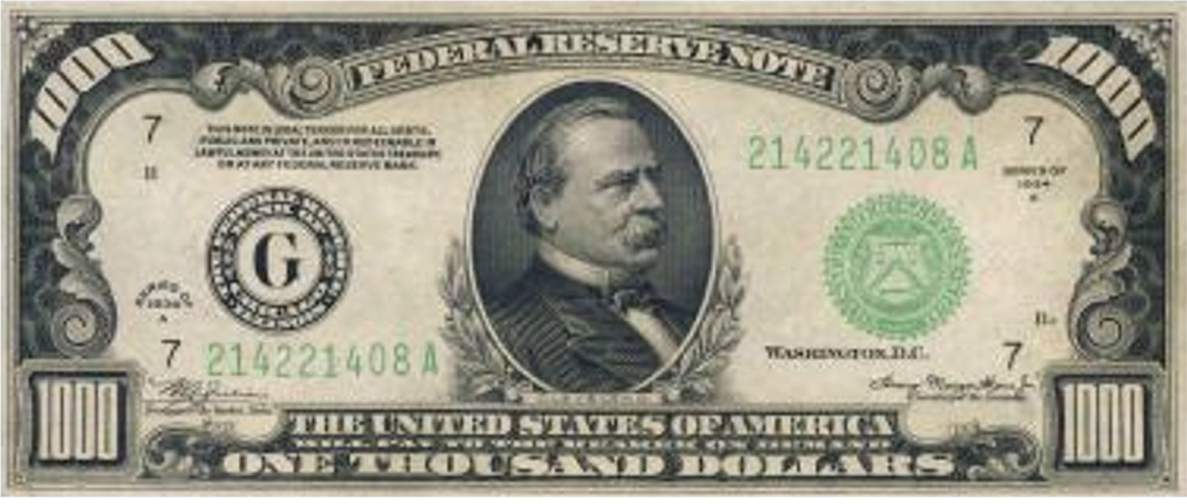
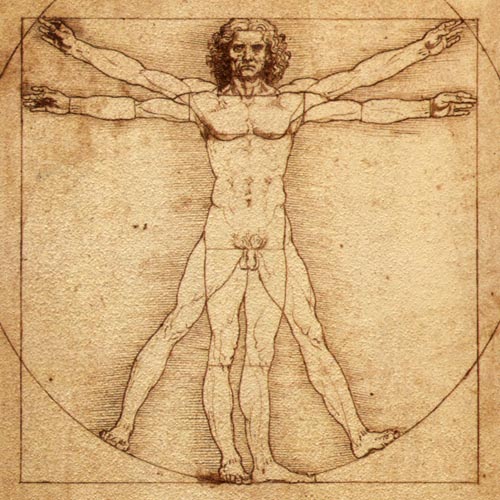


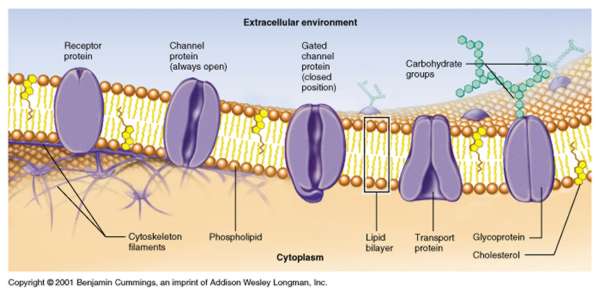
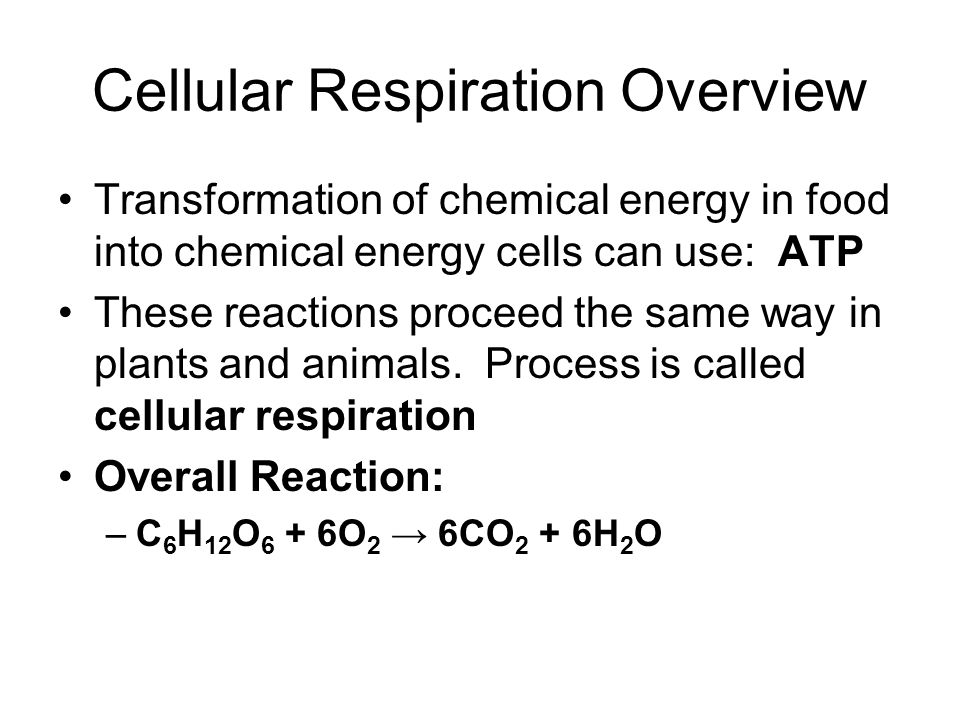


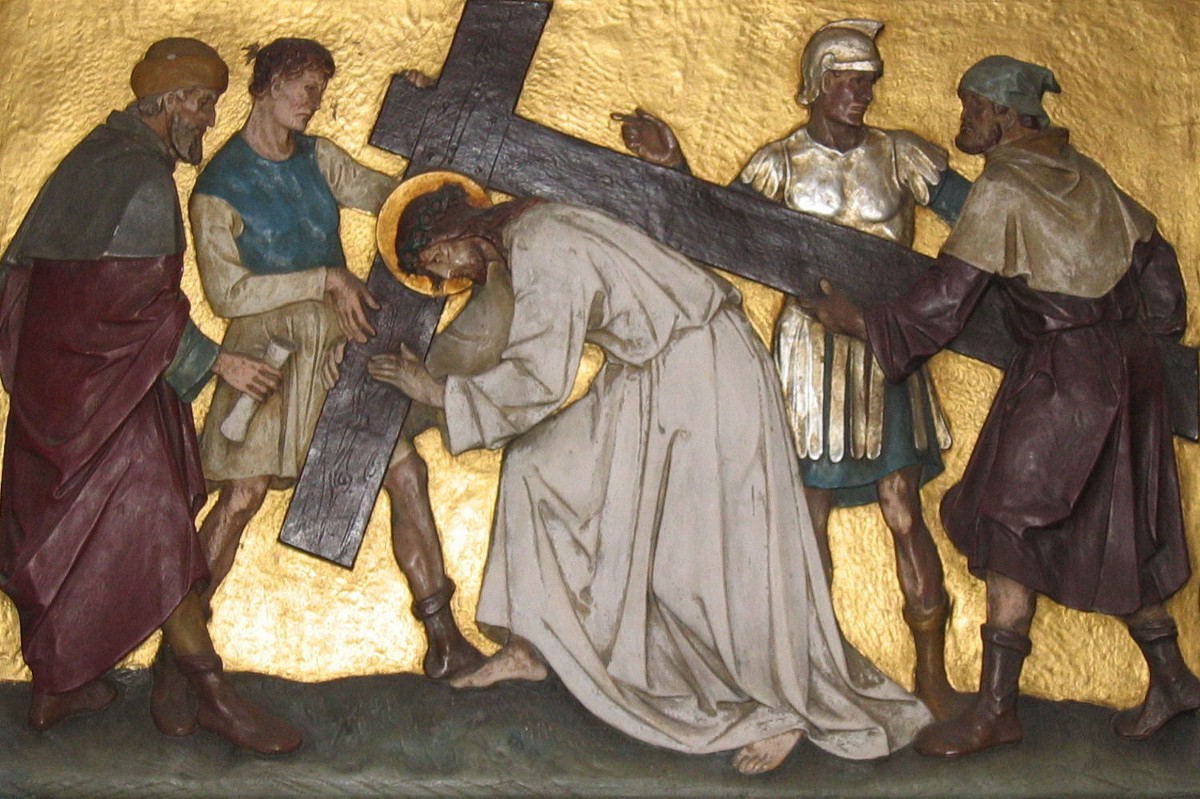



 Whole Dude - Whole Concept