Whole House – A House for God of Israel: Jacob’s Pillow-Pillar Stone marks the site as BethEl, the House of God.
JACOB’S DREAM AT BETHEL
The story of Jacob is described in the Book of Genesis, the first Book of Old Testament. He was the son of Issac, the grandson of Abraham, and the twin brother of Esau.He was named Jacob as he came out with his hand grasping his older twin brother Esau’s heel (Genesis 25:26).
SPIRITUALITY SCIENCE – THE PROMISE OF GOOD OLD AGE: GOD’S PROMISE OF GOOD OLD AGE WAS MADE TO ABRAHAM. ISAAC, THE SON OF ABRAHAM DIED AT 180 YEARS AGE AND HAD LIVED FOR FIVE ADDITIONAL YEARS AS COMPARED TO HIS FATHER. IN THIS PAINTING, ISSAC WAS GIVING HIS BLESSINGS TO JACOB AND HE WAS DECEIVED FOR HE BECAME BLIND ON ACCOUNT OF THE NATURAL AGING PROCESS.
Jacob received his older brother’s blessing from his father and then flees to Laban in Haran to escape from his brother’s anger. His dream at Bethel is narrated in Genesis, chapter 28, verses 10-17 :
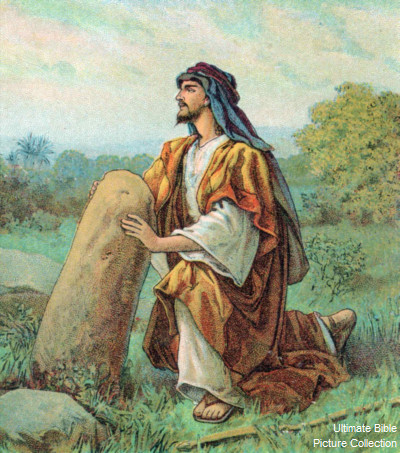
Whole House – A House for God of Israel: Jacob’s Dream at Bethel (Genesis 28: 10-17)
Jacob left Beersheba and set out for Haran. When he reached a certain place, he stopped for the night because the sun had set. Taking one of the stones there, he put it under his head and lay down to sleep. He had a dream in which he saw a stairway resting on the earth, with its top reaching to heaven, and the angels of God were ascending and descending on it. There above it stood the LORD, and He said: “I am the LORD, the God of your father Abraham and the God of Issac. I will give you and your descendants the land on which you are lying….” When Jacob awoke from his sleep, he thought, “Surely the LORD is in this place, and I was not aware of it.” He was afraid and said, “How awesome is this place! This is none other than the house of God; this is the gate of heaven.” Early the next morning Jacob took the stone he had placed under his head and set it up as a pillar and poured oil on top of it. He called the place Bethel, though the city used to be called Luz. He had further taken a vow stating that the stone he had set up as a pillar would be God’s house.
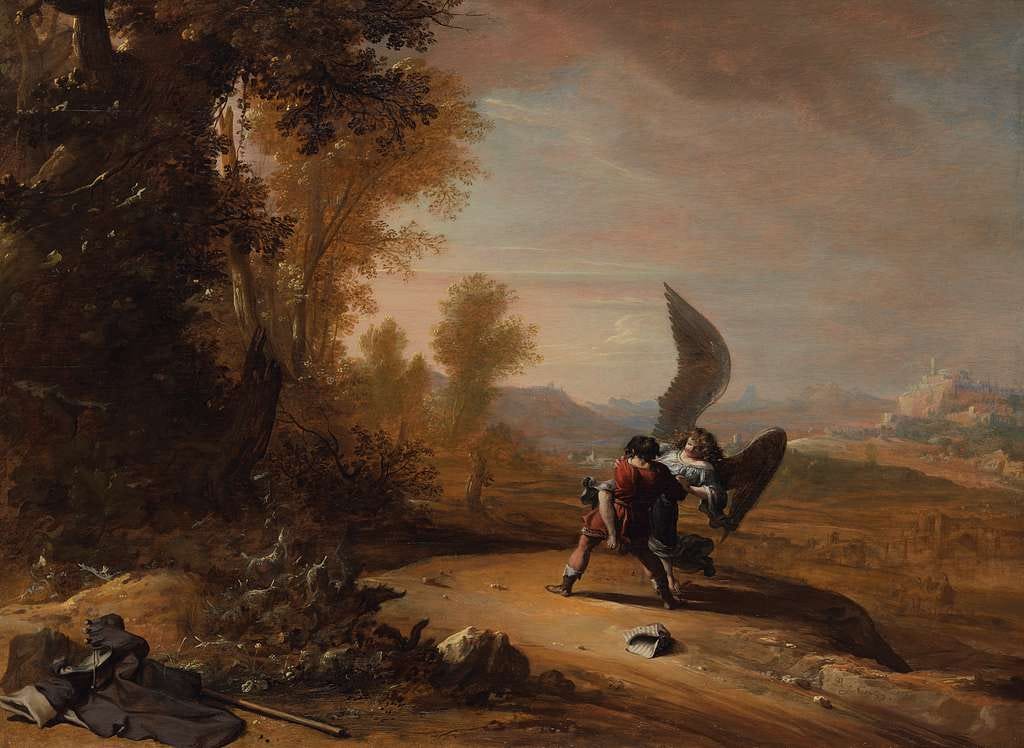
Whole House – A House of God of Israel: Jacob’s Spiritual Struggle at Jabbok (Genesis 32:22-30)
Jacob was the father of the founders of the twelve tribes of Israel. Jacob was given the name of Israel after he withstood a spiritual struggle at Jabbok (Genesis 32:22-30). Jacob had literally wrestled with God who came down in the form of a man. The name Israel is derived from the words ‘Sara’ meaning To Struggle, Wrestle, and ‘El’ meaning God. El is one short form of ‘Elohim’, the name used for God.
THE HOUSE OF GOD AT MOUNT MORIAH
Whole House – A House for God of Israel: God set up Laws for the Israelites mostly regarding holiness and worship. The Old Testament Book of Leviticus, Chapter 16, verse 34 :”This is to be a lasting ordinance for you; Atonement is to be made once a year for all the sins of the Israelites.” The Children of Jacob (the son of Issac, and grandson of Prophet Abraham) need a House for God of Israel.
In Judaism, Mount Moriah is also known as the ‘Temple Mount’, and is the most venerated as the holiest spot on Earth. After liberating Jews from a life of slavery in Egypt, at Mount Sinai, God enters into a ‘New Covenant’ and He had appeared in the form of fire before Moses and other elders.
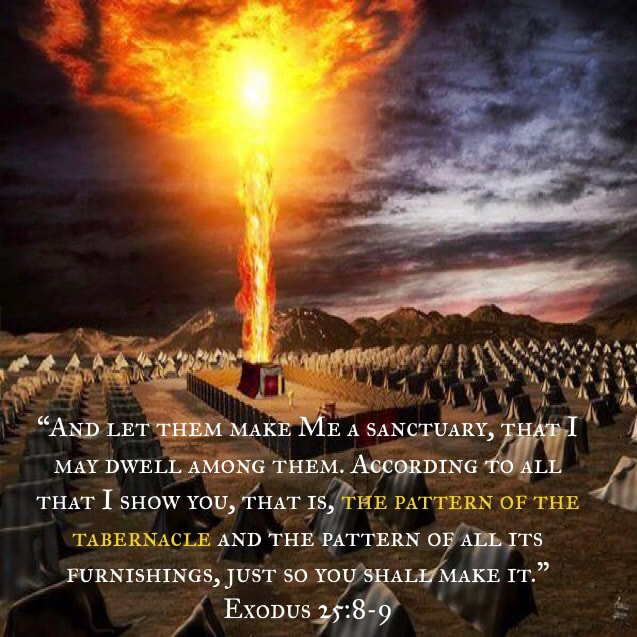
Whole House – A House for God of Israel: Make Me a Sanctuary, a Tabernacle, a House, a Temple.
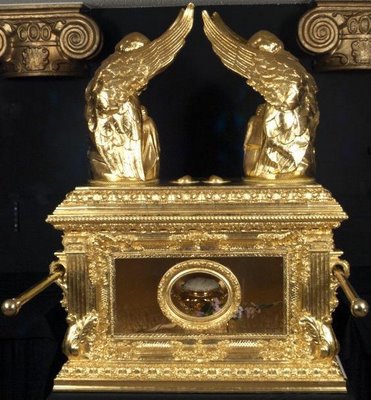
The Book of Exodus, Chapter 25, verses 8-9, God had asked the Jews: “Then have them make a sanctuary for me, and I will dwell among them. Make the Tabernacle and all its furnishings exactly like the pattern I will show you…” The Ark of the Covenant was where God manifested His presence on earth and the Ark went ahead of the Israelites wherever they traveled. The Ark was only housed in a tent for many long years and King David could only erect an altar for God (Book of 2 Samuel, chapter 24:25).
Whole House – A House for God of Israe: 1 Kings, Chapter 8, verse 13l
The opportunity to build a House for God in His Name was given to Solomon, the son of King David. Book of 1 Kings, Chapter 8, verse 13, Solomon declares: “I have indeed built a magnificent temple for you, a place for you to dwell forever.” The site selected by God for the establishment of the Holy Temple in His Name also is considered to be the spot where creation of world began, and Adam the first man was created here. Abraham brought his son Issac for sacrifice at this place. The Jewish tradition known as ‘Midrash’ also claimed that Jacob had a dream and had erected a monument and declared it as the House of Holy One. God had pushed that rock with His right foot and the rock had become the ‘Foundation Stone’, the ‘Corner Stone’, and is also known as the ‘Key Stone’ of Solomon’s First Temple. The Temple of God stands over a stone identified by Jacob as the ‘gate of heaven’. When Solomon dedicated this Temple to God in 957 B.C., God had entered His House in the form of a cloud.
GOD OF ISRAEL’S DWELLING PLACE
Whole House – A House for God of Israel
Psalm 115, song 2-3 says:
Why do the nations say,
“Where is their God?”
Our God is in heaven;
He does whatever pleases Him.
Whole House – A House for God of Israel: “I have indeed built a magnificent Temple for you to dwell forever.” The remnants of Second Temple stand mutely at a place known as Gate of Heaven. The children of Israel need a House for their God.
A PICTURE OF INDIA’S GRIEF OVER JIHADIST ATTACKS IN MUMBAI
TERROR ATTACKS ON INDIA :
Recent news reports are stating that the terror attacks on India have not seen its end and they are predicting the possibilities of more attacks similar to the Mumbai carnage on November 26, 2008. “India will continue to face a serious jihadist threat from Pakistan-based terrorist groups, and neither Indian nor U.S. policy is likely to reduce that threat in the near future”, said Angel Rabasa, lead author of the study and a senior Political Scientist with RAND, a non-profit think tank based in Santa Monica, California. According to RAND, the other extremist groups in Pakistan will find inspiration in the Mumbai attacks and there can be more attacks from groups with high body counts and symbolic targets.THE CONCEPT OF JIHAD :The term Jihad in Arabic means struggle and is often viewed as a religious duty. A person engaged in Jihad is called a ‘mujahid’, the plural is ‘mujahideen’. The Mumbai attackers identified themselves with the name of ‘Deccan Mujahideen’. The aim of Jihad includes the expansion and defense of the Islamic State and warfare against non-believers. Jihad ideology has historically inspired the conquest of non-Muslim population and the transformation of civil society which is viewed as corrupt, arrogant, and disobedient. The Holy Book of Quran, Surah 25, verse 52 states : “Therefore, do not obey the disbelievers, and strive against them with this, a great striving”. The objectives of armed warfare include uprooting unbelief and establishing supremacy of God, through Islam, in the world.”And fight them on until there is no tumult or oppression, and there prevail justice and faith in Allah altogether and everywhere.”
THE HISTORY OF JIHAD IN INDIA :
Sir Jadunath Sarkar, a historian, and former Vice-Chancellor of Calcutta University had contended that several Muslim invaders waged a systematic Jihad against Indians. Sultan Mahamud of Ghazna(present day Ghazni city,Afghanistan) conducted more than twenty Jihadist attacks on North India between 1001 and 1027. In particular the records kept by al-Utbi, Sultan Ghazni’s secretary in the ‘Tarikh-i-Yamini’ document several episodes of bloody campaigns. Persian historian Ferishta records that Sultan Ghazni wants to “root out the worship of idols from the face of all Hindustan(India)”. He looked upon the destruction of temples as an act of Jihad. Mahamud Ghazni specifically directed his campaigns to temple towns of Nagarkot, Thanesar(1011), Mathura(1018), Kannauj(1019), Kalinjar(1023), and Somnath(1024). He had also destroyed temples at Varanasi, Ujjain, Maheshwar, Jwalamukhi, and Dwaraka. Mahmud Ghazni was of Turkic origin but had patronized the use of New Persian language and gave employment to writers such as al-Biruni, and Ferdowsi who gave detailed descriptions of the enormous booty and idols brought back to Ghazni city. Asaru-L-Bilad, a 13 th century geographer also described in great detail the destruction of Somnath. Apart from his regular troops, Mahmud Ghazni had assistance from 30,000 volunteer horsemen who had participated in the Jihad. To resist the attack on Somnath, Ghogha Rana at the age of 90 sacrificed himself and his clan. There are no census documents but after an analysis of all historical documents, historian K.S.Lal had estimated that about 2 million people died during Sultan Ghazni’s attacks on Indian temple towns.Similarly, Sikandar Lodhi of Delhi earned the epithet of ‘But Shikan’- the destroyer of idols. Babur the founder of Mughal empire in India in 1527 ordered a JIHAD against Rajputs at the battle of KHANUA. He had encouraged his men to fight the infidels and asked them to become either a Ghazi(soldier of Islam) or a Shaheed(Martyr of Islam). The Mughal Emperor Aurangzeb waged Jihad against Hindus as well as Shia Muslims whom he identified as heterodox. In South India, the Hindu kingdom of Vijaynagar came under repeated attacks of annual Jihad which had started in 1501 and each attack included destruction of temples. In the historical Third Battle of Panipat(January 1761), Ahmad Shah Abdali declared a Jihad against the Marathas. Estimates from historical documents indicate that about 60 to 80 million people in India died between 1000 and 1525 CE.INDIA’S RIGHT TO SELF-DEFENSE :Indian traditions have clearly established the rules of warfare. A ‘JUST WAR’ or ‘DHARMA YUDDHA’ is a duty and is an obligation of the Ruler. We believe in the principles of protecting all non-combatants. They should not be touched or harmed in any manner. We recognize the right of self-protection, self-defense, and self-preservation. When an enemy attacks you, it would be an act of cowardice if the enemy is not engaged in a battle. In the context of defending people against Jihadist attacks, we are not only defending our territory, our property, our personal lives but also we are defending our right to think for ourselves and cherish the ideas and values that are important to our existence. We have a fundamental right to worship as we please and safeguard the traditional way of life. Since Jihadist attack is actually a war against our fundamental right to practice religion, the propagation of ideas of Jihadist warfare should be prohibited and violators should be punished. The term Self-Defense means defense of one’s rights, beliefs, and existence. The Right to defend oneself with whatever force is reasonably necessary against actual or threatened violence is universally recognized by Law. Self-Defense is a natural, inborn instinct. A National Entity has a Right and also a Duty to defend itself from attacks sponsored by an enemy or an Enemy State. The act of Self-Defense could be expressed in several different forms; a retaliation involving the use of military force, economic and trade sanctions, diplomatic sanctions, imposing travel restrictions, and other punitive or defensive actions as needed.
Dr. R. Rudra Narasimham,
Kurnool Medical College, Kurnool, Andhra Pradesh, India,
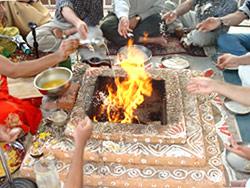
YAGNA, A VEDIC RITUAL OF SACRIFICE-‘HOTREE’ OR ‘YAGNA PERFORMER’ OFFERS ‘HAVIS’ TO FIRE (LORD AGNI)
THE UNIVERSE AS GOD’S BODY
The word ‘omnipresent’ is defined as present everywhere at the same time. The property of being present everywhere is one of the Divine attributes. In western theism it has attracted less attention and the idea of ‘omnipresence’ is explained in a bit unclear way. In Judeo-Christian, and Islamic Cultures, God is not immersed in the substance of creation even though He is able to interact with it as He chooses. They tend to the view that God is in “HEAVEN”, and that God is above and outside of all creation. They explain ‘omnipresence’ in terms of His ‘ESSENCE’ as He is present to all as the cause of their being, His ‘POWER’ as all things are subject to His power, and His ‘KNOWLEDGE’ as He constantly watches all that goes on in the world and all things are bare and open to His eyes and hence He is naturally present in every aspect of the natural order. Whereas Indian thinkers tend to believe that a thing is said to be substantially or essentially in that place in which its substance is. Hence, people in the Land of India traditionally hold the view that God is related to the universe as though it is His body. The entire creation is seen as a manifestation of the Supreme Person. The theory of transcendent(exists apart from material universe) and immanent(actually present throughout the material universe)’omnipresence’ explains the meaning of the word ‘BRAHMAN’, the Ultimate Reality. Indian people reflect this belief in their worship of creation, and the idea that God is immersed in the substance of His creation could be recognized as a core value, the foundation upon which the Cultural traditions of India are established over thousands of years of their continued existence. The rituals of temple worship and the Vedic rituals of Yagna always include aspects of Worship of Creation and the Scriptures reveal that the Gods also Worship Creation to the same extent and the Indian way of life could be stated as a quest for unity with the Divine.
A HYMN TO SEEK PROTECTION FROM THE CREATOR
Yaa srushti srashtu raadyaa vahiti vidhihutam, yaa havi ryaacha hotree
We seek the protection of God who physically manifests Himself with the eight bodies of
1. WATER- Lord VARUNA who was created prior to the creation of all other creation(of living entities).
2. FIRE- Lord Agni who receives ‘HAVIS’, the oblations or offerings given to God.
3. HOTREE- the person who is performing ‘YAGNA’, the Vedic ritual of sacrifice.
4. SUN- Lord Surya, the marker of day time.
5. MOON- Lord Chandra, the marker of night-time.
6. SKY- or ETHER which helps in the propagation of SOUND and is spread across the entire universe.
7.EARTH- Mother Earth, Goddess Bhu Devi, who bears the burden of harboring all living entities.
8. WIND- Lord VAYU who is the ‘Breath of life'(or PRANA) of all living entities that breathe.
THE FUNDAMENTAL RIGHT TO WORSHIP CREATION
The act of Creation Worship defines Indian Identity. All other Cultural Traditions that are existing in India proceed from this foundational principle. Indians seek their well-being, prosperity, happiness and eventually salvation through acts of worship. The foreign forces that occupied and ruled India tried hard to take away this Right to Worship as per our belief that God is immanent. We need to recognize the Right to Worship Creation as a Fundamental Right. Citizens while they are free to profess their religion , should not be free to ‘PROPAGATE’ a religion or idea which basically interferes with a Fundamental Right. No person could have a Fundamental Right to PROPAGATE at the expense of denying and devaluing other core values. To that extent, we should seek an amendment to PART III, Article 25 of the Constitution of India which deals with Freedom of Religion. The Constitution of India must recognize the Worship of Creation as a Foundational Principle of the Land of India and hence should be considered a Fundamental Right and should prohibit PROPAGATION of religion which infringes upon this Core Value. Such an amendment is vital to defend the Freedom of Religion as religious doctrines of Islam and Christianity are opposed to the idea of divinity of all created objects. These religious faiths divide humanity into two categories; the believers, and the non-believers. They also further express the claim that they possess a divine sanction to punish or modify the beliefs of the non-believers. In the global community, the adherents of Hindu religious faith are only a minority and they need special protection to defend the Right to Freedom of Religion.
Whole Dude – Whole Worship: The Lord God or the Principal Presiding deity at Malibu Hindu Temple is known as Lord Venkateshwara who represents the physical manifestation of the Supreme Being, Lord Vishnu in the material realm. Since the LORD is present in this terrestrial realm, He knows the Brahman Spirit that is in Prison.
Whole Dude – Whole Service: A Salute to The Law of Temperance. A tribute to John Milton.Whole Dude – Whole Service:NINE YEARS SERVICE MEDAL – A SALUTE TO THE LAW OF TEMPERANCE
The Law of Temperance
Whole Dude – Whole Service:NINE YEARS SERVICE MEDAL – A SALUTE TO THE LAW OF TEMPERANCE
John Milton (1608 – 1674), in his greatest poetic achievement of ‘PARADISE LOST’ describes Man’s First Disobedience of God, and the loss thereupon of Paradise wherein Man was placed. Adam, the first Man who was created in God’s image and likeness brought Death into the World. God declares that Adam and Eve could no longer abide in ‘Garden of Eden‘, the Paradise. God sends Angel Michael with a Band of Cherubim to dispossess them. Michael reveals to Adam the ‘Law of Temperance’ which could help him to live for many long years.
Whole Dude – Whole Service:NINE YEARS SERVICE MEDAL – A SALUTE TO THE LAW OF TEMPERANCE
Angel Michael also comforted Adam by assuring him that if he observes the ‘Law of Temperance’, Death would be like the gentle act of gathering a ripe fruit when fully mature.
Paradise Lost, Book XI ( 520-540):
Whole Dude – Whole Service: In John Milton’s epic poem of Paradise Lost, angel Michael explained ‘The Law of Temperance’ to Adam, the first created man to face the threat of death.
In John Milton’s epic poem of Paradise Lost, angel Michael explained ‘The Law of Temperance’ to Adam, the first created man to face the threat of death.
I yield it just, said Adam, and submit.
But is there yet no other way, besides
These painful passages, how we may come
To Death, and mix with our connatural dust?
There is, said, Michael, if thou well observe
The rule of not too much, by temperance taught
In what thou eatst and drinkst, seeking from thence
Due nourishment, not gluttonous delight,
Till many years over thy head return:
So maist thou live, till like ripe Fruit thou drop
Into thy Mother lap, or be with ease
Gathered, not harshly pluckt, for Death mature:
The Nature of Temperance
Whole Dude – Whole Service:NINE YEARS SERVICE MEDAL – A SALUTE TO THE LAW OF TEMPERANCE
The essence of Temperance is choosing moderation and deliberately avoid excess. In Indian Culture and Tradition, living in moderation and living in virtue are almost identical. Socrates suggests that one should “choose that which is orderly and sufficient and has a due provision for daily needs”. He compares the intemperate man “to a vessel full of holes because it can never be satisfied”. Socrates describes the temperate man as able to satisfy his limited desires, whereas the intemperate man of boundless desire, can never pause in his search of pleasure. According to Freud, when “the ego learns that it must inevitably go without immediate satisfaction, postpone gratification, learn to endure a degree of pain, and altogether renounce certain sources of pleasure”, it “becomes ‘reasonable’, is no longer controlled by the pleasure-principle, but follows the reality-principle”, which seeks ” a delayed and diminished pleasure, one which is assured by its realization of fact, its relation to reality”.
Temperance and Courage
Whole Dude – Whole Service: Saint Thomas Aquinas and ‘The Law of Temperance’.
Saint Thomas Aquinas and ‘The Law of Temperance’.
Thomas Aquinas has defined Temperance as “a disposition of the soul, moderating any passions or acts, so as to keep them within bounds. Temperate refers to a man who abstains from bodily pleasures and delights in this very fact. A man not only acts temperately but is temperate in character, when his desires are themselves habitually moderated to be in accord with reason. A temperate man is not pained at the absence of pleasure or by his abstinence from it. Temperance contributes the virtue of Fortitude which strengthens men against “the enticement of pleasure” as well as against the fear of pain. A man who is able to stand firm against the onslaught of pleasures is more able to remain firm against the dangers of death. And so “Temperance can be said to be Brave”. The endurance of pain is central to the nature of Courage. Temperance and Courage are not distinct virtues as both are based upon an ability to stand firm against pain and danger.
The Nine-Years Long Service Medal – A Salute to the Law of Temperance:
Whole Dude – Whole Service: During my service in the Indian Army Medical Corps, I learned the values of Temperance, Fortitude, Courage, and delaying gratification of desires, and avoid seeking physical comforts and pleasures.
During my service in the Indian Army Medical Corps, I learned the values of Temperance, Fortitude, Courage, and delaying gratification of desires, and avoid seeking physical comforts and pleasures.
Whole Dude – Whole Service:NINE YEARS SERVICE MEDAL – A SALUTE TO THE LAW OF TEMPERANCE
During the first nine years of my Indian Army Service, apart from taking part in the War of Liberation of Bangladesh, I participated in a variety of Army Operations that keep the men ready and prepared for a battle. Military Training and Service can be best described as habituation for a temperate character. The nature of Army Operations and Tactics always demand to overcome the onslaught of sense pleasures and voluntarily delaying the gratification of personal desires. A lifestyle based upon physical ease and comfort and indulgence in food and alcohol is not compatible with the Army way of life. The nature of Army Operations is influenced by terrain, climatic conditions, distances and the availability of transportation. There is no scope to cater for physical comfort, relaxation, and entertainment. The supply of rations and food provisions is limited because of the problems of their bulk and weight. Army Rules and the Code of Conduct emphasize that men should honor their commitment to serve more than anything else. Such commitment to Serve with Honor would only be possible only when the man in uniform lives in accordance with the Law of Temperance.
Whole Dude – Whole Service:NINE YEARS SERVICE MEDAL – A SALUTE TO THE LAW OF TEMPERANCE
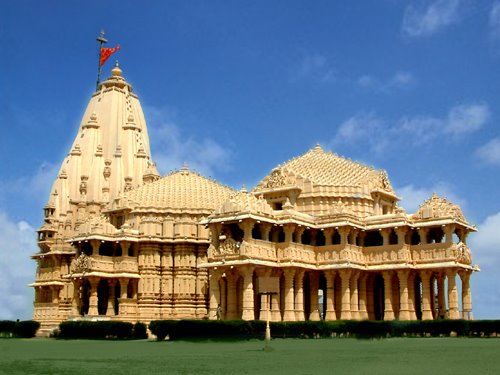
The Temple of Lord Somnath. The Battle between the Power of Creation and the Power of Destruction:
Kindly pay homage to Sardar VallabhbhaiPatel, India’s first Deputy Prime Minister who had recreated the Temple of Lord Somnath and vanquished the evil forces which visited Somnath repeatedly to utterly destroy this sacred place of Hindu worship.
Whole Dude – Whole ConvictionWhole Dude – Whole ConvictionKindly pay homage to Sardar VallabhbhaiPatel, India’s first Deputy Prime Minister who had recreated the Temple of Lord Somnath and vanquished the evil forces which visited Somnath repeatedly to utterly destroy this sacred place of Hindu worship.Kindly pay homage to Sardar VallabhbhaiPatel, India’s first Deputy Prime Minister who had recreated the Temple of Lord Somnath and vanquished the evil forces which visited Somnath repeatedly to utterly destroy this sacred place of Hindu worship.
THE TEMPLE OF LORD SOMNATH IS THE EVIDENCE FOR THE POWER OF CREATION OVER THE POWER OF DESTRUCTION.
This entry is dedicated to the memory of Sardar Vallabhbhai Patel, India’s first Deputy Prime Minister.
THE SHRINE ETERNAL :
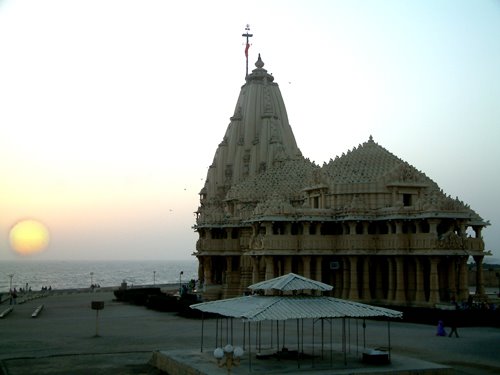
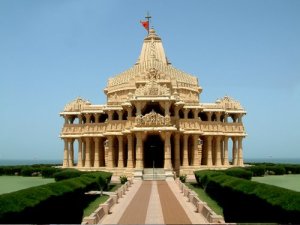
Somnath Temple is in the ‘Prabhas Kshetra’, near the seaport city of Veraval in Junagadh District, Kathiawar Peninsula of Saurashtra , on the shores of Arabian Sea,the western coast of Gujarat, India. This holy place of pilgrimage is a place of great antiquity and recent excavations there have revealed a settlement dating from about 1500 B.C. As per Indian traditions, the place is of significance as it is considered as the place from where Lord Krishna departed from this world. The presiding deity of this temple is Lord Shiva and He is known by the name of SOMNATHA or the Lord of the Moon. The present temple as it exists today is known as ‘Kailash Mahameru Prasada and is built-in CHALUKYA style of temple architecture. The site lied in a state of ruin for centuries and the decision to rebuild it was made by Sardar Vallabhbhai Patel during his visit on 13 November, 1947. The temple was inaugurated on December 1, 1951 by Dr. Rajendra Prasad, the first President of the Republic of India. He had remarked that, “The Somnath temple signifies that the power of creation is always greater than the power of destruction”. The temple symbolizes the enduring fame of Sardar Patel who during the first three years of Indian independence after 1947, had served as Deputy Prime Minister, Minister of Home Affairs, Minister of Information, and Minister of States. He was considered as practical and decisive. He was the architect of the Indian Union and his greatest contribution was the achievement of the peaceful integration of over 535 princely states into the Indian Union. The principality of Junagadh, and the princely State of Hyderabad had initially resisted the offer to join the Indian Union. Having failed in his attempts to join Pakistan, the Nawab of Junagadh fled away from the country. Mr. Bhutto,( the father of Mr. Z.A. Bhutto, who served as Pakistan’s Prime minister) acting in his capacity of the ‘DEWAN’ of the court of Junagadh, had invited Lord Mountbatten to accept the accession of Junagadh to India. In the State of Hyderabad, a militant movement called the Razakars was launched seeking independence but Sardar Patel restored peace in September 1948 and the ruler Nizam had accepted the terms of accession to the Indian Union. This part of Indian history and the integration of princely states into Indian Union has again become relevant after the enemy’s brutal attack in Mumbai which I had mentioned in my previous entry. The enemy had described himself as ‘Deccan Mujahedeen’, and the media reports indicate that the enemy had specific designs to gobble Junagadh, and Hyderabad apart from encouraging insurgency in the border State of Kashmir. The enemy’s intentions will force us to defend SOMNATH in Junagadh District which is resurrected after repeated attacks over centuries.
THE HISTORY OF SOMNATH :
Jyotirlinga Temple at Somnath is mentioned in Hindu prayers in praise and worship of Lord Shiva:”Sauraashtra dese visadeti ramye, Jyotirmayam Chandra Kalaa vatamsam, Bhakti pradaanaaya Krupaa vateernam, Tam Somanaatham Saranam prapadye.”Somnath, the confluence of three rivers, River Sarasvati, River Hiranya, River Ilanki and Kapila is mentioned in ancient Hindu Scriptures known as Rig Veda.
LORD SOMNATH TEMPLE-THE SHRINE ETERNAL- TESTIMONY TO THE POWER OF CREATION OVER THE POWER OF DESTRUCTION.
Somnath finds its mention in the ancient text of RIG VEDA. It is associated with the holy names of GANGA, YAMUNA, and SARASWATI, popularly known as ‘TIRTH DHAM’ where Indians traditionally offer worship by a practice described as ‘River Worship’. The ancient river of Saraswati may have merged into the Sea at Somnath apart from smaller rivulets known by the names of Hiranya, Kapila and Ilanki. The place is extensively described as a place of pilgrimage and its importance is narrated in the ancient texts of ‘SKANDA PURANA’, ‘BHAGAVATA PURANA’, and ‘SHIVA PURANA’. Lord Shiva in His radiant form known as ‘Jyotir Linga’ resides at Twelve different places in India and Somnath is listed as the first place of residence of ‘DWADASA JYOTIR LINGA’.Tradition claims that the original Temple of Somnath was built by Lord Moon, and was later built by King Ravana of Lanka who is a central figure in the story of Indian epic poem of RAMAYANA. The SINDH area of the Indian subcontinent came under Arab conquest in 7th century A.D. The Somnath Temple built by the YADAVA kings of Vallabhi of Saurashtra around 649 A.D. was destroyed in 725 A.D. by the Arab governor of Sindh. The Pratihara King Nagabhata II rebuilt it in red stone. Between 1001 A.D. and 1027 A.D. , the road to conquest of India was prepared by Sultan Mahmud of Ghazna( modern GHAZNI in Afghanistan) who conducted more than twenty raids into North India. His raids were mainly for plunder. They revealed the wealth of India and demonstrated the vulnerability of India to military attacks. During one of his raids, in 1024 A.D. , marching across India’s Thar Desert, Mahmud of Ghazna had plundered and destroyed the Somnath Temple. The amount looted was estimated at 20 thousand, thousand ‘Dinars’. The enormous treasures found at Somnath have been a theme of wonder for all who have written on that conquest. The Paramara King of Bhoj of Malwa, Solanki King Bhima of Anhilwara/Patan between 1026 A.D. and 1042 A.D. rebuilt the Temple. By 1297/98 A.D. , Gujarat was conquered by Ala-ud-Din Khalij, Sultan of Delhi and the Temple was razed.Solanki King Kumarapala built a Temple of stone and this was destroyed again in 1394 A.D. For the last time, the Temple was destroyed in 1706 A.D by the Mughal Emperor Aurangzeb and the site remained in ruins till India’s independence in 1947. The rebirth of the Temple on December 1, 1951 demonstrates the vitality of the Indian spirit.
A HYMN IN PRAISE OF LORD SOMNATH :
Saurashtra dese visadeti ramye
Jyotirmayam, Chandra kala vatamsam
Bhakti prada naya Krupa vatirnam
Tam Somanatham saranam prapadye.
Lord Somanatha is dwelling in His great splendor in the Province of Saurashtra. May this Lord Somanatha who is full of radiance, and the crescent-shaped Moon shines in His matted hair, with His extreme compassion grant me a great sense of devotion with which I would seek my protection and let Him be my refuge.
Jyotirlinga Temple at Somnath is mentioned in Hindu prayers in praise and worship of Lord Shiva:”Sauraashtra dese visadeti ramye, Jyotirmayam Chandra Kalaa vatamsam, Bhakti pradaanaaya Krupaa vateernam, Tam Somanaatham Saranam prapadye.”
THE TAJ MAHAL PALACE HOTEL, BOMBAY (MUMBAI) BUILT IN 1903 – THE FIRST LUXURY HOTEL OF INDIA
A Sad Day in the lives of people who love India:
November 27, 2008 ( A HAPPY THANKS GIVING DAY IN THE UNITED STATES) is indeed a sad day in the lives of many people who love India and cherish its rich Culture and take pride in its noble values. It is painful to watch the beautiful landmark of Bombay engulfed in smoke and fire. We as a nation share this grief and mourn the loss of our people from an unprovoked and sudden attack. The repeated attacks on Mumbai reminds of the repeated assaults on SOMNATH Temple and the Temple was rebuilt seventeen times and we may need that kind of patience and endurance and demonstrate our resilience and frustrate our enemy.
India achieved much progress and Bombay (Mumbai) is the proud symbol of that progress and it is the natural home to people of all faiths. The presence of Parsis, Jews and other religious minority groups in Mumbai speaks about the spirit of tolerance of the city’s inhabitants. They are countless number of Muslims who are part of that rich heritage and they are part of a well-integrated society. India , a land of peace and non-violence has come under the attack of an enemy who knows no mercy and has no sense of human values. We should be united and stay determined to fight this threat. We need to be prepared for the next confrontation. Our willingness to defend ourselves is the only force that will deter our enemies.
HEARTY CONGRATULATIONS TO MUMBAI POLICE DEPARTMENT
I am particularly happy to know that the Mumbai Police had captured a terrorist alive and the terrorist was taken to the court. The details of this heinous crime have already emerged and very soon the international community would recognize that Pakistan has sponsored and has premeditated this crime against the people of India. The Mumbai Police Department took the brunt of this attack, displayed great bravery and they should be fully equipped to fight back any such future assault on innocent civilians.
THE TAJ MAHAL PALACE HOTEL
Jamestji Nasarwanji Tata, the legendary founder of India’s largest industrial house built this 565-room hotel with its architecture blending Moorish, Oriental, and Florentine styles. It was built-in 1903, much before the Gateway of India was completed in 1928 to commemorate the visit of Britain’s King George V and Queen Victoria. It offers a panoramic view of the Arabian Sea and is considered to be a heritage structure. The restoration of the century-old Taj Mahal Palace could take as much as 12 months and may cost about $ 100 million.
THE PROBLEMS OF URBAN WARFARE
We need to cope up with the realities of Urban Warfare. Urban centers of life have come under repeated attacks. We could easily see the sense of shock, the unspeakable amount of pain, and the heavy burden of anxiety on the faces of people, the innocent victims of this ruthless warfare. Because of the vulnerability of our borders, the enemy could sneak in and launch a surprise attack at any time. A small contingent of enemy force with assault rifles and hand grenades can inflict a large number of casualties amongst unarmed and unprepared civilians in a very short time. It needs a considerable amount of effort to flush out the enemy when the enemy is holed up in big buildings with a large civilian population. We need to immediately alert people to leave the streets and take cover in their homes and places of business should be shut down and large establishments such as hotels should have emergency plans to keep their guests until help arrives. During World War II civilians were regularly alerted by air raid warnings. We could also send the emergency warning over the radio, television and the mobile phones and the paging devices. People at Taj Mahal, Oberoi Hotel, and Nariman Place were not alerted when the enemy started his first attack at the Victoria Terminus. A city-wide alert could have helped people to barricade themselves. The streets were not safe even for police personnel if they use unprotected vehicles. It was reported that five police personnel were shot and killed when their vehicle got ambushed. People in buildings should also be warned to stay away from glass windows. Like in air raids, people would be safer if the lights are turned off. We can not negotiate with our enemies over hostages and the only option we have is to retake our land and property that comes under the enemy occupation. We need to prepare for these urban military operations and we should have personnel with proper equipment for fighting a battle in crowded cities and concrete buildings.
Our intelligence capabilities appear to be limited and we can not actually depend upon the government of Pakistan to provide us with information about groups which are training and preparing for these attacks on their soil. Amongst Muslim nations, I could expect some help from Iran which is the home of Shia faith. Iran is interested in selling its natural gas and has also taken the initiative to restore the historical monuments at Golconda, Hyderabad. Iran has the ability to penetrate the Shia groups operating from Pakistan. The recent attackers called themselves as ‘DECCAN MUJAHIDEEN’ and it may indicate that they are a Shia group. The Shia faith arrived in the Deccan region of India from Persia( the present day Iran) and the terror group is taking its orders from Pakistan and Iran is not involved in their command and control.
The Parsi community which also arrived in India from Persia gave us peace and prosperity. Iran the home of Shia faith should shoulder the burden of controlling the Shia groups operating out of Pakistan.
The Right to Life means a Life for Life.REBBAPRAGADA SUBBARAO (1893-1948), LAWYER, POET, SPORTSMAN, DISTINGUISHED CITIZEN OF RAJAHMUNDRY
REBBAPRAGADA SUBBARAO (1893-1948), LAWYER, POET, SPORTSMAN, DISTINGUISHED CITIZEN OF RAJAHMUNDRY
This entry is dedicated to the memory of my grandfather, Shri.Rebbapragada Subbarao, who served the British Crown as a Public Prosecutor at East Godavari District Sessions Court in Rajahmundry for two terms from 1940. He never hesitated in seeking the capital punishment when he prosecuted criminals for the offense of murder. I was not fortunate enough to witness his performance as a Public Prosecutor but my grandmother shared information about his stellar qualities and his great reputation. While I grew up in Rajahmundry, during a school field trip, I visited the Central Jail in Rajahmundry where the death sentence is carried out by hanging. My impression from that trip was that the death sentence is appropriate and is not cruel. This entry is an effort to understand my grandfather’s support for capital punishment.
The Right to Life:
The Right to Life means a Life for Life: Thomas Jefferson’s Declaration of Independence seeking natural inalienable rights was made seeking support with a firm reliance on the protection of Divine Providence. The operation of Divine Providence is the central requirement if man has the natural, inalienable rights to Life, Liberty, and the pursuit of Happiness.
Human beings everywhere demand the realization of diverse values to ensure their individual and collective well-being. A fundamental value that is universally claimed by all people is that of the Right to Life. Thomas Jefferson asserts that his countrymen are a “free people claiming their rights as derived from the laws of nature and not as the gift of their Chief Magistrate.” In the Declaration of Independence proclaimed on July 4, 1776, he eloquently claims, “We hold these truths to be self-evident, that all men are created equal, that they are endowed by the Creator with certain unalienable Rights, that among them are Life, Liberty and the Pursuit of Happiness.” The basic principle of the French Declaration of the Rights of Man and of the Citizen (1789) was that “all men are born free and equal in rights,” which were specified as the rights of Liberty, Private Property, the inviolability of the person, and resistance to oppression. It specifically states that Liberty consists in being able to do anything that does not harm others: thus the exercise of the natural rights of every human has no bounds other than those that ensure to the other members of society the enjoyment of these same rights.
The Reason for Punishment:
The Right to Life means a Life for Life.If there is no penalty attached, the above words would be vain words.
A Right which is not protected is not a Right and a Law without penalty attached is not a Law. If the Constitution declares a ‘Right to Life’ and if Moses proclaims the divine law that commands that “You shall not murder” (The Book of Exodus 20:13, and The Book of Deuteronomy 5:17), if there is no penalty attached, these words would be vain words.
The Right to Life means a Life for Life. If there is no penalty attached, the above words would be vain words.
A penalty is imposed as a consequence to an act of wrongdoing. Punishment is generally conceived as the infliction of pain. Why men should be punished is one of the most controversial questions in the field of moral and political thought, and in psychology and theology as well. There are three major types of wrongdoing in relation to which men discuss the nature and the need of punishment, its justice or its expediency. Punishment is traditionally considered in relation to, evil or wicked actions, violations of law, and sin. Murder is an act which simultaneously violates the moral, the civil and the divine law.
The Purpose of Punishment:
The Right to Life means a Life for Life. The concept of punishment proposed by Jesus demands self-evaluation.
The question about the purpose of punishment critically tests the meaning of anyone’s theory of Law and Justice. The purpose of punishment will affect the penalties to be imposed for wrongdoing. Some people think that punishment need only be inherently just and others think that punishment cannot be justified without reference to its utility or expediency. The purpose of punishment could be described under three different categories:
1. Punishment should be justified only by its consequences.
2. Punishment should be a combination of awarding a just penalty and securing good effects.
3. Punishment should be a just retaliation exclusively.
The Utilitarian Theory of Punishment:
This view is based upon the idea that punishment should not be equal to revenge or an act of hostility. A punishment is an evil inflicted by public authority on those who have transgressed the law so that the will of men may be better disposed to obedience. The chief aim of punishment is securing the reformation and the deterrence of criminals and to maintain public peace. The Court does not exist for punishment only but also for the salvation of the criminal. The spirit and meaning of punishment is seen as the salvation and the reformation of the wrongdoer.
According to Socrates, “to suffer punishment is another name for being justly corrected when you do wrong,” and he “who is punished and suffers retribution, suffers justly.” He believed that justice is restored to the soul of the wrongdoer. “The proper office of punishment is two-fold; he who is rightly punished ought either to become better and profit by it or he ought to be made an example to his fellows, that they may see what he suffers, and fear and become better.”
Plato had implied that virtue could be taught. “He who desires to inflict rational punishment does not retaliate for a past wrong which cannot be undone.” He punishes for the sake of prevention. Plato thought that the death penalty should be imposed only on the incurable who cannot profit from an example to other men not to offend.
Hobbes places the reason for punishment in the future rather than in the past in its utility to procure certain effects rather than retaliation. “Men look not at the greatness of the evil past, but the greatness of the good to follow.” We are forbidden to inflict punishment with any other design than for the correction of the offender, or the direction of others.
Locke derives from natural law the right to punish those who transgress that law and to restrain and prevent the like offence.
Rousseau lays great emphasis on the reformation of the criminal. “There is not a single ill-doer who could not be turned to some good. The State has no right to put to death, even for the sake of making an example, anyone whom it can leave alive without danger.”
The Retributive Purpose of Punishment:
The Right to Life means a Life for Life. In the modern human society, the individual has the right to report a crime and the justice is served by the Society after due verification of the crime.
Kant and Hegel viewed that retribution or retaliation is the only basis for punishment. Punishment should be purely retributive and it need not serve some end beyond itself and need not produce some desired consequence in the future. We should punish only because we have, under the moral law, a duty to do so. The purpose of punishment is to uphold the moral law.
The effect of the punishment upon the wrongdoer or upon others whose conduct may be affected by punishments meted out, must not be taken into account at all. Punishment of the transgressor may heal the feelings of those he has injured and it may even satisfy a desire for revenge, but those factors should have no motivating force. Nothing should be sought except the preservation of the balance sheet of justice. Every wrong is duly requited by a proportionate measure of punishment. It should not consider any person except the wrongdoer himself.
According to Kant, “Judicial punishment can never be administered merely as a means of promoting another good, either with regard to the Criminal himself, or to Civil Society, but must in all cases be imposed only because the individual on whom it is inflicted has committed a Crime…….The Penal Law is a Categorical Imperative.”Punishment cannot be justified except as doing the work of Justice.
The Right of Retaliation (ius talionis ):
The Right to Life means a Life for Life
Kant says, “It is just the Principle of Equality by which the pointer Scale of Justice is made to incline no more to one side than the other; It may be rendered by saying that the undeserved evil which anyone commits on another, is to be regarded as perpetrated on himself…….This is the Right of Retaliation; and properly understood it is the only principle which can definitely assign both the quality and the quantity of a just penalty. All other standards are wavering and uncertain; and on account of other considerations involved in them, they contain no principle conformable to the sentence of pure and strict Justice.” Retributive Punishment or retaliation seems to express the principle of justice or fairness in exchange.
A Life for Life ( lex talionis ):
The Right to Life means a Life for Life
A Life for Life is the symbolic statement in the Greek as well as the Hebrew tradition. “Who so’er shall take the sword, shall perish by the sword.” Retribution is not revenge. It is the righting of wrong. It is the very act of crime itself which vindicates itself.
The gravity of the offense is the only determinant of the severity of the punishment. The punishment should fit the crime, not the nature of the criminal as someone capable of being benefitted by punishment. Kant and Hegel do not think that the justification of the death penalty depends upon the curability or incurability of the offender. The taking of the criminal’s life need not be motivated by a desire to protect society from his future depredations. It is sufficient that he has taken a life and it should be repaid by a proportionate requital.
The Right to Life means A Life for Life.
“Whoever sheds the blood of man,
by man shall his blood be shed:
for in the image of God
has God made man. ” (The Book of Genesis, chapter 9, verse 6)
The reason murderers deserved the death penalty was the supreme value of human life. To destroy human life is to attack the image of God, and therefore God demands an accounting.
Murder must be described as a sin, as a crime and as a vice. The Criminal gives his consent for Capital Punishment by his very act.
Dr. R. Rudra Narasimham, B.Sc., M.B.B.S.,
Kurnool Medical College, Kurnool, Andhra Pradesh, India,
M.B.B.S. Class of April, 1970.
The Right to Life means a Life for Life. If anyone takes a human life, that person’s life will also be taken by human hands. For God made human beings in his own image.
Rajahmundry Formulates My Connection to India and Indian Literature
Bharat Darshan – City of Rajahmundry shapes My connection to India and Indian literature. Shri. Sarat Chandra Chatterjee or Chattopadhyay, popularly known as Sarat Babu.Shri. Sarat Chandra Chatterjee or Chattopadhyay, popularly known as Sarat Babu.
I belong to Rajahmundry where Kandukuri Veeresalingam had written the first novel ever written in the Telugu language. However, it was ‘ SARAT BABU’ who had first provoked my interest in reading Telugu literature. Sarat Babu, the famous novelist had written in Bengali language but fortunately, his books are translated into Telugu language and while I grew up in Rajahmundry, his novels were extremely popular he quickly aroused my curiosity.
Rajahmundry – My connection to India and Indian literature.
In 1953, the Telugu film ‘DEVADASU’ with Akkineni Nageswara Rao (A N R) in the lead role was released and the songs from that film though not written by Sarat Babu also became very popular. It was not the popularity of this film which had drawn me towards the novels written by Sarat Babu.
Rajahmundry – My connection to India and Indian literature
I actually started reading his translated stories a few years later after joining Danavaipeta Municipal Corporation High School. I was attracted by his powerful narrative style and the portrayal of the characters in his stories. His novels were easily available in the City Public Library. I know Telugu people who learned the Bengali language just to get the pleasure of reading Sarat Babu’s original works. I also know some of my friends who acquired their names from Sarat Babu. I should acknowledge the fact that his novels gave me the impetus to develop the habit of reading books. While Telugu people could embrace and adore a Bengali novelist, I have not witnessed any love for Tamil writers. While I attended Danavaipeta Municipal High School in Rajahmundry, I learned about ‘TIRUKKURAL’ and was not introduced to any other Tamil literature.
The Bengal, Andhra, Tamil Connection:
Rajahmundry – My connection to India and Indian literature.
Since Mylapore, Madras is my birthplace, I grew up with a sense of fondness for that City and during the 1950s I visited Madras several times as my maternal grandparents still lived there. The Howrah-Madras Mail connected Rajahmundry and Madras. At Rajahmundry I got connected to the nation and much of it was inspired by the writers and thinkers of Bengal. At the beginning of the 20th century, Bengal shaped our sentiments and exerted a great influence on our minds. I am not surprised that ‘Vande Mataram’ is our National Song and ‘Jana Gana Mana’ is our National Anthem and the honor goes to Bengal. Unfortunately, Madras apart from being the State Capital could not excite Telugu people’s’ hearts in the way Bengal did. I can not recall the name of even one public figure from the Tamil speaking areas of Madras State who may have visited Rajahmundry or other Telugu speaking areas of Madras State. Actually, the relationship between Telugu and Tamils started deteriorating after India’s independence in 1947 and it led to the linguistic partition of India. I am proud of my Telugu heritage but I am not truly happy with the partition of the country on a linguistic basis.
Rajahmundry – My connection to India and Indian literature
Dr. R. Rudra Narasimham, B.Sc., M.B.B.S.,
C/O Shri. R. Suryanarayana Murthy, M.A., B.Ed.,
13-92 First Cross Road, Prakasam Nagar, Rajahmundry,
East Godavari District, Andhra Pradesh, India.
S.S.L.C. MARCH 1961, Danavaipeta Municipal High School, Rajahmundry.
Rajahmundry – My connection to India and Indian literature
Rajahmundry – The Gateway to Traditions and History
Bharat Darshan – Rajahmundry – The Gateway to Traditions and History. Kandukuri Veeresalingam Pantulu of Rajahmundry
Kandukuri Veeresalingam Pantulu of Rajahmundry
Bharat Darshan – Rajahmundry – The Gateway to Traditions and History
I am a native of Rajahmundry of East Godavari District, Andhra Pradesh, India by way of my family connections. I lived only a small part of my life in my hometown. Within those few years, Rajahmundry very graciously connected me to the nation that we know as India. On one hand, I was introduced to the traditions of River Worship and Idol Worship, I got acquainted with the ideas of Ahimsa (non-injury), and at the same time I was also introduced to India’s history of foreign occupation, the pain imposed by the Muslim invaders, the struggle for Independence from the British Rule and equally important is the social awakening of the people. During the 19th century, India saw the rise of nationalism and simultaneously there was a wish to reform the society. The natives of Rajahmundry received inspiration from a variety of sources.
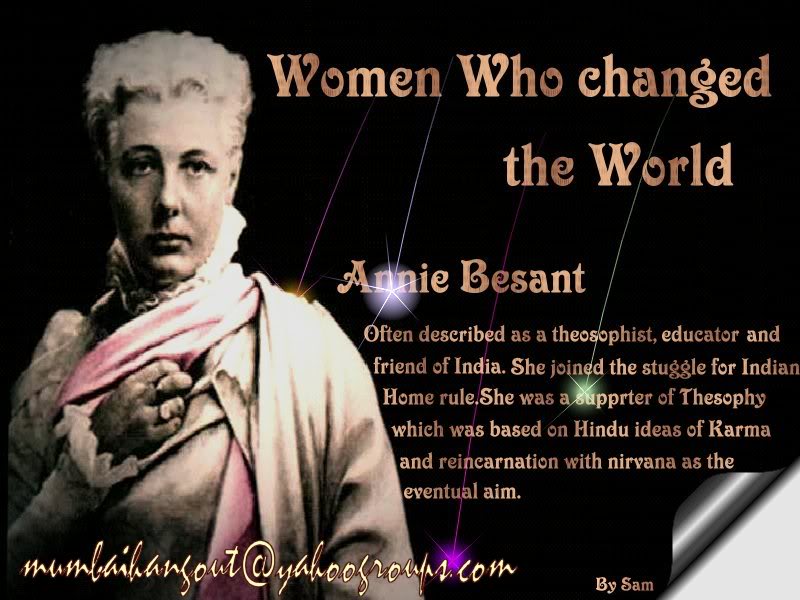
Bharat Darshan – Rajahmundry – The Gateway to Traditions and History. ANNIE BESANT – ANGEL OF INDIA.
Ms. Annie Besant who became the President of the Theosophical Society in 1907 visited Rajahmundry twice and established a place of worship known as ‘Divya Gjyan Samaj’ in a residential sub-division of Rajahmundry which is still known as ‘ALCOT GARDENS’ (named after Theosophist Henry Steel Olcott).
Bharat Darshan – Rajahmundry – The Gateway to Traditions and History
Bipin Chandra Pal (1858-1932), the leader of ‘Vande Mataram’ nationalist movement visited Rajahmundry in April 1907.
Bharat Darshan – Rajahmundry – The Gateway to Traditions and History
Alluri Sita Ramaraju (1898-1924) was inspired by the patriotic zeal of the revolutionaries in Bengal and waged a brief war against the British winning the hearts of the natives of Rajahmundry.
Kandukuri Veeresalingam Pantulu Garu:
Bharat Darshan – Rajahmundry – The Gateway to Traditions and History
He was born into a poor Brahmin family at Rajahmundry in 1848. About one hundred years later, when I arrived in Innespeta subdivision of Rajahmundry, the first time I had known this great man was during a visit to the municipal park on the Main Road, just a short walking distance from my grandparents’ house. There is a very imposing statue and people spoke about him with pride and admiration. My eldest brother, Hari was a student at the Veeresalingam Theistic High School in Innespeta. During the academic year 1952-53, I studied in 3rd grade at ‘Shade Girls High School’ located near ‘Kambala Cheruvu’ (Lake Kambala) while my family resided in Danavaipeta subdivision of Rajahmundry. Myself and my elder brother Pratap used to walk to the school and the easiest way to reach the school was a private road which traverses the Veeresalingam Gardens. The subdivisions of Danavai peta and the Danavai Pond and Prakasam Nagar are located on the southern side of the Gardens and Gandhi Nagar is located along the northern perimeter of the Gardens. The school is at a short distance from the north-west entrance to the Gardens. Apart from the tombs of Veeresalingam and his wife Rajya Lakshmi, the Gardens had a venue to conduct marriage functions and there was a Home for Widows. On our way to the school, we used to enter the Widow’s Home and a classmate of ours by name Sai Baba would join us in the walk to the school. On our return trip, the three of us used to reach the Home and after leaving Sai Baba, myself and my brother would resume our walk to our residence in Danavaipeta. There were several occasions when we would wait at the Home while Sai Baba’s mother would be breastfeeding him. During that school year, it was my daily experience and I knew that my friend and his mother derived their support from this great benefactor known as Veeresalingam.
As my family lived on the outer fringes of Veeresalingam Gardens during the most part of my later school years at Danavaipeta Municipal High School, walking across the Gardens and playing cricket in the evening in the open areas of the Garden became a part of my daily routine. The Gardens had several flowering plants and fruit-bearing trees and to celebrate the festival of Ganesh we used to gather from the Gardens several flowers, leaves, and fruits which are required for the worship. At the same time, I also knew about ‘Hithakarani Samajamu’. Veeresalingam donated all his lifetime earnings and had established this trust in 1907. Addepalli Vivekananda Devi, a social worker, and educationist lived in Danavaipeta and I had seen her several times and I was aware that she was continuing the relentless effort started by Veeresalingam to empower women and for the uplifting of women.
Bharat Darshan – Rajahmundry – The Gateway to Traditions and History
In 1968, Ms. Addepalli Vivekananda Devi successfully established Srimati. Kandukuri Rajya Lakshmi College for Women near the Lake known as ‘Danavai Gunta’. My sister and a sister-in-law studied in this College.
Veeresalingam was influenced by the ideals of ‘BRAHMO SAMAJ‘ founded by the great social reformers of Bengal, Raja Ram Mohan Roy, Keshub Chunder Sen, and Iswar Chandra Vidya Sagar who did much work for women’s emancipation. Veeresalingam was the pioneer of social reform in Andhra areas of the Madras Presidency apart from his remarkable contributions to Telugu literature and for the cause of education.
Bharat Darshan – Rajahmundry – The Gateway to Traditions and History
During the course of life, moments slip away and fortunately, they are laid into account. If there are no memories, there is no life worth speaking about.
Dr. R. Rudra Narasimham, B.Sc., M.B.B.S.,
Danavaipeta Municipal High School, Rajahmundry,
S.S.L.C. Class, March 1961
Bharat Darshan – Rajahmundry – The Gateway to Traditions and History.















 Whole Dude - Whole Concept