The Supreme Ruler of Tibet Marks 65 Years in Exile
Supreme Ruler of Tibet Marks 65th Milestone of Life’s Journey in Exile. On Sunday, March 31, 2024, the Supreme Ruler of Tibet Marks 65th Milestone of Life’s Journey in Exile.Supreme Ruler of Tibet Marks 65th Milestone of Life’s Journey in Exile.
From March 31, 1959 to March 31, 2024, the Living Tibetan Spirits record Sixty-Five Years of Life’s Journey in Exile. The Struggle is not over and yet it is time to take a deep breath and say Thank You India and Thank You America.
In the Indian Tradition, the number 60 is very significant for Indians recognize Sixty specific names to mark Years for purposes of timekeeping. The Cyclical Flow of Time continues in sets of Sixty Years.
Living Tibetan Spirits of Special Frontier Force – Establishment 22 – Vikas Regiment record Life in Exile
Supreme Ruler of Tibet Marks 65th Milestone of Life’s Journey in Exile. Supreme Ruler of Tibet Marks 65th Milestone of Life’s Journey in Exile. Supreme Ruler of Tibet Marks 65th Milestone of Life’s Journey in Exile. Supreme Ruler of Tibet Marks 65th Milestone of Life’s Journey in Exile. Supreme Ruler of Tibet Marks 65th Milestone of Life’s Journey in Exile. Supreme Ruler of Tibet Marks 65th Milestone of Life’s Journey in Exile. Supreme Ruler of Tibet Marks 65th Milestone of Life’s Journey in Exile.
DALAI LAMA: ‘DON’T KNOW HOW LONG STRUGGLE FOR TIBET WILL LAST’
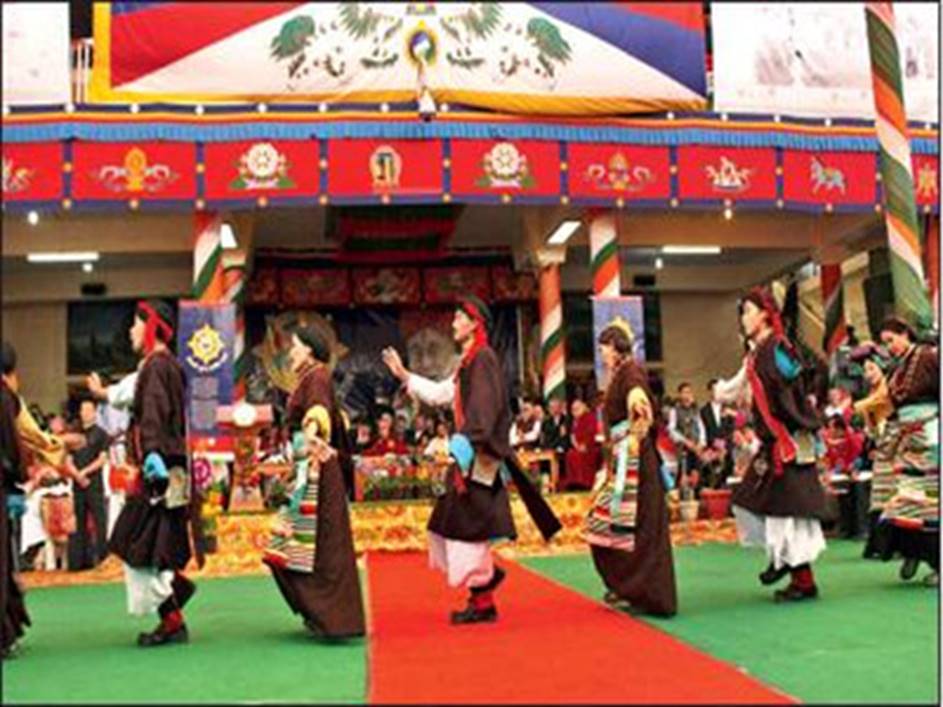
Supreme Ruler of Tibet Marks 65th Milestone of Life’s Journey in Exile. “Thank You India” a cultural program organized in McLeod Ganj, Dharamshala, India on Saturday, March 31, 2018 to mark the 60th Anniversary of Life in Exile.
I do not know for how long the Tibetan struggle will go on. However, the struggle will remain alive till the spirit of Tibetans remains,” the spiritual leader of Tibetans The Dalai Lama said at the “Thank You India” program being held at McLeod Ganj on Saturday, March 31, 2018 to mark his arrival in India, exactly 60 years ago.
On March 14, 1959, the Dalai Lama was forced to flee Tibet following failed uprising against China. After he took shelter in India, Tibetan community across globe under his leadership launched struggle for free Tibet but till date have not succeeded. During last few years, the demand has changed into one for autonomous Tibet.
While interacted with media persons, the Dalai Lama, when questioned about the possibility of Tibetans returning to their homeland one day, replied that Tibetan issue is an issue of justice. While commenting on the equation between India and China, he said that both were most populated countries of the World and both have ability to destroy each other.
“Any sensible person would want ‘Hindi-Chini Bhai Bhai’ to live together. None of them can be disloyal to each other, so other things will go on by the side,” he said. “Confrontation does not yield any result and amicable solution of Tibet problem is the only way out,” the Nobel Peace Laureate said.
“The Chinese are following a socialist form of government, which means everybody should have equal rights. We are not demanding separation from China, but the Tibetan people should have the autonomy to preserve their culture, language, environment and religion,” he added.
Earlier, the Dalai Lama recalled his journey in exile. He said that no time was wasted in these years. “It is a matter of pride that Tibetans have preserved their tradition and culture, wherever they are living across the globe,” he said.
He said that as there was need to preserve Tibetan culture and language, a logical analysis was also the need of hour. “When everybody is praising Tibetans it becomes our responsibility too to check where we were lacking,” he said.
Glimpses of 65 Years Life in Exile
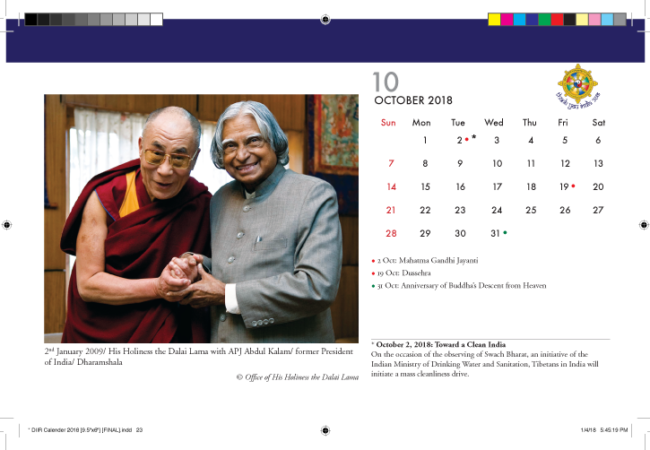
Supreme Ruler of Tibet Marks 65th Milestone of Life’s Journey in Exile. “Thank You India” a cultural program organized in McLeod Ganj, Dharamshala, India on Saturday, March 31, 2018 to mark the 60th Anniversary of Life in Exile. Supreme Ruler of Tibet Marks 65th Milestone of Life’s Journey in Exile. “Thank You India” Year 2018 Calendar marks the 60th Anniversary of Life in Exile. His Holiness the Dalai Lama with Indian Prime Minister Jawaharlal Nehru in Mussoorie, on April 04, 1959. Supreme Ruler of Tibet Marks 65th Milestone of Life’s Journey in Exile. “Thank You India” Year 2018 Calendar marks the 60th Anniversary of Life in Exile. His Holiness the Dalai Lama with Indian President Dr. Rajendra Prasad on April 17, 1961.Supreme Ruler of Tibet Marks 65th Milestone of Life’s Journey in Exile. “Thank You India” Year 2018 Calendar marks the 60th Anniversary of Life in Exile. His Holiness the Dalai Lama with Indian Prime Minister Lal Bahadur Shastri on October 27, 1965.Supreme Ruler of Tibet Marks 65th Milestone of Life’s Journey in Exile. “Thank You India” Year 2018 Calendar marks the 60th Anniversary of Life in Exile. His Holiness the Dalai Lama with Indian President Dr. Sarvepalli Radhakrishnan on May 08, 1964.Supreme Ruler of Tibet Marks 65th Milestone of Life’s Journey in Exile. “Thank You India” Year 2018 Calendar marks the 60th Anniversary of Life in Exile. His Holiness the Dalai Lama with Indian Prime Minister Indira Gandhi on August 06, 1966.Supreme Ruler of Tibet Marks 65th Milestone of Life’s Journey in Exile. “Thank You India” Year 2018 Calendar marks the 60th Anniversary of Life in Exile. His Holiness the Dalai Lama with Indian Prime Minister Morarji Desai on July 22, 1977.Supreme Ruler of Tibet Marks 65th Milestone of Life’s Journey in Exile. “Thank You India” Year 2018 Calendar marks the 60th Anniversary of Life in Exile. His Holiness the Dalai Lama with Indian Prime Minister Charan Singh in 1979.Supreme Ruler of Tibet Marks 65th Milestone of Life’s Journey in Exile. “Thank You India” Year 2018 Calendar marks the 60th Anniversary of Life in Exile. His Holiness the Dalai Lama with Gianni Zail Singh, President of India on August 05, 1985.Supreme Ruler of Tibet Marks 65th Milestone of Life’s Journey in Exile. “Thank You India” Year 2018 Calendar marks the 60th Anniversary of Life in Exile. His Holiness the Dalai Lama with Indian Prime Minister Atul Bihari Vajpayee on July 03, 2001.Supreme Ruler of Tibet Marks 65th Milestone of Life’s Journey in Exile. “Thank You India” Year 2018 Calendar marks the 60th Anniversary of Life in Exile. His Holiness the Dalai Lama with Dr. APJ Abdul Kalam, President of India on January 02, 2009. Supreme Ruler of Tibet Marks 65th Milestone of Life’s Journey in Exile. “Thank You India” Year 2018 Calendar marks the 60th Anniversary of Life in Exile. His Holiness the Dalai Lama with Indian Prime Minister Dr. Manmohan Singh on September 22, 2014.Supreme Ruler of Tibet Marks 65th Milestone of Life’s Journey in Exile. “Thank You India” Year 2018 Calendar marks the 60th Anniversary of Life in Exile. His Holiness the Dalai Lama with Pranab Mukherjee, President of India on December 10, 2016.
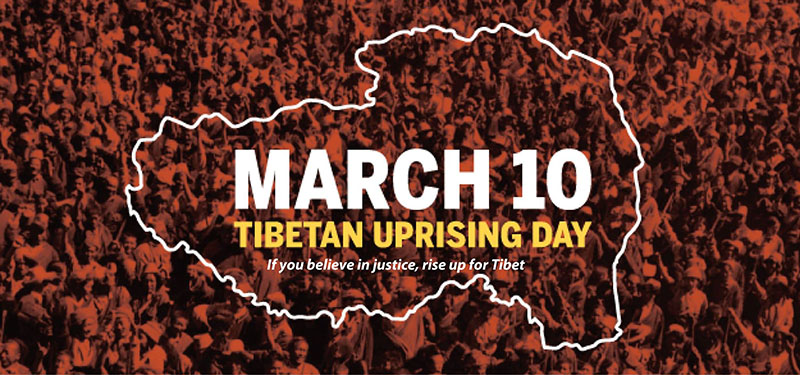
Sunday, March 10, 2024. 65th Anniversary of Tibetan Uprising Day.
On Sunday, March 10, 2024, the Living Tibetan Spirits commemorate events of Tibetan Uprising on Tuesday, March 10, 1959.
Sunday, March 10, 2024. 65th Anniversary of Tibetan Uprising Day.
Tibet Uprising or Tibet Rebellion on Tuesday, March 10, 1959 makes a profound impact on the course of my life’s journey since 1971 when I joined the Tibetan Resistance Movement in support of Human Rights, Freedom, Peace and Justice in Occupied Tibet. I speak on behalf of the Living Tibetan Spirits who live in exile without a refugee status, without asylum protection, and without any entity that can be called a friend.
Sunday, March 10, 2024. 65th Anniversary of Tibetan Uprising Day: For Seventy Five years, Tibetans are living under military occupation and political oppression. What is Tibet’s Future? How to evict the illegal occupier of Tibet?
How to find Hope when the Final Destination remains unknown? Can Patience and Perseverance serve the purpose of Hope for Freedom, Peace, and Justice?
Sunday, March 10, 2024. 65th Anniversary of Tibetan Uprising Day.
Sunday, March 10, 2024. 65th Anniversary of Tibetan Uprising Day.
The Norbulingka, the Dalai Lama’s Summer Palace in Lhasa, Tibet, which was destroyed by the Chinese Army during the 1959 Tibetan Uprising but later rebuilt. lapin.lapin on Flickr.com
Chinese artillery shells pummeled the Norbulingka, the Dalai Lama’s summer palace, sending plumes of smoke, fire, and dust into the night sky. The centuries-old building crumbled under the barrage, while the badly outnumbered Tibetan Army fought desperately to repel the People’s Liberation Army (PLA) from Lhasa…
Meanwhile, amidst the snows of the high Himalaya, the teenaged Dalai Lama and his bodyguards endured a cold and treacherous two-week-long journey into India.
Origins of the Tibetan Uprising of 1959
Tibet had an ill-defined relationship with China’s Qing Dynasty (1644-1912); at various times it could have been an ally, an opponent, a tributary state, or a region within Chinese control.
In 1724, during a Mongol invasion of Tibet, the Qing seized the opportunity to incorporate the Tibetan regions of Amdo and Kham into China proper. The central area was renamed Qinghai, while pieces of both regions were broken off and added to other western Chinese provinces. This land grab would fuel Tibetan resentment and unrest into the twentieth century.
When the last Qing Emperor fell in 1912, Tibet asserted its independence from China. The 13th Dalai Lama returned from three years of exile in Darjeeling, India, and resumed control of Tibet from his capital at Lhasa. He ruled until his death in 1933.
China, meanwhile, was under siege from a Japanese invasion of Manchuria, as well as a general breakdown of order across the country.
Between 1916 and 1938, China descended into the “Warlord Era,” as different military leaders fought for control of the headless state. In fact, the once-great empire would not pull itself back together until after World War II, when Mao Zedong and the Communists triumphed over the Nationalists in 1949.
Meanwhile, a new incarnation of the Dalai Lama was discovered in Amdo, part of Chinese “Inner Tibet.” Tenzin Gyatso, the current incarnation, was brought to Lhasa as a two-year-old in 1937 and was enthroned as the leader of Tibet in 1950, at 15.
China Moves in and Tensions Rise
In 1950, Mao’s gaze turned west. He decided to “liberate” Tibet from the Dalai Lama’s rule and bring it into the People’s Republic of China. The PLA crushed Tibet’s tiny armed forces in a matter of weeks; Beijing then imposed the Seventeen Point Agreement, which Tibetan officials were forced to sign (but later renounced).
According to the Seventeen Point Agreement, privately-held land would be socialized and then redistributed, and farmers would work communally. This system would first be imposed on Kham and Amdo (along with other areas of the Sichuan and Qinghai Provinces), before being instituted in Tibet proper.
All the barley and other crops produced on the communal land went to the Chinese government, according to Communist principles, and then some was redistributed to the farmers. So much of the grain was appropriated for use by the PLA that the Tibetans did not have enough to eat.
By June of 1956, the ethnic Tibetan people of Amdo and Kham were up in arms.
As more and more farmers were stripped of their land, tens of thousands organized themselves into armed resistance groups and began to fight back. Chinese army reprisals grew increasingly brutal and included wide-spread abuse of Tibetan Buddhist monks and nuns. (China alleged that many of the monastic Tibetans acted as messengers for the guerrilla fighters.)
The Dalai Lama visited India in 1956 and admitted to Indian Prime Minister Jawaharlal Nehru that he was considering asking for asylum. Nehru advised him to return home, and the Chinese Government promised that communist reforms in Tibet would be postponed and that the number of Chinese officials in Lhasa would be reduced by half. Beijing did not follow through on these pledges.
By 1958, as many as 80,000 people had joined the Tibetan resistance fighters.
Alarmed, the Dalai Lama’s government sent a delegation to Inner Tibet to try and negotiate an end to the fighting. Ironically, the guerrillas convinced the delegates of the righteousness of the fight, and Lhasa’s representatives soon joined in the resistance!
Meanwhile, a flood of refugees and freedom fighters moved into Lhasa, bringing their anger against China with them. Beijing’s representatives in Lhasa kept careful tabs on the growing unrest within Tibet’s capital city.
March 1959 – The Uprising Erupts in Tibet Proper
Important religious leaders had disappeared suddenly in Amdo and Kham, so the people of Lhasa were quite concerned about the safety of the Dalai Lama. The people’s suspicions therefore were raised immediately when the Chinese Army in Lhasa invited His Holiness to watch a drama at the military barracks on March 10, 1959. Those suspicions were reinforced by a none-too-subtle order, issued to the head of the Dalai Lama’s security detail on March 9, that the Dalai Lama should not bring along his bodyguards.
On the appointed day, March 10, some 300,000 protesting Tibetans poured into the streets and formed a massive human cordon around Norbulingka, the Dalai Lama’s Summer Palace, to protect him from the planned Chinese abduction. The protestors stayed for several days, and calls for the Chinese to pull out of Tibet altogether grew louder each day. By March 12, the crowd had begun to barricade the streets of the capital, while both armies moved into strategic positions around the city and began to reinforce them.
Ever the moderate, the Dalai Lama pleaded with his people to go home and sent placatory letters to the Chinese PLA commander in Lhasa. and sent placatory letters to the Chinese PLA commander in Lhasa.
When the PLA moved artillery into range of the Norbulingka, the Dalai Lama agreed to evacuate the building. Tibetan troops prepared a secure escape route out of the besieged capital on March 15. When two artillery shells struck the palace two days later, the young Dalai Lama and his ministers began the arduous 14-day trek over the Himalayas for India.
On March 19, 1959, fighting broke out in earnest in Lhasa. The Tibetan army fought bravely, but they were vastly outnumbered by the PLA. In addition, the Tibetans had antiquated weapons.
The firefight lasted just two days. The Summer Palace, Norbulingka, sustained over 800 artillery shell strikes that killed an unknown number of people inside; the major monasteries were bombed, looted and burned. Priceless Tibetan Buddhist texts and works of art were piled in the streets and burned. All remaining members of the Dalai Lama’s bodyguard corps were lined up and publicly executed, as were any Tibetans discovered with weapons. In all, some 87,000 Tibetans were killed, while another 80,000 arrived in neighboring countries as refugees. An unknown number tried to flee but did not make it.
In fact, by the time of the next regional census, a total of about 300,000 Tibetans were “missing” – killed, secretly jailed, or gone into exile.
Aftermath of the 1959 Tibetan Uprising
Since the 1959 Uprising, the central government of China has been steadily tightening its grip on the Tibet.
Although Beijing has invested in infrastructure improvements for the region, particularly in Lhasa itself, it has also encouraged thousands of ethnic Han Chinese to move to Tibet. In fact, Tibetans have been swamped in their own capital; they now constitute a minority of the population of Lhasa.
Today, the Dalai Lama continues to head the Tibetan government-in-exile from Dharamshala, India. He advocates increased autonomy for Tibet, rather than full independence, but Chinese government generally refuses to negotiate with him.
Periodic unrest still sweeps through Tibet, especially around important dates such as March 10 to 19 – the anniversary of the 1959 Tibetan Uprising.
Your Citation
Szczepanski, Kallie. “The Tibetan Uprising of 1959.” ThoughtCo, Feb. 6, 2017, thoughtco.com/the-tibetan-uprising-of-1959-195267. Szczepanski, Kallie. (2017, February 6). The Tibetan Uprising of 1959. https://www.thoughtco.com/the-tibetan-uprising-of-1959-195267
Sunday, March 10, 2024. 65th Anniversary of Tibetan Uprising Day.Sunday, March 10, 2024. 65th Anniversary of Tibetan Uprising Day .
Tibetan Consciousness Movement spreads in Occupied Tibet
Whole Dude – Whole Unrest. A Thanka painting inside the Namgyal Institute.
Excerpt: Special Frontier Force – The Doctrine of Tibetan Resistance: The Problem of War and Peace in Tibet. Can we order Peace for the sake of War, and not War for the sake of Peace? It may be argued that Peace is Inevitable or it may be stated that War is Inevitable. The problem is the absence of Natural Order, Natural Condition, Natural Power, and Natural Authority in the Land of Tibet and in the lives of Tibetans. I state that Resistance is Inevitable, Resistance will Endure, and Resistance will Prevail if there is no Natural Order in Tibet. Tibet can Resist, Tibet will Resist, and Tibetan Resistance will Prevail until the Natural Order is restored in Tibet.Tibetan Identity is a reflection of Tibetan Consciousness and Tibetan Resistance is the natural reaction to occupation.
Whole Dude – Whole Unrest: This Yak dressed up in Tibetan Costume symbolizes the Tibetan Consciousness Movement. The Consciousness of The Living Tibetan Spirits includes the Land, the People, the denizens of Tibet.
The Living Tibetan Spirits appreciate the following article published by Mr. Bahukutumbi.Raman, the former associate of Mr. R. N. Kao of the Intelligence Bureau, and the Secretary (Research) of the Research and Analysis Wing (R&AW) from 1968 to 1977. During 1971, Mr. R. N. Kao and Mr. B. Raman visited my Organization that was commanded by Major General Sujan Singh Uban, Inspector General Special Frontier Force. Mr. B. Raman also served as Additional Secretary, the Cabinet Secretariat, Government of India.
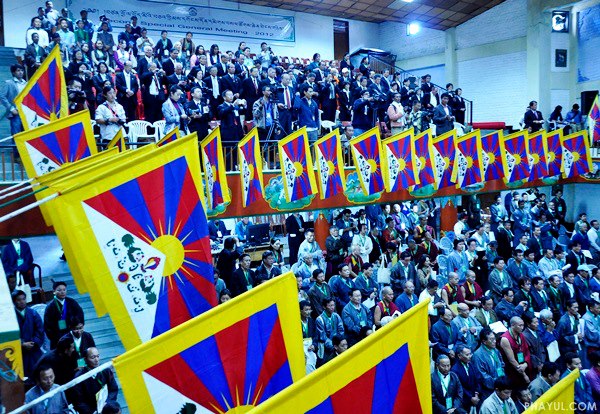
Whole Dude – Whole Unrest: For the purpose of working out a response to the current tragic situation in Tibet, a Special General Meeting of Tibetans was held at Dharamshala, India.
The Tibetan Spirits live in my consciousness and we recognize the Tibetan Consciousness Movement. The Tibetan Identity will survive in spite of illegal occupation of Tibet. We have set our minds free and freedom is the state of our minds and freedom is the condition of our Spirits.
WHOLE DUDE – WHOLE UNREST: OLD FLAMES NEVER DIE – TIBETAN CONSCIOUSNESS MOVEMENT
The unrest in the Tibetan areas of China —Tibet, Qinghai, Sichuan and Yunnan— continues in different forms. The unrest was triggered off in March last by unhappiness among the Tibetans of Sichuan over the continued suppression of their political, religious and ethnic rights by the Chinese authorities and over their attempts to punish anyone who proclaimed his or her loyalty to His Holiness the Dalai Lama. 2. The unrest in the Tibetan areas of Sichuan has taken the form of a chain of self-immolations by young Tibetan monks of the large Kirti monastery. The Chinese authorities have not been able to stop these acts or attempted acts of self-immolation despite their removing a large number of monks of the monastery to a military detention camp euphemistically called a re-education centre and punishing those present at the time of the self-immolations on charges of abetment to suicide. They have also been forcing senior monks to come out with statements condemning self-immolations as unBuddhist and have launched a campaign against His Holiness for not condemning self-immolations. 3. Despite these suppressive measures, acts or attempted acts of self-immolation continue with nine so far. In the latest incident reported on October 17, 2011, a nun is reported to have committed self-immolation. This is the first instance of a self-immolation by a nun in the history of Tibetan Buddhism. Wamgmo, the 20-year-old nun, was from the Mamo or Dechen Choekorling Nunnery, which has about 350 nuns in Ngaba. Nuns from here had also participated in the March 2008 protest movement, 4. The same day, the Chinese police opened fire on a group of protesting Tibetans, injuring two of them. There were no fatalities. The shooting followed a protest the previous day in the Khekor township of Serthar (in Chinese, Seda) county of the Kardze (in Chinese, Ganzi) prefecture. A group of seven Tibetans protested in front of the local police station and shouted slogans calling for freedom for Tibet, the return of His Holiness from exile and the release from jail of His Holiness the Panchen Lama, chosen by the Dalai Lama in accordance with Tibetan Buddhist traditions. The Chinese have jailed him and the Communist Party of China has nominated its own Panchen Lama who has not been accepted by the Tibetans. 5. The self-immolations in Sichuan have been accompanied by protests and commercial strikes by Tibetans in the towns and villages to which those committing self-immolation belonged. The Tibetan community of Sichuan observed a day of fasting and protest on October 19 to express solidarity with the families of those who committed self-immolation. The acts of self-immolation have not so far spread to other Tibetan areas outside Sichuan. 6. However, a Tibetan-consciousness movement has been spreading right across the Tibetan belt. The objective of the movement is to enhance the consciousness of the Tibetans–particularly the youth— about the distinct nature of the Tibetan culture as distinguished from the Han culture and to impress upon the youth the importance of preserving the Tibetan culture and maintaining their loyalty and devotion to His Holiness the Dalai Lama. The monasteries have been in the forefront of this movement. 7. As part of this Tibetan-consciousness movement, Tibetans are being encouraged to dress in typical Tibetan style, speak among themselves only in the Tibetan language, eat only Tibetan food and participate in joint prayer meetings. Reports received from Tibet and other Tibetan areas say that thousands of Tibetans–many of them youth—are participating in the peaceful gatherings organised by this movement. The Chinese authorities have till now refrained from disrupting this movement lest it led to any violence. 8.At the Sershul monastery in the Kardze (in Chinese, Ganzi) Tibetan Autonomous Prefecture of the Sichuan province, more than 20,000 Tibetan monks and others gathered from Oct. 6-13 to take part in discussions on Tibetan-consciousness. In an earlier Tibetan-consciousness gathering from Oct. 2-5 at the Dzogchen monastery, also in Kardze, a senior religious leader spoke to more than 10,000 Tibetans on the Tibetan identity. Pledges to struggle for Tibetan freedom through non-violent means were taken 9. Similar gatherings were held in eight other places during September and October, including one gathering of about 1,400 monks in Nangchen in the Yulshul (in Chinese, Yushu) Tibetan Autonomous Prefecture of Qinghai province. 10. The absence of acts of self-immolation, protest meetings and commercial strikes in Tibet itself should not be misconstrued to mean that the struggle for Tibetan rights, which led to a mass flare-up in 2008, is showing signs of subsiding. It has taken a different form. The presence of thousands of Tibetans–particularly Tibetan youth— in the Tibetan-consciousness gatherings in Tibet speaks of the continuing pride of the Tibetans in their Tibetan personality, culture and religious faith. 11. The Tibetan struggle for the protection and preservation of their self-identity and their loyalty and devotion to His Holiness remain as strong as ever. What should be encouraging is that a new generation Tibetan activists, different from those who were in the vanguard of the 2008 flare-up, has emerged and is now leading the Tibetan struggle. The new generation believes in a peaceful struggle. It feels that the violence of March 2008 played into the hands of the Chinese and enabled them to use brutal force to suppress the movement.
Whole Dude – Whole Unrest: Tibetan Consciousness Movement
Tibet Awareness – Uprising in the Land of Rising Sun
WHOLE CHALLENGE: UPRISING IN THE LAND OF RISING SUN (1959) AND UPRISING IN MY HEART (1962)
I am happy to share the Guest Column titled ‘Dragon’s Familiar Dance’ published in India Today, November 07, 2011. Brahma Chellaney, the author of this article is Professor of Strategic Studies at the Centre for Policy Research, New Delhi.
The word uprising describes the action of rising up and specifically it means an outbreak against a ruler or power or the act of revolt. Tibetans witnessed an Uprising in the Land of Rising Sun. Tibetans are conscious of the fact of the flight of His Holiness the Dalai Lama to India to lead a life in exile. I am conscious of the fact of Communist China’s attack on India during 1962. Communist China’s brutal aggression provoked an uprising in my heart. It has stirred me, it caused an intense swelling of emotions and it gave birth to a desire to resist Communist China as best as possible. Tibetans and myself have experienced similar emotions and feelings and share a common desire to resist Communist China and the threat it imposed upon our consciousness. During 1962, I was a young student at Giriraj Government Arts College, Nizamabad, Nizamabad District, Telangana, India. The students of Giriraj College spontaneously reacted to China’s attack and expressed their sense of resentment. We joined hands and walked on the City streets to express our Unity and Solidarity to defend India. This desire to oppose Communist China helped me to find an opportunity to join the ranks of Indian Army. On completion of my Basic Medical Officers Command Training Course (BMOC 20/70 ) at Officers Training School, Army Medical Corps Centre, Lucknow, and professional training at Military Hospital Ambala, during my first military assignment, I joined others who share my desire to fight the Red Dragon. We all know that it is a Challenge that needs preparation. While getting trained to gain the ability to move upwards to face the enemy, some people have fallen down. They have fallen with a desire still living in their hearts.
My consciousness is aware of this desire for Freedom and it keeps the Spirits alive in the form of a desire to resist the enemy and to end the illegal occupation of the Land of Rising Sun. The desire to resist your enemy causes feelings of sorrow or dukha like all other human desires. But, the condition called Freedom is not a desire. Freedom is the natural state or condition of human beings and military occupation is a violation or transgression of this natural condition of human existence. There is no choice other than that of revolting against occupation. So, we have accepted the desire to revolt against the enemy seeking the Compassion of Buddha to uplift us from the feelings of sorrow or Dukha.
Whole Challenge: The Red Dragon’s Lust for Global Supremacy poses a great danger to Freedom and Democracy all over the world.
With the 50th anniversary of the 1962 invasion approaching, history is in danger of repeating itself.
Brahma Chellaney The writer is professor of strategic studies at the Centre for Policy Research, New Delhi GUEST COLUMN India Today, November 7, 2011
As the 50th anniversary of China’s invasion approaches, history is in danger of repeating itself, with Chinese military pressures and aggressive designs against India not only mirroring the pre-1962 war situation but also extending to Pakistan-occupied Kashmir (PoK) and the oceans around India. China’s expanding axis of evil with Pakistan, including a new troop presence in PoK, heightens India’s vulnerability in Jammu and Kashmir, even as India has beefed up its defences in Arunachal Pradesh. By muscling up to India, what is China seeking to achieve? The present situation, ominously, is no different in several key aspects from the one that prevailed in the run-up to the 1962 war. ● The aim of “Mao’s India war” in 1962, as Harvard scholar Roderick MacFarquhar has called it, was largely political: to cut India to size by demolishing what it represented—a democratic alternative to China’s autocracy. The swiftness and force with which Mao Zedong defeated India helped discredit the Indian model, boost China’s international image, and consolidate Mao’s internal power. The return of the China-India pairing decades later riles Beijing. ● Just as the Dalai Lama’s flight to India in 1959 set the stage for the Chinese military attack, the exiled Tibetan leader today has become a bigger challenge for China than ever. The continuing security clampdown across the Tibetan plateau since the March 2008 Tibetan uprising parallels the harsh Chinese crackdown in Tibet during 1959-62. ● The prevailing pattern of cross-frontier incursions and other border incidents is no different from the situation that led up to the 1962 war. Yet, India is repeating the same mistake by playing down the Chinese intrusions. Gratuitously stretching the truth, Indian officials say the incursions are the result of differing perceptions about the line of control. But which side has refused to define the line of control? It speaks for itself that China hasn’t offered this excuse. The fact is that Chinese forces are intruding even into Utttarakhand—the only sector where the line of control has been clarified by an exchange of maps—and into Sikkim, whose 206-km border with Tibet is recognized by Beijing. ● The 1962 war occurred against the backdrop of China instigating and arming insurgents in India’s northeast. Although such Chinese activities ceased after Mao’s death, China has come full circle today, with Chinese-made arms increasingly flowing into guerrilla ranks in northeast India via Burmese front organisations. In fact, Pakistan-based terrorists targeting India also rely on Chinese arms. ● China’s pre-1962 psychological war is returning. In recent years, Beijing has employed its state-run media and nationalistic websites to warn of another armed conflict. It is a throwback to the coarse rhetoric China had used in its build-up to the 1962 war. Its People’s Daily, for example, has warned India to weigh “the consequences of a potential confrontation with China.” China merrily builds strategic projects in an internationally disputed area like Pak Occupied Kashmir but responds with crude threats when others explore just for oil in the South China Sea. ● Just as India in the early 1960s retreated to a defensive position in the border negotiations after having undermined its leverage through a formal acceptance of the “Tibet region of China,” the spotlight now is on China’s revived Tibet-linked claim to Arunachal rather than on the core issue, Tibet itself. India, with its focus on process than results, has remained locked in continuous border negotiations with China since 1981—the longest and the most-fruitless process between any two nations post-Second World War. This process has only aided China’s containment-with-engagement strategy. ● In the same way that India under Nehru unwittingly created the context to embolden Beijing to wage aggression, New Delhi is again staring at the consequences of a mismanagement of relations. The more China’s trade surplus with India has swelled—jumping from $2 billion in 2002 to more than $30 billion now—the greater has been its condescension toward India. To make matters worse, the insidious, V.K. Krishna Menon-style shadow has returned to haunt Indian defence management and policy. India has never had more clueless defence and foreign ministers or a weaker Prime Minister with a credibility problem than it does today. In fact, as it aims to mould a Sino-centric Asia, China is hinting that its real geopolitical contest is more with India than with the distant United States. The countries around India have become battlegrounds for China’s moves to encircle India. From a military invasion in 1962 and a subsequent cartographic aggression, China is moving towards a hydrological aggression and a multipronged strategic squeeze of India. China’s damming of rivers flowing from Tibet to India are highlighting Indian vulnerability on the water front even before India has plugged its disadvantage on the nuclear front by building a credible but minimal deterrent. Whether Beijing actually sets out to teach India “the final lesson” by launching a 1962-style attack will depend on several factors. They include India’s domestic political situation, its defence preparedness, and the availability for China of a propitious international timing of the type the Cuban missile crisis provided in 1962. If India does not want to be caught napping again, it has to come out of the present political paralysis and inject greater realism into its China policy, which today bears a close resemblance to a studied imitation of an ostrich burying its head in the sand. (c) India Today.
WHOLE CHALLENGE – FREEDOM IN THE LAND OF RISING SUN: FREE TIBET. IF NOT NOW, WHEN?















 Whole Dude - Whole Concept