RED DRAGON – RED CHINA – OCCUPIER OF TIBET: ARCHAEOLOGICAL FINDINGS SUGGEST THAT PEOPLE OF ANCIENT TIBET HAD FACED THREATS OF FOREIGN CONQUESTS.
Red China took possession of Tibet or seized Tibet using her superior military power. Red China told a lie when she claimed about peaceful liberation of Tibet by People’s Liberation Army. Red China is an occupying force that faces eviction from Tibet when Peace, Freedom, and Justice will prevail again. It is interesting to note that people of ancient Tibet had faced similar threats from external aggressors.
Archaeologist explores the first civilization of ancient Tibet
Mon, Aug 10, 2015
Vestiges of a once flourishing prehistoric civilization dot the landscape of Upper Tibet.
For more than two decades, University of Virginia Tibet Center archaeologist and historian John Vincent Bellezza has been exploring highland central Asia, going places where few archaeologists and explorers have ventured. Since 1992, he has investigated and documented scores of monumental sites, rock art, castles, temples, residential structures, and other features on the desolate reaches of the TIBETAN PLATEAU, building a knowledge base on a vast archaic civilization and ancient religion that flourished long before Buddhism emerged and dominated this otherwise comparatively sparsely populated high altitude region.
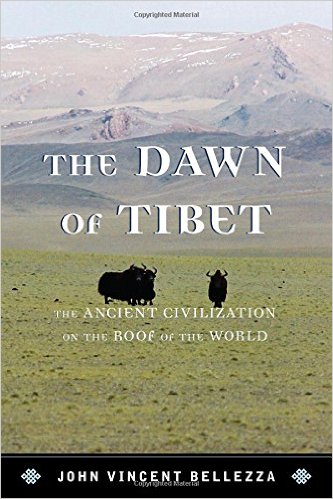
“Commonly, when people think of Tibet, Buddhism comes to mind,” writes Bellezza in his newest book, THE DAWN OF TIBET. By this he also implies the better-known and popular images of the imposing, sky-high, mountaintop monumental wonders of Buddhist centers such as Lhasa. But, he continues, “before Buddhism was introduced, a different type of civilization reigned in Tibet, one with monuments, art, and ideas alien to those of more recent times……….Demarcated through an enormous network of citadels and burial centers spanning one thousand miles from east to west, it would endure for some fifteen hundred years.”*
Bellezza is describing an archaic civilization known as ZHANG ZHUNG, which flourished from about 500 BC to 625 AD and encompassed most of the western and northwestern regions of the Tibetan Plateau. Mastering an ancient technology base not normally attributed to people of this region in the popular perception, the people of Iron Age Zhang Zhung, according to Bellezza, built citadels, elite stone-corbelled residential structures, temples, necropolises featuring stone pillars, sported metal armaments and a strong equestrian culture, established links with other cultures across Eurasia, and exhibited a relatively uniform and standardized cultural tradition rich in ritualistic religious practice, where kings and priests dominated the highest rungs of power. These are all characteristics of stratified, centralized and developed societies most often associated with the more southerly, lower-altitude great Old World Bronze and Iron Age civilizations that ringed the Mediterranean as well as the advanced civilizations of Mesoamerica and South America. The supporting findings on the landscape, when considered across two decades of investigation, have been nothing less than prolific.
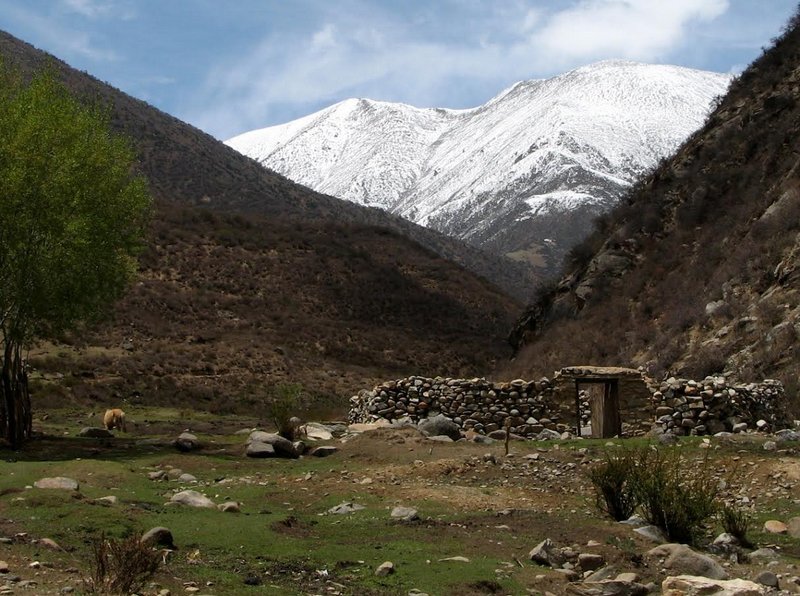
The Tibetan Plateau features ancient stone structures, many of which date back to the First Millennium B.C. McKay Savage, Wikimedia Commons
But this archaeological evidence, according to Bellezza, also opened a window on a civilization that heavily fortified itself from threats both within and without. The struggle for resources in a land where climate gradually changed over preceding millennia from one that was relatively warmer and moist to one that was cold and dry may have played a significant role in this. Competing external and internal forces may have played another. “Most archaic era residential facilities in Upper Tibet were built on unassailable high ground, on inaccessible islands, or in hidden spots, “ writes Bellezza. “This insularity indicates that defense was a preoccupation of the population. Eternal Bon historical sources speak of the martial character of Zhang Zhung society and its political nexus of kings and priests.” Even the priests were depicted in the literature as possessing arms. On the other hand, notes Bellezza, “these literary accounts also hold that the ancient priesthood was very adept in the practice of astrology, divination, magic, and medicine.”*
With much still awaiting discovery and study, Bellezza continues to explore and analyze the massive trove of data he has already compiled on this ancient people. In time, he and other researchers hope, by merging references in the literary sources with the accumulating new archaeological evidence, a sharper focus on an otherwise obscure and ill-understood civilization will emerge.
Readers can learn more about Zhang Zhung in Belezza’s book, THE DAWN OF TIBET, and in an upcoming article about Zhang Zhung authored by Bellezza in the Fall issue of Popular Archaeology Magazine.
The Subjugation of Tibet is a crime against humanity
THE SUBJUGATION OF TIBET: RED CHINA’S ILLEGAL, AND UNJUST OCCUPATION OF TIBET IS A CRIME AGAINST HUMANITY.
I am pleased to share this article authored by Patrick Boehler, “FROM THE ARCHIVES: DALAI LAMA’S ACCESSION TO THRONE AND FLIGHT TO INDIA” in The New York Times blog called ‘Sinosphere’ that includes dispatches from China. This blog post includes a series of news stories published by The New York Times. Just like India which was part of British Empire for several centuries, Tibet was part of Mongol, and later Manchu China Empires for several centuries. But, at no time India was a part of a national entity called Great Britain. Similarly, at no time Tibet is part of a national entity called China or People’s Republic of China. Red China’s Expansionist Policy and acts of aggression have no legitimacy. Red China’s illegal, unjust military occupation of Tibet is a Crime Against Humanity.
SINOSPHERE : DISPATCHES FROM CHINA
From the Archives: Dalai Lama’s Accession to Throne and Flight to India
BY PATRICK BOEHLER July 6, 2015 7:55 am July 6, 2015 7:55 am
Photo
THE SUBJUGATION OF TIBET: RED CHINA’S ILLEGAL, AND UNJUST OCCUPATION OF TIBET IS A CRIME AGAINST HUMANITY.
An op-ed by the Dalai Lama in The New York Times on Feb. 3, 1979.Credit John Faber
As the Dalai Lama celebrates his 80th birthday on Monday, here is a look at how The New York Times covered his early years as the spiritual leader of Tibet, a time when rare glimpses into the Himalayan territory’s politics came mostly from radio broadcasts from India and a few travelers and missionaries from war-torn China.
In December 1933, The Times reported the death of the Dalai Lama’s predecessor, the 13th in the line of spiritual rulers. That was followed by the start of a mission to find his reincarnation in a newborn child, and by international wrangling for influence in the capital, Lhasa.
“The question of succession has its ramifications in widely separated places,” The Times noted in 1934. “In the offices of the Indian government at Delhi; in the India office of London’s Downing Street; in the Kremlin of Moscow; at Kuomintang headquarters in Nanking; at the Japanese military headquarters in Manchuria; at the court of the Manchu Pu Yi; and in the inner councils of the militarists in Tokyo.”
Sir Francis Younghusband, who had led a British expedition to Lhasa 30 years earlier, described the search for a successor in an article for The Times in 1934. “What changes may come, who can say?” he wrote. “British influence may wane. Chinese influence may wax. Or the reverse may happen. In any case, the Tibetans will strive to preserve their soul.”
The current Dalai Lama was born a year later, in 1935. His discovery as the reincarnation of his predecessor seemingly went unreported. In 1940, The Times carried a report from Lhasa describing the child’s enthronement ceremony.
Photo
The first image of the 14th Dalai Lama to appear in The New York Times in 1940.Credit The New York Times
“Wearing a scarlet cloak and riding through reverent crowds in a great golden palanquin, a 6-year-old Chinese peasant boy today was enthroned as the 14th Dalai Lama, chief civil and religious ruler of this monastic kingdom,” The Times wrote.
“Monks from the hundreds of monasteries scattered throughout the kingdom blessed the boy as he passed,” the report added. “The entire city was perfumed by incense burners that lined the route.”
The report noted that a portrait of Sun Yat-sen, the founder of the Chinese republic, and Chinese flags were hung in the throne room to reflect acceptance of Chinese claims of sovereignty over Tibet. In Nanking, officials and monks kowtowed to the Dalai Lama’s image, The Times reported.
The first reports of Chinese Communist forces entering Tibet appeared in The Times in 1950, “blurred by cloudy gulfs of time and distance,” months after Mao Zedong proclaimed the People’s Republic in Beijing.
In November 1950, Indian government sources tole The Times that they had lost radio contact with Lhasa, “now under imminent threat of capture by the invading Chinese Communist forces.” The Dalai Lama had fled the capital, according to the report. A truce, with a reported assurance that Beijing would accept “internal autonomy in Tibet while the Chinese Communists take over the frontier patrol,” was reported on a Times front page in March 1951.
In August 1951, The Times reported the arrival of the Dalai Lama’s brother in the United States. In September, the People’s Liberation Army said it had entered Lhasa. “There is considerable opposition to the Communist regime in Lhasa, according to the latest news received at this border from the Tibetan capital,” a Times correspondent wrote from Kalimpong, in West Bengal, India.
“Resentment against the loss of their ancient freedom to the Chinese Communists smoulders angrily beneath the surface of the present apparent subservience of Tibet to Red occupation,” The Times’s longtime correspondent Robert Trumbull wrote in 1952. “It waits an opportune moment to burst into flame,” as it has always eventually done “in previous Chinese attempts to subjugate the Himalayan Lamaist state.”
Photo
The Dalai Lama seen next to Premier Zhou Enlai of China in Beijing in 1954.Credit The New York Times
The same year, it was reported that Soviet engineers planned to rapidly industrialize the territory, starting with a wool processing plant. “This will serve a twofold purpose of providing employment and to some extent reducing Tibet’s dependence on foreign countries, especially the United States, for marketing raw wool,” The Times wrote.
Mr. Trumbull reported that the Dalai Lama openly defied the Chinese authorities in 1953 by refusing to fly the Chinese flag. Still, he stayed in power. “It is known from a high Tibetan source available in India that the Dalai Lama’s position, as the highest spiritual and temporal authority in the Buddhist state, has been too secure with his people for the Communists to override entirely,” Mr. Trumbull wrote.
Photo
THE SUBJUGATION OF TIBET: RED CHINA’S ILLEGAL, AND UNJUST OCCUPATION OF TIBET IS A CRIME AGAINST HUMANITY.
The Chinese premier announced the end of the Dalai Lama’s rule over Tibet in a radio broadcast in 1959.Credit The New York Times Reports of clashes in Tibet and efforts by Beijing to control the territory increased in frequency during the years leading up to the rebellion of 1959. On March 21, Elie Abel reported the first fighting in Lhasa. “Virtually the entire population of Lhasa had joined rebellious Khamba tribesmen in an unequal struggle against Chinese troops,” Mr. Abel wrote from New Delhi.
In a message broadcast on March 28, Premier Zhou Enlai of China said the Panchen Lama would replace the Dalai Lama, who Mr. Zhou said was being held by rebels, The Times reported. A week later, the newspaper reported the Dalai Lama’s arrival in India, the beginning of the life in exile he has led ever since.
“An envoy of the young god-king had reached the border Sunday, stating that the Dalai Lama had requested political asylum,” The Times reported, adding that the State Department was “greatly pleased” at the news.
Sinosphere, the China blog of The New York Times, delivers intimate, authoritative coverage of the planet’s most populous nation and its relationship with the rest of the world. Drawing on timely, engaging dispatches from The Times’ distinguished team of China correspondents, this blog brings readers into the debates and discussions taking place inside a fast-changing country and details the cultural, economic and political developments shaping the lives of 1.3 billion people.
Copy right 2015 The New York Times Company
history of us india tibet relations h h dalai lama and indira gandhi september4 1959
history of us tibet relations the 14th dalai lama arrived in india 1959
history of us india tibet relations his holiness the dalai lama being received by indian officials at the indo tibet border in 1959
history of us india tibet relations his holiness the 14th dalai lama radhakrishnan nehru
la fg g tibet future 20150703
red china subjugator march12 1959
THE SUBJUGATION OF TIBET : RED CHINA’S ILLEGAL, AND UNJUST OCCUPATION OF TIBET IS A CRIME AGAINST HUMANITY.
THE EVIL RED EMPIRE – RED CHINA – OPPRESSOR : TIBET IS NOT A PART OF RED CHINA . HOWEVER, IT IS CORRECT TO STATE THAT TIBETANS ARE OPPRESSED BY RED CHINA’S TYRANNY .
Oppressor refers to a person or group that oppresses people. Oppressor is related to terms like tyrant, despot, persecutor, and,subjugator. Oppressor is a person who uses power or authority in a cruel, unjust, or harmful way. Red China is an Oppressor for she persecutes people in Occupied Tibet. In recent times, news media in the United States have shared a number of stories to focus public attention of people about problems faced by people of Philippines and other weak neighbors of Red China because of China’s Maritime Expansionism. Not even a single word is mentioned about Red China’s oppressive rule over Occupied Tibet.
THE EVIL RED EMPIRE – RED CHINA – OPPRESSOR : TIBET IS NOT A PART OF RED CHINA . RED CHINA EXPANDED HER TERRITORY THROUGH MILITARY CONQUEST .
Tibet is the first victim of Red China’s Expansionist Policy. The problems of South China Sea demand proper evaluation of Red China’s tyranny, despotism, subjugation, persecution, suppression, and oppression of Tibetan people living their miserable lives in Occupied Tibet.
MASINLOC, Philippines — When nations duel over reefs, rocks and islets, people are going to get hurt, and in the South China Sea dispute, that means the fishermen here who once wrested a living from the contested waters.
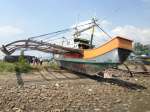
Gunmen in a Chinese speedboat drove Macario Forones, for instance, away from a favorite spot called Scarborough Shoal, and now his boat, the Marvin-1, sits useless in the grass and weeds above the high-tide line, and he sells someone else’s fish from a stall in the local market. Efrim Forones now dives for clams in the bay, making about one-tenth of what he earned when he fished the sea. Viany Mula says he was set upon with a Chinese water cannon when he ventured out to the shoal in his boat, and now he makes deliveries around town on a motorbike, barely earning enough each day, as he p
“I really want to fish the shoal,” Mula said one recent day. “It’s a very rich fishing ground. But that’s not possible now.”
For generations, the South China Sea was a regional common. Fishing boats from all of the surrounding countries would roam its waters, pausing now and then to trade cigarettes or potatoes or gossip.
But then Vietnam, followed by the Philippines, began staking claims to some of the islands, and now China is moving in, in a big way. Beijing is building up the outposts it has established, enlarging islands that it controls and claiming exclusive rights to fishing grounds.
The smaller, poorer nations can’t put up a real fight for the access to the sea that they long enjoyed. “That’s not for us,” Mula said. “We have nothing.”
But the Philippines does have the United States behind it, after a fashion. The Americans are making more visits here, and stepping up naval patrols and overflights — and in the process, the South China Sea dispute becomes something bigger than a contest for fish. It looks more and more like a geostrategic confrontation between the two great powers, China and the United States; that’s certainly how the Chinese characterize it.
The U.S. military has long been a source of anguish, self-doubt and defiance for the Philippines, a former U.S. colony. Many Filipinos are encouraged by recent U.S. attention to the maritime dispute, but they wonder whether the Americans give much thought to the Philippines and the people who are paying a price as the dispute deepens. One in three residents of Masinloc have depended over the years on fishing for their livelihoods, said Mayor Desiree Edora. Scarborough Shoal, a half-day’s sail from shore, was a refuge from storms, a gathering place for fishermen from all over and a home to abundant grouper and giant clams. Now, the Chinese have barred foreign boats. It is like being thrown out of your own house, she said.
“We can’t replicate what Scarborough Shoal can provide,” she said.
The Philippines took China to court — an international tribunal in The Hague — two years ago over competing claims in the sea. China refused to participate; a decision is expected next year, but it probably will be unenforceable. The Philippine move may have provoked the Chinese into trying to cement their claims by occupying and building up as many spots in the sea as they can, but officials in the Philippines say they had no choice after efforts to negotiate came to nothing.
The governor of Zambales province, Hermogenes E. Ebdane Jr., said he wonders what China’s ultimate goal is. “No one’s going to war over fish,” he said. His constituents, the fishermen, will have to find something else to do. But if this confrontation is about something bigger, Ebdane said, it’s unclear what role the Philippines might have. There’s a new defense agreement with the United States, but, he said, neither side seems to have thought through the implications for the murky weeks and months ahead.
A legacy of deep ambivalence
At the Defense College in Quezon City, on the outskirts of Manila, an entire wall in the lobby is given over to a painting that depicts the massacre of four dozen U.S. soldiers by Filipino insurgents at Balangiga in 1901. A diorama up a staircase shows Filipinos battling Spanish conquistadors, and fighting against the Japanese in World War II — alongside Americans. The United States seized the Philippines from Spain in 1898 and held it until 1946. The U.S. military continued to keep permanent bases here until 1991.
The legacy is a deep ambivalence toward the United States. But the U.S. Navy is the one force that is willing to challenge the Chinese and keep up regular patrols in the region. An agreement signed last year would allow the U.S. military standing presence here, rotating forces onto Philippine bases. The agreement is held up by a lawsuit in the Philippine Supreme Court.
Washington has stepped up visits and patrols, and it has made much of joint training exercises and the donation of used military equipment. “That is not to protect the Philippines but to protect their own turf,” said Roilo Golez, a member of the country’s House of Representatives. U.S. military aid, worth about $40 million a year, is nothing but a token, he said.
The Philippine armed forces, in this nation of 100 million, remain in woeful shape. It is an article of faith that the government was caught napping when China began making its moves in the South China Sea.
“We remain quite dependent on allied help, and that is not good,” said Rafael Alban III, former secretary of the interior. “The focus of the Philippine government has been on politics, politics, politics, at the expense of national security. China is taking advantage of our inertia and lack of assertiveness. We are presenting ourselves as unworthy before friend and foe.” Walden Bello, founding director of a group called Focus on the Global South, said his country “is right back to its role in the Cold War, when it played the part of handmaiden to the United States.”
But military officials here say they are unsure of the U.S. commitment if hostilities should break out. The United States and the Philippines have a mutual defense treaty pledging assistance if either is attacked, but Washington doesn’t recognize any nation’s territorial claims in the South China Sea, including the Philippines’. Naval analysts in Washington say the U.S. response to conflict there would depend entirely on the circumstances.
“We may have overestimated how the United States will come to the rescue,” said Chito Santa Romana, an expert on China. “We may have underestimated Chinese resolve.”
Water-borne civil disobedience
The two biggest vessels in the Philippine navy are former U.S. Coast Guard cutters, retrofitted with deck guns, and of little use in standing up to the Chinese. The government, in any case, has no desire to provoke China into a military confrontation.
That leaves the fishing fleet as the country’s best means of maintaining a presence in the parts of the South China Sea that Beijing claims. Philippine — and Vietnamese — boats challenge the Chinese when and where they can, until the Chinese coast guard drives them off. It is water-borne civil disobedience.
“These are small, subsistence fishermen,” said Evan P. Garcia, undersecretary for policy in the Philippines Department of Foreign Affairs. “They’re not a threat to anybody. And it’s not as if they just went there yesterday.”
The fish they’re after may be the other big casualty of the dispute. The tensions over the years have kept anyone from getting good data on fish stocks or devising a conservation plan. Hundreds of millions of people live around the South China Sea and eat its fish. The Marine Stewardship Council, with an office in Singapore, says that the humpback wrasse and bluefin tuna populations are close to collapse. Edgardo Gomez, a marine biologist in Manila, said that the Chinese have wiped out the giant clams on Scarborough and that their construction work is destroying reefs that support the bottom rungs of the sea’s food chain.
“You have tons and tons of marine life in and around those reefs that are now gone,” he said. The hatch is being shut on a way of life. The United States and China are either pursuing strategic advantage or practicing destructive gamesmanship, depending on the perspective. Filipinos have to live with that — with the “odd detour,” as Garcia put it, that brought them here.
Viany Mula would trade his motorbike in the blink of an eye for a chance to return to sea. But that is not going to happen.
Englund visited the Philippines on a Jefferson Fellowship, supported by the East-West Center.
THE EVIL RED EMPIRE – RED CHINA – OPPRESSOR : TIBET IS NOT A PART OF RED CHINA . HOWEVER, IT IS CORRECT TO STATE THAT TIBETANS ARE OPPRESSED BY RED CHINA’S TYRANNY .
THE EVIL RED EMPIRE – RED CHINA – OPPRESSOR : Filipino fisherman’s personal story .
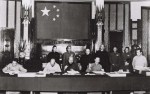
THE EVIL RED EMPIRE – RED CHINA – OPPRESSION IN TIBET – ON MAY 23, 1951, TIBETAN DELEGATES GAVE CONSENT TO A 17-POINT PLAN WHICH PROMISED THAT RED CHINA WILL NOT USE COERCION TO IMPLEMENT HER MEASURES INSIDE TIBET . RED CHINA VIOLATED THIS AGREEMENT .
THE EVIL RED EMPIRE – RED CHINA – OPPRESSOR : TIBET IS NOT A PART OF RED CHINA . RED CHINA EXPANDED HER TERRITORY THROUGH MILITARY CONQUEST .











 Whole Dude - Whole Concept