Whole Crusade – The Call for Peace through Freedom in Occupied Tibet

#WHOLEVILLAIN  -  WHOLEVILLAIN  -  WHOLE  VILLAIN  -  HISTORY  OF  THE  US-TIBET  RELATIONS  :  OCTOBER  19,  1973.  THIS  ARTICLE  ACCORDS  A  SPECIAL  RECOGNITION  TO  DR  HENRY  ALFRED  KISSINGER  FOR  HIS  ACTIONS  THAT  SHAPED  US-TIBET  RELATIONS  FROM  1969  TO  1977 .
#WHOLEVILLAIN – WHOLEVILLAIN – WHOLE VILLAIN – HISTORY OF THE US-INDIA-TIBET RELATIONS: OCTOBER 19, 1973. THIS ARTICLE ACCORDS A SPECIAL RECOGNITION TO DR HENRY ALFRED KISSINGER FOR HIS ACTIONS THAT SHAPED US-TIBET RELATIONS FROM 1969 TO 1977.

On behalf of Special Frontier Force (#SpecialFrontierForce), Establishment 22 (#Establishment22), and Vikas Regiment I acknowledge the role of Dr. Henry Alfred Kissinger as that of #WholeVillain, WholeVillain, and Whole Villain in the history of the US-Tibet relations. I ask my readers to give special attention to some of the aspects of US-Tibet relations. These are:

1. From 1911 to 1950, for about 39-years, Tibet was an independent, sovereign nation. However, Tibet chose a political policy called ‘Isolationism’ and limited its interactions with foreign powers. Tibet had diplomatic relations with a few of its immediate neighbors like India, Nepal, and China. For Tibet had no formal diplomatic relationships with the United States, their relations always existed under the shadow of US-India relations. It should not be of any surprise for both India, and Tibet face a common external enemy.

2. People’s Republic of China as a national entity came into existence on October 01, 1949 following the Communist October Revolution that seized political power in China after defeating the nationalists or Kuomintang who fled mainland China to establish Republic of China popularly known as Taiwan.

3. The security threat posed by People’s Republic of China is the driving force that still shapes the US-India-Tibet relations. After Communist China’s illegal invasion and military occupation of Tibet since 1950s, the history of the US-India-Tibet relations is shaped entirely with the sole purpose of resisting China’s military occupation of Tibet.

4. During the long course of 66-years, the US-India-Tibet relations are primarily based on the principles on which the United States declared its independence from its rule by Great Britain. In the words used by US President Eisenhower, the US-India-Tibet relations represent a “Crusade for Peace through Freedom” in Occupied Tibet.

5. I am a witness to the history of US-India-Tibet relations on account of my affiliation with a military organization called Special Frontier Force (#SpecialFrontierForce) or Establishment 22 (#Establishment22) or Vikas Regiment. I have no particular need to cite any government documents to support my statements. However, I have to acknowledge the vastly superior intelligence capabilities of People’s Republic of China which gave it a clear insight about the US-India-Tibet relations. China expressed its displeasure by attacking India along its Himalayan Frontier during October-November 1962.  The US-India-Tibet relations survived and in this article I give special recognition to diabolic actions of  Dr. Henry Alfred Kissinger, PhD from 1968 to 1977 with emphasis on his illegal/unconstitutional actions during 1969 to 1972.

#WHOLEVILLAIN  -  WHOLEVILLAIN  -  WHOLE  VILLAIN  -  HISTORY  OF  THE  US-TIBET  RELATIONS :  MARCH  17,  2015 .  GREAT  HALL  OF  THE  PEOPLE  IN  PEKING(BEIJING).  DR  HENRY  ALFRED  KISSINGER  WITH  CHINESE  PRESIDENT   XI  JINPING .  I  AM  ASKING  MY  READERS   TO  RECOGNIZE  THE  FACE  OF  #WHOLEVILLAIN  IN  HISTORY  OF  THE  US-TIBET  RELATIONS  .
#WHOLEVILLAIN – WHOLEVILLAIN – WHOLE VILLAIN – HISTORY OF THE US-INDIA-TIBET RELATIONS: MARCH 17, 2015. THE GREAT HALL OF THE PEOPLE IN PEKING (BEIJING). DR HENRY ALFRED KISSINGER WITH CHINESE PRESIDENT XI JINPING . I AM ASKING MY READERS TO RECOGNIZE THE FACE OF WHOLE VILLAIN IN THE HISTORY OF THE US-INDIA-TIBET RELATIONS .
#WHOLEVILLAIN  -  WHOLEVILLAIN  -  WHOLE  VILLAIN  -  HISTORY  OF  THE  US-TIBET  RELATIONS :  MARCH  17,  2015 .  GREAT  HALL  OF  THE  PEOPLE,  PEKING(BEIJING) .  DR  HENRY  ALFRED  KISSINGER  WITH  CHINESE  PRESIDENT  XI  JINPING .  I  ASK  MY  READERS  TO  RECOGNIZE  THE  FACE  OF  #WHOLEVILLAIN  IN  HISTORY  OF  THE  US-TIBET  RELATIONS .
#WHOLEVILLAIN – WHOLEVILLAIN – WHOLE VILLAIN – HISTORY OF THE US-INDIA-TIBET RELATIONS: MARCH 17, 2015. THE GREAT HALL OF THE PEOPLE IN PEKING (BEIJING).  DR HENRY ALFRED KISSINGER WITH CHINESE  PRESIDENT XI JINPING. I ASK MY READERS TO RECOGNIZE THE FACE OF WHOLE VILLAIN IN THE HISTORY OF THE US-TIBET RELATIONS .

Dr. Henry Kissinger is given due credit for initiating diplomatic relations between the United States and People’s Republic of China. I am asking my readers to recognize the faces of those Chinese leaders and the military dictator of Pakistan whom he befriended. Dr. Kissinger was appointed Assistant National Security Affairs in December 1968 and worked as National Security Adviser from 1969. During the years 1969 to September 1973, Kissinger had no constitutional power or authority to meet or engage foreign leaders and set the direction for the US foreign policy. 

#WHOLEVILLAIN  -  WHOLEVILLAIN  -  WHOLE  VILLAIN  -  HISTORY  OF  THE  US-TIBET  RELATIONS  : 37TH  US  PRESIDENT  RICHARD  M  NIXON  WITH  DR  HENRY  ALFRED  KISSINGER .  TELL  ME  THE  NAMES  OF  YOUR  FRIENDS,  I'LL  TELL  WHO  YOU  ARE .
#WHOLEVILLAIN – WHOLEVILLAIN – WHOLE VILLAIN – HISTORY OF THE US-INDIA-TIBET RELATIONS: 37TH US PRESIDENT RICHARD M NIXON WITH DR HENRY ALFRED KISSINGER. TELL ME THE NAMES OF YOUR FRIENDS, I’LL TELL WHO YOU ARE.

“Tell Me  The  Names  of  Your  Friends, I’ll  Tell Who You Are.”

TELL ME  THE  NAMES  OF  YOUR  FRIENDS, I’LL  TELL WHO  YOU ARE

Dr Henry Alfred Kissinger PhD who served as National Security Adviser from 1969 to 1975 selected People’s Republic of China’s Communist Party leaders Mao Zedong and Zhou En-Lai to befriend China and to begin trade and commerce relations between  these two countries.

#WHOLEVILLAIN  -  WHOLEVILLAIN  -  WHOLE  VILLAIN  -  HISTORY  OF  THE  US-TIBET  RELATIONS  :  WHO  IS  DR  HENRY  ALFRED  KISSINGER  PHD  ???  TELL  ME  THE  NAMES  OF  HIS  FRIENDS,  I'LL  TELL  YOU  WHO  HE  IS  .
#WHOLEVILLAIN – WHOLEVILLAIN – WHOLE VILLAIN – HISTORY OF THE US-INDIA-TIBET RELATIONS: WHO IS DR HENRY ALFRED KISSINGER PHD? TELL ME THE NAMES OF HIS FRIENDS, I’LL TELL YOU WHO HE IS.
#WHOLEVILLAIN  -  WHOLEVILLAIN  -  WHOLE  VILLAIN  -  HISTORY  OF  THE  US-TIBET  RELATIONS  :  DR  HENRY  ALFRED  KISSINGER  IN  HIS  BOOK  "ON  CHINA"  FAILED  TO  ACCOUNT  FOR  HIS  DIABOLIC,  VILLAINOUS  ACTIONS  THAT  RECKLESSLY  UNDERMINED  HISTORY  OF  THE  US-TIBET  RELATIONS .
#WHOLEVILLAIN – WHOLEVILLAIN – WHOLE VILLAIN – HISTORY OF THE US-INDIA-TIBET RELATIONS: WHO IS DR HENRY ALFRED KISSINGER PHD? TELL ME THE NAMES OF HIS FRIENDS, I’LL TELL YOU WHO HE IS.

Dr Henry Alfred Kissinger in his book “On China” failed to account for his own diabolic, villainous actions that recklessly undermined history of the US-India-Tibet relations.

#WHOLEVILLAIN  -  WHOLEVILLAIN  -  WHOLE  VILLAIN  -  HISTORY  OF  THE  US-TIBET  RELATIONS  :  THE  STATUE  OF  LIBERTY  SYMBOLIZES  THE  VALUES  THAT  GUIDE  AND  SHAPE  THE  US  FOREIGN  POLICY .  THE  US -  TIBET - INDIA  RELATIONS  AIM  AT  RESTORING  FREEDOM  IN  OCCUPIED  TIBET .  THIS  RELATIONSHIP  WAS  ESTABLISHED  SOON  AFTER  COMMUNIST  CHINA'S  INVASION  AND  OCCUPATION  OF  TIBET  IN  1950.
#WHOLEVILLAIN – WHOLEVILLAIN – WHOLE VILLAIN – HISTORY OF THE US-INDIA-TIBET RELATIONS: THE STATUE OF LIBERTY SYMBOLIZES THE VALUES THAT GUIDE AND SHAPE THE US FOREIGN POLICY. THE US -TIBET-INDIA RELATIONS AIM AT RESTORING FREEDOM IN OCCUPIED TIBET. THIS RELATIONSHIP WAS ESTABLISHED SOON AFTER COMMUNIST CHINA’S INVASION AND OCCUPATION OF TIBET IN 1950.
#WHOLEVILLAIN  -  WHOLEVILLAIN  -  WHOLE  VILLAIN  -  HISTORY  OF  THE  US-TIBET  RELATIONS  :  I  ASK  MY  READERS  TO  REFLECT  UPON  THE  VALUES  THAT  GUIDED  THE  UNITED  STATES  TO  DECLARE  ITS  INDEPENDENCE .  THE  SAME  VALUES  SHAPED  THE  US  FOREIGN  POLICY  WHEN  IT  COUNTERACTED  THE   THREAT  POSED  BY  COMMUNISM .
#WHOLEVILLAIN – WHOLEVILLAIN – WHOLE VILLAIN – HISTORY OF THE US-INDIA-TIBET RELATIONS: I ASK MY READERS TO REFLECT UPON THE VALUES THAT GUIDED THE UNITED STATES TO DECLARE ITS INDEPENDENCE. THE SAME VALUES SHAPED THE US FOREIGN POLICY WHEN IT COUNTERACTED THE THREAT POSED BY COMMUNISM.
HISTORY  OF  THE  US-INDIA-TIBET  RELATIONS  :  CRUSADE  FOR  PEACE  THROUGH  FREEDOM .
HISTORY OF THE US-INDIA-TIBET RELATIONS: CRUSADE FOR PEACE THROUGH FREEDOM .

The Crusade for Peace through Freedom in Occupied Tibet:

HISTORY  OF  THE  US-INDIA-TIBET  RELATIONS  :  BIRTH  OF  THE  RED  DRAGON  .  OCTOBER  01,  1949 .
HISTORY OF THE US-INDIA-TIBET RELATIONS: THE BIRTH OF THE RED DRAGON. OCTOBER 01, 1949.

I ask my readers to explore the history of the US-India-Tibet relations formulated on the principles of Freedom and Democracy from 1949 by 33rd US President Harry S Truman (1949-1952). Dwight David Eisenhower, 34th President of the US (1953-1961) continued President Truman’s foreign policy of containing Communism. John Fitzgerald Kennedy, 35th President of the US (1961-1963) and Lyndon Baines Johnson, 36th President of the US (1963-1969) continued to checkmate Communist Cold War strategy. To gain a correct historical perspective, I have to mention that Richard Milhous Nixon served as Vice President (1953-1956, & 1957-1960) under President Eisenhower and was intimately involved in implementing President Eisenhower’s policy of containing Communism in Southeast Asia. I am pleased to share some of these photo images that help me to recapitulate the historical ties between the United States, India, and Tibet. Because of the silence and secrecy imposed by Cold War Era, the connections between these three nations are often misunderstood.

HISTORY  OF  THE  US-INDIA-TIBET  RELATIONS  :
HISTORY OF THE US-INDIA-TIBET RELATIONS: 33rd US President Harry S. Truman (1949-1952)
HISTORY  OF  THE  US-INDIA-TIBET  RELATIONS  :
HISTORY OF THE US-INDIA-TIBET RELATIONS: 34th US President Dwight D. Eisenhower (1953-1961)
HISTORY  OF  THE  US-INDIA-TIBET  RELATIONS  :
HISTORY OF THE US-INDIA-TIBET RELATIONS: 35th US President John F. Kennedy (1961-1963)
HISTORY  OF  THE  US-INDIA-TIBET  RELATIONS  :
HISTORY OF THE US-INDIA-TIBET RELATIONS: 36th US President Lyndon B. Johnson (1963-1969)
HISTORY  OF  THE  US-INDIA-TIBET  RELATIONS  :
HISTORY OF THE US-INDIA-TIBET RELATIONS. The Crusade for Peace through Freedom in Occupied Tibet.
HISTORY  OF  THE  US-INDIA-TIBET  RELATIONS  :  FORMER  CIA  OFFICIALS  KENNETH  KNAUS  AND  JOHN  GREANEY  SHARED  THEIR  PERSONAL  EXPERIENCES  OF  THE  US-INDIA-TIBET  RELATIONS  .
HISTORY OF THE US-INDIA-TIBET RELATIONS: FORMER CIA OFFICIALS KENNETH KNAUS AND JOHN GREANEY SHARED THEIR PERSONAL EXPERIENCES OF THE US-INDIA-TIBET RELATIONS. The Crusade for Peace through Freedom in Occupied Tibet.
HISTORY  OF  THE  US-INDIA-TIBET  RELATIONS  :  BRUCE  WALKER ,  FORMER  OFFICIAL  OF  CIA .
HISTORY OF THE US-INDIA-TIBET RELATIONS: BRUCE WALKER , FORMER OFFICIAL OF CIA. The Crusade for Peace through Freedom in Occupied Tibet.
HISTORY  OF  THE  US-INDIA-TIBET  RELATIONS  :  OCTOBER   11,  1949 .
HISTORY OF THE US-INDIA-TIBET RELATIONS: OCTOBER 11, 1949. The Indian Prime Minister visit to the USA.
HISTORY  OF  THE  US-INDIA-TIBET  RELATIONS  :  OCTOBER  11,  1949 .
HISTORY OF THE US-INDIA-TIBET RELATIONS: OCTOBER 11, 1949. The Indian Prime Minister’s visit to the USA.
HISTORY  OF  THE  US-INDIA-TIBET  RELATIONS  :  OCTOBER  11,  1949 .
HISTORY OF THE US-INDIA-TIBET RELATIONS: OCTOBER 11, 1949. The Indian Prime Minister’s visit to the USA.
#WHOLEVILLAIN  -  WHOLEVILLAIN  -  WHOLE  VILLAIN  -  HISTORY  OF  THE  US-TIBET  RELATIONS .

The History of The US-India-Tibet Relations: The US President Eisenhower with the US Secretary of State. The Crusade for Peace through Freedom in Occupied Tibet.

HISTORY  OF  THE  US-INDIA-TIBET  RELATIONS  :  DECEMBER  16,  1956 .
HISTORY OF THE US-INDIA-TIBET RELATIONS: DECEMBER 16, 1956. The Indian Prime Minister’s visit to the USA. Both India and the US desired for Peace through Freedom in Occupied Tibet.
#WHOLEVILLAIN
#WHOLEVILLAIN Nixon served as the US Vice President for two terms during the presidency of Eisenhower. He knows about the Crusade for Peace through Freedom in Occupied Tibet.
#WHOLEVILLAIN
The history of the US-India-Tibet relations. #WHOLEVILLAIN Nixon served as the US Vice President for two terms during the presidency of Eisenhower. He knows about the Crusade for Peace through Freedom in Occupied Tibet.
#WHOLEVILLAIN  - APRIL  1958
The history of the US-India-Tibet Relations. #WHOLEVILLAIN – APRIL 1958. Nixon served as the US Vice President for two terms during the presidency of Eisenhower. He knows about the Crusade for Peace through Freedom in Occupied Tibet.
#WHOLEVILLAIN
#WHOLEVILLAIN Whole Villain. Nixon served as the US Vice President for two terms during the presidency of Eisenhower. He knows about the Crusade for Peace through Freedom in Occupied Tibet.
#WHOLEVILLAIN
#WHOLEVILLAIN Whole Villain. Nixon served as the US Vice President for two terms during the presidency of Eisenhower. He knows about the Crusade for Peace through Freedom in Occupied Tibet.
#WHOLEVILLAIN  17  NOVEMBER  1954.
#WHOLEVILLAIN Whole Villain. 17 NOVEMBER 1954. Vice President Nixon with the Vice President of India. Nixon served as the US Vice President for two terms during the presidency of Eisenhower. He knows about the Crusade for Peace through Freedom in Occupied Tibet
HISTORY  OF  THE  US-INDIA-TIBET  RELATIONS :  SEPTEMBER  1957 . PEKING .
HISTORY OF THE US-INDIA-TIBET RELATIONS: SEPTEMBER 1957. PEKING. Indian Vice President’s visit to Peking. Initially, both India and Tibet believed the assurances offered by Communist China and desired a peaceful resolution of Tibet’s Occupation.
HISTORY  OF  THE  US-INDIA-TIBET  RELATIONS  : SEPTEMBER  1957 . PEKING .
HISTORY OF THE US-INDIA-TIBET RELATIONS : SEPTEMBER 1957. INDIAN VICE PRESIDENT IN PEKING. Initially, both India and Tibet believed the assurances offered by Communist China and desired for a peaceful resolution of the conflict provoked by the Chinese aggression in Tibet.
#WHOLEVILLAIN
The History of the US-India-Tibet Relations. Nixon-Kissinger #WHOLEVILLAIN Whole Villain. Nixon served as the US Vice President for two terms during the presidency of Eisenhower. The US policy of the Crusade for Peace through Freedom in Occupied Tibet was clearly understood by the Enemy.
History of the US-Tibet Relations-Kasturi-Sarvepalli-Eisenhower-and-Nixon-1960
The history of the US-India-Tibet relations.#WHOLEVILLAIN – 1960. Nixon served as the US Vice President for two terms during the presidency of Eisenhower. He knows the US policy of the Crusade for Peace through Freedom in Occupied Tibet
HISTORY  OF  THE  US-INDIA-TIBET  RELATIONS  :  DECEMBER  09,  1959.
HISTORY OF THE US-INDIA-TIBET RELATIONS: DECEMBER 09, 1959. Crusade for Peace through Freedom in Occupied Tibet. India was a free country and the call was for Freedom in Occupied Tibet. The US President’s visit to India.
#WHOLEVILLAIN  - DECEMBER  10,  1959
History of the US-India-Tibet Relations – DECEMBER 10, 1959. Crusade for Peace through Freedom in Occupied Tibet. The US President’s visit to India.
HISTORY  OF  THE  US-INDIA-TIBET  RELATIONS  :
HISTORY OF THE US-INDIA-TIBET RELATIONS: Crusade for Peace through Freedom in Occupied Tibet. The US President’s visit to India In December 1959.
HISTORY  OF  THE  US-INDIA-TIBET  RELATIONS  :
HISTORY OF THE US-INDIA-TIBET RELATIONS: Crusade for Peace through Freedom in Occupied Tibet. The US President’s visit to India in December 1959.
#WHOLEVILLAIN  -  NIXON  EISENHOWER  JUSTICE  WARREN
#WHOLEVILLAIN – NIXON, EISENHOWER, AND JUSTICE WARREN. Nixon served as the US Vice President for two terms during the presidency of Eisenhower. He knows the US policy, Crusade for Peace through Freedom in Occupied Tibet.
#WHOLEVILLAIN
The History of the US-India-Tibet Relations. Crusade for Peace through Freedom in Occupied Tibet. The Prince of Peace, the US President’s visit to India in December 1959.
#WHOLEVILLAIN
The History of the US-India-Tibet Relations. Crusade for Peace through Freedom in Occupied Tibet. The Prince of Peace, the US President’s visit to India in December 1959.
HISTORY  OF  THE  US-INDIA-TIBET  RELATIONS :
THE HISTORY OF THE US-INDIA-TIBET RELATIONS: Nixon served as the US Vice President for two terms during the presidency of Eisenhower. He knows the US policy, the Crusade for Peace through Freedom in Occupied Tibet
#WHOLEVILLAIN
The History of the US-India-Tibet Relations. Crusade for Peace through Freedom in Occupied Tibet.
#WHOLEVILLAIN
The History of the US-India-Tibet Relations. Crusade for Peace through Freedom in Occupied Tibet
#WHOLEVILLAIN
The History of the US-India-Tibet Relations. His Holiness the 14th Dalai Lama arrived in India on March 31, 1959 seeking political asylum as Communist China persisted with its brutal occupation of Tibet.
#WHOLEVILLAIN
The History of the US-India-Tibet Relations. His Holiness the 14th Dalai Lama arrived in India on March 31, 1959 seeking political asylum as Communist China persisted with its brutal occupation of Tibet.
HISTORY  OF  THE  US-INDIA-TIBET  RELATIONS  :  MARCH  31,  1959 .
The History of the US-India-Tibet Relations. His Holiness the 14th Dalai Lama arrived in India on March 31, 1959 seeking political asylum as Communist China persisted with its brutal occupation of Tibet.
HISTORY  OF  THE  US-INDIA-TIBET  RELATIONS  :  LIFE  IN  EXILE .
The History of the US-India-Tibet Relations. His Holiness the 14th Dalai Lama arrived in India on March 31, 1959 seeking political asylum as Communist China persisted with its brutal occupation of Tibet.
HISTORY  OF  THE  US-INDIA-TIBET  RELATIONS  :
The History of the US-India-Tibet Relations. His Holiness the 14th Dalai Lama arrived in India on March 31, 1959 seeking political asylum as Communist China persisted with its brutal occupation of Tibet.
HISTORY  OF  THE  US-INDIA-TIBET  RELATIONS  :  SEPTEMBER  04,  1959 .
The History of the US-India-Tibet Relations. His Holiness the 14th Dalai Lama arrived in India on March 31, 1959 seeking political asylum as Communist China persisted with its brutal occupation of Tibet. SEPTEMBER 04, 1959, His Holiness the 14th Dalai Lama and Ms. Indira Gandhi, daughter of the Indian Prime Minister. .
HISTORY  OF  THE  US-INDIA-TIBET  RELATIONS  :  INDIA-TIBET  RELATIONS  ARE  ALWAYS  A  REFLECTION  OF  THE  US-TIBET  RELATIONS .
HISTORY OF THE US-INDIA-TIBET RELATIONS : INDIA-TIBET RELATIONS ARE ALWAYS A REFLECTION OF THE US-TIBET RELATIONS. The Crusade for Peace through Freedom in Occupied Tibet.
#WHOLEVILLAIN  -  WHOLEVILLAIN  -  WHOLE  VILLAIN  -  HISTORY  OF  THE  US-TIBET  RELATIONS  :  THIS   PHOTO  IMAGE  OF  KENNETH  KNAUS  OF  CIA  WITH  HIS  HOLINESS  THE  14TH  DALAI  LAMA  SPEAKS  OF  HISTORY  OF  THE  US-TIBET  RELATIONS .
#WHOLEVILLAIN – WHOLEVILLAIN – WHOLE VILLAIN – HISTORY OF THE US-TIBET RELATIONS: THIS PHOTO IMAGE OF KENNETH KNAUS OF CIA WITH HIS HOLINESS THE 14TH DALAI LAMA SPEAKS OF HISTORY OF THE US-TIBET  RELATIONS. The Crusade for Peace through Freedom in Occupied Tibet.
#WHOLEVILLAIN  1960
#WHOLEVILLAIN Whole Villain 1960. Nixon served as the US Vice President for two terms during the presidency of Eisenhower. He knows about the Crusade for Peace through Freedom in Occupied Tibet.
HISTORY  OF  THE  US-INDIA-TIBET  RELATIONS :  APRIL  22,  1961. CAMP  DAVID, MARYLAND .
HISTORY OF THE US-INDIA-TIBET RELATIONS: APRIL 22, 1961. CAMP DAVID, MARYLAND. The Crusade for Peace through Freedom in Occupied Tibet.
#WHOLEVILLAIN
The History of the US-India-Tibet Relations. The Indian Prime Minister’s visit to the US in September 1961. The Crusade for Peace through Freedom in Occupied Tibet.
HISTORY  OF  THE  US-INDIA-TIBET  RELATIONS  : SEPTEMBER  1961 .
HISTORY OF THE US-INDIA-TIBET RELATIONS: SEPTEMBER 1961. The Indian Prime Minister’s visit to the US, The Crusade for Peace through Freedom in Occupied Tibet.
HISTORY  OF  THE  US-INDIA-TIBET  RELATIONS  :  SEPTEMBER  07,  1961 .
HISTORY OF THE US-INDIA-TIBET RELATIONS: SEPTEMBER 07, 1961. The Crusade for Peace through Freedom in Occupied Tibet.
HISTORY  OF  THE  US-INDIA-TIBET  RELATIONS  :  NOVEMBER 07,  1961.
HISTORY OF THE US-INDIA-TIBET RELATIONS: NOVEMBER 07, 1961. The Crusade for Peace through Freedom in Occupied Tibet.
HISTORY  OF  THE  US-INDIA-TIBET  RELATIONS  :  SEPTEMBER  09,  1961 .
HISTORY OF THE US-INDIA-TIBET RELATIONS: SEPTEMBER 09, 1961. The Crusade for Peace through Freedom in Occupied Tibet.
HISTORY  OF  THE  US-INDIA-TIBET  RELATIONS  :  CHINA-INDIA  WAR  OF  OCTOBER-NOVEMBER  1962 .
HISTORY OF THE US-INDIA-TIBET RELATIONS: CHINA-INDIA WAR OF OCTOBER-NOVEMBER 1962. China retaliated against the US-India-Tibet policy of Crusade for Peace through Freedom in Occupied Tibet.
HISTORY  OF  THE  US-INDIA-TIBET  RELATIONS  :  THE  1962  INDIA - CHINA  WAR  FOR  ALL  PRACTICAL  CONSIDERATIONS  IS  THE  PHYSICAL  EVIDENCE  FOR  THE  US-INDIA-TIBET  RELATIONS  WHICH  REMAIN  SHROUDED  BY  SILENCE  AND  SECRECY  IMPOSED  BY  COLD  WAR  ERA  DIPLOMACY .
HISTORY OF THE US-INDIA-TIBET RELATIONS: THE 1962 INDIA – CHINA WAR FOR ALL PRACTICAL CONSIDERATIONS IS THE PHYSICAL EVIDENCE FOR THE US-INDIA-TIBET RELATIONS WHICH REMAIN SHROUDED BY SILENCE AND SECRECY IMPOSED BY COLD WAR ERA DIPLOMACY.
#WHOLEVILLAIN  JUNE 03  1963
The History of the US-India-Tibet Relations. The policy of Crusade for Peace through Freedom in Occupied Tibet remains unchanged after the China-India War of 1962. JUNE 03, 1963, the Indian President’s visit to the United States.
HISTORY  OF  US-INDIA-TIBET  RELATIONS : JUNE  04,  1963.
The History of the US-India-Tibet Relations. The policy of Crusade for Peace through Freedom in Occupied Tibet remains unchanged after the China-India War of 1962. JUNE 04, 1963, the Indian President’s visit to the United States.
HISTORY  OF  US-INDIA-TIBET  RELATIONS :  JUNE 03/04, 1963 .
The History of the US-India-Tibet Relations. The policy of Crusade for Peace through Freedom in Occupied Tibet remains unchanged after the China-India War of 1962. JUNE 03/04, 1963, the Indian President’s visit to the United States.
HISTORY  OF  US-INDIA-TIBET  RELATIONS : JUNE 03/04,  1963 .
The History of the US-India-Tibet Relations. The policy of Crusade for Peace through Freedom in Occupied Tibet remains unchanged after the China-India War of 1962. JUNE 03/04, 1963, the Indian President’s visit to the United States.
HISTORY  OF  US-INDIA-TIBET  RELATIONS  :  JUNE 03/04,  1963 .
The History of the US-India-Tibet Relations. The policy of Crusade for Peace through Freedom in Occupied Tibet remains unchanged after the China-India War of 1962. JUNE 03/04, 1963, the Indian President’s visit to the United States.
HISTORY  OF  US-INDIA-TIBET  RELATIONS  :  JUNE 03/04,  1963 .
The History of the US-India-Tibet Relations. The policy of Crusade for Peace through Freedom in Occupied Tibet remains unchanged after the China-India War of 1962. JUNE 03/04, 1963, the Indian President’s visit to the United States..
HISTORY  OF  US-INDIA-TIBET  RELATIONS  : 1964 . NEW DELHI .
HISTORY OF US-INDIA-TIBET RELATIONS: 1964. NEW DELHI. Indian Prime Minister with His Holiness the 14th Dalai Lama. The US-India-Tibet policy of Crusade for Peace through Freedom in Occupied Tibet persisted after the 1962 China-India War.

America’s 1971 Opening to Peking (Beijing):

#WHOLEVILLAIN
#WHOLEVILLAIN Whole Villain. Nixon served as the US Vice President for two terms during the presidency of Eisenhower. He knows about the Crusade for Peace through Freedom in Occupied Tibet.
#WHOLEVILLAIN
#WHOLEVILLAIN Whole Villain. Nixon served as the US Vice President for two terms during the presidency of Eisenhower. He knows about the Crusade for Peace through Freedom in Occupied Tibet.
#WHOLEVILLAIN  WHOLEVILLAIN  WHOLE  VILLAIN  -  HISTORY  OF  THE  US-INDIA-TIBET  RELATIONS : OCTOBER  24,  1970.  PRESIDENT  NIXON  BEFRIENDED  PAKISTAN'S  MILITARY  DICTATOR  GENERAL  AGHA  YAHYA  KHAN  IGNORING  HIS  CRIMES  AGAINST  HUMANITY  , THE  CRIME  OF  GENOCIDE  IN  EAST  PAKISTAN .
#WHOLEVILLAIN WHOLEVILLAIN WHOLE VILLAIN – HISTORY OF THE US-INDIA-TIBET RELATIONS: OCTOBER 24, 1970. PRESIDENT NIXON BEFRIENDED PAKISTAN’S MILITARY DICTATOR GENERAL AGHA YAHYA KHAN IGNORING HIS CRIMES AGAINST HUMANITY, THE CRIME OF GENOCIDE IN EAST PAKISTAN.
#WHOLEVILLAIN  WHOLEVILLAIN  WHOLE  VILLAIN  -  HISTORY  OF  THE  US-INDIA-TIBET  RELATIONS :
#WHOLEVILLAIN WHOLEVILLAIN WHOLE VILLAIN – HISTORY OF THE US-INDIA-TIBET RELATIONS: Dr Henry Kissinger with Pakistan’s Military Dictator. Tell me who your friends are, I’ll tell you who you are.
#WHOLEVILLAIN  WHOLEVILLAIN  WHOLE  VILLAIN  -  HISTORY  OF  THE  US-INDIA-TIBET  RELATIONS .
#WHOLEVILLAIN WHOLEVILLAIN WHOLE VILLAIN – HISTORY OF THE US-INDIA-TIBET RELATIONS. The US President befriends Pakistan’s military dictator ignoring his crimes against humanity, genocide in East Pakistan.
#WHOLEVILLAIN  AUGUST  10  1971
The History of the US-India-Tibet Relations. The problem of Freedom in Occupied Tibet was placed on the Back Burner while Nixon-Kissinger changed the Course of the US Policy

#WHOLEVILLAIN AUGUST 10, 1971

#WHOLEVILLAIN  JULY 09 - 11  1971
#WHOLEVILLAIN JULY 09-11, 1971. The History of the US-India-Tibet Relations. The problem of Freedom in Occupied Tibet was placed on the Back Burner while Nixon-Kissinger changed the Course of the US Policy
#WHOLEVILLAIN
#WHOLEVILLAIN Whole Villain. The History of the US-India-Tibet Relations. The problem of Freedom in Occupied Tibet was placed on the Back Burner while Nixon-Kissinger changed the Course of the US Policy
#WHOLEVILLAIN
#WHOLEVILLAIN Whole Villain. The History of the US-India-Tibet Relations. The problem of Freedom in Occupied Tibet was placed on the Back Burner while Nixon-Kissinger changed the Course of the US Policy
#WHOLEVILLAIN
#WHOLEVILLAIN Whole Villain. The History of the US-India-Tibet Relations. The problem of Freedom in Occupied Tibet was placed on the Back Burner while Nixon-Kissinger changed the Course of the US Policy
#WHOLEVILLAIN  WHOLEVILLAIN  WHOLE  VILLAIN  -  HISTORY  OF  THE  US-INDIA-TIBET  RELATIONS .
#WHOLEVILLAIN WHOLEVILLAIN WHOLE VILLAIN – The History of the US-India-Tibet Relations. The problem of Freedom in Occupied Tibet was placed on the Back Burner while Nixon-Kissinger changed the Course of the US Policy
#WHOLEVILLAIN  JULY  1971
#WHOLEVILLAIN Whole Villain. JULY 1971. The History of the US-India-Tibet Relations. The problem of Freedom in Occupied Tibet was placed on the Back Burner while Nixon-Kissinger changed the Course of the US Policy
#WHOLEVILLAIN
#WHOLEVILLAIN Whole Villain. The History of the US-India-Tibet Relations. The problem of Freedom in Occupied Tibet was placed on the Back Burner while Nixon-Kissinger changed the Course of the US Policy in 1971.
THE ORIGINAL SIN: The misuse and abuse of political power. Dr. Henry Kissinger had lacked Constitutional Power to conduct secret diplomacy on behalf of the people of the United States.
THE ORIGINAL SIN: The misuse and abuse of political power. Dr. Henry Kissinger had lacked Constitutional Power to conduct secret diplomacy on behalf of the people of the United States. The History of the US-India-Tibet Relations. The problem of Freedom in Occupied Tibet was placed on the Back Burner while Nixon-Kissinger changed the Course of the US Policy
THE CHECKS AND BALANCES IN GOVERNMENT BY LAW: What is the source of Power which Dr. Henry Kissinger may have used to usurp the role of the Secretary of State while he was employed at the National Security Council from 1968 to 1973???
THE CHECKS AND BALANCES IN GOVERNMENT BY LAW: What is the source of Power which Dr. Henry Kissinger may have used to usurp the role of the Secretary of State while he was at the National Security Council from 1968 to 1973? The History of the US-India-Tibet Relations. The problem of Freedom in Occupied Tibet was placed on the Back Burner while Nixon-Kissinger changed the Course of the US Policy
#WHOLEVILLAIN
#WHOLEVILLAIN Whole Villain. The History of the US-India-Tibet Relations. The problem of Freedom in Occupied Tibet was placed on the Back Burner while Nixon-Kissinger changed the Course of the US Policy in 1971.
#WHOLEVILLAIN  WHOLEVILLAIN  WHOLE  VILLAIN  -  HISTORY  OF  THE  US-INDIA-TIBET  RELATIONS :
#WHOLEVILLAIN WHOLEVILLAIN WHOLE VILLAIN – The History of the US-India-Tibet Relations. The problem of Freedom in Occupied Tibet was placed on the Back Burner while Nixon-Kissinger changed the Course of the US Policy in 1971.
#WHOLEVILLAIN  WHOLEVILLAIN  WHOLE  VILLAIN  -  HISTORY  OF  THE  US-INDIA-TIBET  RELATIONS .
#WHOLEVILLAIN WHOLEVILLAIN.The History of the US-India-Tibet Relations. The problem of Freedom in Occupied Tibet was placed on the Back Burner while Nixon-Kissinger changed the Course of the US Policy in 1971.
#WHOLEVILLAIN  WHOLEVILLAIN  WHOLE  VILLAIN  -  HISTORY  OF  THE  US-INDIA-TIBET  RELATIONS  :  INDIA'S  PRIME  MINISTER  MRS.  INDIRA  GANDHI  MADE  A  FUTILE  TRIP  TO  WASHINGTON  D.C.  ON  NOVEMBER  03,  1971  TO  GET  THE  US  SUPPORT  TO  STOP  GENOCIDE  IN  EAST  PAKISTAN .
#WHOLEVILLAIN WHOLEVILLAIN WHOLE VILLAIN – HISTORY OF THE US-INDIA-TIBET RELATIONS : INDIA’S PRIME MINISTER MRS. INDIRA GANDHI MADE A FUTILE TRIP TO WASHINGTON D.C. ON NOVEMBER 03, 1971 TO GET THE US SUPPORT TO STOP GENOCIDE IN EAST PAKISTAN .
HISTORY  OF  THE  US-INDIA-TIBET  RELATIONS :  LIBERATION  OF  BANGLADESH  ON  DECEMBER  16,  1971 .
HISTORY OF THE US-INDIA-TIBET RELATIONS: THE LIBERATION OF BANGLADESH ON DECEMBER 16, 1971. India and Tibet worked together in support of this Liberation while the US opposed the Liberation
HISTORY  OF  THE  US-INDIA-TIBET  RELATIONS  :  LIBERATION  OF  BANGLADESH  ON  DECEMBER  16,  1971 .
HISTORY OF THE US-INDIA-TIBET RELATIONS: THE LIBERATION OF BANGLADESH ON DECEMBER 16, 1971. India and Tibet worked together while the US opposed the Liberation.
#WHOLEVILLAIN
#WHOLEVILLAIN Whole Villain. The History of the US-India-Tibet Relations. The problem of Freedom in Occupied Tibet was placed on the Back Burner while Nixon-Kissinger changed the Course of the US Policy
#WHOLEVILLAIN
#WHOLEVILLAIN Whole Villain. The History of the US-India-Tibet Relations. The problem of Freedom in Occupied Tibet was placed on the Back Burner while Nixon-Kissinger changed the Course of the US Policy
#WHOLEVILLAIN
#WHOLEVILLAIN Whole The History of the US-India-Tibet Relations. The problem of Freedom in Occupied Tibet was placed on the Back Burner while Nixon-Kissinger changed the Course of the US Policy
#WHOLEVILLAIN
#WHOLEVILLAIN Whole Villain. The History of the US-India-Tibet Relations. The problem of Freedom in Occupied Tibet was placed on the Back Burner while Nixon-Kissinger changed the Course of the US Policy
#WHOLEVILLAIN
The legacy of Dr. Henry Kissinger.#WHOLEVILLAIN Whole Villain. The History of the US-India-Tibet Relations. The problem of Freedom in Occupied Tibet was placed on the Back Burner while Nixon-Kissinger changed the Course of the US Policy
The actions taken by Dr. Henry Alfred Kissinger prior to September 22, 1973 to foment relations between United States and Communist China by conducting secret visits to Peking and by holding secret negotiations with the Head of State and Prime Minister of Communist China are illegal, and unconstitutional. These actions have undermined the trust placed in the office of the Secretary of State and reveal Dr. Kissinger’s mockery of the United States Constitution.

Dr. Henry Alfred Kissinger takes credit for the relations between the United States and Communist China that he had helped to shape following his secret visit to Peking (Beijing) during 1971. Dr. Kissinger published the book, “On China” on May 17, 2011 and most recently this book got reviewed by N. Narasimhan, the former Chief of India’s External Intelligence Agency. I am publishing the guest column that has appeared in Southasiaanalysis.org paper dated 31 December, 2011. Both Dr. Kissinger and N. Narasimhan fail to address a fundamental question about the legitimacy of the actions taken during 1971-72 that paved the way for normalization of U.S. – China relationship. Dr. Kissinger’s mischief began with his appointment as Assistant for National Security Affairs in December 1968. While working on behalf of National Security Council, Dr. Kissinger conducted secret negotiations with Heads of State and Prime Ministers without  participation of Mr. William P. Rogers, the Secretary of State. Dr. Kissinger was sworn in as Secretary of State on September 22, 1973. Dr. Kissinger had grossly misused his position as an adviser and his actions during 1971-1973 prior to his appointment as Secretary of State were illegal and unconstitutional. The United States Constitution demands that the U.S. Administration is held fully accountable for all of its actions, and the U.S. Congress acts on behalf of the people to demand that public accountability. The actions of Dr. Kissinger during 1971-72 were a clear violation of  trust placed in the office of the Secretary of State. For Constitution is the source of Power, it has provisions to check the use of power. The abuse of power is accomplished by separation of powers. A system of checks and balances limits the power of each branch of the Government and permits the Law of the Constitution to be applied when its officials usurp powers not granted by the Constitution or otherwise act unconstitutionally. Dr. Kissinger was not vested with powers to conduct secret diplomatic negotiations with officials of foreign governments while he was at National Security Council.

#WHOLEVILLAIN  -  WHOLEVILLAIN  -  WHOLE  VILLAIN  -  HISTORY  OF  THE  US-TIBET  RELATIONS  :  DR  HENRY  ALFRED  KISSINGER  WON  THE  1973  NOBEL  PEACE  PRIZE  FOR  MAKING  A  CEASE-FIRE  AGREEMENT  WITH  NORTH  VIETNAM  .  IT  WAS  SOON  FOLLOWED  BY  UTTER  DISASTER .  US  ARMY  WAS  BETRAYED .  SAIGON  WAS  CAPTURED  BY  NORTH  VIETNAM .
#WHOLEVILLAIN – WHOLEVILLAIN – WHOLE VILLAIN – HISTORY OF THE US-TIBET RELATIONS: DR HENRY ALFRED KISSINGER WON THE 1973 NOBEL PEACE PRIZE FOR MAKING A CEASE-FIRE AGREEMENT WITH NORTH VIETNAM. IT WAS SOON FOLLOWED BY UTTER DISASTER. THE US ARMY WAS BETRAYED. SAIGON WAS CAPTURED BY NORTH VIETNAM .
#WHOLEVILLAIN  WHOLEVILLAIN  WHOLE  VILLAIN  -  HISTORY  OF  THE  US-INDIA-TIBET  RELATIONS :  A  HISTORICAL  FALL  FROM  GRACE . PRESIDENT  RICHARD  MILHOUS  NIXON  RESIGNED  ON  AUGUST  09,  1974 .
#WHOLEVILLAIN WHOLEVILLAIN WHOLE VILLAIN: A HISTORICAL FALL FROM GRACE. PRESIDENT RICHARD MILHOUS NIXON RESIGNED ON AUGUST 09, 1974.The History of the US-India-Tibet Relations. The problem of Freedom in Occupied Tibet was placed on the Back Burner while Nixon-Kissinger changed the Course of the US Policy
#WHOLEVILLAIN  APRIL  29,  1975  FALL  OF  SAIGON
The history of the US-India-Tibet relations. The legacy of Dr. Henry Kissinger #WHOLEVILLAIN Whole Villain, APRIL 29, 1975 FALL OF SAIGON
#WHOLEVILLAIN
The history of the US-India-Tibet relations. The legacy of Dr. Henry Kissinger. #WHOLEVILLAIN Whole Villain
#WHOLEVILLAIN
The legacy of Dr. Henry Kissinger #WHOLEVILLAIN Whole Villain. The History of the US-India-Tibet Relations. The problem of Freedom in Occupied Tibet was placed on the Back Burner while Nixon-Kissinger changed the Course of the US Policy
HISTORY  OF  THE  US-INDIA-TIBET  RELATIONS :THE  LEGACY  OF  DR  HENRY  ALFRED  KISSINGER .
THE LEGACY OF DR HENRY ALFRED KISSINGER. The History of the US-India-Tibet Relations. The problem of Freedom in Occupied Tibet was placed on the Back Burner while Nixon-Kissinger changed the Course of the US Policy
HISTORY  OF  THE  US-INDIA-TIBET  RELATIONS :  THE  LEGACY  OF  DR  HENRY  ALFRED  KISSINGER .
THE LEGACY OF DR HENRY ALFRED KISSINGER. The History of the US-India-Tibet Relations. The problem of Freedom in Occupied Tibet was placed on the Back Burner while Nixon-Kissinger changed the Course of the US Policy

The Living Tibetan Spirits:

HISTORY  OF  THE  US-INDIA-TIBET  RELATIONS SINCE  1949 .  THERE  IS  HOPE  FOR  FUTURE  AND  THERE  IS  HOPE  FOR  VICTORY  IN  THE  CRUSADE  FOR  PEACE  THROUGH  FREEDOM .
HISTORY OF THE US-INDIA-TIBET RELATIONS SINCE 1949. THERE IS HOPE FOR FUTURE AND THERE IS HOPE FOR VICTORY IN THE CRUSADE FOR PEACE THROUGH FREEDOM IN OCCUPIED TIBET .

I speak on behalf of the Living Tibetan Spirits, the spirits of the young Tibetan men who live in my consciousness. Myself, and the Living Tibetan Spirits feel dismayed by Dr. Kissinger’s book “On China”, and its review by the  former chief of India’s External Intelligence Agency. Both of them fail to speak about the United States-Tibet relations that established the multinational defense pact or alliance called Establishment Number. 22 (1962) and later named as Special Frontier Force (1966) to secure Freedom, Liberty, and Democracy in the occupied Land of Tibet. There was a basic and fundamental understanding between the people of Tibet and the United States to defend the Freedom of Tibet. Dr. Kissinger has caused a breach of trust between these two parties which have agreed to work together to defend the rights of Tibetan people to regain their lost freedom. The ideological rift between the US and Communist China is as wide as it was during 1949. The US-India-Tibet Relations survived the test of times and there is hope for a better future. There is hope for victory in the ‘Crusade for Peace through Freedom in Occupied Tibet’.

Rudra N. Rebbapragada,

Ann Arbor, Michigan, U.S.A.

Service Information:
Service Number: MS-8466/MR-03277K; Rank: Major; Branch: Army Medical Corps/Short Service Regular Commission/Direct Permanent Commission (1969-1984); 
Medical Officer, South Column, Operation Eagle (1971-72),
Headquarters Establishment No. 22 C/O 56 APO (1971-74),
Directorate General of Security,
Office of Inspector General Special Frontier Force,
East Block V, Level IV, R. K. Puram,
New Delhi – 110 022

http://www.southasiaanalysis.org/papers49/paper4837.html
Dr.Henry Kissinger’s Book “ON CHINA” – An Indian Perspective

Guest Column: By N. Narasimhan 31/12/2011

“ Relations Between Great Powers cannot b sustained by inertia, commerce or mere sentiments” Aaron Freidburg in New Republic, August 4, 2011.

That this Book is unique in many ways is quite obvious. Not just because of the Statistics. that Dr.Kissinger has counted having made about 50 trips to Beijing and the sheer mental and physical stamina on display. Hypothetically, someone can beat that in numerical terms. Or can conceivably even carry out missions of comparable importance in future. But there is not even a “ghostly” chance of any one replicating the meetings he has had with Mao, Deng, and the successor Chairmen of CPC/CMC/PRC; or the meticulous manner he has kept a record of these and shared them with the world.

For good or bad, this review will be understandably in the nature of lessons to be learnt, in the light of where we are now, our system and other deficiencies, and that have contributed calling for remedial action with urgency, to safeguard long and continually being neglected vital national interests.

India – China Border Dispute and War:

The India – China border war of 1962 has been covered here more in the perspective of a major illustration of Dr.K’s basic thesis on China’s “exceptionalism” and “singularity”, as characteristic style of statecraft distilled in which principles of “deterrent co-existence”, and “offensive-deterrence”(being defined as “luring in the opponents and then dealing them a sharp and stunning blow”) are important components.

Parenthetically, the India – China Border War has also been given dubious pride of place, as a dramatic opening prop for the Prologue with which Dr.K has begun the book ! Not being a critical element to his main purpose of the Book, in Dr.K’s broad brush treatment of the history and actual developments preceding the October – November 1962 Chinese attack on India, the facts are smudgy and a number of crucial issues have been glossed over. In fact, there are arguably many historic inaccuracies.

The Chinese Attack was a well planned meticulous attack
This Book has done yeoman service to the Indian cause by conclusively demonstrating that the Chinese attack was a well planned and meticulously executed “malice aforethought”, which was personally handled by Mao himself. The quotes attributed to Mao in this Section almost all have been sourced from an article by one John K.Garver.

Some of Dr.K’s assessments of Chinese working and decision-making style described in this Section, which get repeated often in different forms, throughout the Book are worth reproduction for ready perusal.

“It was not yet an order for military confrontation; rather a kind of alert to prepare a strategic plan. As such, it triggered the familiar Chinese style of dealing with strategic decisions: thorough analysis; careful preparation; attention to psychological and political factors; quest for surprise; and rapid conclusion“.
(Page 188, Chapter 7 – from an account of Mao’s meeting with Chinese Military Commanders in 1962)

Dr.K goes on to mention two specific points which demonstrated the comprehensive way in which Chinese policy was being planned. The Chinese leaders were concerned that the U.S might use the Sino – Indian conflict they were preparing for to unleash Taiwan against the Mainland. Also the U.S may start some mischief in Indo – China, in the developments of the then current edition of the Vietnam War, and use it for an American attack on Southern China through Laos.

They used a simple subterfuge to obtain quick reassurance on the first point. At the routine Ambassador level meetings then under way at far away Warsaw, they got the U.S. Representative to deny any American intention of armed action in Taiwan by making a false allegation that the U.S. had amassed troops for this purpose, and getting it refuted by him. Remarkable in itself, Dr.K also highlights this to additionally emphasize the difference between a comprehensive approach to policy making (Chinese model) and a segmented one (by others).

Then Chinese Ambassador Wang Bingnan at Warsaw had claimed in his Memoirs that this information played a very “big role” in Beijing’s final decision to proceed with the operations in the Himalayas. (Page-189, Chapter -7).

The role of the Soviet Union, Khrushchev and the Cuban missile crisis finds a mention in this Section, with references to Soviet flip-flops. But Dr.K does not make a specific point that the then raging Sino – Soviet ideological war may have played any significant role in the Chinese decisions and actions leading to the 1962 war – the point (the cruciality of the Soviet/Russian factor and role) he has made in every other of the three major comparable international conflicts/crises he has elaborated on, namely, the Korean war, the Taiwan Straits crises and the third Vietnam war (“We touched the Tiger’s buttocks”), to exemplify China’s use of armed action as a policy tool in its international relations. (Page-340, Chapter-13).

It needs to be noted though that Dr.K has graphically/gleefully, but briefly, described, in different places, caustic /acerbic exchanges between the Chinese and Soviet leaders and their publications, to show China’s irritation and indignation at different aspects of Indo-Soviet relations. But not as significant factor in China launching the Border War.
The so-called 1961 “Indian Forward Policy/Nehru’s Forward Policy” gets mention, as occasion to quote Mao epigrammatically telling the Central Military Commission (CMC) and top leaders, “a person sleeping in comfortable bed is not easily roused by someone else’s snoring”. (Page 187, Chapter 7). (What or whom, did he have in mind in this allusion?!)

Tibet, Tripartite Agreement and Neville Maxwell’s Thesis”

Neville Maxwell who had made much of this “Forward Policy” as the main reason for “India’s China War”, in his eponymous Book sponsored by the PRC, (he was a State guest in Beijing writing the Book) gets a small foot note reference (Serial # 7, Page-545, Notes), in the early tracing of the history of the Simla Tripartite negotiations leading to the McMahon Line Agreement (1914), to quote the Emperor’s then Representatives in Calcutta, Lu Hsing – Chi on the Middle Kingdom’s positive attitude to the Simla Meeting; “We must exert muscles to the utmost during this Conference”, (Page-186, Chapter 7)

Dr.K, however fails to note that the main reason for the then Chinese Central Government’s refusal to fully “sign” the Tripartite Agreement was their non acceptance of the border between “Inner” (Sichuan and Yunnan provinces) and “Outer” (present Autonomous Region area) Tibet, and not the India – Tibet segment of the Line, while he elaborates on the significance/ difference in Diplomatic Practice between “initialling” and “signing” an International Agreement.

Though mentioning Tibet in the context of the evolution the McMahon Line aspect of the border dispute, Dr.K briefly refers to HH the Dalai Lama (DL) taking asylum in India in 1959 in this Section, only to the extent of China beginning “to treat the issue of demarcation line increasingly in strategic terms”, not as a significant trigger for the Border War China launched three and a half years later. (Page 187, Chapter 7).

There is an amazing passage of brutal frankness, in a book replete with breath-taking dialogue scripts, on the 1959 Tibetan Revolt and the D.L’s escape – a verbatim record of a macabre exchange between Mao and Khrushchev during the latter’s visit to Beijing in October, 1959, that has to be highlighted . (Page-171, Chapter-6)

Three Mao quotes given by Dr.K in this Section on India – China 1962 War are worth reproducing, as they unambiguously establish the “malice aforethought” of Mao to unleash the War on India, as supplementary Diplomacy, with meticulous preparedness.
(i)“You (perhaps referring Nehru) wave a gun, and I will wave a gun. We will stand face to face and can each practice our courage.” Mao defined it as policy of “armed coexistence” (to the CMC – page 188, Chapter-7).
(ii) “Lack of forbearance in small matters upsets great plans. We must pay attention to the situation”. (to the CMC – Page 188, Chapter-7)
(iii) “We fought a war with old Chiang (Kai-shek). We fought a war with Japan, and with America. With none of these did we fear. And in each case we won. Now the Indians want to fight a war with us. Naturally, we don’t have fear. We cannot give ground, once we give ground it would be tantamount to letting them seize a big piece of land equivalent to Fujian province……Since Nehru sticks his head out and insists on us fighting him, for us not to fight with him would not be friendly enough. Courtesy emphasizes reciprocity”.(In early October 1962 – “to assembled Chinese leaders to announce the final decision, which was for war” – Page 190, Chapter-7)

Other Aspects of Indian Interest

It is somewhat disappointing for the Indian observer that Dr.K. had not found time and space to cover China – Pakistan relations despite their having been found to be crucial in U.S – China bilateral talks, and had apparently been dealt with as such at top leadership meetings, from two important perspectives, namely, nuclear/missile proliferation and international terrorism, during the Clinton and George W.Bush, Presidencies.(On Terrorism, Dr.K evocatively describes China as an “agnostic bystander” – till America’s “9/11”)

However, all that he has to say on the bilateral, collusive violations of international agreements and commitments on nuclear and missile non proliferation areas by the two “rogue” friends of the U.S. is :–

“Finally, the experience with the “Private” proliferation network of apparently friendly Pakistan with North Korea, Libya, and Iran demonstrates the vast consequences to the international order of the spread of nuclear weapons, even when the proliferating country does not meet the formal criteria of a rogue state.” (Page-496 – Chapter-18).

The following passage from Huang Hua’s harangue to Brzezinski in the segment relating to the third Vietnam War (page 352, Chapter 13) has something India can ponder over, in the light of its so far ineffective responses to Pakistan’s long persisting Low Intensity War strategy, to expose the fallacious perceptions it is based on.
“As for the argument that the Soviet Union would not dare to use conventional arms for fear of nuclear attack from the West, this is only wishful thinking. To base a strategic stance on this thinking is not only dangerous but also unreliable”. (citation # 15, page 352, Chapter 13 and page 555 of Notes ).

The suggestion is that India needs to drastically change the ambiance of bilateral equations in Subcontinent, and gain “strategic space and strategic autonomy”, by appropriate actions and responses to periodic provocations by Pakistan, so that its “all weather friend” China, as ever pragmatic, finds it prudent to read the wisdom of the above quote to its permanently parasitic neighbour – with two small changes, inserting “India” in place of “Soviet Union” and “you” in place of “the West”, as highlighted in passage above.

Four major Historic Occurrences in US-China Relations: Principled?

These figure repeatedly in the context of the four major historic occurrences, marking the evolution of U.S – China bilateral relations, post October 1949, namely; the triangle of U.S – Soviet Union – China, Cold War era and beyond, the tortuous negotiations over Taiwan, the Korean and Vietnam wars, as well as the domestic convulsions engineered by Mao in revolutionary zeal.

Behind the facade of fiery militancy bordering on nuclear war mongering/of “principled” ideological firmness/political toughness/historic Civilizational patience, drawing inspiration from Confucius, Sun Tzu, and so on, the PRC leadership is capable of extreme elasticity and pliability, surpassing the marvels witnessed in the fantastic physical contortions of the famed Chinese Circus Gymnasts.

The only principle of their “Principled stand” is pragmatic achievement of the desired goal, by hook or crook, which may be battle for survival against, or keeping at bay, the Polar Bear time and again, checkmate the U.S. Imperialism in Korea, Vietnam, Taiwan, Southeast Asia, and of late, the East Pacific, or determined pursuit of pulling the country out of backwardness, poverty, towards economic domination of the world.

It looks like the hoary Middle Kingdom Statecraft culture held the concept of “consistency” at arm’s length and use of the ideograph to depict this. Or that it had been banned along the way by Emperor Chin Shi Huang Di, with the writings of Confucius and other Chinese wise men.

Dr.K’s dramatic, ‘blow – by – blow’ account of how the Chinese Leadership desperately sought to settle the crisis precipitated by Fang Lizhi, (China’s Andrei Sakhrov sans the Noble and perhaps the Hydrogen bomb), suddenly seeking refuge in the US Embassy in Beijing with his wife on June 4 1989, fearing the worst to his safety following the Tiananmen (TAM) crack down, is a vivid, “no-holds-barred” play out of most of the above “Chinese characteristics” (pages 428-432, Chapter 15). It is also the high point of the trust Chinese Leaders had in Dr.K and his (brain) power to deliver them from the most awkward of situations (they were many) when he specially undertook this mission (November 1989) as a non official. The passage “At this point Deng got up from his seat and unscrewed the phones between his seat and mine as a symbol that he wanted to talk privately” (page 430) and what followed to a happy, face-saving package deal end, epitomizes the quintessential spirit and substance of Dr.K’s Book, on himself, China, and all in between. Point to note:- When the chips are down, there is no scale to measure the depth of a Chinese climb down.

The Chinese Leadership of all generations practices with consummate success all verbal and physical feints, duplicity, outright lies, wrapped in deliberate studied ambiguity, grandstanding calls for World Revolutions against Imperialism, Revisionism, Hegemonism, Brinkmanship in readiness to risk nuclear war annihilation, as a tool of blackmail, and so on, to achieve well planned, meticulously executed, long-range objectives of domination, even from an intrinsically weak position – Wei Qi style.

The “Chinese characteristics”- the world should take note of:

The known history of the 1962 India-China Border War, and the “unknown” developments in this area of the past three decades since the resumption of the dialogue between the two countries, post the 1962 War hiatus, (dealt with in detail elsewhere in this Paper), are the close-to-home, hurtful, demonstration of these “Chinese Characteristics”.

Most of the time they have succeeded in pulling the wool over the eyes of “friends” as well as “foes” at the given point of time. (many times the same entity is simultaneously invested with both the roles and dealt with).

PRC’s ‘cohort’-ing with impunity with “rogue”countries and their discredited leaders, shunned by most the world at a given point of time, like those of Sudan, Zimbabwe, Ethiopia, Somalia, Cambodia, Myanmar and many despots of later America, inter alias  for crass material benefits like access to oil and other commodities, or for diplomatic purposes, uniquely sets them apart as unafraid of isolation or widespread unpopularity. Eventually they have the last laugh.

There have been, inevitably, a few misfires and failures, in this approach, and the PRC has taken the tumble, at times grievous hurt, on the chin, and continued to march forward.

Now the Chinese involvement with Col. Gaddafi in Libya and the temporary set-back in their oil fortunes there are the latest illustration. Their cozy relationship with Bangladesh after a short interregnum, despite their support to the hilt to Pakistani suppression in the East, prior to and during 1981 war, is another classic of adroit, nimble footwork, turning 180 degrees, sans any qualms.

All along, the Chinese Leadership has demonstrated extraordinary capacity to mobilize resources, man power, material and what have you, on a stupendous scale, and concentrate these to tackle the tasks on hand, be it the Korean War, Taiwan Straits crises, border show downs with the Soviets in Siberia, or the ill-conceived, force-marching of the country to instant economic Utopia, through the Great Leap Forward steroid administration, the Societal Purification and perpetual Revolution sought in the GPCR and dazzling achievements in putting up modern Infrastructure show pieces or disconcerting cyber attacks on strategic assets of countries all over the world with uncanny ease which can poise them to the role of Hitler of the future e-universe.

Aggressive Postures of Chinese Diplomacy:

To illustrate (one of many) the confidence and aggressive facet of Chinese diplomacy, even when in a hole of relative weakness, Dr.K cites detailed accounts of meetings of not only Deng, but also of second tier leaders like Foreign Minister Huang Hua, where they passionately hector his successor NSA, Zbig. Brzezinski, on the wrong line of policy and approach, in their view, adopted by the U.S towards the Soviet Union, (in the backdrop of the 3rd Vietnam War) which, inter alias  allowed the Soviets various concessions in areas of trade and technology, instead of putting military pressure on it, that would rebound to haunt the U.S. through competition and challenge in future (Page 351- 353 Chapter 13).

It is ironic that, now, the shoe is on the other foot. The accommodative policy adopted by the U.S towards China in the past two decades, 1990-2010, in trade and technology transfer areas, have made China a major challenge to U.S, while the Soviet Union had withered away.
Throughout the Book Dr.K gives invaluable insights into the PRC and CPC inner working, and thought – cum – decision-making processes at the highest levels from extensively researched authentic records, mostly of U.S provenance, but also plenty of Chinese and Soviet origin. It is felt that China watching scholars and diplomats will reap adequate dividends if they strive to access similar archival records of Albania, under Enver Hoxha / Mehmet Shehu the only country which PRC/CPC had kept close relations with during its decades of “revolutionary” isolation, including the domestically turbulent GPCR years, when it strove to be the center / leader of World Revolution and Communist Orthodoxy. In particular, significant keys to the mystery of Lin Piao’s death and the rise and fall of the Gang of Four may be available here.

“Insistent Posture” of the Chinese:

The most important take for me personally from Dr.K’s Book, in dealing with China is the phrase “Insistent Posture” (IP). This occurs obscurely (Page 508) in the last brilliant Chapter-18, “The New Millennium”, in the context of Dr.K comprehensively analyzing a December, 2010 seminal, authoritative Statement on PRC Foreign Policy by State Councillor Dai Bingguo in its multifaceted aspects. It has apparently been used by the “Triumphalist” school in the ongoing “The National Destiny Debate”, exemplified by two very popular, “deeply nationalistic” Books, “China is Unhappy”, a 2009 collection of essays, and “China Dream” a 2010 publication by PLA Senior Colonel Liu Mingfu, both of which advocate that China should stand up and follow aggressive measures “to become the number one in the world”. One ostensible purpose of Dai Bingguo is to distance the PRC leadership from this popular, almost militarist posture, carry conviction with and reassure the world about the bonafides of the Official policy, namely, “peaceful rise” – since revised to “peaceful development” – and “harmonious world”. (Pages 504 onwards, Chapter-18).

All the above three offerings have been expertly summarized and analyzed by Dr.K, with appreciable objectivity and thoroughness, as well as realism of an American strategic thinker. Hence, one should refrain from seeking to gild the lily, as it were, but recommend that this Chapter should be read in full, along with the succeeding, equally brilliant, “Epilogue”, where, after drawing parallel from the developments leading to World War-I, with the help of a U.K. diplomatic study, “The Crowe Memorandum”, he weighs in, ever so gently, in favour of a non-confrontationist development of U.S – China relations, in future, in the face of real, strong, inevitable challenges.

I have plumbed that “Insistent Posture” should be the watch word hereafter which should guide India’s approach to all aspects of bilateral relations with the PRC.

Obiter on India – China relations The Indian Public Should be taken into Confidence:

The nitty-gritty of the post Nehru era India – China border dispute negotiations have been marked by near total secrecy. This has been plainly proven to be purposeless, self-defeating, counterproductive, and arguably much worse. This has given rise to lot of unhealthy speculation about various proposals proffered by either side.

One of these is a “swap”, attributed to different Chinese Leaders including Mao, Chou, Deng, at different points of time. In essence this amounted to a Chinese offer that they would allow India to keep the disputed area in the Eastern sector, in return for India’s acceptance of the Chinese claims in the Western (Ladakh) sector.

Dr.K’s Book refers to this Swap in suitably authentic tone, as having been offered by Chou Enlai, and its non acceptance by India, without however any specific official level citation at this point (page 187, Chapter 7). Other references allude to this subject else were in the Book in general terms, basing on the secondary source, Mr John Garver.

Ambassador C.V.Ranganathan Book, “India and China, The Way Ahead”, second edition, 2004, (herein after referred to as “CVR – ICWA”), gives strong credence to this thesis, with a detailed narrative of the 1979 talks in Beijing between Deng and the visiting then Indian External Affairs Minister, Mr. Vajpayee, wherein the Swap had figured (Pages 166 – 168, CVR – ICWA). No documentary authority has however been cited. The narrative also shies away from authoritatively spelling out details of the Swap. It however avers that India rejected the PRC proposals on Constitutional legal, technical grounds, again without citing any authority.

“CVR – ICWA” nevertheless speculates that difficulties envisaged in “selling” any line of territorial compromise to the Indian public to settle the Border issue would be electoral hot potato. Does this mean that India just kept mum without any response, beyond, “Sorry we cannot accept this for domestic political reasons”?. Or they discussed their problems with their counterparts, in whatever fashion, but had chosen to hide it from the Indian public?

Whichever way, even if essentially correct, this premise is a totally fallacious, escapist, if not a “cop-out”, showing poor appreciation and judgement of the dynamics of India’s domestic polity.

India’s relations with the PRC is one area which can be safely postulated as extrinsic to, and fairly well insulated from the vagaries of domestic electoral politics, which can be safely kept that way unless violently mishandled.

Whatever the assessed obstacles, these will not go away with time, but only assume more dangerous dimensions, eventually bringing greater grief to the country, through the tactics of “seeping aggression” being successfully pursued by the PRC, through more frequent, enlarging, and growingly emphatic references to their claims to Tawang and “South Tibet”, which had not been seen till recently.

Recently, there was an article in Chinese media in which the author discussed in detail the relative merits of China handing over to India areas claimed by it in the Eastern Sector (Arunachal Pradesh), in return for India agreeing to China’s retention of the area under its occupation in the Ladakh Sector (Aksai Chin).

Probably for the first time, this author claimed at length that Chairman Mao had himself convincingly advanced in detail (obviously before his death) the strategic advantages of China retaining Aksai Chin, compared to lesser purchase in keeping Arunachal Pradesh. This seemed to indicate the existence of an ongoing debate, or its recrudescence, on the subject within China and a serious attempt being made by some section of the leadership to gain wider acceptance among the country’s population for this move, in the face of internal opposition.

This clearly calls for India to have a goal and a strategy to take advantage of such debates in China by appropriate, adroit modifications in negotiating positions / postures.

India Should produce a White paper on Border Negotiations:

In view of these developments, it is time that Government of India sets all speculation on this at rest without further delay, with an authentic, comprehensive report on Border negotiations held so far since 1963-1964, on the lines of the White Papers published prior to 1963 events. Simultaneously, Government of India should make public every aspect of what all has transpired in bilateral negotiations between the two countries covering all subjects, beyond the Border Dispute too.

The paradox and contrast with Government of India in keeping its “Aam Admi”( general public ) in total darkness on momentous external relations issues affecting national security, thereby denying itself the strength and support of the masses, needs to be taken note of and corrected.

Issue of River Waters:

There is a special urgency to do this immediately in respect of negotiations on the exploitation of waters of international rivers flowing out of Tibet for which both the Governments have constituted the “India – China Expert Level Mechanism on Trans – Border Rivers” which holds annual meetings.

The potential long-term adverse effects of the River Waters issue are much more damaging to the future of the Nation and its population, than even the dispute over Border territorial claims, whose (mis) handling over the years has proved dangerous enough to National security. The absence so far of any meaningful detailed disclosures on this subject, covering Government of India’s attitude and actions, if any, as well as PRC’s responses, if any, evoke an eerie, nightmarish feeling of replay of the Border dispute tragedy of the 1954 – 1962 vintage.

In the absence of more detailed information, the PM’s recent statement on the River Waters, in the current Parliament Session, gives the impression that Government of India may be following a wrong course of action intending to domestically down play the problems with the PRC, in the misplaced assessment that this is either necessary, or will lead to maintaining over all, friction – free, “friendly” relations with the PRC. If so, there has been a culpable failure to learn the lessons from the tragic experiences of Mr.Nehru which led to his refusal to a January, 7 1963 oral message of Chou Enlai requesting to meet personally and discuss the six (Non-Aligned Movement) nation Colombo proposals, with the observation “matters are gone too far and the people of India could not be persuaded to accept Chinese ‘bluff and nonsense’ any more”. (Pages 99 – 101 of India’s CDA in Beijing, Dr.P.K.Banerjee Memoirs of the Chinese Invasion of India).

White papers published by Government of India on the 1962 War graphically show the background for Mr.Nehru’s above frustration. That it is fatal to second guess PRC’s intentions and meanings from their cleverly ambiguous statements, especially from a self-induced, preconceived naive mind-set, resulting in make-believe or wishful interpretations of what one wants to see and hear, rather than nailing the PRC in writing on what they had specifically intended or wanted say.

Two letters exchanged between the two Prime Ministers, one of Mr Nehru dated May, 22, 1959 where he sought it interpret Chou Enlai on having accepted the McMahon Line during his visit to India in January, 1957 (letter written after a lapse of two years after the visit!) and Chou Enlai’s flat contradiction of the same in his reply dated September, 8, 1959 are prime examples of the failure to adopt the methodology of “Insistent Posture” (refer Para 73).

An extract of Diplomatic Note dated 31 May 1962 by the Chinese Foreign Ministry to the Indian Embassy in Beijing at Appendix – II is another shining illustration of the dangers of the preconceived mind-set in dealing with the PRC (Page-142, CVR – ICWA).

There was no Dr.K in the 1950s to wise up the world with experience to share in dealing with latter-day Middle Kingdom Mandarins who have carried the same Imperial DNA for millennia, mutated for good measure with dyed – in – the wool , Marxist – Leninist Revolutionary ambitions.

Government of India will be well advised even now to go over with fine tooth comb what all have been officially exchanged with the PRC, on the subject of River Waters, what replies the PRC had given in writing, including the record of exchanges at annual meetings of Experts. ( hopefully they are comprehensive.

The Concept of “Line of Actual Control”:

The Line of Actual Control (LAC) is a crucial concept, which unfortunately has remained only that, for decades now, in India – China Border negotiations. The PRC has successfully evaded giving any meaningful idea of their version of this LAC, in spite of undertaking to do so in solemn bilateral undertakings in Agreements signed by Heads of States and Governments of the two countries periodically. Absence “Insistent Posture” on Government of India’s part, the PRC has merrily gotten away without giving any concrete description of the LAC, so that they can draw it any time in future South of Tawang and tell Government of India that they have never said anything contradictory before officially and they cannot be proven wrong. And they will get Neville Maxwells of 21st century (perhaps some Indians too!) to paint them as paragons of all Celestial virtues, attributed to Confucius, Sun Tzu etc.

Singularity and Exceptionalism:

Dr.K devotes time and space in the Book to highlight China’s “Singularity” and “Exceptionalism”. One salient aspect emphasized is the great influence of China’s ancient Civilizational history, Culture, and writings of Philosophers like Confucius, Sun Tzu as the bedrock and guiding force throughout the many millennia, to the cataclysmic contemporary developments of 20th/21st Century, and the strength and sustenance Mao and his successors had drawn from this, to the extent of even using the same ancient elliptical, allegoric, epigrammatic, vague circumlocutory verbiage to hide and fudge, so as to thrive and succeed.

India too has a great History:

India has also been blessed with ancient history and civilization and great philosophers and thinkers whose teachings had served generations of Rulers and the Ruled for millennia. Except that in Indian case there seems to be a disastrous break in the past couple of centuries under British colonialism, and contemporary Rulers seem unaware of and unwilling to draw strength, sustenance and guidance from their Heritage, in meaningful, practical ways.
This is an important point to ponder over while learning from the successful Chinese experience, so rivetingly told in the Book by the master practitioner of International Diplomacy.
Another noteworthy/mentionable fact is that the PRC has been most successful in educating and sensitizing the entire country without significant distinction among populations in rural and urban areas, on the major aspects of its Foreign Policies and external relations with important countries at any given point of time, (dealt with in the Book), both in broad strategic long-term perspective and nuances, as well as immediate tactical moves, as situations develop, so as to be able to demonstrate massive support on the street, especially when it concerns countries like Japan, Soviet Union, Vietnam and the U.S.

Even allowing for the differences in the systems of government, control over media etc., this gulf is a major, self-inflicted failure which is regrettably and totally unjustified.
(The writer is a former chief of India’s External Intelligence Agency)

Dr. Kissinger's diplomatic initiatives had totally failed the US Policy in Southeast Asia. Communist China remains a huge military threat in this region and United States had failed in its mission to curb the expansion of Communist Power.
Dr. Kissinger’s diplomatic initiatives totally failed the US Policy in Southeast Asia. Communist China remains a huge military threat in this region and the United States failed in its mission to curb the  expansion of Communist Power. The History of the US-India-Tibet Relations. The problem of Freedom in Occupied Tibet was placed on the Back Burner while Nixon-Kissinger changed the Course of the US Policy

Whole Repression – Love Counteracts the Violation of Natural Freedom in Tibet

Love Counteracts the Violation of Natural Freedom in Tibet

LOVE COUNTERACTS THE VIOLATION OF NATURAL FREEDOM IN TIBET. LOVE IS THE BASIS FOR BALANCE IN LIFE.

Natural Science such as Physics and Chemistry describe Four Fundamental Forces and Four Fundamental Interactions. These are, 1. The Strong Nuclear Force, 2. The Weak Nuclear Force, 3. Electromagnetism, and 4. Gravitation.

I describe ‘LOVE’ as Fifth Fundamental Force to account for existence of Life on planet Earth. Love acts as a Force of Compassion to sustain Life. Love also acts as a Force to counteract the violation of Natural Order, Natural Balance, Natural Equilibrium, and Natural Freedom.

People’s Republic of China or Red China is governed by political doctrine called Communism which provides rule or governance by a One-Party political structure which lays emphasis on the requirements of State rather than on Individual Liberties. Communist State plans and controls all aspects of economy apart from social, cultural, and religious aspects of all Individual State Subjects. Communist State sponsors Violence to establish tyranny or totalitarian regime. Communist Policy or Doctrine demands use of power or authority by Party and State to oppose Natural Rights and Natural Freedom entitled to citizens.

Red China, in pursuit of its State Policy of Expansionism, made an unprovoked attack on Tibet in 1950. Red China uses her Military Power or Force to threaten, to harm, to cause pain, to give misery, to bring misfortune, and to create trouble in the lives of Tibetans to force them live under State-sponsored Occupation, Oppression, Repression, Suppression, and Subjugation.

Natural History of Tibet reveals that Nature uplifted Tibet using massive force of Collision generated by Indian landmass northwards thrust into Asian Continent. This Natural Event created a Natural Condition that sustains Natural Freedom experienced by denizens of Tibet. Red China’s military occupation of Tibet fundamentally opposes Nature’s Plan for Tibet.

Red China violated Natural Order that shapes Tibetan Existence. In my analysis, Love acting as Fundamental Force will counteract Red China’s Violation by using Force/Power/Energy that has been shaping and conditioning planet Earth over billions of years of its existence.

Rudra Narasimham Rebbapragada

DOOM DOOMA DOOMSAYER

LOVE COUNTERACTS THE VIOLATION OF NATURAL FREEDOM IN TIBET. THE OFFENDER OR VIOLATOR WILL BE DISCIPLINED BY PHYSICAL FORCE.

Pink Hearts Can’t Conceal Repression in Tibet – Human Rights Watch

Clipped from: https://www.hrw.org/news/2017/06/13/pink-hearts-cant-conceal-repression-tibet-propaganda

New Campaign Aimed at Increasing Loyalty to Party, China

To many people’s ears the phrase “Four Loves” probably invokes images of a pop music act or a self-help philosophy – not an authoritarian regime’s latest campaign for political loyalty. But the Chinese Communist Party is once again deploying gentle terms to conceal its suppression of human rights.

LOVE COUNTERACTS THE VIOLATION OF NATURAL FREEDOM IN TIBET.

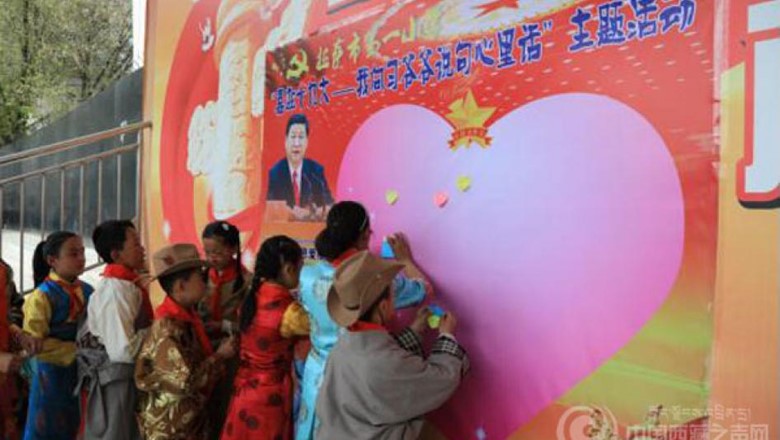
A photo showing children from primary schools in Lhasa, the capital of Tibet, “speaking [their] hearts to Grandpa [President] Xi” as part of the “Four Emphases and Four Loves” campaign.  © vtibet

Tibet, a region known for systemic, state-sponsored human rights violations, is now awash with posters celebrating the “Four Emphases and Four Loves.” The campaign requires people to “Love the core by emphasizing the Party’s kindness/Love the motherland by emphasizing unity/Love your home by emphasizing what you can contribute/Love your life by emphasizing knowledge.”

Translation: don’t criticize policies or officials and do show gratitude and loyalty to “the core” – the CCP and its leader Xi Jinping. The only way to “love the motherland” is to oppose anything that threatens “unity,” which certainly includes substantive criticism of the Party or the state or any discussion of independence or increased autonomy. And to be a “good citizen” is to focus one’s efforts on what you can “contribute” – but implicitly it’s up to the Party to decide what can or cannot be contributed.

It’s also never too early to start indoctrinating people in this mindset: photos from primary schools in Lhasa, the capital of Tibet, show children “speaking [their] hearts to Grandpa [President] Xi.” One is captioned, “The words of the heart spelled out in…small notes.”

Campaigns for Tibetans’ hearts and minds seem almost tragic against the backdrop of repression there. In recent years authorities have reshaped the region’s economy in a manner that suits the central government and effectively excludes Tibetans from decision-making – and in the case of some nomadic communities leaves them demonstrably worse off. 

Authorities remain suspicious of Tibetans’ loyalties, and have also radically expanded the security and surveillance apparatus, and methodically inserted state control into all aspects of religious practice. Meanwhile, Tibetans – and many others across China – have virtually no ability to help develop, change, or object to the policies that profoundly affect their lives.

Propaganda – no matter how treacly, and no matter how many pink hearts deployed – is unlikely to generate the kind of loyalty or respect Chinese authorities seem to want from Tibetans. Respect for Tibetans’ human rights, on the other hand, might go a long way towards that goal.

LOVE COUNTERACTS THE VIOLATION OF NATURAL FREEDOM IN TIBET. BEIJING DOOMED.


Whole Dispute – Resolve Tibet-China Border Dispute

Resolve Tibet-China Border Dispute

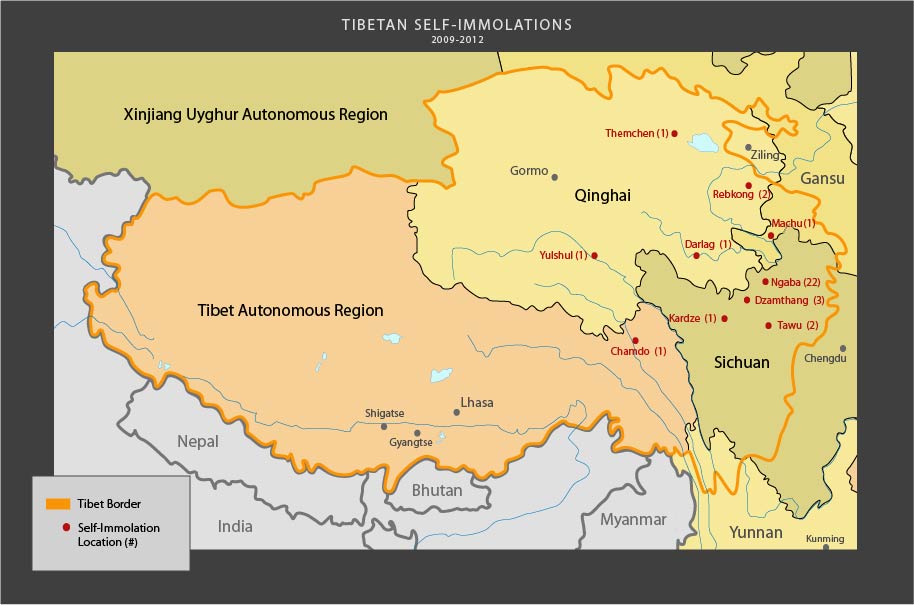
People's Republic of China's province called Tibetan Autonomous Region or "TAR" was established in 1965 after Communist China had annexed Tibetan territory and illegally added it to adjoining Chinese provinces. Hence, there is a valid dispute about China-Tibet boundaries.
Whole Dispute: People’s Republic of China’s province called Tibetan Autonomous Region or “TAR” was established in 1965 after Communist China annexed Tibetan territory and illegally added it to adjoining Chinese provinces. Hence, there is a valid dispute about China-Tibet boundaries. Tibet Protests Map 2008-2009.

It is surprising to note that people who write about the Sino-Indian border conflict make no reference to the history of Tibet. To state very briefly, the Great Fifth Dalai Lama founded the Ganden Phodrang Government of Tibet in 1642. The successive Dalai Lamas have headed the Tibetan State for nearly four centuries. From 1279 to 1368 Tibet was under the nominal control of the Yuan or Mongol dynasty of China, but subsequently regained its independence. In 1644, the Manchu or Qing dynasty was established in China and Tibet came under its nominal protection although for the most part the country retained control over its internal affairs. With the downfall of the Qing or Ching dynasty, the Great 13th Dalai Lama declared Tibet’s Independence on 13th February, 1913. For 39 years, from 1911 to 1950, Tibet was an independent nation. In Political Science, when states are called free and independent, their autonomy or sovereignty means that they have full power to levy war, conclude peace, contract alliances, establish commerce, and do all other acts and things which independent states may have the right to do. In its capacity as an independent nation, Tibet signed a treaty called the McMahon Treaty (following the Simla Agreement) which established the border between India and Tibet. The Republic of India after gaining its full independence during 1947 did not annul or revoke this treaty. As such, for all legal purposes, this treaty is valid. People’s Republic of China came into its existence after the Communists took over mainland China during 1949 and forced the Nationalist Party (Kuomintang) establish the Republic of China in Formosa or Taiwan. Both the Nationalists, and the Communists seek the reunification of Taiwan with the mainland. That issue is not yet decided. Meantime, Communist China invaded Tibet during 1950 and occupied it. In 1951, a defeated Tibet signed a treaty making Tibet a part of China. However, most Tibetans do not recognize this treaty and do not accept its legitimacy. In 1959, after a failed, massive Tibetan uprising, the 14th Dalai Lama and about 100, 000 of his followers escaped to India. Tibetans have established the Tibetan Government-in-Exile, and on September 02, 1960, the first members of the First Tibetan Parliament-in-Exile took their oath of office. In September, 2012, Tibetans have celebrated 52nd Democracy Day. During 1965, People’s Republic of China formed a province that it named as Tibetan Autonomous Region or “TAR.” In doing so, Communist China annexed several parts of Tibet and added them to its own territory. Tibetans have not agreed for this seizure of their territory. One of the central demands of the Tibetan Government-in-Exile is that of unifying all the Tibetan territory that is now under Chinese military occupation.

We have to very important issues; 1. Unification of Republic of China with People’s Republic of China and establish a national entity called China, and 2. demarcating the border between the new “One-China” and its neighbor, Tibet. Tibetans have not surrendered their claims for independence, freedom, and self-determination. As such, Tibet is not a part of China and the borders of China’s province called “TAR” do not establish the legitimate borders between Tibet and China.

India forgets that China cannot be trusted
G.PARTHASARATHY

December 5, 2012:

One cannot but be surprised by the statement of the National Security Advisor (NSA) Shivshankar Menon brushing aside the serious implications of Chinese actions, while voicing optimism that “we are in the process of agreeing on a framework to settle the boundary”.

Have we forgotten that after agreeing to delineate the Line of Actual Control, the Chinese backed off on the entire process?

In 2005, Premier Wen Jiabao agreed that “in reaching a border settlement, the two sides shall safeguard due interests of their settled populations in border areas”.

This clearly signaled that there was no question of transferring territories containing settled populations and addressed Indian concerns on Chinese claims to Tawang in Arunachal Pradesh. Within a year, however, China was laying claim not merely to Tawang, but the entire state of Arunachal Pradesh.

One can only conclude that the new “framework” the NSA spoke of to settle the boundary issue would be about as successful as the much-touted “Joint anti-Terror Mechanism” with Pakistan, which came apart with the 26/11 attacks.

Just a day before the NSA spoke, Army Chief General Bikram Singh described bilateral relations with China as “absolutely perfect” and added that mechanisms were now in place to solve any issues
between the two countries. This was an astonishing comment, at a time when the army wants additional strike formations, apart from vastly improved communications on the border with China.

Was it because Singh feels the army is unlikely to get its needs fulfilled soon, and needs to sound conciliatory to the Chinese? Do the other two Service Chiefs and the Defence Minister share this
optimism? All these issues need to be debated now that Parliament is in session.

INTERNAL RUMBLINGS

China can now be described as a “dynastic dictatorship,” after its 18th Party Congress. Outgoing leader Hu Jintao voiced concern at the growing dissatisfaction in China over political corruption.

The Party Congress had been preceded by the downfall of its rising star Bo Xilai, whose lavish and flamboyant lifestyle had led to the conviction of his wife for murdering a British businessman and
revelations of the billions of dollars of assets that Bo and his family had acquired.

This was followed by a a well documented leak, quite evidently by Bo’s supporters, about ill-gotten wealth accumulated by Prime Minister Wen Jiabao and his family.

China’s worst kept secrets about dynastic politics in the Communist Party became public when it emerged that four of the seven members of its highest decision-making body, the Standing Committee of the Politburo, were “Princelings,” or descendants of first generation, Mao-era political leaders. Most “Princelings”, including Party Chief Xi Jinping, lead lavish life styles, with families having extensive business interests. The contradictions between having an open economy linked to foreign markets on the one hand and a one-party, authoritarian political structure perceived to be unresponsive to pubic grievances on the other, are coming to the forefront in China.

China will continue to seek new ways to further open up its economy and maintain a high growth rate. But the “Princelings” are unlikely to bring any changes in the basic authoritarian nature of the State apparatus. Tutored by Deng Xiao Ping, who was determined not to follow the glasnost and perestroika path of Gorbachev in the Soviet Union, the new dispensation will be averse to increasing democratization.

TERRITORIAL AGGRESSION

With jingoistic propaganda, evidently to divert public opinion away from domestic issues like high level corruption, China is obviously in no mood to show any flexibility on its territorial claims along the Sino-Indian border. As Chinese passports are generally valid for ten years, there can logically be no change in China’s territorial claims in this period.

China will continue on its path of rapid military modernization, combined with an assertive line on its maritime and land boundary claims.

China’s recent decision to depict the entire South China Sea, together with Arunachal Pradesh and parts of Ladakh as Chinese territory in maps on Chinese passports, has to be seen in the light of this
growing Chinese readiness to use force and military coercion to enforce its territorial claims. One has recently witnessed aggressive Chinese postures resulting in a virtual naval takeover around the
disputed Scarborough Shoal, claimed by the Philippines.

A similar aggressive approach has been taken on recent tensions with Japan, with Chinese naval vessels entering territorial waters, adjacent to the disputed Diaoyu/Senkaku Islands.

China has evidently been emboldened by the American assertion that while the US does have a stand on freedom and maintenance of peace and stability in the South China Sea, it “does not take sides in (maritime) disputes”.

ECONOMIC CONCERNS

New Delhi is now talking of getting superfast trains and rail equipment from China, at a time when there is growing concern at our over dependence on second rate Chinese power equipment.

There are also concerns about dangers to cyber security and communications infrastructure posed by imports from China. Should we not insist on co-production, together with transfer or technology, in such strategic sectors, with preference for cooperation with friendly countries like Japan, France and Germany?

(The author is former High Commissioner to Pakistan.)

Comments:
Dear Mr GP, Many thanks for this caution. Will the ears listen to and the eyes see the ground realities instead of indulging in this ‘all is well’ kind of assumption and self assurance? . The present atmosphere is somewhat similar to the one that prevailed in early 1960s when our leaders wrongly assumed that China would never attack India. Reference is invited to the recent interview granted by Dai Bingguo Chinese Negotiator to PTI (covered by this publication) covering China – Pakistan relationships and China’s territorial claims. We need to exercise extra caution, think and act carefully. I held the view earlier that China will think twice before attacking India once again. But am forced to rethink. Camradely with China can wait. Recent bonhomie in the form of financial assistance, collaboration in power and infrastructure may not be entirely and mutually beneficial. One may need to read the fine print very carefully! Thanks for this opportunity to interact.

Regards

from: Dr.Guru.Raghavan
Posted on: Dec 5, 2012 at 23:08 IST

Tibet declared its independence on February 13, 1913 and had signed the McMahon Treaty with India after the Simla Agreement of 1914. Republic of India has not annulled or voided this Treaty and holds it as a valid agreement between two neighboring States. However, Tibetans do not agree the boundaries of the present Tibetan Autonomous Region and are demanding the unification of the three provinces, 1. U-Tsang, 2. Kham, and 3. Amdo of Tibet nation as it existed before China's illegal military occupation since 1950.
Tibet declared its independence on February 13, 1913 and signed the McMahon Treaty with British India after the Simla Agreement of 1914. Republic of India has not annulled or voided this Treaty and holds it as a valid agreement between two neighboring States. However, Tibetans dispute the boundaries of the present Tibetan Autonomous Region and are demanding the unification of the three provinces, 1. U-Tsang, 2. Kham, and 3. Amdo of Tibet nation as it existed before China’s illegal military occupation since 1950.

Whole Right – The Fight against Red China’s Tyranny

The Wolf and The Lamb: 

THE TYRANT WILL ALWAYS FIND AN EXCUSE FOR HIS TYRANNY.

This story is attributed to Aesop, the legendary Greek story-teller. Once upon a time, a Wolf was lapping at a stream. When looking up, the Wolf saw a Lamb just beginning to drink a little down the stream. “There’s my supper,” thought the Wolf. The Lamb looked so very helpless and innocent. The Wolf felt he ought  to have  an excuse for taking its life. Then he called out to the Lamb, “How dare you muddle the water from which I am drinking?” “No, Master, No,” said the Lamb; “if the water be muddy up there, I cannot be the cause of it, for it runs down from you to me.” “Well then,” said the Wolf, “Why did you call me bad names this time last year?” “That cannot be,” said the Lamb, “I am only six months old.” “I don’t care,” snarled the Wolf, “If it was not you, it was your father,” and with that he rushed upon the poor little Lamb, seized him and ate him up, saying,”Well I won’t stay supper less even though you refute every one of my imputations.” 

A tyrant will always find a pretext for his tyranny. When the oppressor is unjust, the innocent cannot get justice by reasoning. The unjust will not listen to the reasoning of the innocent. 

The Battle of Right Against Might: 

Mahatma Gandhi’s Battle Strategy – Nonviolent Non-Cooperation

Mahatma Gandhi had challenged the mighty British Empire with a Battle Strategy of his own. On the morning of March 12, 1930, Gandhi and about 78 of his followers had set out to oppose the unjust British Rule. He started marching from Sabarmati Ashram, Ahmedabad toward the village of Dandi on the Arabian Sea. 

GANDHI’S SALT MARCH FROM MARCH 12 TO APRIL 6, 1930
MAHATMA GANDHI AND SAROJINI NAIDU DURING SALT SATYAGRAHA OF 1930.

At that time, under the British Rule, it was forbidden to make salt or even pick it up. It was illegal to collect even natural deposits of salt. Gandhi wanted to attack this unjust Salt Act. He went to the Sea to break the Law. He had inspired people to break the Law. He had marched 240 miles to resist the British Power. The Salt March which is popularly described as Salt Satyagraha was one of Mahatma Gandhi’s most successful Campaigns in the Indian Nationalist Movement for Independence and to overthrow the British Rule. 

GANDHI RESISTED THE MIGHTY BRITISH EMPIRE WITH THIS VERY SIMPLE ACT – A BRILLIANT BATTLE PLAN AND THINKING.

When he got to the Sea, Gandhi broke the Salt Law by the simple act of picking up a tiny lump of soil with some natural salt at Dandi beach. And, he had forced the British to repeal the unjust Salt Law. Gandhi did not reach Dandi in a bus or a car. He had marched all the way on foot. He got the attention that he had wanted. He had shown the way to the people. Injustice could be resisted. Tyranny is not acceptable. People can change unjust laws and get rid of unjust rulers. 

GANDHI’S APPEAL FOR SYMPATHY FOR HIS BATTLE – A STRUGGLE FOR JUSTICE

March 10 – Tibetan National Uprising Day 

TIBET AWARENESS DAY – MARCH 10 – TIBETANS OBSERVE THIS DAY AS TIBETAN NATIONAL UPRISING DAY

H.H. Dalai Lama fled into exile after the Tibetan National Uprising on March 10, 1959 was brutally crushed by Communist China. The illegal and unjust military occupation of Tibet should be challenged and should be opposed. The Chinese Rule in Tibet must be resisted. Mahatma Gandhi had demonstrated the Power of Touch. We can easily resist Chinese military occupation of Tibet. We should resolve and refuse to touch Made in China products. Gandhi won his Battle Campaign by the sheer Power of innocent people who had peacefully joined in opposition to tyranny. Tibet’s  Battle of Right against Might deserves World’s Sympathy.

The Living Tibetan Spirits

I am a witness and my consciousness got exposed to the spirits of young Tibetan men who had given their lives while dreaming about the eviction of the illegal occupier from the Land of Tibet. 

Trulku Tenzin Delek Rinpoche is a revered philanthropist and a religious leader. He is a visionary and consistent advocate of Tibetan Identity and Culture. He was sentenced to life imprisonment on January 26, 2005. He is a soldier in this ‘Battle of Right against Might.
Yeshi Jinpa is a monk of Sog Tsenden Monastery in Sog County of Nagchu Prefecture in Tibet occupied by Communist China. He was arrested on December 02, 2009. He is a soldier in this ‘Battle of Right against Might’.