Thursday, March 31, 2022. 63rd Milestone of Life’s Journey in Exile. The plight of the Living Tibetan Spirits.
From March 31, 1959 to March 31, 2022, the Living Tibetan Spirits record Sixty-three Years of Life’s Journey in Exile. The Struggle is not over and yet it is time to take a deep breath and say Thank You India and Thank You America.
In the Indian Tradition, the number 60 is very significant for Indians recognize Sixty specific names to mark Years for purposes of timekeeping. The Cyclical Flow of Time continues in sets of Sixty Years.
Thursday, March 31, 2022. 63rd Milestone of Life’s Journey in Exile. The plight of the Living Tibetan Spirits.
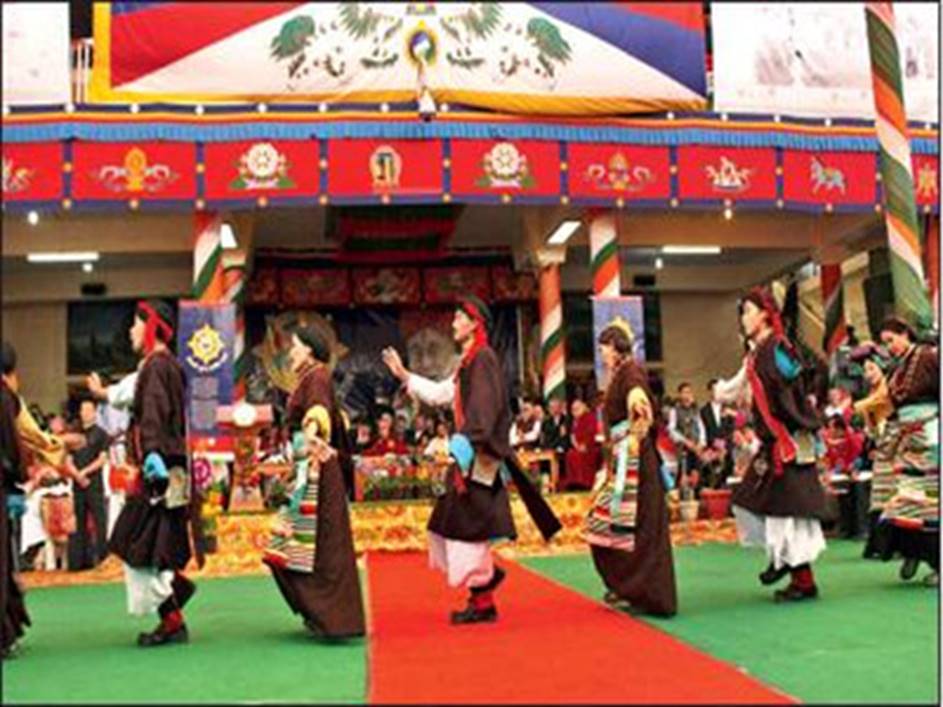
A cultural program being organized as part of the Thank You India function held in McLeod Ganj on Saturday
I do not know for how long the Tibetan struggle will go on. However, the struggle will remain alive till the spirit of Tibetans remains,” the spiritual leader of Tibetans The Dalai Lama said at the “Thank You India” programme being held at McLeod Ganj on Saturday to mark his arrival in India, exactly 60 years ago.
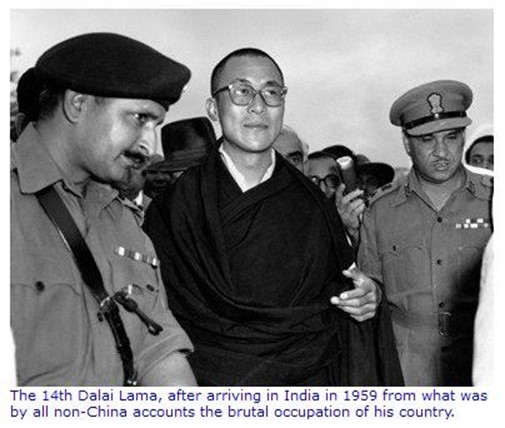
On March 31, 1969, the Dalai Lama was forced to flee Tibet following failed uprising against China. After he took shelter in India, Tibetan community across globe under his leadership launched struggle for free Tibet but till date have not succeeded. During last few years, the demand has changed into one for autonomous Tibet.
While interacted with media persons, the Dalai Lama, when questioned about the possibility of Tibetans returning to their homeland one day, replied that Tibetan issue is an issue of justice. While commenting on the equation between India and China, he said that both were most populated countries of the World and both have ability to destroy each other.
“Any sensible person would want ‘Hindi-Chini Bhai Bhai’ to live together. None of them can be disloyal to each other, so other things will go on by the side,” he said. “Confrontation does not yield any result and amicable solution of Tibet problem is the only way out,” the Nobel Peace Laureate said.
“The Chinese are following a socialist form of government, which means everybody should have equal rights. We are not demanding separation from China, but the Tibetan people should have the autonomy to preserve their culture, language, environment and religion,” he added.
Earlier, the Dalai Lama recalled his journey in exile. He said that no time was wasted in these years. “It is a matter of pride that Tibetans have preserved their tradition and culture, wherever they are living across the globe,” he said.
He said that as there was need to preserve Tibetan culture and language, a logical analysis was also the need of hour. “When everybody is praising Tibetans it becomes our responsibility too to check where we were lacking,” he said.
Thursday, March 31, 2022. 63rd Milestone of Life in Exile. The plight of the Living Tibetan Spirits.
The Succession of the Dalai Lama is the exclusive Political Right of Tibetans.
In my analysis, the Succession of the Dalai Lama is the exclusive Political Right of Tibetans. The primary concern is not that of Religious Freedom of Tibetans to practice their religion. The real concern is about the Political Rights of Tibetans to Self-Determination, the Right to choose their own Supreme Ruler of Tibet.
The Fundamental Right to choose the Successor of the Dalai Lama belongs to Tibetans and it does not belong to anybody else, not any government or any entity.
Rudra Narasimham Rebbapragada
Special Frontier Force-Establishment No.22
The Succession of the Dalai Lama is the exclusive Political Right of Tibetans.
Only the Tibetan system to choose Dalai Lama’s successor: US
Oct 28, 2019, | IANS
The Succession of the Dalai Lama is the exclusive Political Right of Tibetans.
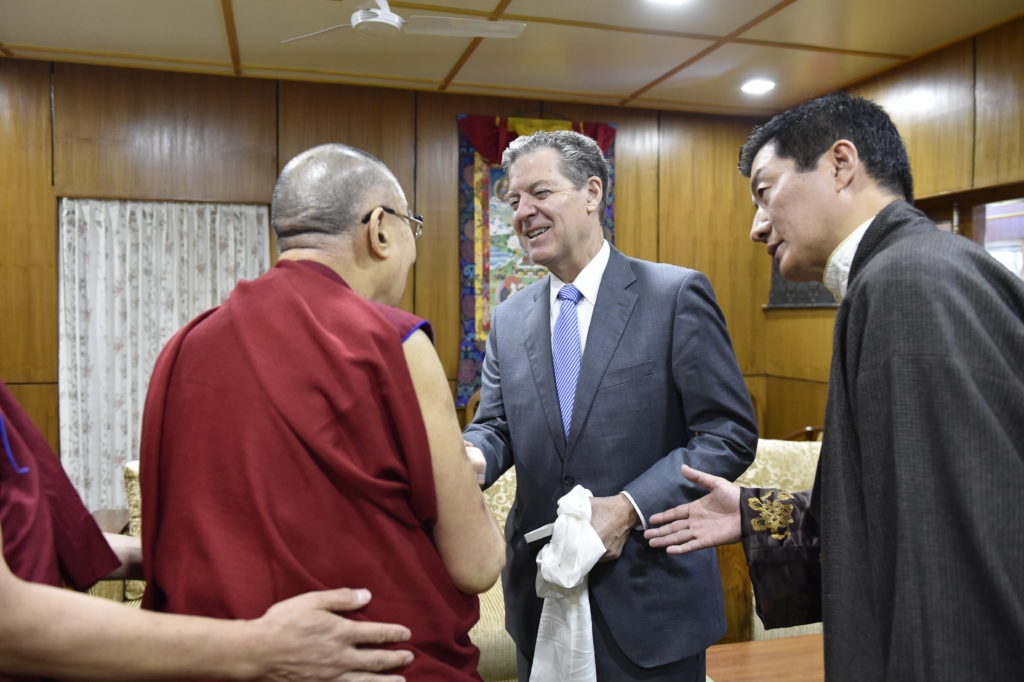
Dharamsala, Oct 28: US Ambassador at large for International Religious Freedom, Samuel D. Brownback, called on the Dalai Lama at his official palace here on Monday and favored that successor to the spiritual leader belongs to the Tibetan Buddhist system. During the two-day visit, which began on Sunday, the Ambassador met high-ranking officials of Central Tibetan Administration (CTA), including ‘Prime Minister’ Lobsang Sangay.
The Ambassador was accompanied by three members from the US State Department’s Office of International Religious Freedom and two from the US Embassy in New Delhi.
The Dalai Lama, who believes in the “middle-path” policy that advocates “greater autonomy” for the people in Tibet, is viewed by the Chinese as a hostile element who is bent on splitting Tibet from China.
Speaking to CTA-run Tibet News Bureau, Brownback said the purpose of his visit is to send a clear message that “the United States government supports the Tibetan people, the Dalai Lama and that the role of picking a successor to the Dalai Lama belongs to the Tibetan Buddhist system, the Dalai Lama and other Tibetan Buddhist leaders”.
“It does not belong to anybody else, not any government or any entity,” he said.
“I want to express clearly the US government supports the Dalai Lama and supports the succession of the Dalai Lama to be done by the Tibetan Buddhist leadership.”
Prior to the meeting with Sangay on Sunday, Brownback met a group of survivors of religious persecution who had recently escaped from Tibet.
In the hour-long meeting, the Ambassador asked questions to each of the survivors and listened to their accounts.
He thanked them for their courage and expressed his full support and earnest efforts towards advancing religious freedom inside Tibet, a post on the CTA website said.
“We believe in religious freedom; the United States strongly supports religious freedom. We believe people all over the world deserve this right and they should be able to practice theirs peacefully and freely. Unfortunately, Tibetans aren’t allowed to practice their faith freely in Tibet and they have to get out to India and other places to practice their faith. So I was hearing with some people who had recently left and all for the reason of wanting to practice their faith freely,” the post quoting the Ambassador added.
This is Brownback’s second visit to Dharamsala this year. Last time he called on the elderly Buddhist spiritual leader in March.
The Dalai Lama lives in exile along with some 140,000 Tibetans, over 100,000 of them in India. Over six million Tibetans live in Tibet.
The Tibetan-in-exile administration is based in this northern Indian hill town but is not recognized by any country.
The Succession of the Dalai Lama is the exclusive Political Right of Tibetans.
The Supreme Ruler of Tibet cannot be chosen by any foreign government.
India must resist China’s Tibet plan
PM Modi should encourage Beijing to talk to the Tibetans, and facilitate a Xi-Dalai Lama meeting
ANALYSIS Updated: Oct 08, 2019 19:25 IST
Amitabh Mathur
Chinese President Xi Jinping is expected to arrive soon for his second informal meeting with Prime Minister Narendra Modi. The coming summit is taking place in the backdrop of important developments on which the two countries have taken confronting stands.
While China advised restraint on rising tensions with Pakistan following the Pulwama and Balakot episodes, it has openly criticized India on the recent constitutional and administrative changes in Jammu and Kashmir. It reiterated its claim on all of Ladakh, stating the changes violated China’s territorial integrity which it would not “idly watch”. It supported Pakistan in the United Nations and has additionally objected to the army exercise currently underway in Arunachal Pradesh, which it claims as its own. So, apart from the usual irritants in bilateral relations such as the border dispute and trade imbalance, not much progress is expected on the traditional faultlines in Sino-Indian relations.
Even though Tibet does not seem to figure on the agenda, the meeting will be followed by a particular interest in Dharamshala. This follows misgivings in some Tibetan quarters that New Delhi is gradually diluting its support to the Tibetan cause. This impression gained ground following the government’s direction to tone down the “Thank You India” program that the central Tibetan administration had planned in January 2018, and the subsequent directive that elected leaders and senior government officials should avoid sharing a public platform with the Dalai Lama. The recent war of words over the issue of Dalai Lama’s reincarnation has led to questions about whether there is an adequate realization, willingness, and preparation within the Government of India to thwart China’s design to ultimately install its own candidate in Potala Palace.
Though the Dalai Lama has spoken of various possibilities regarding his reincarnation, he has consistently rejected any Chinese government role in the process. He has stated that if he reincarnates, it will be in a free country, thereby ruling out China or Chinese-controlled Tibet. He has instructed Tibetans to reject any Chinese appointee as an imposter. The Chinese have been equally emphatic, declaring that choosing the next Dalai Lama is their historical prerogative. Chinese officials conveyed a blunt message to the Government of India by visiting Indian journalists that New Delhi’s failure to not recognize Beijing’s candidate would adversely affect bilateral ties.
To the Tibetans, the struggle to choose the Dalai Lama’s reincarnation reflects the struggle for the leadership of Tibetan Buddhism. More than political, the Tibetan struggle is a civilizational one for the survival of its unique culture and identity. It is sustained by a deep attachment to their spiritual leaders, the highest of whom is the Dalai Lama. China has not been able to dilute this loyalty to any significant extent. Its experiment to install an imposter Panchen Lama has failed. Attempts to mold an indoctrinated monastic order have also not succeeded. Its repressive measures indicate China remains wary of civil unrest of the kind that erupted in Tibet in 2008.
An authoritarian regime cannot countenance an institution not under its control. Therefore, appointing its own Dalai Lama is a strategic priority. What has encouraged Beijing to vehemently assert its intentions is its perception that international support for Tibet is flagging, and with its political and economic clout, it can deter countries from coming forward on the issue. It perhaps also believes that Tibetans, who identify all hopes and aspirations with the person of the 14th Dalai Lama, will not only be demoralized at his passing on, but also fragment into ineffectual uncoordinated groups, bereft of financial and political backers.
For New Delhi to acquiesce to any such Chinese design would be a folly. It must not fall prey to arguments that the passing on of the Dalai Lama would remove an obstacle to border settlement and normalize relations with China. Given its policy of regaining its lost territories, assertions on Arunachal Pradesh and Ladakh, its military build-up in Tibet, plans to build dams and divert river waters, and its undermining of India in its neighborhood, there can be no assuaging China. On the contrary, supporting the Tibetans strengthens India’s hand in dealing with China. New Delhi should take immediate steps to ascertain the Dalai Lama’s wishes on his reincarnation, and act proactively to ensure these will be endorsed by not just the Tibetans but for the Buddhist world at large. The US Congress has already passed the “Tibetan Policy and Support Act of 2019”, which has officially declared China has no role in selecting the reincarnation of the Dalai Lama.
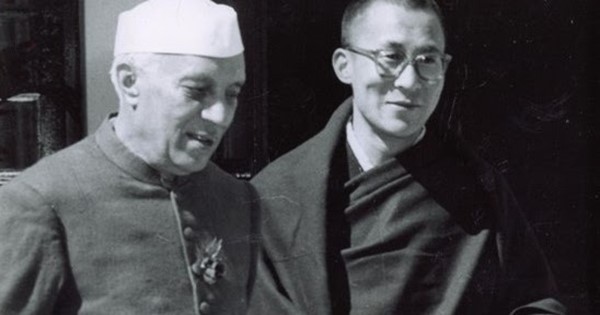
Some Chinese scholars have argued that the approach to suppress Tibetan civilizational aspirations has neither succeeded nor is likely to. This should be our advice too to President Xi. The time has come for India to encourage China to convert its intermittent contacts with the Dalai Lama into formal or structured talks to find an acceptable solution. A bold step for Modi could be to facilitate a meeting between Xi Jinping and the Dalai Lama, like the one the latter held with Premier Chou en-Lai in New Delhi in 1956.
Amitabh Mathur is a former adviser to the ministry of home affairs on Tibetan affairs. The views expressed are personal
WHERE IS TIBET? INDIA AND CHINA ARE NOT NEIGHBORS.
HIS HOLINESS THE 14th DALAI LAMA – PRINCE OF PEACE: The Dalai Lama is seen seated on his throne in Potala Palace, Lhasa, Tibet in this photo image from 1956/1957.
Tibetan government passes a resolution on ‘reincarnation of Dalai Lama’
Tibetan parliament-in-exile speaker Pema Jungney. Photograph:( ANI ) Dharamsala, Himachal Pradesh, India Oct 06, 2019, 04.47 PM (IST)
In a strong message to China, Tibetan government-in-exile has passed a resolution reaffirming that the successor of Dalai Lama will be chosen by the spiritual leader himself and no nation has locus standi on the issue.
“No nation, government, entity or any individual can claim to recognize the reincarnation of His Holiness the Dalai Lama. The final authority on decisions regarding the reincarnation of His Holiness the Dalai Lama rests indisputably and completely with His Holiness the Dalai Lama himself and the concerned authorities of the Gaden Phodrang Trust,” Speaker Pema Jungney, Tibetan Parliament-in-Exile, told ANI on Saturday.
The resolution comes days ahead of Chinese President Xi Jinping’s visit to India.
Jungney made these remarks after a special meeting by Tibetan Parliament-in-Exile-at the Tibetan headquarters.
During the meeting, the two-page resolution was adopted which outrightly rejected China’s preposterous interference in the institution of Tibetan reincarnation and affirms the supreme authority of the Dalai Lama over Tibetan Buddhism.
The official document further challenged China’s advancing measures of control over Tibetan Buddhism and expressed outright rejection and contempt of the Order Number 5, a regulation issued in 2007 by China’s State Administration of Religious Affairs (SARA) for the so-called “management of the reincarnation of living Buddhas”.
The meeting was attended by 340 Tibetan authorities representing the three pillars of Tibetan democracy: The Kashag (cabinet); Tibetan Parliament-in-Exile and Tibetan Supreme Justice Commission.
STORY HIGHLIGHTS
The resolution comes days ahead of Chinese President Xi Jinping’s visit to India.
The Supreme Ruler of Tibet cannot be chosen by any foreign government.
THE BEAUTY AND ATTRACTION OF GOD LIE IN THE EYE OF BELIEVER
Beauty and Attraction of God lie in the eye of the believer.
The Successor of the Dalai Lama will be decided by the Dalai Lama. The Successor, Male or Female will be the embodiment of Truth, Bliss, and Beauty described in the Indian Tradition as Satyam, Shivam, and Sundaram. The Beauty and Attraction of God always lie in the Eye of Believer.
Rudranarasimham Rebbapragada
SPECIAL FRONTIER FORCE
Beauty and Attraction of God lie in the eye of the believer.
Will myself decide on my successor: Dalai Lama
Beauty and Attraction of God lie in the eye of the believer.
Dharamshala, July 15 (IANS) Tibetan spiritual leader the Dalai Lama, respected by millions as a living god, who has been caught in a controversy over his recent joke that his successor a female Dalai Lama would have to be “more attractive”, has clarified that his reincarnation is to be decided by him.
The Buddhist monk had apologized for his “attractive” female successor remark, saying he genuinely meant no offence and offered his sincere apologies if people were hurt by what he had said.
However, aides in his private office in this northern Indian town on Monday clarified there is no question of search for his successor as the Dalai Lama, 84, announced in 2011 that he would decide at 90 whether he should have a successor.
The issue of reincarnation is his personal right, an aide in the Dalai Lama’s office told IANS.
At the same time, the globe-trotting monk warned that any candidate chosen for political ends by anyone, including China, should not be recognized or accepted.
The aide said still there is no certainty that whether the institution of the Dalai Lama should continue or not after the 14th and current Dalai Lama, Tenzin Gyatso.
“My reincarnation is to be decided by myself, nobody has the right to decide about that,” he often said in his remarks.
“One day you will hear that the Dalai Lama has passed away, but I will come back, even if the institution of Dalai Lama is no longer recognized. I will be back,” a post on his website quoting the Dalai Lama said.
But who is next after the Dalai Lama?
Now, the Dalai Lama’s institution is useful to the Tibetan culture and the Tibetan people.
“Thus, if I were to die today, I think the Tibetan people would choose to have another Dalai Lama. In the future, if the Dalai Lama’s institution is no longer relevant or useful and our present situation changes, then the Dalai Lama’s institution will cease to exist,” the monk said in a post.
“Personally, I feel the institution of the Dalai Lama has served its purpose. More recently, since 2001 we now have a democratically elected head of our administration, the Kalon Tripa.
“The Kalon Tripa runs the daily affairs of our administration and oversees our political establishment. Half-jokingly and half seriously, I state that I am now in semi-retirement.”
In August 2011 when Lobsang Sangay took over the reins of the government-in-exile from monk and scholar Samdhong Rinpoche, who held the post for 10 years but was overshadowed by the Dalai Lama, the Dalai Lama announced: “When I am about 90, I will consult the high lamas and re-evaluate whether the institution of the Dalai Lama should continue or not.”
On his birthday on July 6 this year, he said, “I am now 84, but I hope to be able to celebrate the occasion with all of you for many more years to come.”
Clarifying this month on his remark during a BBC interview that have caused disquiet, the Dalai Lama recalled the conversation on the physical appearance of a female successor with the then Paris editor of Vogue magazine, who had invited him in 1992 to guest-edit the next edition.
She asked if a future Dalai Lama could be a woman. His Holiness replied, “Certainly, if that would be more helpful,” adding, as a joke, that she should be attractive, said a statement by his office.
The Dalai Lama was at least partially responding to the unfamiliar ambience of working with a team whose prime focus was the world of high fashion.
On the Chinese stating that the next Dalai Lama will be born in Tibet and chosen by them, he said: “If the present situation regarding Tibet remains the same, I will be born outside Tibet away from the control of the Chinese authorities. This is logical. The very purpose of a reincarnation is to continue the unfinished work of the previous incarnation.”
His Holiness the 14th Dalai Lama, Tenzin Gyatso, describes himself as a simple Buddhist monk.
In 1989, the Dalai Lama won the Nobel Peace Prize for his non-violent struggle for Tibet. He was awarded the US Congressional Gold Medal in October 2007, even in the face of protests by China.
The Dalai Lama now lives in exile along with some 140,000 Tibetans, over 100,000 of them in different parts of India. Over six million Tibetans live in Tibet.
(Vishal Gulati can be reached at vishal.g@ians.in)
–IANS
vg/in
(This story was auto published from a syndicated feed. No part of the story has been edited by The Quint.)
Beauty and Attraction of God lie in the eye of the believer.
“The reincarnation of the Dalai Lama is a historical, religious and political issue. There are established historical institutions and formalities for the reincarnation of the Dalai Lama,” Wang Neng Sheng, an official in the rank of vice minister in Tibet, told a small group of Indian journalists in Lhasa.
The Right to grant asylum to the next Dalai Lama.
The 14th Dalai Lama fled to India in 1959 following a crackdown on an uprising by the local population in Tibet. (IE photo)
The successor of the Dalai Lama must be decided within China and any interference by India on the issue will impact bilateral ties, Chinese authorities have said. In first clear assertion on the sensitive issue, senior Chinese officials and experts said the reincarnation of the Dalai Lama must be approved by the Chinese government and the selection should take place within the country based on an over 200-year old historical process.
“The reincarnation of the Dalai Lama is a historical, religious and political issue. There are established historical institutions and formalities for the reincarnation of the Dalai Lama,” Wang Neng Sheng, an official in the rank of vice minister in Tibet, told a small group of Indian journalists in Lhasa. “The Dalai Lama’s reincarnation is not decided by his personal wish or by some group of people living in other countries,” he added.
Wang, the director general at the government of Tibet Autonomous Region, said the current Dalai Lama was recognized by Beijing and his successor must be found through the “draw of lots in golden urn process” within China. Echoing Wang’s views, Zha Luo, director at Beijing-based China Tibetology Research Centre, a government-run influential think tank, said any refusal by India to recognize the next Dalai Lama to be chosen within China will impact bilateral ties.
The 14th Dalai Lama fled to India in 1959 following a crackdown on an uprising by the local population in Tibet. India granted him political asylum and the Tibetan government-in-exile is based on Dharamsala in Himachal Pradesh since then.
The Dalai Lama is 84 years old now and the issue of his successor has gained prominence in the last couple of years. “It will be a major political difference that would impact bilateral relations and any wise political leader wouldn’t do that,” said Zha whose team advises central government on policy issues for Tibet said. He was asked what will happen if India refuses to recognize the next Dalai Lama chosen by China. “Since the reincarnation of the Dalai Lama is an important issue for China any friendly country or friend of China would not interfere or meddle on the issue,” he added. Zha, however, called it a hypothetical answer to a hypothetical question. India has maintained its stand on the Dalai Lama.
“Government of India’s position on His Holiness the Dalai Lama is clear and consistent. He is a revered religious leader and is deeply respected by the people of India. There is no change in that position. His Holiness is accorded all freedom to carry out his religious activities in India,” Ministry of External Affairs spokesperson had told a media briefings in March last year.
Wang said the process of selecting the next Dalai Lama must follow two clear steps: “It must go to draw of lots in the golden urn and the reincarnation must be recognized by the central government.” He said the “centrality” of the central government must be recognized and that any personal move by the current Dalai Lama on the issue is not going to be recognized by Chinese government or religious followers in Tibet.
“It was with the central government’s recognition that the Dalai Lama became the 14th Dalai Lama. Otherwise, he wouldn’t have been in that position,” Wang said. He alleged that the Dalai Lama has been “inciting” and “misguiding” young Tibetan people for his political motives.
Asked about the Dalai Lama’s comments that he was ready to accept Tibet as part of China, Wang said he has been resorting to political rhetoric without taking any action. “He still believes that Tibet is an independent country. Without any concrete moves from his side, his words do not mean anything,” he added. He said there were around 10 rounds of discussions between private representatives of the Dalai Lama and Beijing. The last round took place in 2011 in Beijing.
“The discussions were about the future of the Dalai Lama and did not include or touch on the topic of future of Tibet as a part of China’s sovereign territory,” Wang said. The Indian government had issued a note nearly a year back to senior officials, asking them not to attend events organized by the Tibetan government-in-exile. India has also been supporting the ‘One China’ policy, which states that Taiwan and Tibet are part of China’s mainland. Beijing made the ‘One-China’ policy a prerequisite for countries to establish diplomatic ties with it.
THE THREE-DIMENSIONS OF FEMALE REINCARNATION OF THE DALAI LAMA DESCRIBE THE IDEALS OF TIBETAN NATIONALISM.
Tibetan Nationalism is Defined by the Ideals of Truth, Bliss, and Beauty.
The Female Reincarnation of the Dalai Lama will be a ‘Thing of Beauty’ for it is Beauty accompanied by the Dimensions of Truth and Bliss. Buddha, the Most Compassionate Being has Three Dimensions. These are 1. Satyam (Truth), 2. Shivam (Bliss), and 3. Sundaram (Beauty).
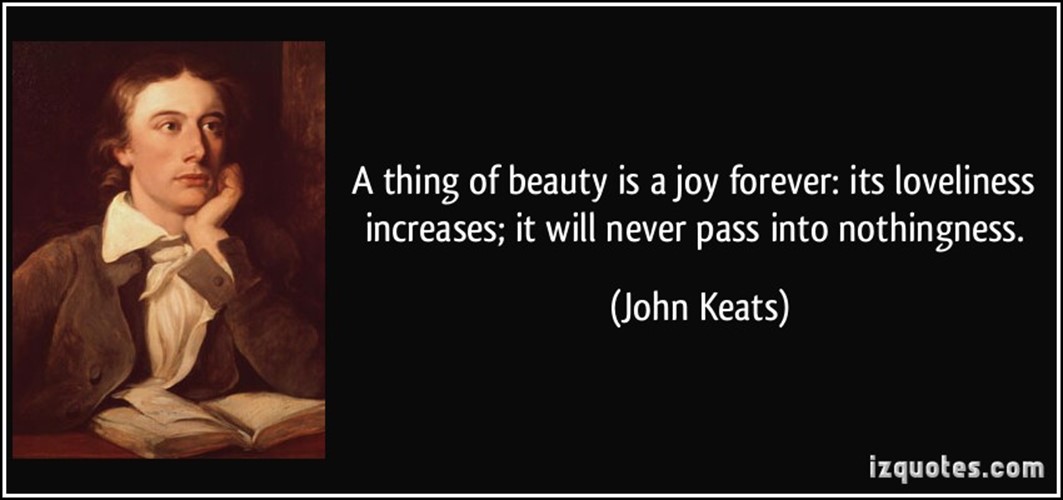
Tibetan Nationalism will always be inspired by the highest ideals of humanity. The Female Reincarnation of the Dalai Lama will bring a Great “Joy Forever.”
Rudranarasimham Rebbapragada
Special Frontier Force
Tibetan Nationalism is Defined by the Ideals of Truth, Bliss, and Beauty.
The Dalai Lama has apologized for controversial comments about the possibility of a woman succeeding him.
Speaking to the BBC last month, the Tibetan spiritual leader had said that any future female Dalai Lama should be “attractive”.
But a statement from his office apologized for his words, suggesting it had been a joke.
“He is deeply sorry that people have been hurt by what he said and offers his sincere apologies,” it said.
In the interview, the spiritual leader, who is 84 this week, touched on topics including US President Donald Trump, his dreams of returning to Tibet, and refugees.
However, it was his comments on the prospect of a female Dalai Lama that raised eyebrows.
“If a female Dalai Lama comes, she should be more attractive,” he said in English, while laughing
The statement apologized for any offence caused and put it down to a misunderstood joke.
The Dalai Lama “has a keen sense of the contradictions between the materialistic, globalized world he encounters on his travels and the complex, more esoteric ideas about reincarnation that are at the heart of Tibetan Buddhist tradition”, the statement said.
“However, it sometimes happens that remarks, which might be amusing in one cultural context, lose their humor in translation when brought into another. He regrets any offence that may have been given.”
Throughout his life, the Dalai Lama has opposed the objectification of women and supported gender equality, it added.
The statement also said comments in which he said refugees in the European Union should ultimately return home “may have been misinterpreted.”
“He certainly appreciates that many of those who leave their countries may not wish or be able to return,” it said,
However, there was no apology for his comments on Mr. Trump who, he said, had a “lack of moral principle.”
Watch: ‘Dalai Lama reaffirms belief female successor would have to be attractive’ (The Independent)
Tibetan Nationalism is inspired by the Ideals of Truth, Bliss, and Beauty.Tibetan Nationalism is Defined by the Ideals of Truth, Bliss, and Beauty.
TIBETAN EXISTENCE. TO TWEET OR NOT TO TWEET IS THE QUESTION FOR THE FUTURE DALAI LAMA
Tibetan Existence. To tweet or not to tweet is the question for the future Dalai Lama.
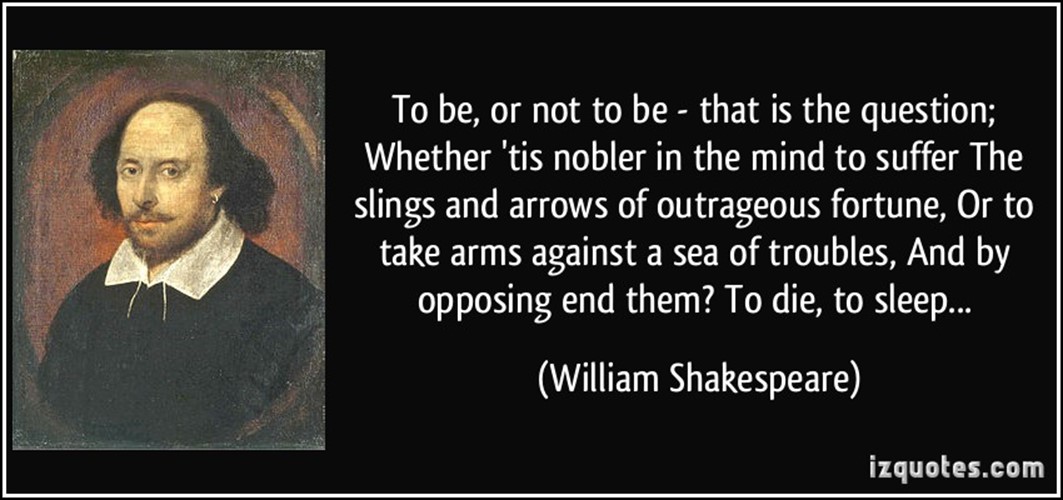
“To be, or not to be – that is the question.” Tibetan Existence is truly endangered by relentless, brutal military occupation since 1950. Tibetans face just one question. The question is, “How to Oppose the Occupation of Tibet?” Nothing else really matters. To tweet or not to tweet is the question for the future Dalai Lama.
Rudranarasimham Rebbapragada
Special Frontier Force
Tibetan Existence. To tweet or not to tweet is the question for the future Dalai Lama.
Twitter is canceling the Dalai Lama because he said a female successor should be ‘attractive’
Tibetan Existence. To tweet or not to tweet is the question for the future Dalai Lama.
The fourteenth Dalai Lama (83 years) and the spiritual guru of the Buddhists from Tibet (Photo by Pallava Bagla/Corbis via Getty Images)
The Dalai Lama, the exiled spiritual leader of Tibetan Buddhism, and the 14th person to hold the title, made waves this week when he said his successor, if a woman, needs to be physically attractive.
Rajini Vaidyanathan
✔ @BBCRajiniV
This was perhaps the most surprising moment in the interview. I asked the Dalai Lama if he stood by his earlier comment that if his successor was female, she should be attractive.
Tibetan Existence. To tweet or not to tweet is the question for the future Dalai Lama.
“You once said that you would be open to a female successor,” BBC News reporter Rajini Vaidyanathan asked the religious leader, in a video interview published Thursday on Twitter.
“That’s also possible,” the Dalai Lama confirmed.
“You also told one of my colleagues that, that female must be attractive, otherwise it’s not much use,” she continued. “…Can you see why that comment upset a lot of women?”
The Dalai Lama answered, “If a female Dalai Lama comes, she should be more attractive.” If not, “people, I think prefer, not see her, that face.”
The reporter asked, “It’s about who you are inside, isn’t it?”
“Yes, I think both,” he said. “Real beauty is inner beauty, that’s true. But we’re human beings. I think the appearance is also important.”
The religious leader also suggested that most people would prefer not to look at a “dead face” and argued that women in the public eye should wear makeup.
People took issue with his comments, calling his holiness “canceled.”
Author Jessica Valenti tweeted that this moment was “about as 2019 as it gets.”
Others just felt disappointed.
Some called out what they felt was the absurdity of his comments and made jokes.
One person even suggested singer and icon Dolly Parton step into the role.
These weren’t the only remarks the Dalai Lama made that raised eyebrows this week. He also told the BBC that European nations should be obliged to take in those who are fleeing their home countries, but that those people should ultimately be taught skills and return home, saying, “European countries should take these refugees and give them education and training, and the aim is – return to their own land with certain skills.”
He continued, “But the whole of Europe [will] eventually become Muslim country – impossible. Or African country, also impossible.”
Tibetan Existence. To tweet or not to tweet is the question for the future Dalai Lama.
I am a Refugee hosting ‘The Living Tibetan Spirits’ in my consciousness. I am disappointed with President Trump’s “Keep America First Policy” for he placed the Great Tibet Problem on ‘The Back Burner’.
Rudranarasimham Rebbapragada
SPECIAL FRONTIER FORCE
The Dalai Lama on Trump.
The Dalai Lama on Trump, women and going home – BBC News
He is, without a doubt, one of the best-known people on the planet. In an age where celebrity is worshipped, the Dalai Lama is a faith leader who has become a spiritual superstar.
As he approaches his 84th birthday, the monk who has handed out millions of handshakes and crafted as many inspirational quotes, is candid and at times shocking.
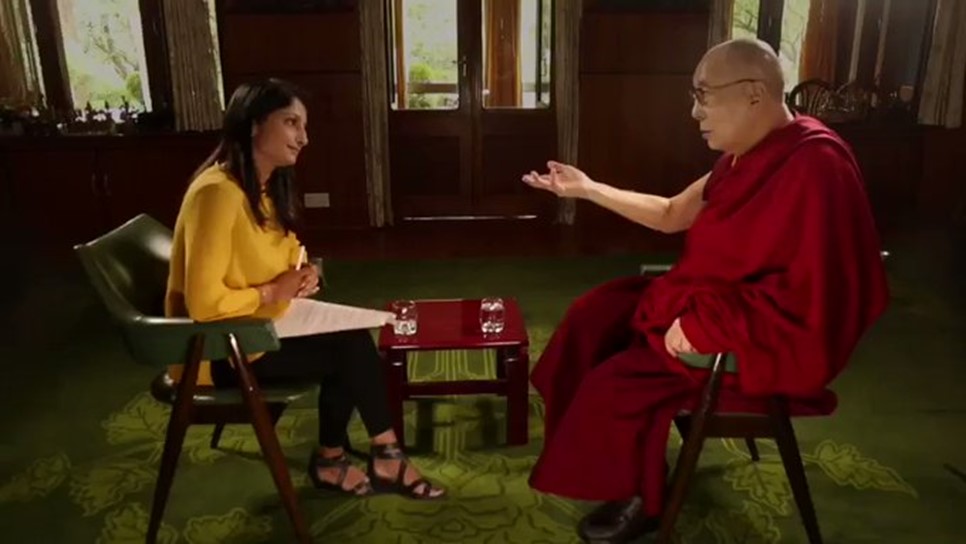
I met him at his residence high in the mountains, in the town of McLeod-Ganj near Dharamshala in the northern Indian state of Himachal Pradesh.
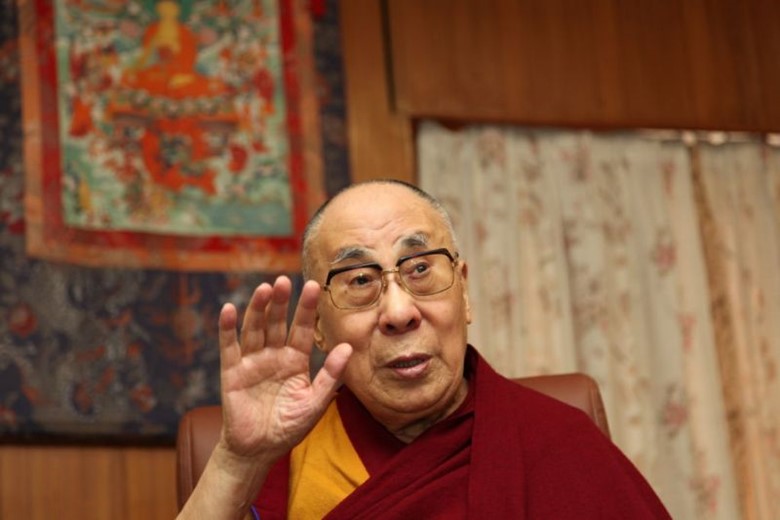
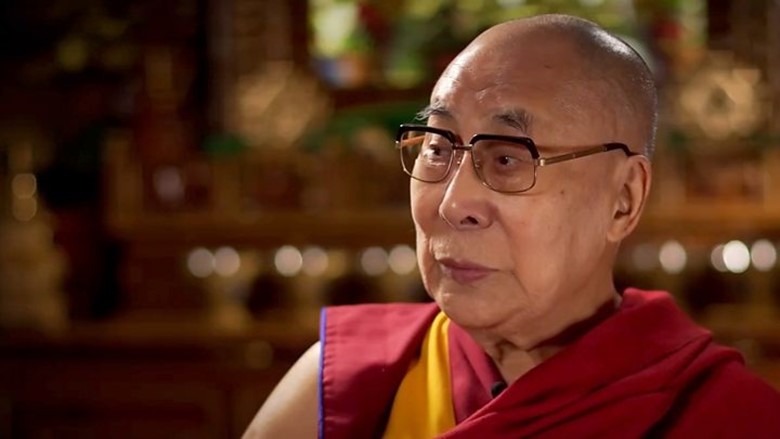
For a man so revered – seen as superhuman by many – he was refreshingly down to Earth. As he entered the room wearing his trademark red robes, assisted by his aides, he emanated the air of an approachable Clark Kent rather than an unearthly Superman.
And yet this is a man who has met world leaders and shared stages with pop stars and actors. A man who has long been a thorn in China’s side.
“One Chinese official once called me a demon,” he said laughing, before raising his hands to his head to mimic horns. “When I first heard that, my response was – yes, I’m a demon with horns.”
“I pity their ignorance, their political thinking is very narrow minded,” he added as he chuckled.
The Dalai Lama on Trump.
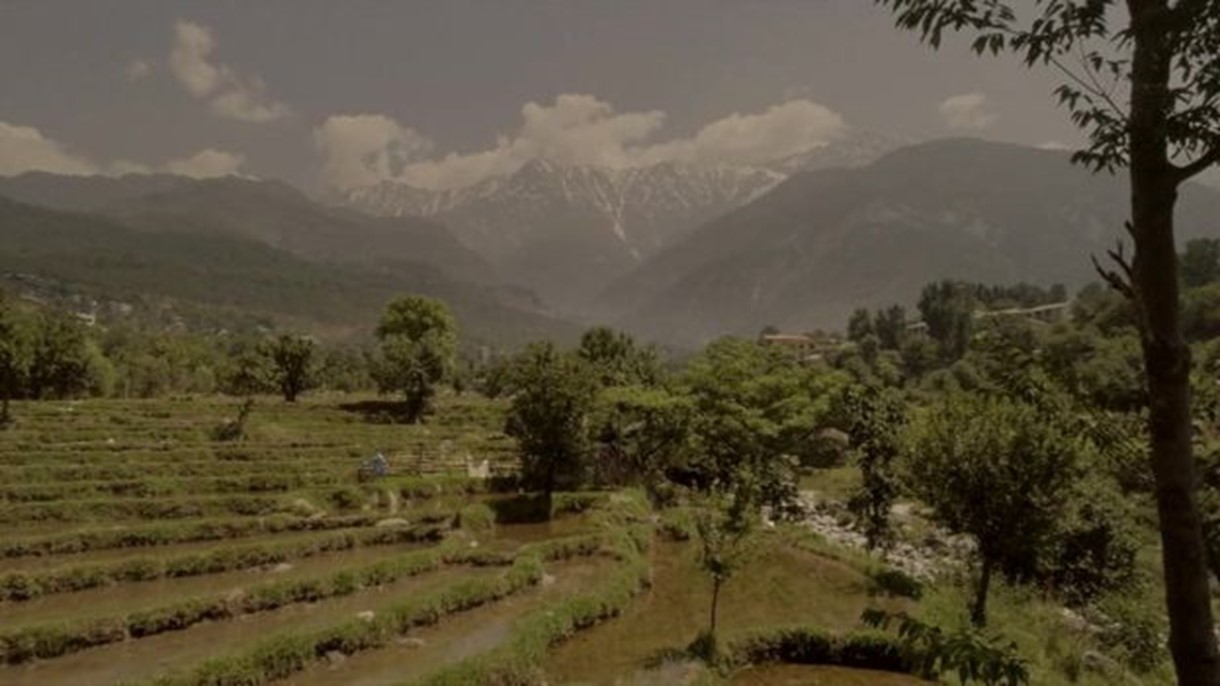
Image caption The view from the Dalai Lama’s residence in the northern Indian state of Himachal Pradesh
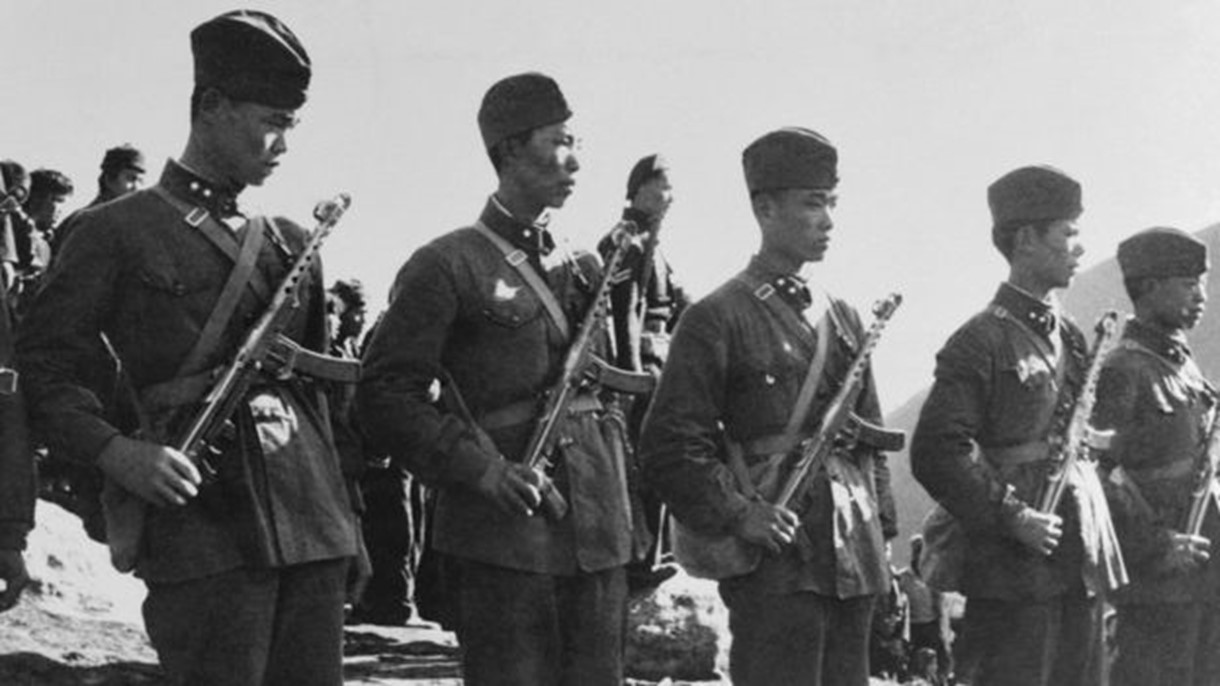
The grudge with China is longstanding and has defined his entire life. The Dalai Lama was forced to flee his home of Tibet in 1959 after China sent troops into the region.
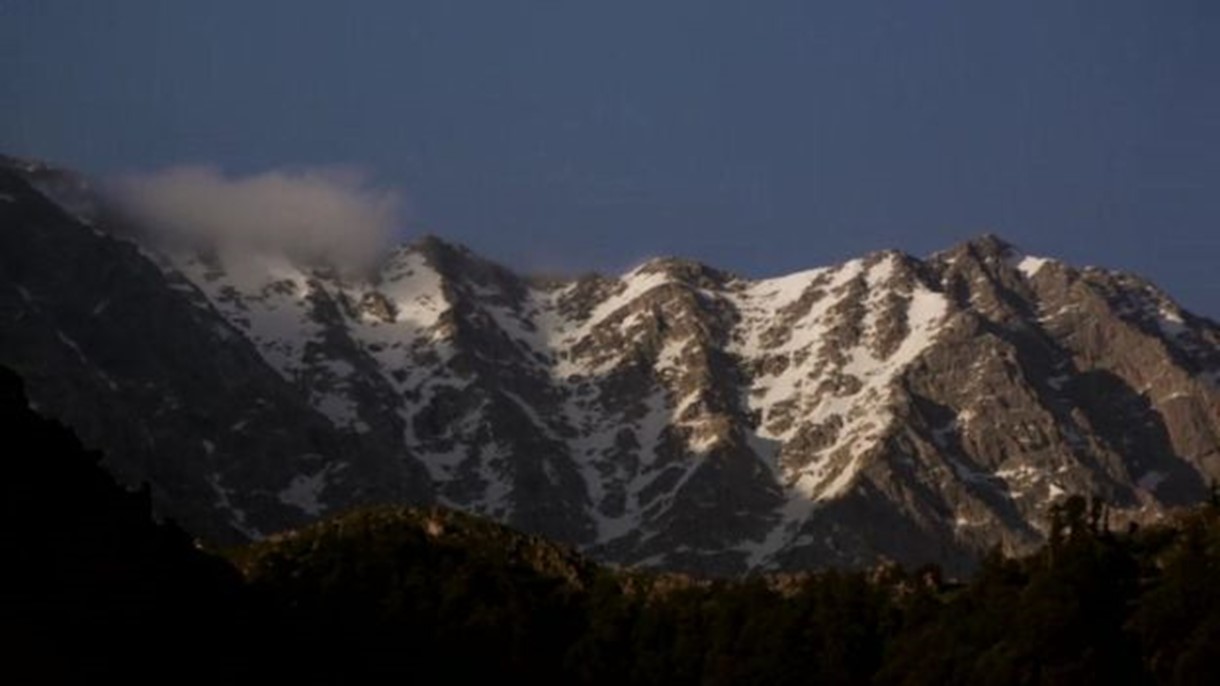
He sought refuge in India and for six decades has been living in exile in Dharamsala along with some 10,000 Tibetans. His monastery – which overlooks the snow-capped peaks of the Dhauladhar range in the Himalayas – is breathtakingly beautiful. But the view is bittersweet.
His life’s cause – to return home – remains a distant dream, even if he insists it may yet happen. “The Tibetan people have trust in me, they ask me [to] come to Tibet,” he says.
But in the next breath he adds that India has also become his “spiritual home”. An implicit acceptance, perhaps, that his goal of an autonomous Tibet is far from reality.
While he “formally” stepped down from political responsibilities in 2011, as the spiritual leader of the Tibetan people he has continued to be their figurehead.
The Dalai Lama on Trump
Image copyright Getty Images Image caption Chinese troops stand guard near the Tibet border in 1959
There haven’t been talks between his representatives and China for many years.
The Dalai Lama told me China’s President Xi Jinping had yet to ask him for a meeting. He did tell me that he had had some discussions with retired Chinese officials in the past few years, but none of these seem to have moved the dial.
In the 1950s, when China first sent troops in, Tibet was poor. Now it is an economic behemoth and its growing influence has in many ways overshadowed the Dalai Lama’s cause.
There was a time when the Dalai Lama was the toast of capitals around the world as US presidents lined up to meet him. George W Bush famously presented him with the Congressional gold medal while Barack Obama met him on several occasions, including in Delhi in 2017 after he left office.
But relations with the current occupant of the White House are very different. Despite being open to a meeting with President Donald Trump, the Dalai Lama told me that Mr. Trump, who is close to China’s Xi, had never asked for one.
The Dalai Lama’s advancing years may have curtailed his foreign travel schedule, but the spiritual leader says he hasn’t received a call from Mr. Trump either.
In a scathing assessment, he said the 45th president’s time in office was defined by a “lack of moral principle”, a contrast to remarks made in 2016 when he said he had “no worries” about a Trump presidency.
“When he became president, he expressed America first. That is wrong,” the Dalai Lama told me.
The withdrawal from the Paris climate accord and the migrant crisis are two big areas of concern. “When I saw pictures of some of those young children, I was sad,” he said of the situation at the US-Mexico border. “America… should take a global responsibility.”
The Dalai Lama is keen to separate his relationship with the president, or lack of one, with that of other American politicians. He highlights the vice-president’s support for the Tibetan people and the backing he has enjoyed from politicians in both houses of Congress.
President Trump’s apparent snub is reflective of the wider pressure Beijing can exert on those who engage with the Dalai Lama.
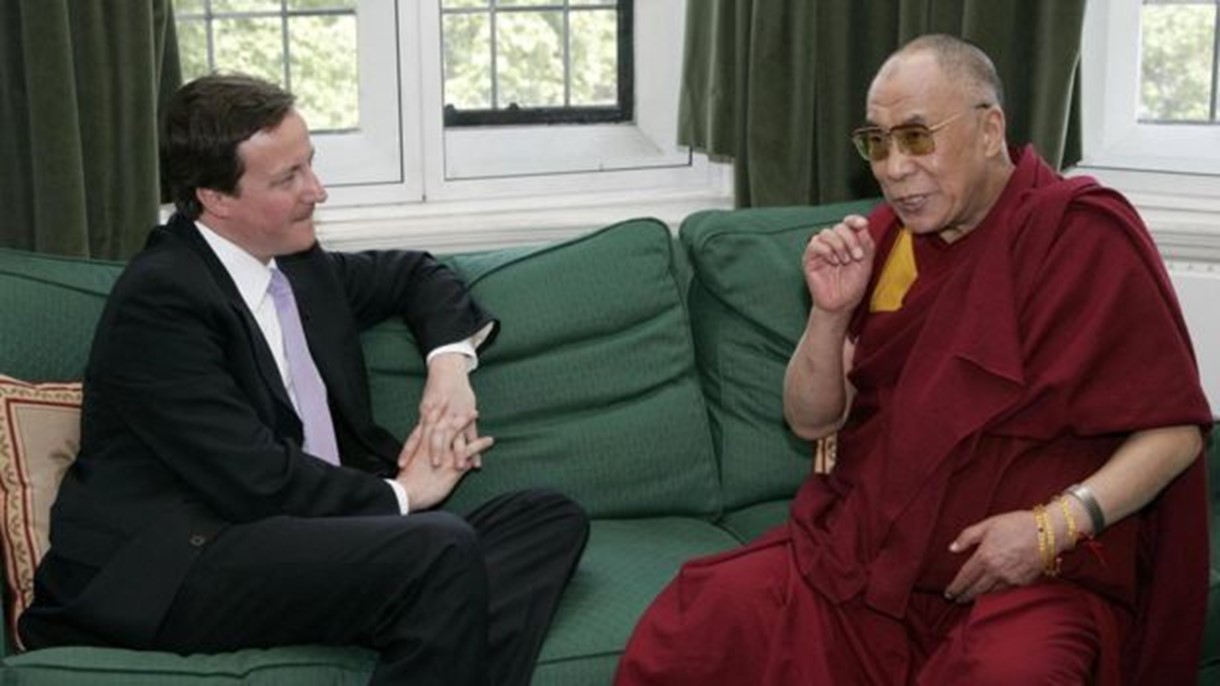
In 2012, China temporarily froze relations with the UK after David Cameron met him and. last year, the Indian government cancelled its plans for a celebration to mark 60 years of his exile, for fear it would upset Beijing.
The Dalai Lama on Trump
Image copyright PA Image caption David Cameron meets the Dalai Lama in 2008
The Dalai Lama’s world view is inherently global. When we discuss Brexit, he tells me that he is “an admirer of the European Union” pointing out that global partnerships have been key in avoiding major conflicts.
But the world’s most famous refugee has some surprising views on immigration.
In a speech last year, he said that refugees to the European Union should ultimately return home, adding that “Europe is for Europeans”, a statement he stood by when I challenged him on it.
“European countries should take these refugees and give them education and training, and the aim is return to their own land with certain skills,” he said.
The Dalai Lama believes the end game should be to rebuild the countries people have fled. But with some 70 million people displaced across the world according to the latest figures, what if people want to stay?
“A limited number is OK, but the whole of Europe [will] eventually become Muslim country, African country – impossible,” he said. A controversial viewpoint, and a reminder that while the Dalai Lama is a spiritual figurehead, he is also a politician with views and opinions like everyone else.
The Dalai Lama on Trump
Image caption The Dalai Lama’s monastery overlooks the snow-capped peaks of the Dhauladhar range in the Himalayas
Later in our conversation I also challenged him on another remark he made in 2015, when he said if he was followed by a female Dalai Lama, she would have to be attractive.
In another surprise, he reaffirmed his belief that beauty matters as much as brains. “If a female Dalai Lama comes, she should be more attractive,” he told me while laughing.
His message seemed at odds for a man who preaches a message of tolerance and inner confidence, but the Dalai Lama told me that in Buddhist literature both inner and outer beauty matter. He also said that equality was important and was keen to stress that he supported women’s rights and equal pay in the workplace.
As the interview ended, I was struck by how unexpectedly frank our discussion had been, which reminded me of something the Dalai Lama had told me earlier in the day.
One advantage of not being able to return home to Tibet, he said, was that India is a free country where he can express himself openly.
The Dalai Lama’s message of unity is universal – but for a man famed for his compassion, he can also be controversial.
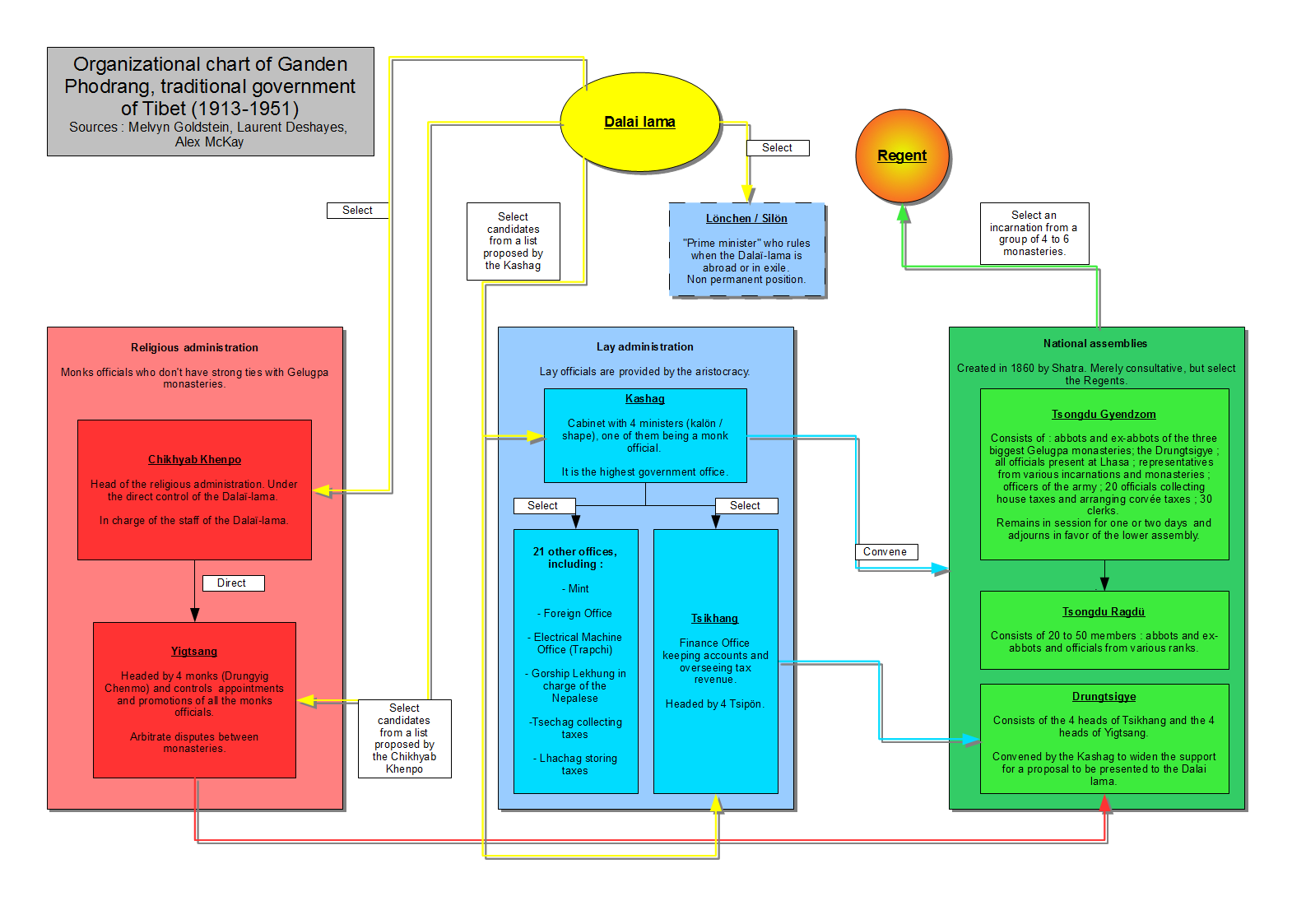
In my analysis, the Political Institution called ‘The Dalai Lama’ represents the Government of Tibet while the person called Tenzin Gyatso may have relinquished his power and may identify himself as the Retired Head of State of Tibet. While the exile Tibetan community elected a President of their choice, Tibetans presently living in Occupied Tibet do not participate in the activities of the Tibetan Government-in-Exile. Tibetans have not yet exercised their Right to Self-Rule or Self-Determination. As such, the Communist Party of China has no legal right to rule or govern Tibet. Military Occupation and Colonization of Tibet cannot abolish The Institution of The Dalai Lama known as The Ganden Phodrang.
Rudranarasimham Rebbapragada
SPECIAL FRONTIER FORCE
Where is Tibet? Who is The Dalai Lama?
Enigma of the Dalai Lama
The writer is former Ambassador of Pakistan and ex-Assistant Secretary General of OIC
Latest news, courtesy AFP, has it that the US Ambassador to China has called on Beijing to open a ‘substantive dialogue with the Dalai Lama’. He made these remarks during a visit to northwest China’s Qinghai province.
This bit of news gives rise to several questions. For one thing, it is something of a pity that, despite having won the Nobel Prize for Peace, the Dalai Lama has hardly been an agitator on the side of peace. Instead, he has often appeared as a tool in the hands of political forces that have an axe to grind against the Peoples’ Republic of China.
One has nothing against the Dalai Lama. He is undoubtedly a very revered personality. He may also be a ‘symbol of peace’ in the estimation of the US administration. But then he has also allowed himself to become a highly controversial political personality and one who has no qualms about being manipulated by certain powers to further their own agendas on the chessboard of international intrigue.
The Dalai Lama went into exile in the 1950s when China asserted its sovereignty over Tibet. He has squandered away several valuable opportunities of coming to terms with the reality of Tibet that has been accepted legally as a part of China by most of the world. This is not the occasion to go into the political complexities of this question. What is important is that the Dalai Lama could perhaps have done greater service to his cause, and to that of peace, if he had adopted the path of reconciliation rather than allow his followers to be kept hostage in a game of high stakes on the international chessboard. It should be more in the character of a revered religious personality and Nobel Peace laureate to work for a denouement leading to a grand reconciliation rather than confrontation.
Be that as it may, it came as something of a disappointment to the well-wishers of the Dalai Lama and his followers to find that he had opted to become a pawn in the US campaign aimed at the ‘containment of China’. Years back, president Bush had presented Tibet’s ‘exiled’ spiritual leader with the US Congress’ highest civilian award and taken advantage of the occasion to offer some gratuitous advice to the Chinese leadership, which the latter understandably had taken exception to.
There was widespread feeling that the timing of the US Congress award to the Dalai Lama was somewhat inappropriate. The only context that this award fitted into was the US obsession with ‘containment’ of China. In this campaign, the Dalai Lama appeared to have allowed his image to be used as a (willing) pawn. Knowing and acknowledging his stature as a religious personality, this can be termed as something of a pity.
The one inference that can be drawn from the latest US statement is that the American administration under President Trump may have the intention to up the ante and revisit the erstwhile forward policy of former president Bush aimed at ‘containment of China’.
It must be recognized that due to its pragmatic and realistic policies, China has meanwhile earned for itself a respected place under the sun. Due to its conscious decision to eschew unnecessary confrontational policies in favor of concentration on a constructive drive veered towards economic development, China has become a major economic prime-mover.
It is a matter of some interest that India appears as an inevitable variable in all the regional equations that concern China. India is host to the Dalai Lama and also the co-signatory of the India-US nuclear deal of doubtful credentials. India, of course, is second to none in its ability to manipulate the twists and turns related to the moves on the international chessboard. In aligning itself with the sole superpower in a China-baiting exercise, it surely must have a very good idea which side its bread is buttered on. No one should have any uncalled-for illusions, though. It would hardly be advisable to underestimate China at this point in time.
Published in The Express Tribune, June 10th, 2019.




















 Whole Dude - Whole Concept