Whole Dude – Whole Vidya – Whole Knowledge

The Discovery of Real or True Self:

Adhyatma Vidya. The Knowledge of the Spiritual Self. The Great Banyan Tree of Kolkata has lived for over 250 years. This tropical fig tree known as Ficus benghalensis is native to India; ‘adventitious’ roots that grow from its branches go downwards and take root to form new trunks over a relatively wide area. In the Sanskrit language, the Sacred Fig or Ficus religiosa is known as ‘ASVATTHA’. In my opinion, Hindu Scriptures refer to Banyan tree as ‘ASVATTHA’. It is cherished for its everlasting or imperishable nature. If the tree is living, we need to know the nature of its substance that keeps it living.
Adhyatma Vidya. The Knowledge of the Spiritual Self. The Banyan Tree offers an unusual appearance. It has roots that appear growing from its branches and the roots are located up in the air and away from the ground; it has trunks and branches growing downwards apart from the normal branches that grow upwards and outwards. Because of its adventitious roots, Banyan Tree spreads to cover a wide area and lives for a long time. Knowing and understanding this Asvattha Tree is important to gain the Knowledge of Vedas, the Hindu Scriptures that reveal the Knowledge of the Spiritual Self or Adhyatma Vidya.

The Knowledge of the Banyan Tree:

The Hindu Scripture, The Bhagavad Gita, Chapter XV known as  Purusottama Yoga speaks about the nature of the Supreme Person. It metaphorically compares the Supreme Being to the popularly known Fig Tree or Asvattha.

Adhyatma Vidya. The Knowledge of the Spiritual Self. Ficus religiosa or the Bodhi Tree is often worshipped in India. The tree is also described as “Sthaanuu” which means immovable.

I ask readers to visualize the Banyan tree called Ficus benghalensis rather than the holy tree called Ficus religiosa, or the Bodhi tree under which Lord Gautama Buddha experienced Enlightenment.
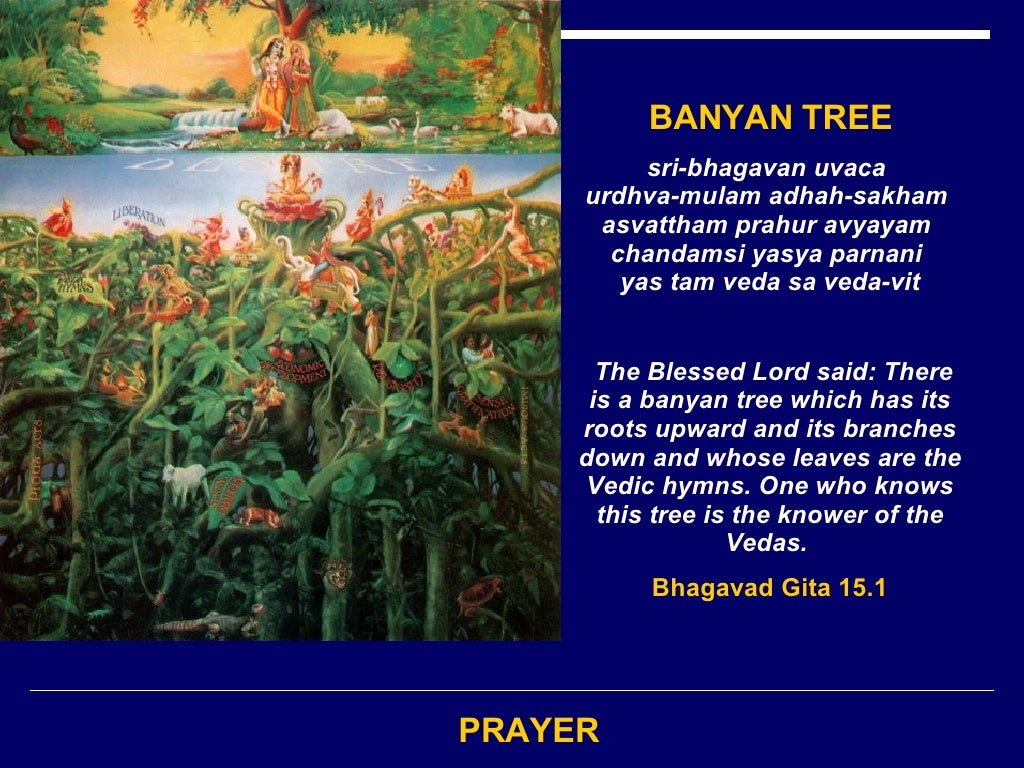
PRAYER BANYAN TREE sri-bhagavan uvaca   urdhva-mulam adhah-sakham   asvattham prahur avyayam   chandamsi yasya parnani   y...
Adhyatma Vidya. The Knowledge of Spiritual Self. The Knowledge of Banyan Tree.

The first verse reads as follows: Sri Bhagavan Uvacha: “Urdhva-Mulam adhah-sakham Asvattham prahur avyayam,    Chandamsi yasya parnani yas tam Veda sa Veda-vit.”The Supreme Lord Krishna said: There is a (Banyan) Asvattha Tree which has its roots upward and its branches down and metaphorically it is imperishable, and the Vedic hymns are its leaves. One who knows this Tree is the Knower of the Vedas (the person attains the Knowledge of the Ultimate Reality or the Supreme being).

When we know the Banyan Tree and its apparent imperishable quality, we may understand the true nature of man. The man is a spiritual being. The truth or falsity of this proposition depends on the fact of man’s having a substance that is of spiritual nature. Such a substance of spiritual kind is perceptible to the senses, is amenable to direct observation, and could be subject to verification by experimental science. To establish the fact of man’s spiritual nature, it needs reasoning based upon scientific validity.

The structure and the behavior of things contribute to their individual being and function. If the man has a set of defining features based upon his structure (Human Anatomy), function (Human Physiology), and behavior (Human Behavioral Science), the spiritual nature of man could be proved on theoretical and practical reasoning and could be verified by scientific experiments. I am not seeking to discover a soul or spirit that could have an existence independent of man’s physical being. However, it will be important to note that it is not possible to conceive of a soul or spirit if it is never associated with its human body. My purpose is that of describing the spiritual nature of the human organism and of other living beings. To understand the true nature of human being, we need to ascertain the validity of Knowledge that pertains to the Spiritual Self. 

Man is a Mortal Being: 

Man is a mortal being who must eventually die. When Lazarus died and was laid in a tomb for four days, Jesus performed a miracle and Lazarus came back to life from death. The Book of John, Chapter 11, narrates this event. In verses 41 and 42, Jesus said,”Father, I thank You that You have heard Me. And I know that You always hear Me, but I said this for the benefit of the people who are standing here, that they may believe that You sent Me.” The risen Lazarus had eventually died.

The man’s greatest need is not only to know the world around him but also to know himself better. The man must understand what it is to be a substance and what it is to exist. The man is a physical being or thing with matter and form. The corporeal body of man is composite of two principles; matter, and form. What is called matter is a potentiality, and what is called form is the actuality. The corporeal substance or matter called protoplasm becomes an actuality and is recognized as a living person because of the uniqueness of its genome that operates its living functions and defines its size, shape, color, and external form or morphological appearance. However, life comes into existence only when matter or substance has the ability to acquire energy from its external environment. The human being comes to life when his corporeal substance uses its ability and power called Nutrition to acquire energy and matter from its environment.

Life begins with fertilization, the union of sperm with an egg cell, and this event called conception proceeds to develop a human being after an important event called implantation. The life journey after conception continues if there is a connection between the energy seeking embryo and its maternal energy provider. To exist means that the living entity is maintaining a relationship, a partnership, a connection, or association with its source of energy.

The man leads energy-dependent existence deriving energy and matter from nature which supports other living forms with a similar corporeal substance called protoplasm. The mortality of man must be understood as the dissolution of man’s physical form. The dissolution of a living man into non-living molecules and chemical elements would not alter the potentiality of protoplasm to acquire energy and matter to create its own substance.

Things in Nature change with Time, but what is called Human Nature remains unchanged even under the influence of Time. As per the Laws of Conservation of Mass and Energy, as described in classical Physics, mass or energy remain constant. The potentiality of living substance to acquire energy and matter to form its own kind of substance has remained unchanged or unaffected by major natural calamities and other cataclysmic events. Life forms perish and yet life continues as new life forms. During the billions of years of existence, planet Earth has experienced several minor, and major extinction events described in its geologic history.

The Science of Paleontology offers information to support a hypothesis based upon theoretical and empirical evidence to propose that the substance called protoplasm is eternal, immutable, and indestructible as the Chemical Elements that constitute protoplasm have those defining attributes such as immutability and imperishability. At a fundamental level, it could be stated that the man is a mortal, physical being who derives his physical form because of its association with an imperishable substance. During any stage of its existence, the form called man cannot be separated from the eternal, immortal, and imperishable nature of its chemical elements.

Adhyatma Vidya. The Knowledge of the Spiritual Self. California State Tree known as Redwood includes Sequoia sempervirens and the Giant Sequoia is known as Sequoia gigantea. The Redwoods are the most massive trees in the world and could attain a trunk diameter as large as 30 feet. They also include the tallest trees in the world averaging about 300 feet high. They include the oldest known living trees and may reach ages of over 3,000 years. What is that corporeal substance that is living apparently in an imperishable manner?
Adhyatma Vidya. The Knowledge of the Spiritual Self.Sequoia sempervirens. The man has officially designated this tree as the State Tree of California State. What is the connection between man and plants or trees? What is the corporeal substance shared or common to all living entities?
Adhyatma Vidya. The Knowledge of the Spiritual Self. Sequoia gigantea is a massive tree. A living thing has a form and has matter. We often recognize the form and give it a name. What about the “MATTER” that constitutes the substance of this living thing? We need to understand the ‘potentiality’ of the Matter to know the nature of the Form. The Form has no independent existence of its own. The Form lives if and only if it has Matter that is living.

 What is Soul or Spirit?  

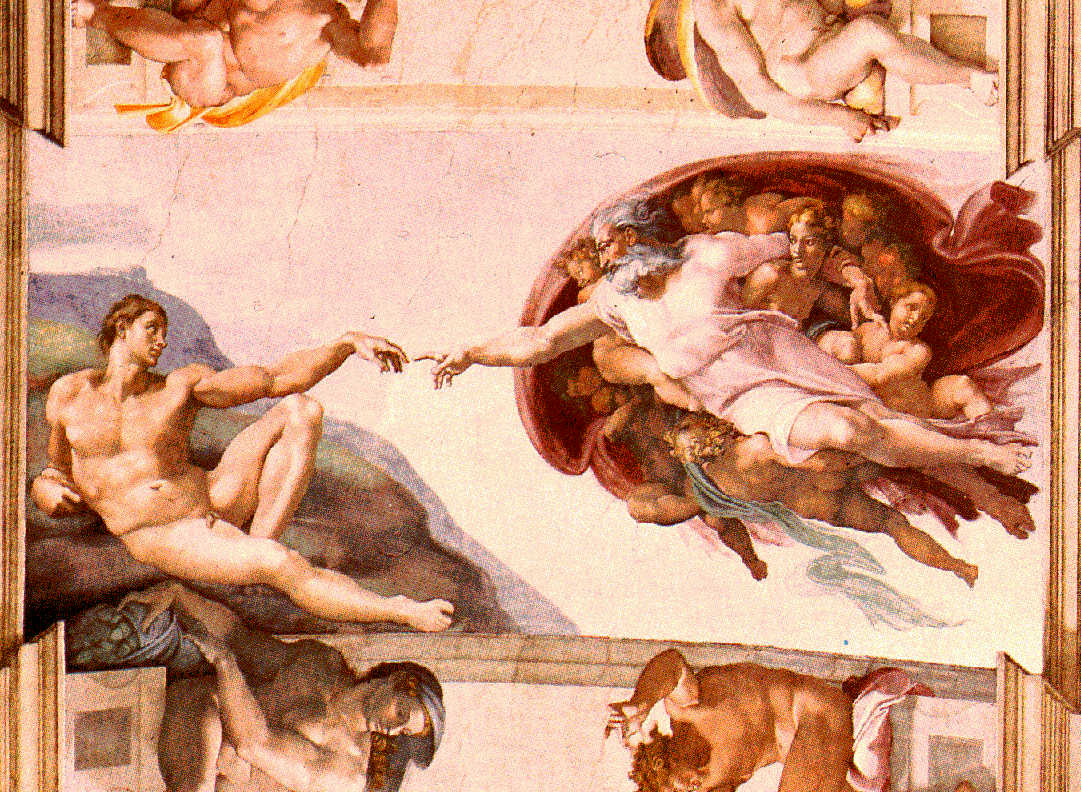
The Book of Genesis, Chapter 1, verse 27:”So God created man in His own image; in the image of God He created him; male and female He created them.”

Traditionally, man has been divided into two parts; body, and soul. In common usage, the term soul represents the immaterial aspect of a human being. The soul is further defined as that part of the individual which is considered to survive the death of the body. The term spirit is often used to describe a disembodied soul. On separation from the human body, the soul or spirit has a life of its own, a capacity for independent existence or self-subsistence which describes its immortality. I inform my readers to evaluate the possibility of immortality by understanding the immutable attributes of the Chemical Elements constituting the Living Matter.

The conceptions of Soul: 

There are a variety of conceptions about the soul or spirit. Some of the traditional conceptions of the soul are the following:

1. The soul is the immaterial substance, form, or principle of self-motion, vitality, life force, or life in living things. The insentient body is completely distinct from the sentient soul. 

2. Soul describes the Doctrine of the Self and is considered to be synonymous with the True-Self. In a human being, the soul confers the Individuality and its Human Nature.

3. The soul is often described as a thinking substance and is often equated with the mind. The soul has knowledge of itself by the reflection of its acts. The soul is the knower and it knows the physical, and mental acts of the human body where it resides. 

4. The soul is important to maintain and to preserve life. The soul may not directly participate in the activities of the human body. However, the activities of the human body may have a polluting effect on the soul. If the soul is tainted or contaminated by the sinful acts of the body, the soul may obtain purification by its release from the body. Some form of human effort, activity, attitude, and behavior is essential to keep the soul in its natural, pure, and perfect condition. 

5. The soul that has experienced the polluting effects by its association with a human body would be forced to experience perpetual reincarnation by a process called transmigration. The soul continues to reside as a prisoner in different bodies until such time it attains its original state or condition of purity and perfection. 

6. The soul is a transcendental or noumenal object that is real but not visible and could not be detected by human sensory perception. The human body that is visible is, in fact, unreal or is a product of sensory illusion. 

I ask my readers to attach a simple meaning to terms such as the soul or the spirit. It would be sufficient to describe the soul or the spirit as the vital, animating principle found in all living things.

The relationship between Soul and Human Body: 

Most religions and cultures speak about the soul and describe it as some incorporeal or immaterial substance/principle of human life that is distinct from the body. Despite the frequent acceptance of the existence of a soul, different religions and philosophers have developed a variety of theories as to the nature of the soul and its relationship to the human body. There are divergent views about the origin of the soul, when and how it gets implanted into the human body, and the mortality or when and if the soul dies. I would like to share the view that is attributed to Lord Krishna, the avatar or reincarnation of Hindu God Lord Vishnu.

Adhyatma Vidya – The Bhagavad Gita: 

The word ‘vidya’ is related to acquired knowledge or learned experience derived from studies or from instructions given by a teacher. The term ‘adhyatma’ pertains to the individual soul, Atma, or atman which describes the Spiritual Self. The phrase ‘Adhyatma Vidya’ could be described as the Knowledge of the Spiritual Self. 

The legendary Indian Sage Veda Vyasa known as Krishna Dvaipayana was the author of the epic poem ‘The Mahabharata’ (Great Epic of the Bharata Dynasty). Veda Vyasa is recognized as the compiler of ancient Hindu texts known as the Vedas. The Book VI of Mahabharata narrates Lord Krishna’s conversation with Prince Arjuna while the warring parties of Pandavas and Kauravas had assembled at the battlefield of Kurukshetra. Lord Krishna reveals His views about the soul, the human body and their relationship in “The Song of the Lord” known as ‘The Bhagavad Gita’. These poems of The Bhagavad Gita give a synopsis of the religious thought and experience of Indians through the ages.

Spirituality Science. The Knowledge of Spiritual Self. Adhyatma Vidya. Bhagavad Gita, Chapter 10, text 39.

Chapter X of The Bhagavad Gita is titled ‘Vibhuti-Vistara Yoga’ and it describes the divine or transcendental attributes of the Supreme Lord. In verse #39, the Lord claims, “I am the generating seed of all existences. There is no being, moving or unmoving( “Chara-acharam” ) that can exist without Me.

Adhyatma Vidya. The Knowledge of the Spiritual Self.

Verse #32, the Lord proclaims, “….of all the branches of Learning and Knowledge, I am the Knowledge of the Spiritual Self (Adhyatma Vidya).

Adhyatma Vidya. The Knowledge of the Spiritual Self. In all living beings, I am consciousness.

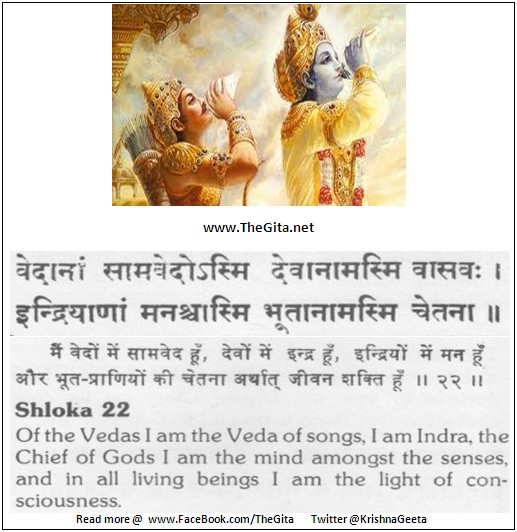
In verse #22, the Lord describes the nature of His connection with the living beings that He has generated, “…. and in living beings, I am Consciousness (“Bhutanam Asmi Chetana”).” He also clarifies that Consciousness or Chetana as a different characteristic and separates it from the mind, intellect, and organs of sense perception. The mind is traditionally viewed as the major organ of sense perception, the seat of thoughts, intellect, emotions, feelings, and self-ego. Consciousness or Chetana is associated with the characteristics of a living being.

The Lord also cites The Vedanta Sutra to make the distinction between the body, the soul, and the Supersoul. The Vedanta, the insights from Vedic Scriptures describe three manifestations of the Supreme Lord’s Energy. These are 1. Annamoya or dependence upon Food for existence, 2. Pranamoya or the manifestation of the living symptoms and life forms, and 3. Jnanamoya or the Knowledge of the distinction between the body, the field of activity and the Knower who resides in the body. If a living being needs food for its existence and performs its living functions in a state or condition called awareness or consciousness, it could be described as the manifestation of the Supreme Lord’s Energy.

Adhyatma Vidya. The Knowledge of the Spiritual Self. I am ‘Life’ or “Jivanam” in all Living Entities.

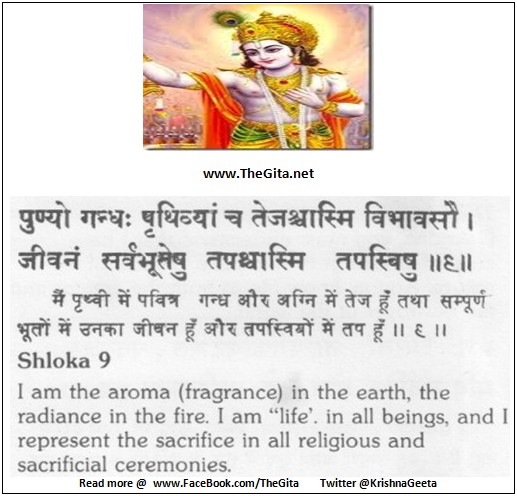
In Chapter VII titled ‘Paramahamsa Vijnana Yoga’ or Knowledge of the Ultimate Truth, in verse #9 Lord Krishna claims: “I am the life (“Jivanam”) of all that lives.” He demonstrates a connection between life and consciousness to describe the spiritual nature of Self.

Adhyatma Vidya. The Knowledge of the Spiritual Self: Existence Precedes Essence.

The Chapter XIII of The Bhagavad Gita titled ‘Kshetra – Kshetrajna Vibhaga Yoga’ deals with the dichotomy or distinction between the material body, immortal soul, and the Supersoul. It states the view that the material body is called the field of activity or Kshetra. One who knows this body, the field of activity is called the Knower of the Field or Kshetrajna. The Knower of the Field is the Owner of the body. The Supreme Lord is also the Knower of the field of activity in all bodies( verse #3 ).

श्रीभगवानुवाच ।
इदं शरीरं कौन्तेय क्षेत्रमित्यभिधीयते ।
एतद्यो वेत्ति तं प्राहुः क्षेत्रज्ञ इति तद्विदः ॥ १३-२॥


śrībhagavānuvāca
idaṃ śarīraṃ kaunteya kṣetramityabhidhīyate
etadyo vetti taṃ prāhuḥ kṣetrajña iti tadvidaḥ


The Blessed Lord said: This body, O Kaunteya is called Kshetra (the Field) and he who knows it is called Kshetrajna (the Knower-of-the-Field) by those who know them (Kshetra and Kshetrajna) i. e., by the sages.

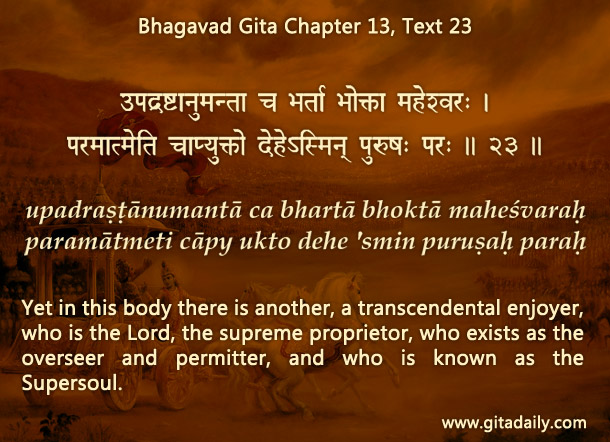
In this human body, there is another indwelling Observer, a Sanctioner, a Preserver, an Enjoyer, and indeed ultimate Controller called ‘Paramatma’ or Supersoul. The Supreme Lord or Paramesvaram is residing equally in all living entities( verses # 23, 27, and 28 ).

Adhyatma Vidya. The Knowledge of the Spiritual Self. Body, Soul, and the Supersoul.

The final Chapter XVIII of The Bhagavad Gita titled ‘Moksha-Upadesa Yoga’ comes to an interesting conclusion about the Single Reality that pervades all existence that is divided into innumerable forms. Verse #20 reads as follows: 

“Sarva bhutesu yenaikam bhavam avyayam iksate  avibhaktam vibhaktesu taj jnanam viddhi Satvikam.”

Understand that Knowledge by which one undivided, imperishable (Avyayam) reality is seen within all diverse living entities is in the nature of goodness (Satvikam).

What is that undivided reality that is imperishable that connects all the diverse, living entities? 

The Body-Soul Dichotomy: 

In the Indian tradition, the individual soul is known as Atma or Atman. The Supreme Soul or the Supersoul is known as Paramatma, Paramesvaram, or Brahman, the Ultimate Truth, and the Reality. However, the concepts about Atma or individual soul vary and the Hindus belong to different schools of thought. While the concepts about the individual soul are different, there is general agreement among various Indian thinkers and philosophers about the distinction between the material, insentient, and perishable human body and the immaterial, sentient, and imperishable or immortal soul. The soul is independent and is not attached and it still requires the substance of the corporeal body.

However, I am not able to draw that distinction between the Body and it’s embodied Soul as I am not able to make that separation from the substance and its function. To describe a function, I need the substance. Man lives and functions with consciousness because of the fundamental nature of the corporeal substance called protoplasm, and this substance is apparently imperishable, indestructible, and immortal. We could destroy the physical form of man and several other living forms, but man or nature and the influence of Time have not demonstrated an ability to destroy this living substance which has survived on planet Earth continuously over billions of years. Man cannot create life and man cannot destroy life. Man can only live or exist because of the spiritual nature of his corporeal substance with which he can not seek separation until the time of dissolution of his physical form after an event called death. After physical decomposition, the chemical elements get eventually taken up by other living things. The substance has a life of its own and continues to create the new substance of its own kind and becomes visible as a living life form with a different identity or morphological appearance.

Man is a Created Being:  

Adhyatma Vidya. Knowledge of the Spiritual Self. Man is a created being. Spirituality explores the connection between man and his Creator. The Trimurti at Elephanta Island Cave Temples near Mumbai, India represents God as the Creator (Brahma), the Preserver (Vishnu) and the Destroyer (Shiva).

The status of man in nature describes the man as a created object; a new object, one of its own kind, distinctive, and unique which cannot be duplicated by using any known reproductive technology such as cloning. Genetically identical twins can still be separated as Individuals with Individuality.

The Eternal Reality of Soul’s Immortality:

Adhyatma Vidya. The Knowledge of the Spiritual Self. Ajanta Caves near Aurangabad, Maharashtra State, India, Fresco-type wall paintings. Man’s spiritual dimension describes man’s humanity, moral nature, individuality, and Consciousness.

Religious thinkers have further defined Soul as that part of the individual which partakes of divinity. People of all races, cultures, and religions would like to investigate the nature of this God-Connection as they perceive the world and the universe in which they exist as a fact of Creation. I have not discovered evidence that would fundamentally deny the fact of Creation.

 Man is a Social Being:

French philosopher Auguste Comte (1798-1857) coined the term Sociology. He believed that the scientific study of social organization would make possible a reconstitution of the social order based on principles of moral progress.

Apart from being a created Physical being, the man is recognized as a Social being as he displays social instincts and social behaviors in all of his activities. A rudimentary understanding of Sociology or Theories of Social Science would clarify this matter. Social instincts and Social Behaviors are seen in all animals including bacteria.

At a cellular level, the social function is called ‘Association’. Man is an association of trillions of cells. Each human organ and organ system represents an association of cells that display functional subordination to perform selective tasks. Life is just impossible without social structure and organization.

Matter, Energy, and Knowledge:

The Greek philosopher  Aristotle observes that corporeal substances are composite of two principles, form and matter. What is called matter is a potentiality, what is called form is an actuality. The totality of things has been divided in various ways. The three fundamental distinctions are 1. the distinction between the natural and the supernatural, 2. the distinction between the material and the spiritual, and 3. the distinction between the lifeless and the living. When we make the distinction animate/inanimate, living/non-living, and inorganic/organic, a question arises about the nature of that distinction. The difference, is that one of kind or degree? The Mechanistic View claims the continuity of nature in terms of the universality of purely mechanical principles. 

I define Life as the organization of matter with implanted supernatural Knowledge. The establishment of supernatural Knowledge in matter describes the operation of ‘God Principle’, Spirit, or Soul. Life comes into existence when matter and energy come together with the establishment of ‘God Connection’.

Life and Consciousness:

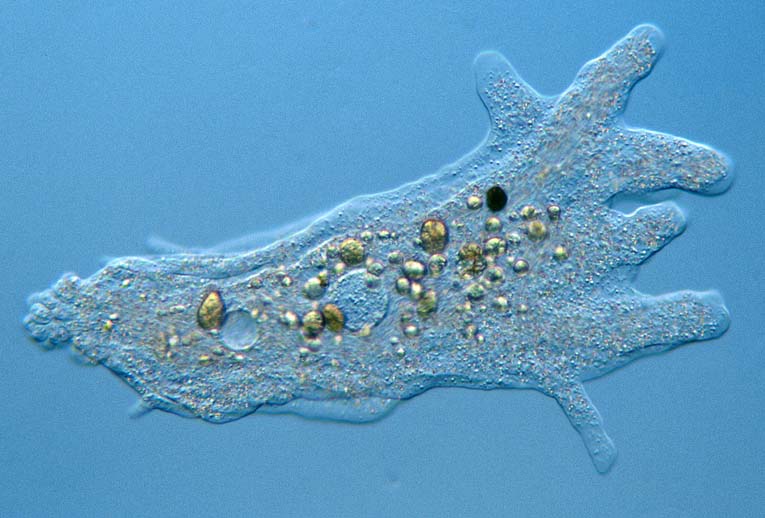
Amoeba proteus, the unicellular, protozoan organism is conscious or aware of its own state of existence. It has the abilities of Motion, Nutrition, and Reproduction. All of its living functions are goal-oriented. It responds to its environment and survives adverse environmental conditions by a process called encystment.

The basic characteristic of a Living Cell or organism is the presence of consciousness. I recognize a cell as a Living Cell if it displays functions that characterize the presence of awareness or consciousness. The Living Cell or Living Thing need not be aware or conscious of the Subject who may be investigating or observing the properties of that Object. The Living Object needs to be aware of its own existence and its condition called Living. Atoms and molecules display their properties and interact according to the Laws of Physics and Chemistry. Living organic molecules show individualistic behaviors under experimental conditions that could be repeated and be verified. The Living Cell is very selective and it responds in a variable manner to physical and chemical stimuli. It can communicate or send signals to other Living Cells present in its environment. It responds according to its internal condition in relation to the environment in which it exists. The interactions of non-living physical matter are not goal-oriented. The interactions of Living matter are goal-oriented and they specifically achieve the purpose of sustaining, preserving, defending, and continuing its own living condition or existence.

Life and Death is a continuous process:

When does Life begin? When does Life end? Life always comes into a state of existence from a previously existing Living Cell. Life and Death is a continuous process and is recognized by the presence of Consciousness and Individuality.

When does Life begin? When does Life end? Every Living Cell is derived from a previously existing Living Cell. Life has not experienced the final event called DEATH. Life continues its act of Living through a function called Reproduction. A given species is considered to be totally extinct only if there is no surviving member to represent that particular species. In spite of numerous major and minor extinction events, Life exists on planet Earth as if Life is imperishable. The phenomena of Life and Death always involve a social group of interacting living things.

The Soul and God Connection: 

All types of Living Cells with or without nucleus represent thermodynamically unstable systems. Without a continuous input of energy, a Living Cell will degrade spontaneously into a nonliving collection of molecules. Biological existence is possible because of an association or connection, or partnership between energy seeker and energy provider.

 There has been no clearly defined and universally accepted metaphysical conception of the term Soul. It is a term often used without a precise definition in philosophy, religion, or routine conversation. In this discussion, I face the problem of using words to which no definitive meaning is attached. If I make an attempt to define the word ‘God’, my readers may even speculate that I may belong to a new religious order. We need to come to a consensus even if an entity called ‘God’ does not exist.

Life is a condition that describes Synchronized Existence, the synchronization of activities, the connection between energy dependent life functions and its Source of Power.

A majority of life forms have synchronized their state of existence with an event that produces alternating periods of light and darkness while that source of light is not being turned ‘on’ and ‘off’. Rather we are forced to experience the effects of an illusion. Sunrise and Sunset is the reality that governs a majority of Biological Rhythms that control the life processes. The illusion is the necessary condition for the biological existence of Life.

Who has established the connection between Autotrophs and Heterotrophs? The creative mechanism to trap Solar Energy describes implanted Knowledge to formulate the connection between autotrophs and heterotrophs.
In mitochondria, many substances(food) are oxidized and ATP, the energy-storing chemical of the Cell is produced. The most important equations for living things are mutually inverse. Respiration of humans and Cellular Respiration represents the reverse of Photosynthesis.

Soul and Death:

The idea of ‘Soul’ always comes in the context of Death. If the man is immortal, we will not be spending our time and energy to verify the existence of an immortal principle.

Red Blood Cells display functional subordination to serve the purpose of the Whole Organism. Functional differentiation and Functional Unity are important to support the existence of the Subject or Individual who is, in reality, an association of trillions of cells.

In a multicellular organism, the consciousness works both at the level of each individual cell and to establish the functioning of the organism as an individual unit. Without functional unity, the organism cannot maintain its biological existence. Cell differentiation is the process by which the individual cells use adaptation to perform specific tasks. Red Blood Cells perform specific tasks.

The neurobiological aspects of Consciousness:

Reticular Formation of Brain Stem has connections with almost all other parts of the Central Nervous System and it helps to coordinate and integrate actions of different parts of the CNS. It is important for Behavioral Arousal and the Capacity for Consciousness.

In the Human Brain Stem, several neurons, and nuclei which are in an area called Reticular Formation are functionally adapted to compose the contents of human consciousness. The Reticular Formation gives the Capacity for Consciousness. The selected contents of this consciousness are read in the cortical areas of the cerebral hemispheres and described as Cortical awareness. For example, the information about circulation, respiration, and Acid-Base Balance is processed by the Brain Stem and compensatory mechanisms if needed are initiated without the need for cortical awareness.

Consciousness is awareness of existence, the facts that relate to the state or condition of existence. Behavioral Arousal and Cortical awareness of thoughts, feelings, and sensations is an important component of total Biological Existence.

Identity and Individuality:

The Eternal Reality of Soul’s Immortality is described in The Bhagavad Gita, Chapter II, verse 13. Lord Krishna spoke to the Pandava Prince Arjuna. The morphological Identity constantly changes under the influence of Time.
Image result for bhagavad gita chapter 2, verse 12

For each of us, our Individuality existed in the past and our Individuality will continue in the future without interruption. Certainly, never did I not exist, nor you, nor all these Kings and certainly never shall we cease to exist in the future.

The issue of spirituality, the nature of Soul and consciousness must be explored in the context of arriving at an understanding of man’s Identity and Individuality. If the man is viewed as an association of trillions of cells, we need to know the Identity of that Subject who lives because of the functions of the trillions of cells.

Rudra Narasimham Rebbapragada

Bhavanajagat

Adhyatma Vidya – The Discovery of True or Real Self: The Knower – The Knowing-Self: The Man, the entire human organism is derived from a single, fertilized Egg Cell. How does this complex multicellular organism recognizes its own Identity?


Whole Dude – Whole Substance

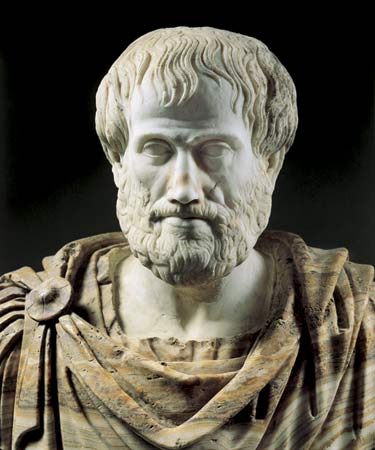
Whole Dude – Whole Substance: Greek Philosopher Aristotle, Father of Science brings Religion, Philosophy, and Science to come together to know and understand Man as a Whole Person with Form and Matter. Whole Dude comprises of Whole Substance and is not divisible into Body and Soul.

Aristotle states that corporeal substances are composite of two principles; 1. Form, and 2. Matter. What is called Form is actuality, and what is called Matter is potentiality.

We often tend to understand the actuality of human form without giving much attention to the potentiality of its matter or its living substance. Aristotle did not regard the human body and soul as  separate as the soul is merely a set of defining features. He states that the structure and behavior of things contribute to their individual being and function. In his opinion, “There is a science which investigates Being as Being and the attributes which belong to Being in virtue of its own nature.”

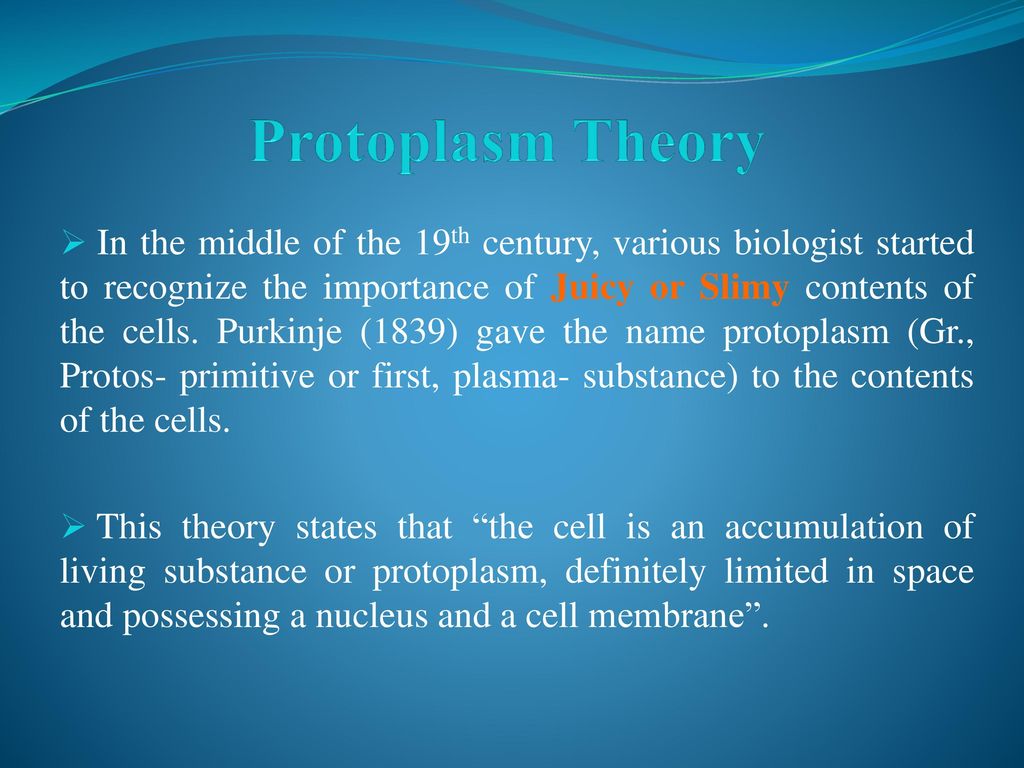
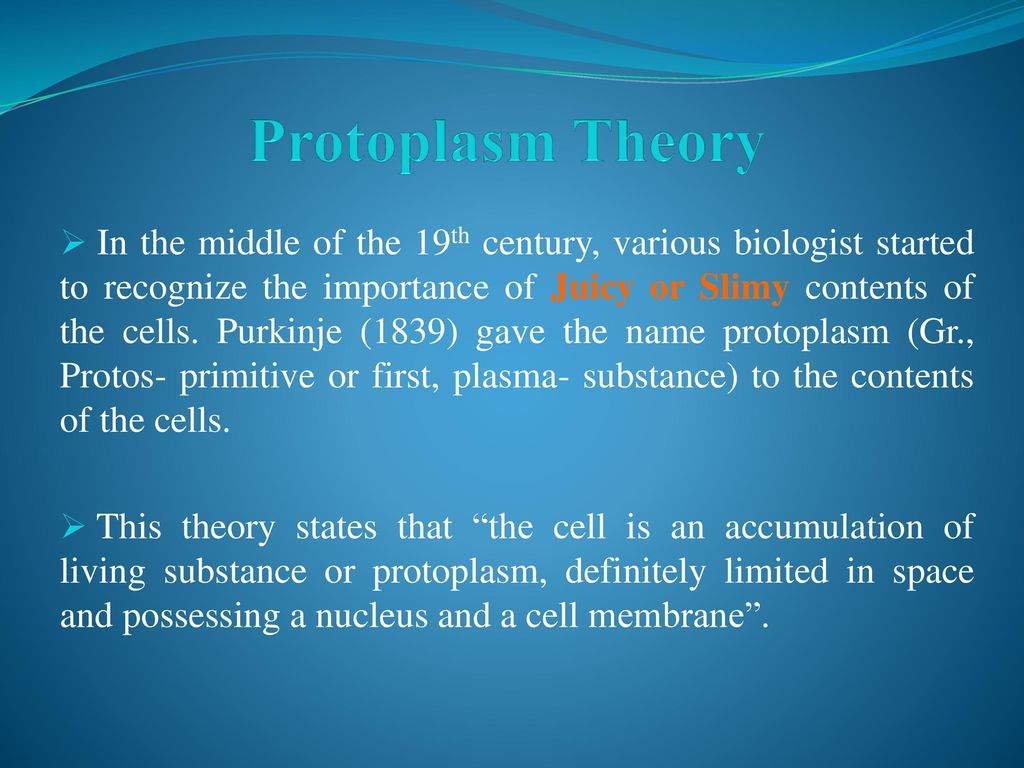
Whole Dude – Whole Substance: In the middle of the 19th century, various biologist started to recognize the importance of Juicy or Slimy contents of the cells. Purkinje (1839) gave the name protoplasm (Gr., Protos- primitive or first, plasma- substance) to the contents of the cells. This theory states that the cell is an accumulation of living substance or protoplasm, definitely limited in space and possessing a nucleus and a cell membrane .

Whole Dude or Whole Person is composed of Whole Substance and that Substance is of Spiritual Nature. Hence, Whole Dude or Whole Person is not divisible into Body and Soul. Whole Dude or Whole Person is not an embodied Soul and is a Living Soul.

Whole Dude – Whole Substance: Whole Dude or Whole Person is composed of Whole Substance and that Substance is of Spiritual Nature.

Whole Dude – Whole Self

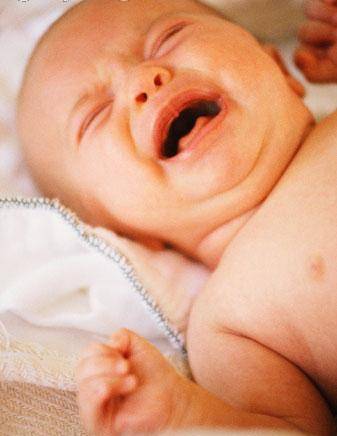
Whole Dude- Whole Self: SPIRITUALISM : THE UNITY OF MAN IN BODY, MIND, AND SOUL. Spiritualism describes the relation between a changing object and its unchanging spiritual nature. This baby which started its existence as a single, fertilized Egg-Cell will continue to grow and develop undergoing a series of changes in physical appearance or Identity and yet will retain the same Individuality during the entire course of Life’s Journey.

“EKAM EVA ADVITIYAM” – This statement in Sanskrit language is from Chandogya Upanishad (6:2:1) and it means: “I, one alone and there is no second.” The original intent of this statement is that of seeking the unity of the Objective Reality of Man known as ‘ATMA’ (the Individual Soul) and the Ultimate Reality known as ‘PARAMATMA’ or Supersoul. There is no Duality between the two and there is no disunity between Man and God.

However, God is not an object which is under Man’s control and the views about God are subjective opinions. I am quoting this statement to find the Unity of Man in body, mind, and soul. Man’s greatest need is not only to know the world around him but also to know himself better. Man must understand what it is to be a substance and what it is to exist. We need to establish knowledge about Man on a firm basis and the information it provides must be tested for its accuracy and consistency with external reality. Dr. William James in his book, The Principles of Psychology, has observed: “True ideas are those we can assimilate, validate, corroborate, and verify.” The separation of man into body, mind, and soul is not supported by scientific study of man.

Whole Dude – Whole Self: It is impossible to describe the concept called “SOUL”, or “SPIRIT” if it is never associated with its human body. If “SOUL” is defined as the vital, animating, Life Principle, Spiritualism demands the existence of a Living Soul or Spirit.

Man comes into existence from a single fertilized Egg Cell. This Man cannot be separated into two distinct entities like insentient material being and sentient spiritual being. The physical being and the conscious being are one and the same. The division of Man into a physical substance and a thinking substance or that of a physical body and a thinking mind is not valid as they have no independent existence of their own. The division of Man into physical body and an immortal, non-material or immaterial Soul is not also valid as the Soul is described as the vital, animating principle that is the chief characteristic of Life.

Whole Dude – Whole Self: The Egg Cell is the source of Man’s Life. The Spiritual Nature of Man could be discovered and could be described from the biological properties, characteristics and nature of the corporeal substance found in the Egg Cell.

The Spiritual Nature of Man is not a mental function. The Spiritual Nature of Man could be discovered and could be described from the biological properties, characteristics and nature of Man’s corporeal substance found in the fertilized Egg Cell. This substance is Conscious. This Single Egg Cell grows, divides, develops, and builds the cells, the tissues, and the organ systems that constitute the Human Individual. The Spiritual Nature of the substance present in the Single, fertilized Egg Cell brings the functional unity of all the cells, tissues, and organ systems to establish the Physical Reality called Man.

Whole Dude – Whole Self: Human Embryo Implantation at about six days after Conception. The Single, fertilized Egg Cell and the Human Embryo that develops from it is Conscious of its existence reflecting its Spiritual Nature.

 About six days after Conception, the developing Human Embryo implants itself into maternal tissues by establishin an anatomical connection called Placenta. The implantation of Human Embryo does not involve any human thought and the Mother has no cortical awareness of the fact of implantation. The implantation demonstrates the Consciousness of the Human Embryo which is aware of the fact of its own existence. Spiritualism defines the internal, mutually beneficial relationship, partnership, association, and connection between the cells, tissues, and organ systems for the benefit of the Human Person who exists because of their living functions. The Subject that is born from the Single, fertilized Egg Cell is always a new, original, distinctive, unique, one of its own kind of Object that exists because of the innate Spiritual Nature of the material substance. Being born relates Man to the Subjective and Objective Realities of his biological existence. There is structural and functional unity between Man and his Body, Mind, and Soul. There is no Life, and there is no Human Existence if these entities are separated. Spiritualism is the potency that brings Man’s Essence and Man’s Existence to come together to provide Man the Subjcetive and Objective Reality of his own biological existence in the physical, and material world. Man is not an embodied Soul and Man is a Living Soul. 

What is Man?

Whole Dude – Whole Self: This painting the Vitruvian Man (c. 1492) by Leonardo da Vinci displays a spirit of scientific inquiry. What is Man? The understanding of human nature will help to promote man’s well-being.

I will be repeatedly asking this same question in several of my blog posts on the subject of Spiritualism. I want to remind myself that the motivation for asking this question comes from a statement expressed in Sanskrit language: “Sarvesham Swastir Bhavatu”, a statement which seeks the well-being of all humans, of all races, of all cultures, of all religions, and of all nations. The meaning and purpose of human life are affected by whatever we think is the real or true nature of man. It is more important to recognize that our efforts to support the well-being of man would require correct understanding and knowledge of the real or true man.

Self and The Knowing-Self:

Whole Dude – Whole Self: FACIAL RECOGNITION-IDENTITY AND INDIVIDUALITY-THE SELF and THE KNOWING-SELF: Identity describes the external reality of man and it helps to know the man as a specific Individual. This Individual exists with unchanging Individuality which describes the internal reality of man. Identity provides awareness of the Self and Individuality involves the Knowledge of the Knowing-Self.

To know about Man, we can observe the various activities that describe the Man. The Physical being known as Man is known from the living functions performed by the tissues and organ systems of his body. This Physical being has Identity or identifying features such as age, gender, race, ethnicity and other biometrical information to know the person as a specific Individual. Factors like language, religion, culture, education, social occupation, nationality, and sexual orientation are also used to describe the Man. The Mental being known as Man is described from mental functions such as intellect, thoughts, moods, feelings, cravings, and self-pride. Man, the Social being is known from his social interactions and much of human action and behavior involves interacting with other individuals present in his social environment. Man, the Moral being is known from the choices he makes in the performance of his actions where discernment plays a role to distinguish right from wrong, and good from evil. Man, the Spiritual being is known from the nature of his existence seeking peace, harmony, and tranquility within himself and with others in his environment and community. I designate the term ‘SELF’ to describe Man as a Physical, Mental, Social, Moral, and Spiritual being. I have also observed that the Physical being is in reality consists of about 100 trillion individual living cells that show complex structural differentiation and functional organization. The corporeal substance is of spiritual nature and hence Man, the Physical being has no choice other than that of existing as a Spiritual being. The question is not that of, How Man knows himself? The question that I would like to ask is, How does the body know the Identity of the Man who lives? If the body knows its Owner, there is an anatomical structure that is associated with the function called Knowing-Self.

The Function of Knowing-Self:

Whole Dude – Whole Self: Self and The Knowing-Self

The Reticular Formation (RF) is located in the central Brain Stem and extends from Medulla to Thalamus. It consists of more than about 100,000 Brain Stem nuclei. It is estimated that a single neuron in this network may have synapses with as many as 25,000 other neurons. The RF has connections  with almost all other parts of the Central Nervous System including Spinal Cord, Cranial Nerve nuclei, Cerebellum, Hypothalamus, Thalamus, Corpus Striatum, Limbic System, and Cerebral Cortex. Thus, the RF helps to coordinate and integrate actions of different parts of the Central Nervous System such as 1. regulation of muscle and reflex activity, 2. central transmission of sensory impulses, 3. respiration, 4. cardiovascular responses, 5. behavioral Arousal, and 6. Alert/Sleep Cycle.

Whole Dude – Whole Self: Self and The Knowing-Self.

There are two distinct aspects of human Consciousness namely, 1. the Capacity for Consciousness and 2. the Content of Consciousness. When Consciousness is viewed as a psychological or strictly as a mental function, it is represented by the Content of Consciousness called Cortical Awareness which is a function of the Cerebral Cortex. When Consciousness is understood as a biological function that includes the maintenance of vital functions like respiration, and circulation apart from various homeostatic mechanisms to preserve a constant internal environment, it is represented by the aspect of Capacity for Consciousness.

Whole Dude – Whole Self: Self and The Knowing-Self

The Knowing-Self is located in the Reticular Formation of the Brain Stem and its functions are of critical importance in the clinical diagnosis of Brain Death. During Life, the cells, tissues, and various organ systems of the human body work together for the benefit of ‘SELF’ which is known and recognized by this Knowing-Self.

Man is a Mortal Being:

Man’s greatest need is not only to know the world around him but also to know himself better. Man must understand what it is to be a substance and what it is to exist. Man is a physical being or thing with matter and form. The corporeal body of man is composite of two principles; matter, and form. What is called matter is potentiality, and what is called form is actuality. The corporeal substance called protoplasm becomes actuality and is recognized as a living person because of the uniqueness of its genome that operates its living functions and defines its size, shape, color, and external form or morphological appearance. However, life comes into existence only when matter or substance has the ability to acquire energy from its external environment. The human being comes to life when his corporeal substance uses its potential ability and power called ‘Nutrition’ to acquire energy and material from its environment. Life begins with fertilization, the union of sperm with egg cell, and this event called conception proceeds to develop a human being after an important event called implantation. The life journey after conception continues if there is a connection between the energy seeking embryo and its maternal energy provider. To exist means that the substance is maintaining a relationship, a partnership, a connection, or association with its source of energy. Man leads energy dependent existence deriving energy and material from nature which supports other living forms with a similar corporeal substance called protoplasm. The mortality of man must be understood as the dissolution of man’s physical form. The dissolution of living man into non-living molecules and physical elements would not alter that potentiality of protoplasm to acquire energy and material to create its own substance. Things in Nature change with Time; but what is called Nature remains unchanged even under the influence of Time. As per The Laws of Conservation of Mass and Energy as described in classical Physics, mass or energy remain constant. The potentiality of living substance to acquire energy and material to form its own kind of substance has remained unchanged or unaffected by major natural calamities and other cataclysmic events. Life forms perish and yet life continues as new life forms. During the billions of years of existence, planet Earth has experienced several minor, and major Extinction Events described in its geological history. The Science of Paleontology offers scientific evidence to support an argument based upon theoretical and practical grounds to propose that the substance called protoplasm could be eternal, immovable, immutable, and indestructible. At a fundamental level, it could be stated that man is a mortal or materialistic being who derives his physical form because of its association with an imperishable substance. During any stage of his existence, the form called man cannot be separated from the eternal nature of its substance.

Identity and Individuality:

Whole Dude – Whole Self: The Eternal Reality of Soul’s Immortality is described in The Bhagavad Gita, Chapter II, verse 12. Lord Krishna spoke to the Pandava Prince Arjuna :”Na tv evaham jatu nasam na tvam neme JanadhipaH;Na chaiva na bhavisyamaH, sarve vayam ataH param.” For each of us our Individuality existed in the past and our Individuality will continue in the future without interruption. Certainly, never at any time did I not exist, nor you, nor all these Kings and certainly never shall we cease to exist in the future.

The issue of spirituality, the nature of Soul and consciousness must be explored in the context of arriving at an understanding of man’s Identity and Individuality.

If man is viewed as an association of trillions of cells, we need to know the Identity of that Subject who lives because of the functions of the trillions of cells. The purpose of consciousness at cellular level is to foster functional unity of the multicellular organism and to establish it as an Individual. In a multicellular organism, cells have short lives as individuals. The Subject or the whole organism has a life span of its own and it has effects on individual cells. Multicellularity is accompanied by adaptive subordination of all cells to the requirements of the organism as a whole. To achieve proper numerical balance between functionally related cell groups, the death of many cells is necessary for other cells to reach maturity. This programmed cell death plays an important role in embryological development. Such programmed cell death events are essential if the organism as a whole is to develop its normal final form. Waves of genetically driven cell deaths are critical to the proper modeling of organs and organ systems.

We need to know and understand that death of cells is a must to establish the Identity and to sustain the Individuality of the human being. The dying process helps man to understand his Individuality. The Individuality is preserved while death is a daily event at the cellular level. The phenotype or the morphological appearance of the human Subject undergoes constant change during the Life journey and yet the Individuality remains unchanged. We recognize the death of this human Subject when his Soul departs from his body. Soul may be stated as an entity which is regarded as being immortal or spiritual part of the person. The Spirit of a dead person generally refers to a principle separate from the body and leading an existence of its own. If Soul is viewed as a Non-thing or Nothingness, it comes into the world of existence by entering the physical being at its conception which becomes conscious or aware of its existence. This consciousness has also existed in a previously existing Living Egg Cell which is the Mother of Life, Energy, and Knowledge.

Consciousness by its very nature is immortal, it is eternal, and it has no birth or death. We recognize the arrival and departure of the new product during the Life-Death continuum where the Individuality is unaffected by the changes that are caused by the powerful influence of Time.

Whole Dude – Whole Self: The Rudi-Grant Connection examines the complex issues of identity and individuality in the multicellular human organismTHE NEWBORN BABY ALWAYS ARRIVES INTO THE WORLD WITH AN ORIGINAL, UNIQUE, DISTINCT, AND ONE OF ITS OWN KIND OF GENOME THAT HAS NEVER EXISTED IN THE PAST AND WILL NEVER EXIST AGAIN IN THE FUTURE.

Whole Dude – Whole Human

The Theory of Human Nature:

Whole Dude – Whole Human: This painting the Vitruvian Man (c. 1492) by Leonardo da Vinci displays a spirit of scientific inquiry. What is Man? The understanding of human nature will help to promote man’s well-being

What is Man? The motivation for asking this question comes from a statement expressed in the Sanskrit language, ‘Sarvesham Swastir Bhavatu’ which seeks the well-being of all human beings of all races, of all nations, of all cultures, and of all religions. The term altruism describes unselfish concern for the welfare of others. It involves human behavior and actions that appear to favor another individual’s chances of survival and reproduction. The thought expressed in the Sanskrit language reveals human nature. Our efforts to support the well-being of man would be affected by our understanding the ‘real’ or ‘true’ nature of man.

All religious and cultural traditions make assumptions about human nature. The basic assumption about human nature is that of finding it displayed in feelings, thoughts, actions, and behavior.

If man is viewed as a multicellular organism, we need to discover the human nature of this subject who lives because of the functions of the trillions of cells. Hence, we need to know if human nature is displayed in the functional characteristics that are observable in biotic interactions of cells that constitute the human organism. The objective of this blog post is to explore the universal principles that determine human nature. Human cultures and religions seek to know human nature as reflected in man’s thoughts, feelings, moods, actions, and behavior. I seek the knowledge of human nature by describing the characteristics of behavior exhibited by the cells that constitute the human individual.

The Study of Man as a Living Thing:

Whole Dude – Whole Human: Greek philosopher and the founder of Biology Aristotle (384 – 322 B.C.) has observed that there is a science which investigates being as being and the attributes which belong to being in virtue of its own nature.

Greek philosopher and the founder of Biology Aristotle (384 – 322 B.C.) has observed that there is a science which investigates being as being and the attributes which belong to being in virtue of its nature. For a thing to come into being, Aristotle describes four kinds of causes, 1. Efficient Cause, 2. Formal Cause, 3. Material Cause, and 4. Final Cause, the end or purpose for which a thing exists.

Aristotle describes corporeal substances are composite of two principles, form, and matter. Matter and Form are the Material and the Formal Cause respectively of what comes to be known as a thing. The matter represents the potentiality of the livng corporeal substance and the form represents the actuality of the living thing. The structure and the behavior of things contribute to their individual being and function. Aristotle did not regard the body and soul as two separate entities as the soul is merely a set of defining features.

Whole Dude – Whole Human: In the middle of the 19th century, various biologist started to recognize the importance of Juicy or Slimy contents of the cells. Purkinje (1839) gave the name protoplasm (Gr., Protos- primitive or first, plasma- substance) to the contents of the cells. This theory states that the cell is an accumulation of living substance or protoplasm, definitely limited in space and possessing a nucleus and a cell membrane .

I proceed with my presentation keeping the basic criteria that Aristotle uses to know human nature, 1. the human form, 2. the living matter, 3. the human living thing, its nature being a function of its structure and its behavior. In case of man, the human form undergoes changes during every stage of its existence such as infancy, boyhood, youth, adult, and oldage.

The living matter or protoplasm continues to live without any apparent changes in its fundamental living properties. The biological functions or the characteristics of the living matter or protoplasm do not evolve or change because of its survival value for the species.

The living functions such as consciousness, responsiveness, recognition, communication through signalling, motion, and nutrition are innate properties of the living substance or protoplasm and are not acquired by a learning process. This innate ability of protoplasm to perform functions helps in the development of instinctive behavior that is observed in the organism. It is not surprising to observe that certain important features of human nature are innate rather than learned from experience. There are several factors involved in the development of human nature and in the formation of individual character. We need to recognize the contrast between the innate and the learned, heredity and environment, nature and nurture or social upbringing. The biological properties such as Motion, and Nutrition, the biological characteristics such as consciousness or awareness of its own condition called existence in a given environment, and the biological nature such as responsiveness, communication, and recognition of other living cells present in its external environment could account for an instinctive behavior pattern observed in all living organisms. This instinctive behavior pattern accounts for the nature of biotic interactions among members of a given biotic community.

To explain human nature, we need to study the character and behavior of man’s corporeal substance or protoplasm and view man as a terrestrial organism represented by a biotic community of trillions of individual living cells and as a natural host to trillions of microbes that inhabit man’s gastrointestinal tract.

The terms such as spirit or soul must be used by stating its defining features and we need to understand the connection between the feature and the substance that contributes to that feature of soul or spirit that is seen as the vital, animating principle found in all living things.

The Mechanist concept of Life:

Whole Dude – Whole Human: There is fundamental distinction between the lifeless and the living, animate and inanimate, living and nonliving matter. The living system cannot maintain its living functions by exclusively using the elementary laws of Physics and Chemistry.

The Mechanist Concept of Life asserts that the phenomena of life are merely processes and transformations obeying elementary laws of Physics and Chemistry. The living system is ultimately reducible to its constituent molecules and atoms. The living cell is a thermodynamically unstable system. This means that without continuous input of energy, a living cell will degrade spontaneously into a nonliving collection of molecules.

Whole Dude – Whole Human: The human nature of man is constituted by the spiritual nature of the living substance.

To maintain life an organism not only repairs or replaces (or both) its structures by a constant supply of the materials of which it is composed but also keeps its life processes in operation by a steady supply of energy. This functional activity of a living cell is called metabolism.

Whole Dude – Whole Human: The human nature of man is defined by the living substance that is the prerequisite to build the Living System.

Living systems must be supplied energy for continual synthesis of new organic molecules and to replace, or to repair broken organic molecules. The human nature of man is defined by the living substance that can creatively manipulate matter and energy it acquires from its external environment.

We need to explain this functional ability of a living system to acquire energy from its external environment. This ability is not operated by laws of Physics and Chemistry.

Whole Dude – Whole Human: The human nature of man is defined by the living substance that can creatively manipulate matter and energy it acquires from its external environment.

For example, in Physics, the force by which every mass or particle of matter including photons attracts and is attracted by every other mass or particle is called Gravitation which is the weakest of the four Fundamental Forces operating in nature. A living system does not use the force of Gravitation to attract a substance to use it for its metabolism. Physics explains the process of diffusion and the operation of Osmosis in which a solvent passes through a semipermeable membrane such as the wall of a livng cell, into a solution of higher concentration, so as to equalize concentrations on both sides of the membrane (the osmotic pressure gradient). Osmosis is a relevant biological mechanism but it does not fully account for the energy acquisition by a living cell.

How does Protoplasm acquires Energy?

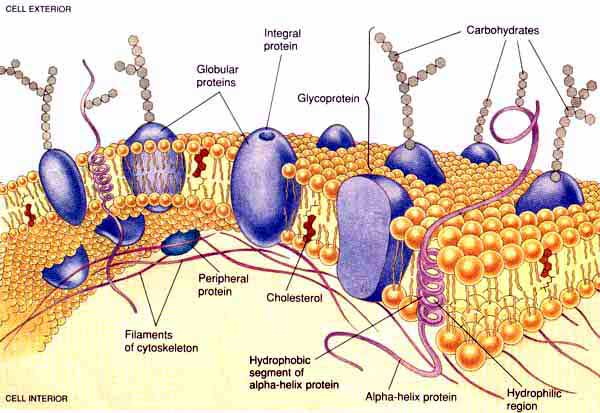
Whole Dude – Whole Human: The Biological Membrane or the Plasma Membrane separates protoplasm of the cell from its environment. It allows a highly controlled exchange of matter across the barrier it poses.

The functional activity called metabolism involves a living system’s continual exchange of some of its materials with its surroundings, principally in the process of building up, repairing, or breaking the molecules of life.

The most striking characteristics of protoplasm are its vital properties of Motion, and Nutrition. By Motion is meant the property which protoplasm has of changing its shape and position by some “intrinsic power” and exhibit amoeboid movement. Ciliary movement or the vibration of hair-like processes from the surface of any cell may also be regarded as a variety of the motion with which protoplasm is endowed. Nutrition is the “power” which protoplasm has of attracting to itself the materials necessary for its growth and maintenance from surrounding matter. When any foreign particle comes in contact with the protoplasmic substance, it becomes incorporated in it, being enwrapped by one or more processes projected from the parent mass which encloses it. When thus taken up, the foreign particle may remain in the substance of the protoplasm for some time without change, or may be again extruded. The living substance called protoplasm has the “intrinsic power” of motion and uses its power to ingest and to expel foreign particles in the external environment with which it may come into contact. The Biological Membrane or the Plasma Membrane which separates protoplasm of the cell from its environment allows a highly controlled exchange of matter across the barrier it poses; some compounds are able to pass through the membrane easily, others are completely blocked. The screening effect on the substances that enter and leave the cell is perhaps the most important function of the membrane.

The actions and behavior of protoplasmic substance are dependent upon its innate “power” and may not be attributable to elementary laws of Physics and Chemistry.

Spiritualism and Human Nature:

Whole Dude – Whole Human: Red Blood Cells provide a very good example of the adaptive subordination of cells to meet the requirements of the Whole Organism. The specialized functions of tissues and organs of human body are possible because of such functional subordination.

The structural differentiation and the functional organization of various organ systems makes man a very complex living organism. This kind of specialized functions of tissues and organs is possible because of adaptive subordination of the cells to the requirements of the Whole Organism. If altruism describes any behavior that appears to favor another individuals’ chances of survival, we can easily recognize this characteristic in the functions performed by the Red Blood Cells. Each Red Blood Cell lives for a very limited life span of its own and during its short period of existence it serves the purpose of the Whole Human Organism with a sense of devotion, with the spirit of cooperation, to provide assistance to all other cells, tissues, and organs of the body in a selfless manner.

I define the term ‘Spiritualism’ as the NATURE of a relationship, a partnership, an association, or bonding between two individual living entities based upon characteristics such as compassion, sympathy, understanding, cooperation, mutual assistance, mutual tolerance, voluntary subservience to provide some benefit to the member participating in the biotic interaction.

Spiritualism is innate and is not acquired by learning experience. The very existence of the human being and to perform the characteristic living functions, man depends upon the protoplasmic substance and its innate “power” to acquire energy from its external environment.

The human form becomes the actuality that it represents by the NATURE of its spiritual association with the protoplasmic living matter. Man is a spiritual being because of the spiritual nature of his protoplasmic living substance.

Whole Dude – Whole Human: The human nature of man is determined by the spiritual nature of his living substance often described as protoplasm.