BEIJING IS DOOMED – STRIKE BY SPACE SUPERPOWER

BEIJING IS DOOMED – STRIKE BY SPACE SUPERPOWER

BEIJING IS DOOMED – STRIKE BY SPACE SUPERPOWER. DOWNFALL OF BABYLON. BOLIDE COLLISION AND DINOSAUR EXTINCTION. REVELATION 18: 1-24.

During 2016, Red China spends over Six Billion Dollars to become World’s Space Superpower. Unlike the weird Quantum Phenomenon called “entanglement,” Red China’s “ENTANGLEMENT” with EVIL is no mystery. It is Known to ‘Space Superpower’, or “My Father in Heaven.” The word “EVIL” means Calamity, Catastrophe, Apocalypse, or Disaster. In due recognition of Red China’s Evil actions, ‘Doomsayer of Doom Dooma’ announces, “Beijing Is Doomed.” Red China’s “Roaming Dragon” will watch helplessly when Space Superpower Strikes Pudong Dragon’s Field called Shanghai. Bolide Collision caused Dinosaur Extinction and it takes another Bolide to wipe out Red Dragon.

Rudranarasimham Rebbapragada
Ann Arbor, MI 48104-4162 USA
SPECIAL FRONTIER FORCE

Beijing Is Doomed – Strike By Space Superpower. “Roaming Dragon” will watch helplessly as Space Superpower Strikes Pudong Dragon’s Field.

CHINA: THE NEW SPACE SUPERPOWER

For years, its space programme was shrouded in secrecy. Now, with plans for Lunar and Mars Missions, and crowds at its launch sites, China is ready for liftoff.

BEIJING IS DOOMED
BEIJING IS DOOMED – STRIKE BY SPACE SUPERPOWER

The Long March 7 carrier rocket blasts off on 25 June 2016 at the Wenchang launch site in the Hainan province of China. Photograph: VCG/Getty Images

STUART CLARK

Sunday 28 August 2016 04.00 EDT

At 8 pm Beijing time on 25 June this year the tropical darkness over China’s Hainan province was temporarily banished by a blinding orange light. Accompanied by the thunderous roar of engines, a 53m-tall rocket pushed itself into the sky.

China is developing rapidly into one of the major space players

Fabio Favata, European Space Agency

An increasing number of Chinese rockets have launched in the past few years but this one was significant for three reasons. It was the first launch of the new Long March 7 rocket, designed to help the Chinese place a multi-module space station in orbit. It was the first liftoff from China’s newly constructed Wenchang launch complex, a purpose-built facility set to become the focus for Chinese space ambitions. And it was the first Chinese launch where tourists were encouraged to go along and watch.

For a space programme that has long been shrouded in secrecy, it’s a major step. The Wenchang complex has been designed with large viewing areas, and in the sultry heat of that June night, tens of thousands of spectators stood cheering as the rocket began its 394km journey above the Earth and into orbit.

“China is developing very rapidly into one of the major space players,” says Fabio Favata, head of the programme coordination office at the European Space Agency’s (ESA) directorate of science. 

BEIJING IS DOOMED - SPACE SUPERPOWER.
BEIJING IS DOOMED – STRIKE BY SPACE SUPERPOWER.

The Long March 7 carrier rocket moves vertically to the launch tower in Wengchang, 22 June 2016. Photograph: VCG via Getty Images

China launched a pioneering “hack proof” quantum communication satellite, called Quantum Experiments at Space Scale, on 16 August from its older Jiuquan launch centre in the Gobi Desert. This is the first large-scale satellite designed to investigate the weird quantum phenomenon called “entanglement” that so unnerved Albert Einstein he once called it “spooky”. In addition, China is preparing to launch another new rocket design, a new space station, an X-ray telescope and a crewed mission before the year is out.

China is estimated to spend around $6bn a year on its space programme. Although that is almost $1bn more than Russia, it is still a fraction of the American Space Budget, which is around $40bn a year. Despite its large budget, the US made only 19 successful space launches in 2013, compared with China’s 14 and Russia’s 31. With numbers like this, it is clear that China has arrived in space, and is set to become stronger.

To use a Chinese phrase, they want to bring their own mat to the table. They want respect from the space community

“You will see the Chinese quite visibly begin to match the capacity of the other spacefaring powers by 2020,” predicts Brian Harvey, space analyst and author of China in Space: The Great Leap Forward. Key to this will be the large manned space station, Tiangong, which they plan to have in orbit by then. Although not as physically large as the International Space Station America, Russia, Europe, Japan and other countries have been building and using since 1998, China’s space station will have a broadly similar capacity to perform science.

“Science is becoming more and more important in the Chinese space programme,” says Wang Chi of the National Space Science Centre, Chinese Academy of Sciences. “We are not [just] satisfied with the achievements we have made in the fields of the space technology and space application. With the development of the Chinese space programme, we are trying to make contributions to human knowledge about the universe.”

Beijing is Doomed.
Beijing is Doomed – Strike By Space Superpower.


Chinese astronauts of the Shenzhou 10 manned spacecraft mission, Wang Yaping, Nie Haisheng and Zhang Xiaoguang. Photograph: ChinaFotoPress via Getty Images

Perhaps most impressive is the broad front on which the Chinese space programme is advancing. They are making strides in everything from human space flight to space science and planetary exploration.

So do the Chinese want to take over space? Brian Harvey, space analyst and author of China in Space: The Great Leap Forward, believes the Chinese simply want to be seen as equals. “To use a Chinese phrase, I think they are wanting to bring their own mat to the table,” he says. “They are looking for equality, they want respect from the world’s space community.”

To that end, China’s biggest inroad has been made with the ESA through the space science programme. Soon after the turn of the century. ESA launched the Cluster Mission to study so-called “space weather” and the electrical malfunctions this could cause on satellites. The Chinese were keen to learn more about space weather too and came to the European agency with a proposal: they would build extra satellites to enhance the Cluster mission if ESA would collaborate with them.

“They understood that space weather was a key challenge as we rely more and more on technology in orbit,” says Christopher Carr, a physicist at Imperial College, London, who worked on the Cluster mission. ESA took care of the negotiations, allowing scientists, including Carr, to build the instruments unhindered. Although there were some differences in working methods that had to be ironed out, Carr says: “Overall it was an enjoyable collaboration.”

The Double Star mission was launched in 2003 and became China’s first scientific satellite. Cluster and Double Star have so far produced 2,300 peer-reviewed science papers. “That is an enormously successful, astonishing scientific output,” says Carr.

China has gone from strength to strength. In December 2015, it launched the Dark Matter Particle Explorer, a satellite to look for the mysterious non-atomic matter that astronomers believe makes up a large fraction of the universe. This December, it plans to launch the Hard X-ray Modulation Telescope to look for black holes. ESA and China are working together on a new mission – the Solar Wind Magnetosphere Ionosphere Link Explorer (Smile), which is slated for launch in 2021.

The Chinese know that the value of these collaborations extends way beyond the science. “We are the newcomers in space science, and don’t have much experience,” says Wang Chi. “International collaborations are the shortcut for China to catch up with the world. In addition, science, especially space science, should be the responsibility of all humans around the globe. International collaboration is the effective way to obtain the maximum science return from any space mission.”

Favata agrees: “At ESA we collaborate with all major spacefaring nations. If Smile works well it is likely to be the pathfinder for future missions. ”

In stark contrast is America, where there is a blanket ban on working with China that dates back years. The most obvious consequence of this has been the exclusion of China from the International Space Station. But far from slowing the Chinese down, the cold shoulder has actually speeded them up.

Circling above us at the moment is the disused shell of China’s first space station. The eight-ton Tiangong 1 (Heavenly Palace) was launched on 29 September 2011 and hosted two three-person crews between 2012 and 2013. It is now abandoned and expected to re-enter Earth’s atmosphere some time later this year.

The Chinese will launch Tiangong 2, a second test station, next month. It will lead to a substantial orbital facility that will be in use by 2020. Known simply as Tiangong, it will be a key base for space research, with two large science modules joined together by a connecting service module.

“They can do a lot of science on it. It will have a research capacity that the ISS didn’t reach nearly as quickly,” says Harvey.

China is not planning to keep Tiangong all to itself. In June, it signed an agreement with the UN Office for Outer Space Affairs to open the station to experiments and astronauts from UN member states, specifically developing countries that find space too expensive at the moment.

And running the experiments is where China’s astronaut programme comes in. There have been just five crewed space flights since 2003, and none at all since 2013. This is deliberate. “The idea is to take a significant step forward each time,” says Harvey, “and they’re not going to cut corners in terms of safety.”

Beijing is Doomed.
Beijing is Doomed – Strike By Space Superpower.


2011: the Long March II-F rocket carrying the China’s first space station module Tiangong 1 at the Jiuquan Satellite Launch Center in north-west China’s Gansu Province. Photograph: AP

For the next decade, the Tiangong space station is likely to be the principal destination. Their crew capsule is called Shenzhou (divine vessel). It looks similar to the Russian Soyuz modules probably because the Chinese bought Soyuz technology in the mid-90s. This same agreement saw the training of two Chinese astronauts at the Yuri Gagarin Cosmonaut Training Centre in Russia, who then returned to China and trained more astronauts themselves.

Twelve Chinese astronauts have now been into space, including Liu Yang who became the first Chinese woman in space on Shenzhou 9 in 2012. Assuming the Tiangong 2 gets to orbit in September, then Shenzhou 11 will follow on 16 October, carrying two people whose identities have yet to be made public who are scheduled to spend a month on board.

“I think the military element in the Chinese space programme is quite overstated” : Brian Harvey, space analyst

Looking to the future, the Chinese have already begun testing the larger replacement of the Shenzhou capsule. A scaled-down version flew on the June flight of the Long March 7 from Hainan. This larger vehicle will be capable of taking up to six crew to the full Tiangong space station or on missions to lunar orbit.

It was the secondary payload, Aolong 1 (Roaming Dragon), on that launch that raised eyebrows, and stoked fears in some quarters that the civilian space programme is just a front for more covert operations. Aolong 1 has a robotic arm that can grab another satellite and guide it to burn up in Earth’s atmosphere. Officially, it is to remove space debris from orbit but it could also be used as a weapon, bringing down a rival’s satellite.

Although this is true of any space debris removal system, doubts remain because China does not have an unblemished record in anti-satellite weaponry. In 2007, the Chinese shot down one of their own orbiting spacecraft in what was probably a thinly veiled warning to America. Chinese concerns had been growing since 2002 when the US withdrew from 1972’s Anti-Ballistic Missile treaty, which paved the way for President George W Bush’s administration to develop space-based weapons systems.

Since that time, concern over China’s militarization of space has persisted in America. To others, however, that is little more than paranoia. “I think the military element in the Chinese space programme is overstated,” says Harvey. “It’s based on a misreading of the fact that their facilities are protected by the military. It’s a bit like saying the US military controlled the Apollo programme because the US navy took the returning astronauts out of the ocean. It doesn’t stand up.”

Beijing is Doomed - Space Superpower.
Beijing is Doomed – Strike By Space Superpower.

The Long March 2D carrier rocket carrying the remote sensing satellite Yaogan IV blasts off in December 2008. China claimed the satellite was used for scientific research purposes. Some western analysts believed they were spy satellites. Photograph: ChinaFotoPress/Getty Images

The military may not be in the driving seat, but it does launch about 15-20% of China’s space missions. The Yaogan series of satellites are billed as remote sensing missions but analysts believe they are actually spy satellites. “I suspect they are entirely military missions. I’ve never seen any scientific papers from the Yaogan missions,” says Harvey.

It is this American fear of China’s military that’s been driving the ban on collaboration, in particular the prevention of technologies being transferred to China by mistake. But now ESA has found a way to allow collaboration without the loss of control. It is “an elegant solution”, says astrophysicist Graziella Branduardi-Raymont at University College London, who is working on Smile. “China builds the basic spacecraft and sends it to Europe. ESA and its collaborators then attach the payload module, which holds the science instruments, and launches the mission. That way, no western tech goes to China.”

The Russians never got much further than paper studies in the 1970s. This is real, the spacecraft is already built

When it comes to rockets, China continues to develop a formidable arsenal of launch vehicles. Their rockets are called Long March and have been in development since the 1970s. The mainstay of their complement is gradually being replaced by the Long March 5, 6 and 7.

While the Long March 7 in June was capable of lifting about 13 tonnes into low Earth orbit, it is the Long March 5 that analysts are really excited about. Due to make its maiden flight this autumn, it’s capable of lifting 25 tonnes to low Earth orbit, rivaling anything the Americans, Russians or Europeans currently have. It is not yet known what the Long March 5 will send into orbit, but the giant rocket’s second flight, scheduled for next year, will be carrying a very special cargo. It will be a robotic mission designed to land on the lunar surface and send back samples of moon rock to the Earth for Chinese scientists to analyse.

Beijing is Doomed - Space Superpower.
Beijing is Doomed – Strike By Space Superpower.


China’s Shenzhou 10 rocket blasts off from the Jiuquan space centre in the Gobi Desert in June 2013. Photograph: AFP/Getty Images

The Chinese call their lunar exploration mission Chang’e, after the Chinese goddess of the moon. In December 2013 Chang’e 3 hit the headlines after it successfully deployed a small rover on the lunar surface. Despite some technical problems, it continued to return data until just a few weeks ago.

Now, China plans to land a similar mission on the far side of the Moon in 2018. This will be a world first. “The Russians did think about such a mission in the 1970s but they never got much further than paper studies. This is real, the spacecraft is already built,” says Harvey.

Also in the advanced planning stages is a rover to go to Mars. Penciled in for launch in 2020, the Chinese Mars mission is going to find itself racing NASA and the ESA, which have their own Mars rover missions launching that year too.

But what about a human landing on the moon? There could be no bigger sign of Chinese competency than that. Sure, America did it almost 50 years ago but with each passing year Apollo seems to have less relevance to the modern exploration of space. NASA has held back from committing to a new round of lunar landings. Russia and ESA would both like to go to the moon but can’t go it alone. The Chinese, however, seem to have the lunar surface in their sights. Designs for a Long March 9 rocket are currently being studied. With the first launch for the Long March 9 due in 2025, China could very well be in a position to land astronauts on the moon by 2030. This puts it roughly neck-and-neck with America, which currently plans to send astronauts to lunar orbit in 2023 but which has made no commitment to returning to the surface.

Beijing Is Doomed – Strike By Space Superpower.

Liu Yang, China’s first female astronaut, waves during a departure ceremony before becoming the first Chinese woman in space in June 2012. Photograph: Jason Lee/Reuters

Almost certainly this will be a flashpoint, but the ignition of a new space race would be a mistake. The Apollo programme of the 1960s cost the equivalent of hundreds of billions of dollars for little more than technological one-upmanship. Better now, surely, to cooperate, spreading the cost and the benefit across the world.

The Chinese space programme is gaining momentum year upon year. Its power lies not in unlimited funds but in carefully chosen projects, and the pursuit of clearly targeted goals – something the traditional space powers could learn from, especially when is comes to the crewed programmes.

At present there is no agreement on what to do when the current agreements to use the International Space Station come to an end in 2024. With America continuing to talk about hugely expensive missions to Mars, but with no real plans or budget in place to do this, Russia and ESA could increasingly find that their space ambitions are more aligned with those of the Chinese.

Beijing Is Doomed – Strike By Space Superpower.

Mission control at the Jiuquan space centre in the Gobi Desert after China’s longest manned space mission in 2013. Photograph: AFP/Getty Images

What is clear is that the Chinese space programme is more willing than ever to cooperate. With the signing of the UN agreement to host foreign experiments and eventually astronauts on their space station, the Chinese are opening up. It is of course hard to imagine Russia and in particular ESA abandoning Nasa altogether, but it is not inconceivable. In the aftermath of 2008’s credit crunch, Nasa pulled out of a number of high-profile joint missions with Europe, including robotic Mars exploration and space-based observatories. This left ESA floundering for new partners, or frantically rescoping its missions. Increasingly, China will play a role in the international exploration of space, and although it is early days they have so far they have proved to be highly reliable.

A seismic shift in space power is taking place. Europe could pivot either way or balance in the middle. Although most still talk about China “becoming” a space superpower, it is likely that history will record the tipping point as 25 June this year, when a giant rocket split the sky amid the cheers of more than 20,000 tourists.

© 2016 Guardian News and Media Limited or its affiliated companies. All rights reserved.

Beijing Is Doomed - Strike By Space Superpower. Genesis 19. Sodom and Gomorrah Destroyed.
Beijing Is Doomed – Strike By Space Superpower. Genesis 19. Sodom and Gomorrah Destroyed.
Beijing Is Doomed - Strike By Space Superpower. Genesis 19. Downfall of Sodom and Gomorrah.
Beijing Is Doomed – Strike By Space Superpower. Genesis 19. Downfall of Sodom and Gomorrah.
Beijing Is Doomed - Strike By Space Superpower. Genesis 19. Burning of Sodom and Gomorrah.
Beijing Is Doomed – Strike By Space Superpower. Genesis 19. Burning of Sodom and Gomorrah.
Beijing Is Doomed - Strike by Space Superpower. Genesis 19: 24-25. Burning of Sodom and Gomorrah.
Beijing Is Doomed – Strike by Space Superpower. Genesis 19: 24-25. Burning of Sodom and Gomorrah.
Beijing Is Doomed - Strike by Space Superpower. Genesis 19. Sodom and Gomorrah Destroyed.
Beijing Is Doomed – Strike by Space Superpower. Genesis 19. Sodom and Gomorrah Destroyed.
Beijing Is Doomed - Strike By Space Superpower. Genesis 19. Regime Change By Burning Sulfur.
Beijing Is Doomed – Strike By Space Superpower. Genesis 19. Regime Change By Burning Sulfur.
BEIJING IS DOOMED - STRIKE BY SPACE SUPERPOWER.. GENESIS 19: 24-25.
BEIJING IS DOOMED – STRIKE BY SPACE SUPERPOWER.. GENESIS 19: 24-25.


MAGIC KINGDOM IN SHANGHAI – MAGIC OF REGIME CHANGE IN PUDONG DRAGON’S FIELD

MAGIC KINGDOM IN SHANGHAI – MAGIC OF REGIME CHANGE IN PUDONG DRAGON’S FIELD

MAGIC KINGDOM IN SHANGHAI – MAGIC OF REGIME CHANGE IN PUDONG DRAGON’S FIELD. DOWNFALL OF BABYLON. REVELATION 18: 1-24.

Communist Party of China makes huge capital investment to open Disneyland Amusement Park ‘Magic Kingdom’ in Shanghai. Communist Party of China will know Magic of Regime Change in Pudong Dragon’s Field. Prophecy of Babylon’s sudden Downfall Unsealed.

Rudranarasimham Rebbapragada
Ann Arbor, MI 48104-4162 USA
SPECIAL FRONTIER FORCE

MAGIC KINGDOM IN SHANGHAI – MAGIC OF REGIME CHANGE IN PUDONG DRAGON’S FIELD. FALL OF BABYLON, REVELATION 18: 1-24.

Business News

Shanghai Disneyland: Communist Party emerges largest backer

Though capitalism and socialism make strange bedfellows, it is less known that the largest backer of Disneyland is the Communist Party itself

By: ANURAG VISWANATH Published: August 13, 2016 6:21 AM

Magic Kingdom in Shanghai - Magic of Regime Change. Fall of Babylon in Pudong Dragon's Field. Revelation 18: 1-24.
Magic Kingdom in Shanghai – Magic of Regime Change. Fall of Babylon in Pudong Dragon’s Field. Revelation 18: 1-24.

This summer, Walt Disney’s $5.5-billion Disneyland—an extravaganza of a narrowly-construed “American fantasy”—finally opened its doors in Shanghai, China. This was to a largely curious domestic audience who, up until now, had been unable to afford the luxury of next-door Hong Kong’s Disneyland. Certainly, the mad rush at Shanghai’s Disneyland—located at the south-eastern fringes of Pudong, which until 1990s was marshes, farmland and herdsmen, so-to-speak an area on Shanghai’s fringe—is to be seen to be believed. In the metamorphosis of the Pudong marshes and the coming of Mickey Mouse to Mao’s land, hangs many a tale.

But first the euphoria. Despite the exorbitantly-priced entry ticket to Disneyland (RMB 499 for peak season, about R4,900), folks, both urban and rural, young and old, have not stopped making a beeline—and this in a country where the average disposable income is RMB 1,830 (about R18,000). Three-hour serpentine queues for flight simulator “Soaring Over the Horizon”, the partial closure of “Adventure Isle Roaring Rapids” and the scorching Shanghai summer heat didn’t deter crowds who flocked armed with parasols, water bottles and a few sporting the ubiquitous Mickey Mouse T-shirts. Disneyland is expecting 20 million visitors in 2017. Chinese Tourism spending is estimated at $610 billion in China and abroad. There are about 120 million outbound Chinese tourists—six times the number of outbound Indian tourists (20 million). China’s domestic tourism is high during the two “golden weeks” (National Day in October and Spring Festival in February) and is on the upsurge. Mickey Mouse wants to cash in.

What does the arrival of Mickey Mouse in China mean? While there are little doubts about the sheer elasticity of China’s “socialism with Chinese characteristics”, the bottom line is Communist Party’s propensity for hard-nosed economics—where tourism and, de facto, consumption is the new mojo.

Certainly, Disneyland did not happen overnight, but came with the careful cultivation of Pudong.

Nothing exemplifies Pudong more than China’s moderniser-par-excellence Deng Xiaoping’s adage “build nests, the birds will come”. Pudong, an area on the wrong side of the Huangpu River, was long barren until it was identified as the “dragon-head of reforms” by none other than Deng Xiaoping in 1992. Since then, the urbanisation of Pudong has been phenomenal—attested by the world’s second-tallest skyscraper, Shanghai Tower. Pudong is a mirror to China’s urbanisation, from 17.9% in 1978 to 53.7% in 2013. Today, urbanisation—a la Pudong—has been identified as the core strategy for development by the National Urbanisation Plan (2014-20), with the objective of 60% urbanisation by 2020. Of course, Pudong has been successful, but the blind precipitous imitation of the Pudong strategy elsewhere by local governments has backfired. In fact, scholars and critics decry the same as “forced urbanisation”.

That said, the sheer weight of state-led initiative to urbanise Pudong is no less laudatory.

Second, while business in India depends on political weather and ideological rhetoric, Disneyland was embraced with flexibility, if you please, to accommodate ideological lightweights such as Mickey and his friends. Disneyland witnessed little or no political upheavals (notwithstanding political succession struggles at Beijing)—when the Communist Party gave the commitment, it was for the long haul—start to finish.

While India continues to struggle with land acquisition, with the onus for acquisition resting on states, China does it swiftly and top-down. Disneyland covers 960 acres, nine times the size of Commonwealth Games Village, New Delhi—leading up to the relocation of 150 factories and the resettlement of 2,000 households belonging to four townships. At last count, there was no social assessment project, but there was no widespread bungling of finances in the resettlement either.

Thus, business in China largely rides on the diktat of the Party, which has a long-term vision. Disneyland was a hard-won fight with lobbying and negotiations, starting in the late 1990s. The chief executive of Disney, Robert Iger, first visited Communist Party leader Yu Zhengsheng in Shanghai in 2008. To Disney’s credit, a photograph of senior Xi (father of current Chinese President Xi Jinping) shaking hands with Mickey Mouse at Disneyland (presumably in California) in 1980 appeared as a token of friendship—no doubt, a veritable diplomatic coup.

Though capitalism and socialism make strange bedfellows, Disney’s entry was not all about diplomatic manoeuvres only. It is less known that the largest backer of Disneyland is the Communist Party itself—in the shape of Disney’s local partner, state-owned, joint-investment holding Shanghai Shendi Group.

While Disney owns 43% of the resort, the Shanghai Shendi Group, in addition to 30% control of the Disney management company, takes “57% stake in the Shanghai resort, which includes revenue from hotels, restaurants and merchandise sold on the grounds.” This has been a cut-throat deal as opposed to Disney’s presence in Hong Kong (2005), which literally cajoled Disney to set up shop.

Third, Pudong, the dragon-head, has spurred a multiplier effect. Now, Shanghai Shendi Group has concluded a deal with US outlet developer Value Retail to build an outlet and a seven-star hotel, Shanghai Atlantis resort will follow.

At Beijing, Universal Studios has said that its sixth theme park globally—after Hollywood and Orlando in the US, and in Spain, Singapore and Tokyo—will be operational by 2019.

Fourth, at the home front, Chinese billionaire and largest commercial property developer Wang Jianlin (head of the Dalian Wanda Group which signed a preliminary agreement with Indian authorities to develop Wanda Industrial New City in Haryana) has likened Disney to a “lone tiger” against a “pack of wolves”, indicating competition at the home turf.

For now, the pack of wolves seem to emanate from the Wanda stable and should not be underestimated. A lavish array of theme parks have been set afloat by Wanda in tier-2 cities—such as Wuxi (near Shanghai), Nanchang (730-km east of Shanghai), Hefei (460-km east of Shanghai), Harbin (2,300-km north of Shanghai) and Xishuangbanna (2,900-km south of Shanghai)—which are centred not around Mickey Mouse or even Pokemon, but elements of local Chinese ethnic culture, geography or tradition. Reportedly, Xishuangbanna theme park features adventures around the old Tea Road (route) and a jungle adventure with a rainforest theme. In other words, will Wanda give Disneyland a run for its money?

Disneyland in Shanghai has a sense of “Chineseness”—as it does in Japan with a certain “Japaneseness”. But Mickey Mouse has also come with American prices in China—RMB 60 doughnut, RMB 60 balloon (about R600) and an overpriced ticket. Ten years ago, Disneyland would have been a monopoly, but what about today? Those who have been to the string of mid-range Wanda hotels know that it cuts no corners and so it is with the Wanda theme parks. In other words, while the euphoria is palpable, Disneyland’s fate in the long run is the big question.

Last but not the least, be it Mickey Mouse or Wanda’s Tea Road adventure, grant it to the Communist Party, which has done its math well—an eye on tourism, the burgeoning middle-class
and a ride to the bank. With global and China’s slowdown in exports, a thrust towards domestic consumption, Disneyland (and Wanda parks) all help drive up consumer spending.

The author is a Singapore-based Sinologist and adjunct fellow at the Institute of Chinese Studies,
New Delhi. She is the author of “Finding India in China”

Copyright © The Indian Express [P] Ltd. All Rights Reserved.

Magic Kingdom in Shanghai - Magic of Regime Change in Pudong Dragon's Field. Fall of Babylon, Revelation 18: 1-24.
Magic Kingdom in Shanghai – Magic of Regime Change in Pudong Dragon’s Field. Fall of Babylon, Revelation 18: 1-24.
Magic Kingdom in Shanghai - Magic of Regime Change in Pudong Dragon's Field.
Magic Kingdom in Shanghai – Magic of Regime Change in Pudong Dragon’s Field.
Magic Kingdom in Shanghai - Magic of Regime Change in Pudong Dragon's Field.
Magic Kingdom in Shanghai – Magic of Regime Change in Pudong Dragon’s Field.
Magic Kingdom in Shanghai - Magic of Regime Change in Pudong Dragon's Field.
Magic Kingdom in Shanghai – Magic of Regime Change in Pudong Dragon’s Field.
Magic Kingdom in Shanghai - Magic of Regime Change in Pudong Dragon's Field.
Magic Kingdom in Shanghai – Magic of Regime Change in Pudong Dragon’s Field.
Magic Kingdom in Shanghai - Magic of Regime Change in Pudong Dragon's Field. Fall of Babylon, Revelation 18: 1-24.
Magic Kingdom in Shanghai – Magic of Regime Change in Pudong Dragon’s Field. Fall of Babylon, Revelation 18: 1-24.
Downfall of Red Dragon - Regime Change By Bolide Impact. Refer to REVELATION, 18:1-24. Bolide Impact Dinosaur Extinction.
Magic Kingdom in Shanghai – Magic of Regime Change in Pudong Dragon’s Field. Downfall of Babylon – Regime Change By Bolide Impact. REVELATION 18: 1-24. 


DOWNFALL OF RED DRAGON – REGIME CHANGE BY BOLIDE IMPACT

DOWNFALL OF RED DRAGON – REGIME CHANGE BY BOLIDE IMPACT

DOWNFALL OF RED DRAGON - REGIME CHANGE BY BOLIDE IMPACT. REFER TO REVELATION, 18:1-24.
DOWNFALL OF RED DRAGON – REGIME CHANGE BY BOLIDE IMPACT. REFER TO REVELATION, 18:1-24.

Natural History of planet Earth records sudden demise of Dinosaurs that lived for about 160 million years. Dinosaur Extinction is called Cretaceous – Tertiary or K-T Mass Extinction Event. This downfall of Dinosaurs is attributed to “BOLIDE” impact; a large Meteor or asteroid, or comet exploding in Earth’s atmosphere.

In Human History, powerful regimes have risen and have fallen down. But, there is no historical record of any empire’s downfall caused by ‘Bolide’ impact. Interestingly, The New Testament Book ‘REVELATION’ in Chapter 18 predicts Fall of Babylon by ‘Bolide’ impact. This prophecy has not yet come true.

I unsealed this prophecy for I am destined to be known as ‘Doomsayer of Doom Dooma’. For the first time in recorded Human History, I expect Regime Change by ‘Bolide’ Impact causing sudden Downfall of Evil Red Empire which is often represented by ‘Red Dragon’.

Rudranarasimham Rebbapragada
Ann Arbor, MI 48104-4162 USA
SPECIAL FRONTIER FORCE

THIS DAY IN HISTORY: 08/12/1990 – SKELETON OF T-REX DISCOVERED

Downfall of Red Dragon – Regime Change by Bolide Impact. Tyrannosaurus rex Skeleton Discovered on August 12, 1990.


A full Tyrannosaurus Rex skeleton is discovered on This Day in History. The date is August 12th. Susan Hendrickson, a paleontologist, discovers the T Rex in Faith, South Dakota.

Author: History.com Staff URL:http://www.history.com/this-day-in-history/skeleton-of-tyrannosaurus-rex-discovered Publisher: A+E Networks

On this day in 1990, fossil hunter Susan Hendrickson discovers three huge bones jutting out of a cliff near Faith, South Dakota. They turn out to be part of the largest-ever Tyrannosaurus rex skeleton ever discovered, a 65 million-year-old specimen dubbed Sue, after its discoverer.

Amazingly, Sue’s skeleton was over 90 percent complete, and the bones were extremely well-preserved. Hendrickson’s employer, the Black Hills Institute of Geological Research, paid $5,000 to the land owner, Maurice Williams, for the right to excavate the dinosaur skeleton, which was cleaned and transported to the company headquarters in Hill City. The institute’s president, Peter Larson, announced plans to build a non-profit museum to display Sue along with other fossils of the Cretaceous period.

In 1992, a long legal battle began over Sue. The U.S. Attorney’s Office claimed Sue’s bones had been seized from federal land and were therefore government property. It was eventually found that Williams, a part-Native American and member of the Cheyenne River Sioux tribe, had traded his land to the tribe two decades earlier to avoid paying property taxes, and thus his sale of excavation rights to Black Hills had been invalid. In October 1997, Chicago’s Field Museum purchased Sue at public auction at Sotheby’s in New York City for $8.36 million, financed in part by the McDonald’s and Disney corporations.

Sue’s skeleton went on display at the Field Museum in May 2000. The tremendous T.rex skeleton–13 feet high at the hips and 42 feet long from head to toe–is displayed in one of the museum’s main halls. Another exhibit gives viewers a close-up view of Sue’s five foot-long, 2,000-pound skull with its 58 teeth, some as long as a human forearm.

Sue’s extraordinarily well-preserved bones have allowed scientists to determine many things about the life of T.rex. They have determined that the carnivorous dinosaur had an incredible sense of smell, as the olfactory bulbs were each bigger than the cerebrum, the thinking part of the brain. In addition, Sue was the first T.rex skeleton to be discovered with a wishbone, a crucial discovery that provided support for scientists’ theory that birds are a type of living dinosaur. One thing that remains unknown is Sue’s actual gender; to determine this, scientists would have to compare many more T.rex skeletons than the 22 that have been found so far.

© 2016, A&E Television Networks, LLC. All Rights Reserved.

Downfall of Red Dragon - Regime Change by Bolide Impact. Refer to REVELATION, 18:1-24. Bolide Events 1994 - 2014.
Downfall of Red Dragon – Regime Change by Bolide Impact. Refer to REVELATION, 18:1-24. Bolide Events 1994 – 2013.
Downfall of Red Dragon - Regime Change By Bolide Impact. Refer to REVELATION, 18:1-24. Bolide is large METEOR.
Downfall of Red Dragon – Regime Change By Bolide Impact. Refer to REVELATION, 18:1-24. Bolide is large METEOR.
Downfall of Red Dragon - Regime Change By Bolide Impact. Refer to REVELATION, 18:1-24. Bolide Impact Dinosaur Extinction.
Downfall of Red Dragon – Regime Change By Bolide Impact. Refer to REVELATION, 18:1-24. Bolide Impact Dinosaur Extinction.

THE FUTURE OF RED CHINA WITHOUT DALAI LAMA

THE FUTURE OF RED CHINA WITHOUT DALAI LAMA

THE FUTURE OF RED CHINA AFTER DALAI LAMA. I HAVE NO CONCERNS FOR FUTURE OF TIBETAN BUDDHISM AFTER DALAI LAMA.
THE FUTURE OF RED CHINA WITHOUT  DALAI LAMA. I HAVE NO CONCERNS FOR FUTURE OF TIBETAN BUDDHISM WITHOUT DALAI LAMA.


What will be the future of Red China without Dalai Lama??? I am not asking about the future of Tibet or Tibetan Buddhism with or without Dalai Lama. As ‘Doomsayer of Doom Dooma’, I am predicting a future event, a sudden disaster, catastrophe, apocalypse, cataclysmic event that will bring downfall of Red China and there will be no person or nation to save her.

THE FUTURE OF RED CHINA WITHOUT DALAI LAMA. BEIJING IS DOOMED.


Rudranarasimham Rebbapragada

Ann Arbor, MI 48104-4162 USA
SPECIAL FRONTIER FORCE

WHAT’S THE FUTURE OF THE DALAI LAMA? NEW YORK TIMES MAGAZINE POSES THE RIGHT QUESTIONS 

THE FUTURE OF RED CHINA WITHOUT DALAI LAMA. I HAVE NO CONCERNS ABOUT FUTURE OF TIBET OR TIBETAN BUDDHISM WITH OR WITHOUT DALAI LAMA.
THE FUTURE OF RED CHINA WITHOUT DALAI LAMA. I HAVE NO CONCERNS ABOUT FUTURE OF TIBET OR OF TIBETAN BUDDHISM WITH OR WITHOUT DALAI LAMA.


JULIA DUIN, December 13, 2015

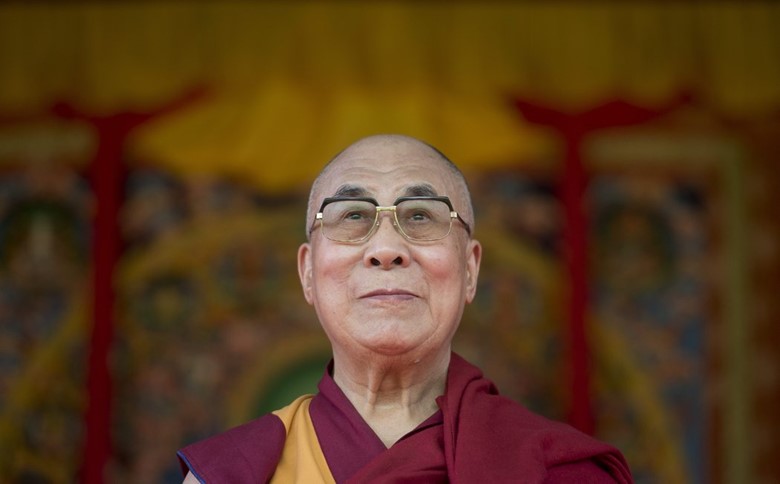
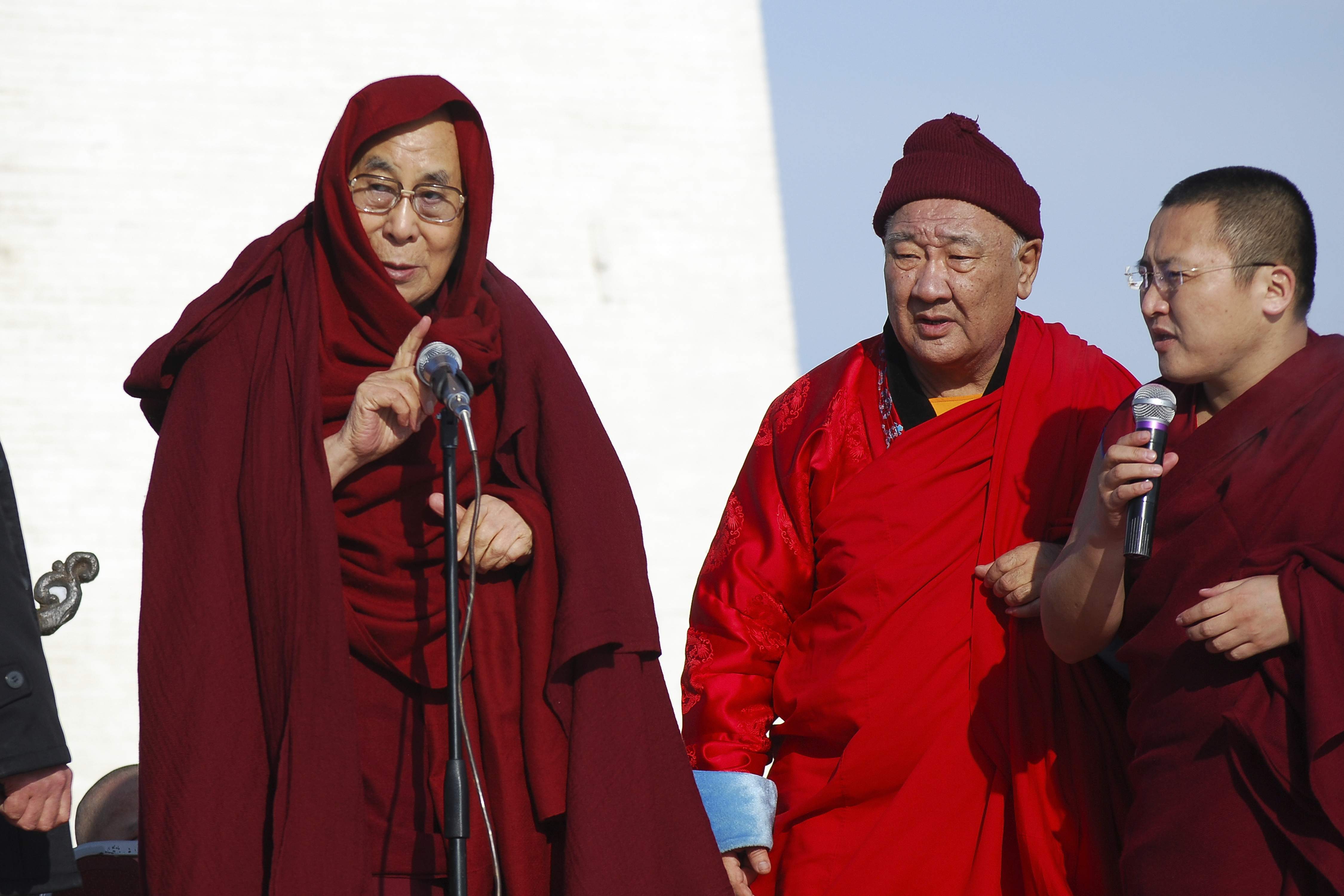
The Dalai Lama was the topic of a New York Times magazine profile recently, and unlike the laudatory sort of write-ups one usually sees about this 80-year-old religious icon, this one calls his leadership into question.

THE FUTURE OF RED CHINA WITHOUT DALAI LAMA. I PREDICT SUDDEN CATASTROPHIC DOWNFALL OF THE EVIL RED EMPIRE AFTER DALAI LAMA WITH OR WITHOUT HIS REINCARNATION.


Not only his leadership, but his legacy is questioned this time around

We’ve written about how he decided four years ago to give up his political role as head of the world’s exiled Tibetan community. The Buddhist leader will be dying sooner or later, the article says, and maybe sooner. So what will happen then to Tibetan Buddhism and the cause of free Tibet?
So you get paragraphs like this:

The economic potency of China has made the Dalai Lama a political liability for an increasing number of world leaders, who now shy away from him for fear of inviting China’s wrath. Even Pope Francis, the boldest pontiff in decades, report­edly declined a meeting in Rome last December. When the Dalai Lama dies, it is not at all clear what will happen to the six million Tibetans in China. The Chinese Communist Party, though officially atheistic, will take charge of finding an incarnation of the present Dalai Lama. Indoctrinated and controlled by the Communist Party, the next leader of the Tibetan community could help Beijing cement its hegemony over Tibet. And then there is the 150,000-strong community of Tibetan exiles, which, increasingly politically fractious, is held together mainly by the Dalai Lama. The Tibetan poet and activist Tenzin Tsundue, who has disagreed with the Dalai Lama’s tactics, told me that his absence will create a vacuum for Tibetans. The Dalai Lama’s younger brother, Tenzin Choegyal, was more emphatic: ‘‘We are finished once His Holiness is gone.’’

I had forgotten the dust-up about the pope not meeting with the Buddhist leader, but a year has passed since then and they have yet to meet.
The article continues on, recounting how 140 Buddhist monks and nuns have publicly set themselves on fire to protest the suppression of Tibet by China. And what does the Dalai Lama do in response?

As if in response to these multiple crises in his homeland, the Dalai Lama has embarked on some improbable intellectual journeys. In 2011, he renounced his role as the temporal leader of the Tibetan people and declared that he would focus on his spiritual and cultural commitments. Today, the man who in old photos of Tibet can be seen enacting religious rites wearing a conical yellow hat — in front of thangkas, or scrolls, swarming with scowling monsters and copulating deities — speaks of going ‘‘beyond religion’’ and embracing ‘‘secular ethics’’: principles of selflessness and compassion rooted in the fundamental Buddhist notion of interconnectedness.

Increasingly, the Dalai Lama addresses himself to a nondenominational audience and seems perversely determined to undermine the authority of his own tradition. He has intimated that the next Dalai Lama could be female. He has asserted that certain Buddhist scriptures disproved by science should be abandoned. He has suggested — frequently, during the months that I saw him — that the institution of the Dalai Lama has outlived its purpose. Having embarked in the age of the selfie on a project of self-abnegation, he is now flirting with ever-more-radical ideas. One morning at his Dharamsala residence in May this year, he told me that he may one day travel to China, but not as the Dalai Lama.

As much as this leader would like to shuck off his political obligations, the world won’t let him, the article notes. There is simply no one to take his place.
Still, as a political negotiator, the article states, he has failed. But who wouldn’t? Was the Dalai Lama supposed to be a modern-day Gandhi, bringing China to its knees somehow? Rather, it’s China that is setting the conditions. The Dalai Lama very much wants to return to Tibet before he dies. By the time you’ve finished this piece, you’ll be convinced that will never happen.
One thing the writer — who is an Indian intellectual and author who’s had access to the Buddhist spiritual leader for years — brings out is the ordinariness of the man. He lists a number of things the Dalai Lama will do to confound people and keep them from putting him on a pedestal.
I have covered two of the DL’s appearances in the Washington, DC area. The one included an esoteric discourse on Buddhism that defied translation. But the other had quite a bit of barnyard humor, which was tough to square with a world-famous monk. I never knew if the latter was part of an earthiness that comes with being from that part of the world, or something else. The author of this piece likewise captures the oddity of the Dalai Lama, who will sometimes make weird jokes or pronouncements in public settings that make little or no sense or seem odd at best.
Couple that with examples throughout the piece about how the Dalai Lama and his cause are losing traction throughout the West, and one concludes that by waiting out the Dalai Lama, the Chinese may win this battle.
The piece has way more to say about politics than religion, although it does have flashes of insight like the following:

The ‘‘world picture,’’ as he saw it, was bleak. People all over the world were killing in the name of their religions. Even Buddhists in Burma were tormenting Rohingya Muslims. This was why he had turned away from organized religion, engaged with quantum physics and started to emphasize the secular values of compassion. It was no longer feasible, he said, to construct an ethical existence on the basis of traditional religion in multicultural societies.

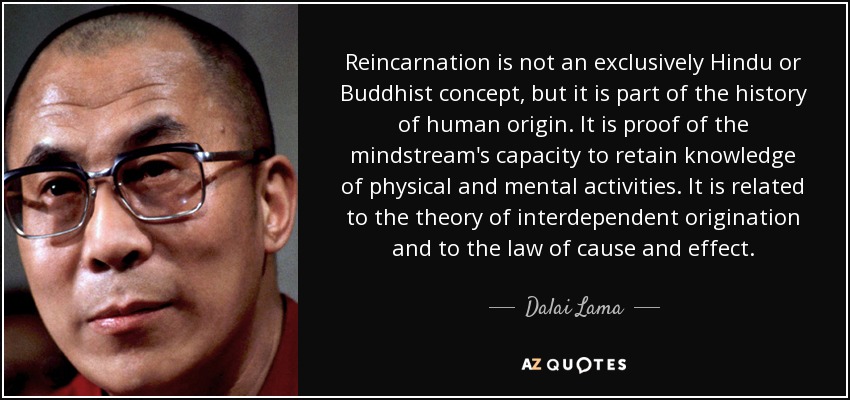
When asked if he means to reincarnate once he dies, the Dalai Lama answers that he does not. Our GetReligioncolleague Ira Rifkin covered this pronouncement earlier this year. The institution of the Dalai Lama, the author of the magazine article points out, has reached the end of its usefulness.
So what will happen with Tibet? In one sense, the article leaves you hanging. In another sense, it’s clear that the Dalai Lama has already checked out.
There are a few journalistic burps in this piece, one being that the Buddha was born in Nepal, not India as the article says. And as one commentator pointed out, Tibetan Buddhism believes its leaders must reincarnate until everyone is ready for full enlightenment. So how can this Dalai Lama say he will not reincarnate?
Otherwise, it raises the right questions about a man who, along with Pope Francis, is one of the world’s top spiritual leaders.

Shutterstock photos by Nadezda Murmakova and Phaendin.

© 2014 GetReligion.org unless otherwise noted.

All rights reserved.

THE FUTURE OF RED CHINA WITHOUT DALAI LAMA. RED CHINA'S FUTURE IS SEALED BY THIS PROPHECY.
THE FUTURE OF RED CHINA WITHOUT DALAI LAMA. RED CHINA’S FUTURE IS SEALED BY THIS PROPHECY.


THE FUTURE OF RED CHINA WITHOUT DALAI LAMA. BEIJING IS DOOMED. THE FUTURE OF TIBETAN BUDDHISM IS NOT AT RISK. RED CHINA IS DESTINED TO LOSE POWER AND STATUS.


THE FUTURE OF RED CHINA WITHOUT DALAI LAMA. BEIJING IS DOOMED.


THE EVIL RED EMPIRE – CONSUMERISM AND ECONOMIC EXPANSIONISM

THE EVIL RED EMPIRE – CONSUMERISM AND ECONOMIC EXPANSIONISM

THE EVIL RED EMPIRE – CONSUMERISM – ECONOMIC EXPANSIONISM. RED CHINA’S SHIFT FROM COMMUNISM TO CONSUMERISM POSES A GREATER DANGER . COMMUNIST PARTY CHAIRMAN MAO ZEDONG’S DREAM OF PROLETARIAN REVOLUTION IS BURIED.

Consumerism is a theory that claims continual increase in consumption of material goods is sound economically. Red China buried her dreams of Proletarian Revolution to embrace this theory of ‘CONSUMERISM’ as a means to accomplish her goal of Economic Expansionism. People all over the world have recognized dangers posed by practice of Consumerism. What we clearly need is Consumer Protection, not only laws to safeguard interests of the buying public, but also to protect rights of workers, communities, environment, and ecological systems that sustain delicate natural equilibrium. The lives, health, and well-being of both workers and consumers is compromised by hazardous products and planet Earth is facing a major challenge to the very existence of Life. Red China’s Economic Expansionism is not sustainable and her economic collapse is simply inevitable. Red China’s Economic Meltdown is indeed a Blessing to all of us.

Rudranarasimham Rebbapragada
Ann Arbor, MI 48104-4162 USA
SPECIAL FRONTIER FORCE

The Evil Red Empire. The Evil of Consumerism is far more dangerous than the Evil of Communism.


THE EVIL RED EMPIRE – CONSUMERISM – ECONOMIC EXPANSIONISM. RED CHINA’S ECONOMIC MELTDOWN IS A BLESSING TO ALL OF US.
The Evil Red Empire - Consumerism - Economic Expansionism. Red China's Shift to Consumerism is the Driving Force causing Income Inequality.
The Evil Red Empire – Consumerism – Economic Expansionism. Red China’s Shift to Consumerism is the Driving Force causing Income Inequality.
The Evil Red Empire - Consumerism - Economic Expansionism.Red China is forcing a Culture of Consumption chasing a Mirage of Economic Prosperity.
The Evil Red Empire – Consumerism – Economic Expansionism.Red China is forcing a Culture of Consumption chasing a Mirage of Economic Prosperity.
The Evil Red Empire - Consumerism - Economic Expansionism. Self-Indulgence leads to Self-Destruction.
The Evil Red Empire – Consumerism – Economic Expansionism. Self-Indulgence leads to Self-Destruction.
The Evil Red Empire - Consumerism - Economic Expansionism Plan is Fundamentally Flawed.
The Evil Red Empire – Consumerism – Economic Expansionism Plan is Fundamentally Flawed.

THE US NEWS & WORLD REPORT

 IS CHINA COOKING THE BOOKS ON ECONOMIC EXPANSION?

Analysts aren’t terribly confident in the Chinese government’s economic growth data.

THE EVIL RED EMPIRE – CONSUMERISM – ECONOMIC EXPANSIONISM. RED CHINA DRIFTED FROM PROLETARIAN REVOLUTION TO PROMOTING MASS CONSUMERISM TO POWER ITS ECONOMIC ENGINE. RED CHINA’S ECONOMIC DOWNFALL IS A BLESSING TO ALL PEOPLE.

China’s government expects its economy to grow 6.5 percent each year between 2016 and 2020.

By ANDREW SOERGEL Nov. 2, 2015 | 1:10 p.m. EST
One of China’s most senior government officials over the weekend said his country’s economy should expect to see “at least 6.5 percent” gross domestic product growth each year between 2016 and 2020, despite a growing pool of evidence suggesting China is in the midst of a historic economic slowdown.

But whether Chinese GDP numbers actually paint a clear economic picture is another question entirely.

“We propose to achieve the goal of creating a ‘moderately prosperous society’ by 2020, which requires annual economic growth of at least 6.5 percent over the next five years,” Chinese Premier Li Keqiang said Sunday during a speech in Seoul, according to The Associated Press.
He said the economy is operating within a “reasonable range” and that the government has “the confidence and ability” to hit its growth target of “about 7 percent” this year.

THE EVIL RED EMPIRE – CONSUMERISM – ECONOMIC EXPANSIONISM. RED CHINA PURSUING A PATH OF SELF-DESTRUCTION.

Rumors had floated around in the days and weeks leading up to Sunday’s announcement that the government would eventually lower its expansion goals for the next several years following a slew of recently underwhelming economic indicators suggesting Asia’s financial giant was beginning to cool. Exports and imports have plummeted in recent months, and the Chinese government announced in October that GDP expanded by only 6.9 percent in the third quarter – which represents the worst three-month period for the Chinese economy since the world was just emerging from the global financial crisis in 2009.
But even that 6.9 percent growth – the worst China had posted in more than half a decade – sounded too good to be true.
“We don’t have total confidence in the numbers, and we are surprised by the acceleration in services output given the collapse in the equity market,” a team of Bloomberg economists wrote in a research note at the time.

China’s stock market has recently strengthened, thanks in no small part to extraordinary governmental intervention. The heavy-handed Chinese government has thrown out safety net after safety net in an attempt to prevent a hard economic landing. Only a few weeks ago, China slashed its interest rates for the sixth time in less than a year.

“We continue to expect China to pull out all the stops to kick-start its economy in the coming weeks and months,” Burt White, chief investment officer at LPL Financial, wrote in a research note last week. “The [People’s Bank of China] interest rate cuts, along with selected fiscal and legislative actions in China, should further help to calm fears of a hard landing.”

THE EVIL RED EMPIRE – CONSUMERISM – ECONOMIC EXPANSIONISM. RED CHINA AND RUSSIA ARE PLOTTING TO UNDERMINE STRENGTH OF US CURRENCY.

Are China and Russia Trying to Undermine the U.S. Dollar?But some analysts have speculated that the Chinese government’s intervention could extend to the country’s economic news releases as well. A recent Wall Street Journal survey of 64 select economists found that 96 percent of respondents think China’s GDP estimates don’t “accurately reflect the state of the Chinese economy.”
They likely “overstate GDP by about 2 to 3 percentage points,” said one respondent.

“A government wielding such a heavy hand in markets is surely influencing/manipulating official statistics.” said another.

Ironically, China’s own premier has previously said he’s far from confident in the country’s GDP estimates, calling them “man-made” and unreliable, according to a leaked document from 2007 obtained by WikiLeaks. He said government data releases, especially the GDP numbers, should be used “for reference only.”

“Quite frankly, we don’t believe them at all. It’s not only that they come in suspiciously close to the target, which is pre-set. They’re produced remarkably quickly and rarely revised,” Danny Gabay, director at Fathom Financial Consulting, said last month in a radio interview with the BBC.

THE EVIL RED EMPIRE – CONSUMERISM – ECONOMIC EXPANSIONISM. THE PRACTICE OF CONSUMERISM HAS NO MAGICAL POWER TO SAVE MAN.

Gabay said he recalculated economic growth “based on Premier Li’s advice, which is that the GDP data are untrustworthy and we should use alternative measures to gauge the level of activity in China like electricity use, credit growth and other domestic indicators.” He said the actual growth number is “closer to 3 percent. Not 7.3 percent.”

But even if the 6.5 percent growth target between now and 2020 seems a little optimistic, it’s a clear recognition from the Chinese government that economic expansion now is not what it once was. China enjoyed double-digit annual growth between 2003 and 2007, and 2014’s 7.4 percent jump was still significantly higher than the global average, even though it was China’s worst year in more than two and a half decades.

For comparison’s sake, the U.S. economy hasn’t grown by 7.4 percent or more in a single year since 1951. And double-digit annual growth hasn’t been seen in America since 1943.

Part of the problem is that once an economy gets to a certain size, it’s just harder to keep up the momentum, which is likely at least partially responsible for China’s gradual slowdown. It would be unreasonable to expect the Chinese economy to plug along at a double-digit pace, just as it would be unreasonable to expect the U.S. economy to suddenly grow by 10 or 12 percent for a prolonged period of time.

But China’s government is able to influence market activity in a way America’s is not, which could artificially prolong China’s still respectable levels of economic growth beyond what would happen naturally. Most expect to continue to see relatively positive GDP numbers out of China for some time, even if such releases could be filled with a little bit of hot air.

“As an economy closely linked to international markets, China cannot stay immune to the lackluster performance of the global economy,” Chinese President Xi Jinping told Reuters in an interview last month. “We do have concerns about the Chinese economy, and we are working hard to address them.”

Andrew Soergel

Andrew Soergel is an Economy Reporter at U.S. News.
homepage-logo.png

Copyright2015©U.S.News&
World Report LP.

TIBET CONSCIOUSNESS – RED CHINA HAS NO REDEEMER

TIBET CONSCIOUSNESS – RED CHINA HAS NO REDEEMER

TIBET CONSCIOUSNESS – RED CHINA HAS NO REDEEMER. RED CHINA’S DESTINY IS NOT DECIDED BY RELATIVE MILITARY STRENGTHS OF CHINA AND UNITED STATES.

The proud Han Chinese people may choose to ‘love’ or ‘hate’ United States of America. The issue is not that of bilateral US – China relations. Red China would be paid back with the very weapons she used on others. Just as she destroyed Tibet, she would be destroyed. Red China is exhausting herself for nothing. She dominated Tibet but she is wearing herself out. Red China is moving toward her own logical end of self-destruction.

The Evil Red Empire is destined to be uprooted, torn down, and destroyed for Red China has not repented and her evil actions are not forgiven.

Chinese people may love or hate America. But, Red China has no choice. Red China has no Redeemer. No one can save Red China for she pursued a hazardous course of action to the brink of catastrophe. Beijing is Doomed.

Rudranarasimham Rebbapragada
Ann Arbor, MI 48104-4162, USA
SPECIAL FRONTIER FORCE. ESTABLISHMENT 22


The Spirits of Special Frontier ForceThe Spirits of Special Frontier Force, Ann Arbor, MI. At Special Frontier Force, I host ‘The Living Tibetan Spirits’…
 
View on www.Facebook.com


THE NEW YORK TIMES

Contributing Op-Ed Writer

A Land China Loves and Hates

OCT. 13, 2015

TIBET CONSCIOUSNESS – RED CHINA HAS NO REDEEMER. UNITED STATES CANNOT SAVE RED CHINA FROM HER CHOSEN FATE. BEIJING IS DOOMED.

Credit Erik S. Lesser/European Pressphoto Agency

murong-xuecun-contrib-thumbLarge.jpg

MURONG XUECUN

HONG KONG On the 10th anniversary of the Sept. 11 attacks, a major Chinese television network broadcast a documentary that investigated how Chinese people viewed not only those pivotal events but America itself. One man, referring to the slaughter of thousands of Americans, declared, What a beautiful job! Another said, They should give America more of the same. And a student standing in Tiananmen Square said he approved of the attacks because the United States was a bully and a hegemon. Later in the film, the young man in Tiananmen Square went on to describe his plans for the future. He said that he loved America and that he was about to go there to study. If I don’t have to come back, then I won’t, he said.
The Chinese view of America has not changed since this aired four years ago.

On Sept. 3, President Xi Jinping orchestrated an extravagant military parade in Beijing. An acquaintance from my schooldays was so excited by the spectacle, the disciplined troop formations, the advanced equipment that he wrote in a post on WeChat that he could hardly sleep that night. He added that his friends should guard against America because American imperialism still wants to destroy us.

Only a few months earlier, this same man had taken his daughter on a trip to Boston, where he reported enthusiastically on social media about visiting Harvard University and eating a huge lobster. He also pledged to send his daughter to America. We should help our next generation live in a place without pollution, without recycled cooking oil and poisoned milk powder, he wrote.

The young man in Tiananmen Square and my former schoolmate are hardly alone in holding contrasting, schizophrenic views of America. For many Chinese people, the depth of their admiration for the American system and way of life is matched only by their animosity toward the country.

According to a Pew Research Center survey released earlier this year, only 44 percent of Chinese people have a favorable view of America the 33rd lowest approval rating out of 40 countries surveyed, and far lower than the 84 percent reported for South Korea and the 68 percent for Japan.

The Chinese hostility to America is first and foremost the result of government propaganda. Because of censorship, many people lack a basic understanding of life outside China. And although in the past few decades the Chinese government has been careful to avoid a real clash with America, Beijing’s domestic propaganda has never ceased presenting it as the enemy. Stir in 60 years of uninterrupted anti-American schooling, and it is hardly surprising that one result is an irrational hostility toward the United States.

Another Chinese documentary, Silent Contest, from 2013, highlighted one of the major reasons for castigating America as the eternal enemy. In the film, it was said that America’s key strategic objective is to dominate and break up China. You hear a lot of this kind of talk from Chinese officials. Like most despotic governments, the Chinese leadership likes to play the part of defender of the people a role that necessitates the existence of a powerful external enemy. A strong and hostile America is an important source of the legitimacy for Communist Party rule.

But in our globalized age, where there are myriad, multilayered interactions between countries, it is impossible for our government to fully stop people from seeking to research, study and understand the United States.

American films, TV shows and products, and many other aspects of American culture remain influential in everyday Chinese life. On the Internet, Chinese netizens loudly praise America’s system of government and spontaneously rally to America’s defense in global affairs. Some people like to compare America and Russia in recent years Beijing has been cozying up to Moscow and analyze the behavior of the two countries toward China, wondering aloud if we have chosen the right friend.

Many of the same people who are suspicious of America’s intentions are the ones who harbor the most fervent hopes of going to live there. In everyday conversation these people might be ashamed of China’s human rights record and our political situation, or they may talk about how they want to buy an apartment in New York to find a secure place for their money, but when a foreign government or organization (from no matter what country) criticizes the Chinese system, they become defensive. In the case of the United States, they will often fire off a list of America’s failings, such as racism and gun violence.

A mixed view of extremes about America is not uncommon around the world, but what makes it so striking here is that many Chinese government officials and elites seem to hold these contrasting views.
Like the young man in the documentary in Tiananmen Square, the children of many high officials go to America to study, to settle down, to invest in property. For years, the children and grandchildren of the Communist Party elite have been attending America’s top universities. Perhaps most famously, President Xi Jinping’s daughter enrolled at Harvard in 2010.

Many Chinese people can’t help but notice that the elites have no problem taking advantage of what America has to offer, but when they are preaching to the public, they seem to have another view.

Government leaders can’t be relied on to deliver better bilateral relationships, especially not the Chinese government. But its encouraging that, in the shadow of censorship, some ordinary Chinese people are opening their eyes and looking more realistically at our country and its place in the world. American leaders should realize that the best hope for improved Chinese-American relations resides with these Chinese people.

Nevertheless, as long as the Chinese government pretends to be the defender of the people against the United States and persists in its negative propaganda, Chinese-American relations will have a long way to go.

Murong Xuecun is a writer whose latest novel to be published in English is Dancing Through Red Dust. This article was translated by The New York Times from the Chinese.
A version of this op-ed appears in print on October 14, 2015, in The International New York Times.

Copyright 2015 The New York Times Company.

TIBET CONSCIOUSNESS – RED CHINA HAS NO REDEEMER. RED CHINA HAS NOT REPENTED AND HER EVIL ACTIONS ARE NOT FORGIVEN. UNITED STATES CANNOT SAVE RED CHINA AS SHE MOVES ON HER CHOSEN PATH OF SELF-DESTRUCTION.
TIBET CONSCIOUSNESS – RED CHINA HAS NO REDEEMER. CHINA CANNOT SAVE HERSELF FROM RUIN AND CATASTROPHE. UNITED STATES CAN WEEP ALOUD BUT CANNOT SAVE CHINA FROM HER DOWNFALL.


TIBET CONSCIOUSNESS – RED CHINA HAS NO REDEEMER. US AND CHINA RELATIONS ARE STRAINED BY RED CHINA’S EVIL ACTIONS IN TIBET. US CANNOT REPENT ON BEHALF OF CHINA. US CANNOT BEG FOR MERCY ON BEHALF OF CHINA.
TIBET CONSCIOUSNESS – RED CHINA HAS NO REDEEMER. ALL THESE YOUNG PEOPLE CAN DO NOTHING TO SAVE RED CHINA FROM HER SLIDE ON A SLIPPERY SLOPE.
TIBET CONSCIOUSNESS – RED CHINA HAS NO REDEEMER. US – CHINA STARTED THEIR RELATIONS WITH TRADE AND COMMERCE. BUT NO NATION ON EARTH CAN SAVE CHINA FROM HER DOOM.


TIBET CONSCIOUSNESS – RED CHINA HAS NO REDEEMER. US – CHINA RELATIONS WILL NOT BE DECIDED BY US POLICIES TOWARDS CHINA. RED CHINA SEALED HER FATE BY CHOOSING A POLICY TOWARDS TIBET.


TIBET CONSCIOUSNESS – RED CHINA HAS NO REDEEMER. THE RELATIVE STRENGTH OF MAJOR CURRENCIES IS OF NO CONSEQUENCE. BEIJING IS DOOMED BY OVERWHELMING POWER OF HER OWN EVIL ACTIONS.


TIBET CONSCIOUSNESS – RED CHINA HAS NO REDEEMER. NIXON – KISSINGER, FORD – CARTER, REAGAN – BUSH, CLINTON -OBAMA CANNOT REDEEM RED CHINA FOR SHE IS DOOMED.


TIBET CONSCIOUSNESS – RED CHINA HAS NO REDEEMER. RED CHINA WILL FALL INTO A GRAVE THAT SHE PREPARED FOR TIBET.


TIBET CONSCIOUSNESS – RED CHINA HAS NO REDEEMER. US – CHINA ECONOMIC RELATIONSHIP IS OF NO CONSEQUENCE. RED CHINA CANNOT PAY RANSOM TO WARD OFF SUDDEN DISASTER.


TIBET CONSCIOUSNESS – RED CHINA HAS NO REDEEMER. THE EVIL RED EMPIRE, THE RED DRAGON IS DESTINED TO BE UPROOTED, TORN DOWN, AND DESTROYED.
TIBET CONSCIOUSNESS - RED CHINA HAS NO REDEEMER. RED CHINA IS LIVING ON A SLIPPERY SLOPE. NO ONE CAN SAVE FROM DOWNFALL.
TIBET CONSCIOUSNESS – RED CHINA HAS NO REDEEMER. RED CHINA IS LIVING ON A SLIPPERY SLOPE. NO ONE CAN SAVE FROM DOWNFALL.

CHINA’S FATE IS SEALED – BEIJING IS DOOMED

CHINA’S FATE IS SEALED – BEIJING IS DOOMED

RED CHINA'S FATE IS SEALED - BEIJING IS DOOMED.
RED CHINA’S FATE IS SEALED – BEIJING IS DOOMED.

Red China after her act of military aggression in 1950 and occupying Tibet had several opportunities to make amends to her evil actions and return to peaceful relationships with her neighbors. By choosing to use evil force, Red China has sealed her own fate. She has opted to “Live by the Sword, surely, she will Die by the Sword.” What she conquered by Sword, she will lose by Sword.

Rudranarasimham Rebbapragada
Ann Arbor, MI 48104-4162, USA
SPECIALFRONTIERFORCE.ESTABLISHMENT22

RED CHINA'S FATE IS SEALED - BEIJING IS DOOMED: RED CHINA HAD A CHANCE TO MAKE AMENDS AND EMBRACE INSTEAD OF CONQUEST BY SWORD.
RED CHINA’S FATE IS SEALED – BEIJING IS DOOMED: RED CHINA HAD A CHANCE TO MAKE AMENDS AND EMBRACE INSTEAD OF CONQUEST BY SWORD.
 
  image          
The Spirits of Special Frontier ForceAt Special Frontier Force, I host ‘The Living Tibetan Spirits’ to promote Tibet Awareness. 
 
View on www.facebook.com


ANI NEWS

China denies all universal rights to Tibet even after 50 years of rule (Part-II) , AniNews.in

Beta Sep 1 2015, 9:07 am


China denies all universal rights to Tibet even after 50 years of rule (Part-II)

Sep 1, 8:27 am

china.jpg

HONG KONG, Sep.1(ANI): Its been more than 50 years since China established complete control over Tibet and in this period China has institutionalised a system of two policies – one for the Chinese people and another for the Tibetans.
Hong Kong based Tibet watchers who on the condition of not being identified for fear of Chinese reprisal outlined a series of instances which prove that China has treated Tibet as nothing more than a Colony and as a strategic buffer against India.
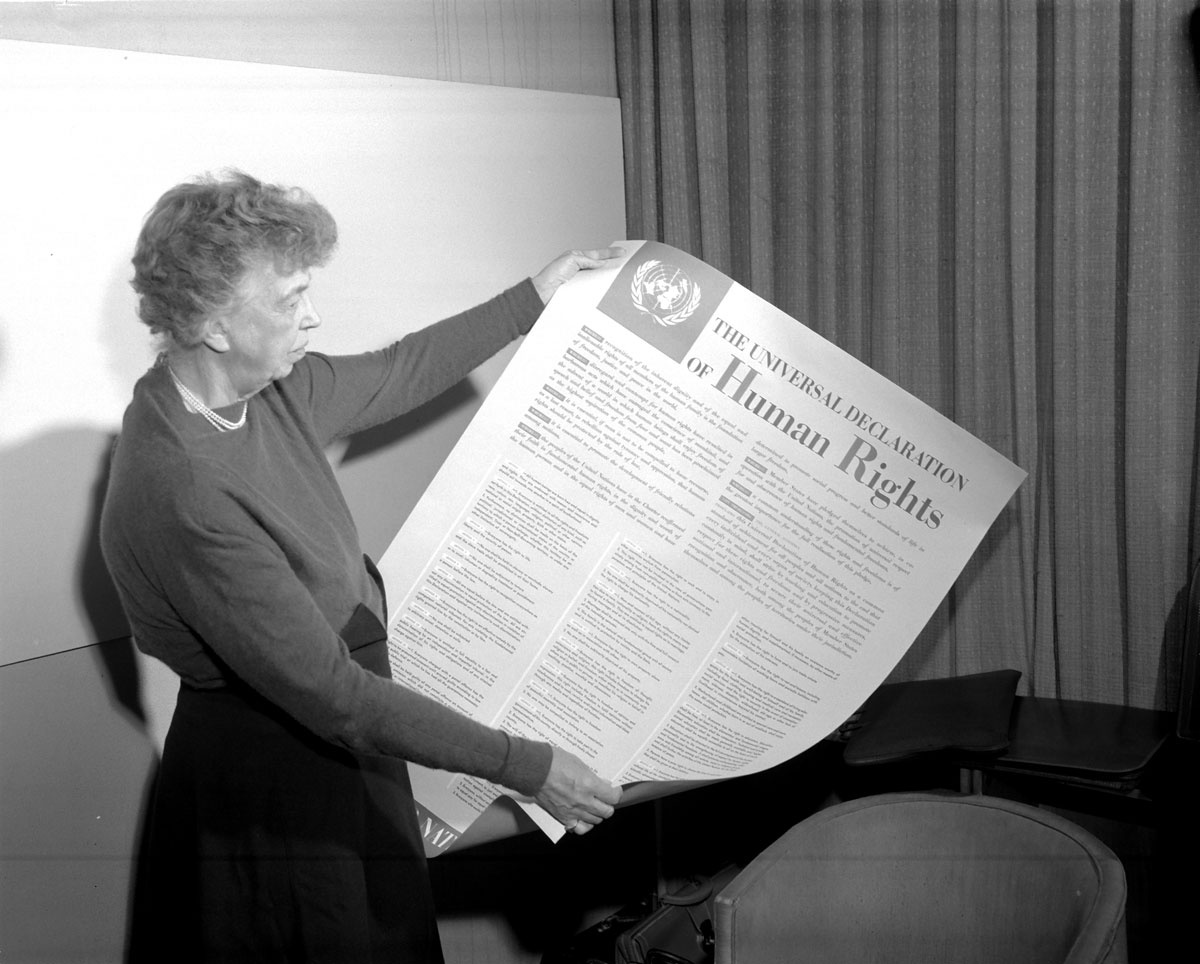
Experts point to the fact that China has accepted the Universal Declaration of Human Rights (UDHR) as a member of the United Nations.
The declaration forms the basic charter of rights for all global citizens. However over the past many decades, adherence to the UDHR has been minimal at best as far as Tibet is concerned.
When it comes to Tibet and Tibetans, they count for less than an average Han Chinese citizen, and actually don’t enjoy the rights they are entitled to as per international laws.
The UDHR calls on governments to grant every human being these rights, but the reality is that not one of the UDHR rights is extended to the people of Tibet.
For example Article 16 of the UDHR says that men and women of full age, without any limitation due to race, nationality or religion, have the right to marry and to create a family. They are also entitled to equal rights as when to marry, how to manage their marriage, and to decide when to dissolve it.
The family, according to the UDHR, is the natural and fundamental group unit of society and is entitled to protection by society and the state.
But, when comes to Tibet, since 1980, China has passed a series of measures related to marriage laws. Beijing has stopped the practice of polygamy in TAR, and has been actively promoting the mixed marriages between Tibetans and Han Chinese.
The local administration has reportedly announced offers of special treatment to children born of such unions. Such incentives are publicised heavily by the state media.
Tibetan poet Tsering Woeser says that “authorities use it as a tool”, and compared it to the Japanese police being encouraged to marry local women during Japan’s occupation of Taiwan.
On the issue of owning property, the UDHR says no one shall be arbitrarily deprived of his or property, but in China-dominated TAR seizure of farmland for industry is arbitrary and common.
Joel Brinkley of the Chicago Tribune adds that “China has evicted more than 400,000 Tibetans from their homelands” over the past few years, and believes that the intent behind this is to exploit Tibet’s vast mineral and water resources.
The UDHR’s Article 18 talks about the right to freedom of thought, conscience and religion, but evidence has surfaced of the People’s Armed Police firing on unarmed Tibetan protestors calling for a semblance of religious freedom.
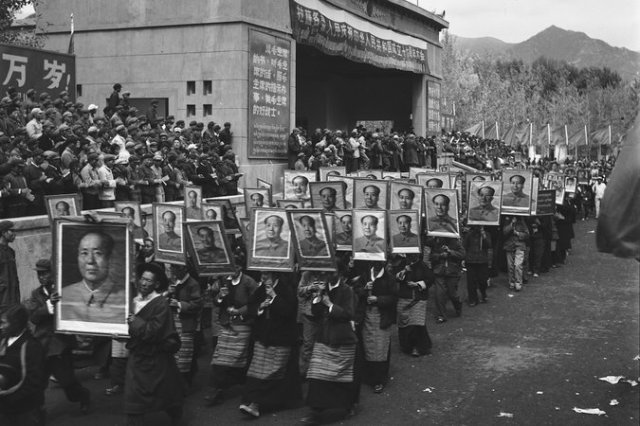
During the Cultural Revolution, most, if not all, Tibetan monasteries (97 percent were actually closed down) were reportedly ransacked by the Communist Party.
Currently, every monastery and nunnery is constantly under surveillance and subject to random checks by Communist Party officials. So-called Monastery Management Committees have been set up in increasing numbers to keep check on the activities of monks and nuns, and to control their numbers, particularly in the largest ones of Drepung, Sera and Ganden.
Such checks extend to night raids for images of the Dalai Lama and other such “subversive” objects.
For example, recently, a 13-year old nun, after participating in a peaceful protest, was held, interrogated, beaten and tortured.
She was sentenced for singing nationalist songs – which does not exactly exemplify “freedom of thought”.
On the issue of everyone having the right to express their opinion without interference and to seek, receive and impart information and ideas through any media and regardless of frontiers, which is enjoined in Article 19 of the UDHR, China routinely cuts off internet and phone-messaging services after each incident of self-immolation in TAR, of which there have been over 140 in the past six years.
As for the right to expression and freedom of opinion, the armed crackdowns, the surprise arrests and the extrajudicial killings are indicative of a general intolerance to such niceties.
The right to freedom of peaceful assembly and association as enshrined in Article 20, is regularly stamped out and quickly, with violence if required.
Tibet and the Tibetan people have been compelled to identify with the People’s Republic of China. In April 2015, the Communist Party demanded that all Buddhist monasteries display the Chinese flag, or face punishment.
This latest move is part of a drive to make places of worship ‘secularised’, and in line with Beijing’s ideologues.
Article 21 of the UDHR allows every individual to take part in the government of his or her country, directly, or through freely chosen representatives, but in the case of China, democracy does not exist in the sense that it is understood the world over.
The political representatives of the Chinese are not freely chosen, but are designated by the Communist Party. As such, not only Tibetans, but all citizens under the authority of the People’s Republic of China have no right of participation in their governance.
Recently, China arrested ten Tibetans for protesting against the denial of welfare benefits to their community.
Tibetans have been subject to “city moats” which prevent their access to their own cities.
The ‘will of the people’ is a concept almost entirely alien to any Chinese citizen in conceptual and real terms.
The right to social security, as enshrined in Article 22 of the UDHR, which calls for realisation both through national effort and international co-operation, is used to violate the rights of Tibetans further.
Article 23 says everyone has the right to work, and to have free choice of employment, but in Chinese – ruled TAR, the resettlement policy violates this article, depriving Tibetan nomads of their free choice of employment.
As far as just conditions of work, Tibetans are forced to learn Chinese in order to access any gainful employment, even as a construction worker.
Tibetans claim that Chinese workers receive higher wages; the loss of jobs due to political activities is also very common.
Even China admits that there is no minimum wage in the TAR.
The right to rest and leisure, as well as reasonable limitation of working hours and periodic holidays with pay does not exist in Chinese-ruled TAR.
Here, re-education is promoted through labor camps, and there is no semblance of worker’s rights to be defended here.
Holidays, too, are out of the question, and there is no reasonable limitation on working hours.
What about the right to an adequate standard of living, as enshrined in Article 25 of the UDHR?
It simply does not exist in TAR. Pulmonary diseases are the most widespread affliction in Tibet. While prefectural and city hospitals are adequate in responding to such illnesses, there is very little recourse to proper medical care for nomadic tribes as village and township hospitals are extremely poor.
The medical system is “clearly inequitable.” Distances across Tibet have also led to Chinese healthcare works failing to immunize children as “they don’t want to travel so far.”
Access to medication is clearly segregated: Tibetan doctors are unable to purchase drugs from pharmaceutical companies, as only Chinese government workers and ‘officials with connections to the Chinese’ are given access.
While officially, China’s ‘One Child’ policy does not extend to Tibetans as a community, in practice, birth control has actively been promoted in the TAR.
Sterilisation can take place on the basis of volunteering or through forced abortions, which leaves a very chilling picture of healthcare in TAR.
Article 26 of the UDHR talks of the right to education and the right to have free education at the elementary and fundamental stages, but in TAR, schooling is compulsory until secondary education, nominally “bilingually”, and guidelines are applied arbitrarily.
The emphasis is on creating Chinese-medium schools in Tibetan areas despite the fact that Tibetan students want to be taught in Tibetan and learn more effectively when they are.
Tibet has six institutes of higher learning, but only 60 percent of those selected for university in TAR are ethnic Tibetans, compared to the 97 percent share of population they reportedly enjoy.
This demonstrates the fact that access to higher education is highly coloured by discriminatory policies. Indeed, state funds go disproportionally to schools where Chinese students predominate.
Chinese authorities in TAR are on record, as saying that the purpose of giving an education to Tibetans is to see whether they are “opposed to or turn their hearts to the Dalai Clique and in whether they are loyal to or do not care about our great motherland and the great socialist cause..”
China does not promote tolerance, but actively seeks to destroy it in TAR.
The right freely to participate in the cultural life of the community as enjoined in the UDHR’s Article 27, is absent in TAR. The Chinese, admittedly, are very happy to impose limits on Tibetan intellectual production.
Insofar as duties to the community are concerned, while keenly desired by the Tibetan people, is trounced upon, and all vestiges of rights for the minorities are virtually non-existent.
China has a long history of using the justifications of human rights and economic prosperity “for all” to oppress those in Tibet, and nothing seems likely to change.
The recently concluded 6th Tibet Work Forum on August 24 and 25 did not offer any guarantees for the future, but harped instead on the need to maintain stability, a buzzword to Tibetans that they can expect an even harsher regime ahead.(ANI)

Copyright © 2010 aninews.in All rights reserved.


THE EVIL RED EMPIRE – RED CHINA – COMMUNIST

THE  EVIL  RED  EMPIRE  -  RED  CHINA  -  COMMUNIST :  ONE - PARTY  GOVERNANCE  OF  RED  CHINA  HAS  NO  RESPECT  FOR  NATURAL  RIGHTS  OF  PEOPLE .
THE EVIL RED EMPIRE – RED CHINA – COMMUNIST: ONE – PARTY GOVERNANCE OF RED CHINA HAS NO RESPECT FOR NATURAL RIGHTS OF PEOPLE .

I am asking my readers to acknowledge Red China’s one-party governance as “COMMUNIST.” In the years ahead, the United States and others will be left with no political alternatives as there is fundamental incompatibility between the systems of governance called ‘Democracy’, and ‘Communism’.

THE  EVIL  RED  EMPIRE  -  RED  CHINA  -  COMMUNIST  :   COMMUNISM  LAYS  EMPHASIS  ON  THE  REQUIREMENTS  OF  THE  STATE  WITH  NO  CONCERN  FOR  INDIVIDUAL  LIBERTIES .  COMMUNIST  GOVERNANCE  IS  NOT  BASED  UPON  SOCIAL  CONTRACT .  COMMUNISTS  RULE  WITHOUT  CONSENT  OF  THEIR  PEOPLE .
THE EVIL RED EMPIRE – RED CHINA – COMMUNIST : COMMUNISM LAYS EMPHASIS ON THE REQUIREMENTS OF THE STATE WITH NO CONCERN FOR INDIVIDUAL LIBERTIES . COMMUNIST GOVERNANCE IS NOT BASED UPON SOCIAL CONTRACT . COMMUNISTS RULE WITHOUT CONSENT OF THEIR PEOPLE .

Communism is the form of government by a one-party political structure which lays emphasis on the requirements of the State rather than on individual liberties. State is primarily involved in planning and control of economy without transparency and public accountability. Democracy is a form of government based on the theory of “Natural Rights” and the doctrine of government by “Social Contract.” In Democracy, government is instituted among men deriving its just powers from consent of the governed. Communism includes an unmistakable design to establish tyranny.

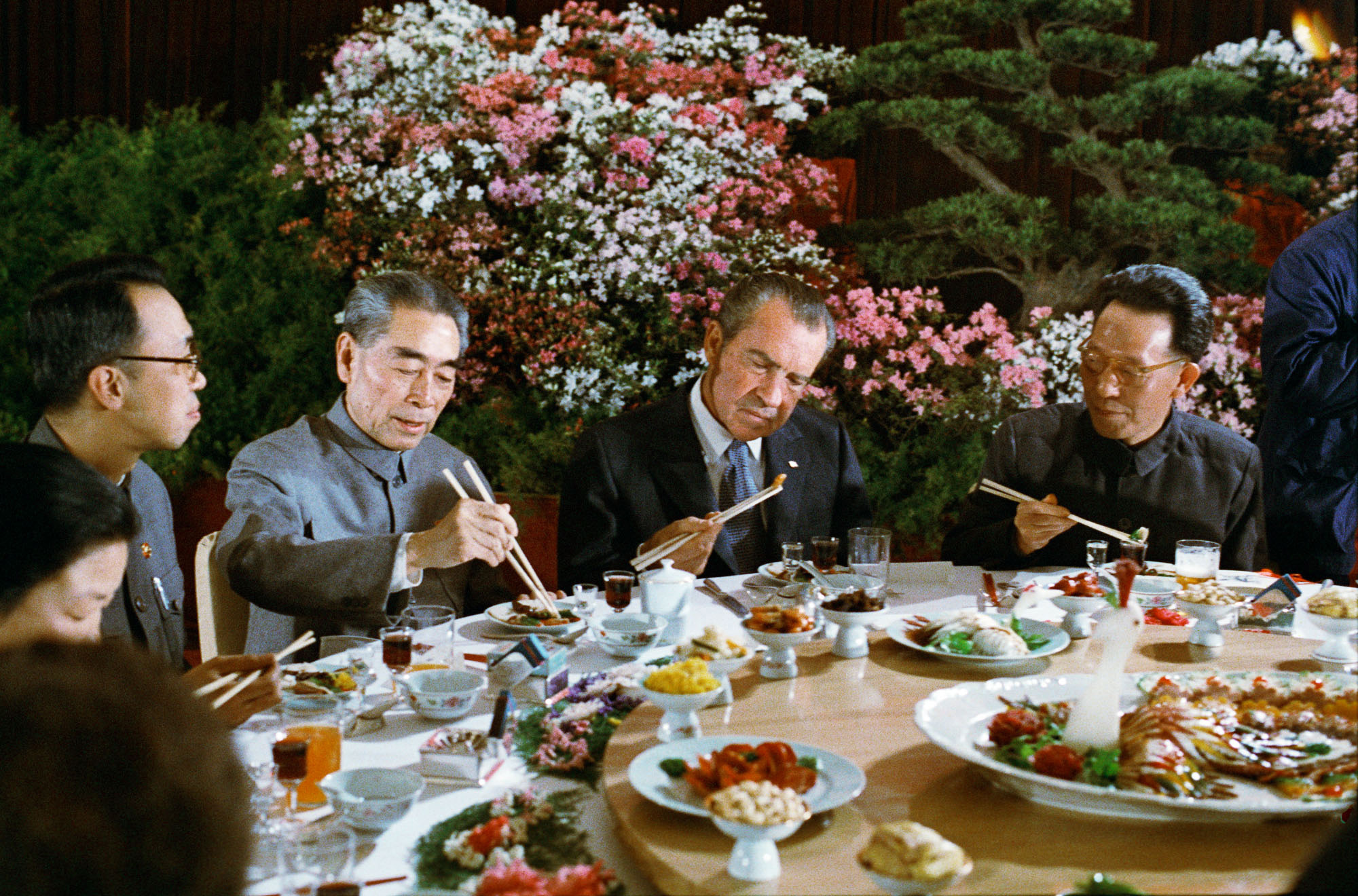
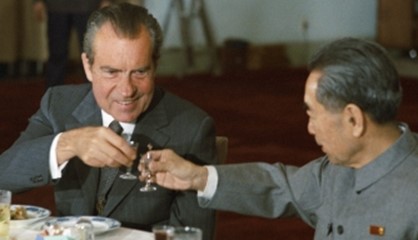
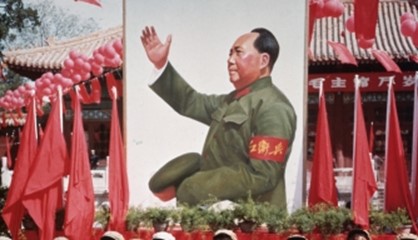
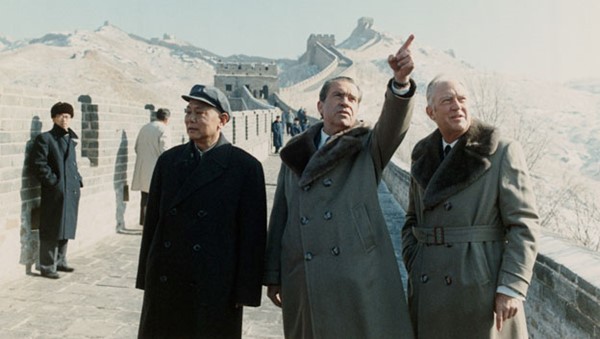
Red China’s Communist Party Chairman Mao Tse-Tung or Mao Zedong established a national entity on October 01, 1949 where the Communist Party can rule or govern people without their consent. Red China entered the Korean War against UN forces in 1950, participating on a large scale until the armistice of 1953. Red China invaded and occupied its weak neighbor Tibet during October 1950. A liberal “Hundred Flowers” period of 1957 was followed by a harsh crackdown on intellectuals. Red China demonstrated its ambitions to become a global superpower by exploding an atomic bomb in 1964 and the launching of its first satellite in 1970. Nixon-Kissinger “TREASON” in Vietnam paved the way for Red China’s entry to the United Nations. While the United States was engaged in a bloody war in Vietnam to resist and contain Communism, Nixon-Kissinger visited Peking in February 1972. US and Red China normalized diplomatic relations on January 01, 1979.

In 1981, Red China’s Communist Party severely criticized Mao Tse-Tung’s policies in the last years of his life in a public document and in 1982 Maoist ideology and political structure were curbed through the adoption of new Party and national constitution. The events commonly described as “TIANANMEN SQUARE MASSACRE” during May-June 1989 is clear evidence of a system of governance inspired by ideology of Communism which has no respect for “Natural Rights” of people.

THE EVIL RED EMPIRE - RED CHINA - COMMUNIST :  Beijing. Tien An Men Square. 'The Tank Man' stopping the column of T59 tanks. 4th June 1989.
THE EVIL RED EMPIRE – RED CHINA – COMMUNIST: Beijing. Tien An Men Square. ‘The Tank Man’ stopping the column of T59 tanks. 4th June 1989.

Red China has not accounted for her “Crimes Against Humanity” during a period of her history called the “Cultural Revolution.” Communist Party Chairman Mao Tse-Tung launched a massive upheaval in August 1966 to physically destroy all ‘liberal’ elements who in his view posed a threat to China’s “Red Revolution.” It was a mass campaign to revitalize revolutionary fervor by attacking people and cultural institutions perceived as liberal or so-called “BOURGEOIS” elements in cultural circles. Tibetan religious and political institutions that define Tibetan national character and Tibetan national identity became the targets of vicious attacks that aimed to physically destroy persons and material properties associated with Tibetan Culture using State-sponsored violence. Cultural Revolution ended in 1976 with the death of Chairman Mao and the purging of the “Gang of Four.” However, Communist misrule, xenophobia, and anti-intellectualism continue unabated in Occupied Tibet.

Rudra Narasimham Rebbapragada
Ann Arbor, MI 48104-4162, USA
The Spirits of Special Frontier Force


Here’s how The Washington Post covered Tiananmen Square in 1989

By SWATI SHARMA June 4

In 1989, the chinese military descended on Tiananmen Square and moved to end pro-democracy demonstrations. The event, which resulted in several hundred to several thousand dead, is considered one of the most brutal crackdowns in modern history. At the height of the protests, which were sparked by the death of a Communist Party leader who wanted reform, at least a million people were estimated to have participated in the demonstrations. Here is a look back at the Tiananmen Square massacre through the pages of The Washington Post.

May 20: Students defy martial law orders

“[T]he government today declared martial law ‘in certain areas’ of the capital to meet the growing defiance by Chinese citizens. Martial law provisions included a ban on demonstrations, and restrictions on the movements of Chinese citizens and the activities of foreign journalists.”

may20
June 3: Troops are blocked for a second time

Although 200,000 troops surrounded Tiananmen Square, citizens were able to stop them from entering. “The citizens shouted ‘Go home,’ and called on people in the area to join them in opposition to the troops. The troops continued to press forward but were channeled into the left-hand side of the street, when a mass of people now numbering more than 1,000 stopped the soldiers in their tracks. The troops then seemed to give up.”

june3military
Tiananmen Square Massacre June 1989

June 3: Frightened students worry about what comes next

After troops were blocked from entering the square twice, concerned students and media contemplate the military’s next move. Staff writer Jay Mathews poses a simple question: “Would they come?”

june3students
Tiananmen Square Massacre June 1989.

June 4: The massacre

Here is the front page, leading with staff reporter Daniel Southerland’s coverage.

june4
Tiananmen Square Massacre June 1989.

June 4: The legacy of Tiananmen Square

The front of The Post’s Outlook section: “‘There’s been nothing like it in human history,’CBS’s Charles Kuralt proclaimed on Sunday morning.”

june-4-legacy1.jpg&w=480
Tiananmen Square Massacre June 1989.

June 5: Death in Tiananmen

june5
Tiananmen Square Massacre June 1989.

June 6: An infamous photo is born

june6
July 1: An avenue full of corpses

Shen Tong became the first Chinese student to speak publicly about the massacre. He told reporters: “People around me were being shot because they could not believe the army was shooting at them, so they did not move.”

july1
Massacre in Tiananmen Square June 1989.

Note: This post was originally published on June 3, 2014.

Swati Sharma is a digital editor for World and National Security and previously worked at the Boston Globe.

red china communist protest june03 1989
The Evil Red Empire: Red China Communist: PRO-DEMOCRACY  PROTEST  June 03, 1989
red china communist tien an men square 1989
The Evil Red Empire: Red China Communist t. Tiananmen Square Protests 1989
1989, Beijing, China, Bodies of protestors shot by the Chinese army piled up in the corner of Capital hospital after the Chinese army occupation of Tiananmen Square on the 4th June, 1989.,; date created: 2008:05:06; Tiananmen Square Massacre
1989, Beijing, China, Bodies of protestors shot by the Chinese army piled up in the corner of Capital hospital after the Chinese army occupation of Tiananmen Square on the 4th June, 1989. Tiananmen Square Massacre
red china communist bodies mangled bicycles 1989
The Evil Red Empire: Red China Communist. Bodies and mangled bicycles. Pro Democracy Protests 1989.
red china communist pro democracy protests june05 1989
The Evil Red Empire: Red China Communist. Pro Democracy protests June 05 1989

THE EVIL RED EMPIRE – RED CHINA – ECONOMIC EXPANSIONISM

THE EVIL RED EMPIRE – RED CHINA – ECONOMIC EXPANSIONISM :

THE  EVIL  RED  EMPIRE  -  RED  CHINA  -  ECONOMIC  EXPANSIONISM  :  AT  SPECIAL  FRONTIER  FORCE  WE  ARE  TRAINED  TO  RECOGNIZE  RED  CHINA  AS  AN  ADVERSARY,  AN  OPPONENT,  AN  ENEMY  WITH  WHOM  WE  ARE  ENGAGED  IN  A  PROLONGED  CONFLICT .
THE EVIL RED EMPIRE – RED CHINA – ECONOMIC EXPANSIONISM : AT SPECIAL FRONTIER FORCE WE ARE TRAINED TO RECOGNIZE RED CHINA AS AN ADVERSARY, AN OPPONENT, AN ENEMY WITH WHOM WE ARE ENGAGED IN A PROLONGED CONFLICT .

Bill Powell published a story in Newsweek magazine predicting a prolonged geopolitical struggle between the United States and Red China and named it Cold War-2. In his analysis, Red China is a tough adversary because of its economic power. He makes no mention about adversarial relationship between Tibet and Red China since 1950s. At Special Frontier Force, an alliance between the US, India, and Tibet, we have always recognized Red China as an adversary, an enemy, an opponent, and a party with which we are engaged in a prolonged conflict with a potential to secure our mission fighting a battle that aims to evict the occupier of Tibet. Special Frontier Force is a product of Cold War-1 and we are not waiting for the dawn of a “New Cold War” or “Cold War-2.”

Economics is the Science that deals with the production, distribution, and consumption of wealth. Red China’s economy is managed by a system of government that is involved in all the aspects of production, distribution, and consumption of its national wealth. A capitalist is a person who has capital, owner of wealth used in business. Capitalism is the economic system in which all or most of the means of production and distribution are privately owned and operated for profit. Communism is an economic theory or system in which a one-party political structure has the ownership of all property and manages the production and distribution of economic goods. In a Communist State, the economy is just another tool in the hands of one-party that governs the Land. Unlike capitalists in the West, Red China’s concern for earning profits is translated into implementing its Policy of Expansionism of which Economic Expansionism is one dimension.

Red China while expanding private ownership of property, its one-party government remains as the ultimate manager who makes decisions about production, distribution, and consumption of wealth. Red China brings raw materials and finds new markets for its manufactured products. Red China is able to get raw materials and flood the world markets with Made in China products with great ease without the need to conquer other countries fighting costly battles. American and other capitalists who directly or indirectly invest in Red China have no control over the one-party government that manages all the parts of its economic system. American and other foreign investors are primarily concerned about the profits they earn by giving Red China the power of production and distribution of goods. The one-party government of Red China is empowered by this capital inflow and by its ability to acquire raw materials from other nations without waging wars or by simply occupying territory of its weaker neighbors like Tibet.

Red China has steadily expanded its Economic Power which it uses to exert its political influence over weaker nations and even over developed nations in the West. Nixon-Kissinger US administration in 1972 formulated trade and commerce relations with Red China not knowing the nature of its one-party government. Red China is earning profits from its worldwide trade and those profits directly benefit to accomplish its goal of Expansionism to become a true Imperial Power.

In the years ahead, the United States and others will be left with no political alternatives to face the challenges posed by Expansionist Red China. The capitalists who invest in Red China have the only option of Economic Disinvestment.

Rudranarasimham Rebbapragada
Ann Arbor, MI 48104-4162, USA
SPECIALFRONTIERFORCE.ESTABLISHMENT22

A NEW COLD WAR, YES. BUT IT’S WITH CHINA, NOT RUSSIA

Newsweek

Bill Powell

THE  EVIL  RED  EMPIRE  -  RED  CHINA  -  ECONOMIC  EXPANSIONISM : PEOPLE'S  REPUBLIC  OF  CHINA  CAME  INTO  ITS  EXISTENCE  ON  OCTOBER  01,  1949 .  AFTER  ITS  MILITARY  INVASION  AND  OCCUPATION  OF  TIBET  IN  1950,  A  GEOPOLITICAL  STRUGGLE  TOOK  BIRTH  TO  EVICT  THE  OCCUPIER  OF  TIBET .
THE EVIL RED EMPIRE – RED CHINA – ECONOMIC EXPANSIONISM : PEOPLE’S REPUBLIC OF CHINA CAME INTO ITS EXISTENCE ON OCTOBER 01, 1949 . AFTER ITS MILITARY INVASION AND OCCUPATION OF TIBET IN 1950, A GEOPOLITICAL STRUGGLE TOOK BIRTH TO EVICT THE OCCUPIER OF TIBET .

© Saul Loeb/Reuters Secretary of State John Kerry and Chinese Foreign Minister Wang Yi shake hands prior to meetings at the Ministry of Foreign Affairs in Beijing, May 16, 2015. The Soviet system failed because it didn’t work; China will be a tougher adversary.

Something that as recently as a decade ago was almost never discussed in polite company—the prospect for a prolonged geopolitical struggle between the United States and China (Cold War 2.0)—is now Topic A in the foreign policy salons of both Washington and Beijing. In the United States, the centrist Council on Foreign Relations issued a lengthy report calling for the U.S. to “revise” its “grand strategy” toward China. In Beijing, Liu Mingfu, a colonel in the People’s Liberation Army and one of its most influential strategists, wrote in his recent book, The China Dream, “In the 21st century China and the United States will square off and fight to become the champion among nations.’’

The current tension in the South China Sea, where Beijing is building artificial islands in the Spratlys, a contested chain claimed by six countries, certainly sounds like a Cold War in the making. The U.S. Defense Department let it be known in mid-May that it was considering sending surveillance aircraft and warships to within 12 nautical miles of the chain, as a signal to Beijing to back off. The Chinese Foreign Affairs Ministry immediately condemned Washington for even thinking about it.

Meanwhile, nine Chinese and Russian warships came together for joint exercises in the Mediterranean Sea—the most recent evidence of the warmer ties between the two historical antagonists. A month earlier, Vietnam, deeply distrustful of Beijing, hosted a dozen U.S. defense contractors for meetings in Hanoi. They came just eight days before celebrations marking the 40th anniversary of Vietnam’s defeat of the United States.

War games, prospective weapons sales, a war of words over contested real estate in some far-flung part of the world. That’s all pretty much standard Cold War fare, familiar to anyone in Moscow or Washington who fought the last one. But a Washington vs. Beijing Cold War 2.0—should it prove to be unavoidable—would be very different from its predecessor.
The fundamental, obvious difference is that Beijing would bring far more economic power to the contest than the Soviet Union ever did. Indeed, for Soviet citizens, the enduring image from the last days of Communism is empty shelves at the food store. And pretty much everywhere the Soviets exerted their influence—from Eastern Europe to Africa to Latin America—economic calamity ensued. The command and control, state-dominated form of economic management didn’t work, and that—more than how many nuclear weapons Moscow possessed—was what mattered in the end.

Contrast that with China. Already the second-largest economy in the world, it may well surpass the United States as the biggest in a decade or so. While the state controls the commanding heights of the economy—banking, telecommunications, energy—it tries to do so in a market-friendly way, and it allows unfettered private enterprise in a range of industries (including, critically, high technology) that have helped drive China’s extraordinary three-decade-long ascent from poverty. Alibaba is but one recent example of a private Chinese company with an increasingly global footprint. Remember all those great Soviet companies with initial public offerings of billions of dollars on the NASDAQ or the New York Stock Exchange? Right. You don’t. Because there weren’t any.

China is in the business of deploying its economic power abroad in a big way. It invests heavily in infrastructure projects in Africa. It uses its massive foreign exchange reserves to buy up resources—oil, gas and minerals—throughout Africa and Latin America. This is often—inaccurately—described as “soft” power. Economic power is not the same as soft power. Soft power has to do with lots of things—the form of government, the transparency of government, the accountability of elites to the broad citizenry, what a country stands for and stands against. The projection of economic power means the ability to put money in local pockets. Beijing is doing that aggressively, and, given its enormous accumulation of foreign exchange reserves, it is in a position to continue to do so for quite some time, even as its frantic economic growth now slows.

The United States, in the view of many analysts, is in a different and arguably more difficult place. Its hard power—its military assets—still dwarfs China’s, even though Beijing has rapidly increased its defense spending in recent years. But the prospect of a Cold War between the two countries was—and to a certain extent still is—dismissed by many China hands in the U.S. because, as former National Security Council staffer Aaron Friedberg wrote last year in his book A Contest for Supremacy, “the enormous advantages the United States now enjoys are the product of its long-standing lead in the development and deployment of new technologies, and the unmatched ability of its huge and dynamic economy to carry the costs of military primacy.”

Is the United States still more technologically advanced than China? Absolutely. Is it still more innovative. Yes. But those leads are narrowing, and the U.S. plainly faces a host of domestic economic issues—from debt to demographics to an economy seemingly stuck at stall speed—that are daunting. As Friedberg wrote, “Whether [the United States] will continue to enjoy [its
economic advantages] in a long-term strategic rivalry with China is by no means obvious.”

The other critical difference between Cold War 1.0 and the Cold War 2.0 that now looms is the simple fact that China is the most important market in the world for the Fortune 500. By contrast, the Soviet Union, for 99.5 percent of America’s biggest companies, simply didn’t exist. Beijing can use access to its market as leverage in geopolitical disputes, and in so doing will be playing to a core establishment constituency in the United States: big business. As long as China avoids an economic crisis that upends the current economic reality, that reality is going to be difficult for Washington to finesse as geopolitical competition intensifies.

There is, of course, tremendous irony in that. For decades, U.S. policy was to help China succeed economically. We had convinced ourselves that through trade and prosperity, political change would come in Beijing (just as it had in South Korea and Taiwan, former authoritarian economic success stories turned vibrant democracies). That notion is now long gone. The
Chinese Communist Party, and its one-party rule, doesn’t appear to be going anywhere. It’s also playing a long game; its military is just a regional player now, but by 2049, when the party expects to celebrate its 100th anniversary in power, it may well be able to project force globally. That, anyway, is the intention of the more hawkish elements of the party and its military.

Washington had earnestly hoped that the days of a global struggle against a powerful adversary were gone, the stuff of history books. That it’s now waking up and acknowledging a different reality is step one in what Liu Mingfu calls the central “fight” for the 21st century.

THE  EVIL  RED  EMPIRE  -  RED  CHINA  -  ECONOMIC  EXPANSIONISM :  RED  CHINA  HAS  DRAINED  THE  ECONOMIC  POWER  OF  AMERICAN  AND  FOREIGN  CAPITALIST  WHO  INVEST  IN  RED  CHINA .  THEY  HAVE  NO  POLITICAL  OPTIONS . THE  ONLY  CHOICE  IS  THAT  OF  ECONOMIC  DISINVESTMENT .
THE EVIL RED EMPIRE – RED CHINA – ECONOMIC EXPANSIONISM : RED CHINA HAS DRAINED THE ECONOMIC POWER OF AMERICAN AND FOREIGN CAPITALIST WHO INVEST IN RED CHINA . THEY HAVE NO POLITICAL OPTIONS . THE ONLY CHOICE IS THAT OF ECONOMIC DISINVESTMENT .

THE EVIL RED EMPIRE – TERRITORIAL EXPANSIONISM

THE EVIL RED EMPIRE – TERRITORIAL EXPANSIONISM:

Mao Zedong proclaims the founding of the People's Republic of China in Beijing on Oct. 1, 1949.
Mao Zedong proclaims the founding of the People’s Republic of China in Beijing on Oct. 1, 1949.

The Evil Red Empire called Red China or People’s Republic of China(Mandarin. Zhonghua Renmin Gongheguo) was proclaimed at Peking( now Beijing) by Communist Party Chairman Mao Zedong or Mao Tse-Tung on October 01, 1949. He formulated a vision of Empire building using a Policy of Expansionism during the late 1940s. Red China expanded its territory after the Communist victory in all of China. Apart from keeping territories gained by China in its historical past, Red China during 1950 attacked Tibet which had declared its independence after the downfall of Manchu China( the Ch’ing or Manchu dynasty) that ruled China from 1644 to 1912. The following Provinces and Autonomous Regions of Red China bear mute testimony to the great problem of its Territorial Expansionism:

the evil red empire the dragon covets the arctic2

1. Tibet, Xizang Autonomous Region.
2. Sichuan Province(Szechwan, annexed Tibetan territory).
3. Qinghai Province(Tsinghai annexed Tibetan territory).
4. Xinjiang Uygur Autonomous Region( Sinkiang Uigur)
5. Inner Mongolian Autonomous Region(Nei Monggol).
6. Liaoning Province, Jilin Province(Kirin), and Heilongjiang Province(Heilungkiang) which together represent Manchuria.

the evil red empire map of tibet1

The problem of Red China’s Expansionism in South China Sea must be studied in conjunction with the above problems of annexed territory. The United States will not succeed in its efforts to address the problem of Red China’s land reclamation activities in South China Sea without resolving The Great Problem of Tibet.

Rudranarasimham Rebbapragada
Ann Arbor, MI 48104-4162, USA
SPECIALFRONTIERFORCE.ESTABLISHMENT22

US, China remain at odds over South China Sea activity

Associated Press

By MATTHEW LEE, AP Diplomatic Writer

© Provided by Associated Press S. Secretary of State John Kerry speaks during a joint press conference following meetings with Chinese Foreign Minister Wang Yi at the Ministry of Foreign Affairs in Beijing, China, Saturday, May 16, 2015. Kerry is in China to press Beijing to halt increasingly assertive actions it is taking in the South China Sea that have alarmed the United States and China’s smaller neighbors. (Saul Loeb/Pool Photo via AP)

BEIJING — The United States and China held firm Saturday to deep disagreements over increasingly assertive Chinese activity in disputed areas of the South China Sea, as Beijing politely but pointedly rejected U.S. Secretary of State John Kerry’s push for it to reduce tensions.

After meeting in the Chinese capital, both Kerry and China’s Foreign Minister Wang Yi stressed the importance of dialogue to resolve the competing claims, but neither showed any sign of bending in their positions over Chinese land reclamation projects that have alarmed the United States and China’s smaller neighbors. The U.S. and most members of the Association of Southeast Asian Nations want a halt to the projects, which they suspect are aimed at building islands and other land features over which China can claim sovereignty.

“We are concerned about the pace and scope of China’s land reclamation in the South China Sea,” Kerry said, urging China to speed up talks with ASEAN on binding guidelines on how maritime activity in disputed areas should be handled. “And, I urged China, through Foreign Minister Wang, to take actions that will join with everybody in helping to reduce tensions and increase the prospect of diplomatic solutions.”

“I think we agree that the region needs smart diplomacy in order to conclude the ASEAN-China code of conduct and not outposts and military strips,” Kerry told reporters at a joint news conference with Wang.

But Wang signaled that while China was prepared to talk, it would not back down on the construction which he said “is something that falls fully within the scope of China’s sovereignty.”
“The determination of the Chinese side to safeguard our own sovereignty and territorial integrity is as firm as a rock, and it is unshakable,” he said. “It has always been our view that we need to find appropriate solutions to the issues we have through communications and negotiations that we have among the parties directly concerned with peaceful and diplomatic means on the basis of respecting historical facts and international norms. This position will remain unchanged in the future.”

Wang added that the differences between China and the U.S. could be managed “as long as we can avoid misunderstanding and, even more importantly, avoid miscalculation.”
The Chinese claims and land reclamation projects have rattled the region where South China Sea islands and reefs are contested by China and five other Asian governments and activities have led to clashes, accompanied by nationalistic protests and occasional serious diplomatic implications.

The U.S. says it takes no position on the sovereignty claims but insists they must be negotiated. Washington also says ensuring maritime safety and access to some of the world’s busiest commercial shipping routes is a U.S. national security priority.

China has bristled at what it sees as U.S. interference in the region and wants to negotiate with the ASEAN countries individually, something those much smaller nations fear will not be fair.
In one disputed area, the Spratly Islands, U.S. officials say China has reclaimed about 2,000 acres of dry land since 2014 that could be used as airstrips or for military purposes. The U.S. argues that man-made constructions cannot be used to claim sovereignty.

Obama administration officials have declined to comment on reports that it may deploy military assets, or that it is considering a demonstration of freedom of navigation within 12 nautical miles of the islands’ notional territorial zone. But they have said many of the features claimed by China in the disputed Spratlys are submerged and do not carry territorial rights, and said that China cannot “manufacture sovereignty.”

Despite the clear disagreements over the South China Sea, Kerry and Wang said they were on track to make progress in other areas, notably on climate change, the fight against violent extremism and preparations for the next round of the U.S.-China Strategic and Economic Dialogue in June and Chinese President Xi Jinping’s visit to Washington in September. They expressed pleasure with their cooperation in the ongoing Iran nuclear talks, their solidarity in trying to denuclearize North Korea and combat diseases such as the deadly Ebola virus.
Kerry will wrap up the China portion of his Asia trip in meetings with Xi, Chinese State Councilor Yang Jiechi and the country’s top military officer.

On Sunday, Kerry heads to Seoul where he will be meeting senior South Korean officials and deliver a speech on cyber security and related issues.
Kerry will return to Washington after delivering a speech on a proposed Trans-Pacific trade agreement in Seattle on Tuesday.

1 of 5 © Provided by Associated Press

S. Secretary of State John Kerry, left, talks with Chinese Foreign Minister Wang Yi after their joint press conference at the Ministry of Foreign Affairs in Beijing Saturday, May 16, 2015. Kerry is in China to press Beijing to halt increasingly assertive actions it is taking in the South China Sea that have alarmed the United States and China’s smaller neighbors. (Saul Loeb/Pool Photo via AP)

2 of 5 © Provided by Associated Press

S. Secretary of State John Kerry speaks during a joint press conference following meetings with Chinese Foreign Minister Wang Yi at the Ministry of Foreign Affairs in Beijing, China, Saturday, May 16, 2015. Kerry is in China to press Beijing to halt increasingly assertive actions it is taking in the South China Sea that have alarmed the United States and China’s smaller neighbors. (Saul Loeb/Pool Photo via AP)

3 of 5 © Provided by Associated Press

S. Secretary of State John Kerry at the Ministry of Foreign Affairs in Beijing, China, Saturday, May 16, 2015. Kerry is in China to press Beijing to halt increasingly assertive actions it is taking in the South China Sea that have alarmed the United States and China’s smaller neighbors. (Saul Loeb/Pool Photo via AP)

4 of 5 © Provided by Associated Press

S. Secretary of State John Kerry, left, and Chinese Foreign Minister Wang Yi hold a joint press conference following meetings at the Ministry of Foreign Affairs in Beijing Saturday, May 16, 2015. Kerry is in China to press Beijing to halt increasingly assertive actions it is taking in the South China Sea that have alarmed the United States and China’s smaller neighbors. (Saul Loeb/Pool Photo via AP)

5 of 5 © Provided by Associated Press

S. Secretary of State John Kerry, left, and Chinese Vice Chairman of the Central Military Commission General Fan Changlong, right, shake hands prior to a meeting at the Ministry of
National Defense in Beijing Saturday, May 16, 2015. Kerry is in China to press Beijing to halt increasingly assertive actions it is taking in the South China Sea that have alarmed the United States and China’s smaller neighbors. (Saul Loeb/Pool Photo via AP)

5 of 5