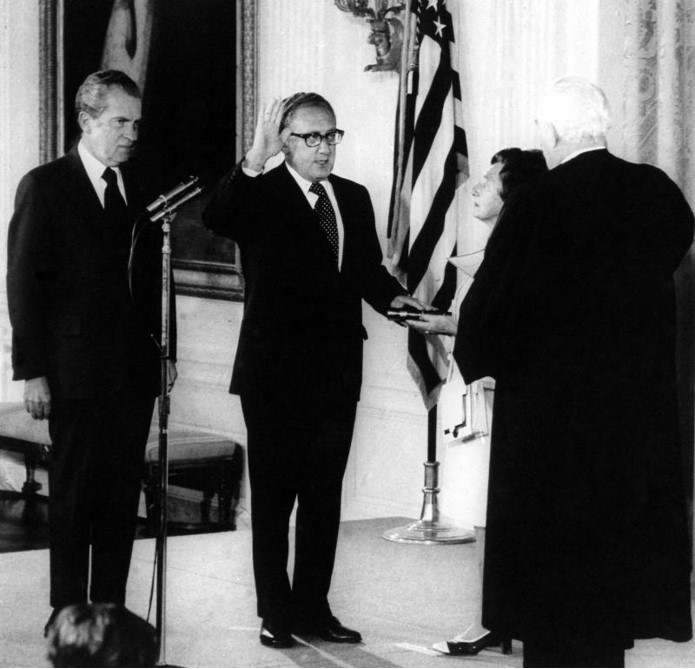
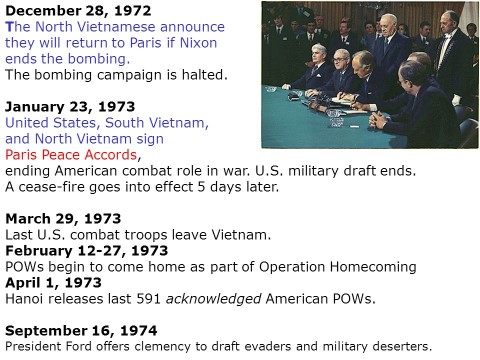
OCTOBER 17, 1974 – NIXON-KISSINGER VIETNAM TREASON – FORGOTTEN NATIONAL TRAGEDY

OCTOBER 17, 1974 – NIXON-KISSINGER VIETNAM TREASON – FORGOTTEN NATIONAL TRAGEDY

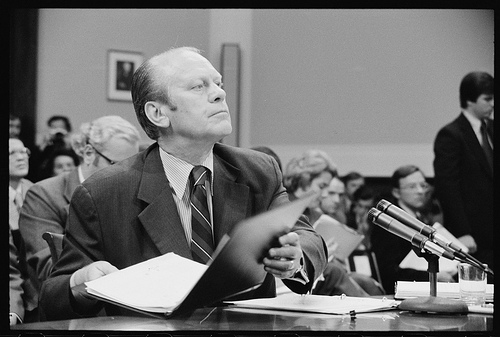
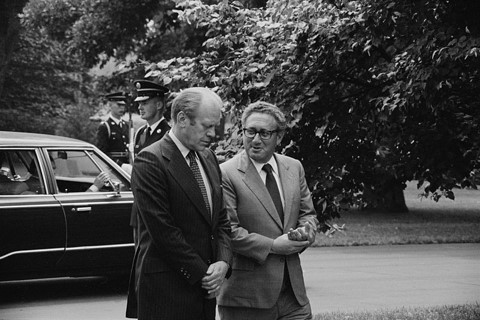
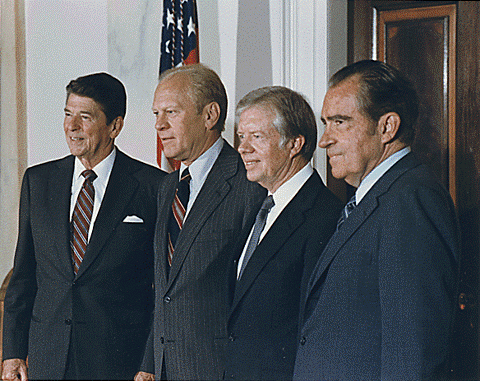
As I live in Ann Arbor, Michigan, USA, I give close attention to Ford’s Doomed Presidency. On August 09, 1974, President Ford chose to pardon President Richard M. Nixon who resigned on August 08, 1974.

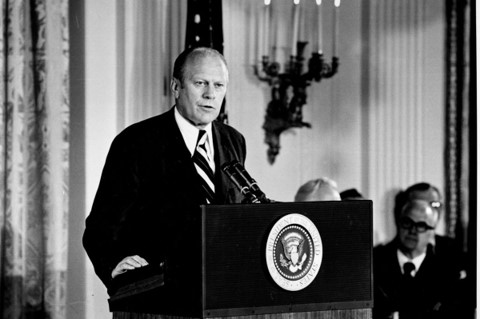
On October 17, 1974, President Ford explained to Congress as to why he had chosen to pardon President Nixon. From his explanation it is evident that Nixon-Kissinger Vietnam Treason remains ‘Forgotten National Tragedy’.

Rudranarasimham Rebbapragada

SPECIAL FRONTIER FORCE

FORD EXPLAINS HIS PARDON OF NIXON TO CONGRESS – OCT 17, 1974

Clipped from: http://www.history.com/this-day-in-history/ford-explains-his-pardon-of-nixon-to-congress?

Presidential

1974

On this day in 1974, President Gerald Ford explains to Congress why he had chosen to pardon his predecessor, Richard Nixon, rather than allow Congress to pursue legal action against the former president.

Congress had accused Nixon of obstruction of justice during the investigation of the Watergate scandal, which began in 1972. White House tape recordings revealed that Nixon knew about and possibly authorized the bugging of the Democratic National Committee offices, located in the Watergate Hotel in Washington D.C. Rather than be impeached and removed from office, Nixon chose to resign on August 8, 1974.

When he assumed office on August 9, 1974, Ford, referring to the Watergate scandal, announced that America’s “long national nightmare” was over. There were no historical or legal precedents to guide Ford in the matter of Nixon’s pending indictment, but after much thought, he decided to give Nixon a full pardon for all offenses against the United States in order to put the tragic and disruptive scandal behind all concerned. Ford justified this decision by claiming that a long, drawn-out trial would only have further polarized the public. Ford’s decision to pardon Nixon was condemned by many and is thought to have contributed to Ford’s failure to win the presidential election of 1976.

From his home in California, Nixon responded to Ford’s pardon, saying he had gained a different perspective on the Watergate affair since his resignation. He admitted that he was “wrong in not acting more decisively and more forthrightly in dealing with Watergate, particularly when it reached the stage of judicial proceedings and grew from a political scandal into a national tragedy.”

Sent from Mail for Windows 10

CHINESE DREAM – PEOPLE’S NIGHTMARE – BEIJING DOOMED

CHINESE DREAM – PEOPLE’S NIGHTMARE – BEIJING DOOMED

People’s Republic of China uses secret rituals to select leaders of Communist Party as well as leaders of its government. Chinese Dream will unfold into People’s Nightmare as Beijing sealed its own Fate or Destiny because of her ‘EVIL’ actions. The Aftermath of Evil is called Doom, Catastrophe, Disaster, Cataclysm, and Apocalypse.

Rudranarasimham Rebbapragada

DOOM DOOMA DOOMSAYER

HOW WILL CHINA SELECT ITS NEW LEADERS AT ITS COMMUNIST PARTY CONGRESS?

Clipped from: http://www.npr.org/sections/parallels/2017/10/17/558078791/how-will-china-select-its-new-leaders-at-its-communist-party-congress

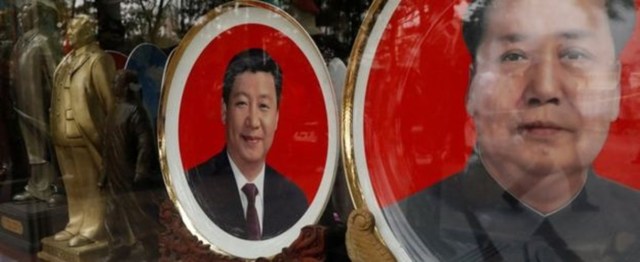
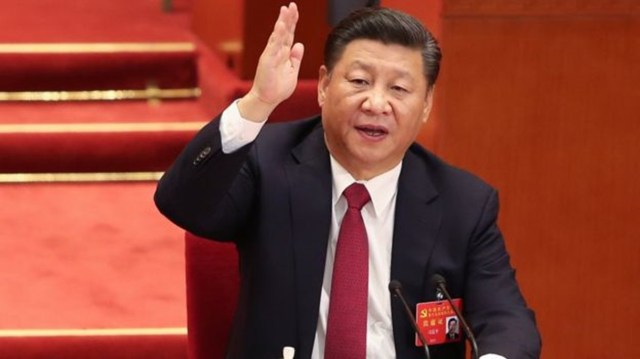
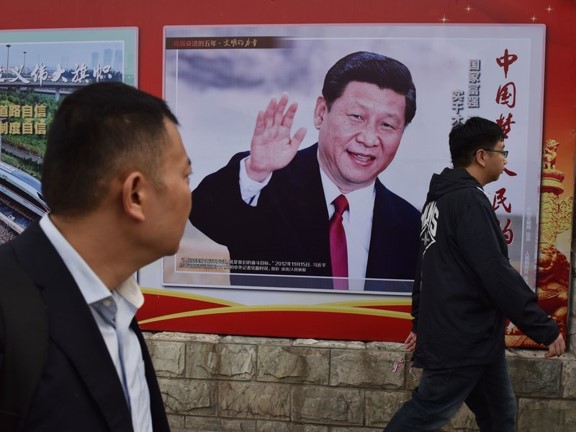
A poster in Beijing features Chinese President Xi Jinping and a slogan reading "Chinese Dream, People’s Dream." Xi is preparing to embark on a second five-year term this week. Greg Baker/AFP/Getty Images

A poster in Beijing features Chinese President Xi Jinping and a slogan reading "Chinese Dream, People’s Dream." Xi is preparing to embark on a second five-year term this week.

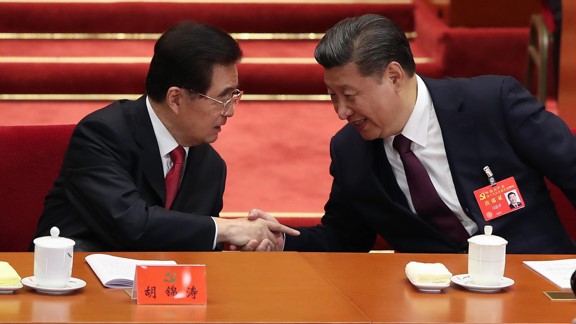
Preparations for a major shakeup of China’s Communist Party leadership are all but complete, ahead of a national congress that begins in Beijing on Wednesday. President Xi Jinping, the party boss, is expected to cement his already considerable power and embark on a second five-year term.

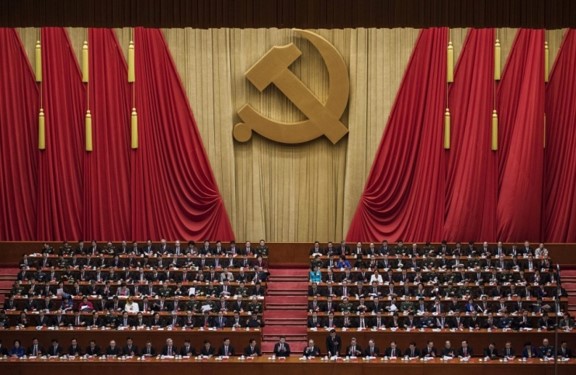
Last Saturday, in an auditorium bedecked with red flags and hammer-and-sickle emblems, the party’s outgoing central committee members raised their hands in unison to approve the congress’s final preparations.

Beijing’s streets are lined with security personnel, and police have hustled dissidents out of town on enforced "vacations" ahead of the country’s most important political event.

Held every five years, the National Congress of the Chinese Communist Party is a piece of political theater that University of Victoria political scientist Wu Guoguang describes as being at once "holy" and "hollow."

When it comes to understanding exactly how the leader of the world’s most populous nation is chosen, "In fact, nobody knows," Wu says. "It’s jungle politics," he adds. "The party does not play the game by its own rules."

According to the Communist Party’s charter, China’s nearly 90 million party members select nearly 2,300 delegates, who in turn vote for a roughly 200-member central committee. That committee then elects a 25-odd-member Politburo, a standing committee having between five and nine members and the party’s general secretary or top leader.

But in fact, "The election is a formality," Wu says. "The positions are decided in advance of the congress." Then they’re given to the delegates to rubber-stamp.

The actual selection of the party leadership, Wu adds, is done "in a black box" behind closed doors.

In other words, while power appears to flow from the bottom up, it actually goes from the top down.

Experts’ best guess, Wu says, is that around 20 people, including serving and retired members of the Politburo standing committee, bargain in secret to decide the next leader several months before the congress.

In theory, the national congress is the party’s highest organ of power. But Wu, the author of China’s Party Congress: Power, Legitimacy, and Institutional Manipulation, who helped draft political reforms for the late Chinese Premier and Communist Party boss Zhao Ziyang, says that the leadership has many ways to manipulate the institution to make sure nobody it dislikes is ever nominated — much less elected.

One such device is a sort of straw poll or dry run ahead of the congress, so that leaders can sniff out and neutralize opposition to their preferred candidates.

The selection process is full of uncertainty, says Wu. This uncertainty may be behind the event’s massive security operations, to which "every blade of grass, every tree looks like an enemy soldier," as the old Chinese saying goes.

Part of the problem is that so many successions under communist rule have ended in failure. Three of Mao Zedong’s anointed heirs, Liu Shaoqi, Lin Biao and Hua Guofeng, were purged or sidelined.

Liu was purged and persecuted during the Cultural Revolution and died in 1969. Lin died in a 1971 plane crash, after an alleged failed coup attempt. Hua served as party chairman for five years until Deng Xiaoping pushed him aside in 1981.

During the 1980s, supreme leader Deng sacked two of his appointed successors in a row, ostensibly because they were soft on dissent.

Experts point out that China has neither a hereditary dynasty nor competitive elections. To restore a semblance of order to the leadership selection process in the years following the June 4, 1989, massacre near Tiananmen Square, the party established some unwritten rules or norms to govern it.

The most important of these is an informal rule that Politburo standing committee members must retire at age 68.

But experts believe that Xi is not satisfied with the informal rules and intends to bend, break or scrap them altogether.

And if there is any unwritten rule experts say Xi cannot tolerate, it is one that could hinder his ability to designate his own successor. In Chinese politics, this is a guarantee of a retired leader’s survival and continuing behind-the-scenes influence.

Years ago, supreme leader Deng is believed to have anointed two of Xi’s predecessors. They in turn apparently designated two men, Sun Zhengcai and Hu Chunhua, as Xi’s possible successors.

But in July, Sun was sacked for corruption and violating party discipline as party boss of southwest China’s Chongqing city, and Xi signaled that he would not accept anyone else’s choice as his heir. Hu remains in place, at least for now.

Mao, Deng and many Chinese emperors centuries before them essentially ruled until they died. China’s Constitution mandates a two-term limit for its presidents, but there are no term limits for party leaders, who are above the president.

Xi serves as president, party leader and head of the military. During his first term, he outdid his predecessors with tough crackdowns on both dissent and official corruption at home along with a muscular military posture to back up China’s territorial claims in the South China Sea and the China-India border. Experts expect more of the same from a second Xi term.

Xi is not the first to challenge the party’s informal leadership succession rules. Bo Xilai, a flamboyant politician who also served as Chongqing party boss, questioned personnel arrangements for the 18th party congress in 2012, as he sought to enter the leadership’s top ranks. He challenged the leadership lineup — which included Xi — that was decided by Xi’s predecessors. The following year, Bo was sentenced to life in prison on corruption charges.

Hong Kong University of Science and Technology professor Ding Xueliang argues that Xi has wanted to overhaul the succession process for years, especially since Bo’s challenge.

"Even now," Ding says, "Xi still talks about the ‘residual toxic influence’ of Bo Xilai in Chongqing," presumably a reference to the fact that some of Bo’s allies or subordinates remain in positions of power.

Indeed, Xi has spent much of his first term getting rid of the masses of bureaucrats installed by, and still loyal to, his predecessors, lest they rebel or obstruct the implementation of his policies.

This reflects the fact, Ding observes, that personal ties remain paramount in Chinese politics and bureaucrats tend to "obey those who appointed them."

Communist personnel policies, Ding notes, make it hard to sack bureaucrats before they retire, and the bureaucrats are not subject to much independent oversight.

Ding argues that Xi has used his mass anti-corruption campaign as a tool to knock out not just rival politicians and obstinate bureaucrats but also party congress delegates. He notes that Chairman Mao did the same during the 1966-1975 Cultural Revolution.

At the 19th party congress, experts will be looking at several key details. Here are some of the questions they are asking:

· Will Xi show any indication that he might seek a third term as president, beginning in 2022? Or will he retire from his party and government posts but hang on as military chief, as some of his predecessors have done?

· Will Wang Qishan, Xi’s 69-year-old right-hand man and anti-corruption czar, retain his job? He is already past the age after which no party leaders are supposed to be appointed to new positions, according to an informal rule.

· Will Xi change his job title from general secretary of the Communist Party to chairman, the title Mao used?

· Will Xi name a successor during the party congress?

· Will Xi’s ideas be written into the party charter as "Xi Thought" or "Xi Theory," as were the ideas of Mao and Deng? Or will his ideas be written into the charter without Xi’s name, as was the case with Xi’s two less powerful immediate predecessors?

If Xi breaks the informal rules, observes Ding, the Hong Kong professor, it’s not clear what new ones he might replace them with.

And maybe it doesn’t matter. Neither formal nor informal rules have done much to constrain China’s leaders. Deng famously remained paramount leader in retirement with no higher official title than honorary chairman of the China Bridge Association.

Political arrangements in China are rarely explicit, Ding muses. "After thousands of years of Chinese politics, rulers have developed innumerable methods to get what they want," he says. "It’s never so simple."

Sent from Mail for Windows 10

Virus-free. www.avast.com

FIVE FIFTY FORUM ON TIBET EQUILIBRIUM

FIVE FIFTY FORUM ON TIBET EQUILIBRIUM

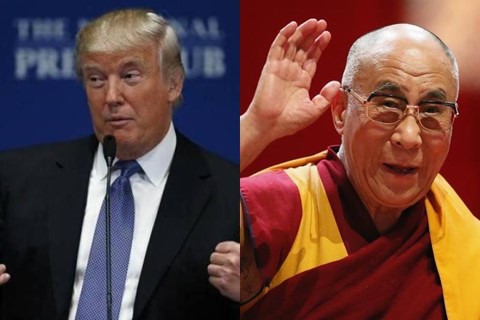
At ‘Five Fifty’ Forum on Tibet Equilibrium, His Holiness the Dalai Lama openly shared his concerns about US President Donald Trump’s reluctance to engage him in Cold War Era secret diplomacy.

Rudranarasimham Rebbapragada
SPECIAL FRONTIER FORCE

THE DALAI LAMA SPEAKS ON TRUMP AND ‘AMERICA FIRST’

Clipped from: https://www.washingtonpost.com/news/josh-rogin/wp/2017/10/11/the-dalai-lama-speaks-on-trump-and-america-first/?

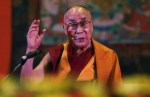
The Dalai Lama during an event at American University last year. (Manuel Balce Ceneta/Associated Press)
DHARAMSALA, India
The Dalai Lama, the spiritual head of the Tibetan nation, is known worldwide for his advocacy of non-violence, peaceful coexistence, environmental protection and human rights. But the 82-year-old Buddhist monk is worried about the rise of nationalism and selfishness around the world and in the United States.
In wide ranging remarks to a unique conference of Tibet supporters here in northern India, the Dalai Lama said he was concerned about President Trump’s “America first” policy, America’s stance on global warming and the use of military tools to solve international problems. He also praised the United States and expressed hope that the American people will continue to do the right things, including with respect to Tibet.
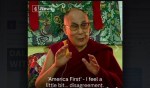
“Your ancestors really considered the importance of liberty, freedom, democracy, these things,” the Dalai Lama said in response to my question about his current view of the United States. “The present president, in the very beginning he mentioned ‘America first.’ That sounded in my ear not very nice.”
The Dalai Lama is concerned that the United States, despite being “the leader of the free world,” was becoming more “selfish, nationalist,” he said. But the American Congress and people have long supported the cause of Tibet and human rights, and he thinks that will continue, he added.
The Dalai Lama also lamented that Trump doesn’t pay more attention to the issue of global warming, which, he said, knows no borders and no religion.
“The present president is not much paying attention to ecology. So on that, I feel some reservation,” the Dalai Lama said. “But anyway, the American people elected him, so I must respect [that].”
The event, called the Five Fifty Forum, was hosted by the Tibetan government-in-exile, which is based in this northern Indian mountain town. The Dalai Lama has been living in India since he fled Tibet in 1959 and has not been allowed to return.
The forum was held under Chatham House rules, which forbid quoting participants. But the leadership of the Tibetan government-in-exile gave me permission to publish the Dalai Lama’s remarks.
The Tibetan leader, who is believed by followers to be in his 14th reincarnation, criticized the use of military force around the world and called on nations to solve problems through diplomacy and negotiation rather than violence. He said the use of military power, even by the United States, never achieves its goal.
“Every problem on this planet, including our problem, must be solved with respect and mutually acceptable [solutions],” he said.
The Dalai Lama’s commentary on world events was not limited to the United States. He said that the Britain had erred in voting to leave the European Union, and he attributed that decision to nationalism as well.
The European Union should become the model for every region and then, when the world’s countries are all working together, they can demilitarize, the Dalai Lama explained. “That’s my vision. That’s my hope.”
The Dalai Lama said he wants to engage with China to find a mutually acceptable solution for Tibet. He added that the Tibetan people must also be ready to talk to China if there’s an opening. That doesn’t seem likely, considering that the Chinese government cut off dialogue with the Tibetans in 2010 and has pursued a brutal repression campaign in the region ever since.
Nevertheless, “for the last several centuries, praying to Buddha more or less failed,” the Dalai Lama joked. “So I think we need to take a more practical approach.”
He is arguing against current trends for a world based on common interest, global integration, defense of human rights and shared responsibility for the environment. For most of his long life, the United States has agreed with him and led that effort. Will that continue? Even the Dalai Lama doesn’t know.

Sent from Mail for Windows 10

Virus-free. www.avast.com

COMMUNIST CHINA’S DOCTRINE OF NEOCOLONIALISM – COLONIZATION OF EGYPT

COMMUNIST CHINA’S DOCTRINE OF NEOCOLONIALISM – COLONIZATION OF EGYPT

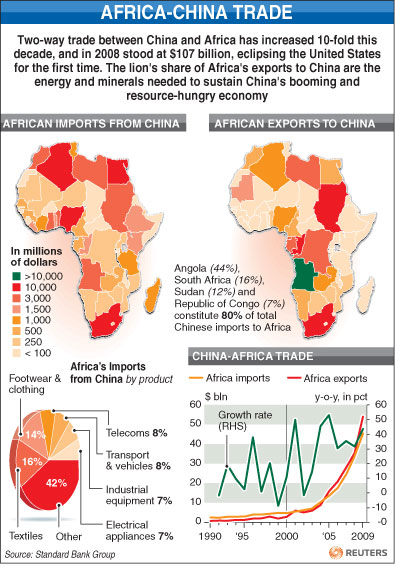
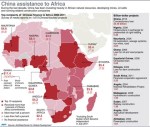
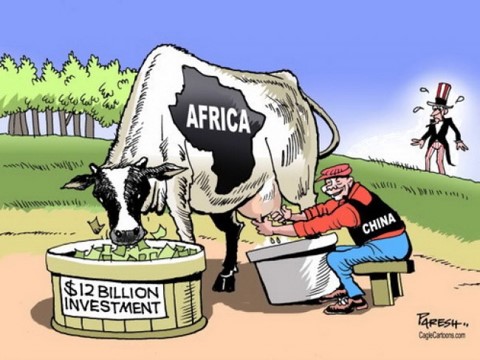
China in Africa: South Africa Joins BRICs Summit - Global ...
On globalsherpa.org

Communist China’s successful colonization of Egypt and Africa is of special interest to me. I served in Establishment No. 22, Special Frontier Force to defend Freedom, Democracy, and Peace in Occupied Tibet.

During 1971-72, I served under the Command of Lieutenant Colonel B K Narayan who returned from Egypt after serving as Military Attaché in Indian Embassy in Cairo. For he was an Islamic Scholar who mastered Arabic Language as well as Quran, President Nasser, and President Sadat befriended him to seek his interpretation of Quran in the conduct of Egypt’s foreign policy. He performed Hajj pilgrimage while he served in Cairo. In 1971, long before conclusion of Israel-Egypt Peace Treaty of March 26, 1979, Colonel Narayan predicted Peace between Egypt and Israel as that Peace Plan is consistent with preaching of Holy Quran.

No more wars, no more bloodshed. Peace unto you. Shalom ...
On boardofwisdom.com

Rudranarasimham Rebbapragada
SPECIAL FRONTIER FORCE

Clipped from:
http://www.aljazeera.com/programmes/aljazeeraworld/2017/10/egypt-china-171001122401865.html

Filmmaker: Adam Bahgat
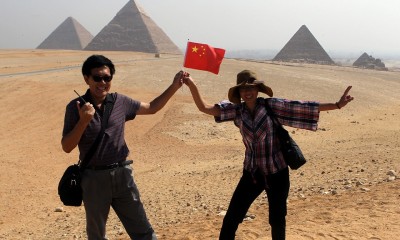
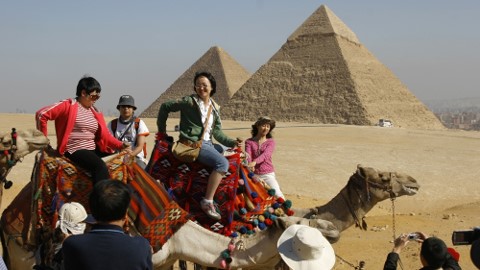
The Chinese community in Egypt has grown to over 10,000 people, thanks to a burgeoning commercial relationship between the two countries.
Increasing numbers of Chinese have come to study, work and open businesses in the Arab world’s most populous country, where many have developed an affinity for its life, culture and its people.
For over a quarter century, China and Egypt have steadily been learning how to make money together – through a range of economic and infrastructure projects.
Egypt has awarded several contracts to Chinese companies for the construction of a $20bn administrative and residential city that will be physically linked to Cairo. And China is the lead investor in the construction of a planned multibillion-dollar industrial zone around the Suez Canal.

I love Egypt and I consider it my second home. Egyptians are generally kind and I’ve experienced a lot to confirm this … They also have a sense of humor. They’re always joking even if they’re suffering from life’s hardships … That’s why they’re happy.

Saleh Machyanj, Chinese businessman

Each new collaboration is an opportunity for the Chinese diaspora to grow their businesses.
South of Cairo, the Shaqel Thoben area is one of the world’s major production centers for marble and granite.
“The equipment and machines used here are from China,” says Zhaou Ping, a marble and granite factory worker who has been in Egypt for three years.
“My boss in China asked me to come with the equipment and be a consultant … Before I came to Egypt, I worked in the same field in China. When an Egyptian manufacturer visited my factory, he asked me to work with him. I now have many Muslim friends in the factory where I work. They treat me like a brother and a friend, so I don’t feel like a stranger or foreigner in Egypt. I feel I’m in my country, with my family.”
The Chinese have quite quickly helped diversify Egypt’s economy. In 1999, there were only a few hundred but their numbers continue to grow as the two countries build stronger economic ties.
Some who started out as small traders are now successful business owners, like restaurant owner Po Wein Zhoun. Po cleverly opened a Chinese restaurant when she realized there was a growing demand for it.
“I realized many Chinese in Egypt have problems finding Chinese food … So I opened a small Chinese restaurant six years ago. After two years, the restaurant started becoming successful. For a year and a half, I bought this restaurant from another Chinese,” says Po, who is married to an Egyptian.
Business is the main but attraction for Chinese who come to Egypt; but some are also drawn to the country’s ancient heritage, like blogger Ali who studied Arabic and Egyptian history back in China. Fascinated, “I read an essay about Egypt and its pyramids and loved it. It’s about [the] mystery of the pyramids going back thousands of years. No one knows how they were actually built,” says Ali.
For some, their love of Egypt becomes profound, forming friendships that touch them and make them want to stay permanently.
WATCH: King Cobra and the Dragon: As China increases its economic ties in Africa, has the continent entered a new era of colonialism?
Chinese businessman Saleh Machyanj has been in Egypt since the 1990s.
“I love Egypt and I consider it my second home. Egyptians are generally kind and I’ve experienced a lot to confirm this … They also have a sense of humor. They’re always joking even if they’re suffering from life’s hardships. In China, the pressure and pace of life doesn’t allow time for joking … But in Egypt, friends meet in cafes for tea or juice. They chat until the evening. That’s why they’re happy.”
The Chinese want peace and stability in Egypt and across the region, for business and personal reasons.
Many investors withdrew after the 2011 Arab Spring revolution – but today, China and Egypt are redoubling efforts to strengthen their trade relationship.
The Egyptian trade minister recently said he expects China to emerge as Egypt’s fastest growing investment partner in the coming years.
If projects like the new administrative capital, and its rail link, worth billions of dollars, materialize, commercial ties between the two countries will continue to grow, as will the Chinese community in Egypt.
Source: Al Jazeera

Imperialism in Africa – NEW POWER
On new-power.org

Whole Dude – Whole Thanks

Special Frontier Force pays tribute to Jimmy Carter on President’s Day 2024
Whole Dude – Whole Thanks: Special Frontier Force – Establishment 22. This Shoulder Badge represents a military alliance/pact between India, Tibet and the United States of America.

Special Frontier Force Celebrates President Jimmy Carter’s Birthday

Special Frontier Force celebrates President Jimmy Carter’s Birthday.

On Monday, February 19, 2024 President’s Day, Special Frontier Force celebrates 39th US President’s birthday which falls on October 01. President Jimmy Carter, in 1977, lifted Visa and Travel Restrictions imposed upon His Holiness the 14th Dalai Lama by 37th and 38th US Presidents.

Special Frontier Force Celebrates President Jimmy Carter’s Birthday.

Clipped from: http://www.history.com/this-day-in-history/jimmy-carter-is-born?

Presidential

Special Frontier Force celebrates President Jimmy Carter’s birthday.

October 01, 1924

On this day in 1924, future President James Earl Carter is born in Plains, Georgia. Carter, who preferred to be called “Jimmy,” was the son of a peanut farmer and was the first president to be born in a hospital. Carter was raised a devoted Southern Baptist and graduated from the Naval Academy in Annapolis, Maryland, in 1946. He married Rosalynn Smith later that year.

After graduation, Carter served in the Navy’s new nuclear submarine program and was looking forward to a career in the Navy when his father passed away in 1953. The Carters dutifully returned to Georgia and took over the family farm. Back in Plains, Carter became involved in local politics, serving first on the school board and working his way up to a seat on the George State Planning Commission. In 1962, he was elected to the George Senate and, nine years later, he became governor.

A liberal Democrat, Carter launched a campaign against Republican presidential incumbent Gerald Ford in 1974, when the American electorate was still reeling from the Vietnam War, which ended in 1973, and former President Richard Nixon’s involvement in the Watergate scandal. Ford, who assumed office immediately upon Nixon’s resignation in 1974, pardoned his former boss, enraging many who thought Nixon should have had to stand trial. Carter’s “Washington outsider” persona helped him win the White House in 1976.

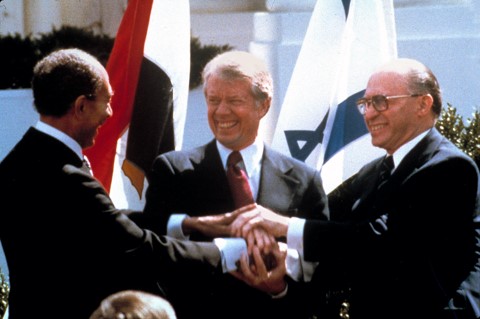
Carter’s tenure as president was most notable for his alternative-energy policies, racial-equality programs and friendly overtures toward Russia. He was instrumental in brokering a peace treaty between Israel and Egypt and signed an arms-reduction treaty with the Soviet Union (SALT II). These triumphs, however, were overshadowed by his inability to lead the nation out of a crippling energy crunch caused by the OPEC oil embargo of 1973.

On top of his administration’s failure to effectively combat the energy crisis, which in turn contributed to rapidly rising inflation, Carter’s administration was forced to deal with another crisis. In 1979, an Islamist student group in Iran stormed the U.S. embassy in Teheran, holding 70 Americans hostage for 444 days. Carter’s failure to secure the release of the hostages, the ongoing recession and a growing movement toward conservatism in America contributed to Carter’s loss to Ronald Reagan in the 1980 presidential campaign.

The Carters have since stayed active in national and international affairs. In 1982, they founded the Carter Center in Atlanta to advocate for human rights and to alleviate “unnecessary human suffering” around the world. Since 1984, the Carters have given their time each year to build homes and raise awareness of homelessness with the international charitable organization Habitat for Humanity. In 2002, Carter won the prestigious Nobel Prize for his efforts to find peaceful solutions to international conflicts, to advance democracy and human rights and to promote economic and social development.

Special Frontier Force Celebrates President Jimmy Carter’s Birthday.

SEPTEMBER 27, 1987 – BLACK DAY TO FREEDOM, DEMOCRACY, AND PEACE IN TIBET

SEPTEMBER 27, 1987 – BLACK DAY TO FREEDOM, DEMOCRACY, AND PEACE IN TIBET

SEPTEMBER 27, 1987 – BLACK DAY TO FREEDOM, DEMOCRACY, AND PEACE IN TIBET

A new era in Tibetan Resistance Movement began on September 27, 1987 when Tibetans in Lhasa openly revolted against Chinese Occupation of Tibet.

Rudranarasimham Rebbapragada

SPECIAL FRONTIER FORCE

TIBETANS TAKE OUT MARCH TO OBSERVE 1987 LHASA UPRISING – DEHRADUN NEWS

Clipped from: http://timesofindia.indiatimes.com/city/dehradun/tibetans-take-out-march-to-observe-1987-lhasa-uprising/articleshow/60859321.cms

DEHRADUN: The Tibetan population in the city observed Wednesday as ‘Black Day’ and took out a candle light march in the heart of the city to commemorate the 1987 uprising in Lhasa, Tibet, which began on September 27, that year.


A peaceful demonstration held on the day in Lhasa was stopped by Chinese authorities and in the days to follow, riots broke out in the city in which several Tibetans were attacked, taken to prison and some were killed.

The commemoration ceremony was organized jointly by Doon Valley Regional Tibetan Women’s Association (RTWA) and regional Tibetan Youth Congress. Tibetans across the city also came together and remembered those who sacrificed their lives for free Tibet. The Tibetan market also remained shut on the day.

Tibet came into the limelight in 1987, 28 years after the Dalai Lama’s flight in 1959. The 1987 Lhasa pro-independence demonstrations were a landmark in Tibetan history. From 1987 to 1992, about 140 protests and demonstrations were held in Tibet to oppose the Chinese rule in Tibet.

Sent from Mail for Windows 10

Virus-free. www.avast.com

WHAT’S UP? WHATSAPP DOWN IN COMMUNIST CHINA

WHAT’S UP? WHATSAPP DOWN IN COMMUNIST CHINA

What’s Up? WhatsApp down in Communist China. Disruption of Messaging Service ahead of Communist Party Meeting in October 2017 merely symbolizes the absence of Transparency and Public Accountability in Communist Governance.

Rudranarasimham Rebbapragada

DOOM DOOMA DOOMSAYER

CHINA DISRUPTS ‘WHATSAPP’ AHEAD OF COMMUNIST PARTY MEETING

Clipped from: http://www.bbc.com/news/business-41395640

Image copyright Getty Images

The messaging service WhatsApp has been disrupted in China as the government steps up security ahead of a Communist Party meeting next month.

Users have faced problems with the app for more than a week with services dropping in and out.

At times, it has been completely blocked and only accessible via virtual private networks (VPNs) which circumvent China’s internet firewall.

WhatsApp is Facebook’s only product allowed to operate in mainland China.

Facebook’s main social media service and its Instagram image sharing app are not available on the mainland.

Services disrupted

The BBC’s China based correspondents said the WhatsApp messaging service started going offline more than a week ago.

A test of its services on Tuesday showed users in China could not send video messages or photographs to people outside China.

The disruption follows restrictions on WhatsApp video chats and photographs in July, which were later lifted.

The tightening of online censorship comes as China steps up security ahead of the Communist Party’s national congress which is held every five years.

"The run-up period to a gathering is normally a time of greater restrictions of all kinds to assure that the critical Party Congress is held under ideal social conditions and is not disrupted", Robert Lawrence Kuhn, long-time advisor to China’s leaders and multinational corporations told the BBC.

However, he said it is not yet clear whether the restrictions will be relaxed as has happened after previous party congresses, adding that many analysts do not believe they will be.

WhatsApp has declined to comment on the latest clampdown.

Image copyright Getty Images Image caption WeChat is the most popular messaging service in China

Analysis – Stephen McDonell, BBC China correspondent, Beijing

Last week word started spreading around other platforms… "Is WhatsApp blocked?"

The replies would come in: "You need to use a VPN". Then the VPNs were being blocked.

Welcome to online China in the run-up to the Communist Party Congress.

Taking out WhatsApp has no impact on most Chinese people. They don’t use it. The unrivalled king of cyberspace in this country is WeChat (or, in Chinese, Weixin 微信)

You would really struggle to find somebody here not using WeChat to send messages, share photos, swap locations, flirt, read news and pay for pretty much everything. This all-encompassing app at the center of people’s lives is available for the Communist Party to spy on the entire population.

WhatsApp is not – at least not to the same extent.

So, during this sensitive time leading up to the once-in-five-years Party Congress, those with responsibility for censoring social media are nervous.

They worry that somebody may use an app beyond their complete control to, for example, organize a protest or post a funny photo of President Xi Jinping and for this to somehow go under their radar.

Tech crackdown

WhatsApp provides end-to-end encryption which ensures only the sender and recipient can view the content of messages.

It also prevents Facebook from knowing what is said in any text, voice and video conversation being communicated on WhatsApp.

"China has shown little tolerance to encryption especially on platforms that can be used to share materials or potential propaganda," Bill Taylor-Mountford, Asia Pacific vice president for LogRhythm told the BBC.

The latest disruption to WhatsApp appears to be part of a broader crackdown on the internet and online content in China.

On Monday, China’s cyber watchdog handed down maximum penalties to some of the country’s top technology firms including Tencent, Baidu and Weibo for failing to properly censor online content.

The penalties were imposed for failing to remove fake news and pornography, as well as content that authorities said "incites ethic tension" and "threatens social order".

Created with Microsoft OneNote 2016.

SEPTEMBER 21, 1949 – THE COLD WAR IN ASIA – THE BIRTH OF ONE-PARTY GOVERNANCE IN PEKING

SEPTEMBER 21, 1949 – THE COLD WAR IN ASIA – THE BIRTH OF ONE-PARTY GOVERNANCE IN PEKING


On September 21, 1949 Mao Zedong revealed plan for One-Party Governance of mainland China establishing Single-Party System or Party-State. On September 21, 2017, the Communist Party of China continues to pose threat to Democracy, Freedom, Peace, and Justice in Asia.


Rudranarasimham Rebbapragada

DOOM DOOMA DOOMSAYER

MAO ZEDONG OUTLINES THE NEW CHINESE GOVERNMENT – SEPTEMBER 21, 1949


Clipped from: http://www.history.com/this-day-in-history/mao-zedong-outlines-the-new-chinese-government?

Cold War

1949

At the opening of the Chinese People’s Political Consultative Conference in Peking, Mao Zedong announces that the new Chinese government will be “under the leadership of the Communist Party of China.”

The September 1949 conference in Peking was both a celebration of the communist victory in the long civil war against Nationalist Chinese forces and the unveiling of the communist regime that would henceforth rule over China. Mao and his communist supporters had been fighting against what they claimed was a corrupt and decadent Nationalist government in China since the 1920s. Despite massive U.S. support for the Nationalist regime, Mao’s forces were victorious in 1949 and drove the Nationalist government onto the island of Taiwan. In September, with cannons firing salutes and ceremonial flags waving, Mao announced the victory of communism in China and vowed to establish the constitutional and governmental framework to protect the “people’s revolution.”

In outlining the various committees and agencies to be established under the new regime, Mao announced that “Our state system of the People’s Democratic Dictatorship is a powerful weapon for safeguarding the fruits of victory of the people’s revolution and for opposing plots of foreign and domestic enemies to stage a comeback. We must firmly grasp this weapon.” He denounced those who opposed the communist government as “imperialistic and domestic reactionaries.” In the future, China would seek the friendship of “the Soviet Union and the new democratic countries.” Mao also claimed that communism would help end reputation as a lesser-developed country. “The era in which the Chinese were regarded as uncivilized is now over. We will emerge in the world as a highly civilized nation.” On October 1, 1949, the People’s Republic of China was formally announced, with Mao Zedong as its leader. He would remain in charge of the nation until his death in 1976.


PRESIDENT TRUMP JUST SAY “NO” TO COMMUNISM

PRESIDENT TRUMP JUST SAY "NO" TO COMMUNISM

PRESIDENT TRUMP JUST SAY "NO" TO COMMUNISM

At U.N. General Assembly, on Tuesday September 19, President Trump delivered an empty threat to ‘totally destroy’ North Korea. United States tried twice in the past to destroy Korea and Vietnam on the battlefield. US failed in 1953 and 1975 for Korea and Vietnam are not the "Real Enemy." Korea and Vietnam survived the US bombing campaigns for they have the support of Communists.

ms-clipboard-file://C:/Users/Rudra/AppData/Local/Packages/Microsoft.Office.OneNote_8wekyb3d8bbwe/TempState/msohtmlclip/clip_image002.png

I ask President Trump to Just Say "NO" to Communism, the "Real Enemy," to Win ‘The Cold War in Asia’.

Rudranarasimham Rebbapragada

SPECIAL FRONTIER FORCE

AT U.N., TRUMP WARNS U.S. MAY HAVE TO ‘TOTALLY DESTROY’ NORTH KOREA

Clipped from: https://www.msn.com/en-us/news/world/at-un-trump-warns-us-may-have-to-totally-destroy-north-korea/ar-AAschGJ?li=BBnb7Kz

UNITED NATIONS — U.S. President Donald Trump said on Tuesday that the United States will be forced to "totally destroy" North Korea unless Pyongyang backs down from its nuclear challenge, mocking North Korean leader Kim Jong Un as a "rocket man" on a suicide mission.

Loud murmurs filled the green-marbled U.N. General Assembly hall when Trump issued his sternest warning yet to North Korea, whose ballistic missile launches and nuclear tests have rattled the globe. Unless North Korea backs down, he said, "We will have no choice but to totally destroy North Korea."

"Rocket man is on a suicide mission for himself and his regime," he said.

North Korea’s mission to the United Nations did not immediately respond to a request for comment on Trump’s remarks. A junior North Korean diplomat remained in the delegation’s front-row seat for Trump’s speech, the North Korean U.N. mission said.

In his first appearance at the annual gathering of world leaders, the president used a 41-minute speech to take aim also at Iran’s nuclear ambitions and regional influence, Venezuela’s collapsing democracy and the threat of Islamist extremists.

He also criticized the Cuban government. But his strongest words were directed at North Korea. He urged United Nations member states to work together to isolate the Kim government until it ceases its "hostile" behavior.

He said North Korea’s pursuit of nuclear weapons and ballistic missiles "threatens the entire world with unthinkable cost of human life."

In what may have been a veiled prod at China, the North’s major trading partner, Trump said: "It is an outrage that some nations would not only trade with such a regime but would arm, supply and financially support a country that imperils the world with nuclear conflict."

Turning to Iran, Trump called the 2015 nuclear deal negotiated by his predecessor, Barack Obama, was an embarrassment and hinted that he may not recertify the agreement when it comes up for a mid-October deadline.

"I don’t think you’ve heard the last of it," he said.

He called Iran an "economically depleted rogue state" that exports violence. The speech marked his latest attempt to lay out his America First vision for a U.S. foreign policy aimed at downgrading global bureaucracies, basing alliances on shared interests, and steering Washington away from nation-building exercises abroad.

Trump, who entered the White House eight months ago, told world leaders at the 193-member global body that the United States does not seek to impose its will on other nations and will respect other countries’ sovereignty.

"I will defend America’s interests above all else," he said. "But in fulfilling our obligations to other nations we also realize it’s in everyone’s interest to seek a future where all nations can be sovereign, prosperous and secure."

Reading carefully from a script, Trump said the U.S. military would soon be the strongest it has ever been. Turning to Venezuela, Trump called the collapsing situation there "completely unacceptable" and said the United States cannot stand by and watch. He warned the United States was considering what further actions it can take. "We cannot stand by and watch," he said.

Shortly before Trump’s speech, U.N. Secretary-General Antonio Guterres appealed from the General Assembly lectern for statesmanship to avoid war with North Korea. "This is the time for statesmanship," said the former prime minister of Portugal.

"We must not sleepwalk our way into war.." The U.N. Security Council has unanimously imposed nine rounds of sanctions on North Korea since 2006 and Guterres appealed for the 15-member body to maintain its unity on North Korea.

Trump has warned North Korea that military action was an option for the United States as Pyongyang has carried out a series of tests toward developing the ability to target the United States with a nuclear-tipped missile. Financial markets showed little reaction to Trump’s speech, with most major assets hovering near the unchanged mark on the day.

Sent from Mail for Windows 10

PRESIDENT TRUMP’S DEFINING MOMENT – ARE YOU FRIEND OF FREEDOM AND DEMOCRACY?

PRESIDENT TRUMP’S DEFINING MOMENT – ARE YOU FRIEND OF FREEDOM AND DEMOCRACY?


On Tuesday September 19, 2017, President Trump will address the UN General Assembly. It will be President Trump’s defining moment. He must prove his credentials to the world.


On behalf of Special Frontier Force, I ask Mr. President, “Are You Friend of Freedom and Democracy?”


Trump must verify his love, hate relationship with American Values. While defending Freedom and Democracy, the US lost its battle in Vietnam. Now, I must know as to how President Trump plans to “WIN” ‘The Cold War in Asia’.


Rudranarasimham Rebbapragada

Ann Arbor, Michigan, USA 48104 – 4162

SPECIAL FRONTIER FORCE


TRUMP’S LOVE, HATE RELATIONSHIP WITH THE UNITED NATIONS – ABC NEWS


Clipped from: http://abcnews.go.com/Politics/president-trumps-love-hate-relationship-united-nations/story?id=49925472

Evan Vucci/AP

President Trump will make his first speech before the United Nations General Assembly on Tuesday. Will he bring the world together or sow division? Will he embrace an institution that he has previously called weak and incompetent?

His relationship with the New York-based global organization is long and complicated.

Trump, the candidate, says UN “not a friend of freedom”

During his March 23, 2016 speech before the American Israel Public Affairs Committee’s conference, then-candidate Trump issued some of his toughest commentary, speaking of the “utter weakness and incompetence of the United Nations.”

“The United Nations is not a friend of democracy. It’s not a friend to freedom,” Trump said. “It’s not a friend even to the United States of America, where, as you know, it has its home. And it surely is not a friend to Israel.”

Though a 2016 Global Attitudes Survey by Pew Research Center showed that 64 percent of Americans had a favorable view of the United Nations, Trump’s campaign promises for a protectionist economic policy and an aggressive approach to China come into conflict with the goals of multilateralism and the UN charter. His promotion of interrogation techniques “worse than waterboarding,” his push for a temporary ban on Muslims from entering the U.S. and his decision to pull out of the Paris Climate Accords have also put Trump at odds with UN allies.

Last December, Trump continued his assault on the institution, tweeting: “The United Nations has such great potential but right now it is just a club for people to get together, talk and have a good time. So sad!”

Trump, the real estate magnate: “I’m a big fan” of the UN

In 2005, Trump testified before a subcommittee looking at UN spending, calling himself a “big fan of the United Nations and all it stands for.” He told lawmakers the institution was one of the reasons he chose to build Trump World Tower, one of his luxury residential properties, where he did in 1998.

“If the United Nations weren’t there, perhaps I wouldn’t have built it in that location,” said Trump. “So it means quite a bit to me.” When Trump was planning the building, many UN officials, including Secretary General Kofi Annan, expressed disapproval of the massive construction project.

Trump’s renovation hopes

At a 2005 hearing, a Senate Homeland Security and Governmental Affairs subcommittee was looking at renovations at the UN New York headquarters and estimated development costs for similar projects in New York. Trump had met with UN officials to pitch his services, but they were refused. He told members he thought the project could cost $700 million, and he predicted the UN would end up spending upwards of $3 billion.

“You have to deal in New York City construction to see what tough people are all about,” Trump said at the time. “I listen to these people and they’re very naive, I respect them, but they’re very naive in this world. I might be naive in their world. But in this world, they’re naive.”

He also noted at a 2005 hearing that it was a dream of his to move the United Nations headquarters to the World Trade Center.

Seven years later, he shared another UN preoccupation, tweeting on Oct. 3, 2012: “The cheap 12 inch sq. marble tiles behind speaker at UN always bothered me. I will replace with beautiful large marble slabs if they ask me.”

On Tuesday, Trump will address the United Nations General Assembly and the world without his “beautiful large marble slabs” as a backdrop.