Whole Threat – Military Occupation of Tibet remains a threat to the World

China’s Military Threat is worsening since 1950
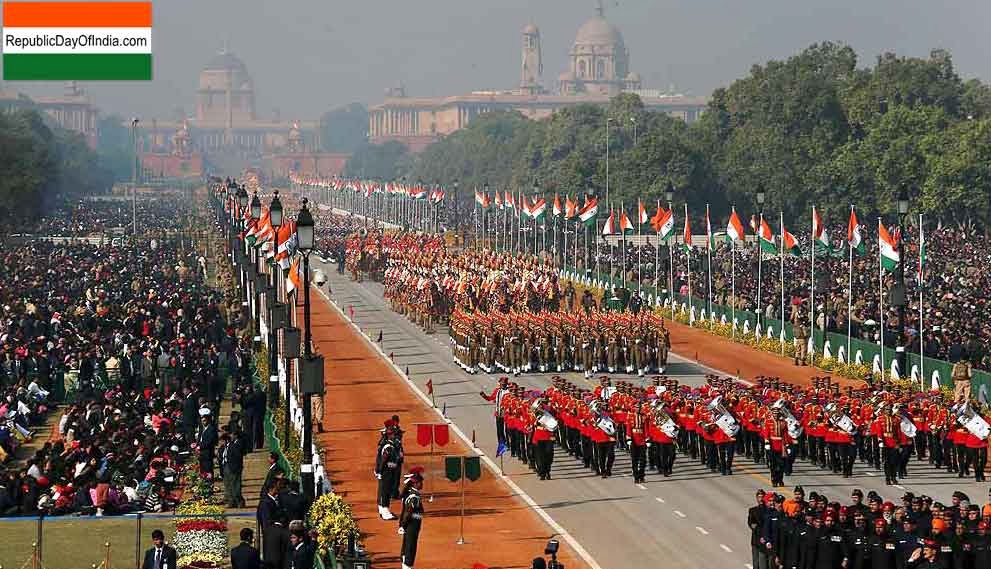
Special Frontier Force - China's Military Threat: On the happy occasion of the celebration of India's Republic Day on January 26, 2014, I would like to speak about the military threat posed by China's military occupation of Tibet.
China’s Military Threat is worsening since 1950: On the happy occasion of the celebration of India’s Republic Day on January 26, 2014, I speak about the military threat posed by China’s military occupation of Tibet.

India declared itself as a sovereign Republic on January 26, 1950.  As Indians celebrate Republic Day on this day, I share an article titled “AIM OF CHINA’S MILITARY REFORMS” authored by  Professor Jayadeva Ranade, a member of the National Security Advisory Board, Distinguished Fellow with the Centre for Air Power Studies, New Delhi and who had in the past served as the additional Secretary in the Cabinet Secretariat. The threat posed by China by its military invasion of Tibet since 1950 is worsening without any respite.
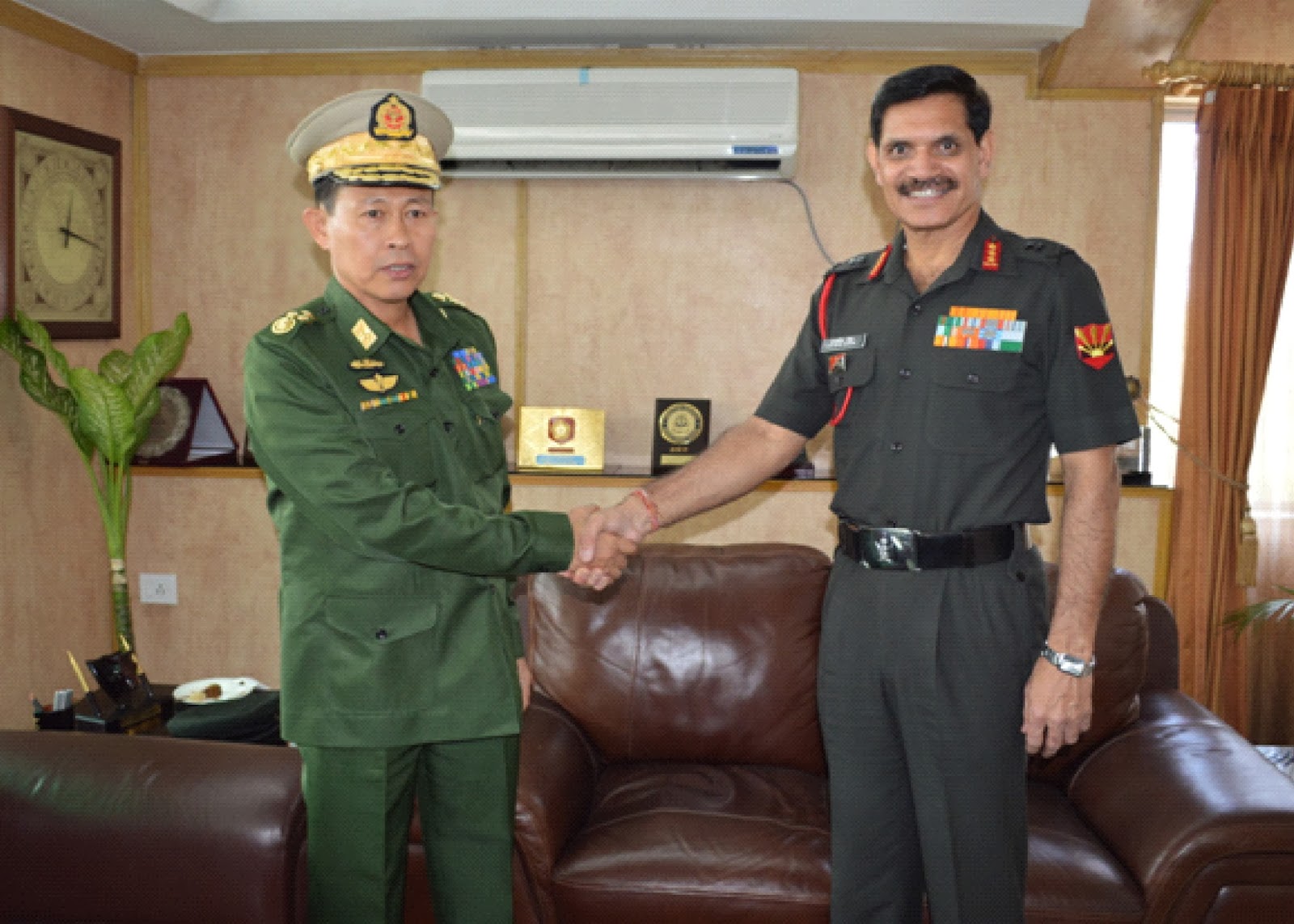
Special Frontier Force - China's Military Threat: The Deputy Commander-in-Chief, Myanmar Defence Service and Commander-in-Chief, Myanmar Army Vice Senior General Soe Win visited the Indian Army Eastern Command Headquarters in Fort William, Kolkata on December 10, 2013. He is seen with Eastern Army Commander Lieutenant General Dalbir Singh Suhag who served as the Inspector General Special Frontier Force from April 2009 to March 2011.
China’s Military Threat: The Deputy Commander-in-Chief, Myanmar Defence Service and Commander-in-Chief, Myanmar Army Vice Senior General Soe Win visited the Indian Army Eastern Command Headquarters in Fort William, Kolkata on December 10, 2013. He is seen with Eastern Army Commander Lieutenant General Dalbir Singh Suhag who served as the Inspector General Special Frontier Force from April 2009 to March 2011.

For the first time in the history of Special Frontier Force, its Inspector General is now appointed as the Vice Chief of Army Staff (VCOAS). Lieutenant General Dalbir Singh Suhag served as Inspector General Special Frontier Force from April 2009 to March 2011. He served as the GOC-in-C, Eastern Command from June 16, 2012 to December 31, 2013. His present appointment as the Vice Chief of Army Staff indicates that he will become the next Indian Army Chief in August 2014.

In my opinion, China’s military power, military strategy, and military tactics will not assure the inevitability of peace that is imposed by its military occupation of Tibet. Peace and War are conditions that prevail in relationship with an external reality called Natural Order. Tibetan Resistance is a symptom of the absence of Natural Order in Tibet. Resistance will prevail, and Resistance will endure if Natural Order is not restored in Tibet. Tibetans love Tibet and the Love of one’s own country is neither a moral, nor a religious virtue for it is a Natural Virtue. Speaking of War and Peace in Tibet, I ask, “Can we order Peace for the sake of War, and not War for the sake of Peace?” If Perseverance is the Secret of all Triumphs, Tibetan Resistance can hope for its Victory.

Special Frontier Force - China's Military Threat: China's Military Power, China's Military Strategy, and China's Military Tactics cannot overcome the Power of Perseverance, the Perseverance of Tibetan Resistance.
China’s Military Threat: China’s Military Power, China’s Military Strategy, and China’s Military Tactics cannot overcome the Power of Perseverance, the Perseverance of Tibetan Resistance.

Aim of China’s Military Reforms

By Jayadeva Ranade

SPECIAL FRONTIER FORCE - CHINA'S MILITARY THREAT: WORLD PARLIAMENTARIANS CONVENTION ON TIBET HELD IN OTTAWA, CANADA, 2012. Carl Gershman, President of the National Endowment for Democracy, Washington, DC, Professor Jayadeva Ranade, Distinguished Fellow with the Centre for Air Power Studies, New Delhi, with Richard Gere, Chairman of the International Campaign for Tibet.
CHINA’S MILITARY THREAT: WORLD PARLIAMENTARIANS CONVENTION ON TIBET HELD IN  OTTAWA,  CANADA, 2012. Carl Gershman, President of the National Endowment for Democracy, Washington, DC, Professor Jayadeva Ranade, Distinguished Fellow with the Centre for Air Power Studies, New Delhi, with Richard Gere, Chairman of the International Campaign for Tibet.

Published: 21st January 2014 06:00 AM

The writer is a member of the National Security Advisory Board and former additional secretary in the cabinet secretariat, Indian government.

Special Frontier Force - China's Military Threat: China CV-16 Liaoning Aircraft Carrier. Navy J-15 Flying Shark takeoff. China has modernized its military cpabilities.
China’s Military Threat: China CV-16 Liaoning Aircraft Carrier. Navy J-15 Flying Shark takeoff. China has modernized its military capabilities.

Modernization of China’s People’s Liberation Army (PLA) has entered the final stage of its current phase. The Chinese Communist Party (CCP)’s Third Plenum, which was held in November 2013 and represents a major advance in China’s reforms, provided a substantive push to the PLA’s modernization when it approved proposals for major organizational restructuring. The reforms coincide with China’s continuing assertiveness that has unsettled its neighbors.
Appointments to the Central Military Commission (CMC) effected earlier by the CCP’s 18th Congress in Beijing in November 2012 accelerated the drive to strengthen and modernize the 2.3 million-strong PLA. Within days of his appointment as the CMC chairman, Xi Jinping not only endorsed the military modernization policies of his predecessors Hu Jintao and Jiang Zemin, but also began bluntly advocating more rapid modernization and technological upgrade of the PLA.
The organizational reforms approved by the CCP’s Third Plenum indicate that changes are imminent in the PLA’s command structure comprising the four principal departments and seven military regions. The PLA Navy (PLAN), PLA Air Force (PLAAF) and China’s strategic missile strike force, namely the Second Artillery, have clearly been allotted an enhanced operational role and will receive priority in allocation of budgets and manpower. Personnel of the Second Artillery, PLAAF and PLAN already receive higher salaries than their counterparts in the PLA’s ground forces. Within days of the Third Plenum, CMC vice-chairman and till recently the PLAAF commander, Xu Qiliang, wrote an article in the party mouthpiece People’s Daily confirming the reforms will be implemented. He mentioned that the number of non-combatants would be drastically reduced and that the reforms would enable the PLA to win wars.
Quite separately, reports filtering out of Beijing and disclosed initially in the solitary official English-language China Daily, suggest that plans have been finalized to merge the military regions. These envisage reorganizing the seven military regions into five “combat zones” (zhan chu) within the next five years. Over the past few years China’s military literature has hinted at such impending change with occasional references to “Theatre Commands”. The reorganization is intended to concentrate firepower and troops trained for a specific type of warfare within a single theatre or zone for ease of rapid deployment. Land and sea warfare forces are to be grouped separately. This reorganization gives the PLA a definite “outward orientation” neatly meshing with its doctrine of “active defence”.

Special Frontier Force - China's Military Threat: Shenyang SAC J-16 Stealth Fighter Aircraft.
China’s Military Threat: Shenyang SAC J-16 Stealth Fighter Aircraft. Military Spending will not increase Military Power.

According to these reports, the three mainly coastal military regions of Jinan, Nanjing and Guangzhou are to be converted into three “combat zones.” Adopting a mainly maritime role, their primary objective will be to reinforce China’s efforts to establish dominance over the East China Sea and South China Sea and face up to the US-Japan alliance. By 2020, all three zones will be reinforced by three aircraft carrier combat groups. Reports suggest existing aircraft carrier Liaoning will be deployed in the East China Sea, while the other two aircraft carriers will be in the South China Sea. Interestingly on January 1, Xinhua showed pictures of Liaoning returning to its home base in Qingdao after month-long exercises in the South China Sea, but avoided mention of the run-in with the US-guided missile warship USS Cowpens.
In April 2013, Xinhua reported Rear Admiral Song Xue, deputy chief of staff of the PLA Navy, saying a second aircraft carrier was under construction. He told foreign military attaches that it would be larger and carry more fighter aircraft. On January 18, 2014, party secretary of Liaoning province Wang Min disclosed China’s second domestically produced aircraft carrier is being built at Dalian and would be ready in six years.
The four inland military regions of Shenyang, Beijing, Chengdu and Lanzhou are to similarly be merged into two large combat zones. Chengdu and Lanzhou both exercise operational jurisdiction over the India-China border. Each of the two new zones will have units of the PLA Navy, Air Force and Second Artillery integral to them. They will function under a new unified combat command. These reports also disclose that the PLA’s 300,000 non-combatant personnel will be eliminated by 2022. Though China’s ministry of defence denied the reports, it is pertinent that mention was first made in China Daily and that its contents are generally in consonance with Xu Qiliang’s assertion in People’s Daily and the reforms approved at the CCP CC’s Third Plenum.
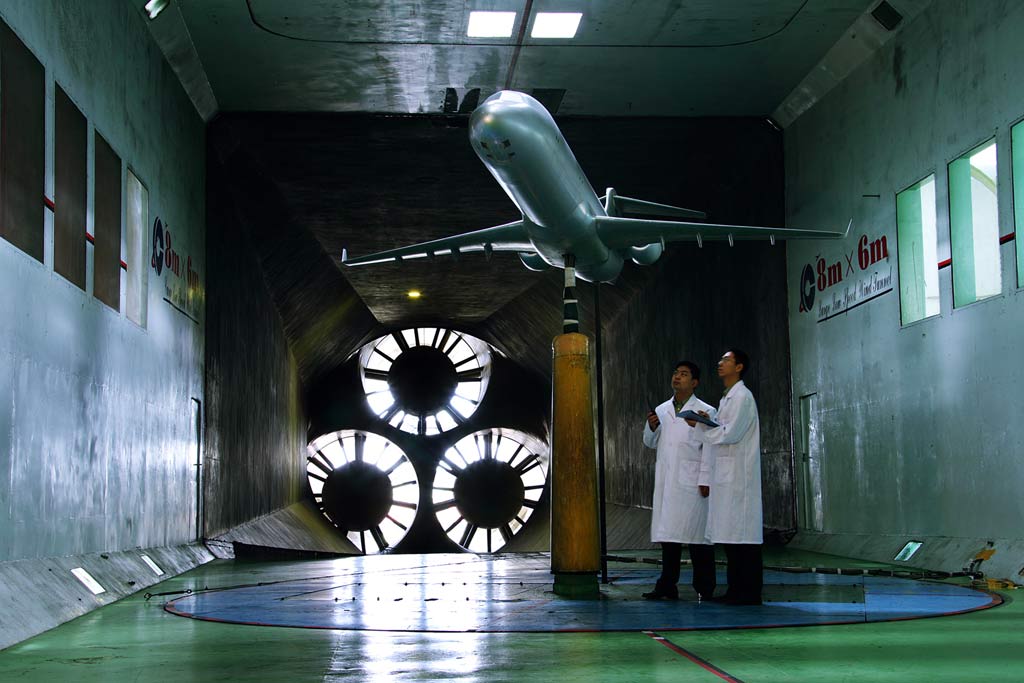
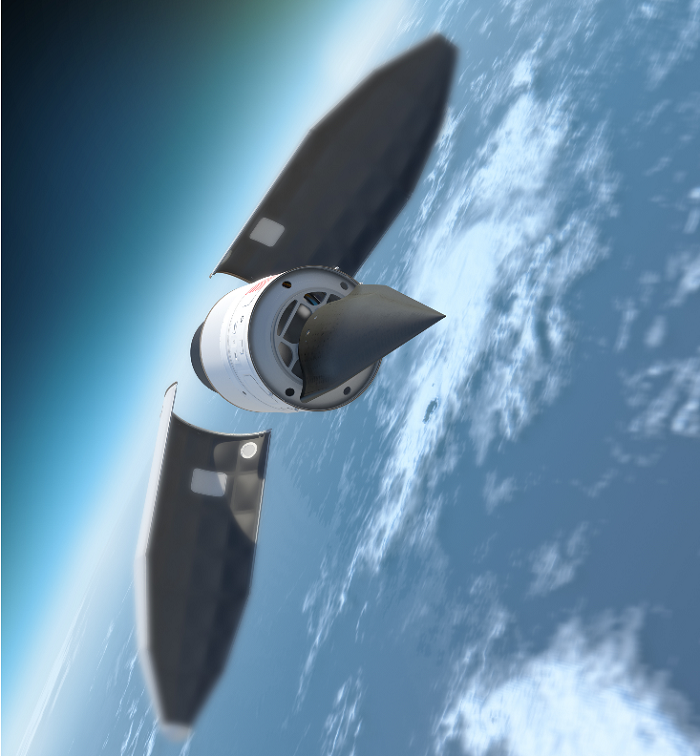
Special Frontier Force - China's Military Threat:  China has built over 39 Wind Tunnels that include Subsonic, Supersonic, Hypersonic, and others to improve its ability to design and test its military aircraft.
China’s Military Threat: China has built over 39 Wind Tunnels that include Subsonic, Supersonic, Hypersonic, and others to improve its ability to design and test its military aircraft.
Special Frontier Force - China's Military Threat: China has reportedly developed a WU-14 Hypersonic Glide Vehicle. China's Military Empire will collapse under its own weight as things in Nature change while Natural Order remains Unchanging.
China’s Military Threat: China has reportedly developed a WU-14 Hypersonic Glide Vehicle. China’s Military Empire will collapse under its own weight as things in Nature change while Natural Order remains Unchanging.

Rapid advances have also been made in the indigenous development of advanced defence technology and hardware in the past three years. Emphasis was underscored with the appointment of General Zhang Youxia, a known proponent of indigenous development of modern advanced defence technology, as director of the PLA’s General Armaments Department (GAD) in October 2012. The latest development was the announcement on January 9 that China had conducted the first flight test of a new hypersonic glide vehicle, dubbed the WU-14 by the Pentagon, thus becoming one of five nations to possess this capability. The hypersonic vehicle, capable of travelling at speeds between Mach 8 and 12, represents a major advance in China’s secretive strategic nuclear and conventional military and missile programmes. China had in May 2012 opened a new JF12 shockwave hypersonic wind tunnel—the largest of its kind—that replicates flying conditions between Mach 5 and 9.

Also this month, pictures of the new two-seater J-16 stealth fighter built by the Shenyang Aircraft Corporation were posted online. Slated to first be inducted by PLAN and later the PLAAF, the J-16 is loaded with eight tons of air-to-air and anti-ship missiles and has a combat radius of several hundred miles, enabling it to help Chinese warships battle for control of regional waters claimed by China. Some reports claim two dozen J-16 are ready for induction.
These military reforms will give the PLA an outward focus, implying that “recovery” of territories claimed by Beijing will be a central feature of China’s strategic agenda. They will reinforce diplomacy aimed at realising “China’s Dream”. Xi Jinping, meanwhile, continues to further tighten his and the CCP’s grip on the PLA. An important example is the Third Plenum approving the PLA being brought within the ambit of the party’s anti-corruption watchdog, the Central Discipline Inspection Commission.

Professor Jayadeva Ranade is a member of the National Security Advisory Board and former additional secretary in the cabinet secretariat, Indian government.
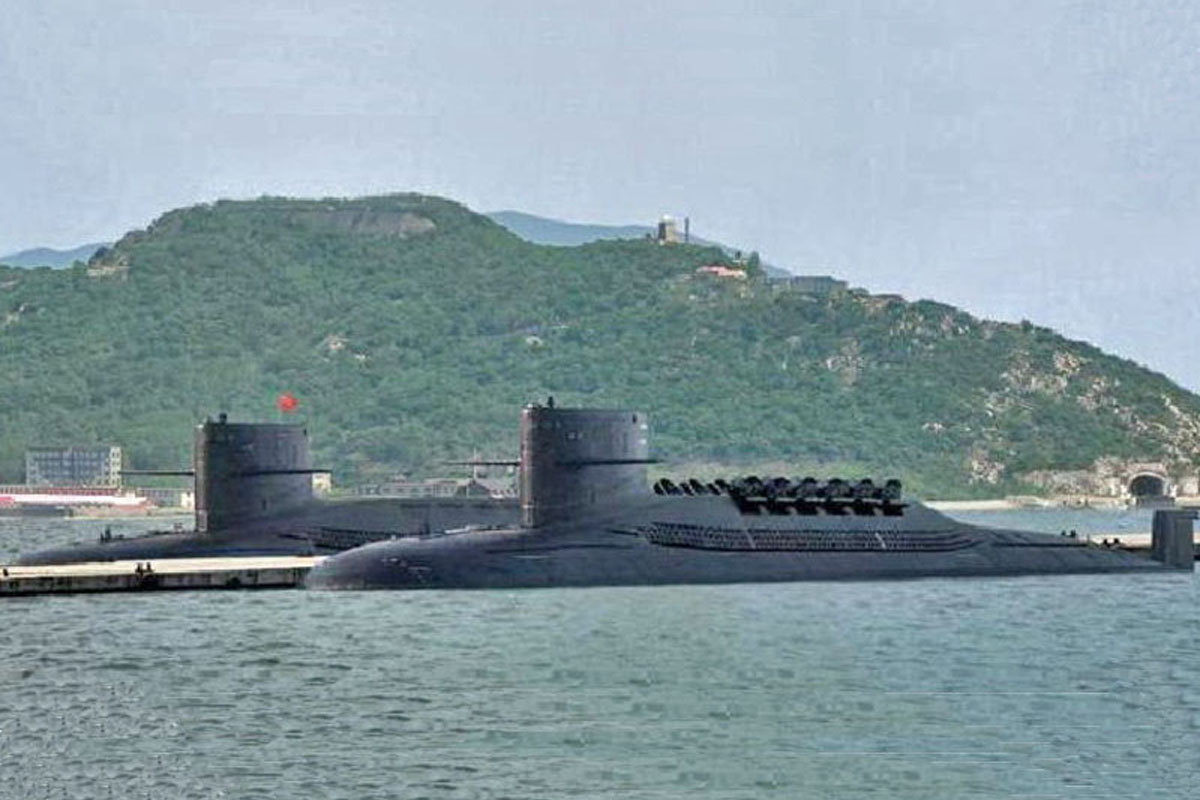
China’s Military Threat: Nuclear Submarine 2009 plan type094 02

Whole Dispute – Resolve Tibet-China Border Dispute

Resolve Tibet-China Border Dispute

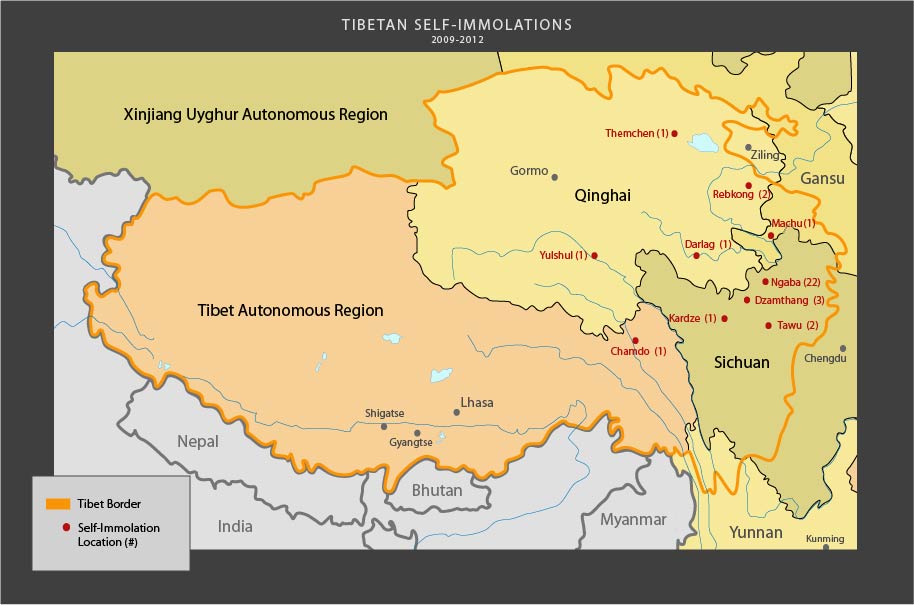
People's Republic of China's province called Tibetan Autonomous Region or "TAR" was established in 1965 after Communist China had annexed Tibetan territory and illegally added it to adjoining Chinese provinces. Hence, there is a valid dispute about China-Tibet boundaries.
Whole Dispute: People’s Republic of China’s province called Tibetan Autonomous Region or “TAR” was established in 1965 after Communist China annexed Tibetan territory and illegally added it to adjoining Chinese provinces. Hence, there is a valid dispute about China-Tibet boundaries. Tibet Protests Map 2008-2009.

It is surprising to note that people who write about the Sino-Indian border conflict make no reference to the history of Tibet. To state very briefly, the Great Fifth Dalai Lama founded the Ganden Phodrang Government of Tibet in 1642. The successive Dalai Lamas have headed the Tibetan State for nearly four centuries. From 1279 to 1368 Tibet was under the nominal control of the Yuan or Mongol dynasty of China, but subsequently regained its independence. In 1644, the Manchu or Qing dynasty was established in China and Tibet came under its nominal protection although for the most part the country retained control over its internal affairs. With the downfall of the Qing or Ching dynasty, the Great 13th Dalai Lama declared Tibet’s Independence on 13th February, 1913. For 39 years, from 1911 to 1950, Tibet was an independent nation. In Political Science, when states are called free and independent, their autonomy or sovereignty means that they have full power to levy war, conclude peace, contract alliances, establish commerce, and do all other acts and things which independent states may have the right to do. In its capacity as an independent nation, Tibet signed a treaty called the McMahon Treaty (following the Simla Agreement) which established the border between India and Tibet. The Republic of India after gaining its full independence during 1947 did not annul or revoke this treaty. As such, for all legal purposes, this treaty is valid. People’s Republic of China came into its existence after the Communists took over mainland China during 1949 and forced the Nationalist Party (Kuomintang) establish the Republic of China in Formosa or Taiwan. Both the Nationalists, and the Communists seek the reunification of Taiwan with the mainland. That issue is not yet decided. Meantime, Communist China invaded Tibet during 1950 and occupied it. In 1951, a defeated Tibet signed a treaty making Tibet a part of China. However, most Tibetans do not recognize this treaty and do not accept its legitimacy. In 1959, after a failed, massive Tibetan uprising, the 14th Dalai Lama and about 100, 000 of his followers escaped to India. Tibetans have established the Tibetan Government-in-Exile, and on September 02, 1960, the first members of the First Tibetan Parliament-in-Exile took their oath of office. In September, 2012, Tibetans have celebrated 52nd Democracy Day. During 1965, People’s Republic of China formed a province that it named as Tibetan Autonomous Region or “TAR.” In doing so, Communist China annexed several parts of Tibet and added them to its own territory. Tibetans have not agreed for this seizure of their territory. One of the central demands of the Tibetan Government-in-Exile is that of unifying all the Tibetan territory that is now under Chinese military occupation.

We have to very important issues; 1. Unification of Republic of China with People’s Republic of China and establish a national entity called China, and 2. demarcating the border between the new “One-China” and its neighbor, Tibet. Tibetans have not surrendered their claims for independence, freedom, and self-determination. As such, Tibet is not a part of China and the borders of China’s province called “TAR” do not establish the legitimate borders between Tibet and China.

India forgets that China cannot be trusted
G.PARTHASARATHY

December 5, 2012:

One cannot but be surprised by the statement of the National Security Advisor (NSA) Shivshankar Menon brushing aside the serious implications of Chinese actions, while voicing optimism that “we are in the process of agreeing on a framework to settle the boundary”.

Have we forgotten that after agreeing to delineate the Line of Actual Control, the Chinese backed off on the entire process?

In 2005, Premier Wen Jiabao agreed that “in reaching a border settlement, the two sides shall safeguard due interests of their settled populations in border areas”.

This clearly signaled that there was no question of transferring territories containing settled populations and addressed Indian concerns on Chinese claims to Tawang in Arunachal Pradesh. Within a year, however, China was laying claim not merely to Tawang, but the entire state of Arunachal Pradesh.

One can only conclude that the new “framework” the NSA spoke of to settle the boundary issue would be about as successful as the much-touted “Joint anti-Terror Mechanism” with Pakistan, which came apart with the 26/11 attacks.

Just a day before the NSA spoke, Army Chief General Bikram Singh described bilateral relations with China as “absolutely perfect” and added that mechanisms were now in place to solve any issues
between the two countries. This was an astonishing comment, at a time when the army wants additional strike formations, apart from vastly improved communications on the border with China.

Was it because Singh feels the army is unlikely to get its needs fulfilled soon, and needs to sound conciliatory to the Chinese? Do the other two Service Chiefs and the Defence Minister share this
optimism? All these issues need to be debated now that Parliament is in session.

INTERNAL RUMBLINGS

China can now be described as a “dynastic dictatorship,” after its 18th Party Congress. Outgoing leader Hu Jintao voiced concern at the growing dissatisfaction in China over political corruption.

The Party Congress had been preceded by the downfall of its rising star Bo Xilai, whose lavish and flamboyant lifestyle had led to the conviction of his wife for murdering a British businessman and
revelations of the billions of dollars of assets that Bo and his family had acquired.

This was followed by a a well documented leak, quite evidently by Bo’s supporters, about ill-gotten wealth accumulated by Prime Minister Wen Jiabao and his family.

China’s worst kept secrets about dynastic politics in the Communist Party became public when it emerged that four of the seven members of its highest decision-making body, the Standing Committee of the Politburo, were “Princelings,” or descendants of first generation, Mao-era political leaders. Most “Princelings”, including Party Chief Xi Jinping, lead lavish life styles, with families having extensive business interests. The contradictions between having an open economy linked to foreign markets on the one hand and a one-party, authoritarian political structure perceived to be unresponsive to pubic grievances on the other, are coming to the forefront in China.

China will continue to seek new ways to further open up its economy and maintain a high growth rate. But the “Princelings” are unlikely to bring any changes in the basic authoritarian nature of the State apparatus. Tutored by Deng Xiao Ping, who was determined not to follow the glasnost and perestroika path of Gorbachev in the Soviet Union, the new dispensation will be averse to increasing democratization.

TERRITORIAL AGGRESSION

With jingoistic propaganda, evidently to divert public opinion away from domestic issues like high level corruption, China is obviously in no mood to show any flexibility on its territorial claims along the Sino-Indian border. As Chinese passports are generally valid for ten years, there can logically be no change in China’s territorial claims in this period.

China will continue on its path of rapid military modernization, combined with an assertive line on its maritime and land boundary claims.

China’s recent decision to depict the entire South China Sea, together with Arunachal Pradesh and parts of Ladakh as Chinese territory in maps on Chinese passports, has to be seen in the light of this
growing Chinese readiness to use force and military coercion to enforce its territorial claims. One has recently witnessed aggressive Chinese postures resulting in a virtual naval takeover around the
disputed Scarborough Shoal, claimed by the Philippines.

A similar aggressive approach has been taken on recent tensions with Japan, with Chinese naval vessels entering territorial waters, adjacent to the disputed Diaoyu/Senkaku Islands.

China has evidently been emboldened by the American assertion that while the US does have a stand on freedom and maintenance of peace and stability in the South China Sea, it “does not take sides in (maritime) disputes”.

ECONOMIC CONCERNS

New Delhi is now talking of getting superfast trains and rail equipment from China, at a time when there is growing concern at our over dependence on second rate Chinese power equipment.

There are also concerns about dangers to cyber security and communications infrastructure posed by imports from China. Should we not insist on co-production, together with transfer or technology, in such strategic sectors, with preference for cooperation with friendly countries like Japan, France and Germany?

(The author is former High Commissioner to Pakistan.)

Comments:
Dear Mr GP, Many thanks for this caution. Will the ears listen to and the eyes see the ground realities instead of indulging in this ‘all is well’ kind of assumption and self assurance? . The present atmosphere is somewhat similar to the one that prevailed in early 1960s when our leaders wrongly assumed that China would never attack India. Reference is invited to the recent interview granted by Dai Bingguo Chinese Negotiator to PTI (covered by this publication) covering China – Pakistan relationships and China’s territorial claims. We need to exercise extra caution, think and act carefully. I held the view earlier that China will think twice before attacking India once again. But am forced to rethink. Camradely with China can wait. Recent bonhomie in the form of financial assistance, collaboration in power and infrastructure may not be entirely and mutually beneficial. One may need to read the fine print very carefully! Thanks for this opportunity to interact.

Regards

from: Dr.Guru.Raghavan
Posted on: Dec 5, 2012 at 23:08 IST

Tibet declared its independence on February 13, 1913 and had signed the McMahon Treaty with India after the Simla Agreement of 1914. Republic of India has not annulled or voided this Treaty and holds it as a valid agreement between two neighboring States. However, Tibetans do not agree the boundaries of the present Tibetan Autonomous Region and are demanding the unification of the three provinces, 1. U-Tsang, 2. Kham, and 3. Amdo of Tibet nation as it existed before China's illegal military occupation since 1950.
Tibet declared its independence on February 13, 1913 and signed the McMahon Treaty with British India after the Simla Agreement of 1914. Republic of India has not annulled or voided this Treaty and holds it as a valid agreement between two neighboring States. However, Tibetans dispute the boundaries of the present Tibetan Autonomous Region and are demanding the unification of the three provinces, 1. U-Tsang, 2. Kham, and 3. Amdo of Tibet nation as it existed before China’s illegal military occupation since 1950.

Whole Right – The Fight against Red China’s Tyranny

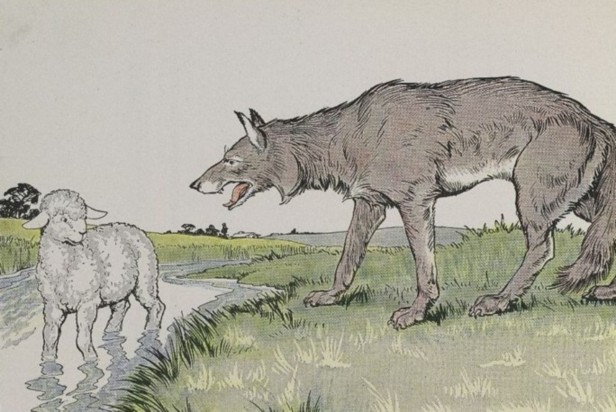
The Wolf and The Lamb: 

THE TYRANT WILL ALWAYS FIND AN EXCUSE FOR HIS TYRANNY.

This story is attributed to Aesop, the legendary Greek story-teller. Once upon a time, a Wolf was lapping at a stream. When looking up, the Wolf saw a Lamb just beginning to drink a little down the stream. “There’s my supper,” thought the Wolf. The Lamb looked so very helpless and innocent. The Wolf felt he ought  to have  an excuse for taking its life. Then he called out to the Lamb, “How dare you muddle the water from which I am drinking?” “No, Master, No,” said the Lamb; “if the water be muddy up there, I cannot be the cause of it, for it runs down from you to me.” “Well then,” said the Wolf, “Why did you call me bad names this time last year?” “That cannot be,” said the Lamb, “I am only six months old.” “I don’t care,” snarled the Wolf, “If it was not you, it was your father,” and with that he rushed upon the poor little Lamb, seized him and ate him up, saying,”Well I won’t stay supper less even though you refute every one of my imputations.” 

A tyrant will always find a pretext for his tyranny. When the oppressor is unjust, the innocent cannot get justice by reasoning. The unjust will not listen to the reasoning of the innocent. 

The Battle of Right Against Might: 

Mahatma Gandhi’s Battle Strategy – Nonviolent Non-Cooperation

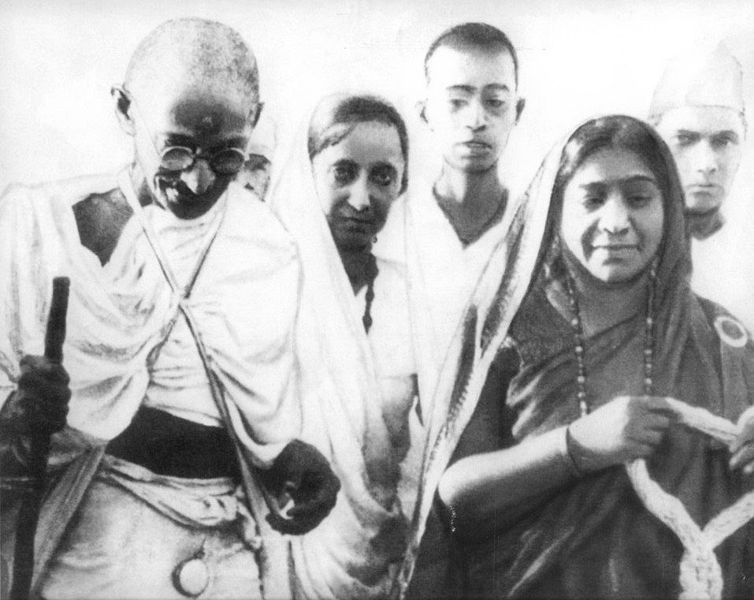
Mahatma Gandhi had challenged the mighty British Empire with a Battle Strategy of his own. On the morning of March 12, 1930, Gandhi and about 78 of his followers had set out to oppose the unjust British Rule. He started marching from Sabarmati Ashram, Ahmedabad toward the village of Dandi on the Arabian Sea. 

GANDHI’S SALT MARCH FROM MARCH 12 TO APRIL 6, 1930
MAHATMA GANDHI AND SAROJINI NAIDU DURING SALT SATYAGRAHA OF 1930.

At that time, under the British Rule, it was forbidden to make salt or even pick it up. It was illegal to collect even natural deposits of salt. Gandhi wanted to attack this unjust Salt Act. He went to the Sea to break the Law. He had inspired people to break the Law. He had marched 240 miles to resist the British Power. The Salt March which is popularly described as Salt Satyagraha was one of Mahatma Gandhi’s most successful Campaigns in the Indian Nationalist Movement for Independence and to overthrow the British Rule. 

GANDHI RESISTED THE MIGHTY BRITISH EMPIRE WITH THIS VERY SIMPLE ACT – A BRILLIANT BATTLE PLAN AND THINKING.

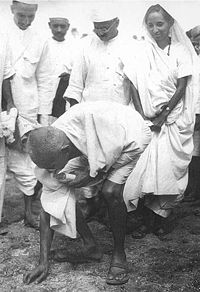
When he got to the Sea, Gandhi broke the Salt Law by the simple act of picking up a tiny lump of soil with some natural salt at Dandi beach. And, he had forced the British to repeal the unjust Salt Law. Gandhi did not reach Dandi in a bus or a car. He had marched all the way on foot. He got the attention that he had wanted. He had shown the way to the people. Injustice could be resisted. Tyranny is not acceptable. People can change unjust laws and get rid of unjust rulers. 

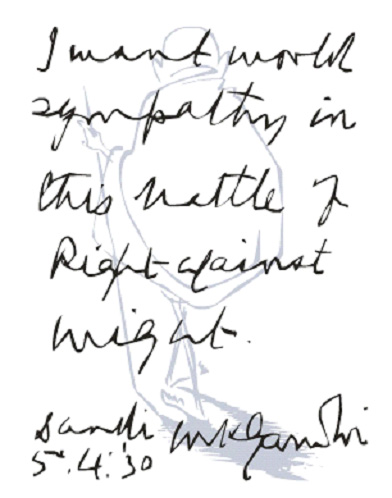
GANDHI’S APPEAL FOR SYMPATHY FOR HIS BATTLE – A STRUGGLE FOR JUSTICE

March 10 – Tibetan National Uprising Day 

TIBET AWARENESS DAY – MARCH 10 – TIBETANS OBSERVE THIS DAY AS TIBETAN NATIONAL UPRISING DAY

H.H. Dalai Lama fled into exile after the Tibetan National Uprising on March 10, 1959 was brutally crushed by Communist China. The illegal and unjust military occupation of Tibet should be challenged and should be opposed. The Chinese Rule in Tibet must be resisted. Mahatma Gandhi had demonstrated the Power of Touch. We can easily resist Chinese military occupation of Tibet. We should resolve and refuse to touch Made in China products. Gandhi won his Battle Campaign by the sheer Power of innocent people who had peacefully joined in opposition to tyranny. Tibet’s  Battle of Right against Might deserves World’s Sympathy.

The Living Tibetan Spirits

I am a witness and my consciousness got exposed to the spirits of young Tibetan men who had given their lives while dreaming about the eviction of the illegal occupier from the Land of Tibet. 

Trulku Tenzin Delek Rinpoche is a revered philanthropist and a religious leader. He is a visionary and consistent advocate of Tibetan Identity and Culture. He was sentenced to life imprisonment on January 26, 2005. He is a soldier in this ‘Battle of Right against Might.
Yeshi Jinpa is a monk of Sog Tsenden Monastery in Sog County of Nagchu Prefecture in Tibet occupied by Communist China. He was arrested on December 02, 2009. He is a soldier in this ‘Battle of Right against Might’.