
Excerpt: The article critically examines Mahatma Gandhi’s leadership during the Indian Independence movement, particularly focusing on his commitment to ‘Ahimsa’ or non-violence. While acknowledging Gandhi’s successful use of non-violence as a political weapon, the author questions if Gandhi was wrong in not considering violent self-defense to protect people from communal violence spawned during the Partition of India. The author suggests Gandhi underestimated the importance of using force to defend life during the violent upheaval, leading to loss of millions of lives. This is contrasted with the actions of other leaders, such as Mohammad Ali Jinnah, reviewed on their approach to the struggles during the same period.

The Flip Side of Gandhi’s political Leadership:

Leadership position gives the man an aura or charisma. Gandhi had earned the title of ‘MAHATMA’, a Great Soul because of his leadership role in India’s Struggle for Independence from British Rule. He inspired a sense of nationalism and I have acknowledged the same in several of my blog posts. He had championed the use of Nonviolence or ‘AHIMSA’ as a political tool and had encouraged people to defend human dignity and human value. However, leadership comes with responsibility. Leadership imposes a heavy burden and a true leader must take responsibility for the consequences of his actions and shortcomings. The principle of nonviolence must be evaluated in the context of defending Human Rights. A man is entitled to his life. A man has the Right to defend himself with whatever force is reasonably necessary against actual or threatened violence. Self-defense is a principle, is a natural instinct, and is a natural Law. Self-defense and Self-preservation may require the use of force or violence to stop the aggressor. It is not a crime to kill an aggressor to defend one’s own life. In a civilized society, the State has a duty to protect the lives of people, and give people the means and the support to exercise their right to self-defense. I have revisited the assassination of Mahatma Gandhi by Nathuram Godse. I had to examine the flip side of his leadership. Gandhi was the unchallenged leader of the Freedom Movement and the Congress Party. His response to British Viceroy Lord Mountbatten’s proposal for partition of British India was highly irresponsible and was not expected of a leader. The Freedom Movement had generated a demand for an Islamic State in all areas where Muslims had a numerical majority. Under the British Rule, Hindus, Muslims, Sikhs, and others had enjoyed a degree of protection and had lived together for centuries. The Freedom Struggle had changed this situation of peaceful coexistence. As the freedom struggle had intensified to end the British Rule, the British stopped paying attention to maintain peace and order within the community. To make their demand for a separate Islamic State, and to consolidate their position on the ground, Muslims had started a program of ethnic intimidation, and of ethnic cleansing to wipe out Hindus living in areas under their control. Hindu properties were looted and burned and Hindus were violently expelled from their homes. Several men, women, and children were brutally killed during vicious mob attacks. The Freedom Movement had unleashed these violent forces and no protection was given to the innocent people who were caught in the middle. In such a situation, the leadership had a moral duty and responsibility to organize and put in place the structures that could defend the community from violent attacks. It was the duty of the Congress Party and its leadership to advocate the use of force as self-defense. If Hindus had not supported the Congress Party and its demand for Freedom, the Movement would not have gained any momentum. There would be no demand for an Islamic State and any Muslim demand for freedom would be rejected and the British would have maintained Law and Order. So, Gandhi as the leader of this Freedom Movement was expected to shoulder a greater responsibility as compared to Muslim League leaders like Mohammad Ali Jinnah. The British proposal for partition of Indian subcontinent had imposed a great burden on Gandhi. His leadership duty would also include defending the rights of Hindus to their lives and to their properties. The dismemberment of British India into two independent nations should not have been agreed upon without demanding the British Viceroy Lord Mountbatten to deploy enough number of troops and make full security arrangements for a peaceful transfer of power. Gandhi as the leader of the Movement must have personally checked and satisfied himself that the British Government had enough resources to protect people. He must have consulted with the Congress Party Working Committee to make arrangements for self-defense in addition to the security measures if any taken by the British rulers. Gandhi had no vested authority or power to concede the demand for India’s Partition. He must have involved all the rank and file of the Congress Party in that decision-making process. In any case, Gandhi must have delayed Independence until arrangements for maintenance of Law and Order were finalized. The tragic consequences of Partition of India fully expose the failure of Gandhi’s leadership. He had utterly failed to visualize the importance of using violent force to defend the Right to Life. Gandhi’s flippant attitude had contributed to the loss of millions of innocent lives.


If Mahatma Gandhi had advocated the use of violent force to protect people and their properties, he could have saved his own life. Unfortunately, the bullet that had hit Gandhi has forced us to inspect the darker side of his leadership.
Self-defense is a Right, it is a Duty, and it does not qualify as violence even when it involves killing the aggressor. I am not opposed to the idea of using nonviolence as a political weapon in the fight for India’s Freedom. The question that I would ask is; What is the idea of Independence if people are not given the opportunity to experience it?

The View of Sri Aurobindo Ghosh on Gandhi’s adherence to Non-Violence

The method of absolute non-violence that was followed during the ‘Satyagraha’ movement should be questioned. It led to the breaking of skulls and a great deal of suffering for the freedom fighters. Two questions arise in the context of the use of non-violence: 1. Was it right and healthy for the nation to go through this kind of non-violence? and 2. Does Indian culture and spirituality enjoin this kind of non-violence?
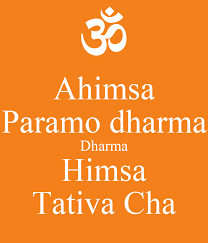
The well-known aphorism states:
“Ahimsa paramo DharmaH;
Dharma himsa tathaiva cha.”

Non-violence or Ahimsa is the highest principle, and so is violence or Himsa in defense of the righteous. Sri Aurobindo had also pointed out that, “Politics is concerned with masses of mankind and not with individuals. To ask masses of mankind to act as saints, to rise to the height of divine love and practice it in relation to their adversaries or oppressors is to ignore human nature. It is to set a premium on injustice and violence by paralyzing the hand of the deliverer when raised to strike. The Gita is the best answer to those who shrink from battle as a sin, and aggression as a lowering of morality.”

The sword of the warrior is as necessary to the fulfillment of justice and righteousness as the holiness of the saint. Saint Ramdas is not complete without Shivaji. To maintain justice and prevent the strong from despoiling, and the weak from being oppressed is the function for which the ‘Kshatriya’ was created. “Therefore,” says Sri Krishna in the Bhagavad Gita, “God created battle and Armour, the sword, the bow, and the dagger.”




 Whole Dude - Whole Concept