Whole Hope – The Hope for Freedom in occupied Tibet

Tibet Consciousness – The Undying Hope for Freedom

Hope for Tibet’s Freedom comes from a belief that predicts Red China’s sudden downfall similar to fall of the Evil Empire identified as Babylon in Revelation, Chapter 18.

On behalf of Special Frontier Force, Establishment 22, I host the Living Tibetan Spirits. These are Spirits of young Tibetan soldiers who lost their lives with the hope for Freedom in Tibet. We have not given up on our hope.

At Special Frontier Force, the concern is not about scoring a military victory. Occupation of Tibet is unjust, is illegal, and we stand opposed to it and resist  as best as possible. Victory in War is not always decided by relative strengths of parties involved. Red China’s act of aggression is Evil and hence Red China is destined to fail.

Hope for Tibet’s Freedom comes from a belief that predicts Red China’s sudden downfall similar to fall of the Evil Empire identified as Babylon in Revelation, Chapter 18.

Hope for Tibet’s Freedom comes from a belief that predicts Red China’s sudden downfall similar to fall of the Evil Empire identified as Babylon in Revelation, Chapter 18.
TIBET CONSCIOUSNESS - UNDYING HOPE FOR FREEDOM - THIS CIA TRAINED FREEDOM FIGHTER SHARED A PHOTO TAKEN BY UNKNOWN CHINESE SPY WITH JOURNALIST NOLAN PETERSON, THE DAILY SIGNAL. BOTH OF THEM HAVE TO ACCOUNT FOR THE POSSESSION OF THAT PHOTO.
TIBET CONSCIOUSNESS – UNDYING HOPE FOR FREEDOM – THIS CIA – TRAINED TIBETAN FREEDOM FIGHTER SHARED A PHOTO TAKEN BY UNKNOWN CHINESE SPY WITH JOURNALIST NOLAN PETERSON, THE DAILY SIGNAL. BOTH OF THEM HAVE TO ACCOUNT FOR THE POSSESSION OF THAT PHOTO.

I am pleased to share a story published by Nolan Peterson, foreign correspondent of The Daily Signal. Hopefully, media will give attention to the foul game played by Nixon-Kissinger during 1970-72. Special Frontier Force/Establishment 22 initiated Liberation of Bangladesh with military action in the Chittagong Hill Tracts in response to Genocide in East Pakistan. India’s Prime Minister Mrs. Indira Gandhi met US President Richard M Nixon in Washington DC on November 03/04, 1971 to enlist his support for India’s military intervention in East Pakistan. President Nixon announced his plan to visit Communist China on July 15, 1971. I call it as “Black Day to Freedom” and characterize Nixon as Backstabber of Tibet. I have known Richard M Nixon and his association with Tibetan Freedom Movement during the years he served as US Vice President during the presidency of Dwight David Eisenhower. Later, President Nixon denied support to India and Tibet for he needed help of General Yahya Khan, Pakistan’s military dictator to befriend Chairman Mao Zedong of Communist China who was known for his crimes against humanity including killing of millions of innocent civilians during infamous Cultural Revolution. I may not agree with Nolan Peterson’s analysis of events, but it doesn’t really matter. The only thing that matters to me is that of hosting undying hope for Freedom in Tibet.

Rudra Narasimham Rebbapragada
Ann Arbor, MI 48104-4162 USA
Special Frontier Force-Establishment 22-Vikas Regiment

A CIA-Trained Tibetan Freedom Fighter’s Undying Hope for Freedom

NOLAN PETERSON @nolanwpeterson October 13, 2015

TIBET CONSCIOUSNESS – UNDYING HOPE FOR FREEDOM. TSERING TUNDUK OF SPECIAL FRONTIER FORCE. ESTABLISHMENT 22. HE AND PETERSON HAVE TO EXPLAIN THEIR CONNECTION TO CHINA.

Tsering Tunduk fled Tibet in 1959 after Chinese soldiers executed his parents. (Photo: Nolan Peterson/The Daily Signal)

PANGONG LAKE, India—At dawn, the old man stood outside his home on the Indian side of Pangong Lake, thumbing his prayer beads and chanting, “Om mani padme hum.”
The sun was rising from behind a wall of Himalayan peaks on the opposite shore, which was Tibet.

The old man’s face, which had been darkly tanned by a lifetime in the high-altitude sun, was as carved and as wrinkled as the Himalayas. His mouth moved almost imperceptibly as he chanted his mantra and stared across the burning blue water toward his homeland, from which he has been exiled for more than half a century.

The old man, whose name is Tsering Tunduk, fled Tibet in 1959 with his little sister, Khunda, after Chinese soldiers executed their parents. It was the same year the Dalai Lama escaped Chinese artillery in the Tibetan capital of Lhasa to seek exile in India.

Orphaned and alone, Tunduk and his sister joined a group of refugees for a treacherous two-month-long journey across the Himalayas into India. Along the way they faced hypothermia and frostbite, a lack of food, and persistent attacks by Chinese troops. Once they arrived in India, the two children began the hard life of refugees.

Ten years later, after he had completed his studies in Mussoorie in 1969, Tunduk volunteered for a secretive all-Tibetan unit in the Indian army called Establishment 22, which the U.S. CIA helped stand up and train when China attacked India in the 1962 Sino-Indian War. Tunduk went through six months of basic training, which included jump training taught by CIA instructors, whom Tunduk remembered as “blond and tall.”

As a new recruit Tunduk made only 80 rupees a month (when he retired in 1996 he made 1,300 rupees a month, about $20), but life in the military offered Tunduk an opportunity more valuable to him than money.

TIBET CONSCIOUSNESS – UNDYING HOPE FOR FREEDOM. PANGONG LAKE NEAR INDIA – TIBET BORDER. Photo. Nolan Peterson. The Daily Signal. CIA – TRAINED TIBETAN FREEDOM FIGHTER IS NOT DEFENDING INDIA-TIBET BORDER. 

Pangong Lake, which is 83 miles long, forms part of the border between India and Tibet. (Photo: Nolan Peterson/The Daily Signal)

“China killed my parents, and I wanted revenge,” Tunduk, who is now 70 years old, said during an interview from his home on Pangong Lake. He spoke in halting, accented English as he peeled potatoes in preparation for dinner. A CD playing the Buddhist, “Om mani padme hum,” mantra set to music was on an endless loop in the background. A shrine to the Dalai Lama, draped in a Khata scarf and with offerings of fruit laid out before it, was on a shelf over the table.

“I would have fought them with a knife at that time,” Tunduk added, not looking up. “I wanted to kill them all.”

Even now, at 70, Tunduk says that when he closes his eyes to sleep at night, he is haunted by images of his dead parents. As he describes their murder, Tunduk’s face muscles relax. His usual smile is replaced by something cold and expressionless. His mind is back in a time and place that no words, not even from one’s native tongue, have the power to faithfully recreate.

Tunduk grew up in an area called Nangchen, in the Kham region of Tibet. “They went through my village to get to Lhasa,” he said.

Tunduk’s father was the village boss, he explained, and when the Chinese soldiers took over, they hauled his father and mother into the town square where the soldiers had gathered all the villagers for the Thamzing, or “struggle session”—a public spectacle used to humiliate, torture, or execute Tibetans who oppose Chinese rule.

The Chinese soldiers tied Tunduk’s father’s arms and legs behind his back, beat him, and then shot him in the head. Next, they painted a target in charcoal on Tunduk’s mother’s chest, suspended her by her arms from two wood poles, and used her for target practice, pumping her body with bullets long after she was dead.

The Chinese soldiers made Tunduk and his sister watch. “I cried, and my sister cried,” he said. “There was nothing left to do but cry.”
Tunduk remembers looking into the faces of the Chinese soldiers and seeing nothing—neither pleasure nor pain. It was as if they had no emotions, he said.

A SECRET WAR

After China invaded Tibet in 1950, a grassroots resistance movement sprang up across the Himalayan kingdom. By 1956, tens of thousands of Tibetans were fighting an insurgency against Communist China’s People’s Liberation Army (PLA). These bands of guerrilla warriors, mainly comprising Tibetans from the eastern Kham region (known for its fierce warriors and bandits), coalesced into a resistance army called the Chushi-Gangdruk, which Tibetan resistance leader Gompo Tashi headed. The Chushi-Gangdruk (which translates to “Four Rivers, Six Ranges,” signifying unity among all the regions of Tibet) played a key role in the Dalai Lama’s escape from Tibet in 1959. The resistance army also provided armed escorts for the tens of thousands of refugees who followed in the exiled leader’s footsteps to seek sanctuary in India and Nepal.

The Chushi-Gangdruk fought the modern, mechanized Chinese army on horseback, wielding swords and World War I-era weapons such as British .303 Lee-Enfield rifles. Their fighting spirit and tactical successes eventually spurred the CIA to begin an operation in 1957 to airdrop supplies and train hand-picked fighters as paratroopers at secret bases in Saipan; Camp Hale, Colorado; and Camp Peary, Virginia—at a CIA training facility also called the “farm.” The Tibetans’ training was eclectic, including espionage tradecraft, paramilitary and small unit combat tactics, and Morse code and radio communication. The CIA operation to train and assist Tibetan fighters was code-named ST CIRCUS, and the over flights and airdrop missions were named ST BARNUM.

Over the span of the CIA’s secret war in Tibet, which lasted until 1972, Tibetan agents were dropped into Tibet from aircraft ranging from World War II B-17s, which were painted all black, to C-130s from secret bases in East Pakistan (now Bangladesh). At first the CIA used East European pilots whom the CIA had previously recruited to drop anti-Soviet operatives into Ukraine. The idea was that the East European pilots would give the U.S. plausible deniability of its involvement if an aircraft went down. Later flights, however, used Air America aircrews and U.S. Forest Service smokejumpers the CIA recruited as jumpmasters and loadmasters. Special U-2 spy plane flights were also ordered to provide more intelligence about the geography of inner Tibet, much of which was still uncharted in the 1960s.

The CIA’s Tibetan operation ultimately failed to make a large-scale impact on the Chinese occupation, and many of the CIA-trained Tibetan fighters were killed in combat or captured. But the operation scored a few key tactical victories and raised the morale of exiled Tibetans. It did create an awkward situation for the Dalai Lama, however, who owed his life to the Chushi-Gangdruk warriors but was also trying to court the favor of the Indian government to secure a home for his exiled nation—backing a secret CIA war in Chinese-occupied Tibet was not in India’s interest at the time.

The CIA continued training Tibetan freedom fighters in Colorado until 1964. And support for Tibetan guerrillas based in the Mustang region of Nepal continued until President Richard Nixon’s normalization of relations with China in 1972.
Yet after CIA support dried up, approximately 10,000 Tibetan guerrilla fighters continued serving in Establishment 22.

TIBET CONSCIOUSNESS – UNDYING HOPE FOR FREEDOM. SPECIAL FRONTIER FORCE. ESTABLISHMENT NO. 22 Photo (Possibly taken by unknown Chinese Spy.) Shared by Nolan Peterson. The Daily Signal. BOTH TSERING AND PETERSON HAVE TO ACCOUNT FOR THIS PHOTO. WHICH OF THESE TWO IS CONNECTED WITH CHINESE INTELLIGENCE???

Tunduk, third from left, during jump training with the Indian army. (Photo: Shared by Nolan Peterson/The Daily Signal)

In 1962, the CIA’s Tibet operation was in limbo. The Kennedy administration questioned the utility of the mission due to the botched Bay of Pigs invasion and a budding rapprochement with India—Indian Prime Minister Jawaharlal Nehru was reluctant to support Tibet in a way that might antagonize China. The Dalai Lama’s presence in India and the CIA’s recruitment of Tibetan fighters from refugee communities made the CIA’s mission in Tibet a political liability for India’s fragile relations with Beijing.

But the political calculus for both the U.S. and India changed on Oct. 22, 1962, when China attacked India along the Himalayan frontier. India scrambled to mount a military response as 25,000 PLA troops invaded over the Thang La Ridge. Nehru’s longstanding efforts to downplay the Tibetan situation to appease Beijing were exposed as misleading, and he faced scathing criticism at home. Humiliated, Nehru turned to the U.S. to help stand up an all-Tibetan guerrilla warfare unit, tapping into the CIA’s existing recruiting and training networks for the Chushi-Gangdruk mission.

The original purpose of Establishment 22 was to use Tibetans’ fighting prowess and genetic ability to physically perform at high altitude to wage a guerrilla war against China in the Himalayas. Initially, the CIA provided much of the unit’s weapons and training. But the 1962 Sino-Indian War cooled before the Tibetan unit could be trained and fielded. India, however, recognized the combat potential of the unit and kept it active. The unit deployed to combat for the first time in East Pakistan (in hot and humid lowland conditions) in 1971 as part of Operation EAGLE, and later faced Pakistani troops in the Himalayas. Establishment 22, however, never officially faced Chinese soldiers in combat.

The use of Tibetans in operations against Pakistan was controversial among the Tibetan exile community. But the government in exile in Dharamsala ultimately supported the move out of deference to their Indian hosts. The U.S. opposed Establishment 22’s operations against Pakistan. But in 1975 the CIA rekindled its support for the Tibetan unit, sending two airborne advisers to train the Tibetans in high-altitude parachute jumps, using drop zones in Ladakh.
India later tagged Establishment 22 for counterterrorism operations. Based in Chakrata, Uttarakhand, the unit continues to serve along India’s Himalayan border as part of the Special Frontier Force.

ENEMIES

Many young Tibetan men joined the Indian military due to both the promise of exacting revenge on China and a lack of better career alternatives.
When Tunduk arrived in India, he was a 14-year-old orphan unable to communicate by means other than hand signals. “When we fled to India across the mountains we had problems with cold and food, and the Chinese were shooting at us,” he said. “And when we arrived, we had a big language problem.”

Once in India, Tunduk finished school and studied languages—he can now speak eight, he says, including English. Following graduation, however, Tunduk found that his status as a refugee afforded him few appealing career options. India conscripted many Tibetan refugees into road construction and repair teams for India’s Himalayan highways. That life didn’t appeal to Tunduk. And there was something else: he couldn’t shake his hatred for China.

“Army life was a very crazy life, but it was my best option,” he said. “I had no hope at that time to do anything else. No hope, and no aim. I faced a lot of problems, and I was affected by what happened to my parents. It made me angry. The truth is I joined the army to have revenge.”
“The army gave me a good life,” he added. “But I was always fighting for Tibet, not for India.”

Tunduk first saw combat in East Pakistan in 1971, and he fought in the 1986 battle on Siachen Glacier against Pakistani troops, in which 17 Tibetans died.
“Sometimes I became frustrated when I had to fight in other wars,” Tunduk said. “Our aim was to fight with China. Pakistan is not my enemy. China killed my parents and captured my country. China is my enemy.”

HOPE

Tunduk lives at an isolated collection of stone huts and seasonal tents called Man on the Indian shore of Pangong Lake, a thin 83-mile-long lake at an altitude of 13,940 feet, which forms part of the border between India and China in the Ladakhi Himalayas. Only nine families permanently inhabit Man, and Tunduk is the only Tibetan among them.
The lake, which is about three miles across at its widest point, is the highest saltwater lake in the world. It is the epitome of a Tibetan landscape. “After 27 years in the army, I came here because it reminds me of Tibet,” Tunduk said.

It is a long, difficult journey to Pangong Lake from the Ladhaki capital of Leh. The road is sometimes almost indiscernible as it cuts across steep mountain faces and down arid, high-altitude valleys. This road, like many in Ladakh, was constructed and maintained by Tibetan refugees pressed into construction gangs by the Indian government in the 1960s. Even today, small troupes of Tibetan road workers, comprising both men and women, are constantly at work in some of the harshest conditions imaginable. They keep India’s Himalayan roads clear, removing large rocks deposited by landslides or filling in potholes. All by hand. They live in small encampments made from old parachutes, located on what little flat ground there is. There are no trees for shade, and there is no water except for a trickle of snowmelt. Living their lives above 15,000 feet, they endure a lonely and miserable existence.

The road to Pangong Lake crosses the Chang La pass, which tops out at 17,688 feet, roughly the same height as Mt. Everest base camp in Nepal. There is an Indian army camp here, where soldiers deployed to the Himalayan border with China are sent to acclimate to the altitude. Past Chang La there are a few scattered settlements, but the Indian army constitutes most of the human footprint in this part of the Himalayas, underscoring lingering tensions with China about territorial rights in this barren, rugged territory, which date back to the 1962 Sino-Indian War.
After hours of weaving up and down mountain passes and endless switchbacks, the road enters a long valley and rounds the base of a mountain, where the ridgelines ahead seem to peel apart like curtains, revealing Pangong Lake.

TIBET CONSCIOUSNESS – UNDYING HOPE FOR FREEDOM. SPECIAL FRONTIER FORCE. ESTABLISHMENT 22, LEH, LADHAK, INDIA. ROAD TO PANGONG LAKE. Photo. Nolan Peterson. The Daily Signal.

The road to Pangong Lake from the Ladhaki capital of Leh. (Photo: Nolan Peterson/The Daily Signal)

The lake is complete, abandoned isolation. The water is a collage of deep blue and aquamarine, contrasting sharply with the earthen oranges, browns, and reds of the surrounding mountains. All the colors, made more brilliant and crisp by the thin air, seem to swirl together; it’s like looking at a Monet painting up close. Distances seem to disappear across the massive landscape due to the increased definition of light at high altitude.

The sun’s radiation is pulsing and hot, but noticed only when the nearly constant wind settles for a brief and rare moment. The only hints of humanity are several small settlements of seasonal tents and primitive homes on the Indian lakeshore.

Tunduk is short but well-built. He stands straight and moves purposefully. His body and features have been hardened by a difficult life, not broken by it. He smiles constantly and speaks excitedly in English. He uses his hands a lot as he talks, placing a hand over his heart to show sincerity and a hand on your shoulder or knee when he addresses you.
His clothes are worn and sullied by the hard years of sustaining life in this inhospitable place. Around his neck he wears a necklace with an amulet given to him by the Dalai Lama. He handles the intricately woven design like a priceless work of art. “The Dalai Lama is my God and my king,” he said.

Tunduk used to graze cows, but the extended periods spent in the harsh climate around Pangong Lake became too demanding as he grew older. In the winter, when the temperatures sometimes drop to -40 Celsius, his cheeks and the tip of his nose would turn black from frostbite, he said. Now Tunduk sticks with growing barley and black peas—the same crops that his parents grew in Tibet when he was a boy.

“It’s a very hard life here,” he said. “We live like nomads, as my parents did.”
He stockpiles food, fuel, and other supplies for the winter in case snow closes the roads and he is cut off. The roof of his home is covered with firewood and dried saucers of yak and cow dung. The walls inside are lined with bags of rice and other foodstuff. And above the dinner table is a shrine to the Dalai Lama.

Only about two miles of water separate Tunduk’s home from Tibet. Tantalizingly close, but Tunduk has not set foot in his homeland since 1959. And as he grows older he admits the chances of him ever returning home are fading. Yet he has not given up hope.
“I’m still waiting for freedom,” he said. “And when Tibet is free one day, I will walk back home from here. I will try my best.”

Different Techniques

Tunduk married his wife, Ganyen Tsultime, on Dec. 10, 1989—the same day the Dalai Lama received the Nobel Peace Prize. “We met too late to have children,” Tunduk said. His younger sister, Khunda now lives in Simla, India, and has a daughter who is a nurse in California.

TIBET CONSCIOUSNESS – UNDYING HOPE FOR FREEDOM. SPECIAL FRONTIER FORCE, ESTABLISHMENT 22 TSERING TUNDUK. Photo. Nolan Peterson. The Daily Signal. I HAVE REASONS TO DOUBT THIS MAN’S LOYALTY TO SPECIAL FRONTIER FORCE AND ITS MISSION.

Tsering Tunduk outside his home on the Indian side of Pangong Lake. (Photo: Nolan Peterson/The Daily Signal)

Tunduk and his wife spend nights in the sanctuary of their home. They sleep, eat, and pass time in the main room, which is heated by a stove that burns a combination of wood and yak dung. As the roof timbers creak in the Himalayan wind, Tunduk plays cards with a neighbor. There is a TV, and it is tuned to Indian news. Despite his isolation, Tunduk uses television to stay apprised of what’s happening in the world, and he is well versed in foreign affairs. He compares the current plight of Syrian refugees with that of Tibetans.

“I see a lot of countries with problems today; Syria, Iraq, Afghanistan, Lebanon, Ukraine,” he said. “I see these things, and I know what these people are going through. We had our dark times, too. Where there is a war, there is a sad story. Orphans and casualties—it’s always the same.”

Tunduk, who is devoutly Buddhist, believes that he is a sinner because of what he did as a soldier. He killed in combat and is deeply ashamed of it. To atone for the sins he believes he has committed, Tunduk has resolved to live life according to the teachings of the Dalai Lama.

“My medicine is to be kind, to make others happy,” Tunduk said as he sat outside his home, sipping on butter tea on a cloudless morning. The sun was bright and strong and still low over the Tibetan mountains on the opposite side of the lake.

“We are all the same in our hearts,” he went on, looking toward Tibet. “We want to be happy and to not suffer. We all believe in the same God (In my analysis, no Tibetan Buddhist expresses his religious belief using the term God); we just have different techniques.”

Portrait of Nolan Peterson@nolanwpeterson

NOLAN PETERSON

Nolan Peterson, a former special operations pilot and a combat veteran of Iraq and Afghanistan, is The Daily Signal’s foreign correspondent based in Ukraine.

Related
Tibetan refugees outside a monastery in Leh. (Photo: Nolan Peterson/The Daily Signal)
Hope for Tibet’s Freedom comes from a belief that predicts Red China’s sudden downfall similar to fall of the Evil Empire identified as Babylon in Revelation, Chapter 18.

Tibet: The Forgotten Refugee Crisis

The Daily Signal logo


TIBET CONSCIOUSNESS – UNDYING HOPE FOR FREEDOM. SPECIAL FRONTIER FORCE. ESTABLISHMENT 22 THERE IS NO CONTROVERSY. TIBETAN EXILE PARTICIPATION IN OPERATION EAGLE 1971 WAS ON A VOLUNTARY BASIS, AND TIBETAN COMMUNITY FULLY SUPPORTED THIS OPERATIONAL TASK. THIS PHOTO WAS TAKEN BY A CHINESE SPY.On bhavanajagat.com
TIBET CONSCIOUSNESS - UNDYING HOPE FOR FREEDOM. US PRESIDENT RICHARD M NIXON HAS TO BE KNOWN AS BACKSTABBER OF TIBET. THE HOPE FOR TIBET'S FREEDOM IS STLL ALIVE.
TIBET CONSCIOUSNESS – UNDYING HOPE FOR FREEDOM. US PRESIDENT RICHARD M NIXON HAS TO BE KNOWN AS BACKSTABBER OF TIBET. THE HOPE FOR TIBET’S FREEDOM IS STLL ALIVE.
TIBET CONSCIOUSNESS - UNDYING HOPE FOR FREEDOM. US PRESIDENT RICHARD M NIXON IS TO BE KNOWN AS BACKSTABBER OF TIBET. THE HOPE FOR TIBET'S FREEDOM IS STILL ALIVE.
TIBET CONSCIOUSNESS – UNDYING HOPE FOR FREEDOM. US PRESIDENT RICHARD M NIXON IS TO BE KNOWN AS BACKSTABBER OF TIBET. THE HOPE FOR TIBET’S FREEDOM IS STILL ALIVE.
TIBET CONSCIOUSNESS - UNDYING HOPE FOR FREEDOM. US PRESIDENT RICHARD M NIXON PURPOSEFULLY, DELIBERATELY IGNORED THE PROBLEM OF GENOCIDE IN EAST PAKISTAN.
TIBET CONSCIOUSNESS – UNDYING HOPE FOR FREEDOM. US PRESIDENT RICHARD M NIXON PURPOSEFULLY, DELIBERATELY IGNORED THE PROBLEM OF GENOCIDE IN EAST PAKISTAN.
TIBET CONSCIOUSNESS - UNDYING HOPE FOR FREEDOM. US PRESIDENT RICHARD NIXON PURPOSEFULLY IGNORED GENOCIDE IN EAST PAKISTAN AND BEFRIENDED PAKISTAN'S MILITARY DICTATOR, A BUTCHER OF HIS OWN PEOPLE.
TIBET CONSCIOUSNESS – UNDYING HOPE FOR FREEDOM. US PRESIDENT RICHARD NIXON PURPOSEFULLY IGNORED GENOCIDE IN EAST PAKISTAN AND BEFRIENDED PAKISTAN’S MILITARY DICTATOR, A BUTCHER OF HIS OWN PEOPLE.
TIBET CONSCIOUSNESS - UNDYING HOPE FOR FREEDOM. US PRESIDENT RICHARD M NIXON WITH GENERAL YAHYA KHAN, PAKISTAN'S MILITARY DICTATOR WHO WAS GUILTY OF GENOCIDE. BLACK DAY TO FREEDOM.
TIBET CONSCIOUSNESS – UNDYING HOPE FOR FREEDOM. DR HENRY KISSINGER(HE WAS NOT US SECRETARY OF STATE AND MADE ILLEGAL CONTACT WITH A FOREIGN HEAD OF STATE TO FORMULATE US FOREIGN POLICY) WITH GENERAL YAHYA KHAN, PAKISTAN’S MILITARY DICTATOR WHO WAS GUILTY OF GENOCIDE. BLACK DAY TO FREEDOM.
TIBET CONSCIOUSNESS - UNDYING HOPE FOR FREEDOM. A BLACK DAY TO FREEDOM. Original caption: Washington, DC.: President Nixon meets with General Agha Yahya Khan, President of Pakistan, at the White House. Khan was among six heads of state to call on Nixon following his banquet 10/24, to mark the 25th anniversary of the United Nations. October 25, 1970 Washington, DC, USA
TIBET CONSCIOUSNESS – UNDYING HOPE FOR FREEDOM. A BLACK DAY TO FREEDOM. Original caption: Washington, DC.: President Nixon meets with General Agha Yahya Khan, President of Pakistan, at the White House. Khan was among six heads of state to call on Nixon following his banquet 10/24, to mark the 25th anniversary of the United Nations. October 25, 1970 Washington, DC, USA
TIBET CONSCIOUSNESS - UNDYING HOPE FOR FREEDOM. ON NOVEMBER 03, 1971, US PRESIDENT RICHARD M NIXON REFUSES TO CONSIDER INDIA'S PLEA FOR ASSISTANCE TO RESPOND TO HUMANITARIAN CRISIS IN EAST PAKISTAN.
TIBET CONSCIOUSNESS – UNDYING HOPE FOR FREEDOM. ON NOVEMBER 03, 1971, US PRESIDENT RICHARD M NIXON REFUSES TO CONSIDER INDIA’S PLEA FOR ASSISTANCE TO RESPOND TO HUMANITARIAN CRISIS IN EAST PAKISTAN.
TIBET CONSCIOUSNESS - UNDYING HOPE FOR FREEDOM. ON NOVEMBER 03, 1971 US PRESIDENT RICHARD NIXON DECLINED TO INTERVENE IN EAST PAKISTAN TO STOP GENOCIDE.
TIBET CONSCIOUSNESS – UNDYING HOPE FOR FREEDOM. ON NOVEMBER 03, 1971 US PRESIDENT RICHARD NIXON DECLINED TO INTERVENE IN EAST PAKISTAN TO STOP GENOCIDE.

Whole Hope – How to turn your Whoops into a Win playing Hoops

Whoops! Tibetans Win Freedom Playing Hoops

Whoops! Tibetans Win Freedom Playing Hoops

Whoops! It’s Hoop Time in Tibet. It gives me Whole Hope. I am hoping that Tibetans will begin scoring Wins on the playground which will ultimately lead to a Win on the battlefield. I am praying for the time to announce Tibetan Victory in the Hoops Game. As the saying goes, “The Battle of Waterloo was Won on the Playing Fields of Eton.” The saying emphasizes that the foundations for victory at Waterloo, and by extension, British military prowess, were laid through the discipline, teamwork, and leadership skills developed during a public school education.  The quote suggests that the values of courage, discipline, and teamwork, which are crucial in war, were instilled in British officers during their time at prestigious public schools like Eton. Freedom does not come automatically even if you live at the ‘Rooftop’ of the World. Tibetans need to ascend to a new level where they can outplay their opponents in a Game of Strength and Will Power.

Rudra Narasimham Rebbapragada

Special Frontier Force-Establishment 22-Vikas Regiment

Whoops! Tibetans Win Freedom Playing Hoops

Basketball in Tibet: A Sport’s Unlikely Ascent

Clipped from: https://www.theatlantic.com/magazine/archive/2019/01/tibet-basketball/576421/

Monks, nomads, and a sport’s unlikely ascent in a remote corner of the globe

Whoops! Tibetans Win Freedom Playing Hoops

An Rong Xu

ALONG the northeastern edge of the Tibetan plateau, a treacherous landscape where yaks graze above the clouds, basketball hoops are everywhere: at the bases of cliffs; in the courtyards of centuries-old, golden-roofed monasteries; in nomadic villages tucked into the hills.

It was within such a village, Zorge Ritoma, that Dugya Bum, a sheep and yak herder from the Golden Stone Clan, took up the sport. He’d played in school, but after dropping out at 16 he became a full-time nomad, the livelihood of his ancestors. During winter, his family lived in a mud-walled house about four miles from Zorge Ritoma’s center, grazing yaks and sheep at the foot of the mountains. In the summer, when the weather improved, they took the herds up to rich, high-altitude pastures and resided in temporary tents. In the fall, they would gradually make the journey back down.

As a teenager, Dugya Bum grew his hair long and smoked cigarettes. He avoided eye contact. His parents, all too familiar with the physical demands of a permanent nomadic existence, encouraged him to explore alternative life paths. So in 2011, he took a job at Norlha, a textile company that had opened in the village a few years earlier and was hiring nomads as yak-wool artisans. But the routines of office and factory work didn’t suit him.

Then, in 2015, a tall, gangly stranger arrived from the United States. The newcomer set about putting together a real basketball team, with practices and drills and tournaments and all the rest. Dugya Bum signed on to play after work. The sport became central to his life. The team generated excitement throughout the village, and in the nomadic communities beyond. Now, going on four years later, a semi-professional sports program is flourishing and spreading hope, in a region better known for its reincarnated lamas than its athletes.

A few years ago, while living in Queens, I began to wonder whether any Buddhist monks played hoops. I’d loved the sport since childhood and had recently become fascinated by practitioners of Buddhism. And while the pairing may seem far-fetched, it made a certain sense to me. Devotion to the sport involves countless hours in the solitude of echoing, dimly lit places—rickety old gymnasiums, empty playgrounds, driveways late at night—where one undergoes a genuinely meditative sensory experience: the rhythmic bouncing of a ball; the mental focus and repetition essential for knocking down free throws; the visualizations, such as imagining oneself sinking a last-second shot. There’s a reason Phil Jackson—a.k.a. the Zen Master—didn’t coach football.

I visited a few Buddhist monasteries in the New York area, where I was met with a consistent response from the polite but puzzled residents: No, monks don’t play basketball. That seemed to be that.

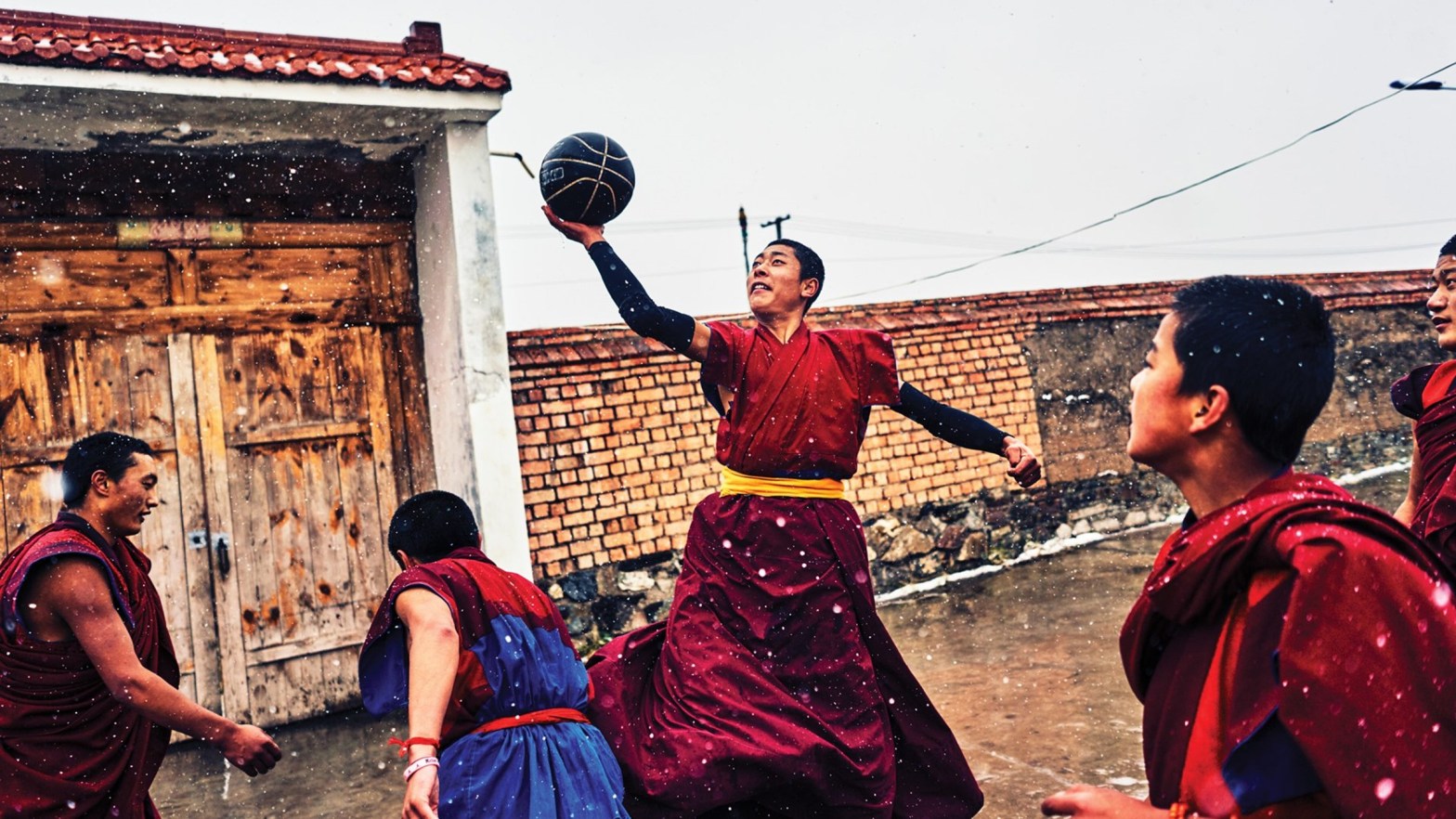
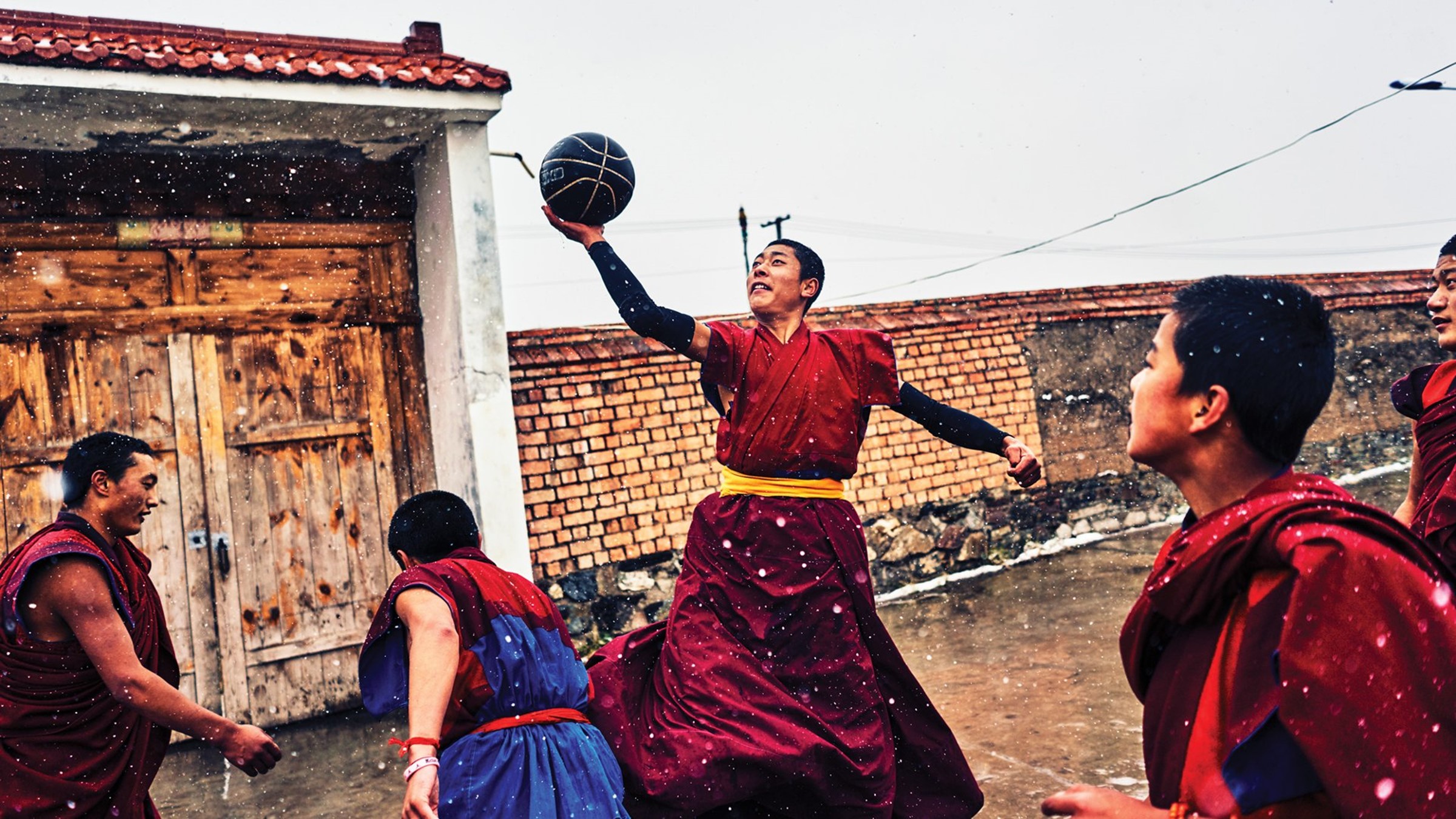
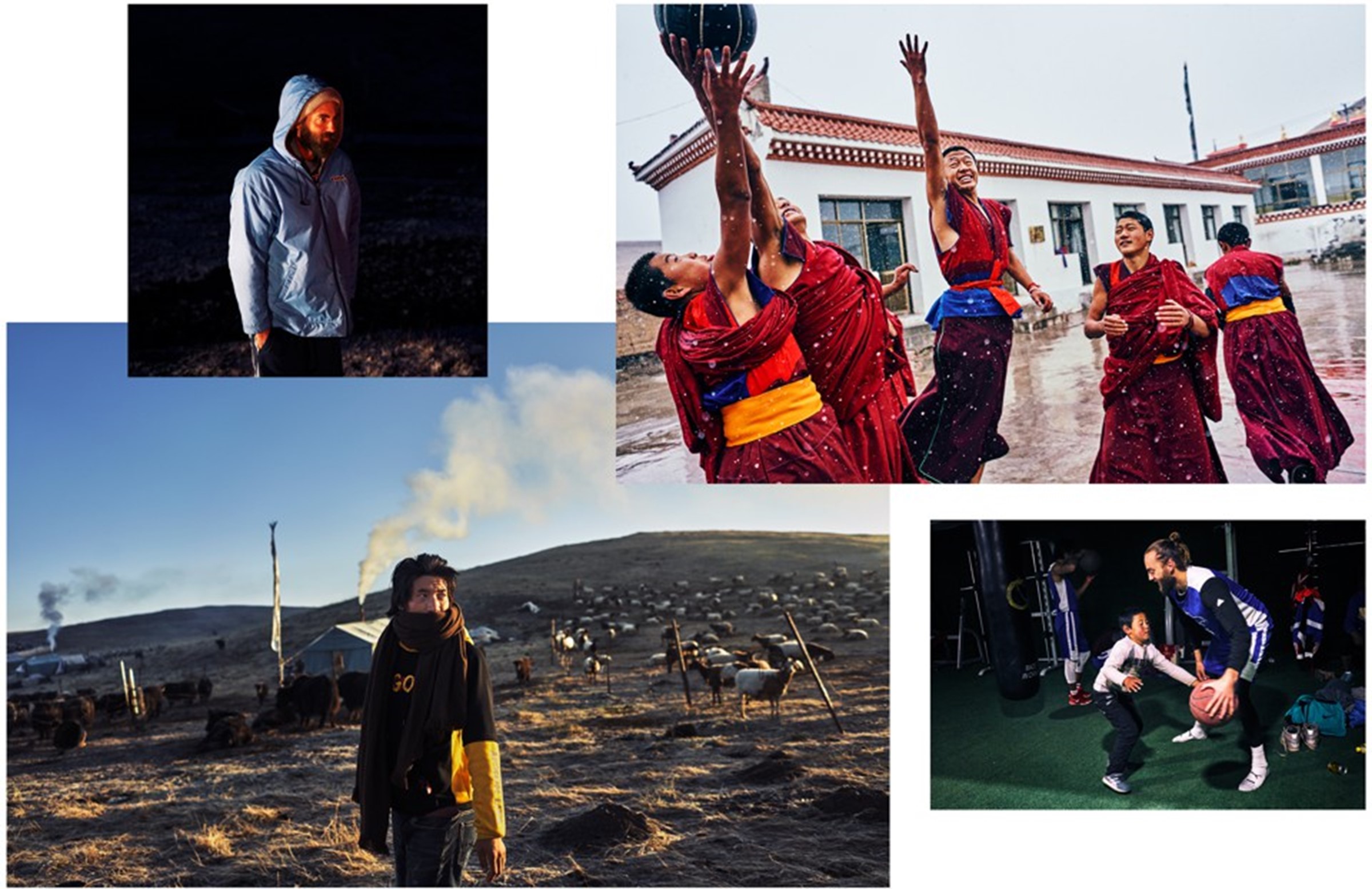
But there’s always the internet. Late one evening in 2017, I Googled basketball and Buddhist monk and eventually found a Facebook page on which a grainy video had been posted. It showed a red-robed monk on an outdoor court effortlessly leaping up, grabbing the rim, and shattering the backboard. I initially suspected this was a hoax, but if so, it was an elaborate one. In one picture on the page, a man stood on a mountaintop amid rising smoke. “Team captain Jampa making offerings and passionate prayers to his village’s mountain gods before a basketball match,” the caption said. In another picture, a flock of sheep approached a basketball court beside a barren hill. “And the fans rush the court!” that caption said. I saw a picture of young nomadic women shooting baskets on a snowy, icy court, and a video of a young monk executing a pretty up-and-under move to evade a shot-blocker and put the ball in the hoop. This, it turned out, was Norlha basketball.

A red-robed monk effortlessly leaped up and shattered the backboard.

I contacted Willard “Bill” Johnson, the team coach and the moderator of the Facebook page. He told me, in a dreamy voice, that the people of Tibet were mad for hoops.

Johnson described to me the upcoming Norlha Basketball Invitational and Tibetan Hoop Exchange, featuring a tournament that he said would showcase the top teams—some composed of nomads, others of monks—in the Gannan Tibetan Autonomous Prefecture. (Gannan is part of China’s Gansu province and is located in the traditional Tibetan region of Amdo.) Johnson called it a “turning point” for his team— “our big test.” The tournament would gauge his players’ strength against tougher competition than they had yet seen. Excited, I made travel arrangements to attend the tournament. The next day, alas, it was postponed. The tournament would have coincided with the 19th National Congress of the Chinese Communist Party in Beijing, for which security was being tightened throughout the country. Local police from China’s Public Security Bureau, concerned about large gatherings, had asked Norlha for the postponement.

I decided to make the journey, nonetheless.

Basketball first appeared in the Tibetan highlands about 100 years ago. At that time, the rugged, sparsely populated Tibetan plateau was ruled by warlords on its eastern frontier and in central and western Tibet by the Buddhist government of the Dalai Lama.

According to Chinese historical records, in 1935 central Tibet sent a basketball team to the Sixth National Games in Shanghai, more than 2,500 miles from the Tibetan capital of Lhasa. But the team didn’t arrive until after the tournament was over. An overland trip would have taken several months on horseback, Tibet historians told me, with provisions carried by yaks or mules.

Whoops! Tibetans Win Freedom Playing Hoops

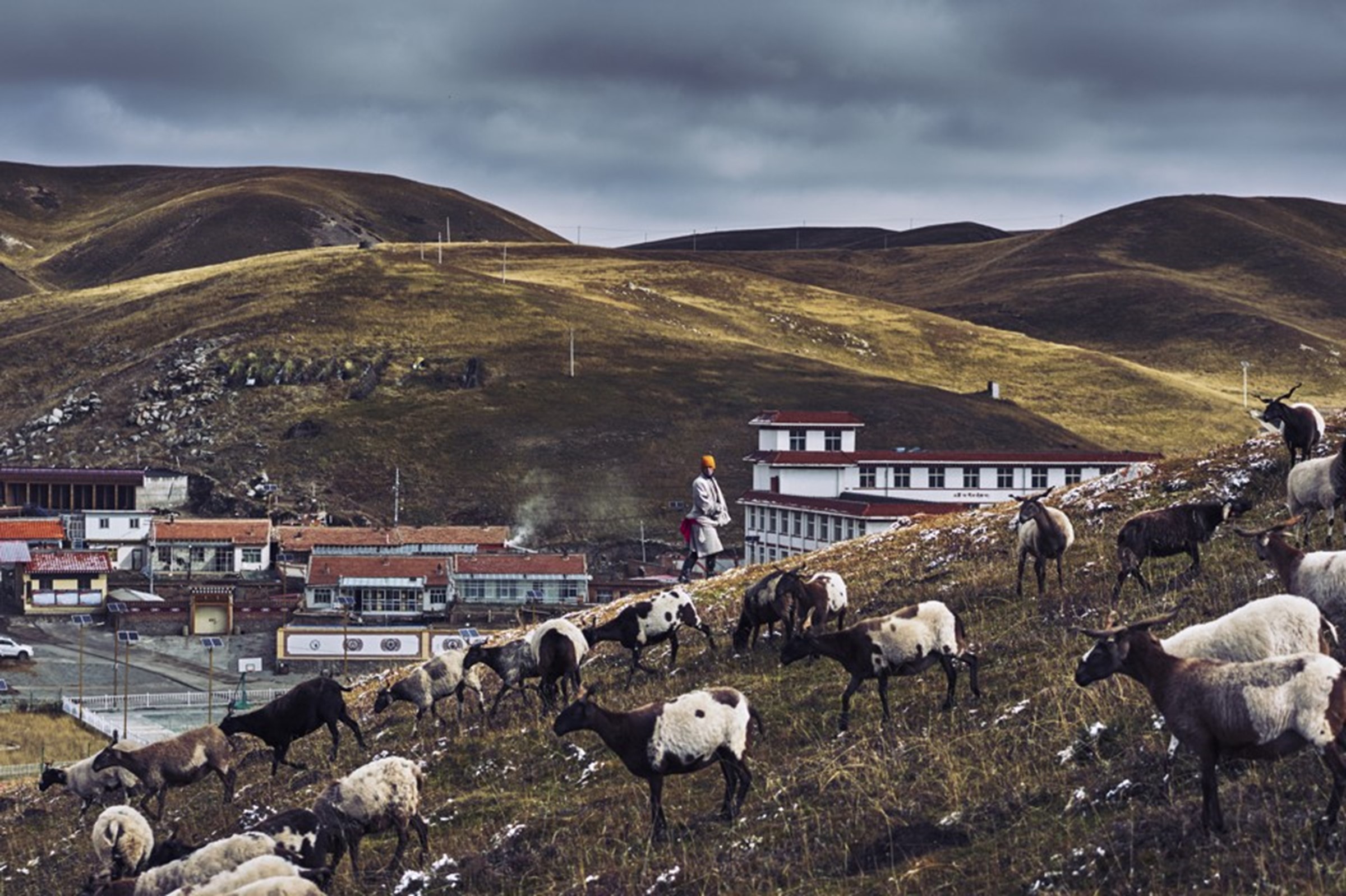
Sheep being herded in Zorge Ritoma. (An Rong Xu)

In his book Seven Years in Tibet, the Austrian mountaineer Heinrich Harrer wrote that upon his arrival in Lhasa in 1946, the city “made no provision for games,” with one exception: “a small ground for basketball.” Particularly in eastern Tibet, the sport spread in part for topographic reasons: The uneven and rocky landscape encouraged basketball over soccer, which requires a much more level ground.

In 1951, China’s People’s Liberation Army, including a military basketball team, marched into central Tibet and occupied—or “peacefully liberated,” in the Chinese view—the region. It would be another eight years before the Dalai Lama fled from Lhasa into exile in India. During the interim, championship basketball games were held in a large open space in front of the Potala Palace, the Dalai Lama’s enormous hillside residence. Dongak Tenzing, 83, a former Tibetan soldier who grew up in Lhasa and now lives in Madison, Wisconsin, described them to me. Thousands of people would attend, Tibetan townspeople, government and palace officials, uniformed Chinese military personnel, aristocrats, and monks. Food and drink stalls surrounded the manicured dirt court, and the score was displayed on a blackboard. The games—which were organized by the Chinese—were clean and disciplined, Dongak remembered. Rough play was prohibited, as were displays of emotion, which were considered rude.

Nomads have lived in the Zorge Ritoma area since at least the 17th century. Until the late 1950s, they lived in yak-wool tents year-round; by the 1960s, when they started building dwellings with mud walls to stay in during the winter, basketball was an important part of village life for young men, according to Dugya Bum’s grandfather Gonpo Tashi, who played as a child. The basketballs used at that time, he said, were made from the bladders and skin of freshly slaughtered animals; while lacking the bounce necessary for proper dribbling, they were adequate for passing and shooting.

In Zorge Ritoma, villagers played a rough, unusual variation of basketball using a wooden hoop, Jampa Dhundup, a point guard and leader for Norlha’s team, told me. According to the rules, the ball couldn’t touch players below the waist. And “whichever team fought the best won—no one thought about skill.”

In the late 1990s, television started trickling into remote areas. At the same time, basketball was becoming a favorite pastime of Tibetan monks. Johnson mentioned to me an old tradition of “big, strong monks who were athletes”—an apparent reference to the dobdobs, the physically aggressive monks who carried weapons, engaged in sporting competitions, and served as monastic police and bodyguards for important lamas and other travelers.

Alex McKay, a Tibetologist and sports historian of the Himalayan region, suggested to me that the macho image of the American basketball star likely appeals to eastern Tibetans because they have roots in a warrior culture. As one Tibetan player from Amdo told Chinese media during a tournament in March: “We don’t have professional coaches back home. All of us learned to play by watching NBA and CBA games on TV, by following the players’ movements. No one gave us any direction.”

Zorge Ritoma, known among locals simply as Ritoma, sits at the base of four sacred peaks. Its 275 families are scattered across several valleys in red- and pink-roofed houses, now mostly made of brick or stone. Much of the village’s food is derived from yaks—meat, cheese, butter, and yogurt—and religion is embedded in everyday life. “Sky burials,” in which the body is taken to a mountaintop and prepared for vultures, are performed on the dead.

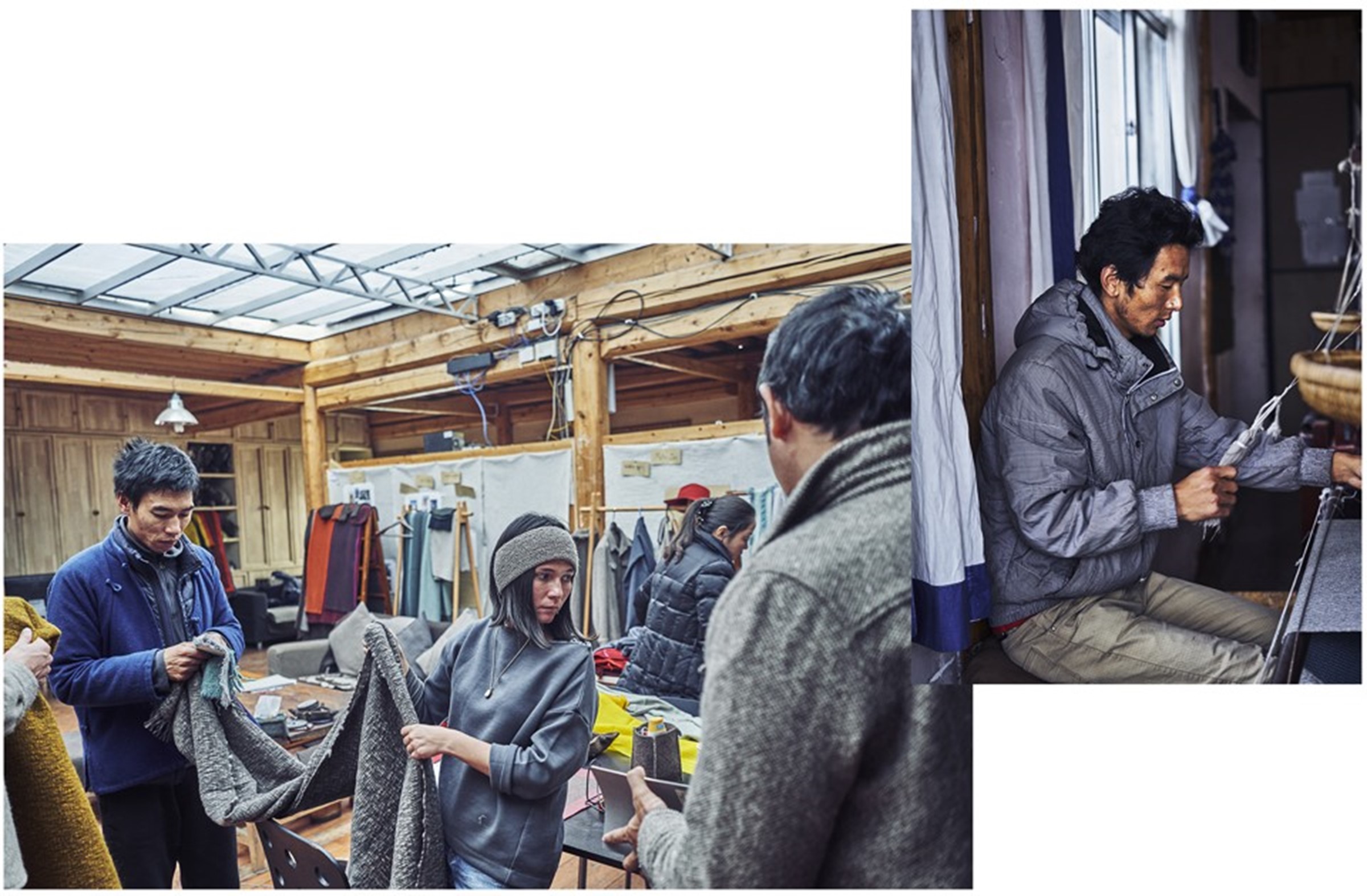
In 2007, Kim Yeshi—a French American who studied anthropology and Tibetan Buddhism in college and married a Tibetan man in 1979—along with her daughter, Dechen Yeshi, co-founded the Norlha plant in Ritoma. The intent was both to preserve Tibetan culture and to offer a consistent source of income to the villagers. A year later, Kim decided to have a basketball court built to accommodate the community’s obsession with the game. It’s a paved surface adjacent to a workshop on a narrow, relatively flat stretch between Ritoma’s main road and a hill whose incline doubles as makeshift bleachers.

The employees played after work. Using one or two basketballs, they congregated around the hoop and heaved up shots. A regular at the court was Dugya Bum. As the eldest son, he would normally have been expected to carry on as the nomadic heir to the family’s herds and have a wife chosen for him. Instead, shortly after he dropped out of school, his grandfather approached Norlha’s executives and asked, “Do you have something he can do?” Norlha trained Dugya Bum to use an office computer, speak rudimentary English, and take photographs of models wearing the scarves the company manufactures from yak wool. He liked the photography, but didn’t excel at it; principally, he saw it as an opportunity to get closer to a particular model, Lhamo Tso, with whom he had fallen in love.

Whoops! Tibetans Win Freedom Playing Hoops

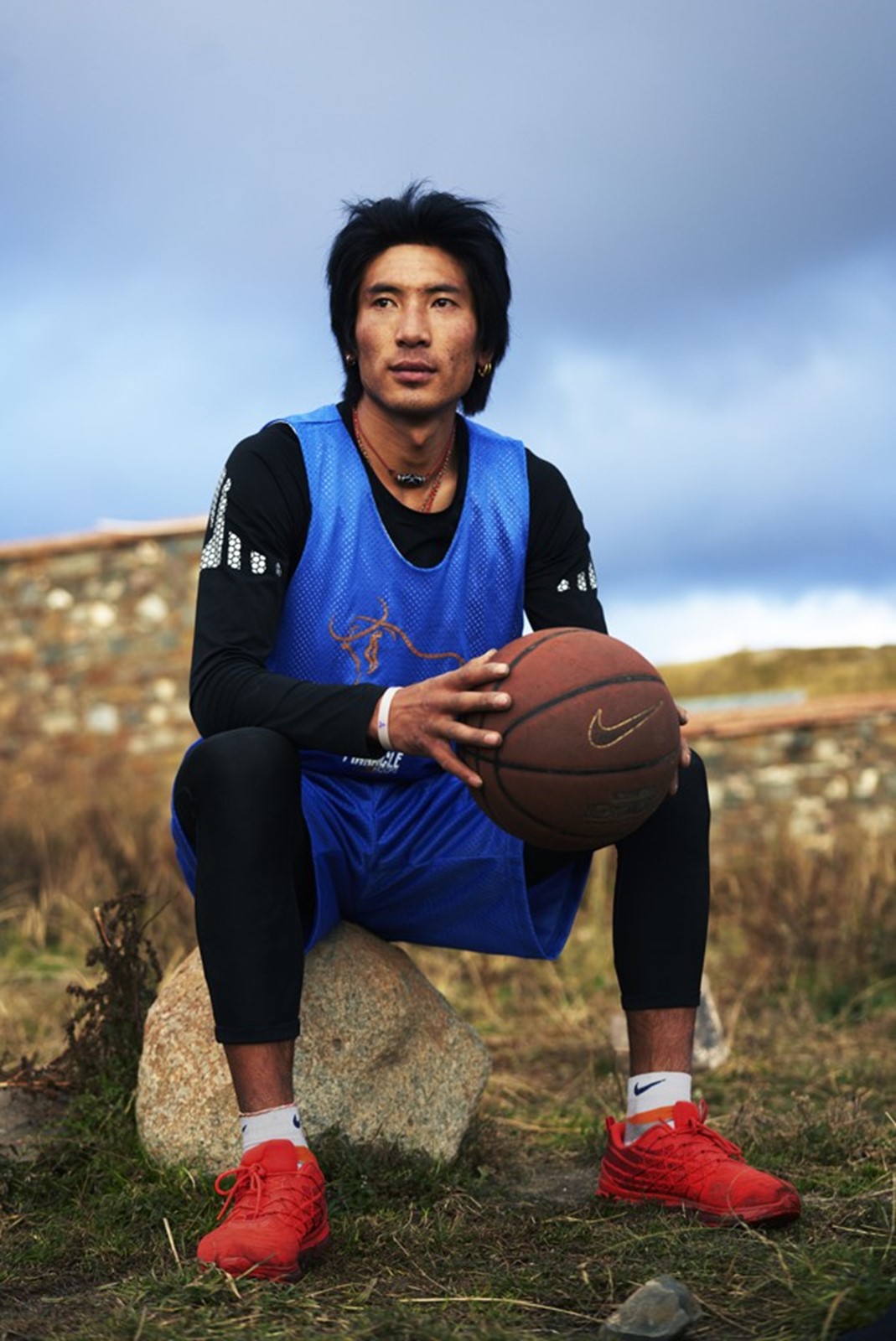
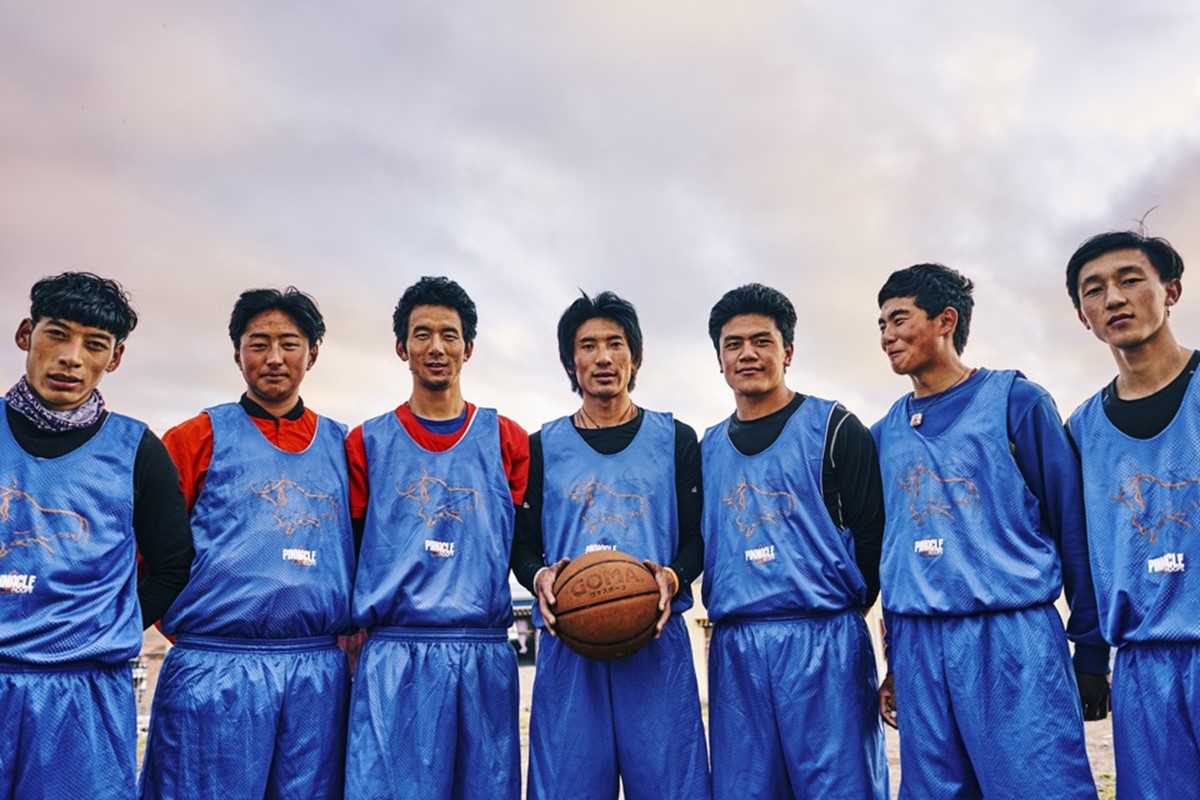
Dugya Bum, who is the best player on the Norlha basketball team. (An Rong Xu)

Dugya Bum was a rebellious, immature employee. He ignored the no-smoking rule and routinely snuck into the guesthouse kitchen to take food. He was transferred to the factory workroom, where he eventually became a dyer. He complained about his pay.

In the felting section upstairs, a quiet, skinny man of 20 named Jamphel Dorjee was having his own troubles. Jamphel had grown up herding animals in a village down the road. He had married a woman in Ritoma, where he didn’t know anyone. His wife worked at Norlha, so he had gotten a job there too. Jamphel was shy, and his workstation was isolated from other employees’. After work, he had nothing to do. But he noticed that every evening, the other male employees played basketball. One night, he followed them to the court. Soon, he was trying to play. But neither he nor Dugya Bum knew that basketball would transform their lives.

Bill Johnson, 32, grew up in Everett, Washington, north of Seattle. In high school, he was into math and theater. But when he sprouted to 6 foot 8, he began to focus on basketball. He could shoot well, but because of his skinny frame, he struggled with rebounding and defense. He wasn’t recruited by any major basketball schools, so he enrolled at MIT. He worked hard at his game, and in 2009, when he was a senior and co-captain, MIT advanced to the Division III NCAA tournament—the first berth in its history.

Whoops! Tibetans Win Freedom Playing Hoops

Norlha coach Bill Johnson (left) and veteran point guard Jampa Dhundup (right). (An Rong Xu)

When he wasn’t on the court, Johnson had a slightly offbeat vibe. He won a school talent show with an interpretive dance involving streamers and tight pink shorts. (“If you’ve seen the movie Napoleon Dynamite, it was almost like that,” Jimmy Bartolotta, an MIT teammate, told me.) Rather than spend spring break in Cancún with his friends, he volunteered to teach dental hygiene in Nicaragua.

After graduation, Johnson became an MIT assistant coach, then played in a league in Costa Rica. “I was nickel-and-diming it,” he says, “barely getting by.” While visiting Bartolotta, who played professionally in Iceland, Johnson partied and drank with fans; soon after, he signed a short-term contract to play there. After that, he went to play for six months in Australia.

In 2014, after a stint playing in Cape Verde, Johnson returned to the United States. His MIT friends were now neurosurgeons and engineers, real-estate investors and CEOs. Johnson—who had grown out his beard, and often bundled his hair into a man bun—had no real career plan. He was scrolling through Facebook when he noticed a post from a cousin in India about a former classmate, Dechen Yeshi, who was hiring a tutor for her young daughter in Ritoma. Johnson began researching Norlha online. When he saw a photo of its basketball court, that “sealed the deal,” Johnson says.

One player sported dress shoes; another, a worn business suit; and another, mittens.

He applied for the job opening and was immediately rejected. Dechen considered him overqualified. Also, she was puzzled by the degree to which his application emphasized basketball. But over the next several months, he emailed repeatedly. Even after the tutor position was filled, Johnson told Dechen he was willing to help the company in any capacity.

Dechen, in turn, researched Johnson online. His persistence and academic credentials impressed her, as did his attitude. So, she invited him to Ritoma to be a volunteer basketball coach for the Norlha team. The ragtag group of Norlha workers occasionally competed in ad hoc tournaments, and she thought Johnson could perhaps instill discipline and teamwork—values that might also benefit the company. Plus, he’d offered to pay his own way. “All I need is a bed,” he’d written.

Whoops! Tibetans Win Freedom Playing Hoops

Left: Dechen Yeshi (center), a co-founder of Norlha, inspects a new product in the company’s workshop. (An Rong Xu)

Johnson arrived in Ritoma in August 2015. The place felt empty: The nomads and their animals were off in the high summer pasture.

At the Norlha guesthouse, where he’d be staying, he met with Jampa, the team’s soft-spoken veteran guard. Jampa, now 30, is also a poet, whose work has been published as far off as Lhasa, some 1,400 miles away. “We want to be the best team in Gannan,” Jampa said. “We can start tomorrow. Tell us what to do.”

At the first practice, about 25 Norlha employees gathered on the court. To them, the moment was surreal: Here stood a professional player from the United States. (“We all thought, NBA,” Jampa recalls.)

For his part, Johnson saw a “hodgepodge of guys.” Most of the players were wearing jeans. One sported dress shoes; another, a worn business suit; and another, mittens. Moments before practice was to begin, there was a roar and a cloud of dust as a motorbike bearing another player screeched to a stop at mid-court. “Holy shit,” Johnson muttered to himself. “What is this?”

Johnson is careful to describe his coaching style as a collaborative effort between himself and the players. Still, he knew what he saw when practice began. Players hogged the ball. They made clumsy attempts at virtuoso dribbling. Shooting forms were askew. “Nothing was right,” Johnson says. “These guys just beat the crap out of each other.”

Johnson’s first impression of Dugya Bum was negative. He had an arrogant vibe, and off the court, he dressed in flashy clothes: big coral necklaces, orange bandannas, porcupine-style hair. His jump shot was herky-jerky, and his skills were underwhelming. But at 6-foot-1, Dugya Bum at least carried himself like a basketball player. He was fast, and he was fluid.

Constantly following Dugya Bum to practice was Jamphel, who admired his co-worker’s athleticism. Unlike Dugya Bum, though, Jamphel, at 5-foot-10, was timid and constantly had the ball stolen from him. His shot resembled an overhead catapult and was wildly inaccurate.

Still, Johnson was enthusiastic as he ran his new players through drills for the first time. Practices, which lasted from 5:30 p.m. until sundown, became must-see events. Villagers brought stools and thermoses of hot water. They laughed when shots were missed and clapped when they went in. They watched as Johnson shouted at his guys and occasionally played alongside them. Sometimes, to everyone’s delight, he would dunk the ball.

Johnson led the players on jogs through the village and sat with them to meditate. During lunch, he had them lift weights—mostly bricks and bags of flour or rice—in the factory courtyard. He showed them film of the San Antonio Spurs, whose style emphasized teamwork. The players called Johnson gegen, meaning “teacher.”

Jampa phoned representatives of rival teams to schedule games. Occasionally, local businessmen sponsored tournaments. Nomadic teams traveled to them by motorbike and camped out in tents. All-monk teams also joined the competitions. Across the region, Johnson noticed, were passionate players without coaches or “any concept of what we would consider organized play.”

At times, the most effective way to guide and motivate his team, Johnson realized, was to play himself. So he suited up for one tournament in August 2016, in a cavernous gym full of cigarette smoke in Maqu, 125 miles from Ritoma. Despite Johnson’s participation, Norlha was overwhelmed by a more aggressive, better-shooting team and lost in the first round of the playoffs. Dugya Bum had scored a few baskets, but he hadn’t played impressively. Johnson had forbidden him to shoot anything but layups because of his faulty jumper. As for Jamphel, “I wouldn’t even consider putting him in,” Johnson says.

With winter approaching, the practice was put on hold until April. Nonetheless, Dugya Bum began messaging Johnson, requesting one-on-one instruction. They met at the court at 6:30 a.m., or during lunch, or before dusk, to run drills and lift weights. Johnson deconstructed Dugya Bum’s jump shot. Jamphel tagged along. Together, over the long, brutal winter, the two teammates worked on their game. Dugya Bum quit smoking. “I’d give up my life for basketball,” he told fellow Norlha employees.

By the summer of 2017, Dugya Bum was a different player. He blew past defenders for easy baskets. He dished the ball off to teammates for assists. His jump shot had improved; he got the green light to shoot from mid-range. With added muscle, he finished more easily at the rim, powering through contact with opposing players. There were moments, Johnson thought when Dugya Bum could have held his own playing New York City streetball.

Players informed Johnson they couldn’t practice because they had to chase mastiffs that were roaming around the village and terrifying people.

Norlha was also playing better as a team. Players no longer ignored their teammates to go one-on-one. Now they worked the ball around for an open shot. At summer’s end, Dugya Bum was selected as an all-star to play in Gannan’s annual tournament. Afterward, he was named one of Gannan’s top 10 players.

In the workroom, meanwhile, Dugya Bum’s attitude had improved. He made eye contact with co-workers and talked more openly. Basketball had helped him “find meaning,” Dechen Yeshi, who called him a “model employee,” told me. By this time, he had also married Lhamo Tso, the Norlha model.

Jamphel had also progressed on the court and was earning minutes. He was a more adept ball handler, had improved his court awareness, and made open shots. But what Johnson admired most were his intangibles: Whatever Johnson asked him to do, he did without hesitation.

Even more significant was Jamphel’s evolution off the court. The once-quiet young man was now opening up to teammates. “We’ve become best friends,” Jamphel recently said of them.

Jamphel’s wife, Jamyang Dolma, works at Norlha as a tailor and a model. Like other nomadic women suddenly thrust into a 9-to-5 job, she had found the concept of free time after work completely alien.

For women especially, nomadic life is difficult. Days are long and dominated by chores: starting fires, milking animals, chopping wood, churning butter, cooking meals, collecting dung for use as fuel, cleaning pots, caring for children. The idea of a hobby never came up. “In traditional life, women don’t play basketball, but it doesn’t mean women don’t like it,” Jamyang Dolma told me. “It may be because they never had the opportunity or anybody to lead them.”

In 2016, a female Norlha employee, Wandi Tso, asked Johnson whether women at the company could form a team.

“Whenever you want to play,” Johnson told her, “let’s do it.”

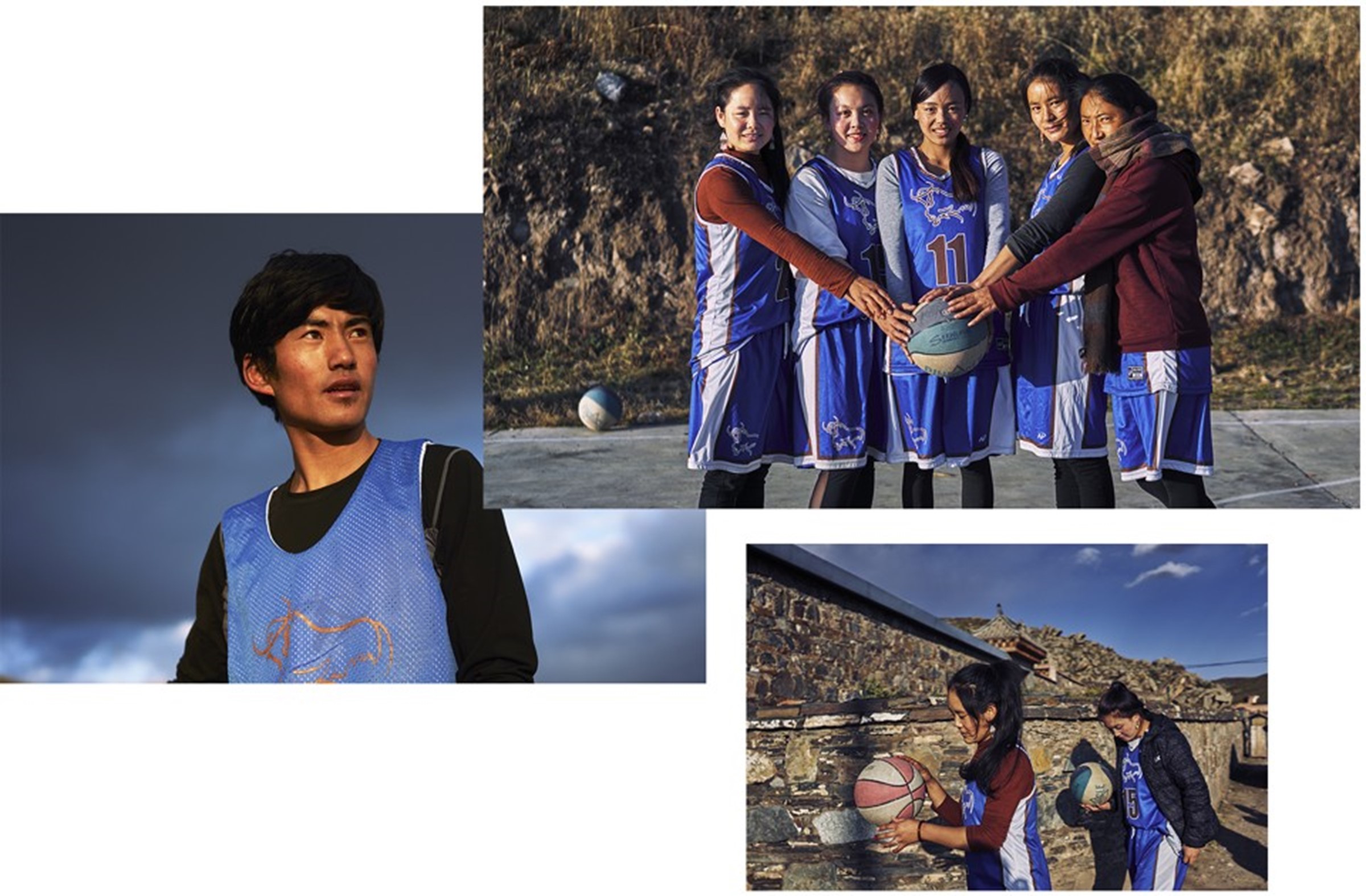
The women who signed up were initially too afraid to even catch the ball. But as they learned the fundamentals, their confidence rose. Their shooting form was generally “textbook,” Johnson says, unlike the men’s, whose years of bad habits had to be trained out of them. Villagers in Ritoma gradually grew accustomed to seeing women on the court.

Dugya Bum and Jamphel helped Johnson train the women’s team, which included both of their wives. Lhamo Tso became the team’s best all-around player, and Jamyang Dolma the team’s best shooter. At home, she and Jamphel would discuss the drills they’d worked on that day.

Whoops! Tibetans Win Freedom Playing Hoops

Left: Jamphel Dorjee, the most improved player on the men’s team. Above right: Players from the Norlha women’s team, including Lhamo Tso (far left), the team’s best all-around player, and Jamyang Dolma (second from right), the team’s best shooter and Jamphel Dorjee’s wife. (An Rong Xu)

In September 2017, the Norlha women played competitively in front of the villagers, in a three-on-three tournament organized by Johnson. Wearing light-blue jerseys, the Norlha players giggled each time they blundered and clapped whenever their team scored.

When I was there, I watched one of the women’s team’s practices. Two female coaches were visiting for the week: Ashley Graham, a former professional player in Europe who owns the training group Pinnacle Hoops, and Carly Fromdahl, a Pinnacle instructor who played college ball at Seattle University. They ran the Norlha women through drills, including layup lines (the women dribbled slowly but made most of their shots), ball-handling exercises, and chest-and-bounce passes.

Basketball, Dechen told me, has become a “gateway for the women to try new things.” They started doing yoga and meet regularly outside of work. They eat meals together now and have begun discussing their jobs, lives, and plans for the future.

Basketball has “made them more courageous,” Dechen said.

For the men’s team, however, hurdles began to emerge. At MIT, Johnson had considered practice time sacred—something to be missed only because of serious illness or a family member’s death. In Ritoma, Johnson scheduled mandatory practices three days a week. But aside from Dugya Bum and Jamphel, attendance was spotty. Once, Johnson’s players informed him they couldn’t practice, because they had to chase after fearsome Tibetan mastiffs that were roaming around the village and terrifying people. Another time, they said they couldn’t practice because they had been up all night circumambulating the village monastery, a Buddhist ritual performed to accumulate merit toward future rebirths. Often, players had to help relatives with nomadic duties, such as finding lost sheep.

So early in the 2017 season, Johnson set a benchmark: To play in a major tournament in Maqu scheduled for August, the team was required to hold 20 practices with at least 10 players in attendance. But at summer’s end, the standard hadn’t been met. At a team meeting, Johnson said Norlha wouldn’t play in Maqu. (He later discovered that multiple players had joined the team solely for the trip, during which they would have been able to skip work and stay in a hotel.) All but three of the players quit. The holdouts: Dugya Bum, Jamphel, and Jampa.

Soon afterward, Johnson and Dechen met to discuss the program’s future. Norlha’s team was open only to employees, and it had become clear that the company’s 120-person workforce was not a large enough pool from which to draw a committed squad. During their chat, Johnson noted that among the villagers who didn’t work at the factory were many good players who were eager to train but had no coach.

Korchen Kyap, for example, was a 23-year-old nomad who had proved to be one of Ritoma’s best players—6-foot-2, with excellent leaping ability. Throughout the previous winter, when Johnson returned to the United States to visit family, Korchen Kyap and other nomads who had been playing without a coach flocked to Norlha’s court daily for pickup games, braving the ice and snow. But during the summer, the heart of the basketball season, it was impossible for Korchen Kyap to play with the team, even without Norlha’s employees-only rule. The up-mountain pasture to which he herded his animals each morning was too far from the village center for him to return for practice at 5:30 p.m.

Dechen had seen how Johnson’s brand of team-first basketball had brought Tibetans together, spread the Norlha name, and raised revenue by earning cash prizes—anywhere from the equivalent of several hundred to several thousand dollars—at tournaments in the region.

So Dechen decided to open up the team to the nomads—and pay the players. She set aside an annual budget of 145,000 yuan, or about $21,000. Two players, Dugya Bum and Chökyong Kyap—a fiery, talented guard from the White Horse Clan—would become full-time basketball players, with Dugya Bum earning a monthly salary of 2,500 yuan (about $365, or four times the average local income) and Chökyong Kyap earning 2,000 yuan. Eight players making 1,000 yuan a month would round out Norlha’s traveling team. Five practice players, including three developmental players, would earn 500 yuan apiece. (Johnson himself was now earning a salary as Norlha’s e-commerce manager, a job he’d taken on in 2016.)

Johnson is hoping to eventually add monks to the team. Ritoma’s best monk player is Dugya Bum’s brother, Sonam Drakpa. (He is the backboard-shatterer I saw in the video on Norlha’s Facebook page.) He and two other monks—Korchen Kyap’s brother and a 6-foot-4 bruiser named Sherab—scrimmage with Norlha during the monastery’s brief summer break. But as far as playing full-time, “it’s tough with the monks’ schedules,” Johnson told me sadly.

Whoops! Tibetans Win Freedom Playing Hoops

Photographs were taken in October 2018 in Zorge Ritoma (An Rong Xu)

I wasn’t the only visitor who had planned to attend Johnson’s Norlha Basketball Invitational and Tibetan Hoop Exchange. Eight other Americans made the trip as well, including four basketball players: Graham and Fromdahl from Pinnacle Hoops; Andrew Greenblatt, a former Division III men’s basketball player at Swarthmore College who had helped Johnson raise funds for the tournament; and Isaac Eger, a writer who was traveling the world playing pickup basketball. Johnson had arranged for some low-key pickup games against monks in the region. Building relationships with them, he said, is “priceless.”

With this in mind, Johnson planned a scrimmage with the top team from Labrang, one of Amdo’s largest monasteries. But first, we were given a tour. Pressed up against a big green mountain, the monastery’s white, red, and yellow structures, some with gilded roofs, are connected by a labyrinth of dirt alleyways through which monks and pilgrims roam. A monk leading tours collected my ticket stub, crumpled it up, and tossed it into a trash bin. “NBA,” he said, bumping my fist.

The day of the scrimmage, as we drove along a narrow mountain pass, Johnson warned our group of Labrang’s physicality and offered an advance apology: “No one’s purposely trying to hurt you,” he said. “They’re still Buddhist.” (I’d intended to play but was sidelined after pulling a muscle the previous day while demonstrating a jump hook.)

We made a winding descent into a valley, then turned off the road and drove unsteadily on rocky grasslands. The court appeared, its weathered surface riddled with cracks and wet spots. A stream flowed alongside it. In all directions, empty plateau stretched for miles.

A green taxi wobbled up behind us. It stopped shy of the water’s edge, and several 20-something monks in robes got out, holding bags and basketballs. More taxis followed, also filled with monks. The men vanished into a nearby hut and emerged wearing basketball gear, including white “USA” jerseys. They splashed across the stream and onto the court.

The athleticism and creativity of Labrang’s players were immediately evident. They hung in the air on jump shots and made Kobe Bryant–esque fadeaways. They played hard, and they fouled hard. At one point, Greenblatt got clocked by the opposing point guard and fell. “They don’t mean any harm!” Johnson shouted.

A stray ball rolled onto the court, and some of the Americans stopped playing. Labrang seized the chance to make an uncontested layup. “Guys!” Johnson shouted, “There’s gonna be hawks, vultures, balls rolling onto the court—you gotta play through!”

The teams played two games to 20, and both went down to the wire. The monks won the first one, 20–19. The second went to the Americans, 20–18. After that game, Greenblatt, Graham, and Fromdahl sprawled onto the court exhausted, unaccustomed to playing at that altitude.

“These guys are tough,” Johnson said.

“Super tough,” Greenblatt replied.

Whoops! Tibetans Win Freedom Playing Hoops

The Norlha basketball team prepares for a game against the Sichuan All-Stars at a tournament in Hezuo, the capital city of the Gannan Tibetan Autonomous Prefecture. (An Rong Xu)

Although the Norlha Invitational tournament had been postponed, Johnson was still planning to lead, with the visiting Americans, several days of clinics for Norlha’s teams. But after the first day—a cool, sunny afternoon of spirited drills and pickup games—Johnson received more bad news: False rumors had reached the Public Security Bureau that the Americans, me included, were NBA players; apparently worried that our presence would attract large crowds, the authorities urged the Norlha team to stay away from the court. All remaining basketball activities were called off.

The following day, a damp snow fell, blanketing the court. Entire streets were reduced to mud. The village was quiet.

I took the opportunity to visit Dugya Bum’s house. I walked through his front gate into a muddy outer courtyard, and then into a room with a red carpet and wood-paneled walls. Displayed high on one was an elegantly framed picture, bordered by Tibetan letters, of LeBron James in front of a grasslands backdrop of horses and mountains. Basketball trophies were perched on a shelf.

Sipping butter tea, we spoke about his dream, nearly realized, of making a living playing basketball. When I asked him what his life would be like without hoops, he chuckled uncomfortably, then paused. “If basketball disappeared,” he said softly, “my love would be finished. Everything would be finished.”

Shortly after I left the plateau, good news arrived at last: A monk had built a new gymnasium in Hezuo, the capital city of Gannan, 16 miles away, and there would be a tournament in late November. In a preliminary-round game, Norlha faced the Zorge All-Stars, a brutally physical, all-nomad team. Norlha lost in overtime by one point. But the team won its three other matchups, qualifying for the playoffs.

Norlha won a quarterfinal rematch against Zorge, 48–39. In the semifinals, Norlha defeated a university team from Zhuoni County by one point, setting up an evening final against White Khata, a team featuring standout players from across the vast Amdo region.

Before sunrise on the day of the championship, Norlha’s players rode their motorbikes up to Amnye Tongra, Ritoma’s highest peak. They made offerings of sugar, barley, and fruit to the mountain deity believed to protect Ritoma and shouted, “Lha gyal lo!“— “Victory to the gods!”

A large contingency of Ritomans—nomads, monks, and Norlha employees—drove to Hezuo, where fans of both teams squeezed into the tiny, high-ceilinged gym, stuffing it beyond capacity. Fans bled onto the court; some climbed up the basket supports. Norlha wore its standard blue jerseys; Khata wore red. On the walls behind the baskets hung billboard-size posters of Kobe Bryant and LeBron James.

Eventually, officials locked the gym door; outside, latecomers climbed onto one another’s shoulders and peered in through the windows. Back in Ritoma, in the monastery and in households alike, people huddled around their smartphones, which were illuminated with shaky video feeds of the match.

When the game began, Dugya Bum seemed overhyped and anxious. On his first offensive touch, he rose up for a 10-foot jump shot that clanked long off the backboard. Twice in the ensuing minutes, he turned the ball over.

Meanwhile, Khata’s blazing-fast guards penetrated at will. The score, indicated on a small flip-style board at center court, seesawed back and forth. At halftime, Norlha led 18–16.

In the second half, Dugya Bum’s nerves settled. He soared in for rebounds and, low in his defensive stance, kept Khata’s ball handlers at bay. Norlha led 28–24 entering the final quarter.

Whoops! Tibetans Win Freedom Playing Hoops

Johnson hopes that his team will become so well-respected that it will attract players from across the Tibetan plateau. (An Rong Xu)

Khata bounced back, tying the score and then taking a narrow lead. In the waning minutes, with Norlha trailing 36–35, Johnson hit a three-pointer from the top of the key. Khata replied with a three of its own and followed that with a lay up to pull ahead by three. A Norlha player then made one of two free throws to cut the lead to two.

But that was as close as the team got. In the final seconds, there was scrambling and desperation from Norlha. Whoops and hollers filled the gym. But the clock wound down. A horn rang and Khata fans burst onto the court. Norlha had lost 41–39. Dugya Bum kneeled on the floor and covered his eyes, hiding tears.

Johnson huddled his team close. “We played our hearts out!” he shouted. “I know this hurts. But use this hurt, this feeling that you have right now, to fuel you over the winter.”

Jampa drove Johnson and Dugya Bum back to Ritoma. Dugya Bum was in the back seat, silent. It was almost midnight when they arrived back in Ritoma. Jampa dropped off Dugya Bum and Johnson at Norlha’s gate.

In a few months, Johnson would move out of the guesthouse and into his own place in the village. “I’m still scratching the surface of this way of life, this culture, Buddhism,” he told me, adding that he’s “definitely here for the long haul.”

Johnson’s vision for Norlha basketball is to build a program so well respected across the plateau that the best and most driven players will flock to train in Ritoma and then return to their towns and villages as player-coaches to spread what they have learned. Johnson knows achieving this goal is in large part dependent on Dugya Bum: If his commitment remains steadfast, Johnson believes he could become one of the best players in all of Tibet.

It was with these aspirations in mind that Johnson, late that night after their championship loss, gathered his thoughts as he and Dugya Bum stood together in the darkness. Before heading their separate ways, they embraced. Then Johnson looked Dugya Bum in the eye. “What you’ve done this last year was amazing,” Johnson said. “But keep it going. You’re our leader now. This is just the beginning.”

Support for this article was provided by a grant from the Pulitzer Center. It appears in the January/February 2019 print edition with the headline “How Tibet Went Crazy for Hoops.”

Whoops! Tibetans Win Freedom Playing Hoops