The Temple of Lord Somnath. The Battle between the Power of Creation and the Power of Destruction:
Kindly pay homage to Sardar VallabhbhaiPatel, India’s first Deputy Prime Minister who had recreated the Temple of Lord Somnath and vanquished the evil forces which visited Somnath repeatedly to utterly destroy this sacred place of Hindu worship.
Whole Dude – Whole ConvictionWhole Dude – Whole ConvictionKindly pay homage to Sardar VallabhbhaiPatel, India’s first Deputy Prime Minister who had recreated the Temple of Lord Somnath and vanquished the evil forces which visited Somnath repeatedly to utterly destroy this sacred place of Hindu worship.Kindly pay homage to Sardar VallabhbhaiPatel, India’s first Deputy Prime Minister who had recreated the Temple of Lord Somnath and vanquished the evil forces which visited Somnath repeatedly to utterly destroy this sacred place of Hindu worship.
THE TEMPLE OF LORD SOMNATH IS THE EVIDENCE FOR THE POWER OF CREATION OVER THE POWER OF DESTRUCTION.
This entry is dedicated to the memory of Sardar Vallabhbhai Patel, India’s first Deputy Prime Minister.
THE SHRINE ETERNAL :
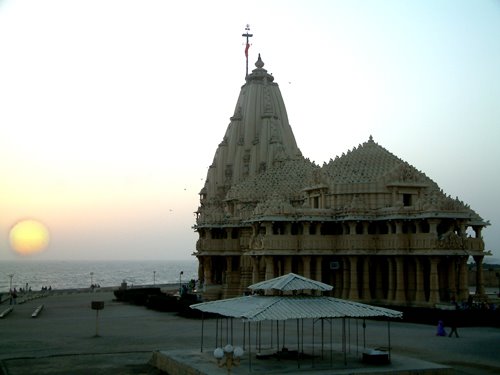
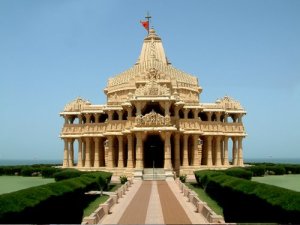
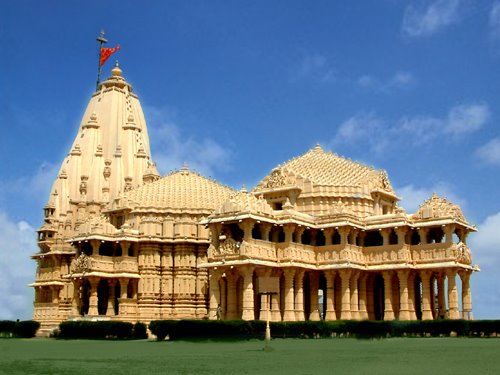
Somnath Temple is in the ‘Prabhas Kshetra’, near the seaport city of Veraval in Junagadh District, Kathiawar Peninsula of Saurashtra , on the shores of Arabian Sea,the western coast of Gujarat, India. This holy place of pilgrimage is a place of great antiquity and recent excavations there have revealed a settlement dating from about 1500 B.C. As per Indian traditions, the place is of significance as it is considered as the place from where Lord Krishna departed from this world. The presiding deity of this temple is Lord Shiva and He is known by the name of SOMNATHA or the Lord of the Moon. The present temple as it exists today is known as ‘Kailash Mahameru Prasada and is built-in CHALUKYA style of temple architecture. The site lied in a state of ruin for centuries and the decision to rebuild it was made by Sardar Vallabhbhai Patel during his visit on 13 November, 1947. The temple was inaugurated on December 1, 1951 by Dr. Rajendra Prasad, the first President of the Republic of India. He had remarked that, “The Somnath temple signifies that the power of creation is always greater than the power of destruction”. The temple symbolizes the enduring fame of Sardar Patel who during the first three years of Indian independence after 1947, had served as Deputy Prime Minister, Minister of Home Affairs, Minister of Information, and Minister of States. He was considered as practical and decisive. He was the architect of the Indian Union and his greatest contribution was the achievement of the peaceful integration of over 535 princely states into the Indian Union. The principality of Junagadh, and the princely State of Hyderabad had initially resisted the offer to join the Indian Union. Having failed in his attempts to join Pakistan, the Nawab of Junagadh fled away from the country. Mr. Bhutto,( the father of Mr. Z.A. Bhutto, who served as Pakistan’s Prime minister) acting in his capacity of the ‘DEWAN’ of the court of Junagadh, had invited Lord Mountbatten to accept the accession of Junagadh to India. In the State of Hyderabad, a militant movement called the Razakars was launched seeking independence but Sardar Patel restored peace in September 1948 and the ruler Nizam had accepted the terms of accession to the Indian Union. This part of Indian history and the integration of princely states into Indian Union has again become relevant after the enemy’s brutal attack in Mumbai which I had mentioned in my previous entry. The enemy had described himself as ‘Deccan Mujahedeen’, and the media reports indicate that the enemy had specific designs to gobble Junagadh, and Hyderabad apart from encouraging insurgency in the border State of Kashmir. The enemy’s intentions will force us to defend SOMNATH in Junagadh District which is resurrected after repeated attacks over centuries.
THE HISTORY OF SOMNATH :
Jyotirlinga Temple at Somnath is mentioned in Hindu prayers in praise and worship of Lord Shiva:”Sauraashtra dese visadeti ramye, Jyotirmayam Chandra Kalaa vatamsam, Bhakti pradaanaaya Krupaa vateernam, Tam Somanaatham Saranam prapadye.”Somnath, the confluence of three rivers, River Sarasvati, River Hiranya, River Ilanki and Kapila is mentioned in ancient Hindu Scriptures known as Rig Veda.
LORD SOMNATH TEMPLE-THE SHRINE ETERNAL- TESTIMONY TO THE POWER OF CREATION OVER THE POWER OF DESTRUCTION.
Somnath finds its mention in the ancient text of RIG VEDA. It is associated with the holy names of GANGA, YAMUNA, and SARASWATI, popularly known as ‘TIRTH DHAM’ where Indians traditionally offer worship by a practice described as ‘River Worship’. The ancient river of Saraswati may have merged into the Sea at Somnath apart from smaller rivulets known by the names of Hiranya, Kapila and Ilanki. The place is extensively described as a place of pilgrimage and its importance is narrated in the ancient texts of ‘SKANDA PURANA’, ‘BHAGAVATA PURANA’, and ‘SHIVA PURANA’. Lord Shiva in His radiant form known as ‘Jyotir Linga’ resides at Twelve different places in India and Somnath is listed as the first place of residence of ‘DWADASA JYOTIR LINGA’.Tradition claims that the original Temple of Somnath was built by Lord Moon, and was later built by King Ravana of Lanka who is a central figure in the story of Indian epic poem of RAMAYANA. The SINDH area of the Indian subcontinent came under Arab conquest in 7th century A.D. The Somnath Temple built by the YADAVA kings of Vallabhi of Saurashtra around 649 A.D. was destroyed in 725 A.D. by the Arab governor of Sindh. The Pratihara King Nagabhata II rebuilt it in red stone. Between 1001 A.D. and 1027 A.D. , the road to conquest of India was prepared by Sultan Mahmud of Ghazna( modern GHAZNI in Afghanistan) who conducted more than twenty raids into North India. His raids were mainly for plunder. They revealed the wealth of India and demonstrated the vulnerability of India to military attacks. During one of his raids, in 1024 A.D. , marching across India’s Thar Desert, Mahmud of Ghazna had plundered and destroyed the Somnath Temple. The amount looted was estimated at 20 thousand, thousand ‘Dinars’. The enormous treasures found at Somnath have been a theme of wonder for all who have written on that conquest. The Paramara King of Bhoj of Malwa, Solanki King Bhima of Anhilwara/Patan between 1026 A.D. and 1042 A.D. rebuilt the Temple. By 1297/98 A.D. , Gujarat was conquered by Ala-ud-Din Khalij, Sultan of Delhi and the Temple was razed.Solanki King Kumarapala built a Temple of stone and this was destroyed again in 1394 A.D. For the last time, the Temple was destroyed in 1706 A.D by the Mughal Emperor Aurangzeb and the site remained in ruins till India’s independence in 1947. The rebirth of the Temple on December 1, 1951 demonstrates the vitality of the Indian spirit.
A HYMN IN PRAISE OF LORD SOMNATH :
Saurashtra dese visadeti ramye
Jyotirmayam, Chandra kala vatamsam
Bhakti prada naya Krupa vatirnam
Tam Somanatham saranam prapadye.
Lord Somanatha is dwelling in His great splendor in the Province of Saurashtra. May this Lord Somanatha who is full of radiance, and the crescent-shaped Moon shines in His matted hair, with His extreme compassion grant me a great sense of devotion with which I would seek my protection and let Him be my refuge.
Jyotirlinga Temple at Somnath is mentioned in Hindu prayers in praise and worship of Lord Shiva:”Sauraashtra dese visadeti ramye, Jyotirmayam Chandra Kalaa vatamsam, Bhakti pradaanaaya Krupaa vateernam, Tam Somanaatham Saranam prapadye.”
Whole Dude – Whole Intuition: Jean Jacques Rousseau, Swiss-French philosopher, writer, and political theorist was one of the great figures of the French Enlightenment and he continues to inspire the Romantic generation
JEAN JACQUES ROUSSEAU – FRENCH PHILOSOPHER, POLITICAL THEORIST WHOSE IDEAS INSPIRED THE LEADERS OF FRENCH REVOLUTION
Could science and the methods of rational and empirical inquiry help us in knowing the nature and the destiny of humanity? Could we extend scientific methods into every field of inquiry? Could we find truth and reality as an external experience or is it visualized entirely in the realm of intuition and conscience?
How to attain Enlightenment? The Methods of Inquiry called Reason, Experience, and Intuition
Whole Dude – Whole Intuition: How to attain Enlightenment?
Man has to find his way to his pure nature, and this, through feelings. Man’s duty is to look for his most deep interior feelings and follow them.
Enlightenment – The Age of Reason:
Whole Dude – Whole Intuition: How to attain Enlightenment?
Enlightenment is a European intellectual movement of the 17th and 18th centuries in which ideas concerning God, reason, nature and man were synthesized into a world view. The thinkers of the Enlightenment were committed to secular views based on reason or human understanding only, which they hoped would provide a basis for beneficial changes affecting every area of life and thought.
Whole Dude – Whole Intuition: How to attain Enlightenment?
The Enlightenment was based upon a few great fundamental ideas- such as the dedication to reason, the belief in intellectual progress, the confidence in nature as a source of inspiration and value, and the search for tolerance and freedom in political and social institutions. Central to Enlightenment thought were the use and the celebration of reason, the power by which man understands the universe and improves his own condition. The goals of rational man were considered to be knowledge, freedom and happiness. It instigated revolutionary developments in art, philosophy and politics. Sir Issac Newton is considered to be the true father of Enlightenment. He established the basic idea of the authority and autonomy of reason.
Whole Dude – Whole Intuition: How to attain Enlightenment?
The Enlightenment Movement eventually broke up under the impact of new evidence and new insights. Nature, once considered a synonym of reason and visible proof of the existence of God and His benevolence, broke up into something to be studied with scientific objectivity and something to be enjoyed in romantic indulgence. The most significant contribution of the Enlightenment came in the field of social and political philosophy.
Rousseau, Jean-Jacques – The Role of Intuition:
Whole Dude – Whole Intuition: How to attain Enlightenment?JEAN-JACQUES, ROUSSEAU (b.JUNE 28, 1712, GENEVA, SWITZERLAND-d. JULY 2, 1778, ERMENONVILLE, FRANCE) FRENCH PHILOSOPHER, POLITICAL THEORIST WHOSE IDEAS INSPIRED THE LEADERS OF THE FRENCH REVOLUTION.
Rousseau is the least academic of modern philosophers but in many ways he is the most influential. His thought marked the end of the Age of Reason and the birth of Romanticism.
Whole Dude – Whole Intuition: How to attain Enlightenment?
Rousseau makes a profound impact on people’s way of life. He opens men’s eyes to the beauties of nature and he makes liberty an object of almost universal aspiration.
He is credited with having introduced a great discovery about the nature of freedom and he emphasizes the primacy of individual liberty. The other Enlightenment thinkers pursued the nature of humankind empirically in physiological and psychological studies or in historical and anthropological researches, whereas Rousseau seeks the nature of humans in the wholly private realm of intuition and conscience. He looks inward for the fundamental source of moral obligation. Enlightenment has faith in reason which is understood as abstraction from external experience, Rousseau emphasizes that the inner life is the source of truth.
Rousseau shares the Enlightenment view that society perverts natural man, the “noble savage” who lives harmoniously with nature, free from selfishness, want, possessiveness, and jealousy. In his essay, ‘ A Discourse on the Sciences and the Arts ‘(1750), he argues that the history of man’s life on earth has been a history of decay. Man is good by nature but has been corrupted by society and civilization.
Whole Dude – Whole Intuition: How to attain Enlightenment?
One of the first principles of Rousseau’s political philosophy is that politics and morality never be separated. The second important principle is freedom, which the state is created to preserve. The state is a unity and as such expresses the general will. The general will is to secure freedom, equality and justice within the state and in the Social Contract, individual sovereignty is given up to the state in order that these goals might be achieved.
Whole Dude – Whole Intuition: How to attain Enlightenment?
In his political book called ‘Du Contrat Social’ (The Social Contract) published in 1762, Rousseau begins with the opening sentence; “Man was born free, but he is everywhere in chains.” He proposes a society that’s able to cultivate the individual’s moral stature without injury to his freedom. He expresses freedom and equality of citizens in the idiom of natural and inalienable rights. Rousseau believes that man has to find his way to his pure nature and to achieve this, man’s duty is to look for his most deep interior feelings and follow them.
Science and scientific methods bring us knowledge about life, nature and the universe that we live in. But, intuition provides us with the insight to improve the way we live this life.
Whole Dude – Whole Intuition: How to attain Enlightenment
Whole Dude – Whole Opinion: My musings on the death of Socrates
NO EVIL CAN BEFALL A GOOD MAN EITHER HERE OR HEREAFTER
THE DEATH OF SOCRATES
Ms. Emily Wilson is the author of this book (Harvard, 247 pages, $19.95) and it was reviewed by Thomas Meaney and the article with the title The Afterlife of a Skeptic appeared in The Wall Street Journal in its edition of Saturday/Sunday, November 24-25, 2007. The book deals with as to how the execution of a philosopher has been reinterpreted for every era. The history of the interpretation of Socrates’ death speaks about the history of philosophy in the West. Mr. Meaney begins his review with the observation that the name of Socrates recalls his death more than his bewilderingly eccentric life.
Whole Dude – Whole Opinion: My musings on the death of Socrates
Socrates, ancient Athenian philosopher, is best remembered for his admonition to “KNOW THY SELF.” He laid the philosophical foundations of Western Culture. He made an effort to shore up the ethical dimension of life. He directed philosophical thought toward analyses of the character and conduct of human life. As Cicero said, Socrates “brought down philosophy from heaven to earth” – i.e. from the nature speculation of the Ionian and Italian cosmologists to analyses of the character and conduct of human life, which he had assessed in terms of an original theory of the soul. Socrates turned philosophy away from a study of the way things are, toward a consideration of virtue and the health of the human soul. He was a man of deep piety with the temperament of a mystic. He believed in the soul’s immortality and claimed that the soul of man partakes of the Divine. Socrates held himself to be an envoy from God. He believed himself charged with a mission from God to make his fellowmen aware of their ignorance and of the supreme importance of knowledge of what is for the soul’s good.
Whole Dude – Whole Opinion: My musings on the death of Socrates
Socrates redirected philosophy from cosmology to the formulation of a rule of life, to the “practical use of reason.” The specific message from God that Socrates brought to his fellowmen was that of the “care” or “tending” of one’s ” soul, to make one’s soul as good as possible”- “making it like God,” in fact – and not to ruin one’s life, as most men do, by putting care for the body or for “possessions” before care for the “soul”; for the “soul” is that which is most truly a man’s self. According to Socrates the soul is the man. He believed that to do wrong is to damage one’s soul. From this it follows that it is always worse to do wrong than to be wronged and that one must never return wrong for wrong. He also maintained that virtue is knowledge and that all the virtues really amount to knowledge. His self-control and powers of endurance were exemplary. His self-imposed life of hardships and austerity was the price of his spiritual independence.
Whole Dude – Whole Opinion: My musings on the death of Socrates
Socrates believed that he can teach merely by asking the right questions. He spent his life in conversation with Athenian citizens, seeking true knowledge and exposing the errors of those who claimed to have wisdom. Socrates challenged anyone with a pretense to knowledge. Socrates ushered in an age of rational inquiry. According to Socrates, the radical vice of ancient democracy is that of putting society in the hands of men without true insight and with no adequate expert knowledge (and in this regard, Socrates is absolutely correct and even today that is the biggest danger of Democracy!). He expected that statesmen should act like “physicians of the body politic” and that they should promote “righteousness and temperance.”
Whole Dude – Whole Opinion: My musings on the death of Socrates
Socrates was indicted for “impiety,” “corruption of the young,” and “neglect of the gods whom the city worships and the practice of religious novelties.” He elevated virtue over the gods themselves, whose approval was so central to Athenian civil life. Socrates claimed that he could prick the city into a higher state of self-awareness by disturbing its settled world view. In Plato’s account of the trial, “The Apology,” Socrates defended himself not as a victim of censorship but as a benefactor of Athens. In an open- air Athenian court room in 399 B.C., the world’s first democracy sentenced one of the world’s first public intellectuals to death for disrespecting the city’s gods and leading its youth astray. His disciples were prepared to help him escape, but Socrates baffled them when he cheerfully swigged his lethal cup of hemlock after praising the city that wanted him gone. Socrates died for choosing the right to speak his conscience.
In the 18 th and 19 th centuries, Socrates was a hero aswellas a scourge for the best minds of their ages. Nietzsche saw Socrates as a deleterious species of cultural sickness. For him, Socrates marked the beginning of the regrettable triumph of “naive rationalism.” Socrates’ death was a hostile act that, by championing a deadeningly abstract and unattainable notion of virtue, precluded living authentically in the world. Socrates is described as a radical skeptic. Ms. Wilson in her book concludes her interpretation of Socrates’ death with a curiously banal argument. She charges that Socrates wasn’t a good family man.
In the closing words of his speech to the jury, Socrates says: “when my sons grow up, punish them, and pain them in the very same way I pained you, if they seem to you to care about money or anything else before virtue. And if they are reputed to be something when they are nothing, reproach them just as I did you, tell them that they do not care for the things they should, and that they suppose they are something when they are worth nothing .” The man who had been condemned to death for corrupting the sons of the city ends his life by instructing his executioners about how to treat his own children. He goes to his death with his faith in his own reason. After 2,400 years, it is still a resounding epitaph.
Whole Dude – Whole Opinion: My musings on the death of Socrates. LORD SHIVA – THE GOD OF LEARNING – THE PURSUIT OF KNOWLEDGE AND WISDOM
I am totally surprised by the book and its review. In the West, there appears to be no awareness of the ideas and thoughts that are routinely expressed in the East. I would not describe Socrates as a skeptic and I would never describe his way of life as eccentric. I would compare Socrates to Shiva on one hand and on the other, I would compare him to Gautama Buddha. If Jesus Christ, who had written nothing, spent His time talking to people, when put on trial did not defend Himself and made no attempt to protect His personal life and did not return to His earthly parents’ home, could be recognized as The Savior of Mankind , I would most certainly uphold Socrates’ claim that he is indeed a benefactor.
Whole Dude – Whole Opinion: My musings on the death of Socrates. SPIRITUALITY SCIENCE – THE DOCTRINE OF CREATION: SOCRATES – “KNOW THYSELF, AND YOU WILL KNOW THE UNIVERSE AND THE GODS.”
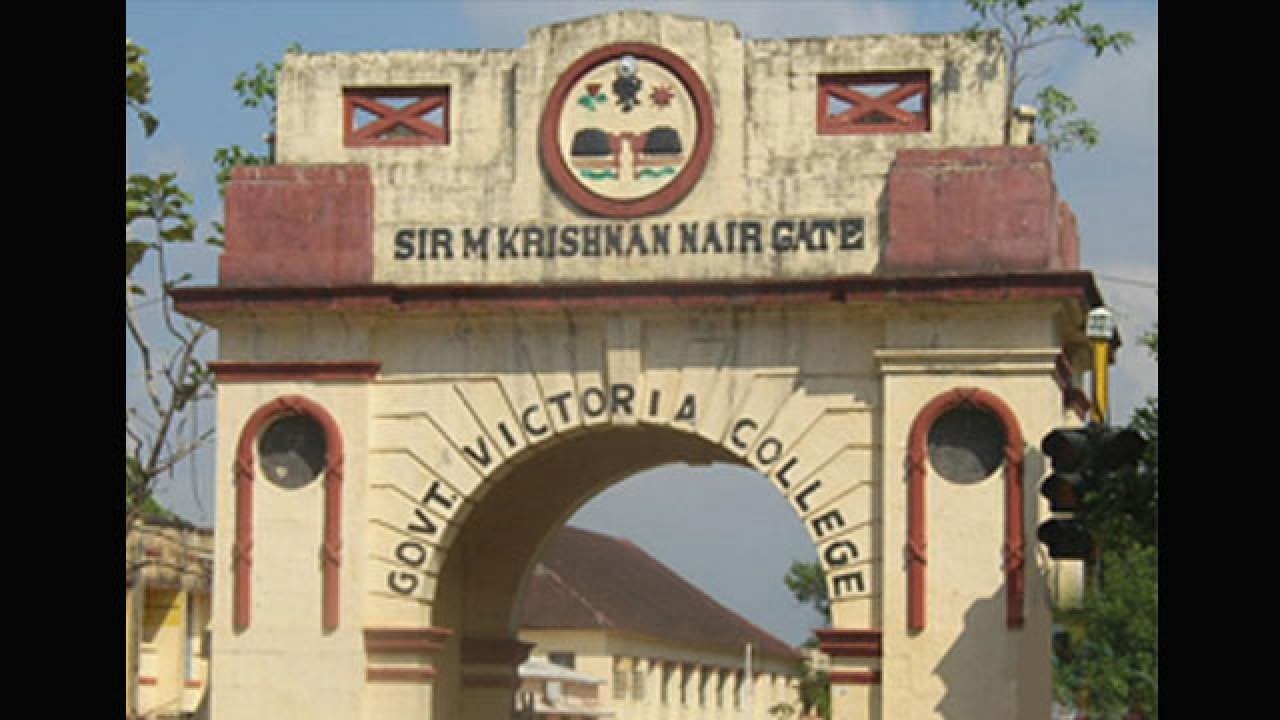
Whole Dude – Whole Account: The Moments Slip Away And Are Laid to Your Account. Recalling the Moments at Government Victoria College, Palghat.
Government Victoria College, Palakkad is the oldest institution of higher learning in the Malabar region of Kerala. In January 1888 it was raised to the rank of a second grade college and was affiliated to the University of Madras. The institution was taken over by the Government of Madras Presidency in 1919.The teaching of Geography as an optional subject for ‘Intermediate’ students commenced in 1945. Before the creation of linguistic provinces in 1956, Palghat was part of Madras State after India’s independence in 1947.
Whole Dude – Whole Account: Moments Slip Away And Are Laid to Your Account. Recalling the Moments at Government Victoria College, Palghat.
The Motto of the College is the Latin slogan Labuntur et imputantur. Indeed it is true that life’s moments slip away and fortunately they are laid to your account.
Whole Dude – Whole Account: Moments Slip Away And Are Laid to Your Account. Recalling the Moments at Government Victoria College, Palghat.
Because of Victoria College, I am able to recall some of those moments that slipped away from my life about 55 years ago. I am speaking of the times when Palghat was a part of Madras State and when Victoria College was affiliated to the Madras University. In 1952, I was a four-year old kid and my father was employed in the Madras State Educational Service. He had obtained his M.A degree in Indian History from Madras University and worked in the Madras Presidency College, Madras which is now known as Chennai city. My father had also a Diploma in Geography and he was transferred to Government Victoria College, Palghat to teach Geography. In his long career in the Educational Service, my father taught mostly Indian History, and at Victoria College, he taught Geography and was assigned to the Department of Geography.
Whole Dude – Whole Account: The Moments Slip Away and are Laid to Your Account. Reliving the Moments of Life at Queen Victoria College, Palghat.
We lived in a rented house in Palghat. The house is on a dead-end street and it is the last house on the street and it abuts the college compound wall.The house faces the college cricket stadium/sports grounds.There is a canteen of the college right in front of the house.The stadium has a nice pavilion for the spectators to sit and watch the games. Our landlord had two sons who were then students at the college. Apart from my parents, I lived with my two elder brothers. For the first time in my life, I was introduced to the game of Cricket in this house while we lived in Palghat. In the front courtyard of the house, we had a large tree which served as the stumps for our game. Very often, myself and my brothers would watch the Cricket matches and I have seen for the first time the official scorekeeping sheets they fill up during the game. Cricket has been popular with Indians for a long time. It was not Mylapore, Madras and it was not my native place Rajahmundry where I took my first lesson to play this game. I remember Palghat as the place where my love for the game of Cricket began.
Whole Dude – Whole Account: Moments Slip Away And Are Laid to Your Account. Recalling the Moments at Government Victoria College, Palghat.
When I opened my PALGHAT ACCOUNT, my landlord’s two sons still look young and fresh like any other college students and I still have the visual image of myself and my brothers, all kids, playing cricket in front of the house. This is life. It is full of moments that quietly slip away and if you are lucky, the account that you have created is still there and you have the chance to recapture the moment and you can actually relive in that moment and the freshness of it is carefully preserved and it tastes as good as it was on the first occasion. Thanks to Victoria College, Palghat and I still have an account with credit balance.
Whole Dude – Whole Account: Moments Slip Away And Are Laid to Your Account. Recalling the Moments at Government Victoria College, Palghat.
Essence and Existence:
What is man’s nature and how to describe man’s essence? The essence is supported by existence. The existence is in the moments that slip away on which man has no control. Man exists as he helplessly watches the moment called future is churned into past, and present is only an instant in this future-past continuum. Fortunately, man can recall and revisit the moments that have slipped away and bring past into the present moment.
Whole Dude – Whole Account: Moments Slip Away And Are Laid to Your Account. Recalling the Moments at Government Victoria College, Palghat.







 Whole Dude - Whole Concept