WHOLE DUDE – WHOLE PRESERVATION

A PICTURE OF INDIA’S GRIEF OVER JIHADIST ATTACKS IN MUMBAI

TERROR ATTACKS ON INDIA  : 

Recent news reports are stating that the terror attacks on India have not seen its end and they are predicting the possibilities of more attacks similar to the Mumbai carnage on November 26, 2008. “India will continue to face a serious jihadist threat from Pakistan-based terrorist groups, and neither Indian nor U.S. policy is likely to reduce that threat in the near future”, said Angel Rabasa, lead author of the study and a senior Political Scientist with RAND, a non-profit think tank based in Santa Monica, California. According to RAND, the other extremist groups in Pakistan will find inspiration in the Mumbai attacks and there can be more attacks from groups with high body counts and symbolic targets.THE CONCEPT OF JIHAD  :  The term Jihad in Arabic means struggle and is often viewed as a religious duty. A person engaged in Jihad is called a ‘mujahid’, the plural is ‘mujahideen’. The Mumbai attackers identified themselves with the name of ‘Deccan Mujahideen’. The aim of Jihad includes the expansion and defense of the Islamic State and warfare against non-believers. Jihad ideology has historically inspired the conquest of non-Muslim population and the transformation of civil society which is viewed as corrupt, arrogant, and disobedient. The Holy Book of Quran, Surah 25, verse 52 states : “Therefore, do not obey the disbelievers, and strive against them with this, a great striving”. The objectives of armed warfare include uprooting unbelief and establishing supremacy of God, through Islam, in the world.”And fight them on until there is no tumult or oppression, and there prevail justice and faith in Allah altogether and everywhere.”

THE HISTORY OF JIHAD IN INDIA  :

Sir Jadunath Sarkar, a historian, and former Vice-Chancellor of Calcutta University had contended that several Muslim invaders waged a systematic Jihad against Indians. Sultan Mahamud of Ghazna(present day Ghazni city,Afghanistan) conducted more than twenty Jihadist attacks on North India between 1001 and 1027. In particular the records kept by al-Utbi, Sultan Ghazni’s secretary in the ‘Tarikh-i-Yamini’ document several episodes of bloody campaigns. Persian historian Ferishta records that Sultan Ghazni wants to “root out the worship of idols from the face of all Hindustan(India)”. He looked upon the destruction of temples as an act of Jihad. Mahamud Ghazni specifically directed his campaigns to temple towns of Nagarkot, Thanesar(1011), Mathura(1018), Kannauj(1019), Kalinjar(1023), and Somnath(1024). He had also destroyed temples at Varanasi, Ujjain, Maheshwar, Jwalamukhi, and Dwaraka. Mahmud Ghazni was of Turkic origin but had patronized the use of New Persian language and gave employment to writers such as al-Biruni, and Ferdowsi who gave detailed descriptions of the enormous booty and idols brought back to Ghazni city. Asaru-L-Bilad, a 13 th century geographer also described in great detail the destruction of Somnath. Apart from his regular troops, Mahmud Ghazni had assistance from 30,000 volunteer horsemen who had participated in the Jihad. To resist the attack on Somnath, Ghogha Rana at the age of 90 sacrificed himself and his clan. There are no census documents but after an analysis of all historical documents, historian K.S.Lal had estimated that about 2 million people died during Sultan Ghazni’s attacks on Indian temple towns.Similarly, Sikandar Lodhi of Delhi earned the epithet of ‘But Shikan’- the destroyer of idols. Babur the founder of Mughal empire in India in 1527 ordered a JIHAD against Rajputs at the battle of KHANUA. He had encouraged his men to fight the infidels and asked them to become either a Ghazi(soldier of Islam) or a Shaheed(Martyr of Islam). The Mughal Emperor Aurangzeb waged Jihad against Hindus as well as Shia Muslims whom he identified as heterodox. In South India, the Hindu kingdom of Vijaynagar came under repeated attacks of annual Jihad which had started in 1501 and each attack included destruction of temples. In the historical Third Battle of Panipat(January 1761), Ahmad Shah Abdali declared a Jihad against the Marathas. Estimates from historical documents indicate that about 60 to 80 million people in India died between 1000 and 1525 CE.INDIA’S RIGHT TO SELF-DEFENSE  : Indian traditions have clearly established the rules of warfare. A ‘JUST WAR’ or ‘DHARMA YUDDHA’ is a duty and is an obligation of the Ruler. We believe in the principles of protecting all non-combatants. They should not be touched or harmed in any manner. We recognize the right of self-protection, self-defense, and self-preservation. When an enemy attacks you, it would be an act of cowardice if the enemy is not engaged in a battle. In the context of defending people against Jihadist attacks, we are not only defending our territory, our property, our personal lives but also we are defending our right to think for ourselves and cherish the ideas and values that are important to our existence. We have a fundamental right to worship as we please and safeguard the traditional way of life. Since Jihadist attack is actually a war against our fundamental right to practice religion, the propagation of ideas of Jihadist warfare should be prohibited and violators should be punished. The term Self-Defense means defense of one’s rights, beliefs, and existence. The Right to defend oneself with whatever force is reasonably necessary against actual or threatened violence is universally recognized by Law. Self-Defense is a natural, inborn instinct. A National Entity has a Right and also a Duty to defend itself from attacks sponsored by an enemy or an Enemy State. The act of Self-Defense could be expressed in several different forms; a retaliation involving the use of military force, economic and trade sanctions, diplomatic sanctions, imposing travel restrictions, and other punitive or defensive actions as needed.   

Dr. R. Rudra Narasimham,  

Kurnool Medical College, Kurnool, Andhra Pradesh, India,  

M.B.B.S.,  Class  of  April,  1970.

Whole Dude – Whole Power

THE TEMPLE OF LORD SOMNATH IS THE EVIDENCE FOR THE POWER OF CREATION OVER THE POWER OF DESTRUCTION. 

This entry is dedicated to the memory of Sardar Vallabhbhai Patel, India’s first Deputy Prime Minister. 

THE SHRINE ETERNAL : 

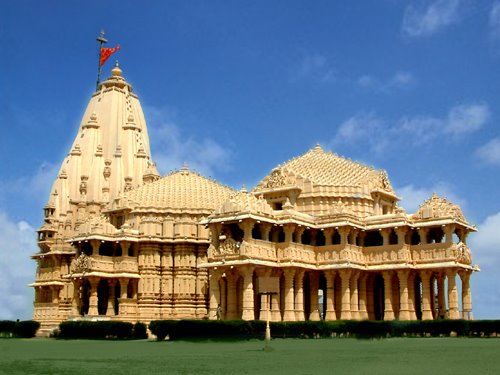
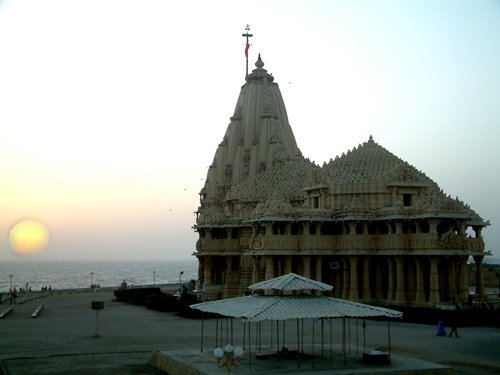
Somnath Temple is in the ‘Prabhas Kshetra’, near the seaport city of Veraval in Junagadh District, Kathiawar Peninsula of Saurashtra , on the shores of Arabian Sea,the western coast of Gujarat, India. This holy place of pilgrimage is a place of great antiquity and recent excavations there have revealed a settlement dating from about 1500 B.C. As per Indian traditions, the place is of significance as it is considered as the place from where Lord Krishna departed from this world. The presiding deity of this temple is Lord Shiva and He is known by the name of SOMNATHA or the Lord of the Moon. The present temple as it exists today is known as ‘Kailash Mahameru Prasada and is built-in CHALUKYA style of temple architecture. The site lied in a state of ruin for centuries and the decision to rebuild it was made by Sardar Vallabhbhai Patel during his visit on 13 November, 1947. The temple was inaugurated on December 1, 1951 by Dr. Rajendra Prasad, the first President of the Republic of India. He had remarked that, “The Somnath temple signifies that the power of creation is always greater than the power of destruction”. The temple symbolizes the enduring fame of Sardar Patel who during the first three years of Indian independence after 1947, had served as Deputy Prime Minister, Minister of Home Affairs, Minister of Information, and Minister of States. He was considered as practical and decisive. He was the architect of the Indian Union and his greatest contribution was the achievement of the peaceful integration of over 535 princely states into the Indian Union. The principality of Junagadh, and the princely State of Hyderabad had initially resisted the offer to join the Indian Union. Having failed in his attempts to join Pakistan, the Nawab of Junagadh fled away from the country. Mr. Bhutto,( the father of Mr. Z.A. Bhutto, who served as Pakistan’s Prime minister) acting in his capacity of the ‘DEWAN’ of the court of Junagadh, had invited Lord Mountbatten to accept the accession of Junagadh to India. In the State of Hyderabad, a militant movement called the Razakars was launched seeking independence but Sardar Patel restored peace in September 1948 and the ruler Nizam had accepted the terms of accession to the Indian Union. This part of Indian history and the integration of princely states into Indian Union has again become relevant after the enemy’s brutal attack in Mumbai which I had mentioned in my previous entry. The enemy had described himself as ‘Deccan Mujahedeen’, and the media reports indicate that the enemy had specific designs to gobble Junagadh, and Hyderabad apart from encouraging insurgency in the border State of Kashmir. The enemy’s intentions will force us to defend SOMNATH in Junagadh District which is resurrected after repeated attacks over centuries. 

THE HISTORY OF SOMNATH :

Jyotirlinga Temple at Somnath is mentioned in Hindu prayers in praise and worship of Lord Shiva:”Sauraashtra dese visadeti ramye, Jyotirmayam Chandra Kalaa vatamsam, Bhakti pradaanaaya Krupaa vateernam, Tam Somanaatham Saranam prapadye.”
Somnath, the confluence of three rivers, River Sarasvati, River Hiranya, River Ilanki and Kapila is mentioned in ancient Hindu Scriptures known as Rig Veda.


LORD SOMNATH TEMPLE-THE SHRINE ETERNAL- TESTIMONY TO THE POWER OF CREATION OVER THE POWER OF DESTRUCTION.

 Somnath finds its mention in the ancient text of RIG VEDA. It is associated with the holy names of GANGA, YAMUNA, and SARASWATI, popularly known as ‘TIRTH DHAM’ where Indians traditionally offer worship by a practice described as ‘River Worship’. The ancient river of Saraswati may have merged into the Sea at Somnath apart from smaller rivulets known by the names of Hiranya, Kapila and Ilanki. The place is extensively described as a place of pilgrimage and its importance is narrated in the ancient texts of ‘SKANDA PURANA’, ‘BHAGAVATA PURANA’, and ‘SHIVA PURANA’. Lord Shiva in His radiant form known as ‘Jyotir Linga’ resides at Twelve different places in India and Somnath is listed as the first place of residence of ‘DWADASA JYOTIR LINGA’.Tradition claims that the original Temple of Somnath was built by Lord Moon, and was later built by King Ravana of Lanka who is a central figure in the story of Indian epic poem of RAMAYANA. The SINDH area of the Indian subcontinent came under Arab conquest in 7th century A.D. The Somnath Temple built by the YADAVA kings of Vallabhi of Saurashtra around 649 A.D. was destroyed in 725 A.D. by the Arab governor of Sindh. The Pratihara King Nagabhata II rebuilt it in red stone. Between 1001 A.D. and 1027 A.D. , the road to conquest of India was prepared by Sultan Mahmud of Ghazna( modern GHAZNI in Afghanistan) who conducted more than twenty raids into North India. His raids were mainly for plunder. They revealed the wealth of India and demonstrated the vulnerability of India to military attacks. During one of his raids, in 1024 A.D. , marching across India’s Thar Desert, Mahmud of Ghazna had plundered and destroyed the Somnath Temple. The amount looted was estimated at 20 thousand, thousand ‘Dinars’. The enormous treasures found at Somnath have been a theme of wonder for all who have written on that conquest. The Paramara King of Bhoj of Malwa, Solanki King Bhima of Anhilwara/Patan between 1026 A.D. and 1042 A.D. rebuilt the Temple. By 1297/98 A.D. , Gujarat was conquered by Ala-ud-Din Khalij, Sultan of Delhi and the Temple was razed.Solanki King Kumarapala built a Temple of stone and this was destroyed again in 1394 A.D. For the last time, the Temple was destroyed in 1706 A.D by the Mughal Emperor Aurangzeb and the site remained in ruins till India’s independence in 1947. The rebirth of the Temple on December 1, 1951 demonstrates the vitality of the Indian spirit. 

A HYMN IN PRAISE OF LORD SOMNATH : 

Saurashtra dese visadeti ramye 

Jyotirmayam, Chandra kala vatamsam 

Bhakti prada naya Krupa vatirnam 

Tam Somanatham saranam prapadye. 

Lord Somanatha is dwelling in His great splendor in the Province of Saurashtra. May this Lord Somanatha who is full of radiance, and the crescent-shaped Moon shines in His matted hair, with His extreme compassion grant me a great sense of devotion with which I would seek my protection and let Him be my refuge. 

Jyotirlinga Temple at Somnath is mentioned in Hindu prayers in praise and worship of Lord Shiva:”Sauraashtra dese visadeti ramye, Jyotirmayam Chandra Kalaa vatamsam, Bhakti pradaanaaya Krupaa vateernam, Tam Somanaatham Saranam prapadye.”