Whole Dude – Whole Worship

"haviryajna done by a Nambudiri in Kerala...
Whole Dude – Whole Worship

YAGNA, A VEDIC RITUAL OF SACRIFICE-‘HOTREE’ OR ‘YAGNA PERFORMER’ OFFERS ‘HAVIS’ TO FIRE (LORD AGNI)

THE UNIVERSE AS GOD’S BODY

The word ‘omnipresent’ is defined as present everywhere at the same time. The property of being present everywhere is one of the Divine attributes. In western theism it has attracted less attention and the idea of ‘omnipresence’ is explained in a bit unclear way. In Judeo-Christian, and Islamic Cultures, God is not immersed in the substance of creation even though He is able to interact with it as He chooses. They tend to the view that God is in “HEAVEN”, and that God is above and outside of all creation. They explain ‘omnipresence’ in terms of His ‘ESSENCE’ as He is present to all as the cause of their being, His ‘POWER’ as all things are subject to His power, and His ‘KNOWLEDGE’ as He constantly watches all that goes on in the world and all things are bare and open to His eyes and hence He is naturally present in every aspect of the natural order. Whereas Indian thinkers tend to believe that a thing is said to be substantially or essentially in that place in which its substance is. Hence, people in the Land of India traditionally hold the view that God is related to the universe as though it is His body. The entire creation is seen as a manifestation of the Supreme Person. The theory of transcendent(exists apart from material universe) and immanent(actually present throughout the material universe)’omnipresence’ explains the meaning of the word ‘BRAHMAN’, the Ultimate Reality. Indian people reflect this belief in their worship of creation, and the idea that God is immersed in the substance of His creation could be recognized as a core value, the foundation upon which the Cultural traditions of India are established over thousands of years of their continued existence. The rituals of temple worship and the Vedic rituals of Yagna always include aspects of Worship of Creation and the Scriptures reveal that the Gods also Worship Creation to the same extent and the Indian way of life could be stated as a quest for unity with the Divine.

A HYMN TO SEEK PROTECTION FROM THE CREATOR

Yaa srushti srashtu raadyaa vahiti vidhihutam, yaa havi ryaacha hotree

Ye dvey kaalam vidhatta, sruti vishaya gunaa, Yaa sthithaa vyaapya viswavam

Yaa maa hu sarva bhuta prakriti riti, Ya Yaa praanina praanavanta

Pratyakshaabhi prasanna stanubhi ravatu Vastaabhi rashtaabhi reesa.

We seek the protection of God who physically manifests Himself with the eight bodies of

1. WATER- Lord VARUNA who was created prior to the creation of all other creation(of living entities).

2. FIRE- Lord Agni who receives ‘HAVIS’, the oblations or offerings given to God.

3. HOTREE- the person who is performing ‘YAGNA’, the Vedic ritual of sacrifice.

4. SUN- Lord Surya, the marker of day time.

5. MOON- Lord Chandra, the marker of night-time.

6. SKY- or ETHER which helps in the propagation of SOUND and is spread across the entire universe.

7.EARTH- Mother Earth, Goddess Bhu Devi, who bears the burden of harboring all living entities.

8. WIND- Lord VAYU who is the ‘Breath of life'(or PRANA) of all living entities that breathe.

THE FUNDAMENTAL RIGHT TO WORSHIP CREATION

The act of Creation Worship defines Indian Identity. All other Cultural Traditions that are existing in India proceed from this foundational principle. Indians seek their well-being, prosperity, happiness and eventually salvation through acts of worship. The foreign forces that occupied and ruled India tried hard to take away this Right to Worship as per our belief that God is immanent. We need to recognize the Right to Worship Creation as a Fundamental Right. Citizens while they are free to profess their religion , should not be free to ‘PROPAGATE’ a religion or idea which basically interferes with a Fundamental Right. No person could have a Fundamental Right to PROPAGATE at the expense of denying and devaluing other core values. To that extent, we should seek an amendment to PART III, Article 25 of the Constitution of India which deals with Freedom of Religion. The Constitution of India must recognize the Worship of Creation as a Foundational Principle of the Land of India and hence should be considered a Fundamental Right and should prohibit PROPAGATION of religion which infringes upon this Core Value. Such an amendment is vital to defend the Freedom of Religion as religious doctrines of Islam and Christianity are opposed to the idea of divinity of all created objects. These religious faiths divide humanity into two categories; the believers, and the non-believers. They also further express the claim that they possess a divine sanction to punish or modify the beliefs of the non-believers. In the global community, the adherents of Hindu religious faith are only a minority and they need special protection to defend the Right to Freedom of Religion. 

Whole Dude – Whole Worship: The Lord God or the Principal Presiding deity at Malibu Hindu Temple is known as Lord Venkateshwara who represents the physical manifestation of the Supreme Being, Lord Vishnu in the material realm. Since the LORD is present in this terrestrial realm, He knows the Brahman Spirit that is in Prison.

Whole Dude – Whole Power

THE TEMPLE OF LORD SOMNATH IS THE EVIDENCE FOR THE POWER OF CREATION OVER THE POWER OF DESTRUCTION. 

This entry is dedicated to the memory of Sardar Vallabhbhai Patel, India’s first Deputy Prime Minister. 

THE SHRINE ETERNAL : 

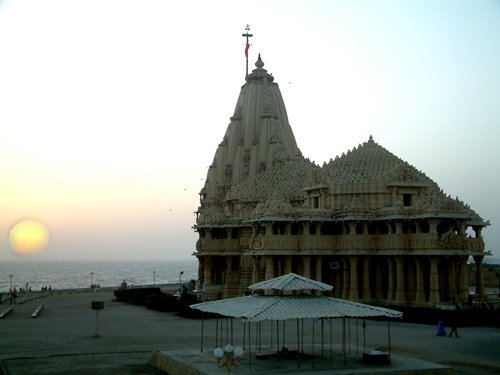
Somnath Temple is in the ‘Prabhas Kshetra’, near the seaport city of Veraval in Junagadh District, Kathiawar Peninsula of Saurashtra , on the shores of Arabian Sea,the western coast of Gujarat, India. This holy place of pilgrimage is a place of great antiquity and recent excavations there have revealed a settlement dating from about 1500 B.C. As per Indian traditions, the place is of significance as it is considered as the place from where Lord Krishna departed from this world. The presiding deity of this temple is Lord Shiva and He is known by the name of SOMNATHA or the Lord of the Moon. The present temple as it exists today is known as ‘Kailash Mahameru Prasada and is built-in CHALUKYA style of temple architecture. The site lied in a state of ruin for centuries and the decision to rebuild it was made by Sardar Vallabhbhai Patel during his visit on 13 November, 1947. The temple was inaugurated on December 1, 1951 by Dr. Rajendra Prasad, the first President of the Republic of India. He had remarked that, “The Somnath temple signifies that the power of creation is always greater than the power of destruction”. The temple symbolizes the enduring fame of Sardar Patel who during the first three years of Indian independence after 1947, had served as Deputy Prime Minister, Minister of Home Affairs, Minister of Information, and Minister of States. He was considered as practical and decisive. He was the architect of the Indian Union and his greatest contribution was the achievement of the peaceful integration of over 535 princely states into the Indian Union. The principality of Junagadh, and the princely State of Hyderabad had initially resisted the offer to join the Indian Union. Having failed in his attempts to join Pakistan, the Nawab of Junagadh fled away from the country. Mr. Bhutto,( the father of Mr. Z.A. Bhutto, who served as Pakistan’s Prime minister) acting in his capacity of the ‘DEWAN’ of the court of Junagadh, had invited Lord Mountbatten to accept the accession of Junagadh to India. In the State of Hyderabad, a militant movement called the Razakars was launched seeking independence but Sardar Patel restored peace in September 1948 and the ruler Nizam had accepted the terms of accession to the Indian Union. This part of Indian history and the integration of princely states into Indian Union has again become relevant after the enemy’s brutal attack in Mumbai which I had mentioned in my previous entry. The enemy had described himself as ‘Deccan Mujahedeen’, and the media reports indicate that the enemy had specific designs to gobble Junagadh, and Hyderabad apart from encouraging insurgency in the border State of Kashmir. The enemy’s intentions will force us to defend SOMNATH in Junagadh District which is resurrected after repeated attacks over centuries. 

THE HISTORY OF SOMNATH :
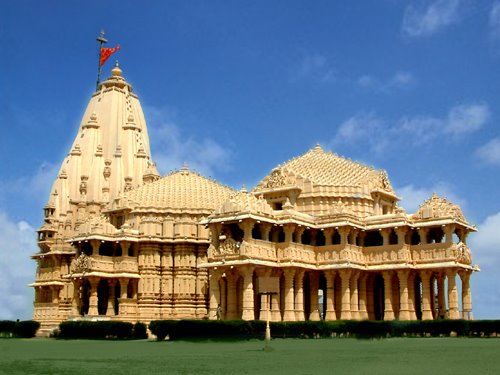
Jyotirlinga Temple at Somnath is mentioned in Hindu prayers in praise and worship of Lord Shiva:”Sauraashtra dese visadeti ramye, Jyotirmayam Chandra Kalaa vatamsam, Bhakti pradaanaaya Krupaa vateernam, Tam Somanaatham Saranam prapadye.”
Somnath, the confluence of three rivers, River Sarasvati, River Hiranya, River Ilanki and Kapila is mentioned in ancient Hindu Scriptures known as Rig Veda.


LORD SOMNATH TEMPLE-THE SHRINE ETERNAL- TESTIMONY TO THE POWER OF CREATION OVER THE POWER OF DESTRUCTION.

 Somnath finds its mention in the ancient text of RIG VEDA. It is associated with the holy names of GANGA, YAMUNA, and SARASWATI, popularly known as ‘TIRTH DHAM’ where Indians traditionally offer worship by a practice described as ‘River Worship’. The ancient river of Saraswati may have merged into the Sea at Somnath apart from smaller rivulets known by the names of Hiranya, Kapila and Ilanki. The place is extensively described as a place of pilgrimage and its importance is narrated in the ancient texts of ‘SKANDA PURANA’, ‘BHAGAVATA PURANA’, and ‘SHIVA PURANA’. Lord Shiva in His radiant form known as ‘Jyotir Linga’ resides at Twelve different places in India and Somnath is listed as the first place of residence of ‘DWADASA JYOTIR LINGA’.Tradition claims that the original Temple of Somnath was built by Lord Moon, and was later built by King Ravana of Lanka who is a central figure in the story of Indian epic poem of RAMAYANA. The SINDH area of the Indian subcontinent came under Arab conquest in 7th century A.D. The Somnath Temple built by the YADAVA kings of Vallabhi of Saurashtra around 649 A.D. was destroyed in 725 A.D. by the Arab governor of Sindh. The Pratihara King Nagabhata II rebuilt it in red stone. Between 1001 A.D. and 1027 A.D. , the road to conquest of India was prepared by Sultan Mahmud of Ghazna( modern GHAZNI in Afghanistan) who conducted more than twenty raids into North India. His raids were mainly for plunder. They revealed the wealth of India and demonstrated the vulnerability of India to military attacks. During one of his raids, in 1024 A.D. , marching across India’s Thar Desert, Mahmud of Ghazna had plundered and destroyed the Somnath Temple. The amount looted was estimated at 20 thousand, thousand ‘Dinars’. The enormous treasures found at Somnath have been a theme of wonder for all who have written on that conquest. The Paramara King of Bhoj of Malwa, Solanki King Bhima of Anhilwara/Patan between 1026 A.D. and 1042 A.D. rebuilt the Temple. By 1297/98 A.D. , Gujarat was conquered by Ala-ud-Din Khalij, Sultan of Delhi and the Temple was razed.Solanki King Kumarapala built a Temple of stone and this was destroyed again in 1394 A.D. For the last time, the Temple was destroyed in 1706 A.D by the Mughal Emperor Aurangzeb and the site remained in ruins till India’s independence in 1947. The rebirth of the Temple on December 1, 1951 demonstrates the vitality of the Indian spirit. 

A HYMN IN PRAISE OF LORD SOMNATH : 

Saurashtra dese visadeti ramye 

Jyotirmayam, Chandra kala vatamsam 

Bhakti prada naya Krupa vatirnam 

Tam Somanatham saranam prapadye. 

Lord Somanatha is dwelling in His great splendor in the Province of Saurashtra. May this Lord Somanatha who is full of radiance, and the crescent-shaped Moon shines in His matted hair, with His extreme compassion grant me a great sense of devotion with which I would seek my protection and let Him be my refuge. 

Jyotirlinga Temple at Somnath is mentioned in Hindu prayers in praise and worship of Lord Shiva:”Sauraashtra dese visadeti ramye, Jyotirmayam Chandra Kalaa vatamsam, Bhakti pradaanaaya Krupaa vateernam, Tam Somanaatham Saranam prapadye.”