Whole Dude – Whole Punishment

The Right to Life means a Life for Life. REBBAPRAGADA SUBBARAO (1893-1948), LAWYER, POET, SPORTSMAN, DISTINGUISHED CITIZEN OF RAJAHMUNDRY

REBBAPRAGADA SUBBARAO (1893-1948), LAWYER, POET, SPORTSMAN, DISTINGUISHED CITIZEN OF RAJAHMUNDRY

This entry is dedicated to the memory of my grandfather, Shri.Rebbapragada Subbarao, who served the British Crown as a Public Prosecutor at East Godavari District Sessions Court in Rajahmundry for two terms from 1940. He never hesitated in seeking the capital punishment when he prosecuted criminals for the offense of murder. I was not fortunate enough to witness his performance as a Public Prosecutor but my grandmother shared information about his stellar qualities and his great reputation. While I grew up in Rajahmundry, during a school field trip, I visited the Central Jail in Rajahmundry where the death sentence is carried out by hanging. My impression from that trip was that the death sentence is appropriate and is not cruel. This entry is an effort to understand my grandfather’s support for capital punishment.

The Right to Life:

The Right to Life means a Life for Life: Thomas Jefferson’s Declaration of Independence seeking natural inalienable rights was made seeking support with a firm reliance on the protection of Divine Providence. The operation of Divine Providence is the central requirement if man has the natural, inalienable rights to Life, Liberty, and the pursuit of Happiness.

Human beings everywhere demand the realization of diverse values to ensure their individual and collective well-being. A fundamental value that is universally claimed by all people is that of the Right to Life. Thomas Jefferson asserts that his countrymen are a “free people claiming their rights as derived from the laws of nature and not as the gift of their Chief Magistrate.” In the Declaration of Independence proclaimed on July 4, 1776, he eloquently claims, “We hold these truths to be self-evident, that all men are created equal, that they are endowed by the Creator with certain unalienable Rights, that among them are Life, Liberty and the Pursuit of Happiness.” The basic principle of the French Declaration of the Rights of Man and of the Citizen (1789) was that “all men are born free and equal in rights,” which were specified as the rights of Liberty, Private Property, the inviolability of the person, and resistance to oppression. It specifically states that Liberty consists in being able to do anything that does not harm others: thus the exercise of the natural rights of every human has no bounds other than those that ensure to the other members of society the enjoyment of these same rights.

The Reason for Punishment:

The Right to Life means a Life for Life. If there is no penalty attached, the above words would be vain words.

A Right which is not protected is not a Right and a Law without penalty attached is not a Law. If the Constitution declares a ‘Right to Life’ and if Moses proclaims the divine law that commands that “You shall not murder” (The Book of Exodus 20:13, and The Book of Deuteronomy 5:17), if there is no penalty attached, these words would be vain words.

The Right to Life means a Life for Life. If there is no penalty attached, the above words would be vain words.

A penalty is imposed as a consequence to an act of wrongdoing. Punishment is generally conceived as the infliction of pain. Why men should be punished is one of the most controversial questions in the field of moral and political thought, and in psychology and theology as well. There are three major types of wrongdoing in relation to which men discuss the nature and the need of punishment, its justice or its expediency. Punishment is traditionally considered in relation to, evil or wicked actions, violations of law, and sin. Murder is an act which simultaneously violates the moral, the civil and the divine law.

The Purpose of Punishment:

The Right to Life means a Life for Life. The concept of punishment proposed by Jesus demands self-evaluation.

The question about the purpose of punishment critically tests the meaning of anyone’s theory of Law and Justice. The purpose of punishment will affect the penalties to be imposed for wrongdoing. Some people think that punishment need only be inherently just and others think that punishment cannot be justified without reference to its utility or expediency. The purpose of punishment could be described under three different categories:

1. Punishment should be justified only by its consequences.

2. Punishment should be a combination of awarding a just penalty and securing good effects.

3. Punishment should be a just retaliation exclusively.

The Utilitarian Theory of Punishment:

This view is based upon the idea that punishment should not be equal to revenge or an act of hostility. A punishment is an evil inflicted by public authority on those who have transgressed the law so that the will of men may be better disposed to obedience. The chief aim of punishment is securing the reformation and the deterrence of criminals and to maintain public peace. The Court does not exist for punishment only but also for the salvation of the criminal. The spirit and meaning of punishment is seen as the salvation and the reformation of the wrongdoer.

According to Socrates, “to suffer punishment is another name for being justly corrected when you do wrong,” and he “who is punished and suffers retribution, suffers justly.” He believed that justice is restored to the soul of the wrongdoer. “The proper office of punishment is two-fold; he who is rightly punished ought either to become better and profit by it or he ought to be made an example to his fellows, that they may see what he suffers, and fear and become better.”

Plato had implied that virtue could be taught. “He who desires to inflict rational punishment does not retaliate for a past wrong which cannot be undone.” He punishes for the sake of prevention. Plato thought that the death penalty should be imposed only on the incurable who cannot profit from an example to other men not to offend.

Hobbes places the reason for punishment in the future rather than in the past in its utility to procure certain effects rather than retaliation. “Men look not at the greatness of the evil past, but the greatness of the good to follow.” We are forbidden to inflict punishment with any other design than for the correction of the offender, or the direction of others.

Locke derives from natural law the right to punish those who transgress that law and to restrain and prevent the like offence.

Rousseau lays great emphasis on the reformation of the criminal. “There is not a single ill-doer who could not be turned to some good. The State has no right to put to death, even for the sake of making an example, anyone whom it can leave alive without danger.”

The Retributive Purpose of Punishment:

The Right to Life means a Life for Life. In the modern human society, the individual has the right to report a crime and the justice is served by the Society after due verification of the crime.

Kant and Hegel viewed that retribution or retaliation is the only basis for punishment. Punishment should be purely retributive and it need not serve some end beyond itself and need not produce some desired consequence in the future. We should punish only because we have, under the moral law, a duty to do so. The purpose of punishment is to uphold the moral law.

The effect of the punishment upon the wrongdoer or upon others whose conduct may be affected by punishments meted out, must not be taken into account at all. Punishment of the transgressor may heal the feelings of those he has injured and it may even satisfy a desire for revenge, but those factors should have no motivating force. Nothing should be sought except the preservation of the balance sheet of justice. Every wrong is duly requited by a proportionate measure of punishment. It should not consider any person except the wrongdoer himself.

According to Kant, “Judicial punishment can never be administered merely as a means of promoting another good, either with regard to the Criminal himself, or to Civil Society, but must in all cases be imposed only because the individual on whom it is inflicted has committed a Crime…….The Penal Law is a Categorical Imperative.”Punishment cannot be justified except as doing the work of Justice.

The Right of Retaliation (ius talionis ):

The Right to Life means a Life for Life

Kant says, “It is just the Principle of Equality by which the pointer Scale of Justice is made to incline no more to one side than the other; It may be rendered by saying that the undeserved evil which anyone commits on another, is to be regarded as perpetrated on himself…….This is the Right of Retaliation; and properly understood it is the only principle which can definitely assign both the quality and the quantity of a just penalty. All other standards are wavering and uncertain; and on account of other considerations involved in them, they contain no principle conformable to the sentence of pure and strict Justice.” Retributive Punishment or retaliation seems to express the principle of justice or fairness in exchange.

A Life for Life ( lex talionis ):

The Right to Life means a Life for Life

A Life for Life is the symbolic statement in the Greek as well as the Hebrew tradition. “Who so’er shall take the sword, shall perish by the sword.” Retribution is not revenge. It is the righting of wrong. It is the very act of crime itself which vindicates itself.

The gravity of the offense is the only determinant of the severity of the punishment. The punishment should fit the crime, not the nature of the criminal as someone capable of being benefitted by punishment. Kant and Hegel do not think that the justification of the death penalty depends upon the curability or incurability of the offender. The taking of the criminal’s life need not be motivated by a desire to protect society from his future depredations. It is sufficient that he has taken a life and it should be repaid by a proportionate requital.

The Right to Life means A Life for Life.

“Whoever sheds the blood of man,

by man shall his blood be shed:

for in the image of God

has God made man. ” (The Book of Genesis, chapter 9, verse 6)

The reason murderers deserved the death penalty was the supreme value of human life. To destroy human life is to attack the image of God, and therefore God demands an accounting.

Murder must be described as a sin, as a crime and as a vice. The Criminal gives his consent for Capital Punishment by his very act.

Dr. R. Rudra Narasimham, B.Sc., M.B.B.S.,

Kurnool Medical College, Kurnool, Andhra Pradesh, India,

M.B.B.S.  Class  of  April,  1970.

The Right to Life means a Life for Life. If anyone takes a human life, that person’s life will also be taken by human hands. For God made human beings in his own image.

Whole Dude – Whole Literature

Rajahmundry Formulates My Connection to India and Indian Literature

Bharat Darshan – City of Rajahmundry shapes My connection to India and Indian literature. Shri. Sarat Chandra Chatterjee or Chattopadhyay, popularly known as Sarat Babu.
Shri. Sarat Chandra Chatterjee or Chattopadhyay, popularly known as Sarat Babu.

SARAT CHANDRA CHATTERJEE (CHATTOPADHYAY), SEPT 15, 1876 – JAN 16, 1938

I belong to Rajahmundry where Kandukuri Veeresalingam had written the first novel ever written in the Telugu language. However, it was ‘ SARAT BABU’ who had first provoked my interest in reading Telugu literature. Sarat Babu, the famous novelist had written in Bengali language but fortunately, his books are translated into Telugu language and while I grew up in Rajahmundry, his novels were extremely popular he quickly aroused my curiosity.

Rajahmundry – My connection to India and Indian literature.

In 1953, the Telugu film ‘DEVADASU’ with Akkineni Nageswara Rao (A N R) in the lead role was released and the songs from that film though not written by Sarat Babu also became very popular. It was not the popularity of this film which had drawn me towards the novels written by Sarat Babu.

Rajahmundry – My connection to India and Indian literature

I actually started reading his translated stories a few years later after joining Danavaipeta Municipal Corporation High School. I was attracted by his powerful narrative style and the portrayal of the characters in his stories. His novels were easily available in the City Public Library. I know Telugu people who learned the Bengali language just to get the pleasure of reading Sarat Babu’s original works. I also know some of my friends who acquired their names from Sarat Babu. I should acknowledge the fact that his novels gave me the impetus to develop the habit of reading books. While Telugu people could embrace and adore a Bengali novelist, I have not witnessed any love for Tamil writers. While I attended Danavaipeta Municipal High School in Rajahmundry, I learned about ‘TIRUKKURAL’ and was not introduced to any other Tamil literature.

The Bengal, Andhra, Tamil Connection:

Rajahmundry – My connection to India and Indian literature.

Since Mylapore, Madras is my birthplace, I grew up with a sense of fondness for that City and during the 1950s I visited Madras several times as my maternal grandparents still lived there. The Howrah-Madras Mail connected Rajahmundry and Madras. At Rajahmundry I got connected to the nation and much of it was inspired by the writers and thinkers of Bengal. At the beginning of the 20th century, Bengal shaped our sentiments and exerted a great influence on our minds. I am not surprised that ‘Vande Mataram’ is our National Song and ‘Jana Gana Mana’ is our National Anthem and the honor goes to Bengal. Unfortunately, Madras apart from being the State Capital could not excite Telugu people’s’ hearts in the way Bengal did. I can not recall the name of even one public figure from the Tamil speaking areas of Madras State who may have visited Rajahmundry or other Telugu speaking areas of Madras State. Actually, the relationship between Telugu and Tamils started deteriorating after India’s independence in 1947 and it led to the linguistic partition of India. I am proud of my Telugu heritage but I am not truly happy with the partition of the country on a linguistic basis.

Rajahmundry – My connection to India and Indian literature

Dr. R. Rudra Narasimham, B.Sc., M.B.B.S.,

C/O Shri. R. Suryanarayana Murthy, M.A., B.Ed.,

13-92 First Cross Road, Prakasam Nagar, Rajahmundry,

East Godavari District, Andhra Pradesh, India.

S.S.L.C.  MARCH 1961, Danavaipeta Municipal High School, Rajahmundry. 

Rajahmundry – My connection to India and Indian literature

Whole Dude – Whole Gateway

Rajahmundry – The Gateway to Traditions and History

Bharat Darshan – Rajahmundry – The Gateway to Traditions and History. Kandukuri Veeresalingam Pantulu of Rajahmundry

Kandukuri Veeresalingam Pantulu of Rajahmundry 

Bharat Darshan – Rajahmundry – The Gateway to Traditions and History

I am a native of Rajahmundry of East Godavari District, Andhra Pradesh, India by way of my family connections. I lived only a small part of my life in my hometown. Within those few years, Rajahmundry very graciously connected me to the nation that we know as India. On one hand, I was introduced to the traditions of River Worship and Idol Worship, I got acquainted with the ideas of Ahimsa (non-injury), and at the same time I was also introduced to India’s history of foreign occupation, the pain imposed by the Muslim invaders, the struggle for Independence from the British Rule and equally important is the social awakening of the people. During the 19th century, India saw the rise of nationalism and simultaneously there was a wish to reform the society. The natives of Rajahmundry received inspiration from a variety of sources.

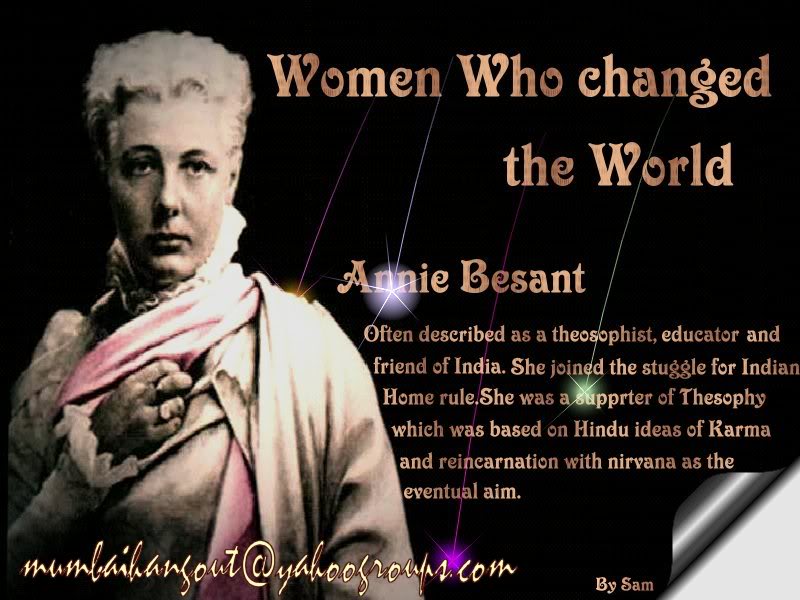
Bharat Darshan – Rajahmundry – The Gateway to Traditions and History. ANNIE BESANT – ANGEL OF INDIA.

Ms. Annie Besant who became the President of the Theosophical Society in 1907 visited Rajahmundry twice and established a place of worship known as ‘Divya Gjyan Samaj’ in a residential sub-division of Rajahmundry which is still known as ‘ALCOT GARDENS’ (named after Theosophist Henry Steel Olcott).

Bharat Darshan – Rajahmundry – The Gateway to Traditions and History

Bipin Chandra Pal (1858-1932), the leader of ‘Vande Mataram’ nationalist movement visited Rajahmundry in April 1907.

Bharat Darshan – Rajahmundry – The Gateway to Traditions and History

Alluri Sita Ramaraju (1898-1924) was inspired by the patriotic zeal of the revolutionaries in Bengal and waged a brief war against the British winning the hearts of the natives of Rajahmundry.  

Kandukuri Veeresalingam Pantulu Garu:  

Bharat Darshan – Rajahmundry – The Gateway to Traditions and History

He was born into a poor Brahmin family at Rajahmundry in 1848. About one hundred years later, when I arrived in Innespeta subdivision of Rajahmundry, the first time I had known this great man was during a visit to the municipal park on the Main Road, just a short walking distance from my grandparents’ house. There is a very imposing statue and people spoke about him with pride and admiration. My eldest brother, Hari was a student at the Veeresalingam Theistic High School in Innespeta. During the academic year 1952-53, I studied in 3rd grade at ‘Shade Girls High School’ located near ‘Kambala Cheruvu’ (Lake Kambala) while my family resided in Danavaipeta subdivision of Rajahmundry. Myself and my elder brother Pratap used to walk to the school and the easiest way to reach the school was a private road which traverses the Veeresalingam Gardens. The subdivisions of Danavai peta and the Danavai Pond and Prakasam Nagar are located on the southern side of the Gardens and Gandhi Nagar is located along the northern perimeter of the Gardens. The school is at a short distance from the north-west entrance to the Gardens. Apart from the tombs of Veeresalingam and his wife Rajya Lakshmi, the Gardens had a venue to conduct marriage functions and there was a Home for Widows. On our way to the school, we used to enter the Widow’s Home and a classmate of ours by name Sai Baba would join us in the walk to the school. On our return trip, the three of us used to reach the Home and after leaving Sai Baba, myself and my brother would resume our walk to our residence in Danavaipeta. There were several occasions when we would wait at the Home while Sai Baba’s mother would be breastfeeding him. During that school year, it was my daily experience and I knew that my friend and his mother derived their support from this great benefactor known as Veeresalingam.  

As my family lived on the outer fringes of Veeresalingam Gardens during the most part of my later school years at Danavaipeta Municipal High School, walking across the Gardens and playing cricket in the evening in the open areas of the Garden became a part of my daily routine. The Gardens had several flowering plants and fruit-bearing trees and to celebrate the festival of Ganesh we used to gather from the Gardens several flowers, leaves, and fruits which are required for the worship. At the same time, I also knew about ‘Hithakarani Samajamu’. Veeresalingam donated all his lifetime earnings and had established this trust in 1907. Addepalli Vivekananda Devi, a social worker, and educationist lived in Danavaipeta and I had seen her several times and I was aware that she was continuing the relentless effort started by Veeresalingam to empower women and for the uplifting of women.

Bharat Darshan – Rajahmundry – The Gateway to Traditions and History

In 1968, Ms. Addepalli Vivekananda Devi successfully established Srimati. Kandukuri Rajya Lakshmi College for Women near the Lake known as ‘Danavai Gunta’. My sister and a sister-in-law studied in this College.  

Veeresalingam was influenced by the ideals of ‘BRAHMO SAMAJ‘ founded by the great social reformers of Bengal, Raja Ram Mohan Roy, Keshub Chunder Sen, and Iswar Chandra Vidya Sagar who did much work for women’s emancipation. Veeresalingam was the pioneer of social reform in Andhra areas of the Madras Presidency apart from his remarkable contributions to Telugu literature and for the cause of education. 

Bharat Darshan – Rajahmundry – The Gateway to Traditions and History

During the course of life, moments slip away and fortunately, they are laid into account. If there are no memories, there is no life worth speaking about. 

Dr. R. Rudra Narasimham, B.Sc., M.B.B.S., 

Danavaipeta Municipal High School, Rajahmundry,

S.S.L.C. Class, March 1961

Bharat Darshan – Rajahmundry – The Gateway to Traditions and History.

Whole Dude – Whole Brahmin

The West Meets the East – Meet the White American Brahmin

Bharat Darshan – The West Meets the East-Meet the White American Brahmin.

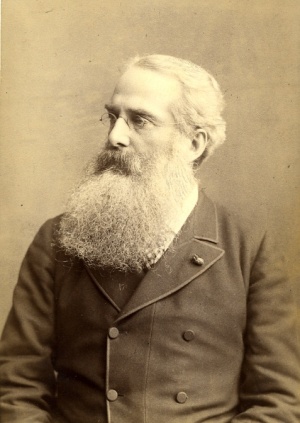
Colonel Henry Steel Olcott (Born. August 2, 1832,Orange, N.J. U.S.A., Died. February 17, 1907, Adyar, Madras (Chennai), India.

Bharat Darshan – The West Meets the East-Meet the White American Brahmin.

“OH, East is East, and West is West,

And never the twain shall meet.

Till Earth and Sky stand presently at

God’s Great Judgment Seat.”

(Rudyard Kipling, English poet, novelist, Nobel Prize winner)

The West Meets the East – The East – West Confluence:

Bharat Darshan – The West Meets the East. Meet the White American Brahmin. Helena Petrovna Blavatsky and Colonel Henry Steel Olcott founded the Theosophical Society and established its headquarters at Adyar, Madras, Chennai .

Colonel Henry Steel Olcott, an American lawyer and philosopher founded the Theosophical Society in New York City in 1875 along with Russian-born religious mystic Helena Petrovna Blavatsky, William Judge and others. He became the first president of the Theosophical Society. In 1878 he and Blavatsky visited India. The two settled there in 1879 and in 1882 established the permanent headquarters of the Theosophical Society at Adyar, Madras. Theosophy incorporates aspects of Buddhism, Hinduism and Christian esotericism. His acceptance by and influence on the Buddhists was far reaching. Identified with Eastern philosophical thought, he also helped revive Hindu philosophy. A Pandit conferred on him the sacred thread of the Brahmin caste.

Olcott dedicated his energies to fraternal understanding and the search for truth. He referred to theosophists as “original searchers after spiritual knowledge”. In his farewell message he expressed the wish ” to impress on all men on earth that ‘there is no religion higher than Truth’ and that in the Brotherhood of Religions lies the peace and progress of humanity.”

Upon his death at Adyar, Madras, India in 1907, Olcott was succeeded as president by Ms. Annie Besant, a social reformer and Indian independence leader. She visited my home town Rajahmundry twice and established ‘Divya Gjyan Samaj'(Divine Wisdom Assembly) building at Alcot Gardens. The teachings of the Theosophical Society emphasized human service, a spiritual evolutionism and the role of suprahuman masters of Wisdom (“ADEPTS”).

The natives of my home town Rajahmundry still honour the memory of Colonel Olcott. The residential community of ‘Alcot Gardens’ derives its name from “Olcott”. (Kindly review the comment posted .)

Dr. R. Rudra Narasimham, B.Sc., M.B.B.S.,

Danavaipeta Municipal High School, Rajahmundry, East Godavari District, Andhra Pradesh, India,

S.S.L.C.,  Class  of  March, 1961.

THE WEST MEETS THE EAST. MEET THE WHITE AMERICAN BRAHMIN. ANNIE BESANT – ANGEL OF INDIA .

Whole Hero – The adoration of Lord Rama


Whole Dude – Whole Hero

Sree Rama, Rama, Rameti, Rame, Raame, Manorame

Sahsra Nama tattulyam, Rama Nama Varanane.

My Beloved Hero:

Human existence faces challenges from several directions. The concept of Samsara is an additional and significant challenge experienced by the people of Land of India. Lord Rama during His life’s journey had faced several challenges and His name gives the comfort and protection that I seek while my journey is rough and tough.

The Culture of the Land Of India introduced to me several personalities and Cultural icons and I tend to develop a relationship with them and each of my relationships exists in a particular context. Shiva is my protector and the Master who guides my intellectual functions. I describe Lord Krishna as my Guru, the Guru who guides my actions and I name Prince Karna as my favorite Hero as he is the “Salt of Life.” Rama describes himself in the following words. On the occasion of Princess Seetha’s ordeal by fire at the end of the epic battle, Rama says to Brahma (The Lord of Creation) who appeared there among others:

आत्मानं मानुषं मन्ये रामं दशरथात्मजम् || ६-११७-११
सोऽहं यस्य यतश्चाहं भगवंस्तद्ब्रवीतु मे |

11. manye = I think; aatmaanam = of myself; maanuSham = to be a human being; raamam = called Rama; dasharathaatmajam = the son of Dasaratha; bhagavaan = you; as a gracious Divinity; braviitu = tell; me = me; tat = that; saH aham yasya = which I as such really am; aham yashcha = and why I am like this.

“I think of myself to be a human being, by name Rama, the son of Dasaratha. You, as a gracious Divinity, tell me that which I as such really am like this.”

“I regard myself only as Rama, son of Dasaratha, an ordinary human being. Who I am in reality, where I belong, why I took birth, are matters on which you may enlighten me, and I do not know.”

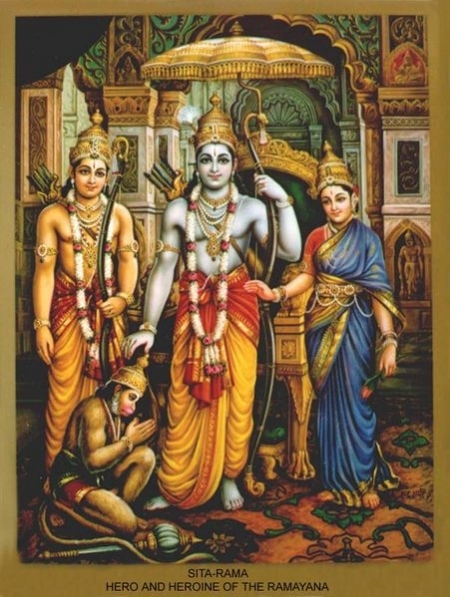
In the personality of Rama, the course of human conduct and the Dharma governing it come linked together. My love for Rama could be mostly attributed to the story that is revealed in Book II, ‘Ayodhya Kanda’ of Valmiki Ramayana. We should view the events described through imagination and actually experience the emotional state of each character as the story is enacted in front of our eyes. It is claimed that, wherever Rama’s tale is told, Hanuman himself joins the gathering and reverentially stands with tear-filled eyes, listening. This has been my personal experience. Whenever I read the story about this ordinary human being, my eyes fill up with tears. I rechecked my emotions while preparing to write down this entry. When I read Ayodhya Kanda, my eyes can not resist from filling up with tears. For having experienced this emotional connection, I claim that Rama is my Beloved Hero.

My desire to speak about Rama is provided by Rama himself and I did mention about it in the very first entry of my blog posts. I give credit to the Telugu poet Bammera Potana whom I acknowledge as my ‘mentor’. Potana proclaims that he wrote his poems with the help of the creative spirit inspired directly by Rama. My Master Shiva gives the consent to entertain this idea that Rama is my resource for creative writing, my Guru Krishna approves my actions to express my sentimental attachment to Rama, Saraswati gracefully provides the ability to pen my thoughts, Hanuman certifies that my tears are genuine and Ganesha blesses my effort and lets me post this entry.

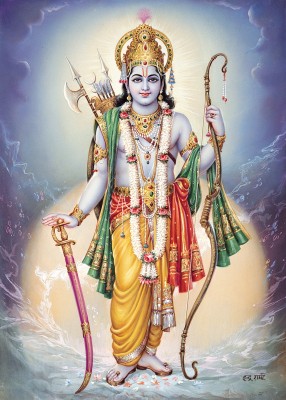
Lord Rama – My Beloved Hero. The Life Journey is viewed as a perilous and tedious swim without navigational aids and floatation devices across an unknown and uncharted ocean.

In the Indian tradition, the Life Journey is described as a perilous and tedious swim without navigational aids and floatation devices across an unknown and uncharted ocean. I stay afloat while I cross this ocean and the name ‘RAMA’ is like a life jacket, a flotation device which would guide me to get to the destination and gives me the hope to reach the shore. I live in a universe which is a reflection of “MAYA.” I find no better way to know the Ultimate Reality. I prefer to cling to the two-letter ‘MANTRA’ of RA-MA. I would just be happy if I could find the way and end up in the company of others who lived before me placing their trust in this Name.

Mother Kaikeyi spoke prophetic words when she said Rama’s dutifulness would bring him glory undying. That glory she said will continue as long as the Himaalaya stands and the waters of Ganga flow and as long as the ocean-waves beat on the solid earth.

May everyone that reads the Chapter XV of Ayodhya Kanda receive by Rama’s grace the strength to bear the sorrows that have to be faced in life.

I would have loved to share these thoughts with my mother and I shed tears reading Rama’s story while remembering her.

RA MA – The Two letters are a source of inspiration to millions of people across India. In the field of Art, Literature, and Music, the personality of Rama inspires people to creatively express their thoughts and ideas.