Trouble in Tibet – Chinese Mining in Tibet
Red China’s mining activities in Occupied Tibet are illegal. I ask the global community to refrain from purchasing Made in China products for they are products of illegal activities.
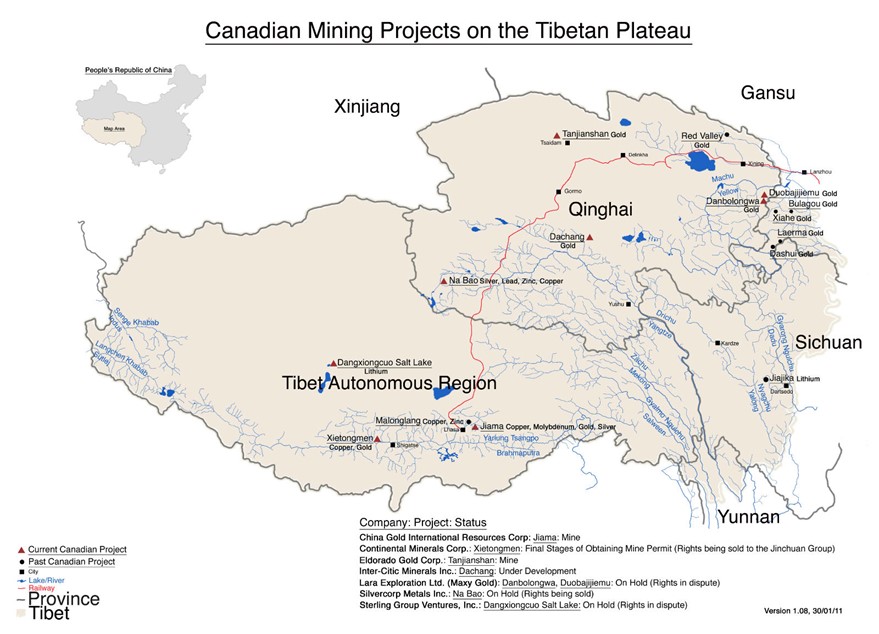
On 4 May 2016, a sudden mass death of fish in the Lichu River in Minyak Lhagang, Dartsedo County in Karze Prefecture brought hundreds of local Tibetans out on the street, protesting against a lithium mining company (Ronda Lithium Co Ltd) that released mine waste into the Lichu River, a tributary of Nakchu/Yalong river, the biggest river that merges with Yangtse downstream.
Tibetans protest against Chinese mining in Minyak County, Tibet
Tibet post International
Friday, 06 May 2016 17:15 Yeshe Choesang, Tibet Post International

Dharamshala — More than 100 Tibetans have protested against Chinese mining operations at a site considered sacred by local Tibetan residents, drawing a large police force to the area and prompting fears of clashes.
‘The protest took place at Yulshok Gargye in Minyak County, Kham Province of eastern Tibet (Ch: Minya Konka, Kangding County, Sichuan, China),” on May 4, 2016,’ Aka Penpa, a monk from South India told the TPI.
‘Chinese authorities deployed dozens of police forces in vehicles to the protest site, immediately after the event,’ TPI’s source said.
“The situation is still very tense, as there are growing fears among the locals that the security crackdown, may take place in the open sky,” sources said, adding: “It is also unknown whether or not the Chinese authorities arrested any of these Tibetan protesters.”
Mt Minyak Gangkar is one of the highest mountains in Kham region of eastern Tibet, which is located near Dartsedo City. It is with elevation of 7556m. The town of Dartsedo was an important trade center between Tibet and China, and for centuries its importance lay on the tea-horse trade. Mt Minyak Gangkar is one of the most sacred snow capped mountain in the Kham region.
Mining operations in Tibet have led to frequent standoffs with Tibetans who accuse Chinese firms of disrupting sites of spiritual significance and polluting the environment as they extract local wealth.
 Whole Dude - Whole Concept