The Clinton Curse – Why the United States failed on August 22, 1996?
I am asking Christians to reject President Clinton’s Public Law 104 – 193. All said and done, President Clinton’s Evil Plan failed to resolve the problem of National Debt. The Repeal Movement exposes President Clinton’s contemptuous violation of Constitutional Principles of equal protection, equal justice and equal treatment under LawThe erosion of Christian Values sets in motion a great economic disaster since August 22, 1996: In this graphic, Julie Peasley shows how many one-dollar bills it would take to stack up to the total U.S. debt of $31.4 trillion.I am asking Christians to reject President Clinton’s Public Law 104 – 193. All said and done, President Clinton’s Evil Plan failed to resolve the problem of National Debt. The Repeal Movement exposes President Clinton’s contemptuous violation of Constitutional Principles of equal protection, equal justice and equal treatment under LawI am asking Christians to reject President Clinton’s Public Law 104 – 193. All said and done, President Clinton’s Evil Plan failed to resolve the problem of National Debt. The Repeal Movement exposes President Clinton’s contemptuous violation of Constitutional Principles of equal protection, equal justice and equal treatment under LawI am asking Christians to reject President Clinton’s Public Law 104 – 193. All said and done, President Clinton’s Evil Plan failed to resolve the problem of National Debt. The Repeal Movement exposes President Clinton’s contemptuous violation of Constitutional Principles of equal protection, equal justice and equal treatment under LawI am asking Christians to reject President Clinton’s Public Law 104 – 193. All said and done, President Clinton’s Evil Plan failed to resolve the problem of National Debt. The Repeal Movement exposes President Clinton’s contemptuous violation of Constitutional Principles of equal protection, equal justice and equal treatment under Law
President Clinton’s New Beginning in 1996. Economic Oppression of alien workers
I am asking Christians to reject President Clinton’s Public Law 104 – 193. All said and done, President Clinton’s Evil Plan failed to resolve the problem of National Debt. The Repeal Movement exposes President Clinton’s contemptuous violation of Constitutional Principles of equal protection, equal justice and equal treatment under Law
On August 22, 1996, US President Bill Clinton (Democrat) signed into Law that reintroduced Slavery, Involuntary Servitude, Serfdom and Forced Labor in the pretext of making ‘A New Beginning’. Welfare Reform Act or Personal Responsibility and Work Opportunity Reconciliation Act (PRWORA) is unjust and unfair for it violates Constitutional Law that defends natural rights of all people living in United States. All US taxpayers must be treated as equals for receiving retirement income benefits for which they paid taxes. President Clinton’s action constitutes a transgression of President Abraham Lincoln’s Emancipation Proclamation that saved US Non-Citizens or Aliens from the indignity of Slavery.
I am asking Christians to reject President Clinton’s Public Law 104 – 193. All said and done, President Clinton’s Evil Plan failed to resolve the problem of National Debt. The Repeal Movement exposes President Clinton’s contemptuous violation of Constitutional Principles of equal protection, equal justice and equal treatment under Law
The Campaign to Repeal the Welfare Reform Act of 1996 is not about giving citizenship rights to non-citizens. It is about upholding the Supreme Law of the Land to abolish bondage, servitude, and slavery. The Reconstruction of America is not yet over. Slavery re-appeared in this Land in a new form and remains hidden or unnoticed. ‘The Clinton Curse’ explains as to why the United States failed on August 22, 1996. The Curse reveals the nature of The Beast that is waiting to overtake this nation.
The Clinton Curse – The Beast is waiting to overtake the United States
The Lord shall bring a nation against thee from far, from the end of the earth, as swift as the eagle flieth; a nation whose tongue thou shalt not understand; Deuteronomy 28:49The Lord shall bring a nation against thee from far, from the end of the earth, as swift as the eagle flieth; a nation whose tongue thou shalt not understand; Deuteronomy 28:49I am asking Christians to reject President Clinton’s Public Law 104 – 193. All said and done, President Clinton’s Evil Plan failed to resolve the problem of National Debt. The Repeal Movement exposes President Clinton’s contemptuous violation of Constitutional Principles of equal protection, equal justice and equal treatment under LawI am asking Christians to reject President Clinton’s Public Law 104 – 193. All said and done, President Clinton’s Evil Plan failed to resolve the problem of National Debt. The Repeal Movement exposes President Clinton’s contemptuous violation of Constitutional Principles of equal protection, equal justice and equal treatment under LawI am asking Christians to reject President Clinton’s Public Law 104 – 193. All said and done, President Clinton’s Evil Plan failed to resolve the problem of National Debt. The Repeal Movement exposes President Clinton’s contemptuous violation of Constitutional Principles of equal protection, equal justice and equal treatment under LawI am asking Christians to reject President Clinton’s Public Law 104 – 193. All said and done, President Clinton’s Evil Plan failed to resolve the problem of National Debt. The Repeal Movement exposes President Clinton’s contemptuous violation of Constitutional Principles of equal protection, equal justice and equal treatment under LawI am asking Christians to reject President Clinton’s Public Law 104 – 193. All said and done, President Clinton’s Evil Plan failed to resolve the problem of National Debt. The Repeal Movement exposes President Clinton’s contemptuous violation of Constitutional Principles of equal protection, equal justice and equal treatment under LawI am asking Christians to reject President Clinton’s Public Law 104 – 193. All said and done, President Clinton’s Evil Plan failed to resolve the problem of National Debt. The Repeal Movement exposes President Clinton’s contemptuous violation of Constitutional Principles of equal protection, equal justice and equal treatment under LawI am asking Christians to reject President Clinton’s Public Law 104 – 193. All said and done, President Clinton’s Evil Plan failed to resolve the problem of National Debt. The Repeal Movement exposes President Clinton’s contemptuous violation of Constitutional Principles of equal protection, equal justice and equal treatment under LawI am asking Christians to reject President Clinton’s Public Law 104 – 193. All said and done, President Clinton’s Evil Plan failed to resolve the problem of National Debt. The Repeal Movement exposes President Clinton’s contemptuous violation of Constitutional Principles of equal protection, equal justice and equal treatment under LawI am asking Christians to reject President Clinton’s Public Law 104 – 193. All said and done, President Clinton’s Evil Plan failed to resolve the problem of National Debt. The Repeal Movement exposes President Clinton’s contemptuous violation of Constitutional Principles of equal protection, equal justice and equal treatment under Law
The Great Awakening Movement – Spiritual Warfare against the Clinton Curse
I am asking Christians to reject President Clinton’s Public Law 104 – 193. All said and done, President Clinton’s Evil Plan failed to resolve the problem of National Debt. The Repeal Movement exposes President Clinton’s contemptuous violation of Constitutional Principles of equal protection, equal justice and equal treatment under LawI am asking Christians to reject President Clinton’s Public Law 104 – 193. All said and done, President Clinton’s Evil Plan failed to resolve the problem of National Debt. The Repeal Movement exposes President Clinton’s contemptuous violation of Constitutional Principles of equal protection, equal justice and equal treatment under LawI am asking Christians to reject President Clinton’s Public Law 104 – 193. All said and done, President Clinton’s Evil Plan failed to resolve the problem of National Debt. The Repeal Movement exposes President Clinton’s contemptuous violation of Constitutional Principles of equal protection, equal justice and equal treatment under Law
US Congress must do the Right thing to Save America from The Clinton Curse, The Economic Disaster of 1996 to 2025.
I ask my readers to review 43-word 13th Amendment and tell me if those words still govern, rule, and operate the lives of all people, wage earners who perform labor paying taxes.
My readers should not be surprised if I describe the US Congress as “Slave Driver.” The reason for my claim is based on PRWORA enacted by the US Congress in 1996 that amended The US Social Security Act of 1935. This legal provision enacted by 104th US Congress is incorporated as Section 202(y) of the Social Security Act. It mandates that no Retirement Income benefits shall be payable to registered alien (non-citizen) taxpayers in the United States without showing proof of lawful residency as determined by the Attorney General. In my view, such proof must not be demanded if a worker has attained full retirement age as determined by law.
I am asking Christians to reject President Clinton’s Public Law 104 – 193. All said and done, President Clinton’s Evil Plan failed to resolve the problem of National Debt. The Repeal Movement exposes President Clinton’s contemptuous violation of Constitutional Principles of equal protection, equal justice and equal treatment under Law
Social Security Act, Section 202(y) violates the principle enshrined in those 43 words called the 13th Amendment. This 1996 amendment to the Social Security Act is fundamentally flawed for it is unconstitutional. It takes away the property rights (earnings, wages, and retirement income) of individuals who paid Federal, State, Local, Social Security and Medicare Taxes working in this country to attain the full retirement age.
The Emancipation Proclamation issued by President Abraham Lincoln (Republican) in September 1862 came into effect on January 01, 1863 freeing slaves in all territory still at War with the Union. These slaves were not citizens of the Land and had no political rights of their own. In Law, Servitude or Slavery refers to the burden imposed upon the property of a person by a specified right another has in its use. Servitude involves labor in which the person who performs labor has no right to his earnings from labor. The Emancipation Proclamation specifically protects, defends, preserves and safeguards rights of aliens or non-citizens residing in the United States.
I am asking Christians to reject President Clinton’s Public Law 104 – 193. All said and done, President Clinton’s Evil Plan failed to resolve the problem of National Debt. The Repeal Movement exposes President Clinton’s contemptuous violation of Constitutional Principles of equal protection, equal justice and equal treatment under Law
The amended Social Security Act unconstitutionally gives power to Social Security Administration to withhold the property (wages, earnings, monthly retirement income benefits) of alien workers who are not convicted by US Court of Law. In my analysis, The Social Security Act of 1935 amended in 1996 fails to uphold the US Constitution as the Supreme Law of this Land.
I ask my readers to make the distinction between Social Security Tax and Monthly Retirement Benefit. The first represents tax paid to the government and the second represents earning or wage entitled to a retired person to provide income and security during old age.
I am asking Christians to reject President Clinton’s Public Law 104 – 193. All said and done, President Clinton’s Evil Plan failed to resolve the problem of National Debt. The Repeal Movement exposes President Clinton’s contemptuous violation of Constitutional Principles of equal protection, equal justice and equal treatment under Law
All said and done, President Clinton’s Evil Plan failed to resolve the problem of National Debt. The Repeal Movement exposes President Clinton’s contemptuous violation of Constitutional Principles of equal protection, equal justice and equal treatment under Law.
I am asking Christians to reject President Clinton’s Public Law 104 – 193. All said and done, President Clinton’s Evil Plan failed to resolve the problem of National Debt. The Repeal Movement exposes President Clinton’s contemptuous violation of Constitutional Principles of equal protection, equal justice and equal treatment under Law
President Clinton’s Slavery Law of 1996 tramples upon fundamental freedoms and human dignity entitled to all human beings without any concern for their country of origin or citizenship status.
The Lord shall bring a nation against thee from far, from the end of the earth, as swift as the eagle flieth; a nation whose tongue thou shalt not understand; Deuteronomy 28:49
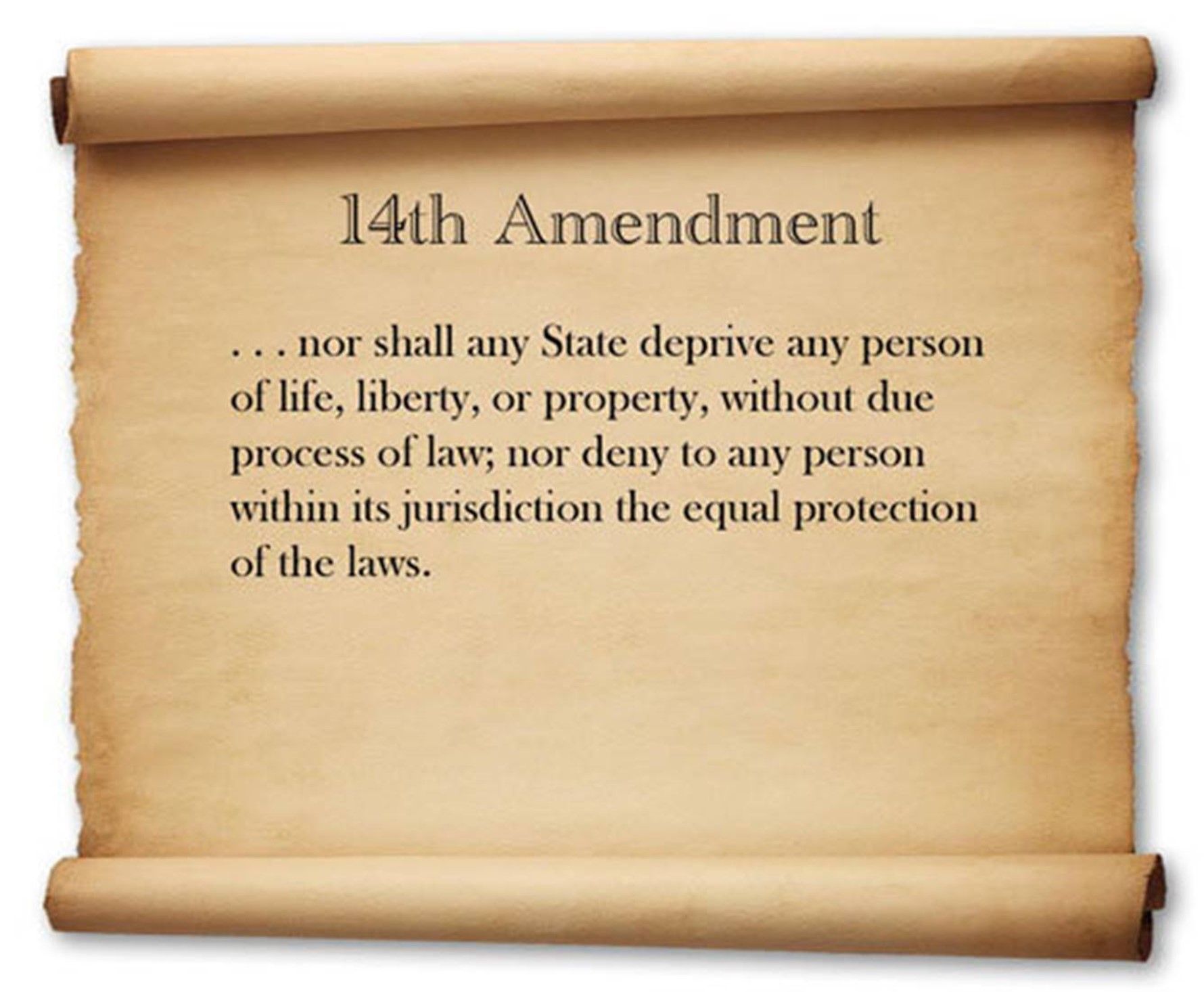
The US Congress can levy taxes but cannot deprive any person of Life, Liberty and Property without due process of Law. The United States Cannot Balance the Budget and cannot solve the problem of mounting National Debt without reaping the Blessings of God’s Promise. President Clinton’s tricks and gimmicks will utterly ruin and destroy the Nation for he failed to obey the LORD.
The Lord shall bring a nation against thee from far, from the end of the earth, as swift as the eagle flieth; a nation whose tongue thou shalt not understand; Deuteronomy 28:49I am asking Christians to reject President Clinton’s Public Law 104 – 193. All said and done, President Clinton’s Evil Plan failed to resolve the problem of National Debt. The Repeal Movement exposes President Clinton’s contemptuous violation of Constitutional Principles of equal protection, equal justice and equal treatment under Law
Whole Dude – Whole Fallout: The economic fallout of ‘The Clinton Curse’. The United States needs the Blessings of the LORD God Creator.
I reviewed the opinions of nine global thinkers on the issue of the economic fallout of the Coronavirus pandemic. None of the nine global thinkers mentioned about the need for the Blessings of the LORD God Creator. In my analysis, no man, and no nation can ever hope to be self-reliant. Both the individual entity, and the national entity will only exist if and only if the existence is granted by the LORD God Creator’s Mercy, Grace, and Compassion.
Whole Dude – Whole Fallout: The economic fallout of ‘The Clinton Curse’. The United States needs the Blessings of the LORD God CreatorWhole Dude – Whole Fallout: The economic fallout of ‘The Clinton Curse’. The United States needs the Blessings of the LORD God Creator.
How the Economy Will Look After the Coronavirus Pandemic
Whole Dude – Whole Fallout: The economic fallout of ‘The Clinton Curse’. The United States needs the Blessings of the LORD God Creator: In this graphic, Julie Peasley shows how many one-dollar bills it would take to stack up to the total U.S. debt of $31.4 trillion.Americans will give attention to my words after they fail to resolve the Economic Crisis through either Liberal or Conservative Spending Plans to revive the National Economy.Whole Dude – Whole Fallout: The economic fallout of ‘The Clinton Curse’. The United States needs the Blessings of the LORD God Creator. Americans will give attention to my words after they fail to resolve the Economic Crisis through either Liberal or Conservative Spending Plans to revive the National Economy.Whole Dude – Whole Fallout: The economic fallout of ‘The Clinton Curse’. The United States needs the Blessings of the LORD God Creator. Americans will give attention to my words after they fail to resolve the Economic Crisis through either Liberal or Conservative Spending Plans to revive the National Economy.
In my analysis, the Economic Policy of President Bill Clinton is fundamentally flawed for it violated the principles of Natural Law that make America a proud and prosperous nation in the world. The economic downfall of the United States is relentless and is almost unstoppable. There can be no healing and no recovery without the Blessings promised by God and living up to the Official Motto “IN GOD WE TRUST.”
WHOLE DUDE – WHOLE FALLOUT: THE CLINTON CURSE. THE RETURN OF ORIGINAL SIN. THE UNITED STATES IS CURSED TO RUN ITS GOVERNMENT WITH BORROWINGS FROM FOREIGN NATIONS.
The pandemic will change the economic and financial order forever. We asked nine leading global thinkers for their predictions.
BY JOSEPH E. STIGLITZ, ROBERT J. SHILLER, GITA GOPINATH, CARMEN M. REINHART, ADAM POSEN, ESWAR PRASAD, ADAM TOOZE, LAURA D’ANDREA TYSON, KISHORE MAHBUBANI APRIL 15, 2020, 5:10 PM
Whole Dude – Whole FALLOUT: The Clinton Curse. The United States needs the Blessings of the LORD God Creator.
After many weeks of lockdowns, tragic loss of life, and the shuttering of much of the global economy, radical uncertainty is still the best way to describe this historical moment. Will businesses reopen and jobs come back? Will we travel again? Will the flood of money from central banks and governments be enough to prevent a deep and lasting recession, or worse?
This much is certain: The pandemic will lead to permanent shifts in political and economic power in ways that will become apparent only later.
To help us make sense of the ground shifting beneath our feet, Foreign Policy asked nine leading thinkers, including two Nobel-Prize-winning economists, to weigh in with their predictions for the economic and financial order after the pandemic.
We Need a Better Balance Between Globalization and Self-Reliance
by Joseph E. Stiglitz
Economists used to scoff at calls for countries to pursue food or energy security policies. In a globalized world where borders don’t matter, they argued, we could always turn to other countries if something happened in our own. Now, borders suddenly do matter, as countries hold on tightly to face masks and medical equipment, and struggle to source supplies. The coronavirus crisis has been a powerful reminder that the basic political and economic unit is still the nation-state.
The coronavirus crisis has been a powerful reminder that the basic political and economic unit is still the nation-state.
To build our seemingly efficient supply chains, we searched the world over for the lowest-cost producer of every link in the chain. But we were short-sighted, constructing a system that is plainly not resilient, insufficiently diversified, and vulnerable to interruptions. Just-in-time production and distribution, with low or no inventories, may be capable enough of absorbing small problems, but we have now seen the system crushed by an unexpected disturbance.
We should have learned the lesson of resilience from the 2008 financial crisis. We had created an interconnected financial system that seemed efficient and was perhaps good at absorbing small shocks, but it was systemically fragile. If not for massive government bailouts, the system would have collapsed as the real estate bubble popped. Evidently, that lesson went right over our heads.
The economic system we construct after this pandemic will have to be less shortsighted, more resilient, and more sensitive to the fact that economic globalization has far outpaced political globalization. So long as this is the case, countries will have to strive for a better balance between taking advantage of globalization and a necessary degree of self-reliance.
This Wartime Atmosphere Has Opened a Window for Change
by Robert J. Shiller
There are fundamental changes that happen from time to time—often during times of war. Though the enemy is now a virus and not a foreign power, the COVID-19 pandemic has created a wartime atmosphere in which such changes suddenly seem possible.Though the enemy is a virus and not a foreign power, the pandemic has created a wartime atmosphere in which fundamental changes suddenly seem possible.
This atmosphere, with narratives of both suffering and heroism, is spreading with the disease. Wartime brings people together not only within a country, but also between countries, as they share a common enemy like the virus. Those who live in advanced countries can feel more sympathy with those suffering in poor countries because they are sharing a similar experience. The epidemic is also bringing us together in countless Zoom get-togethers. Suddenly the world seems smaller and more intimate.
There is also reason to hope that the pandemic has opened a window to creating new ways and institutions to deal with the suffering, including more effective measures to stop the trend toward greater inequality. Perhaps the emergency payments to individuals that many governments have made are a path to a universal basic income. In the United States, better and more universal health insurance might just have been given new impetus. Since we are all on the same side in this war, we may now find the motivation to build new international institutions allowing better risk-sharing among countries. The wartime atmosphere will fade again, but these new institutions would persist.
The Real Risk Is Politicians Exploiting Our Fears
by Gita Gopinath
Over only a few weeks, a dramatic chain of events—tragic loss of life, paralyzed global supply chains, interrupted shipments of medical supplies between allies, and the deepest global economic contraction since the 1930s—has laid bare the vulnerabilities of open borders.People may self-assess their individual risks and decide to curtail travel indefinitely, reversing 50 years of rising international mobility.
If support for an integrated global economy was already declining before COVID-19 struck, the pandemic will likely hasten the reassessment of globalization’s costs and benefits. Firms that are part of global supply chains have witnessed firsthand the risks inherent in their interdependencies and the large losses caused by disruption. In future, these firms are likely to take greater account of tail risks, resulting in supply chains that are more local and robust—but less global. In emerging markets, whose embrace of globalization included a steady opening to capital flows, we risk seeing capital controls being reimposed as these countries scramble to shield themselves from the destabilizing forces of the sudden economic stop. And even as containment measures gradually come off worldwide, people may self-assess their individual risks and decide to curtail travel indefinitely, reversing half a century of rising international mobility.
The real risk, however, is that this organic and self-interested shift away from globalization by people and firms will be compounded by some policymakers who exploit fears over open borders. They could impose protectionist restrictions on trade under the guise of self-sufficiency and restrict the movement of people under the pretext of public health. It is now in the hands of global leaders to avert this outcome and to retain the spirit of international unity that has collectively sustained us for more than 50 years.
Another Nail in the Coffin of Globalization
by Carmen M. Reinhart
World War I and the global economic depression in the early 1930s ushered in the demise of a previous era of globalization. Apart from a resurgence of trade barriers and capital controls, an important explanation for this demise is the fact that more than 40 percent of all countries at the time entered default, cutting many of them off from the global capital markets until the 1950s or much later. By the time World War II ended, the new Bretton Woods system combined domestic financial repression with extensive controls of capital flows, with little resemblance to the preceding era of global trade and finance.Pandemic-induced recessions may be deep and long—and as in the 1930s, sovereign defaults will likely spike.
The modern globalization cycle has faced a series of blows since the financial crisis of 2008-2009: a European debt crisis, Brexit, and the U.S.-China trade war. The rise of populism in many countries further tilts the balance toward home bias.
The coronavirus pandemic is the first crisis since the 1930s to engulf both advanced and developing economies. Their recessions may be deep and long. As in the 1930s, sovereign defaults will likely spike. Calls to restrict trade and capital flows find fertile soil in bad times.
Doubts about pre-coronavirus global supply chains, the safety of international travel, and, at the national level, concerns about self-sufficiency in necessities and resilience are all likely to persist—even after the pandemic is brought under control (which may itself prove a lengthy process). The post-coronavirus financial architecture may not take us all the way back to the pre globalization era of Bretton Woods, but the damage to international trade and finance is likely to be extensive and lasting.
The Economy’s Preexisting Conditions Are Made Worse by the Pandemic
by Adam Posen
The pandemic will worsen four preexisting conditions of the world economy. They will remain reversible through major surgery but turn chronic and damaging absent such interventions. The first of these conditions is secular stagnation—the combination of low productivity growth, a lack of private investment returns, and near-deflation. This will deepen as people stay risk-averse and save more following the pandemic, which will persistently weaken demand and innovation.
Second, the gap between rich countries (along with a few emerging markets) and the rest of the world in their resilience to crises will widen further.Economic nationalism will increasingly lead governments to shut off their own economies from the rest of the world.
Third, partly as a result of flight to safety and the apparent riskiness of developing economies, the world will continue to be over-reliant on the U.S. dollar for financing and trade. Even while the United States becomes less attractive for investment, its attraction will increase relative to most other parts of the world. This will lead to ongoing dissatisfaction.
Finally, economic nationalism will increasingly lead governments to shut off their own economies from the rest of the world. This will never produce complete autarky, or anything close to it, but it will reinforce the first two trends and increase resentment of the third.
More Than Ever, the World Looks to Central Bankers for Deliverance
by Eswar Prasad
The economic and financial carnage wrought by the pandemic could leave deep scars on the world economy. Central banks have stepped up to the challenge by tearing up their own rulebooks. The U.S. Federal Reserve has bolstered financial markets with asset purchases and provided dollar liquidity to other central banks. The European Central Bank has declared “no limits” to its support of the euro and announced massive purchases of government and corporate bonds, and other assets. The Bank of England is financing government spending directly. Even some emerging-market central banks, such as the Reserve Bank of India, are considering extraordinary measures—all risks be damned.Central bankers, once considered cautious and conservative, have shown they can act with agility, boldness, and creativity.
Fiscal stimulus by governments, on the other hand, has proved to be politically complicated, cumbersome to implement, and often difficult to target where the need is greatest.
Central bankers, once considered cautious and conservative, have shown they can act with agility, boldness, and creativity in desperate times. Even when political leaders are unwilling to coordinate policies across borders, central bankers can act in concert.
Now and for a long time to come, central banks have become entrenched as the first and main line of defense against economic and financial crises. They may come to rue this immense new role and the unrealistic burdens and expectations it will impose on them.
The Normal Economy Is Never Coming Back
by Adam Tooze
As the lockdowns began, the first impulse was to search for historical analogies—1914, 1929, 1941? Since then, what has come ever more to the fore is the historical novelty of the shock we are living through. There is something new under the sun. And it is horrifying.
The economic fallout defies calculation. Many countries face a far deeper and more savage economic shock than they have ever previously experienced. In sectors like retail, already under fierce pressure from online competition, the temporary lockdown may prove to be terminal. Many stores will not reopen, their jobs permanently lost. Millions of workers, small-business owners, and their families are facing catastrophe. The longer we sustain the lockdown, the deeper the economic scars, and the slower the recovery.
The longer we sustain the lockdown, the deeper the economic scars, and the slower the recovery.
What we thought we knew about the economy and finance has been radically disturbed. Since the shock of the 2008 financial crisis, there has been a lot of talk about the need to reckon with radical uncertainty. We now know what truly radical uncertainty looks like.
We are witnessing the largest combined fiscal effort since World War II, but it is already clear that the first round may not be enough. There are few illusions about the unprecedented acrobatics that central banks are performing. To deal with the accumulated liabilities, history suggests some radical alternatives, including a burst of inflation or an organized public default (which would not be as drastic as it sounds if it affects government debts held by central banks).
If the response by businesses and households is risk-aversion and a flight to safety, it will compound the forces of stagnation. If the public response to the debts accumulated by the crisis is austerity, that will make matters worse. It makes sense to call instead for a more active, more visionary government to lead the way out of the crisis. But the question, of course, is what form that will take and which political forces will control it.
Many Lost Jobs Will Never Return
by Laura D’Andrea Tyson
The pandemic and subsequent recovery will accelerate the ongoing digitalization and automation of work—trends that have eroded middle-skill jobs while increasing high-skill jobs during the last two decades and contributed to the stagnation of median wages and rising income inequality.Many low-wage, low-skill, in-person service jobs, especially those provided by small firms, will not return with the recovery.
Changes in demand, many of them accelerated by the economic dislocation wrought by the pandemic, will change the future composition of GDP. The share of services in the economy will continue to rise. But the share of in-person services will decline in retail, hospitality, travel, education, health care, and government as digitalization drives changes in the way these services are organized and delivered.
Many low-wage, low-skill, in-person service jobs, especially those provided by small firms, will not return with the eventual recovery. However, workers providing essential services such as policing, firefighting, health care, logistics, public transportation, and food will be in greater demand, creating new job opportunities and increasing the pressure to raise wages and improve benefits in these traditionally low-wage sectors. The downturn will accelerate the growth of nonstandard, precarious employment—part-time workers, gig workers, and workers with multiple employers—leading to new portable benefits systems that move with workers and broaden the definition of employer. New low-cost training programs, digitally delivered, will be required to provide the skills required in new jobs. The sudden dependence of so many on the ability to work remotely reminds us that a significant and inclusive expansion of Wi-Fi, broadband, and other infrastructure will be necessary to enable the accelerating digitalization of economic activity.
A More China-Centric Globalization
by Kishore Mahbubani
The COVID-19 pandemic will accelerate a change that had already begun: a move away from U.S.-centric globalization to a more China-centric globalization.
The COVID-19 pandemic will accelerate a change that had already begun: a move away from U.S.-centric globalization to a more China-centric globalization.
Why will this trend continue? The American population has lost faith in globalization and international trade. Free trade agreements are toxic, with or without U.S. President Donald Trump. By contrast, China has not lost faith. Why not? There are deeper historical reasons. Chinese leaders now know well that China’s century of humiliation from 1842 to 1949 was a result of its own complacency and a futile effort by its leaders to cut it off from the world. By contrast, the past few decades of economic resurgence were a result of global engagement. The Chinese people have also experienced an explosion of cultural confidence. They believe they can compete anywhere.
Consequently, as I document in my new book, Has China Won?, the United States has two choices. If its primary goal is to maintain global primacy, it will have to engage in a zero-sum geopolitical contest, politically and economically, with China. However, if the goal of the United States is to improve the well-being of the American people—whose social condition has deteriorated—it should cooperate with China. Wiser counsel would suggest that cooperation would be the better choice. However, given the toxic U.S. political environment toward China, wiser counsel may not prevail.
Whole Dude – Whole Fallout: The Economic Fallout of The Clinton Curse. The United States needs the Blessings of the LORD God Creator.
The Rudolf-Rudi doctrine of Spiritualism describes the Debt Addiction as a symptom of Spiritual Sickness
Yes Indeed, Life is complicated. The complexity of Life involves the fiscal policy chosen by man in support of his economic well being. God’s Providence is the fundamental basis of man’s material well being.
The Rudolf-Rudi doctrine of Spiritualism describes the Debt Addiction as a symptom of Spiritual Sickness
The man made fiscal policy must follow the instructions given by God to follow the principles of fair and just treatment of all people. The US National Debt is a symptom of the spiritual sickness introduced by the US President Bill Clinton in 1996-97. The Nation is now addicted to Debt.
The Rudolf-Rudi doctrine of Spiritualism describes the Debt Addiction as a symptom of Spiritual Sickness. The Yoke of Slavery called Foreign Debt.
US starts fiscal year with record $31 trillion in debt
By FATIMA HUSSEIN, AP News, October 4, 2022
The Rudolf-Rudi doctrine of Spiritualism describes the Debt Addiction as a symptom of Spiritual Sickness. The US President Joe Biden may have to pray for the Blessings promised by God.
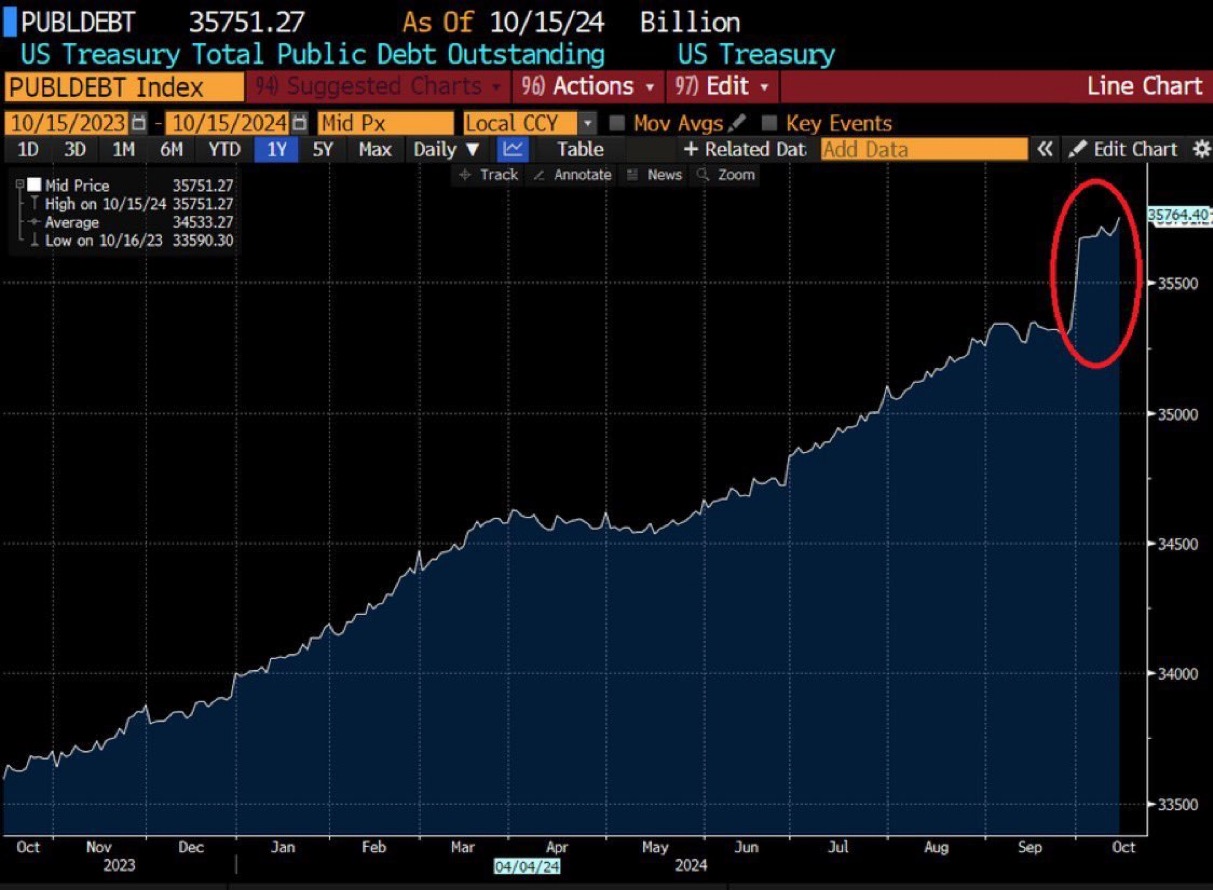
WASHINGTON (AP) — The nation’s gross national debt has surpassed $31 trillion, according to a U.S. Treasury report released Tuesday that logs America’s daily finances.
Edging closer to the statutory ceiling of roughly $31.4 trillion — an artificial cap Congress placed on the U.S. government’s ability to borrow — the debt numbers hit an already tenuous economy facing high inflation, rising interest rates and a strong U.S. dollar.
And while President Joe Biden has touted his administration’s deficit reduction efforts this year and recently signed the so-called Inflation Reduction Act, which attempts to tame 40-year high price increases caused by a variety of economic factors, economists say the latest debt numbers are a cause for concern.
Owen Zidar, a Princeton economist, said rising interest rates will exacerbate the nation’s growing debt issues and make the debt itself more costly. The Federal Reserve has raised rates several times this year in an effort to combat inflation.
Zidar said the debt “should encourage us to consider some tax policies that almost passed through the legislative process but didn’t get enough support,” like imposing higher taxes on the wealthy and closing the carried interest loophole, which allows money managers to treat their income as capital gains.
“I think the point here is if you weren’t worried before about the debt before, you should be — and if you were worried before, you should be even more worried,” Zidar said.
The Congressional Budget Office earlier this year released a report on America’s debt load, warning in its 30-year outlook that, if unaddressed, the debt will soon spiral upward to new highs that could ultimately imperil the U.S. economy.
In its August Mid-Session Review, the administration forecasted that this year’s budget deficit will be nearly $400 billion lower than it estimated back in March, due in part to stronger than expected revenues, reduced spending, and an economy that has recovered all the jobs lost during the multi-year pandemic.
In full, this year’s deficit will decline by $1.7 trillion, representing the single largest decline in the federal deficit in American history, the Office of Management and Budget said in August.
Maya MacGuineas, president of the Committee for a Responsible Federal Budget said in an emailed statement Tuesday, “This is a new record no one should be proud of.”
“In the past 18 months, we’ve witnessed inflation rise to a 40-year high, interest rates climbing in part to combat this inflation, and several budget-busting pieces of legislation and executive actions,” MacGuineas said. “We are addicted to debt.”
A representative from the Treasury Department was not immediately available for comment.
Sung Won Sohn, an economics professor at Loyola Marymount University, said “it took this nation 200 years to pile up its first trillion dollars in national debt, and since the pandemic we have been adding at the rate of 1 trillion nearly every quarter.”
Predicting high inflation for the “foreseeable future,” he said, “when you increase government spending and money supply, you will pay the price later.”
The Rudolf-Rudi doctrine of Spiritualism describes the Debt Addiction as a symptom of Spiritual Sickness. President Bill Clinton’s fiscal policy violates the principle of Equal Justice Under Law.
Presidents’ Day 2022. The Nation must wake up to the reality of the Clinton Curse.
Presidents’ Day 2022. The Nation must wake up to the reality of the Clinton Curse.
Presidents’ Day is a federal holiday celebrated on the third Monday in February; Presidents’ Day 2022 occurs on Monday, February 21.
Presidents’ Day 2022. The Nation must wake up to the reality of the Clinton Curse.
Originally established in 1885 in recognition of President George Washington, the holiday became popularly known as Presidents’ Day after it was moved as part of 1971’s Uniform Monday Holiday Act, an attempt to create more three-day weekends for the nation’s workers. While several states still have individual holidays honoring the birthdays of Washington, Abraham Lincoln and other figures, Presidents’ Day is now popularly viewed as a day to celebrate all U.S. presidents, past and present.
The story of Presidents’ Day date begins in 1800. Following the death of George Washington in 1799, his February 22 birthday became a perennial day of remembrance.
Presidents’ Day 2022. The Nation must wake up to the reality of the Clinton Curse.
The Uniform Monday Holiday Act also included a provision to combine the celebration of Washington’s birthday with that of Abraham Lincoln, which fell on February 12. Lincoln’s Birthday had long been a state holiday in places like Illinois, and many supported joining the two days as a way of giving equal recognition to two of America’s most famous statesmen.
Washington and Lincoln still remain the two most recognized leaders, but Presidents’ Day is now popularly seen as a day to recognize the lives and achievements of all of America’s chief executives. Some lawmakers have objected to this view, arguing that grouping George Washington and Abraham Lincoln together with less successful presidents minimizes their legacies.
In its modern form, Presidents’ Day is used by many patriotic and historical groups as a date for staging celebrations, reenactments and other events. A number of states also require that their public schools spend the days leading up to Presidents’ Day teaching students about the accomplishments of the presidents, often with a focus on the lives of Washington and Lincoln.
Presidents’ Day 2022. The Nation must wake up to the reality of the Clinton Curse. Presidential Term: January 20, 1993 – January 20, 2001
On Monday, February 21, 2022, while celebrating the Presidents’ Day, I remind the Nation about the legacy of William Jefferson Clinton, the 42nd US President. Bill Clinton’s Presidential Term: January 20, 1993 – January 20, 2001.
1995-1999
Outstanding debt in 1995: $4.97 trillion
Debt adjusted for inflation: $8.39 trillion
Outstanding debt in 1999: $5.66 trillion
Debt adjusted for inflation: $8.72 trillion
Change in debt between 1995-1999: 13.72% Change in debt adjusted for inflation: $337.54 billion
2000-2004
Outstanding debt in 2000: $5.67 trillion
Debt adjusted for inflation: $8.47 trillion
Outstanding debt in 2004: $7.38 trillion
Debt adjusted for inflation: $10.04 trillion
Change in debt between 2000-2004: 30.05% Change in debt adjusted for inflation: $1.57 trillion
Bill Clinton rejected the Promises of Prosperity and embraced the Curses of Indebtedness the LORD imposed for acts of Disobedience.
U.S. National Debt Clock February 2022
An Overview of the United States National Debt
The Current Outstanding Public Debt of the United States is:
Of the $5.1 trillion dollars of US debt that is owned by foreign governments, China and Japan own nearly half, as evidenced by this chart:
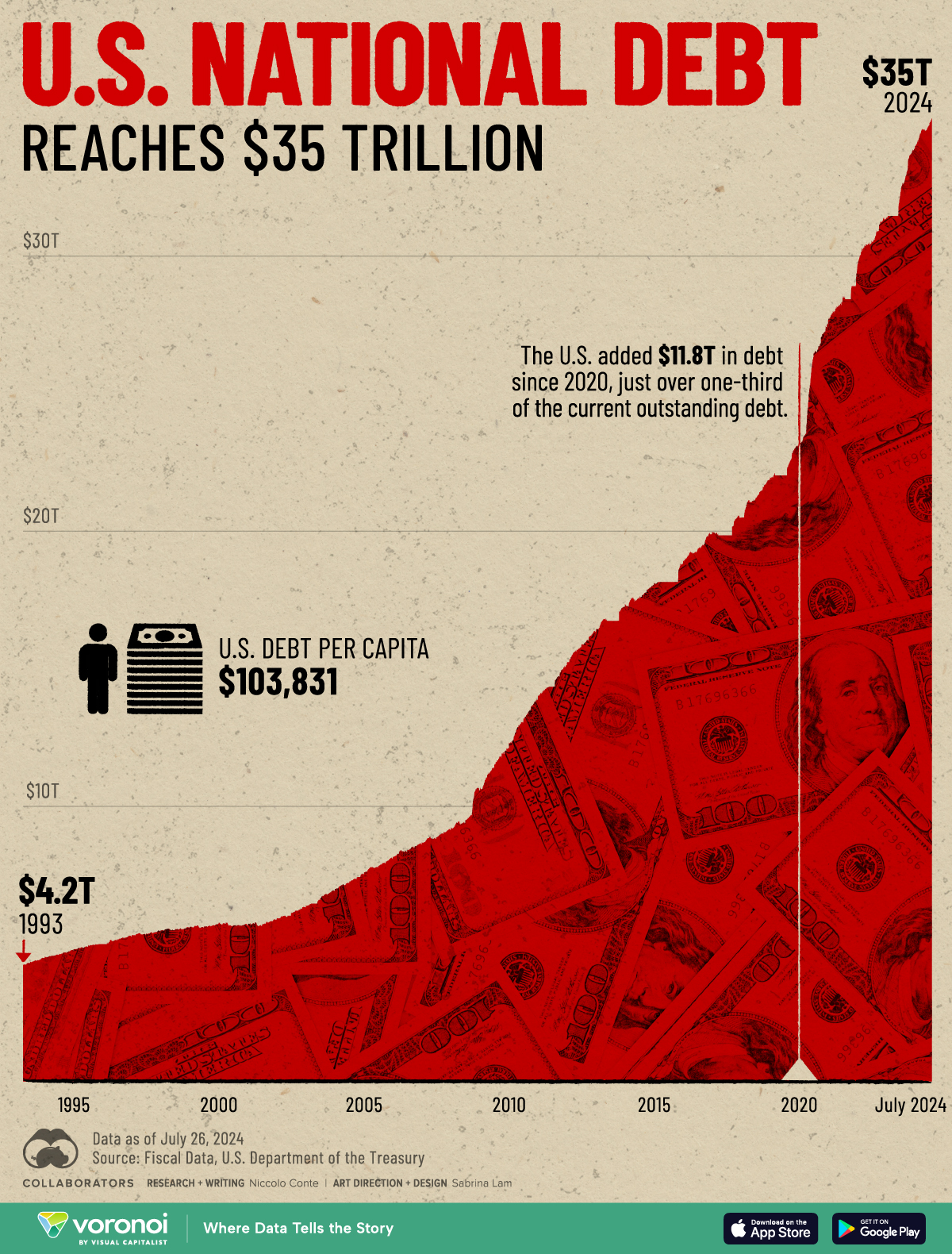
America’s national debt surpasses $30 trillion for the first time
Presidents’ Day 2022. The Nation Must Wake Up to the Reality of the Clinton Curse.
Skyrocketing pile of debt
The federal government now owes almost $8 trillion to foreign and international investors, led by Japan and China. Eventually, that will need to be paid back, with interest.
“That means American taxpayers will be paying for the retirement of the people in China and Japan, who are our creditors,” said Kelly.
The $30 trillion national debt figure is somewhat inflated by the fact that a chunk of the money is owed by the government to itself. This is debt held in Social Security and other government trust funds. So-called intragovernmental holdings total more than $6 trillion.
Presidents’ Day 2022. The Nation must wake up to the reality of the Clinton Curse.
The United States must reflect upon the actions of the 42nd President that violate the LORD’ s Commandments. The Welfare Reform Act of 1996 enacted by President Bill Clinton reintroduced Slavery into the United States nullifying President Abraham Lincoln’s Proclamation that abolished Slavery.
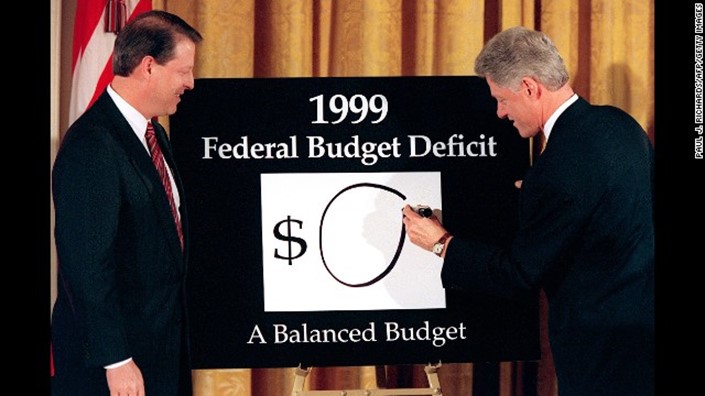
Presidents’ Day 2022. The Nation must wake up to the reality of the Clinton Curse. A Balanced Budget vs Foreign Debt. The Rudolf-Rudi doctrine of Spiritualism describes the Debt Addiction as a symptom of Spiritual Sickness. The Economic Fallout of The Clinton Curse. The United States needs the Blessings of the LORD God Creator.
Whole Dude – Whole Gimmicks: In fact, the national debt went from $4.4 Trillion at the end of 1993 to almost $5.7 Trillion at the end of 2000, U.S. Treasury data shows, a 28 percent increase in the debt over this time when our nation supposedly was running a balanced budget.
1997 Balanced Budget and Taxpayer Relief Act
SUMMARY:
The Balanced Budget Act of 1997 (a spending bill) and the Taxpayer Relief Act of 1997 (a tax bill) legislated the elimination of the annual budget deficit by 2002. Both bills were passed by Congress by large bipartisan majorities and signed into law by President Clinton prior to the August 1997 congressional recess.
DESCRIPTION:
Following difficult and highly partisan budget negotiations in 1993 (for the FY 1994 budget) and 1995 (for the FY 1996 budget), the negotiations in 1997 for the FY 1998 were marked largely by bipartisanship, even as the legislators and the President sought to produce the first balanced federal budget since 1969.
The Clinton Curse. A Balanced Budget vs Foreign Debt. Slaying the Dragon of Debt.
In my analysis, President Clinton did not create a Balanced Budget in 1997 for the first time since 1969. In fact, President Clinton violated the preachings of the Bible about Fiscal Policy. This Nation failed to receive the Blessings promised by LORD God. President Clinton foolishly chose to disobey God’s Commandments and invited the Curses promised by LORD God.
The Clinton Curse: Slaying the Dragon of Debt.The Clinton Curse: Slaying the Dragon of Debt.
President Bill Clinton invoked the Curses promised by the LORD God for acts of disobedience of God in the formulation of the Fiscal Policy of the Nation.
The Clinton Curse: Slaying of the Dragon of Debt.
The United States has nothing to fall back in its fight to Slay the Dragon of Debt. The United States needs the promise of Prosperity to Slay the Dragon of Debt. I ask the US Congress to Repeal PRWORA, the Slavery Act of 1996 to correct the transgressions of President Bill Clinton’s Fiscal Policy.
December 06. The Death of the 13th Amendment to the US Constitution. President Bill Clinton’s “A New Beginning” imposed the Death Sentence on the rights granted by the 13th Amendment.
U.S. deficit to eclipse $1 trillion in 2020, CBO says, as fiscal imbalance continues to widen
The Clinton Curse: Slaying of the Dragon of Debt. The U.S. Capitol seen through window reflections Jan. 27, 2020. (Patrick Semansky/AP)
By Jeff Stein
Jan. 28, 2020 at 3:23 p.m. EST
The U.S. government’s budget deficit is projected to reach $1.02 trillion in 2020, according to a report released Tuesday by the nonpartisan Congressional Budget Office, as the federal government continues to spend much more than it collects in tax revenue.
A combination of the 2017 tax cuts and a surge in new spending has pushed the deficit wider. This year would mark the first time since 2012 that the deficit breached $1 trillion, a threshold that has alarmed some budget experts because deficits typically contract — not expand — during periods of sustained economic growth.
Overall, the CBO projected that the federal government will spend $4.6 trillion in the fiscal year that ends Sept. 30 and bring in $3.6 trillion in tax revenue.
And some of the costliest government programs are projected to experience expansions in the next decade. Spending for Medicare, which provides health care for older Americans, will rise from $835 billion in 2020 to $1.7 trillion by 2030, while annual federal spending on Social Security will grow from roughly $1.1 trillion to $1.9 trillion over that span.
The CBO’s estimates assume that Congress will allow tax cuts for individuals passed in Republicans’ 2017 tax law to expire in 2025. GOP lawmakers in Congress will at least try to extend most if not all of these provisions.
This year’s deficit would be an increase from 2019, when the government deficit grew to $984 billion. The deficit in 2016, President Barack Obama’s last full year in office, was $585 billion. CBO now projects that the deficit will be at least $1 trillion each year in perpetuity unless policymakers make changes.
The CBO also projected the economy would grow by 2.2 percent in 2020, which represents a healthy clip but falls short of the 3 percent target set by the Trump administration. The projections were contained in the CBO’s annual budget and economic outlook.
With rising annual deficits, the total debt held by the government is also projected to grow dramatically, from about $18 trillion in 2020 to $31 trillion in 2030, according to the CBO’s projections. The U.S. government must pay interest on this debt to keep borrowing money.
“The U.S. economy is doing well, with low unemployment and rising wages that have drawn people off the sidelines and back into the labor force,” Phillip L. Swagel, the CBO’s director, said in a statement. “But our projections also suggest that over the long-term, changes in fiscal policy must be made to address the budget situation.”
The deficit outlook appears slightly worse than it did just a year ago. In 2019, bipartisan majorities in Congress approved new spending bills that added more than $500 billion to the deficit over the next decade. The most expensive new policies were the permanent repeal of taxes created under Obama’s Affordable Care Act, including one on expensive health plans.
These actions would have done more to drive up the deficit had they not been mitigated by lower-than-expected interest rates, which allow the government to borrow money more cheaply than the CBO had originally anticipated.
The CBO projection also appears to cast doubt on recent statements by President Trump and other administration officials that the 2017 Republican tax cut is creating enough revenue through new economic growth that it will offset all near-term losses. White House officials have defended the $1.5 trillion tax legislation, which slashed tax rates for businesses and many households.
Tax revenue has risen slowly since the tax cuts were passed, but many forecasters say the cuts led to a sizable drop-off in projected revenue collections. Combined with an increase in spending, the deficit has ballooned, forcing the Treasury Department to borrow more money to cover the balance.
Trump, asked about the rising deficit following the tax cuts, told CNBC last year: “We’ve taken in more revenue substantially than we did when the taxes were high. Nobody can even believe it.”AD
Treasury Secretary Steven Mnuchin also expressed confidence the tax cut would not add to the nation’s debt, saying: “We’ve tracked the numbers, and we’re right on track.”
Trump has told aides he will look for big spending cuts in his second term, a position echoed by Mnuchin, who said government spending must be slowed down. Trump aides have also previewed a potential second round of tax cuts.
The CBO report shows that tax collections are weaker than they would be without the 2017 Republican tax law, which permanently locked in lower rates for many corporations while creating temporary reductions for households. Tax revenue remained roughly flat the first year the law was in effect, despite economic growth of nearly 3 percent. It rose slightly in 2019 but not enough to compensate for flatlining the year before.AD
Asked about Mnuchin’s remarks on Tuesday, Swagel pointed to CBO’s April 2018 analysis finding the GOP tax law would increase the deficit by $1.9 trillion over 10 years. That number accounts for the impact of faster economic growth due to the tax law. Swagel served as a Treasury official in George W. Bush’s administration and worked at the American Enterprise Institute, a conservative think-tank.
In January 2017, before the tax law, the CBO projected corporate tax revenue would represent 1.8 percent of gross domestic product. Now, they are expected to represent only 1.1 percent of GDP.
Many Republicans in recent years have abandoned the calls to slash spending in part because Trump has supported big increases in the budget. During the Obama administration, many Republicans insisted on spending cuts as a way to shrink the deficit. About half of the current deficit can be attributed to spending increases and tax cuts put in place by Congress since 2015, according to the nonpartisan Committee for a Responsible Federal Budget.AD
“This is an important warning light,” Marc Goldwein, a budget expert with the group, said of the CBO’s report. “We know deficits as a share of GDP have never been this high when the economy is this strong.”
Other economic experts played down the danger posed by the rising deficit. They noted the country is still extremely unlikely to default because of the supremacy of the U.S. dollar among international creditors, and that inflation — one of the potential hazards of high deficits — remains low by historical standards.
“There is simply no threat of inflation on the horizon,” said Robert C. Hockett, a professor at Cornell University who has advised Sens. Bernie Sanders (I-Vt.) and Elizabeth Warren (D-Mass.) on economic policy matters.
Still, Hockett castigated the Trump administration for not putting the higher deficits to better use. Republicans have said the tax cuts have juiced economic growth and boosted wages for U.S. workers, while Democrats have characterized them as a giveaway to the rich.
“Trump is wasting these deficits. It’s fine to engage in deficit spending, but Trump has used them to give tax cuts to billionaires, which does nothing to increase the well-being of the vast majority of Americans or improve the nation’s productivity,” Hockett said.
Jeff Stein is a policy reporter for The Washington Post. He was a crime reporter for the Syracuse Post-Standard and, in 2014, founded the local news nonprofit the Ithaca Voice in Upstate New York. He was also a reporter for VoxTHE CLINTON CURSE: SLAYING THE DRAGON OF DEBT.
THE CLINTON CURSE – CLINTON’S IMMORAL SOCIAL SECURITY POLICY
The Clinton Curse. Clinton’s immoral Social Security Policy.
Social Security is the largest owner of the US Debt. In 1996, President Clinton amended the Social Security Act of 1945 by approving Public Law 104 – 193. President Clinton made an immoral choice to address the problem of mounting US Debt. His plan to reduce the US Debt by denying the payment of Old Age Retirement Income Benefits to senior alien workers has backfired. God has given His Promise. It delivers Blessings for the obedience of Commandments. Disobedience of God’s Commandments has consequences. The Clinton Curse reveals the consequences of President Clinton’s corrupt conduct. As of today, the US satisfies the government’s need for revenue by borrowing from foreign nations.
The Clinton Curse. Clinton’s immoral Social Security Policy.
To satisfy the U.S. government’s need for revenue, Washington collects taxes and fees. What happens if this isn’t enough? What happens if the federal government needs more? That is the subject of this article in which we’ll reveal who owns the most U.S. debt and how much of it is owned by foreign nations. We’ll begin by explaining, in simple terms, how the debt market functions.
Debt 101
An individual takes on debt when they finance a new car, house, etc. The U.S. government does so when it issues securities. Specifically, the federal government issues Treasury bills, notes, and bonds. The primary difference is in their maturity. For example, Treasury bills have a maturity of less than one year. Treasury notes mature in one to ten years. Treasury bonds have maturities greater than 10 years.
To issue its debt, the government holds periodic Treasury auctions. A successful auction indicates a strong demand for U.S. Treasury securities. If the auction doesn’t go well, it means demand for Treasuries is weak. Who owns the most Treasury’s?
Owners of U.S. Debt
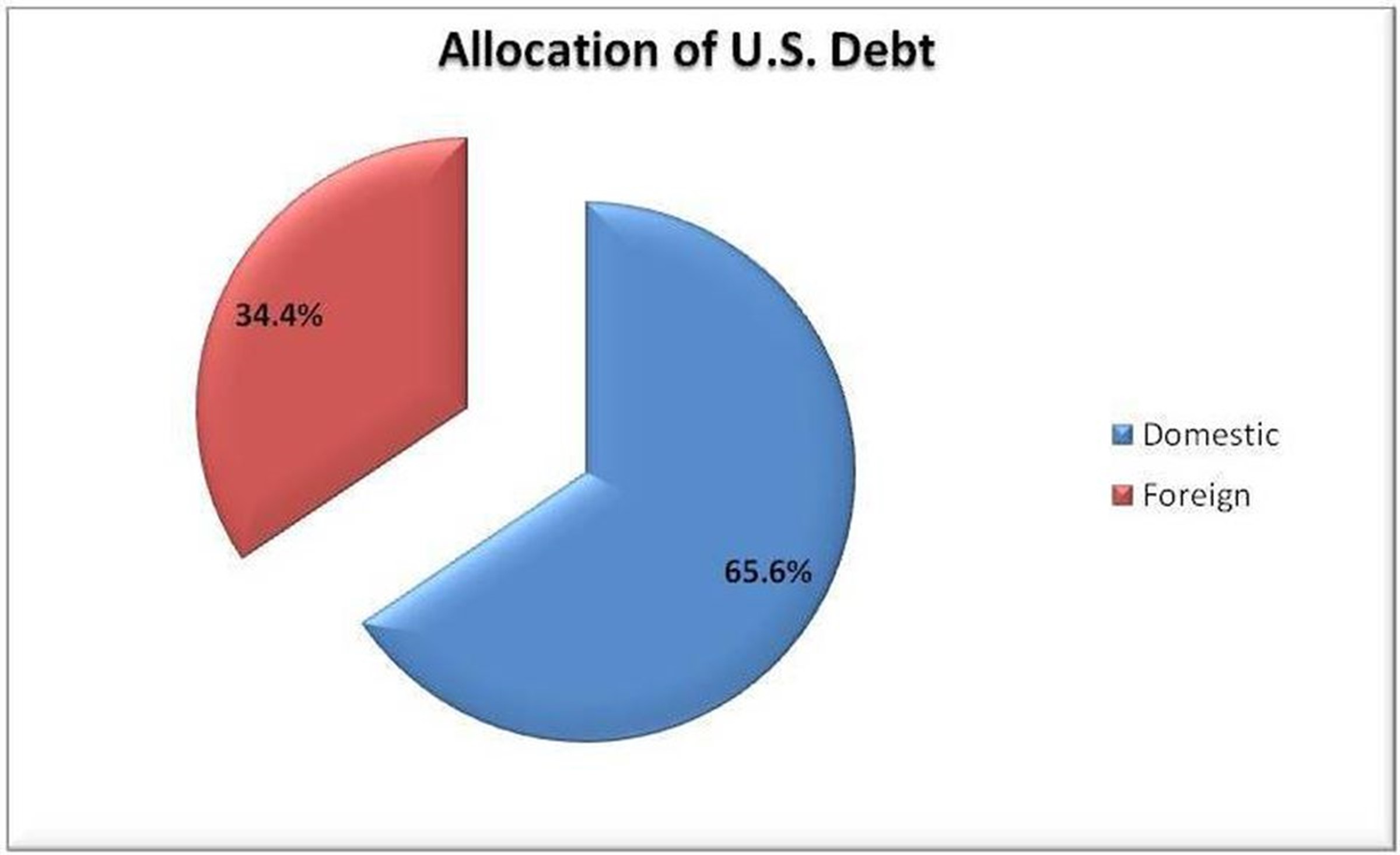
The largest owner of U.S. debt is Social Security. Since the Social Security system is a government entity, how can the government own its own debt? Good question. This is where the “house of cards” theory resides. Some believe the federal government is merely moving the IOUs from one shell to another, hoping to escape the watchful eye of its citizens. In any event, Social Security owns about 16% of the debt followed by other federal government entities (13%), and the Federal Reserve (12%). How much is owned by foreign governments? The following chart contains the answer.
The Clinton Curse. Clinton’s immoral Social Security Policy.
According to the U.S. Treasury Department, at the end of August 2014, more than a third of the debt was owned by foreign countries (34.4%). The largest foreign holders of U.S. debts are Mainland China (7.2%) and Japan (7.0%). What is the consequence of having such a large percentage of debt held by foreign nations? It depends. It depends on the relationship between the U.S. and the specific foreign country. It also depends on the global interest rate environment. Finally, it depends on the geopolitical climate and the degree of fear around the globe. This is the case because when fear rises money flows into U.S. Treasuries which is viewed as a safe place to invest. The percentage of debt owned by countries that are less friendly to America is about 10%. This includes China, several oil exporters (Ecuador, Venezuela, Iran, Iraq, Libya, etc.), and a few others. The worst case would materialize if the largest holders decided to sell their Treasury securities at the same time. This could potentially decrease demand which would push yields higher. If yields rose, the federal government would find it more difficult to service the debt, pushing the deficit higher. If the deficit rose, the total debt burden would accelerate and, unless demand for U.S. debt was to increase, it could get ugly. Will this transpire? It’s not too likely. At least not for the foreseeable future anyway.
Conclusion
Given the state of the global markets, the U.S. is still considered to be the best house in a bad neighborhood. Even though more than one-third of the debt is owned by foreign nations, as long as there are no safer places to invest, money will find its way here. Therefore, global turmoil would be in the best interest of the federal government. Anything which raises fear will bring money to the Treasury and allay the need for higher taxes. However, one day this unsustainable path we’re on will reach its day of reckoning. However, that’s probably not any time soon.
The Clinton Curse. Clinton’s immoral Social Security Policy.
THE CLINTON CURSE – THE US ECONOMY ON A SLIPPERY SLOPE
The Clinton Curse. The US Economy on a Slippery Slope.
Antislavery Campaign of 2018 demands the Repeal of PRWORA of 1996 as it triggered ‘The Clinton Curse’ placing the US economy on a slippery slope. In my analysis, President Clinton did not Balance the US Budget for he acted in violation of God’s Commandments.
President Clinton missed the opportunity to save the country from foreign debt because he denied the payment of the Old Age Retirement Income and Health Insurance Benefits to alien workers who fully subscribed to the Social Security and Medicare Plans by paying the necessary taxes. To the same extent, ‘The Clinton Curse’ invites Americans to live their lives paying taxes to repay the foreign debt.
How Bill Clinton’s Balanced Budget Destroyed The Economy – Business Insider
The Clinton Curse. The US Economy on a Slippery Slope.
Bill Clinton is giving the keynote speech at the Democratic National Convention tonight.
The idea is to make people feel nostalgic for the last time when the economy was really booming, and hope that some of that rubs off on Obama.
However, in the New York Post, Charlie Gasparino uses the occasion to remind everyone that the seeds of our current economic malaise were planted during the Clinton years.
Basically, it was under Clinton that Fannie and Freddie really began blowing the housing bubble, issuing epic amounts of mortgage-backed debt.
The story that Gasparino tells is basically: Liberal Bill Clinton thought he could use government to make everyone a homeowner and so naturally this ended in disaster.
Gasparino specifically cites the controversial Community Reinvestment Act, a popular conservative bogeyman:
How did they do this? Through rigorous enforcement of housing mandates such as the Community Reinvestment Act, and by prodding mortgage giants Fannie Mae and Freddie Mac to make loans to people with lower credit scores (and to buy loans that had been made by banks and, later, “innovators” like Countrywide).
The Housing Department was Fannie and Freddie’s top regulator — and under Cuomo, the mortgage giants were forced to start ramping up programs to issue more subprime loans to the riskiest of borrowers.
That’s interesting. But the truth is far more complicated. And more interesting.
Clinton’s Budget Legacy
In addition to being remembered for a strong economy, Bill Clinton is remembered as the last President to preside over balanced budgets.
Given the salience of the national debt issue in American politics today, the surpluses are a major mark of pride for the former President (and arguably the entire country). They shouldn’t be.
“I think it is safe to say that we are still suffering the harmful effects of the Clinton budget surpluses,” says Stephanie Kelton, an economics professor at the University of Missouri Kansas City.
To understand why you first need to understand that the components of GDP look like this:
In the above equation, C is private consumption (spending). ‘I’ is investment spending. ‘G’ is government spending. And ‘X-M’ is exports-minus imports (essentially the trade surplus).
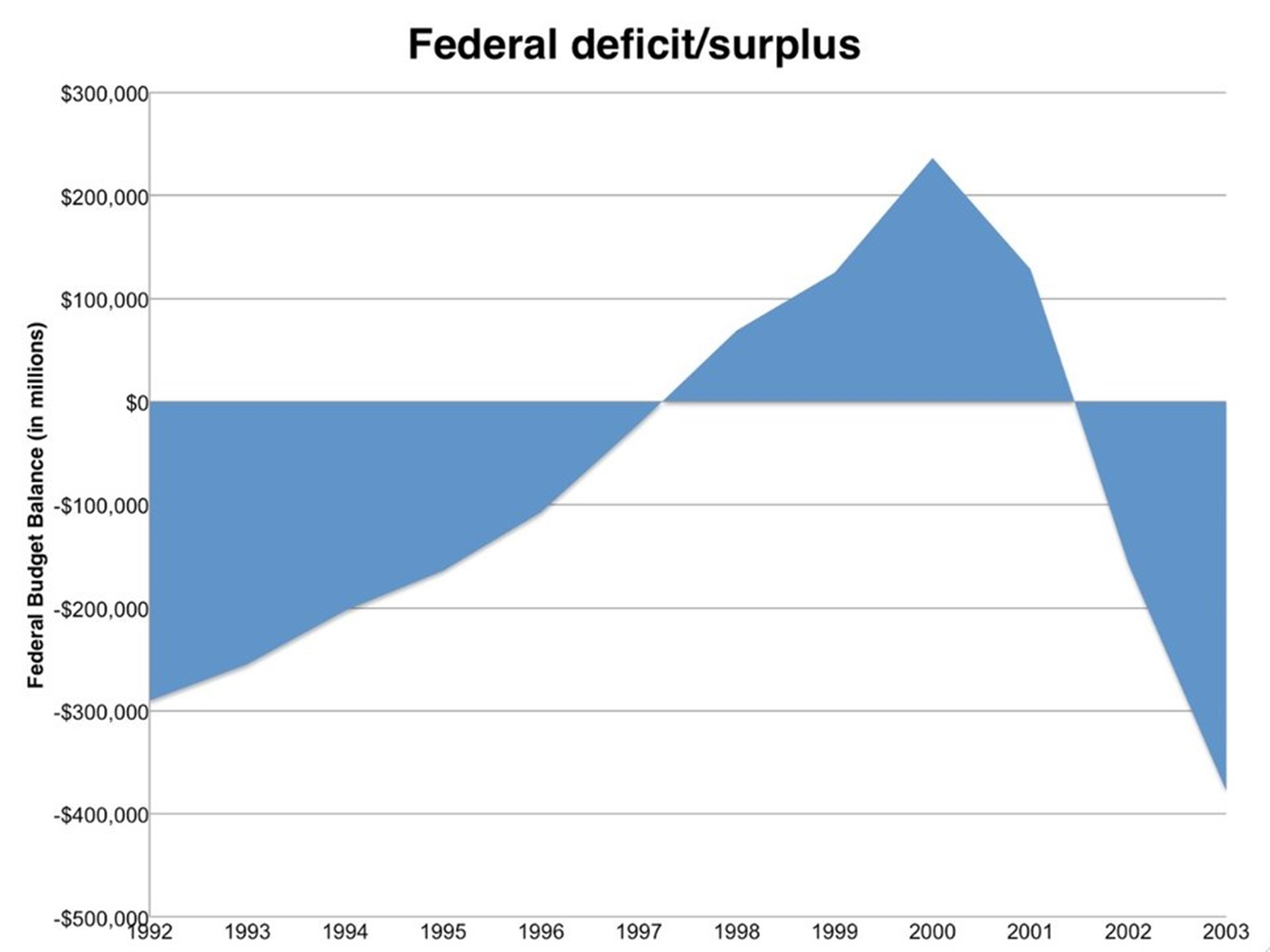
Here’s a chart of the government budget around the years during and right after Clinton, in case you need a reminder that the government was in surplus near the end of his tenure.
The Clinton Curse. The US Economy on a Slippery Slope.
Business Insider, Bloomberg
If the government is in surplus, it means that the government is taking in more cash than it is spending, which is the opposite of stimulus.
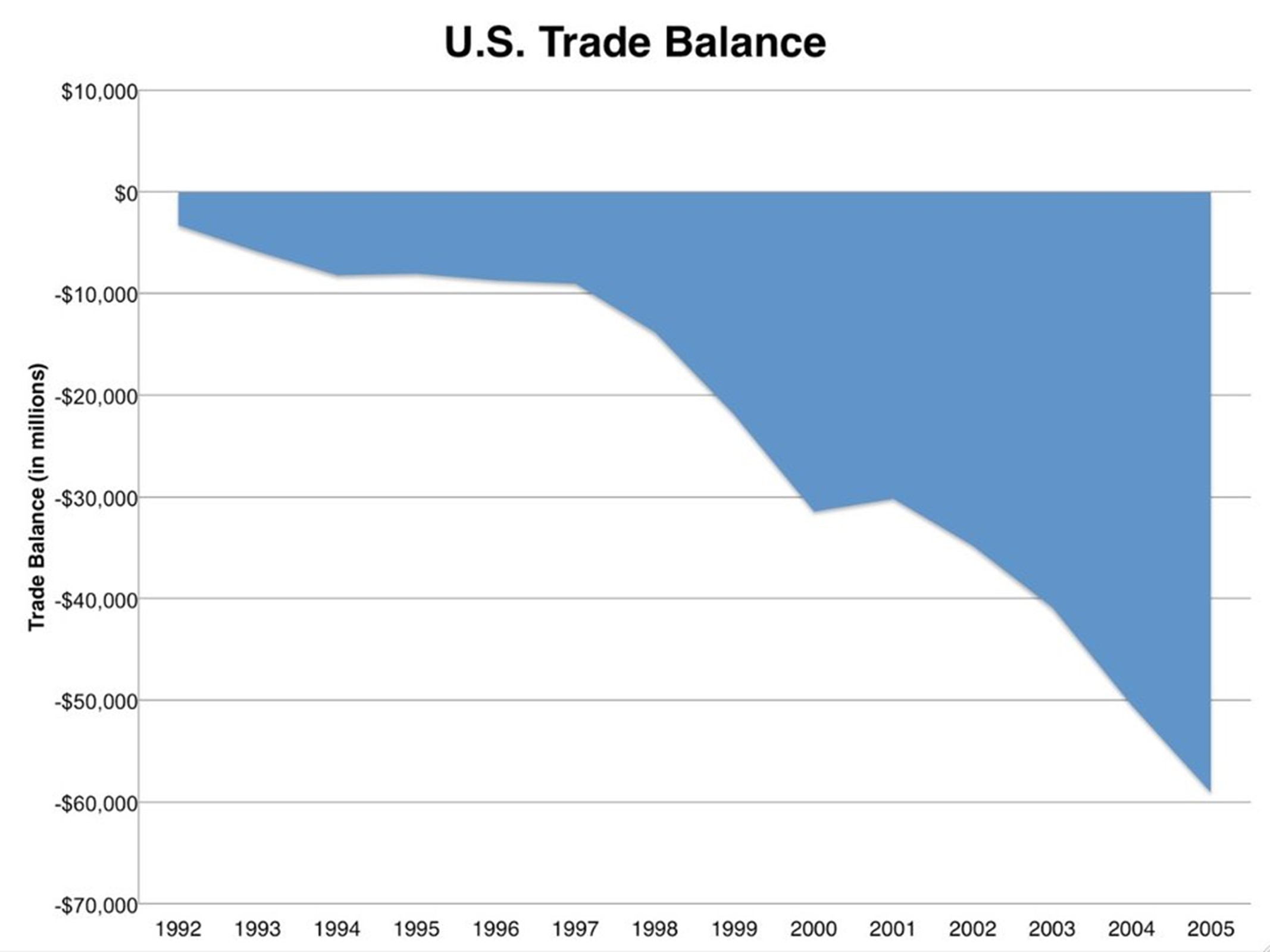
It’s also well-known that the US trade deficit exploded during the late 90s, which means that ‘X-M’ was also a huge drag on GDP during his years.
The Clinton Curse. The US Economy on a Slippery Slope.
Business Insider, Bloomberg
So the trade deficit was subtracting from GDP, and the government was sucking up more money from the private sector than it was pushing out.
There was only one “sector” of the economy left to compensate: Private consumption. And private consumption compensated for the drags from government and trade in two ways.
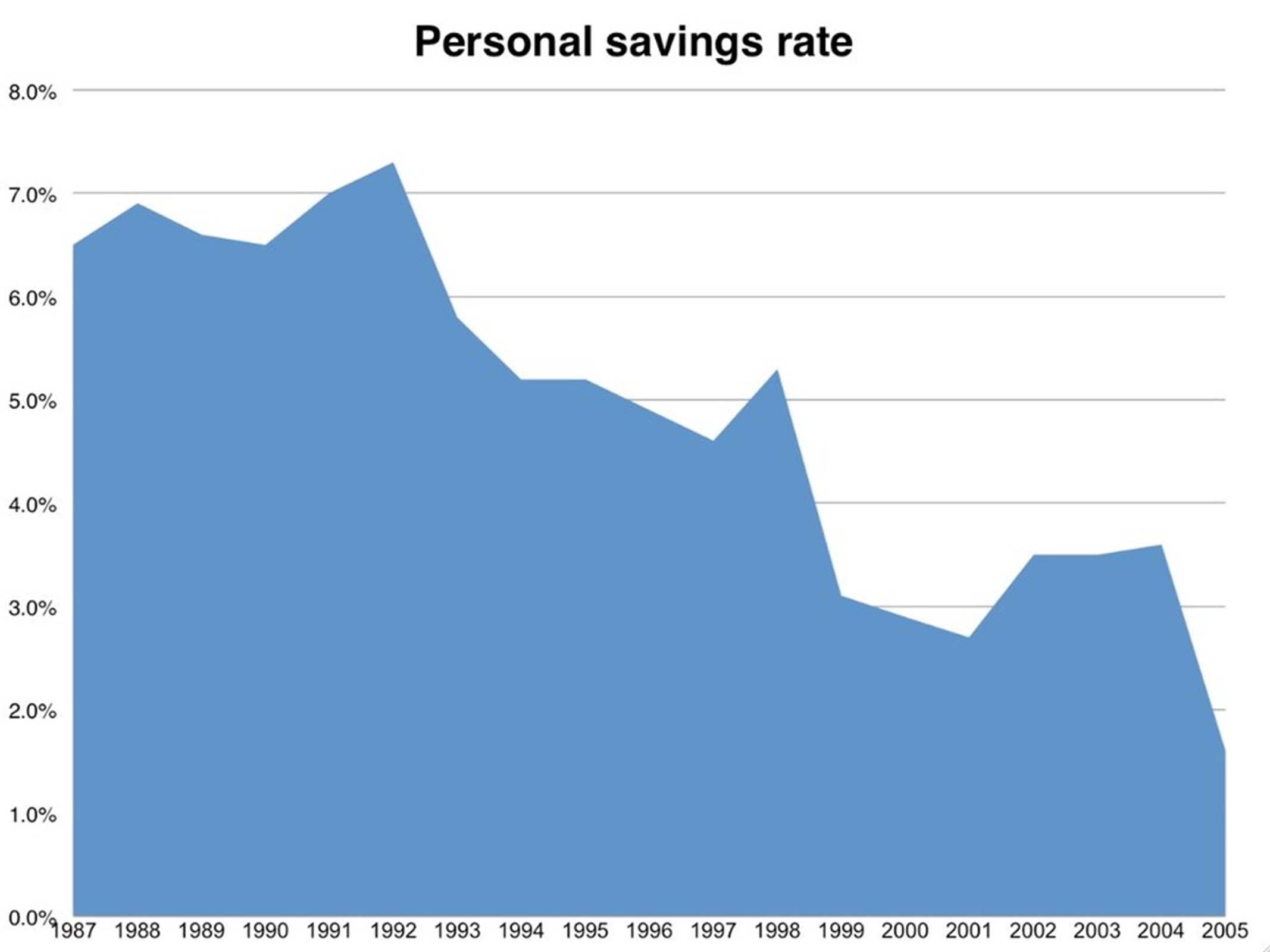
First, the household savings rate collapsed during the Clinton years.
The Clinton Curse. The US Economy on a Slippery Slope.
Business Insider, Bloomberg
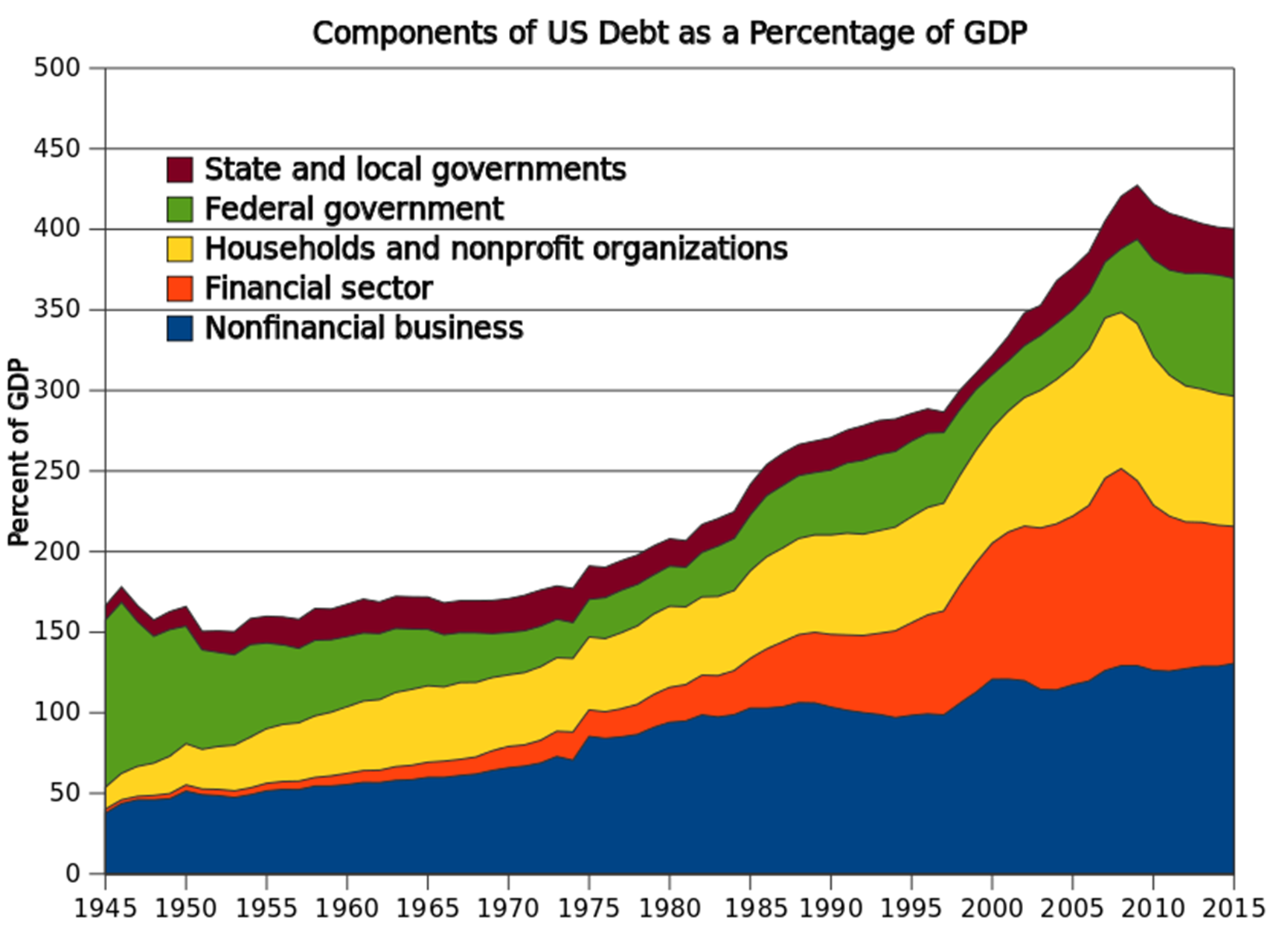
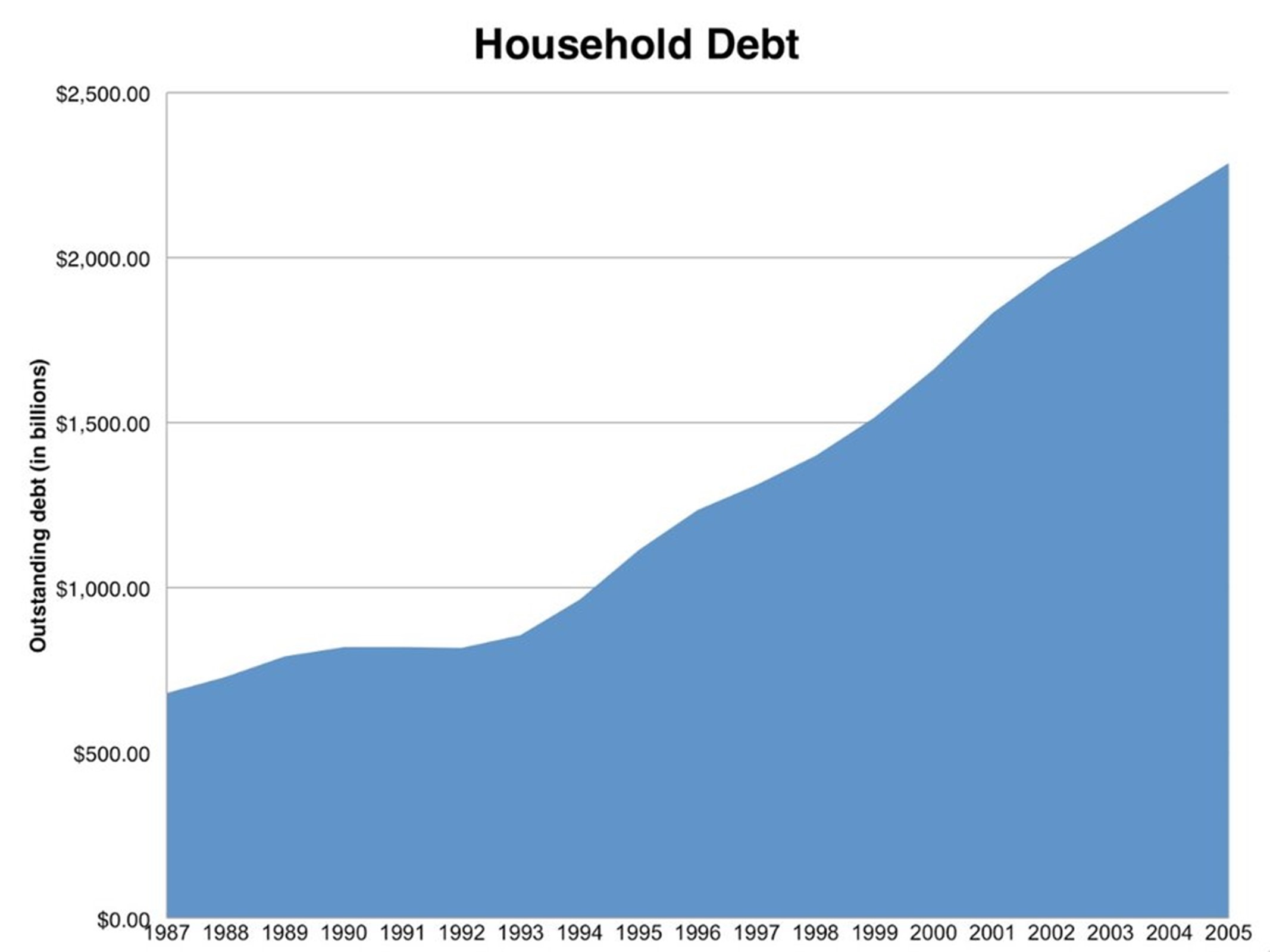
And even more ominously, household debt began to surge.
The Clinton Curse. The US Economy on a Slippery Slope.
Business Insider, Bloomberg
So already you can see how the crisis started to germinate under Clinton.
As his trade and budget policies became a drag on the economy, households spent and went into debt like never before.
Economist Stephanie Kelton expounded further in an email to Business Insider:
“Now, you might ask, “What’s the matter with a negative private sector balance?”. We had that during the Clinton boom, and we had low inflation, decent growth and very low unemployment. The Goldilocks economy, as it was known. The great moderation. Again, few economists saw what was happening with any degree of clarity. My colleagues at the Levy Institute were not fooled. Wynne Godley wrote brilliant stuff during this period. While the CBO was predicting surpluses “as far as the eye can see” (15+ years in their forecasts), Wynne said it would never happen. He knew it couldn’t because the government could only run surpluses for 15+ years if the domestic private sector ran deficits for 15+ years. The CBO had it all wrong, and they had it wrong because they did not understand the implications of their forecast for the rest of the economy. The private sector cannot survive in negative territory. It cannot go on, year after year, spending more than its income. It is not like the US government. It cannot support rising indebtedness in perpetuity. It is not a currency issuer. Eventually, something will give. And when it does, the private sector will retrench, the economy will contract, and the government’s budget will move back into deficit.”
But this is only part of the story. What about what Charlie Gasparino wrote about above?
The Fannie and Freddie Boom
When the government is running a surplus, it no longer has to issue much debt. But risk-free government bonds are a crucial component of portfolios for all kinds of financial institutions, and for mom & pop investors who like the safety of regularly Treasury payouts. The yield on the 10-year bond was over 5% back in those days… nothing to sneeze at for people planning for a retirement.
This created a bit of a crisis.
Bond trader Kevin Ferry, a veteran of the scene, told Business Insider about the panic that was unfolding over the government’s lack of debt.
“OMG, they were all saying… there wasn’t going to be any paper!”
How did the markets react?
“Lo and behold… [Fannie and Freddie] issuance “SURGED” in the late 90s,” said Ferry.
Everything changed. While the government dramatically slowed down the issuance of Treasuries, Fannie and Freddie picked up the baton and started selling debt like never before.
“Prior to those years, there were not regular [Fannie and Freddie] auctions.”
“The system wanted it.”
“The fear was that there wasn’t going to be any…. There were no bill auctions.”
“The brokers were calling up ma & pa and said there are no more T-Bill auctions!”
And the data bears this out.
Total agency issuance of mortgage-backed securities spiked in 1998 and 1999, and from then on they never looked back.
The Clinton Curse. The US Economy on a Slippery Slope.
Business Insider, Bloomberg
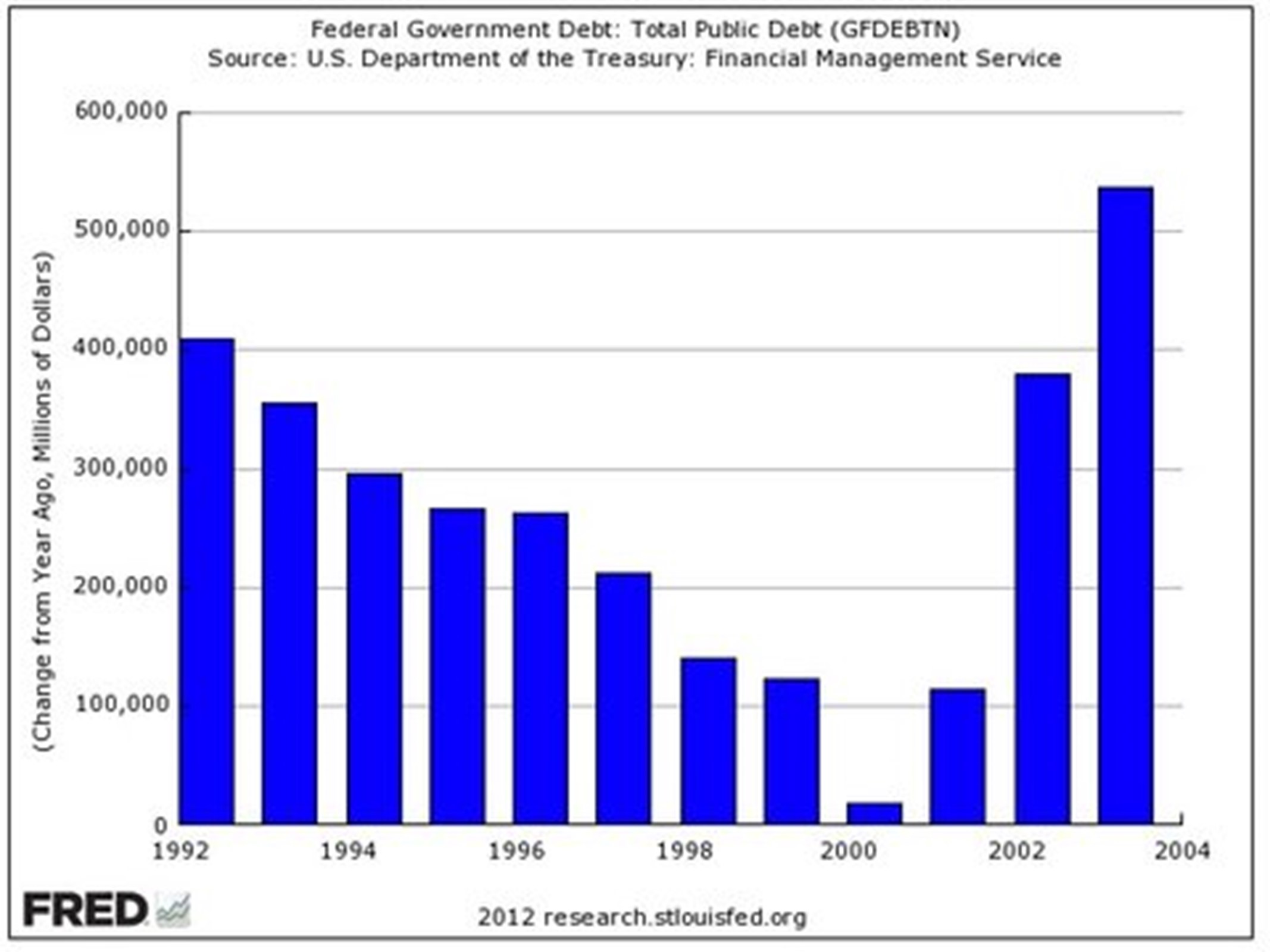
And just to drive home the point again, about how the 1998-1999 spike in issuance was the mirror image of the annual change in the size of the government debt.
The Clinton Curse. The US Economy on a Slippery Slope.
FRED
Note that both government debt and agency issuance spiked in the early 2000s, but that was during a recession when the private sector dramatically scaled back its activity form the late 90s.
How Clinton Destroyed The Economy
The bottom line is that the signature achievement of the Clinton years (the surplus) turns out to have been a deep negative. For this drag on GDP was being counterbalanced by low household savings, high household debt, and the real revving up of the Fannie and Freddie debt boom that had a major hand in fueling the boom that ultimately led to the downfall of the economy.
And that brings up a broader question that people who advocate balanced budgets must answer.
What’s the point of it?
Despite the budget surplus, interest rates were higher. And the surplus provided no protection of the coming slump. And if anything, it just weakened the most brittle part of the economy: households.
Furthermore, there is a pattern of this.
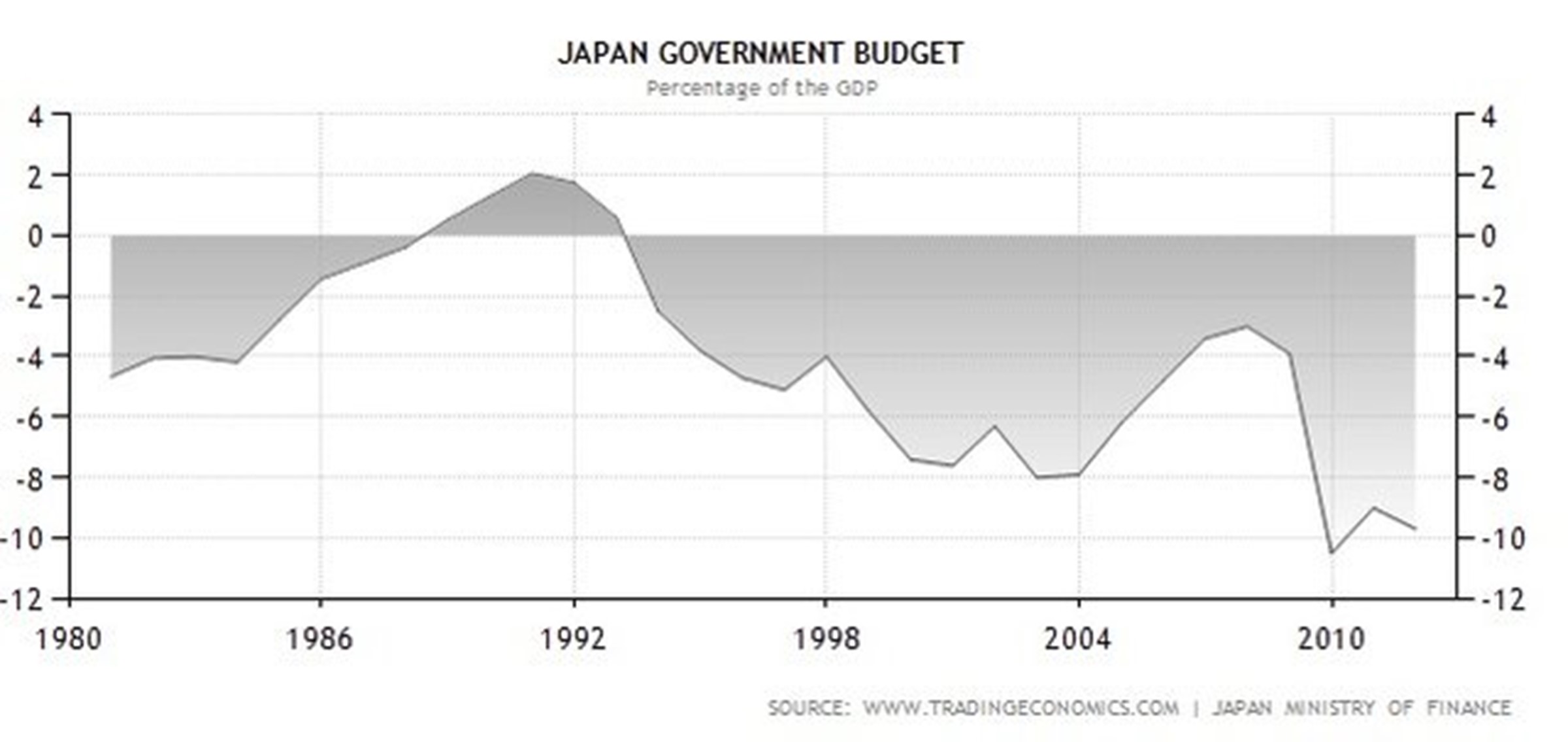
Japan ran a budget surplus in the year right before its economy went into terminal decline, as this chart from Trading Economics shows
The Clinton Curse. The US Economy on a Slippery Slope.
So while Clinton will be remembered nostalgically tonight, for both the performance of the economy and his government finances, they shouldn’t be remembered fondly.
The Clinton Curse. The US Economy on a Slippery Slope.



























 Whole Dude - Whole Concept