
Resolve Tibet-China Border Dispute
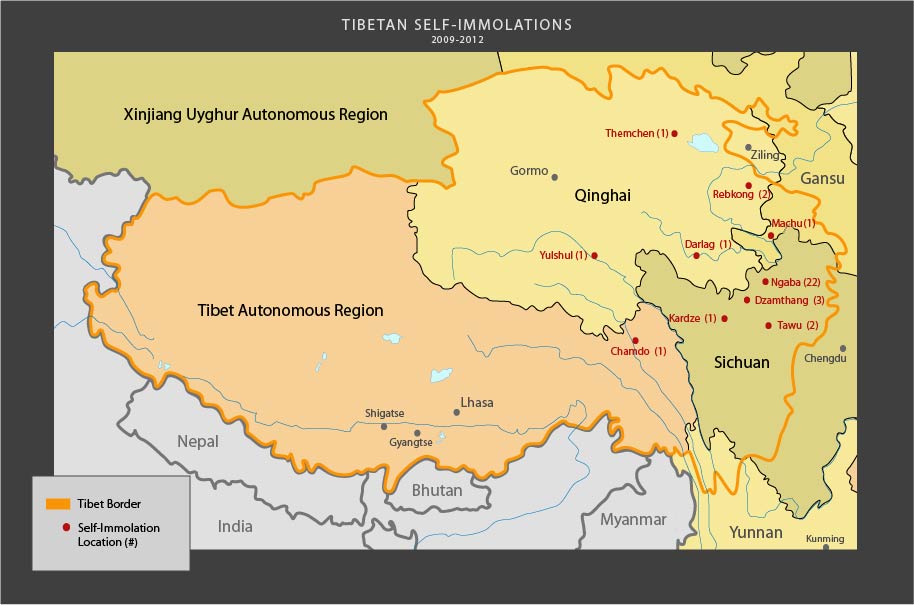
It is surprising to note that people who write about the Sino-Indian border conflict make no reference to the history of Tibet. To state very briefly, the Great Fifth Dalai Lama founded the Ganden Phodrang Government of Tibet in 1642. The successive Dalai Lamas have headed the Tibetan State for nearly four centuries. From 1279 to 1368 Tibet was under the nominal control of the Yuan or Mongol dynasty of China, but subsequently regained its independence. In 1644, the Manchu or Qing dynasty was established in China and Tibet came under its nominal protection although for the most part the country retained control over its internal affairs. With the downfall of the Qing or Ching dynasty, the Great 13th Dalai Lama declared Tibet’s Independence on 13th February, 1913. For 39 years, from 1911 to 1950, Tibet was an independent nation. In Political Science, when states are called free and independent, their autonomy or sovereignty means that they have full power to levy war, conclude peace, contract alliances, establish commerce, and do all other acts and things which independent states may have the right to do. In its capacity as an independent nation, Tibet signed a treaty called the McMahon Treaty (following the Simla Agreement) which established the border between India and Tibet. The Republic of India after gaining its full independence during 1947 did not annul or revoke this treaty. As such, for all legal purposes, this treaty is valid. People’s Republic of China came into its existence after the Communists took over mainland China during 1949 and forced the Nationalist Party (Kuomintang) establish the Republic of China in Formosa or Taiwan. Both the Nationalists, and the Communists seek the reunification of Taiwan with the mainland. That issue is not yet decided. Meantime, Communist China invaded Tibet during 1950 and occupied it. In 1951, a defeated Tibet signed a treaty making Tibet a part of China. However, most Tibetans do not recognize this treaty and do not accept its legitimacy. In 1959, after a failed, massive Tibetan uprising, the 14th Dalai Lama and about 100, 000 of his followers escaped to India. Tibetans have established the Tibetan Government-in-Exile, and on September 02, 1960, the first members of the First Tibetan Parliament-in-Exile took their oath of office. In September, 2012, Tibetans have celebrated 52nd Democracy Day. During 1965, People’s Republic of China formed a province that it named as Tibetan Autonomous Region or “TAR.” In doing so, Communist China annexed several parts of Tibet and added them to its own territory. Tibetans have not agreed for this seizure of their territory. One of the central demands of the Tibetan Government-in-Exile is that of unifying all the Tibetan territory that is now under Chinese military occupation.
We have to very important issues; 1. Unification of Republic of China with People’s Republic of China and establish a national entity called China, and 2. demarcating the border between the new “One-China” and its neighbor, Tibet. Tibetans have not surrendered their claims for independence, freedom, and self-determination. As such, Tibet is not a part of China and the borders of China’s province called “TAR” do not establish the legitimate borders between Tibet and China.
India forgets that China cannot be trusted
G.PARTHASARATHY
December 5, 2012:
One cannot but be surprised by the statement of the National Security Advisor (NSA) Shivshankar Menon brushing aside the serious implications of Chinese actions, while voicing optimism that “we are in the process of agreeing on a framework to settle the boundary”.
Have we forgotten that after agreeing to delineate the Line of Actual Control, the Chinese backed off on the entire process?
In 2005, Premier Wen Jiabao agreed that “in reaching a border settlement, the two sides shall safeguard due interests of their settled populations in border areas”.
This clearly signaled that there was no question of transferring territories containing settled populations and addressed Indian concerns on Chinese claims to Tawang in Arunachal Pradesh. Within a year, however, China was laying claim not merely to Tawang, but the entire state of Arunachal Pradesh.
One can only conclude that the new “framework” the NSA spoke of to settle the boundary issue would be about as successful as the much-touted “Joint anti-Terror Mechanism” with Pakistan, which came apart with the 26/11 attacks.
Just a day before the NSA spoke, Army Chief General Bikram Singh described bilateral relations with China as “absolutely perfect” and added that mechanisms were now in place to solve any issues
between the two countries. This was an astonishing comment, at a time when the army wants additional strike formations, apart from vastly improved communications on the border with China.
Was it because Singh feels the army is unlikely to get its needs fulfilled soon, and needs to sound conciliatory to the Chinese? Do the other two Service Chiefs and the Defence Minister share this
optimism? All these issues need to be debated now that Parliament is in session.
INTERNAL RUMBLINGS
China can now be described as a “dynastic dictatorship,” after its 18th Party Congress. Outgoing leader Hu Jintao voiced concern at the growing dissatisfaction in China over political corruption.
The Party Congress had been preceded by the downfall of its rising star Bo Xilai, whose lavish and flamboyant lifestyle had led to the conviction of his wife for murdering a British businessman and
revelations of the billions of dollars of assets that Bo and his family had acquired.
This was followed by a a well documented leak, quite evidently by Bo’s supporters, about ill-gotten wealth accumulated by Prime Minister Wen Jiabao and his family.
China’s worst kept secrets about dynastic politics in the Communist Party became public when it emerged that four of the seven members of its highest decision-making body, the Standing Committee of the Politburo, were “Princelings,” or descendants of first generation, Mao-era political leaders. Most “Princelings”, including Party Chief Xi Jinping, lead lavish life styles, with families having extensive business interests. The contradictions between having an open economy linked to foreign markets on the one hand and a one-party, authoritarian political structure perceived to be unresponsive to pubic grievances on the other, are coming to the forefront in China.
China will continue to seek new ways to further open up its economy and maintain a high growth rate. But the “Princelings” are unlikely to bring any changes in the basic authoritarian nature of the State apparatus. Tutored by Deng Xiao Ping, who was determined not to follow the glasnost and perestroika path of Gorbachev in the Soviet Union, the new dispensation will be averse to increasing democratization.
TERRITORIAL AGGRESSION
With jingoistic propaganda, evidently to divert public opinion away from domestic issues like high level corruption, China is obviously in no mood to show any flexibility on its territorial claims along the Sino-Indian border. As Chinese passports are generally valid for ten years, there can logically be no change in China’s territorial claims in this period.
China will continue on its path of rapid military modernization, combined with an assertive line on its maritime and land boundary claims.
China’s recent decision to depict the entire South China Sea, together with Arunachal Pradesh and parts of Ladakh as Chinese territory in maps on Chinese passports, has to be seen in the light of this
growing Chinese readiness to use force and military coercion to enforce its territorial claims. One has recently witnessed aggressive Chinese postures resulting in a virtual naval takeover around the
disputed Scarborough Shoal, claimed by the Philippines.
A similar aggressive approach has been taken on recent tensions with Japan, with Chinese naval vessels entering territorial waters, adjacent to the disputed Diaoyu/Senkaku Islands.
China has evidently been emboldened by the American assertion that while the US does have a stand on freedom and maintenance of peace and stability in the South China Sea, it “does not take sides in (maritime) disputes”.
ECONOMIC CONCERNS
New Delhi is now talking of getting superfast trains and rail equipment from China, at a time when there is growing concern at our over dependence on second rate Chinese power equipment.
There are also concerns about dangers to cyber security and communications infrastructure posed by imports from China. Should we not insist on co-production, together with transfer or technology, in such strategic sectors, with preference for cooperation with friendly countries like Japan, France and Germany?
(The author is former High Commissioner to Pakistan.)
Comments:
Dear Mr GP, Many thanks for this caution. Will the ears listen to and the eyes see the ground realities instead of indulging in this ‘all is well’ kind of assumption and self assurance? . The present atmosphere is somewhat similar to the one that prevailed in early 1960s when our leaders wrongly assumed that China would never attack India. Reference is invited to the recent interview granted by Dai Bingguo Chinese Negotiator to PTI (covered by this publication) covering China – Pakistan relationships and China’s territorial claims. We need to exercise extra caution, think and act carefully. I held the view earlier that China will think twice before attacking India once again. But am forced to rethink. Camradely with China can wait. Recent bonhomie in the form of financial assistance, collaboration in power and infrastructure may not be entirely and mutually beneficial. One may need to read the fine print very carefully! Thanks for this opportunity to interact.
Regards
from: Dr.Guru.Raghavan
Posted on: Dec 5, 2012 at 23:08 IST

 Whole Dude - Whole Concept