Whole Dude – Whole Deficit: Fiscal Year 2023 in Review. The federal government ran a deficit of $1.7 trillion in fiscal year 2023, $320 billion (23%) more than FY2022’s deficit.
Whole Dude – Whole Deficit: The Repeal PRWORA Project
Excerpt: The “Repeal PRWORA Project” advocates for the repeal of Public Law 104-193, also known as the Personal Responsibility and Work Opportunity Reconciliation Act (PRWORA) signed by US President Bill Clinton in 1996. The organizers argue that this law reintroduced varieties of slavery, including involuntary servitude and forced labor, by unfairly denying retirement income benefits to non-citizen taxpayers who cannot provide proof of lawful residency. Critics claim this law infringes on the constitutional rights of these workers, violating principles of equal treatment, protection, and justice under law. They demand for a strict adherence to the natural law principles abolishing any form of slavery.
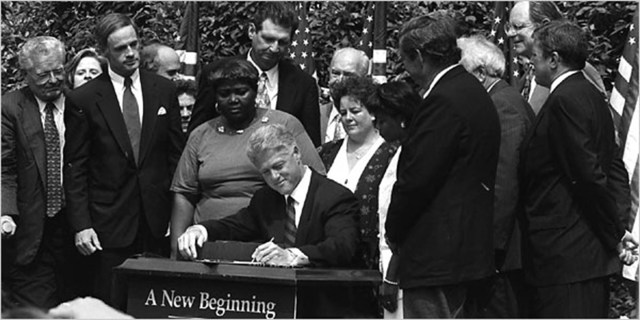
Whole Dude – Whole Deficit: The Clinton Curse. The Staggering Budget Deficit in 2020.- In 1996, President Clinton reintroduced Slavery, “A New Beginning” to balance the budget by undermining the protections offered by the Social Security Act.
In my analysis, the Economic Policy of President Bill Clinton is fundamentally flawed for it violated the principles of Natural Law that make America a proud and prosperous nation in the world. The economic downfall of the United States is relentless and is almost unstoppable. There can be no healing and no recovery without the Blessings promised by God and living up to the Official Motto “IN GOD WE TRUST.”
Whole Dude – Whole Deficit: The Clinton Curse. The Staggering Budget Deficit in 2020. There are Curses and serious consequences for the Disobedience of LORD’s Commandments.
U.S. deficit to soar to record $3.8 trillion in 2020, budget watchdog group says
Whole Dude – Whole Deficit: The Clinton Curse. The Staggering Budget Deficit in 2020.:
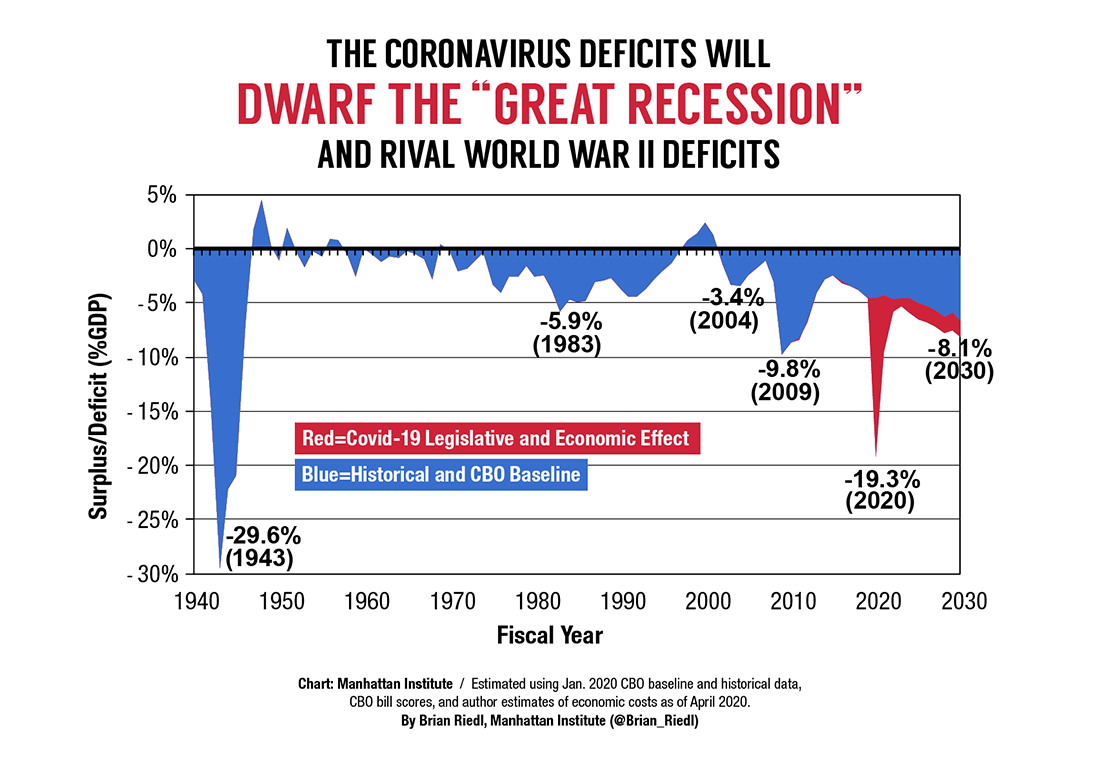
WASHINGTON (Reuters) – A steep economic downturn and massive Coronavirus rescue spending will nearly quadruple the fiscal 2020 U.S. budget deficit to a record $3.8 trillion, a staggering 18.7% of U.S. economic output, a Washington-based watchdog group said on Monday.
Releasing new budget estimates based on spending mandated by law, the Committee for a Responsible Federal Budget (CRFB) also projected that the fiscal 2021 deficit would reach $2.1 trillion in 2021, and average $1.3 trillion through 2025 as the economy recovers from damage caused by Coronavirus-related shutdowns.
The estimates follow the U.S. Treasury’s report on Friday of a $744 billion budget deficit in the six months through March 30, which included minimal impact from the outbreak of the new Coronavirus. Officials said significant budget impacts from spending and reduced revenues would appear in April’s budget results.
The CRFB, a coalition of former U.S. lawmakers, government officials and economists that has advocated for reducing deficits, said U.S. public debt by the Sept. 30 fiscal year-end would exceed 100% of U.S. GDP, from just under 80% prior to the Coronavirus crisis.
“These projections almost certainly underestimate deficits, since they assume no further legislation is enacted to address the crisis and that policymakers stick to current law when it comes to other tax and spending policies,” the group said in a statement.
CRFB’s projections also assume the economy experiences a strong recovery in 2021 and fully returns to its pre-crisis trajectory by 2025.
If that recovery is achieved, public debt would reach 107% of GDP that year, exceeding levels at the end of World War Two. A slower recovery could cause debt to reach 117% of GDP by 2025, the group said.
The record for a fiscal year deficit was $1.41 billion, set in 2009. Deficits exceeding $1 trillion followed for three subsequent years before subsiding as the economy recovered. But the deficit reached $984 billion in 2019 and the Congressional Budget Office had projected a $1.07 trillion deficit for 2020.
The CRFB started with that pre-crisis CBO estimate and added about $2.2 trillion in spending while subtracting $570 billion in revenue due to reduced economic activity.
Reporting by David Lawder; Editing by Paul Simao and Lisa Shumaker
Whole Dude – Whole Deficit: The Clinton Curse. The Staggering Budget Deficit in 2020.
December 06. The Death of the 13th Amendment to the US Constitution. President Bill Clinton’s “A New Beginning” imposed the Death Sentence on the rights granted by the 13th Amendment.
The 13th Amendment to the U.S. Constitution, ratified in 1865 in the aftermath of the Civil War, abolished slavery in the United States. The 13th Amendment states: “Neither slavery nor involuntary servitude, except as a punishment for crime whereof the party shall have been duly convicted, shall exist within the United States, or any place subject to their jurisdiction.”
On January 31, 1865, the House of Representatives passed the proposed amendment with a vote of 119-56, just over the required two-thirds majority. The following day, President Lincoln approved a joint resolution of Congress submitting it to the state legislatures for ratification.
But President Lincoln would not see final ratification: Lincoln was assassinated on April 14, 1865, and the necessary number of states did not ratify the 13th Amendment until December 6, 1865.
Social Security Act, Section. 202 (y), VIOLATES THE 13th Amendment to the US Constitution
Social Security Act, Section. 202(y) violates the 13th Amendment to the US Constitution, .
At a ceremony held in Emancipation Hall of the United States Capitol Visitor Center on Wednesday, December 09, 2015, President Barack Obama and leaders of Congress commemorated the 150th Anniversary of the 13th Amendment to the US Constitution. House Speaker Paul Ryan in his remarks stated that the Constitution is Supreme Law of the Land. The 13th Amendment is just 43 words long. I want to examine if those 43 words govern, rule, and operate the lives of all inhabitants of this Land.
My readers should not be surprised if I describe the US Congress as “Slave Driver.” The reason for my claim is based on a law enacted by the US Congress in 1996 that amended the US Social Security Act of 1935. This legal provision enacted by Congress is incorporated as Section 202(y) of the Social Security Act:
OLD-AGE AND SURVIVORS INSURANCE BENEFIT PAYMENTS:(y) Notwithstanding any other provision of law, no monthly benefit under this title shall be payable to any alien in the United States for any month during which such alien is not lawfully present in the United States as determined by the Attorney General.
It mandates that no benefits shall be payable to any alien in the United States without showing proof of lawful residency as determined by the Attorney General. This law violates the principle enshrined in those 43 words called the 13th Amendment. US Congress enacted legislation amending Social Security Act and that amended Social Security Act is fundamentally flawed for it is unconstitutional. It takes away the property rights of individuals residing in this country. The government can impose taxes on citizens and aliens residing in the country. The Old Age Insurance Monthly Benefit paid by the Social Security Administration is not a tax; the Monthly Benefit constitutes income or property of the individual who contributed to the Insurance Plan.
The Emancipation Proclamation issued by President Abraham Lincoln in September 1862 came into effect on January 01, 1863 freeing slaves in all territory still at War with the Union. These slaves are not citizens of the Land and had no political rights or citizenship rights of their own. For all practical purposes, the slaves who lived in the US were aliens for they were not citizens of the US.
In Law, Servitude or Slavery refers to the burden imposed upon property of a person by a specified right another has in its use. Servitude involves labor in which the person who performs labor has no right to his earnings from labor. The amended Social Security Act unconstitutionally gives power to the Social Security Administration to withhold property(wage, earnings, monthly retirement income benefits) of alien workers without obtaining formal approval by the US Court of Law. This amended Social Security Act does not uphold the Constitution as the Supreme Law of this Land.
Social Security Act, Section. 202(y) violates the 13th Amendment. President Barack Obama delivers remarks at an event commemorating the 150th anniversary of the 13th Amendment abolishing slavery, at the U.S. Capitol in Washington, D.C., Dec. 9, 2015. (Official White House Photo by Lawrence Jackson)
WASHINGTON – Earlier today, at a ceremony in Emancipation Hall of the United States Capitol Visitor Center, President Obama and leaders of Congress commemorated the 150th anniversary of the 13th amendment to the Constitution. Following are House Speaker Paul Ryan’s (R-WI) remarks at the ceremony, as prepared for delivery: The Thirteenth Amendment is just 43 words long. It is so short that, when you read it, you can almost miss the whole significance. You have to stop and remind yourself that 600,000 people died in the Civil War—600,000 died over 43 words. Or to be more precise, they died in a war that decided whether those 43 words would ever be written.
And not everyone supported the Thirteenth Amendment. There was fierce opposition. But I think it is telling that when the state of Maryland held a referendum to abolish slavery, it was the votes of Union soldiers that put it over the top. It was the men who had been in the field and heard the battle cries and seen heroic deeds. They knew, better than most, that everyone in that field was an American.
A private in the 89th Illinois put it best. He wrote, “I have often [heard] of men say that they would not fight beside a negro soldier but . . . the whites and blacks charged together and they fell just as well as [we] did. . . . I have seen a great [many] fighting for our country. Then why should they not be free[?]”
It took a war for us to answer that question. We should be honest with ourselves. It took centuries of cruelty and injustice. But today we celebrate the moment when our country decided: Yes, they should be free. They would be free. And we thought this decision was so important that for the first time in half a century, we amended the Constitution. From then on, it would be the supreme law of the land.
And so today we celebrate this 43-word amendment, this “new birth of freedom.” “It is altogether fitting and proper that we should do this.” And we should remember all that it took: the historic battles, the great generals, yes—but also the men in the ranks, the names we have forgotten, especially the men who had once been enslaved: men like William H. Carney and Andrew Jackson Smith.
These men were segregated. They were mistreated. And yet they still fought. They fought for a country that had denied them their freedom. They fought for all of us. And so when we read those 43 short and simple words, we should remember these men and what they did. We should realize those words, like their acts, are gallant, noble, profound. We have witnessed true greatness in this country. And when we ratified the Thirteenth Amendment, we committed ourselves to build a country just as great.
That is what those 43 words mean. That is what they represent. And that is more than worthy of celebration. Thank you.
Social Security Act, Section. 202(y) violates the 13th Amendment to the US Constitution,Social Security Act, Section. 202(y) violates the 13th Amendment to the US Constitution,.
Social Security Act, Section 202 (y) violates the property rights of alien workers paying the Social Security Taxes.
Presidents’ Day 2020. The Legacy of US National Debt.
The national debt stands at $22.72 trillion as of Sept. 30, 2019. This enormous bill didn’t come from nowhere, and it’s safe to say that the U.S. will likely continue borrowing money in the foreseeable future. So, how worried should Americans be about the national debt? There’s not a lot of agreement across the political spectrum on the answer to that question.
$20 bill from 1995. Presidents’ Day 2020. The Legacy of US National Debt. The 42nd US President (Presidential Term January 20, 1993 to January 20, 2001)made an Unjust and Unfair plan to reduce the US National Debt by denying the payment of Social Security and Medicare Benefits to tax paying alien hourly wage workers.
However, understanding why the U.S. borrows money and how different historical events shaped that process is important to any informed voter, especially with another election approaching in November. Knowing how much the federal government borrowed to deal with various issues and events throughout the last century can help you gauge whether each politician’s plans to address the national debt are feasible.
For example, you can note how 1933 saw a marked increase in debt as the new Roosevelt administration broke with the fiscal orthodoxy of the time by employing large deficits to combat the Great Depression. Each recession has correlated with a spike in borrowing, with tax revenues dropping when the needs of the American people were at their highest. All told, tracking the progress of the national debt is a valuable way to understand the U.S. government’s relationship to its people.
Using data from TreasuryDirect and the Bureau of Labor Statistics’ consumer price index inflation calculator, GOBankingRates analyzed the total U.S. national debt from 1900 to present in five-year increments and adjusted the outstanding debt for inflation to provide context in today’s dollars.
The US Treasury Building in 1900. Presidents’ Day 2020. The Legacy of US National Debt.
1900-1904
Outstanding debt in 1900: $2.14 billion
Debt adjusted for inflation: $65.37 billion
Outstanding debt in 1904: $2.26 billion
Debt adjusted for inflation: $65.37 billion
Change in debt between 1900-1904: 5.95% Change in debt adjusted for inflation: -$4.55 million
$20 U.S. gold certificate from 1905 Presidents’ Day 2020. The Legacy of US National Debt.
1905-1909
Outstanding debt in 1905: $2.27 billion
Debt adjusted for inflation: $66.42 billion
Outstanding debt in 1909: $2.64 billion
Debt adjusted for inflation: $74.54 billion
Change in debt between 1905-1909: 16.04% Change in debt adjusted for inflation: $8.12 billion
William Howard Taft, who was president from 1910-1913. Presidents’ Day 2020. The Legacy of US National Debt.
1910-1914
Outstanding debt in 1910: $2.65 billion
Debt adjusted for inflation: $71.75 billion
Outstanding debt in 1914: $2.91 billion
Debt adjusted for inflation: $74.84 billion
Change in debt between 1910-1914: 9.80% Change in debt adjusted for inflation: $3.09 billion
U.S. Treasury Building in 1915. Presidents’ Day 2020. The Legacy of US National Debt.
1915-1919
Outstanding debt in 1915: $3.06 billion
Debt adjusted for inflation: $77.81 billion
Outstanding debt in 1919: $27.39 billion
Debt adjusted for inflation: $406.87 billion
Change in debt between 1915-1919: 795.68% Change in debt adjusted for inflation: $329.06 billion
$5 U.S. silver certificate from 1923. Presidents’ Day 2020. The Legacy of US National Debt.
1920-1924
Outstanding debt in 1920: $25.95 billion
Debt adjusted for inflation: $333.46 billion
Outstanding debt in 1924: $21.25 billion
Debt adjusted for inflation: $319.35 billion
Change in debt between 1920-1924: -18.12% Change in debt adjusted for inflation: -$14.10 billion
Calvin Coolidge, who was president from 1925-1929. Presidents’ Day 2020. The Legacy of US National Debt.
1925-1929
Outstanding debt in 1925: $20.52 billion
Debt adjusted for inflation: $301.26 billion
Outstanding debt in 1929: $16.93 billion
Debt adjusted for inflation: $254.44 billion
Change in debt between 1925-1929: -17.47% Change in debt adjusted for inflation: -$46.83 billion
Pageant in front of the U.S. Treasury Building in 1930. Presidents’ Day 2020. The Legacy of US National Debt.
1930-1934
Outstanding debt in 1930: $16.19 billion
Debt adjusted for inflation: $249.05 billion
Outstanding debt in 1934: $27.05 billion
Debt adjusted for inflation: $518.80 billion
Change in debt between 1930-1934: 67.15% Change in debt adjusted for inflation: $269.75 billion
$1 U.S. silver certificate from 1935. Presidents’ Day 2020. The Legacy of US National Debt.
1935-1939
Outstanding debt in 1935: $28.70 billion
Debt adjusted for inflation: $538.35 billion
Outstanding debt in 1939: $40.44 billion
Debt adjusted for inflation: $747.62 billion
Change in debt between 1935-1939: 40.90% Change in debt adjusted for inflation: $209.27 billion
US Treasury Building in 1941. Presidents’ Day 2020. The Legacy of US National Debt.
1940-1944
Outstanding debt in 1940: $42.97 billion
Debt adjusted for inflation: $788.68 billion
Outstanding debt in 1944: $201.00 billion
Debt adjusted for inflation: $2.93 trillion
Change in debt between 1940-1944: 367.80% Change in debt adjusted for inflation: $2.15 trillion
Harry S. Truman, who was president from 1945-1949. Presidents’ Day 2020. The Legacy of US National Debt.
1945-1949
Outstanding debt in 1945: $258.68 billion
Debt adjusted for inflation: $3.69 trillion
Outstanding debt in 1949: $252.77 billion
Debt adjusted for inflation: $2.73 trillion
Change in debt between 1945-1949: -2.29% Change in debt adjusted for inflation: -$963.81 billion
$10 U.S. silver certificate from 1953. Presidents’ Day 2020.The Legacy of US National Debt.
1950-1954
Outstanding debt in 1950: $257.36 billion
Debt adjusted for inflation: $2.74 trillion
Outstanding debt in 1954: $271.26 billion
Debt adjusted for inflation: $2.59 trillion
Change in debt between 1950-1954: 5.40% Change in debt adjusted for inflation: -$152.83 billion
The increase in national debt from 1950-1954 was outpaced by inflation, so the value of the dollar decreased faster than the rate at which the national debt grew.
$1 U.S. silver certificate from 1957. Presidents’ Day 2020. The Legacy of US National Debt.
1955-1959
Outstanding debt in 1955: $274.37 billion
Debt adjusted for inflation: $2.63 trillion
Outstanding debt in 1959: $284.71 billion
Debt adjusted for inflation: $2.51 trillion
Change in debt between 1955-1959: 3.77% Change in debt adjusted for inflation: -$116.70 billion
The increase in national debt from 1955-1959 was outpaced by inflation, so the value of the dollar decreased faster than the rate at which the national debt grew.
John F. Kennedy, who was president from 1961-1963. Presidents’ Day 2020. The Legacy of US National Debt.
1960-1964
Outstanding debt in 1960: $286.33 billion
Debt adjusted for inflation: $2.49 trillion
Outstanding debt in 1964: $311.71 billion
Debt adjusted for inflation: $2.58 trillion
Change in debt between 1960-1964: 8.86% Change in debt adjusted for inflation: $98.14 billion
Lyndon B. Johnson, who was president from 1965-1969. Presidents’ Day 2020. The Legacy of US National Debt.
1965-1969
Outstanding debt in 1965: $317.27 billion
Debt adjusted for inflation: $2.59 trillion
Outstanding debt in 1969: $353.72 billion
Debt adjusted for inflation: $2.48 trillion
Change in debt between 1965-1969: 11.49% Change in debt adjusted for inflation: -$111.54 billion
The increase in national debt from 1965-1969 was outpaced by inflation, so the value of the dollar decreased faster than the rate at which the national debt grew.
Gas ration stamps being printed by the U.S. Bureau of Engraving and Printing as a result of the 1973 oil crisis. Presidents’ Day 2020. The Legacy of US National Debt.
1970-1974
Outstanding debt in 1970: $370.92 billion
Debt adjusted for inflation: $2.46 trillion
Outstanding debt in 1974: $475.06 billion
Debt adjusted for inflation: $2.48 trillion
Change in debt between 1970-1974: 28.08% Change in debt adjusted for inflation: $19.62 billion
Specially stamped bicentennial $2 bill from 1976. Presidents’ Day 2020. The Legacy of US National Debt.
1975-1979
Outstanding debt in 1975: $533.19 billion
Debt adjusted for inflation: $2.55 trillion
Outstanding debt in 1979: $826.52 billion
Debt adjusted for inflation: $2.93 trillion
Change in debt between 1975-1979: 55.01% Change in debt adjusted for inflation: $378.78 billion
US Treasury Building in 1980. Presidents’ Day 2020. The Legacy of US National Debt.
1980-1984
Outstanding debt in 1980: $907.70 billion
Debt adjusted for inflation: $2.83 trillion
Outstanding debt in 1984: $1.57 trillion
Debt adjusted for inflation: $3.89 trillion
Change in debt between 1980-1984: 73.21% Change in debt adjusted for inflation: $1.06 trillion
Senior citizens in a retirement home watching the 1987 stock market crash. Presidents’ Day 2020. The Legacy of US National Debt,
1985-1989
Outstanding debt in 1985: $1.82 trillion
Debt adjusted for inflation: $4.35 trillion
Outstanding debt in 1989: $2.86 trillion
Debt adjusted for inflation: $5.92 trillion
Change in debt between 1985-1989: 56.73% Change in debt adjusted for inflation: $1.57 trillion
George H.W. Bush, who was president from 1990-1993. Presidents’ Day 2020. The Legacy of US National Debt.
1990-1994
Outstanding debt in 1990: $3.23 trillion
Debt adjusted for inflation: $6.36 trillion
Outstanding debt in 1994: $4.69 trillion
Debt adjusted for inflation: $8.14 trillion
Change in debt between 1990-1994: 45.14% Change in debt adjusted for inflation: $1.78 trillion
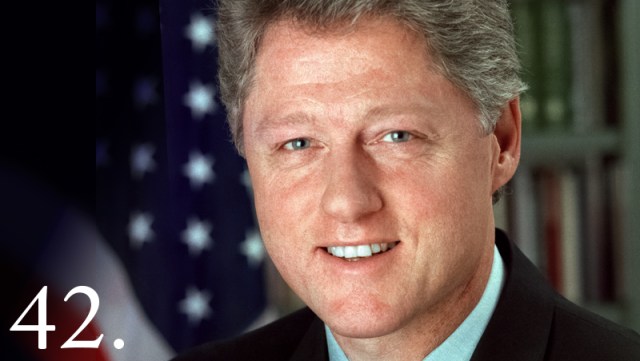
William Jefferson Clinton was the US President from January 20, 1993 to January 20, 2001. Presidents’ Day 2020. The Legacy of US National Debt.
1995-1999
Outstanding debt in 1995: $4.97 trillion
Debt adjusted for inflation: $8.39 trillion
Outstanding debt in 1999: $5.66 trillion
Debt adjusted for inflation: $8.72 trillion
Change in debt between 1995-1999: 13.72% Change in debt adjusted for inflation: $337.54 billion
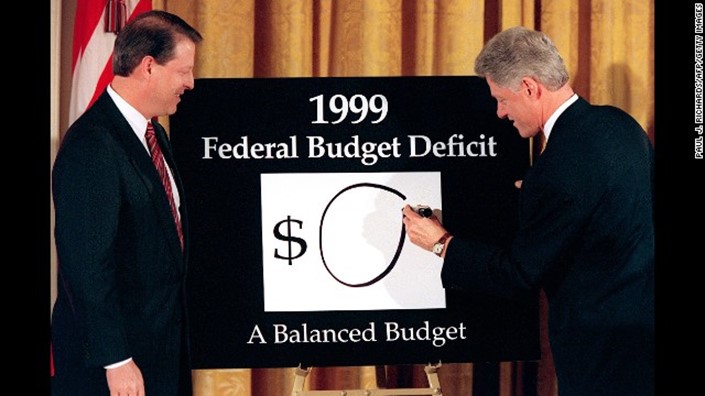
42nd US President ( Presidential term from January 1993 to January 2001. Bill Clinton did not Balance the US Budget. Presidents’ Day 2020. The Legacy of US National Debt.–
2000-2004
Outstanding debt in 2000: $5.67 trillion
Debt adjusted for inflation: $8.47 trillion
Outstanding debt in 2004: $7.38 trillion
Debt adjusted for inflation: $10.04 trillion
Change in debt between 2000-2004: 30.05% Change in debt adjusted for inflation: $1.57 trillion
Barack Obama, who was inaugurated as the 44th U.S. president in 2009. Presidents’ Day 2020. The Legacy of US National Debt.
2005-2009
Outstanding debt in 2005: $7.93 trillion
Debt adjusted for inflation: $10.44 trillion
Outstanding debt in 2009: $11.91 trillion
Debt adjusted for inflation: $14.27 trillion
Change in debt between 2005-2009: 50.14% Change in debt adjusted for inflation: $3.83 trillion
Occupy Wall Street protests in 2011. Presidents’ Day 2020. The Legacy of US National Debt.
2010-2014
Outstanding debt in 2010: $13.56 trillion
Debt adjusted for inflation: $15.98 trillion
Outstanding debt in 2014: $17.82 trillion
Debt adjusted for inflation: $19.35 trillion
Change in debt between 2010-2014: 31.43% Change in debt adjusted for inflation: $3.37 trillion
Current US Treasury Building. Presidents’ Day 2020. The Legacy of US National Debt.
2015-2019
Outstanding debt in 2015: $18.15 trillion
Debt adjusted for inflation: $19.68 trillion
Outstanding debt in 2019: $22.72 trillion
Debt adjusted for inflation: $22.84 trillion
Change in debt between 2015-2019: 25.17% Change in debt adjusted for inflation: $3.16 trillion
Presidents’ Day 2020. The Legacy of US National Debt.
Whole Dude – Whole Gimmicks: In fact, the national debt went from $4.4 Trillion at the end of 1993 to almost $5.7 Trillion at the end of 2000, U.S. Treasury data shows, a 28 percent increase in the debt over this time when our nation supposedly was running a balanced budget.
1997 Balanced Budget and Taxpayer Relief Act
SUMMARY:
The Balanced Budget Act of 1997 (a spending bill) and the Taxpayer Relief Act of 1997 (a tax bill) legislated the elimination of the annual budget deficit by 2002. Both bills were passed by Congress by large bipartisan majorities and signed into law by President Clinton prior to the August 1997 congressional recess.
DESCRIPTION:
Following difficult and highly partisan budget negotiations in 1993 (for the FY 1994 budget) and 1995 (for the FY 1996 budget), the negotiations in 1997 for the FY 1998 were marked largely by bipartisanship, even as the legislators and the President sought to produce the first balanced federal budget since 1969.
The Clinton Curse. A Balanced Budget vs Foreign Debt. Slaying the Dragon of Debt.
In my analysis, President Clinton did not create a Balanced Budget in 1997 for the first time since 1969. In fact, President Clinton violated the preachings of the Bible about Fiscal Policy. This Nation failed to receive the Blessings promised by LORD God. President Clinton foolishly chose to disobey God’s Commandments and invited the Curses promised by LORD God.
The Clinton Curse: Slaying the Dragon of Debt.The Clinton Curse: Slaying the Dragon of Debt.
President Bill Clinton invoked the Curses promised by the LORD God for acts of disobedience of God in the formulation of the Fiscal Policy of the Nation.
The Clinton Curse: Slaying of the Dragon of Debt.
The United States has nothing to fall back in its fight to Slay the Dragon of Debt. The United States needs the promise of Prosperity to Slay the Dragon of Debt. I ask the US Congress to Repeal PRWORA, the Slavery Act of 1996 to correct the transgressions of President Bill Clinton’s Fiscal Policy.
December 06. The Death of the 13th Amendment to the US Constitution. President Bill Clinton’s “A New Beginning” imposed the Death Sentence on the rights granted by the 13th Amendment.
U.S. deficit to eclipse $1 trillion in 2020, CBO says, as fiscal imbalance continues to widen
The Clinton Curse: Slaying of the Dragon of Debt. The U.S. Capitol seen through window reflections Jan. 27, 2020. (Patrick Semansky/AP)
By Jeff Stein
Jan. 28, 2020 at 3:23 p.m. EST
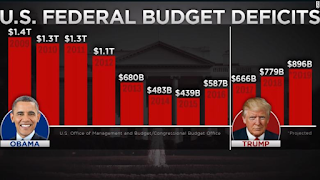
The U.S. government’s budget deficit is projected to reach $1.02 trillion in 2020, according to a report released Tuesday by the nonpartisan Congressional Budget Office, as the federal government continues to spend much more than it collects in tax revenue.
A combination of the 2017 tax cuts and a surge in new spending has pushed the deficit wider. This year would mark the first time since 2012 that the deficit breached $1 trillion, a threshold that has alarmed some budget experts because deficits typically contract — not expand — during periods of sustained economic growth.
Overall, the CBO projected that the federal government will spend $4.6 trillion in the fiscal year that ends Sept. 30 and bring in $3.6 trillion in tax revenue.
And some of the costliest government programs are projected to experience expansions in the next decade. Spending for Medicare, which provides health care for older Americans, will rise from $835 billion in 2020 to $1.7 trillion by 2030, while annual federal spending on Social Security will grow from roughly $1.1 trillion to $1.9 trillion over that span.
The CBO’s estimates assume that Congress will allow tax cuts for individuals passed in Republicans’ 2017 tax law to expire in 2025. GOP lawmakers in Congress will at least try to extend most if not all of these provisions.
This year’s deficit would be an increase from 2019, when the government deficit grew to $984 billion. The deficit in 2016, President Barack Obama’s last full year in office, was $585 billion. CBO now projects that the deficit will be at least $1 trillion each year in perpetuity unless policymakers make changes.
The CBO also projected the economy would grow by 2.2 percent in 2020, which represents a healthy clip but falls short of the 3 percent target set by the Trump administration. The projections were contained in the CBO’s annual budget and economic outlook.
With rising annual deficits, the total debt held by the government is also projected to grow dramatically, from about $18 trillion in 2020 to $31 trillion in 2030, according to the CBO’s projections. The U.S. government must pay interest on this debt to keep borrowing money.
“The U.S. economy is doing well, with low unemployment and rising wages that have drawn people off the sidelines and back into the labor force,” Phillip L. Swagel, the CBO’s director, said in a statement. “But our projections also suggest that over the long-term, changes in fiscal policy must be made to address the budget situation.”
The deficit outlook appears slightly worse than it did just a year ago. In 2019, bipartisan majorities in Congress approved new spending bills that added more than $500 billion to the deficit over the next decade. The most expensive new policies were the permanent repeal of taxes created under Obama’s Affordable Care Act, including one on expensive health plans.
These actions would have done more to drive up the deficit had they not been mitigated by lower-than-expected interest rates, which allow the government to borrow money more cheaply than the CBO had originally anticipated.
The CBO projection also appears to cast doubt on recent statements by President Trump and other administration officials that the 2017 Republican tax cut is creating enough revenue through new economic growth that it will offset all near-term losses. White House officials have defended the $1.5 trillion tax legislation, which slashed tax rates for businesses and many households.
Tax revenue has risen slowly since the tax cuts were passed, but many forecasters say the cuts led to a sizable drop-off in projected revenue collections. Combined with an increase in spending, the deficit has ballooned, forcing the Treasury Department to borrow more money to cover the balance.
Trump, asked about the rising deficit following the tax cuts, told CNBC last year: “We’ve taken in more revenue substantially than we did when the taxes were high. Nobody can even believe it.”AD
Treasury Secretary Steven Mnuchin also expressed confidence the tax cut would not add to the nation’s debt, saying: “We’ve tracked the numbers, and we’re right on track.”
Trump has told aides he will look for big spending cuts in his second term, a position echoed by Mnuchin, who said government spending must be slowed down. Trump aides have also previewed a potential second round of tax cuts.
The CBO report shows that tax collections are weaker than they would be without the 2017 Republican tax law, which permanently locked in lower rates for many corporations while creating temporary reductions for households. Tax revenue remained roughly flat the first year the law was in effect, despite economic growth of nearly 3 percent. It rose slightly in 2019 but not enough to compensate for flatlining the year before.AD
Asked about Mnuchin’s remarks on Tuesday, Swagel pointed to CBO’s April 2018 analysis finding the GOP tax law would increase the deficit by $1.9 trillion over 10 years. That number accounts for the impact of faster economic growth due to the tax law. Swagel served as a Treasury official in George W. Bush’s administration and worked at the American Enterprise Institute, a conservative think-tank.
In January 2017, before the tax law, the CBO projected corporate tax revenue would represent 1.8 percent of gross domestic product. Now, they are expected to represent only 1.1 percent of GDP.
Many Republicans in recent years have abandoned the calls to slash spending in part because Trump has supported big increases in the budget. During the Obama administration, many Republicans insisted on spending cuts as a way to shrink the deficit. About half of the current deficit can be attributed to spending increases and tax cuts put in place by Congress since 2015, according to the nonpartisan Committee for a Responsible Federal Budget.AD
“This is an important warning light,” Marc Goldwein, a budget expert with the group, said of the CBO’s report. “We know deficits as a share of GDP have never been this high when the economy is this strong.”
Other economic experts played down the danger posed by the rising deficit. They noted the country is still extremely unlikely to default because of the supremacy of the U.S. dollar among international creditors, and that inflation — one of the potential hazards of high deficits — remains low by historical standards.
“There is simply no threat of inflation on the horizon,” said Robert C. Hockett, a professor at Cornell University who has advised Sens. Bernie Sanders (I-Vt.) and Elizabeth Warren (D-Mass.) on economic policy matters.
Still, Hockett castigated the Trump administration for not putting the higher deficits to better use. Republicans have said the tax cuts have juiced economic growth and boosted wages for U.S. workers, while Democrats have characterized them as a giveaway to the rich.
“Trump is wasting these deficits. It’s fine to engage in deficit spending, but Trump has used them to give tax cuts to billionaires, which does nothing to increase the well-being of the vast majority of Americans or improve the nation’s productivity,” Hockett said.
Jeff Stein is a policy reporter for The Washington Post. He was a crime reporter for the Syracuse Post-Standard and, in 2014, founded the local news nonprofit the Ithaca Voice in Upstate New York. He was also a reporter for VoxTHE CLINTON CURSE: SLAYING THE DRAGON OF DEBT.











 Whole Dude - Whole Concept